 NBCNGMI™
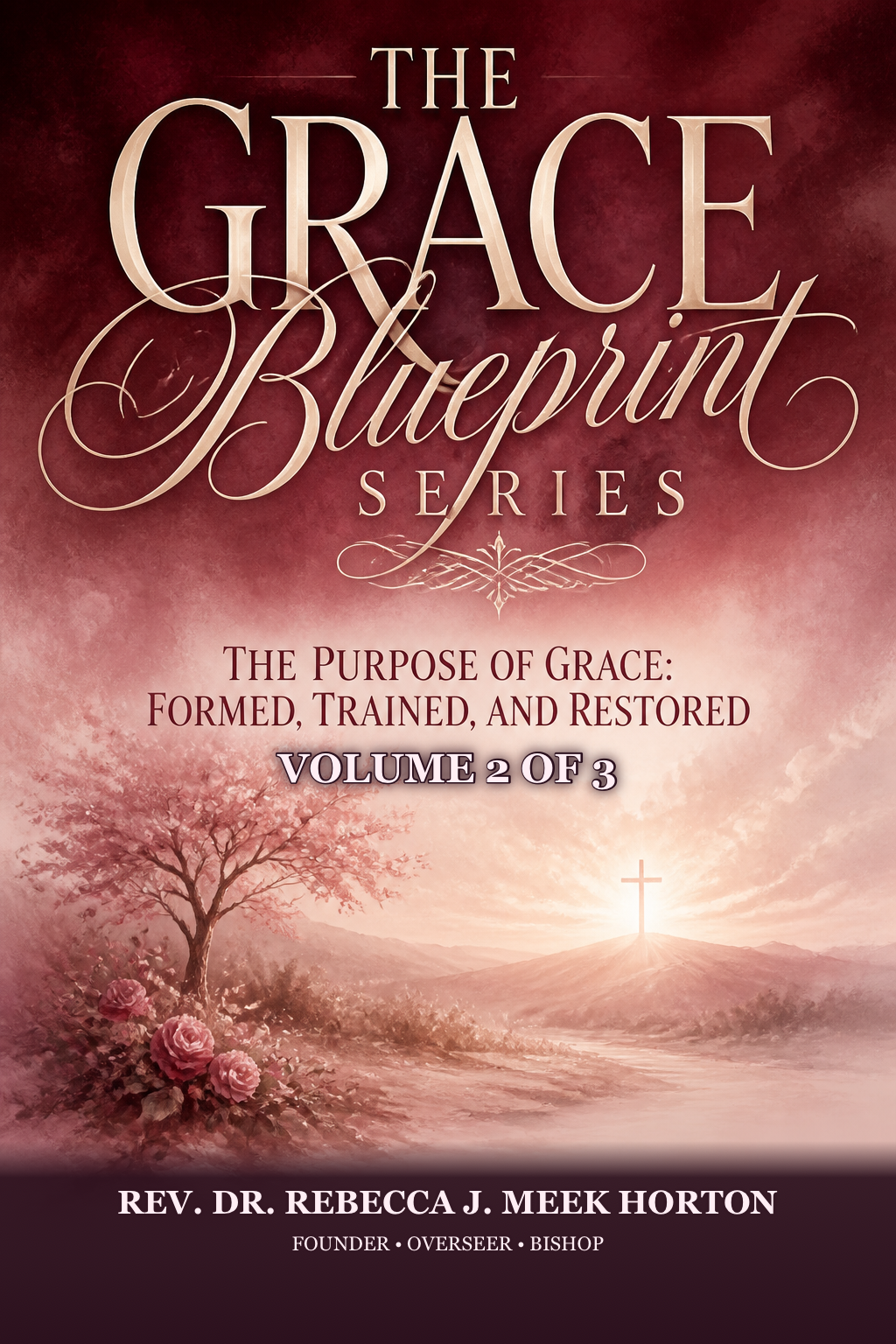
The Grace Blueprint Series · Volume 2
The Purpose of Grace: Formed, Trained, and Restored
Part 2 of 3 in the series "The Grace Blueprint Series". Series theme: Series arc: This series follows the holy movement of God’s grace from foundation to formation to faithful sending. Book One helps readers receive the presence of grace in God, revealed in Jesus Christ, and rest in salvation and identity. Book Two shows how grace forms the heart through holiness, waiting, weakness, endurance, an
Full publication
NBCNGMI MASTER KNOWLEDGE LIBRARY Featuring the works of The Sage, Apostle Prophet. Rev. Dr. Rebecca J. Meek Horton, Apostolic Prophetic Architect, NewBeing Creation Network Global Ministries, Inc. Integrated Framework Modalities™
Dedication
To every believer who has wondered if GOD’s Grace is still enough for the weight of the Call: I dedicate this book to you. May you be formed, trained, and restored by the same Grace that saved you, and may you find courage to keep the next faithful step.
Purpose
I wrote this book for every believer who has received GOD’s Grace, yet still wonders how that Grace is able to form, train, steady, and restore the heart.
My prayer is that these pages help you see Grace not only as what saves you, but as GOD’s faithful work within you in holiness, waiting, weakness, endurance, confession, and restoration.
May this book strengthen you to trust the sufficiency of GOD’s Grace, take the next faithful step, and keep walking in obedience before Him. 2 Corinthians 12:9 (KJV)
Preface
I wrote this book for the believer who loves GOD, yet feels tired in the middle of becoming.
There is a grace we receive when we come to Christ. There is also a grace that keeps working in us after we have said yes. That grace does not leave us where it found us. It forms us. It trains us. It corrects what is crooked, strengthens what is weak, and restores what has fallen under pressure.
This second book in The Grace Blueprint Series was born from that holy middle place. Book One helped us rest in the presence of grace revealed in Jesus Christ. This book asks what happens next. What does grace do when the heart is still being shaped? What does grace mean when obedience is costly, waiting is long, weakness is honest, and restoration requires truth?
Many believers wonder if they are failing because the process is harder than they expected. They feel the weight of the Call, but also the limits of their strength. I understand that tension. Grace is not permission to quit growing. Grace is GOD’s sufficiency for the growth He requires.
The Lord said, “My grace is sufficient for thee: for my strength is made perfect in weakness” 2 Corinthians 12:9 (KJV). That word has carried many of us through seasons where we could not carry ourselves.
This book is not written to shame the weary. It is written to steady them. It is not written to excuse sin. It is written to help the heart return to GOD with confession, truth, and hope. It is not written to rush your process. It is written to help you recognize the faithful work of GOD within it.
Grace teaches. “For the grace of God that bringeth salvation hath appeared to all men, Teaching us…” Titus 2:11–12 (KJV). That means grace has purpose beyond rescue. Grace trains the life that has been saved.
As you read, I invite you to come honestly. Bring your weakness, your waiting, your weariness, your questions, and your desire to obey. Do not despise the place of formation. Nothing is random. Nothing is wasted.
Begin with this simple prayer: Lord, form in me what Your grace has already begun.
Introduction
Grace is often received with tears and then misunderstood in the middle of the road.
Many believers know how to say, “I am saved by grace,” but struggle to understand what grace is doing when life becomes slow, painful, correcting, or hidden. We rejoice when grace forgives us. We may feel confused when grace trains us. We thank GOD when grace lifts guilt, but we may resist when grace confronts habits, purifies motives, teaches patience, exposes weakness, and calls us back after failure.
This book is written for that place.
The Purpose of Grace: Formed, Trained, and Restored is the second book in The Grace Blueprint Series. Book One helped establish grace as the gift and presence of GOD revealed in Jesus Christ, grounding the believer in salvation, sonship, and identity. This book asks the next question: What does grace do after it has received us?
The answer is simple, but not shallow.
Grace forms us.
Grace is not only GOD’s mercy toward the guilty. Grace is also GOD’s power at work in the yielded. It does not merely cover the old life; it teaches us how to walk in the new one. Scripture says, “For the grace of God that bringeth salvation hath appeared to all men, Teaching us that, denying ungodliness and worldly lusts, we should live soberly, righteously, and godly, in this present world;” Titus 2:11–12 (KJV).
Grace teaches.
That means grace has a purpose beyond relief. It trains the heart toward holiness. It steadies the soul in waiting. It meets weakness with sufficiency. It gives endurance when the road is longer than expected. It restores the fallen through confession, truth, and mercy. Grace does not flatter us. Grace fathers us.
If you are struggling to fulfill your call, this book is for you. If you feel tired from trying to obey, this book is for you. If you have wondered whether your weakness has disqualified you, this book is for you. If you have fallen and are afraid restoration is no longer possible, this book is for you.
But this book will not tell you that formation is easy.
There is a cost to being trained by grace. Holiness will ask you to release what once comforted you. Waiting will ask you to trust GOD without controlling the timing. Weakness will ask you to stop pretending. Endurance will ask you to keep walking when feelings are quiet. Restoration will ask you to tell the truth without hiding behind shame.
Yet none of this is punishment. This is purposeful grace.
When Paul pleaded for his thorn to depart, the Lord answered him, “My grace is sufficient for thee: for my strength is made perfect in weakness” 2 Corinthians 12:9 (KJV). Grace did not remove every pressure from Paul’s life, but it gave him what was needed to remain faithful inside the pressure. That is part of the mystery and mercy of grace. It does not always change the road first. Sometimes it changes the walker.
Read this book slowly. Do not rush to finish chapters. Let the Scriptures search you. Let the practices become honest places of prayer, repentance, discernment, and obedience. You do not need to perform your way through these pages. You are invited to walk through them with GOD.
Each chapter will carry one clear movement of formation. You will be asked to see what grace is training in you, name where resistance is present, and take one next faithful step. That step may be confession. It may be rest. It may be forgiveness. It may be returning to a holy habit. It may be waiting without resentment. It may be asking for help.
Small obedient steps matter.
Nothing is random. Nothing is wasted.
The grace that saved you is not finished with you. The God of all grace is still forming, training, strengthening, and restoring His people. As Peter wrote, “But the God of all grace, who hath called us unto his eternal glory by Christ Jesus, after that ye have suffered a while, make you perfect, stablish, strengthen, settle you” 1 Peter 5:10 (KJV).
That is the promise held before us.
Grace does not leave you where it found you.
Grace forms you for faithful obedience.
Chapter 1 — When Grace Meets the Unfinished Heart
You can be saved and still feel unfinished.
You can love GOD and still notice impatience rising in your chest. You can carry a real Call and still feel afraid to answer it. You can pray, serve, worship, give, and still wonder why some parts of your heart seem slow to change.
Many believers carry this quiet ache. They do not doubt that GOD has saved them. They doubt whether they are becoming who they are supposed to be. They hear sermons about purpose, destiny, gifts, and assignment, but inside they feel scattered. Their lives are not empty of grace, but they are not yet steady in grace.
This chapter begins there.
Grace is not only GOD’s pardon for the guilty; grace is GOD’s purposeful work in the unfinished heart. It saves us, yes. But it also begins forming us for the life GOD prepared.
Paul wrote, “For by grace are ye saved through faith; and that not of yourselves: it is the gift of GOD: Not of works, lest any man should boast. For we are his workmanship, created in Christ Jesus unto good works, which GOD hath before ordained that we should walk in them” Ephesians 2:8-10 (KJV).
That word workmanship gives hope to the weary soul. You are not a discarded project. You are not a failed believer because you still need forming. You are GOD’s workmanship.
There is comfort here, but there is also direction. Grace does not only tell you that you are forgiven. Grace tells you that you are being made. You are not trying to invent a new self by pressure, comparison, or fear. You are being formed in Christ by the GOD who saves, keeps, corrects, strengthens, and sends.
The ache of the unfinished heart
A young woman sits in her car after church. She has just served on the ministry team. She smiled, greeted people, helped where she was needed, and prayed for a friend who was struggling.
But now the car is quiet, and tears come.
She is not crying because she hates GOD. She is crying because she loves Him and feels tired. She wonders why obedience still feels so uneven. One week she is full of faith. The next week she is anxious, reactive, and uncertain. She knows she is called, but she does not feel stable enough to carry what she senses.
That ache is more common than many admit.
Some believers hide it behind busyness. Some hide it behind spiritual language. Some hide it behind silence. They say, “I’m fine,” while inwardly asking, “What is wrong with me?”
But the question needs RE-Language™. Instead of asking, “What is wrong with me?” a wiser question is, “What is GOD still forming in me?”
That change does not excuse sin or immaturity. It simply removes shame from the place where responsibility must begin.
Shame often makes the heart collapse inward. It turns conviction into condemnation. It takes a real area of needed growth and uses it as evidence that we are unwanted, unusable, or beyond help. But the Holy Ghost does not need shame to produce holiness. GOD can tell the truth without crushing His children.
The unfinished heart is not an unloved heart.
Peter was unfinished when Jesus called him. He was bold, sincere, and unstable. He spoke quickly. He promised loyalty. He misunderstood suffering. He denied the Lord. Yet Jesus did not treat Peter’s weakness as the end of his story.
Before Peter denied Him, Jesus said, “Simon, Simon, behold, Satan hath desired to have you, that he may sift you as wheat: But I have prayed for thee, that thy faith fail not: and when thou art converted, strengthen thy brethren” Luke 22:31-32 (KJV).
Jesus saw the fall before Peter felt the shame of it. He saw the weakness before Peter admitted it. Yet He also saw the strengthening that would come after restoration. That is grace with holy purpose.
Grace met Peter before he was steady. Grace also restored and strengthened him for the road ahead.
This matters because many believers confuse being unfinished with being disqualified. They see the gap between their salvation and their maturity, and they assume GOD must be disappointed beyond repair.
But Scripture does not teach that grace saves finished people. Grace saves sinners and begins the holy work of formation.
Paul did not say, “Ye are your own improvement project.” He said, “We are his workmanship” Ephesians 2:10 (KJV).
That means GOD is not only interested in where He is sending you. He is also committed to what He is shaping in you before, during, and through the sending.
Sometimes the ache you feel is not proof that grace is absent. It may be proof that grace is working deeply enough to make you honest. A numb heart does not grieve over distance from GOD. A hardened heart does not care about obedience. If you are troubled by what is unformed in you, do not rush to despair. Bring that trouble into prayer. Let it become an invitation.
David knew the ache of needing inward formation. He prayed, “Create in me a clean heart, O GOD; and renew a right spirit within me” Psalm 51:10 (KJV). That is not a polished prayer. It is an honest prayer. It is the cry of a man who knew he needed more than image management. He needed GOD to work in the heart.
There are seasons when the most spiritual thing you can do is stop pretending. Not to indulge weakness. Not to excuse disobedience. But to stand before GOD truthfully and say, “This place is not yet whole. This place is not yet steady. This place is still afraid. Lord, meet me here.”
Grace begins where striving fails
Striving often sounds responsible at first.
“I just need to try harder.”
“I need to be stronger.”
“I cannot let anyone see me struggle.”
“I should be past this by now.”
There is a kind of effort that belongs to obedience. Scripture does not call us to laziness. The Christian life includes discipline, repentance, submission, endurance, and practice. Paul told Timothy, “Exercise thyself rather unto godliness” 1 Timothy 4:7 (KJV). There is holy effort.
But striving is different.
Striving tries to produce spiritual maturity without resting in GOD’s grace. It carries the burden of becoming as if transformation depends on human pressure alone. It is effort separated from dependence. It is labor without abiding. It is obedience attempted from fear instead of love.
That burden becomes heavy.
A man may be called to preach, teach, lead, build, intercede, or serve. He may sense GOD pulling him toward greater obedience. But instead of receiving grace for formation, he tries to perform readiness. He learns the right words. He copies the habits of strong people. He pushes through exhaustion. He mistakes motion for maturity.
For a season, it may look fruitful.
Then pressure reveals what is unformed.
He becomes impatient with people. He avoids correction. He feels threatened by delay. He resents hidden service. He loses tenderness. He keeps moving, but his heart is not being governed by grace.
Nothing is random. Nothing is wasted. Even that exposure can become mercy if he will let grace tell the truth.
Grace does not flatter us. Grace does not pretend we are mature where we are not. But grace also does not shame us into hiding. Grace brings us into the light so GOD can form what performance cannot fix.
This is where many believers become tired. They are not tired only from work. They are tired from trying to carry a spiritual life in their own strength. They are tired from managing appearances. They are tired from measuring themselves against someone else’s season. They are tired from turning every weakness into a private courtroom.
Jesus gives a better invitation. He said, “Come unto me, all ye that labour and are heavy laden, and I will give you rest” Matthew 11:28 (KJV). He did not invite only those who had already mastered rest. He called the weary. He called the burdened. He called those carrying weight they were never meant to carry apart from Him.
Ephesians 2 is clear. “Not of works, lest any man should boast” Ephesians 2:9 (KJV). Salvation is not earned. Neither is formation fueled by boasting. The life that begins by grace must continue by grace.
This does not make us passive. It makes us dependent in the right way.
Dependence is not helplessness. It is stewardship. It is the honest confession that apart from Christ we cannot produce the life of Christ. It is the daily returning of the heart to GOD, saying, “Form in me what I cannot manufacture.”
Jesus said, “Abide in me, and I in you. As the branch cannot bear fruit of itself, except it abide in the vine; no more can ye, except ye abide in me” John 15:4 (KJV). The branch is not useless because it needs the vine. The branch is living according to its design when it receives life from the vine.
So it is with us.
We do not overcome striving by refusing obedience. We overcome striving by returning obedience to its proper root. We obey because we belong to Christ. We repent because grace has opened the door of truth. We practice holiness because the life of GOD is forming us from the inside. We serve because we have received mercy, not because we are trying to purchase it.
When striving fails, grace does not say, “Do nothing.” Grace says, “Come back to the source. Let your obedience flow from Me.”
The Call will reveal what grace must form
A Call from GOD is not only an assignment to do something. It is also a place where the heart is revealed.
The Call exposes motives.
It exposes impatience.
It exposes fear of people.
It exposes the desire to be affirmed.
It exposes the temptation to compare.
It exposes the pain we hoped would stay hidden.
This exposure is not always pleasant, but it is often gracious.
Imagine a clay vessel being shaped on a wheel. The potter’s hands press, steady, lift, and narrow the clay. To the clay, if clay could feel, the pressure might seem like rejection. But the pressure is part of formation. Without it, the vessel cannot hold what it was meant to carry.
GOD’s grace works with holy purpose.
The Lord told Jeremiah, “Arise, and go down to the potter’s house, and there I will cause thee to hear my words” Jeremiah 18:2 (KJV). Jeremiah watched the potter work with the clay. The vessel was marred in the hand of the potter, but the potter did not throw the clay away. Scripture says, “so he made it again another vessel, as seemed good to the potter to make it” Jeremiah 18:4 (KJV).
There is a holy kindness in that image. The clay was still in the potter’s hand. The marring was real, but it was not final. The forming continued.
When you step toward obedience and find weakness in yourself, do not immediately assume you have missed GOD. Sometimes obedience simply brings unformed places to the surface.
A person called to serve others may discover selfishness.
A person called to lead may discover insecurity.
A person called to teach may discover pride.
A person called to prayer may discover distraction.
A person called to reconciliation may discover bitterness.
A person called to generosity may discover fear.
A person called to speak truth may discover the desire to be liked.
A person called to carry responsibility may discover resentment toward hidden preparation.
These discoveries can feel discouraging. But they can also become doorways to maturity if we respond with humility.
This is where RE-Calibration™ begins. We stop pretending. We stop condemning ourselves. We stop blaming everyone around us. We bring the revealed place to GOD and ask for truth, cleansing, and instruction.
David prayed, “Search me, O GOD, and know my heart: try me, and know my thoughts: And see if there be any wicked way in me, and lead me in the way everlasting” Psalm 139:23-24 (KJV).
That is not the prayer of a person trying to hide. It is the prayer of someone who trusts GOD enough to be examined.
The Call does not require a perfect heart before you begin. But it does require a yielded heart as you walk.
This is the difference between shame and stewardship.
Shame says, “Because I am unfinished, I should hide.”
Stewardship says, “Because I am unfinished, I will bring my heart to GOD and obey the next faithful step.”
The difference matters.
If shame leads, we will either retreat from the Call or perform inside it. We will hide from correction, avoid accountability, and call isolation “discernment.” Or we will push harder, speak louder, and try to prove that we are ready while our souls are becoming brittle.
But if stewardship leads, we can tell the truth without giving up. We can say, “This motive needs cleansing.” “This fear needs surrender.” “This habit needs correction.” “This wound needs healing.” “This delay needs patience.” We can take responsibility without taking on condemnation.
GOD is not careless with what He reveals. He does not expose the heart for entertainment. He reveals to redeem. He uncovers to cleanse. He corrects to establish.
Hebrews says, “For whom the Lord loveth he chasteneth, and scourgeth every son whom he receiveth” Hebrews 12:6 (KJV). Correction is not always rejection. In the hand of GOD, correction is often proof of sonship and love.
So when the Call reveals what is unformed, pause before panic. Ask what grace is showing you. Ask what obedience is required now. Ask what counsel, confession, discipline, rest, or surrender may be needed.
Do not Force-The-FiT™. Do not force yourself into an image of readiness that grace has not formed. Let GOD build weight in you before increase comes through you.
Saved by grace, made for walking
Paul says we are saved by grace, and then he says we are “created in Christ Jesus unto good works” Ephesians 2:10 (KJV).
Grace does not end with rescue. Grace gives direction.
The good works do not save us. They are not payment for mercy. They are the prepared pathway of a life that belongs to GOD. Paul says GOD “hath before ordained that we should walk in them” Ephesians 2:10 (KJV).
Walk is a humble word.
It is not flashy. It is not frantic. It is not a performance on a stage. Walking means one step, then another. It means pace. It means direction. It means continuing when the feeling is not dramatic.
Many believers struggle because they look for grace only in big moments. They want grace for the altar, grace for the breakthrough, grace for the open door, grace for the public assignment. But forming grace often meets us in ordinary obedience.
Grace helps you apologize.
Grace helps you tell the truth.
Grace helps you open Scripture when your mind feels crowded.
Grace helps you stay quiet when your flesh wants the last word.
Grace helps you rest instead of proving your worth.
Grace helps you serve in hidden places without becoming bitter.
Grace helps you begin again after failure.
Grace helps you receive correction without collapsing.
Grace helps you forgive when your heart would rather keep rehearsing the wound.
Grace helps you say no to what weakens your obedience.
Grace helps you say yes to what strengthens your walk with GOD.
This is Walking in Obedience™. Not perfection. Not passivity. Not striving. A faithful walk with GOD, one surrendered step at a time.
A mother caring for children in a hard season may feel she is not doing anything “great” for GOD. But grace may be forming patience, tenderness, endurance, and prayer in the unseen room of daily life.
A young minister waiting for an open door may feel delayed. But grace may be forming humility, discipline, and integrity before influence increases.
A believer recovering from a fall may feel ashamed to come close again. But grace may be teaching honest confession and a deeper hatred for hiding.
An older saint who feels overlooked may be learning the quiet holiness of faithfulness without applause.
A worker in a difficult job may be learning how to carry Christlike character under pressure.
A leader who has been slowed down may be learning that timing is as important as motive.
The walk matters.
GOD is not only measuring visible outcomes. He is forming inward substance.
Micah gives us a simple picture of faithful walking: “He hath shewed thee, O man, what is good; and what doth the LORD require of thee, but to do justly, and to love mercy, and to walk humbly with thy GOD?” Micah 6:8 (KJV).
Walk humbly.
Not impress humbly. Not announce humbly. Walk humbly.
There is a grace for the next step that we often miss because we are anxious about the whole journey. We want the full map. GOD often gives enough light for obedience now. Psalm 119:105 says, “Thy word is a lamp unto my feet, and a light unto my path” (KJV). A lamp does not show every mile ahead. It gives light for the step in front of you.
This is mercy. If GOD showed us every pressure, delay, correction, and assignment at once, we might faint under the weight of what we do not yet have grace to carry. So He walks us. He forms us in movement. He teaches us to obey today.
The unfinished heart wants to know, “When will I be fully ready?”
Grace often answers, “Walk with Me.”
The cost of letting grace form you
There is a cost to receiving forming grace.
It will cost you the comfort of pretending you are fine.
It will cost you the pride of self-made strength.
It will cost you the habit of blaming your instability on every circumstance.
It will cost you the secret agreement with shame that says hiding is safer than truth.
It will cost you the right to keep calling delay rejection.
It will cost you the habit of comparing your formation to someone else’s fruit.
It will cost you the need to be seen before you are strengthened.
Grace is free, but formation is not shallow.
When grace meets the unfinished heart, it does not merely soothe the ache. It begins to govern the movement of the heart. It brings order where there has been confusion. It brings weight where there has been immaturity. It brings operation where obedience has been inconsistent. It brings wisdom where timing and desire have been tangled.
This is not instant. It is holy work.
Some days you will feel progress. Other days you will feel exposed. Some prayers will be full of faith. Other prayers will sound like, “Lord, help me.”
That prayer is enough to begin.
The danger is not that you are unfinished. The danger is refusing to be formed.
A believer can turn weakness into hiding. A believer can turn delay into bitterness. A believer can turn calling into performance. A believer can turn grace into a word they admire but do not actually receive for the places that need change.
There is a sober tenderness in this. GOD will not force us into maturity while we protect our excuses. He invites. He convicts. He corrects. He draws. He gives grace. But we must come into the light.
John wrote, “But if we walk in the light, as he is in the light, we have fellowship one with another, and the blood of Jesus Christ his Son cleanseth us from all sin” 1 John 1:7 (KJV).
Walking in the light does not mean pretending there is no darkness to confess. It means we stop making peace with hiding. We let truth have access to us. We let grace cleanse what shame tried to cover.
So the invitation is simple and serious.
Let grace meet the real you.
Not the polished version. Not the ministry version. Not the version that knows what to say. Bring GOD the unfinished heart. Bring Him the fear, the fatigue, the inconsistency, the grief, the desire to obey, and the places where you do not yet know how.
He is not surprised by what He already sees.
And He is not finished with what He has begun.
You may feel unfinished, but you are not abandoned.
You may feel weak, but you are not without grace.
You may feel slow in formation, but GOD is not careless with His workmanship.
The same grace that saved you is able to shape you. The same Christ who received you is able to mature you. The same GOD who began the work knows how to continue it with truth, patience, mercy, and power.
Let this be the first settled place in this book: your unfinished heart is not beyond the reach of grace. It is the very place where forming grace begins its holy work.
Key Takeaways
• Grace is not only GOD’s pardon; it is His purposeful work in the heart.
• Being unfinished does not mean being disqualified.
• The Call reveals what grace is ready to form.
Practice
Take ten quiet minutes today with Ephesians 2:8-10 (KJV).
Read it slowly. Then write one honest sentence in response to this prompt:
“Lord, the unfinished place I need to bring to Your grace is…”
Do not explain it away. Do not condemn yourself for it. Name it truthfully before GOD, and ask Him for the next faithful step.
Chapter 2 — The Promise of Forming Grace
A woman sat in her car after church with both hands on the steering wheel, staring through the windshield at nothing in particular.
The sermon had been about grace. The altar call had been tender. The worship had lifted her heart. But as the parking lot emptied, one thought kept pressing on her chest.
“I know GOD saved me. But why am I still like this?”
She was not talking about rebellion. She was talking about the unfinished places. The quick temper. The fear that returned at night. The old patterns that still knew her name. The deep sense that she was called, but not steady enough to carry the Call well.
Many believers know that ache.
We believe grace received us. But we wonder if grace will also mature us.
The promise of this chapter is simple: the grace that received us in Christ is sufficient to mature us in Christ. Formation is not self-repair. It is not religious striving. It is GOD’s faithful work in the heart of the believer.
Paul wrote, “Being confident of this very thing, that he which hath begun a good work in you will perform it until the day of Jesus Christ:” Philippians 1:6 KJV.
That sentence is not permission to be passive. It is permission to stop panicking.
GOD does not begin His work in you and then abandon you to finish it alone.
The Work GOD Began
Grace is not a visitor that meets us at salvation and then leaves us at the door of maturity.
Grace begins, continues, corrects, strengthens, and completes. It is the holy kindness of GOD that not only forgives sin, but forms sons and daughters.
When Paul wrote to the Philippians, he did not place confidence in their personality, discipline, intelligence, or religious performance. He said, “he which hath begun a good work in you will perform it.” Philippians 1:6 KJV.
The confidence was in GOD.
This matters because many Christians secretly carry a different gospel in their emotions than the one they confess with their mouths. With their mouth they say, “I am saved by grace.” But in their heart they feel, “Now I must become worthy by pressure.”
That pressure does not form peace. It forms performance.
Performance asks, “How do I prove I belong?”
Grace says, “You belong in Christ; now be formed by Him.”
Performance hides weakness.
Grace brings weakness into the light.
Performance fears process.
Grace understands that process is part of formation.
There is a difference between conviction and condemnation. Conviction calls us back to GOD. Condemnation pushes us into hiding. Conviction tells the truth with hope attached. Condemnation tells part of the truth and leaves us with despair.
The Spirit of GOD does not flatter us. He searches us. He exposes what needs to be healed, corrected, surrendered, or strengthened. But He does not expose us in order to destroy us. He exposes us in order to form us.
David prayed, “Search me, O God, and know my heart: try me, and know my thoughts:” Psalm 139:23 KJV.
Then he prayed, “And see if there be any wicked way in me, and lead me in the way everlasting.” Psalm 139:24 KJV.
That is the posture of forming grace.
Search me.
Know me.
Try me.
Lead me.
Not, “Leave me alone because I am ashamed.”
Not, “Condemn me because I am unfinished.”
Not, “Use me while I remain unsearched.”
But, “Lead me in the way everlasting.”
Think of a child learning to walk. A good father does not despise the child because the steps are unsteady. He stays near. He reaches. He corrects. He celebrates growth without pretending the child is already mature.
The child is not loved because the walk is perfect.
The child learns to walk because love is present.
So it is with forming grace.
GOD is not shocked by the unfinished places in you. He knew them when He called you. He knew the fears, the wounds, the habits, the immaturity, the pride, the insecurity, the old survival patterns. He did not call an imaginary version of you. He called you, and His grace is not confused by the work still needed.
This does not mean GOD approves everything in us. It means He is not overwhelmed by what must be changed. He is not surprised by the weakness you just discovered. He is not intimidated by the history you wish you did not have. He is not limited by the places where you still need teaching.
Nothing is random. Nothing is wasted.
Even the places you are ashamed to name can become places where grace teaches you dependence, honesty, humility, and obedience.
Sometimes the very place you want to hide becomes the place where GOD begins to form steadiness. The fear that makes you cling can become the place where He teaches trust. The impatience that embarrasses you can become the place where He teaches waiting. The wound that makes you defensive can become the place where He teaches truth and tenderness.
This is not quick work. But it is holy work.
And it is GOD’s work.
Formation Is Not Self-Repair
Self-repair begins with the fear that everything depends on you.
It sounds responsible, but it often becomes exhausting. It says, “I must fix myself quickly so GOD can use me.” It treats the soul like a project and maturity like a deadline.
Self-repair can even use spiritual words. It can make a vow at the altar, build a list of disciplines, and speak strongly about change. But underneath it all, the heart is afraid.
Afraid of disappointing GOD.
Afraid of being exposed.
Afraid of losing the Call.
Afraid that one more failure will prove there was never enough grace.
But Scripture gives us a deeper hope.
Paul prayed for the Galatians with these words: “My little children, of whom I travail in birth again until Christ be formed in you,” Galatians 4:19 KJV.
Notice the aim.
Not image management.
Not religious polish.
Not public usefulness.
Christ formed in you.
That is the promise and the pattern of grace.
Formation is not becoming a more impressive version of yourself. It is becoming more yielded to Christ. It is His life shaping your loves, your motives, your thoughts, your reactions, your desires, and your obedience.
This reframes the whole journey.
If formation is self-repair, then every failure feels like final evidence that you are disqualified.
If formation is GOD’s faithful work, then every failure becomes a place for repentance, learning, humility, and return.
That does not make sin small. It makes grace strong.
Grace never calls darkness light. Grace gives us courage to bring darkness into the light. Grace does not rename disobedience as growth. Grace gives us a way to repent without being swallowed by shame.
John wrote, “But if we walk in the light, as he is in the light, we have fellowship one with another.” 1 John 1:7 KJV.
Walking in the light is not walking in perfection. It is walking in honesty before GOD. It is refusing to let hidden things govern the heart. It is letting truth reach the places we would rather protect.
Consider a believer who keeps responding harshly under pressure. Self-repair says, “I am terrible. I will try harder. I will never speak that way again.” For a few days, the person is careful. Then pressure returns, and the same reaction comes out.
Shame follows. The cycle repeats.
Forming grace moves differently.
It asks, “What is being revealed in me? What fear, wound, pride, hurry, or unbelief is speaking before love can answer? What truth must I receive? What obedience must I practice?”
This is RE-Language™ in holy practice. We move from shame to responsibility.
Not, “I am hopeless.”
But, “This pattern needs grace, truth, and obedience.”
Not, “I will never change.”
But, “GOD is forming me, and I must bring this place into the light.”
Not, “I failed, so I am finished.”
But, “I have fallen short, and I must return to the One who is faithful.”
This is not soft. It is honest.
Self-repair often avoids the root while trying to control the symptom. Forming grace goes deeper. It does not only ask you to manage behavior. It invites you to be changed in the inward parts.
A person can control a tone for a while and still carry bitterness. A person can avoid an outward sin and still feed an inward desire. A person can look disciplined in public and remain fearful, angry, or unbelieving in private.
GOD loves us too much to only polish what people can see.
David said, “Behold, thou desirest truth in the inward parts: and in the hidden part thou shalt make me to know wisdom.” Psalm 51:6 KJV.
That is where forming grace works.
In the inward parts.
In the hidden part.
In the place where motives live.
In the place where reactions begin.
In the place where wounds explain too much and obedience must become stronger than old pain.
GOD is not merely decorating the outside of your life. He is forming Christ within.
So when the Spirit reveals something unfinished, do not rush past it. Do not excuse it. Do not turn it into a name for yourself. Sit with GOD long enough to tell the truth.
You are not a project trying to earn love.
You are a child being formed by grace.
Grace Matures Us in Christ
Maturity is not instant. It is also not optional.
The believer who has been received by grace is also called to grow in grace. This growth is not a frantic climb for acceptance. It is the fruit of abiding in the life of Christ.
Peter wrote, “But grow in grace, and in the knowledge of our Lord and Saviour Jesus Christ.” 2 Peter 3:18 KJV.
Grow in grace.
Not grow away from grace.
Not begin with grace and then graduate into pressure.
Not receive grace for pardon and then depend on flesh for maturity.
Grow in grace.
Paul described the transforming work of the Spirit this way: “But we all, with open face beholding as in a glass the glory of the Lord, are changed into the same image from glory to glory, even as by the Spirit of the Lord.” 2 Corinthians 3:18 KJV.
We are changed.
That word matters.
Christian maturity is not pretending to be changed. It is not learning the language of maturity while the heart remains untouched. It is not being gifted but ungoverned, busy but unformed, visible but unstable.
Grace forms the heart so the life can carry weight.
A calling without formation becomes strain.
A gift without formation can injure people.
A platform without formation can expose what prayer would have healed.
This is why GOD often works slowly and deeply. He is not only preparing you for what you will do. He is forming who you are becoming while you do it.
A man may pray for a door to open, while GOD is forming patience.
A woman may ask for influence, while GOD is forming humility.
A leader may ask for increase, while GOD is forming integrity.
An intercessor may ask for greater authority, while GOD is forming purity of motive.
A teacher may ask for a wider room, while GOD is forming faithfulness in the small room.
A servant may ask to be seen, while GOD is forming contentment before Him.
This is not rejection. It is mercy.
Wisdom instructs before expansion is released.
GOD’s forming grace protects us from carrying more than our soul can steward. He knows the difference between enthusiasm and readiness. He knows the difference between a sincere desire and a formed capacity.
Do not Force-The-FiT™.
There are seasons when grace says, “Rest here and be rooted.”
There are seasons when grace says, “Let Me correct this before it multiplies.”
There are seasons when grace says, “You are not being delayed because I have forgotten you. You are being formed because I love you.”
The immature heart often sees formation as punishment.
The maturing heart begins to see formation as care.
Jesus spoke of fruitfulness with the language of abiding. He said, “Abide in me, and I in you.” John 15:4 KJV.
Then He said, “I am the vine, ye are the branches.” John 15:5 KJV.
A branch does not produce fruit by panic. It bears fruit by remaining connected to the vine. The life that produces fruit is not manufactured by the branch. It is received from the vine.
That does not mean the branch does nothing. It abides. It remains. It receives. It yields to pruning. It stays where life flows.
So it is with the believer.
Holy habits matter. Obedience matters. Confession matters. Prayer matters. Scripture matters. Fellowship matters. But none of these are ways we become the source of our own maturity. They are ways we remain available to the life of Christ.
Maturity is not a costume we put on for ministry.
It is the quiet evidence that Christ is shaping us.
A person may speak with power and still need forming. A person may serve with excellence and still need forming. A person may know Scripture and still need forming. A person may be called and still need forming.
There is no shame in needing formation.
The danger is refusing it.
The Faithfulness Beneath the Process
The promise of forming grace rests on the faithfulness of GOD.
That is what steadies us when growth feels slow.
Paul wrote to the Thessalonians, “Faithful is he that calleth you, who also will do it.” 1 Thessalonians 5:24 KJV.
Not, “Faithful are you, if you never struggle.”
Not, “Faithful are you, if you understand every season.”
Not, “Faithful are you, if you mature at the speed you expected.”
“Faithful is he that calleth you.”
This does not remove your responsibility. It restores your confidence.
You still confess sin. You still obey. You still forgive. You still seek counsel when needed. You still practice discipline. You still say no to what damages the soul. You still take the next faithful step.
But beneath all of that is not the terror of being abandoned by GOD.
Beneath all of that is His covenant faithfulness.
Hebrews gives us this blessing: “Now the God of peace, that brought again from the dead our Lord Jesus, that great shepherd of the sheep, through the blood of the everlasting covenant,” Hebrews 13:20 KJV.
Then it continues, “Make you perfect in every good work to do his will, working in you that which is wellpleasing in his sight, through Jesus Christ; to whom be glory for ever and ever. Amen.” Hebrews 13:21 KJV.
GOD works in you what is pleasing to Him.
That is forming grace.
A shepherd does not merely point to the path and disappear. He leads, feeds, corrects, gathers, and restores. Jesus is not only the door into salvation. He is the Shepherd of the whole journey.
This is important when you are tired.
Weariness can make the process feel personal, as if GOD is withholding help from you. Delay can make you question whether you missed Him. Repeated weakness can make you wonder whether you are truly changing.
But the Shepherd is not absent because the road is long.
There may be days when you feel more aware of your immaturity than your growth. There may be seasons when you look at your calling and feel too unfinished to continue. There may be pressure to compare your pace with someone else’s fruit.
Resist that comparison.
GOD does not form every vessel in the same way, at the same pace, for the same assignment. Steward what He is doing in you.
One believer may be formed through hidden service. Another through long waiting. Another through correction. Another through grief. Another through responsibility that reveals the need for deeper dependence. Another through a season of rest that feels unproductive but restores the soul.
The Potter knows the vessel.
Isaiah wrote, “But now, O LORD, thou art our father; we are the clay, and thou our potter; and we all are the work of thy hand.” Isaiah 64:8 KJV.
Clay does not understand every movement of the Potter’s hand. It does not know why pressure is applied here and not there. It does not know why one area must be softened again, reshaped again, steadied again.
But the Potter is not careless.
Nothing is random. Nothing is wasted.
The hidden work matters.
The quiet obedience matters.
The private surrender matters.
The small correction matters.
The honest prayer matters.
The return after drifting matters.
The tears you bring to GOD instead of turning into bitterness matter.
Grace is forming you even when the growth is not dramatic.
Sometimes the evidence of grace is not that you no longer feel weakness. Sometimes the evidence is that you bring the weakness to GOD sooner. Sometimes it is that you apologize faster. Sometimes it is that you pause before answering. Sometimes it is that you no longer call hiding wisdom. Sometimes it is that you can receive correction without collapsing into shame.
Small evidences are still evidences.
Do not despise them.
A seed does not become a tree in one afternoon. Roots grow where no one applauds. Strength gathers before height appears. Much of what holds the tree steady is never seen by those who enjoy its shade.
So it is with forming grace.
GOD is not only concerned with the visible fruit. He is forming the hidden root.
The Tension of Trusting Grace to Form You
Here is the cost: receiving forming grace means surrendering the illusion that you can control your own maturity.
That is uncomfortable.
We like measurable progress. We like quick change. We like spiritual formulas that promise visible results by Friday. We want maturity without exposure, healing without honesty, calling without correction, and fruit without pruning.
But forming grace asks us to trust GOD’s way, not merely seek relief.
It asks us to stop hiding behind spiritual language and let truth reach the heart.
It asks us to admit, “I cannot form myself into Christlikeness by pressure.”
It asks us to participate without pretending we are the source.
That is a holy tension.
Grace does not make you passive. Grace makes you dependent.
Grace does not remove obedience. Grace teaches obedience from love instead of fear.
Grace does not excuse immaturity. Grace gives you a way to grow without shame ruling the process.
This is where many believers need RE-Calibration™.
The goal is not to say, “I am under grace, so I do not need to change.”
The goal is to say, “Because I am under grace, I can come into the light and be changed.”
That change may require confession.
It may require counsel.
It may require a boundary.
It may require an apology without explanation.
It may require sitting with Scripture instead of rehearsing fear.
It may require waiting before you move.
It may require obeying in a small place when you wanted a large assignment.
This is not punishment. This is formation.
Paul wrote, “For it is God which worketh in you both to will and to do of his good pleasure.” Philippians 2:13 KJV.
GOD works in the willing and in the doing.
He touches desire.
He strengthens obedience.
He forms the inward yes and the outward walk.
That is the promise.
The grace that saved you is not weak in the face of your formation. The grace that found you is able to train you. The grace that forgave you is able to mature you. The grace that called you is able to keep you.
So do not despise the process.
Do not curse the slow work.
Do not confuse being unfinished with being forsaken.
He who began the good work will perform it until the day of Jesus Christ.
Key Takeaways
• Grace does not only receive us; grace forms us in Christ.
• Formation is GOD’s faithful work, not self-repair or religious striving.
• The unfinished places are invitations to honesty, surrender, and growth.
Practice
Set aside ten quiet minutes today.
Pray with Philippians 1:6 open before you. Read it slowly: “Being confident of this very thing, that he which hath begun a good work in you will perform it until the day of Jesus Christ:” Philippians 1:6 KJV.
Then write one sentence in response to each prompt:
• Where have I been trying to repair myself by pressure?
• What unfinished place do I need to bring honestly before GOD?
• What is one faithful step of surrender I can take today?
Do not make the step large.
Make it true.
Chapter 3 — Grace Trains Us Toward Holiness
She sat in the church parking lot with the engine running and her hands still on the steering wheel.
The sermon had been about grace. The altar call had been tender. The worship had reminded her that Jesus receives the weary and forgives the sinner. She believed all of it. She had wept through most of it.
But before she could pull out of the parking space, her phone lit up.
It was the same conversation she had promised GOD she would not reopen. The same doorway. The same emotional pull. The same mixture of comfort and compromise.
For a moment, she whispered, “Lord, I know You forgive me.”
Then another thought came, quieter and firmer: “Yes, but grace is also here to train you.”
That is where many believers live.
Not denying grace.
Not rejecting Jesus.
Not wanting sin to rule them.
But still unsure how grace moves from pardon to formation.
They know how to come to GOD for mercy after they fall. They are less sure how to walk with GOD before they fall again.
They have heard that grace forgives. They may not have been taught that grace forms. They know grace receives the sinner. They may not yet know grace trains the son and daughter.
The controlling truth of this chapter is simple: grace does not excuse sin; grace trains the heart toward holiness. GOD’s grace receives us in Christ, then teaches us how to deny what once ruled us and walk in loving obedience one surrendered choice at a time.
Titus 2:11-12 says, “For the grace of God that bringeth salvation hath appeared to all men, Teaching us that, denying ungodliness and worldly lusts, we should live soberly, righteously, and godly, in this present world” (KJV).
Grace brings salvation.
Grace also teaches.
It does not save us and leave us unformed. It does not forgive us and abandon us to the old patterns. It does not cover us so we can keep walking toward what is killing us.
Grace is the kindness of GOD that comes all the way into our real life.
Into the appetite.
Into the anger.
Into the fear.
Into the secret place.
Into the Call.
Into the unfinished heart.
Grace Is a Teacher, Not an Excuse
Some people speak of grace as if it only covers what we refuse to confront. But Scripture does not present grace as permission to remain unchanged. Grace is not GOD looking away from sin. Grace is GOD coming near to save, cleanse, correct, strengthen, and form.
Paul asks plainly in Romans 6:1-2, “What shall we say then? Shall we continue in sin, that grace may abound? God forbid. How shall we, that are dead to sin, live any longer therein?” (KJV).
That question matters because the flesh likes to misuse mercy.
The flesh says, “GOD understands,” when what it means is, “I do not want to surrender.”
The flesh says, “Nobody is perfect,” when what it means is, “I do not want to be corrected.”
The flesh says, “Grace covers me,” when what it means is, “I want comfort without change.”
The flesh can turn holy words into hiding places. It can use the language of grace while resisting the work of grace. It can quote mercy while protecting rebellion.
This is why we need truth.
Grace does cover. But it also confronts.
Not with cruelty.
Not with shame.
Not to crush the soul.
Grace confronts because sin destroys what GOD loves.
Think of a parent teaching a child to pull their hand away from a hot stove. The warning is not rejection. The correction is not hatred. The parent is not trying to limit the child’s joy. The parent is protecting the child’s life.
So it is with GOD.
When grace says no, it is not robbing us. It is rescuing us.
When grace trains us to deny ungodliness, it is not making life smaller. It is making the heart freer.
A child may think the warning is harsh because the danger is not yet understood. A believer may feel the same way when GOD begins touching an area we have grown used to protecting. At first, correction can feel like loss. It can feel like GOD is taking something that comforted us, fed us, entertained us, or made us feel powerful.
But grace sees the end of the thing.
Grace sees what bitterness will do to the soul.
Grace sees what lust will do to love.
Grace sees what pride will do to the Call.
Grace sees what secret compromise will do to discernment.
Grace sees what prayerlessness will do to obedience.
GOD is not trying to embarrass us by naming sin. He is healing us by bringing truth to the place we have been managing in the dark.
Ungodliness is not only scandalous behavior. It is any pattern that moves the heart away from the nature, will, and ways of GOD. It can be bitterness. Secret lust. Pride. Envy. Prayerlessness. Manipulation. Greed. Unforgiveness. Self-pity. The need to be seen. The refusal to be corrected.
Worldly lusts are not only physical cravings. They are disordered desires shaped by the world rather than governed by Christ. The lust for control. The lust for applause. The lust for ease. The lust to be right. The lust to escape pain without obedience.
These desires do not always announce themselves as rebellion. Sometimes they sound reasonable. Sometimes they sound wounded. Sometimes they sound spiritual.
“I just need closure.”
“I deserve to be happy.”
“I had to say it.”
“I am only protecting myself.”
“They made me act this way.”
“I can handle it.”
“It is not that serious.”
Grace teaches us to recognize these things without pretending and without collapsing into shame.
That matters because some believers only know two responses to sin.
They excuse it, or they condemn themselves.
They minimize it, or they fall apart.
They hide it, or they assume GOD is finished with them.
Grace teaches another way. It teaches us to tell the truth in the presence of mercy.
First John 1:7 says, “But if we walk in the light, as he is in the light, we have fellowship one with another, and the blood of Jesus Christ his Son cleanseth us from all sin” (KJV).
Walking in the light does not mean pretending there is no sin to confess. It means refusing to make darkness your home.
Grace brings us into the light, and the blood of Jesus cleanseth us.
RE-Language™ helps here.
Instead of saying, “I am hopeless,” say, “This pattern needs surrender.”
Instead of saying, “I will never change,” say, “Grace is training me in this place.”
Instead of saying, “This is just who I am,” say, “This is what GOD is forming in me.”
Instead of saying, “I already failed, so it does not matter,” say, “I can return to GOD now and take the next faithful step.”
Instead of saying, “I cannot help it,” say, “I need grace, truth, and obedience in this area.”
These are not word games. They are truth-filled responsibility. Shame makes sin a hiding place. Grace makes truth a doorway.
Shame says, “Cover yourself.”
Grace says, “Come to Christ.”
Shame says, “Your struggle is your identity.”
Grace says, “Your life belongs to GOD.”
Shame says, “Stay in the cycle.”
Grace says, “Be trained.”
Nothing is random. Nothing is wasted. Even the place where you feel convicted can become a classroom of grace if you will stop hiding and begin yielding.
Holiness Is Loving Alignment
Holiness can sound heavy when we misunderstand it. Some hear the word and think only of rules, distance, severity, or religious performance. But holiness is first about belonging to GOD.
To be holy is to be set apart unto Him. It is loving alignment with His heart, His character, His Word, and His way.
First Peter 1:15-16 says, “But as he which hath called you is holy, so be ye holy in all manner of conversation; Because it is written, Be ye holy; for I am holy” (KJV).
GOD does not call His people to holiness because He is trying to make them impressive. He calls them to holiness because He is holy, and they belong to Him.
A wedding ring is just metal until covenant gives it meaning. Once it belongs to a marriage, it is set apart. You do not treat it like a coin, a tool, or a trinket. Its value is tied to covenant.
The believer’s life is like that.
You are not common because you have been purchased by Christ. You are not your own. Your body, words, motives, relationships, appetites, time, and calling belong to GOD.
First Corinthians 6:19-20 says, “What? know ye not that your body is the temple of the Holy Ghost which is in you, which ye have of God, and ye are not your own? For ye are bought with a price: therefore glorify God in your body, and in your spirit, which are God’s” (KJV).
This is not bondage. This is identity.
The world tells us that freedom means belonging to no one but ourselves. Scripture tells us something better. We were made for GOD. We are most free when we are rightly aligned with the One who created, redeemed, and keeps us.
A fish is not free because it jumps onto dry land. It may have escaped the boundary of water, but it has not escaped into life. It has escaped into death.
So it is with the soul.
The commandments of GOD are not dry land stealing our freedom. They are the waters of life where the redeemed heart learns to breathe.
Holiness becomes distorted when it is separated from love. Jesus said in John 14:15, “If ye love me, keep my commandments” (KJV).
He did not say, “If ye fear rejection, keep my commandments.”
He did not say, “If ye want to impress people, keep my commandments.”
He did not say, “If ye need to prove you are better than others, keep my commandments.”
He said, “If ye love me.”
Obedience grows rightly when it grows from love.
A person can obey outwardly and still be far from GOD inwardly. They can look disciplined but be driven by pride. They can avoid visible sin but harbor secret contempt. They can serve faithfully but resent correction. They can know the right language and still refuse the right surrender.
Grace goes deeper than appearance.
Grace trains the heart.
This is why holiness cannot be reduced to a list of what we do not do. Denial is part of it, but denial is not the whole of it. We deny ungodliness so we may live unto GOD. We turn from darkness so we may walk in light. We lay down what deforms us so Christ may form us.
Holiness is not merely quitting sin.
Holiness is returning to alignment.
A believer may stop gossiping, but grace also trains the heart to love truth and guard another person’s dignity.
A believer may end an impure relationship, but grace also trains the heart to receive comfort from GOD instead of using people to medicate loneliness.
A believer may stop chasing recognition, but grace also trains the heart to serve quietly before the Lord.
A believer may stop arguing, but grace also trains the heart to become teachable.
A believer may stop overworking, but grace also trains the heart to trust GOD without performing for worth.
GOD is not only after changed behavior. He is forming a changed person.
This is why the Call of GOD cannot be separated from holiness. Gifts may open doors, but character must be formed to carry responsibility. Anointing does not excuse disobedience. Ministry activity does not cancel the need for surrender. Visibility does not mean maturity.
Stewardship before increase.
If GOD is training your heart, it is not because He is delaying your purpose without reason. He is forming the vessel. He is strengthening the inner life. He is teaching you how to carry what you have been asking Him to release.
Second Timothy 2:21 says, “If a man therefore purge himself from these, he shall be a vessel unto honour, sanctified, and meet for the master’s use, and prepared unto every good work” (KJV).
Prepared.
That word matters.
Holiness is not punishment. It is preparation.
It is not GOD withholding life from you. It is GOD making you ready to carry life rightly.
Training Begins with Denial
Titus says grace teaches us to deny ungodliness and worldly lusts. That word deny is important.
There are desires you cannot negotiate with. There are patterns you cannot manage into holiness. There are doors you must close. There are voices you must stop feeding. There are excuses you must stop protecting.
Denial is not always dramatic. Sometimes it is quiet and practical.
Do not answer the message.
Do not rehearse the offense.
Do not click the link.
Do not make the purchase.
Do not repeat the accusation.
Do not feed the fantasy.
Do not call pride discernment.
Do not call delay disobedience, and do not call disobedience waiting.
Do not keep sitting where your conviction keeps telling you to stand up and leave.
Do not keep explaining what GOD has already told you to surrender.
Grace trains us to tell the truth about what is happening inside us.
This is where many believers need more honesty and less panic. Temptation is not the same as surrender. A pull is not a command. A feeling is not lord. A craving is not king.
You may feel anger rise and still choose a soft answer.
You may feel envy rise and still bless your brother.
You may feel fear rise and still obey GOD.
You may feel desire rise and still walk away.
You may feel loneliness rise and still refuse the doorway of compromise.
You may feel pressure rise and still wait for wisdom.
Grace does not always remove the pull immediately. Sometimes grace trains your will while the pull is still loud.
That is difficult, but it is not failure. It is training.
A person may think, “If I were really free, I would not feel this temptation.” But freedom is not proven only by the absence of a pull. Often freedom is proven when the pull is present, and you no longer bow to it.
James 1:14-15 says, “But every man is tempted, when he is drawn away of his own lust, and enticed. Then when lust hath conceived, it bringeth forth sin: and sin, when it is finished, bringeth forth death” (KJV).
Temptation has movement. It draws. It entices. It invites agreement. It wants conception. It wants a place to grow.
Grace interrupts that movement.
Grace teaches you to stop before agreement.
Stop before the message.
Stop before the fantasy.
Stop before the accusation.
Stop before the bitterness becomes your speech.
Stop before the fear becomes your decision.
This is where SAPP™ Discernment becomes practical. See what is really happening. Ask the deeper questions. Ponder the motive and cost. Practice the next faithful step.
See: “I am not just tired. I am vulnerable.”
Ask: “What am I really wanting right now?”
Ponder: “Where will this lead if I keep feeding it?”
Practice: “What is the next faithful step of obedience?”
That step may be turning off the phone. It may be calling a mature believer. It may be going to sleep instead of scrolling. It may be confessing the temptation before it becomes action. It may be leaving the room. It may be kneeling in prayer.
Training is often very concrete.
Think of a person learning to walk after an injury. The therapist does not hate them because the movement is difficult. The therapist does not shame them because their muscles tremble. But the therapist also does not say, “Since this is hard, stay in the bed forever.”
Training is mercy with direction.
It is patient, but it is not passive.
Hebrews 12:11 says, “Now no chastening for the present seemeth to be joyous, but grievous: nevertheless afterward it yieldeth the peaceable fruit of righteousness unto them which are exercised thereby” (KJV).
The present moment of correction may grieve the flesh. It may feel costly. It may expose how attached we were to what harmed us. But afterward, there is fruit.
Peaceable fruit.
Righteous fruit.
Fruit that cannot grow in a heart that refuses training.
This is why we must not confuse conviction with condemnation. Condemnation pushes you away from GOD in despair. Conviction calls you toward GOD in truth.
Condemnation says, “Hide.”
Conviction says, “Come into the light.”
Condemnation says, “You are finished.”
Conviction says, “This must be surrendered.”
Condemnation attacks identity.
Conviction corrects direction.
Grace trains through conviction, not condemnation.
If conviction is present, do not run from it. Steward it. Bring it to GOD. Let it become RE-Calibration™. Let it become a turning. Let it become obedience.
Psalm 139:23-24 says, “Search me, O God, and know my heart: try me, and know my thoughts: And see if there be any wicked way in me, and lead me in the way everlasting” (KJV).
That is the prayer of a trainable heart.
Not a perfect heart.
A trainable heart.
Obedience Is One Surrendered Choice at a Time
Many believers become discouraged because they imagine holiness only as a lifetime achievement. They look at the whole road and feel too weak to walk it.
But grace often trains us through the next surrendered choice.
Not the next ten years.
Not every future battle.
The next choice.
This does not make holiness small. It makes obedience possible.
Jesus said in Luke 9:23, “If any man will come after me, let him deny himself, and take up his cross daily, and follow me” (KJV).
Daily.
There is grace for the daily cross.
There is grace for the next yes.
There is grace for the next no.
There is grace for the next honest confession.
There is grace for the next repaired conversation.
A man who has been harsh with his family may not know how to rebuild years of damage in one evening. But by grace, he can confess without blaming. He can speak gently tonight. He can pray before responding tomorrow. He can seek counsel. He can practice truth.
A woman who has lived in comparison may not feel free from envy overnight. But by grace, she can stop studying another person’s life as if it measures her worth. She can thank GOD for what He entrusted to her. She can bless what she used to resent.
A leader who has been performing strength may not know how to become whole at once. But by grace, he can stop lying about weariness. He can ask for prayer. He can receive correction. He can choose obedience over image.
A believer who has drifted in secret may not know how to restore every damaged discipline in one day. But by grace, they can open the Bible today. They can tell the truth today. They can pray honestly today. They can refuse the hidden thing today.
Nothing is random. Nothing is wasted. Even the small surrendered choice becomes part of formation.
This is where Walking in Obedience™ becomes real. Obedience is not only the large yes spoken at the altar. It is the steady yes lived in the hidden places.
It is what you do when nobody applauds.
It is what you refuse when nobody would know.
It is how you answer when you could manipulate.
It is how you repent when you could defend.
It is how you wait when you could force.
It is how you forgive when resentment asks for one more rehearsal.
It is how you tell the truth when exaggeration would make you look better.
It is how you rest when pride wants to prove you are needed.
Holiness is practiced in the ordinary.
The kitchen.
The office.
The bedroom.
The text thread.
The meeting.
The thought life.
The private wound.
The public pressure.
GOD forms His people there.
We may want holiness to feel like a sudden fire that burns away every struggle. Sometimes GOD does deliver suddenly. We should thank Him when He does. But often He trains steadily. He teaches us to abide. He strengthens our spiritual muscles through repeated obedience.
This is not self-repair. This is grace at work.
Philippians 2:13 says, “For it is God which worketh in you both to will and to do of his good pleasure” (KJV).
GOD works in the willing.
GOD works in the doing.
The desire to obey is grace. The strength to obey is grace. The correction that brings us back is grace. The humility to repent is grace. The endurance to continue is grace.
So when you choose obedience, do not boast as if you formed yourself. And when you stumble, do not despair as if grace has left you.
Return.
Listen.
Surrender.
Keep walking.
This is why holy habits matter, though we will speak more fully about them later. Scripture, prayer, confession, rest, obedience, and wise fellowship are not ways to earn GOD’s love. They are places where the heart stays near enough to be trained.
John 15:4 says, “Abide in me, and I in you. As the branch cannot bear fruit of itself, except it abide in the vine; no more can ye, except ye abide in me” (KJV).
The branch does not bear fruit by striving to look alive. It bears fruit by abiding.
So do we.
When you open Scripture with a surrendered heart, grace trains you.
When you pray instead of pretending, grace trains you.
When you confess instead of hiding, grace trains you.
When you submit to wise correction, grace trains you.
When you keep one faithful step after another, grace trains you.
WISDOM is not yours until YOU WALK IT.
The Cost of Being Trained
We must be honest. Training costs something.
Grace will not let us keep every attachment. It will not bless every appetite. It will not protect every image we have built. It will not agree with the version of ourselves that wants Christ as Savior but not Lord.
There will be moments when obedience feels like loss.
You may lose access to relationships that fed compromise.
You may lose the comfort of blaming others.
You may lose the false peace of hiding.
You may lose the approval of people who preferred you uncorrected.
You may lose the illusion that good intentions are enough.
You may lose habits that helped you avoid pain but kept you from healing.
You may lose the right to keep calling disobedience “my process.”
This is part of the cost.
Jesus never hid the cost of following Him. Luke 14:27 says, “And whosoever doth not bear his cross, and come after me, cannot be my disciple” (KJV).
This is not a call to earn salvation. Salvation is by grace. But the grace that saves us also brings us under the loving rule of Christ. He does not redeem us so we can remain governed by the old master.
But the greater cost is remaining untrained.
Sin does not stay small. Hidden compromise becomes spiritual dullness. Repeated resistance becomes hardness. Excused ungodliness becomes a pattern. A pattern becomes a path. A path becomes a bondage.
Grace interrupts the path before destruction finishes its work.
That interruption may feel painful. It may feel like pruning. It may feel like GOD is touching the very place you wanted Him to leave alone.
But His correction is not rejection.
His training is not abandonment.
His holiness is not against your joy.
Hebrews 12:6 says, “For whom the Lord loveth he chasteneth, and scourgeth every son whom he receiveth” (KJV).
Whom the Lord loveth.
That is important.
The training of GOD is not proof that He has stopped loving you. It is proof that He is dealing with you as His own. He is not casual about your formation because He is not casual about your life.
The Call of GOD on your life does not require you to pretend you have no weakness. But it does require surrender. Grace is sufficient for weakness; it is not an agreement with rebellion.
This is a holy distinction.
Weakness says, “Lord, I need You.”
Rebellion says, “Lord, I will not yield.”
Weakness reaches for help.
Rebellion protects control.
Weakness may tremble and still come.
Rebellion may speak religious words and still refuse.
Grace meets weakness with help.
Grace meets rebellion with truth.
Both are mercy, but they do not feel the same.
If you are weak, come boldly to the throne of grace. Hebrews 4:16 says, “Let us therefore come boldly unto the throne of grace, that we may obtain mercy, and find grace to help in time of need” (KJV).
If you are resisting, come honestly. Do not dress rebellion in better language. Do not call stubbornness discernment. Do not call compromise compassion. Do not call fear wisdom. Tell the truth, because grace is not afraid of truth.
If you are being trained right now, do not despise the process. Do not measure GOD’s love by how much He lets you keep. Measure His love by how faithfully He forms you into the image of Christ.
He is not only preparing you to do something for Him.
He is forming you to walk with Him.
And that is the deeper purpose of holiness.
Not image.
Not performance.
Not religious superiority.
Fellowship.
Alignment.
Freedom.
A life that belongs to GOD in truth.
Key Takeaways
• Grace does not excuse sin; grace teaches the heart to deny it.
• Holiness is loving alignment with GOD, not religious performance.
• Obedience grows through one surrendered choice at a time.
Practice
Choose one pattern that grace has been correcting.
Name it plainly before GOD without excuse. Do not soften it. Do not dramatize it. Tell the truth in the presence of mercy.
Then write one sentence of RE-Language™ that moves you from shame to responsibility.
For example: “I am not hopeless; this anger needs surrender and grace will train me.”
Or: “This hidden compromise is not my identity; it is a pattern GOD is calling me to bring into the light.”
Pray this simple prayer today:
“Lord Jesus, thank You for saving me by grace. Train my heart toward holiness. Show me the next surrendered choice, and give me grace to obey. Amen.”
Then take that one step before the day ends.
Chapter 4 — Waiting Without Losing Hope
The chair beside the bed had become her altar.
She did not call it that at first. It was just the place where she sat after everyone else had gone to sleep. A Bible on her lap. A prayer half-whispered. A phone facedown because one more message, one more update, one more comparison would have undone her.
She was waiting for an answer.
Waiting for a door to open.
Waiting for a child to come home.
Waiting for the Call to make sense.
Waiting for strength to return.
And beneath all of it, she was waiting for GOD to feel near again.
Many believers know that chair. It may not be beside a bed. It may be in a car before work, a pew after service, a kitchen after bad news, or a quiet place where nobody sees the questions. Waiting can feel like nothing is happening. But in the hand of GOD, waiting is not empty space. Waiting is a place where grace steadies desire, timing, and trust.
That is the controlling truth of this chapter: grace does not only help us move; grace also teaches us how to wait without losing hope.
Waiting is one of the places where the sufficiency of grace becomes personal. It is easy to speak of grace when the answer comes quickly. It is harder when obedience continues without visible proof. It is harder when you have done what you know to do, prayed what you know to pray, repented where you needed to repent, and still the season has not shifted.
In that place, the heart may ask quiet questions.
Is GOD still working?
Did I misunderstand Him?
Is my weakness the reason this is taking so long?
Have I missed my time?
These questions do not make you faithless. They reveal where grace wants to steady you. GOD does not despise the trembling heart that comes to Him. He teaches it to wait.
Waiting Reveals What Desire Is Carrying
Waiting has a way of bringing desire to the surface.
At first, we may think we are only waiting for an outcome. A ministry opportunity. A healing. A relationship restored. A job. A clear instruction. A visible sign that we have not missed GOD. But as the days stretch, we begin to notice what the desire is carrying.
Sometimes desire carries faith.
Sometimes it carries fear.
Sometimes it carries a quiet demand that GOD move according to our imagined schedule.
Sometimes it carries a need for approval that we have not yet named.
Sometimes it carries grief from other seasons, and the present delay presses on an old wound.
This is not said to shame the heart. The heart needs shepherding. Waiting simply reveals what movement can hide.
When we are busy moving, we can mistake motion for trust. We can keep serving, planning, producing, posting, helping, and saying the right words while anxiety is leading us underneath. Waiting slows the noise enough for the truth to rise.
A believer may say, “I am waiting on GOD,” but inwardly feel, “If this does not happen soon, I will not know who I am.” That is a heavy burden to place on an outcome. Grace begins to separate identity from timing. Grace reminds us that our life is hidden with Christ before it is seen by people.
“For ye are dead, and your life is hid with Christ in God” Colossians 3:3 (KJV).
That hidden life matters. Before the door opens, before people affirm, before the assignment becomes visible, the believer belongs to Christ. Waiting cannot take that away. Delay cannot erase adoption. Silence cannot cancel the faithfulness of GOD.
This is where grace speaks tenderly and firmly. It does not say, “Your desire does not matter.” It says, “Your desire is not your foundation.” It does not say, “Stop caring.” It says, “Bring what you care about under the care of GOD.”
David prayed with longing, but he also spoke to his own heart: “Wait on the LORD: be of good courage, and he shall strengthen thine heart: wait, I say, on the LORD” Psalm 27:14 (KJV).
Notice the phrase, “he shall strengthen thine heart.” Waiting is not only about receiving what is ahead. It is about the heart being strengthened while we remain present with GOD.
This is important because an unstrengthened heart can mishandle a right thing.
A gift can become a burden if the heart is not steady.
A platform can expose insecurity if the heart is not settled.
A relationship can become an idol if the heart is asking another person to do what only GOD can do.
A ministry door can become a place of striving if the heart has not learned rest.
A promotion can become pressure if character has not been formed for the weight.
An answer can become entitlement if gratitude has not been cultivated in the delay.
Consider a young minister who senses a real Call but has no platform, no invitation, and no open door. If desire is unformed, the waiting may turn into comparison. Every announcement feels personal. Every promotion of someone else feels like rejection. Every testimony sounds like proof that GOD has forgotten him.
He may still pray, but his prayers become tight. He may still serve, but his service becomes heavy. He may still say, “GOD’s timing is best,” but inwardly he is measuring GOD’s love by public opportunity.
Forming grace meets him there. It does not mock his desire. The Call may be real. The burden may be sincere. The gift may truly be from GOD. But grace says, “Let desire be purified before it is enlarged.”
That waiting is not punishment. It is mercy.
GOD loves us too much to let our assignment outrun our formation. Stewardship before increase. The Lord is not only preparing a place for you to stand. He is preparing the heart that must stand there.
There is a holy difference between desire and demand.
Desire can be surrendered.
Demand must be satisfied.
Desire can pray, “Lord, if it be Thy will, order my steps.”
Demand says, “Lord, prove You are with me by doing this now.”
Desire can wait with tears and still worship.
Demand grows offended when GOD does not obey our timeline.
Desire can be honest.
Demand becomes controlling.
Most of us do not mean to demand. We are tired. We are afraid. We have hoped a long time. We have watched other people receive answers while our own request remains unresolved. We have carried promises, responsibilities, grief, and private disappointment. But grace is kind enough to show us when our waiting has become tense with control. It does not expose us to condemn us. It exposes us to heal us.
The psalmist gives language for this kind of inward shepherding: “My soul, wait thou only upon God; for my expectation is from him” Psalm 62:5 (KJV).
That is not a casual sentence. It is a soul being instructed. It is the inner life being brought back under truth. “My expectation is from him.” Not from the applause. Not from the invitation. Not from the relationship. Not from the report. Not from the calendar. From Him.
A helpful practice in waiting is to ask the heart a few honest questions before GOD:
What am I afraid will happen if this does not come soon?
What am I tempted to believe about GOD because I am still waiting?
What part of my identity have I tied to this outcome?
What obedience is still possible today?
What desire have I stopped surrendering because I am afraid GOD will not handle it tenderly?
These are not questions for self-accusation. They are questions for RE-Calibration™. They help the soul come back into alignment with truth.
A woman waiting for marriage may discover that the desire is carrying loneliness, but also a fear that she is unseen. Grace does not belittle that ache. Grace brings her back to truth: being unmarried is not being unheld. Being delayed is not being discarded.
A father waiting for work may discover that the desire is carrying responsibility, but also shame. Grace does not tell him to be careless. It strengthens him to seek, apply, ask, and provide what he can, while refusing to let employment status define his worth before GOD.
A leader waiting for clarity may discover that the desire is carrying obedience, but also fear of disappointing people. Grace teaches that people’s urgency cannot become the lord of the soul.
Waiting reveals what desire is carrying. Grace helps us carry desire without being ruled by it.
Grace Steadies Our Sense of Timing
One of the hardest parts of waiting is not knowing how long it will last.
If we knew the exact day, we might manage it better. We could mark the calendar, count the days, and tell our souls, “Just hold on until then.” But most waiting does not come with a date. It comes with a promise, a burden, a prayer, or a need. Then it asks us to trust GOD’s pace.
Isaiah gives a promise for the weary waiter:
“But they that wait upon the LORD shall renew their strength; they shall mount up with wings as eagles; they shall run, and not be weary; and they shall walk, and not faint” Isaiah 40:31 (KJV).
This is not a promise that waiting will always feel easy. It is a promise that GOD meets those who wait upon Him with renewed strength.
The verse does not say they that wait upon circumstances. It does not say they that wait upon people’s approval. It does not say they that wait upon perfect conditions. It says they that wait upon the LORD.
That distinction matters.
Waiting upon the LORD means our attention is not held hostage by delay. We are not passive. We are not careless. We are not pretending we have no desire. We are placing desire under the care of GOD’s wisdom.
There is a difference between waiting on an answer and waiting upon the LORD.
When we only wait on an answer, our peace rises and falls with updates. A phone call can make us hopeful. A delay can make us despair. A “not yet” can feel like rejection.
When we wait upon the LORD, the answer still matters, but it is no longer the only place our soul looks for life. We look to GOD Himself. We remember that He is not absent from the process. We let Him renew strength before He changes circumstances.
Timing is as important as motive.
A door can be good and still be early. A relationship can matter and still need healing. A Call can be real and still require preparation. A burden can be from GOD and still need order before movement.
This is where many believers struggle. We may test the will of GOD only by the presence of opportunity. If the door opens, we assume it must be time. If someone asks, we assume we must say yes. If pressure rises, we assume we must move quickly.
But not every open door is an assignment for this season.
Not every urgent request is holy timing.
Not every delay is resistance from the enemy.
Not every slow place is failure.
Some delays are protection. Some delays are preparation. Some delays are GOD giving roots time to grow before branches are seen.
Think of a farmer. He does not plant seed and return the next morning angry that there is no harvest. He waters. He watches. He removes weeds. He waits because he understands that growth has a hidden process. Impatience would not make the crop grow faster. It might damage what is forming beneath the soil.
If the farmer digs up the seed every day to check whether it is growing, he interrupts the very process he is trying to confirm. Some things cannot be watched into maturity. They must be stewarded with patience.
Many believers damage their own peace because they interpret hiddenness as abandonment. But hidden does not mean absent. Buried seed is not dead seed. It is seed in process.
The same is true in the Call. There may be seasons when GOD is strengthening discipline before visibility. He may be teaching forgiveness before authority. He may be forming endurance before influence. He may be correcting motives before increase. He may be teaching you to serve without needing to be seen. He may be teaching you to rest before responsibility increases. He may be making your yes stronger by slowing your pace.
None of that is wasted.
Nothing is random. Nothing is wasted.
Grace helps us stop calling every delay denial. It teaches us to say, “GOD, I do not see the full timing, but I trust Your wisdom more than my urgency.”
This does not mean we stop making wise decisions. Waiting upon the LORD is not neglect. It is governed movement. We still do what faithfulness requires. We still prepare. We still study. We still serve. We still seek counsel. We still take responsibility for what is in our hands.
But we refuse to force what GOD has not released.
Do not Force-The-FiT™.
There is peace in that refusal. It may not be easy peace, but it is clean peace. The soul is no longer trying to drag tomorrow into today. The heart can breathe again because timing belongs to GOD.
“The steps of a good man are ordered by the LORD: and he delighteth in his way” Psalm 37:23 (KJV).
Ordered steps include movement and pause. They include open doors and closed ones. They include seasons of running and seasons of standing still. The grace that orders your steps also knows when your heart needs time to be steadied.
This is not always comfortable. Sometimes GOD’s order feels slow to us because we can only see part of the road. We see the need. We see the opportunity. We see the pressure. We see our age, our bills, our responsibilities, our limitations, our desire. GOD sees all of that, but He also sees what we cannot see.
He sees the weight of the door.
He sees the condition of the heart.
He sees the hidden dangers.
He sees the people attached to the assignment.
He sees the preparation that will protect what He gives.
It takes humility to believe that GOD’s timing is not indifference. It takes grace to accept that a “not yet” may be love.
The writer of Hebrews says, “For ye have need of patience, that, after ye have done the will of God, ye might receive the promise” Hebrews 10:36 (KJV).
Notice the phrase, “after ye have done the will of God.” Sometimes the waiting comes after obedience, not before it. That can be confusing. We think obedience should immediately produce relief. Sometimes it produces a longer trust.
You may have done the right thing and still need patience.
You may have forgiven and still need healing.
You may have applied and still need provision.
You may have surrendered and still need clarity.
You may have stepped out and still need endurance.
Grace steadies timing by teaching us to remain faithful without demanding instant fruit.
Hope Is Fed by Remembering GOD’s Character
Hope does not survive on wishful thinking. Hope is fed by the character of GOD.
When waiting becomes long, the mind begins to rehearse possibilities. Some are faithful. Others are fearful. “What if nothing changes?” “What if I missed it?” “What if GOD is displeased with me?” “What if this desire never comes to pass?” “What if I cannot keep going?” “What if I am hoping for something GOD never intended?”
These questions must be brought into the light. If they stay hidden, they become a private theology of disappointment.
A private theology of disappointment is what the heart builds when pain goes unprocessed before GOD. It may still attend church. It may still quote Scripture. It may still serve. But underneath, it begins to believe things about GOD that are not true.
GOD is slow because He is careless.
GOD helps others more than He helps me.
GOD is punishing me by delaying me.
GOD has forgotten what He asked me to carry.
These thoughts may not be spoken aloud, but they shape trust. Grace brings them into the light so truth can answer them.
The soul needs truth while it waits.
Jeremiah wrote from a place of sorrow, yet he said, “The LORD is good unto them that wait for him, to the soul that seeketh him. It is good that a man should both hope and quietly wait for the salvation of the LORD” Lamentations 3:25-26 (KJV).
He did not say waiting feels good. He said the LORD is good.
That is where hope rests.
Hope says, “GOD is still good when I do not understand the pace.”
Hope says, “GOD is still faithful when the evidence is not complete.”
Hope says, “GOD is still with me when my emotions are tired.”
Hope says, “GOD is still wise when I am confused.”
Hope says, “GOD is still Father when I feel alone.”
This kind of hope must be practiced. It does not always rise automatically. Sometimes hope begins as a small act of remembrance.
You remember how GOD kept you before.
You remember the cross of Jesus Christ.
You remember that grace found you when you could not save yourself.
You remember that the Father is not careless with His children.
You remember the prayers He answered.
You remember the strength He gave when the circumstance did not change.
You remember the correction that saved you from a path you could not yet see clearly.
A simple practice in waiting is to write down evidences of GOD’s faithfulness. Not to manipulate your emotions, but to give your soul truthful material to hold. “GOD gave me strength that day.” “GOD corrected me without destroying me.” “GOD provided enough.” “GOD sent wise counsel.” “GOD kept me when I wanted to quit.” “GOD gave me peace when the answer had not come.” “GOD closed a door I later thanked Him for closing.”
The psalmist practiced this kind of remembering. “I will remember the works of the LORD: surely I will remember thy wonders of old” Psalm 77:11 (KJV).
Remembering is not living in the past. It is bringing the truth of GOD’s proven faithfulness into the present battle for hope.
There will be days when your emotions do not volunteer hope. On those days, remembrance becomes stewardship. You steward your mind by refusing to feed it only fear. You steward your mouth by speaking truth instead of rehearsing despair. You steward your prayer by bringing your sorrow to GOD instead of building conclusions without Him.
This is not pretending. It is spiritual honesty.
A woman waiting for healing may say, “My body is tired today, but GOD has been faithful to sustain me.”
A father waiting for his child may say, “I am grieving, but GOD loves my child more perfectly than I do.”
A leader waiting for clarity may say, “I do not know the next season yet, but GOD has not abandoned this one.”
A servant waiting for fruit may say, “I cannot see the harvest, but I can be faithful with the seed.”
A believer waiting for reconciliation may say, “I cannot force another heart, but I can walk in truth, humility, and prayer.”
These sentences may feel small. But small truth can steady a shaking soul.
Remembering does not remove all pain from waiting, but it keeps pain from becoming the only voice in the room.
Nothing is random. Nothing is wasted.
There is another part of remembering that matters. We remember not only what GOD has done for us, but who GOD has revealed Himself to be in Scripture.
He is merciful.
He is holy.
He is faithful.
He is patient.
He is near to the brokenhearted.
He does not change.
“For I am the LORD, I change not; therefore ye sons of Jacob are not consumed” Malachi 3:6 (KJV).
If hope depends only on visible progress, it will rise and fall with every report. But if hope is anchored in the character of GOD, it can remain even while tears remain.
Hope is not loud every day. Sometimes it is quiet. Sometimes it is a whisper. Sometimes it is just enough strength to pray again.
That still counts.
There is a holy tenderness in small hope. The bruised reed is not useless to GOD. The smoking flax is not rejected by Him. He knows how to care for faith that feels faint.
The waiting soul can learn to say with Scripture, “I wait for the LORD, my soul doth wait, and in his word do I hope” Psalm 130:5 (KJV).
“In his word do I hope.” Not in guessing. Not in pressure. Not in comparison. Not in emotional certainty. In His Word.
That is why Scripture matters so deeply in waiting. The Word of GOD gives the soul a place to stand when feelings shift. It corrects false conclusions. It feeds hope with truth. It reminds us that the story is larger than the moment we can see.
Prayer When GOD’s Pace Feels Hidden
Waiting changes the way we pray.
At first, prayer may be full of requests. “Open the door.” “Fix this.” “Move now.” “Show me.” These prayers are not wrong. GOD invites His children to ask. Jesus said, “Ask, and it shall be given you; seek, and ye shall find; knock, and it shall be opened unto you” Matthew 7:7 (KJV).
But over time, grace deepens prayer.
We still ask, but we also surrender.
We still seek, but we also listen.
We still knock, but we also trust the wisdom of the One who opens and shuts.
In waiting, prayer becomes less about controlling the outcome and more about remaining in communion with GOD.
That shift matters. If prayer is only a tool to get an outcome, delay will make prayer feel useless. But if prayer is communion with GOD, then even unanswered prayer becomes a place of nearness, honesty, correction, and strength.
A mother praying for her adult son may begin with, “Lord, change him.” That is an honest prayer. But as grace works in her, the prayer may become, “Lord, keep my heart from fear. Teach me how to love without controlling. Show me when to speak and when to be still. Do what only You can do.”
That is not weaker prayer. That is formed prayer.
A pastor waiting for a congregation to heal may begin with, “Lord, make this season end.” Later, grace may teach him to pray, “Lord, make me faithful in this season. Keep me tender. Give me wisdom for the people in front of me today.”
That is prayer shaped by trust.
A believer waiting for direction may begin with, “Lord, tell me everything.” Later, grace may teach the prayer, “Lord, give me light for the next step, and make me obedient with what I already know.”
That is not settling for less. That is learning to walk.
“Thy word is a lamp unto my feet, and a light unto my path” Psalm 119:105 (KJV).
A lamp does not show the whole road at once. It gives enough light for the next step. Many of us want a floodlight because we are afraid. GOD often gives a lamp because He is teaching trust.
The lamp is not proof that GOD is withholding. It is proof that GOD is present. He gives enough light for obedience. Then He teaches us to walk with Him.
When GOD’s pace feels hidden, a simple rhythm can help:
Wait in stillness.
Ask honestly.
Listen carefully.
Keep the next faithful step.
This does not make waiting easy, but it gives the soul a way to remain present. Many believers lose hope not because GOD has failed them, but because they live too long in noise. Stillness allows the heart to tell the truth before GOD. Honest asking removes pretense. Listening makes room for Scripture, conviction, counsel, and peace. Keeping the next step protects us from paralysis.
Wait in stillness does not mean emptying the soul of all feeling. It means coming before GOD without rushing to perform. Sit there. Breathe. Let your body remember that you are not holding the world together.
Some of us only know how to pray while tense. We pray as if urgency proves sincerity. But a rushed soul may not be a surrendered soul. Stillness is not laziness. It is a confession: GOD is GOD, and I am not.
Ask honestly means you stop editing your prayers to sound stronger than you are. If you are afraid, say so. If you are tired, say so. If you are confused, say so. Reverence does not require pretending.
The Psalms teach us that holy people can pray honestly. They cry, ask, remember, repent, rejoice, and lament before GOD. Honest prayer does not offend Him when it is brought with reverence. It opens the heart to grace.
Listen carefully means you give room for GOD to correct, comfort, and lead through His Word, by His Spirit, and through wise counsel. Listening is not chasing every impression. It is humble attentiveness anchored in Scripture.
This is important because waiting can make us vulnerable to confusion. When we are desperate, we may be tempted to treat every feeling as direction, every coincidence as confirmation, and every pressure as command. Grace teaches discernment. GOD will not lead us against His Word. He will not require disobedience in the name of relief. He will not ask us to force what He has not ordered.
Keep the next faithful step means you obey what is clear while what is hidden remains hidden.
You may not know the whole road. You may only know the next obedient thing.
Make the call.
Forgive the offense.
Rest your body.
Open the Word.
Attend to your family.
Serve where you are.
Stop rehearsing the fear.
Ask for counsel.
Tell the truth.
Apologize where needed.
Prepare quietly.
Do the simple duty in front of you.
Do not despise the small step. Often, grace keeps hope alive through daily obedience, not dramatic signs.
The next faithful step is not a way to earn the answer. It is a way to stay aligned while you wait. It keeps the heart from drifting into passivity or panic. It says, “GOD, I trust You with what I cannot do, and I will obey You in what I can do.”
WISDOM is not yours until YOU WALK IT.
There may be a season when your next faithful step is not public at all. It may be hidden repentance. It may be getting enough sleep so your body can recover. It may be calling the person you have avoided. It may be returning to Scripture after weeks of scrolling and worry. It may be serving quietly without announcing your frustration. It may be saying no to one more obligation because obedience also requires stewardship.
Grace does not shame small obedience. Grace meets it.
A waiting believer might pray like this:
“Lord, I do not know how long this season will last. I bring You my desire without pretending it does not matter. I bring You my fear without letting it rule me. Give me light for the next faithful step. Strengthen my heart while I wait upon You.”
That prayer may not change the whole situation in one day. But it can bring the heart back into communion. It can quiet the panic. It can open the soul to strength.
The Cost of Waiting Honestly
Waiting asks something of us.
It asks us to release the illusion of control. It asks us to stop forcing outcomes that GOD has not given. It asks us to face the impatience we may have dressed in spiritual language. It asks us to grieve honestly without accusing GOD falsely.
That cost is real.
Some waiting includes tears. Some waiting includes silence. Some waiting includes watching others receive what you are still praying for. Some waiting includes obeying GOD when there is no applause, no visible fruit, and no quick relief.
Some waiting includes feeling misunderstood. People may assume nothing is happening because nothing is visible. They may tell you to move on too quickly. They may offer simple answers to a deep process. They may grow tired of hearing that you are still waiting.
But GOD sees the hidden obedience.
He sees the prayer you prayed and did not post.
He sees the bitterness you resisted.
He sees the comparison you brought back into truth.
He sees the tears you did not let become accusation.
He sees the small duty you kept doing when your heart was heavy.
This is where the heart must be honest. Biblical hope is not denial. It does not say, “This does not hurt.” It says, “This hurts, and GOD is still worthy of trust.”
There is a difference between waiting with hope and waiting with numbness.
Numbness says, “I do not care anymore.”
Hope says, “I still care, but I surrender this desire to GOD.”
Numbness shuts down the heart.
Hope keeps the heart open before the Lord.
Numbness may feel safer because it lowers expectation. If I stop caring, I cannot be disappointed. If I stop hoping, I cannot be hurt. But a closed heart cannot receive well either. Grace does not call us to numbness. Grace teaches us how to remain tender without being ruled by pain.
If you are weary in waiting, do not shame yourself for being human. Bring your weariness to GOD without decoration. The Lord is not threatened by your honest prayer. He already knows what is in you. Grace gives you permission to come into the light.
But grace also calls you away from bitterness.
Bitterness may feel protective, but it slowly poisons trust. It tells the soul, “GOD has withheld good from you because He is not good.” That lie must be resisted with truth.
The waiting season may be long, but it does not have to deform you. Grace can keep you soft. Grace can keep you prayerful. Grace can keep you obedient. Grace can keep you from turning delay into despair.
This does not mean you never cry. It means your tears do not have to become your theology.
This does not mean you never ask why. It means your questions do not have to become accusations.
This does not mean you never feel weak. It means weakness can become a place where grace holds you.
The Lord knows how to meet His people in the long middle. He met Joseph in the prison before the palace. He met David in the fields before the throne. He met Hannah in her sorrow before the answer came. He met the disciples between the promise and Pentecost.
Waiting has always been part of the formation of GOD’s servants.
Joseph’s prison was not the end of his story, but it was part of his formation. David’s field was not wasted because no crowd was watching. Hannah’s tears were not ignored because the answer had not yet come. The disciples’ waiting after the ascension was not inactivity; it was obedience to the instruction they had received.
The long middle is where many servants are formed.
It is where motives are searched.
It is where endurance grows.
It is where prayer becomes less performative and more real.
It is where we learn that GOD is not only the GOD of arrival, but also the GOD of the process.
“But let patience have her perfect work, that ye may be perfect and entire, wanting nothing” James 1:4 (KJV).
Patience has a work. It is not passive. It forms maturity. It exposes what is hurried. It strengthens what is weak. It teaches the soul how to remain under GOD’s hand without running ahead of His wisdom.
Patience does not mean you never act. It means you do not act from panic. It means you do not call fear wisdom. It means you do not force a door because you are tired of being hidden. It means you remain faithful to GOD in the pace He permits.
There is a quiet surrender in honest waiting:
“Lord, I still desire this.”
“Lord, I still hurt.”
“Lord, I still do not understand.”
“Lord, I still trust You.”
That is not weakness. That is grace forming the heart.
You are not asked to understand everything.
You are asked to wait upon the LORD.
And the promise remains: “But they that wait upon the LORD shall renew their strength” Isaiah 40:31 (KJV).
Renewed strength may come as courage for one more day. It may come as peace in one conversation. It may come as wisdom to stop forcing. It may come as conviction to repent. It may come as rest after long strain. It may come as hope that rises quietly after tears.
Do not measure renewed strength only by how strong you feel. Sometimes renewed strength looks like not quitting. Sometimes it looks like not retaliating. Sometimes it looks like praying again. Sometimes it looks like waiting without becoming hard.
Grace is sufficient for that kind of waiting too.
Key Takeaways
• Waiting is not empty time; grace uses it to steady desire, timing, and trust.
• Hope is sustained by GOD’s character, not by visible progress alone.
• The next faithful step keeps the heart obedient while the full answer is still hidden.
Practice
Choose one desire you are waiting on GOD to answer or fulfill.
For the next seven days, set aside ten quiet minutes each day. Use this simple rhythm:
• Wait: Sit still before GOD and breathe slowly.
• Ask: Tell Him honestly what you desire and what you fear.
• Listen: Read Isaiah 40:31 (KJV) slowly and notice what truth steadies you.
• Keep: Write down one faithful step you can take that day without forcing the outcome.
Do not try to solve the whole season in one sitting.
Just keep the next faithful step. Grace will meet you there.
Chapter 5 — Sufficient Grace in Weak Places
She sat in the car after the meeting with both hands on the steering wheel, too tired to drive.
The ministry update had gone well. People smiled. Someone said, “You are so strong.” She nodded because that is what she had learned to do. Nod. Smile. Keep moving. But when the door closed and the parking lot emptied, her strength fell apart.
She loved GOD. She was not trying to quit. She was not rebelling against her Call. She was simply tired of carrying the appearance of strength when her soul felt thin.
Many believers know that quiet place.
We are saved by grace, but sometimes we try to fulfill the Call by performance. We preach strength, post strength, sing strength, and serve strength, while hiding the weak places we are afraid GOD will be disappointed to see.
The controlling truth of this chapter is simple: grace does not shame weakness or require pretending; the grace of Christ meets weak places with sufficient strength for obedient living.
Weakness is not always sin. Limitation is not failure. Need is not rebellion. Sometimes weakness is the place where GOD teaches us that the Call was never meant to be carried by human sufficiency.
The Place We Stop Pretending
There is a kind of exhaustion that comes from labor. There is another kind that comes from pretending.
Labor can be holy. Pretending slowly drains the soul.
A believer can serve faithfully and still be human. A pastor can teach truth and still need prayer. A mother can love her children and still feel overwhelmed. A leader can carry responsibility and still need rest, counsel, and help.
But when we believe weakness makes us unworthy, we begin to hide. We learn how to sound better than we are. We answer, “I’m fine,” because explaining the truth feels too costly. We keep moving because stopping might reveal that we are not as strong as everyone thinks.
This is not only emotional. It becomes spiritual. Pretending trains the heart to live divided. One part of us speaks faith. Another part silently panics. One part serves in public. Another part collapses in private. Over time, we may start to confuse the public version of ourselves with faithfulness.
But faithfulness is not pretending to have no need.
Faithfulness is bringing the truth of our need to GOD.
Scripture does not treat human weakness as a surprise.
Psalm 103:14 says, “For he knoweth our frame; he remembereth that we are dust” (KJV).
That verse is not an insult. It is mercy.
GOD knows our frame. He knows the material He is working with. He knows the pressure on the mind, the weariness in the body, the tenderness of the heart, and the fears we have not named out loud.
He is not confused by the limits He already understands.
Grace begins to form us when we stop offering GOD a false version of ourselves.
Think of a child who falls and scrapes her knee. If she hides the wound, the wound remains dirty. If she brings it to a loving parent, the cleaning may sting, but healing begins. The parent does not say, “How dare you bleed?” The parent draws near.
Some of us have treated GOD as though He is harsh with our humanity. We have imagined that He only receives the strong, the steady, the unbothered, the impressive. But the Father who gave His Son for our salvation is not shocked by our need for sustaining grace.
Hebrews 4:15-16 says, “For we have not an high priest which cannot be touched with the feeling of our infirmities; but was in all points tempted like as we are, yet without sin. Let us therefore come boldly unto the throne of grace, that we may obtain mercy, and find grace to help in time of need” (KJV).
Notice where we are invited to come.
Not to the throne of condemnation.
Not to the throne of religious performance.
Not to the throne of cold evaluation.
We are invited to the throne of grace.
And we are invited there in time of need.
This means need is not the reason to stay away. Need is the reason to come.
Grace is not only for the altar where we first believed. Grace is also for the Monday morning when we do not know how to continue. Grace is for the quiet hour after the meeting. Grace is for the tired servant. Grace is for the believer who still loves GOD but feels worn thin.
The place we stop pretending may feel frightening at first. But it can become holy ground. It is the place where language changes from shame to truth.
Not “I am a failure.”
But “Lord, I am weak here.”
Not “I should be beyond this.”
But “Lord, I need grace for this.”
Not “I cannot let anyone know.”
But “Lord, lead me to wise help.”
That is not weakness running from GOD. That is weakness coming home.
What Paul Learned in the Thorn
The apostle Paul understood calling, labor, suffering, and limitation. He was not a shallow man looking for comfort. He was a servant of Christ who endured much and kept his eyes on the Lord.
Paul had revelation. Paul had assignment. Paul had endurance. Paul had spiritual authority. Yet Paul also knew what it was to have a thorn.
He wrote, “And lest I should be exalted above measure through the abundance of the revelations, there was given to me a thorn in the flesh” (2 Corinthians 12:7 KJV).
Paul asked the Lord to remove it. Not once, but three times.
There is comfort in that.
A mature believer can ask GOD for relief. A faithful servant can pray for the pressure to lift. A called person can say, “Lord, take this from me,” without being accused of unbelief.
Paul did not pretend the thorn was nothing. He did not dress pain in religious language and call it easy. He brought it before the Lord.
Then came the answer.
“And he said unto me, My grace is sufficient for thee: for my strength is made perfect in weakness” (2 Corinthians 12:9 KJV).
That answer did not mean Paul’s pain was imaginary. It did not mean the thorn was easy. It did not mean mature believers never ask GOD for relief.
It meant Christ Himself would be enough in the place Paul could not fix.
Sufficient grace is not always the removal of pressure. Sometimes it is the presence of Christ strengthening us within pressure.
This is important because many believers quietly measure grace by immediate relief. If the burden lifts, we say GOD helped us. If the burden remains, we wonder if we failed.
But Paul’s testimony teaches us something deeper. The grace of Christ can be sufficient even when the thorn remains.
That kind of grace is not weak grace. It is strong grace. It holds the servant steady when circumstances do not change quickly. It keeps pride from rising when gifts increase. It teaches dependence where self-confidence would have taken over.
There are thorns that humble us. There are thorns that slow us. There are thorns that expose how much we wanted control. There are thorns that reveal whether we are trusting Christ or trusting the feeling of being capable.
This does not mean every painful thing should be accepted without prayer, counsel, care, or correction. Some burdens need to be addressed. Some patterns need repentance. Some systems need RE-Calibration™. Some bodies need rest and medical attention. Some relationships need boundaries.
But even when we act responsibly, we still must learn the deeper lesson: our sufficiency is not ourselves.
Paul’s response is remarkable: “Most gladly therefore will I rather glory in my infirmities, that the power of Christ may rest upon me” (2 Corinthians 12:9 KJV).
He did not glorify weakness as an identity. He gloried in the grace that met him there.
There is a difference.
We do not build our lives around our limitations. We build our lives on Christ. But we stop pretending our limitations disqualify us from needing Him.
A lamp does not boast in its own brightness. It shines because it is connected to power. In the same way, the believer does not fulfill the Call by proving independent strength. We bear fruit by abiding in the One who gives life.
Jesus said, “I am the vine, ye are the branches: He that abideth in me, and I in him, the same bringeth forth much fruit: for without me ye can do nothing” (John 15:5 KJV).
Without Him, nothing.
Not less.
Nothing.
That truth humbles pride, but it also heals shame. If fruit comes from abiding, then weakness is not the end of fruitfulness. Disconnection is the danger. Pretending can disconnect the heart from honest dependence. Abiding brings the weak soul back to the true Source.
Paul learned that the thorn did not cancel the Call. It became a place where the power of Christ rested upon him.
That is sufficient grace.
Weakness Is Not Worthlessness
One of the enemy’s cruel strategies is to translate weakness into shame.
You feel tired, and shame says, “You are failing.”
You feel inadequate, and shame says, “You were never called.”
You need help, and shame says, “You are a burden.”
You cannot do everything, and shame says, “GOD must be disappointed.”
That language must be corrected.
Weakness means you are limited. It does not mean you are rejected.
Inadequacy means you need grace. It does not mean you have no value.
Needing help means you are part of the body. It does not mean you are less spiritual.
The body of Christ was never designed for isolated heroes. Paul wrote, “But now hath God set the members every one of them in the body, as it hath pleased him” (1 Corinthians 12:18 KJV).
Every member has a place. Every member also has limits. The eye is not the hand. The foot is not the ear. Grace does not make one person everything. Grace teaches each person to be faithful in their measure.
This matters for the Call.
Sometimes believers suffer not because GOD has asked too much, but because they have added more than GOD assigned. They confuse love with overextension. They confuse availability with obedience. They confuse being needed with being called to meet every need.
Sufficient grace strengthens us for GOD’s assignment, not for every demand placed upon us.
This is where stewardship becomes holy. We must learn to ask, “What has GOD actually entrusted to me in this season?” Not, “What will make everyone approve of me?” Not, “What proves I am strong?” Not, “What keeps me from disappointing people?”
There is grace for obedience. There may not be grace for performance.
A believer may be exhausted because he is doing many good things that are not his assignment. A leader may be weary because she is carrying decisions that belong to a team. A parent may be overwhelmed because love has been mixed with the belief that every outcome depends on personal control.
But Christ did not call us to be everywhere. He called us to follow Him.
There is humility in receiving limits.
There is wisdom in discerning assignment.
There is freedom in knowing the difference between compassion and control.
A man may be called to shepherd his family, serve in ministry, and work with diligence. But if he tries to become everyone’s counselor, rescuer, provider, and answer, his soul will begin to fracture. Not because he does not love GOD. Because he is trying to carry what belongs to GOD.
Christ is the Saviour. We are servants.
That sentence can set a person free.
It can also offend the part of us that wants to be necessary. Sometimes we call it burden, but underneath it is identity. We do not know who we are if everyone does not need us. We do not know how to rest if we are not solving something. We do not know how to receive love apart from usefulness.
Grace forms that place too.
Grace teaches us to serve without becoming the source. Grace teaches us to care without controlling. Grace teaches us to answer when GOD sends us and be quiet when He has not.
The weak place can become a place of honest discernment.
Ask plainly:
What is mine to carry?
What belongs to another person?
What belongs only to GOD?
Those questions do not make love smaller. They make love cleaner.
Receiving Sufficiency for the Next Step
Sufficient grace is often received in small obedient movements.
We may want a great rush of strength for the entire road. GOD often gives enough light for the next step.
This does not mean He is withholding. It means He is training dependence.
Lamentations 3:22-23 says, “It is of the LORD’S mercies that we are not consumed, because his compassions fail not. They are new every morning: great is thy faithfulness” (KJV).
New every morning.
Not borrowed from yesterday. Not stored in fear for next year. Given by the faithful GOD for the day in front of us.
When weakness rises, the next faithful step may be simple.
It may be telling the truth in prayer: “Lord, I am weak here.”
It may be asking a trusted believer to pray with you.
It may be sleeping instead of forcing more work.
It may be saying no to an assignment that is not yours.
It may be returning to Scripture before answering the pressure.
It may be doing the small task you have been avoiding because shame made it feel too heavy.
Grace does not always feel dramatic. Sometimes grace feels like enough breath to pray. Enough courage to ask for help. Enough humility to admit need. Enough strength to obey one clear instruction.
This is where many of us miss it. We look for grace to feel like a sudden emotional lift. Sometimes GOD gives that. We thank Him when He does. But often grace arrives as a quiet strengthening toward obedience.
You still feel tender, but you tell the truth.
You still feel tired, but you make the necessary call.
You still feel afraid, but you open the Scripture.
You still feel weak, but you apologize.
You still feel uncertain, but you take the next faithful step.
This is not self-effort dressed up as faith. This is dependence practiced in real life. WISDOM is not yours until YOU WALK IT.
Romans 8:26 gives comfort to the weak soul: “Likewise the Spirit also helpeth our infirmities: for we know not what we should pray for as we ought” (KJV).
Even prayer is not carried by our strength alone.
The Spirit helps.
This is tenderness. This is sufficiency. GOD does not stand far away waiting for the weak to become impressive. He draws near and helps His children pray, stand, repent, rest, serve, and continue.
There are days when prayer may begin with words and days when it begins with tears. There are days when all you can say is, “Lord, help me.” Do not despise that prayer. The proud heart may use many words and still stay far from GOD. The weak heart may whisper one honest cry and be near the throne of grace.
A believer in weakness may say, “I do not have enough.”
Grace answers, “Christ is enough for this step.”
Not enough for pride. Not enough for pretending. Not enough for self-glory. Enough for obedience.
This is how the Call becomes steadier. Not because we become untouched by weakness, but because we learn where to bring weakness. Not because every pressure disappears, but because Christ becomes more real than our pressure.
The next step matters.
Do not despise small obedience. Small obedience is often where grace trains the soul.
The Honest Cost
Receiving sufficient grace will cost us the image of self-sufficiency.
That may sound simple, but it is often painful.
Some of us have survived by being the strong one. The dependable one. The one who does not need anything. The one who keeps going no matter what. To receive grace in weakness, we must let that false identity come down.
This does not mean we become irresponsible. It means we become truthful.
We stop using ministry language to hide exhaustion.
We stop calling fear “discernment.”
We stop calling overwork “faithfulness.”
We stop calling people-pleasing “love.”
We stop calling isolation “strength.”
Grace invites us into a more honest life.
There is also a cost in community. If we admit weakness, some people may misunderstand. Some may prefer the version of us that never needed rest. Some may be disappointed when we set wise limits.
But the Call is not sustained by human applause. It is sustained by Christ.
Galatians 1:10 asks, “For do I now persuade men, or God? or do I seek to please men?” (KJV).
The servant of Christ must learn the difference between faithful service and enslaved performance.
Faithful service flows from obedience. Enslaved performance is driven by fear.
Faithful service can rest when GOD says rest. Enslaved performance feels guilty for being human.
Faithful service receives help. Enslaved performance hides need.
Faithful service wants GOD pleased. Enslaved performance cannot survive people being disappointed.
This is not easy. It may require courage. It may require counsel. It may require a slower pace. It may require confessing, “I have been trying to prove strength instead of receiving grace.”
It may require a conversation with a leader, a spouse, a friend, or a ministry team. It may require admitting that the current pace is not sustainable. It may require RE-Calibration™ before the soul becomes harder than it was meant to be.
But there is mercy here.
GOD is not asking you to become careless. He is asking you to become dependent in truth.
Sufficient grace does not make us passive. It makes us honest, humble, and steady. It teaches us to carry what is ours, release what is not, and trust Christ with what only He can bear.
Nothing is random. Nothing is wasted. Even the weak place can become a classroom of grace.
The woman in the car did not need to prove strength to GOD in that moment. She needed to meet Him truthfully. She needed to breathe, pray, and stop calling collapse commitment. She needed grace for the next step, not applause for the last meeting.
So do we.
The Call is holy, but we are not holy because we never feel weak. We are made holy by the GOD who saves, forms, trains, restores, and sustains us by grace.
Key Takeaways
• Grace meets weakness without shame.
• Christ’s strength is sufficient for obedience.
• You are a servant, not the Saviour.
Practice
Take ten quiet minutes today with 2 Corinthians 12:9.
Read it slowly: “And he said unto me, My grace is sufficient for thee: for my strength is made perfect in weakness” (KJV).
Then write three honest sentences:
• Lord, the weak place I have been hiding is...
• The strength I have been trying to perform is...
• The next faithful step I can take by Your grace is...
Do not write what sounds spiritual. Write what is true.
Then take that next faithful step within twenty-four hours. Ask for prayer. Rest. Apologize. Say no. Begin again. Complete the small act of obedience in front of you.
Grace is sufficient there.
Chapter 6 — Discernment When Pressure Rises
The phone lights up again.
A message. Then another. Then a missed call. Someone needs an answer today. A door seems open, but something in your spirit feels unsettled. You want to be faithful. You do not want to miss GOD. You do not want to disappoint people. You do not want fear to make the decision, but you are not sure whether caution is wisdom or unbelief.
Pressure has a way of making everything sound urgent.
It can make a good opportunity feel like a command. It can make another person’s expectation feel like GOD’s voice. It can make your tired emotions sound like truth. And when you are carrying a Call, pressure can become even heavier because you are not just choosing for convenience. You are trying to walk in obedience.
The single truth of this chapter is simple: grace forms discernment by slowing the soul, clearing the mind, and helping us take the next faithful step with GOD.
Discernment is not panic dressed in spiritual language. It is not delay because we are afraid. It is not needing every detail before we obey. Discernment is sober judgment under grace. It is learning to see what is really happening, ask GOD for wisdom, weigh what is pressing on us, and practice the next faithful step.
James gives us a merciful invitation:
“If any of you lack wisdom, let him ask of God, that giveth to all men liberally, and upbraideth not; and it shall be given him.” James 1:5 KJV
GOD does not shame His children for needing wisdom. He invites us to ask.
That invitation matters because pressure often exposes where we have been trying to appear stronger than we are. We may know how to serve, but not how to pause. We may know how to answer, but not how to listen. We may know how to carry responsibility, but not how to discern whether a burden is assigned or simply available.
Grace meets us there.
Grace does not only forgive the wrong decision after we make it. Grace trains the heart before we move. It teaches us to stop confusing urgency with authority. It teaches us to bring fear, desire, guilt, weariness, and expectation into the presence of GOD before they become our steering wheel.
When Pressure Gets Loud
Pressure does not always arrive as crisis. Sometimes it comes as an opportunity. Sometimes it comes through affection. Sometimes it comes through guilt. Sometimes it comes through fatigue.
A leader says, “We need you.” A family member says, “If you loved me, you would.” A ministry door opens quickly. A bill is due. A relationship becomes confusing. A responsibility expands. A timeline shrinks.
In those moments, the soul can begin to rush.
Rushing is not always movement. Sometimes it is escape. We want the discomfort to end, so we make a decision just to stop feeling pressed. But grace teaches us that urgency is not the same as obedience.
There are times when GOD calls us to act quickly. But even then, the action comes from clarity, not panic. The peace of GOD may lead us into hard obedience, but it will not require us to be ruled by fear.
Paul wrote:
“For God is not the author of confusion, but of peace, as in all churches of the saints.” 1 Corinthians 14:33 KJV
Confusion is not always proof that something is wrong, but it is often a sign that the soul needs to slow down and seek GOD. Peace does not always mean the choice is easy. Peace means GOD is governing you in the choice. There is a difference between a hard yes and a pressured yes. There is a difference between a holy no and a fearful no.
Consider a believer asked to accept a new responsibility in church. The need is real. The work matters. The person asking is sincere. But this believer is already carrying family strain, work pressure, and spiritual fatigue. If they say yes only because they fear disappointing others, the answer may look faithful while the motive is unstable.
At first, everyone may celebrate the yes. The schedule is filled. The task is covered. The pressure lifts from the person who asked. But inside, resentment may begin to grow. Prayer becomes thin. Joy becomes strained. The believer begins to serve from depletion rather than love.
The issue may not be the assignment itself. The issue may be the lack of discernment before accepting it.
Discernment begins by naming what is really happening.
Not just, “They need me.”
But also, “I am tired.”
Not just, “This is a good opportunity.”
But also, “I feel pressured to prove myself.”
Not just, “I should be able to handle this.”
But also, “My current capacity is limited.”
This is not selfishness. It is stewardship.
Grace does not ask us to pretend we have no limits. Grace teaches us to bring our limits into the light so obedience can be honest.
The called life is not a life without weight. It is a life where weight is carried with GOD, in the order and measure He gives. Some burdens are holy. Some burdens are unnecessary. Some burdens are for now. Some are for later. Some look spiritual, but they are only the result of other people’s urgency.
Do not Force-The-FiT™.
A simple first prayer under pressure is this:
“Lord, help me see clearly.”
Before you answer. Before you explain. Before you defend yourself. Before you make a promise your soul cannot carry. Ask GOD to help you see.
Seeing clearly may begin with a quiet confession: “I want to say yes because I want them to approve of me.” Or, “I want to say no because I am afraid of being stretched.” Or, “I do not know yet.” These are not final answers. They are honest starting places.
Grace can work with honesty.
Ask for Wisdom Without Shame
Some believers struggle to ask GOD for wisdom because they think they should already know.
They have been saved for years. They know Scripture. They have served. They have prayed. They have walked through hard seasons. So when confusion comes, they feel embarrassed by their need.
But James does not say, “If any new believer lack wisdom.” He says, “If any of you lack wisdom.” James 1:5 KJV
That includes the mature. That includes the called. That includes the one who has preached, taught, served, led, endured, and overcome. Needing wisdom does not mean you are failing. It means you are human, dependent, and invited.
The grace of GOD frees us from pretending.
We do not have to act certain when we are not. We do not have to spiritualize confusion. We do not have to give immediate answers to prove we are strong. We can pause and ask.
There is a holy humility in saying, “I need to pray before I respond.”
There is maturity in saying, “I do not have clarity yet.”
There is wisdom in saying, “I need counsel.”
This kind of language may feel uncomfortable if you were trained to always have an answer. But a rushed answer is not always a faithful answer. Sometimes the most obedient sentence you can speak is, “I will get back to you after I pray.”
Proverbs gives this instruction:
“Trust in the LORD with all thine heart; and lean not unto thine own understanding.” Proverbs 3:5 KJV
Leaning on our own understanding is not only relying on intellect. It can also mean relying on anxiety, habit, wounded instinct, old survival patterns, or the fear of man. We may think we are being wise when we are only repeating what pressure taught us.
Some of us learned to decide quickly because slow decisions once brought criticism. Some learned to say yes because no felt unsafe. Some learned to overexplain because simple boundaries were not respected. Some learned to call exhaustion “faithfulness” because being needed felt like being loved.
Grace retrains that.
It teaches us to ask GOD with a clean heart and open hands.
A woman facing a career decision may have two options. One pays more, but would pull her away from her children in a season when they need her presence. Another pays less, but allows steadier rhythms and spiritual peace. The question is not only, “Which one is better?” The deeper question is, “What is GOD asking me to steward in this season?”
Money matters. Provision matters. Responsibility matters. But discernment refuses to make one factor the whole truth. Grace helps her bring the whole picture before GOD: finances, family, peace, calling, capacity, timing, counsel, and obedience.
Wisdom often comes when we ask better questions.
Not only, “Can I do this?”
But, “Should I carry this now?”
Not only, “Is this open?”
But, “Is this aligned?”
Not only, “Will people approve?”
But, “Will this help me obey GOD with a whole heart?”
Not only, “What do I want?”
But, “What is forming in me if I choose this?”
Not only, “What am I afraid of losing?”
But, “What has GOD already told me to keep?”
GOD gives wisdom generously. He is not irritated by the child who asks. He is not offended by the servant who pauses. He is not threatened by your need for clarity.
Ask Him.
Ask in prayer. Ask with Scripture open. Ask while walking quietly instead of scrolling for confirmation. Ask before the meeting. Ask after the emotional conversation. Ask when your body is tired and your thoughts are loud. Ask when the answer seems obvious, because sometimes obvious things still need to be submitted to GOD.
Paul gives a steady practice for pressured hearts:
“Be careful for nothing; but in every thing by prayer and supplication with thanksgiving let your requests be made known unto God.” Philippians 4:6 KJV
“And the peace of God, which passeth all understanding, shall keep your hearts and minds through Christ Jesus.” Philippians 4:7 KJV
Prayer does not always remove the decision. But it keeps the heart and mind while the decision is being made. That is grace.
Weigh the Voices Before You Move
Pressure usually brings voices.
Some voices are external. People have opinions, timelines, expectations, and needs. Some are internal. Fear speaks. Pride speaks. Shame speaks. Desire speaks. Old pain speaks. Even weariness has a voice.
Discernment does not mean every voice is evil. It means every voice must be weighed.
Not every open door is assignment. Not every burden is yours to carry. Not every delay is disobedience. Not every opportunity is provision. Not every “yes” is faith. Not every “no” is fear.
This is why grace forms sober judgment.
Paul writes:
“For God hath not given us the spirit of fear; but of power, and of love, and of a sound mind.” 2 Timothy 1:7 KJV
A sound mind is part of GOD’s mercy to His people. It is not coldness. It is not suspicion. It is not overthinking everything until we cannot move. A sound mind is a mind brought under the care and truth of GOD.
Fear is loud, but it is not Lord. Shame is heavy, but it is not truth. Urgency is forceful, but it is not always wisdom. People may be sincere, but sincerity does not make their expectation your assignment.
When pressure rises, ask these questions slowly:
What is really being asked of me?
What is motivating my response?
What Scripture speaks to the heart of this matter?
What counsel do I need from mature believers?
What will this decision require after the excitement fades?
What fruit is likely if I move from fear?
What is the next faithful step, not the whole map?
These questions are not meant to trap you in analysis. They are meant to bring light.
This is a simple discernment rhythm: see truthfully, ask wisely, ponder honestly, and practice the next faithful step. See what is really happening. Ask GOD for wisdom. Ponder the motive, timing, cost, and counsel. Practice the step that obedience requires now.
Imagine someone feels pushed to launch a ministry quickly because others are already doing visible work. The desire to serve may be sincere. The burden may be real. But if comparison is driving the timing, the work may begin with strain instead of grace.
Discernment asks, “Is this obedience, or am I trying to prove I am called?”
That question may sting. But it can save the soul from unnecessary weight.
There is no shame in preparation. Hidden formation is not wasted time. A seed does not become unfaithful because it is still underground. A servant is not delayed because GOD is forming roots before fruit.
Another person may feel led to confront someone. The issue is real. Truth matters. But anger is hot, and the heart wants to punish. Discernment asks, “Can I speak truth in love right now, or do I need to let GOD govern my spirit first?”
That question may delay a conversation, but it may protect the witness of Christ.
There is a difference between truth spoken under the rule of the Spirit and truth used as a weapon. Grace does not make us passive. Grace makes us clean. It teaches us to confront when needed, but not from revenge. It teaches us to be honest, but not cruel. It teaches us to be courageous, but not careless.
Grace does not remove responsibility. It deepens it.
The more pressure rises, the more we must refuse careless movement. Nothing is random. Nothing is wasted. Even the pressure can become a place of formation if we let GOD search us there.
Sometimes the pressure reveals fear of people. Sometimes it reveals hunger for recognition. Sometimes it reveals a wound that still wants control. Sometimes it reveals that we are weary and need rest before we can judge clearly.
This is not condemnation. This is mercy.
A searched heart is safer than an impulsive one.
David prayed:
“Search me, O God, and know my heart: try me, and know my thoughts:” Psalm 139:23 KJV
“And see if there be any wicked way in me, and lead me in the way everlasting.” Psalm 139:24 KJV
That is a brave prayer under pressure. It asks GOD not only to show us what others are doing, but what is happening in us. It invites Him to reveal the path that leads to life.
Keep the Next Faithful Step
Discernment does not always give the whole picture.
Many times, GOD gives enough light for the next step. Not the next five years. Not every outcome. Not every explanation. Just the next faithful step.
This can frustrate us because pressure wants certainty. Fear wants guarantees. Pride wants control. But grace often trains us through simple obedience.
Proverbs continues:
“In all thy ways acknowledge him, and he shall direct thy paths.” Proverbs 3:6 KJV
Acknowledge Him in the conversation. Acknowledge Him in the email. Acknowledge Him in the meeting. Acknowledge Him in the pause. Acknowledge Him in the decision not to answer yet. Acknowledge Him in the small act of obedience that nobody applauds.
The next faithful step may be:
“I will pray for twenty-four hours before answering.”
“I will ask one wise person for counsel.”
“I will review my current responsibilities honestly.”
“I will apologize before making another decision.”
“I will say no without guilt.”
“I will say yes, but with clear boundaries.”
“I will wait until my emotions settle.”
“I will obey what GOD has already made clear.”
The next step matters because obedience becomes visible there.
A man overwhelmed by family pressure may not know how to repair every relationship. But he can make one honest phone call without accusation. A woman uncertain about ministry direction may not know her long-term assignment. But she can be faithful in the place where GOD has already planted her. A tired servant may not know how to regain full strength. But they can stop making commitments out of guilt.
This is Walking in Obedience™ in plain form: receive the light you have, obey the step you know, and keep your heart before GOD.
The next faithful step is not small to GOD. It may feel small because it does not solve everything. But obedience often becomes durable through small, repeated acts of faithfulness.
Wait in stillness.
Ask honestly.
Listen carefully.
Keep the next faithful step.
That simple rhythm can steady the soul when pressure wants to scatter it. Stillness helps you stop reacting. Honest asking brings the real issue into prayer. Careful listening gives space for Scripture, counsel, conviction, and peace. Keeping the next step turns discernment into obedience.
The cost is real.
Discernment may disappoint people who wanted a quick yes. It may expose motives you preferred not to see. It may require you to pause when others are moving fast. It may ask you to admit that a good thing is not your thing. It may require counsel, confession, boundaries, or courage.
Sometimes the cost of discernment is losing the image of being always available.
Sometimes it is losing the comfort of blaming others.
Sometimes it is releasing the need to look spiritual while you are still becoming steady.
Sometimes it is admitting that your “yes” has been tied to fear, or your “no” has been tied to self-protection.
Sometimes it is sitting in the discomfort of not being understood.
But the fruit is peaceable.
Not always easy. Not always immediate. But peaceable.
Grace forms people who do not have to be dragged by urgency. Grace forms people who can be moved by GOD.
And when you miss it, grace is still not finished with you. If you rushed, return. If you spoke too quickly, humble yourself. If you said yes from fear, seek wisdom for the next faithful correction. If you delayed from unbelief, confess it and obey. Discernment grows through practice, repentance, and renewed dependence.
GOD is patient with forming hearts.
He is not only interested in the decision in front of you. He is forming the disciple who will make decisions with Him.
Key Takeaways
• Pressure is not always proof that you must move quickly.
• GOD gives wisdom generously to those who ask.
• The next faithful step is often clearer than the whole path.
Practice
Before making one pressured decision this week, pause for fifteen minutes.
Write four simple lines:
• What is really happening?
• What am I feeling?
• What wisdom do I need from GOD?
• What is the next faithful step?
Then pray James 1:5 back to GOD in your own words, and do not answer until you have given your soul room to hear.
Chapter 7 — Holy Habits for a Steady Soul
The cup was still full, but the woman kept walking back to the sink.
She had made tea, answered messages, prayed in a hurry, opened her Bible, closed it again, and moved from one task to the next with the strange feeling that she was leaking inside. Nothing dramatic had happened. No great failure. No public trouble. Just a slow inward scattering.
By noon she whispered, “Lord, why am I so unstable?”
Many believers know that feeling.
They love GOD. They believe the gospel. They want to fulfill their Call. Yet the soul feels hurried, thin, and easily moved. One hard conversation steals peace. One delay shakes confidence. One temptation pulls harder than expected. One disappointment makes obedience feel heavy.
Sometimes the believer is not rebellious. They are simply unattended inside.
They have been moving, serving, answering, producing, and carrying. But they have not been abiding. The outer life keeps functioning while the inner life grows dry.
This chapter’s single idea is simple: holy habits do not earn grace; they make room for grace to keep shaping a steady soul.
Jesus said, “Abide in me, and I in you. As the branch cannot bear fruit of itself, except it abide in the vine; no more can ye, except ye abide in me” (John 15:4 KJV).
Then He made it plainer: “I am the vine, ye are the branches: He that abideth in me, and I in him the same bringeth forth much fruit: for without me ye can do nothing” (John 15:5 KJV).
A branch does not strain fruit out of itself. It remains connected.
Holy habits are ways we remain near.
They are not a ladder to climb into GOD’s approval. They are not spiritual decoration. They are not proof that we are better than someone else. They are quiet places of return where grace forms the heart, steadies the mind, corrects the way, and strengthens obedience.
A life of grace needs rhythm.
Not rigid control. Not religious pressure. Rhythm.
The soul needs appointed places where it remembers what is true, tells the truth about what is happening, receives mercy, and takes the next faithful step.
Abide Before You Build
Many believers try to build a life for GOD before they learn to abide with GOD.
They want to serve well, speak well, lead well, love well, and endure well. These desires are good. But when the work of the Call becomes louder than communion with Christ, the soul begins to run on memory instead of life.
At first, it may not look dangerous.
The calendar is full. The responsibilities are meaningful. People are helped. Needs are met. The believer may even feel useful. But usefulness without nearness can become a quiet danger. We may begin to measure our spiritual health by how much we are doing instead of how closely we are walking.
Abiding is not laziness. It is dependence.
It is the daily return to Christ as the source before we try to carry anything in His name. It is where grace recalibrates the heart before pressure defines the day.
Think of a lamp beside a chair. The lamp may be beautiful. It may be placed in the right room. It may have a good bulb. But if it is unplugged, it cannot give light. Its design is not enough. Its position is not enough. It must remain connected to power.
So it is with us.
Calling does not replace communion. Gift does not replace abiding. Experience does not replace dependence. Anointing does not cancel the need to return to the presence of GOD.
A steady soul is not a soul that never feels. It is a soul that keeps returning to the Vine.
This matters because some believers confuse emotional movement with spiritual failure. They think, “If I were really mature, I would not feel so much.” But Scripture does not teach that maturity means numbness. Jesus wept. Jesus was moved with compassion. Jesus groaned in spirit. Yet He remained perfectly yielded to the Father.
Steadiness is not the absence of feeling. It is governed return.
It is learning where to take the feeling.
It is learning not to let pressure become lord.
It is learning to pause before reacting, pray before carrying, and abide before building.
This is where shame must be RE-Languaged. The question is not, “What is wrong with me that I need daily grace?” The better question is, “Where is GOD inviting me to stay connected today?”
Daily dependence is not a weakness to hide. It is the way branches live.
The branch does not apologize for needing the vine. It would be foolish for the branch to say, “I should be stronger than this by now.” Its life comes from connection. Its fruit comes from remaining.
So when you wake up needing mercy again, do not call it failure.
When you need the Word again, do not call it immaturity.
When you need prayer again, do not call it weakness.
When you need correction again, do not call it shame.
Call it abiding.
The apostle Paul wrote, “For in him we live, and move, and have our being” (Acts 17:28 KJV). That is not only a doctrine to affirm. It is a life to practice.
We live in Him.
We move in Him.
We have our being in Him.
The Call was never meant to pull you away from the One who called you. If serving GOD is making you lose sight of GOD, something needs RE-Calibration™.
Not condemnation.
RE-Calibration™.
A believer may begin with a simple question each morning: “Lord, before I build anything today, help me abide.”
That prayer is small, but it is not shallow.
It brings the soul back to order.
Scripture and Prayer Return Us to the Vine
Scripture is not a box to check. It is bread for the soul.
Prayer is not a performance to prove devotion. It is honest communion with the Father.
When Scripture and prayer become places of meeting, grace begins to form the inner life quietly and faithfully. The Word teaches us what is true. Prayer brings our real condition into the presence of GOD.
The psalmist said, “Thy word is a lamp unto my feet, and a light unto my path” (Psalm 119:105 KJV).
A lamp does not show the whole road at once. It gives enough light for the next step.
That matters for the believer who feels overwhelmed in the Call. Sometimes we want GOD to explain the full assignment, the full timeline, the full outcome, and the full cost. Often He gives enough light for obedience today.
Scripture steadies us because it tells the truth when emotions are loud.
Prayer steadies us because it brings the heart out of hiding.
The Word says what our fear will not say. It reminds us of GOD’s character when circumstances are unfinished. It corrects the thought that sounds wise but is rooted in self-protection. It exposes the lie that we are alone. It renews the mind when pressure has trained us to expect defeat.
Romans 12:2 says, “And be not conformed to this world: but be ye transformed by the renewing of your mind” (KJV).
Renewal is not only for the moment of conversion. The mind must keep being brought back to truth. The world has a way of pressing its shape into our thinking. Fear presses. Hurry presses. Comparison presses. Offense presses. Disappointment presses.
Scripture is one of the holy places where grace reshapes what pressure has bent.
A young minister once shared that he only opened his Bible when he needed a sermon. Over time, he felt dry and resentful. He was feeding others from a place where he was no longer eating. His RE-Calibration™ was simple. Before preparing anything for others, he would read a small passage for his own soul and ask, “Lord, what are You forming in me?”
That small shift changed the weight of his service.
He stopped treating Scripture as material and began receiving it as nourishment.
The Word was no longer only something he handled. It became something that handled him. It searched his motives. It comforted his weariness. It corrected his impatience. It reminded him that ministry was not the source of his life. Christ was.
This is not only for ministers. A mother packing lunches, a student facing pressure, a worker entering a difficult meeting, a caregiver sitting beside a hospital bed, a believer rebuilding after disappointment—all need the Word as living light.
A tired father may read one verse before the house wakes up and carry it into a difficult day.
A young adult may write one Scripture on a card and look at it before entering a place of temptation.
A grieving believer may sit with one psalm and pray through tears.
A leader may pause before a meeting and ask, “Lord, let Your Word govern my mouth.”
These are not small things in the spirit.
They are places of return.
And prayer does not have to begin polished.
Philippians 4:6 says, “Be careful for nothing; but in every thing by prayer and supplication with thanksgiving let your requests be made known unto God” (KJV).
In every thing.
Not only in the things that sound spiritual. Not only in the things we have already processed. Not only after we have calmed down.
Bring the fear. Bring the irritation. Bring the temptation. Bring the weariness. Bring the confusion. Bring the desire to quit.
Prayer is where the soul stops pretending.
Some believers do not pray honestly because they think honesty will offend GOD. But GOD is not helped by our pretending. He already knows the thought before we dress it in religious language. Prayer is not giving GOD information. Prayer is bringing ourselves into communion with Him.
Hannah prayed with bitterness of soul. David cried out in distress. Elijah spoke from exhaustion. The Lord met His servants in truth, not performance.
A simple daily practice may be enough to begin: read a few verses slowly, name one truth from the text, and answer GOD honestly in prayer. Not rushed. Not dramatic. Just present.
For example, you may read, “The LORD is my shepherd; I shall not want” (Psalm 23:1 KJV).
Then name the truth: “GOD is my Shepherd. I am not abandoned.”
Then answer honestly: “Lord, I have been living as if everything depends on me. Shepherd me today.”
That is a holy habit.
You may read, “Casting all your care upon him; for he careth for you” (1 Peter 5:7 KJV).
Then name the truth: “GOD cares for me.”
Then answer honestly: “Lord, I have carried this care like proof of responsibility. Teach me to cast it without becoming careless.”
That is prayer.
Nothing is random. Nothing is wasted. Even small daily returns become places where grace forms steadiness.
Do not despise a small beginning. A soul does not become steady by occasional intensity alone. Many are looking for one powerful moment to replace a life of daily return. GOD can meet us powerfully in a moment, but He also forms us faithfully in rhythm.
Read.
Listen.
Pray.
Return tomorrow.
This is how the soul learns to live near the Vine.
Confession, Rest, and Obedience Keep the Soul Honest
A steady soul is not built by denial.
Some believers try to stay steady by refusing to admit what is happening inside. They call exhaustion faithfulness. They call avoidance peace. They call silence maturity. But grace does not require pretending.
Confession keeps the soul honest.
This chapter is not the full path of restoration after a fall. That comes later. Here, confession is the daily habit of staying truthful before GOD. It is the practice of bringing sin, fear, motive, resentment, and misalignment into the light before they harden.
First John 1:7 says, “But if we walk in the light, as he is in the light, we have fellowship one with another” (KJV).
Walking in the light is not living without need. It is refusing to hide.
It is possible to be active in church and hidden from GOD in the heart. It is possible to speak truth publicly and avoid truth privately. It is possible to say the right words while allowing a wrong motive to grow quietly beneath them.
Confession interrupts that hidden growth.
It brings the soul back into the light while the issue is still tender enough to be corrected.
Confession may sound like this:
“Lord, I obeyed outwardly, but inwardly I was resentful.”
“Lord, I am jealous of what You are doing through someone else.”
“Lord, I am tired, and I am tempted to call my tiredness unbelief.”
“Lord, I said yes when I should have waited.”
“Lord, I am serving, but I want to be seen.”
“Lord, I forgave with my mouth, but I keep rehearsing the injury.”
This kind of honesty is not shame. It is stewardship.
It is not accusing yourself in a way Christ has not accused you. It is agreeing with GOD so grace can correct what sin is trying to conceal.
Psalm 51:6 says, “Behold, thou desirest truth in the inward parts” (KJV).
GOD is not only forming public behavior. He is forming inward truth.
Rest also keeps the soul honest.
Sometimes the most spiritual thing a tired believer can do is stop trying to prove they are strong.
Jesus said to His disciples, “Come ye yourselves apart into a desert place, and rest a while” (Mark 6:31 KJV).
Rest is not withdrawal from obedience. It is part of sustainable obedience.
The body has limits. The mind has limits. Emotions have limits. Limits are not always failure. They can be invitations to humility.
A believer may say, “But the work is important.”
Yes. And because the work is important, the vessel must be stewarded.
Stewardship before increase.
Consider a person who drives every day but never stops for fuel, oil, or repair. They may admire the destination. They may be sincere. They may even feel urgent. But sincerity will not keep the engine from breaking down.
Rest is a holy habit because it reminds us that GOD is GOD, and we are not.
Rest confronts the pride that says, “Everything will fall apart if I stop.”
Rest confronts the fear that says, “If I am not always available, I will be forgotten.”
Rest confronts the false guilt that says, “Need is failure.”
Rest teaches the soul to trust GOD’s care while we sleep, pause, and recover.
Psalm 127:2 says, “It is vain for you to rise up early, to sit up late, to eat the bread of sorrows” (KJV).
This does not rebuke diligence. Scripture honors diligence. It rebukes anxious self-reliance. There is a way to work hard while still trusting GOD. There is also a way to work constantly because we do not believe He is holding what we cannot hold.
Rest helps reveal the difference.
For some, rest may mean a full Sabbath rhythm. For others, it may begin with turning the phone off for one hour, taking a walk without trying to solve every problem, going to bed instead of scrolling in exhaustion, or sitting quietly before GOD without producing anything.
Rest is not always easy. A hurried soul may feel guilty when it stops. That guilt may need to be brought into confession too.
“Lord, I do not know how to rest without feeling irresponsible.”
That is a truthful prayer.
Then obedience gives shape to what grace is forming.
James 1:22 says, “But be ye doers of the word, and not hearers only, deceiving your own selves” (KJV).
Obedience is not always large. Often it is very plain.
Tell the truth.
Apologize.
Forgive.
Turn off the phone.
Keep your word.
Stop feeding the thought.
Serve without needing applause.
Say no where pride wants to say yes.
Say yes where fear wants to hide.
Holy habits are not impressive when watched from the outside. But heaven sees the surrendered choice.
A steady soul is formed one obedient step at a time.
Sometimes believers want a feeling of strength before they obey. But often strength meets us in the step. Grace does not always remove the trembling before obedience. Sometimes grace teaches us to obey while trembling, trusting that GOD is faithful in the movement.
A person may not feel ready to apologize, but grace can help them speak humbly.
A believer may not feel free from temptation, but grace can help them remove access.
A servant may not feel joy returning yet, but grace can help them take the next honest step without pretending.
Obedience is where formation becomes visible.
Not perfect obedience. Growing obedience.
Not obedience to earn sonship. Obedience because we are already loved, already received, already called to walk with GOD.
Jesus said, “If ye love me, keep my commandments” (John 14:15 KJV).
Love does not make obedience unnecessary. Love makes obedience personal.
We are not trying to impress a distant master. We are learning to walk with the One who loved us first.
Wise Fellowship and the Cost of Steadiness
Grace forms us personally, but not privately.
We need wise fellowship.
Not noisy fellowship. Not flattering fellowship. Not people who only agree with our feelings. Wise fellowship helps us stay awake to truth, love, and obedience.
Hebrews 10:24-25 says, “And let us consider one another to provoke unto love and to good works: Not forsaking the assembling of ourselves together” (KJV).
The word “consider” matters. It means we pay attention to one another with care. We do not merely gather in the same room. We help one another continue in love and good works.
A steady soul needs people who can ask gentle, honest questions.
“How is your prayer life, not your public activity?”
“Are you carrying more than grace has assigned you to carry?”
“Is this decision coming from peace, pressure, or fear?”
“Where do you need to repent?”
“Where do you need to rest?”
This kind of fellowship is a mercy.
It is not control. It is care.
It is not suspicion. It is love awake.
The enemy often works in isolation. Shame isolates. Weariness isolates. Offense isolates. Pride isolates. Pain isolates. And once the believer is alone inside, thoughts can grow louder than truth.
Wise fellowship helps us hear rightly again.
Proverbs 27:17 says, “Iron sharpeneth iron; so a man sharpeneth the countenance of his friend” (KJV).
Sharpening is not always comfortable, but it is useful. A faithful friend does not wound for pleasure. A faithful friend helps remove dullness so obedience can become clear again.
One woman serving faithfully in church began to feel bitter. She was still present, still smiling, still dependable. But her joy was thinning. A mature sister noticed and invited her to talk. Not to accuse her. Not to correct her quickly. Just to listen truthfully.
In that conversation, the woman realized she had been saying yes from fear of disappointing people. Her next step was not to quit everything. It was to tell the truth, adjust her commitments, and return to serving from obedience rather than pressure.
Wise fellowship helped her see what hurry had hidden.
This is one reason fellowship must be chosen with discernment.
Not everyone who has access to your emotions has wisdom for your soul. Not everyone who understands your frustration will help you obey GOD. Some people will feed the very thing grace is trying to heal.
Wise fellowship does not flatter your rebellion and call it support.
Wise fellowship does not shame your weakness and call it correction.
Wise fellowship helps you return to Christ.
The question is not, “Who always agrees with me?” The better question is, “Who helps me stay truthful, humble, and obedient before GOD?”
But there is a cost to holy habits.
The cost is not earning GOD’s love. That love is given in Christ.
The cost is surrendering the false comforts that keep us unsteady.
We may have to give up the comfort of constant noise.
We may have to give up the habit of reacting quickly.
We may have to give up spiritual performance.
We may have to give up isolation.
We may have to give up the pride of being needed by everyone.
We may have to tell the truth before we feel ready.
We may have to stop calling hurry obedience.
We may have to stop using busyness to avoid grief.
We may have to stop measuring our worth by how many people depend on us.
Holy habits ask for time, attention, humility, and consistency. They ask us to stop treating grace as emergency help only and begin receiving grace as daily formation.
This will feel ordinary.
There may be no music playing. No deep feeling every morning. No instant change after one prayer. No visible fruit after one week.
But roots are usually hidden before fruit is visible.
Do not despise the hidden work.
A farmer does not dig up seed every day to see whether it is growing. He waters. He waits. He tends the ground. He trusts the process GOD built into the seed.
In the same way, keep showing up with GOD.
Open the Word.
Pray honestly.
Confess quickly.
Rest faithfully.
Obey plainly.
Walk with wise believers.
These habits are not the source of grace. Christ is the source. But these habits keep the soul near the place where grace is received, recognized, and obeyed.
A steady soul is not made in one dramatic moment. It is formed through daily abiding.
And when you miss a day, return.
When you become distracted, return.
When you fall into old reactions, return.
When your prayers feel dry, return.
When obedience feels costly, return.
Do not turn holy habits into another place of condemnation. If you stumble in the rhythm, do not abandon the Vine. Come back. Grace is not forming you because you performed perfectly. Grace is forming you because Christ is faithful.
Philippians 2:13 says, “For it is God which worketh in you both to will and to do of his good pleasure” (KJV).
GOD is at work in the willing.
GOD is at work in the doing.
The holy habit is not you proving you can change yourself. It is you showing up where GOD works in you.
Nothing is random. Nothing is wasted.
The quiet fifteen minutes matter.
The honest confession matters.
The hidden no matters.
The restful pause matters.
The phone call to a wise believer matters.
The verse held in the heart during pressure matters.
The next faithful step matters.
Grace is forming a steady soul.
Key Takeaways
• Holy habits do not earn grace; they make room to receive it.
• A steady soul keeps returning to Scripture, prayer, confession, rest, obedience, and wise fellowship.
• Small surrendered steps matter because grace forms us in the ordinary.
Practice
Choose one daily abiding rhythm for the next seven days.
Set aside fifteen quiet minutes each day.
Read John 15:4-5 slowly.
Ask three questions:
“Lord, where am I trying to bear fruit without abiding?”
“What truth are You giving me today?”
“What is my next faithful step?”
Then take that step before the day ends.
Keep it simple. Keep it honest. Keep walking.
Chapter 8 — Endurance for the Long Road
The field looked empty.
He had prayed over it, worked it, watched it, and returned to it day after day. He had put his hand to the plow with sincerity. He had sown in obedience, not applause. He had forgiven when it cost him. He had served when no one noticed. He had kept showing up when his heart wanted to sit down.
Still, the field looked empty.
This is one of the quiet pains of the Christian life: obeying GOD and not yet seeing the fruit you hoped for.
Some believers are not tired because they are rebellious. They are tired because they have been faithful for a long time. They have loved difficult people. They have prayed through dry seasons. They have carried responsibilities that did not come with much encouragement. They have kept answering the Call while wondering, “Lord, how much longer?”
The single truth of this chapter is this: grace gives endurance for the long road without requiring the heart to become hard.
GOD does not form His people by rushing every harvest. He forms us by teaching us how to continue in Him when the harvest is not yet visible. “And let us not be weary in well doing: for in due season we shall reap, if we faint not” Galatians 6:9 KJV.
Grace does not deny weariness. Grace meets us in it. Grace does not shame the tired soul. Grace teaches the tired soul how to keep walking.
When the Harvest Is Delayed
Delayed fruit can test motives in ways success never will.
When obedience brings quick results, we often feel confirmed. The door opens. The prayer is answered. The person changes. The ministry grows. The assignment makes sense. We feel strengthened because we can see something.
But when obedience is followed by silence, hiddenness, resistance, or slow growth, another kind of formation begins.
A parent keeps praying for a child who still seems far from GOD.
A pastor keeps teaching a small congregation with little visible increase.
A believer keeps resisting an old pattern, but the fight still feels daily.
A servant keeps doing what is right, but others misunderstand the work.
In these places, the heart may begin to ask, “Is this worth it?”
That question is not always unbelief. Sometimes it is weariness telling the truth.
Scripture does not pretend the long road is easy. Paul writes, “And let us not be weary in well doing.” That means weariness can come while doing well. The problem is not always that we are doing the wrong thing. Sometimes we are doing the right thing over a long stretch of time.
Delayed fruit can make obedience feel foolish. But GOD measures more than visible outcomes. He sees faithfulness, hidden surrender, quiet restraint, tears sown in prayer, and choices no one else applauds.
Nothing is random. Nothing is wasted.
The seed is not dead because the soil is quiet.
There is a difference between no fruit and not yet fruit. Grace helps us discern the difference. Without grace, we may abandon the field too soon. With grace, we learn to keep sowing without trying to force the season.
The Danger of a Hardened Heart
There is a weariness that makes people want to quit.
There is also a weariness that makes people keep going, but with a closed heart.
This second kind can be harder to recognize.
A believer may still serve, still attend, still lead, still speak the right words, but inwardly become numb. The heart stops expecting goodness. Prayer becomes duty without trust. Obedience becomes motion without tenderness. The person continues, but joy has gone quiet.
This is not endurance. This is survival dressed like faithfulness.
GOD is not asking His children to become machines. He is not glorified by service that slowly kills love. He desires obedience that remains alive to Him.
Hebrews tells us, “Let us run with patience the race that is set before us, Looking unto Jesus the author and finisher of our faith” Hebrews 12:1-2 KJV.
We do not endure by staring at the road alone. We endure by looking unto Jesus.
If we look only at the assignment, we may become resentful.
If we look only at people, we may become bitter.
If we look only at results, we may become discouraged.
If we look only at ourselves, we may become condemned.
But when we look unto Jesus, we remember that endurance is not self-generated strength. It is grace received again and again.
Jesus endured without becoming sinful, bitter, or false. He suffered without surrendering His love to hatred. He obeyed the Father fully. “For consider him that endured such contradiction of sinners against himself, lest ye be wearied and faint in your minds” Hebrews 12:3 KJV.
Fainting can happen in the mind before it shows in the body.
This is why we must let grace reach the inner places, not only the outer schedule. A full calendar can hide a fainting mind. A strong public face can hide a soul that has stopped breathing freely before GOD.
Endurance with a tender heart requires honesty.
“Lord, I am tired.”
“Lord, I am disappointed.”
“Lord, I do not want to become bitter.”
“Lord, keep my heart alive while I keep obeying.”
That kind of prayer is not weakness against faith. It is faith bringing weakness into the presence of GOD.
The Quiet Cost of Continuing
Every long obedience has a cost.
There is the cost of being misunderstood. People may not see why you keep choosing the narrow way. They may call your patience weakness, your holiness extreme, your steadiness delay, or your obedience foolish.
There is the cost of hidden labor. Some assignments do not come with visible honor. You may be planting values in children, caring for an aging parent, building a ministry foundation, praying over a city, or serving in a role that seems small to others but is weighty before GOD.
There is the cost of delayed comfort. Sometimes continuing means you do not get the relief you wanted when you wanted it.
There is the cost of refusing shortcuts. You could manipulate the outcome, chase attention, force a door, or lower the standard to get faster results. But grace trains you to stay aligned with GOD.
This is where endurance becomes stewardship.
Stewardship asks, “What has GOD placed in my hands, and how do I carry it faithfully in this season?”
Not every season is a season of expansion. Some seasons are for strengthening the roots. Some are for guarding the heart. Some are for continuing quietly until GOD changes the assignment or reveals the fruit.
Paul wrote, “Moreover it is required in stewards, that a man be found faithful” 1 Corinthians 4:2 KJV.
Found faithful.
Not found famous.
Not found understood.
Not found constantly affirmed.
Found faithful.
This does not mean you should ignore exhaustion, refuse help, or call every burden your assignment. Endurance is not the same as overextension. Some people are weary because they are carrying what GOD did not assign. Others are weary because they are carrying what He did assign, but without rest, fellowship, or honest prayer.
Wisdom matters.
Grace does not tell you to keep bleeding in silence. Grace teaches you to keep obeying with discernment. It may lead you to ask for help, adjust your pace, seek counsel, or lay down a false responsibility. It may also strengthen you to remain where your flesh wanted to flee.
The long road requires both courage and clarity.
Courage says, “I will not quit because it is hard.”
Clarity says, “I will not call every hard thing holy.”
Endurance must be governed by obedience, not pride.
Grace for Today’s Step
Most people do not faint in one dramatic moment.
They faint by inches.
A skipped prayer here. A little bitterness there. A habit of numbing. A refusal to rest. A slow withdrawal from fellowship. A quiet agreement with despair. A heart that keeps saying, “It does not matter,” until it almost believes it.
Grace interrupts that slow fading by bringing us back to today.
Not the whole road.
Not the whole harvest.
Not the full answer.
Today.
Jesus taught us to pray, “Give us this day our daily bread” Matthew 6:11 KJV. Daily bread is not only physical provision. It reminds us that GOD knows how to sustain His people one day at a time.
Endurance is often built through daily grace, not dramatic strength.
Today, you tell the truth.
Today, you pray even if your words are few.
Today, you do the next faithful thing.
Today, you refuse the bitter sentence.
Today, you rest without guilt.
Today, you return to Scripture.
Today, you ask for help.
Today, you bless instead of retaliating.
Today, you keep sowing.
This is not small. This is holy.
The enemy often tries to make endurance feel meaningless because it is repetitive. But repetition in obedience can become formation. The steady return to GOD forms the soul. The repeated “yes” strengthens spiritual muscle. The daily refusal to quit becomes a quiet testimony.
Paul writes, “But though our outward man perish, yet the inward man is renewed day by day” 2 Corinthians 4:16 KJV.
Day by day.
Not all at once.
Grace renews us in portions we can carry.
This is why we must RE-Language™ weariness. Instead of saying, “I cannot do this anymore,” we may need to say, “I need GOD’s grace for the next faithful step.” Instead of saying, “Nothing is happening,” we may need to say, “I do not yet see all GOD is doing.” Instead of saying, “I am failing because I am tired,” we may need to say, “I am human, and I must receive strength honestly.”
This does not make the road easy. It makes the road walkable.
And sometimes, walkable is the grace we need.
The Cost We Must Name
Endurance will ask something of you.
It will ask you to release the demand to understand every delay.
It will ask you to keep your heart clean when you are not celebrated.
It will ask you to stop measuring GOD’s faithfulness by your preferred timeline.
It will ask you to receive rest as obedience, not weakness.
It will ask you to admit when you are weary before weariness becomes resentment.
It will ask you to keep sowing good seed when the field still looks empty.
This is not passive waiting. This is active faithfulness.
But hear this clearly: GOD is not asking you to endure apart from Him. He is not standing at the finish line shouting instructions while you collapse on the road. He is present with you. He strengthens, corrects, comforts, and sustains.
“The LORD is good unto them that wait for him, to the soul that seeketh him” Lamentations 3:25 KJV.
You may be tired, but you are not abandoned.
You may be delayed, but you are not forgotten.
You may be hidden, but you are not unseen.
You may be sowing in tears, but GOD knows how to bring forth fruit in due season.
So do not confuse this season’s silence with GOD’s absence. Do not confuse slow fruit with wasted obedience. Do not confuse weariness with failure.
Grace is still working.
Grace is forming endurance.
Grace is keeping your heart from hardening.
Grace is teaching you how to continue without losing your soul.
Key Takeaways
• Weariness can come while doing well, but grace teaches us not to faint.
• Endurance is not numb survival; it is continued obedience with a tender heart.
• GOD gives daily grace for the next faithful step, even when fruit is delayed.
Practice
Take ten quiet minutes today and write three sentences before GOD:
• Lord, I am weary in this place: __________.
• Lord, keep my heart tender by helping me release: __________.
• Lord, my next faithful step today is: __________.
Then do that one step.
Do not try to carry the whole road tonight. Receive grace for today, and keep walking.
Chapter 9 — Restored Through Confession and Truth
The phone was face down on the kitchen table.
She had already read the message three times. Someone knew. Not everything, but enough. Enough to make her stomach tighten. Enough to make prayer feel impossible. Enough to make her wonder whether the Call on her life had been damaged beyond repair.
Her Bible was open nearby, but she could not look at it. Shame had made the room feel smaller.
Many believers know that room.
Not always because of public sin. Sometimes because of private drift. A cold heart. A hidden habit. A lie told too many times. A compromise explained away until conviction grew quiet. A season where prayer stopped, worship became mechanical, and obedience felt far away.
The enemy often speaks loudest after a fall. He does not only accuse the sin. He attacks identity. He says, “You are finished. You are false. You should hide.”
But grace tells the truth differently.
The single truth of this chapter is simple: grace restores through honest confession, truthful repentance, and renewed walking in the light.
Not pretending. Not blaming. Not drowning in shame. Not rushing back into activity to prove we are still useful.
Confession is not the end of your story. In Christ, it is often the doorway back to truth.
“If we confess our sins, he is faithful and just to forgive us our sins, and to cleanse us from all unrighteousness” 1 John 1:9 (KJV).
Grace Does Not Restore What We Keep Hidden
Hidden sin does not stay still. It grows roots.
David described the weight of silence this way: “When I kept silence, my bones waxed old through my roaring all the day long” Psalm 32:3 (KJV).
That is not only poetry. That is what concealment does to the soul. It drains strength. It distorts prayer. It makes ordinary correction feel like attack. It turns fellowship into performance because we are present, but guarded.
A believer can still attend church and be hiding. Still serve and be hiding. Still quote Scripture and be hiding. Still carry a title and be hiding.
Grace does not meet us in the mask. Grace meets us in truth.
This is not because GOD is unaware until we confess. He already knows. Confession does not inform GOD. Confession brings us out of agreement with darkness and back into agreement with Him.
Imagine a child with a splinter buried in his hand. He keeps it closed because he fears the pain of removal. The closed fist feels safer for a moment. But the wound cannot be cleaned while the hand stays shut.
That is what hiding does. It protects the pain while preventing healing.
Some believers hide because they confuse conviction with condemnation. Conviction says, “Come back to GOD.” Condemnation says, “Stay away because you are unworthy.” The Holy Ghost does not flatter sin, but He does not drive the repentant away from Christ.
“There is therefore now no condemnation to them which are in Christ Jesus” Romans 8:1 (KJV).
This does not make sin light. It makes Christ sufficient.
Grace is not casual about sin. Grace is powerful enough to bring sin into the light without destroying the person who confesses it.
So the first movement of restoration is not activity. It is honesty.
Not, “It was not that bad.”
Not, “Everyone does it.”
Not, “I was under pressure.”
Not, “If they had treated me better, I would not have done it.”
A restored life begins with plain truth: “I sinned. I drifted. I hid. I need mercy. I need cleansing. I need to walk in truth again.”
That kind of confession may feel frightening, but it is safer than hiding. Darkness is never a safe covering.
Confession Tells the Truth Without Performing
Confession is not a speech we give to earn forgiveness. It is truth spoken before GOD.
The Scripture says, “If we confess our sins...” 1 John 1:9 (KJV). It does not say if we punish ourselves enough, explain ourselves perfectly, cry long enough, or promise loudly enough.
Confession is agreement with GOD about what is true.
It names sin without dressing it up.
It receives mercy without making excuses.
It refuses shame as an identity.
There is a difference between remorse and confession. Remorse may grieve consequences. Confession grieves the breach with GOD. Remorse may say, “I hate that this happened.” Confession says, “Against GOD, I have sinned, and I must return.”
David prayed, “For I acknowledge my transgressions: and my sin is ever before me” Psalm 51:3 (KJV).
He did not manage the language to protect his image. He acknowledged the truth.
This is where many believers struggle. They think honesty will disqualify them, so they perform sorrow instead of practicing confession. They use spiritual language to stay vague.
“I made a mistake.”
“I was not myself.”
“I was in a low place.”
“I slipped.”
Sometimes those words may be partly true, but they may not be clear enough to heal. RE-Language™ helps us move from vague to responsible.
Instead of saying, “I just messed up,” say, “I chose what was wrong, and I am bringing it into the light.”
Instead of saying, “I am ruined,” say, “I have sinned, and I need GOD’s mercy and cleansing.”
Instead of saying, “I cannot be used anymore,” say, “I need restoration, wisdom, and accountable walking.”
Truth does not have to be cruel to be clear.
A man once confessed to his pastor that he had been dishonest in a business matter. At first, he circled the issue with many words. He spoke about stress, deadlines, family pressure, and fear. All of that was real. But then he paused and said, “I lied because I wanted to protect myself.”
That sentence opened the door.
Not because it was impressive. Because it was true.
Confession is not about sounding spiritual. It is about becoming honest before GOD.
And sometimes confession must include another trusted believer, pastor, or mature spiritual leader. James writes, “Confess your faults one to another, and pray one for another, that ye may be healed” James 5:16 (KJV).
Not every sin must be announced to everyone. Wisdom matters. But some patterns need accountable light. Hidden cycles often stay strong because they stay isolated.
Choose carefully. Confess to someone mature, prayerful, truthful, and safe. Not someone who will excuse sin. Not someone who will shame you. Someone who can help you return to the Lord with sobriety and hope.
Repentance Turns the Feet, Not Just the Feelings
Confession tells the truth. Repentance turns from the sin.
These belong together.
Proverbs says, “He that covereth his sins shall not prosper: but whoso confesseth and forsaketh them shall have mercy” Proverbs 28:13 (KJV).
Notice both words: confesseth and forsaketh.
Grace does not restore us by leaving us unchanged. Grace brings mercy, and mercy teaches us to turn.
Repentance is not self-hatred. It is not panic. It is not dramatic language without changed direction. Repentance is a grace-enabled turning of the heart, mind, and feet back toward GOD.
This is where restoration becomes practical.
If the sin was lying, repentance includes telling the truth.
If the sin was hidden bitterness, repentance includes releasing revenge and seeking a clean heart.
If the sin was sexual compromise, repentance includes cutting access, seeking accountability, and honoring the body as belonging to GOD.
If the sin was neglect of the Call, repentance includes returning to obedience in the next faithful step.
If the sin was pride, repentance includes receiving correction without defending the image.
Many people want restoration without restructuring. But if the door that led to sin stays open, the pattern will likely return.
Nothing is random. Nothing is wasted. Even the place of failure can become a place of learning if we let grace teach us.
Ask simple questions:
What did I ignore before I fell?
What desire was I feeding?
What warning did I dismiss?
What pressure did I use as an excuse?
What support did I avoid?
What needs to change now?
These questions are not for self-torment. They are for wisdom.
A woman who kept returning to angry outbursts began to notice a pattern. The anger was not random. It usually came after exhaustion, isolation, and unspoken resentment. Her repentance did not stop at apologizing after each explosion. She began to tell the truth earlier. She rested before depletion. She asked for prayer before bitterness hardened. She practiced repair quickly.
That was not perfection. It was repentance with structure.
Repentance often requires removing what feeds the fall.
Jesus said, “And if thy right hand offend thee, cut it off, and cast it from thee” Matthew 5:30 (KJV).
This is serious language. It teaches us not to negotiate with what keeps pulling us away from GOD. Some access must be cut. Some conversations must end. Some habits must be interrupted. Some environments must be left. Some devices need boundaries. Some relationships require counsel.
Do not Force-The-FiT™ with what keeps breaking your obedience.
Grace is tender, but it is not weak. It gives power to turn.
Walking in the Light Again
Restoration is not only being forgiven. It is learning to walk in the light again.
John writes, “But if we walk in the light, as he is in the light, we have fellowship one with another” 1 John 1:7 (KJV).
Walking in the light is not living without weakness. It is living without concealment.
It means your life is becoming more honest before GOD, yourself, and the right people. It means you stop building a second life in the dark. It means you let truth govern your steps.
For someone who has fallen, this may feel slow. That is all right. Restoration is not always instant return to former responsibility. Forgiveness may be immediate, but trust is often rebuilt through time, humility, and consistent fruit.
This is one of the hard mercies of grace.
If you served in leadership and fell, restoration may include a season of stepping back. Not because GOD has abandoned you, but because healing, accountability, and rebuilding matter. The Call is not protected by pretending. It is protected by truth.
If you drifted privately, restoration may include simple renewed obedience. Return to prayer. Return to Scripture. Return to fellowship. Return to the thing GOD last told you to obey. Do not make the return so grand that you never begin.
If shame has made you silent, begin with one honest prayer:
“Lord, I am here. I have sinned. I receive Your mercy. Teach me to walk in the light.”
The prodigal son did not heal in the far country by rehearsing shame forever. He came home. The father did not call his return meaningless. He received him. Yet the son still had to leave the far country and walk toward home.
There is a difference between being sorry in the pigpen and rising to return.
Some believers keep confessing the same forgiven sin because they do not know how to receive cleansing. They think remembering shame proves humility. But humility agrees with GOD. If GOD says He forgives and cleanses the confessing believer, humility does not argue.
First John 1:9 does not only say He forgives. It says He cleanses.
Receive both.
Forgiveness addresses guilt.
Cleansing addresses defilement.
Grace does not merely remove the record. Grace begins restoring the person.
Walking in the light may include repair where possible. If you harmed someone, repentance may require apology, restitution, or truthful accountability. Romans says, “If it be possible, as much as lieth in you, live peaceably with all men” Romans 12:18 (KJV).
You cannot control every response. You cannot force trust. You cannot demand immediate restoration from people you hurt. But you can walk humbly. You can tell the truth. You can accept consequences without bitterness. You can let GOD rebuild what should be rebuilt and release what cannot be forced.
That too is grace.
The Cost of Coming Into the Light
Coming into the light costs us the false comfort of hiding.
It may cost image. It may cost position. It may cost access. It may cost the story we wanted people to believe about us. It may require apology, counsel, accountability, boundaries, and time.
But staying hidden costs more.
It costs peace. It costs tenderness. It costs discernment. It costs fellowship. It costs the quiet confidence to stand before GOD without pretending.
The goal is not humiliation. The goal is restoration.
Grace does not shame the repentant heart, but grace will not partner with deception. GOD loves us too much to restore the mask and leave the wound untouched.
“The sacrifices of God are a broken spirit: a broken and a contrite heart, O God, thou wilt not despise” Psalm 51:17 (KJV).
A broken and contrite heart is not a destroyed identity. It is a softened heart. A heart that has stopped arguing. A heart that is ready to be cleansed, corrected, and led.
If you have fallen, drifted, or hidden, do not let shame write the final sentence.
Come into the light.
Tell the truth.
Receive mercy.
Turn your feet.
Walk again.
Grace is sufficient not only to pardon the sinner, but to restore the child who returns to the Father.
Key Takeaways
• Grace restores through truth, not hiding.
• Confession names sin without accepting shame as identity.
• Repentance turns the feet and rebuilds an honest walk.
Practice
Set aside twenty quiet minutes today.
Pray Psalm 139:23-24 in your own words before GOD: “Search me, O God, and know my heart...” (KJV).
Then write three simple lines:
What I need to confess is:
What I need to turn from is:
My next faithful step in the light is:
If your confession involves harm, danger, addiction, abuse, or a repeated hidden pattern, take one responsible step and speak with a mature pastor, counselor, or trusted spiritual leader this week.
Do not carry darkness alone.
Come into the light, and keep walking.
Chapter 10 — Formed to Keep Walking
The path did not look spiritual.
It was a narrow stretch of ground behind a house, softened by days of rain. Every step left a mark. The person walking it was not moving fast. There was no music, no crowd, no visible breakthrough. Just wet shoes, slow breathing, and the decision not to turn back.
That is often what obedience feels like after the excitement fades.
Not dramatic. Not loud. Not always clear.
Just the next step.
Many believers imagine that if grace is truly at work, the road will become easier to read. The heart will stop wrestling. The weakness will disappear. The waiting will make sense. The Call will feel smooth.
But the life formed by grace is not usually a life without pressure. It is a life learning how to keep walking with GOD in the pressure.
This is the single truth this final chapter carries: grace does not only begin the Christian life; grace forms us to keep walking with GOD, one faithful step at a time.
Peter gave the church this charge: “But grow in grace, and in the knowledge of our Lord and Saviour Jesus Christ. To him be glory both now and for ever. Amen.” 2 Peter 3:18 (KJV)
Grow in grace.
Not earn grace.
Not outgrow grace.
Not perform beyond grace.
Grow in it.
Grace is not a door we walked through long ago and then left behind. Grace is the atmosphere of the formed life. It pardons, trains, steadies, corrects, strengthens, restores, and sends us onward in Christ.
This matters at the end of a book like this because endings can tempt the heart to rush. We hear truth. We feel stirred. We want to become different quickly. We may even turn formation into another project to manage.
But grace does not call us into frantic self-improvement. Grace calls us into abiding obedience.
Jesus said, “Abide in me, and I in you.” John 15:4 (KJV)
Abide means remain.
Stay with Him when the lesson is tender.
Stay with Him when progress is slow.
Stay with Him when obedience is plain but costly.
Stay with Him when you cannot see the full road.
The purpose of grace is not simply that you would have a better moment with GOD. It is that you would become a person who can walk with GOD in truth, through ordinary days, under real pressure, with a heart still being formed.
Grace Keeps Forming What Grace Began
A farmer does not plant seed and expect a harvest the next morning. He watches the field. He tends the soil. He waits through weather he cannot control. Growth is real, but it is not instant.
There are days when nothing seems to be happening above the ground. The soil looks still. The work feels hidden. Yet life is moving where the eye cannot measure it.
So it is with the heart.
The believer who belongs to Christ is not abandoned to self-repair. GOD does not save us by grace and then leave us to mature by pressure, shame, or willpower. The same grace that received us in Christ continues forming Christ in us.
Paul wrote with confidence, “Being confident of this very thing, that he which hath begun a good work in you will perform it until the day of Jesus Christ.” Philippians 1:6 (KJV)
He which hath begun.
He will perform it.
That does not remove our obedience. It restores our hope. We are not the source of the work. We are called to yield to the One who is faithful to complete what He began.
This matters because many Christians are tired from trying to become holy by fear. They have mistaken spiritual formation for constant self-accusation. They notice unfinished places in their hearts and assume grace has failed them.
They say, “I should be further by now.”
They say, “If I were really called, I would not still struggle here.”
They say, “Maybe GOD is tired of me.”
But unfinished does not mean forsaken.
A child learning to walk falls often. A loving father does not call the child fake because the steps are unsteady. He helps the child rise again. He teaches balance. He encourages movement. He stays near.
The fall is not the whole story. The rising matters. The learning matters. The father’s nearness matters.
GOD’s grace is not sentimental. It does not pretend sin is harmless. It does not excuse disobedience. But neither does it crush the sincere heart that is still being trained.
Grace tells the truth and gives strength for the truth.
That is one of the deep mercies of grace. It does not flatter us, and it does not destroy us. It tells us what is real in the presence of the One who can heal, cleanse, correct, and keep.
David prayed, “Search me, O God, and know my heart: try me, and know my thoughts.” Psalm 139:23 (KJV)
That is not the prayer of a person hiding from truth. That is the prayer of someone who trusts GOD enough to be examined.
Grace makes that kind of honesty possible.
This is why your weakness, waiting, repentance, and endurance are not wasted places. Nothing is random. Nothing is wasted. GOD has been forming something deeper than visible success. He has been shaping trust. He has been exposing false strength. He has been teaching obedience that can survive delay.
You may have wanted quick fruit, but GOD may have been growing roots.
You may have wanted a larger door, but GOD may have been strengthening a private yes.
You may have wanted the pain to pass quickly, but GOD may have been teaching you how to endure without becoming hard.
The question is not, “Am I finished?”
The better question is, “Am I still yielding to the grace that forms me?”
A believer may still have tender places. Old fears may still speak. The Call may still feel bigger than personal capacity. But grace keeps drawing the heart back to Christ, back to truth, back to obedience, back to the next faithful step.
This is a better way to speak over your life.
Instead of saying, “I am failing because I am still being formed,” say, “I am still yielding because grace is still working.”
Instead of saying, “I am too weak for the Call,” say, “Christ’s strength is made perfect in weakness.”
Instead of saying, “I do not know the whole way,” say, “GOD is giving light for the step before me.”
This is not denial. This is RE-Language™ that moves the soul from shame to responsibility, from despair to stewardship, from vague fear to faithful obedience.
Grace keeps forming what grace began.
The Walk Is Daily Before It Is Great
Most of the Christian life is lived in ordinary moments.
The quiet prayer before a hard conversation.
The decision to tell the truth when hiding would be easier.
The choice to rest instead of proving worth through exhaustion.
The return to Scripture when the heart feels dull.
The apology after pride speaks too quickly.
The small obedience no one applauds.
This is where formation becomes real.
We often want grace for the large assignment while resisting grace in the daily habit. We want strength for the platform but avoid surrender in the private place. We want clarity for the future but neglect faithfulness in the present.
GOD forms walkers before He sends runners.
Micah gives a simple picture of faithful life: “He hath shewed thee, O man, what is good; and what doth the LORD require of thee, but to do justly, and to love mercy, and to walk humbly with thy God?” Micah 6:8 (KJV)
Walk humbly.
Not impress loudly.
Not rush anxiously.
Not compare constantly.
Walk humbly with thy GOD.
There is mercy in that word walk. It does not demand that you understand the whole road today. It calls you to remain with GOD in the step that is before you.
Walking is repeated motion. One step, then another. Some days the step feels strong. Some days it feels small. Some days the step is joyful. Some days it is taken through tears.
But walking with GOD is still holy when it is slow.
This is important for believers who feel pressure in their Call. The world often measures calling by visibility, speed, and increase. Even in ministry, it is easy to confuse movement with maturity. We can begin to think that if something is growing, it must be healthy. If something is visible, it must be fruitful. If something is busy, it must be obedient.
But grace forms a different kind of life.
Stewardship before increase.
GOD cares about the heart carrying the assignment. He cares about the order beneath the movement. He cares about the obedience that no one can celebrate because no one can see it.
A man may preach to many and still need to learn patience at home.
A woman may counsel others and still need to bring her own grief honestly to GOD.
A leader may build something useful and still need to repent of striving.
A servant may be gifted and still need formation in rest, humility, and truth.
The daily life matters because the daily life is where the heart is trained.
A woman once described her season of calling as “living under a fog.” She had obeyed GOD in what she knew, but the fruit was slow. Doors opened and closed. People misunderstood her pace. She began to wonder if she had missed GOD.
What helped her was not a dramatic new plan. It was a small daily rhythm.
She began each morning with stillness before the LORD. She asked one honest question: “What is mine to obey today?” She listened through Scripture, prayer, counsel, and quiet attention. Then she kept one clear step.
Some days the step was to make a phone call.
Some days it was to forgive.
Some days it was to stop checking for results and return to the work.
Some days it was to rest without guilt.
Some days it was to confess that she was more afraid than she had admitted.
Some days it was to say no because yes would have been pride disguised as service.
Over time, the fog did not lift all at once, but her soul became steadier. Grace was not only giving direction. Grace was forming her while she walked.
That is often how grace matures us. Not by giving us every answer, but by teaching us how to remain faithful with the light we have.
The formed life is not built by occasional intensity. It is built by daily surrender.
This is why holy habits matter. Scripture, prayer, confession, rest, obedience, and wise fellowship are not ways to prove that we are worthy. They are places where grace keeps shaping the heart.
A believer who opens the Word when feelings are flat is still being formed.
A believer who prays honestly instead of performing strong language is still being formed.
A believer who returns to fellowship after drifting is still being formed.
A believer who chooses mercy when resentment feels easier is still being formed.
Do not despise the ordinary ground. Many roots grow there.
Wait Before You Move
Waiting is one of the hardest forms of obedience because it exposes what we trust.
When pressure rises, the heart wants movement. Any movement. A quick answer. A visible sign. A decision that makes the anxiety stop. But not all movement is obedience. Some movement is fear wearing spiritual language.
Grace teaches us to wait before we move.
Waiting is not passive when it is done before GOD. It is the holy pause where desire is steadied, motives are searched, and timing is surrendered.
Isaiah gave this promise: “But they that wait upon the LORD shall renew their strength; they shall mount up with wings as eagles; they shall run, and not be weary; and they shall walk, and not faint.” Isaiah 40:31 (KJV)
They that wait.
Not they that rush.
Not they that force.
Not they that panic.
They that wait upon the LORD.
Waiting upon GOD is not the same as doing nothing. It is active dependence. It is bringing desire under His rule. It is letting GOD be GOD over timing, outcome, visibility, and pace.
The psalmist writes, “The steps of a good man are ordered by the LORD: and he delighteth in his way.” Psalm 37:23 (KJV)
Ordered steps require a submitted pace.
This is difficult for believers in the Call because calling often comes with urgency. There is work to do. People need help. Doors may open. Needs may be real. But wisdom asks more than, “Is this good?” Wisdom also asks, “Is this ordered? Is this mine? Is this the time? Is my soul moving from obedience or pressure?”
Timing is as important as motive.
A thing can be good and still not be yours.
A thing can be needed and still not be assigned to you.
A thing can be possible and still be premature.
A thing can look like increase and still overload the structure GOD is still forming in you.
Waiting protects the heart from confusing emotion with instruction.
It also protects us from using activity to escape surrender. Sometimes we want a new assignment because sitting still would make us face grief. Sometimes we want to help everyone because being needed feels safer than being known. Sometimes we want a public yes because private obedience feels too hidden.
Grace is kind enough to slow us down.
Consider a leader who receives an invitation that looks like advancement. The opportunity is public, honorable, and connected to the Call. Yet inwardly there is unrest. Not fear alone, but a quiet lack of release. The immature response may say yes quickly because the door looks rare. The formed response waits.
Waiting may reveal that the invitation is good but premature.
Waiting may reveal that the motive is mixed.
Waiting may reveal that the assignment belongs to someone else.
Waiting may reveal that the answer is yes, but not yet.
Waiting may also reveal that the unrest was fear, and that GOD is calling for courage. This is why waiting must be done with honesty, Scripture, counsel, and surrender. Waiting is not an excuse to avoid obedience. It is a place where obedience becomes clean.
James wrote, “If any of you lack wisdom, let him ask of God, that giveth to all men liberally, and upbraideth not; and it shall be given him.” James 1:5 (KJV)
GOD does not shame His children for needing wisdom.
Ask Him.
Ask before the announcement.
Ask before the commitment.
Ask before the reaction.
Ask before the escape.
Ask before you attach His name to your urgency.
This kind of waiting has a cost. It may look slow to others. It may feel like losing momentum. It may require disappointing people. It may expose how much identity has been tied to being chosen, needed, or seen.
But grace is sufficient even there.
Grace can hold you steady when obedience looks like restraint.
Ask, Listen, and Keep the Step
A durable life with GOD needs a simple practice that can survive complicated seasons.
You need a way to return when life feels loud.
You need a way to pray when emotions are tangled.
You need a way to obey when the whole road is not clear.
Here is one you can carry anywhere:
Wait.
Ask.
Listen.
Keep.
Wait in stillness before GOD instead of beginning in noise. Give your soul time to settle. You may only have five minutes, but offer those minutes honestly.
Stillness is not always comfortable. At first, your thoughts may scatter. Your body may feel restless. Your mind may reach for the phone, the task list, the conversation, the worry. But do not confuse discomfort with failure.
You are learning to become present before GOD.
The psalm says, “Be still, and know that I am God.” Psalm 46:10 (KJV)
Stillness makes room for remembering who is GOD and who is not.
Ask the real question. Not the polished one. Not the one that sounds mature. Ask what is actually in your heart.
“Lord, what am I afraid of?”
“Where am I resisting Your truth?”
“What is mine to obey today?”
“What step have I been avoiding?”
“Where have I confused pressure with Your instruction?”
“What do I need to confess?”
“What truth do I need to receive?”
Honest asking matters because vague prayers can hide an unwilling heart. GOD already knows what is in us. Grace teaches us to come into the light with Him.
Listen carefully. Listen through Scripture first. Listen with humility. Listen for conviction without condemnation. Listen through wise counsel when needed. Listen for the peace that follows surrender, not the relief that follows escape.
This is important. Relief and peace are not always the same.
Relief may come because you avoided a hard obedience.
Peace comes when your heart yields to GOD.
Relief may protect comfort.
Peace can strengthen you for cost.
Listen with Scripture open. Listen with your motives submitted. Listen without demanding that GOD answer in the way you already prefer.
Then keep the next faithful step.
This matters because many believers collect spiritual insight but delay obedience. They want another confirmation before doing what is already clear. They want to feel ready before they obey. They want the fear to leave before they move. They want the apology to feel easy before they make it. They want repentance without exposure, healing without honesty, calling without surrender.
But wisdom must be walked. WISDOM is not yours until YOU WALK IT.
Jesus said, “If ye know these things, happy are ye if ye do them.” John 13:17 (KJV)
There is a blessing connected to practiced obedience.
Not perfect obedience.
Practiced obedience.
The next faithful step may be small, but small does not mean shallow. A seed is small. A word of confession is small. A returned phone call can seem small. A day of sobriety, honesty, prayer, restraint, or forgiveness may look small. But grace often rebuilds a life through steps that pride would overlook.
Naaman almost missed his healing because the instruction seemed too simple. He wanted something dramatic. But the servant said, “My father, if the prophet had bid thee do some great thing, wouldest thou not have done it?” 2 Kings 5:13 (KJV)
Sometimes the simple step is the humbling step.
Sometimes grace gives an instruction that does not flatter our need to feel significant. Wash. Return. Confess. Rest. Forgive. Wait. Ask for help. Open the Word. Tell the truth. Keep the promise. Begin again.
If you have fallen, the next step may be confession.
If you are weary, the next step may be rest and honest prayer.
If you are pressured, the next step may be waiting before deciding.
If you are drifting, the next step may be returning to Scripture and fellowship.
If you are afraid in your Call, the next step may be obeying without performing strength.
If you are angry, the next step may be silence until your words can be governed.
If you are confused, the next step may be asking for wisdom instead of pretending certainty.
If you are ashamed, the next step may be coming into the light with GOD and with a safe, mature believer.
The Spirit-led life is walked, not merely admired. “If we live in the Spirit, let us also walk in the Spirit.” Galatians 5:25 (KJV)
Walking in the Spirit is not a mystical phrase for a careless life. It is a submitted life. It is a life where the next step belongs to GOD. It is the daily practice of saying yes to His truth and no to what pulls the heart away from Him.
Wait.
Ask.
Listen.
Keep.
This rhythm is simple enough for a tired day and strong enough for a hard season.
Name the Cost and Receive the Grace
Keeping the next faithful step will cost something.
It will cost the illusion of control.
It will cost the comfort of excuses.
It will cost the habit of hiding.
It will cost the pride of appearing stronger than you are.
It may cost approval from people who prefer your speed over your obedience.
It may cost old patterns that once protected you but now keep you unformed.
Grace is free, but formation is not casual.
The grace of GOD will not shame you into maturity, but it will call you out of immaturity. It will not reject you because you are weak, but it will teach you not to make weakness your hiding place. It will not demand that you know the whole future, but it will require faithfulness with the light you have.
This is where many believers struggle. They want grace to comfort them, but they are surprised when grace also corrects them. They want grace to restore them, but they resist the truth that restoration requires confession. They want grace to strengthen them, but they grieve when strength comes through endurance instead of escape.
Be encouraged.
The correction of grace is not rejection.
The training of grace is not punishment.
The waiting of grace is not abandonment.
The weakness met by grace is not disqualification.
The restoration of grace is not a lesser life.
GOD is forming sons and daughters who can walk with Him in truth.
Hebrews says, “Now no chastening for the present seemeth to be joyous, but grievous: nevertheless afterward it yieldeth the peaceable fruit of righteousness unto them which are exercised thereby.” Hebrews 12:11 (KJV)
For the present, it can feel grievous.
That is honest.
Correction does not always feel tender in the moment. Waiting does not always feel peaceful at first. Confession does not always feel freeing before it feels exposing. Endurance does not always feel noble when you are tired.
But afterward matters.
Grace is working toward fruit the present moment cannot always explain.
This is why we must learn to name the cost without resenting GOD for it. The narrow way is still the way of life. Jesus said, “Because strait is the gate, and narrow is the way, which leadeth unto life.” Matthew 7:14 (KJV)
Narrow does not mean graceless.
Narrow means formed.
There are things you cannot carry on the narrow way. You cannot carry secret sin and call it peace. You cannot carry bitterness and call it discernment. You cannot carry striving and call it obedience. You cannot carry people-pleasing and call it love. Grace will put its faithful hand on those weights and teach you to lay them down.
That laying down may feel like loss.
But it is mercy.
A believer who lays down the need to be seen may gain a steadier communion with GOD.
A believer who lays down the excuse may gain freedom.
A believer who lays down hidden sin may gain restored fellowship.
A believer who lays down false strength may gain the sufficiency of Christ.
Paul heard the Lord say, “My grace is sufficient for thee: for my strength is made perfect in weakness.” 2 Corinthians 12:9 (KJV)
Sufficient grace does not always remove the thorn. Sometimes it teaches the heart how to depend on Christ in the place that still feels tender.
That dependence is not failure.
It is formation.
This book has carried one movement: grace receives the unfinished heart, promises faithful formation, trains holiness, steadies waiting, meets weakness, gives discernment, builds holy habits, strengthens endurance, and restores through confession and truth.
Now grace sends you back into ordinary days with a steadier question:
What is the next faithful step with GOD?
Not the impressive step.
Not the step that proves you are called.
Not the step that makes everyone understand you.
The faithful step.
The one grace is giving light for today.
You do not need to become sufficient apart from Christ. You never will. The good news is better than that. Christ is sufficient, and His grace is still at work in you.
So grow in grace.
Keep walking.
When tomorrow comes, keep walking.
When the answer is delayed, keep walking.
When repentance is required, keep walking.
When you must rest instead of prove, keep walking.
When the Call feels larger than you, keep walking.
When your hands are empty but your heart is yielded, keep walking.
The grace that began you is not finished with you.
The grace that saved you is forming you.
The grace that corrected you is not against you.
The grace that restored you can sustain you.
“To him be glory both now and for ever. Amen.” 2 Peter 3:18 (KJV)
Key Takeaways
• Grace does not only begin your walk with GOD; grace sustains it.
• Formation is practiced through daily surrender, not spiritual performance.
• The next faithful step is often where grace becomes visible.
Practice
Set aside ten quiet minutes today and walk through this simple rhythm.
Wait: Sit before GOD without rushing. Breathe slowly. Acknowledge His presence.
Ask: Pray one honest question: “Lord, what is my next faithful step?”
Listen: Read 2 Peter 3:18 and sit with it. Notice what truth, correction, or comfort rises in your heart.
Keep: Write down one clear act of obedience for the next twenty-four hours. Make it specific enough to do today.
Then do it.
Not to earn grace.
Because grace is forming you to keep walking.