 NBCNGMI™
Nothing Random, Nothing Wasted: A Stewardship of Faith Series · Volume 1
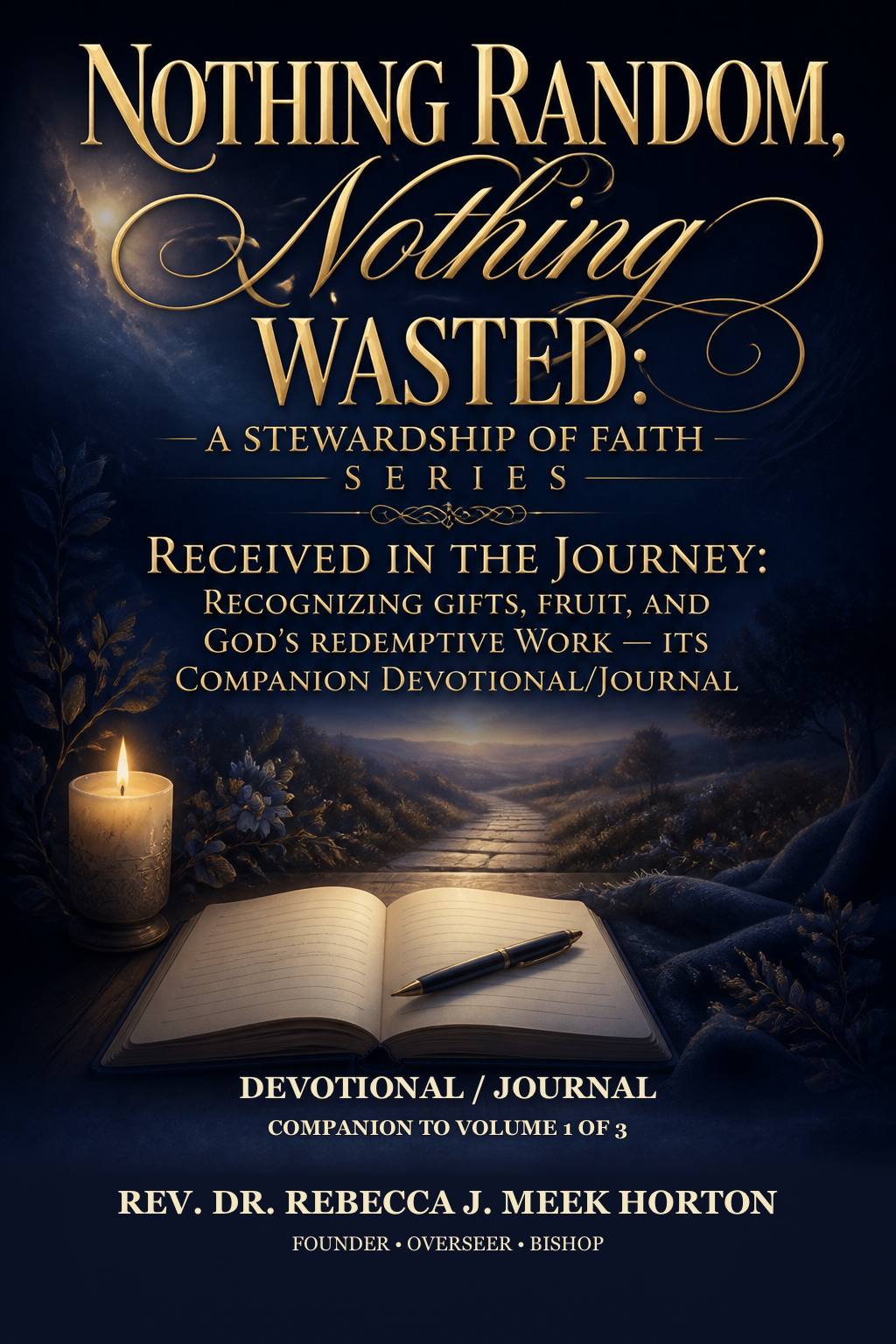
Received in the Journey: Recognizing Gifts, Fruit, and God’s Redemptive Work — Its Companion Devotional/Journal
A companion devotional and journal for "Received in the Journey: Recognizing Gifts, Fruit, and God’s Redemptive Work". Each chapter becomes five entries — a KJV Scripture reading, a devotional, a prayer, a journal prompt, and space to write — closing with An Apostolic Prophetic Architect Message and lined journal pages.
Full publication
NBCNGMI MASTER KNOWLEDGE LIBRARY Featuring the works of The Sage, Apostle Prophet. Rev. Dr. Rebecca J. Meek Horton, Apostolic Prophetic Architect, NewBeing Creation Network Global Ministries, Inc. Integrated Framework Modalities™
Chapter 1 — When the Journey Has Been Teaching You
Entry 1
Scripture Reading —
Romans 8:28-30 (KJV)
And we know that all things work together for good to them that love God, to them who are the called according to his purpose.
For whom he did foreknow, he also did predestinate to be conformed to the image of his Son, that he might be the firstborn among many brethren.
Moreover whom he did predestinate, them he also called: and whom he called, them he also justified: and whom he justified, them he also glorified.
Devotional —
There are seasons we remember mostly by what hurt. The hospital bracelet. The email. The empty chair. The Sunday we almost stayed home. The conversation that changed something. The door that closed. The version of ourselves that had to keep breathing when we did not know how the next day would look.
Romans 8:28 does not ask us to call all of that good. It teaches us to trust the God who can work in all things for good. That distinction protects our hearts from denial. Faith does not require us to pretend that every moment was right, fair, or easy. Faith gives us courage to say, “This happened, and God was still present.”
Many believers survive a season and then move forward without receiving what God formed in them. Survival says, “I made it through.” Receiving asks, “Lord, what did You develop in me while I was getting through?”
That question matters.
You may have gained patience you did not notice. You may now carry compassion for tired people because you have been tired. You may pray with less performance and more honesty. You may listen better. You may have learned what you will not repeat. You may have learned where your boundaries need wisdom. You may have learned that weakness is not always failure. Sometimes weakness becomes the place where dependence is formed.
The journey has been teaching you, even when you did not have language for the lesson.
Romans 8:29 shows us that God’s redemptive work is not only about changing circumstances. It is about conforming us to the image of His Son. God is forming character, mercy, endurance, humility, discernment, and obedience. He is not wasting the hidden places. He is not limited by what people did wrong. He is not confused by what you still grieve.
This is not a rushed conclusion. Some parts of the journey need time, prayer, wise counsel, and tender processing. Receiving does not mean reopening every wound at once. It means beginning with honest attention.
Look again, gently. Not to relive the pain. Not to excuse what was wrong. Not to force meaning where your heart still needs care. Look again to recognize grace.
Nothing is random. Nothing is wasted.
God is wise enough to bring good out of places you could not repair on your own.
Prayer —
Father, I come to You with honesty today. I do not want to pretend that every part of my journey was good, but I do want to trust that You are good in every part of my journey. Help me see where Your grace sustained me, where Your wisdom corrected me, and where Your Spirit formed something in me that I did not recognize at the time. Teach me to receive without striving and remember without bitterness. Give me courage to name what happened and faith to notice what You are redeeming. I surrender my need to understand everything at once. Lead me into wisdom one faithful step at a time. Amen.
Journal Prompt —
Romans 8:28-30 (KJV) teaches that God works redemptively in the lives of those who love Him. What is one season you survived, and what good work of God can you now begin to recognize in you?
Space to Write —
[Answer Lines]
Entry 2
Scripture Reading —
James 1:2-5 (KJV)
My brethren, count it all joy when ye fall into divers temptations;
Knowing this, that the trying of your faith worketh patience.
But let patience have her perfect work, that ye may be perfect and entire, wanting nothing.
If any of you lack wisdom, let him ask of God, that giveth to all men liberally, and upbraideth not; and it shall be given him.
Devotional —
James does not say the trial feels joyful. He does not tell the believer to enjoy pain, minimize pressure, or spiritualize exhaustion. He says to count it all joy because something is being worked in the believer that the trial itself does not get to control.
“The trying of your faith worketh patience.”
There is work happening beneath the surface.
Sometimes you do not recognize patience while it is being formed. It may not feel like patience. It may feel like waiting longer than you wanted. It may feel like praying the same prayer with fewer words. It may feel like choosing not to quit, even when your emotions are tired. It may feel like doing what love requires when nobody sees the cost.
This is why the journey needs interpretation. Without wisdom, we may only remember the pressure. With wisdom, we begin to see what pressure revealed and what grace developed.
Patience is not passivity. Biblical patience is not pretending nothing matters. Patience is governed endurance. It is strength under God’s leadership. It is the soul learning not to be ruled by urgency, fear, offense, or despair.
Many of us want the trial to end before patience finishes its work. That is human. We want relief. We want clarity. We want the lesson to be quick and the outcome to be clean. But James says, “let patience have her perfect work.” There are some things God forms slowly because they are meant to carry weight later.
You may be stronger than you were, not because the season was easy, but because God kept you. You may be slower to judge because you now understand how complex obedience can feel in hard places. You may be more careful with your words because you know what careless words can do. You may be more dependent on God because self-reliance broke under the weight.
That is not failure. That is formation.
Then James gives a simple invitation: if you lack wisdom, ask God. The journey cannot be interpreted by memory alone. Memory tells you what happened. Wisdom helps you understand what it meant, what it revealed, and how to walk forward.
Ask Him.
Not with performance. Not with shame. Not with pressure to produce a perfect answer.
Ask the Father who gives liberally.
The journey has been teaching you. Wisdom helps you receive the lesson without being defined by the trial.
Prayer —
Father, I ask You for wisdom today. I do not want to come out of hard places with bitterness where patience should be. I do not want to rush past what You have been forming in me. Help me let patience have its work without confusing waiting with abandonment. Show me where endurance has grown, where my faith has been tested, and where I still need healing. Teach me to ask You honestly instead of pretending I already understand. Give me wisdom that is clean, steady, and rooted in Your truth. I trust You to help me receive what the journey has been teaching me. Amen.
Journal Prompt —
James 1:2-5 (KJV) connects tested faith, patience, and wisdom. Where has God been developing patience in you, and what wisdom do you need to ask Him for now?
Space to Write —
[Answer Lines]
Entry 3
Scripture Reading —
2 Corinthians 4:7-10 (KJV)
But we have this treasure in earthen vessels, that the excellency of the power may be of God, and not of us.
We are troubled on every side, yet not distressed; we are perplexed, but not in despair;
Persecuted, but not forsaken; cast down, but not destroyed;
Always bearing about in the body the dying of the Lord Jesus, that the life also of Jesus might be made manifest in our body.
Devotional —
There is comfort in knowing Scripture tells the truth about pressure. Paul does not describe a life untouched by trouble. He says, “troubled on every side.” He says, “perplexed.” He says, “persecuted.” He says, “cast down.”
But he also says, “not distressed,” “not in despair,” “not forsaken,” and “not destroyed.”
This is not denial. This is holy interpretation.
The believer can tell the truth about the weight and still testify that the weight did not have the final word. The pressure was real. The confusion was real. The wound was real. But so was the sustaining grace of God.
Sometimes we think strength means we never felt the trouble. But Paul reminds us that the treasure is carried in earthen vessels. We are not made powerful by pretending to be unbreakable. We are made faithful by depending on the power of God in the middle of our humanity.
You may have looked back at a season and only seen how fragile you were. You may remember tears, fear, silence, disappointment, or fatigue. But look again with wisdom. Was there also grace? Did you keep praying, even if the prayer was short? Did you keep loving, even with trembling hands? Did you get back up? Did you learn to ask for help? Did you discover that God did not forsake you?
That matters.
The journey may have exposed your limits, but exposure is not always condemnation. Sometimes exposure becomes invitation. It shows us where we need God, where we need healing, where we need support, and where we need RE-Calibration™.
There is treasure in you, but it is carried in an earthen vessel. That means you do not have to despise your weakness. You can steward it with humility. You can admit where you are still tender. You can receive care. You can let God strengthen what life strained.
And you can also recognize that something of Christ has been made visible through your endurance. Not because you performed perfectly. Not because you understood everything. But because the life of Jesus kept meeting you in places where your own strength was not enough.
Do not only remember that you were cast down.
Remember that you were not destroyed.
There is formation in that testimony.
Prayer —
Father, I thank You that Your power is not limited by my weakness. I confess that I have often judged myself by how fragile I felt instead of recognizing how faithfully You carried me. Help me tell the truth about trouble without surrendering to despair. Show me where I was troubled but sustained, cast down but not destroyed, pressed but still held by Your grace. Teach me to steward my humanity with humility and receive Your strength without shame. Let the life of Jesus be made visible in me, not through perfection, but through dependence, endurance, and faithful obedience. Amen.
Journal Prompt —
2 Corinthians 4:7-10 (KJV) speaks of being pressed but not destroyed. What pressure have you survived, and where can you now see the sustaining power of God?
Space to Write —
[Answer Lines]
Entry 4
Scripture Reading —
Psalm 139:23-24 (KJV)
Search me, O God, and know my heart: try me, and know my thoughts:
And see if there be any wicked way in me, and lead me in the way everlasting.
Devotional —
Receiving from the journey requires honest attention. Not harsh attention. Not shame-filled attention. Honest attention.
David’s prayer is simple and brave: “Search me, O God.” He does not only ask God to look at his circumstances. He asks God to look within him. His heart. His thoughts. His ways. His direction.
That kind of prayer is not easy, but it is necessary for wisdom.
Many of us can explain what happened to us before we can name what happened in us. We remember the event, the person, the decision, the loss, the disappointment. But we may not notice what formed afterward. Did we become guarded? Did we become discerning? Did we become bitter? Did we become patient? Did we learn truth? Did we learn to hide? Did we learn to pray?
The journey needs interpretation because pain can leave residue. Sometimes what we call protection is really fear. Sometimes what we call discernment is really suspicion. Sometimes what we call strength is really hardness. And sometimes what we called weakness was actually humility being formed.
We need God to search us because we cannot always read ourselves clearly.
This prayer is not an invitation to self-condemnation. The Father is not searching you to destroy you. He searches to lead. David says, “lead me in the way everlasting.” God’s examination is connected to His direction. He reveals what needs healing so He can lead us into wholeness. He reveals what needs correction so we can walk in truth. He reveals what needs surrender so we can move forward with clean hands and a steadier heart.
This is careful work.
You do not have to open every box at once. You do not have to process every painful season in one sitting. Wisdom knows pace. If a memory is too tender, seek wise counsel, pastoral support, or professional help where needed. Faith does not require you to handle everything alone.
But when the Lord invites you to look, do not rush past your own life. There may be grace you missed. There may be wisdom you need. There may be an old agreement that needs to be broken. There may be a new strength that needs to be named.
The prayer “Search me” is a doorway into receiving.
It says, “Father, I trust You enough to let You show me the truth.”
Prayer —
Father, I invite You to search me with mercy and truth. Know my heart. Know my thoughts. Show me what I have misunderstood about my journey. Reveal where I have hardened, where I have healed, where I have grown, and where I still need Your care. I do not want to carry pain without wisdom or call fear protection when You are offering freedom. Lead me in the way everlasting. Help me slow down without becoming stuck. Help me see clearly without condemning myself. I trust Your searching because I trust Your heart. Guide me into truth, healing, and the next faithful step. Amen.
Journal Prompt —
Psalm 139:23-24 (KJV) invites God to search the heart and lead the way. What part of your journey do you need to bring before God honestly, and what do you need Him to show you?
Space to Write —
[Answer Lines]
Entry 5
Scripture Reading —
Isaiah 43:18-19 (KJV)
Remember ye not the former things, neither consider the things of old.
Behold, I will do a new thing; now it shall spring forth; shall ye not know it I will even make a way in the wilderness, and rivers in the desert.
Devotional —
There is a way to remember that keeps us bound, and there is a way to remember that helps us receive.
Isaiah 43 does not erase Israel’s past. God had already reminded His people of His power, deliverance, and covenant faithfulness. But here He tells them not to remain fixed on the former things in a way that blinds them to what He is doing now.
That is a word for the journey.
Some seasons become so large in our memory that they define how we expect the future to behave. If we were disappointed, we expect disappointment. If we were betrayed, we expect betrayal. If we were delayed, we expect every door to close. If we were unseen, we assume we will always have to fight to be recognized.
But God says, “Behold, I will do a new thing.”
Receiving what the journey taught you does not mean living inside the old season. It means gathering the wisdom, honoring the grace, healing what needs healing, and walking forward with God. You do not have to drag the whole wilderness into the next place.
The same God who sustained you there can make a way here.
This is where many believers need RE-Alignment™. We have to separate what happened from what we now believe. We have to ask, “Did this season teach me wisdom, or did it teach me fear?” Sometimes both are present. Wisdom can be kept. Fear must be surrendered. Discernment can remain. Suspicion must be healed. Compassion can grow. Bitterness must be brought into the light.
God does not waste the wilderness. He can make a way there. He can bring rivers in the desert. But the new thing must be recognized.
“Shall ye not know it?”
That question matters because God’s work can be present before we perceive it. A new tenderness. A new hunger for truth. A new courage to obey. A new willingness to rest. A new refusal to perform. A new ability to tell the truth. A new peace that does not depend on everything being resolved.
Look for the new thing.
Not with pressure. Not with fantasy. Not by denying the former season.
Look with faith and wisdom.
The journey has been teaching you, but it was never meant to become your prison. Receive the lesson. Release the weight. Keep walking.
Prayer —
Father, I thank You that You are able to do a new thing. Help me not remain trapped in former things in a way that blinds me to Your present work. Teach me to remember with wisdom, not bondage. Show me what I need to carry forward and what I need to release. Make a way in the wilderness places of my heart. Bring rivers into the dry places where hope has felt thin. Help me recognize new grace, new courage, new obedience, and new strength. I trust You to lead me beyond survival into faithful receiving and forward movement. Amen.
Journal Prompt —
Isaiah 43:18-19 (KJV) points to God’s new work. What former thing has been shaping your expectations, and what new work of God do you need to recognize?
Space to Write —
[Answer Lines]
An Apostolic Prophetic Architect Message
Beloved, the journey has not only carried history. It has carried formation.
You have walked through seasons that looked ordinary to others but carried weight in your soul. Some moments were painful. Some were confusing. Some were costly. Some required obedience when you did not feel strong. But hear this with wisdom: survival was not the whole story. God has been forming, teaching, correcting, strengthening, and refining you in places you may not have had language to name.
This is not the hour to pretend everything was good. Redemption is not denial. Romans 8:28 declares, “And we know that all things work together for good to them that love God, to them who are the called according to his purpose” (KJV). The Scripture says God works in all things for good. It does not call all things good. That is holy distinction. That is wisdom. That is clean ground for faith.
Now you must receive.
Receive the compassion that came through sorrow. Receive the discernment that came through exposure. Receive the humility that came through correction. Receive the patience that came through waiting. Receive the courage that came through obedience. Receive the strength that was formed when you kept walking with God, even when your prayers were short and your heart was tired.
But also release what was never meant to define you. Release shame. Release false identity. Release the agreement that the hardest season gets to name your future. The Lord Jesus is Redeemer. He does not waste what is surrendered to Him.
Isaiah 61:3 says, “To appoint unto them that mourn in Zion, to give unto them beauty for ashes, the oil of joy for mourning, the garment of praise for the spirit of heaviness” (KJV).
Beauty for ashes does not mean there were no ashes. It means ashes did not have the final authority.
So take the next faithful step. Open the box with God, not alone in despair. Look again with Scripture, prayer, wisdom, and support where needed. Ask, “Lord, what have You formed in me that I have not yet received?”
Nothing is random. Nothing is wasted.
The journey has been teaching you. Now walk forward with wisdom.
[Journal Page]
[Journal Page]
Chapter 2 — Received, Not Owned
Entry 1
Scripture Reading
1 Corinthians 12:4-7 (KJV)
Now there are diversities of gifts, but the same Spirit.
And there are differences of administrations, but the same Lord.
And there are diversities of operations, but it is the same God which worketh all in all.
But the manifestation of the Spirit is given to every man to profit withal.
Devotional
There is a quiet freedom in the words, “but the same Spirit.” The gifts may differ. The ways they are carried may differ. The effects may differ. But the source remains God. That truth protects the heart from comparison, striving, and ownership.
Many believers become anxious when they recognize something God has placed in them. They wonder if naming it is pride. They may also fear that if they do not name it, they are being unfaithful. Scripture gives us a clearer way. We do not deny what God gives, and we do not possess it as though it began with us. We receive it.
A gift is not a trophy. It is not a title. It is not a replacement for identity. It is a manifestation of the Spirit “to profit withal.” In other words, God gives for service. The gift is not mainly about proving who we are. It is about strengthening, serving, building, and blessing what God loves.
This helps us hold gifts with clean hands. If the Spirit gives, I do not have to compete. If the Spirit distributes differently, I do not have to copy someone else. If God works “all in all,” I do not have to force an outcome to validate my usefulness. I can be faithful with what is in my hand and peaceful about what is not.
This is part of Governed Movement™. The gift needs order, weight, operation, and wisdom. A real gift still needs humility. A visible gift still needs submission. A powerful gift still needs love. Nothing is random. Nothing is wasted. But nothing received by grace should be treated as personal ownership.
Today, let this settle your heart: difference is not rejection. Another person’s gift does not diminish yours. Your gift does not make you superior. The same Spirit is at work.
You can say, “God has entrusted something to me,” without pride. You can also say, “I am still learning how to steward it,” without shame. That is receiving without owning.
Prayer
Father, I receive Your work in me with humility. I do not want to deny what You have entrusted, and I do not want to turn it into pride. Teach me to recognize what comes from Your Spirit and to use it for the good of others. Deliver me from comparison, insecurity, and the need to prove myself. Help me remember that the gift is not my identity. My identity is in belonging to You. Give me wisdom to serve with order, love, and accountability. Let what You place in me bless others and bring glory back to You. Amen.
Journal Prompt
From 1 Corinthians 12:4-7, what may God have entrusted to you for service, and how can you hold it without comparison or ownership?
Space to Write
[Answer Lines]
Entry 2
Scripture Reading
Galatians 5:22-25 (KJV)
But the fruit of the Spirit is love, joy, peace, longsuffering, gentleness, goodness, faith,
Meekness, temperance: against such there is no law.
And they that are Christ's have crucified the flesh with the affections and lusts.
If we live in the Spirit, let us also walk in the Spirit.
Devotional
Gifts may be noticed quickly, but fruit is proven over time. A person may be able to speak well, sing beautifully, lead strongly, teach clearly, or encourage deeply. Those things can be real gifts. But the fruit of the Spirit reveals what is being formed in the inner life.
Paul does not call it the fruit of personality, effort, charm, or talent. He calls it “the fruit of the Spirit.” That matters. Spiritual fruit is not something we tape onto our lives so we can appear mature. It grows as the life of the Spirit works in us.
Love grows where selfishness is surrendered. Joy grows where trust is cultivated. Peace grows where anxiety no longer rules the heart. Longsuffering grows when we remain faithful under pressure. Gentleness grows when strength becomes submitted. Goodness grows when the heart agrees with God. Faith grows when we keep believing. Meekness grows when we stop needing to dominate. Temperance grows when desire comes under holy order.
Fruit is not passive, but it is dependent. We do not produce the Spirit’s life by human strength alone. We participate through repentance, obedience, forgiveness, waiting, yielding, and walking with God. “If we live in the Spirit, let us also walk in the Spirit.” Life and walk must come together.
This is where many of us need RE-Calibration™. We may have asked God to increase our usefulness while He is inviting us to deepen our character. We may want a wider assignment, but He may be growing patience. We may want visible impact, but He may be forming meekness in hidden places. Stewardship before increase.
Fruit makes service safe. Gifts can open a door, but fruit helps us walk through that door without wounding people. Gifts may bless a moment, but fruit protects the spirit in which we serve.
Do not despise the slow work of God in you. Slow does not mean absent. Hidden does not mean wasted. The Spirit grows what cannot be manufactured.
Today, ask less, “How visible is my gift?” and more, “What fruit is the Spirit growing in me?” That question will keep your life rooted, clean, and useful.
Prayer
Father, I want the fruit of Your Spirit to become visible in my life. I confess that I sometimes value what can be seen quickly more than what You are growing deeply. Teach me to walk in the Spirit, not just speak about the Spirit. Grow love where I have been guarded, peace where I have been anxious, patience where I have been rushed, and temperance where I have lacked order. Help me not to perform maturity, but to yield to Your real work in me. Let my service be safe, humble, and full of Your character. Amen.
Journal Prompt
From Galatians 5:22-25, which fruit of the Spirit may God be growing in you right now, and what situation is helping you see that need?
Space to Write
[Answer Lines]
Entry 3
Scripture Reading
Romans 12:3-8 (KJV)
For I say, through the grace given unto me, to every man that is among you, not to thinkof himself more highly than he ought to think; but to think soberly, according as God hathdealt to every man the measure of faith.
For as we have many members in one body, and all members have not the same office:
So we, being many, are one body in Christ, and every one members one of another.
Having then gifts differing according to the grace that is given to us, whether prophecy,let us prophesy according to the proportion of faith;
Or ministry, let us wait on our ministering: or he that teacheth, on teaching;
Or he that exhorteth, on exhortation: he that giveth, let him do it with simplicity; he thatruleth, with diligence; he that sheweth mercy, with cheerfulness.
Devotional
Paul gives us a balanced instruction: do not think too highly of yourself, but think soberly. Soberness is not self-hatred. It is not shrinking back from what God has given. It is truthful agreement with grace.
Some believers confuse humility with denial. They cannot acknowledge a gift without feeling guilty. Others confuse gifting with identity and begin to measure themselves by how needed, noticed, or affirmed they are. Paul gives another way. Think soberly. See rightly. Receive grace as grace.
The body has many members, and “all members have not the same office.” This means we were never called to be identical. The hand does not need to apologize for being a hand. The eye does not need to compete with the foot. The body is strengthened when each part receives its function without pride and without shame.
Your gift is not proof that you are better. Your gift is evidence that grace has assigned you responsibility. That responsibility must be carried with humility, diligence, simplicity, and cheerfulness. The way we carry the gift matters.
This is where stewardship becomes practical. If you teach, study. If you encourage, listen well. If you lead, remain accountable. If you give, keep your heart simple. If you show mercy, do not let bitterness harden you. If you serve, do not use hiddenness as an excuse for resentment. What is received by grace must still be carried responsibly.
A gift can be real and immature. A gift can be present and still need training. A gift can be useful and still need correction. That does not mean the gift is false. It means stewardship is necessary.
Think soberly today. Do not inflate what God has given. Do not diminish it either. Bring it into the light of Scripture, prayer, wise counsel, and faithful practice. Let your place in the body become service, not self-protection.
You are not meaningless in the body of Christ. But your meaning is not rooted in your gift. Your meaning is rooted in belonging to Christ. From that place, you can serve with clarity and peace.
Prayer
Father, I want to think soberly about my life, my gifts, and my place in the body of Christ. Keep me from pride, and keep me from false humility. Help me not to exaggerate what You have given, and help me not to bury it out of fear. Teach me to receive grace as responsibility. Show me where I need discipline, correction, training, or counsel. Help me serve with diligence, simplicity, and cheerfulness. Let my life strengthen the body, not compete with it. I belong to You, and I want what You have entrusted to me to serve Your purpose. Amen.
Journal Prompt
From Romans 12:3-8, where do you need to think more soberly about a gift, not too highly and not too lowly?
Space to Write
[Answer Lines]
Entry 4
Scripture Reading
1 Peter 4:10-11 (KJV)
As every man hath received the gift, even so minister the same one to another, as goodstewards of the manifold grace of God.
If any man speak, let him speak as the oracles of God; if any man minister, let him do itas of the ability which God giveth: that God in all things may be glorified through JesusChrist, to whom be praise and dominion for ever and ever. Amen.
Devotional
Peter uses a word that brings order to the whole conversation: stewards. “As every man hath received the gift, even so minister the same one to another, as good stewards of the manifold grace of God.”
A steward manages what belongs to another. A steward has access, responsibility, and assignment, but not ownership. That is the cleanest way to hold spiritual gifts. We receive. We minister. We steward. God receives the glory.
This protects us from two dangerous errors. The first is possession. We begin to say, “my gift,” in a way that slowly becomes “my identity,” “my platform,” “my importance,” or “my control.” The second is neglect. We say, “It is not mine anyway,” and use that as an excuse to avoid growth, discipline, or obedience. Peter does not allow either error. Because we have received, we minister. Because it is grace, we steward.
If you speak, speak with reverence. Words are not toys. Teaching, exhorting, counseling, preaching, singing, writing, and testifying all carry weight. If you minister, serve from “the ability which God giveth.” This means we do not have to manufacture strength, but we also do not serve carelessly. We serve from dependence.
The goal is clear: “that God in all things may be glorified through Jesus Christ.” This is the aim that purifies the gift. Not applause. Not control. Not being needed. Not proving worth. Glory to God.
Stewardship before increase. If God has entrusted something to you, ask whether you are caring for it well. Are you practicing? Are you studying? Are you accountable? Are you using it in love? Are you allowing correction? Are you resting when needed? Are you letting fruit grow alongside the gift?
A gift in the hands of pride can harm. A gift buried in fear can leave others unserved. But a gift stewarded in humility can bless the body and honor Christ.
Today, receive the word “steward” as an invitation, not a burden. God is not asking you to own what He gave. He is asking you to carry it faithfully.
Prayer
Father, I acknowledge that whatever gift You have entrusted to me belongs first to You. I do not want to possess it in pride or neglect it in fear. Teach me to be a good steward of Your manifold grace. If I speak, help me speak with reverence. If I serve, help me serve from the ability You give. Correct my motives where I want attention more than obedience. Strengthen my discipline where I have been careless. Let my service bless others and glorify Jesus Christ. I receive the responsibility with humility and gratitude. Amen.
Journal Prompt
From 1 Peter 4:10-11, what would it look like for you to become a better steward of what God has entrusted to you?
Space to Write
[Answer Lines]
Entry 5
Scripture Reading
John 15:4-5 (KJV)
Abide in me, and I in you. As the branch cannot bear fruit of itself, except it abide in thevine; no more can ye, except ye abide in me.
I am the vine, ye are the branches: He that abideth in me, and I in him, the same bringethforth much fruit: for without me ye can do nothing.
Devotional
Jesus gives us the secret of fruitfulness: abide. Not strive. Not perform. Not pretend. Abide.
A branch does not create life by itself. It receives life by remaining connected to the vine. The fruit on the branch is evidence of the life flowing through it. This is how spiritual fruit grows in us. We do not manufacture love, joy, peace, patience, gentleness, goodness, faith, meekness, and temperance by religious performance. We bear fruit as we remain in Christ.
This is humbling because Jesus says, “without me ye can do nothing.” That does not mean we cannot stay busy. People can be busy without abiding. We can build, speak, serve, organize, lead, and perform while our inner life is drying out. The absence of abiding may not show immediately, but eventually the branch reveals its source.
This is why gifts and fruit must be held together. A gift may open a door, but abiding keeps the soul alive. A gift may serve others, but abiding forms the spirit in which we serve. A gift may be visible, but fruit reveals whether the life of Christ is being cultivated within us.
Some of us need to stop asking God only for more opportunity and begin asking for deeper connection. More visibility without abiding can become weight without life. More responsibility without fruit can become pressure without peace. Wisdom instructs before expansion is released.
Abiding is not complicated, but it is costly. It costs hurry. It costs self-rule. It costs the illusion that we can carry holy things in our own strength. It invites us into prayer, Scripture, repentance, obedience, rest, and honest dependence.
The beautiful promise is this: “He that abideth in me, and I in him, the same bringeth forth much fruit.” Fruitfulness is not denied to the dependent. It is promised to the abiding.
Today, come back to the Vine. Bring your gifts. Bring your questions. Bring your fatigue. Bring your desire to be useful. Bring your need for character. Do not try to be the source. You are the branch. Christ is the Vine. Stay connected, and let His life bear fruit in you.
Prayer
Father, I confess that I sometimes try to bear fruit without abiding. I become busy, responsible, and outwardly active, but I need the life of Christ flowing in me. Teach me to remain in Him. Slow me where I am rushing. Correct me where I am relying on my own strength. Restore prayer, Scripture, obedience, and surrender in my daily life. I do not want gifts without fruit or service without communion. Let my life be rooted in Christ, and let what grows in me come from Your Spirit. I receive my place as a branch, dependent and loved. Amen.
Journal Prompt
From John 15:4-5, where do you sense Jesus calling you to abide more deeply before asking for more fruit or more opportunity?
Space to Write
[Answer Lines]
An Apostolic Prophetic Architect Message
Beloved, receive this with clarity: what God gives must return to God in glory. The gift is not your throne. The fruit is not your performance. The assignment is not your identity. You belong to God.
The journey of “received, not owned” is not a small correction. It is a holy alignment. It protects the servant from pride, fear, comparison, and misuse. It teaches the heart how to hold grace without gripping it. It teaches the hands how to serve without possessing what was entrusted.
James 1:17 (KJV) says,
Every good gift and every perfect gift is from above, and cometh down from the Fatherof lights, with whom is no variableness, neither shadow of turning.
If it came from above, then it must be stewarded beneath the authority of the One who gave it. If it is good, it did not begin with your striving. If it is perfect in its source, then your responsibility is to carry it with clean hands, a teachable spirit, and a surrendered heart.
Do not reject what God has placed in you because you fear pride. Pride is not healed by denial. Pride is healed by worship, obedience, and accountability. And do not exalt what God has placed in you as though grace needs your ownership to be powerful. Grace is already sufficient.
There is a mature confession rising in the people of God: I have received, and I will steward. I have been entrusted, and I will not possess. I have been called to serve, and I will not make service my identity. I will honor the Giver, cultivate the fruit, and use the gift in love.
This is Governed Movement™. This is stewardship before increase. This is how the believer walks free.
Let the Holy Spirit search motives without condemning identity. Let Him reveal gifts without feeding pride. Let Him grow fruit without forcing performance. Nothing is random. Nothing is wasted.
Now walk in sober agreement with grace. Receive what He has given. Cultivate what He is growing. Serve what He loves. And let all glory return to God through Jesus Christ.
[Journal Page]
[Journal Page]
Chapter 3 — Naming the Gifts Without Exalting the Self
Entry 1
Scripture Reading
1 Corinthians 12:4-7 (KJV)
Now there are diversities of gifts, but the same Spirit.
And there are differences of administrations, but the same Lord.
And there are diversities of operations, but it is the same God which worketh all in all.
But the manifestation of the Spirit is given to every man to profit withal.
Devotional
The Spirit gives gifts, but He does not give them so we can build a private throne around them. The Scripture says the manifestation of the Spirit is given “to profit withal.” That means what God places in you is meant to strengthen more than you. It is entrusted through you, but it does not terminate on you.
This is why gifts often appear in ordinary places before they are named in public places. A person sees confusion and gently brings order. Another notices sorrow and sits close enough to listen. Someone prepares food, makes room, remembers a name, follows up, prays quietly, or explains truth in a way that helps another believer breathe again. No one may announce it, but the Spirit is working.
A gift does not have to be loud to be real. It does not have to be seen by many to matter. Sometimes the clearest evidence of grace is repeated usefulness in hidden service. The question is not, “Who noticed me?” The better question is, “Was someone strengthened because I obeyed?”
Naming a gift is not pride when the posture is stewardship. Pride says, “This proves I am important.” Stewardship says, “This belongs to God, and I must handle it faithfully.” Fear may refuse to name what God is developing. Pride may overname it and demand a place. Wisdom teaches another way: receive clearly, name honestly, serve humbly.
Pay attention to where you consistently serve with grace. Pay attention to what becomes clearer, stronger, calmer, or more cared for when you show up in obedience. Do not rush to build an identity around it. Do not dismiss it as nothing. Bring it before God. Let Scripture, fruit, counsel, and time help you understand what He has entrusted.
Nothing is random. Nothing is wasted. Even the quiet place where your hands move toward a need may be part of your formation. Gifts are not decorations for the self. They are supplies for the body.
Prayer
Father, I thank You for every gift that comes from Your Spirit. I confess that I do not want to exalt myself, but I also do not want to hide from responsibility. Teach me to recognize what You are doing in me without pride, fear, or comparison. Help me notice where my obedience strengthens others. Purify my motives when I want to be seen. Strengthen my courage when I am tempted to shrink back. Let my gifts serve Your purpose and bless Your people. I receive what You entrust as stewardship, not ownership. In Jesus’ name, amen.
Journal Prompt
Read 1 Corinthians 12:4-7 again. Where have you seen your service bring strength, clarity, comfort, order, or encouragement to someone else?
Space to Write
[Answer Lines]
Entry 2
Scripture Reading
Romans 12:3-8 (KJV)
For I say, through the grace given unto me, to every man that is among you, not to think himself more highly then he ought to think; but to think soberly, according as God hath dealt to every man the measure of faith.
For as we have many members in one body, and all members have not the same office:
So we, being many, are one body in Christ, and every one members one of another.
Having then gifts differing according to the grace that is given to us, whether prophecy, let us prophesy according to the proportion of faith;
Or ministry, let us wait on our ministering: or he that teacheth, on teaching;
Or he that exhorteth, on exhortation: he that giveth, let him do it with simplicity; he that ruleth, with diligence; he that sheweth mercy, with cheerfulness.
Devotional
Paul gives us a sober path for recognizing gifts. He does not tell us to think less than truth. He tells us not to think more highly than we ought, but to think soberly. Sobriety is not denial. It is clear judgment under God.
Some believers confuse humility with pretending nothing has been entrusted to them. They say, “I am not gifted,” when the fruit of their service keeps helping others. Others confuse confidence with entitlement and begin to treat a gift as proof that they deserve attention. Both need RE-Calibration™.
Sober thinking allows us to say, “God may be using me here. I want to grow faithfully.” That sentence is clean. It does not boast. It does not hide. It leaves room for counsel, correction, maturity, and service.
Romans 12 reminds us that gifts differ according to grace. This truth protects the heart from comparison. The hand does not need to become the eye. The teacher does not need to become the giver. The one who shows mercy does not need to despise the one who leads. The one who leads must not dismiss the one who serves quietly. Grace is not distributed for competition. It is distributed for the health of the body.
The gift you carry will also require formation. If you teach, you must study. If you lead, you must grow in diligence and character. If you show mercy, you must learn boundaries so compassion does not become exhaustion. If you exhort, your words must be governed by love, not pressure. If you give, simplicity protects the heart from performance. Grace supplies the gift, but maturity stewards it.
Today, do not ask, “How do I become impressive?” Ask, “Where has God given me grace to serve well?” Look for the repeated place where love moves through you and others are strengthened. Then submit that observation to God with humility.
A named gift is not a crown for self. It is a responsibility before God. Receive it soberly. Carry it gently. Grow in it faithfully.
Prayer
Father, I want to think soberly about what You have entrusted to me. Deliver me from false humility that hides from obedience, and deliver me from pride that seeks attention. Help me honor the grace You have given without comparing myself to others. Teach me to value the gifts in the whole body of Christ. Shape my character so I can carry responsibility well. If I need correction, help me receive it. If I need courage, help me obey. I want my service to be faithful, useful, and pleasing to You. In Jesus’ name, amen.
Journal Prompt
Read Romans 12:3-8 again. What gift or grace may God be developing in you, and what maturity does that gift require?
Space to Write
[Answer Lines]
Entry 3
Scripture Reading
1 Peter 4:10-11 (KJV)
As every man hath received the gift, even so minister the same one to another, as good stewards of the manifold grace of God.
If any man speak, let him speak as the oracles of God; if any man minister, let him do it as of the ability which God giveth: that God in all things may be glorified through Jesus Christ, to whom be praise and dominion for ever and ever. Amen.
Devotional
Peter says, “As every man hath received the gift.” That one word, received, protects us. A gift is not something we manufactured. It is not proof that we are better. It is not personal property to control. It is received.
Then Peter tells us what to do with what we have received: “minister the same one to another.” Gifts are not meant to sit in private admiration. They are meant to move toward people in love. The one who speaks must speak with reverence. The one who serves must serve from the ability God gives. The aim is not self-display. The aim is that God may be glorified.
This is where many hearts must be gently corrected. Some are waiting for a title before they serve. Some are waiting for a platform before they obey. Some are waiting for others to recognize what God has already invited them to steward. But gifts are often recognized while we are already serving.
The chair-stacker may carry helps. The listener may carry mercy. The one who brings order may carry administration. The one who asks a simple honest question may carry exhortation or wisdom. The one who notices the overlooked may carry pastoral care. These things may begin quietly, but they are not insignificant.
Stewardship means I handle what God gives with faithfulness, humility, and accountability. I do not bury it because I am afraid. I do not brand it for my own glory. I minister it to others as unto the Lord.
There is also a cost. Stewardship will interrupt convenience. It may ask you to grow in skill, patience, consistency, and submission. It may require you to serve when no one applauds. It may ask you to receive feedback that shapes the gift more deeply. But correction is not rejection. Formation is not failure. Nothing is random. Nothing is wasted.
Today, ask God to show you the difference between ownership and stewardship. Ownership clutches. Stewardship offers. Ownership demands recognition. Stewardship seeks faithfulness. Ownership says, “This is mine.” Stewardship says, “Father, this came from You. Teach me how to serve with it.”
Prayer
Father, I acknowledge that every gift I carry has been received from You. I do not want to hold it as ownership or use it for self-exaltation. Teach me to minister faithfully to others as a good steward of Your manifold grace. Help me serve from the ability You give, not from pressure, performance, or comparison. Let my words be reverent. Let my service be sincere. Let my motives be purified. May what You place in me return glory to You through Jesus Christ. I receive the responsibility with humility. In Jesus’ name, amen.
Journal Prompt
Read 1 Peter 4:10-11 again. What would change if you treated your gift as something received to minister, not something owned to protect?
Space to Write
[Answer Lines]
Entry 4
Scripture Reading
Matthew 6:1-4 (KJV)
Take heed that ye do not your alms before men, to be seen of them: otherwise ye have no reward of your Father which is in heaven.
Therefore when thou doest thine alms, do not sound a trumpet before thee, as the hypocrites do in the synagogues and in the streets, that they may have glory of men. Verily I say unto you, They have their reward.
But when thou doest alms, let not thy left hand know what thy right hand doeth:
That thine alms may be in secret: and thy Father which seeth in secret himself shall reward thee openly.
Devotional
Jesus does not condemn giving. He corrects the motive that needs an audience. The issue is not the act of service. The issue is the hunger to be seen by people more than the desire to please the Father.
This matters when we begin naming gifts. A gift can start in purity and slowly become attached to recognition. We may begin by helping because love moved us. Then, over time, we may feel disappointed when no one notices, offended when someone else is praised, or anxious when our role is not protected. That does not mean the gift is false. It means the heart needs tending.
Hidden service is one of God’s classrooms for humility. It teaches us to obey without applause. It reveals whether we love the work of God or only the visibility that sometimes comes with it. It reminds us that the Father sees what people miss.
There is deep comfort here. Maybe you have served in ways no one recorded. You stayed late. You prayed quietly. You noticed the child, the widow, the tired mother, the new believer, the person who did not know where to sit. You made room. You brought order. You carried a burden without turning it into an announcement. The Father saw.
But this passage also searches us. If we only serve when the room is watching, our service is not free. If we only give when it can be traced back to us, our giving is mixed. If we only use our gifts where we are praised, we may be serving recognition more than people.
Wisdom does not ask us to hide forever. Some gifts must be named so they can be developed and stewarded responsibly. But naming must come from obedience, not appetite. The Father can be trusted with both hidden formation and public usefulness. Our part is to keep the motive clean.
Today, choose one act of service that does not advertise itself. Let it be small if needed. Stack the chair. send the message. pray the prayer. prepare the meal. Make room for someone else. Serve without sounding a trumpet.
The Father who sees in secret is not careless with your obedience.
Prayer
Father, I bring my motives before You. I want to serve because I love You and because people need care, not because I need to be seen. Cleanse me from the desire to sound a trumpet around my obedience. Heal the places in me that feel overlooked, and teach me to trust that You see in secret. Help me serve quietly, faithfully, and joyfully. If public responsibility comes, keep me humble. If hidden service remains, keep me steady. Let my gifts be governed by love, not recognition. In Jesus’ name, amen.
Journal Prompt
Read Matthew 6:1-4 again. Where do you need to practice hidden faithfulness, and what motive is God inviting you to surrender?
Space to Write
[Answer Lines]
Entry 5
Scripture Reading
Galatians 5:22-26 (KJV)
But the fruit of the Spirit is love, joy, peace, longsuffering, gentleness, goodness, faith,
Meekness, temperance: against such there is no law.
And they that are Christ's have crucified the flesh with the affections and lusts.
If we live in the Spirit, let us also walk in the Spirit.
Let us not be desirous of vain glory, provoking one another, envying one another.
Devotional
Gifts matter, but fruit protects the gift. A gifted person without the fruit of the Spirit can wound the very people the gift was meant to strengthen. This is why naming a gift must never become more important than becoming like Christ.
Paul names love, joy, peace, longsuffering, gentleness, goodness, faith, meekness, and temperance. These are not decorations. They are evidence of the Spirit’s formation in us. A teaching gift needs love. A leadership gift needs longsuffering. A mercy gift needs temperance. A prophetic gift needs meekness. A giving gift needs goodness. An exhortation gift needs gentleness. Without fruit, a gift may become forceful, self-protective, or vain.
The passage ends with a clear warning: “Let us not be desirous of vain glory, provoking one another, envying one another.” This is the inner danger around gifts. Vain glory wants to be admired. Provoking compares and competes. Envy grieves when another person is honored. These things can hide under spiritual language, but they do not carry the fragrance of Christ.
When you notice a gift in yourself, ask also about fruit. Am I becoming more loving? Am I more patient with people who grow slowly? Am I gentle when I correct? Am I peaceful when I am not recognized? Am I faithful when service is hidden? Am I meek enough to receive counsel? Am I temperate enough to wait for God’s timing?
A gift may open a door, but fruit helps you remain healthy in the room. Talent may make something visible, but character makes it sustainable. Grace gives supply, and formation gives order. Do not separate what God wants to mature together.
This is not meant to discourage you. It is meant to protect you. God is not only developing what you can do. He is forming who you are. The fruit of the Spirit keeps the gift from becoming an idol. It keeps service from becoming performance. It keeps naming from becoming self-exaltation.
WISDOM is not yours until YOU WALK IT. Today, walk in the Spirit where you serve. Let fruit govern the gift.
Prayer
Father, I thank You for the gifts You give, but I ask You to form the fruit of the Spirit deeply in me. Make me loving, joyful, peaceful, patient, gentle, good, faithful, meek, and temperate. Do not let my gift outrun my character. Correct vain glory, comparison, envy, and selfish ambition in me. Teach me to walk in the Spirit, not merely work for You in my own strength. Let my service carry the fragrance of Christ. Shape me until what I do and who I am both bring honor to You. In Jesus’ name, amen.
Journal Prompt
Read Galatians 5:22-26 again. Which fruit of the Spirit needs to grow around the gift or burden you are beginning to recognize?
Space to Write
[Answer Lines]
An Apostolic Prophetic Architect Message
Beloved, what God has entrusted to you must be received with clean hands and a surrendered heart. You are not being invited into self-promotion. You are being invited into stewardship. There is a difference.
The Scripture says, “For who maketh thee to differ from another? and what hast thou that thou didst not receive? now if thou didst receive it, why dost thou glory, as if thou hadst not received it?” 1 Corinthians 4:7 (KJV). This is the holy correction that keeps the vessel safe. If you received it, you cannot boast as though you created it. If God entrusted it, you cannot bury it as though it has no purpose.
So hear this with peace: naming the gift is not the same as exalting the self. Naming becomes holy when it leads to service, maturity, accountability, and love. You may say, with humility, “I am noticing that God may be using me in this way. I want to grow in it faithfully.” That is not arrogance. That is governed language. That is stewardship with room for counsel.
Do not despise the quiet places where the gift first appeared. The chair, the kitchen, the parking lot, the prayer after service, the patient conversation, the unnoticed act of care. These were not wasted places. They were places of revelation and formation. Nothing is random. Nothing is wasted.
But also hear the warning of wisdom: do not let the gift become your identity. Christ is your life. The gift is your stewardship. If the gift makes you harsh, return to love. If the burden makes you proud, return to humility. If comparison rises, return to gratitude. If fear silences you, return to obedience.
Receive clearly. Name honestly. Serve humbly. Grow steadily. Seek counsel. Watch for fruit. Let the Spirit form both the gift and the vessel.
What God gives, He also teaches us how to carry. Stewardship before increase. Wisdom before expansion. Walk gently, but do not walk away from what He has entrusted.
[Journal Page]
[Journal Page]
Chapter 4 — Recognizing Fruit in Ordinary Places
Entry 1
Scripture Reading
Galatians 5:22–25 (KJV)
But the fruit of the Spirit is love, joy, peace, longsuffering, gentleness, goodness, faith,
Meekness, temperance: against such there is no law.
And they that are Christ's have crucified the flesh with the affections and lusts.
If we live in the Spirit, let us also walk in the Spirit.
Devotional
Fruit is evidence of life. It is not a costume for spiritual people to wear when others are watching. It is what the Holy Spirit grows in the life of a person who belongs to Christ and is learning to walk with Him.
Paul names the fruit plainly: love, joy, peace, longsuffering, gentleness, goodness, faith, meekness, and temperance. These are not small words. They reach into our homes, our conversations, our private thoughts, our delayed answers, and our ordinary frustrations. They meet us where life is actually lived.
It is possible to admire fruit and still resist the place where fruit must grow. We may want patience, but not the inconvenience that reveals impatience. We may want gentleness, but not the conversation where we could be harsh and must choose restraint. We may want temperance, but not the moment where desire must submit to obedience.
This is why ordinary places matter. The kitchen after an argument. The car in traffic. The work email that feels unfair. The child asking again. The quiet temptation nobody else sees. These are not interruptions to spiritual growth. Often, they are the field where growth is revealed.
Fruit is not about pretending. If you are irritated, the Spirit is not asking you to lie and call it peace. He is teaching irritation to bow. If you are wounded, He is not asking you to deny pain. He is forming love that refuses revenge. If you are tired, He is not asking you to perform strength. He is growing faithfulness one obedient step at a time.
Do not despise small evidence. A pause before responding may be fruit. A softer answer may be fruit. Telling the truth without cruelty may be fruit. Returning to prayer after failure may be fruit. Saying no to the old reaction may be fruit.
The journey is not only about what God gives to you. It is also about what He grows in you. Nothing is random. Nothing is wasted. The Spirit can use ordinary places to reveal holy formation.
Prayer
Father, I come to You honestly. I do not want to perform fruit; I want Your Spirit to grow it in me. Search my responses, my words, my motives, and my hidden habits. Show me where I have called immaturity personality, and where I have excused reactions that need surrender. Teach me to walk in the Spirit in ordinary places, not only in visible moments. Let love, patience, gentleness, faithfulness, and self-control become evidence of Your life in me. Help me notice small obedience and keep walking without pride or despair. I belong to Christ, and I want my life to bear witness to Him. Amen.
Journal Prompt
Galatians 5:22–25 names the fruit of the Spirit. Which fruit do I most need to notice and practice in my ordinary responses this week?
Space to Write
[Answer Lines]
Entry 2
Scripture Reading
John 15:1–5 (KJV)
I am the true vine, and my Father is the husbandman.
Every branch in me that beareth not fruit he taketh away: and every branch that beareth fruit, he purgeth it, that it may bring forth more fruit.
Now ye are clean through the word which I have spoken unto you.
Abide in me, and I in you. As the branch cannot bear fruit of itself, except it abide in the vine; no more can ye, except ye abide in me.
I am the vine, ye are the branches: He that abideth in me, and I in him, the same bringeth forth much fruit: for without me ye can do nothing.
Devotional
A branch does not strain fruit into existence. It receives life from the vine. This is one of the quiet corrections Jesus gives us. Fruit is not manufactured by anxiety, image, or religious pressure. Fruit grows from abiding.
Many believers become tired because they are trying to produce what only connection can grow. They try to appear patient, sound peaceful, look joyful, and act gentle. But performed fruit is fragile. It may survive in public and break at home. It may hold during worship and collapse during conflict.
Jesus gives a better way. “Abide in me, and I in you.” This is not passive neglect. It is living connection. It is returning to His Word. It is prayer when the emotions are loud. It is repentance without running away. It is dependence instead of self-manufactured maturity.
Abiding often looks ordinary. Reading Scripture before the day rushes in. Whispering, “Lord, help me answer rightly,” before speaking. Choosing quiet surrender instead of rehearsing offense. Returning to God after a hard response and asking Him to teach you. These are not small things. They are the ways a branch remains connected.
Jesus also says the Father purges the fruitful branch so it may bring forth more fruit. That means even growth can come with pruning. Some attitudes must be cut back. Some words must be restrained. Some habits must be removed. Some motives must be purified. Pruning is not rejection. It is care with purpose.
This is important in the journey. God may be growing fruit in you through places you would not have chosen. The delay, the correction, the hidden season, the uncomfortable conversation, the responsibility that stretches you. These may not feel like growth at first, but they can become places of deeper abiding.
You do not have to force fruit today. You are called to remain with Christ and obey the next faithful step. The life is in Him. The fruit comes from Him. Your part is to stay connected, receive correction, and keep walking.
Prayer
Father, I acknowledge that without Christ I can do nothing. I have tried at times to force what only abiding can grow. Forgive me for trusting appearance more than connection. Draw me back to the true Vine. Teach me to remain in Your Word, return to prayer, receive correction, and obey with a willing heart. When You prune me, help me not to confuse Your care with rejection. Let every ordinary place become an invitation to stay connected to Christ. Grow fruit in me that is real, steady, and useful to others. Amen.
Journal Prompt
John 15:1–5 teaches that fruit comes from abiding. What daily practice helps me remain connected to Christ, and what distraction is weakening that connection?
Space to Write
[Answer Lines]
Entry 3
Scripture Reading
Proverbs 15:1–4 (KJV)
A soft answer turneth away wrath: but grievous words stir up anger.
The tongue of the wise useth knowledge aright: but the mouth of fools poureth out foolishness.
The eyes of the LORD are in every place, beholding the evil and the good.
A wholesome tongue is a tree of life: but perverseness therein is a breach in the spirit.
Devotional
Gentleness is often revealed in the mouth before it is recognized in the moment. A soft answer does not mean a weak answer. It means strength has come under God’s hand.
Many conflicts are not only shaped by what is said, but by how it is carried. Truth can be spoken with care or used as a weapon. Correction can restore or humiliate. Honesty can bring light or become an excuse for cruelty. The fruit of the Spirit touches our language because our words carry weight.
There are ordinary places where the tongue is tested. A misunderstanding at home. A disagreement at work. A message that feels disrespectful. A child’s repeated mistake. A friend’s careless comment. In those moments, the old response may rise quickly. Sarcasm. Accusation. Exaggeration. Silence used as punishment. Words meant to win, not heal.
But fruit interrupts the old pattern.
A soft answer may sound like, “I need a moment before I respond.” It may sound like, “What happened affected me, but I want to speak carefully.” It may sound like, “This needs to change, and I want us to address it without tearing each other down.” That is not avoiding responsibility. That is RE-Calibration™ of speech.
Proverbs says a wholesome tongue is a tree of life. This is a powerful picture. Your words can become a place where life is served. They can make correction easier to receive. They can lower anger instead of feeding it. They can create room for repentance instead of pushing someone into defense.
This does not mean every conversation will end peacefully. Some people may still resist truth. Some situations will still require boundaries. Gentleness does not remove firmness. It removes unnecessary harm.
The eyes of the LORD are in every place. He sees the words spoken publicly and privately. He sees the text you did not send. He sees the insult you swallowed. He sees the tone you changed before it left your mouth. Nobody may clap for that, but Heaven sees.
Small obedience is still obedience. A soft answer in an ordinary place may be one of the clearest signs that fruit is growing.
Prayer
Father, I bring my words before You. I confess that I have not always used truth with care. I have sometimes defended harshness as honesty and reacted before listening. Teach my tongue to serve life. Help me pause when anger rises, answer with wisdom, and speak clearly without cruelty. Show me where my language needs RE-Calibration™. Let my words reflect the Spirit of Christ in my home, my work, my messages, and my difficult conversations. Give me courage to tell the truth and humility to carry it gently. Amen.
Journal Prompt
Proverbs 15:1–4 teaches the power of a soft answer and a wholesome tongue. Where is God inviting me to change my tone, timing, or words?
Space to Write
[Answer Lines]
Entry 4
Scripture Reading
James 1:2–4 (KJV)
My brethren, count it all joy when ye fall into divers temptations;
Knowing this, that the trying of your faith worketh patience.
But let patience have her perfect work, that ye may be perfect and entire, wanting nothing.
Devotional
Pressure reveals what is ripening. It does not always create fruit instantly, but it often shows what has been growing beneath the surface.
James does not pretend testing is easy. He does not call pain pleasant. He teaches us to see pressure through the lens of formation. The trying of faith works patience. That means some patience is not learned in theory. It is formed in the waiting, the inconvenience, the repetition, the delay, and the place where your first reaction does not need to become your final response.
Ordinary pressure can feel small until it touches an unhealed place. A long line. A slow answer. A person who overlooks your effort. A plan that changes without warning. A responsibility that requires more than expected. These moments become mirrors. They show whether patience is only a word we admire or a grace we are learning to walk in.
Patience does not mean you feel nothing. It does not mean you never get tired, disappointed, or concerned. Patience means irritation does not become your ruler. It means you slow down enough to ask, “What is the next faithful step?” It means you refuse to let pressure govern your character.
There is a cost to this kind of fruit. You may have to give up the right to react quickly. You may have to stop rehearsing what someone did and start asking what God is forming in you. You may have to admit that delay is exposing more than inconvenience; it is exposing where trust still needs strengthening.
James says, “let patience have her perfect work.” That word “let” matters. We can interrupt the work by refusing surrender. We can keep escaping the classroom of patience and wonder why the same lesson returns. But when we allow patience to work, maturity begins to deepen.
This is not about shame. It is about formation. God is not wasting the ordinary pressures of your life. The place that tests you may also be the place where patience grows strong enough to nourish others.
Today, do not only ask God to remove every pressure. Ask Him to grow fruit in you while you walk through it.
Prayer
Father, I bring You the places where pressure exposes me. I confess that I do not always respond with patience. Sometimes I hurry, complain, withdraw, or react from my first emotion. Teach me to let patience have her perfect work. Help me see testing as a place of formation, not only frustration. Give me wisdom to respond rightly, courage to stay faithful, and humility to learn what You are showing me. Let my faith become steady under pressure, and let my life show the quiet strength of Your Spirit. Amen.
Journal Prompt
James 1:2–4 connects testing with patience. What ordinary pressure is revealing where patience still needs to grow in me?
Space to Write
[Answer Lines]
Entry 5
Scripture Reading
Matthew 6:1–4 (KJV)
Take heed that ye do not your alms before men, to be seen of them: otherwise ye have no reward of your Father which is in heaven.
Therefore when thou doest thine alms, do not sound a trumpet before thee, as the hypocrites do in the synagogues and in the streets, that they may have glory of men. Verily I say unto you, They have their reward.
But when thou doest alms, let not thy left hand know what thy right hand doeth:
That thine alms may be in secret: and thy Father which seeth in secret himself shall reward thee openly.
Devotional
Some fruit grows where no one is watching. Faithfulness is often formed in secret before it is ever recognized in public.
Jesus warns against doing righteous acts to be seen by people. He is not condemning generosity. He is correcting motive. There is a kind of obedience that needs applause to survive. There is also a kind of obedience that is anchored in the Father’s sight.
Hidden faithfulness matters. The prayer whispered when no one knows you are struggling. The apology made without needing to look superior. The money handled honestly when no one would have discovered the shortcut. The service given without your name attached. The care provided again and again for someone who may never fully thank you.
The world often measures fruit by visibility. The Spirit often grows fruit through consistency.
This is encouraging because many believers are living faithful lives in places that feel unnoticed. A caregiver serving quietly. A parent choosing tenderness after a long day. A worker refusing dishonesty. A young believer returning to Scripture after failure. A leader carrying responsibility without using people for praise. These things may not trend, but they count.
Your Father sees in secret. That truth should settle something in the heart. You do not have to perform obedience for people to prove it is real. You do not have to announce every sacrifice for it to have value. You do not have to be seen by many to be known by God.
At the same time, this Scripture searches us. Why do I do what I do? Am I serving from love or from the hunger to be recognized? Am I faithful only when someone thanks me? Do I withdraw obedience when no one notices?
These are honest questions, not accusations. They help us steward the heart.
Faithfulness is not perfection. It is continued obedience. It is returning, choosing, serving, telling the truth, and walking with God in the hidden places. Nothing is random. Nothing is wasted. Even unseen obedience becomes part of formation.
Today, let the Father’s sight be enough. Keep walking. Keep serving. Keep obeying. Hidden fruit is still fruit.
Prayer
Father, I thank You that You see in secret. I confess that I sometimes want recognition more than I want obedience. Purify my motives. Teach me to be faithful when no one claps, when no one understands, and when no one says thank you. Help me serve from love and not from the need to be seen. Strengthen me in the hidden places where fruit is growing slowly. Let my private obedience be pleasing to You. Keep my heart steady, humble, and honest before You. Amen.
Journal Prompt
Matthew 6:1–4 reminds me that the Father sees in secret. Where am I being invited to remain faithful without needing recognition?
Space to Write
[Answer Lines]
An Apostolic Prophetic Architect Message
Beloved, recognize what the Spirit has been building in the ordinary places. Do not only look for fruit where people gather, clap, affirm, or announce. Look in the kitchen after tension. Look in the text you chose not to send. Look in the apology that cost your pride. Look in the quiet return to prayer. Look in the responsibility you carried when no one knew how heavy it was.
The journey has been teaching you to discern evidence without needing drama. Fruit is not always loud. Sometimes it is the pause. Sometimes it is the softened tone. Sometimes it is the refusal to repeat an old cycle. Sometimes it is the decision to keep obeying when your feelings are still catching up.
Be encouraged. Small obedience is still obedience.
The Scripture says, “Being confident of this very thing, that he which hath begun a good work in you will perform it until the day of Jesus Christ:” Philippians 1:6 (KJV).
That good work is not limited to visible assignments. It includes your character, your speech, your patience, your gentleness, your faithfulness, and your self-control. God is not only preparing you for where you are going. He is forming you in how you walk.
Do not despise slow fruit. Slow fruit often has deep roots. What is formed through surrender can remain steady under pressure. What is grown by the Spirit can nourish others without demanding attention for itself.
Now steward what you have recognized. Pay attention to the places where your responses are being tested. Ask the Holy Spirit what He is growing there. Then take the next faithful step. Pause before speaking. Answer gently. Keep your word. Refuse the shortcut. Tell the truth with care. Return to Scripture. Pray before reacting.
Nothing is random. Nothing is wasted.
The fruit growing in you is not for display only. It is for witness. It is for service. It is for healing in rooms where harshness used to rule. It is for peace in places where reaction used to lead. It is for the glory of God in the daily life of a surrendered believer.
[Journal Page]
[Journal Page]
Chapter 5 — Mapping the Journey With Honest Eyes
Entry 1
Scripture Reading
Psalm 90:12 (KJV)
So teach us to number our days, that we may apply our hearts unto wisdom.
Devotional
There is a way to count time that only measures age, distance, and delay. But Scripture gives us a deeper request: “teach us to number our days.” This is not merely about calendars. It is about wisdom. It is about learning to look at the days we have lived and ask, “What did this season teach me? What did it reveal? What did God form in me while I was just trying to make it through?”
Honest journey mapping begins here. Not with accusation. Not with shame. Not with pressure to understand everything at once. It begins with a humble willingness to pay attention. Many believers have lived through seasons they never stopped to name. They moved from one responsibility to another, one loss to another, one assignment to another, one survival place to another. But unexamined seasons can become unrecognized formation.
You cannot receive well what you refuse to recognize.
Some of what you carry today was received in hard places. You may have learned endurance while caring for someone else. You may have learned discernment after betrayal. You may have learned prayer when answers were delayed. You may have learned compassion through grief. You may have learned boundaries after years of overextending yourself.
But you may also see places where RE-Calibration™ is needed. Maybe you learned to say yes too quickly. Maybe you learned to protect yourself by withdrawing. Maybe you learned to serve while ignoring your own limits. Honest mapping lets you see both grace and growth, both gift and wound, both progress and needed adjustment.
This is not reliving pain. This is reading your life with wisdom.
A map is not the wound. A map is a tool. It helps you notice the seasons, pressures, lessons, losses, relationships, decisions, and growth that shaped your journey. It helps you stop treating your life as disconnected pieces. Nothing is random. Nothing is wasted.
Today, do not try to map everything. Begin with one season. Let the Lord teach you how to number it. Let your heart apply what it learns unto wisdom.
Prayer
Father, I come before You with my days, my memories, and the seasons I have not fully understood. Teach me to number my days with humility and wisdom. Help me see what You have formed in me without forcing myself to relive what still needs care. Give me courage to recognize both growth and places that need RE-Calibration™. I release the need to explain everything at once. I ask You to steady my heart as I look honestly at my journey. Show me what is mine to learn, what is mine to release, and what is mine to steward now. In Jesus’ name, amen.
Journal Prompt
Psalm 90:12 asks God to teach us to number our days. What is one season of your life that needs to be named honestly, and what wisdom may that season be offering you now?
[Answer Lines]
Entry 2
Scripture Reading
Proverbs 4:23-27 (KJV)
Keep thy heart with all diligence; for out of it are the issues of life. Put away from thee a froward mouth, and perverse lips put far from thee. Let thine eyes look right on, and let thine eyelids look straight before thee. Ponder the path of thy feet, and let all thy ways be established. Turn not to the right hand nor to the left: remove thy foot from evil.
Devotional
The heart is not separate from the journey. What happened along the way often leaves impressions there. Some impressions become wisdom. Some become fear. Some become tenderness. Some become guardedness. Some become patterns we repeat without knowing why.
That is why Proverbs tells us to keep the heart with diligence and to ponder the path of our feet. There is a holy connection between what is happening within us and where we are walking. The path matters. The heart matters. The direction matters.
To ponder your path is not to criticize every step you have taken. It is not to blame yourself for every hardship. It is not to pretend that harmful things were acceptable. It is to slow down long enough to ask, “What has this path been producing in me?”
Some paths taught you patience. Some taught you resilience. Some taught you how to pray when words were few. Some revealed that you were stronger than you knew. Some revealed that your heart was still carrying disappointment, resentment, fear, or exhaustion.
Honest eyes can hold more than one truth.
You may have been faithful, and still be tired. You may have been wronged, and still need healing. You may have made progress, and still need correction. You may have served well, and still need better boundaries. This is not contradiction. This is maturity.
When you map your journey, pay attention to your repeated responses. Where do you keep withdrawing? Where do you keep striving? Where do you keep saying yes before asking about capacity? Where do you keep confusing correction with rejection? Patterns are not prisons. Patterns are information.
God does not invite you to ponder your path so you can live under accusation. He invites you to ponder so your ways can be established. Establishment is not built on denial. It is built on truth handled with grace.
Today, guard your heart by telling the truth about your path. Not every detail must be shared with everyone. Some things belong first in prayer, then perhaps with wise counsel. But do not refuse to see what wisdom is showing you.
The path can be pondered. The heart can be guarded. The way can be established.
Prayer
Father, I bring You my heart and my path. I confess that sometimes I keep moving without asking what my steps are revealing. Help me guard my heart with diligence, not fear. Teach me to ponder my path without condemnation. Show me where my ways need to be established, where my responses need healing, and where my decisions need wisdom. I ask for courage to see honestly and humility to adjust faithfully. Keep me from turning to the right hand or to the left. Help me walk in obedience with a steady heart. In Jesus’ name, amen.
Journal Prompt
Proverbs 4:26 says to ponder the path of your feet. What repeated response or pattern do you notice in your journey, and what might God be inviting you to establish differently?
[Answer Lines]
Entry 3
Scripture Reading
Lamentations 3:40-41 (KJV)
Let us search and try our ways, and turn again to the LORD. Let us lift up our heart with our hands unto God in the heavens.
Devotional
There is a kind of searching that leads to shame, and there is a kind of searching that leads back to the Lord. The difference is posture. Shame searches to accuse. Wisdom searches to return. Shame says, “Look what is wrong with you.” Wisdom says, “Let us see clearly so we can turn again to the LORD.”
Honest journey mapping must be done in the presence of God. If you search your ways without grace, you may become harsh with yourself. If you search your ways without truth, you may avoid what needs attention. But when truth and grace are held together, searching becomes stewardship.
Lamentations gives us a simple rhythm: search, try, turn, lift. Search the ways. Try them, meaning examine them with honesty. Turn again to the Lord. Lift the heart.
This is not about becoming trapped in your past. It is about recognizing what your journey has carried into your present. Some seasons leave residue. A loss may leave fear. A betrayal may leave suspicion. A long season of pressure may leave exhaustion. Repeated responsibility may leave a habit of carrying what was never yours alone to carry.
But your heart is not meant to remain buried under the map. After you search and try your ways, you lift your heart with your hands unto God in the heavens.
That matters.
You do not just analyze your journey. You surrender it. You do not just identify patterns. You bring them to the One who heals, corrects, strengthens, and leads. You do not just name the wound. You also ask for wisdom for the next faithful step.
Some things you discover may require pastoral care, therapy, medical support, trusted community, or practical accountability. That is not weakness. Wisdom does not call isolation strength. Help can be part of stewardship.
The goal is not to fix your whole life in one sitting. The goal is to see one place clearly enough to turn toward God with it. RE-Calibration™ often begins with one honest sentence: “Father, this is where I am.”
Today, search gently. Try honestly. Turn fully. Lift your heart. The Lord is not afraid of what your journey contains.
Prayer
Father, I come to search and try my ways before You. I do not want to hide from truth, and I do not want to be swallowed by shame. Help me see what needs attention with humility and grace. Where I have carried pain, teach me how to bring it to You. Where I have repeated old responses, show me the next step of RE-Calibration™. Where I need help, give me courage to ask wisely. I lift my heart to You today, not as a performance, but as surrender. Lead me back into alignment with You. In Jesus’ name, amen.
Journal Prompt
Lamentations 3:40-41 connects honest searching with turning back to the Lord. What is one area of your journey you need to bring to God honestly instead of carrying alone?
[Answer Lines]
Entry 4
Scripture Reading
John 8:31-32 (KJV)
Then said Jesus to those Jews which believed on him, If ye continue in my word, then are ye my disciples indeed; And ye shall know the truth, and the truth shall make you free.
Devotional
Truth is often more tender than we expect. We sometimes fear truth because we assume it will only expose what is wrong. But Jesus teaches that truth, received in Him, makes free. That freedom may not always feel like instant relief. Sometimes it begins as clarity.
Clarity is a gift.
You finally see what belongs to you and what does not. You finally see what was pain and what was pattern. You finally see where you were responsible and where you were wronged. You finally see where God was forming fruit, even when the season felt confusing.
Honest mapping requires this kind of truth. It asks you to look at your journey without exaggeration and without denial. That is not easy. It is easier to say, “That season was just hard,” than to say, “That season formed endurance in me, but it also exposed bitterness I have not surrendered.” It is easier to say, “People hurt me,” than to ask, “How did I learn to protect myself in ways that now keep healthy people out?” It is easier to say, “God used me,” than to ask, “Did I begin to need people to need me?”
Truth handled with God does not destroy you. It steadies you.
This is why the Word must remain central. Jesus did not separate freedom from continuing in His word. His word keeps truth from becoming self-condemnation. His word keeps reflection from becoming obsession. His word keeps your story from becoming your identity.
You are not your worst season. You are not your most reactive decision. You are not the wound. You are not the delay. You are not the misunderstanding. You are one being formed, corrected, healed, and led by the Lord.
Freedom may begin today with one honest recognition. “I have grown.” “I still need healing.” “I need help.” “I need to forgive.” “I need rest.” “I need to stop calling overextension faithfulness.” “I need to receive correction without collapsing.”
Do not rush past the truth that brings freedom. Sit with it in the presence of Christ. Let His word hold you steady while you see clearly.
The truth is not your enemy. In Christ, truth becomes a doorway into freedom.
Prayer
Father, I thank You that truth in Christ does not come to destroy me but to make me free. Help me continue in Your word as I examine my journey. Keep me from denial, and keep me from condemnation. Give me clarity about what I have carried, what I have learned, and what needs healing. I ask for freedom from patterns that were formed in fear, pain, pride, or survival. Teach me to receive truth with a steady heart. Let Your word define me more deeply than any season I have lived through. In Jesus’ name, amen.
Journal Prompt
John 8:31-32 connects continuing in Christ’s word with knowing truth and freedom. What truth about your journey may be difficult to admit, but could become a doorway into freedom?
[Answer Lines]
Entry 5
Scripture Reading
James 1:2-5 (KJV)
My brethren, count it all joy when ye fall into divers temptations; Knowing this, that the trying of your faith worketh patience. But let patience have her perfect work, that ye may be perfect and entire, wanting nothing. If any of you lack wisdom, let him ask of God, that giveth to all men liberally, and upbraideth not; and it shall be given him.
Devotional
James does not call trials easy. He calls us to see what God can work through them. That is an important difference. Honest journey mapping never requires you to pretend pain was pleasant, loss was small, or pressure was harmless. Scripture is not asking you to decorate hardship. It is inviting you to discern formation.
The trying of faith worketh patience. Patience here is more than waiting quietly. It is endurance. It is steadfastness. It is the grace to remain with God while the process is unfinished. Many of us only recognize that endurance after we look back.
You made it through days you did not know how to carry. You kept praying when answers were not clear. You kept serving when strength was thin. You learned to stand, to forgive, to ask for help, to start again, or to obey one step at a time.
But James also gives permission to ask for wisdom. That matters because trials can form us, but they can also confuse us. Pressure may reveal gifts, but it may also reveal places where we need healing. A season may produce fruit, but it may also expose a pattern.
So we ask God for wisdom.
Wisdom helps us recognize what was formed and what still needs RE-Calibration™. Wisdom helps us tell the difference between endurance and unhealthy overextension. Wisdom helps us know when to keep going and when to rest. Wisdom helps us see whether we are walking in obedience or simply repeating survival.
Journey mapping is not complete when you name what happened. It becomes fruitful when you ask what wisdom is required now.
Maybe your next step is to make a simple timeline. Maybe it is to name a loss you minimized. Maybe it is to notice repeated burnout and adjust your yes. Maybe it is to thank God for fruit you never recognized. Maybe it is to call a trusted person and say, “I need help processing this.”
Do not try to fix everything today. Ask for wisdom. God gives liberally. He does not shame the one who lacks wisdom. He invites the one who asks.
There is grace for the next faithful step. WISDOM is not yours until YOU WALK IT.
Prayer
Father, I ask You for wisdom. I do not want to misread my trials, and I do not want to ignore what You have formed in me through them. Help me recognize endurance, patience, fruit, and growth. Help me also recognize where pressure revealed patterns that need healing and RE-Calibration™. I thank You that You give wisdom liberally and do not upbraid me when I ask. Teach me how to take the next faithful step without rushing, avoiding, or pretending. Let patience have her perfect work in me. Make me mature, steady, and aligned with You. In Jesus’ name, amen.
Journal Prompt
James 1:5 invites you to ask God for wisdom. As you look at your journey, what is one place where you need wisdom for your next faithful step?
[Answer Lines]
An Apostolic Prophetic Architect Message
Beloved, your journey is not a pile of disconnected pieces. It may look like the old box on the closet floor, full of cards, bills, photographs, programs, letters, grief, prayers, and unfinished questions. But when wisdom begins to spread the pieces out before God, patterns emerge. Seasons speak. Pressures testify. Losses are named. Growth is recognized. Decisions become teachers. Relationships reveal formation. And the hand of God is seen with greater clarity.
This is not the hour to shame your story. This is the hour to steward it.
The Apostle Paul wrote, “Being confident of this very thing, that he which hath begun a good work in you will perform it until the day of Jesus Christ:” Philippians 1:6 (KJV). That confidence does not erase the cost of the journey. It confirms that God is faithful in the process. What He began, He is able to continue. What He formed, He is able to mature. What still needs healing, He is able to touch with truth and grace.
As an Apostolic Prophetic Architect, I want to encourage you to look again, but look with governed eyes. Do not stare at the wound until it becomes your identity. Do not rush past the lesson until you miss the wisdom. Do not call every hard place punishment. Do not call every useful place assignment. Bring the whole map before the Father.
Some of what you discover will become confirmation. You will see fruit you did not know was growing. You will recognize gifts that have been present for years. You will understand why certain people kept coming to you for help, order, mercy, prayer, counsel, or strength.
Some of what you discover will require RE-Calibration™. That is not failure. That is stewardship. Adjustment is part of maturity.
Nothing is random. Nothing is wasted.
Now take the next faithful step. Name one season. Trace one pattern. Bring one place to God in prayer. If wisdom requires help, ask for it. If obedience requires change, begin simply. The journey has spoken. Now let wisdom walk.
[Journal Page]
[Journal Page]
Chapter 6 — Trials That Mature, Not Harm That Defines
Entry 1
Scripture Reading
"My brethren, count it all joy when ye fall into divers temptations; Knowing this, that the trying of your faith worketh patience. But let patience have her perfect work, that ye may be perfect and entire, wanting nothing." James 1:2-4 (KJV)
Devotional
James does not ask us to pretend that pressure is pleasant. He does not tell wounded people to smile over pain or call every hard thing good. He gives us a wiser invitation: count it joy because God can work maturity in us while faith is being tested.
That distinction matters.
A trial can be real and still not be the final definition of your life. You can carry both pain and growth. You can say, “That hurt me,” and also say, “God formed something in me there.” One does not cancel the other. Honesty is not unbelief. Grief is not failure. Tears do not mean your faith has collapsed.
The trying of faith works patience. Patience is not passive silence. It is steadfastness. It is the grace to keep obeying when the answer is slow, when the path is unclear, when your emotions are tired, and when your strength feels measured by the day instead of the season.
But James also says, “let patience have her perfect work.” That means patience must be allowed to finish what God is forming. Some of us interrupt patience because we want quick relief. Others misuse patience by staying silent where truth is needed. Wisdom helps us discern the difference.
Patience may ask you to keep showing up faithfully. It may ask you to wait without becoming bitter. It may ask you to speak truth without cruelty. It may ask you to stop rehearsing the wound as your identity. It may also ask you to seek counsel, set a boundary, or stop calling harm a holy assignment.
Maturity is not pretending nothing happened. Maturity is allowing God to meet you in what happened and form you without letting the pain define you.
You are not unfinished because you still feel. You are not weak because the trial tested you. You are being invited into a deeper wholeness: “perfect and entire, wanting nothing.” Not flawless. Not untouched. Matured. Settled. Strengthened.
Nothing is random. Nothing is wasted. But that does not mean everything was right. It means God can bring wisdom, correction, healing, and fruit out of the truth.
Let patience do its work today. Not the work of denial. The work of formation.
Prayer
Father, I come to You honestly. I do not want to pretend that hard seasons did not hurt, and I do not want to miss what You are forming in me. Teach me to count it joy without calling pain pleasant. Help me discern the difference between a trial that is maturing me and harm that needs truth, help, or boundaries. Let patience have its perfect work in me. Strengthen my faith where I feel weary. Settle my heart where I feel shaken. Make me mature, whole, and responsive to Your wisdom. I receive Your grace for today, one obedient step at a time. Amen.
Journal Prompt
Read James 1:2-4 again. What part of your faith is being tested right now, and where might patience be doing a deeper work than you can see?
Space to Write
[Answer Lines]
Entry 2
Scripture Reading
"Woe unto them that call evil good, and good evil; that put darkness for light, and light for darkness; that put bitter for sweet, and sweet for bitter! Woe unto them that are wise in their own eyes, and prudent in their own sight!" Isaiah 5:20-21 (KJV)
Devotional
Spiritual maturity requires truthful language. We cannot heal what we keep renaming. We cannot steward what we refuse to see. Isaiah gives a strong warning because language has power. When evil is called good, confusion enters the soul. When darkness is called light, discernment becomes dull. When bitter is called sweet, people learn to tolerate what God never asked them to celebrate.
Some believers have been taught to spiritualize harm. They were told to “just endure,” “just forgive,” or “just keep peace,” even when what was happening was unsafe, unjust, manipulative, or destructive. But peace without truth is not wholeness. Forgiveness without wisdom can become repeated exposure to harm. Endurance without discernment can become silence where protection is needed.
This is why we must not Force-The-FiT™. Every painful experience does not belong in the same category. A difficult season may stretch your patience. A demanding responsibility may grow your endurance. A delay may train your trust. But abuse, exploitation, violence, neglect, degradation, and manipulation must not be baptized with religious language and called “just a trial.”
God is not honored when evil is excused. God is honored when truth is told rightly.
This does not mean we become harsh, suspicious, or reactive. It means we become wise. Wisdom sees the situation truthfully before deciding the next faithful step. Some situations require patience. Some require repentance. Some require boundaries. Some require counsel. Some require intervention. Some require immediate safety.
Isaiah reminds us that false naming is dangerous. When we call harm good, we can begin to blame ourselves for being wounded. When we call darkness light, we may stay where God is giving us permission to seek help. When we call bitter sweet, we may confuse spiritual maturity with emotional suppression.
Truth is not the enemy of faith. Truth is part of freedom.
Today, ask the Holy Spirit to help you use clean language. Not exaggerated language. Not shame-filled language. Clean language. What happened? What did it produce? What belongs to you? What does not belong to you? What needs healing? What needs accountability?
You do not have to make your story sound cleaner than it was. God can meet you in the truth. He is not threatened by honest naming. He is the God who brings light into darkness, not by denying darkness, but by overcoming it.
Prayer
Father, I ask You to restore truth in my language. Help me stop calling evil good or darkness light. Give me wisdom to name what happened without exaggeration, denial, or shame. If I have confused endurance with silence, teach me the difference. If I have minimized harm to keep peace, help me walk in truth. I do not want bitterness to rule me, but I also do not want confusion to bind me. Lead me into wise counsel, safe support, and obedient action where needed. Let truth become a doorway to healing, not a weapon of fear. Amen.
Journal Prompt
Read Isaiah 5:20-21 again. Is there any painful situation you have renamed in a way that keeps you from truth, safety, or healing?
Space to Write
[Answer Lines]
Entry 3
Scripture Reading
"Where no counsel is, the people fall: but in the multitude of counsellors there is safety." Proverbs 11:14 (KJV)
Devotional
There are seasons when the wisest next step is not to try harder alone. It is to ask for help.
That can feel difficult, especially if you were taught that strong believers should already know what to do. But Scripture does not shame counsel. Scripture honors it. Proverbs says there is safety in the multitude of counsellors. Safety is not a small matter. It is part of stewardship.
Some trials require endurance, but some situations require support. A person walking through grief may need someone to sit with them and help them breathe again. A person recovering from betrayal may need pastoral care, counseling, or a trusted mature believer to help them sort truth from fear. A person in danger may need immediate help from safe people and appropriate authorities. A person under repeated emotional distress may need trained professional care.
This is not weakness. This is wisdom.
Faith does not require isolation. Prayer is essential, but prayer is not a substitute for safety. Scripture is foundational, but reading Scripture does not mean refusing wise counsel. God often uses people, process, truth, and community as instruments of mercy.
Counsel helps us slow down. It helps us see what emotion alone may distort. It helps us ask better questions. What is really happening? Is this pressure forming patience, or is harm being repeated? What responsibility belongs to me? What responsibility belongs to someone else? What next step protects obedience, truth, and safety?
A mature believer does not need to prove strength by carrying everything silently. Sometimes maturity says, “I need help seeing clearly.” Sometimes maturity says, “I need someone safe to know what is happening.” Sometimes maturity says, “I cannot keep calling this normal.”
Seeking counsel also protects us from impulsive action. Pain can make us react quickly. Fear can make us stay too long. Anger can make us speak without wisdom. Counsel can help us practice SAPP™ discernment: see the situation truthfully, ask deeper questions, ponder motives and costs, and practice the next faithful step.
You are not less faithful because you need support. You are stewarding your life, your mind, your body, your future, and your obedience.
If counsel is needed, do not delay out of shame. Choose safe, wise, trustworthy help. Not every voice is qualified to carry your vulnerability. Ask God for discernment. Then take the next faithful step.
Safety matters. Your soul matters. Wisdom often arrives through counsel.
Prayer
Father, I acknowledge that I need wisdom beyond my own thoughts. Help me receive counsel without shame. Lead me to safe, mature, trustworthy people who can help me see clearly and walk responsibly. If I am in danger, give me courage to seek immediate help. If I am confused, give me humility to ask questions. If I am weary, give me support that strengthens obedience instead of creating dependency. Teach me to value safety, truth, and stewardship. I trust You to guide my steps and place the right help around me at the right time. Amen.
Journal Prompt
Read Proverbs 11:14 again. Where do you need counsel, safety, or support instead of trying to carry the situation alone?
Space to Write
[Answer Lines]
Entry 4
Scripture Reading
"We are troubled on every side, yet not distressed; we are perplexed, but not in despair; Persecuted, but not forsaken; cast down, but not destroyed; Always bearing about in the body the dying of the Lord Jesus, that the life also of Jesus might be made manifest in our body." 2 Corinthians 4:8-10 (KJV)
Devotional
Paul tells the truth without surrendering hope. He does not deny the trouble. He does not pretend there is no pressure. He says, “troubled on every side.” He says, “perplexed.” He says, “persecuted.” He says, “cast down.” These are honest words.
But he also says, “yet not distressed,” “but not in despair,” “but not forsaken,” “but not destroyed.”
This is mature faith. It does not erase the hard part. It refuses to let the hard part have the final word.
There are seasons when you may feel pressed from multiple directions. Family pressure. Financial pressure. Emotional pressure. Ministry pressure. Health pressure. Decisions that do not wait until you feel strong. Questions that do not resolve quickly. You may feel perplexed, unsure of the next step, tired of being stretched.
Being perplexed is not the same as being faithless. Being cast down is not the same as being destroyed. Feeling pressure is not proof that God has left you.
The journey may bruise you, but it does not have permission to define you. Another person’s sin does not define you. A painful season does not define you. A delay does not define you. Your response is being formed, but your identity belongs to God.
Paul’s words also help us avoid shallow victory language. He does not say, “Nothing happened.” He says, “It happened, but it did not destroy me.” That is different. That is honest strength. That is testimony with integrity.
Some of us need permission to stop minimizing what we survived. Others need encouragement to stop rehearsing survival as our permanent identity. You may have been troubled, but you are not abandoned. You may have been confused, but you are not hopeless. You may have been knocked down, but you are not destroyed.
The life of Jesus can be made manifest in real bodies, real stories, real grief, real recovery, real obedience. Not polished stories. Redeemed stories.
Today, let this Scripture give you language. Name the pressure, then name the preservation. Name the wound, then name the grace. Name the uncertainty, then name the hope. This is not denial. This is governed faith.
You are still here. God is still forming you. The trial did not get the final word.
Prayer
Father, I bring You the places where I feel troubled, perplexed, cast down, or weary. I will not pretend pressure is not real, but I also will not agree that pressure has destroyed me. Thank You for not forsaking me. Thank You for preserving me when I did not know how to preserve myself. Let the life of Jesus be made manifest in me, not through denial, but through truthful endurance and healing. Strengthen my heart to speak with honesty and hope. Help me remember that being pressed is not the same as being abandoned. Amen.
Journal Prompt
Read 2 Corinthians 4:8-10 again. What pressure do you need to name honestly, and what evidence of God’s preservation can you also name?
Space to Write
[Answer Lines]
Entry 5
Scripture Reading
"And not only so, but we glory in tribulations also: knowing that tribulation worketh patience; And patience, experience; and experience, hope: And hope maketh not ashamed; because the love of God is shed abroad in our hearts by the Holy Ghost which is given unto us." Romans 5:3-5 (KJV)
Devotional
Romans shows us a holy progression: tribulation, patience, experience, hope. It is not instant. It is not easy. It is not sentimental. It is formed.
Tribulation works patience. Pressure reveals whether our faith is only language or whether it has become a practiced life. Patience then works experience. Experience is tested character. It is the settled knowing that God has carried you before and can carry you again. Then experience works hope.
This kind of hope is not shallow optimism. It is not pretending the situation is light. It is confidence that God is present, faithful, and redemptive even when the process costs us something. Hope that is born through testing has weight. It has memory. It has roots.
But again, we must hold the truth wisely. Paul is not teaching us to enjoy harm. He is teaching us that God can form hope in tribulation. That means we do not have to make suffering beautiful in order to believe God is good. We do not have to excuse what was wrong in order to receive what God is working. We do not have to be ashamed that the process was hard.
Hope maketh not ashamed.
Shame says, “You should be over this by now.” Hope says, “God is still working in you.”
Shame says, “If your faith were stronger, this would not hurt.” Hope says, “Your faith can be real while your heart is healing.”
Shame says, “This wound is your identity.” Hope says, “God’s love is being shed abroad in your heart by the Holy Ghost.”
The love of God is not absent from the hard place. It is poured into the heart there. Sometimes quietly. Sometimes through Scripture. Sometimes through counsel. Sometimes through rest. Sometimes through a boundary. Sometimes through a new obedience you could not have practiced before.
This is why the journey can produce fruit. Not because pain is good, but because God is redemptive. Love can grow deeper. Peace can become steadier. Longsuffering can become visible. Gentleness can become costly. Faith can become practiced.
You are not being asked to manufacture hope. You are being invited to receive it. Let the Holy Ghost pour the love of God into the places where shame tried to settle.
Your tribulation is not your name. Your wound is not your future. Hope is still being formed.
Prayer
Father, I receive Your hope today. I confess that some seasons have made me weary, and some pain has tried to make me ashamed. But Your Word says hope maketh not ashamed. Let patience be formed in me without denial. Let experience become wisdom, not bitterness. Let hope rise where fear has been loud. Pour Your love into my heart by the Holy Ghost. Teach me to recognize the fruit You are growing through the journey. I trust that You are redemptive, faithful, and near. Help me walk forward with steady obedience and a healed expectation. Amen.
Journal Prompt
Read Romans 5:3-5 again. Where has shame tried to silence your hope, and what truth from this passage can you write over that place today?
Space to Write
[Answer Lines]
An Apostolic Prophetic Architect Message
Beloved, this chapter has carried one governing truth: trials can mature faith, but harm must not be renamed as good. This is a necessary distinction for the people of God. Without it, we confuse endurance with silence, forgiveness with exposure, and maturity with denial. That confusion must be interrupted with truth.
The Lord is not asking you to lie about pain in order to prove faith. He is not asking you to spiritualize what requires safety, counsel, repentance, boundaries, or healing. He is calling you into maturity that can tell the truth and still trust Him.
Hear the Scripture: "But the God of all grace, who hath called us unto his eternal glory by Christ Jesus, after that ye have suffered a while, make you perfect, stablish, strengthen, settle you." 1 Peter 5:10 (KJV)
This is confirmation for the journey. Suffering is not the architect of your identity. God is the One who establishes, strengthens, and settles. The wound may be part of your story, but it is not the throne of your life. The trial may have tested you, but it does not own you. Another person’s sin may have affected you, but it does not define you.
Now steward what has been revealed. If patience is being formed, let it complete its work. If harm has been normalized, bring it into truth. If counsel is needed, seek it without shame. If a boundary is required, practice it with humility and courage. If grief is still present, do not rush it. Walk with God in the truth of it.
Nothing is random. Nothing is wasted. That does not mean everything that happened was right. It means the God of all grace is able to meet you in what happened and bring formation, wisdom, healing, and fruit.
Do not Force-The-FiT™. Let wisdom govern your next step. Some places require endurance. Some require exit. Some require conversation. Some require silence and prayer before action. Some require immediate help.
WISDOM is not yours until YOU WALK IT.
So walk. Slowly if needed. Honestly. Safely. Faithfully. The journey did not end with the trial. God is still forming what remains.
[Journal Page]
[Journal Page]
Chapter 7 — What Was Meant for Evil, God Can Redeem
Entry 1
Scripture Reading
Genesis 50:15-21 (KJV)
And when Joseph's brethren saw that their father was dead, they said, Joseph will peradventure hate us, and will certainly requite us all the evil which we did unto him.
And they sent a messenger unto Joseph, saying, Thy father did command before he died, saying,
So shall ye say unto Joseph, Forgive, I pray thee now, the trespass of thy brethren, and their sin; for they did unto thee evil: and now, we pray thee, forgive the trespass of the servants of the God of thy father. And Joseph wept when they spake unto him.
And his brethren also went and fell down before his face; and they said, Behold, we be thy servants.
And Joseph said unto them, Fear not: for am I in the place of God?
But as for you, ye thought evil against me; but God meant it unto good, to bring to pass, as it is this day, to save much people alive.
Now therefore fear ye not: I will nourish you, and your little ones. And he comforted them, and spake kindly unto them.
Devotional
Joseph stood in a place where many wounded people imagine themselves standing one day. The ones who harmed him were now in front of him. The ones who threw him away now needed mercy. The ones who decided his life was disposable were now afraid of what his authority might do.
Joseph had power. He had memory. He had proof. He had every natural reason to rehearse the wound and make them feel the weight of what they had done. But Joseph also had something deeper than power. He had perspective formed through suffering and governed by God.
He did not pretend. He did not say their actions were harmless. He did not rename betrayal as blessing. He said, “ye thought evil against me.” That sentence matters for every heart that has been pressured to move on too quickly. Redemption does not require denial. Forgiveness does not require false language. Healing does not begin by calling evil good.
Joseph told the truth. Then he made room for God’s greater truth. “But God meant it unto good.” Their intention was evil. God’s redemptive work was good. Those two realities can stand in the same sentence without canceling each other.
This is holy tension. God can redeem what was meant for evil without excusing the evil itself. He can bring preservation out of betrayal. He can bring wisdom out of pain. He can bring life out of what was designed to destroy. But the wound was still wrong. The betrayal still mattered. The grief still had a place.
Some of us need this careful language today. Instead of saying, “It was good that happened,” we can say, “God was faithful in what happened.” Instead of saying, “I needed to be hurt,” we can say, “God met me there and formed wisdom in me.” Instead of saying, “They were right,” we can say, “They were wrong, and God still did not abandon me.”
That is mature faith. Not denial. Not revenge. Not despair. Redemption.
Joseph’s kindness did not erase truth. His truth did not erase mercy. This is what God can form in a surrendered heart: the ability to name evil without becoming ruled by it, and the ability to release vengeance without surrendering wisdom.
Today, let God give you honest language. You do not have to minimize what happened. You also do not have to let what happened own the rest of your life. Nothing is random. Nothing is wasted. God is still greater than what was meant to destroy you.
Prayer
Father, I come before You with honesty. I do not want to call evil good, and I do not want bitterness to govern my heart. Teach me how to tell the truth without being trapped by the truth of my pain. Help me release the need to take Your place, and help me trust You with justice, healing, and timing. Where I have minimized my wound, give me courage to name it rightly. Where I have rehearsed my wound as identity, give me grace to receive redemption. Form in me wisdom, restraint, and mercy that does not deny truth. I receive Your faithfulness in the middle of my story. Amen.
Journal Prompt
Genesis 50:15-21 shows Joseph naming evil while trusting God’s redemptive work. What happened in your story that needs honest language, and where can you see that God did not abandon you?
[Answer Lines]
Entry 2
Scripture Reading
Romans 8:28-31 (KJV)
And we know that all things work together for good to them that love God, to them who are the called according to his purpose.
For whom he did foreknow, he also did predestinate to be conformed to the image of his Son, that he might be the firstborn among many brethren.
Moreover whom he did predestinate, them he also called: and whom he called, them he also justified: and whom he justified, them he also glorified.
What shall we then say to these things? If God be for us, who can be against us?
Devotional
Romans 8:28 is one of the most comforting verses in Scripture, and also one of the most mishandled. When someone is grieving, betrayed, shocked, or trying to breathe through pain, this verse must be handled with tenderness. Scripture comforts. Scripture does not dismiss.
The verse does not say all things are good. It says all things work together for good to them that love God, to them who are the called according to his purpose. That distinction protects the soul.
Betrayal is not good. Abuse is not good. Neglect is not good. False accusation is not good. Death, loss, rejection, manipulation, and cruelty are not good. God does not need us to defend evil in order to prove His sovereignty. His power is not revealed because evil was righteous. His power is revealed because evil cannot outrank His redemptive purpose.
This is where faith refuses both despair and denial.
Despair says, “Because evil touched my story, my story is ruined.” Denial says, “Because God used it, it must not have been evil.” Faith says, “This was wrong, and God is still working.”
That is a grounded confession. It does not rush the wound. It does not silence grief. It does not give careless people permission to keep harming. It simply refuses to give evil the final word.
Paul places this promise inside God’s purpose of forming us into the image of His Son. God’s good is not always quick relief. Sometimes His good is formation. Sometimes it is deliverance. Sometimes it is protection. Sometimes it is wisdom. Sometimes it is the strengthening of discernment. Sometimes it is the recovery of your voice. Sometimes it is the grace to keep loving without surrendering what wisdom has taught you.
When Paul asks, “If God be for us, who can be against us?” he is not saying no one will ever oppose you. He is saying opposition is not ultimate. The enemy may be against you. People may misunderstand you. Systems may fail you. Betrayal may touch you. But none of these can become greater than the God who is for you.
This truth may not answer every question today. It may not remove every tear today. But it can give your heart somewhere to stand.
God is not finished. God is not absent. God is not confused by what happened. He is able to work with fragments, delays, wounds, losses, and places you still do not know how to explain.
Do not force meaning before wisdom has matured. Keep walking. Keep healing. Keep telling the truth. God can still bring good from what was not good.
Prayer
Father, I receive Your Word with care and reverence. Help me not use Romans 8:28 to deny pain, and help me not allow pain to deny Your faithfulness. I confess that You are for me, even when I cannot see how everything is working. Teach me to trust Your purpose without rushing my process. Form Christ in me through what I understand and through what I still cannot explain. Where despair has told me my story is ruined, speak truth again. Where denial has kept me from grieving honestly, give me courage. I believe You are working, and I ask You to help my unbelief. Amen.
Journal Prompt
Romans 8:28-31 says God works all things together for good according to His purpose. Where do you need to stop calling the pain good while still believing God is working good?
[Answer Lines]
Entry 3
Scripture Reading
Psalm 34:17-19 (KJV)
The righteous cry, and the LORD heareth, and delivereth them out of all their troubles.
The LORD is nigh unto them that are of a broken heart; and saveth such as be of a contrite spirit.
Many are the afflictions of the righteous: but the LORD delivereth him out of them all.
Devotional
There is a cry God hears that people may never fully understand. It may not be loud. It may not be public. It may not have polished words. Sometimes it is the cry that rises in the car before you go inside. Sometimes it is the cry you hold back because others still need you to function. Sometimes it is the cry that comes after you have been strong for too long.
Psalm 34 does not shame the righteous for crying. It says the righteous cry, and the LORD hears. That means tears are not proof that faith has failed. Grief is not evidence that you are immature. Brokenheartedness does not place you outside of God’s attention. The LORD is nigh unto them that are of a broken heart.
This matters because wounded believers often feel pressure to become useful before they have been comforted. We want to turn pain into purpose quickly. We want to understand what God is doing before our hearts have even caught up to what happened. We want a testimony, but sometimes what we need first is tenderness.
Redemptive wisdom is often received slowly. Joseph did not understand the whole story in the pit. He did not see the full picture in Potiphar’s house. He did not know the ending while he sat in prison. Some seasons cannot be interpreted immediately. Some wounds need presence before explanation.
God’s nearness is a form of mercy. Before the lesson, there is His presence. Before the platform, there is His care. Before the public meaning, there is the private healing. Before you can say what it taught you, you may need to simply say, “Lord, this hurt.”
The Scripture also tells the truth: many are the afflictions of the righteous. Following God does not mean trouble never touches your life. Righteousness does not make you invisible to betrayal, disappointment, sickness, loss, or delay. But trouble does not have covenant authority over your ending. The LORD delivers.
Deliverance may come in layers. Sometimes He removes you from the situation. Sometimes He strengthens you inside it. Sometimes He brings counsel, protection, correction, and safe people. Sometimes He teaches you to name what was wrong and take the next faithful step. Sometimes deliverance begins when you stop pretending you are not brokenhearted.
Today, let God be near. You do not have to explain everything. You do not have to build a message from the wound today. You do not have to rush redemption to prove you trust Him.
Cry if you need to cry. Pray what is honest. Ask for help where help is needed. The LORD hears. The LORD is near. The LORD delivers.
Prayer
Father, I bring You the places in me that are still tender. I thank You that my tears do not push You away. Your Word says You are near to the brokenhearted, and I need that nearness today. Help me stop rushing to explain what I have not yet healed from. Teach me to receive comfort without shame. Where I need counsel, give me humility to seek it. Where I need rest, help me honor it. Where I need protection, guide my next step. I trust that You hear me, even when my words are few. Deliver me in Your wisdom and in Your time. Amen.
Journal Prompt
Psalm 34:17-19 says the LORD is near to the brokenhearted. What part of your pain have you tried to explain before allowing God to comfort it?
[Answer Lines]
Entry 4
Scripture Reading
Matthew 18:15-17 (KJV)
Moreover if thy brother shall trespass against thee, go and tell him his fault between thee and him alone: if he shall hear thee, thou hast gained thy brother.
But if he will not hear thee, then take with thee one or two more, that in the mouth of two or three witnesses every word may be established.
And if he shall neglect to hear them, tell it unto the church: but if he neglect to hear the church, let him be unto thee as an heathen man and a publican.
Devotional
Redemption does not remove accountability. This is important for anyone who has been taught that forgiveness means silence, access, or pretending nothing happened.
Jesus gives a pathway that includes truth. “Go and tell him his fault.” That is not revenge. That is not bitterness. That is not dishonor. It is honest confrontation with the hope of restoration. Real reconciliation cannot be built on denial. If there has been trespass, the trespass must be named.
Joseph’s brothers feared him because the past had not disappeared. Their betrayal was old, but it was not unreal. Joseph had forgiven, but his forgiveness did not rewrite history. He still said, “ye thought evil against me.” Truth was part of the redemptive moment.
Some people want the comfort of redemption without the responsibility of repentance. They want others to move on, but they do not want to make repair. They want spiritual language to cover unhealed patterns. They say, “God used it,” when they need to say, “I was wrong.” They say, “Let it go,” when they need to stop doing harm. They say, “All things work together,” when they need to tell the truth.
That is not redemption. That is avoidance.
If you harmed someone, humility is the next faithful step. Confess what is true. Do not demand quick trust. Do not use your apology to control their healing. Stop the behavior. Accept wise boundaries. Make repair where possible. Walk in obedience.
If you were harmed, accountability does not mean you are unforgiving. Boundaries do not mean you are bitter. Safety is not rebellion. Forgiveness and access are not the same. Peace and proximity are not the same. Love and lack of boundaries are not the same.
Matthew 18 gives a process, but wisdom must guide how it is practiced. Some situations require support, witnesses, pastoral care, counseling, legal protection, or distance. Confrontation is not always safe to do alone. God is not asking you to be careless with what He has entrusted to you.
Mature redemption can hold mercy and truth together. Mercy does not erase responsibility. Truth does not have to become cruelty. The goal is not humiliation. The goal is righteousness, healing, and restored order where restoration is possible.
Today, ask God for clean courage. Not harshness. Not fear. Not avoidance. Courage to tell the truth. Courage to repent if you need to repent. Courage to set boundaries if they are needed. Courage to believe that God’s redemption is strong enough to include accountability.
Prayer
Father, I ask You for wisdom in the places where truth and mercy must meet. Help me not use forgiveness to avoid necessary honesty. Help me not use honesty as a weapon. If I have harmed someone, give me humility to confess, stop, repair, and accept consequences. If I have been harmed, help me forgive without surrendering discernment. Teach me the difference between bitterness and boundaries. Guide me toward safe counsel where counsel is needed. I want redemption that is truthful, not shallow. I want peace that is righteous, not forced. Lead me in the next faithful step. Amen.
Journal Prompt
Matthew 18:15-17 shows that truth belongs inside restoration. Where might God be calling you to accountability, either through repentance, honest conversation, wise counsel, or a needed boundary?
[Answer Lines]
Entry 5
Scripture Reading
Isaiah 61:1-3 (KJV)
The Spirit of the Lord GOD is upon me; because the LORD hath anointed me to preach good tidings unto the meek; he hath sent me to bind up the brokenhearted, to proclaim liberty to the captives, and the opening of the prison to them that are bound;
To proclaim the acceptable year of the LORD, and the day of vengeance of our God; to comfort all that mourn;
To appoint unto them that mourn in Zion, to give unto them beauty for ashes, the oil of joy for mourning, the garment of praise for spirit of heaviness; that they might be called trees of righteousness, the planting of the LORD, that he might be glorified.
Devotional
What was meant for evil may have touched your story, but it does not have to name you.
This is where redemption moves from an idea into identity. God does not only address what happened around you. He ministers to what happened within you. He binds up the brokenhearted. He proclaims liberty to captives. He opens the prison to them that are bound. He comforts those who mourn. He gives beauty for ashes.
Ashes are evidence that something burned. Mourning is evidence that something mattered. Heaviness is evidence that the soul has carried weight. God does not mock these places. He meets them with exchange.
But this exchange is not shallow. Beauty for ashes does not mean the fire was good. Joy for mourning does not mean the loss was small. Praise for heaviness does not mean you were wrong to feel the burden. It means God’s redemptive work can bring forth life from places that looked finished.
The enemy wants wounds to become names. Rejected. Betrayed. Used. Forgotten. Broken. Unworthy. Too late. Too damaged.
But God speaks a different identity: trees of righteousness, the planting of the LORD, that he might be glorified.
A tree does not become strong overnight. It is planted. It is watered. It grows through seasons. Its roots deepen where no one sees. Its fruit comes in time. This is important because not every wound should become a public message immediately. Not every memory is ready to be taught. Not every painful season needs to be explained to everyone.
Some wisdom must first be healed. Some lessons must be counseled through. Some testimonies must be stewarded quietly until the fruit is mature enough to feed others without reopening the wound in you.
God can redeem the journey without making you perform your pain.
Receive the wisdom, not the wound as identity. You may carry discernment from what happened, but you do not have to carry suspicion into every relationship. You may remember the betrayal, but betrayal does not have to become your lens. You may have scars, but scars are not chains. You may have lost something, but loss is not your lord.
Ask God, “What can I carry from this that is holy, truthful, and useful?” Let Him separate wisdom from fear, testimony from trauma, caution from control, and memory from identity.
You are not the pit. You are not the prison. You are not the betrayal. In Christ, you can become planted, strengthened, fruitful, and free.
Prayer
Father, I receive Your promise of redemption over the places that still feel like ashes. Bind up what is broken in me. Bring liberty where pain has held me captive. Comfort what still mourns. Give me wisdom without letting the wound become my identity. Teach me what to carry and what to release. Help me steward my testimony with patience and maturity. I do not want to perform pain before it is healed. I want to become rooted in You, planted by You, and fruitful for Your glory. Let my life reflect Your restoring power in truth, humility, and freedom. Amen.
Journal Prompt
Isaiah 61:1-3 speaks of beauty for ashes and trees of righteousness. What identity has pain tried to place on you, and what truth is God inviting you to receive instead?
[Answer Lines]
An Apostolic Prophetic Architect Message
Beloved, receive this with sobriety and hope: what was meant for evil does not have the authority to define the final architecture of your life. Evil may have touched a chapter, but it does not own the book. Betrayal may have entered the journey, but betrayal is not your covenant name. Loss may have altered the landscape, but loss is not greater than the Redeemer.
The Word declares, “We are troubled on every side, yet not distressed; we are perplexed, but not in despair; Persecuted, but not forsaken; cast down, but not destroyed” 2 Corinthians 4:8-9 (KJV).
That is not denial. That is governed faith.
You may have been troubled, but you are not without help. You may have been perplexed, but you are not without God. You may have been cast down, but you are not destroyed. There is a difference between being touched by pain and being named by pain.
This is the place where wisdom must steward the wound. Do not rush to explain what still needs healing. Do not make ministry out of what God is still mending. Do not hand unsafe people access and call it forgiveness. Do not keep rehearsing the injury until it becomes your identity. Let truth, grief, accountability, healing, and obedience walk together.
God’s redemption is clean. He does not need to excuse evil to prove His power. He does not need to pretend the wound was righteous to bring forth fruit from your life. He is able to take what was meant to bury you and form wisdom that preserves others.
Stand in this confirmation: you are still here by the mercy of God. There is still breath, still purpose, still formation, still grace for the next faithful step. Nothing is random. Nothing is wasted.
Now walk carefully. Walk truthfully. Walk healed, not hurried. Walk with counsel where counsel is needed. Walk with boundaries where boundaries are wisdom. Walk with thanksgiving where God has preserved you.
WISDOM is not yours until YOU WALK IT.
[Journal Page]
[Journal Page]
Chapter 8 — Carry What You Have Received
Entry 1
Scripture Reading
1 Peter 4:10-11 (KJV)
As every man hath received the gift, even so minister the same one to another, as good stewards of the manifold grace of God.
If any man speak, let him speak as the oracles of God; if any man minister, let him do it as of the ability which God giveth: that God in all things may be glorified through Jesus Christ, to whom be praise and dominion for ever and ever. Amen.
Devotional
There is a holy order in this passage: receive, minister, steward.
Many people want to begin with ministry, but Scripture begins with receiving. Before you can serve well, you must first recognize what grace has placed in your hands. Not everything you received came in a dramatic moment. Some of it came through endurance. Some came through tears. Some came through correction. Some came through years of showing up when no one applauded.
You may not have called it a gift. You may have called it survival. You may have said, “I am just doing what I know to do.” But heaven may see stewardship being formed in you. A listening ear. A steady hand. A deeper compassion. A wiser tongue. A quieter spirit. A clearer discernment. These are not small things.
The Scripture does not say, “As every man hath achieved the gift.” It says, “As every man hath received the gift.” That means the gift is not proof that you are better. It is evidence that God is gracious. The gift is not yours to own. It is entrusted to you to serve others.
This protects the heart from both pride and fear. Pride says, “This is mine.” Fear says, “This cannot be me.” Stewardship says, “Father, if You entrusted this, teach me how to carry it.”
You do not steward what you refuse to notice. You do not minister well with what you deny. There is a humility that names grace without worshiping self. There is a maturity that can say, “God has given me something to serve with, and I must carry it carefully.”
Notice also the purpose: “that God in all things may be glorified through Jesus Christ.” Gifts are not given so we can build an image. Fruit is not grown so we can display spiritual importance. Wisdom is not formed so we can correct everyone around us. What has been received must return glory to God and bring good to people.
Today, do not rush past what grace has been doing in you. Pay attention. What keeps showing up in your life for the good of others? Where has God made you more patient, more discerning, more faithful, more tender, more truthful?
Nothing is random. Nothing is wasted. But what has been received must now be carried with humility.
Prayer
Father, I thank You for every gift, every fruit, and every measure of wisdom You have entrusted to me. I confess that I have sometimes overlooked what You were growing because it did not look dramatic. I have also sometimes been afraid to name what You placed in my life. Teach me to receive without pride and serve without fear. Help me minister only from the ability You give, not from pressure, comparison, or performance. Let what I carry glorify Jesus Christ and strengthen others. Give me a faithful heart, a teachable spirit, and clean motives as I steward Your grace. Amen.
Journal Prompt
From 1 Peter 4:10-11, what grace have I received that may be meant to serve someone else, and how can I carry it without pride or fear?
Space to Write
[Answer Lines]
Entry 2
Scripture Reading
Colossians 3:15-17 (KJV)
And let the peace of God rule in your hearts, to the which also ye are called in one body; and be ye thankful.
Let the word of Christ dwell in you richly in all wisdom; teaching and admonishing one another in psalms and hymns and spiritual songs, singing with grace in your hearts to the Lord.
And whatsoever ye do in word or deed, do all in the name of the Lord Jesus, giving thanks to God and the Father by him.
Devotional
Thanksgiving keeps the heart rightly positioned.
When we stop giving thanks, we start gripping what was given. A gift becomes my gift. Strength becomes my strength. Wisdom becomes my wisdom. Influence becomes my influence. Even a testimony can become something we hold too tightly if we forget the One who carried us through the journey.
Colossians teaches us to live with peace ruling, the word of Christ dwelling, and thanksgiving flowing. This is not shallow gratitude. This is governed gratitude. It is the kind of thanksgiving that remembers the Source while walking in responsibility.
To give thanks does not mean you pretend every part of the journey was pleasant. Some places hurt. Some seasons broke things open. Some losses still need tenderness. Gratitude does not require you to call pain good. It helps you tell the truth without letting bitterness become your interpreter.
You can say, “That was hard, and God sustained me.” You can say, “That wounded me, and God is healing me.” You can say, “I would not choose that road again, but I see wisdom being formed.” This is not denial. This is stewardship.
The Scripture says, “whatsoever ye do in word or deed, do all in the name of the Lord Jesus.” That includes how you use your voice. It includes how you tell your story. It includes how you serve with what you received. It includes how you enter hard conversations. It includes how you carry mercy, wisdom, strength, and correction.
Gratitude helps you carry the lamp without pretending you created the light.
If God has grown gentleness in you, give thanks and bring that gentleness into the room. If He has given you wisdom through hardship, give thanks and share it carefully. If He has made you a safe place for others, give thanks and protect that trust. If He has strengthened your faith, give thanks and use your strength to encourage, not dominate.
Thanksgiving keeps the gift connected to worship. It reminds you that your life is not a stage for self-display. It is a place where Christ may be honored in word and deed.
Today, let gratitude slow your grip. Open your hands again. What you have received is real, but it is not for ownership. It is for worship, service, and faithful stewardship.
Prayer
Father, I thank You for sustaining me through the journey. I thank You for what You have grown in me, even in seasons I did not understand. Help me give thanks without pretending pain was easy. Teach me to speak truthfully, serve humbly, and carry every gift in the name of the Lord Jesus. Let Your peace rule in my heart where anxiety, comparison, or bitterness has tried to rule. Let the word of Christ dwell in me richly so my words and actions are shaped by wisdom. I return every gift, fruit, and testimony to You with thanksgiving. Amen.
Journal Prompt
From Colossians 3:15-17, where do I need to practice gratitude so I can carry what I have received without grasping it as my own?
Space to Write
[Answer Lines]
Entry 3
Scripture Reading
1 Thessalonians 5:16-24 (KJV)
Rejoice evermore.
Pray without ceasing.
In every thing give thanks: for this is the will of God in Christ Jesus concerning you.
Quench not the Spirit.
Despise not prophesyings.
Prove all things; hold fast that which is good.
Abstain from all appearance of evil.
And the very God of peace sanctify you wholly; and I pray God your whole spirit and soul and body be preserved blameless unto the coming of our Lord Jesus Christ.
Faithful is he that calleth you, who also will do it.
Devotional
Testing is not unbelief. Testing is wisdom.
The Scripture says, “Prove all things; hold fast that which is good.” That means everything strong enough to be carried must also be humble enough to be examined. A burden may be real, but the timing may not be ready. A gift may be present, but character may need deeper formation. A lesson may be true, but the wound connected to it may still need care.
This is mercy.
God does not ask you to release everything the moment you recognize it. Some things need prayer. Some need Scripture. Some need counsel. Some need time. Some need healing before they become words. Some need to be held privately before they can be shared publicly.
Not everything that feels urgent is an assignment. Not every open door is your door. Not every opportunity is obedience. Timing is as important as motive.
Testing protects the gift. It protects the person carrying the gift. It protects the people who may receive from that gift.
A person may have walked through hardship and gained wisdom, but if that wisdom comes out harshly, it needs to be seasoned by compassion. Someone may have a teaching gift, but if correction is resisted, the gift is moving faster than maturity. Someone may carry a prophetic sensitivity, but if fear, suspicion, or control shapes the delivery, testing is needed.
Do not Force-The-FiT™.
You do not have to pry open a door to prove God gave you something. You do not have to rush into visibility to validate what heaven has entrusted. You do not have to turn pain into a platform before your heart has been tended.
The same passage that tells us to prove all things also says, “Faithful is he that calleth you, who also will do it.” Testing does not cancel calling. Testing prepares stewardship. The God who calls also sanctifies. He works in the whole person: spirit, soul, and body. He is not only interested in what you can do. He cares about how you are being formed while you do it.
Today, let truth examine what you carry. Ask Scripture to search it. Ask wise counsel to help weigh it. Ask the Spirit to purify motive. Hold fast what is good, and release what is not ready.
Wisdom instructs before expansion is released.
Prayer
Father, I bring before You what I believe I have received. I do not want to move in pride, fear, haste, or confusion. Teach me to prove all things and hold fast that which is good. Search my motives. Heal what still needs care. Strengthen the character around every gift. Help me welcome wise counsel and submit my desires to Your Word. I refuse to force what You have not released. I trust that You are faithful to complete what You have begun in me. Sanctify me wholly, and teach me to carry only what can honor You. Amen.
Journal Prompt
From 1 Thessalonians 5:16-24, what do I need to test by Scripture, fruit, counsel, or timing before I release it to others?
Space to Write
[Answer Lines]
Entry 4
Scripture Reading
Psalm 37:23-24 (KJV)
The steps of a good man are ordered by the LORD: and he delighteth in his way.
Though he fall, he shall not be utterly cast down: for the LORD upholdeth him with his hand.
Devotional
God often leads through steps, not spotlights.
A step is smaller than a full plan. A step is more concrete than a dream. A step can be obeyed today. Many people miss obedience because they are waiting for something large enough to impress them. But faithfulness is often quiet, plain, and close.
Psalm 37 tells us that the steps of a good man are ordered by the Lord. Not only the destination. Not only the dream. Not only the public moment. The steps.
This means the small obedience in front of you matters. The apology matters. The rest matters. The phone call matters. The honest conversation matters. The page written in your journal matters. The choice not to react the old way matters. The decision to ask for counsel matters. The quiet service matters.
Received grace must become walked wisdom.
WISDOM is not yours until YOU WALK IT.
You may have received a burden to encourage others. The next faithful step may not be starting a ministry. It may be writing one sincere note. You may recognize a teaching gift. The next faithful step may not be demanding a platform. It may be studying faithfully and serving under trusted leadership. You may see redemptive wisdom forming through suffering. The next faithful step may not be telling the whole story. It may be receiving healing and letting God strengthen the inward places.
There is also comfort here: “Though he fall, he shall not be utterly cast down.” Carrying what you have received does not mean you will never stumble. Stewardship is not perfection. It is responsive obedience. It is getting up with humility. It is allowing the Lord to uphold you with His hand.
Sometimes fear tries to make every step feel final. But a step is not the whole journey. It is simply the next act of faithfulness. You do not have to carry everything at once. You do not have to understand every outcome. You do not have to prove everything today.
Ask the Lord for the next step, then walk it.
Nothing is random. Nothing is wasted. The ordinary step may be the place where God teaches your heart to trust Him again.
Prayer
Father, I thank You that my steps are not hidden from You. I do not need a spotlight to obey You. I need a faithful heart. Show me the next step You are calling me to take today. Help me stop waiting for everything to feel impressive before I move in obedience. If I stumble, uphold me with Your hand and teach me to rise with humility. Let what I have received become walked wisdom, not stored information. Give me courage for the small step, patience for the process, and trust for the path You are ordering. Amen.
Journal Prompt
From Psalm 37:23-24, what is one ordered step I can take today with what God has entrusted to me?
Space to Write
[Answer Lines]
Entry 5
Scripture Reading
Ephesians 2:8-10 (KJV)
For by grace are ye saved through faith; and that not of yourselves: it is the gift of God:
Not of works, lest any man should boast.
For we are his workmanship, created in Christ Jesus unto good works, which God hath before ordained that we should walk in them.
Devotional
You are His workmanship.
Before you carry the gift, remember you are carried by grace. Before you serve in good works, remember you are saved by grace. Before you try to prove usefulness, remember you are formed in Christ Jesus.
This passage protects us from two dangerous errors. The first is boasting. The second is hiding.
Boasting forgets that salvation is a gift. It forgets that grace came first. It begins to treat good works as proof of personal greatness instead of evidence of God’s redemptive work. Hiding, however, forgets that grace also creates us unto good works. It receives mercy but refuses movement. It buries what was entrusted and calls it humility.
Both need recalibration.
You do not work to be loved by God. You walk because you have been loved by God. You do not serve to earn salvation. You serve because salvation has made you new. You do not carry what you have received to prove your worth. You carry it because grace has placed responsibility in your hands.
The Scripture says the good works were “before ordained that we should walk in them.” Again, the language is walk. Not rush. Not perform. Not compare. Walk.
Walking has a pace. Walking requires attention. Walking allows breathing. Walking teaches dependence. If you run ahead of formation, you may carry the gift without the fruit needed to sustain it. If you refuse to walk at all, you may leave unserved what grace intended to bless through you.
Carrying well will cost you. It may cost you the comfort of hiding. It may cost you the comfort of self-promotion. It may cost you the right to use pain carelessly. It may cost you control.
But the cost is not punishment. It is stewardship.
A steward does not despise the gift. A steward does not worship the gift. A steward receives, tends, tests, and uses what has been entrusted for the glory of God and the good of others.
Today, let grace settle your identity and obedience shape your practice. You are not asked to perform. You are invited to walk. The journey has formed something in you. Now carry the next thing faithfully.
Prayer
Father, I thank You that I am saved by grace through faith, not by my own works. I receive that truth again today. Free me from boasting, and free me from hiding. Teach me to see myself as Your workmanship, created in Christ Jesus unto good works. Help me walk in what You have prepared without rushing, performing, or comparing. I surrender the need to prove myself. I also surrender the fear that keeps me from obedience. Let grace shape my identity, and let faithfulness shape my steps. I want to carry what I have received in a way that honors You. Amen.
Journal Prompt
From Ephesians 2:8-10, where do I need to stop proving, stop hiding, and simply walk in the good work God has placed before me?
Space to Write
[Answer Lines]
An Apostolic Prophetic Architect Message
Beloved, carry what you have received with holy sobriety and steady hope. The journey did not leave you empty. It revealed, refined, corrected, strengthened, and entrusted. Some things you are carrying are gifts. Some are fruit. Some are wisdom. Some are still tender places requiring healing. Do not confuse them, and do not despise any part of the work God is doing.
The Word declares, “Every good gift and every perfect gift is from above, and cometh down from the Father of lights, with whom is no variableness, neither shadow of turning” James 1:17 (KJV).
If it is good, it came from Him. If it is redemptive, He must govern it. If it is entrusted, it must be stewarded. You are not the source. You are the vessel. You are not the owner. You are the steward. You are not required to perform your pain, exaggerate your gift, or rush your fruit into visibility. You are called to walk in obedience.
I confirm this by the witness of Scripture: what God gives must be returned to His glory through faithful practice. The gifts must be tested. The fruit must remain connected to the Spirit. The wisdom must be spoken with humility. The testimony must be carried with truth, not bitterness, and with care, not performance.
Do not Force-The-FiT™. If the door is not open, steward preparation. If the wound is not healed, steward the healing. If the gift is real but immature, steward development. If the next step is small, steward the small step. Nothing is random. Nothing is wasted.
You have come through the journey, but you are not finished being formed. Let gratitude keep your hands open. Let Scripture test what you carry. Let wise counsel help you weigh timing. Let humility protect your heart from both hiding and self-promotion.
Carry the next thing faithfully.
Not everything must be carried publicly. Not everything must be explained immediately. But everything entrusted by God must be handled with reverence.
Walk gently. Walk truthfully. Walk humbly. Walk with God.
[Journal Page]
[Journal Page]