 NBCNGMI™
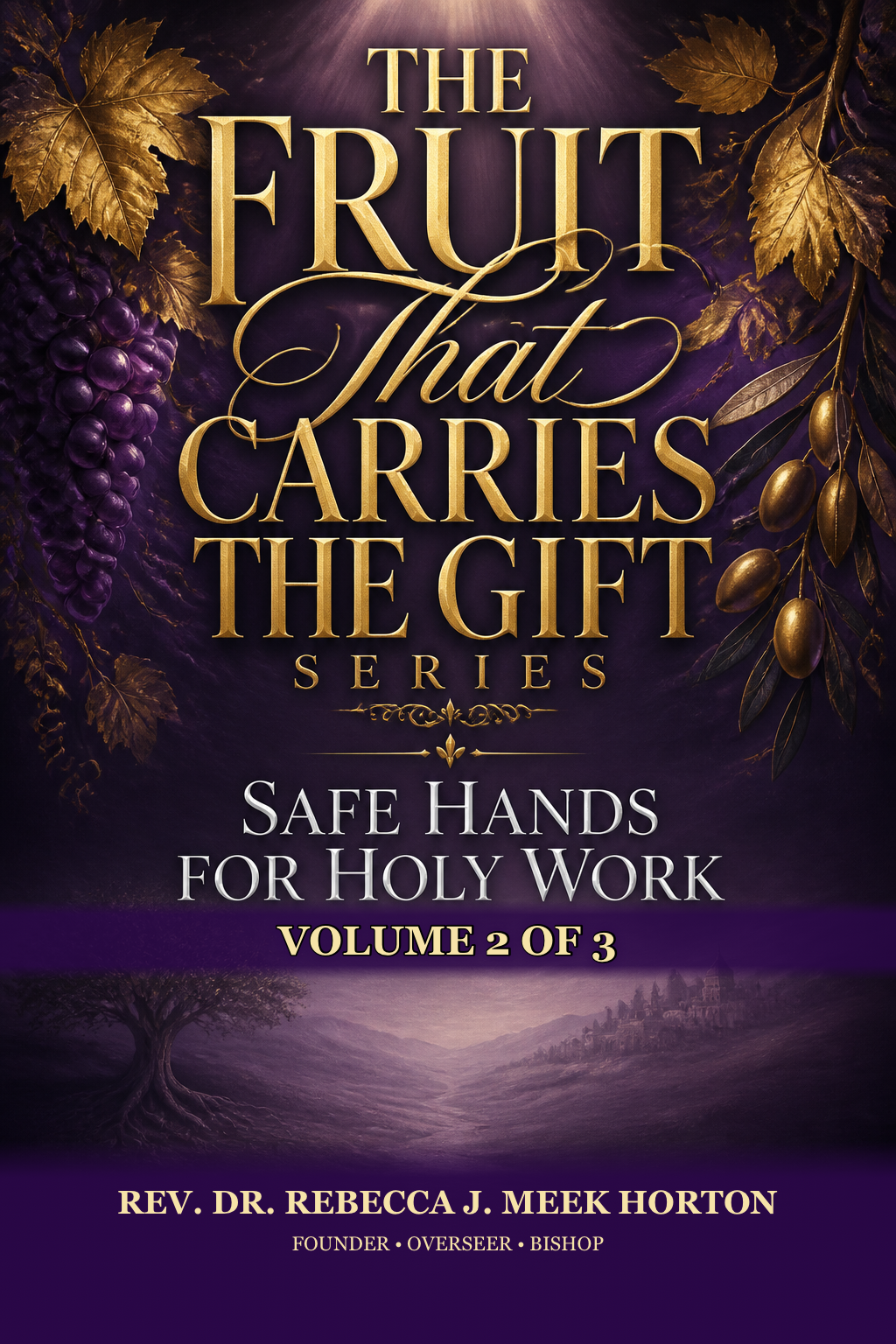
The Fruit That Carries the Gift · Volume 2
Safe Hands for Holy Work
Part 2 of 3 in the series "The Fruit That Carries the Gift". Series theme: Needed for Ministry Series arc: This three-book series moves from root to practice to stewardship. Book One establishes the inner life of abiding and the first governing expressions of Fruit; Book Two brings the Fruit into pressure, conflict, boundaries, and daily ministry reliability; Book Three shows how Spirit-formed character must govern gifts, teams, systems, and lasting service. Together, the books teach that ministry is safest and most fruitful when character carries charisma. How this book advances the series: After the root is established, this book shows whether Fruit can govern the hands, mouth, timing, motives, and boundaries of actual service. This book focuses on Fruit under pressure: longsuffering, kindness, goodness, faithfulness, meekness, and self-control. It brings formation into real ministry situations involving delay, correction, conflict, ethical decisions, follow-through, boundaries, repair, and safeguarding. It should draw from Months Five through Ten and the formation worksheets, while expanding beyond the source with ministry case studies, decision-readiness practices, conflict repair models, and practical guidance for serving without enabling harm or creating dependency.
Full publication
NBCNGMI MASTER KNOWLEDGE LIBRARY Featuring the works of The Sage, Apostle Prophet. Rev. Dr. Rebecca J. Meek Horton, Apostolic Prophetic Architect, NewBeing Creation Network Global Ministries, Inc. Integrated Framework Modalities™
Dedication
To every servant who has learned that holy work requires clean hands, guarded words, patient timing, and a yielded heart. I dedicate this book to those who still desire to serve well, even when the work is heavy, the correction is humbling, and love must become both tender and wise.
Purpose
I wrote this book for servants who want their hands to be safe for holy work, especially when ministry becomes slow, tense, costly, or misunderstood. My hope is that longsuffering, kindness, goodness, faithfulness, meekness, and self-control will become more than words from Galatians 5:22-23; I pray they become the way you speak, decide, repair, set boundaries, and keep showing up. May this book help you serve with love, without enabling harm, carrying the gift with character that can be trusted.
Preface
I wrote this book for the servant who truly wants to help, but has learned that desire alone is not enough.
Holy work requires safe hands.
I have seen sincere people love God, carry gifts, speak with passion, and still wound others because their formation had not yet reached their pressure points. I have also seen quiet, steady servants carry the heart of Christ into hard rooms because the Fruit of the Spirit governed their mouth, their timing, their correction, their boundaries, and their follow-through.
This second book in The Fruit That Carries the Gift begins where the root has already been planted. Now we ask a harder question: can the Fruit remain when ministry becomes uncomfortable?
Can longsuffering stay when people delay, resist, or misunderstand?
Can kindness remain honest without becoming enabling?
Can goodness make ethical choices when compromise would be easier?
Can faithfulness keep showing up after the excitement fades?
Can meekness receive correction without collapse or defensiveness?
Can self-control hold the line when emotions rise?
Galatians 5:22-23 (KJV) But the fruit of the Spirit is love, joy, peace, longsuffering, gentleness, goodness, faith, Meekness, temperance: against such there is no law.
This book was born from the burden to see ministry become safer, steadier, and more faithful. Not safer because nothing hard is ever said. Not steadier because there is no conflict. Not faithful because everyone agrees. But safe because character governs power. Steady because wisdom governs movement. Faithful because love tells the truth and stays submitted to God.
Safe Hands for Holy Work is not written to shame those who have made mistakes in serving. We all need RE-Calibration™. We all need the Lord to search our motives, train our responses, and mature our stewardship. This book is an invitation to slow down, tell the truth, repair what can be repaired, and serve in a way that does not create dependency or ignore harm.
Nothing is random. Nothing is wasted.
May these pages help you carry holy work with clean hands, a guarded heart, a governed mouth, and a faithful next step.
Introduction
Ministry does not only ask what you carry. It asks how you carry it.
A gift can open a door. Character determines what happens after the door opens. A person may teach clearly, pray powerfully, organize well, counsel tenderly, or lead with visible strength. But if pressure exposes impatience, harshness, carelessness, inconsistency, pride, or impulse, the work becomes unsafe. Not always loudly. Sometimes quietly. A delayed response. A sharp word. A promise forgotten. A boundary crossed. A correction received poorly. A person helped in a way that creates dependence instead of maturity.
This is why the Fruit of the Spirit is not decoration for ministry. It is protection.
Galatians 5:22-23 (KJV) But the fruit of the Spirit is love, joy, peace, longsuffering, gentleness, goodness, faith, Meekness, temperance: against such there is no law.
Safe Hands for Holy Work is the second book in The Fruit That Carries the Gift series. Book One established the root: the inner life of abiding, love, joy, and peace. This book brings that root into the weight of actual service. Here we ask a more demanding question: Can the Fruit govern our hands, our mouth, our timing, our motives, and our boundaries when ministry becomes inconvenient?
This book focuses on Fruit under pressure: longsuffering, kindness, goodness, faithfulness, meekness, and self-control. These are not soft virtues. They are ministry safeguards. Longsuffering keeps us steady when people do not change quickly. Kindness keeps truth from becoming cruelty. Goodness protects ethical clarity when shortcuts look useful. Faithfulness turns intention into follow-through. Meekness keeps authority submitted to God. Self-control helps us serve without being ruled by urgency, emotion, attention, or fatigue.
Holy work needs safe hands.
Safe hands do not mean perfect hands. They mean yielded hands. Examined hands. Hands that can apologize. Hands that can pause. Hands that can tell the truth without wounding. Hands that can help without taking over. Hands that can set a boundary without withdrawing love.
This matters because ministry often places us near pain. People come with grief, confusion, need, immaturity, trauma, conflict, and hope. If we are not formed, we may mistake access for assignment, compassion for control, urgency for obedience, and exhaustion for faithfulness. We may try to become someone’s source instead of pointing them back to God. We may rescue what we were only called to steward.
This book will not teach you to serve less. It will teach you to serve more faithfully.
You will find Scripture, ministry case studies, reflection, decision-readiness practices, conflict repair models, and practical guidance for boundaries and safeguarding. Read it slowly. Do not read only to identify what others lack. Let the Word search your own patterns first. The safest servant is not the one who sees everyone else clearly while remaining unexamined. The safest servant is the one willing to be formed before being used.
Some chapters may comfort you. Others may correct you. Receive both as grace. Formation is not punishment. It is preparation. God does not waste pressure when we let Him use it.
As you read, keep one real place of service in mind. It may be your family, church, workplace, classroom, care role, leadership assignment, or hidden obedience. Ask honest questions there. Where am I patient? Where do I push? Where am I kind? Where do I avoid hard truth? Where am I faithful? Where have I overpromised? Where do I need to repair harm? Where do I need to stop helping in a way that keeps someone dependent?
The goal is not guilt. The goal is governed service.
1 Peter 4:10 (KJV) As every man hath received the gift, even so minister the same one to another, as good stewards of the manifold grace of God.
You have received something to steward. The gift is not the whole matter. The vessel matters too.
Begin with this simple next step: before reading the first chapter, name one current ministry pressure where you need the Fruit of the Spirit to govern your response. Write it down. Pray over it. Then read with that place open before God.
Chapter 1 — When the Work Gets Heavy
The folding chairs were still warm from the people who had just left.
A few cups sat half-full on the back table. Someone had forgotten a Bible in the second row. The prayer team was tired, the musicians were packing up, and one volunteer stood near the doorway with tears in her eyes because a conversation after service had gone wrong.
Nobody saw that part on the livestream.
They saw the singing. They heard the teaching. They watched the altar call. They may have noticed the gift.
But ministry is not only what happens when the room is full and the moment is strong. Ministry is also what happens afterward, when people are tired, expectations are high, feelings are tender, and the work still needs to be handled with care.
Every servant eventually meets the weight.
Delay comes.
Disappointment comes.
Correction comes.
Conflict comes.
Unseen labor comes.
The central idea of this chapter is simple: gifts may open doors, but only Spirit-formed Fruit can keep ministry safe under weight.
A gift can make room. A gift can draw attention. A gift can serve powerfully in a moment. But when pressure rises, the question is not only, “Can I do the work?” The deeper question is, “Can I carry the work without bruising people, distorting truth, or losing my soul?”
Galatians teaches us that the evidence of the Spirit’s work is not only power. It is Fruit.
Galatians 5:22-23 (KJV) But the fruit of the Spirit is love, joy, peace, longsuffering, gentleness, goodness, faith, Meekness, temperance: against such there is no law.
This book begins where service gets tested. Not in theory. Not in desire. Not in the first yes.
Under weight.
The Weight Always Comes
Most people begin serving with some measure of hope.
They want to help. They want to bless. They want to answer God. They want their life to matter in the lives of others.
That desire is good. It should be honored.
But desire alone does not prepare us for the heaviness of holy work.
A children’s ministry worker may start with joy, then discover that consistency is harder than enthusiasm. A prayer leader may love intercession, then become weary when people keep returning with the same wounds and choices. A teacher may enjoy study, then face correction when something was spoken too quickly or without enough care. A pastor, mentor, musician, usher, small-group leader, caregiver, or volunteer may all meet the same hidden pressure: the work is holy, but the people are human.
And so are we.
There is a kind of heaviness that comes when results are slow. You pour into someone, and they seem to move forward, then backward. You pray, plan, teach, call, check in, encourage, and still the growth appears small. If longsuffering is not being formed in you, you may begin forcing outcomes. You may push harder than grace allows. Or you may withdraw and call it wisdom when it is really fatigue.
There is a kind of heaviness that comes when people disappoint you. Someone you trusted mishandles responsibility. Someone you helped misunderstands your heart. Someone you served speaks against you. If kindness and meekness are not being formed in you, pain can turn your tone sharp. You may still say true things, but with a spirit that wounds.
There is a kind of heaviness that comes when you are corrected. A leader gives feedback. A participant says your words landed harshly. A decision you made needs to be revisited. If goodness and self-control are not being formed in you, defensiveness can rise faster than humility. You may protect your image instead of receiving RE-Calibration™.
There is a kind of heaviness that comes when nobody notices. You set up the room. You send the reminders. You clean what others leave. You show up early and stay late. You carry names in prayer that nobody knows you are carrying. If faithfulness is not being formed in you, hidden service can begin to feel like neglect.
This is not failure. This is the real place where ministry matures.
Heavy work does not create the Fruit of the Spirit, but it often reveals where Fruit still needs to grow.
The pressure is not random. The weight is not wasted. It can become a place of formation if we let the Holy Spirit search us before we serve from reaction.
Gifts Open Doors, Fruit Carries Weight
A spiritual gift can be visible long before character is mature.
A person may teach clearly but still speak carelessly in conflict. A person may pray with passion but fail to follow through on ordinary commitments. A person may lead with confidence but avoid apology. A person may discern accurately but lack gentleness in delivery. A person may be generous in public but impatient in private.
This is why the Fruit matters.
The Fruit of the Holy Spirit is not decoration for the believer’s life. It is evidence of yieldedness. It is the character of Christ being formed in ordinary decisions, strained relationships, delayed answers, and difficult moments.
In this second part of the series, we are paying attention to six expressions of Fruit under pressure: longsuffering, kindness, goodness, faithfulness, meekness, and self-control. These are not private virtues only. They are ministry safeguards.
Longsuffering helps us stay present without forcing outcomes.
Kindness helps us serve people without losing truth.
Goodness helps us do what is right when it costs.
Faithfulness helps us become dependable in small things.
Meekness helps us carry strength without bruising others.
Self-control helps us guard the mouth, motives, and moment.
Together, these Fruit expressions make our service safer.
Consider a gifted counselor in a church setting. People trust her because she listens well and seems to understand pain. But over time, she begins answering late-night messages immediately, making herself constantly available, and becoming the emotional center of other people’s decisions. At first, it looks compassionate. Then exhaustion comes. Resentment grows. Boundaries blur. People become dependent on her presence instead of learning to walk with God, Scripture, wise counsel, and responsible next steps.
The gift opened the door.
But Fruit must govern the way she stays in the room.
Longsuffering does not mean endless access. Kindness does not mean rescuing. Goodness does not mean avoiding hard truth. Faithfulness does not mean saying yes to everything. Meekness does not mean having no authority. Self-control does not mean silence when action is needed.
Fruit is not weakness. Fruit is governed strength.
When Fruit carries the gift, people are served without being possessed. Truth is spoken without being weaponized. Help is offered without creating dependency. Correction is given without humiliation. Boundaries are held without cruelty.
This is safe service.
Not perfect service. Safe service.
Safe does not mean everyone always feels comfortable. Safe means the servant is being governed by the Spirit, anchored in truth, and willing to act with humility, clarity, and responsibility.
Pressure Reveals What Is Governing Us
Pressure has a way of exposing our hidden governors.
By governor, we mean the inner force that is actually directing our response. We may say we are being led by love, but pressure may reveal fear. We may say we are standing for truth, but pressure may reveal pride. We may say we are being faithful, but pressure may reveal people-pleasing. We may say we are protecting peace, but pressure may reveal avoidance.
This is why we must learn to pause and see what is really happening.
A leader receives a message on Sunday afternoon: “I was hurt by what you said today.”
One response is immediate defense: “That is not what I meant. You misunderstood me.”
Another response is collapse: “I always mess things up. Maybe I should stop serving.”
Another response is avoidance: no reply, no repair, no conversation.
But a Fruit-formed response slows down.
It may sound like this: “Thank you for telling me. I want to understand. Can we talk at a time when we can both speak carefully?”
That response does not admit guilt falsely. It does not surrender truth. It does not allow accusation to rule. But it does make room for humility, listening, and repair.
This is where SAPP™ Discernment becomes a helpful practice. We See the situation truthfully. We Ask the deeper questions. We Ponder the motives and costs. We Practice the next faithful step.
What is really happening?
What did I intend?
What was actually heard?
What does love require now?
What does truth require now?
What response would protect the person, the work, and my own integrity?
The unformed self reacts to pressure.
The Spirit-formed servant learns to respond.
That difference matters because ministry involves people at tender points: grief, sin, confusion, hope, trauma, repentance, calling, family strain, spiritual hunger. If we serve from impulse, we may increase the burden instead of helping carry it.
Paul reminds us that the treasure is carried in earthen vessels. That phrase should keep every servant humble.
2 Corinthians 4:7-9 (KJV) But we have this treasure in earthen vessels, that the excellency of the power may be of God, and not of us. We are troubled on every side, yet not distressed; we are perplexed, but not in despair; Persecuted, but not forsaken; cast down, but not destroyed;
We carry treasure, but we are still earthen vessels.
That means we need formation. We need correction. We need limits. We need prayer. We need Scripture. We need counsel. We need RE-Calibration™ when our reactions begin to outrun wisdom.
The presence of a gift does not remove the need for maturity.
The presence of pressure does not excuse immaturity.
The Holy Spirit is able to form us in the very places where we are tempted to react.
Heavy Work Needs Safe Hands
Holy things should not be carried carelessly.
People’s stories are holy ground. Their pain is not material for our platform. Their trust is not a resource to spend for our importance. Their vulnerability is not permission for control. Their need is not an invitation to become their savior.
We are servants.
That word must stay clean in us.
A servant does not own the people. A servant does not use the work to feed ego. A servant does not hide harm behind spiritual language. A servant does not confuse being needed with being fruitful.
Safe hands remember that the work belongs to God.
That does not make us passive. It makes us careful.
Imagine someone confesses a struggle in a small group. The room becomes quiet. The leader feels the weight of the moment. A careless leader may rush to fix, preach, expose details, or make promises the group cannot keep. A fearful leader may change the subject and leave the person alone in their courage. A safe leader breathes, honors the person, protects the room, and takes the next faithful step.
They might say, “Thank you for trusting us with that. We will not handle it casually. Let us pray, and then I will connect with you after group so we can consider wise support.”
That is not dramatic. It is responsible.
Safe hands do not have to perform importance.
Safe hands know when to speak, when to pause, when to refer, when to report, when to apologize, when to ask for help, and when to say, “This is beyond what I can carry alone.”
This matters in every area of ministry.
When we handle money, goodness must govern us.
When we handle confidential information, self-control must govern us.
When we handle conflict, meekness must govern us.
When we handle delay, longsuffering must govern us.
When we handle wounded people, kindness must govern us.
When we handle commitments, faithfulness must govern us.
The Fruit does not make ministry soft. It makes ministry trustworthy.
Jesus described His own way with words that should search every servant who carries responsibility.
Matthew 11:29-30 (KJV) Take my yoke upon you, and learn of me; for I am meek and lowly in heart:and ye shall find rest unto your souls. For my yoke is easy, and my burden is light.
The Lord Jesus is not careless with power. He is meek and lowly in heart.
If He carries authority that way, we cannot justify harshness as strength. We cannot call impatience discernment. We cannot call control leadership. We cannot call exhaustion faithfulness when wisdom is asking us to receive limits.
To serve in safe hands is to let Christ’s way govern our way.
The Cost of Being Formed Under Weight
This kind of service will cost us.
It will cost us the right to react quickly just because we feel strongly.
It will cost us the comfort of being seen as right all the time.
It will cost us the false peace of avoiding hard conversations.
It will cost us the pride of being needed by everyone.
It will cost us the habit of saying yes when God is requiring a wise no.
It will cost us image, speed, convenience, and sometimes applause.
Fruit grows slowly. It grows through yielding. It grows when we let the Spirit address not only what we do, but how we do it.
This is not easy work.
There will be moments when patience feels like being overlooked. Kindness feels undeserved. Goodness feels expensive. Faithfulness feels boring. Meekness feels misunderstood. Self-control feels like swallowing fire.
But the alternative is costly too.
Without longsuffering, we pressure people into outcomes they are not ready to steward.
Without kindness, we make truth harder to hear than it needs to be.
Without goodness, we protect systems, reputations, or loyalties at the expense of righteousness.
Without faithfulness, people learn not to trust our words.
Without meekness, our strength becomes a source of bruising.
Without self-control, our mouths, emotions, and impulses can damage what we were called to serve.
The cost of formation is real.
The cost of unformed ministry is greater.
So we begin honestly. We do not pretend the work is light when it is heavy. We do not pretend we are mature in areas where pressure still exposes us. We do not shame ourselves for needing growth. We bring the truth into the light and ask the Holy Spirit to form what the work requires.
James 1:4 (KJV) But let patience have her perfect work, that ye may be perfect and entire, wanting nothing.
There is a work patience does in us that speed cannot do.
There is a work correction does in us that praise cannot do.
There is a work hidden service does in us that public opportunity cannot do.
There is a work conflict does in us that agreement cannot do.
If we allow it, the heavy place can become holy formation.
Not because pain is good in itself. Not because every burden is ours to carry. Not because harm should be tolerated. But because God is able to use pressure to reveal, refine, and mature what must be strengthened for safe service.
This is where the journey of this book begins.
Not with the question, “How gifted am I?”
But with better questions:
Can I remain present when growth is slow?
Can I speak truth with tenderness?
Can I choose what is right when it costs?
Can I be trusted in small things?
Can I carry strength without bruising?
Can I slow down before I speak, promise, confront, post, or act?
These are not questions of personality. They are questions of Fruit.
And the Fruit of the Spirit is not manufactured by human striving. It is produced as we yield to the Spirit’s work.
Our part is to stay available, honest, obedient, and willing to be formed.
Key Takeaways
• Gifts may open doors, but Fruit keeps ministry safe under weight.
• Pressure reveals what is governing our responses.
• Safe service requires humility, truth, limits, and Spirit-formed character.
Practice
Before you serve again, take ten quiet minutes for a simple RE-Flection™.
Write down one current ministry pressure: delay, disappointment, correction, conflict, or unseen labor.
Then answer one question honestly:
What is this pressure revealing in me that the Holy Spirit may want to form?
Do not fix everything today. Name one next faithful step, and take it.
Chapter 2 — Safe Hands Carry Holy Things
A nurse once told me the heaviest thing she ever carried was not a tray of medicine. It was trust.
She could lift the tray with one hand. But trust required both hands, a clear mind, a steady heart, and the humility to check the label twice. A small mistake could harm someone. A rushed assumption could change a life. So she learned to slow down, not because she was fearful, but because what she carried mattered.
Holy work is like that.
People bring us more than schedules, questions, prayer requests, and assignments. They bring wounds, hopes, confusion, callings, grief, children, marriages, secrets, and fragile beginnings of faith. They bring what is tender. They bring what is not yet strong. They bring what God is touching.
The controlling idea of this chapter is simple: the Holy Spirit can form servants whose hands, words, timing, motives, and boundaries become trustworthy under the weight of ministry.
This is the promise of this book.
Not that we will never be tired. Not that we will never make mistakes. Not that ministry will become light and easy. But that the Fruit of the Spirit can become visible reliability in ordinary service.
Galatians names the Fruit clearly.
Galatians 5:22-23 (KJV) But the fruit of the Spirit is love, joy, peace, longsuffering, gentleness, goodness, faith, Meekness, temperance: against such there is no law.
These are not decorative qualities for private devotion only. They are not spiritual ornaments we admire from a distance. They are the evidence of the Spirit’s work in the life of a believer. They become the way we carry people, decisions, correction, pressure, delay, and responsibility.
Longsuffering steadies us when outcomes are slow.
Kindness keeps our care human.
Goodness makes us choose what is right.
Faithfulness makes us dependable.
Meekness governs our strength.
Self-control guards the moment before damage is done.
Together, these make ministry safer.
The Weight in Ordinary Hands
Most holy work does not look dramatic while it is happening.
It looks like answering a message with care. Showing up when you said you would. Keeping a confidence. Telling the truth without humiliating someone. Refusing to use influence for personal advantage. Waiting before correcting. Apologizing when your tone wounded someone. Saying no before resentment becomes bitterness.
These moments may seem small, but they carry weight.
A children’s ministry volunteer arrives early and notices one child sitting apart from the others. The easy thing is to rush into the lesson because the schedule is tight. The safe thing is to pause, kneel down, and ask gently, “Are you okay today?” That moment may not appear in a report, but it may become the first place that child feels seen.
A ministry leader receives criticism after a long week. The quick response is defense. The safe response is to breathe, listen, and separate the pain of being corrected from the value of what may need to be corrected.
A prayer team member hears sensitive information. The tempting thing is to share it as a “concern” with someone who was never entrusted with it. The safe thing is to protect what was placed in confidence and pray without exposing.
This is where Fruit becomes reliability.
We often think of gifts as what make ministry effective. Teaching, preaching, administration, hospitality, intercession, leadership, music, discernment, and mercy all matter. Gifts serve the body. But gifts without formed character can become unsafe in the hands of an ungoverned servant.
A gifted person may gather people quickly.
A fruitful person can carry them carefully.
A gifted person may speak powerfully.
A fruitful person knows when silence is wiser.
A gifted person may see what is wrong.
A fruitful person can address it without crushing the person.
Holy things require more than ability. They require stewardship.
Paul wrote to the Corinthians about this kind of responsibility.
1 Corinthians 4:2 (KJV) Moreover it is required in stewards, that a man be found faithful.
Faithfulness is not glamorous, but it is required. Stewardship is not ownership. We do not own the people we serve. We do not own the work. We do not own the outcome. We are entrusted with a portion, for a season, under God.
That truth changes the way we hold everything.
Fruit Makes Service Trustworthy
Fruit does not remove pressure. It governs us inside pressure.
This matters because ministry reveals what is still unformed in us. Delay reveals whether we will manipulate. Conflict reveals whether we will retaliate. Authority reveals whether we will control. Access reveals whether we will honor boundaries. Correction reveals whether we love truth more than image.
The Fruit of the Spirit is not merely how we feel when life is calm. It is how the Spirit forms Christlike responses when life presses against us.
Longsuffering keeps us present when people are slow to change. It does not mean we ignore harm or pretend everything is fine. It means we do not use pressure, shame, or spiritual force to produce what only God can grow.
Kindness gives warmth to truth. It keeps ministry from becoming cold, mechanical, or harsh. Kindness does not flatter. It does not lie. It does not avoid hard conversations. It simply refuses to treat people as problems to manage.
Goodness chooses righteousness in action. It asks, “What is right before God?” not only, “What will keep people pleased?” Goodness protects the work from hidden compromise.
Faithfulness brings consistency. It keeps promises small enough to honor. It follows through. It does not make people chase us for what we agreed to do.
Meekness is strength under holy government. It can correct without bruising. It can lead without dominating. It can hold authority without needing to prove importance.
Self-control guards the mouth, the motive, and the moment. It slows the hand before sending the message. It checks the heart before making the promise. It waits before speaking in anger.
Consider a small church team preparing for an outreach. One person is gifted in planning but impatient with others. Another is compassionate but avoids necessary details. Another is faithful but quiet. Another is creative but inconsistent.
The outreach will not be protected by talent alone.
It will be protected when the planner practices longsuffering, the compassionate servant practices goodness with structure, the quiet faithful one is honored instead of overlooked, and the creative servant learns self-control in commitments. The team becomes safer when Fruit governs function.
That is ministry reliability.
Reliability is not perfection. It is the growing evidence that others can trust how we carry responsibility. They do not have to wonder which version of us will show up. They do not have to prepare for our moods. They do not have to recover from our ungoverned reactions before they can receive our service.
This is one reason spiritual formation is not private only. What is formed in secret eventually touches people in public.
Jesus taught that fruit reveals the tree.
Matthew 7:17-18 (KJV) Even so every good tree bringeth forth good fruit; but a corrupt tree bringeth forth evil fruit. A good tree cannot bring forth evil fruit, neither can a corrupt tree bring forth good fruit.
The issue is not performance. The issue is source.
We do not manufacture the Fruit of the Spirit through personality management. We yield to the Spirit’s work. We repent where we are misaligned. We receive correction. We practice obedience. We allow God to form in us what our assignments will require from us.
Safe service grows from yielded lives.
Trust Is Built in Repeated Moments
Trust is usually built slowly.
It is built when your yes means yes. It is built when you tell the truth about your limits. It is built when you do not use someone’s vulnerability as conversation material. It is built when you correct privately instead of humiliating publicly. It is built when you refuse to promise what you cannot steward.
There is a holy strength in being consistent.
A young man once volunteered to help with setup every week. At first, no one thought much of it. He moved chairs, checked supplies, swept floors, and stayed after others left. Months passed. People began to notice something. He was not trying to be seen, but he could be counted on.
Eventually, when a more visible role opened, the leaders trusted him. Not because he was loud. Not because he demanded opportunity. But because his life had already been preaching reliability.
Small things tell the truth.
Luke 16:10 (KJV) He that is faithful in that which is least is faithful also in much: and he that is unjust in the least is unjust also in much.
This verse does not mean small things are unimportant. It means small things reveal how we handle weight.
If we are careless with small confidences, we may be unsafe with deeper ones.
If we are careless with time, we may burden others with our disorder.
If we are careless with words, we may injure people while claiming to help them.
If we are careless with authority, we may confuse control with leadership.
But the opposite is also true.
If we learn to be faithful in small responsibilities, we become safer for larger ones. If we learn to pause before reacting, people experience steadier care. If we learn to keep our word, people do not have to live under uncertainty. If we learn to repair when we have caused harm, people see humility instead of image protection.
Trust is not built by title. It is built by stewardship.
This does not mean every person will trust us. Some people carry wounds that make trust difficult. Some will misread boundaries as rejection. Some will confuse accountability with unkindness. Some will want access we cannot responsibly give.
Still, we are responsible for becoming trustworthy.
That means we do not measure our safety by applause. We measure it by alignment with God, integrity in conduct, and care for the people entrusted to us.
The Holy Spirit forms servants who can carry both compassion and clarity.
Compassion says, “I see you.”
Clarity says, “This is what I can responsibly carry.”
Compassion says, “You matter.”
Clarity says, “I cannot become your source.”
Compassion says, “I will help.”
Clarity says, “I will not enable harm.”
This balance matters. Without compassion, ministry becomes cold. Without clarity, ministry becomes unsafe.
Safe hands know the difference between serving people and becoming the center of their dependence.
Boundaries Belong to Holy Work
Some servants feel guilty for having limits.
They think love means unlimited availability. They think kindness means saying yes. They think faithfulness means never resting. They think meekness means never confronting. They think self-control means swallowing every concern until the body and soul begin to protest.
But holy work does not require the destruction of the servant.
Jesus Himself withdrew to pray. He served with compassion, but He was not controlled by every demand. He moved with purpose, not panic.
Mark 1:35-38 (KJV) And in the morning, rising up a great while before day, he went out, and departed into a solitary place, and there prayed. And Simon and they that were with him followed after him. And when they had found him, they said unto him, All men seek for thee. And he said unto them, Let us go into the next towns, that I may preach there also: for therefore came I forth.
“All men seek for thee” sounds urgent.
Jesus did not ignore need, but He did not surrender His assignment to demand. He remained governed by the Father.
This is important for everyone who serves.
Need is real, but need is not always instruction.
Urgency is loud, but urgency is not always wisdom.
Access may be requested, but access must still be stewarded.
A safe servant learns to ask better questions before moving. What is mine to carry? What belongs to another leader, parent, pastor, counselor, or trained professional? What can I offer without creating dependency? What limit would protect both the person and the work? What does love require here, not just relief?
Boundaries are not the opposite of love. They are one way love remains clean.
A mentor who answers every late-night emotional crisis may feel compassionate at first. Over time, the pattern may train the person to bypass prayer, community, responsibility, and appropriate care. The mentor becomes exhausted. The person becomes dependent. What began as help becomes unhealthy attachment.
A safer response might be, “I care about you, and I want you supported. I cannot continue late-night crisis conversations, but I can help you identify appropriate support and we can talk at our scheduled time.”
That is not abandonment.
That is stewardship.
In ministry, boundaries protect the vulnerable, the servant, and the witness of the work. They help prevent confusion. They reduce secrecy. They honor proper roles. They keep compassion from becoming control.
This is part of Fruit under pressure.
Longsuffering helps us stay patient with the discomfort of limits.
Kindness helps us communicate boundaries without cruelty.
Goodness helps us choose what is right, even if someone is displeased.
Faithfulness helps us keep the boundary consistently.
Meekness helps us hold the line without pride.
Self-control helps us resist rescuing when rescuing would harm.
Safe hands do not grab what God has not assigned.
Safe hands receive, carry, and release with reverence.
The Cost of Becoming Trustworthy
There is a cost to becoming a safe servant.
We will have to slow down when our flesh wants to rush. We will have to tell the truth when image wants to hide. We will have to apologize without explaining away the wound. We will have to say no and disappoint people. We will have to let God form us in hidden places before asking Him to expand visible influence.
This is not easy.
Some of us are used to being needed. Boundaries may feel like loss. Some of us are used to being praised for overextending. Rest may feel like failure. Some of us are used to speaking quickly. Silence may feel like weakness. Some of us are used to fixing. Waiting may feel like neglect.
But Fruit often grows where old patterns are interrupted.
Nothing is random. Nothing is wasted. Even pressure can become a place of formation when we bring it under the Spirit’s care.
Paul gives a picture of vessels prepared for honorable use.
2 Timothy 2:20-21 (KJV) But in a great house there are not only vessels of gold and of silver, but also of wood and of earth; and some to honour, and some to dishonour. If a man therefore purge himself from these, he shall be a vessel unto honour, sanctified, and meet for the master's use, and prepared unto every good work.
Prepared unto every good work.
That preparation includes skill, but it is deeper than skill. It includes cleansing, surrender, humility, correction, and disciplined obedience. It includes the willingness to let God address what people may not see yet but ministry pressure will eventually reveal.
We do not become safe by pretending we are already safe.
We become safe by yielding.
We let the Spirit search our motives. We receive wise counsel. We repair when we fail. We study Scripture carefully before using it to advise others. We practice telling the truth without drama. We practice keeping commitments. We practice waiting before responding. We practice naming our limits.
This is not self-improvement dressed in spiritual language. This is stewardship under God.
A servant may pray, “Lord, use me.” That is a holy prayer.
But this book invites another prayer beside it: “Lord, form me so I can carry well what You entrust to me.”
That prayer is quieter.
It may not feel exciting.
But it is necessary.
Because people do not only need gifted hands.
They need safe hands.
They need hands that do not mishandle pain.
They need words that do not confuse truth with harshness.
They need timing that does not force what God is still growing.
They need motives that do not turn service into self-importance.
They need boundaries that protect rather than punish.
This is the promise: the Holy Spirit can form this in us.
Not all at once. Not without our participation. Not without repentance and practice. But truly.
The Fruit of the Spirit can move from language to life. It can become the way we lead meetings, answer messages, correct errors, carry secrets, make decisions, handle disappointment, and serve when no one applauds.
This is ministry reliability.
This is character carrying charisma.
This is holy work held in safer hands.
Key Takeaways
• The Fruit of the Spirit makes ministry trustworthy under pressure.
• Safe service requires formed hands, words, timing, motives, and boundaries.
• Reliability is built through repeated obedience in ordinary moments.
Practice
Before your next act of service, pause for five minutes and write one sentence for each question:
What am I carrying?
What limit must I honor?
Which Fruit expression do I need most today: longsuffering, kindness, goodness, faithfulness, meekness, or self-control?
Then pray simply: “Holy Spirit, form me to carry this well.”
Chapter 3 — Longsuffering: Staying Present Without Forcing Outcomes
The chairs were still out after the meeting.
A few people had gone home encouraged. One person had left angry. Another had promised, again, to come next week and take the next step. The leader stood near the back wall with a trash bag in one hand and a question in the other: How long do I keep showing up when nothing seems to change?
Every servant eventually asks that question.
It may come after months of mentoring someone who still repeats the same pattern. It may come after giving wise counsel that is ignored. It may come after praying, preparing, correcting gently, forgiving again, and watching growth move slower than you hoped.
This is where longsuffering becomes more than a word in a list. It becomes the strength to remain faithful without controlling the result.
Galatians 5:22-23 (KJV) But the fruit of the Spirit is love, joy, peace, longsuffering, gentleness, goodness, faith, Meekness, temperance: against such there is no law.
Longsuffering is Spirit-formed endurance under pressure. It helps us serve through delay, difficult people, slow growth, and unanswered questions without manipulating, withdrawing, enabling harm, or pretending avoidance is faith.
It does not make us passive.
It makes us steady.
The Slow Work Is Still Holy Work
Most ministry does not grow at the speed of our concern.
We may want quick repentance, quick maturity, quick reconciliation, quick stability, quick fruit. Sometimes God does move suddenly. But much of His formation is slow, hidden, layered, and deeply personal.
A seed does not become a tree because someone stands over it anxiously. It needs soil, water, light, time, and protection. Ministry often works the same way. We can plant. We can water. We can tend. But we cannot force life.
Paul named this clearly.
1 Corinthians 3:6-7 (KJV) I have planted, Apollos watered; but God gave the increase. So then neither is he that planteth any thing, neither he that watereth; but God that giveth the increase.
This truth humbles the servant.
It reminds us that ministry is real work, but it is not ultimate control. We are responsible for faithfulness. God is responsible for increase.
Think of the person who comes to you after a hard season. They want help, but they are not yet ready for full obedience. You listen. You pray. You speak truth. You give one clear next step. Then they return two weeks later with the same wound and the same resistance.
Longsuffering does not say, “It does not matter.”
It also does not say, “I will make you change.”
It says, “I will stay truthful, prayerful, and properly present while God works. I will not abandon you because growth is slow, and I will not take God’s place because I am impatient.”
That distinction matters.
When we forget it, we either quit too soon or press too hard. We become frustrated with process. We start measuring our worth by someone else’s response. We may become harsh, over-involved, or quietly resentful.
Longsuffering brings us back to order.
Nothing is random. Nothing is wasted. Even the slow places can teach us how to serve without grasping.
Patient Service Is Active, Not Passive
Some people confuse patience with doing nothing.
But biblical patience is not laziness. It is not fear dressed in spiritual language. It is not silence when truth should be spoken. It is not leaving people unprotected because confrontation feels uncomfortable.
Longsuffering is active endurance. It keeps obeying while waiting.
Romans 5:3-4 (KJV) And not only so, but we glory in tribulations also: knowing that tribulation worketh patience; And patience, experience; and experience, hope:
Patience is worked in us. It is formed under weight. It becomes experience, and experience becomes hope.
In ministry, active patience may look like preparing again when attendance has been low. It may look like following up without chasing. It may look like correcting a volunteer privately instead of exposing them publicly. It may look like giving someone space to respond while still keeping the agreed boundary in place.
A small ministry team once had a helper who often arrived late. At first, everyone covered for her. Then frustration grew. One leader wanted to remove her immediately. Another wanted to say nothing in the name of grace.
Neither response was fully patient.
Longsuffering led a different way.
The leader met with her calmly. She named the pattern. She asked what was happening. She clarified the importance of timing because people were depending on the role. Then she offered a smaller assignment for a season, with a clear expectation.
That was patience with structure.
No shaming. No enabling. No pretending.
This is what safe service requires. We do not use patience as an excuse to avoid responsibility. We do not use responsibility as an excuse to become severe.
Longsuffering asks, “What is the next faithful step?”
Sometimes the next step is to wait.
Sometimes it is to speak.
Sometimes it is to adjust the assignment.
Sometimes it is to pause access.
Sometimes it is to keep praying after there is nothing more to say.
Patient service stays awake. It pays attention to fruit, timing, motive, and cost. It does not rush the Holy Spirit. It also does not ignore what is plainly happening.
People Are Not Projects To Be Managed
The pressure to produce outcomes can make us treat people like assignments instead of souls.
We may not mean to do it. It can happen quietly. We begin thinking, If they would just listen to me, they would be better. If they would just follow the plan, this would be easier. If they would just change, I could feel successful.
That is a warning sign.
When our peace depends on another person’s progress, we may begin serving from control instead of love.
Longsuffering helps us remember that people belong to God. They are not proof of our gifting. They are not trophies of our counsel. They are not burdens for us to carry without limit. They are persons made in the image of God, accountable to God, invited by God, and loved by God.
James gives us the image of a farmer.
James 5:7-8 (KJV) Be patient therefore, brethren, unto the coming of the Lord. Behold, the husbandman waiteth for the precious fruit of the earth, and hath long patience for it, until he receive the early and latter rain. Be ye also patient; stablish your hearts: for the coming of the Lord draweth nigh.
The farmer waits, but he does not control the rain.
He prepares the ground. He watches the season. He protects what he can. But he knows there are parts of growth that are not in his hands.
This is a holy lesson for anyone who serves.
Consider a mentor walking with a young believer who keeps struggling with the same decision. The mentor can teach Scripture. She can ask honest questions. She can help the person see patterns. She can encourage repentance and responsibility. But she cannot obey for them.
If she tries, she may create dependency.
The person may begin needing her approval for every decision. The mentor may begin feeling needed in a way that feeds her own insecurity. What began as help can become unhealthy attachment.
Longsuffering does not rescue people from the responsibility God is using to mature them.
It serves without becoming the source.
There is a difference between support and control.
Support says, “I will walk with you as you take the next faithful step.”
Control says, “I will take the step for you so I can feel relief.”
Support builds maturity.
Control builds dependency.
Safe hands know the difference.
This also helps us with difficult people. Some people test patience through criticism, inconsistency, emotional intensity, or resistance to counsel. Longsuffering does not require us to absorb everything without wisdom. It calls us to respond from the Spirit instead of reacting from injury.
We can be gentle without being governed by someone else’s volatility.
We can be available without being endlessly accessible.
We can care without carrying what belongs to God and to the other person.
This is not coldness. It is stewardship.
The Cost Of Refusing To Force
Longsuffering has a cost.
It costs the ego the pleasure of quick results. It costs the flesh the satisfaction of proving a point. It costs the anxious heart the illusion of control. It costs the servant the right to use pressure, guilt, fear, or emotional force to get a response.
This is hard because forcing often feels efficient.
A sharp word may produce immediate silence. Pressure may produce quick agreement. Shame may produce outward compliance. Over-helping may produce temporary relief.
But none of these are the same as transformation.
Forced outcomes often create hidden damage. People may comply while growing fearful, resentful, dependent, or dishonest. They may learn to perform for approval instead of walking in truth.
Longsuffering refuses that shortcut.
It chooses the slower road of truth, prayer, clear boundaries, and faithful presence.
Galatians 6:9 (KJV) And let us not be weary in well doing: for in due season we shall reap, if we faint not.
This verse does not deny weariness. It speaks to it.
There are seasons when doing well becomes tiring. You keep showing up. You keep serving. You keep forgiving. You keep telling the truth in love. You keep doing the unseen labor that no one applauds.
The danger is not only quitting. The danger is changing methods because we are tired.
We may begin manipulating because patience feels too slow. We may withdraw because disappointment feels too heavy. We may call avoidance “waiting on God” when we are really afraid to act. We may call enabling “love” because we do not want someone to be upset with us.
Longsuffering requires honest discernment.
Waiting is faithful when God has not released you to move, when the process needs time, and when your continued presence is helping maturity form.
Waiting becomes avoidance when truth has been delayed, harm is being ignored, responsibility is being refused, or fear is making the decision.
This is where servants must slow down and ask better questions.
What is really happening here?
Am I being patient, or am I afraid?
Am I giving time for growth, or am I allowing a harmful pattern to continue?
Am I trusting God, or am I trying to control the outcome quietly?
Have I spoken the truth I am responsible to speak?
Have I taken the step I am responsible to take?
Longsuffering does not remove the need for courage. It deepens it.
There may be times when patience requires continuing.
There may be times when patience requires releasing.
There may be times when patience requires a difficult conversation.
There may be times when patience requires saying, “I cannot keep serving in this same way if this pattern continues.”
The goal is not to stay in every situation forever. The goal is to remain Spirit-governed while you discern what faithfulness requires.
Jesus was longsuffering, but He was never manipulated. He was compassionate, but He did not enable unbelief. He was present with people, but He also withdrew to pray. He served deeply, but He did not surrender His assignment to the demands of the crowd.
Safe ministry learns from Him.
We do not force fruit.
We do not abandon fields too soon.
We do not confuse pressure with power.
We do not confuse patience with passivity.
We stay faithful, and we let God be God.
Key Takeaways
• Longsuffering is steady obedience under pressure.
• Patience serves actively without forcing change.
• Safe servants support growth without creating dependency.
Practice
Choose one ministry relationship or responsibility where you feel impatient, weary, or tempted to force an outcome.
Take ten quiet minutes and write answers to these four questions:
• What is mine to do faithfully?
• What belongs to God?
• What belongs to the other person?
• What is the next clear step I can take without pressure, fear, or withdrawal?
Then take that one step this week. Keep it simple. Speak truth if truth is needed. Wait if waiting is faithful. Adjust the structure if the current pattern is enabling harm. Pray, obey, and release the outcome back to God.