 NBCNGMI™
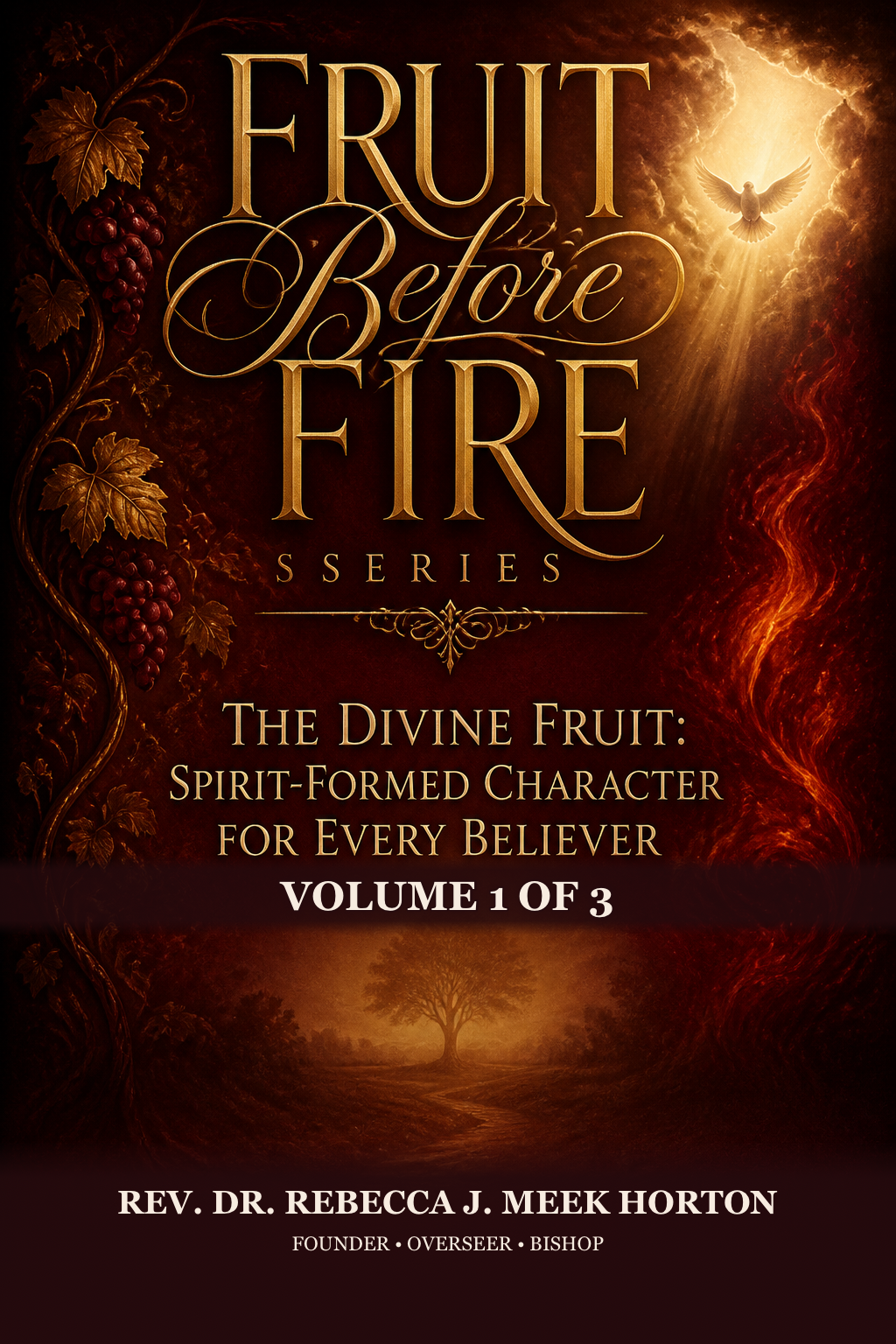
Fruit Before Fire · Volume 1
The Divine Fruit: Spirit-Formed Character for Every Believer — Its Companion Devotional/Journal
A companion devotional and journal for "The Divine Fruit: Spirit-Formed Character for Every Believer". Each chapter becomes five entries — a KJV Scripture reading, a devotional, a prayer, a journal prompt, and space to write — closing with An Apostolic Prophetic Architect Message and lined journal pages.
Full publication
NBCNGMI MASTER KNOWLEDGE LIBRARY Featuring the works of The Sage, Apostle Prophet. Rev. Dr. Rebecca J. Meek Horton, Apostolic Prophetic Architect, NewBeing Creation Network Global Ministries, Inc. Integrated Framework Modalities™
Dedication
I dedicate this devotional journal to every believer who desires to walk closer with the Holy Spirit and bear fruit that remains. May these pages become a quiet place of prayer, reflection, surrender, and Spirit-formed growth in the presence of God.
Purpose
I wrote this companion devotional and journal to help you slow down, sit with Scripture, and let the Fruit of the Spirit become more than a lesson you read — a life you practice.
My prayer is that each entry will guide you into honest RE-Flection™, Spirit-led growth, and one faithful next step as Galatians 5:22-23 becomes visible in your daily character.
May this book help you recognize where God is forming you, yield where He is correcting you, and walk forward with love, joy, peace, patience, kindness, goodness, faithfulness, gentleness, and self-control.
Preface
I wrote this companion devotional and journal because teaching is not complete until it becomes lived truth.
The Divine Fruit: Spirit-Formed Character for Every Believer was written to help us understand that the Fruit of the Holy Spirit is not a list of separate achievements. It is a single fruit with multiple attributes, produced in the life of a believer as we yield to the Spirit’s work. This companion was created to slow that teaching down and bring it closer to the heart.
Sometimes we read truth quickly, agree with it sincerely, and still move on unchanged. I did not want that for this work. I wanted space for Scripture to speak, for prayer to become personal, and for reflection to become practice.
Galatians 5:22-23 (KJV) But the fruit of the Spirit is love, joy, peace, longsuffering, gentleness, goodness, faith, Meekness, temperance: against such there is no law.
This journal is an invitation to sit with each attribute of the Fruit and ask honest questions. Where is the Spirit forming love in me? Where is joy being restored? Where is peace being tested? Where is patience costing me something? Where do kindness, goodness, faithfulness, gentleness, and self-control need to move from idea to obedience?
The goal is not performance. The goal is formation.
You will find five entries for each chapter: a KJV Scripture reading, a devotional, a prayer, a journal prompt, and space to write. Do not rush them. Let the Word have room. Let the Spirit search you before you try to apply the lesson to someone else.
John 15:5 (KJV) I am the vine, ye are the branches: He that abideth in me, and I in him, the same bringeth forth much fruit: for without me ye can do nothing.
My prayer is that this companion helps you abide. Not strive. Not pretend. Not compare. Abide.
Bring your real life to these pages. Bring your questions, your growth, your resistance, your hope, and your next faithful step. The Lord is able to form in us what we cannot manufacture in ourselves.
Nothing is random. Nothing is wasted. Let the Fruit be formed.
Introduction
This companion devotional and journal was created to help you slow down long enough for the Word to become practice.
The Divine Fruit is not a personality upgrade. It is not religious polish. It is Spirit-formed character produced in the life of a believer who yields to God’s work. The Fruit of the Holy Spirit is a single fruit with multiple attributes, and each attribute reveals what the Spirit is forming in us over time.
Galatians 5:22-23 (KJV) But the fruit of the Spirit is love, joy, peace, longsuffering, gentleness, goodness, faith, Meekness, temperance: against such there is no law.
The argument of this companion is simple: what God forms in you must also be practiced through you.
Love must move beyond intention. Joy must remain deeper than circumstance. Peace must govern more than quiet moments. Longsuffering must hold steady when timing is hard. Gentleness, goodness, faith, meekness, and temperance must be seen in real decisions, real relationships, and real pressure.
This journal is not here to rush you. It is here to help you notice. Some growth is loud, but much of the Spirit’s work is quiet. A softened answer. A restrained reaction. A peaceful choice. A faithful step when no one applauds. Nothing is random. Nothing is wasted.
Each chapter from the main book becomes five devotional entries. Every entry includes a KJV Scripture reading, a devotional reflection, a prayer, a journal prompt, and space to write. This rhythm is intentional. You are not only reading about the Fruit; you are learning to recognize where the Spirit is cultivating it in you.
Read slowly. Do not treat this as a checklist to finish. Treat it as a place of meeting.
You may use this companion in several ways:
• Read one entry each day, five days per chapter.
• Sit with one Fruit attribute for a full week or longer.
• Use the journal prompts for personal devotion, small group reflection, or ministry preparation.
• Return to earlier entries when you notice a repeated pattern in your responses.
• End each section by naming one faithful step you can actually practice.
Be honest as you write. Not harsh. Honest.
There is a difference between conviction and shame. Conviction invites surrender and growth. Shame tries to silence you or make you hide. This journal is not a place to perform spiritual maturity. It is a place to bring your real life before God and let Him form what cannot be forced.
John 15:5 (KJV) I am the vine, ye are the branches: He that abideth in me, and I in him, the same bringeth forth much fruit: for without me ye can do nothing.
The cost of this work is surrender. You may have to release the need to be right. You may have to forgive. You may have to wait. You may have to apologize. You may have to let the Spirit correct the way you speak, decide, react, lead, serve, and love.
But the promise is greater than the cost: God does not merely call you to bear fruit; He forms fruit as you abide in Him.
At the end of this companion, you will find An Apostolic Prophetic Architect Message and additional lined journal pages. Use them to gather what God has shown you. Write the lessons. Name the patterns. Mark the growth. Commit to the next step.
Begin with one entry. Read the Scripture. Pray honestly. Write what is true. Then practice one Fruit-bearing response today.
Chapter 1 — Not Human Charm
Entry 1
Scripture Reading
Galatians 5:22-23 (KJV) 22 But the fruit of the Spirit is love, joy, peace, longsuffering, gentleness, goodness, faith, 23 Meekness, temperance: against such there is no law.
Devotional
The first mercy of this passage is its clarity. It does not say the fruit of personality, the fruit of training, the fruit of church culture, or the fruit of public confidence. It says the fruit of the Spirit. That one phrase protects us from pretending and invites us into true formation.
Many of us have learned how to behave in ways that look spiritual. We know what to say. We know how to answer. We know how to serve, smile, and keep moving. But the Holy Spirit is not merely polishing our behavior. He is forming the life of Christ in us. That formation reaches deeper than the surface. It touches what we love, how we respond, what we tolerate, what we resist, and how we treat people when there is no reward for doing right.
This is where honest RE-Flection™ becomes holy ground. Not shame. Not self-condemnation. Not comparison. Honest seeing. The question is not, “Do I look mature?” The question is, “Am I yielding to the Spirit where my heart still resists Him?”
Love is more than being agreeable. Joy is more than being cheerful. Peace is more than being quiet. Longsuffering is more than enduring while secretly boiling inside. Gentleness is more than soft speech. Goodness is more than a good reputation. Faith is more than spiritual language. Meekness is not weakness. Temperance is not image control.
These are not decorations attached to a religious life. They are evidence that divine life is working within the believer.
The Spirit does not ask us to manufacture fruit. A branch does not strain to create life; it stays connected to the source of life. Our part is not performance. Our part is surrender, obedience, and agreement with God in the places He is touching.
Today, let this passage search you gently. Where are you trying to appear fruitful instead of yielding to be formed? Where have you called personality what God is calling to maturity? Where have you mistaken being useful for being governed?
The good news is simple: the same Spirit who reveals the lack is able to produce the fruit. Nothing is random. Nothing is wasted. Even what is exposed can become the place where growth begins.
Prayer
Father, I come before You honestly. I do not want to perform fruit or hide behind what looks mature to others. I need Your Spirit to form what I cannot manufacture. Search my love, my joy, my peace, my patience, my gentleness, my goodness, my faith, my meekness, and my self-control. Show me where I have depended on personality, habit, image, or religious language instead of surrender. I receive Your correction without shame, and I ask for grace to yield in the places I usually protect. Form the life of Christ in me, not just around me. Let my character agree with Your Spirit today. Amen.
Journal Prompt
From Galatians 5:22-23, which attribute feels least formed in your current life, and where do you notice that lack most clearly?
Space to Write [Answer Lines]
Entry 2
Scripture Reading
1 Samuel 16:7 (KJV) But the LORD said unto Samuel, Look not on his countenance, or on the height of his stature; because I have refused him: for the LORD seeth not as man seeth; for man looketh on the outward appearance, but the LORD looketh on the heart.
Devotional
God’s way of seeing is one of the deepest comforts and one of the deepest corrections in Scripture. Man looks at the outward appearance. God looks on the heart. That means God is not fooled by polish, but He is also not dismissive of quiet formation no one else can see.
This matters because human beings often measure maturity by what is visible. We notice confidence, warmth, skill, speech, position, platform, and presentation. We may assume that a person who speaks well is formed well. We may assume that a person who serves often is surrendered deeply. We may even assume that our own public consistency proves our private obedience.
But the Lord sees beneath the appearance.
He sees the motive under the service. He sees the impatience behind the smile. He sees the fear underneath the silence. He sees the pride hidden inside spiritual language. He sees the exhaustion behind constant availability. He sees the anger we have learned to dress in acceptable words.
This is not meant to frighten us. It is meant to free us. If God sees the heart, then we do not have to live trapped in image management. We can stop trying to convince people we are more formed than we are. We can bring the real condition of the heart to the One who can actually transform it.
The danger is not that we have unfinished places. Every believer is still being formed. The danger is pretending those places are not there. The danger is learning how to look spiritual while resisting the Spirit’s work where it matters most.
There is mercy in being seen by God. He does not expose the heart to humiliate it. He reveals the heart to heal, govern, and mature it. His seeing is not shallow observation; it is holy discernment. He knows what is performance and what is surrender. He knows what is natural charm and what is Spirit-formed character.
Today, ask for courage to let God’s sight become your standard. Not people’s applause. Not people’s assumptions. Not the comfort of being thought well of. Let the Lord look upon the heart, and let your heart answer Him truthfully.
Fruit is proved in the places only God can see. And those places are not hidden from His care.
Prayer
Father, I acknowledge that You see my heart clearly. I do not want to live by outward appearance or measure myself by what others can notice. I ask You to search the motives beneath my words, my service, my silence, and my reactions. Where I have managed my image, lead me into truth. Where I have hidden behind charm, ability, or religious behavior, bring me into surrender. Help me receive Your sight as mercy, not condemnation. Teach me to value inward formation more than outward approval. Let my private life become a place of obedience, honesty, and Spirit-formed fruit. Amen.
Journal Prompt
In light of 1 Samuel 16:7, where might you be more concerned with how you appear than with what God is forming in your heart?
Space to Write [Answer Lines]
Entry 3
Scripture Reading
John 15:4-5 (KJV) 4 Abide in me, and I in you. As the branch cannot bear fruit of itself, except it abide in the vine; no more can ye, except ye abide in me. 5 I am the vine, ye are the branches: He that abideth in me, and I in him, the same bringeth forth much fruit: for without me ye can do nothing .
Devotional
Jesus gives us the pattern for fruitfulness: abide. Not impress. Not strive. Not decorate. Not perform. Abide.
A branch cannot bear fruit of itself. This is not an insult to the branch. It is simply the truth of its design. The branch was never created to be the source. It was created to remain connected to the source. Fruit comes because life flows through connection.
This corrects a deep mistake in spiritual life. We often try to produce in public what we have not received in private. We try to be patient without abiding. We try to be peaceful without surrender. We try to be loving while disconnected from the love of Christ. We try to maintain self-control by willpower alone. We try to make our conduct look alive while our communion is neglected.
But taped fruit is not living fruit.
Jesus does not say, “Without me ye can do a little.” He says, “Without me ye can do nothing.” That does not mean we cannot stay busy, sound spiritual, serve in ministry, or keep appearances. It means we cannot produce true Spirit-formed fruit apart from Him. We may produce activity, but not abiding fruit. We may produce movement, but not maturity. We may produce image, but not divine life.
Abiding is not passive. It is faithful dependence. It is returning to Christ before reacting. It is bringing Him the real thought, the real temptation, the real offense, the real fear, and the real desire. It is refusing to live one life before people and another before God. It is staying yielded long enough for His life to govern our responses.
This is also where RE-Calibration™ begins. When pressure reveals what is governing us, we do not need to run into shame. We return to the Vine. We let the exposed place become a point of connection. “Lord, I see impatience here. I see pride here. I see fear here. I see control here. Form Your life in me here.”
Fruitfulness is not a performance requirement. It is the evidence of living connection. If you feel weary from trying to look fruitful, hear the invitation of Christ: abide in Me. Come back to the Source. Let life flow from Him before you try to carry it before others.
Prayer
Father, I confess that I often try to produce what only Your Spirit can form. I have tried to be strong, patient, loving, peaceful, and disciplined in my own strength. I return to Christ as the true Vine. Teach me to abide before I act, speak, decide, serve, or respond. Show me where I have been busy but disconnected, active but unyielded, visible but dry. I do not want taped fruit. I want living fruit that comes from Your life working in me. Help me remain connected today in prayer, obedience, humility, and dependence. Amen.
Journal Prompt
From John 15:4-5, where do you sense you have been trying to bear fruit without abiding, and what would returning to Christ look like today?
Space to Write [Answer Lines]
Entry 4
Scripture Reading
Matthew 7:16-20 (KJV) 16 Ye shall know them by their fruits . Do men gather grapes of thorns, or figs of thistles? 17 Even so every good tree bringeth forth good fruit; but a corrupt tree bringeth forth evil fruit. 18 A good tree cannot bring forth evil fruit, neither can a corrupt tree bring forth good fruit. 19 Every tree that bringeth not forth good fruit is hewn down, and cast into the fire. 20 Wherefore by their fruits ye shall know them.
Devotional
Jesus teaches us to take fruit seriously. Not noise. Not image. Not speed. Not platform. Fruit.
Fruit is evidence. It tells the truth about what is rooted, what is feeding us, and what is governing us. This is why spiritual formation cannot be measured only by public moments. Public moments can be rehearsed. Private responses often reveal what has actually been formed.
The fruit shows up in the kitchen, the car, the meeting, the delayed answer, the hard conversation, the text message, the disappointment, the correction, the temptation, and the ordinary place where no one is clapping. That is not a small thing. Ordinary places are often holy testing grounds.
Pressure does not create what is in us. Pressure reveals what is governing us. When plans change and anxiety rises, fruit tells the truth. When someone corrects us and defensiveness rises, fruit tells the truth. When we are overlooked and resentment rises, fruit tells the truth. When obedience costs us comfort and we want to withdraw, fruit tells the truth.
This truth can feel uncomfortable, but it is also a gift. If we allow fruit to speak honestly, we do not have to stay deceived. We can stop calling anger “passion.” We can stop calling control “leadership.” We can stop calling avoidance “peace.” We can stop calling attention-seeking “service.” We can stop calling fear “wisdom.” RE-Language™ helps us move from excuse to responsibility, from shame to surrender, from vague awareness to faithful action.
Jesus is not inviting us to suspiciously inspect everyone else while ignoring our own heart. He is teaching us discernment. And true discernment begins with humility. Before I judge another person’s fruit, I must allow the Word to examine mine.
The goal is not to condemn yourself every time an immature response appears. The goal is to notice what the response reveals and bring it to the Spirit for formation. A revealed root can become a surrendered root. A surrendered root can become changed fruit.
Today, let fruit tell the truth without letting shame write the conclusion. The Spirit who reveals is the Spirit who forms. He is able to cultivate in you what is consistent, holy, and alive.
Prayer
Father, I ask You to help me see fruit truthfully. Do not let me excuse what needs surrender, and do not let me condemn myself where You are inviting growth. Show me what my responses reveal about my roots. Where I have called control wisdom, avoidance peace, anger passion, or performance faithfulness, bring me into truth. I want my life to bear good fruit, not for image, but for Your glory. Teach me to respond differently in ordinary places. Let my words, motives, timing, and actions become evidence of Your Spirit forming Christ in me. Amen.
Journal Prompt
According to Matthew 7:16-20, what recent response in an ordinary situation revealed the kind of fruit being formed in you?
Space to Write [Answer Lines]
Entry 5
Scripture Reading
1 Corinthians 13:1-3 (KJV) 1 Though I speak with the tongues of men and of angels, and have not charity, I am become as sounding brass, or a tinkling cymbal. 2 And though I have the gift of prophecy, and understand all mysteries, and all knowledge; and though I have all faith, so that I could remove mountains, and have not charity, I am nothing. 3 And though I bestow all my goods to feed the poor, and though I give my body to be burned, and have not charity, it profiteth me nothing.
Devotional
This passage is sobering because it separates spiritual visibility from spiritual formation. A person may speak powerfully and still lack love. A person may understand mysteries and possess knowledge and still lack love. A person may demonstrate faith in ways that look impressive and still lack love. A person may give sacrificially and still miss the governing character of Christ.
That is not a small warning. It tells us that gifting, sacrifice, language, knowledge, and public usefulness are not the same as Spirit-formed fruit.
God can use a person while He is still forming that person. This truth should make us humble. It should slow our assumptions. It should keep us from confusing open doors with completed maturity. A gift may bless others, but fruit governs how the gift is carried. A gift may open a door, but character determines what happens after the door opens.
Without love, sound becomes noise. Without love, knowledge can become pride. Without love, faith can become performance. Without love, sacrifice can become a hidden transaction. Without love, ministry can become movement without the nature of Christ.
This is why fruit is necessary before fire. Power without character can damage what it was meant to serve. Zeal without gentleness can wound. Discernment without meekness can crush. Leadership without peace can spread anxiety. Service without temperance can become control. Boldness without love can become harshness dressed in spiritual language.
The Holy Spirit does not form fruit to limit our gifts. He forms fruit to govern them. Fruit gives our usefulness a holy shape. Fruit protects the people touched by our assignment. Fruit keeps the vessel surrendered while the gift is active.
Today, do not ask only, “Am I being used?” Ask, “Am I being formed?” Do not ask only, “Did I serve?” Ask, “Was love governing me?” Do not ask only, “Was I right?” Ask, “Was Christ visible in my response?”
This is not an invitation to shrink back in fear. It is an invitation to mature. The Lord is not against your gifts. He is committed to your formation. Let love search the motive. Let meekness govern the tone. Let temperance rule the appetite. Let peace slow the reaction. Let the Spirit form character strong enough to carry what He entrusts.
Prayer
Father, I thank You for every gift, ability, and opportunity You have entrusted to me, but I do not want to hide behind usefulness. I ask You to form love in me deeply. Let my service be governed by charity, not attention, ambition, fear, or control. Where I have valued being effective more than being surrendered, correct me with mercy. Where I have spoken truth without tenderness, acted boldly without humility, or served without pure love, bring me into RE-Alignment™. Make my character strong enough to carry my assignment without harming what You called me to serve. Amen.
Journal Prompt
In light of 1 Corinthians 13:1-3, where might your gifting, service, or knowledge need to be more fully governed by love?
Space to Write [Answer Lines]
An Apostolic Prophetic Architect Message
Beloved, receive this with sobriety and encouragement: the Lord is not calling you to decorate your life with religious behavior. He is calling you into Spirit-formed character. There is a difference between being polished and being produced. Polish can impress people. Fruit confirms the work of God within the life.
The five entries you have walked through were not random. Nothing is random. Nothing is wasted. They brought you from source, to sight, to abiding, to evidence, to love. That is divine order. First, you must know that the fruit belongs to the Spirit. Then, you must accept that God sees the heart. Then, you must return to the Vine. Then, you must let fruit tell the truth. Then, you must allow love to govern every gift, word, and assignment.
This is not a season for pretending. This is a season for yielded formation. Do not despise the place where the Holy Spirit reveals immaturity. Exposure under God’s hand is not rejection. It is invitation. It is RE-Calibration™. It is the mercy of God showing you what can no longer govern you if Christ is being formed in you.
Philippians 1:6 (KJV) Being confident of this very thing, that he which hath begun a good work in you will perform it until the day of Jesus Christ:
Let this confidence settle you. The work did not begin with your performance, and it will not be completed by your image. He began it. He will perform it. Your responsibility is to yield, obey, remain honest, and take the next faithful step.
So I confirm this over your walk: you do not have to manufacture what only the Spirit can produce. You do not have to hide behind charm, gifting, vocabulary, temperament, or position. You can come into truth and live. You can be corrected and not condemned. You can be exposed and still be loved. You can be formed in hidden places before fruit is seen in public places.
Walk gently, but walk truthfully. Ask the Spirit to form one attribute more deeply in you today. Then agree with that prayer through one obedient action. That is how formation becomes movement. That is how divine fruit becomes visible through a yielded life.
[Journal Page]
[Journal Page]
Chapter 2 — The Vine Before the Visible
Entry 1
Scripture Reading
John 15:1-8 (KJV) 1 I am the true vine, and my Father is the husbandman. 2 Every branch in me that beareth not fruit he taketh away: and every branch that beareth fruit, he purgeth it, that it may bring forth more fruit. 3 Now ye are clean through the word which I have spoken unto you. 4 Abide in me, and I in you. As the branch cannot bear fruit of itself, except it abide in the vine; no more can ye, except ye abide in me. 5 I am the vine, ye are the branches: He that abideth in me, and I in him, the same bringeth forth much fruit: for without me ye can do nothing . 6 If a man abide not in me, he is cast forth as a branch, and is withered; and men gather them, and cast them into the fire, and they are burned. 7 If ye abide in me, and my words abide in you, ye shall ask what ye will, and it shall be done unto you. 8 Herein is my Father glorified, that ye bear much fruit; so shall ye be my disciples.
Devotional
Jesus begins with order. He does not say, “Produce first, then connect.” He says, “I am the vine, ye are the branches.” That means life begins with attachment, not appearance.
A branch is not powerful because it is visible. A branch is fruitful because it remains connected to the source. It receives what it cannot manufacture. It draws life that does not begin in itself. Before grapes are seen, life is moving quietly through hidden places.
This is a needed word for tired believers. Many have carried the burden of looking fruitful while quietly feeling dry. You may know how to serve, speak, encourage, organize, and keep going. You may know how to appear steady even when your soul is asking for living supply. But Jesus is not calling you to decorate the branch. He is calling you to abide.
Abiding is not laziness. It is surrendered dependence. It is the daily return of your heart to Christ before you try to produce what only Christ can supply. It is pausing before you respond. It is praying before you perform. It is letting His word search you before you use your words to guide someone else.
Jesus says, “without me ye can do nothing.” That is not an insult. It is protection. It protects you from spiritual self-sufficiency. It protects you from image management. It protects you from confusing activity with life.
The Father is glorified when you bear much fruit, but the fruit comes through the sequence Jesus gave. Christ is the vine. You are the branch. Abiding comes before fruit. Fruit glorifies the Father. Fruit marks discipleship.
Do not despise the hidden place. Do not rush past the quiet work of connection. The visible life must be fed by hidden communion with Christ. If the root is neglected, the fruit cannot remain fresh.
Today, come back to the Vine. Not with performance. Not with panic. Not with a speech prepared for God. Come honestly. Tell Him where you have been striving. Tell Him where you have been trying to look fruitful instead of remaining connected.
The branch does not announce itself before the fruit appears. It abides. It receives. It remains. Then fruit comes with weight.
Prayer
Father, I come back to You as my source. I confess where I have tried to produce spiritual fruit through pressure, performance, and appearance. I do not want to live like a cut flower, looking alive while disconnected from the root. Teach me to abide in Christ with honesty and steadiness. Let Your word dwell in me and search me before I move. Help me stop measuring maturity by visibility and start stewarding my connection with You. I receive Your order today. Christ is the vine, and I am the branch. Form in me what I cannot manufacture. Let my life bear fruit that glorifies You. Amen.
Journal Prompt
John 15:1-8 teaches that fruit begins with abiding. Where am I trying to produce fruit without remaining connected to Christ, and what would RE-Alignment™ look like today?
Space to Write [Answer Lines]
Entry 2
Scripture Reading
Psalm 1:1-3 (KJV) 1 Blessed is the man that walketh not in the counsel of the ungodly, nor standeth in the way of sinners, nor sitteth in the seat of the scornful. 2 But his delight is in the law of the LORD; and in his law doth he meditate day and night. 3 And he shall be like a tree planted by the rivers of water, that bringeth forth his fruit in his season; his leaf also shall not wither; and whatsoever he doeth shall prosper.
Devotional
Psalm 1 gives us another picture of fruitfulness. The blessed person is not described first by speed, platform, or public success. The blessed person is planted.
Planted life is different from hurried life. A planted tree does not chase the river. It grows where it has been rooted. It receives steady supply. Its fruit comes “in his season,” not by pressure, demand, or comparison.
This matters because spiritual formation has seasons. The Fruit of the Holy Spirit is not rushed into maturity because we feel embarrassed by process. Love matures through surrender. Joy deepens through presence. Peace strengthens through trust. Patience grows through waiting. Kindness, goodness, faithfulness, gentleness, and self-control are formed through daily yieldedness, not instant display.
The tree in Psalm 1 bears fruit because it is planted by rivers of water. Hidden supply sustains visible fruit. The leaf does not wither because the root is being fed. This is the same truth Jesus teaches in John 15. Fruit has a source and a sequence.
There is also a warning in this passage. Fruitfulness is shaped not only by what we receive, but also by where we remain. The blessed person does not walk, stand, or sit in patterns that pull the heart away from God. Counsel matters. Environments matter. Repeated agreement matters. What feeds you forms you.
If you are tired, do not only ask, “What am I producing?” Ask, “What am I planted near?” Are you drinking from the word of the Lord, or are you being drained by comparison, noise, fear, and the pressure to be seen? Are your roots receiving truth, or are they reaching into places that cannot sustain your soul?
The promise is beautiful: fruit in season, a leaf that does not wither, and work that prospers under God’s order. But the process is simple and costly. Delight in the law of the Lord. Meditate day and night. Stay planted where God can feed you.
This is RE-Focusing™. It is the intentional return of attention, desire, and daily rhythm to the truth that sustains life. You do not have to force fruit out of season. You do have to steward where your roots are drawing from.
Stay planted. Let the river do what pressure cannot.
Prayer
Father, I desire to be planted by the waters of Your truth. I confess that I have sometimes tried to grow while feeding on noise, comparison, and counsel that does not strengthen my obedience. RE-Focus my heart. Teach me to delight in Your word and meditate on it with consistency. Help me stop forcing fruit out of season and trust Your timing. Make my roots deep, my leaf steady, and my life fruitful in the season You appoint. I receive the discipline of being planted, even when movement feels more impressive. Keep me near the river of Your presence. Amen.
Journal Prompt
Psalm 1:1-3 connects fruitfulness with being planted and nourished by God’s word. What has been feeding my inner life lately, and what needs to change?
Space to Write [Answer Lines]
Entry 3
Scripture Reading
Colossians 2:6-7 (KJV) 6 As ye have therefore received Christ Jesus the Lord, so walk ye in him: 7 Rooted and built up in him, and stablished in the faith, as ye have been taught, abounding therein with thanksgiving.
Devotional
Paul gives a simple instruction: as you received Christ Jesus the Lord, walk in Him. Do not begin by grace and continue by striving. Do not receive Christ as source and then live as if maturity depends on self-manufactured strength. Walk in Him.
The language is steady: rooted, built up, stablished, abounding. These are not shallow words. They describe a life being formed from the inside out. Rooted speaks to hidden depth. Built up speaks to structure. Stablished speaks to stability. Abounding with thanksgiving speaks to overflow.
This is the life of the branch before the visible fruit. God forms roots before He displays fruit. He establishes inner life before He entrusts outer weight. Many believers want the fruit of maturity without the root system of abiding. But anything visible that does not have depth will eventually be tested.
A tree with shallow roots may look strong in calm weather. The truth is revealed when wind comes. In the same way, character is often revealed under pressure. It is one thing to speak gently when nothing is challenging you. It is another thing to remain governed when delay, disappointment, or correction touches your heart.
This is why rootedness matters. Rooted believers are not perfect believers. They are connected believers. They have learned to return to Christ as source. They let His word establish their thinking. They do not treat thanksgiving as decoration; they use it as a discipline of remembrance.
Thanksgiving keeps the heart aware of supply. It says, “Father, I remember what You have done. I receive what You are doing. I trust what You are forming.” This protects the soul from entitlement and panic. It keeps the branch from trying to become the vine.
There is a RE-Ordering™ in this passage. Receive Christ. Walk in Him. Be rooted in Him. Be built up in Him. Be established in the faith. Abound with thanksgiving. The order matters because nothing is random. Nothing is wasted.
Today, do not ask only how visible your fruit is. Ask how rooted your life is. Where are you being established? Where are you still trying to build without depth? Where is the Lord calling you back into steady, daily communion?
The visible will come in its time. First, let the roots go deep.
Prayer
Father, I want to walk in Christ the same way I received Him: by grace, through faith, in surrendered dependence. Root me more deeply in Him. Build me with truth, not pressure. Establish my faith where I have been unstable, hurried, or easily shaken. Teach me to abound with thanksgiving, not as a habit of religious language, but as a true remembrance of Your faithfulness. I release the desire to look mature before I have been formed. Strengthen my hidden life so my visible life can carry fruit with integrity. Keep me rooted, built up, and steady in You. Amen.
Journal Prompt
Colossians 2:6-7 calls me to be rooted and built up in Christ. Where do I need deeper roots before asking for more visible fruit?
Space to Write [Answer Lines]
Entry 4
Scripture Reading
Hebrews 12:5-11 (KJV) 5 And ye have forgotten the exhortation which speaketh unto you as unto children, My son, despise not thou the chastening of the Lord, nor faint when thou art rebuked of him: 6 For whom the Lord loveth he chasteneth, and scourgeth every son whom he receiveth. 7 If ye endure chastening, God dealeth with you as with sons; for what son is he whom the father chasteneth not? 8 But if ye be without chastisement, whereof all are partakers, then are ye bastards, and not sons. 9 Furthermore we have had fathers of our flesh which corrected us, and we gave them reverence: shall we not much rather be in subjection unto the Father of spirits, and live? 10 For they verily for a few days chastened us after their own pleasure; but he for our profit, that we might be partakers of his holiness. 11 Now no chastening for the present seemeth to be joyous, but grievous: nevertheless afterward it yieldeth the peaceable fruit of righteousness unto them which are exercised thereby .
Devotional
Pruning does not always feel like love while it is happening. Hebrews tells the truth plainly: “no chastening for the present seemeth to be joyous, but grievous.” God does not ask us to pretend correction is comfortable. He invites us to understand its purpose.
The Father’s discipline is not rejection. It is sonship care. It is His faithful work of forming what is holy, steady, and fruitful in us. He does not correct us because we are disposable. He corrects us because we belong to Him.
In John 15, Jesus says the Father purges the fruitful branch so it may bring forth more fruit. That means pruning can come not only when we are failing, but also when we are growing. Sometimes God touches what is unfruitful. Sometimes He removes what is unnecessary. Sometimes He trims what is alive but no longer ordered for the next measure of fruitfulness.
That can be painful. God may confront a motive that has been hidden under service. He may reveal a dependence on approval. He may slow a door we wanted opened quickly. He may ask us to release a pattern that once helped us survive but now hinders maturity.
The immature heart asks only, “What am I losing?” The forming heart learns to ask, “What is God making room for?” This is not denial of grief. It is stewardship of meaning. The cut is not against the fruit. The cut is for the fruit.
Hebrews names the outcome: “the peaceable fruit of righteousness.” Peaceable fruit does not come from resisting every correction. It comes to those who are “exercised thereby.” In other words, the correction must be received, practiced, and allowed to train us.
This is RE-Calibration™. It is the intentional process of letting God examine, adjust, correct, and RE-Align™ what has drifted from truth, wisdom, and proper order. RE-Calibration™ is not punishment language. It is formation language.
Today, if the Lord is correcting you, do not faint. Do not despise it. Bring your honest discomfort to Him, but do not run from His hand. The Father is not trying to diminish you. He is preparing you to carry fruit without being broken by the weight of it.
Prayer
Father, I admit that correction is not always easy for me to receive. Sometimes I feel afraid, exposed, delayed, or misunderstood. Help me not to despise Your chastening or faint when You rebuke me. Teach me to trust Your Fatherly care. Show me what You are pruning and why it matters for the fruit You are forming. I surrender my need to defend what You are asking me to release. Let Your discipline produce the peaceable fruit of righteousness in me. Train my heart through this process, and help me receive RE-Calibration™ as love, not rejection. Amen.
Journal Prompt
Hebrews 12:5-11 says God’s correction yields the peaceable fruit of righteousness. What pruning have I been resisting, and what fruit might the Father be making room for?
Space to Write [Answer Lines]
Entry 5
Scripture Reading
Galatians 5:22-25 (KJV) 22 But the fruit of the Spirit is love, joy, peace, longsuffering, gentleness, goodness, faith, 23 Meekness, temperance: against such there is no law. 24 And they that are Christ's have crucified the flesh with the affections and lusts. 25 If we live in the Spirit, let us also walk in the Spirit.
Devotional
The Fruit of the Spirit is not a costume for public spirituality. It is the evidence of divine life working through yielded humanity. Paul does not call it the fruit of effort, image, pressure, personality, or talent. He calls it “the fruit of the Spirit.”
That truth brings both comfort and responsibility. It comforts us because we are not asked to manufacture what only the Spirit can form. It also calls us into responsibility because we must yield. We must abide. We must walk in the Spirit and not simply admire spiritual language.
Love, joy, peace, longsuffering, gentleness, goodness, faith, meekness, and temperance are not separate performances we put on when we want to look mature. They are expressions of one Spirit-formed life. The Fruit of the Holy Spirit is a single fruit with multiple attributes, produced in the life of a believer as they yield to the Spirit’s work.
This means the fruit is integrated. A person cannot truly separate love from gentleness, or faithfulness from self-control, or peace from surrender. The Spirit forms whole character, not isolated impressions.
Paul also tells us that those who belong to Christ have crucified the flesh with the affections and lusts. This is where the cost becomes honest. Fruitfulness requires death to the old governing system. The flesh wants control, applause, quick results, self-protection, and its own way. The Spirit forms Christlike character through yielded obedience.
This is why abiding matters. Without abiding, we may imitate fruit for a little while. We may imitate patience until the pressure rises. We may imitate peace until control is threatened. We may imitate kindness until inconvenience costs us something. But Spirit-formed character is revealed when we are tested in places where performance cannot sustain us.
“If we live in the Spirit, let us also walk in the Spirit.” Walking is daily. It is step-by-step obedience. It is not only a Sunday confession or a private desire. It is the choice to let the Spirit govern the next response, the next conversation, the next decision, the next hidden motive.
Today, do not try to hang fruit on the branch. Return to the source. Let the Spirit form what pressure cannot. Let your life become a steady witness that Christ is alive in you.
Prayer
Father, I thank You for the Fruit of the Spirit. I confess that I have sometimes tried to imitate what only Your Spirit can form. I do not want image management; I want Spirit-formed character. Teach me to live in the Spirit and walk in the Spirit today. Let love, joy, peace, longsuffering, gentleness, goodness, faith, meekness, and temperance grow in me through surrendered obedience. Crucify what resists Your work in me. Govern my responses when pressure comes. Form in me fruit that remains, fruit that is honest, and fruit that glorifies You. Amen.
Journal Prompt
Galatians 5:22-25 names the Fruit of the Spirit and calls me to walk in the Spirit. Which attribute is the Spirit forming in me right now, and what obedience is connected to it?
Space to Write [Answer Lines]
An Apostolic Prophetic Architect Message
Beloved, receive this with steadiness: the Father is not asking you to perform fruit. He is calling you back to the Vine. Before the visible, there must be the hidden. Before the harvest, there must be the root. Before the branch carries weight, it must receive life.
This is a holy RE-Ordering™. Christ is the source. The Father is the husbandman. The Spirit forms the fruit. You are the yielded branch. When this order is honored, striving begins to lose its authority. You no longer have to exhaust yourself proving what God is patiently forming.
Do not be discouraged by hidden seasons. Do not misread pruning as rejection. Do not confuse slowness with absence. The Father knows how to tend what belongs to Him. He knows what must be removed, what must be strengthened, and what must be given time to mature.
2 Corinthians 3:18 (KJV) But we all, with open face beholding as in a glass the glory of the Lord, are changed into the same image from glory to glory, even as by the Spirit of the Lord.
Transformation is not theater. It is beholding, yielding, receiving, and walking. You are changed by the Spirit of the Lord. That change may begin quietly, but it will not be wasted. Nothing is random. Nothing is wasted.
I confirm this over your journey: the fruit God forms in you will carry more weight than the image you could have built for yourself. The peace formed through surrender will last longer than the calm created by control. The love formed through obedience will reach deeper than the kindness performed for approval. The faithfulness formed in hidden places will stand when applause is absent.
Stay connected. Let the word of Christ abide in you. Let the Father prune with wisdom. Let the Spirit form character that can be trusted under pressure.
Today’s faithful step is simple: return before you reach. Abide before you act. Pray before you produce. Let your life say, quietly and truly, “Christ is my source, and I will remain in Him.”
[Journal Page]
[Journal Page]
Chapter 3 — One Fruit, Many Holy Expressions
Entry 1
Scripture Reading
Galatians 5:22-23 (KJV)
But the fruit of the Spirit is love, joy, peace, longsuffering, gentleness, goodness, faith, Meekness, temperance: against such there is no law.
Devotional
The Holy Spirit does not hand us a basket of disconnected traits and tell us to manage them by human strength. Scripture says fruit, not fruits. That one word brings order to the way we understand spiritual growth.
Love, joy, peace, longsuffering, gentleness, goodness, faith, meekness, and temperance are many holy expressions of one Spirit-formed life. They are not separate trophies. They are not personality upgrades. They are not religious decorations. They are the evidence that the Holy Spirit is forming Christlike character in a real human life.
This matters in ordinary places. We may say, I need more patience, or I need to be more gentle, or I need better self-control. Those statements can be honest, but they can also quietly place the full burden back on us. The deeper truth is this: the Spirit is not asking us to perform fruit. He is calling us to yield so fruit can be formed.
A branch does not manufacture life by anxiety. A tree does not tape fruit onto itself to appear healthy. Fruit comes from source, root, and life. The believer’s source has changed. The Holy Spirit now works within us to form what the flesh could never produce in truth.
This does not mean growth is instant. It means growth is governed. The Spirit does not form divided character. He does not form love while leaving bitterness protected. He does not form peace while allowing control to remain enthroned. He does not form temperance while our appetites rule unchecked. He forms the whole life.
So today, do not treat one expression of the Fruit as an isolated self-improvement project. Ask where the Spirit is forming wholeness. Ask where love needs longsuffering. Ask where peace needs faith. Ask where gentleness needs meekness. Ask where temperance must protect what God is growing in you.
Nothing is random. Nothing is wasted. The pressure, delay, correction, interruption, and hidden obedience may all become places where the Fruit becomes visible.
You are not called to force what only the Spirit can form. But you are called to yield, obey, and steward the life He is producing in you.
Prayer
Father, I come before You honestly. I do not want to reduce the Fruit of the Spirit to behavior management or religious appearance. I need Your Spirit to form Christlike character in me from the inside out. Teach me to yield where I have been striving. Search the places where I have excused reactions, protected habits, or hidden behind my strongest qualities. Form the whole fruit in my real life, not only in public places. Let love, joy, peace, longsuffering, gentleness, goodness, faith, meekness, and temperance become visible through surrendered obedience. I trust You to complete what I cannot produce on my own. Amen.
Journal Prompt
From Galatians 5:22-23, which expression of the one Fruit is the Holy Spirit bringing to your attention today, and where is He asking you to yield?
Space to Write
[Answer Lines]
Entry 2
Scripture Reading
John 15:4-5 (KJV)
Abide in me, and I in you. As the branch cannot bear fruit of itself, except it abide in the vine; no more can ye, except ye abide in me. I am the vine, ye are the branches: He that abideth in me, and I in him, the same bringeth forth much fruit: for without me ye can do nothing.
Devotional
Fruit begins with abiding. That sounds simple, but it confronts much of the way we try to grow.
Many believers try to produce spiritual maturity by pressure. We make promises, set goals, compare progress, feel guilty, try harder, and then become discouraged when the same reactions appear again. We may change the environment, the schedule, the language, or the people around us, yet the inner pattern remains. The issue is not always lack of desire. Sometimes it is misplaced source.
Jesus gives us the order. The branch bears fruit because it abides in the vine. Life flows before fruit appears. Connection comes before visible evidence. The branch is not passive, but neither is it independent. It must remain connected to the source of life.
This is a needed RE-Ordering™ for our hearts. We are not the vine. We are branches. We are responsible to remain, receive, obey, and respond. We are not responsible to create divine life in our own strength. The Fruit of the Holy Spirit is not produced by personality pressure. It is produced by Spirit-formed life.
Abiding is not only a quiet morning with a Bible open, though that is precious. Abiding also happens when you pause before answering. It happens when you choose prayer over reaction. It happens when you bring your motive into the light before you act. It happens when you let Scripture correct your interpretation. It happens when you remain under the Lordship of Christ in the moment you would rather defend yourself.
The ordinary day becomes the place of formation. In the kitchen, at work, in traffic, in a hard conversation, in a delay, in disappointment, the Spirit asks, Will you remain connected to Me here?
Fruit cannot be separated from abiding. If the relationship is neglected, the visible life weakens. If abiding is restored, formation begins again. This is not shame. This is invitation.
Today, do not begin with the pressure to be impressive. Begin with the call to remain. The Holy Spirit forms what the flesh cannot sustain. Stay near. Stay honest. Stay yielded. The branch that abides will bear fruit in time.
Prayer
Father, I acknowledge that I cannot bear spiritual fruit apart from abiding in Christ. I have sometimes tried to change myself by pressure, comparison, or fear. Today I return to the true Source. Teach me to remain in You when I am tired, delayed, corrected, interrupted, or tempted to react. Let my private connection with You shape my public responses. I do not want fruit that is taped onto my life for appearance. I want Spirit-formed character that grows from holy connection. Help me receive, obey, and remain. Amen.
Journal Prompt
From John 15:4-5, where have you been trying to bear fruit apart from abiding, and what would it look like to remain connected to Christ in that place today?
Space to Write
[Answer Lines]
Entry 3
Scripture Reading
Psalm 139:23-24 (KJV)
Search me, O God, and know my heart: try me, and know my thoughts: And see if there be any wicked way in me, and lead me in the way everlasting.
Devotional
The Fruit of the Spirit calls us into wholeness, and wholeness requires searching.
That is not always comfortable. We often prefer the parts of growth that feel encouraging, visible, and affirming. We like when love looks generous, joy feels easy, peace feels calm, and faith feels strong. But Spirit-formed character also reaches into the hidden places: the motive beneath the smile, the irritation beneath the silence, the fear beneath the control, the pride beneath the correction, the appetite beneath the excuse.
The Spirit does not shame us, but He does search us. This distinction matters. Shame says, You are hopeless. The Spirit says, This place can be brought under the rule of Christ. Shame traps identity. The Spirit restores alignment. Shame hides. The Spirit invites honest surrender.
David’s prayer is courageous because it gives God access beyond appearance. He does not simply ask God to bless what is already visible. He asks God to search the heart and try the thoughts. That prayer moves us away from image management and into formation.
We need this kind of prayer because we can hide behind our strongest attribute. We can say we are loving while refusing self-control. We can say we are truthful while speaking harshly. We can say we are peaceful while avoiding obedience. We can say we have faith while acting impulsively. The Spirit forms whole character, not selective character.
This is where RE-Language™ helps us steward growth without shame. Instead of saying, I am just not patient, we can say, The Spirit is forming longsuffering in me, and I need to yield. Instead of saying, I cannot control myself, we can say, I am learning temperance through the Holy Spirit, one obedient step at a time. Instead of saying, That is just my personality, we can say, My personality must come under the Lordship of Christ.
This kind of language tells the truth without making bondage sound permanent.
Today, let God search you gently and truthfully. Do not protect what He is ready to heal. Do not excuse what He is ready to correct. Do not fear what He reveals. Whatever the Spirit exposes, He is able to redeem, govern, and form.
Prayer
Father, I invite You to search me. I do not want to hide behind appearance, personality, giftedness, or good intentions. Know my heart. Try my thoughts. Show me where I have called reaction honesty, avoidance peace, fear wisdom, or impulse faith. I receive Your correction without shame because Your searching is safe. Lead me in the way everlasting. Teach me to use words that carry responsibility and hope. Form the whole Fruit in me, including the places I have not wanted to face. I yield to Your faithful work. Amen.
Journal Prompt
From Psalm 139:23-24, what is one area of your heart, thoughts, or responses that you need to invite God to search without fear?
Space to Write
[Answer Lines]
Entry 4
Scripture Reading
Romans 12:1-2 (KJV)
I beseech you therefore, brethren, by the mercies of God, that ye present your bodies a living sacrifice, holy acceptable unto God, which is your reasonable service. And be not conformed to this world: but be ye transformed by the renewing of your mind, that ye may prove what is good, and acceptable, and perfect, will of God.
Devotional
Spirit-formed character requires a surrendered life and a renewed mind. The Fruit of the Spirit is not formed only in what we feel. It is formed in what we present to God, what we refuse to conform to, and what we allow Him to renew.
Romans 12 brings the whole person before God. Bodies, minds, choices, patterns, responses, and daily practices all belong on the altar. This is not religious punishment. It is reasonable worship. The life that has received mercy now becomes a living offering.
This matters because many of our character struggles are connected to unrenewed patterns of thinking. We may interpret delay as rejection. We may interpret correction as attack. We may interpret silence as abandonment. We may interpret pressure as permission to react. When thinking remains unexamined, behavior often repeats. But when the mind is renewed, responses can be RE-Calibrated™.
The Fruit of the Spirit is not merely emotional. It is deeply connected to truth-aligned thinking. Peace grows differently when the mind is renewed by trust. Temperance becomes possible when the mind stops negotiating with every impulse. Meekness grows when the mind no longer needs to defend image. Longsuffering strengthens when the mind remembers that delay is not denial of God’s presence.
Transformation is not pretending. It is not forcing a spiritual face over an unchanged pattern. It is the ongoing work of bringing our inner life under God’s truth. This work has cost. It asks us to stop rehearsing old stories that feed old reactions. It asks us to stop excusing what the Spirit is confronting. It asks us to stop calling bondage personality.
But this cost is not cruelty. It is freedom with structure. The Spirit renews us so we can discern and walk in the will of God with clarity. He does not only want us to look calmer. He wants us to become governed by truth.
Today, present the real you to God. Not the polished version. Not the defensive version. Not the exhausted version trying to perform. Bring Him your body, your mind, your repeated reactions, and your ordinary responsibilities. The altar is not the end of you. It is the place where transformation continues.
Prayer
Father, I present myself to You today as a living sacrifice. I bring my body, my thoughts, my emotions, my reactions, and my habits under Your care and authority. Renew my mind where I have been conformed to fear, pressure, pride, complaint, or impulse. Teach me to think in agreement with truth so my life can respond in agreement with the Spirit. I do not want surface change. I want transformation that reaches my ordinary decisions. Help me discern what is good, acceptable, and perfect in Your will, and help me obey one step at a time. Amen.
Journal Prompt
From Romans 12:1-2, what thought pattern needs renewal so the Fruit of the Spirit can be formed more fully in your daily responses?
Space to Write
[Answer Lines]
Entry 5
Scripture Reading
Colossians 3:12-15 (KJV)
Put on therefore, as the elect of God, holy and beloved, bowels of mercies, kindness, humbleness mind, meekness, longsuffering; Forbearing one another, and forgiving one another, if any man have quarrel against any: even as Christ forgave you, so also do ye. And above all these things put on charity, which is bond of perfectness. And let the peace of God rule in your hearts, to the which also ye are called in body; and be ye thankful.
Devotional
The Fruit of the Spirit becomes visible in relationship. It is tested where people are present, where needs are repeated, where offenses happen, where differences require patience, and where love must become more than a feeling.
Colossians gives language for a clothed life. Mercy, kindness, humility, meekness, longsuffering, forgiveness, charity, peace, and thankfulness are not public decorations. They are daily garments for those who belong to God. We do not put them on to pretend. We put them on because we have been made holy and beloved in Christ.
This is important because ordinary relationships often reveal what is still unformed. It is easy to believe we are patient until someone delays us. It is easy to believe we are gentle until someone corrects us. It is easy to believe we are peaceful until someone disappoints us. It is easy to believe we are loving until love requires forgiveness.
The Spirit forms holy expressions in ordinary places. A parent answers without contempt. A friend listens without making the conversation about self. A worker refuses dishonesty. A leader receives correction without becoming defensive. A believer forgives without pretending the wound did not matter. These are not small things. These are places where divine life becomes visible.
The instruction to let peace rule is especially needed. Peace is not avoidance. Peace is not silence that hides resentment. Peace is not control dressed in calm language. Peace is the governing presence of God ruling the heart so that responses come under holy order.
Love holds the expressions together. Without love, kindness can become image. Without love, patience can become quiet bitterness. Without love, goodness can become moral pride. Without love, truth can become harshness. The Spirit does not form divided character. He forms whole character under the rule of Christ.
Today, pay attention to how you are clothed in the place where your character is usually tested. Do not make a dramatic vow. Choose one faithful response. Put on what belongs to your new life. Let peace rule before words leave your mouth. Let love govern the tone. Let the Spirit form the whole fruit where your life is actually lived.
Prayer
Father, I thank You that I am holy and beloved in Christ. Teach me to live clothed in mercy, kindness, humility, meekness, longsuffering, forgiveness, charity, peace, and thankfulness. I confess that relationships often reveal what still needs formation in me. Help me not to hide, blame, or excuse. Let Your peace rule in my heart before I speak, decide, correct, or respond. Form love that is patient, truth that is gentle, and strength that is humble. In the ordinary places of my life, make Your character visible through me. Amen.
Journal Prompt
From Colossians 3:12-15, which holy garment do you most need to put on in one relationship or ordinary situation today?
Space to Write
[Answer Lines]
An Apostolic Prophetic Architect Message
Beloved, the Spirit of God is not forming scattered pieces in you. He is forming whole character. Receive this with both comfort and holy responsibility: the Fruit is one, and the work is integrated. The Lord is not merely polishing your public presentation. He is governing your hidden life, your responses under pressure, your words in conflict, your thoughts in delay, and your obedience when no one applauds.
Philippians 1:6 (KJV)
Being confident of this very thing, that he which begun good work in you will perform until day of Jesus Christ:
This is your confirmation. The good work did not begin in human striving, and it will not be completed by human performance. God begins, God forms, and God faithfully continues. Yet your participation matters. You yield. You listen. You repent where needed. You RE-Language™ what has been spoken from shame, excuse, or defeat. You stop calling bondage permanent. You stop calling reaction personality. You stop calling avoidance peace. You bring the whole life under the Lordship of Christ.
Nothing is random. Nothing is wasted. The repeated place may be the formation place. The difficult conversation may be the revealing place. The delay may be the strengthening place. The ordinary responsibility may be the altar where fruit becomes visible.
Do not despise quiet growth. Do not measure maturity only by dramatic moments. Spirit-formed character is often proven in the small faithful response: the softened answer, the restrained impulse, the honest confession, the forgiven offense, the submitted motive, the peaceful pause.
The Holy Spirit is forming Christlike character in you for real life. Not image. Not performance. Not religious language without transformation. Real fruit. Whole fruit. Holy expressions from one Source.
Today, take one faithful step. Name the place. Yield the response. Ask the Spirit to form the whole fruit there. The work is deep, but the Spirit is faithful.
[Journal Page]
[Journal Page]
Chapter 4 — Love That Carries Weight
Entry 1
Scripture Reading
1 Corinthians 13:1-3 (KJV) 1 Though I speak with the tongues of men and of angels, and have not charity, I am become as sounding brass, or a tinkling cymbal. 2 And though I have the gift of prophecy, and understand all mysteries, and all knowledge; and though I have all faith, so that I could remove mountains, and have not charity, I am nothing. 3 And though I bestow all my goods to feed the poor, and though I give my body to be burned, and have not charity, it profiteth me nothing.
Devotional
There is a kind of sound that fills a room but does not carry holy weight. It may be strong. It may be polished. It may be familiar to church people. It may even stir emotion. But Paul teaches us that spiritual sound without charity becomes noise.
This is where love begins to examine us gently and truthfully. Not to shame us, but to form us.
We can learn how to sound mature before we are formed in maturity. We can learn the phrases, the tone, the posture, and the timing. We can know when to say amen, when to lift our hands, when to pray with intensity, and when to use language that sounds deep. But love asks a deeper question: Is the Spirit governing the person behind the sound?
Charity, in this passage, is not surface kindness. It is godly love under holy rule. It is the love of God shaping how we speak, correct, pray, teach, serve, and respond. Paul does not despise speech, prophecy, knowledge, faith, or sacrifice. He places all of it under love.
That is a necessary RE-Calibration™ for every believer.
The mouth can bless God in worship and wound people in the hallway. The same voice can pray powerfully in public and speak harshly in private. The issue is not only what comes out of the mouth. The issue is what governs the heart before the mouth opens.
Love gives speech holy weight.
This does not mean we avoid truth. Love does not weaken truth. Love cleanses the way truth is carried. Truth does not need cruelty to be strong. Correction does not need humiliation to be clear. Discernment does not need sharpness of ego to be accurate.
Before the next conversation, the next response, the next post, the next prayer, slow down. Ask the Spirit to govern the sound. Ask Him to search the motive. Ask Him to make your words fruitful, not merely impressive.
A cymbal can be loud and empty.
But a life formed by love can speak quietly and still carry heaven’s weight.
Prayer
Father, I come before You with my speech, my motives, and my need to be formed by Your love. I do not want to sound spiritual while remaining unsubmitted in hidden places. Search the words I use, the tone I carry, and the reasons I speak. Teach me to slow down before I answer. Teach me to speak truth without cruelty, correction without pride, and encouragement without performance. Let charity govern my mouth, my ministry, my relationships, and my private life. I receive Your correction without shame. I choose RE-Sponsibility™ over excuse. Form love in me until my sound carries Your heart. In Jesus’ name, amen.
Journal Prompt
From 1 Corinthians 13:1-3, where is God asking me to examine the difference between spiritual sound and Spirit-formed substance in my life?
Space to Write
[Answer Lines]
Entry 2
Scripture Reading
John 13:34-35 (KJV) 34 A new commandment I give unto you, That ye love one another; as I have loved you, that ye also love one another. 35 By this shall all men know that ye are my disciples, if ye have love one to another .
Devotional
Jesus gives a clear mark of discipleship. He does not say the world will first know His disciples by vocabulary, titles, platforms, visibility, gifts, or religious activity. He says love.
That does not lower the standard. It raises it.
Love is not an accessory to Christian life. Love is evidence. It is not decoration placed on top of gifting. It is the governing life of Christ being formed within the believer. The command is not simply to be pleasant. Jesus says, “as I have loved you.” That means our understanding of love must be shaped by Him.
His love was holy. His love was truthful. His love was sacrificial. His love washed feet and confronted sin. His love drew near to the broken and resisted religious pride. His love did not perform for approval. His love obeyed the Father.
This kind of love carries weight because it comes from formation, not performance.
Many people can act warm when life is easy. Many can be gracious when they are being honored. Many can show affection when the relationship is convenient. But Spirit-formed love remains under pressure. It remains when the person is difficult. It remains when forgiveness has to become practice. It remains when service is unseen. It remains when truth must be spoken with clean hands and a governed heart.
This love is not passive. It does not enable harm. It does not call confusion peace. It does not ignore wisdom, timing, boundaries, or truth. Biblical love is not weakness. It is strength submitted to God.
There is a holy difference between being needed and loving well. There is a holy difference between avoiding conflict and walking in peace. There is a holy difference between saying loving words and carrying a loving spirit.
Jesus calls us beyond image into evidence.
Today, let this commandment become personal. Not as a burden you carry alone, but as a formation you yield to. Ask the Holy Spirit to show you one place where love needs to become visible, not loud. One place where love needs to become patient, not performative. One place where love needs to tell the truth without losing tenderness.
The world may notice many things.
Jesus said discipleship would be known by love.
Prayer
Father, I receive the command of Jesus to love as He has loved. I confess that I cannot produce this love by personality, pressure, or performance. I need the Holy Spirit to form it in me. Teach me to love with truth, wisdom, mercy, and obedience. Show me where I have mistaken being nice for being loving, and where I have mistaken harshness for strength. Let my relationships carry the evidence of discipleship. Help me love without enabling sin, serve without needing control, and speak without wounding for pride’s sake. Make my life a faithful witness of Your love. In Jesus’ name, amen.
Journal Prompt
From John 13:34-35, where does my discipleship need to become more visible through love in my daily relationships?
Space to Write
[Answer Lines]
Entry 3
Scripture Reading
Galatians 5:22-23 (KJV) 22 But the fruit of the Spirit is love, joy, peace, longsuffering, gentleness, goodness, faith, 23 Meekness, temperance: against such there is no law.
Devotional
Love is named first in the fruit of the Spirit. That order carries wisdom. Love is not separate from the rest of the fruit. Love gives holy shape to the rest of the fruit.
Joy without love can become self-centered. Peace without love can become avoidance. Longsuffering without love can become silent resentment. Gentleness without love can become fear of people. Goodness without love can become moral pride. Faith without love can become pressure. Meekness without love can become false humility. Temperance without love can become rigid control.
Love keeps the fruit whole.
The fruit of the Spirit is not a personality upgrade. It is not image management. It is not religious polish. It is Spirit-formed character. The Holy Spirit produces in the believer what the believer cannot manufacture in the flesh.
This means love must be formed, not performed.
Performance asks, “How do I appear?” Formation asks, “Who am I becoming before God?” Performance wants the room to notice. Formation wants Christ to be honored. Performance can imitate love for a moment. Formation remains when love costs something.
That cost is real. Love will ask us to forgive without pretending harm did not happen. Love will ask us to serve without worshiping being needed. Love will ask us to correct without humiliating. Love will ask us to listen when we would rather defend ourselves. Love will ask us to be patient when our flesh wants to rush, control, or withdraw.
This is why fruit takes time. Fruit grows through yielding. It grows through abiding. It grows through repeated obedience in ordinary places.
Do not despise ordinary places. The hallway after worship matters. The kitchen conversation matters. The text message matters. The family response matters. The meeting tone matters. The way you treat someone who cannot advance you matters.
Nothing is random. Nothing is wasted.
The Spirit forms love in places where performance has no stage. That is mercy. God does some of His deepest work where no one applauds. He teaches us to carry joy with compassion, peace with courage, patience without bitterness, gentleness without fear, goodness without superiority, faith without force, meekness without pretending, and temperance without pride.
Today, do not try to carry all nine expressions by your own strength. Begin where the Spirit is pointing. Ask one simple question: Where does love need to govern the fruit in me today?
Then take the next faithful step.
Prayer
Father, I yield to the work of the Holy Spirit in me. I do not want fruit that is only visible in public but absent in private. Form love in me until it governs my joy, peace, patience, gentleness, goodness, faith, meekness, and self-control. Show me where I have separated character from love. Teach me to grow without pretending, to obey without performing, and to mature without pride. I welcome Your RE-Calibration™ in ordinary places. Let my life become evidence of Your Spirit, not evidence of my effort alone. Keep forming me in love. In Jesus’ name, amen.
Journal Prompt
From Galatians 5:22-23, which expression of the fruit needs love to govern it more fully in my life right now?
Space to Write
[Answer Lines]
Entry 4
Scripture Reading
Psalm 139:23-24 (KJV) 23 Search me, O God, and know my heart: try me, and know my thoughts: 24 And see if there be any wicked way in me, and lead me in the way everlasting.
Devotional
Love is willing to be searched.
That is not always comfortable. It is easier to measure the act than to examine the spirit behind the act. It is easier to say, “I served,” than to ask, “Did I serve in love?” It is easier to say, “I gave,” than to ask, “Did I give freely or with hidden control?” It is easier to say, “I told the truth,” than to ask, “Did I tell the truth with a heart submitted to God?”
Psalm 139 gives us a prayer for honest formation. “Search me, O God.” This is not the prayer of someone trying to hide. It is the prayer of someone ready to be led.
There is freedom in letting God examine what we cannot fully see in ourselves. We may notice our actions, but God knows the roots. We may explain our tone, but God knows the heart. We may justify our service, but God knows whether love, pride, fear, resentment, or control is operating underneath it.
This is not meant to crush us. It is meant to cleanse us.
RE-Language™ helps us move from shame to RE-Sponsibility™. Instead of saying, “I am just an unloving person,” we can say, “The Holy Spirit is showing me where my service needs purer love.” That shift matters. Shame traps the soul in accusation. RE-Sponsibility™ opens the door to obedience.
Love does not pretend our motives are always pure. Love allows God to purify them.
Sometimes we serve while secretly wanting applause. Sometimes we sacrifice while quietly keeping score. Sometimes we give while expecting loyalty in return. Sometimes we correct because we are irritated, not because we are burdened for restoration. Sometimes we call something love when it is really fear of being disliked.
God is faithful enough to show us the difference.
The prayer of Psalm 139 is not a one-time prayer. It is part of the mature believer’s rhythm. Search me. Try me. See me. Lead me.
That is the movement of Spirit-formed love. It lets God examine the hidden place, not so we can live condemned, but so we can walk in the way everlasting.
Today, ask God to search one area: speech, service, giving, correction, family, ministry, or leadership. Then listen without defending. What He reveals, He is able to govern.
Prayer
Father, I invite You to search me and know my heart. I do not want to hide behind good actions while refusing heart examination. Try my thoughts, my motives, my service, my giving, and my speech. Show me where love is pure, and show me where love needs to be formed more deeply. Deliver me from shame, excuse, resentment, and control. Lead me in the way everlasting. I choose RE-Sponsibility™ today. I will not call conviction condemnation. I will receive Your correction as mercy. Purify my love until my actions and my spirit agree before You. In Jesus’ name, amen.
Journal Prompt
From Psalm 139:23-24, what area of my heart am I willing to let God search today, and what would obedience look like after He shows me the truth?
Space to Write
[Answer Lines]
Entry 5
Scripture Reading
1 John 4:7-12 (KJV) 7 Beloved, let us love one another: for love is of God; and every one that loveth is born of God, and knoweth God. 8 He that loveth not knoweth not God; for God is love. 9 In this was manifested the love of God toward us, because that God sent his only begotten Son into the world, that we might live through him. 10 Herein is love, not that we loved God, but that he loved us, and sent his Son to be the propitiation for our sins. 11 Beloved, if God so loved us, we ought also to love one another. 12 No man hath seen God at any time. If we love one another, God dwelleth in us, and his love is perfected in us.
Devotional
Love begins with God.
That is important because many of us try to define love from pain, personality, family patterns, culture, preference, or fear. Some learned love as control. Some learned love as silence. Some learned love as performance. Some learned love as constant giving with no wisdom. Some learned love as emotional intensity without faithfulness.
But Scripture brings us back to the source: “for God is love.”
This does not mean every human idea of love is automatically holy. It means God defines love. Love is not whatever we feel deeply. Love is not whatever keeps people pleased. Love is not whatever avoids discomfort. Love is revealed in God’s own action toward us.
He loved first.
He loved when we could not earn it. He loved with sacrifice. He loved with purpose. He loved in truth. He loved in holiness. He loved in a way that made life possible through His Son.
Spirit-formed love flows from receiving God’s love rightly. We do not love well by pretending we are never tired, never hurt, never limited, or never in need of wisdom. We love well by abiding in the God who loved us first. His love becomes the source, the pattern, and the governor.
This keeps love from becoming performance. If love begins with me, I will eventually bend it around my wounds, my limits, my need for approval, or my desire for control. If love begins with God, then I must return to Him again and again for cleansing, direction, courage, and mercy.
The passage says, “if God so loved us, we ought also to love one another.” That word “ought” carries responsibility. Not shame. Responsibility. Because we have received mercy, we are called to steward mercy. Because we have received grace, we are called to carry grace. Because we have received truth, we are called to speak truth in a spirit governed by Him.
Love is not vague. It becomes visible.
It becomes visible in how we answer. How we forgive. How we serve. How we set boundaries. How we honor. How we repent. How we refuse to use gifts as a substitute for character. How we let God mature us when love costs something.
Today, return to the source. Let God’s love correct what has been distorted, heal what has been wounded, and govern what has been immature. His love is not weak. His love is holy enough to form you.
Prayer
Father, I receive the truth that love begins with You. Cleanse every false definition of love that I have carried from pain, fear, pride, or control. Teach me to love from Your nature, not from my wounds. Thank You for loving me first and giving Your Son that I might live through Him. Let Your love be perfected in me through obedience, humility, mercy, and truth. Help me love others without performing, without enabling, and without withholding what You have commanded me to give. I return to You as my source. Form Your love in me for Your glory. In Jesus’ name, amen.
Journal Prompt
From 1 John 4:7-12, what false definition of love is God correcting in me, and how is He teaching me to love from Him instead?
Space to Write
[Answer Lines]
An Apostolic Prophetic Architect Message
Beloved, what has been built in these five entries is not emotional language. It is spiritual architecture. Love is not a soft subject. Love is a governing force in Spirit-formed character. It carries the weight that speech, gifting, sacrifice, and service cannot carry by themselves.
Hear this clearly: God is not only listening to the sound. He is weighing the substance. He is not against the gift. He is not against the voice. He is not against the sacrifice. He is forming the vessel so that what flows from the vessel carries His nature.
Colossians 3:14 (KJV) And above all these things put on charity, which is the bond of perfectness.
Charity is the bond. Love holds the formed life together. Where love is missing, things begin to separate. Speech separates from wisdom. Gift separates from humility. Service separates from purity. Correction separates from mercy. Faith separates from patience. But when love governs, the whole life begins to come into holy order.
This is confirmation for the believer who has felt the Spirit slowing you down. The slowing is not rejection. It is formation. The pause before speaking, the conviction after harshness, the discomfort around mixed motives, the call to apologize, the instruction to wait until your spirit is clean before acting, all of it is part of RE-Calibration™.
Nothing is random. Nothing is wasted.
Do not let shame speak louder than the Spirit. If God is showing you where love has been thin, He is also inviting you into deeper maturity. Patterns can be interrupted. Alignment can be restored. The Holy Spirit is not exposing you to abandon you. He is forming Christ in you.
So move forward with humility and courage. Let love govern your sound. Let love purify your gift. Let love examine your sacrifice. Let love keep the fruit whole. Let love lead you back to God as the source.
Today, do one thing in love that carries weight. Speak with tenderness. Serve without control. Repent without defending. Forgive with wisdom. Wait before responding. Choose the next faithful step.
This is Spirit-formed character.
This is love that carries weight.
[Journal Page]
[Journal Page]
Chapter 5 — Joy That Does Not Depend on Ease
Entry 1
Scripture Reading
Psalm 16:11 (KJV) Thou wilt shew me the path of life: in thy presence is fulness of joy; at thy right hand there are pleasures for evermore.
Devotional
Joy begins where God is present.
That sounds simple, but it corrects many of the places where our hearts become tired. We often look for joy in relief, in recognition, in resolved situations, in people behaving differently, or in a season finally becoming easier. When those things do not come quickly, we may assume joy is unavailable to us.
But David places fullness of joy in the presence of the Lord. Not in perfect timing. Not in public approval. Not in comfort. In His presence.
This matters for the believer who is weary but still faithful. You may be doing what is right and still feel stretched. You may be serving, loving, praying, and showing up, while also carrying questions you cannot fully explain. Joy does not require you to deny that. Spirit-formed joy is not a mask over pain. It is a root beneath pressure.
The presence of God does not always remove the hallway. Sometimes He gives you His hand in the hallway. The place is still dark, but you are not walking through it alone. The season may still be uncertain, but uncertainty is no longer the highest authority. His presence becomes the steady place.
This is where RE-Calibration™ begins. We stop saying, “I cannot have joy until this changes,” and we begin telling the truth more faithfully: “This is hard, and I need to return to the presence of the Lord.” That kind of language does not ignore reality. It puts reality back under God.
Joy is not fragile when it is rooted in the Lord. It may become quiet. It may come with tears. It may sit beside grief. But it does not have to disappear every time life becomes difficult.
Today, do not measure your joy by how loud you feel, how light the day is, or how many things are going well. Ask a deeper question: Am I turning toward the presence of God, or am I waiting for ease to give me permission to rejoice?
The Lord is not withholding Himself from you. He is the path of life. He is the fullness of joy. His presence is not decoration for easy days. His presence is strength for every day.
Prayer
Father, I return my heart to Your presence today. I confess that I have sometimes looked for joy in ease, answers, attention, and relief before I looked for it in You. Teach me to delight in You again. Help me stop pretending when I am weary, and help me stop surrendering my inner life to changing circumstances. Show me the path of life in the middle of this day. Let Your presence steady what pressure has shaken. I receive the joy that comes from being near You, not from everything around me being perfect. Father, I choose to come close and remain with You. Amen.
Journal Prompt
Psalm 16:11 places fullness of joy in God’s presence. Where have I been looking for joy apart from His presence, and what would it look like to return to Him today?
Space to Write
[Answer Lines]
Entry 2
Scripture Reading
Nehemiah 8:10 (KJV) Then he said unto them, Go your way, eat the fat, and drink the sweet, and send portions unto them for whom nothing is prepared: for this day is holy unto our Lord: neither be ye sorry; for the joy of the LORD is your strength.
Devotional
The joy of the Lord is not decoration. It is strength.
That is important because many people treat joy as something light, optional, or emotional. If it comes, they receive it. If it leaves, they assume they must simply keep going without it. But Scripture speaks of the joy of the Lord as strength. That means joy carries spiritual weight.
There are kinds of strength we understand more easily. We understand the strength to lift, lead, work, endure, organize, and provide. But there is also a holy strength that keeps the heart from collapsing under heaviness. There is a strength that helps you forgive when offense tries to harden you. There is a strength that helps you serve when no one notices. There is a strength that helps you rise again after disappointment.
That strength is not manufactured by personality. Some people laugh easily, and that can be beautiful. But natural cheerfulness is not the same as Spirit-formed joy. A quiet person may carry great joy. A grieving person may carry great joy. A weary person may still be strengthened by joy because joy is not proven by noise. Joy is proven by source.
Nehemiah spoke these words to people who had been deeply affected by the Word of God. They were tender. They were aware. They were not being told to ignore truth. They were being called to receive strength from the Lord in the middle of holy conviction and renewed understanding.
Sometimes sorrow has a right place. Sometimes tears are honest. But sorrow must not become your dwelling place when God is calling you into renewed strength. The Lord does not expose your need in order to crush you. He reveals truth so He can restore order, renew your heart, and strengthen your walk.
This is a place for wise stewardship. Ask yourself what has been draining strength from your joy. Has it been overextension? Hidden resentment? Serving from obligation instead of presence? Waiting for people to notice? Carrying responsibilities without returning to the Lord?
The joy of the Lord strengthens what human effort cannot sustain. Receive that strength humbly. You do not have to perform joy. You can be strengthened by it.
Prayer
Father, I receive the joy that comes from You as my strength. I admit that I have tried to keep going in my own effort, and I have sometimes confused activity with fruit. Strengthen me where I have become weary. Restore holy delight where responsibility has become heavy. Teach me to serve from Your presence and not from pressure. Help me rejoice without pretending and rest without guilt. Let Your joy guard my heart from resentment, comparison, and exhaustion. Father, I choose to receive strength from You today, not from applause, control, or ease. Amen.
Journal Prompt
Nehemiah 8:10 says the joy of the LORD is your strength. Where do I need His joy to strengthen me today, and what has been weakening my joy?
Space to Write
[Answer Lines]
Entry 3
Scripture Reading
Habakkuk 3:17-18 (KJV) 17 Although the fig tree shall not blossom, neither shall fruit be in the vines; the labour of the olive shall fail, and the fields shall yield no meat; the flock shall be cut off from the fold, and there shall be no herd in the stalls: 18 Yet I will rejoice in the LORD, I will joy in the God of my salvation.
Yet I will rejoice in the LORD, I will joy in the God of my salvation.
Devotional
There is a holy strength in the words although and yet.
Habakkuk does not pretend. He names what is empty. He names what has failed. He names what is missing. The fig tree has not blossomed. There is no fruit in the vines. The fields are not producing. The stalls are empty. This is not shallow optimism. This is not religious language used to escape reality.
He says, although.
Then he says, yet.
This is Spirit-formed joy. It tells the truth about the condition of the field without giving the field ownership of the soul. It does not call loss gain. It does not call difficulty easy. It does not deny disappointment. But it refuses to make circumstances the source of worship, joy, or identity.
Many believers lose joy because they believe joy requires visible proof that everything is improving. But Habakkuk shows us a deeper way. Joy can stand in the place where evidence is not yet visible. Joy can rise before the harvest changes. Joy can remain when the answer has not arrived.
This is not because pain is pleasant. It is because God is still the God of salvation.
There may be an although in your life today. Although the diagnosis is hard. Although the relationship is strained. Although the finances are uncertain. Although the door has not opened. Although the labor feels unseen. Although the season is not what you expected.
Do not rush past that honesty. God is not asking you to lie. But do not stop there either. Let the Spirit lead you to your yet.
Yet I will rejoice in the LORD.
Yet I will return to His presence.
Yet I will not surrender my delight in God to what has not bloomed.
This is governed faith. It is not emotion without truth. It is truth with spiritual order. The circumstance is real, but it is not ruler. The loss is painful, but it is not lord. The waiting is costly, but it is not wasted.
RE-Language™ helps the heart practice this. Instead of saying, “I have no joy because everything is hard,” say, “This is hard, and I am returning to the Lord as my joy.” That is not denial. That is RE-Sponsibility™.
Your field may still be waiting to bloom. But your joy does not have to wait for the field. Your joy is in the Lord.
Prayer
Father, I bring You my although today. I will not pretend that empty places are full or that hard things do not hurt. But I also will not let what is missing become greater in my heart than who You are. Teach me to say yet with faith. Yet I will rejoice in You. Yet I will trust the God of my salvation. Yet I will return to Your presence and receive strength. Help me hold honesty and hope together. RE-Calibrate my joy so it is rooted in You and not in the condition of my circumstances. Amen.
Journal Prompt
Habakkuk 3:17-18 teaches the language of although and yet. What is your honest although today, and what faithful yet will you write before the Lord?
Space to Write
[Answer Lines]
Entry 4
Scripture Reading
Philippians 4:4-7 (KJV) 4 Rejoice in the Lord alway: and again I say, Rejoice. 5 Let your moderation be known unto all men. The Lord is at hand. 6 Be careful for nothing; but in every thing by prayer and supplication with thanksgiving let your requests be made known unto God. 7 And the peace of God, which passeth all understanding, shall keep your hearts and minds through Christ Jesus.
Let your moderation be known unto all men. The Lord is at hand.
Be careful for nothing; but in every thing by prayer and supplication with thanksgiving let your requests be made known unto God.
And the peace of God, which passeth all understanding, shall keep your hearts and minds through Christ Jesus.
Devotional
The command is not simply, “Rejoice.” The command is, “Rejoice in the Lord.”
That one phrase protects us from shallow joy. We are not being told to rejoice in confusion, pain, pressure, or unanswered questions as though those things are good in themselves. We are being called to rejoice in the Lord, who remains good, present, faithful, and near.
Paul writes with clarity. Rejoice in the Lord alway. Again, rejoice. Then he reminds the believer that the Lord is at hand. Joy becomes durable when nearness becomes real. If I believe the Lord is far away, my heart will panic. If I believe I am alone, my mind will race. If I believe everything depends on my ability to manage outcomes, anxiety will become my guide.
But the Lord is at hand.
This does not mean every situation immediately changes. It means the believer is not abandoned inside the situation. So Paul leads us into prayer. Be careful for nothing does not mean be careless. It means do not be ruled by anxious care. Bring everything to God through prayer, supplication, and thanksgiving.
Joy and prayer belong together. When joy weakens, prayer often becomes the pathway of return. Not performance prayer. Not impressive words. Honest prayer. The kind that says, “Father, this is what I am carrying. This is what I cannot control. This is where I need Your help. This is where I choose thanksgiving before I see the full answer.”
Then the peace of God keeps the heart and mind through Christ Jesus.
Notice the order. Rejoice in the Lord. Remember He is near. Bring everything to God. Receive peace that guards the inner life. This is not emotional denial. This is spiritual order.
Many times our joy is drained because our concerns remain unspoken before God. We carry them, rehearse them, manage them, and worry through them, but we do not release them in prayer. Today, let joy be strengthened through return.
You do not have to solve everything before you rejoice. You do not have to feel strong before you pray. You do not have to understand everything before peace can guard you.
The Lord is at hand. Rejoice in Him there.
Prayer
Father, I rejoice in You today. I do not rejoice because everything is easy, but because You are near. I bring You every anxious care, every request, every pressure, and every place I have tried to manage without You. Teach me to pray honestly and give thanks faithfully. Guard my heart and mind through Christ Jesus. Where worry has crowded out joy, restore order. Where fear has spoken loudly, help me listen for Your presence. Father, I choose to rejoice in You again, and I trust Your peace to keep me as I walk forward. Amen.
Journal Prompt
Philippians 4:4-7 connects rejoicing, prayer, thanksgiving, and peace. What concern do you need to bring to God today, and how can thanksgiving help RE-Focus your heart?
Space to Write
[Answer Lines]
Entry 5
Scripture Reading
John 15:9-11 (KJV) 9 As the Father hath loved me, so have I loved you: continue ye in my love. 10 If ye keep my commandments, ye shall abide in my love; even as I have kept my Father's commandments, and abide in his love. 11 These things have I spoken unto you, that my joy might remain in you, and that your joy might be full.
If ye keep my commandments, ye shall abide in my love; even as I have kept my Father's commandments, and abide in his love.
These things have I spoken unto you, that my joy might remain in you, and that your joy might be full.
Devotional
Jesus speaks of joy that remains.
That is different from joy that visits. Many people know moments of joy. A good report, a kind word, a celebration, an answered prayer, or a peaceful day can lift the heart. These are gifts, and we should receive them with gratitude. But Jesus offers something deeper than a passing moment. He speaks of His joy remaining in us and our joy being full.
The pathway He gives is abiding.
Continue ye in my love.
Joy is not sustained by emotional excitement. It is sustained by connection. When we abide in the love of Christ, we stay close to the source. We live from received love, not from anxious striving. We obey from relationship, not performance. We serve from fullness, not emptiness. We learn to remain.
This is important for the believer who has been serving while depleted. Sometimes we try to carry visible fruit while neglecting hidden abiding. We keep moving, giving, answering, helping, producing, and smiling, but our inner life is not being replenished in the love of Christ. Over time, joy becomes thin because connection has become weak.
Jesus does not shame us for needing to abide. He invites us.
His joy remains in the place of loving obedience. Not forced obedience. Not fearful obedience. Loving obedience. The kind that says, “Lord, I trust Your way more than my impulse. I trust Your timing more than my pressure. I trust Your love more than my need to prove myself.”
This is where joy becomes mature. It is no longer controlled by applause. If people see you, you can give thanks. If they do not see you, you can remain steady. If doors open, you can rejoice. If doors close, you can still abide. If service is public, you can serve with humility. If service is hidden, you can serve unto the Lord.
Abiding protects joy from becoming dependent on being noticed.
The Father sees. Christ loves. The Spirit forms. Nothing is wasted when it is done from abiding love.
Today, do not only ask, “Am I joyful?” Ask, “Am I abiding?” If joy has become weak, return to connection. Continue in His love. Let His joy remain in you.
Prayer
Father, I want the joy of Christ to remain in me. I confess that I have sometimes tried to serve without abiding, give without receiving, and obey while disconnected from love. Draw me back to the love of Jesus. Teach me to continue there, not just visit when I am tired. Help me obey from trust and not from fear. Free me from needing applause to feel valuable. Let hidden faithfulness become holy ground again. Father, fill my joy by strengthening my connection to Christ. I choose to abide in His love today. Amen.
Journal Prompt
John 15:9-11 connects abiding in Christ’s love with remaining joy. Where has your joy become thin, and what would it look like to abide more intentionally today?
Space to Write
[Answer Lines]
An Apostolic Prophetic Architect Message
Beloved, joy is not the denial of pressure. Joy is the evidence that your source has been RE-Calibrated™.
You have walked through five readings that all bring you back to one foundation: the Lord Himself is the source of your joy. Not ease. Not applause. Not outcomes. Not momentum. Not being needed. Not being seen. The Lord.
This is a maturing word. It does not flatter the flesh, and it does not shame the weary. It calls the believer back into spiritual order. When joy has been tied to circumstances, circumstances govern the soul. When joy has been tied to recognition, people govern the soul. When joy has been tied to control, uncertainty governs the soul. But when joy is rooted in the Lord, the believer can be pressed and still preserved, stretched and still strengthened, hidden and still fruitful.
Romans 15:13 (KJV) Now the God of hope fill you with all joy and peace in believing, that ye may abound in hope, through the power of the Holy Ghost.
Receive this with sober gladness: the Holy Ghost forms what human effort cannot manufacture. You are not being asked to create joy by force. You are being invited to return to the God of hope, to believe again, to abide again, to pray again, to rejoice in the Lord again.
There is a joy that does not need the room to celebrate you. There is a joy that does not collapse because the field has not bloomed yet. There is a joy that can sit beside tears and still testify, “God is present.” That joy is not weak. That joy is governed.
So take RE-Sponsibility™ for your source. Notice where your joy has been leaking. Name what has been hard. Write your although. Then speak your yet. Return to the presence of the Lord. Let hidden obedience become worship. Let prayer become the place where anxiety is released. Let abiding become your daily posture.
Nothing is random. Nothing is wasted.
The Lord is forming durable joy in you, joy that can serve without striving, wait without bitterness, and rejoice without pretending. Stay close to Him. Your joy is not lost. It is being deepened.
[Journal Page]
[Journal Page]
Chapter 6 — Peace That Guards the Inner Life
Entry 1
Scripture Reading
Philippians 4:6-7 (KJV) 6 Be careful for nothing; but in every thing by prayer and supplication with thanksgiving let your requests be made known unto God. 7 And the peace of God, which passeth all understanding, shall keep your hearts and minds through Christ Jesus.
Devotional
There are days when the outside world looks calm, but the inside world is crowded. The room may be quiet, the house may be still, and yet your heart may be carrying conversations, concerns, deadlines, family matters, financial questions, and things you cannot yet name clearly.
This is where Paul gives a holy instruction: bring everything to God. Not some things. Not only the things that feel spiritual enough. Not only the things that seem large enough to deserve prayer. Everything.
Peace does not come because we deny pressure. Peace comes as we bring pressure into the presence of God. The command is not to become careless. It is to stop being ruled by anxious care. There is a difference between responsibility and anxiety. Responsibility asks, “What is mine to steward?” Anxiety says, “Everything depends on me.”
The peace of God guards the heart and mind through Christ Jesus. That means peace is not only a feeling that visits us. It is a guard assigned to the inner life. It stands watch where fear tries to enter. It interrupts the imagination when one concern becomes ten disasters. It steadies the heart when emotion wants to become the final authority.
This does not mean you will never feel concern. It means concern does not have to govern you. You can feel the weight and still pray. You can tell the truth and still trust. You can name the need and still give thanks. Thanksgiving is not pretending the need is small. Thanksgiving is remembering God is present while the need is real.
This is a place for RE-Language™. Instead of saying, “I cannot handle anything,” you can say, “This is heavy, and I am bringing it to God one honest step at a time.” That shift matters. It moves you from shame into stewardship. It moves you from panic into prayer.
Today, do not wait until your thoughts are organized perfectly before you pray. Bring the tangled places. Bring the unfinished sentences. Bring the thing you keep rehearsing. The peace of God does not require you to have every answer before you come. It meets you as you let your requests be made known unto God.
Prayer
Father, I bring You the real weight of my heart today. I confess that I have often carried concerns as if everything depends on me. I do not want anxiety to rule my thoughts, my tone, my decisions, or my body. Teach me to pray before I panic and to give thanks while I am still waiting. I let my requests be made known unto You, not because I have perfect words, but because I trust Your presence. Guard my heart where fear has pressed in. Guard my mind where thoughts have repeated and multiplied. Through Christ Jesus, let Your peace keep me steady today. Amen.
Journal Prompt
Philippians 4:6-7 teaches me to bring everything to God. What concern have I been carrying in anxious care, and how can I turn it into prayer today?
Space to Write
[Answer Lines]
Entry 2
Scripture Reading
Isaiah 26:3-4 (KJV) 3 Thou wilt keep him in perfect peace, whose mind is stayed on thee: because he trusteth in thee. 4 Trust ye in the LORD for ever: for in the LORD JEHOVAH is everlasting strength:
Devotional
Perfect peace is not the absence of real life. It is the keeping power of God over a mind that keeps returning to Him. Isaiah does not describe a person who never notices trouble. He describes a person whose mind is stayed on the Lord.
To be stayed is to be settled, supported, held in place. Many of us know what it feels like to have a mind that is not stayed. It jumps ahead. It revisits old pain. It imagines outcomes. It studies people’s tone. It rehearses conversations that have not happened. It tries to prepare for every possible loss, delay, rejection, or disappointment.
The mind can become a room with too many voices speaking at once.
God’s invitation is not to shame you for having thoughts. His invitation is to teach your thoughts where to return. Peace grows when the mind learns its resting place. That resting place is not control. It is not certainty about tomorrow. It is not approval from people. It is the Lord Himself.
The Scripture says, “because he trusteth in thee.” Peace and trust are joined. We cannot hold tightly to every outcome and also rest deeply in God. Something has to be released. Sometimes what must be released is not the responsibility itself, but the false ownership attached to it.
You are a steward, not a savior. You are responsible, but you are not God. You can show up faithfully, speak truthfully, work diligently, seek counsel wisely, and take the next step clearly. But you cannot hold the universe together. You were never assigned that burden.
Trust is practiced in small returns. When your mind runs ahead, return. When fear speaks loudly, return. When the pressure rises, return. When you do not know what to do next, return. This is not passivity. This is governed living.
The Lord JEHOVAH is everlasting strength. Your strength has limits. His does not. Your view is partial. His is not. Your emotions rise and fall. His faithfulness remains.
Today, do not demand that your mind become quiet all at once. Begin by giving it a place to rest. Say to your own soul, “Return to the Lord. Stay there. Trust there. Receive strength there.”
Peace is formed as the mind learns to come home to God again and again.
Prayer
Father, I turn my mind toward You today. I admit that my thoughts have wandered into fear, control, and imagined outcomes. I do not want my inner life to be governed by everything I cannot see or solve. Teach me to stay my mind on You. Help me return when I drift, pause when I feel overwhelmed, and trust when I do not understand the timing. I receive the truth that You are everlasting strength. I release false ownership and ask for wisdom to steward what is truly mine. Keep me in Your peace as I practice trust one thought at a time. Amen.
Journal Prompt
Isaiah 26:3-4 connects peace with a mind stayed on God. Where has my mind been resting lately, and what truth about God do I need to return to today?
Space to Write
[Answer Lines]
Entry 3
Scripture Reading
John 14:27 (KJV) Peace I leave with you, my peace I give unto you: not as the world giveth, give I unto you. Let not your heart be troubled, neither let it be afraid.
Devotional
Jesus gives peace differently than the world gives peace. The world often offers peace through escape, distraction, control, favorable conditions, or temporary relief. If the situation changes, the world says you can be at peace. If the person responds correctly, if the money arrives, if the report is clear, if the pressure lifts, then peace may come.
But Jesus gives peace through Himself.
This matters because life does not always become simple before we must keep walking. Some answers take time. Some obedience is costly. Some relationships remain tender. Some responsibilities do not disappear. Some prayers are still waiting in the unseen place. If peace could only exist when everything was easy, then most of us would rarely know peace at all.
Christ’s peace is not fragile like that. He gives a peace that can remain while the heart is still learning to trust. He gives peace that can sit beside tears. He gives peace that can steady a trembling yes. He gives peace that does not require denial.
Jesus says, “Let not your heart be troubled, neither let it be afraid.” This is not a harsh command. It is a loving invitation into His keeping. He knows the heart can be troubled. He knows fear can press hard. He knows the disciples would face uncertainty, loss, opposition, and waiting. Yet He leaves them with peace before the storm unfolds.
There is mercy in that. Christ does not wait until you are strong enough to earn peace. He gives peace because you belong to Him.
Still, receiving peace may cost something. It may cost the right to keep rehearsing fear without interruption. It may cost the habit of controlling everything to feel safe. It may cost the familiar identity of being the one who always holds everything together.
Peace is a gift, but it must be stewarded. You cannot keep feeding fear and expect peace to feel strong. You cannot keep drinking from every anxious source and wonder why your heart is unsettled. Guarded peace asks for holy cooperation.
Today, ask honestly: What have I been using as my source of peace? If the answer is control, approval, certainty, or escape, bring that to Jesus. He is not condemning you. He is calling you deeper.
The peace He gives is not as the world giveth. It is steadier, truer, and stronger because it is rooted in Him.
Prayer
Father, I receive the peace Jesus gives. I confess that I have often looked for peace in changed circumstances, controlled outcomes, or the approval of others. Those places cannot keep my heart. I do not want to live troubled and afraid when Christ has left peace for me. Teach me to receive what He gives and to stop feeding what disturbs my soul. Show me where I have been searching for relief instead of resting in Him. I surrender the false sources of peace I have trusted. Let the peace of Christ settle my heart, govern my responses, and strengthen my obedience today. Amen.
Journal Prompt
John 14:27 shows that Christ’s peace is unlike the world’s peace. What false source of peace have I been leaning on, and how is Jesus inviting me to receive His peace instead?
Space to Write
[Answer Lines]
Entry 4
Scripture Reading
Colossians 3:15-17 (KJV) 15 And let the peace of God rule in your hearts, to the which also ye are called in one body; and be ye thankful. 16 Let the word of Christ dwell in you richly in all wisdom; teaching and admonishing one another in psalms and hymns and spiritual songs, singing with grace in your hearts to the Lord. 17 And whatsoever ye do in word or deed, do all in the name of the Lord Jesus, giving thanks to God and the Father by him.
Devotional
Peace is not only something we feel. Peace is something we allow to rule. Paul writes, “let the peace of God rule in your hearts.” That word carries the weight of governance. Peace is not meant to be a visitor in the inner life. It is meant to have authority there.
This is important because many things ask to rule the heart. Fear asks to rule. Offense asks to rule. Pressure asks to rule. Old patterns ask to rule. Unanswered questions ask to rule. Even good responsibilities can begin to rule if they are carried outside of God’s order.
When peace rules, it does not make us passive. It makes us governed. A governed heart does not ignore reality. It simply refuses to let every emotional wave become a command. It learns to pause before reacting. It learns to ask, “What is actually happening? What is God requiring of me? What am I adding to this situation through fear or assumption?”
That is mature stewardship.
Colossians also connects peace with the Word of Christ dwelling richly in us. Peace is strengthened when truth has room inside. If the inner life is filled only with noise, comparison, crisis, and constant reaction, peace has little space to rule. But when the Word of Christ dwells richly, wisdom begins to form in the hidden places.
This is why daily attention matters. Not as a religious performance. Not as a checklist to prove devotion. But because the heart needs governance. The mind needs truth. The spirit needs alignment. We need the Word to search us, steady us, correct us, and comfort us.
Paul also says, “and be ye thankful.” Thanksgiving helps restore order. It does not deny what is hard. It reminds the heart that hardship is not the only reality. Gratitude trains the inner life to notice God’s presence, provision, mercy, and faithfulness even while responsibilities remain.
Today, let peace rule before you answer the message, make the decision, enter the meeting, correct the child, respond to the spouse, or carry the assignment. Pause long enough to come under God’s order.
Peace does not remove every demand from your day. It changes the spirit in which you meet the day. And when peace rules the heart, your words and deeds can begin to carry the name of the Lord Jesus more faithfully.
Prayer
Father, I ask You to teach me how to let Your peace rule in my heart. I confess that I have allowed fear, pressure, frustration, and assumptions to govern my responses at times. I do not want to be led by every feeling that rises within me. Let the Word of Christ dwell richly in me and bring wisdom to the places where I have been reactive. Help me pause before I speak, listen before I assume, and give thanks before I complain. Govern my heart today so that my words and deeds honor the name of the Lord Jesus. Amen.
Journal Prompt
Colossians 3:15-17 calls me to let peace rule in my heart. What has been ruling my inner life lately, and what would change if God’s peace governed my next response?
Space to Write
[Answer Lines]
Entry 5
Scripture Reading
Romans 15:13 (KJV) Now the God of hope fill you with all joy and peace in believing, that ye may abound in hope, through the power of the Holy Ghost.
Devotional
Peace is not formed by human effort alone. Paul blesses the believers by pointing them to the God of hope, the One who fills with joy and peace in believing. This is important for every tired soul. Peace is not another burden you must manufacture. It is part of the Spirit-formed life.
There is a peace that comes “in believing.” Believing does not mean you understand everything. It does not mean you feel confident every moment. It means you place the weight of your trust on God. You keep turning toward Him. You keep bringing your heart back under His truth. You keep choosing the next faithful step, even when the whole path is not visible.
The Holy Ghost forms peace in us as we yield. Not as we perform. Not as we pretend. Not as we silence every honest emotion. Yielding means we stop resisting God’s way of carrying us. We stop insisting that fear is wiser than trust. We stop treating control as safety. We allow the Spirit of God to recalibrate the inner life.
Paul connects joy, peace, and hope. These are not shallow emotions. They are Spirit-sustained realities. Joy says God is still good. Peace says God is still present. Hope says God is still working. Together, they keep the believer from being swallowed by pressure.
There may be places in your life where hope has felt thin. You may have prayed and waited. You may have done your best and still felt weary. You may have wanted peace, but your mind kept returning to the problem. Be gentle with yourself, but be honest. The answer is not shame. The answer is renewed surrender.
Ask the God of hope to fill you again. Not just touch the surface, but fill the inner places where anxiety has taken up space. Ask Him to fill your believing, not your pretending. Ask Him to strengthen the part of you that wants to trust but feels tired.
Peace grows through the power of the Holy Ghost. That means you are not left to force calm out of your own limited strength. The Spirit forms what the flesh cannot sustain.
Today, practice the WALK™ rhythm with one real concern. Wait in stillness. Ask honestly. Listen carefully. Keep the next faithful step. Do not try to solve everything at once. Let hope rise in obedience.
Prayer
Father, I come to You as the God of hope. I need You to fill the places in me that have been drained by worry, waiting, and uncertainty. I do not want to manufacture peace in my own strength. I want to receive the joy and peace that come through believing. Strengthen my trust where it has grown tired. Recalibrate my heart where fear has taken too much room. By the power of the Holy Ghost, help me abound in hope again. Teach me to yield, to listen, and to keep the next faithful step without demanding the whole answer at once. Amen.
Journal Prompt
Romans 15:13 speaks of joy and peace in believing. Where do I need the God of hope to fill me again, and what is one next faithful step I can take in trust?
Space to Write
[Answer Lines]
An Apostolic Prophetic Architect Message
Beloved, peace is not weakness. Peace is not silence in the face of truth. Peace is not avoidance dressed in spiritual language. Peace is governed strength under the rule of Christ.
What has been built through these five readings is not a momentary calm, but an inner architecture. The Holy Spirit is forming in you a guarded life, a stayed mind, a surrendered heart, a governed response, and renewed hope. This is Spirit-formed character. This is the Divine Fruit becoming visible where pressure used to rule.
Galatians 5:22-23 (KJV) 22 But the fruit of the Spirit is love, joy, peace, longsuffering, gentleness, goodness, faith, 23 Meekness, temperance: against such there is no law.
Peace is part of the Fruit of the Spirit. It is not separate from love. It is not separate from joy. It is not separate from longsuffering, gentleness, goodness, faith, meekness, and temperance. The Spirit forms one whole fruit with multiple expressions, and peace is one of the ways the inner life begins to show that Christ is governing the believer from within.
Hear this clearly: you do not have to be ruled by every thought that rises. You do not have to obey every fear that speaks. You do not have to carry what God never assigned to you. You are called to stewardship, not saviorhood. You are called to obedience, not control. You are called to trust, not emotional numbness.
Peace will cost you the old pattern of rehearsing fear without interruption. It will cost you the habit of naming control as responsibility. It will cost you the comfort of panic-driven movement. But what you receive is greater than what you release.
You receive guardedness. You receive steadiness. You receive the grace to move without being driven. You receive the wisdom to pause, pray, discern, and obey.
Let this be sealed in your spirit: nothing is random, nothing is wasted. Even the pressure that revealed your unrest can become the place where God teaches you peace. Today, walk forward gently and responsibly. Wait in stillness. Ask honestly. Listen carefully. Keep the next faithful step. The peace of God is not only for the quiet room. It is for the life you must live when you rise from it.
[Journal Page]
[Journal Page]
Chapter 7 — Longsuffering Without Bitterness
Entry 1
Scripture Reading
James 5:7-8 (KJV) 7 Be patient therefore, brethren, unto the coming of the Lord. Behold, the husbandman waiteth for the precious fruit of the earth, and hath long patience for it, until he receive the early and latter rain. 8 Be ye also patient; stablish your hearts: for the coming of the Lord draweth nigh.
Devotional
Waiting is one of the places where the heart tells the truth. We may speak faith when life is moving quickly, but delay has a way of uncovering what has been forming beneath the surface. James gives us the picture of a farmer. The farmer plants, covers, watches, and waits. He does not control the rain. He does not command the soil to hurry. He does what is faithful, then he waits with expectation.
Longsuffering is not passive emptiness. It is faithful waiting with a heart that remains established in God. The farmer’s waiting is not weakness. It is wisdom. He understands that fruit does not appear because he is anxious. Fruit appears because seed, soil, season, and rain work together under God’s order.
Many believers are tempted to dig up the seed too soon. We keep checking the situation, rehearsing the disappointment, measuring progress by visible change. But some of God’s deepest work begins hidden. Roots form before fruit appears. Strength develops before evidence comes. The heart is being established while the hands are still empty.
James says, “stablish your hearts.” That is a needed word because waiting can make the heart drift. It can drift into bitterness, suspicion, resentment, control, or despair. Longsuffering calls the heart back into holy steadiness. It says, I will not let delay make me hard. I will not let waiting make me careless. I will not let what I cannot see accuse God of being absent.
This does not mean we pretend waiting is easy. The farmer knows there is cost. There is labor before harvest. There is vulnerability in planting what could fail if God does not provide. Longsuffering is honest about the tension. It names the ache, but it does not bow to it.
Today, you may be waiting for healing, clarity, reconciliation, provision, direction, or change in someone you love. Do not confuse hidden work with wasted time. Nothing is random. Nothing is wasted. Let this be a day of RE-Alignment™. Do what is yours to do. Release what only God can do. Ask Him to establish your heart, not just change your circumstance.
A strengthened heart is part of the harvest.
Prayer
Father, I come to You in the place where I am waiting. I confess that delay can make my heart tired, restless, and tempted to take control. Help me not to dig up what You are still forming. Teach me the patience of the farmer who trusts the process of seed, soil, season, and rain. Establish my heart in Your faithfulness. Keep bitterness from becoming my language and anxiety from becoming my guide. Show me what obedience looks like today, even while the outcome is still hidden. I receive Your strength for this season, and I choose to wait without hardening my heart.
Journal Prompt
From James 5:7-8, where do I need God to establish my heart while I wait? What seed of obedience can I keep stewarding today?
Space to Write
[Answer Lines]
Entry 2
Scripture Reading
Romans 5:3-5 (KJV) 3 And not only so, but we glory in tribulations also: knowing that tribulation worketh patience; 4 And patience, experience; and experience, hope: 5 And hope maketh not ashamed; because the love of God is shed abroad in our hearts by the Holy Ghost which is given unto us.
Devotional
Pressure does not feel like formation when we are in it. It often feels like interruption, loss, delay, or weight. Yet Paul teaches that tribulation can become a place where patience is worked into the believer. He does not call pain pleasant. He does not pretend suffering is small. He shows us that surrendered pressure can produce something holy.
Tribulation worketh patience. That word “worketh” matters. It tells us that endurance is not accidental. Something is being formed as we remain yielded to God. The pressure is not wasted when the heart stays surrendered. What could have made us bitter can become the place where our faith gains experience. What could have trained us to despair can become the soil where hope is strengthened.
Longsuffering is Spirit-formed endurance without bitterness. It is not merely lasting a long time. Some people endure for years but become sharp, suspicious, and closed. They survive the season, but tenderness is buried under resentment. The Spirit forms something different. He teaches us to feel pain without letting pain become lord over our reactions.
There is a cost to this kind of endurance. It costs the flesh its demand for immediate relief. It costs pride its need to be understood by everyone. It costs bitterness its favorite story. It costs fear its right to interpret the future. Holy endurance is not easy, but it is fruitful.
Paul says hope maketh not ashamed. This is not shallow optimism. This is hope rooted in the love of God shed abroad in our hearts by the Holy Ghost. In other words, God does not only command us to endure. He supplies love within us while we endure. The Spirit does not stand far away from the pressure. He works within the believer, forming patience, experience, and hope.
If you are under pressure today, do not rush to make a final conclusion about your life, your calling, or God’s faithfulness. Pressure can speak loudly, but it does not always speak truthfully. Use RE-Cognition™. Notice what is spilling out of your heart. Are your words moving toward trust or accusation? Are your reactions becoming governed or hardened?
Bring the pressure into prayer. Ask God what He is forming in you here. Not just when this is over. Here.
Prayer
Father, I bring You the pressure I am carrying. I admit that I do not always see formation while I am in tribulation. Sometimes I only feel the weight. Help me not to waste this season through bitterness, reaction, or despair. Let patience be worked in me by Your Spirit. Let experience form without making me hard. Let hope rise without shame because Your love is active in my heart. Teach me to surrender my reactions, my conclusions, and my timelines to You. I do not want pain without purpose. I want pressure to become a place of holy formation.
Journal Prompt
From Romans 5:3-5, what is pressure revealing in me right now? Where do I need the Holy Ghost to form patience, experience, and hope?
Space to Write
[Answer Lines]
Entry 3
Scripture Reading
Psalm 27:13-14 (KJV) 13 I had fainted, unless I had believed to see the goodness of the LORD in the land of the living. 14 Wait on the LORD: be of good courage, and he shall strengthen thine heart: wait, I say, on the LORD.
Devotional
There are seasons when fainting feels close. Not always physical fainting, but soul fainting. The kind of weariness where the heart feels thin, courage feels distant, and hope has to be chosen again and again. David does not speak as someone untouched by trouble. He speaks as someone who knew he could have fainted if belief had not held him.
“I had fainted, unless I had believed.” That is honest faith. It does not deny the weakness. It does not pretend the battle is imaginary. It says, I was close to giving way, but belief became a holding place.
Longsuffering often begins here. Not with loud strength, but with the quiet decision to keep believing in the goodness of the Lord. Delay will try to rename God. Pain will try to rename you. Rejection will try to tell you that you are unwanted. Weariness will try to tell you that you are finished. But the Spirit forms another witness within the believer: still held, still called, still being formed, still able to obey.
David says, “Wait on the LORD.” This is not empty waiting. It is not the waiting of abandonment. It is waiting in relationship. It is waiting with courage. It is waiting that receives strength from God, not from visible proof alone.
“He shall strengthen thine heart.” Notice where God works. He strengthens the heart. Sometimes we ask Him first to strengthen the circumstance, change the person, open the door, remove the weight, or speed the process. He can do all of that. But often, before the outside shifts, He strengthens the inside. A strengthened heart can walk through what an ungoverned heart would mishandle.
This is not a call to ignore limits. If you need help, ask for help. If you need rest, receive rest. If wisdom calls for counsel, structure, or boundaries, do not call neglect faith. Longsuffering is not self-abandonment. It is holy endurance with stewardship.
Today, let your language come into RE-Alignment™. Instead of saying, “I cannot take this anymore,” say, “I need help, and I will take the next faithful step.” Instead of saying, “Nothing is changing,” say, “I cannot see everything God is doing yet.” This is not denial. It is governed speech.
Wait on the Lord. Be of good courage. Let Him strengthen your heart today.
Prayer
Father, I confess that there are places where my heart has felt close to fainting. I have wanted answers, relief, and visible change. Yet I choose to believe that I will see Your goodness. Strengthen my heart where waiting has made me weary. Give me courage that is rooted in You, not in perfect circumstances. Help me ask for help where I need help, receive rest where I need rest, and obey where I need to obey. Teach me to speak truth without denying pain. I wait on You today, and I trust You to hold me steady.
Journal Prompt
From Psalm 27:13-14, where have I felt close to fainting? What truth about the goodness of the LORD do I need to hold while I wait?
Space to Write
[Answer Lines]
Entry 4
Scripture Reading
Hebrews 12:14-15 (KJV) 14 Follow peace with all men, and holiness, without which no man shall see the Lord: 15 Looking diligently lest any man fail of the grace of God; lest any root of bitterness springing up trouble you, and thereby many be defiled;
Devotional
Bitterness rarely begins as a tree. It begins as a root. A small agreement. A quiet resentment. A wound rehearsed until it becomes a lens. A sentence repeated in the heart until it starts shaping expectation. “They always.” “God never.” “Nobody cares.” “This will never change.”
Hebrews tells us to look diligently. That means we do not ignore what is growing beneath the surface. We watch the heart with stewardship, not shame. We ask God to help us see what pressure is producing before it becomes a pattern. This is part of longsuffering. Holy endurance is not only about lasting through hardship. It is about refusing to let hardship plant bitterness in us.
Bitterness feels protective at first. It can feel like armor after disappointment. It gives the wounded heart something to hold. But bitterness does not heal. It hardens. It does not guard peace. It troubles peace. It does not stay private. Hebrews says many can be defiled by it. What grows unchecked in one heart can spill into words, relationships, homes, churches, and decisions.
This is why longsuffering must be Spirit-formed. Natural tolerance eventually runs out. Human strength alone often becomes sarcasm, withdrawal, control, or emotional coldness. But the Spirit teaches us how to endure without becoming poisoned by what we survived.
Following peace does not mean pretending harm did not happen. Holiness does not mean staying in unsafe or unwise situations without counsel, help, or boundaries. Longsuffering is not permission for abuse. It is not spiritualized silence. It is the grace to respond to difficulty without letting bitterness become your home.
There may be a place in your life where you are still serving, still showing up, still functioning, but resentment has begun to mix with your obedience. God is not exposing this to condemn you. He is inviting RE-Calibration™. He is saying, Bring the root into the light before it becomes a tree.
Ask: What am I rehearsing? What story am I repeating? What conclusion have I made in pain that Scripture has not authorized? Where do I need help, rest, truth, counsel, or a wiser structure?
The goal is not to look strong. The goal is to remain surrendered. Peace and holiness are not fragile when the heart is guarded by grace. Let God tend the roots today.
Prayer
Father, I ask You to search my heart with mercy and truth. Show me any root of bitterness before it grows deeper. I do not want pain to become poison in my words, decisions, or relationships. Help me follow peace without denying truth. Help me walk in holiness without pretending I am not hurt. Give me wisdom for boundaries, courage to seek help, and humility to release what I have been rehearsing. I refuse to let bitterness become my shelter. Let Your grace reach the hidden places in me and teach me to endure with a surrendered heart.
Journal Prompt
From Hebrews 12:14-15, what root needs attention in my heart? What resentment, repeated story, or hidden wound do I need to bring into the light?
Space to Write
[Answer Lines]
Entry 5
Scripture Reading
Colossians 1:10-11 (KJV) 10 That ye might walk worthy of the Lord unto all pleasing, being fruitful in every good work, and increasing in the knowledge of God; 11 Strengthened with all might, according to his glorious power, unto all patience and longsuffering with joyfulness;
Devotional
Paul connects walking worthy, being fruitful, increasing in the knowledge of God, and being strengthened for patience and longsuffering with joyfulness. This matters because longsuffering is not separate from fruitfulness. It is part of the fruit-bearing life.
We may think fruitful seasons are only the seasons that look productive, visible, and celebrated. But sometimes the most fruitful work of the Spirit happens when we are learning to endure without bitterness. A quiet yes in a hard season can be fruit. A governed response under pressure can be fruit. A refusal to repay wound with wound can be fruit. Asking for help instead of collapsing into resentment can be fruit. Waiting without surrendering to despair can be fruit.
Paul does not say we are strengthened according to our personality, willpower, history, or emotional capacity. He says strengthened with all might, according to His glorious power. This is grace. God does not ask the believer to manufacture holy endurance from an empty soul. He supplies strength by His power.
The phrase “with joyfulness” is tender and challenging. It does not mean every waiting season feels happy. It does not mean tears are faithless. It means the Spirit can preserve a deeper gladness in God even when the circumstance remains difficult. Joyfulness in longsuffering is not the denial of sorrow. It is the witness that sorrow has not taken the throne.
This kind of life requires daily stewardship. We cannot wait until we are overwhelmed and then try to become formed all at once. We practice in small places. We pause before answering. We pray before reacting. We speak truthfully without becoming cruel. We choose the next faithful step instead of demanding the whole map.
This is where WALK™ becomes a daily rhythm. Wait in stillness. Ask honestly. Listen carefully. Keep the next faithful step. Longsuffering grows as we keep walking with God, not as we perform strength for others.
Today, do not measure your maturity only by how much you can carry. Measure it also by how surrendered you remain while carrying it. Strength is not always loud. Sometimes strength is a heart that stays tender, a mouth that stays governed, and hands that keep doing good without becoming bitter.
The Spirit is forming holy endurance in you. Receive His power for patience. Receive His power for longsuffering. Receive His power for joyfulness in the middle of the process.
Prayer
Father, I thank You that You do not ask me to endure in my own strength. Strengthen me with Your might according to Your glorious power. Teach me to walk worthy of You in the hidden places, the delayed places, and the pressured places. Let my life be fruitful even when the fruit is not yet visible to others. Preserve joyfulness in me without making me deny sorrow. Help me pause, pray, listen, and take the next faithful step. I surrender my reactions to You today. Form patience and longsuffering in me by Your Spirit.
Journal Prompt
From Colossians 1:10-11, where do I need God’s strength for patience and longsuffering with joyfulness? What is one small place where I can practice a governed response today?
Space to Write
[Answer Lines]
An Apostolic Prophetic Architect Message
Beloved, the work of longsuffering is not small in the Kingdom of God. It is not weakness. It is not delay without meaning. It is Spirit-formed capacity under weight. When the believer endures without bitterness, heaven is bearing witness through a governed life.
Do not despise the hidden formation. Roots are not applauded, but fruit cannot stand without them. The Lord knows the seasons where you have waited with tears, obeyed without quick evidence, served while weary, and prayed when your own heart needed strengthening. He has seen what others could not see. He has heard what you did not have language to explain.
Galatians 6:9 (KJV) And let us not be weary in well doing: for in due season we shall reap, if we faint not.
This is confirmation for the one who has been tempted to call the season wasted. It is not wasted. Nothing is random. Nothing is wasted. But you must not let bitterness interpret the waiting. Bitterness will take a forming place and call it a forsaken place. Bitterness will take a delay and call it denial. Bitterness will take pain and build an identity God did not speak over you.
The Spirit is calling you into RE-Calibration™. Not shame. Not performance. Not pretending. RE-Calibration™ means bringing the heart back into truth, order, surrender, and stewardship. See what is really happening. Ask the deeper questions. Ponder the motives and costs. Practice the next faithful step.
Longsuffering does not require you to abandon wisdom. Some situations require help, counsel, rest, boundaries, and protection. Holy endurance is not agreement with harm. It is agreement with God while you walk wisely through what is difficult.
So I speak encouragement over your formation: be strengthened in the inner man. Let your mouth come back under grace. Let your heart come out of accusation. Let your obedience become steady again. Let your waiting become worship, not because it is easy, but because God is worthy.
The fruit is forming. The heart is being established. The witness is becoming clear. Keep the next faithful step without hardening your heart.
[Journal Page]
[Journal Page]
Chapter 8 — Gentleness and Goodness in Motion
Entry 1
Scripture Reading
Galatians 5:22-23 (KJV) 22 But the fruit of the Spirit is love, joy, peace, longsuffering, gentleness, goodness, faith, 23 Meekness, temperance: against such there is no law.
Devotional
The Fruit of the Spirit is not a personality improvement plan. It is the visible evidence of the Holy Spirit forming Christlike character in a yielded life. Gentleness and goodness are not separate performances we put on when people are watching. They are expressions of one fruit, growing from one holy source.
Gentleness teaches us how to handle people. Goodness teaches us what to do with what is right. Together, they move character out of theory and into daily life. They affect our tone in a hard conversation. They shape the way we correct a child, answer a spouse, respond to a coworker, steward leadership, or serve someone who cannot repay us.
This matters because a person can be right and still mishandle the person in front of them. Truth without gentleness can bruise. Generosity without goodness can control. Correction without humility can shame. The Spirit does not only form what we say and do. He forms how we carry it.
Galatians names gentleness and goodness among the fruit because God cares about both righteousness and care. He is not asking us to become soft toward sin or passive toward responsibility. He is forming strength under His rule. He is teaching us holy handling.
Gentleness is not weakness. It is governed strength. It is the ability to carry truth without crushing the wounded. Goodness is not image management. It is righteousness in motion. It is choosing what reflects God, even when it costs convenience, attention, or applause.
This is where RE-Calibration™ becomes honest and practical. Instead of saying, This is just how I am, I can say, This is where the Spirit is still forming me. Instead of excusing harshness as honesty, I can ask whether my honesty is submitted to gentleness. Instead of calling myself good, I can ask whether my choices leave mercy visible.
The fruit grows where surrender is practiced. Today, do not try to manufacture gentleness or goodness from human effort. Yield. Pause before you speak. Ask the Holy Spirit to govern your tone, your motive, and your next action. Let goodness move, and let gentleness govern how it moves.
Prayer
Father, I yield my character to the work of Your Spirit. I do not want to perform goodness while my heart remains unformed. I do not want to speak truth in a way that wounds unnecessarily. Teach me holy handling. Govern my words, my motives, my timing, and my actions. Where I have called harshness strength, correct me. Where I have called avoidance kindness, strengthen me. Let gentleness and goodness grow in me as one fruit from Your Spirit. Help me carry responsibility without pride and mercy without fear. Form in me what reflects You. Amen.
Journal Prompt
In light of Galatians 5:22-23, where do I most need the Holy Spirit to form gentleness and goodness in my daily responses?
Space to Write
[Answer Lines]
Entry 2
Scripture Reading
Ephesians 4:29-32 (KJV) 29 Let no corrupt communication proceed out of your mouth, but that which is good to the use of edifying, that it may minister grace unto the hearers. 30 And grieve not the holy Spirit of God, whereby ye are sealed unto the day of redemption. 31 Let all bitterness, and wrath, and anger, and clamour, and evil speaking, be put away from you, with all malice: 32 And be ye kind one to another , tenderhearted, forgiving one another, even as God for Christ's sake hath forgiven you.
Devotional
Words are not small things. They carry weight. They can build, bruise, clarify, confuse, strengthen, or shame. Ephesians does not tell us merely to avoid saying bad things. It calls us to speak what is good for edifying, so grace can be ministered to the hearers.
That is gentleness and goodness in motion.
Gentleness listens to the condition of the person before releasing the weight of the words. Goodness refuses to use speech as a weapon, even when correction is necessary. This does not mean every conversation will feel comfortable. Some words must confront. Some truth must interrupt disorder. Some boundaries must be named clearly. But Spirit-formed speech does not enjoy injury. It aims for restoration, clarity, and obedience.
There is a difference between speaking to be right and speaking to build. There is a difference between releasing frustration and ministering grace. There is a difference between correcting a problem and humiliating a person. The Holy Spirit is attentive to these differences because the person in front of us is not an interruption, an obstacle, or an object. They are someone made by God.
Ephesians also names what must be put away: bitterness, wrath, anger, clamour, evil speaking, and malice. These are not just emotional reactions. They become atmospheres. They enter homes. They enter churches. They enter workplaces. They shape how people brace themselves when we walk into the room. If our presence makes people prepare for impact, the Spirit may be inviting us into RE-Calibration™.
Tenderhearted does not mean unwise. It does not mean easily manipulated. It means our hearts have not become hard while doing what is right. A tender heart can still tell the truth. A tender heart can still set boundaries. A tender heart can still correct. But it does not need cruelty to feel strong.
Today, pay attention to your speech before it leaves your mouth. Ask whether your words are necessary, true, timely, and edifying. Ask whether they minister grace or merely release pressure. The cost may be slowing down. The fruit will be worth it.
Prayer
Father, I bring my speech under Your care. I confess that my words can move faster than wisdom. I do not want bitterness, anger, or pride to shape what comes out of me. Teach me to speak what is good for building. Help my words minister grace, not confusion or shame. When correction is needed, let me carry it with tenderness. When silence is wiser, give me restraint. When forgiveness is required, soften what has become hard in me. Let my mouth agree with the work of Your Spirit in my heart. Amen.
Journal Prompt
From Ephesians 4:29-32, what kind of speech do I need to put away, and what kind of speech do I need to practice instead?
Space to Write
[Answer Lines]
Entry 3
Scripture Reading
Micah 6:8 (KJV) He hath shewed thee, O man, what is good; and what doth the LORD require of thee, but to do justly, and to love mercy, and to walk humbly with thy God?
Devotional
God has shown us what is good. That sentence removes the excuse of vagueness. Goodness is not left to personal preference, public approval, or religious appearance. Micah gives goodness a clear shape: do justly, love mercy, and walk humbly with thy God.
To do justly is to care about what is right. Spirit-formed goodness does not ignore harm, excuse disorder, or bless what God is correcting. It has moral weight. It is willing to choose righteousness even when compromise would be easier.
To love mercy is to care about people while doing what is right. This is where gentleness enters. Goodness without mercy can become severe. Justice without tenderness can become cold. Correction without compassion can become punishment in religious clothing. Mercy does not erase truth. Mercy governs how truth is carried.
To walk humbly with God is to remember that goodness does not begin with us. We are stewards, not sources. That humility protects us from performing goodness for recognition. It keeps service from becoming control. It keeps generosity from becoming leverage. It keeps leadership from becoming domination.
This verse is simple, but it is not shallow. It searches motives. It asks whether our right actions are humble. It asks whether our mercy is active. It asks whether our walk with God is shaping our walk with people.
Many people want to be known as good. The Spirit forms something deeper than reputation. He forms integrity. He forms choices that remain faithful when no one applauds. He forms mercy that does not need to be seen. He forms humility that can do the right thing without using righteousness as a platform for pride.
Today, ask where goodness needs motion. Is there a right action you have delayed because it is uncomfortable? Is there mercy you have withheld because resentment feels easier? Is there humility needed because being right has started to feel more important than being submitted to God?
Micah does not invite us into performance. It invites us into walked-out obedience. Do justly. Love mercy. Walk humbly. This is goodness with gentleness. This is holy care made visible.
Prayer
Father, I receive Your Word with humility. You have shown me what is good, and I do not want to complicate obedience. Teach me to do justly without becoming harsh. Teach me to love mercy without avoiding truth. Teach me to walk humbly with You instead of performing righteousness before people. Search my motives where I want to be seen as good more than I want to be faithful. Help me choose the right action, the merciful posture, and the humble path. Let my life make Your character visible in ordinary places. Amen.
Journal Prompt
According to Micah 6:8, which part of goodness needs my attention today: doing justly, loving mercy, or walking humbly with God?
Space to Write
[Answer Lines]
Entry 4
Scripture Reading
Romans 12:17-21 (KJV) 17 Recompense to no man evil for evil. Provide things honest in the sight of all men. 18 If it be possible, as much as lieth in you, live peaceably with all men. 19 Dearly beloved, avenge not yourselves, but rather give place unto wrath: for it is written, Vengeance is mine; I will repay, saith the Lord. 20 Therefore if thine enemy hunger, feed him; if he thirst, give him drink: for in so doing thou shalt heap coals of fire on his head. 21 Be not overcome of evil, but overcome evil with good.
Devotional
Goodness is tested when evil is present. It is easy to speak about goodness when everyone is kind, fair, grateful, and respectful. But Romans brings goodness into pressure. It speaks to the place where we have been wronged, misunderstood, provoked, or treated unjustly.
Be not overcome of evil, but overcome evil with good.
This does not mean we pretend evil is harmless. It does not mean we remove boundaries, ignore wisdom, or place ourselves back into destructive situations. Scripture is not calling us to denial. It is calling us to governed obedience. Evil does not get to decide who we become.
When someone acts in a harmful way, the flesh wants to mirror the harm. It wants to repay tone with tone, insult with insult, control with control, withdrawal with withdrawal. But Spirit-formed goodness refuses to let another person’s behavior become the ruler of our response.
Gentleness works here too. It refuses the pleasure of revenge. It slows the reaction long enough for obedience to lead. It does not need to crush someone in order to feel protected. It does not confuse peace with passivity, and it does not confuse strength with retaliation.
Romans says, as much as lieth in you, live peaceably with all men. That phrase is honest. Peace is not always fully within your control. You cannot force another person into repentance, maturity, responsibility, or respect. But you can steward what lies in you. You can govern your words. You can refuse malice. You can choose honest action. You can release vengeance to the Lord.
This is costly. Holy care costs pride. It costs the quick satisfaction of getting even. It costs the temporary relief of saying everything the flesh wants to say. But the Spirit forms deeper strength than reaction.
Overcoming evil with good does not always look dramatic. Sometimes it looks like restraint. Sometimes it looks like a boundary spoken without hatred. Sometimes it looks like refusing gossip. Sometimes it looks like doing what is right for someone who cannot repay you. Sometimes it looks like walking away prayerfully instead of escalating.
Today, do not let evil set your tone. Let the Spirit govern your response. Goodness is not weakness in the presence of wrong. It is holy strength moving under God’s authority.
Prayer
Father, I bring my reactions before You. When I am hurt, provoked, or treated unfairly, help me not to be overcome by evil. I do not want another person’s behavior to govern my obedience. Teach me to release vengeance to You and steward what lies within me. Give me wisdom for boundaries, humility for peace, and strength for goodness. Remove malice from my heart. Help me respond without pretending harm is harmless and without becoming harmful myself. Let Your Spirit form a response in me that reflects Your character. Amen.
Journal Prompt
How does Romans 12:17-21 challenge the way I respond when I feel wronged, and what would overcoming evil with good look like in one current situation?
Space to Write
[Answer Lines]
Entry 5
Scripture Reading
James 3:13-18 (KJV) 13 Who is a wise man and endued with knowledge among you? let him shew out of a good conversation his works with meekness of wisdom. 14 But if ye have bitter envying and strife in your hearts, glory not, and lie not against the truth. 15 This wisdom descendeth not from above, but is earthly, sensual, devilish. 16 For where envying and strife is, there is confusion and every evil work. 17 But the wisdom that is from above is first pure , then peaceable, gentle, and easy to be intreated, full of mercy and good fruits, without partiality, and without hypocrisy. 18 And the fruit of righteousness is sown in peace of them that make peace.
Devotional
James ties wisdom to visible conduct. A wise person does not only speak with knowledge. A wise person shows works with meekness of wisdom. That phrase matters. Wisdom from above is not loud with self-importance. It does not need to dominate the room. It carries purity, peace, gentleness, mercy, good fruits, fairness, and sincerity.
This is not decorative spirituality. This is tested character.
There is a kind of knowledge that becomes sharp when the heart is unsubmitted. It can quote truth but create confusion. It can defend doctrine while stirring strife. It can correct others while avoiding self-examination. James tells us not to lie against the truth. If bitter envying and strife are in the heart, wisdom is not truly governing the person, no matter how spiritual the language sounds.
Gentleness and goodness help us discern the source of our movement. Are we moving from the wisdom that is from above, or from pressure, pride, envy, fear, or the need to prove ourselves? Are our works producing peace, mercy, and good fruit, or are they leaving confusion behind?
Goodness is not only the right action. It is action carrying the right spirit. Gentleness is not only a pleasant tone. It is meekness under wisdom. Together, they make righteousness visible without hypocrisy.
This passage is especially important for believers who teach, lead, correct, parent, serve, or counsel others. Influence must be stewarded. A gift without gentleness can injure. Knowledge without goodness can become heavy. Leadership without meekness can create compliance without transformation. The Spirit forms us so that what we carry does not crush those entrusted to our care.
Wisdom from above is easy to be intreated. That means it is not stubbornly unteachable. It can be approached. It can listen. It can receive correction. It can adjust without collapsing into shame or rising into defensiveness. That is mature fruit.
Today, let James search not only what you are doing, but the atmosphere your doing creates. If there is strife, pause. If there is pride, humble yourself. If there is confusion, return to peace. If there is mercy needed, practice it. Let the fruit of righteousness be sown in peace.
Prayer
Father, I ask for the wisdom that is from above. I do not want knowledge without meekness or works without mercy. Search my heart for envy, strife, pride, and hypocrisy. Where my actions have created confusion, lead me into RE-Calibration™. Teach me to be gentle, peaceable, and easy to be intreated. Let my goodness carry purity and mercy. Help me steward influence without control and correction without harshness. Make my life good fruit, not performance. Sow righteousness in me in a way that brings peace to others. Amen.
Journal Prompt
In James 3:13-18, which description of wisdom from above do I most need to practice in my relationships and responsibilities?
Space to Write
[Answer Lines]
An Apostolic Prophetic Architect Message
Beloved, gentleness and goodness are not small virtues. They are evidence of Spirit-formed governance within the life of the believer. They reveal whether truth has only reached the mouth or whether truth has also governed the heart, the hands, the timing, and the tone.
Receive this confirmation: the Lord is not merely calling you to be nice. He is forming holy care in you. Niceness may want approval, but goodness wants faithfulness. Niceness may avoid tension, but gentleness can enter tension without becoming cruel. The Spirit is teaching you how to carry righteousness without mishandling people.
This is part of your maturity. You are being invited to slow down, listen deeper, examine motive, and move with clean obedience. Nothing is random. Nothing is wasted. Even the conversations that expose your impatience can become places of RE-Calibration™. Even the moments where you recognize harshness, avoidance, performance, or pride can become holy turning points.
Matthew 5:16 (KJV) Let your light so shine before men, that they may see your good works, and glorify your Father which is in heaven.
Your good works are not for self-display. They are meant to point beyond you. When goodness moves with humility and gentleness governs strength, the Father is glorified. People do not only see what you did. They feel how you handled them. They witness the difference between flesh-polished behavior and Spirit-formed character.
So do not despise the hidden work. Let the Holy Spirit train your responses before He expands your reach. Let Him soften what has become hard without making you passive. Let Him strengthen what has become fearful without making you severe. Let Him teach your goodness to move in mercy and your gentleness to stand in truth.
This is holy care in motion: righteousness expressed with humility, truth carried with tenderness, and obedience practiced without performance.
Go forward with this clear next step. Before the next difficult conversation or decision, pause and ask: What is right before God, and how can I handle this person with care? Then obey without harshness, avoidance, or pride.
[Journal Page]
[Journal Page]
Chapter 9 — Faith, Meekness, and Temperance Under Holy Rule
Entry 1
Scripture Reading
Galatians 5:22-23 (KJV) 22 But the fruit of the Spirit is love, joy, peace, longsuffering, gentleness, goodness, faith, 23 Meekness, temperance: against such there is no law.
Devotional
The Fruit of the Spirit is not decoration for peaceful days. It is evidence of holy formation in ordinary pressure. It shows up when life interrupts your plans, when someone misunderstands your heart, when a delay tests your trust, and when your first reaction wants to take the lead.
Faith, meekness, and temperance are not separate performances. They are Spirit-formed qualities that reveal who is ruling the inner life. Faith trusts God beyond what is visible. Meekness submits strength to God. Temperance governs desire, appetite, emotion, and reaction under God’s rule.
This matters because many believers love God sincerely but still get pulled by whatever rises first. A feeling rises, and the mouth follows. A fear rises, and the decision follows. A wound rises, and the defense follows. Yet the Spirit does not form fruit so we can appear spiritual. He forms fruit so we can become steady, obedient, and trustworthy under pressure.
There is a holy question worth carrying today: Who is ruling me right now?
Not who hurt me. Not who misunderstood me. Not what I feel. Not what I can prove. Who is ruling me right now?
This question does not shame you. It helps you see. It invites RE-Cognition™ without condemnation. It helps you notice when sight is trying to replace faith, when strength is trying to operate without meekness, or when impulse is trying to call itself honesty.
The Fruit of the Spirit grows in surrendered places. It does not grow by pretending pressure is not real. It grows when the pressure is real and the believer still yields. It grows when you could react but pause. It grows when you could use your strength to crush but choose truth without cruelty. It grows when you could let desire decide but choose obedience instead.
Against such there is no law. There is no holy restriction against Spirit-formed character. There is no divine opposition to faith, meekness, and temperance. These are safe places for the soul to live.
Today, do not try to master your whole life at once. Bring one moment under holy rule. Let the Spirit govern one response, one decision, one sentence, one appetite, one delay. Small obedience is still obedience. Quiet yielding is still formation.
Nothing is random. Nothing is wasted. Even this moment can become fruit.
Prayer
Father, I come before You with an honest heart. I confess that there are moments when my feelings, fears, appetites, or reactions try to rule me. I do not want to only look spiritual in peaceful places. I want to be formed by Your Spirit when pressure comes. Teach me to recognize what is rising in me without surrendering to it. Strengthen faith where sight has been loud. Form meekness where my strength has been unsubmitted. Grow temperance where impulse has been familiar. I yield this day to Your holy rule. Let the Fruit of the Spirit be seen in my next response. Amen.
Journal Prompt
In Galatians 5:22-23, where do I most need the Spirit to form faith, meekness, or temperance in me today? What is one situation where I need to ask, Who is ruling me right now?
Space to Write
[Answer Lines]
Entry 2
Scripture Reading
2 Corinthians 5:6-8 (KJV) 6 Therefore we are always confident, knowing that, whilst we are at home in the body, we are absent from the Lord: 7 (For we walk by faith, not by sight:) 8 We are confident, I say, and willing rather to be absent from the body, and to be present with the Lord.
Devotional
Faith does not deny what is visible. Faith refuses to let the visible become lord.
There are days when sight talks loudly. The account balance speaks. The medical report speaks. The silence from someone you love speaks. The unanswered prayer speaks. The delay speaks. Sight can gather evidence quickly and present a case that feels final.
But faith has another government.
To walk by faith is not to pretend facts are not real. It is to place facts under the higher truth of God’s presence, God’s character, and God’s Word. Faith does not say the situation is easy. Faith says God is still worthy of obedience here.
This is important because many of us confuse faith with emotional certainty. When we feel strong, we say we have faith. When we feel afraid, we assume faith has left. But Spirit-formed faith is deeper than a feeling. It is loyal trust. It is the steadiness that says, I do not see everything, but I will not stop obeying God because my sight is incomplete.
Faith must be formed because sight is immediate. Sight gives quick information. Faith requires surrender. Sight says, Answer now. Defend now. Quit now. Panic now. Faith says, Wait before the Lord. Ask honestly. Listen carefully. Keep the next faithful step.
This is WALK™ in daily practice. Not rushing into noise. Not pretending you have no questions. Not forcing yourself into false confidence. Simply waiting, asking, listening, and keeping the next step God has made clear.
Maybe you are trusting God for someone who seems farther away than before. Maybe you are working faithfully without visible fruit. Maybe you are obeying in a hidden place while others seem to move ahead. Faith will cost you the comfort of needing proof before you obey.
But that cost is not punishment. It is training.
Faith matures when obedience no longer depends on visible confirmation. It grows when you keep praying without controlling. It grows when you keep loving without enabling. It grows when you keep walking uprightly though the outcome is not in your hands.
You do not need to see the whole road to take the next step. Faith is not control over the outcome. Faith is loyalty to God in the process.
Today, let sight report, but do not let it reign.
Prayer
Father, I bring You the places where sight has been louder than faith. I admit that I often want visible proof before I feel safe enough to obey. Teach me to walk by faith and not by sight. Help me see honestly without being ruled by what I see. Strengthen my confidence in Your presence, Your timing, and Your truth. Where delay has discouraged me, give me steadiness. Where uncertainty has made me anxious, give me obedience. I release the need to control the outcome, and I choose to stay loyal to You in the process. Amen.
Journal Prompt
According to 2 Corinthians 5:6-8, where has sight been trying to rule my confidence? What next faithful step can I take without needing full proof?
Space to Write
[Answer Lines]
Entry 3
Scripture Reading
Matthew 11:28-30 (KJV) 28 Come unto me, all ye that labour and are heavy laden, and I will give you rest. 29 Take my yoke upon you, and learn of me; for I am meek and lowly in heart: and ye shall find rest unto your souls. 30 For my yoke is easy, and my burden is light.
Devotional
Jesus describes Himself as meek and lowly in heart. That alone should correct every shallow definition of meekness.
Meekness is not weakness. Jesus was never weak. He carried authority, spoke truth, confronted hypocrisy, endured suffering, and fulfilled the will of the Father. His meekness was not the absence of strength. It was strength fully submitted to God.
This is the invitation before us: Take my yoke upon you, and learn of me.
A yoke speaks of being joined, guided, and governed. Meekness is not merely a personality trait. It is a posture of holy rule. It is what happens when strength stops serving ego and begins serving obedience.
Many people are strong, but not all strength is submitted. Some strength argues until it wins. Some strength exposes others because it can. Some strength uses truth as a weapon for revenge. Some strength refuses to apologize because pride calls itself discernment. Some strength stays silent, not from wisdom, but from fear.
Spirit-formed meekness asks a better question: How can I obey God with the strength I have?
Sometimes meekness speaks clearly. Sometimes meekness waits. Sometimes meekness sets a boundary. Sometimes meekness stays present and refuses to return evil for evil. Sometimes meekness walks away without trying to have the last word.
The action may look soft or firm, but the heart is the issue. Is my strength submitted? Is my tone governed? Is my truth clean? Is my motive free from revenge? Am I trying to restore order, or am I trying to prove I am right?
Jesus connects meekness with rest for the soul. That is not accidental. Unsubmitted strength is exhausting. Always defending yourself is exhausting. Always needing to win is exhausting. Always carrying the burden of self-protection is exhausting.
Meekness brings rest because it stops trying to rule from pride. It comes under the yoke of Christ. It lets Him govern speech, timing, motive, and response.
You may face a moment today where you know exactly what to say to win. You may have the facts. You may have the memory. You may have the sentence that would expose everything. Pause there. Ask whether the Lord is giving you permission to speak, and if so, how.
Meekness is not losing your voice. It is placing your voice under God.
Prayer
Father, I come to You with the strength I have. I do not want my strength to be ruled by pride, fear, revenge, or self-protection. Teach me to learn of Christ, who is meek and lowly in heart. Show me where my words, tone, timing, or silence need to come under Your yoke. Help me speak when obedience requires speech, wait when wisdom requires patience, and walk away when peace requires restraint. I release the need to dominate, embarrass, or prove myself. Let my strength become trustworthy because it is submitted to You. Amen.
Journal Prompt
In Matthew 11:28-30, Jesus connects meekness with rest. Where is unsubmitted strength making my soul weary, and how can I place my voice or response under Christ’s yoke today?
Space to Write
[Answer Lines]
Entry 4
Scripture Reading
1 Corinthians 9:24-27 (KJV) 24 Know ye not that they which run in a race run all , but one receiveth the prize? So run, that ye may obtain. 25 And every man that striveth for the mastery is temperate in all things. Now they do it to obtain a corruptible crown; but we an incorruptible. 26 I therefore so run, not as uncertainly; so fight I, not as one that beateth the air: 27 But I keep under my body, and bring it into subjection: lest that by any means , when I have preached to others, I myself should be a castaway.
Devotional
Temperance is holy mastery. It is not prideful self-control that says, I am strong enough by myself. It is Spirit-formed governance that says, My desires, emotions, appetites, and reactions must come under God.
This matters because desire can be persuasive. Anger can feel justified. Appetite can sound urgent. Fatigue can make irritation seem reasonable. Fear can dress itself as wisdom. Impulse can call itself honesty.
I had to say it.
I could not help myself.
That is just how I am.
I know it was wrong, but I felt it.
These sentences may sound honest, but they can also become hiding places. RE-Language™ helps us move from excuse to stewardship. Instead of saying, I cannot help it, we can say, This is an area where I need to yield to the Spirit and practice obedience.
Temperance does not deny the feeling. It refuses to let the feeling rule.
Paul uses the language of discipline, running, fighting, and bringing the body into subjection. This is not casual. The inner life must be governed because ungoverned desire can damage what gifting builds. A person may preach, serve, lead, work, parent, create, and still be weakened by impulses that have not been submitted.
Small moments matter. Closing the laptop before anger spills into your home matters. Deleting the sentence that is true but cruel matters. Choosing rest before collapse matters. Turning off the screen when your soul becomes crowded matters. Spending with restraint matters. Eating with wisdom matters. Pausing before responding matters.
Temperance is not glamorous, but it is deeply protective. It protects relationships. It protects credibility. It protects peace. It protects the assignment. It protects the body, the mind, the mouth, and the spirit from becoming servants of whatever rises strongest.
This kind of formation has a cost. It will cost the right to be ruled by first reactions. It will cost the habit of calling impulse freedom. It will cost the comfort of immediate release.
But the cost is also a mercy. Temperance makes room for maturity. It teaches the inner life to stop serving disorder. It helps the believer become steady, not because pressure disappears, but because the Spirit governs the response.
Today, watch for the moment when impulse asks for permission. Do not shame yourself. See it truthfully. Ask what obedience requires. Then take one clear step.
Prayer
Father, I bring my desires, emotions, appetites, and reactions under Your rule. I confess that I have sometimes excused what You are calling me to steward. Teach me temperance in the places where impulse has been familiar. Help me pause before I speak, spend, eat, respond, scroll, decide, or react. I do not want to be mastered by what I am called to govern. Strengthen me by Your Spirit to practice obedience in small moments. Let my private life become trustworthy, ordered, and submitted to You. I choose stewardship over excuse and obedience over impulse. Amen.
Journal Prompt
In 1 Corinthians 9:24-27, where do I need to bring my body, desire, speech, or reaction into subjection? What one practice of temperance will I begin today?
Space to Write
[Answer Lines]
Entry 5
Scripture Reading
Titus 2:11-12 (KJV) 11 For the grace of God that bringeth salvation hath appeared to all men, 12 Teaching us that, denying ungodliness and worldly lusts, we should live soberly, righteously, and godly, in this present world;
Devotional
Grace does more than forgive. Grace teaches.
That truth is necessary for Spirit-formed character. Many receive grace as comfort, and grace is comfort. Many receive grace as mercy, and grace is mercy. Many receive grace as rescue, and grace is rescue. But Titus shows us that grace also becomes a holy instructor. It teaches us what to deny and how to live.
Faith, meekness, and temperance grow under this teaching grace.
Grace teaches faith to trust God beyond the visible. Grace teaches meekness to submit strength instead of using it for pride. Grace teaches temperance to deny ungodly impulses and live soberly, righteously, and godly in this present world.
Notice that the Scripture does not remove us from the present world. It teaches us how to live in it. This is where formation happens: not only in prayer rooms, church gatherings, or quiet mornings, but in traffic, text messages, meetings, kitchens, bills, disappointments, corrections, temptations, and delays.
The present world will offer many invitations to disorder. React quickly. Prove yourself. Feed every desire. Defend every feeling. Follow every appetite. Answer every accusation. Trust only what you can see. Use strength to win. Call impulse freedom.
Grace teaches another way.
It teaches us to slow down under holy rule. It teaches us to deny what leads us away from obedience. It teaches us to live soberly, with a clear and governed mind. It teaches us to live righteously, with our conduct aligned with God. It teaches us to live godly, with reverence shaping our choices.
This is not legalism. This is formation.
Holy character is not optional for holy service. If we desire to serve, lead, love, build, pray, teach, parent, or carry influence, then the inner life must come under the Spirit’s instruction. Gifts may open doors, but character sustains stewardship. Opportunity may increase visibility, but fruit proves formation.
The question is not, Do I feel strong enough to live this way?
The better question is, Will I yield to the Spirit in this next moment?
You do not have to correct every pattern in one day. But you can stop surrendering the next step to sight, pride, or impulse. You can receive grace not only as forgiveness, but as instruction. You can let grace teach your tone, your timing, your desire, your decision, and your response.
The Spirit forms fruit in surrendered places. Grace will meet you there and teach you how to walk.
Prayer
Father, I receive Your grace not only as mercy, but as instruction. Teach me to deny what pulls me away from obedience. Teach me to live soberly, righteously, and godly in this present world. I do not want to use grace as permission for disorder. I want grace to train my heart, my mind, my mouth, my strength, and my desires. Help me yield in the next moment, not someday far away. Let faith, meekness, and temperance become visible in my daily life. Form holy character in me for faithful stewardship and service. Amen.
Journal Prompt
In Titus 2:11-12, what is grace teaching me to deny, and what is grace teaching me to practice in this present season?
Space to Write
[Answer Lines]
An Apostolic Prophetic Architect Message
Beloved, faith, meekness, and temperance are not small matters. They are governing graces for the believer who must stand, serve, build, endure, and remain faithful under pressure.
The Spirit is not only forming what people can see. He is forming what will hold when pressure comes. He is forming the hidden response, the private restraint, the submitted strength, the quiet trust, the governed appetite, and the obedient next step. This is where maturity is built. This is where the inner life becomes trustworthy.
Do not despise the small test. The late-night message. The delayed answer. The moment of correction. The appetite asking for permission. The emotion rising fast. The opportunity to prove yourself. These moments are not random. Nothing is random. Nothing is wasted. They are places of holy formation if you will yield.
Romans 12:1-2 (KJV) 1 I beseech you therefore, brethren, by the mercies of God, that ye present your bodies a living sacrifice, holy, acceptable unto God, which is your reasonable service. 2 And be not conformed to this world: but be ye transformed by the renewing of your mind, that ye may prove what is that good, and acceptable, and perfect, will of God.
Present yourself again. Not perfectly. Honestly. Fully. Willingly.
Present your faith where sight has been loud. Present your strength where pride has been near. Present your desires where impulse has been familiar. Present your body, your words, your timing, your motives, and your next decision.
This is not about performance. This is about holy rule. The Spirit forms fruit in the surrendered life, not the self-managed image. You are not being called to pretend. You are being called to yield. You are not being asked to master everything today. You are being invited to obey in the next moment.
So walk steadily. Trust God without requiring full visibility. Use strength without harshness. Practice restraint without resentment. Let grace teach you. Let truth order you. Let the Spirit govern you.
Faith will keep you from quitting.
Meekness will keep you from crushing.
Temperance will keep you from being mastered.
And together, under the rule of the Holy Spirit, they will help form a believer who can be trusted with pressure, service, influence, and increase.
[Journal Page]
[Journal Page]
Chapter 10 — Keep Walking in the Spirit
Entry 1
Scripture Reading
John 15:4-5 (KJV) 4 Abide in me, and I in you. As the branch cannot bear fruit of itself, except it abide in the vine; no more can ye, except ye abide in me. 5 I am the vine, ye are the branches: He that abideth in me, and I in him, the same bringeth forth much fruit: for without me ye can do nothing .
Devotional
Fruit begins with connection.
A branch does not argue itself into fruitfulness. It does not shame itself into growth. It does not perform life from a separated place. It bears because it remains. That is the quiet wisdom of abiding.
Many believers become weary because they are trying to produce Spirit-formed character without returning to the Spirit as the source. We try to be more loving while running on resentment. We try to have peace while refusing stillness. We try to practice self-control while feeding the very appetites that keep ruling us. The issue is not always desire. Sometimes the issue is disconnection.
Jesus does not say, “Try harder apart from Me.” He says, “Abide in me.” Abiding is not spiritual laziness. It is active dependence. It is the daily decision to return to Christ before reaction becomes leadership. It is prayer before pressure speaks. It is Scripture before assumption settles. It is stillness before striving takes over.
This matters in ordinary places. Abiding may look like pausing before answering a sharp comment. It may look like turning off noise so your soul can hear truth again. It may look like saying, “Lord, I am dry,” instead of pretending to be strong. The plant in the window may look alive from a distance, but roots know the truth. God is not fooled by the appearance, and He is not offended by the thirst.
The invitation is not condemnation. It is RE-Connection™. Return to the Vine. Let the hidden place be watered again.
Spirit-formed character is sustained by abiding, not appearance. If the private root is nourished, the public fruit will have strength. If the inward life is neglected, even visible green leaves can bend under pressure.
Today, do not begin by asking, “How do I look?” Ask, “Am I connected?” That one question can save you from spiritual performance and lead you back into living dependence.
Fruit grows where life is received.
Prayer
Father, I come back to You as my source. I confess that I often try to produce what only Your Spirit can form in me. I do not want to look alive while drying out in hidden places. Teach me to abide before I perform, to pray before I react, and to return before I run empty. Strengthen my inner life where no one else can see. Nourish my roots in Your Word, Your presence, and Your truth. I receive the grace to stay connected today. Let my love, peace, patience, and obedience grow from life with You, not pressure from people. In Jesus’ name, amen.
Journal Prompt
John 15:4-5 shows me that fruit comes from abiding. Where have I been trying harder when I actually need to reconnect with Christ?
Space to Write [Answer Lines]
Entry 2
Scripture Reading
Galatians 5:16 (KJV) This I say then, Walk in the Spirit, and ye shall not fulfil the lust of the flesh.
Devotional
Walking in the Spirit is not a moment of inspiration. It is a way of movement.
Paul says, “Walk in the Spirit.” That means step after step, choice after choice, response after response. It is not only what happens at church, in worship, or during a strong prayer time. It is what happens when the phone rings, when the schedule shifts, when the child cries, when the coworker disappoints, when the old appetite speaks again.
The Spirit does not only want to visit our emotions. He governs our walk.
This Scripture gives a clear order. Walk in the Spirit, and the flesh will not have the final rule. The flesh may still speak. Old reactions may still rise. Irritation may still knock. Fear may still suggest control. Pride may still want to defend itself. But the believer who is walking in the Spirit learns not to hand the steering wheel to every impulse.
This is where yielding becomes practical.
Yielding asks, “Who is leading me right now?” Not, “How do I appear?” Not, “How do I prove I am right?” Not, “How do I keep control?” The real question is leadership. Is the Spirit leading this response, or is the flesh leading through pressure, pride, fear, offense, or weariness?
That question is not meant to shame you. It is meant to awaken stewardship.
There is a holy pause available to the believer. It may be small, but it is not weak. A pause can interrupt a cycle. A pause can keep harsh words from becoming damage. A pause can turn a reaction into obedience. A pause can become the place where the Spirit reminds you that you are not required to obey the flesh just because you feel it.
Walking in the Spirit is not pretending the flesh is absent. It is choosing not to let the flesh rule.
Today, you may not need a dramatic change. You may need one governed step. One quiet prayer. One restrained word. One honest apology. One decision not to rehearse bitterness. One act of goodness when your feelings would rather withdraw.
Keep walking. The Spirit forms durable fruit in ordinary obedience.
Prayer
Father, I want to walk in the Spirit today. I do not want my flesh, fear, pride, or pressure to lead my responses. I ask You to make me aware when I am about to move from impulse instead of obedience. Teach me to pause without panic and yield without pretending. Help me bring my feelings, actions, thoughts, and spirit under Your holy rule. When old reactions rise, remind me that I am not powerless. Your Spirit lives in me, and You are forming new fruit through faithful steps. Lead me in the next right response. In Jesus’ name, amen.
Journal Prompt
Galatians 5:16 calls me to walk in the Spirit. What is one ordinary situation today where I need to pause and let the Spirit lead my next response?
Space to Write [Answer Lines]
Entry 3
Scripture Reading
Galatians 5:25 (KJV) If we live in the Spirit, let us also walk in the Spirit.
Devotional
Life in the Spirit must become movement with the Spirit.
It is possible to believe the right truth and still resist the next step of obedience. It is possible to speak spiritual language and still move from control. It is possible to know about the Holy Spirit and still fail to yield to Him in the moment that matters. This is why Paul connects living with walking.
If we live in the Spirit, our steps must come into alignment with that life.
This is not about religious performance. Performance asks, “How do I look?” Yielding asks, “Who is leading me?” Performance wants approval. Yielding wants obedience. Performance can be loud, impressive, and exhausting. Yielding can be quiet, hidden, and deeply fruitful.
The flesh can imitate spirituality for a season. It can sound humble while protecting pride. It can serve while craving recognition. It can avoid conflict and call it peace. It can stay silent and call it meekness, even while resentment grows underneath. But the Spirit forms what the flesh cannot sustain.
This is why daily RE-Calibration™ matters. Not condemnation. Not self-attack. Not vague guilt. RE-Calibration™ is the honest, intentional adjustment of our inner and outer life back toward truth, wisdom, purpose, and proper order. It is saying, “Father, show me what is leading me. Teach me to yield before I move.”
That prayer is simple, but it is not small.
There are moments when the Spirit will lead you to speak. There are moments when He will lead you to be silent. There are moments when He will lead you to forgive, apologize, wait, confront gently, rest, give, refuse, or obey when no one else understands. Walking in the Spirit requires attentiveness. It asks us to stop drifting and start listening.
The life of God within you is not meant to remain an idea. It is meant to govern your steps.
Today, let your walk agree with your life. You belong to God. His Spirit is not merely around you; He is forming Christlike character in you. Yield one decision. Yield one conversation. Yield one hidden motive. Yield one place where you have been performing instead of surrendering.
The next faithful step may be small, but if it is led by the Spirit, it carries holy weight.
Prayer
Father, I thank You for the life of the Spirit within me. I do not want to claim spiritual life while walking in self-rule. Bring my steps into agreement with Your presence in me. Show me where I have been performing, proving, hiding, or controlling. I surrender those places to You without shame and without excuse. Teach me to yield before I speak, before I decide, and before I react. Let my walk become steady, honest, and Spirit-led. Form in me the kind of character that remains faithful when no one is watching. In Jesus’ name, amen.
Journal Prompt
Galatians 5:25 connects living in the Spirit with walking in the Spirit. Where do my daily steps need to come into clearer agreement with the life of God in me?
Space to Write [Answer Lines]
Entry 4
Scripture Reading
Psalm 139:23-24 (KJV) 23 Search me, O God, and know my heart: try me, and know my thoughts: 24 And see if there be any wicked way in me, and lead me in the way everlasting.
Devotional
Examination is not the same as shame.
David’s prayer is honest, but it is not hopeless. He does not ask God to admire the surface. He invites God into the hidden places: the heart, the thoughts, the way within him. This is the prayer of a person who knows that God’s searching is not meant to destroy him. It is meant to lead him.
Shame says, “Hide this.” Wisdom says, “Bring this into the light.” Shame says, “You are not changing.” The Spirit says, “Let Me show you where growth is needed.” Shame attacks identity. Conviction invites obedience. Learning the difference is necessary for every believer who wants to keep walking in the Spirit.
Fruit must be examined, but gently and truthfully.
We can ask, “Where did love carry weight in me this week?” “Where did peace guard me?” “Where did longsuffering keep bitterness from ruling?” “Where did gentleness shape my words?” “Where did temperance restrain what could have mastered me?” These are not questions for self-punishment. They are questions for stewardship.
When God reveals a weak place, He is not exposing it so you will quit. He is showing you where to obey next.
Maybe you were patient with strangers but sharp with your family. Maybe you served publicly but avoided private repentance. Maybe you appeared peaceful while inwardly rehearsing offense. Maybe you practiced discipline in one area but allowed excess in another. This does not mean there is no fruit. It means there is a place for continued formation.
That is RE-Sponsibility™. It is not shame. It is stewardship.
The mature believer does not refuse examination. The mature believer refuses accusation while receiving correction. We do not have to collapse when God shows us the truth. We can confess, adjust, apologize, pray, plan, and keep walking.
Psalm 139:23-24 gives us a safe pattern: search me, try me, see me, lead me. God does not search without leading. He does not reveal without providing a way of obedience. He is faithful to guide us in the way everlasting.
Today, invite the Lord to examine one area without fear. Let Him name what needs attention. Then take one faithful step with Him.
Prayer
Father, I invite You to search me with mercy and truth. I do not want to hide from Your light, and I do not want to turn conviction into shame. Know my heart. Try my thoughts. Show me any way in me that is not aligned with Your will, and lead me in the way everlasting. Give me courage to see clearly and humility to respond rightly. Where I need to confess, help me confess. Where I need to apologize, help me obey. Where I need to change a pattern, give me a faithful next step. I trust Your correction because I trust Your love. In Jesus’ name, amen.
Journal Prompt
Psalm 139:23-24 invites God to search and lead me. What is one area of my heart, thoughts, or responses that I need to bring into the light without shame?
Space to Write [Answer Lines]
Entry 5
Scripture Reading
2 Corinthians 5:7 (KJV) (For we walk by faith, not by sight:)
Devotional
Faith is not only for the mountain. Faith is also for Monday.
Many believers want faith for visible breakthrough, but the fruit of the Spirit often grows in hidden, ordinary places. It grows when you do the right thing without applause. It grows when you keep praying and the situation still looks the same. It grows when you choose peace before you feel calm. It grows when you forgive before your emotions fully cooperate. It grows when you refuse to let what you see become your final authority.
Sight can be loud. Sight says, “Nothing is changing.” Sight says, “You are still the same.” Sight says, “This obedience is too small to matter.” Faith answers, “The Spirit is forming what obedience is making room for.”
This is important because growth is often quiet before it is visible.
You may still feel the old reaction rise, but now you pause before obeying it. That is growth. You may still feel fear, but now you pray before deciding. That is growth. You may still feel offended, but now you refuse to rehearse bitterness. That is growth. You may still feel desire pulling you toward excess, but now you bring it under holy rule. That is growth.
Do not despise growth because it begins small.
A gardener does not dig up the seed every day to see if life is working. The gardener waters, watches, protects, and waits. In the same way, the believer keeps walking. Not anxiously. Not carelessly. Faithfully.
This is where the WALK™ rhythm helps us stay simple. Wait in stillness. Ask honestly. Listen carefully. Keep the next faithful step. This rhythm protects us from spiritual rush. It reminds us that formation is not maintained by pressure, but by daily dependence and obedience.
The cost of this life is consistency. Not perfection. Consistency.
It costs pride to apologize. It costs comfort to forgive. It costs impulse to practice temperance. It costs control to walk by faith. It costs image to admit you are still being formed. But the cost of not being formed is greater. Unformed character can damage what gifting alone cannot protect.
God is not merely preparing you to do something. He is forming you to become someone who can carry what He entrusts.
So today, walk by faith. Keep the next faithful step. The fruit is growing, even where sight cannot yet measure it.
Prayer
Father, I choose to walk by faith and not by sight. I confess that I sometimes measure growth only by what I can see quickly. Teach me to trust Your hidden work. Help me not to despise small obedience, quiet progress, or ordinary faithfulness. When old reactions rise, strengthen me to pause. When fear speaks, teach me to pray. When offense tempts me, help me release bitterness. Give me consistency without striving and patience without passivity. Form in me the character that can carry what You entrust. Today, I will keep walking with You. In Jesus’ name, amen.
Journal Prompt
2 Corinthians 5:7 calls me to walk by faith, not by sight. What small evidence of growth have I overlooked because I was waiting for something more visible?
Space to Write [Answer Lines]
An Apostolic Prophetic Architect Message
Beloved, this is the seal of the matter: keep walking.
Do not reduce the Fruit of the Spirit to a lesson completed, a chapter understood, or a list remembered. The fruit is not a decoration for gifted people. It is the evidence of divine life being formed in yielded vessels. God is not only interested in what you can do. He is forming who you are becoming while you do it.
There is a holy architecture to maturity. First, connection. Then yielding. Then examination. Then faith. Then consistent movement. Nothing is random. Nothing is wasted. Even the places where you discovered dryness can become places of RE-Connection™. Even the moments where you saw immaturity can become doors of RE-Calibration™. Even the ordinary steps that felt too small to matter can become the soil where durable fruit grows.
Hear this with encouragement: formation is not failure. Being corrected by God does not mean you are rejected by God. Being shown a weak place does not mean you lack the Spirit. It means the Spirit is faithfully tending the garden of your life.
Philippians 1:6 (KJV) Being confident of this very thing, that he which hath begun a good work in you will perform it until the day of Jesus Christ:
So do not quit because you are still being formed. Do not hide because God is searching you. Do not perform because people are watching. Do not rush because the process feels slow. Abide. Yield. Examine. Obey. Walk.
The next faithful step still matters.
One apology matters. One restrained word matters. One prayer before reacting matters. One act of goodness matters. One decision to walk by faith and not by sight matters. These are not small when they are surrendered to God. They are construction points in the Spirit-formed life.
I confirm this over you with grace and sobriety: fruit must come before fire. Character must govern capacity. Love must hold power. Peace must steady service. Meekness must carry visibility. Temperance must guard increase.
Keep walking in the Spirit. The life of God in you is not fragile when it is nourished by abiding. Let your roots be watered daily. Let your steps be governed faithfully. Let your fruit remain.
[Journal Page]
[Journal Page]