 NBCNGMI™
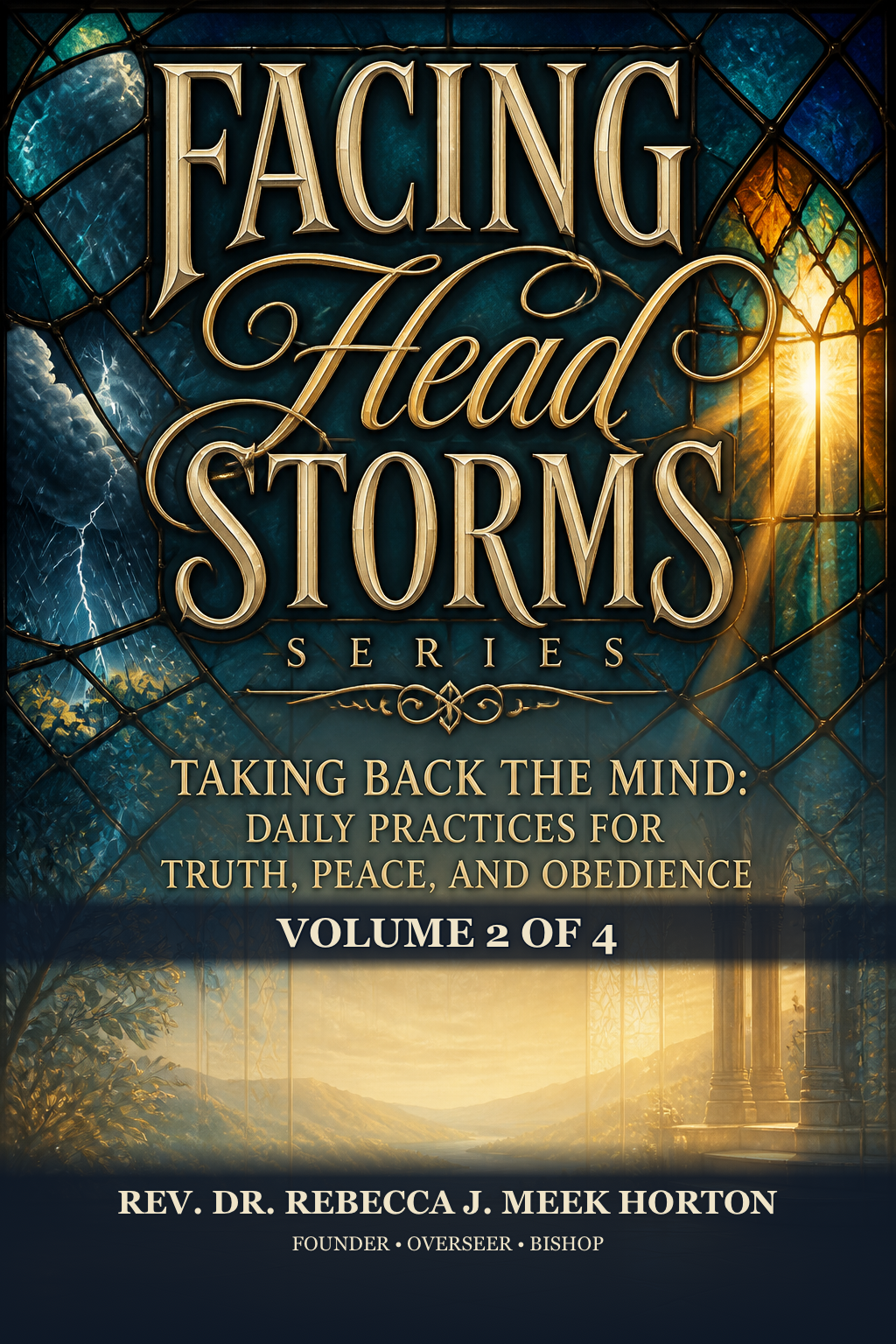
Facing Head Storms · Volume 2
Taking Back the Mind: Daily Practices for Truth, Peace, and Obedience
Part 2 of 4 in the series "Facing Head Storms". Series theme: Ways to facehead storms Series arc: This four-book series moves from recognition to renewal, from renewal to support, and from support to stewardship. The first book helps readers name mental attacks without shame or confusion. The second
Full publication
NBCNGMI MASTER KNOWLEDGE LIBRARY Featuring the works of The Sage, Apostle Prophet. Rev. Dr. Rebecca J. Meek Horton, Apostolic Prophetic Architect, NewBeing Creation Network Global Ministries, Inc. Integrated Framework Modalities™
Dedication
I dedicate this book to every mind that has battled noise, fear, pressure, or repeated thoughts and still desires to obey God. May these pages help you return to truth daily, guard your peace with humility, and take the next faithful step without shame.
Purpose
I wrote this book to help you move from naming the head storm to practicing a steady, Scripture-shaped response each day. My prayer is that these pages teach you to guard your mind with truth, prayer, worship, confession, rest, wise self-talk, and obedient action without pretending discipline is a quick fix. May you learn to bring every anxious, accusing, or confusing thought before God, renew your mind through His Word, and keep the next faithful step with peace and responsibility.
Preface
This book came from a pastoral burden: people were learning to name the storm, but many still needed a daily way to stand inside it.
After the first book in Facing Head Storms, I kept thinking about the person who says, “I know this thought is attacking me, but what do I do next?” Recognition matters, but recognition alone is not renewal. Once we can name the mental attack without shame, we must learn how to respond with truth, prayer, Scripture, worship, rest, confession, and wise action.
Taking Back the Mind is not a quick fix. I do not believe in shaming people into peace or pretending that one verse, one prayer, or one good day removes every battle. Some storms require pastoral care, wise counsel, medical support, therapy, family support, and time. Seeking help is not weakness. It can be stewardship.
But I also believe the mind can be trained in truth. I believe Scripture can be hidden in the heart. I believe prayer can interrupt panic. I believe worship can shift the atmosphere. I believe confession can clear the soul. I believe daily obedience matters, even when feelings are still loud.
Philippians 4:6-8 (KJV) Be careful for nothing; but in every thing by prayer and supplication with thanksgiving let your requests be made known unto God. And the peace of God, which passeth all understanding, shall keep your hearts and minds through Christ Jesus. Finally, brethren, whatsoever things are true, whatsoever things are honest, whatsoever things are just, whatsoever things are pure, whatsoever things are lovely, whatsoever things are of good report; if there be any virtue, and if there be any praise, think on these things.
That is the heart of this book.
We are not taking back the mind by force of personality. We are learning to bring the mind under the care and authority of Christ. We are learning to pause, tell the truth, reject the lie, receive peace, and take the next faithful step.
Read slowly. Practice honestly. Do not despise small beginnings. A renewed mind is often formed one obedient thought, one prayed prayer, one surrendered moment, and one Scripture-held decision at a time.
Nothing is random. Nothing is wasted. God can meet you in the storm and teach you how to walk in peace.
Introduction
A head storm can be loud on the inside while everything outside looks normal.
A student may sit in class and fight thoughts nobody can see. A parent may cook dinner while carrying fear about a child. A minister may preach truth and still have to answer accusation in the private place. An educator may hold a room together while their own mind feels crowded. This is why we must learn more than how to name the storm. We must learn how to respond.
This book is Part 2 in the Facing Head Storms series. The first book helped you recognize mental attacks without shame or confusion. This book takes the next step. It teaches daily practices for guarding the mind through Scripture, prayer, truth, worship, rest, confession, wise self-talk, and faithful action.
The argument is simple: taking back the mind does not mean you control every thought that enters. It means you learn to steward your response under God’s truth.
Romans 12:2 (KJV)
And be not conformed to this world: but be ye transformed by the renewing of your mind, that ye may prove what is that good, and acceptable, and perfect, will of God.
Renewal is not magic. It is not pretending. It is not shouting over pain. It is the steady practice of bringing the mind back to truth when fear, accusation, confusion, temptation, or despair tries to take the lead.
Some storms lift quickly. Some must be walked through with patience, counsel, treatment, support, and daily obedience. This book will not shame you for needing help. Prayer and Scripture are vital, and wise pastoral care, safe community, medical support, counseling, and appropriate professional help can also be part of faithful stewardship. Mental illness, trauma, grief, fatigue, and intrusive thoughts are not proof that you are spiritually inferior.
Still, you are not helpless.
God gives His people practices that train attention, strengthen trust, and interrupt destructive patterns. Philippians 4 does not deny anxiety. It teaches us what to do with it.
Philippians 4:6-8 (KJV)
Be careful for nothing; but in every thing by prayer and supplication with thanksgiving let your requests be made known unto God. And the peace of God, which passeth all understanding, shall keep your hearts and minds through Christ Jesus. Finally, brethren, whatsoever things are true, whatsoever things are honest, whatsoever things are just, whatsoever things are pure, whatsoever things are lovely, whatsoever things are of good report; if there be any virtue, and if there be any praise, think on these things.
Notice the order. Bring the real request to God. Receive the keeping peace of God. Then practice directing the mind toward what is true, honest, just, pure, lovely, and worthy of praise.
That is not denial. That is discipline with dependence.
As you read, do not rush. Keep your Bible near. Keep a notebook if you can. Each chapter will give you one teachable idea and one practice. Do not try to master everything at once. Learn the truth. Internalize it. Focus it into one aim. Execute one faithful step.
Isaiah 26:3 (KJV)
Thou wilt keep him in perfect peace, whose mind is stayed on thee: because he trusteth in thee.
A stayed mind is not an untouched mind. It is a mind brought back again and again to the Lord.
Psalm 119:11 (KJV)
Thy word have I hid in mine heart, that I might not sin against thee.
This is how we begin taking back the mind: not by panic, not by shame, and not by willpower alone, but by hiding truth deeply enough that it can answer the storm.
Before you continue, take one quiet minute. Name one thought pattern you need to bring under God’s truth. Write it plainly. Then pray: Lord, teach me to renew my mind, guard my peace, and obey You one step at a time.
Chapter 1 — When the Storm Moves Inside
The first time you name a head storm, there may be relief.
You finally have language for what has been happening. The racing thoughts. The accusing thoughts. The sudden fear. The pressure in your chest. The old memory that shows up without invitation. The sentence that keeps repeating your mind until it feels stronger than truth.
You may say, “This is a mental attack. This is not my identity. This is not the whole truth.”
That matters.
But then morning comes.
The same thought may return while you are brushing your teeth. The same fear may sit beside you in the car. The same pressure may rise while you are teaching, parenting, studying, preaching, working, or trying to sleep. Naming the storm did not make the sky clear forever.
This is the honest starting place of this book: after a mental attack is named, the mind still needs daily guarding.
Recognition is a beginning, not a complete practice. It helps you see what is happening. But once you see it, you must learn how to respond with truth, peace, and obedience. Not with panic. Not with shame. Not with endless self-analysis. Not with pretending everything is fine.
The mind must be stewarded.
Philippians gives us a doorway into that stewardship.
Philippians 4:6-8 (KJV)
Be careful for nothing; but in every thing by prayer and supplication with thanksgiving let your requests be made known unto God. And the peace of God, which passeth all understanding, shall keep your hearts and minds through Christ Jesus. Finally, brethren, whatsoever things are true, whatsoever things are honest, whatsoever things are just, whatsoever things are pure, whatsoever things are lovely, whatsoever things are of good report; if there be any virtue, and if there be any praise, think on these things.
This passage does not shame the anxious person. It teaches the anxious person what to do with anxiety.
Bring it to God.
Receive His keeping peace.
Then practice thinking on what is true, honest, just, pure, lovely, and worthy of praise.
That is not a quick fix. It is a daily return.
Naming Is Not the Same as Guarding
A person can recognize a thief and still leave the door unlocked.
That is how many of us treat the mind. We finally recognize the pattern. We say, “This is fear.” “This is shame.” “This is accusation.” “This is not from God.” But then we leave the same gates open all day.
We feed the fear with more fear. We rehearse the shame. We scroll until our spirit is crowded. We replay the conversation ten times. We seek five opinions but never sit with God. We call it processing, but sometimes we are practicing the very thought that is hurting us.
Recognition gives language. Guarding gives order.
Proverbs speaks plainly about the inner life.
Proverbs 4:23 (KJV)
Keep thy heart with all diligence; for out of it are the issues of life.
To keep the heart is to guard the inner place where thoughts, desires, motives, and responses begin to form. It does not mean we can control every thought that enters the mind. It does mean we can learn not to give every thought a chair, a microphone, and authority.
Think of a school building.
A wise school does not treat every visitor as safe just because they walked through the door. There is a front office. There is a check-in process. There are boundaries. A person must be identified before they are allowed access to children, classrooms, and staff.
The mind needs a similar kind of stewardship.
Not every thought deserves access to your decisions.
Not every feeling should be allowed to interpret God.
Not every memory should be permitted to define your future.
Not every accusation should be received as truth.
This is not denial. It is discernment.
A minister may wake up on Sunday morning with the thought, “You have nothing worth saying.” A student may sit before an exam and think, “You are going to fail like always.” A parent may hear, “You have ruined your child.” An educator may carry, “Nothing you do matters.” A young person may feel, “I am too broken to be helped.”
Those thoughts may feel personal. They may feel convincing. But feeling strong does not make them sovereign.
A thought can be loud and still be false.
A thought can be familiar and still be destructive.
A thought can come from pain and still need correction.
Daily guarding begins when we stop treating every inner sentence as a final verdict.
This is where RE-Language™ helps us move from shame to responsibility.
Not, “My mind is a mess, so I am hopeless.”
But, “My mind is under pressure, so I need faithful guarding.”
Not, “I should never struggle.”
But, “When struggle rises, I can return to truth.”
Not, “This thought is me.”
But, “This is a thought I must test.”
That shift matters. Shame pushes us into hiding. Responsibility brings us back into stewardship.
The Mind Needs a Daily Gate
Philippians 4 does not begin with pretending. It begins with bringing.
“Be careful for nothing” does not mean, “Nothing hard is happening.” It means anxiety is not meant to govern the believer’s inner life. The trouble may be real, but it does not get to become lord.
The instruction is simple and searching: “in every thing by prayer and supplication with thanksgiving let your requests be made known unto God.”
In everything.
Not just in church matters. Not just in large crises. Not just when we have already calmed down enough to sound spiritual.
In the email you are afraid to open.
In the diagnosis you do not understand.
In the classroom where you feel overwhelmed.
In the child you are worried about.
In the ministry assignment that feels too heavy.
In the private thought you are ashamed to admit.
In everything, bring it to God.
A gate is a place of exchange. What comes in is examined. What goes out is directed. Prayer becomes a holy gate for the mind because it interrupts the inward spiral and brings the matter before God.
Without that gate, the mind often builds its own courtroom.
Fear becomes the prosecutor.
Pain becomes the witness.
Shame becomes the judge.
The soul sits there receiving sentence after sentence: guilty, forgotten, abandoned, incapable, unsafe, unwanted.
Prayer opens another court.
God is present. His Word has authority. His mercy speaks. His wisdom leads. His peace keeps.
This does not mean every emotion disappears at once. Many sincere believers have prayed through tears and still felt trembling in the body. Many have asked God for peace and still needed wise counsel, pastoral support, medical care, therapy, rest, or practical help. That is not spiritual failure. It is human stewardship.
Prayer is not a denial of care. Prayer is the first act of dependence.
Imagine a parent whose child comes home from school upset. The child’s words spill out quickly: “Nobody likes me. I am stupid. I never do anything right.” A wise parent does not mock the child for feeling deeply. But neither does the parent confirm every sentence as truth.
The parent slows the moment.
“What happened?”
“What did someone say?”
“What is true?”
“What do we need to do next?”
The child is not helped by being shamed. The child is helped by being guided.
Your mind also needs guidance.
When fear speaks in absolutes, prayer helps you slow down. When anxiety says, “Everything is falling apart,” prayer helps you bring the actual matter to God. When shame says, “You are finished,” prayer helps you remember mercy. When pressure says, “Decide now,” prayer helps you refuse to be mastered by urgency.
The daily gate does not have to be complicated.
It may begin with one honest sentence: “Lord, this is what is in my mind right now.”
Then another: “Help me see what is true.”
Then another: “Lead me in the next faithful step.”
Small prayers are still prayers. Honest prayers are still prayers. Trembling prayers are still prayers.
Peace Is More Than a Feeling
Philippians promises something that cannot be manufactured by human effort.
Philippians 4:7 (KJV)
And the peace of God, which passeth all understanding, shall keep your hearts and minds through Christ Jesus.
The peace of God is not the same as having every question answered.
It “passeth all understanding.” That means it is not limited to what you can explain. It is not dependent on the mind having a full map. It is not fragile enough to disappear every time life becomes hard.
This peace keeps.
The word picture is strong. Peace stands guard over the heart and mind through Christ Jesus. God’s peace is not passive. It protects. It surrounds. It holds the inner life when circumstances are not yet resolved.
But here is where we must be honest. Many people want peace without practice.
They want peace to arrive while they continue feeding panic. They want peace while refusing truth. They want peace while rehearsing resentment. They want peace while ignoring counsel. They want peace while staying in patterns that keep the mind inflamed.
God is merciful, but He is also wise. Peace is a gift, and we must learn to live in a way that agrees with the gift.
If someone receives medicine but keeps drinking poison, the body remains under attack. In the same way, if we ask God for peace but continue to consume, rehearse, and obey what strengthens fear, we make the battle harder than it needs to be.
This is not blame. It is a call to stewardship.
There are head storms we did not choose. Trauma may leave traces. Grief may come in waves. Anxiety may involve the body as well as the mind. Depression may make simple steps feel heavy. Intrusive thoughts may arrive unwanted. These realities require compassion, patience, and sometimes skilled care.
But even there, daily practice matters.
Practice does not mean instant control. Practice means faithful return.
Return to prayer.
Return to truth.
Return to wise counsel.
Return to what is actually yours to do.
Return to the next faithful step.
A musician does not practice scales because the concert has already started. The musician practices before the pressure so the hands know where to go when the pressure comes. An athlete does not train only on game day. A teacher does not prepare only after students enter the room. A minister does not build a prayer life only when the pulpit feels heavy.
The mind also needs training before the storm is at full strength.
Peace is not earned by practice. Peace is guarded through practice.
There is a difference.
We do not practice to force God to be faithful. We practice because God is faithful, and we want our inner life to come under His truth.
What You Think On Will Train You
Philippians 4:8 brings the mind into focus.
It does not say, “Think about whatever enters first.”
It does not say, “Think about whatever fear presents.”
It does not say, “Think about whatever accusation repeats.”
It says to think on what is true, honest, just, pure, lovely, of good report, virtuous, and praiseworthy.
This is not positive thinking in a shallow sense. It is truth-governed thinking.
The difference matters.
Positive thinking may say, “Nothing bad will happen.”
Truth-governed thinking says, “Even if trouble comes, God is present, and I can obey Him in the next step.”
Positive thinking may say, “I am amazing at everything.”
Truth-governed thinking says, “I am God’s workmanship, and I can grow with humility.”
Positive thinking may say, “I should never feel afraid.”
Truth-governed thinking says, “Fear is present, but fear will not be my master.”
The goal is not to flatter the mind. The goal is to govern it with truth.
A garden will grow something. If it is not tended, weeds do not ask permission. They simply spread. The gardener does not scream at the soil because weeds appeared. The gardener returns with tools, patience, and attention. Pull what does not belong. Plant what is good. Water what should live.
Your thought life is not a machine. It is more like a garden.
It needs daily tending.
If you continually think on accusation, accusation grows. If you continually think on worst-case outcomes, fear grows. If you continually think on offense, bitterness grows. If you continually think on failure, despair grows.
But if you return to what is true, truth is strengthened.
If you return to what is honest, deception loses room.
If you return to what is just, your responses become cleaner.
If you return to what is pure, your desires are corrected.
If you return to what is lovely and of good report, gratitude has soil.
If you return to what is praiseworthy, worship begins to reorder attention.
This is why mental attacks cannot only be answered in crisis. Crisis practice matters, but daily practice builds capacity.
Second Corinthians gives us language for the battle.
2 Corinthians 10:4-5 (KJV)
For the weapons of our warfare are not carnal, but mighty through God to the pulling down of strong holds; Casting down imaginations, and every high thing that exalteth itself against the knowledge of God, and bringing into captivity every thought to the obedience of Christ;
Notice the movement. Imaginations are cast down. Thoughts are brought into captivity. The goal is obedience to Christ.
This is not about attacking people. It is about refusing to let lies rule the inner life.
A student who keeps thinking, “I cannot learn,” may stop trying before the lesson begins. A parent who keeps thinking, “There is no hope for this child,” may lose tenderness and wisdom. A leader who keeps thinking, “I must carry everything alone,” may become controlling, exhausted, or resentful. A believer who keeps thinking, “God is disappointed in me all the time,” may avoid the very presence where mercy is found.
Thoughts train responses.
Responses become patterns.
Patterns shape character.
Character affects stewardship.
That is why the mind matters.
The Cost of Daily Guarding
Daily guarding sounds simple until you have to do it while tired.
This is the cost.
It asks you to stop letting your mind run unattended. It asks you to pause before agreeing with fear. It asks you to test thoughts instead of becoming them. It asks you to bring anxiety to God when you would rather rehearse it. It asks you to choose truth when the lie feels familiar. It asks you to practice peace before you feel peaceful.
It also asks for humility.
You may have to admit, “I have been feeding this storm.”
You may have to confess, “I have allowed pain to interpret God.”
You may have to say, “I need help.”
You may have to turn off what keeps agitating your mind.
You may have to set a boundary with a conversation, habit, or environment.
You may have to seek counsel from a mature believer, pastor, mentor, educator, doctor, or licensed professional.
That is not weakness. That is stewardship.
Wisdom-centered practice does not create dependency. It builds maturity. The goal is not for someone else to think for you, pray for you, decide for you, and carry you forever. The goal is that you become more able to walk with God in truth, humility, counsel, and obedience.
There will be days when your practice feels strong.
There will be days when it feels small.
Keep the next faithful step.
Do not despise small obedience. A guarded morning can change the direction of a day. One honest prayer can interrupt a spiral. One Scripture remembered can answer one lie. One wise conversation can prevent one harmful decision. One moment of thanksgiving can loosen fear’s grip.
God often forms steadiness through repeated returns.
Not performance.
Return.
Not panic.
Return.
Not shame.
Return.
The storm may move inside, but it does not have to rule inside.
Christ is not absent from the life of the mind. His peace can keep the heart and mind. His truth can govern thought. His wisdom can guide the next step.
Key Takeaways
• Naming the head storm is a beginning; daily guarding is the practice.
• Prayer becomes a holy gate where anxiety is brought before God.
• What you think on will train how you respond.
Practice
Today, take ten quiet minutes with Philippians 4:6-8.
Write four short answers:
• What anxious thought or mental pressure is present today?
• What request do I need to make known unto God?
• What is one true, honest, and praiseworthy thought I can return to today?
• What is one obedient next step I can take before the day ends?
Then pray this simply:
Lord, I bring You what is in my mind. Help me not to be ruled by fear, shame, or accusation. Teach me to receive Your peace, think on what is true, and take the next faithful step in obedience. Amen.
Chapter 2 — Renewal Is a Daily Return
The first morning after a hard night can feel disappointing.
You prayed. You cried. You named the attack. You told someone the truth. You may have even slept a little. Then morning came, and the same thought knocked again.
What if nothing changed?
That question can make a person feel defeated before the day begins. A student may wake up with dread before school. A parent may feel the same fear about a child. A minister may step toward service with a tired mind. An educator may walk into the building already bracing for pressure.
The storm was named, but the mind still needs guarding.
This is the promise of this chapter: the mind can be renewed through steady surrender, not instant control. Renewal is not a one-time emotional victory. It is a daily return to God’s truth until the mind learns where to stand.
Romans 12:2 (KJV)
And be not conformed to this world: but be ye transformed by the renewing of your mind, that ye may prove what is that good, and acceptable, and perfect, will of God.
Paul does not describe renewal as a quick escape. He describes it as transformation. That means something is being formed over time. Something old is being refused. Something true is being received. Something obedient is being practiced.
You may not be able to stop every thought from entering your mind. But by the grace of God, you can learn where to return.
Renewal Begins With Surrender
Most people want control when their minds feel crowded.
They want the thought to stop now. They want the fear to leave now. They want the memory, pressure, temptation, or accusation to disappear now. That desire is understandable. A head storm can be exhausting.
But renewal does not begin with control.
It begins with surrender.
Surrender is not giving up. It is giving the mind back to God. It is saying, “Lord, this thought is loud, but it is not my lord. This fear is present, but it is not my shepherd. This pressure is real, but it does not have the right to govern my obedience.”
Romans 12 begins before verse 2. Paul first calls believers to present themselves to God.
Romans 12:1 (KJV)
I beseech you therefore, brethren, by the mercies of God, that ye present your bodies a living sacrifice, holy, acceptable unto God, which is your reasonable service.
The renewing of the mind is connected to the presenting of the life. We do not offer God only our church voice, public image, or Sunday strength. We present the whole self.
The tired body.
The anxious mind.
The confused emotions.
The strained imagination.
The place where we keep replaying what happened.
The place where we keep fearing what might happen.
This matters because many people try to renew their minds while still protecting the very place that needs surrender. They want peace, but not honesty. They want clarity, but not correction. They want relief, but not obedience.
God is not cruel. He is also not careless. He does not renew the mind by flattering what is false. He renews by bringing us into truth.
Think of a person holding a clenched fist around broken glass. The hand is bleeding, but the person keeps saying, “Heal me.” Healing requires opening the hand. Opening the hand may hurt. It may reveal what has been hidden. But it also allows the wound to be cleaned.
That is surrender.
A parent may need to surrender the illusion that worry proves love. A student may need to surrender the belief that one failure defines the future. A minister may need to surrender the need to appear strong at all times. An educator may need to surrender the pressure to carry every burden alone.
Surrender does not mean you stop caring. It means you stop letting fear sit on the throne.
The Mind Learns by Returning
A renewed mind is not built by one dramatic moment alone.
It is trained by return.
Return to the Word.
Return to prayer.
Return to truth.
Return to obedience.
Return after you forgot.
Return after you reacted.
Return after you felt strong yesterday and weak today.
This is not failure. This is formation.
The world trains the mind by repetition. Fear repeats. Shame repeats. Pressure repeats. Social media repeats. Old wounds repeat. Family patterns repeat. Cultural messages repeat. The mind is often shaped by what it hears again and again.
So renewal also requires repetition.
Not empty repetition. Faithful repetition.
The mind must be given truth often enough that truth becomes more familiar than the lie.
Romans 12:2 says, “be ye transformed by the renewing of your mind.” Renewal is not only rejecting what is wrong. It is receiving what is true until the inner life begins to change shape.
A teacher understands this. One lesson rarely forms mastery. Students need review, practice, correction, and application. A math fact is learned through repetition. A reading skill grows by daily use. A character habit forms through repeated choices.
The same is true in the life of faith.
A believer may know one verse and still need to return to it daily. That does not mean the verse failed. It means the mind is being trained.
Lamentations gives language for daily mercy.
Lamentations 3:22-23 (KJV)
It is of the LORD's mercies that we are not consumed, because his compassions fail not. They are new every morning: great is thy faithfulness.
New every morning.
Not once a year.
Not only after a breakthrough.
Not only when emotions are calm.
Every morning.
That means yesterday’s mercy was real, but today still receives fresh mercy. Yesterday’s obedience mattered, but today still asks for a faithful step. Yesterday’s storm may have passed, but today’s mind still needs to return.
This protects us from pride and despair.
Pride says, “I should be past this by now.”
Despair says, “I will never change.”
Wisdom says, “Return today.”
Return is humble. It does not boast. It does not collapse. It simply comes back to God again.
This is important for those who feel ashamed because the same battle keeps appearing. Some patterns need counsel, accountability, medical care, pastoral support, or deeper healing. Seeking wise help is not spiritual failure. It can be faithful stewardship.
But even with help, the daily call remains simple: return to truth.
Do not wait until you feel renewed to return. Return, and let God work renewal in you.
Do Not Measure Renewal Only by Mood
A common mistake is measuring renewal by how quickly feelings change.
If the fear lifts, we think renewal worked.
If the anxiety remains, we think nothing happened.
If peace feels strong, we believe God is near.
If emotions feel heavy, we wonder if God has left.
But mood is not the only measure of renewal.
Feelings are real, but they are not the final ruler. A person can feel afraid and still obey. A person can feel weak and still return to Scripture. A person can feel sadness and still refuse a lie. A person can feel pressure and still choose wisdom.
Renewal often shows up first as a small change in direction.
You used to spiral for three hours. Today you paused after thirty minutes.
You used to believe every accusation. Today you questioned it.
You used to hide in shame. Today you told the truth.
You used to react quickly. Today you waited before speaking.
You used to feed the fear. Today you brought it to God.
That is renewal.
It may not feel dramatic. It may not look impressive. But it is holy movement.
Second Corinthians speaks to the difference between the outward condition and the inward work.
2 Corinthians 4:16 (KJV)
For which cause we faint not; but though our outward man perish, yet the inward man is renewed day by day.
Day by day.
This verse does not deny hardship. The outward man may be under pressure. The body may be tired. Circumstances may still be difficult. The apostle is honest: there can be wasting, suffering, and strain.
Yet the inward man can be renewed day by day.
This is not pretending. This is not calling pain easy. This is not telling people to smile through storms. It is learning that God can work inside a person even before everything outside changes.
A minister may preach with a burden and still be renewed inwardly through obedience. A parent may still be waiting on a child and still be renewed by surrendering that child to God again today. A student may still feel nervous before class and still be renewed by choosing honesty, preparation, and prayer. An educator may still face a difficult environment and still be renewed by remembering that faithfulness matters even when outcomes are slow.
Do not despise small evidence of renewal.
A quieter response is evidence.
A truthful sentence is evidence.
A humble apology is evidence.
A returned prayer is evidence.
A boundary kept is evidence.
A lie refused is evidence.
The enemy would like you to believe that if your feelings are not instantly calm, God is not working. That is not true. Peace may come as a deep assurance before it comes as emotional ease. Renewal may begin as a decision before it becomes a felt experience.
Isaiah gives a promise about the stayed mind.
Isaiah 26:3 (KJV)
Thou wilt keep him in perfect peace, whose mind is stayed on thee: because he trusteth in thee.
A stayed mind is not a mind that never gets attacked. It is a mind learning where to rest. It is a mind being brought back, again and again, to the Lord.
The Cost of Daily Return
Daily renewal has a cost.
It costs the right to live on mental autopilot.
Autopilot says, “Think whatever comes. Follow whatever feeling rises. Repeat whatever fear suggests. Agree with whatever shame says. React before you discern.”
Renewal interrupts that pattern.
It asks you to slow down when you want to rush. It asks you to tell the truth when you want to hide. It asks you to return to Scripture when your mind wants to rehearse the worst. It asks you to obey before your emotions fully agree.
That is costly.
It may feel easier to keep replaying the offense than to bring it to God. It may feel easier to keep imagining disaster than to practice trust. It may feel easier to numb the mind than to renew it. It may feel easier to blame everyone else than to take responsibility for your next faithful step.
Daily return is not glamorous. It is not always loud. It is often quiet obedience when no one sees.
It may look like closing the phone and opening the Bible.
It may look like praying one honest sentence instead of feeding panic.
It may look like going to bed on time because exhaustion has been weakening your discernment.
It may look like saying, “I need help,” instead of pretending.
It may look like refusing to call yourself what God has not called you.
It may look like returning after you failed.
This is where many people get discouraged. They think renewal should remove the need to keep practicing. But practice is not proof that renewal failed. Practice is part of renewal.
No musician says, “If I were gifted, I would never need scales.”
No athlete says, “If I were strong, I would never need training.”
No teacher says, “If my students learned once, they would never need review.”
No disciple should say, “If God were renewing me, I would never need to return.”
Return is how the renewed life is strengthened.
Ephesians says it plainly.
Ephesians 4:22-24 (KJV)
That ye put off concerning the former conversation the old man, which is corrupt according to the deceitful lusts; And be renewed in the spirit of your mind; And that ye put on the new man, which after God is created in righteousness and true holiness.
There is a putting off.
There is a being renewed.
There is a putting on.
This is not passive drift. It is active surrender. It is grace-shaped participation. God is the One who renews, but we are not called to be careless with what He is renewing.
Here is the honest tension: you may have to return before you feel like returning.
You may have to open the Word while your thoughts are still noisy. You may have to pray while your emotions are still tangled. You may have to obey while fear is still talking. You may have to choose truth while shame is still trying to explain you.
This is not hypocrisy.
It is discipleship.
Hypocrisy pretends.
Discipleship returns.
A Simple Promise for a Crowded Mind
The promise of this book is not that you will never face another head storm.
The promise is that you can learn a daily way of returning to God in the storm.
You can become less ruled by mental weather.
You can learn to notice pressure without bowing to it.
You can learn to bring fear into prayer.
You can learn to receive Scripture before panic writes the story.
You can learn to speak with wisdom instead of shame.
You can learn to take the next faithful step.
Renewal is not instant control. It is steady surrender.
This is important because control often becomes another burden. When people think they must control every thought perfectly, they become afraid of their own minds. Then fear creates more fear. Shame creates more shame. The person begins fighting the mind with panic instead of stewarding the mind with truth.
God does not call you to panic about your thoughts.
He calls you to return.
Return does not mean you approve of every thought. It means you bring the mind back under God’s truth. You do not have to treat every mental attack as your identity. You do not have to treat every anxious feeling as prophecy. You do not have to treat every accusation as conviction.
There is a difference between conviction and condemnation.
Conviction leads you toward God with truth and repentance.
Condemnation drives you away from God with shame and despair.
Renewal learns the difference.
A mother standing in the kitchen whispering, “Lord, help me return,” is practicing renewal.
A teenager writing one verse on an index card before school is practicing renewal.
A pastor taking ten quiet minutes before answering a difficult message is practicing renewal.
A teacher breathing, praying, and choosing a wise response before entering a hard classroom is practicing renewal.
Small returns matter.
They are not small to God.
They are the daily places where the mind is brought back from fear, pressure, shame, and confusion into the care and authority of Christ.
Key Takeaways
• Renewal is steady surrender, not instant control.
• The mind is trained by daily return to God’s truth.
• Small obedient returns are real evidence of growth.
Practice
Today, choose one recurring thought, fear, or pressure that has been pulling your mind away from peace and obedience.
Write one sentence that names it truthfully:
“My mind keeps returning to ____________________.”
Then write this return statement:
“Lord, I bring this back to You today. Renew my mind with Your truth, and show me the next faithful step.”
Read Romans 12:2 aloud once in the morning and once before bed for the next three days. Do not rush it. Let the verse become a doorway back to God.
Your next step is simple: return today.
Chapter 3 — Start With Stillness
The message came in at 9:47 p.m.
It was only one sentence, but the mind turned it into a storm.
We need to talk tomorrow.
That was all.
No accusation. No detail. No emergency. Just seven words.
But the body tightened. The stomach dropped. The mind began filling in the blanks. Maybe someone was angry. Maybe something had gone wrong. Maybe a relationship was about to change. Maybe a job was at risk. Maybe a child was in trouble. Maybe the worst thing was already happening.
Within minutes, the conversation had already taken place in the imagination. Defenses were built. Replies were drafted. Tears were close. Sleep was gone.
Nothing had happened yet.
But the storm had moved inside.
The first practice of guarding the mind is stillness. Stillness is the faithful pause before response. It slows the mind long enough to remember God, notice what is true, and choose the next wise action instead of obeying fear, pressure, or intrusive thoughts.
Stillness does not solve every problem. It does not make pain disappear. It does not mean the troubling thought was harmless or that the situation does not matter.
Stillness simply refuses to let panic become the leader.
Psalm 46:10 (KJV)
Be still, and know that I am God: I will be exalted among the heathen, I will be exalted in the earth.
That verse is not a soft decoration for a wall. It is a command in the middle of trouble. Be still. Know. Remember who God is before the storm writes the whole story.
Stillness Is Not Doing Nothing
Many people hear the word stillness and think it means passivity.
It does not.
Stillness is not ignoring responsibility. It is not pretending the thought is not there. It is not refusing to answer a hard question. It is not avoiding a necessary conversation. It is not spiritual laziness.
Stillness is ordered attention.
It is the moment when you stop letting fear drag your mind from room to room. It is the moment when you bring your attention back under God’s presence before you speak, decide, reply, accuse, quit, hide, or spiral.
A mother receives a call from the school. Her child has been in another conflict. Before she calls the child, before she texts the teacher, before she rehearses shame or anger, she sits in the car for two minutes. She places both hands on the steering wheel. She breathes. She says, “Lord, help me respond with truth, not reaction.” Then she makes the call.
That is not doing nothing.
That is stewardship.
A minister hears a criticism after service. The words sting. The first impulse is to defend, explain, or withdraw. Instead, the minister goes into a quiet office, sits down, and waits before God. The criticism may be wrong. It may also carry something that needs to be heard. Stillness gives the heart enough space to discern without being ruled by offense.
That is not weakness.
That is maturity.
A student sees a grade lower than expected. Shame rushes in. The mind says, “You are failing. You are behind. You will never get this right.” Instead of closing the laptop and giving up, the student pauses. “This is one grade. It is information. It is not my identity. What is the next faithful step?” Then the student emails the teacher and asks how to improve.
That is not denial.
That is wisdom.
Stillness creates a small space between what happens and what you do next. In that space, obedience can breathe.
Without that space, the loudest feeling often wins.
The practice is simple, but not easy. The mind likes speed when it feels threatened. Fear wants immediate agreement. Pressure wants immediate movement. Intrusive thoughts want immediate attention. Stillness interrupts that demand.
In the WALK™ rhythm, this is the first movement: Wait. Begin in stillness, not in noise.
Waiting is not the same as delay with no purpose. Waiting before God is a faithful pause that says, “I am not God. I do not see everything. I will not let urgency become my master.”
That sentence may feel small.
It is not small.
It is a door back into peace.
Urgency Is Not Always Wisdom
Some situations truly require quick action.
If someone is in danger, if a child is unsafe, if there is a medical emergency, if harm may happen, you act. You call for help. You remove yourself from danger. You contact the right support. Stillness in those moments may only be one breath before dialing the phone.
But many mental storms are not emergencies. They feel urgent because the nervous system is alarmed, the imagination is active, or an old wound has been touched.
A thought can feel urgent and still not be true.
A fear can feel powerful and still not be your leader.
A memory can feel present and still belong to the past.
A pressure can feel immediate and still require wisdom before movement.
This is why stillness matters. It helps us separate urgency from obedience.
Proverbs 14:29 (KJV)
He that is slow to wrath is of great understanding: but he that is hasty of spirit exalteth folly.
Haste has a cost.
Hasty words can wound a child.
Hasty texts can damage a relationship.
Hasty vows can trap a person in a decision made from fear.
Hasty assumptions can turn a small concern into a false accusation.
Hasty self-talk can become agreement with a lie.
When the storm rises inside, haste often sounds convincing. It says, “You must fix this now.” “You must answer now.” “You must know now.” “You must decide now.” “You must prove yourself now.”
Stillness asks better questions.
What is actually happening?
What do I know, and what am I imagining?
What part of me feels threatened?
What would obedience look like in the next five minutes?
What response can wait until my mind is clearer?
This is not overthinking. This is slowing down enough to tell the truth.
A parent may receive a teenager’s disrespectful comment and feel the old wound of being dishonored. The urge is to lecture for twenty minutes. Stillness may say, “Pause. Do not use authority to unload pain. Correct the behavior, but do not crush the child.”
An educator may read an email from an angry parent. The urge is to defend every detail. Stillness may say, “Do not reply while your body is hot. Draft the response, wait, review it, then answer with clarity.”
A believer may wake up with a heavy thought: “Something bad is going to happen.” The urge is to spend the morning checking, scrolling, worrying, and searching for reassurance. Stillness may say, “This is fear speaking loudly. I will not build my day around an unproven alarm.”
Stillness helps us see the difference between a signal and a command.
A thought may signal that something needs attention.
But not every thought has authority to command your obedience.
That distinction is a major step in taking back the mind.
The mind can produce thoughts. The enemy can accuse. The body can remember stress. People can pressure. Circumstances can shake.
But the believer is not helpless.
By the grace of God, we can pause.
We can notice.
We can refuse immediate agreement.
We can return to truth.
The Body Needs the Pause Too
Mental storms are not only mental.
They often involve the body.
The chest tightens. The jaw locks. The shoulders rise. The stomach twists. The hands shake. The breathing changes. The eyes scan for threat. The body acts as if danger is already in the room, even when the threat is only a thought, a memory, a message, or a possibility.
This does not mean you are weak.
It means you are human.
God made us embodied people. We do not serve Him as floating minds. We serve Him with heart, soul, mind, and strength. When the body is alarmed, the mind often becomes less clear. Stillness gives the body a chance to settle so the mind can listen.
This is not replacing faith with a technique.
It is stewarding the vessel God gave you.
A simple pause can help.
Sit down if you can.
Put your feet on the floor.
Unclench your hands.
Lower your shoulders.
Take a slow breath.
Look around and name where you are.
Say quietly, “God is here, and I can take the next faithful step.”
This does not make the problem vanish. It helps you stop treating the alarm as the answer.
Isaiah 26:3 (KJV)
Thou wilt keep him in perfect peace, whose mind is stayed on thee: because he trusteth in thee.
The word picture is steady. A mind stayed on God is not a mind that never feels fear. It is a mind that keeps returning to where it belongs.
Returning is the practice.
You may have to return ten times in one hour. That does not mean you failed. It means you are learning to bring the mind back.
Stillness helps that return.
Imagine holding a cup filled to the rim. If you run through the house, it spills everywhere. If you stop and steady your hand, the water settles. The cup is not empty. It is steadied.
Many minds are not empty of concern. They need to be steadied.
Stillness is one way we let the waters settle before we move.
This is especially important with intrusive thoughts. An intrusive thought may enter suddenly and feel disturbing, shameful, frightening, or strange. The first temptation is to panic over the fact that the thought came. Then the mind may begin asking, “Why did I think that? What does this mean about me? Am I dangerous? Am I terrible? Am I losing control?”
Stillness does not analyze the thought endlessly. That territory belongs more fully to the practice of thought capture. Here, stillness simply creates the first boundary.
It says, “A thought has appeared. I do not have to fuse with it. I do not have to obey it. I do not have to build a whole identity around it. I can pause before God.”
That pause matters.
It keeps the mind from becoming a courtroom where fear serves as judge, witness, and accuser.
Stillness allows you to step out of the courtroom and back into God’s presence.
How to Practice the Faithful Pause
Stillness needs to become practical.
If it stays poetic, it will not help you at 2:00 a.m. when your mind is racing. It will not help in the hallway before a hard conversation. It will not help when your child says something painful, when your spouse is silent, when the bill arrives, when the memory returns, when the accusation rises.
You need a simple practice you can actually use.
Begin with four small movements.
First, stop.
Do not answer yet if you do not have to. Do not send the message yet. Do not make the decision yet. Do not follow the thought down every hallway. Stop long enough to notice that a storm is rising.
This can be as simple as saying, “Pause.”
Second, settle.
Let your body know you are not going to be driven by the first surge. Sit down if possible. Breathe slowly. Put the phone down. Step away from the screen. Drink water. Lower the noise.
Do not worship the body, but do not ignore it either.
Third, see.
Name what is happening without drama.
“I am anxious.”
“I feel pressured.”
“I am tempted to defend myself.”
“I am having an intrusive thought.”
“I am afraid of being rejected.”
“I do not have enough information yet.”
This is SAPP™ discernment beginning with See. Name what is really happening. Not what fear predicts. Not what shame declares. What is actually happening.
Fourth, seek.
Turn your attention toward God.
This may be one sentence: “Lord, give me wisdom.”
It may be one verse remembered.
It may be one quiet question: “What is the next faithful step?”
It may be silence before the Lord.
Do not make it complicated. Complication can become another storm.
A faithful pause may take thirty seconds.
It may take five minutes.
It may take a whole evening before answering something that does not require immediate response.
The length is not the point.
The posture is the point.
James 1:19-20 (KJV)
Wherefore, my beloved brethren, let every man be swift to hear, slow to speak, slow to wrath: For the wrath of man worketh not the righteousness of God.
Slow to speak does not mean never speak.
Slow to wrath does not mean never confront.
Swift to hear does not mean agree with everything.
It means we do not let reaction outrun righteousness.
A woman once said, “If I do not answer right away, I feel like I am losing control.”
That was honest.
But stillness helped her RE-Language™ that belief.
Not, “If I pause, I lose control.”
But, “If I pause, I make room for self-control.”
That is a different sentence. It carries a different spirit. It moves from fear to stewardship.
Another person said, “If I sit still, the thoughts get louder.”
Sometimes they do at first. When you stop running, you may notice the noise you have been trying to outrun. That can feel uncomfortable. Stillness is not always peaceful in the first moments. It may reveal how crowded the mind has become.
Do not be discouraged by that.
The goal is not to force instant calm.
The goal is to stop surrendering leadership to the storm.
If the thoughts are intense, keep the pause gentle and brief. Open your eyes. Sit near a safe person. Step outside. Read one verse aloud. Contact a counselor, pastor, mentor, doctor, or crisis support if you are at risk of harming yourself or someone else. Seeking help is not failure. It can be wise stewardship.
Stillness is not isolation.
Stillness is a starting place.
It prepares you to pray, to read, to ask for counsel, to confess, to rest, to speak wisely, or to act responsibly.
Stillness Makes Room for Obedience
The point of stillness is not stillness.
The point is obedience.
We pause so we can respond faithfully.
A person who pauses but never acts may be hiding. A person who pauses and then obeys is practicing wisdom.
Stillness should lead somewhere.
It may lead to an apology.
It may lead to a boundary.
It may lead to a phone call.
It may lead to silence instead of argument.
It may lead to asking for help.
It may lead to opening the Bible.
It may lead to going to sleep instead of rehearsing fear all night.
It may lead to doing the next ordinary responsibility in front of you.
This is important because mental storms often try to make life feel unreal. The storm says, “Everything is falling apart.” Obedience often says, “Wash the dishes. Take the medicine. Finish the assignment. Call the mentor. Feed the child. Go to bed. Tell the truth. Do the next faithful thing.”
Stillness helps you hear that simple instruction again.
There is a humility in this. Many of us want God to give us the whole map before we move. But often, He gives light for the next step.
Stillness helps us stop demanding the whole road and start receiving the next faithful step.
The cost is real.
Stillness will cost you the satisfaction of immediate reaction.
It will cost you the false comfort of rehearsing every possible outcome.
It will cost you the pride of always having a quick answer.
It may cost you the approval of people who expect instant access to your emotions, your time, or your decision.
It may cost you the familiar rhythm of panic.
That last cost is tender but true. Sometimes panic becomes familiar. Not healthy, but familiar. The mind may not know what to do with quiet at first. Peace can feel strange when chaos has been normal.
Practice anyway.
Stillness is not earned by naturally calm people. It is learned by people who return to God again and again.
The storm may still be loud.
But it does not have to be lord.
Key Takeaways
• Stillness is a faithful pause before response.
• Urgency is not always wisdom.
• The pause makes room for prayer, truth, and wise action.
Practice
Choose one daily moment to practice stillness before you need it.
For the next seven days, set aside three quiet minutes.
Sit still.
Put your feet on the floor.
Read Psalm 46:10 aloud.
Psalm 46:10 (KJV)
Be still, and know that I am God: I will be exalted among the heathen, I will be exalted in the earth.
Then ask one question:
What is the next faithful step in front of me today?
Write one simple answer.
When a storm rises later, return to the same rhythm: stop, settle, see, seek.
Do not wait until panic is in charge to practice peace.
Chapter 4 — Hide the Word Before the Battle
A teacher does not wait for the fire alarm to explain the evacuation plan.
The plan is practiced before smoke fills the hallway. Students learn where to stand, which door to use, and who to follow while the room is calm. It may feel unnecessary on a normal Tuesday. Then one day the alarm sounds, and what was practiced in peace becomes protection under pressure.
The mind needs that kind of preparation.
When a head storm rises, it is difficult to build a whole theology in the middle of fear. It is hard to search for truth when panic is already speaking. It is hard to remember God’s character when accusation, anxiety, shame, or intrusive thoughts are crowding the room.
This chapter’s single idea is simple: Scripture must be stored before the storm so truth is already near when the mind comes under pressure.
Psalm 119:11 (KJV)
Thy word have I hid in mine heart, that I might not sin against thee.
The psalmist does not say, “Thy word have I looked for only when I was desperate.” He says the Word is hidden in the heart. Stored. Kept. Carried. Ready.
This is not superstition. Bible verses are not magic phrases. Scripture is the living truth of God, and we are called to receive it with reverence, understanding, and obedience. The goal is not to collect verses to feel religious. The goal is to let truth dwell deeply enough that when the mind is pressed, the soul has something faithful to reach for.
Truth Stored Becomes Truth Available
A storm exposes what has been stored.
If a student has practiced multiplication tables, the answer comes faster during a test. If a nurse has been trained in emergency protocol, the hands know what to do when the room gets tense. If a parent has rehearsed a safety plan with a child, the child is less likely to freeze when danger appears.
The same principle applies to the mind.
When fear speaks, the mind reaches for what is familiar. If the only familiar voices are shame, worry, suspicion, and old wounds, those voices may take the lead. But if Scripture has been read, repeated, pondered, and carried, truth has a place to stand.
This is why daily Scripture engagement matters. It is not only for information. It is formation.
The Word begins to shape what the heart recognizes as true. It corrects false conclusions. It steadies emotions without denying them. It gives language when the mind is noisy. It reminds the believer that God has spoken before the storm began.
Joshua was called to lead after Moses died. The assignment was large. The people were many. The land ahead was contested. God did not tell Joshua to be strong by pretending the work was easy. He gave him a way to be governed by the Word.
Joshua 1:8 (KJV)
This book of the law shall not depart out of thy mouth; but thou shalt meditate therein day and night, that thou mayest observe to do according to all that is written therein: for then thou shalt make thy way prosperous, and then thou shalt have good success.
Notice the order.
The Word is in the mouth.
The Word is meditated on day and night.
The Word is obeyed.
Joshua did not need Scripture as decoration. He needed it for leadership, courage, discernment, and obedience. So do we.
A minister needs the Word stored before counseling the wounded. A student needs the Word stored before comparison and pressure begin speaking. A parent needs the Word stored before fear about a child becomes control. An educator needs the Word stored before exhaustion turns compassion into irritation.
Stored truth does not remove every hard feeling. It gives the heart a stronger authority than the feeling.
Read Before You Need Rescue
Many people open Scripture only when the storm is already loud. That is not wrong. God meets us in crisis. But crisis reading is harder because the mind is already fighting for air.
Preparation reading is different.
It is quieter. Slower. Less frantic. It says, “Lord, feed me before I feel empty. Teach me before I am tested. Correct me before I drift. Strengthen me before I am shaken.”
This is part of mature stewardship. We do not wait until the car is out of gas to decide fuel matters. We do not wait until the body collapses to decide food matters. We should not wait until the mind is flooded to decide Scripture matters.
Psalm 119:105 (KJV)
Thy word is a lamp unto my feet, and a light unto my path.
A lamp is useful when it is already in your hand.
It does not show the whole road at once. It gives enough light for the next step. That is often what we need in a head storm. Not a complete explanation. Not perfect emotional control. Not instant relief. Enough light to refuse the lie and take the next faithful step.
This kind of reading should be simple enough to continue.
Some people make Scripture engagement so complicated that they quit. They think if they cannot study for an hour, they have failed. But a steady practice is better than an impressive plan that never becomes life.
Begin with a small portion. Read slowly. Ask what the passage says about God, about human nature, about obedience, and about hope. Write one sentence you need to carry. Return to it during the day.
This is RIPS™ Scripture Engagement in a daily form: Read it well, Interpret it faithfully, Ponder it honestly, and Steward what you receive.
Read it well means do not snatch a verse out of context just to support what you already feel.
Interpret it faithfully means ask what the Scripture means, not only what you want it to mean.
Ponder it honestly means let the Word search you before you use it on someone else.
Steward what you receive means carry it responsibly into speech, choices, relationships, and thought life.
For example, a student may read Isaiah 26:3 before school. The verse speaks of perfect peace for the mind stayed on God. The student should not turn that into shame by saying, “If I ever feel anxious, I must not love God.” That is not faithful interpretation. A wiser response is, “Lord, my mind is tempted to scatter today. Teach me to return my attention to You.”
Isaiah 26:3 (KJV)
Thou wilt keep him in perfect peace, whose mind is stayed on thee: because he trusteth in thee.
The verse becomes a place of return, not a weapon of shame.
That is how Scripture prepares the mind.
Remember What You Can Carry
Not every verse you read will be memorized word for word. But every believer can learn to carry truth.
There is a difference between pressure and peace when even one verse is near.
A child may not understand every doctrine of God’s care, but the child can learn, “The Lord is my shepherd.” A teenager may not know how to explain sanctification, but can carry, “Create in me a clean heart, O God.” A weary adult may not be able to recite a chapter, but can remember, “God is our refuge and strength.”
Small truth carried faithfully is not small in the storm.
Psalm 23:1 (KJV)
The LORD is my shepherd; I shall not want.
Psalm 51:10 (KJV)
Create in me a clean heart, O God; and renew a right spirit within me.
Psalm 46:1 (KJV)
God is our refuge and strength, a very present help in trouble.
A practical way to remember Scripture is to attach it to daily places.
Put one verse on the bathroom mirror.
Place one verse on the dashboard.
Keep one verse in a notebook.
Save one verse as a phone lock screen.
Speak one verse while walking to class, work, or the kitchen.
Parents can place a verse where the family eats. Educators can keep a verse in a planner. Ministers can keep a small list of anchor Scriptures for weary days. Students can write one verse on an index card and review it before opening social media.
The point is not performance. The point is nearness.
The Word must become more accessible than the lie.
Many head storms are strengthened by repeated false language. The mind says, “I am alone.” “I always fail.” “Nothing will change.” “God is disappointed with me.” “I cannot handle this.” “This thought must be who I am.”
Scripture gives us truthful language to answer those claims.
Not exaggerated language.
Not denial.
Truth.
When the mind says, “I am alone,” the believer can remember Hebrews 13:5. When the mind says, “There is no way forward,” the believer can remember Psalm 119:105. When shame says, “You cannot come back to God,” the believer can remember 1 John 1:9.
Hebrews 13:5 (KJV)
Let your conversation be without covetousness; and be content with such things as ye have: for he hath said, I will never leave thee, nor forsake thee.
1 John 1:9 (KJV)
If we confess our sins, he is faithful and just to forgive us our sins, and to cleanse us from all unrighteousness.
This is not about arguing with every thought until the mind is exhausted. That territory will be developed more in the coming chapters. Here the focus is preparation. Build the storehouse before the pressure comes.
One family I know used a simple practice during a hard season. They chose one verse for the week. They read it at breakfast, said it before bedtime, and asked one question: “Where did we need this truth today?” The children did not always give deep answers. Sometimes one said, “At recess.” Another said, “When I was mad.” The parent said, “When I wanted to worry.”
That was enough.
Truth was being placed into real life.
Use the Word Like Jesus Did
Jesus shows us what stored Scripture looks like under pressure.
In Matthew 4, He is tempted in the wilderness. He is hungry. He is alone. The enemy speaks with distortion and pressure. Jesus does not answer with panic. He answers with written truth.
Matthew 4:3-4 (KJV)
And when the tempter came to him, he said, If thou be the Son of God, command that these stones be made bread. But he answered and said, It is written, Man shall not live by bread alone, but by every word that proceedeth out of the mouth of God.
Jesus says, “It is written.”
That matters.
He does not negotiate with the lie. He does not let appetite become lord. He does not allow pressure to define identity. He stands in what God has already spoken.
The enemy continues, and Jesus continues to answer with Scripture.
Matthew 4:7 (KJV)
Jesus said unto him, It is written again, Thou shalt not tempt the Lord thy God.
Matthew 4:10 (KJV)
Then saith Jesus unto him, Get thee hence, Satan: for it is written, Thou shalt worship the Lord thy God, and him only shalt thou serve.
Jesus knew the Word before the wilderness.
That is the lesson.
A head storm may come through fear, accusation, temptation, exhaustion, memory, grief, pressure, or intrusive thoughts. The believer does not need to invent truth in that moment. The believer needs to return to truth already received.
This requires carefulness.
We must not use Scripture carelessly or harshly. The enemy quoted Scripture too, but he twisted it. That means knowing Bible words is not the same as submitting to Bible truth.
Scripture must be read in context, under God’s authority, with humility.
A person can misuse a verse to avoid responsibility. Another can misuse a verse to shame someone who is suffering. Another can misuse a verse to deny the need for wise counsel, medical care, counseling, rest, or community support. That is not stewardship. That is distortion.
Faithful Scripture engagement does not make us proud. It makes us teachable.
Colossians 3:16 (KJV)
Let the word of Christ dwell in you richly in all wisdom; teaching and admonishing one another in psalms and hymns and spiritual songs, singing with grace in your hearts to the Lord.
The Word is to dwell richly, not thinly.
In all wisdom, not in reaction.
With grace in the heart, not spiritual arrogance.
This is especially important for leaders, parents, mentors, and educators. People under your care do not need Scripture thrown at them like stones. They need truth offered with clarity, tenderness, and responsibility.
A young person who is anxious does not need, “Just memorize more verses and you will be fine.” That may sound spiritual, but it can create shame. A wiser response is, “Let us carry one truth together today. Let us also notice what support you need.”
Scripture is central. It is not an excuse to ignore the whole person.
The Cost of Preparing Early
Preparation costs us something.
It costs attention.
It costs consistency.
It costs the pride of thinking we can handle the mind without daily truth.
It costs the habit of feeding on noise first and Scripture last.
Many people want peace in crisis but do not want truth in routine. They want strength in the storm but do not want formation in the quiet. This is honest, and it must be named.
The mind is shaped by what it repeatedly receives.
If the first voice every morning is fear, outrage, comparison, entertainment, or hurry, we should not be surprised when the mind struggles to recognize peace. This does not mean every storm is our fault. It means our inputs matter.
A farmer cannot control every weather pattern, but he can tend the soil.
In the same way, you cannot control every intrusive thought, every painful memory, every stressful event, or every attack that comes against your mind. But you can tend the inner ground. You can decide what truth is planted. You can decide what is repeated. You can decide what gets the first word and the last word of the day.
This may require practical boundaries.
You may need to stop reaching for your phone before reaching for Scripture.
You may need to choose one passage instead of scrolling through twenty opinions.
You may need to read even when you do not feel inspired.
You may need to ask a mature believer to help you understand a passage.
You may need to teach your children one verse at a time instead of waiting until family life is less busy.
You may need to admit that your mind has been overfed by noise and underfed by truth.
That admission is not shame. It is RE-Cognition™. You are naming what is real so you can move responsibly.
Then comes RE-Alignment™. You begin to bring your habits back under truth.
This is not instant control. It is daily return.
Scripture engagement will not make every hard thought disappear. It will not remove the need for rest, wise counsel, confession, worship, community, or appropriate professional care when needed. But it will give the mind a holy storehouse. It will help you recognize lies sooner. It will give you a faithful place to stand when the storm moves inside.
The Word kept in the heart becomes mercy in the moment.
Key Takeaways
• Scripture stored in peace becomes truth available under pressure.
• The goal is not verse collection, but faithful formation.
• Read, remember, and carry the Word before the storm rises.
Practice
Choose one anchor verse for the next seven days.
Use Psalm 119:11, Isaiah 26:3, Psalm 46:1, Psalm 119:105, or another verse that speaks to the place where your mind is often attacked.
Write it by hand.
Read it slowly each morning.
Say it once during the day.
Before bed, ask: “Where did I need this truth today?”
Do this for seven days without trying to make it impressive. Let the Word become near.
Next step statement:
This week, I will carry one Scripture before the storm rises by reading it each morning and returning to it when my mind feels pressured.
Chapter 5 — Pray Before You Spiral
The message came late, when the house should have been settling.
A mother looked at her phone and saw three missed calls from her son. Before she could call back, her mind had already left the room. In seconds, it built a scene. Accident. Hospital. Police. Regret. Her chest tightened. Her breathing changed. Her hands shook before she knew what was true.
Then the phone rang again.
He had a flat tire.
The trouble was real. He did need help. But the story her mind built was larger than the facts she had.
That is how a head storm often begins. Not always with a lie we choose on purpose, but with a fear that starts building before truth has been invited to speak.
The single controlling idea of this chapter is simple: prayer interrupts anxiety by bringing real trouble to God before the mind builds a false story.
Prayer does not deny the trouble. Prayer does not pretend the body is calm when it is not. Prayer does not shame the person whose nervous system is sounding an alarm. Prayer brings the alarm into the presence of God before fear becomes the narrator.
Paul gives us a doorway:
Philippians 4:6-7 (KJV)
Be careful for nothing; but in every thing by prayer and supplication with thanksgiving let your requests be made known unto God. And the peace of God, which passeth all understanding, shall keep your hearts and minds through Christ Jesus.
This is not a command to be careless. It is not saying, “Nothing matters.” It is saying, “Do not let anxious care rule you.” Bring everything to God. Bring the fear. Bring the need. Bring the request. Bring thanksgiving. Then receive the peace of God as a guard over the heart and mind through Christ Jesus.
Before the Spiral Gets a Voice
Anxiety often moves fast.
It does not ask permission before it starts explaining the future. It takes one symptom, one silence, one bill, one conflict, one look, one delay, and begins to tell a story.
You may feel it like this:
Something happens.
Your body reacts.
Your mind searches for danger.
Fear supplies a meaning.
The meaning becomes a story.
The story becomes a spiral.
By the time you notice it, you are not only dealing with the original concern. You are dealing with ten imagined outcomes, three old wounds, a memory from years ago, and a conclusion about your whole life.
This is why prayer must come early.
Not because early prayer magically removes every feeling, but because prayer changes who gets the first seat in the conversation.
A student receives a message from a teacher: “Please see me after class.” His stomach drops. He thinks, “I failed. I’m in trouble. My parents will be disappointed. I always mess up.” By the time class ends, he is almost sick.
But what if he prayed before the spiral took over?
Not a long prayer. Not a polished prayer.
Just this: “Lord, I do not know what this means yet. Help me not build a false story. Give me courage to hear what is true.”
That prayer may not remove the meeting. It may not remove the consequence if there is one. But it interrupts the false authority of fear.
Prayer says, “God is present before the outcome is known.”
That matters.
A head storm often convinces us that we are alone with the thought. Prayer reminds us that we are not alone, and the thought is not Lord.
This is part of wise stewardship. We do not wait until the mind has burned through every fearful possibility before turning to God. We learn to bring the first flame before it becomes a wildfire.
Psalm 55:22 (KJV)
Cast thy burden upon the LORD, and he shall sustain thee: he shall never suffer the righteous to be moved.
Notice the promise. It does not say, “Cast thy burden upon the LORD, and there will never be a burden.” It says He shall sustain thee.
Prayer is not pretending there is no weight. Prayer is putting the weight where it belongs.
Bring the Real Trouble
Some people do not pray before they spiral because they think prayer requires calm.
They think they must fix their tone, organize their emotions, and sound spiritual before they come to God. So they wait. They spiral first. They rehearse the fear. They search online. They call too many people. They imagine every possible ending. Then, when they are exhausted, they finally pray.
But Scripture invites a different order.
Philippians says, “in every thing.” Not only in church things. Not only in clean things. Not only in things that make sense to other people.
Every thing.
The diagnosis.
The bank account.
The child who is drifting.
The classroom pressure.
The marriage strain.
The loneliness.
The intrusive fear.
The leadership decision.
The resentment you do not want to admit.
The thought that keeps circling.
The real trouble belongs in prayer.
This does not mean every fear is accurate. It means every fear can be brought honestly before God. There is a difference.
A minister may stand before people on Sunday and still feel crushed on Monday. A parent may teach a child to trust God and still feel afraid in the night. An educator may encourage a student while privately carrying exhaustion. A student may smile in the hallway while fighting a storm no one sees.
Prayer gives the soul a truthful place to begin.
Paul names three movements: prayer, supplication, and requests made known unto God.
Prayer turns toward God.
Supplication brings the need with humility.
Requests become clear enough to name.
That clarity matters. Anxiety thrives in fog. Prayer helps us name what we are actually carrying.
Instead of “Everything is falling apart,” prayer may help you say, “Lord, I am afraid about this bill.”
Instead of “No one cares about me,” prayer may help you say, “Lord, I feel alone tonight.”
Instead of “My child will never change,” prayer may help you say, “Lord, I am afraid for my child and I need wisdom for the next conversation.”
Instead of “I cannot do this,” prayer may help you say, “Lord, I need strength for today.”
This is not wordplay. This is stewardship of the inner life.
RE-Language™ helps here. We move from vague panic to responsible prayer.
Not, “My whole life is ruined.”
But, “I am facing a hard moment, and I need God’s wisdom for the next faithful step.”
Not, “I am weak and useless.”
But, “I am weary, and I need God’s sustaining grace.”
Not, “This feeling is the truth.”
But, “This feeling is real, and I will bring it under God’s truth.”
God is not honored by fake peace. He is honored when we come truthfully.
1 Peter 5:7 (KJV)
Casting all your care upon him; for he careth for you.
The verse does not say, “Cast only the care that makes you look mature.” It says all your care.
Bring the real trouble.
Ask Before You Build the Story
Anxiety often asks questions God never asked us to answer.
What if this never changes?
What if they leave?
What if I fail?
What if I get sick?
What if I cannot recover?
What if the money runs out?
What if my child never comes back?
Some “what if” questions are practical and can help us plan responsibly. But many of them are not planning. They are panic wearing the clothes of preparation.
Prayer helps us ask better questions.
Instead of letting fear ask, “What if everything goes wrong?” we can ask God, “What is true right now?”
Instead of, “How will I survive the next ten years?” we can ask, “What do I need to obey today?”
Instead of, “Why am I like this?” we can ask, “Lord, what do You want to heal, correct, strengthen, or teach in me?”
Instead of, “Who can I blame?” we can ask, “What is my responsibility before You?”
This is where prayer interrupts the false story.
A false story may contain a real fact, but it uses that fact to reach an unfaithful conclusion.
Fact: The person did not answer my message.
False story: They hate me, I am unwanted, and I will always be rejected.
Fact: I made a mistake at work.
False story: I am a failure and I will never be trusted again.
Fact: My body feels strange today.
False story: Something terrible is definitely happening.
Fact: My child is making concerning choices.
False story: God is not listening, and all hope is gone.
Prayer slows the leap from fact to fear.
It teaches us to say, “Lord, here is what I know. Here is what I do not know. Keep me from filling the unknown with terror.”
This is not denial. It is truthfulness.
There may be a hard conversation coming. There may be a real appointment to make. There may be a boundary to set. There may be medical care, counseling, pastoral support, or wise counsel to seek. Prayer does not replace responsibility. Prayer orders responsibility.
Prayer asks God for wisdom before fear takes the steering wheel.
James 1:5 (KJV)
If any of you lack wisdom, let him ask of God, that giveth to all men liberally, and upbraideth not; and it shall be given him.
That is a mercy. God does not shame the person who asks for wisdom. He gives.
A father sits in the car after a difficult meeting with his teenager’s school. He feels anger rising. He wants to send a sharp message. He wants to blame the teacher, the child, the system, himself, and everyone else.
But before he responds, he prays: “Lord, I am angry and afraid. Help me hear what is true. Show me what is mine to address. Keep me from speaking out of panic.”
That prayer may lead him to apologize for part of the situation. It may lead him to advocate firmly. It may lead him to seek help. It may lead him to set a boundary at home. But now he is acting from a clearer place.
The facts did not disappear.
The false story lost some power.
Add Thanksgiving Without Pretending
Philippians 4 does not only say to pray. It says to pray “with thanksgiving.”
That can feel difficult when the mind is under pressure.
Thanksgiving may sound impossible when the rent is due, the test result is pending, the relationship is tense, or the night has been long. We must be careful here. Thanksgiving is not pretending pain is good. Thanksgiving is not calling evil good. Thanksgiving is not spiritual performance.
Thanksgiving is remembrance.
It brings God’s faithfulness into the room with the current fear.
When anxiety speaks, it often narrows the view. It says, “This is all there is.” Thanksgiving says, “This is real, but it is not all.”
Thanksgiving remembers:
God has carried me before.
God is present now.
God has given grace I did not earn.
God has not stopped being good.
God’s Word is still true.
God can give wisdom for the next step.
Even if the outcome is hard, I will not be without Him.
This kind of thanksgiving is not shallow. It may be spoken through tears.
A caregiver sits beside a hospital bed. The machines beep. The outcome is uncertain. Thanksgiving does not require her to say, “This does not hurt.” It may sound like, “Lord, thank You that You are near. Thank You for the nurse who came quickly. Thank You for breath in this moment. Thank You that I can call on You.”
That is not denial. That is defiance against despair.
Thanksgiving keeps anxiety from becoming the only witness.
It is also a way of training attention. The mind cannot be renewed by feeding only on threat. It needs truth, memory, and worshipful attention. Thanksgiving helps the heart remember that fear is not the full report.
Isaiah 26:3 (KJV)
Thou wilt keep him in perfect peace, whose mind is stayed on thee: because he trusteth in thee.
A stayed mind is not a mind with no problems. It is a mind held toward God.
Thanksgiving helps hold the mind there.
This will not always feel natural. At first, it may feel small or even forced. That does not mean it is false. Many holy practices feel weak when we begin them in a storm. The point is not to impress God with beautiful words. The point is to turn the heart toward what is true.
Start simple.
“Lord, thank You that I can come to You.”
“Lord, thank You that this feeling is not bigger than You.”
“Lord, thank You for one breath, one moment, one next step.”
“Lord, thank You that Your peace can guard what my fear cannot protect.”
Thanksgiving does not erase the request. It steadies the person making it.
Peace as a Guard, Not a Bargain
Paul says the peace of God “shall keep your hearts and minds through Christ Jesus.”
The word keep carries the idea of guarding. Peace stands watch where anxiety has been pacing.
But we need to understand this carefully.
Prayer is not a bargain where we say the right words and God must instantly change the circumstance. Prayer is communion with God. It is surrender. It is dependence. It is honest request. It is trustful release. Sometimes the circumstance changes quickly. Sometimes it does not. Sometimes the feeling lifts. Sometimes the body takes longer to settle. Sometimes peace comes as calm. Sometimes peace comes as strength to keep obeying while tears are still present.
The peace of God “passeth all understanding.” That means it may not make sense to people watching. It may not even make sense to you. But it is real.
It is the grace to not be ruled by the storm.
A leader may still have to make a hard decision. A parent may still have to drive to the hospital. A student may still have to take the exam. A minister may still have to preach after a week of grief. An educator may still have to face a difficult meeting.
Peace does not always remove the assignment.
Peace guards the heart and mind through Christ Jesus while obedience continues.
This is important because some people feel condemned when they pray and still feel anxious. They assume, “If I really trusted God, I would feel nothing.”
That is not always true.
The body may need time. The brain may be responding to stress, trauma, fatigue, hormones, illness, or repeated pressure. Prayer is vital, but it is not a reason to reject wise care. If anxiety is severe, persistent, or connected to trauma, panic attacks, self-harm thoughts, or inability to function, seeking pastoral support, trusted community, medical care, or professional counseling can be part of faithful stewardship. Help is not shame. It can be wisdom.
Prayer is still the first turning of the heart toward God.
It may also be the place where God gives courage to make the appointment, tell the truth, ask for help, take medication as prescribed, rest, confess, set a boundary, or stop hiding.
The peace of God does not make us passive. It makes us guarded enough to obey.
The Cost of Praying Before the Spiral
This practice has a cost.
It costs the comfort of rehearsing fear.
That may sound strange, but many people have learned to treat worry as preparation. They feel responsible only when they are mentally reviewing everything that could go wrong. They believe if they stop worrying, they are being careless.
But worry is not the same as wisdom.
Worry circles.
Wisdom seeks God, tells the truth, receives counsel, and takes the next faithful step.
Praying before the spiral means you may have to surrender the illusion of control. You may have to stop feeding on information that inflames fear. You may have to put the phone down. You may have to wait before sending the message. You may have to admit, “I do not know yet.” You may have to ask for prayer before you have an impressive answer.
It also costs pride.
Prayer puts us back in the place of dependence. It says, “I am not my own savior. I cannot govern my mind by willpower alone. I need God.”
That is not weakness in the shame-filled sense. It is humility. It is truth.
Matthew 6:34 (KJV)
Take therefore no thought for the morrow: for the morrow shall take thought for the things of itself. Sufficient unto the day is the evil thereof.
Jesus does not deny that the day may have trouble. He says today has enough. Anxiety tries to make us live tomorrow’s trouble with today’s strength. Prayer brings us back to God’s grace for this moment.
This is why we pray before we spiral.
Not after we have imagined every disaster.
Not after we have accused ourselves.
Not after we have created a full story from half a fact.
Before.
A short prayer before the spiral is often more faithful than a long panic followed by a desperate prayer at the end.
God receives both. There is mercy for both. But maturity learns to come sooner.
Key Takeaways
• Prayer brings real trouble to God before fear builds a false story.
• Thanksgiving remembers God’s faithfulness without pretending pain is not real.
• The peace of God guards the heart and mind through Christ Jesus.
Practice
Today, choose one concern that has been trying to become a spiral.
Take five quiet minutes and pray through four simple sentences:
“Lord, the real concern is __________.”
“Lord, the fear-story my mind is building is __________.”
“Lord, my request is __________.”
“Lord, thank You for __________.”
Then take one responsible next step.
It may be making a call, writing down facts, asking for counsel, resting, apologizing, setting a boundary, or waiting before responding.
Do not aim for perfect calm.
Aim to bring the storm to God before it becomes your narrator.
Chapter 6 — Capture the Thought, Do Not Become It
The thought came before the coffee was finished.
She was standing at the kitchen counter, waiting for the toast to rise, when one sentence crossed her mind: You are going to fail again.
No warning. No long build. Just a sentence.
Her shoulders tightened. Her stomach dropped. Within seconds, the thought had grown into a full report: You always start strong and fall apart. You are not disciplined enough. People are tired of you. God must be tired of you too.
Nothing had happened yet that morning.
No bad news.
No argument.
No failure.
Just a thought.
This is where many head storms gain strength. Not only from the first thought, but from the way we receive it. We hear a sentence in the mind and treat it like truth. We feel an emotion and treat it like instruction. We have an image, memory, fear, or accusation, and before we test it, we start becoming it.
The controlling idea of this chapter is simple: you are responsible to steward your thoughts, but you are not required to become every thought that enters your mind.
A thought may come. That does not mean it is true.
A thought may be loud. That does not mean it is Lord.
A thought may feel familiar. That does not mean it is your identity.
The practice we need is not panic. It is capture. We learn to notice the thought, name it honestly, test it against truth, and choose the next faithful response.
2 Corinthians 10:4-5 (KJV)
(For the weapons of our warfare are not carnal, but mighty through God to the pulling down of strong holds;) Casting down imaginations, and every high thing that exalteth itself against the knowledge of God, and bringing into captivity every thought to the obedience of Christ;
Paul is not teaching believers to be afraid of the mind. He is teaching us that thoughts, arguments, imaginations, and high things must be brought under the obedience of Christ. That means we do not let every inner voice govern the house.
We capture the thought before the thought captures the day.
The First Victory Is Separation
A thought can feel so close that it seems like it must be you.
I am hopeless.
I am unsafe.
I am unwanted.
I am dirty.
I am going to lose my mind.
I cannot obey God.
I will never change.
When a sentence begins with “I am,” it can feel final. It sounds like identity. It sounds like a verdict. But not every “I am” statement in the mind is telling the truth about who you are.
The first act of wisdom is separation.
Instead of saying, “I am hopeless,” learn to say, “A hopeless thought is passing through my mind.”
Instead of saying, “I am unsafe,” say, “A fear thought is speaking right now.”
Instead of saying, “I will never change,” say, “An accusation is trying to define my future.”
This is not wordplay. This is stewardship.
RE-Language™ helps us move from shame to responsibility, from vague to actionable. The goal is not to deny what you feel. The goal is to tell the truth about what is happening. You may be experiencing fear, but fear is not your master. You may be hearing accusation, but accusation is not your name. You may be carrying intrusive thoughts, but intrusive thoughts are not proof of your character.
This matters deeply for people who face repeated mental battles. Some thoughts come because of fatigue. Some come from trauma. Some are temptations. Some are lies. Some are symptoms of anxiety, depression, obsessive thought patterns, grief, stress, or spiritual attack. Some are old words spoken by people who wounded you, replaying like they still have authority.
We must be careful and compassionate here. Having a distressing thought does not automatically mean you desire it, agree with it, or have sinned by its arrival. A thought can knock on the door without being invited to sit at the table.
The question is not only, “Why did this thought come?”
The better first question is, “What will I do with it now that I have noticed it?”
Imagine a teacher standing in a classroom. A student shouts something disruptive from the back of the room. The teacher does not have to pretend nothing happened. The teacher also does not have to hand that student the lesson plan, the grade book, and the keys to the building.
The teacher names the disruption and restores order.
In the same way, your mind may present a disruptive thought. You do not have to panic. You do not have to obey it. You do not have to build your identity around it. You can notice it and bring it under the authority of Christ.
That is the first victory: I noticed the thought, but I did not become it.
Proverbs 14:15 (KJV)
The simple believeth every word: but the prudent man looketh well to his going.
The simple person believes every word. The prudent person slows down and looks carefully. This is not only about words from other people. It also applies to words inside the mind.
Not every thought deserves belief.
Some thoughts need to be corrected.
Some thoughts need to be dismissed.
Some thoughts need to be brought to prayer.
Some thoughts need to be discussed with a wise counselor, pastor, doctor, therapist, parent, mentor, or trusted mature believer.
Some thoughts need practical care because the body is exhausted, the nervous system is overwhelmed, or the person is under more pressure than they can safely carry alone.
Capturing a thought is not pretending you do not need help. It is often the first step toward seeking help with honesty.
Name What Is Speaking
A thought loses some of its power when it is named truthfully.
Head storms often become worse when everything stays vague. The mind says, Something is wrong. Something bad is coming. You are not okay. Nobody understands. This will never end.
Vague thoughts feel large because they have no edges.
Naming gives the thought edges.
Here is a simple practice:
Name the thought in one sentence.
Not five pages. Not a full court case. One sentence.
“I am having the thought that I will fail.”
“I am having the thought that God has left me.”
“I am having the thought that I am a burden.”
“I am having the thought that I need to quit.”
“I am having the thought that no one can be trusted.”
“I am having the thought that this feeling will last forever.”
This step is not agreement. It is identification.
You are not confessing it as truth. You are naming what is speaking so it can be tested.
This is where many people get stuck. They are afraid to name the thought because they think naming it gives it power. But hidden thoughts often grow stronger in secrecy. Naming a thought before God, and when needed before a safe and wise person, brings it into the light where truth can address it.
Psalm 139:23-24 (KJV)
Search me, O God, and know my heart: try me, and know my thoughts: And see if there be any wicked way in me, and lead me in the way everlasting.
David did not hide his inner life from God. He invited God to search it.
That kind of prayer requires humility. It says, “Lord, I am not the best judge of everything moving inside me. Search me. Try me. Lead me.”
Naming the thought does not mean trusting the thought. It means allowing God’s truth to examine it.
Let us use an example.
A student receives one poor grade and thinks, I am stupid. I will never succeed.
If the student becomes the thought, shame takes over. The student may withdraw, stop trying, hide the paper, or decide the future is already ruined.
But if the student names the thought, space opens.
“I am having the thought that one grade defines my intelligence and future.”
Now the thought can be tested. Is that true? Does one grade define a person? What can be learned? What help is needed? What next step is wise?
The thought may still sting, but it no longer has full control.
Or consider a parent whose child is struggling. The thought comes: This is all my fault. I have failed as a parent.
If the parent becomes the thought, shame may produce panic, control, anger, or despair.
But if the parent names it, the parent can slow down.
“I am having the thought that my child’s struggle proves I am a failure.”
Now truth can enter. Have I made mistakes? Possibly. Is repentance needed? Maybe. Is counsel needed? Maybe. But does this struggle define my entire identity or remove God’s ability to work? No.
Naming helps us tell the difference between conviction and condemnation.
Conviction is specific and leads toward repentance, repair, and obedience.
Condemnation is vague and crushing. It says, “You are bad. You are hopeless. Hide.”
The Holy Spirit can bring correction with holy clarity. Accusation brings fog and despair.
Test the Thought Before You Trust It
After you name the thought, test it.
Do not ask first, “Does this thought feel true?”
Many lies feel true when we are tired, afraid, wounded, or overwhelmed.
Ask better questions.
Is this thought faithful to Scripture?
Is it accurate to the situation?
Is it truthful about both the problem and God’s character?
Is it simple enough to lead to obedience, or is it creating confusion and panic?
That is a FATS™ Integrity Check for the inner life: Faithful, Accurate, Truthful, and Simple.
A thought may contain a piece of truth and still lead you into a lie.
For example: “I made a mistake” may be true.
But “I made a mistake, so God is done with me” is not faithful to Scripture.
“I feel afraid” may be true.
But “I feel afraid, so I must be outside God’s care” is not truthful.
“This situation is hard” may be true.
But “This is hard, so obedience is impossible” is not accurate.
Testing the thought means we do not let emotion become judge, jury, and sentence.
Philippians 4:8 gives us a holy filter for the mind.
Philippians 4:8 (KJV)
Finally, brethren, whatsoever things are true, whatsoever things are honest, whatsoever things are just, whatsoever things are pure, whatsoever things are lovely, whatsoever things are of good report; if there be any virtue and if there be any praise, think on these things.
This verse does not teach denial. It does not say, “Pretend hard things are not happening.” It teaches governed attention. It teaches us to give mental space to what is true, honest, just, pure, lovely, of good report, virtuous, and praiseworthy.
Truth comes first.
That is important.
Some people try to jump to pleasant thoughts without truth. That will not hold. Biblical thought capture does not begin with pretending. It begins with truth under God.
So when a thought rises, ask:
What is true here?
What is not true here?
What does Scripture clearly say?
What fruit will this thought produce if I follow it?
Does this thought move me toward obedience or away from it?
Does this thought require secrecy, despair, revenge, compromise, or isolation?
Does this thought agree with the character of God revealed in Scripture?
If the thought says, “You are worthless,” test it.
Scripture teaches that human life bears dignity because God made mankind in His image. Scripture teaches that believers are bought with a price. Scripture teaches that God’s people are His workmanship in Christ Jesus. Worthlessness does not agree with God’s Word.
If the thought says, “You should handle this alone,” test it.
Scripture honors wise counsel, confession, and the care of the body of Christ. Isolation is not always wisdom. Sometimes it is fear wearing the clothes of privacy.
If the thought says, “There is no way forward,” test it.
The next step may not be easy. It may require help. It may require repentance, rest, planning, medical care, pastoral counsel, or a difficult conversation. But “no way forward” is often a storm sentence, not a truth sentence.
Testing is not endless arguing with the mind. Some people get trapped trying to answer the same thought for hours. That can become another spiral. The goal is not to debate every accusation until the mind feels perfectly calm. The goal is to bring the thought under truth and choose obedience.
A judge does not keep retrying a case after the verdict has been given. Once truth has spoken, the next work is to act responsibly.
Choose the Next Faithful Response
A captured thought needs a faithful response.
If we only name and test the thought but never choose a next step, we may become thoughtful but stuck. Wisdom does not only examine. Wisdom walks.
This is where SAPP™ Discernment helps the mind move with order:
See what is really happening.
Ask the deeper questions.
Ponder motives, cost, counsel, and Scripture.
Practice the next faithful step.
For daily use, keep it even simpler:
Name it.
Test it.
Choose.
Name the thought.
Test it against Scripture and truth.
Choose the next faithful response.
The next faithful response is usually smaller than the storm wants you to believe.
The storm says, “Fix your whole life right now.”
Wisdom says, “Send the honest message.”
The storm says, “You have ruined everything.”
Wisdom says, “Confess what is yours and repair what you can.”
The storm says, “Hide from everyone.”
Wisdom says, “Tell one safe person the truth.”
The storm says, “Quit.”
Wisdom says, “Rest, seek counsel, and decide when you are not flooded.”
The storm says, “You are powerless.”
Wisdom says, “Take the next obedient step.”
This is not quick-fix language. Some battles are long. Some thoughts return many times. Some mental patterns need skilled support. Some intrusive thoughts are frightening and exhausting. Some storms involve medical, emotional, relational, and spiritual layers.
But repeated practice matters.
You are not failing because you had to capture the same thought again. You are training. You are RE-Inforcing™ a truth-aligned response. You are teaching the mind, the body, and the soul that every storm does not get to choose the path.
Think of a security guard at a school entrance. The guard does not say, “I checked one person yesterday, so I should never have to check anyone again.” The role requires repeated attention. Not fear. Not obsession. Steady stewardship.
Your mind also needs steady stewardship.
A thought may come back. Capture it again.
A lie may return. Test it again.
A fear may shout. Choose again.
Over time, the practice builds a path.
Isaiah 26:3 (KJV)
Thou wilt keep him in perfect peace, whose mind is stayed on thee: because he trusteth in thee.
The promise is connected to the stayed mind. A stayed mind is not a mind that never gets attacked. It is a mind being brought back, again and again, to God.
That return is part of maturity.
Not instant control.
Not emotional perfection.
Not pretending.
A steady return.
The Cost of Capturing Thoughts
This practice will cost you something.
It will cost you the comfort of letting every emotion lead.
It will cost you the false relief of rehearsing accusation.
It will cost you the familiar habit of agreeing with shame.
It will cost you the excuse of saying, “That is just how my mind works,” when God is inviting you into stewardship, support, and growth.
It may also cost you pride. You may have to admit that some thoughts are too heavy to carry alone. You may need prayer. You may need counsel. You may need professional care. You may need to tell a parent, pastor, teacher, doctor, mentor, spouse, or trusted friend, “My thoughts have become difficult, and I need help.”
That is not weakness. That is wisdom.
If you are having thoughts of harming yourself or someone else, do not sit alone trying to manage it privately. Tell someone immediately and seek emergency help in your area. Faithfulness includes safety. Your life matters, and urgent care can be part of God’s provision.
For many daily head storms, the practice is simple, but not easy.
Pause.
Name the thought.
Test it.
Choose the next faithful response.
Then repeat as needed.
Do not despise repetition. The mind is often renewed through repeated returns.
Key Takeaways
• A thought can be present without being your identity.
• Name the thought so it can be tested by truth.
• Choose the next faithful response instead of obeying the storm.
Practice
Today, choose one recurring thought that has been troubling you. Write it in this form:
“I am having the thought that __________.”
Then answer three questions:
• Is this thought faithful to Scripture and God’s character?
• What is true, and what is not true?
• What is one faithful step I can take today?
Keep the step small and clear. Send the message. Open the Bible. Ask for counsel. Take a walk. Apologize. Rest. Make the appointment. Tell the truth.
Do not wait until the thought disappears before you obey God.
Capture it, test it, and take the next faithful step.
Chapter 7 — Answer Lies With Written Truth
The notebook sat on the nightstand for six months before she used it.
It was pretty, with a clean cover and blank pages. She bought it after a hard week because someone told her journaling might help. But every time the storm came, she reached for her phone, not the notebook. She searched. She scrolled. She replayed conversations. She rehearsed what might happen next. By the time she was done, the lie felt larger than when it started.
One night, after another wave of accusation rose in her mind, she did something small.
She opened the notebook and wrote one sentence:
I am a failure, and God is tired of me.
Then she stopped.
Seeing the sentence on paper changed something. It was no longer a fog filling the room. It was a statement that could be tested. It could be brought under truth. It could be answered.
The controlling idea is simple: a lie left vague can rule the mind, but a lie written down can be answered with written truth and followed by obedient action.
This is not about arguing with your mind all day. That can become another storm. This is about stewardship. You name the lie, answer it with Scripture, and take the next faithful step.
The Lie Must Be Named
A lie often feels powerful because it stays undefined.
It comes as pressure, dread, heaviness, shame, or a sentence that repeats itself so often you stop questioning it. It may sound like your own voice. It may sound like someone who wounded you. It may sound spiritual, but carry accusation instead of conviction.
You will never change.
God is disappointed in you.
You are too damaged to be useful.
If they really knew you, they would leave.
Nothing good is coming.
You are on your own.
These statements are not all the same. Some are shame. Some are fear. Some are despair. Some are accusation. Some are rooted in real pain, but they reach false conclusions.
That is why we write them down.
Writing is not magic. It is stewardship. It slows the storm enough for truth to enter.
When a student is overwhelmed before a test, the lie may be, I am stupid. But the truth may be, I am anxious, underprepared in one area, and able to ask for help and study with focus. That is a very different sentence.
When a parent is exhausted, the lie may be, I am ruining my child. But the truth may be, I need wisdom, support, correction, and rest. I am responsible, but I am not hopeless.
When a minister feels the weight of people’s needs, the lie may be, If everyone is not okay, I have failed. But the truth may be, I am called to serve faithfully, not to replace God.
When an educator faces another difficult day, the lie may be, Nothing I do matters. But the truth may be, faithfulness in formation often bears fruit slowly.
The lie must be named because vague shame cannot be corrected. It must be brought into the light.
Scripture gives us language for this work.
2 Corinthians 10:4-5 (KJV)
(For the weapons of our warfare are not carnal, but mighty through God to the pulling down of strong holds;) Casting down imaginations, and every high thing that exalteth itself against the knowledge of God, and bringing into captivity every thought to the obedience of Christ;
Notice the movement. Something rises against the knowledge of God. It must be cast down. Thoughts must be brought into captivity to the obedience of Christ.
This does not mean every hard thought is a demon. It does not mean every anxious thought is rebellion. It means the mind is not a neutral field. Thoughts must be tested. Some must be refused. Some must be corrected. Some must be brought under truth.
Naming the lie is the first act of clarity.
Not, I feel bad.
But, The thought attacking me is: God has left me.
Not, I am spiraling.
But, The fear repeating itself is: I will not survive this.
Not, I am ashamed.
But, The accusation I keep hearing is: I am beyond mercy.
Once the sentence is written, you can ask better questions:
Is this faithful to Scripture?
Is this accurate to the whole situation?
Is this truthful, or is it fear speaking as fact?
Is this simple enough to answer and act on?
A lie thrives in exaggeration. Truth can stand in plain words.
Written Truth Gives the Mind an Anchor
When Jesus was tempted in the wilderness, He did not enter a long debate with the devil. He answered with written truth.
Matthew 4:3-4 (KJV)
And when the tempter came to him, he said, If thou be the Son of God, command that these stones be made bread. But he answered and said, It is written, Man shall not live by bread alone, but by every word that proceedeth out of the mouth of God.
Matthew 4:7 (KJV)
Jesus said unto him, It is written again, Thou shalt not tempt the Lord thy God.
Matthew 4:10 (KJV)
Then saith Jesus unto him, Get thee hence, Satan: for it is written, Thou shalt worship the Lord thy God, and him only shalt thou serve.
Three times the answer was rooted in what was written.
Jesus did not need to prove His identity to the tempter. He did not need to obey pressure. He did not need to perform. He answered with Scripture and remained obedient to the Father.
This matters for us.
When accusation comes, the mind often wants relief more than truth. It wants to feel better quickly. It may reach for distraction, reassurance, control, food, noise, anger, avoidance, or endless checking. Some of those patterns may quiet the moment, but they do not build a steady mind.
Written truth anchors the soul when emotion is loud.
This is why Scripture must be specific. General religious phrases may comfort for a moment, but a specific lie needs specific truth.
If the lie is, I am condemned and God will not receive me, answer with Romans 8:1.
Romans 8:1 (KJV)
There is therefore now no condemnation to them which are in Christ Jesus, who walk not after the flesh, but after the Spirit.
If the lie is, Fear is in control, answer with 2 Timothy 1:7.
2 Timothy 1:7 (KJV)
For God hath not given us the spirit of fear; but of power, and of love, and of a sound mind.
If the lie is, God will not guide me, answer with Proverbs 3:5-6.
Proverbs 3:5-6 (KJV)
Trust in the LORD with all thine heart; and lean not unto thine own understanding. In all thy ways acknowledge him, and he shall direct thy paths.
If the lie is, I must hide this forever, answer with 1 John 1:9.
1 John 1:9 (KJV)
If we confess our sins, he is faithful and just to forgive us our sins, and to cleanse us from all unrighteousness.
The goal is not to collect verses as decoration. The goal is to steward truth until it becomes available in the storm.
Think of it like preparing a first-aid kit. You do not wait until someone is bleeding to search every drawer in the house. You gather what is needed before the emergency.
A written truth list is a first-aid kit for the mind.
One page may have three columns:
Lie
Scripture
Truth response
For example:
Lie: I am alone.
Scripture: Hebrews 13:5.
Truth response: God has not forsaken me. I will reach out to one wise person and take the next faithful step.
Hebrews 13:5 (KJV)
Let your conversation be without covetousness; and be content with such things as ye have: for he hath said, I will never leave thee, nor forsake thee.
Notice the truth response includes action. That is important. Truth is not only something we repeat. It is something we obey.
Answer Once, Then Obey
One danger in mental storms is endless arguing.
The mind says, You are not safe.
You answer, God is with me.
The mind says, But what if this happens?
You answer again.
The mind says, But what if that happens?
Before long, you are not standing in truth. You are trapped in debate.
There is a time to answer. There is also a time to stop arguing and obey.
Jesus did not keep negotiating in the wilderness. He answered with truth and remained aligned with the Father. The pattern was not panic, debate, surrender. It was truth, refusal, obedience.
For us, the rhythm can be simple:
Write the lie.
Write the Scripture.
Write one truthful response.
Take one faithful action.
That action may be small. Small does not mean weak.
If the lie says, Stay in bed; nothing matters, the faithful action may be to sit up, wash your face, and pray one honest sentence.
If the lie says, Send that angry message now, the faithful action may be to put the phone down for ten minutes and ask God for wisdom.
If the lie says, Hide from everyone, the faithful action may be to text one mature person, I am having a hard day. Please pray. I do not need you to fix it; I just need support.
If the lie says, You already failed, so keep sinning, the faithful action may be confession, repentance, and removing access to the pattern.
Truth must become movement.
James teaches that hearing without doing is incomplete.
James 1:22 (KJV)
But be ye doers of the word, and not hearers only, deceiving your own selves.
This is where written truth protects us from both shame and passivity.
Shame says, You are terrible. Give up.
Passivity says, Just read another verse and do nothing.
Wisdom says, Receive the truth, then practice the next obedient step.
A person facing fear may write:
Lie: I cannot handle this conversation.
Truth: God gives wisdom, and I can speak with humility.
Action: I will write down the main point, pray, and speak calmly for five minutes.
A student may write:
Lie: If I fail this assignment, my future is over.
Truth: One assignment matters, but it is not my whole life. I can ask for help and complete the next part.
Action: I will email my teacher, study for thirty minutes, and turn in what I can.
A parent may write:
Lie: My child’s struggle proves I failed.
Truth: My child is responsible before God too. I can love, guide, pray, and set wise boundaries.
Action: I will have one calm conversation and not try to control the whole outcome tonight.
A minister may write:
Lie: If I rest, I am abandoning the people.
Truth: I am a servant, not the Savior.
Action: I will keep Sabbath boundaries and trust God with what only God can carry.
Written truth does not remove responsibility. It makes responsibility clearer.
You are not trying to win an argument with every thought. You are learning to stop letting lies lead your obedience.
Build a Truth Record
One written answer helps in the moment. A truth record helps over time.
A truth record is a simple place where you keep the lies you have identified, the Scriptures that answer them, and the faithful steps you are practicing. It may be a notebook, index cards, a document, or a note in your phone. The format is not the point. The practice is.
The mind learns through repetition.
Fear repeats. Shame repeats. Accusation repeats. So truth must be carried repeatedly too.
Psalm 119:11 (KJV)
Thy word have I hid in mine heart, that I might not sin against thee.
Hiding the Word in the heart is not rushed. It is stored. It is kept. It is carried until it becomes part of how we respond.
A truth record may include categories:
Accusation
Fear
Shame
Hopelessness
Temptation
Confusion
For each category, keep two or three Scriptures and one truth response in your own words. Keep it faithful, accurate, truthful, and simple.
For accusation:
Lie: God is tired of me.
Truth: In Christ, I can come to God in repentance and trust His mercy.
Action: I will confess what is true, receive mercy, and keep walking.
For fear:
Lie: Something bad will happen, and I will fall apart.
Truth: God has not promised a trouble-free life, but He gives presence, wisdom, and help.
Action: I will do the next responsible thing and refuse to rehearse disaster.
For shame:
Lie: My weakness makes me worthless.
Truth: Weakness is not worthlessness. I need grace, support, and faithful stewardship.
Action: I will ask for help without calling myself a failure.
For hopelessness:
Lie: This will never change.
Truth: I do not know the whole outcome. God calls me to faithfulness today.
Action: I will take one step that agrees with life, truth, and obedience.
This kind of record becomes especially helpful when you are too tired to think clearly. In a storm, you can return to what you already wrote in steadier moments.
That is not dependency. That is preparation.
Soldiers train before battle. Musicians practice before performance. Teachers prepare before class. Parents plan before crisis. Believers store truth before the mind is crowded.
A truth record also helps you notice patterns.
If the same lie keeps returning, do not only answer it. Ask why it keeps finding an open door.
Is there unhealed grief?
Is there exhaustion?
Is there sin being protected?
Is there a boundary that needs to be set?
Is there trauma that needs wise care?
Is there a medical, emotional, or mental health concern that needs professional support?
Scripture, prayer, and wise action belong together. If a mental storm includes thoughts of self-harm, harm to others, severe distress, loss of functioning, or symptoms that feel unmanageable, seek immediate help from a trusted person, pastor, medical professional, counselor, crisis service, or emergency support in your area. Asking for help is not a failure of faith. It is faithful stewardship.
Truth is not fragile. It can stand in the presence of wise care.
The Cost of Written Truth
This practice sounds simple. It is simple. But simple does not mean easy.
It costs honesty.
You may have to admit what your mind has been saying. You may have to write down sentences you feel embarrassed to see on paper. You may have to face the fact that a lie has been shaping your choices.
It costs humility.
You may discover that some thoughts you called discernment were fear. Some things you called conviction were shame. Some things you called wisdom were control. Some things you called protection were avoidance.
It costs discipline.
You may not feel like writing. You may not feel like opening Scripture. You may want relief without participation. But renewal requires a daily return.
It costs obedience.
The written truth may ask you to apologize, forgive, rest, confess, ask for help, set a boundary, stop rehearsing fear, or refuse a sinful pattern. Truth is comforting, but it also governs.
Still, the cost is worth it.
A mind trained by lies becomes reactive. A mind stewarded by truth becomes steadier. Not perfect. Not untouched by pain. But steadier.
Jesus said:
John 8:31-32 (KJV)
Then said Jesus to those Jews which believed on him, If ye continue in my word, then are ye my disciples indeed; And ye shall know the truth, and the truth shall make you free.
Continue is an important word.
Not visit the truth once.
Not use the truth only in crisis.
Continue.
Freedom is not built by occasional agreement with God. It grows as we remain in His Word and let His truth govern what we believe, say, and do.
Key Takeaways
• A vague lie gains power, but a written lie can be tested.
• Written truth anchors the mind when emotion is loud.
• Do not argue endlessly; answer with Scripture and obey the next step.
Practice
Create one written truth card today.
Use this simple rhythm:
• Write the lie in one sentence.
• Choose one Scripture that answers it.
• Write one truthful response in your own words.
• Take one faithful action within the next twenty-four hours.
Here is a starter:
Lie: ______________________________________
Scripture: __________________________________
Truth response: _____________________________
Next faithful action: _________________________
Keep the card where you can reach it.
When the lie returns, do not panic and do not debate all day. Read the Scripture. Speak the truth response. Take the next faithful step.
Chapter 8 — Let Worship Reorder Attention
The kitchen light was on, but nothing was cooking.
A mother stood at the counter with one hand on the sink and the other pressed against her forehead. The children were asleep. The house was finally quiet. But her mind was still crowded.
One thought kept repeating.
What if this never changes?
She tried to reason with it. She tried to push it away. She tried to distract herself with her phone, but the scrolling only made her more restless. Then, almost without planning it, she began to hum an old worship song she had learned years ago.
Not loudly.
Not dramatically.
Just enough to interrupt the storm.
A few minutes later, nothing outside had changed. The bills were still there. The concern was still real. The problem was not solved.
But her attention had shifted.
The thought was no longer the loudest thing in the room.
That is the work of worship in a crowded mind.
Worship does not pretend the storm is not real. Worship turns the heart back toward the One who is more real than the storm. When the mind is crowded, worship helps reorder attention around God’s character, His truth, His faithfulness, and His presence.
The single controlling idea of this chapter is simple: worship is a daily practice of turning attention back to God so the mind does not become ruled by fear, accusation, noise, or pressure.
Attention Needs a Shepherd
The mind does not stay empty.
If it is not being guided toward truth, it will often drift toward fear, memory, pressure, comparison, offense, or imagined outcomes. This is not always rebellion. Sometimes it is exhaustion. Sometimes it is trauma. Sometimes it is a nervous system that has been on alert too long.
But even when the cause is understandable, the mind still needs shepherding.
Worship is one way we shepherd attention.
It says, “This thought is present, but it is not Lord.”
It says, “This fear is loud, but it does not get the throne.”
It says, “This pressure is real, but God is still worthy.”
Isaiah gives us a clear picture of a mind held in holy direction.
Isaiah 26:3 (KJV)
Thou wilt keep him in perfect peace, whose mind is stayed on thee: because he trusteth in thee.
A stayed mind is not a mind that never gets attacked. It is a mind that keeps being brought back.
That matters.
Some people feel defeated because their attention wandered again. They think, “If I really trusted God, I would not have to keep returning.” But renewal is not proven by never drifting. Renewal is practiced by returning.
A teacher may bring a classroom back to the lesson ten times in one hour. That does not mean the lesson has failed. It means the room needs guidance. A parent may gently redirect a child again and again. That does not mean the child is hopeless. It means formation takes repetition.
The same is true inside the mind.
Worship helps the soul return.
Not by force.
Not by panic.
Not by pretending.
By lifting God back into view.
When David said he would bless the Lord at all times, he was not saying every season felt easy. He was choosing where his mouth and soul would point.
Psalm 34:1-3 (KJV)
I will bless the LORD at all times: his praise shall continually be in my mouth. My soul shall make her boast in the LORD: the humble shall hear thereof, and be glad. O magnify the LORD with me, and let us exalt his name together.
To magnify the Lord does not make God bigger than He is. God cannot become greater than He already is. Magnifying the Lord makes Him clearer to us.
Fear magnifies threat.
Shame magnifies failure.
Anxiety magnifies uncertainty.
Worship magnifies God.
It brings His character back into focus until the mind can see more than the storm.
Praise Tells the Mind Who God Is
Praise is not only emotional expression. Praise is truth spoken toward God and within the hearing of the soul.
When you praise God as faithful, you are not informing Him of something He forgot. You are reminding your own heart what is true.
When you praise God as holy, you are placing your trouble under a greater reality.
When you praise God as merciful, you are answering the accusation that you are beyond help.
This is why worship must be rooted in truth, not just feeling. Feelings may rise during worship, and that can be beautiful. But feelings are not the foundation. God’s character is the foundation.
A person in a head storm may not feel peaceful at first. They may not feel close to God. They may not feel strong. Worship can begin before the feeling arrives.
A minister preparing to preach may feel mental heaviness on Sunday morning. A student may feel panic before an exam. A parent may feel fear after a hard conversation with a child. An educator may feel drained after carrying everyone else’s burdens all day.
In each case, worship does not require them to deny what is happening.
It gives them truthful language while they are inside it.
They may say:
“Lord, You are present.”
“Lord, You are wise.”
“Lord, You are faithful.”
“Lord, You are my refuge.”
“Lord, You are still good.”
These are not magic words. They are worshipful truth.
Philippians 4 teaches us to give attention to what is true and worthy of praise. This does not mean we ignore responsibility. It means we refuse to let the mind feed endlessly on what is false, corrupting, fearful, or hopeless.
Philippians 4:8 (KJV)
Finally, brethren, whatsoever things are true, whatsoever things are honest, whatsoever things are just, whatsoever things are pure, whatsoever things are lovely, whatsoever things are of good report; if there be any virtue, and if there be any praise, think on these things.
Notice the phrase, “if there be any praise.”
Praise trains attention.
It teaches the mind to look for what reflects God’s goodness, truth, and faithfulness. This is not shallow positivity. It is holy focus.
A student who says, “I am going to fail. I cannot do this. I am stupid,” is not helped by pretending the assignment is easy. But worship can help that student return to truth: “God, You are my help. You made my mind. Give me steadiness. I will do the next right thing.”
A parent who says, “My child will never change,” is not helped by denial. But worship can help that parent remember: “God, You love my child more than I do. You are patient. You are able to work in ways I cannot control.”
A minister who says, “I am carrying too much,” may need rest, counsel, and boundaries. But worship can still begin here: “Lord, the church belongs to You. The people belong to You. I serve under Your hand, not as the savior of anyone.”
Praise tells the mind who God is.
And when the mind remembers who God is, it can stop treating every thought like a final authority.
Song Can Carry Truth When Strength Is Low
There are moments when the mind is too tired for long study.
The Bible may be open, but the eyes keep moving over the same line. Prayer may feel scattered. Thought capture may feel hard. The heart may not have many words.
In those moments, song can carry truth for us.
A hymn learned in childhood.
A chorus from worship service.
A simple line sung under the breath.
A psalm read aloud slowly.
God designed us as whole persons. Truth reaches the mind, but it also settles through the body, memory, breath, and sound. Singing can slow breathing. It can interrupt mental looping. It can help the heart say what it cannot yet organize.
This is not a replacement for Scripture. It is one way Scripture-shaped truth can be carried.
Paul and Silas give us a sober picture. They were not singing from comfort. They were in prison. Their bodies had been hurt. Their future was uncertain. Yet worship rose in the night.
Acts 16:25 (KJV)
And at midnight Paul and Silas prayed, and sang praises unto God: and the prisoners heard them.
Midnight worship is different from easy worship.
It does not come from convenience. It comes from conviction.
But we must be careful here. This passage does not mean every song immediately breaks every chain in the same visible way. God did deliver Paul and Silas powerfully in Acts 16, but many faithful believers have worshiped in hard places where the outward circumstances did not change quickly.
Worship is not a lever we pull to control outcomes.
Worship is surrender that keeps God central while outcomes remain in His hands.
That is important for the tired reader.
If you worship and still feel heavy, you have not failed.
If you sing and still need help, you have not failed.
If you praise and still need counseling, medical care, pastoral support, or community, you have not failed.
Worship is not a denial of wise support. It is part of faithful stewardship.
Think of a hospital room where a family softly sings while waiting for news. The song does not replace the doctor. It does not erase the diagnosis. It does not guarantee the outcome they desire. But it brings the presence and truth of God into the waiting.
Think of a classroom where a teacher plays quiet worship before students arrive, not to escape the hard day, but to prepare the heart to serve with patience.
Think of a teenager who feels overwhelmed and chooses one worship song instead of feeding panic through endless scrolling.
These are small acts.
But small acts can become holy resistance.
Song says, “My fear will not be the only voice.”
Song says, “My pain will not write the whole story.”
Song says, “God is still worthy in the night.”
Gratitude Helps the Heart Remember
A crowded mind often forgets.
It forgets what God has already carried us through.
It forgets answered prayers.
It forgets former mercies.
It forgets that today’s storm is not the first storm God has seen us through.
Gratitude is worship that remembers.
It does not deny grief. It does not force cheerfulness. It simply tells the truth about grace already received.
Psalm 77 shows this movement. The psalmist is troubled, but he chooses remembrance. He turns attention toward the works and wonders of the Lord.
Psalm 77:11-12 (KJV)
I will remember the works of the LORD: surely I will remember thy wonders of old. I will meditate also of all thy work, and talk of thy doings.
Remembrance is not passive. The psalmist says, “I will remember.” That is an active decision.
In a head storm, memory often becomes selective. The mind may replay what hurt, what failed, what might happen, or what has not been resolved. Gratitude helps restore balance by asking, “What else is true?”
Not, “What is easy?”
Not, “What can I pretend?”
But, “What else is true?”
Here are simple gratitude questions:
What has God brought me through before?
What mercy did I receive today?
Who has God used to help me?
What truth is still holding me?
What provision have I overlooked?
What strength did I have that I did not have yesterday?
This is not about keeping a decorative gratitude list to appear spiritual. It is about training attention to recognize grace.
A parent may write, “Today, my child spoke kindly for five minutes.” That matters.
A student may write, “I finished one assignment.” That matters.
A minister may write, “One person received prayer with an open heart.” That matters.
An educator may write, “I stayed patient when I wanted to shut down.” That matters.
Gratitude does not have to be large to be worship.
Sometimes it is a cup of water.
A safe drive.
A text from a friend.
A moment of quiet.
A verse remembered at the right time.
A breath taken slowly instead of a harsh response.
The mind often wants dramatic proof that God is near. But many days, God trains us to notice daily bread.
Remembrance also protects us from rewriting the whole story around one painful chapter.
If today is hard, today is hard.
But today is not all there is.
God has been faithful before today. God is present in today. God will remain God after today.
Worship helps the heart hold that wider view.
Remembrance Builds Holy Perspective
Remembrance is more than looking backward. It helps us see the present rightly.
In the Old Testament, God often told His people to remember. They were to remember deliverance, covenant, mercy, commandments, and the works of the Lord. Why? Because forgetfulness leads to fear, pride, and disobedience.
When people forget God’s faithfulness, they panic faster.
When people forget God’s mercy, they hide sooner.
When people forget God’s holiness, they compromise easier.
When people forget God’s provision, they grasp tighter.
Remembrance builds holy perspective.
It places today inside the larger testimony of God.
A church leader facing conflict may remember, “God has sustained this ministry before.” That does not remove the need for wisdom, but it lowers the panic.
A family facing pressure may remember, “God has provided step by step.” That does not erase the budget, but it strengthens faith for responsible decisions.
A student facing mental heaviness may remember, “God helped me ask for support last time.” That does not make the next step effortless, but it makes it possible.
This is part of RE-Language™ for worship.
Not, “Nothing ever changes.”
But, “This is hard, and God has helped me before.”
Not, “I am alone.”
But, “My mind feels crowded, and I can turn my attention back to the Lord.”
Not, “I have no strength.”
But, “My strength is low, and worship can help me return to truth.”
Not, “If I still struggle, worship did not work.”
But, “Worship is not a quick fix. It is a faithful return.”
This kind of language matters because the mind listens to what we repeatedly say.
Worship does not ask us to lie about pain. It teaches us to tell the whole truth.
Yes, the storm is real.
Yes, the mind may feel crowded.
Yes, the body may be tired.
Yes, the situation may still need counsel, planning, boundaries, or support.
And yes, God is still worthy.
Yes, God is still present.
Yes, God is still holy.
Yes, God is still merciful.
Yes, God is still able to guide the next faithful step.
The Cost of Worship in a Crowded Mind
Worship sounds gentle, but it can be costly.
It costs attention.
That may be one of the greatest costs in a noisy age.
It costs the right to rehearse fear endlessly.
It costs the secret comfort of self-pity.
It costs the pride of waiting until we feel spiritual before we obey.
It costs the habit of letting the loudest thought lead.
Sometimes worship asks us to turn off what is feeding the storm. Not every song, voice, video, conversation, or feed helps the soul stay ordered. Some things keep the mind stirred up while pretending to comfort it.
Worship may require a practical decision:
Turn off the phone for ten minutes.
Stop replaying the argument.
Leave the room and breathe.
Put on a worship song instead of another anxious search.
Speak one praise before speaking one complaint.
Write three mercies before writing three fears.
This is not always easy.
When the mind is crowded, fear wants urgency. Shame wants isolation. Anger wants rehearsal. Anxiety wants control. Worship interrupts all of that, not by shouting louder, but by bowing lower.
It says, “God, You are first.”
There will be days when worship feels dry. Keep it simple.
There will be days when singing feels impossible. Read a psalm aloud.
There will be days when gratitude feels small. Name one mercy.
There will be days when your attention wanders every thirty seconds. Bring it back every thirty seconds.
That return is part of the practice.
You are not trying to perform peace.
You are learning to practice attention.
You are not trying to impress God.
You are responding to Him.
You are not trying to worship your way into control.
You are worshiping because God is worthy, and your mind needs to remember.
Key Takeaways
• Worship turns attention back to God’s character when the mind is crowded.
• Praise, song, gratitude, and remembrance help the heart regain holy perspective.
• Worship is not a quick fix; it is a faithful return.
Practice
Choose one worship anchor for the next seven days.
Pick one song, one psalm, or one short praise statement that turns your attention back to God. Use it once each day before the mind becomes crowded, and again when a head storm begins to rise.
Write this sentence and complete it:
“When my mind is crowded, I will turn my attention back to God by ____________________.”
Keep it simple.
Sing one song.
Read one psalm.
Name one mercy.
Speak one praise.
Do not wait until you feel steady to worship. Let worship help you return to the One who steadies you.
Chapter 9 — Rest Is Not Laziness
The hallway light is still on.
A parent meant to turn it off an hour ago, but the laundry is half-folded, the school form is unsigned, and tomorrow’s lunch is not packed. A student is staring at a screen with tired eyes, reading the same sentence again and again. A minister is trying to prepare one more message while carrying five people’s emergencies in the heart. An educator is grading papers late into the night, knowing the alarm will come too soon.
Nobody calls it disobedience.
They call it responsibility.
But sometimes the body is warning us before the soul has language for it. The mind gets louder. Small problems feel huge. A simple correction feels like rejection. A normal delay feels like abandonment. Temptation feels stronger because strength is lower. The head storm does not always begin with a lie. Sometimes it begins with depletion.
The controlling idea of this chapter is simple: rest is not laziness; rest is obedient stewardship of the body, mind, and spirit God has entrusted to you.
Rest is not escape from responsibility. It is part of responsible living. It is not a reward for people who finished everything. It is a rhythm for people who belong to God and are not called to live as if they are endless.
Exhaustion Changes the Battle
A tired mind is easier to accuse.
When the body is worn down, the mind often loses its ability to weigh thoughts wisely. The same thought that could be dismissed at noon may feel convincing at midnight. “You are failing.” “Nothing is changing.” “You are behind.” “You are alone.” “You cannot keep doing this.”
Sometimes the thought is not stronger. You are simply weaker.
That does not make you sinful for being tired. It means you are human. It means you need stewardship, not shame.
This matters because many people try to fight every mental attack only at the thought level while ignoring the condition of the vessel carrying the thought. They rebuke, repeat, analyze, and push harder, but they have not slept well in days. They have skipped meals, carried conflict, lived in noise, and called it faithfulness.
But the body and mind are not enemies of spiritual life. They are part of the life God has given you to steward.
Elijah gives us a sober picture. After a great victory on Mount Carmel, he ran in fear from Jezebel and sat under a juniper tree, overwhelmed and ready to die. God did not first give him a long lecture. God gave him sleep and food.
1 Kings 19:5-8 (KJV)
And as he lay and slept under a juniper tree, behold, then an angel touched him, and said unto him, Arise and eat. And he looked, and, behold, there was a cake baken on the coals, and a cruse of water at his head. And he did eat and drink, and laid him down again. And the angel of the LORD came again the second time, and touched him, and said, Arise and eat; because the journey is too great for thee. And he arose, and did eat and drink, and went in the strength of that meat forty days and forty nights unto Horeb the mount of God.
The journey was too great for him in that condition.
That sentence is not an insult. It is mercy.
There are seasons when the honest sentence is not, “I need to try harder.” It is, “The journey is too great for me in this condition, and I need to receive God’s provision wisely.”
A student who studies all night may think more hours equal more strength, but the next day the mind is foggy and the emotions are thin. A parent who never pauses may begin answering a child’s normal need with irritation. A minister who never rests may mistake burnout for burden. An educator who gives without replenishment may become numb toward the very people they are called to serve.
Rest does not remove every spiritual battle. It does not replace Scripture, prayer, confession, wise counsel, or obedience. But rest can reduce the unnecessary weight exhaustion adds to the battle.
RE-Language™ helps us here.
Not, “I am lazy because I need rest.”
But, “I am stewarding my capacity so I can obey with a clearer mind and a steadier spirit.”
That shift matters. Shame drains. Stewardship strengthens.
God Built Rest Into Creation
Rest did not begin with weakness.
Rest appears in Scripture before sin enters the world. God finished His work and rested. He did not rest because He was tired. He rested because creation had order, completion, and rhythm.
Genesis 2:2-3 (KJV)
And on the seventh day God ended his work which he had made; and he rested on the seventh day from all his work which he had made. And God blessed the seventh day, and sanctified it: because that in it he had rested from all his work which God created and made.
If rest appears before the fall, then rest is not a curse. It is not failure. It is woven into God’s order.
Later, when God gave Israel the commandment concerning the sabbath, He placed rest inside obedience. The people were not free to work endlessly just because there was more to do. Their animals rested. Their servants rested. Their households rested. Rest was not only personal relief; it was communal justice.
Exodus 20:8-11 (KJV)
Remember the sabbath day, to keep it holy. Six days shalt thou labour, and do all thy work: But the seventh day is the sabbath of the LORD thy God: in it thou shalt not do any work, thou, nor thy son, nor thy daughter, thy manservant, nor thy maidservant, nor thy cattle, nor thy stranger that is within thy gates: For in six days the LORD made heaven and earth, the sea, and all that in them is, and rested the seventh day: wherefore the LORD blessed the sabbath day, and hallowed it.
This command exposes a common lie: “Everything depends on me.”
Sabbath teaches the soul to stop playing God.
The work matters. The calling matters. The children matter. The classroom matters. The ministry matters. The assignment matters. But you are not the Creator. You are a steward. A steward works faithfully, then releases what only God can govern.
Think of a farmer. The farmer prepares the soil, plants the seed, waters, watches, and labors. But the farmer cannot stand in the field all night commanding the seed to grow. At some point, the farmer goes home. That is not neglect. That is agreement with reality.
Some of us are standing over seeds at midnight, trying to make growth happen by anxiety.
Rest says, “I have done the faithful portion given to me today. I will not confuse my limits with failure. I will trust God with what remains unfinished.”
This is especially hard in seasons of pressure. Parents can feel guilty resting when children still need formation. Ministers can feel guilty resting when people still need prayer. Students can feel guilty resting when assignments are still waiting. Educators can feel guilty resting when there is always one more plan to improve.
But endless work does not prove endless love. Sometimes it proves we have not accepted our creaturely limits.
Rest is not quitting.
Rest is order.
Rest Requires Humility
It takes humility to rest.
Pride does not always look arrogant. Sometimes pride looks exhausted. It says, “If I stop, everything will fall apart.” It says, “No one can do this but me.” It says, “I must answer every call, carry every burden, fix every person, and finish every task.”
That may sound noble, but it can quietly become self-dependence.
Jesus invited His disciples to rest after ministry. They had been sent out, they had preached, and they had returned to tell Him what they had done and taught. The needs around them were still real. The people were still coming and going. Yet Jesus called them away.
Mark 6:31 (KJV)
And he said unto them, Come ye yourselves apart into a desert place, and rest a while: for there were many coming and going, and they had no leisure so much as to eat.
Notice the phrase, “rest a while.”
Not disappear forever.
Not abandon the people.
Not reject the mission.
Rest a while.
The need was not the disciples’ master. Jesus was.
That is an important distinction for leaders and caregivers. Compassion is holy, but pressure is not always God. A need can be real and still not be yours to meet at that moment. A message can matter and still not need to be answered at midnight. A person can be loved and still not have access to every part of your capacity.
Rest requires boundaries.
A boundary is not hatred. It is honest stewardship. It says, “I am not available for everything, because I am accountable to God for what He has actually assigned to me.”
A minister may need to appoint trained leaders instead of being the only person everyone calls. A parent may need to build a bedtime rhythm instead of collapsing every night in chaos. A student may need to stop scrolling late and choose sleep as preparation for obedience. An educator may need to set a grading limit and trust that faithful work within wise limits is better than resentful overextension.
Humility says, “I need God, and I need rhythms that remind me I am not God.”
Psalm 127 speaks directly to anxious labor.
Psalm 127:1-2 (KJV)
Except the LORD build the house, they labour in vain that build it: except the LORD keep the city, the watchman waketh but in vain. It is vain for you to rise up early, to sit up late, to eat the bread of sorrows: for so he giveth his beloved sleep.
This does not condemn diligence. Scripture honors work. It condemns vain, sorrow-fed striving that forgets the Lord.
There is a difference between faithful labor and anxious overfunctioning.
Faithful labor works with God.
Anxious overfunctioning tries to be God.
Rest helps reveal the difference.
Rest Rebuilds Capacity
Rest is not empty time. Rest is rebuilding time.
The body repairs. The mind sorts. The nervous system settles. The emotions regain proportion. The spirit becomes more attentive. When rest is practiced wisely, it helps restore capacity for truth, peace, and obedience.
Capacity matters because calling requires a vessel.
You can have a sincere heart and still run out of strength. You can love your family and still need sleep. You can be called to serve and still need quiet. You can be strong in faith and still need recovery after strain.
Isaiah gives a promise for those who wait upon the Lord. This waiting is not laziness. It is dependence.
Isaiah 40:28-31 (KJV)
Hast thou not known? hast thou not heard, that the everlasting God, the LORD, the Creator of the ends of the earth, fainteth not neither is weary? there is no searching of his understanding. He giveth power to the faint and to them that have no might he increaseth strength. Even the youths shall faint and be weary and the young men shall utterly fall: But they that wait upon the LORD shall renew their strength they shall mount up with wings as eagles they shall run, and not be weary and they shall walk, and not faint.
God does not faint. We do.
That difference is not a defect in God’s design. It is part of our dependence.
Rest may look ordinary, but it can be deeply spiritual when received with thanksgiving and order. Going to bed on time can be obedience. Taking a walk without noise can be stewardship. Eating a simple nourishing meal can be care for the vessel. Turning off a screen can be protection. Saying, “I cannot have this conversation well tonight; let us talk tomorrow,” can be wisdom.
Rest is not always sleep, though sleep is often needed.
Rest may include quiet, recreation, worship, unhurried meals, time outdoors, a slower pace, gentle movement, laughter, or stepping away from constant input. For children and youth, rest may include limits on devices and permission to be unproductive without guilt. For caregivers, rest may require asking for help. For leaders, rest may require training others instead of controlling every outcome.
This is where the 5-Gs™ Leadership frame helps quietly. Healthy leadership does not gather people only to depend on one exhausted person. It gathers, grounds, grows, gives, and glorifies. When others are grounded and grown, they can give. The work becomes shared. God is glorified beyond one personality.
Rest rebuilds capacity not only by stopping work, but by correcting the false structure that made exhaustion feel necessary.
If your life only works when you are depleted, the structure needs RE-Ordering™.
If your service requires you to ignore your body, the rhythm needs RE-Calibration™.
If your inner voice calls every limit laziness, your language needs RE-Newal™.
This is not an excuse to avoid hard things. Some seasons are demanding. New babies, illness, grief, school deadlines, caregiving, ministry assignments, and financial pressure can stretch a person deeply. Rest may not be easy or ideal in those seasons. It may come in small portions.
But small portions still matter.
A ten-minute pause is not nothing.
A consistent bedtime three nights this week is not nothing.
Asking someone to sit with your loved one while you breathe is not nothing.
Closing the laptop and praying, “Lord, I release what I cannot finish tonight,” is not nothing.
Capacity is often rebuilt through small faithful choices repeated over time.
The Cost of Slowing Down
Rest will cost you.
It may cost you the illusion of being always available. It may cost you the approval of people who benefited from your lack of boundaries. It may cost you the pride of being needed by everyone. It may cost you the habit of measuring your worth by productivity.
Some people will misunderstand. They may call wisdom selfish. They may call limits weakness. They may expect instant access because that is what you have trained them to expect.
Rest also asks you to face what busyness helped you avoid.
When the noise lowers, grief may speak. Fear may surface. Unfinished emotions may rise. Some people stay exhausted because stillness feels dangerous. If that is true, be gentle and honest. You may need pastoral care, trusted counsel, or appropriate professional support. Deep trauma, depression, anxiety disorders, medical conditions, and chronic exhaustion are not proof that you are spiritually inferior. Seeking wise help can be part of faithful stewardship.
Rest is not a quick fix for every head storm. It is not a substitute for truth. It is not permission to withdraw from responsibility. It is one practice within a larger life of renewal.
The cost is real, but so is the fruit.
A rested parent often listens better.
A rested student often thinks clearer.
A rested minister often discerns more wisely.
A rested educator often teaches with more patience.
A rested believer is not automatically mature, but exhaustion is no longer being allowed to distort everything without challenge.
Jesus gives an invitation to the burdened that includes rest for the soul.
Matthew 11:28-30 (KJV)
Come unto me, all ye that labour and are heavy laden, and I will give you rest. Take my yoke upon you and learn of me for I am meek and lowly in heart: and ye shall find rest unto your souls. For my yoke is easy and my burden is light.
The rest Jesus gives is deeper than a nap, but it does not despise the body. His yoke teaches a different way to carry life. Not frantic. Not self-saving. Not driven by accusation. Joined to Him, learning of Him, walking with Him.
There is a kind of tiredness that sleep alone cannot heal. The soul needs Christ.
There is also a kind of mental storm that gets worse when the body is denied basic care. The body needs stewardship.
Wisdom does not separate what God has joined in human life. Body, mind, and spirit are not the same, but they affect one another. To steward one wisely can support the others.
So receive this plainly: you are allowed to be human.
You are allowed to need sleep.
You are allowed to pause before answering.
You are allowed to eat, breathe, walk, and recover.
You are allowed to set a boundary without making a speech.
You are allowed to stop working for the day even when work remains.
You are not lazy because you are limited.
You are responsible when you steward your limits under God.
Key Takeaways
• Exhaustion can make mental attacks feel stronger than they are.
• Rest is obedience, humility, and stewardship, not escape.
• Wise limits rebuild capacity for truth, peace, and obedience.
Practice
Choose one rest boundary for the next seven days.
Do not choose something dramatic. Choose something you can actually keep.
Write one sentence:
This week, I will steward my rest by ______________________________.
Examples:
This week, I will steward my rest by turning off my phone thirty minutes before bed.
This week, I will steward my rest by taking a quiet ten-minute walk after work.
This week, I will steward my rest by asking for help with one responsibility instead of carrying it alone.
This week, I will steward my rest by ending study or work at a set time on three nights.
Before you begin, pray simply:
Lord, teach me to rest without shame, work without striving, and trust You with what I cannot finish today.
Chapter 10 — Confess What Keeps Returning
The same argument keeps returning at the kitchen sink.
The dishes are not the real problem. The tone is. The old sentence rises before you can stop it. You say what you promised yourself you would not say again. The room goes quiet. A child walks away. A spouse withdraws. You stand there with wet hands, a tight chest, and the familiar sentence in your mind: Why do I keep doing this?
Or maybe it is not anger.
Maybe it is the secret fear you keep hiding behind busyness. The resentment you dress up as discernment. The habit you keep deleting from view. The bitterness you explain as wisdom. The jealousy you call concern. The despair you do not tell anyone about because you are supposed to be stronger by now.
This chapter’s single idea is simple: what keeps returning must be brought into the light with truth, not buried under shame. Confession is not a performance of self-punishment. It is a practice of truth that clears space for mercy, counsel, and change.
Confession is one of the ways we stop letting hidden things govern us.
Not every recurring thought is sin. Not every mental storm is rebellion. Trauma, anxiety, intrusive thoughts, depression, exhaustion, medical conditions, and spiritual attack must be handled with wisdom, compassion, and proper care. But there are times when something keeps returning because it has not been named honestly before God. There are times when fear has become agreement. Resentment has become a dwelling place. Sin has become a pattern. Avoidance has become a habit.
Confession helps us tell the truth without collapsing under it.
Bring It Into the Light
Hidden things grow in the dark.
A fear grows stronger when it is never named. A resentment grows sharper when it is rehearsed but never confessed. A sin pattern grows more protected when it is excused, minimized, or spiritualized. Even pain can grow distorted when it is sealed away and left alone to explain our life.
Confession begins with light.
It says, Lord, this is what is here.
That sounds simple, but it can feel costly. Many of us learned to hide before we learned to heal. We hide because we fear rejection. We hide because we fear consequences. We hide because we do not want people to know how long the struggle has been present. We hide because shame tells us that being honest will destroy us.
But Scripture gives another way.
1 John 1:9 (KJV)
If we confess our sins, he is faithful and just to forgive us our sins, and to cleanse us from all unrighteousness.
Notice what confession meets in God: faithfulness and justice. Not cruelty. Not surprise. Not rejection.
God is not learning the truth when we confess. He already knows. Confession changes our posture. We stop defending the dark. We stop pretending. We stop calling bondage by softer names. We come into agreement with truth before God.
A parent may confess, Lord, I have been using my stress as permission to speak harshly.
A student may confess, Lord, I have been hiding my fear of failure behind procrastination and dishonesty.
A minister may confess, Lord, I have been serving with resentment and calling it endurance.
An educator may confess, Lord, I have been carrying bitterness toward the people I am called to help.
These confessions are not meant to crush. They are meant to open the door.
Here is the RE-Language™ shift:
Not, I am disgusting because this is still here.
But, This pattern is present, and I am bringing it into the light with God.
That is responsibility without shame.
Shame says, Hide.
Truth says, Come into the light.
Shame says, You are what you did.
Truth says, Name what happened, receive mercy, and walk in obedience.
Confession does not make sin small. It makes grace visible. It does not remove responsibility. It gives responsibility a holy place to stand.
Name the Pattern Clearly
Vague confession rarely changes a repeated pattern.
Sometimes we say, Lord, forgive me for everything, because we are afraid to name the one thing. There is a place for broad humility before God, but repeated patterns often need clear language.
A head storm can become more confusing when everything is blurry. The mind says, I am just a mess. I am always wrong. Nothing will ever change. That kind of language feels honest, but it is often too vague to be useful.
Confession needs truthful words.
Psalm 32 shows what happened when David kept silent and what changed when he acknowledged his sin.
Psalm 32:3-5 (KJV)
When I kept silence, my bones waxed old through my roaring all the day long. For day and night thy hand was heavy upon me: my moisture is turned into the drought of summer. Selah. I acknowledged my sin unto thee, and mine iniquity have I not hid. I said, I will confess my transgressions unto the LORD; and thou forgavest the iniquity of my sin. Selah.
Silence did not bring peace. Covering did not bring strength. But confession opened the way to forgiveness.
To name a pattern clearly, ask simple questions:
• What keeps returning?
• When does it usually rise?
• What do I usually do with it?
• What am I protecting, feeding, excusing, or avoiding?
• What truth have I been resisting?
This is not overthinking. It is honest stewardship.
For example, do not only say, I have a bad attitude.
Say, I keep rehearsing what they did, and I am allowing resentment to shape how I speak about them.
Do not only say, I struggle with fear.
Say, I keep imagining the worst outcome, and I am making decisions from panic instead of wisdom.
Do not only say, I need to do better.
Say, I have been hiding this habit, and I need help, boundaries, and accountability.
Do not only say, I am tired.
Say, I have ignored my limits, refused rest, and then blamed others when my body and mind broke down.
Clear confession is not cruel. It is clean.
It gives the soul something truthful to bring before God. It gives wise counsel something real to address. It gives obedience a place to begin.
This matters for families, churches, schools, and leadership spaces. A child who says, I am bad, needs help naming the behavior without becoming the behavior. A student who says, I cannot do anything right, needs language that separates identity from action. A leader who says, I am under attack, may also need to ask whether pride, exhaustion, secrecy, or resentment has opened a door to confusion.
Faithfulness requires truth.
And truth must be specific enough to obey.
Confess Without Calling Everything Sin
This is where wisdom is needed.
Some people confess too little. They excuse sin, deny harm, and refuse responsibility.
Others confess too much. They treat every painful emotion, intrusive thought, trauma response, or bodily weakness as proof of spiritual failure.
Both errors harm the soul.
Confession is not a place to accuse yourself falsely. It is a place to tell the truth before God.
If an intrusive thought flashes through your mind and grieves you, that thought is not automatically your desire, your identity, or your sin. If grief rises again after many years, that does not mean you have failed. If anxiety surges in your body, that does not mean you are faithless. If trauma echoes in your nervous system, that does not mean you are spiritually defective.
Bring those things to God, yes. Bring them into the light, yes. Seek wise care, yes. But do not label everything as rebellion when some things require healing, support, medical wisdom, pastoral care, counseling, rest, or protection.
At the same time, do not use pain as permission to avoid obedience.
A wounded person can still wound others. A tired person can still speak harshly. A fearful person can still manipulate. A disappointed person can still become bitter. Compassion and responsibility must walk together.
This is part of mature discernment.
Psalm 139 gives us a humble prayer. It does not assume we see ourselves perfectly. It asks God to search what we may miss.
Psalm 139:23-24 (KJV)
Search me, O God, and know my heart: try me, and know my thoughts: And see if there be any wicked way in me, and lead me in the way everlasting.
That prayer is not self-hatred. It is surrender.
Search me.
Know me.
Try me.
Lead me.
The aim is not to stay in inspection forever. The aim is to be led in the way everlasting.
So when something keeps returning, slow down and sort it truthfully.
Is this a temptation I need to resist?
Is this a sin I need to confess and forsake?
Is this a wound that needs care?
Is this a fear that needs truth and wise support?
Is this a pattern that needs accountability?
Is this exhaustion asking for stewardship?
Is this resentment I have been feeding?
That kind of discernment keeps us from two dangers: denial and false guilt.
A young person may need to learn, The thought that scared you is not who you are. Tell a safe adult. Bring it into the light. You do not have to fight alone.
A parent may need to learn, Your exhaustion is real, but your harshness still needs confession and repair.
A minister may need to learn, Spiritual warfare is real, but so is the need for rest, counsel, and honest accountability.
An educator may need to learn, Compassion fatigue is real, but contempt for the people you serve will damage your calling.
Confession does not flatten every struggle into the same category. It helps us bring each thing before God honestly, so the next faithful step can be wise.
Let Confession Lead to Repair
Confession that never moves toward change becomes religious language.
God’s mercy is not weak. It forgives, cleanses, and teaches us to walk differently. That does not mean every pattern disappears instantly. Some strongholds require repeated obedience, wise counsel, practical boundaries, and time. But confession should turn us toward repair.
Proverbs speaks plainly about covering and forsaking.
Proverbs 28:13 (KJV)
He that covereth his sins shall not prosper: but whoso confesseth and forsaketh them shall have mercy.
Confess and forsake.
That is the movement.
Confession says, This is true.
Forsaking says, I cannot keep agreeing with it.
Repair asks, What needs to be made right?
If you spoke harshly, repair may begin with an apology that does not blame the other person.
Not, I am sorry you were offended.
But, I spoke harshly. That was wrong. I am sorry. I am working on responding differently.
If you hid something, repair may mean telling the truth to the person who needs to know.
If you fed resentment, repair may mean stopping the private rehearsal, refusing gossip, and asking God to deal with your heart.
If you crossed a boundary, repair may mean accepting consequences and rebuilding trust slowly.
If you keep returning to a harmful habit, repair may mean removing access, seeking counsel, joining a support structure, and telling one mature person who can walk with you responsibly.
Repair is not the same as rushing reconciliation.
Some situations require safety, distance, pastoral wisdom, legal help, or professional care. Confession does not require someone to remain in danger. Forgiveness does not erase the need for boundaries. Repentance does not demand instant trust from those who were harmed.
This is part of the cost.
Confession may cost us the comfort of our excuses. It may cost us the image we wanted to protect. It may require a hard conversation. It may require asking for help after pretending we were fine. It may require accepting that trust is rebuilt through consistent fruit, not emotional words.
But the cost of hiding is greater.
Hidden resentment poisons the heart. Hidden sin divides the life. Hidden fear governs decisions. Hidden shame isolates the soul. Hidden patterns often become louder because they are never brought under truth.
James gives a picture of confession in community.
James 5:16 (KJV)
Confess your faults one to another, and pray one for another, that ye may be healed. The effectual fervent prayer of a righteous man availeth much.
This does not mean everyone needs access to every detail of your life. Wisdom matters. Confess to God fully. Confess to people appropriately. If someone was harmed, repair what is yours to repair. If accountability is needed, choose mature and trustworthy help. If the issue involves abuse, danger, addiction, self-harm, or serious mental distress, involve qualified support and safe leadership.
Confession is not public exposure for the sake of humiliation.
It is truth brought into the right light for healing, mercy, counsel, and change.
Choose the Right Light
Not every person is a safe confessor.
Some people will minimize what God is trying to correct. Some will condemn what God is trying to heal. Some will spread what should have been guarded. Some will use your confession to control you.
This is why wisdom matters.
The right light is truthful, godly, mature, and responsible.
For some matters, the right light is private confession before God.
For some, it is confession to the person you harmed.
For some, it is a pastor, counselor, mentor, parent, educator, or mature believer.
For some, it is a doctor, therapist, crisis resource, or trained professional.
For some, it is a structured recovery or accountability setting.
Do not confuse secrecy with privacy. Privacy can be wise. Secrecy protects darkness.
A simple test may help:
• Am I keeping this private because it is wise and properly guarded?
• Or am I keeping this secret because I do not want truth, counsel, or change?
The answer matters.
A student who is overwhelmed may not need to confess to a whole classroom. They may need to tell a parent, counselor, teacher, or trusted leader, I am not okay, and I need help.
A parent who keeps exploding at home may not need to post a confession online. They may need to apologize to their family and seek counsel for anger, stress, and spiritual formation.
A ministry leader with a recurring hidden sin does not need vague public language that protects the pattern. They need real accountability, appropriate disclosure, and submitted correction.
A believer carrying resentment may need to sit with God and say the names honestly, then seek counsel before speaking, so confession does not become accusation.
The goal is not drama. The goal is truth that leads to freedom.
Hebrews invites us to come to God’s throne with confidence, not because we are clean in ourselves, but because grace is available.
Hebrews 4:16 (KJV)
Let us therefore come boldly unto the throne of grace, that we may obtain mercy, and find grace to help in time of need.
Mercy is not only for the moment after failure. Grace is help in time of need.
That means you can confess before the pattern erupts again.
Lord, resentment is rising.
Lord, I want to hide.
Lord, I am tempted to return to what harms me.
Lord, I am afraid and trying to control everyone.
Lord, I need mercy and help now.
This is confession as daily practice. Not a dramatic event only after collapse, but a steady return to truth.
The Tension and the Cost
Confession asks us to give up the false safety of hiding.
That is not easy.
It can feel safer to keep the pattern unnamed. It can feel safer to blame stress, blame people, blame the enemy, blame the past, or blame the pressure. Sometimes those things are part of the story. But confession asks, What is mine to bring into the light?
That question can hurt.
It may reveal that we enjoyed the resentment. It may reveal that we used fear to control. It may reveal that we called disobedience a coping mechanism. It may reveal that we have been avoiding help because help would require change.
Confession may also reveal grief. Sometimes what keeps returning is not only sin but sorrow. A loss not mourned. A fear never spoken. A wound never tended. A burden carried alone too long.
Bring that too.
God is not only interested in correcting behavior. He shepherds the whole person. But He shepherds us in truth. He does not heal us by helping us lie.
So tell the truth.
Tell the truth without making excuses.
Tell the truth without calling yourself beyond mercy.
Tell the truth without rushing past repair.
Tell the truth without confessing falsely.
Tell the truth and take the next faithful step.
Key Takeaways
• What stays hidden often stays powerful.
• Confession is truth that makes room for mercy and change.
• Not every storm is sin, but every storm can be brought to God honestly.
Practice
Choose one thing that keeps returning.
Set aside ten quiet minutes. Write one clear sentence that names it without shame and without excuse.
Use this frame:
Lord, what keeps returning is __________. I have been __________. I need Your mercy and my next faithful step is __________.
Then decide what kind of light is needed.
• If it is sin, confess it to God and forsake the next agreement with it.
• If someone was harmed, plan one honest repair conversation.
• If you need accountability, contact one mature and trustworthy person.
• If the struggle involves danger, self-harm, abuse, addiction, or serious distress, seek qualified help immediately.
Do not try to fix your whole life in one day.
Bring one returning thing into the light, receive mercy, and take one faithful step.
Chapter 11 — Speak to Yourself With Wisdom
The sentence came so quickly she almost missed it.
She dropped the laundry basket in the hallway, heard something break in the kitchen, remembered the bill she had not paid, and thought, I cannot do anything right.
No one else said it.
No one stood in the room accusing her.
But the words landed with force.
A whole identity was built out of one tired moment.
That is how inner speech often works. It does not always arrive as a long speech. Sometimes it is one sentence. I am failing. I am too much. I am not enough. I will never change. God must be tired of me. Nobody would understand. This storm will never lift.
The mind does not only need truth from the outside. It also needs wisdom in the way we speak inside.
The single controlling idea of this chapter is simple: wise self-talk is not pretending, performing, or preaching at yourself; it is learning to speak truthfully, responsibly, and actionably when your emotions are loud.
RE-Language™ helps us do that. It teaches us to Recognize language that harms or confuses and Reframe it toward clarity and growth.
This matters because the words you use with yourself can either deepen the storm or help you take the next faithful step.
Not every thought is truth.
Not every feeling is a command.
Not every inner sentence deserves agreement.
Some words need to be corrected before they become a home.
Words Shape the Room Inside You
Words do not merely describe what is happening. They help shape how we carry what is happening.
A person can say, “I am under pressure,” or “My whole life is falling apart.” Both may come from real stress, but they do not lead the mind in the same direction.
A student can say, “This assignment is hard,” or “I am stupid.” One names a challenge. The other attacks identity.
A parent can say, “I lost patience and need to repair this,” or “I am a terrible parent.” One opens the door to responsibility. The other opens the door to shame.
A minister can say, “I am weary and need rest, counsel, and prayer,” or “I am useless.” One tells the truth. The other agrees with despair.
Scripture treats words with seriousness because words carry weight.
Proverbs 18:21 (KJV) Death and life are in the power of the tongue: and they that love it shall eat the fruit thereof.
This verse is not permission to pretend pain away. It is a warning that speech bears fruit.
Words can feed fear.
Words can feed faith.
Words can train the mind toward hopelessness.
Words can call the soul back to God.
Think of a classroom where a child keeps hearing, “You never listen.” After a while, the child may stop trying to listen because the label has become heavier than the instruction. But if the teacher says, “You are distracted right now; bring your eyes back here,” the child receives a clear correction and a possible next step.
The same thing happens in the inner life.
Shame labels.
Wisdom locates.
Shame says, “This is who you are.”
Wisdom says, “This is what is happening, and here is the next faithful step.”
RE-Language™ begins by listening to the words already moving inside the mind. Not to obey every word, but to examine them. You cannot reframe what you refuse to recognize.
When the head storm rises, pause and ask: What sentence am I repeating right now?
Do not start by judging yourself for having the sentence. Start by noticing it. Recognition is not agreement. Recognition is stewardship.
If the sentence is vague, make it clear.
If it is condemning, bring it into the light.
If it is exaggerated, reduce it to truth.
If it is irresponsible, bring it back to obedience.
For example:
“I always ruin everything” becomes “I made a mistake here, and I need to take responsibility for this part.”
“Nobody cares” becomes “I feel alone right now, and I need to reach out wisely instead of isolating.”
“I cannot handle this” becomes “This is hard, and I need help, order, and one next step.”
“God has left me” becomes “I feel forsaken, but God’s Word must govern what I believe about His presence.”
Wise self-talk does not deny the storm. It refuses to let the storm become the narrator.
Speak Truth Without Cruelty
Some people think being truthful with themselves means being harsh.
They call it honesty, but it sounds like accusation.
They say, “I am just telling myself the truth,” while using words they would never use with a wounded child, a grieving friend, or a struggling student.
Truth does not need cruelty to be strong.
Conviction and condemnation do not speak the same way. Conviction brings sin, weakness, and responsibility into the light so we can turn, repair, and grow. Condemnation tries to bury us under shame until we stop moving.
Godly truth is clear. It may be painful. It may correct us. But it does not destroy hope.
Ephesians 4:29 (KJV) Let no corrupt communication proceed out of your mouth, but that which is good to the use of edifying, that it may minister grace unto the hearers.
This verse speaks about communication with others, but it also gives wisdom for the way speech functions. Words should edify. They should build what is right. They should minister grace.
If your inner speech is corrupting your courage, crushing your hope, and keeping you from obedience, it needs to be brought under wisdom.
A mother snaps at her child after a long day. The shame sentence says, “You are awful. You are damaging your child. You never should have been a parent.”
That sentence may feel serious, but it is not wise. It mixes truth with despair. It offers no repair.
Wise self-talk says, “I sinned with my words. I need to repent to God, apologize to my child, and ask for help with my anger and exhaustion.”
That sentence is truthful. It is responsible. It is actionable.
It does not excuse the wrong.
It does not attack the person.
It moves toward obedience.
A young man fails an exam. Shame says, “I am a failure.” Wisdom says, “I failed this exam. I need to review how I studied, ask for help, and make a plan for the next one.”
A minister feels overlooked. Shame says, “My service does not matter.” Wisdom says, “I feel unseen, and I need to bring that honestly to God without letting bitterness govern my service.”
A person battling intrusive thoughts says, “Something is wrong with me because this thought came.” Wisdom says, “A thought came. I do not have to become it. I can test it, reject what is false, and seek support if it keeps returning.”
This is not softness. This is stewardship.
The goal is not to flatter yourself. The goal is to tell the truth in a way that keeps the door open to repentance, healing, counsel, and faithful action.
A wholesome tongue brings life.
Proverbs 15:4 (KJV) A wholesome tongue is a tree of life: but perverseness therein is a breach in the spirit.
A wholesome tongue is not a dishonest tongue. It is a healing tongue. It speaks in a way that supports life, order, and restoration.
Some of us learned to speak harshly to ourselves because harshness was spoken over us. Some learned it in homes where mistakes were mocked. Some learned it in schools where struggle became a label. Some learned it in churches where correction was given without tenderness. Some learned it through trauma, rejection, or repeated disappointment.
That history may explain the pattern, but it does not have to govern the future.
RE-Language™ invites a holy change.
Not “I am damaged.”
But “I have been wounded, and God can teach me wise stewardship.”
Not “I am too far gone.”
But “I need help, truth, and the next faithful step.”
Not “I should be over this.”
But “This is taking time, and I will keep walking with God responsibly.”
Say What Is True, Simple, and Actionable
When emotions are loud, complicated language can become another storm.
The mind starts building arguments.
What if this never changes?
What if I fail again?
What if they leave?
What if God is disappointed?
What if I cannot recover?
In those moments, wise self-talk must be simple enough to carry.
Not shallow.
Simple.
Simple truth gives the mind a handle.
David models this kind of inner speech in the Psalms. He does not pretend he is calm when he is not. He speaks to his own soul with honesty and direction.
Psalm 42:5 (KJV) Why art thou cast down, O my soul? and why art thou disquieted in me? hope thou in God: for I shall yet praise him for the help of his countenance.
David names the condition: cast down and disquieted.
Then he gives direction: hope thou in God.
This is not denial. It is leadership of the inner life.
There are times when you must stop letting your emotions speak without wisdom and begin speaking to your soul under God’s truth.
A simple RE-Language™ rhythm can help:
Recognize: What am I saying to myself?
Reframe: What is true, responsible, and actionable?
Here is the difference.
Shame-filled self-talk says, “I am a mess.”
Wise self-talk says, “I am overwhelmed right now. I need to pause, breathe, pray, and do the next thing.”
Shame-filled self-talk says, “I always go backward.”
Wise self-talk says, “I am noticing an old pattern. I need to return to the practice, not surrender to the pattern.”
Shame-filled self-talk says, “I cannot trust myself.”
Wise self-talk says, “I need accountability and structure in this area.”
Shame-filled self-talk says, “I am alone.”
Wise self-talk says, “I feel alone, and I will reach out to one safe, mature person today.”
Shame-filled self-talk says, “I am not spiritual enough.”
Wise self-talk says, “I need to come to God honestly and keep learning obedience.”
Notice the pattern. Wise self-talk does not stop at emotion. It moves toward stewardship.
This is where many people get stuck. They try to replace negative thoughts with positive thoughts, but the new sentence is too vague to help.
“I am amazing” may not help a person who is grieving, anxious, or ashamed. The mind may reject it because it feels disconnected from the moment.
Try something truer.
“God is with me in this moment.”
“I can take one faithful step.”
“This feeling is real, but it is not my ruler.”
“I need counsel, not isolation.”
“I can repent without hating myself.”
“I can rest without calling myself lazy.”
“I can tell the truth without falling apart.”
“I do not need to solve my whole life tonight.”
These sentences are not magic. They are handles. They help you hold truth when the storm is trying to pull you into confusion.
For students, this may sound like, “This test matters, but it does not define my worth. I will study the next section for twenty minutes.”
For parents, it may sound like, “My child’s struggle is serious, but panic will not lead us well. I will listen, pray, and take the next wise step.”
For educators, it may sound like, “This classroom is difficult today, but I can respond with structure instead of shame.”
For ministers, it may sound like, “This burden is heavy, but I am not the Savior. I will serve faithfully and stay within my assignment.”
For anyone facing a head storm, it may sound like, “This thought is loud, but truth is still available.”
The goal is not to win an argument with every thought. The goal is to steward the mind toward truth, peace, and obedience.
Learn the Tongue of the Taught
Wise self-talk is learned.
Many people expect themselves to speak wisely under pressure without practicing wisdom in calmer moments. But the mouth usually reveals what the heart has been rehearsing.
If your inner language has been trained by fear, it will take practice to train it in truth.
If it has been trained by shame, it will take practice to train it in grace and responsibility.
If it has been trained by panic, it will take practice to train it in stillness.
Isaiah gives us a beautiful picture of taught speech.
Isaiah 50:4 (KJV) The Lord GOD hath given me the tongue of the learned, that I should know how to speak a word in season to him that is weary: he wakeneth morning by morning, he wakeneth mine ear to hear as the learned.
A word in season matters.
Not every true sentence is the right sentence for the moment. A weary soul needs truth that can be carried. A corrected soul needs truth that can lead to repentance. A fearful soul needs truth that brings it back under God’s care. A tempted soul needs truth that strengthens obedience.
This begins with listening.
“He wakeneth mine ear to hear as the learned.”
Before we speak with wisdom, we must learn to hear with humility. That means we let Scripture correct our inner vocabulary. We let wise counsel challenge the sentences we keep repeating. We let the Holy Spirit expose where we have confused shame with truth, fear with discernment, or control with responsibility.
Consider the difference in these inner statements:
“I have to fix everyone.”
This may sound responsible, but it is not true. It puts you in God’s place.
RE-Language™: “I am responsible to love, pray, speak truth, and obey God. I am not responsible to control outcomes.”
“If I rest, everything will fall apart.”
This may sound urgent, but it often reveals fear.
RE-Language™: “Rest is part of obedience. I will steward my limits and trust God with what is not mine to carry.”
“If I ask for help, I am weak.”
This may sound strong, but it is pride wearing armor.
RE-Language™: “Asking for wise help is stewardship, not failure.”
“If I struggle, I must be failing spiritually.”
This may sound holy, but it is not faithful to the full witness of Scripture.
RE-Language™: “Struggle is a place to bring truth, prayer, counsel, and obedience. I can be honest without surrendering.”
The tongue of the taught does not speak from panic. It speaks from formation.
This is especially important when the mind is crowded. In a head storm, you may not be able to preach a sermon to yourself. You may need one taught sentence.
“Lord, lead me in truth.”
“I will not agree with shame.”
“I can pause before I respond.”
“This is not the whole story.”
“God gives wisdom.”
“One faithful step is enough for now.”
Over time, these sentences become pathways. The mind learns where to return.
This does not mean the storm will never rise. It means you are no longer entering the storm without language.
The Cost of Changing Your Inner Speech
This practice has a cost.
It will ask you to slow down when you want to spiral.
It will ask you to stop rehearsing sentences that feel familiar but are not faithful.
It will ask you to give up the strange comfort of self-condemnation.
That may sound odd, but shame can become familiar. Some people use shame to feel in control. If they punish themselves first, maybe no one else can hurt them as much. If they call themselves a failure, maybe they will not be surprised by disappointment. If they expect rejection, maybe hope will not feel so risky.
Wise self-talk requires courage because it makes room for hope, responsibility, and change.
It also requires humility. You may have to admit that your interpretation is not always accurate. You may have to say, “I have been speaking death over a place God wants to heal.” You may have to apologize, not only to other people, but to God for agreeing with words that contradict His truth.
This practice may also require support. If your inner speech is shaped by trauma, abuse, severe anxiety, depression, compulsive thoughts, or other mental health concerns, do not treat that as a private failure. Prayer, Scripture, pastoral care, wise community, and appropriate professional help can work together as faithful stewardship.
You are not less spiritual because you need help learning a new way to speak inside.
You are practicing RE-Sponsibility™. You are accepting stewardship over your thoughts, words, choices, and growth.
There is also the cost of consistency. One wise sentence spoken once may help in the moment, but repeated practice forms a new pattern. You may need to write the reframed sentence down. You may need to say it out loud. You may need to return to it ten times in one day.
That is not failure.
That is training.
The mind is often renewed through repeated return. When the old sentence rises, return. When the shame phrase comes back, return. When fear tries to narrate the day, return.
Recognize.
Reframe.
Respond.
Do not wait until you feel strong to speak wisely. Speak wisely as part of becoming strong.
Key Takeaways
• Wise self-talk tells the truth without agreeing with shame.
• RE-Language™ helps you Recognize harmful language and Reframe it toward clarity and growth.
• The best inner sentence is often true, simple, and actionable.
Practice
Choose one sentence you often say to yourself when your emotions are loud.
Write it down exactly as it comes.
Then walk through this simple RE-Language™ practice:
• Recognize: What am I saying to myself?
• Test: Is this sentence faithful, accurate, truthful, and simple?
• Reframe: What is true, responsible, and actionable?
• Speak: Say the reframed sentence out loud once today.
Use this pattern:
Old sentence: “I am __________________________.”
Wise sentence: “What is true is __________________________, and my next faithful step is __________________________.”
Do not try to rewrite your whole inner life in one day.
Begin with one sentence.
Speak it with wisdom.
Then keep walking.
Chapter 12 — Keep the Practice When the Sky Clears
The morning after a hard storm has a strange quiet.
The sky is blue again. The rain has stopped. The wind has moved on. But the yard still tells the truth. Branches are scattered across the grass. The trash can is sideways. The flowerpots have shifted. A small leak in the roof has left a stain in the ceiling.
A wise person does not look at the clear sky and say, “Nothing happened.”
A wise person checks the house.
The same is true for the mind.
When the pressure lifts, when the panic slows, when the intrusive thought is not as loud, when sleep finally comes, it is tempting to stop practicing. We think, “I am better now.” We put down Scripture. We pray less honestly. We stop capturing thoughts. We let worship become occasional. We return to exhaustion. We avoid confession. We speak to ourselves carelessly again.
Then another head storm comes, and we wonder why we feel unprepared.
The controlling idea of this final chapter is simple: do not wait for the next storm to practice peace, truth, and obedience. Daily renewal is not only for crisis. It is stewardship for the clear sky too.
The goal is not to live afraid of another storm. The goal is to live prepared, rooted, and responsive. The mind is not guarded by panic. It is guarded by practiced truth.
Proverbs 4:23 (KJV) Keep thy heart with all diligence; for out of it are the issues of life.
Keeping the heart is not fear. It is faithful care.
Peace Is Practiced Before Pressure
Most people do not rise to a practice they have never built.
When fear comes, the mind often reaches for what is familiar. If worry is familiar, worry speaks first. If shame is familiar, shame interprets the moment. If avoidance is familiar, avoidance feels safe. If Scripture has been hidden in the heart, the Word has a place to rise. If prayer has become a path, the feet know where to go.
This is why the clear-sky season matters.
Clear days are not empty days. They are training days. They are grounding days. They are RE-Inforcement™ days. They are the days when truth becomes less like a tool we search for in panic and more like a lamp already in our hand.
Psalm 119:11 (KJV) Thy word have I hid in mine heart, that I might not sin against thee.
Notice the order. The Word is hidden before the moment of testing. It is carried before the battle. It is stored before the need becomes urgent.
Think of a student who waits until the morning of the exam to open the book. The student may be sincere, but sincerity cannot replace preparation. A parent who waits until the child is already in crisis to build trust will have a harder road. A minister who only prays when the room is full may find the private life too thin for the public weight. An educator who never rests may lose patience with the very students they are called to serve.
Preparation is not perfection. It is daily faithfulness.
When the sky clears, keep the practice.
Read a little Scripture while the mind is quiet.
Pray before anxiety demands your attention.
Capture small thoughts before they become strongholds.
Worship before heaviness crowds the room.
Rest before the body collapses.
Confess before patterns grow roots in secrecy.
Speak truth to yourself before emotion becomes your only language.
This is not spiritual busywork. It is the slow formation of a mind that knows where to turn.
Isaiah 26:3 (KJV) Thou wilt keep him in perfect peace, whose mind is stayed on thee: because he trusteth in thee.
A stayed mind is not a mind that never feels pressure. It is a mind that has learned where to remain.
Gather the Practices Into One Rhythm
A scattered practice is hard to keep.
If Scripture, prayer, thought capture, worship, rest, confession, and wise self-talk remain separate ideas, they may feel like too much. The tired person will say, “I cannot do all of that.” The busy parent will say, “I do not have time.” The student will say, “I do not know where to start.” The minister may say, “I teach this to others, but I struggle to keep it myself.”
So we gather the practices into a simple daily rhythm.
Not a complicated system.
Not a heavy rule.
A rhythm.
Begin with stillness.
Before the phone. Before the arguments. Before the schedule takes command. Take a small pause and remember God is present. This may be two minutes at the kitchen table, one quiet breath in the car, or a moment before opening the classroom door.
Then receive the Word.
Read a short passage slowly. Do not rush to master it. Let it search you. Let it name what is true. Let it become the first voice of the day, even if the day is already loud.
Then pray honestly.
Bring the real concern, not the polished version. Tell God what is pressing on your mind. Ask for wisdom. Ask for a clean heart. Ask for the courage to obey the next clear step.
Then capture one thought.
Not every thought. One. Ask, “What thought is trying to lead me today?” Write it down if you can. Test it. Is it true? Is it faithful? Is it producing obedience, fear, pride, shame, or confusion?
Then answer with truth.
This is where wise self-talk becomes stewardship. Not, “I am fine,” if you are not fine. Not, “Nothing bothers me,” if something does. Say what is true, simple, and actionable.
For example:
“I feel afraid, but fear does not have to lead this decision.”
“I am tired, so I will not treat exhaustion as prophecy.”
“This thought is loud, but loud does not mean true.”
“I need counsel, not isolation.”
“I can take the next faithful step.”
Then worship.
This does not always mean a long song. It may be a whispered praise. It may be gratitude. It may be remembering one way God has carried you. Worship reorders attention. It helps the soul look again at God’s character.
Then keep one act of obedience.
Do the next faithful thing. Send the apology. Take the walk. Drink the water. Ask for help. Turn off the device. Make the appointment. Open the Bible. Tell the truth. Set the boundary. Rest.
This rhythm is not meant to impress anyone. It is meant to help you return.
Romans 12:2 (KJV) And be not conformed to this world: but be ye transformed by the renewing of your mind, that ye may prove what is that good, and acceptable, and perfect, will of God.
Renewing is not only a thought event. It becomes a way of walking.
Make It Small Enough to Keep
One of the greatest threats to a daily practice is making it too large to sustain.
Many people leave a crisis with strong intentions. They decide they will read ten chapters a day, pray for two hours, journal every thought, exercise perfectly, sleep perfectly, eat perfectly, and never speak negatively again.
For three days, they try.
Then real life comes.
A child gets sick. A deadline moves. Grief returns. The body is tired. The mind resists. Shame whispers, “You failed again.”
This is why wisdom asks for a practice that is faithful and keepable.
Small does not mean shallow.
A seed is small, but it can carry a tree.
Five honest minutes with God can become a doorway back to peace. One verse carried all day can interrupt a lie. One captured thought can prevent a spiral. One confession can break secrecy. One wise sentence spoken to yourself can keep shame from taking the wheel.
The issue is not how impressive the practice looks. The issue is whether it is truthful, repeatable, and obedient.
Jesus warned against religious performance that seeks attention. He taught His disciples to pray with sincerity, not for display. A daily rhythm for the mind must stay humble. If it becomes another way to prove your worth, it will become a burden. If it becomes a way to receive grace and walk responsibly, it will become a gift.
Philippians 4:8 (KJV) Finally, brethren, whatsoever things are true, whatsoever things are honest, whatsoever things are just, whatsoever things are pure, whatsoever things are lovely, whatsoever things are of good report; if there be any virtue, and if there be any praise, think on these things.
This verse is not a call to pretend painful things do not exist. It is a call to govern the mind by what is worthy of holy attention.
That takes practice.
A teacher may practice it between classes: “This morning was hard, but I will not carry irritation into the next room.”
A parent may practice it after a difficult conversation: “My child is struggling, but I will not let fear write their future.”
A student may practice it before a test: “I feel pressure, but I can breathe, pray, and do the work before me.”
A minister may practice it after criticism: “I can receive correction without surrendering my identity to accusation.”
A weary believer may practice it at night: “Today was heavy, but God was still present. I will rest as an act of trust.”
This is RE-Language™ for the inner life. It moves from shame to responsibility, from vague distress to clear stewardship, from emotional noise to obedient speech.
The smaller the practice, the more likely it can travel with you.
You do not need a perfect morning to keep your mind stayed on God.
You need a faithful return.
Let the Rhythm Tell the Truth
A durable practice must make room for honesty.
Some people try to use spiritual discipline to avoid telling the truth. They read Scripture but never name the fear. They pray but never confess resentment. They worship but refuse rest. They talk about faith but will not seek counsel. They tell themselves strong words but never admit they are wounded.
That is not renewal. That is hiding with religious language.
Truth is part of peace.
If something keeps returning, bring it into the light. A repeated fear may need prayer and Scripture. It may also need counsel. A recurring resentment may need confession and forgiveness. A pattern of panic may need medical evaluation, trauma-informed care, pastoral support, or practical changes in schedule and environment. A cycle of exhaustion may require not only more faith, but a different stewardship of sleep, responsibility, and boundaries.
This is not weakness.
It is wisdom.
James 5:16 (KJV) Confess your faults one to another, and pray one for another, that ye may be healed. The effectual fervent prayer of a righteous man availeth much.
Confession is not humiliation. It is agreement with truth before God and, when appropriate, with trusted people. It clears space for mercy, prayer, accountability, and change.
But confession must be wise. Not everyone is safe with your tender places. Choose mature counsel. Choose people who can pray without gossiping, correct without crushing, and support without controlling. The goal is not dependency. The goal is maturity.
Families can practice this truth by building homes where hard feelings can be named without shame and guided without chaos.
Churches can practice it by teaching prayer and Scripture while also honoring wise referral when someone needs professional care.
Schools and mentors can practice it by recognizing distress, responding calmly, and helping students take responsible next steps.
Individuals can practice it by refusing both extremes: “I must handle everything alone,” and “Someone else must fix my mind for me.”
Neither extreme is wisdom.
The faithful path says, “I will bring this before God. I will receive truth. I will seek wise help when needed. I will take the next responsible step.”
That is stewardship.
That is maturity.
That is how the practice becomes durable.
The Cost of Keeping the Practice
There is a cost to this way of life.
It will cost convenience.
You may have to pause when you want to react. You may have to open the Word when your emotions want the first word. You may have to turn off noise that keeps your mind stirred. You may have to confess what pride wants to hide. You may have to rest when your schedule praises exhaustion. You may have to ask for help before the situation becomes a crisis.
It will cost the comfort of familiar patterns.
Worry may feel normal. Shame may feel deserved. Overthinking may feel productive. Anger may feel protective. Avoidance may feel peaceful for a moment. But familiar does not always mean faithful.
It will also cost the illusion of instant control.
A daily rhythm does not guarantee that you will never have another hard thought. It does not mean anxiety will vanish in one prayer. It does not mean grief will become easy. It does not mean every mental attack will stop at once.
Discipline is not a quick fix.
It is a way of returning.
Some days the practice will feel strong. Some days it will feel weak. Some days you will read and feel nourished. Some days you will read and feel distracted. Some days prayer will flow. Some days prayer will be one sentence: “Lord, help me keep going.”
Keep the practice anyway.
Do not measure faithfulness only by feeling. Measure it by return.
Did you return to God?
Did you return to truth?
Did you return to obedience?
Did you return to wise care?
Did you return to the next faithful step?
Then grace is at work.
Nothing is random. Nothing is wasted. Even the small returns are forming you.
A Rule for the Clear Sky
As this book closes, carry one simple rule:
Do not wait for the next storm to practice peace, truth, and obedience.
Practice when the morning is quiet.
Practice when the appointment goes well.
Practice when the child comes home smiling.
Practice when the sermon is over.
Practice when the grade improves.
Practice when the bill is paid.
Practice when the mind is not loud.
Clear skies are not permission to neglect the soul. They are an invitation to deepen the roots.
The tree that stands in the storm did not grow roots during the storm only. The roots grew quietly, underground, on ordinary days. No one applauded them. No one saw them. But when the wind came, the hidden work mattered.
Your daily practice is hidden root work.
Scripture roots the mind in truth.
Prayer roots the heart in dependence.
Thought capture roots attention in discernment.
Worship roots affection in God’s character.
Rest roots the body in humility.
Confession roots the soul in honesty.
Wise self-talk roots language in responsibility.
Together, these practices help you keep walking when the weather changes.
This is not the end of the journey. It is the beginning of stewardship.
The next book in the larger path will turn toward support: how families, churches, schools, and mentors can respond with care, boundaries, and referral wisdom. But before we ask others to help us wisely, we practice receiving and stewarding what God has already placed before us.
Truth.
Peace.
Obedience.
The next faithful step.
Key Takeaways
• Do not wait for crisis to practice renewal.
• A small daily rhythm can guard the mind with truth.
• Faithfulness is measured by return, not perfect feeling.
Practice
For the next seven days, set one daily ten-minute appointment with God. Keep it simple and repeatable.
Use this rhythm:
Wait: Sit quietly for one minute and remember God is present.
Receive: Read one short Scripture passage slowly.
Pray: Tell God the real concern you are carrying.
Capture: Write one thought that is trying to lead you.
Answer: Speak one truthful, responsible sentence in response.
Keep: Choose one faithful action for the day.
Write this sentence and complete it:
This week, I will practice peace, truth, and obedience each day at __________, and my next faithful step today is __________.