 NBCNGMI™
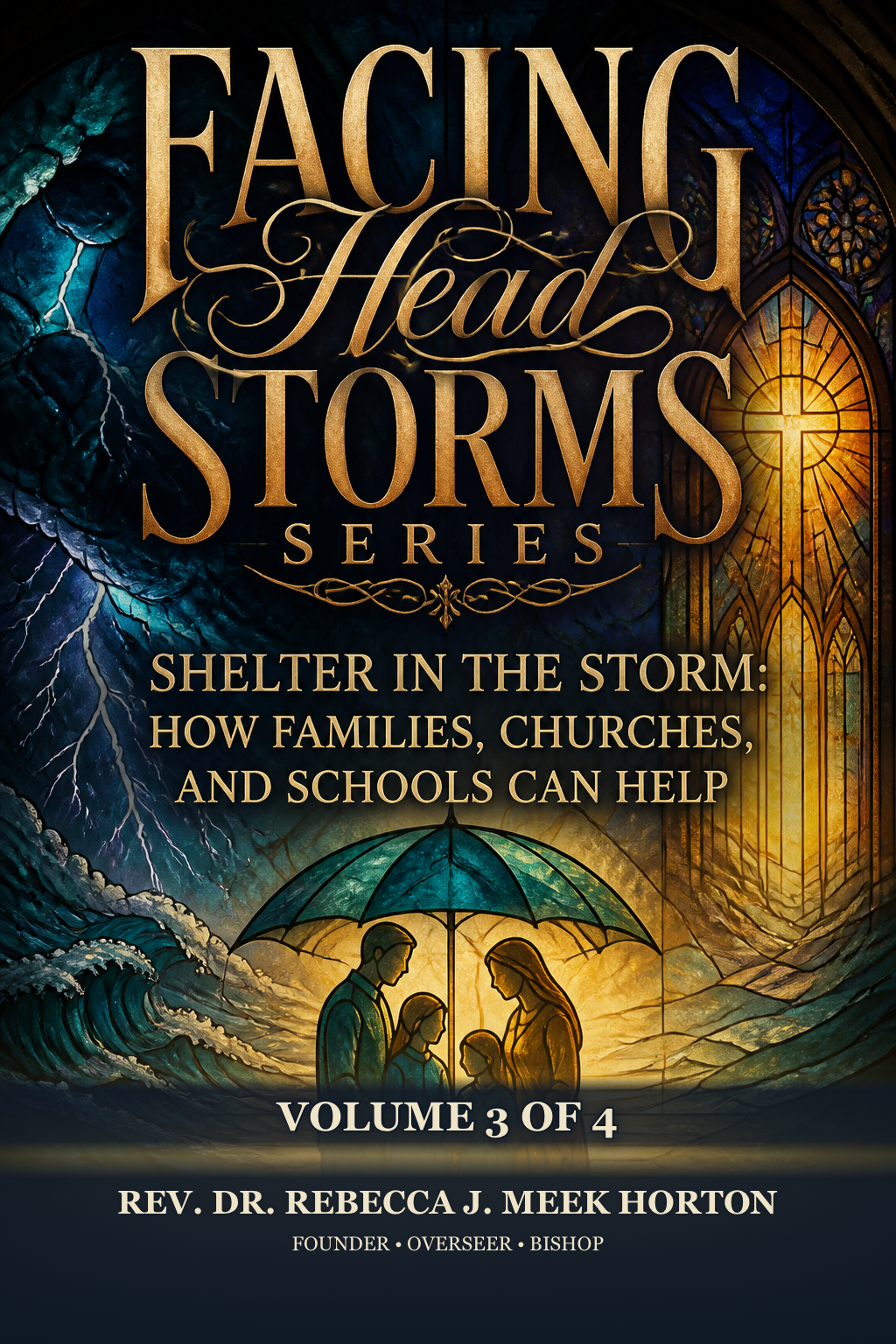
Facing Head Storms · Volume 3
Shelter in the Storm: How Families, Churches, and Schools Can Help
Part 3 of 4 in the series "Facing Head Storms". Series theme: Ways to facehead storms Series arc: This four-book series moves from recognition to renewal, from renewal to support, and from support to stewardship. The first book helps readers name mental attacks without shame or confusion. The second
Full publication
NBCNGMI MASTER KNOWLEDGE LIBRARY Featuring the works of The Sage, Apostle Prophet. Rev. Dr. Rebecca J. Meek Horton, Apostolic Prophetic Architect, NewBeing Creation Network Global Ministries, Inc. Integrated Framework Modalities™
Dedication
I dedicate this book to every family, church, school, mentor, and friend who has chosen to become shelter instead of noise. May God teach us to bear burdens wisely, speak without shame, set safe boundaries, and walk with one another toward help, healing, and hope.
Purpose
I prepared this book for the families, churches, schools, mentors, and friends who want to help someone facing head storms without using shame, fear, or careless words.
My prayer is that these pages teach you how to listen with compassion, carry burdens wisely, set safe boundaries, and know when pastoral care must walk alongside professional mental health support.
May this book help you become a faithful shelter in the storm—not a savior, not a controller, but a steady helper who points people toward truth, care, community, and the next faithful step.
Preface
I prepared this book for the people standing near the storm.
After the first two books in this series, we have named head storms without shame and begun building daily practices of Scripture, prayer, truth, and wise action. But I know this also: many people who are struggling cannot stand well if everyone around them is confused, harsh, silent, afraid, or unprepared.
A person in a head storm needs more than slogans. They need people who can listen without panic, speak without shame, pray without pretending, and help without taking over. They need family, church, school, and community support that is both compassionate and wise.
Galatians 6:2 (KJV) Bear ye one another's burdens, and so fulfil the law of Christ.
That verse carries the heart of this book. We are not called to ignore burdens. We are not called to shame people for having them. We are also not called to carry in a way that creates dependency, secrecy, or unsafe patterns. Love must have wisdom. Care must have boundaries. Prayer must walk with truth.
This book was born from the burden to equip parents, ministers, educators, mentors, students, and friends to respond more faithfully when someone near them is under mental, emotional, or spiritual pressure. Too often, people want to help but do not know what to say. Others say too much, too fast. Some spiritualize everything. Some dismiss everything. Some see danger signs but do not know when to involve professional help.
We need a wiser way.
Proverbs 11:14 (KJV) Where no counsel is, the people fall: but in the multitude of counsellors there is safety.
My prayer is that these pages help you become part of that safety. Not as a rescuer. Not as a controller. Not as someone who replaces God, family, pastoral care, medical care, or counseling. But as a faithful support person who can listen, discern, encourage, set limits, and help someone take the next right step.
There is cost in this kind of care. It asks patience. It asks humility. It asks us to learn what we do not know. It asks us to love people without making ourselves the answer.
But shelter matters in a storm.
May this book help you become steady shelter without becoming someone’s savior. May Christ be glorified in the way we bear burdens together.
Introduction
A storm does not only affect the person standing in the rain.
When someone is fighting fear, tormenting thoughts, depression, anxiety, confusion, grief, trauma, spiritual pressure, or mental exhaustion, the people around them feel the weather too. Parents wonder what to say. Ministers wonder how to pray and when to refer. Educators notice changes in behavior but may not know what is happening underneath. Friends want to help, but fear saying the wrong thing. Mentors may carry more than they were trained to carry.
This book is for the people around the struggler.
Shelter in the Storm is Part 3 of the Facing Head Storms series. The first book helped readers recognize mental attacks without shame or confusion. The second book built daily practices for guarding the mind through Scripture, prayer, truth, and wise action. This third book moves from personal practice to community care.
The argument is simple: no one should have to face head storms alone, but support must be wise enough not to become control, shame, rescue, or dependency.
Galatians 6:2 (KJV) Bear ye one another's burdens, and so fulfil the law of Christ.
Bearing a burden does not mean becoming someone’s savior. Christ is Savior. It does not mean ignoring danger signs, excusing harmful behavior, or trying to handle every crisis privately. It means we come near with love, truth, humility, and responsibility.
Families, churches, schools, and mentors can become sheltering places when they learn how to listen before correcting, speak without shaming, set boundaries without cruelty, and refer without fear. Good support does not replace prayer. It does not replace Scripture. It also does not reject wise counsel, medical care, trauma-informed support, or professional mental health help when needed.
Proverbs 11:14 (KJV) Where no counsel is, the people fall: but in the multitude of counsellors there is safety.
Some storms require more than one helper. A pastor may provide spiritual care. A parent may provide daily support. A teacher may notice patterns. A counselor may help process trauma or mental health symptoms. A doctor may evaluate physical or neurological concerns. A trusted friend may help someone stay connected to life when isolation feels easier.
This is not weakness. This is stewardship.
Ecclesiastes 4:9-10 (KJV) Two are better than one; because they have a good reward for their labour. For if they fall, the one will lift up his fellow: but woe to him that is alone when he falleth; for he hath not another to help him up.
Still, helping has a cost. It asks us to slow down. It asks us to stop using quick religious phrases where careful listening is needed. It asks us to admit when a situation is beyond our training. It asks us to protect the vulnerable, report danger when necessary, and refuse secrecy when safety is at risk.
This book will not teach you to diagnose people. It will teach you to discern your role. It will help you notice signs of distress, respond with care, avoid harmful language, build support plans, and know when pastoral care must work alongside professional mental health support.
Read this book slowly. Do not read it only for someone else. Let it search your language, your assumptions, your helping style, and your boundaries. If you are a minister, read with your congregation in mind. If you are a parent, read with both love and steadiness. If you are an educator, read with watchfulness and humility. If you are a student, friend, or mentor, read to learn how to care without carrying what does not belong to you.
The goal is not panic. The goal is prepared compassion.
1 Thessalonians 5:14 (KJV) Now we exhort you, brethren, warn them that are unruly, comfort the feebleminded, support the weak, be patient toward all men.
That verse gives us a wise pattern. Different needs require different responses. Some people need warning. Some need comfort. Some need support. All need patience.
Shelter in the Storm is an invitation to become that kind of helper: faithful, attentive, honest, and safe.
Before you continue, think of one person, family, classroom, ministry, or circle of influence where stronger support is needed. Write one sentence naming the need. Then pray: Lord, teach me how to help with wisdom, love, boundaries, and courage.
Chapter 1 — When the Storm Enters the Room
A mother stands in the hallway outside her teenager’s bedroom, hand lifted to knock, heart beating faster than she wants to admit.
The room has been quiet too long.
Not peaceful quiet. Heavy quiet.
Earlier that day, the words were sharp. “I’m fine.” “Leave me alone.” “You don’t understand.” The mother wanted to answer quickly, but something in her spirit told her this was more than attitude. This was pain wearing a hard face.
Across town, a pastor reads a message from a church member who has not been seen in weeks. A teacher notices a student who used to laugh now keeps a hood up and eyes down. A mentor hears a young adult say, almost casually, “I don’t know how much longer I can keep doing this.”
When a head storm enters the room, it does not enter neatly.
It enters through silence, anger, withdrawal, panic, confusion, exhaustion, repeated thoughts, strange behavior, spiritual fear, or words that frighten the people who hear them. It enters homes, classrooms, churches, offices, youth groups, text threads, and late-night phone calls.
And the people nearby often feel the same question rise inside:
What am I supposed to do now?
The controlling idea of this chapter is simple: wise care can become shelter without becoming control.
This book is for the people around the struggler. It is for parents, ministers, educators, mentors, relatives, friends, and church members who want to help but do not want to harm. It will not ask you to become someone’s savior. You cannot be that. It will not ask you to become a therapist if that is not your role. It will not ask you to carry what only God can carry.
It will teach you how to become safer, steadier, and wiser in the room.
The First Weight Is Not Knowing
One of the hardest parts of helping someone through a mental or emotional storm is not knowing what you are seeing.
Is this sadness or danger?
Is this spiritual attack, emotional overload, trauma, illness, grief, exhaustion, rebellion, fear, or some mixture of many things?
Is this a moment that needs patience, or a crisis that needs immediate help?
Most families, churches, and schools feel pressure because they are trying to interpret pain while they are standing close to it. When you love someone, you do not observe their suffering from a distance. You feel it in your body. You lose sleep. You replay conversations. You wonder what you missed. You question what you should have said.
A father may hear his son say, “I don’t want to talk,” and feel rejected. A teacher may watch a student shut down and feel powerless. A minister may pray with someone on Sunday and then worry all week about whether the person is safe. A friend may receive a heavy message and not know whether to respond gently, firmly, or urgently.
This not knowing is a burden.
Scripture does not mock burden. It tells us how to carry it together.
Galatians 6:2 (KJV)
Bear ye one another's burdens, and so fulfil the law of Christ.
Bearing a burden does not mean pretending we have all knowledge. It means refusing to abandon someone because their pain is complicated.
It also means we must be honest about our limits.
A person can care deeply and still not know what to do. That is not failure. That is a signal to slow down, seek wisdom, and refuse panic as a guide. Panic usually pushes us toward one of two errors. We either take over, or we pull away.
Taking over says, “I must fix this myself.”
Pulling away says, “This is too much for me.”
Wise care learns a better sentence: “I will come close with humility, and I will seek the right help with wisdom.”
Think of a storm in the natural world. If the wind is strong and the rain is hard, a good shelter does not argue with the weather. It does not shout at the person who is soaked. It does not pretend the clouds are not dark. It opens a safe place, gives covering, and helps the person get oriented.
That is the first calling of community care.
Not to diagnose everything in the doorway.
Not to preach before listening.
Not to control every outcome.
To become steady enough that the person in the storm is not left alone in it.
Love Feels Responsible, but It Is Not Sovereign
When someone you love is struggling in the mind, responsibility can become tangled.
Parents may think, “If I had done more, this would not be happening.”
Ministers may think, “If my faith were stronger, they would be free by now.”
Teachers may think, “If I report this, I may betray the student’s trust; if I do not, I may fail them.”
Friends may think, “If I set a boundary, I am abandoning them.”
These thoughts are heavy because love wants to protect. Love wants to stop pain. Love wants to make the storm end.
But love is not sovereign.
Only God is.
That truth is not an excuse for passivity. It is protection against false ownership. You are responsible to love, listen, pray, tell the truth, seek counsel, keep appropriate boundaries, and take wise action. You are not responsible to become the Holy Ghost, the healer, the rescuer, the doctor, the counselor, the parent if you are not the parent, or the final answer to another person’s life.
This distinction matters.
When helpers forget their limits, they often become anxious, controlling, offended, or exhausted. They start measuring their faithfulness by another person’s immediate improvement. If the person has a better day, the helper feels successful. If the person spirals, the helper feels like a failure.
That is too much weight for a human soul.
Jesus cares for people without confusion about His identity. We are called to follow Him, not replace Him. Even faithful helpers remain servants.
John 15:5 (KJV)
I am the vine, ye are the branches: He that abideth in me, and I in him, the same bringeth forth much fruit: for without me ye can do nothing.
That last sentence is not meant to shame us. It is meant to return us to dependence.
For without me ye can do nothing.
A caregiver who remembers this can breathe differently. A parent can pray without trying to control every hidden thought in a child’s mind. A pastor can walk with a member while knowing when to include additional care. A teacher can notice, document, report, and support without pretending to be the student’s whole safety system. A friend can remain loving without becoming consumed.
Here is a simple RE-Language™ shift for this whole book:
Not, “I have to fix them.”
But, “I am called to offer faithful support and seek wise help.”
Not, “If they struggle, I failed.”
But, “Their storm is real, and my role must stay truthful.”
Not, “Love means no boundaries.”
But, “Love must be safe enough to last.”
When love accepts its proper stewardship, it becomes stronger. It stops performing. It stops panicking. It stops trying to prove itself through control. It learns to stand near the struggler with humility.
That humility becomes shelter.
The Room Needs Less Shock and More Steadiness
When someone reveals mental distress, the first response often shapes what happens next.
A shocked face can close a door.
A rushed correction can silence a confession.
A spiritual accusation can deepen shame.
A dismissive answer can teach a person not to speak again.
This does not mean helpers must respond perfectly. No family, church, or school will do this without mistakes. But we can learn to become less reactive.
Imagine a young person telling a youth leader, “My thoughts scare me.” If the leader gasps, lectures, or says, “You should not think like that if you trust God,” the young person may retreat. But if the leader says, “Thank you for telling me. I am glad you did not carry that alone. Let’s slow down and make sure you are safe,” the room changes.
The storm has not ended.
But shelter has begun.
Steadiness is not coldness. It is calm love under pressure. It is the ability to stay present without letting fear take the lead. In a home, steadiness may sound like, “I want to understand what this has been like for you.” In a church, it may sound like, “We will pray, and we will also walk with wisdom.” In a school, it may sound like, “I am listening, and because I care about your safety, I may need to involve the right support.”
Steadiness tells the struggler, “Your pain did not make me disappear.”
This matters because many people in head storms already feel like a burden. They may believe they are too much, too confusing, too spiritual, too emotional, too broken, or too far gone. A steady helper does not confirm that fear. A steady helper communicates care with words, tone, timing, and follow-through.
The apostle Paul gives a picture of varied care in one verse.
1 Thessalonians 5:14 (KJV)
Now we exhort you, brethren, warn them that are unruly, comfort the feebleminded, support the weak, be patient toward all men.
The language is old, but the wisdom is present. Different conditions need different responses. Some need warning. Some need comfort. Some need support. All need patience.
This is why a one-size response does not work.
Not every storm is rebellion.
Not every silence is defiance.
Not every strong emotion is manipulation.
Not every spiritual struggle is solved by more effort.
Not every troubling behavior can be ignored.
Wise care learns to ask, “What kind of care is needed here?” That question slows the helper down. It keeps the parent from only punishing when listening is needed. It keeps the minister from only praying when referral is needed. It keeps the educator from only correcting behavior when distress may be underneath. It keeps the friend from only absorbing pain when boundaries and support are needed.
This book will teach those distinctions step by step.
For now, the first practice is steadiness.
A storm will try to make everyone in the room storm with it. Fear rises. Voices rise. Assumptions rise. Old wounds rise. But someone must become anchored. Someone must remember that calm is not weakness. Someone must make space for truth.
Proverbs 15:1 (KJV)
A soft answer turneth away wrath: but grievous words stir up anger.
A soft answer is not a weak answer. It is a governed answer. It does not mean we avoid truth. It means we refuse to let fear season our words.
In a head storm, the room needs fewer speeches and more safety. It needs fewer assumptions and more careful questions. It needs fewer labels and more truth. It needs fewer reactions and more wisdom.
Shelter Is Shared, Not Centered on One Person
One hidden danger in community care is the lonely helper.
This may be the mother who carries everything because she does not want others to judge her child. It may be the pastor who becomes the only person receiving crisis calls. It may be the teacher who knows something is wrong but is unsure how much to involve others. It may be the friend who becomes the only emotional outlet for someone in deep distress.
At first, being the only helper may feel noble.
Over time, it becomes unsafe.
No one helper should become the whole shelter.
When one person carries the entire weight, several things can happen. The helper becomes exhausted. The struggler becomes dependent on one person. Important needs may be missed. Boundaries blur. Secrets grow. Resentment builds. And if the helper becomes unavailable, the struggler may feel abandoned because the care was never wisely shared.
Scripture honors counsel and shared wisdom.
Proverbs 11:14 (KJV)
Where no counsel is, the people fall: but in the multitude of counsellors there is safety.
This does not mean everyone needs to know everything. It does not give permission for gossip, spectacle, or careless exposure. A wise circle is not a spotlight. A wise circle protects dignity while increasing safety.
In a family, shared shelter may include a parent, another trusted adult, a pastor, and a qualified professional when needed. In a church, it may include a trained care team, pastoral leadership, and referral relationships. In a school, it may include the teacher, counselor, administrator, parent or guardian, and required safety processes. Among friends, it may mean refusing to be the only person who knows and helping the struggler involve someone mature and responsible.
This will be developed more fully later in the book. Here, we simply name the promise: wise care grows stronger when it is shared with the right people in the right way.
Two are better than one.
Ecclesiastes 4:9-10 (KJV)
Two are better than one; because they have a good reward for their labour. For if they fall, the one will lift up his fellow: but woe to him that is alone when he falleth; for he hath not another to help him up.
The warning is plain: woe to him that is alone when he falleth.
Isolation makes storms more dangerous. But unwise exposure can also wound. The goal is not to announce someone’s struggle. The goal is to build enough support that the person is not left alone and the helper is not carrying beyond capacity.
A shelter has structure. It has walls, a roof, a door, and a foundation. If one wall tries to become the whole building, the shelter fails. In the same way, care needs structure.
A parent brings love and daily presence.
A minister brings spiritual care and community wisdom.
An educator brings observation and school-based responsibility.
A counselor or clinician brings trained mental health support.
A mentor brings encouragement and perspective.
A friend brings companionship.
Each role matters. Each role has limits. Each role should serve the person, not possess the person.
This is part of the maturity this book is calling forth. We are not building dependency. We are building wise support that helps people take their next faithful step.
The Cost of Becoming Shelter
There is a cost to this kind of care.
It will cost us our need for quick answers.
We may want to say the perfect sentence and watch the pain lift. But head storms rarely move on our preferred schedule. Wise care requires patience when progress is slow, uneven, or hidden.
It will cost us our pride.
We may have to admit, “I do not know enough.” We may have to seek counsel. We may have to apologize for words we used before we understood. We may have to learn new ways of listening, speaking, and responding.
It will cost us our comfort.
It is uncomfortable to sit with someone’s fear without rushing to fix it. It is uncomfortable to ask direct safety questions when needed. It is uncomfortable to involve others when secrecy feels easier. It is uncomfortable to set boundaries and still keep love warm.
It will cost us control.
This may be the hardest part. Helpers often want assurance that if they do the right things, the struggler will immediately become well. But people are not projects. Healing is not always linear. Support is not a remote control. God has not called us to control another person’s soul. He has called us to love faithfully, act wisely, and steward our role.
There is also a cost for institutions.
Families must examine the tone of the home.
Churches must examine whether people can speak honestly without being shamed.
Schools must examine whether distress is noticed early or only punished after it disrupts the room.
Mentors must examine whether they are giving support or feeding dependence.
This kind of care asks all of us to grow.
But the cost is not wasted. Nothing is random. Nothing is wasted when it is surrendered to God and shaped by wisdom.
A home can become calmer.
A church can become safer.
A school can become more watchful.
A mentor can become more responsible.
A friend can become more grounded.
And a struggler can begin to feel what many have not felt in a long time: I am not alone, and I am not being controlled. I am being helped with wisdom.
That is the promise of this book.
Not perfect care.
Not expert control.
Not panic disguised as love.
Wise shelter.
The kind that listens before leading.
The kind that uses healing words.
The kind that shares care wisely.
The kind that keeps boundaries.
The kind that knows when more help is needed.
The kind that lets prayer and referral walk together.
The kind that strengthens homes, churches, and schools without making one person carry the whole storm.
Key Takeaways
• Wise care can become shelter without becoming control.
• Love is responsible to support, but it is not sovereign.
• No one helper should carry the whole storm alone.
Practice
Choose one person or setting where you may be called to offer steadier care: your home, church, school, mentoring relationship, or friendship.
Write one sentence that names your role truthfully.
Use this frame:
My role is to offer __________________ with wisdom, while remembering I am not responsible to __________________.
Example:
My role is to offer patient support with wisdom, while remembering I am not responsible to fix what only God and proper care can heal.
This week, pray over that sentence. Then ask God for one next faithful step that would make you a safer shelter for someone facing a head storm.
Chapter 2 — Help Is Not the Same as Fixing
The first time someone you love says, “I am not okay,” something inside you may rise up fast.
A parent may start searching for the right answer before the child finishes speaking. A minister may feel pressure to find the perfect Scripture, prayer, or counsel in the moment. An educator may begin calculating risk, policy, parent contact, and classroom impact all at once. A friend may panic and say too much because silence feels unsafe.
The desire to help is good.
But the desire to fix can become heavy.
This chapter’s controlling idea is simple: faithful support means coming alongside another person with humility, not taking over their life, their healing, or their stewardship.
Help becomes shelter when it steadies a person. Help becomes control when it tries to carry what only God, wise care, and the person’s own responsible participation can carry.
Galatians gives us a clear command.
Galatians 6:2 (KJV)
Bear ye one another's burdens, and so fulfil the law of Christ.
That is not permission to become another person’s savior. It is a call to love with strength, patience, and humility.
We bear burdens. We do not become God.
We come close. We do not take over.
We support. We do not control.
We help the person keep walking. We do not remove every step from their feet.
What Fixing Tries to Do
Fixing usually begins with fear.
The struggler shares something painful, and the helper feels the weight of it. The helper may think, “I have to make this stop.” Or, “If I say the wrong thing, I will make it worse.” Or, “If I do not solve this now, I have failed.”
That pressure can push good people into unwise patterns.
A parent may lecture when the child needs steadiness. A minister may preach too quickly when the person needs care and truth over time. A teacher may become either too distant or too involved because the situation feels bigger than the school day. A friend may promise constant availability because they are afraid the person will fall apart.
Fixing tries to remove discomfort as fast as possible.
But healing is often slower than fixing wants it to be.
A young adult sits at the kitchen table and tells his mother, “My thoughts have been dark again.” She loves him deeply. Her first instinct is to ask ten questions, quote three verses, and demand that he tell her everything he has been thinking. Her fear is not evil. It is understandable. But if fear leads the conversation, he may feel managed instead of loved.
A wiser response begins with presence.
Not panic.
Not control.
Not instant explanation.
A calm sentence may do more good than a flood of words: “Thank you for telling me. I am here with you. We will take the next right step.”
Fixing often says, “Let me make this go away.”
Faithful support says, “You do not have to carry this alone, and we will walk wisely.”
There is a difference.
Fixing puts the helper at the center. Support keeps God, truth, safety, and stewardship at the center.
Fixing may look strong, but it often grows from anxiety. Support may look slower, but it is usually stronger because it makes room for wisdom.
Proverbs warns us about moving without knowledge.
Proverbs 19:2 (KJV)
Also, that the soul be without knowledge, it is not good; and he that hasteth with his feet sinneth.
When someone is in a head storm, speed is not always wisdom. Urgency has its place, especially when safety is at risk. But panic is not the same as urgency. Panic scatters. Wisdom steadies.
The helper must learn to ask, “Am I responding to the person’s need, or am I reacting to my own fear?”
That question can change the whole room.
Bearing Is Not Owning
Galatians 6 gives us both compassion and responsibility.
Galatians 6:2 calls us to bear one another’s burdens. A few verses later, Scripture also says:
Galatians 6:5 (KJV)
For every man shall bear his own burden.
These verses do not contradict each other. They teach order.
There are burdens too heavy to carry alone. Suffering, grief, mental distress, temptation, confusion, trauma, and crisis can become crushing when a person is isolated. The body of Christ is not called to stand far away and say, “That is your problem.” Love comes near.
But there is also a personal burden each person must carry. There is a stewardship that cannot be transferred. Another person cannot repent for me. Another person cannot believe for me. Another person cannot make every appointment, tell every truth, practice every skill, take every medicine if prescribed, set every boundary, or choose every obedient step for me.
Support helps a person carry the heavy load without stealing the personal load.
This matters in families, churches, and schools.
A father can sit with his daughter while she cries. He can help her make a plan. He can contact appropriate support when needed. He can remove shame from the conversation. But he cannot live her inner life for her.
A pastor can pray, teach, counsel within his role, and help connect the person to wise care. But he cannot become the person’s only support, only voice, or only source of stability.
An educator can notice distress, document responsibly, follow policy, and treat the student with compassion. But the educator cannot become the student’s parent, therapist, or savior.
A friend can check in, speak truth, and stay kind. But a friend cannot carry unlimited access, unlimited crisis, and unlimited emotional responsibility without harm.
Bearing is shared love.
Owning is misplaced control.
A simple image may help. If someone is moving a heavy table, you may take one side and help them carry it through the doorway. That is bearing a burden. But if you take the whole table, move into their house, rearrange every room, and refuse to let them touch anything, you are no longer helping. You are taking over.
In care, taking over can feel loving at first. It may even bring short-term relief. But over time it can weaken the struggler, exhaust the helper, and confuse the relationship.
Faithful support asks better questions:
What part of this burden can I help carry?
What part belongs to this person’s own stewardship?
What part requires God’s wisdom beyond me?
What part requires counsel, family involvement, pastoral care, school process, or professional support?
What part must not be handled alone?
These questions keep love in order.
They also protect the helper from pride. Sometimes we take ownership because we are afraid. Sometimes because we love deeply. Sometimes because we like feeling needed. Sometimes because we confuse availability with faithfulness.
That is hard to admit.
But honest motives help love mature.
Rescue Can Become a Trap
Rescue is necessary when someone is in immediate danger. If a person may harm themselves or someone else, or cannot remain safe, the response must be active and urgent. Love does not stand by and call passivity faith.
But not every hard moment is a rescue moment.
Many care situations require steady support, not dramatic intervention.
Rescue habits form when the helper repeatedly steps in to remove consequences, silence discomfort, or manage another person’s life so the helper does not have to feel afraid. Over time, the struggler may learn, “I do not have to participate because someone else will take over.” The helper may learn, “I am only valuable when I am needed.” Both become trapped.
A mother keeps calling her grown son’s employer to explain his absences. She does it because she loves him and fears he will lose the job. But the pattern continues. He stops communicating directly. She becomes more anxious and resentful. He becomes less responsible. What began as help becomes a system that protects avoidance.
A ministry leader answers every late-night message from the same person, even when there is no immediate danger. At first, it feels compassionate. Months later, the leader is exhausted, the person has not built broader support, and the relationship has become dependent. The leader is not only tired; the leader is now afraid to step back.
A teacher quietly excuses every assignment for a student who is struggling emotionally. Compassion is present, but structure disappears. The student may need support, adjustments, and communication. But if every expectation is removed without a plan, the student may fall further behind and feel more hopeless.
Rescue without wisdom can increase helplessness.
This does not mean we become hard. It means we become honest.
We can say, “I will help you make the call, but I will not make every call for you.”
We can say, “I can sit with you for a few minutes and help you breathe through this moment, but we also need to involve the right support.”
We can say, “I love you too much to pretend this pattern is safe.”
We can say, “I am with you, and I will not do your stewardship for you.”
This is RE-Language™ at work. We move from shame to responsibility, from dependency to stewardship, and from vague concern to actionable care.
Not, “You are too much.”
But, “This is too much for one person to carry alone, so we need a wiser support plan.”
Not, “I am done with you.”
But, “I care about you, and I need to help in a way that is safe and sustainable.”
Not, “You never try.”
But, “What is one step you are willing to take today?”
Not, “I have to fix you.”
But, “I can walk with you while you take the next faithful step.”
Words like these keep dignity in the room.
They also tell the truth.
Jesus carried what no one else could carry. We must not try to take His place.
There is a difference between Christlike love and a savior complex. Christlike love serves in obedience to God. A savior complex serves under the pressure of being indispensable.
Christlike love tells the truth. A savior complex hides the truth to keep the peace.
Christlike love strengthens responsibility. A savior complex often creates dependency.
Christlike love knows when to say, “I am here.” It also knows when to say, “We need more help than I can provide.”
That humility is not failure. It is wisdom.
The Helper Must Stay Human
One of the quiet dangers in community care is that the helper forgets they are human too.
A parent may stop sleeping because they are watching every mood. A minister may carry people’s pain from house to pulpit to hospital to home without ever laying it before God. An educator may hold concern for student after student and then wonder why their own heart feels numb. A friend may become the emergency contact for every emotional wave and call it loyalty.
Compassion without limits becomes exhaustion.
Exhaustion without honesty becomes resentment.
Resentment without correction becomes harm.
Even Jesus withdrew to pray. He loved perfectly, but He did not move under the control of every demand placed upon Him.
Luke 5:15-16 (KJV)
But so much the more went there a fame abroad of him: and great multitudes came together to hear, and to be healed by him of their infirmities. And he withdrew himself into the wilderness, and prayed.
If the Lord Jesus, in His earthly ministry, withdrew in communion with the Father, helpers must not despise their own need for prayer, rest, counsel, and order.
The helper must practice stewardship too.
That may mean pausing before answering a message. It may mean asking another mature person for guidance while respecting confidentiality and safety. It may mean admitting, “I do not know what to do next.” It may mean saying, “I can talk at this time, and if this is an emergency, we need to contact emergency support now.” It may mean refusing to carry secret weight that should not remain secret.
A helper who stays human can offer steadier care.
A helper who pretends to be limitless becomes unsafe.
There is a kind of pride that looks like sacrifice. It says, “I am the only one they trust.” Or, “No one else can help like I can.” Or, “If I step back, everything will fall apart.”
Sometimes that may feel true. But it is rarely healthy.
Wise care makes room for God, appropriate support, and the struggler’s own participation. It does not build a private kingdom of dependency around one helper.
The WALK™ rhythm can help the helper slow down.
Wait: Do not begin in noise. Pause before reacting.
Ask: What is really needed here?
Listen: What does Scripture, wisdom, safety, and proper counsel require?
Keep: Take the next faithful step, not every possible step.
This protects the caregiver from rushing and from avoidance.
It also helps families, churches, and schools move from panic to order. The goal is not cold procedure. The goal is faithful care that can last.
James reminds us where wisdom begins.
James 1:5 (KJV)
If any of you lack wisdom, let him ask of God, that giveth to all men liberally, and upbraideth not; and it shall be given him.
Helpers need wisdom as much as strugglers do.
A caregiver may know how to love but not know what to do. That is not shameful. It is a place to ask God, seek counsel, and take responsible action.
Pressure says, “You must know everything now.”
Wisdom says, “Ask God, tell the truth, and take the next faithful step.”
The Cost of Faithful Support
Faithful support has a cost.
It costs the helper the illusion of control.
It costs the parent the fantasy that love can prevent every wound. It costs the minister the pressure of being the answer to every pain. It costs the educator the comfort of looking away when something seems wrong. It costs the friend the role of being constantly needed.
It also costs patience.
People do not always heal on our timeline. A struggler may take one step forward and then become afraid. They may receive counsel one week and resist it the next. They may want help but fear change. They may speak honestly and then pull back. They may need repeated reminders that they are not alone and that they still have responsibility.
This can be frustrating.
Love does not mean pretending it is easy.
There will be moments when the helper feels helpless. There will be times when the right choice is not obvious. There will be conversations that require courage. There will be situations where safety requires more action than the struggler wants. There will be seasons when prayer feels tearful and practical steps feel small.
But small faithful steps matter.
A steady presence matters.
A calm tone matters.
A truthful sentence matters.
A wise referral matters.
A boundary spoken in love matters.
A parent who does not shame matters.
A minister who knows their role matters.
A teacher who notices and responds responsibly matters.
A friend who refuses both abandonment and control matters.
Faithful support is not dramatic every day. Often it is quiet obedience.
Romans gives us a picture of shared compassion.
Romans 12:15 (KJV)
Rejoice with them that do rejoice, and weep with them that weep.
There is holy strength in being able to weep with someone without trying to own their sorrow.
There is holy humility in being able to help without becoming the center.
There is holy wisdom in knowing that love can come close and still leave room for God to work.
A struggler facing head storms needs shelter. But shelter is not a cage. Shelter gives covering so a person can breathe, tell the truth, receive care, and take the next step. Shelter protects life without stealing responsibility.
That is the kind of help this book is building.
Not control.
Not panic.
Not shame.
Not rescue as a way of life.
Wise care.
Steady presence.
Shared burdens.
Personal stewardship.
Next faithful steps.
Key Takeaways
• Helping means coming alongside, not taking over.
• Bearing burdens does not remove another person’s stewardship.
• Wise support steadies the struggler without creating dependency.
Practice
Think of one person you are trying to help.
Write their name privately, then answer these four questions:
What burden can I help carry with love?
What responsibility still belongs to them?
What fear in me may be pushing me to fix, rescue, or control?
What is one faithful support step I can take this week without taking over?
Choose one action. Keep it simple.
Make one calm check-in. Pray before you speak. Offer one practical support. Ask one wise question. Or, if the situation is beyond your role, help connect the person to appropriate care.
Do not aim to be the fixer.
Aim to be faithful.
Chapter 3 — Listen Before You Lead
The teenager stood in the hallway with one hand on the doorknob and the other hand gripping a backpack strap.
Her mother asked, “Are you okay?”
The answer came too fast.
“I’m fine.”
But her eyes were tired. Her shoulders were tight. Her room had been quiet for days, but not peaceful. Assignments were missing. Meals were half-eaten. The phone was always near, yet she seemed farther away than ever.
The mother wanted to say everything at once.
You need to pray. You need to stop isolating. You need to tell me what is going on. You cannot keep acting like this.
All of those words rose from love. Some of them might even become necessary later. But in that moment, the first faithful act was not correction.
It was listening.
The first skill of wise community care is slow, careful listening. Before families, ministers, educators, mentors, and friends try to lead someone through a head storm, they must learn how to hear pain without rushing to fix it, explain it, minimize it, preach at it, or interrogate it.
Listening is not weakness. It is not passive. It is not agreement with everything a person feels or says. Listening is a disciplined form of love that gives a hurting person room to be honest enough for help to begin.
James 1:19 (KJV)
Wherefore, my beloved brethren, let every man be swift to hear, slow to speak, slow to wrath:
Swift to hear does not mean slow to care. It means we care enough not to make our first words the center of the room.
The First Shelter Is Attention
When someone is struggling in the mind, the room can become crowded even if only two people are present.
Fear enters. Assumptions enter. Old family patterns enter. Religious pressure enters. School expectations enter. Unspoken shame enters.
A parent may hear, “I can’t do this anymore,” and immediately feel panic. A minister may hear, “I feel empty,” and immediately prepare a sermon. A teacher may notice a student shutting down and immediately think about performance, discipline, or missed work. A friend may hear troubling words and immediately try to cheer the person up.
These responses are understandable.
But if we move too fast, we may answer a question the person did not ask and miss the pain they were trying to reveal.
Attention is the first shelter because it says, “You are not a problem to be pushed away. You are a person to be received with care.”
This does not require perfect words. It requires presence.
Job’s friends are remembered for much of what they said wrong later, but their first response carried wisdom. They came near, saw his grief, and sat with him before speaking.
Job 2:13 (KJV)
So they sat down with him upon the ground seven days and seven nights, and none spake a word unto him: for they saw that his grief was very great.
They saw that his grief was very great.
That seeing matters.
There are moments when the most spiritual thing a caregiver can do is stop performing certainty and sit with the weight of what is real.
A father sits at the kitchen table after his son says, “I don’t know why I feel this way.” The father wants to explain hormones, school pressure, bad friends, too much screen time, and spiritual warfare. Some of those may matter. But first he says, “I’m listening. Tell me what the day feels like when it gets heavy.”
That one sentence opens a door.
A pastor meets with a member who says, “I feel like I’m failing God.” The pastor could correct the theology immediately. Instead, he says, “When did that feeling start getting loud?” The member begins to talk about grief, exhaustion, and fear that had been hidden under church attendance.
A teacher notices a student who used to participate now staring at the desk. Instead of calling the student out in front of others, she quietly says after class, “I noticed you seem weighed down lately. You do not have to explain everything right now, but I want you to know I am paying attention and I care.”
Attention does not solve everything.
But it can lower the loneliness.
And when loneliness lowers, honesty often rises.
Hear the Story Before the Symptom
A symptom tells you something is happening. A story helps you understand what the person is carrying.
Withdrawal may look like rebellion. Irritability may look like disrespect. Silence may look like indifference. Crying may look like weakness. Missing work may look like laziness.
Sometimes those behaviors do require responsibility. This book will speak later about boundaries, safety, and support circles. But this chapter begins before that. It asks us to slow down enough to hear what may be underneath the behavior.
Proverbs 18:13 (KJV)
He that answereth a matter before he heareth it, it is folly and shame unto him.
That verse is direct. Answering before hearing is not wisdom. It is folly.
Many caregivers answer too soon because silence feels unsafe. We want to reduce the discomfort. We want the conversation to move somewhere manageable. We want the person to say something we can respond to, categorize, or correct.
But head storms are often tangled. A person may not know how to explain what is happening inside them. They may speak in fragments. They may contradict themselves. They may say, “I don’t know,” again and again.
Listening gives time for the story to unfold.
A parent hears a child say, “I hate school.”
A rushed response says, “You don’t hate school. You just don’t want to work.”
A listening response says, “What part of school feels the hardest right now?”
The child may then say, “Lunch.”
Now the parent learns this may not be about homework. It may be about isolation, bullying, embarrassment, social fear, or something else the first statement did not reveal.
A minister hears a young adult say, “I don’t feel close to God anymore.”
A rushed response says, “You need to get back in the Word.”
A listening response says, “What has made God feel far away to you?”
The young adult may speak about unanswered prayer, depression, trauma, or a church wound. Scripture will matter deeply in that care. Prayer will matter. Truth will matter. But truth must be applied to the real wound, not to the caregiver’s first assumption.
An educator sees a student sleeping in class.
A rushed response says, “You are being irresponsible.”
A listening response, in the proper setting, says, “I noticed you are having trouble staying awake. Is something affecting your sleep or safety at home?”
The answer may reveal stress, caregiving responsibilities, grief, housing instability, anxiety, or another concern that needs wise attention through appropriate school channels.
Hearing the story does not mean excusing harmful behavior. It means we do not try to lead with incomplete information.
Jesus often asked questions before giving instruction. He did not ask because He lacked knowledge. He asked in ways that revealed the heart, named desire, and invited response.
In John 5, Jesus asked the man at the pool, “Wilt thou be made whole?” In Mark 10, He asked blind Bartimaeus, “What wilt thou that I should do unto thee?” The Lord was not confused. He was drawing the person into honest participation.
Caregivers can learn from that pattern.
Do not reduce the person to the symptom.
Ask for the story.
Ask Questions That Open, Not Trap
Not all questions help.
Some questions open the heart. Others feel like a courtroom.
Why are you acting like this? What is wrong with you? Didn’t I teach you better? How could you think that? Are you just trying to get attention?
Those questions may rise from fear, but they often land as accusation. They can push a struggler deeper into hiding.
Wise questions are clear, calm, and spacious. They help the person tell the truth without feeling hunted.
Proverbs 20:5 (KJV)
Counsel in the heart of man is like deep water; but a man of understanding will draw it out.
Draw it out.
Not yank it out. Not shame it out. Not threaten it out. Not force it out in public.
Draw it out with understanding.
A helpful question usually does at least one of four things.
It invites description.
“What has this week been like for you?” “What happens in your mind when the storm gets loud?” “When do you feel most overwhelmed?” “What does a hard morning look like?”
It clarifies meaning.
“When you say you feel numb, what do you mean by numb?” “When you say you cannot keep up, are you talking about schoolwork, relationships, emotions, or all of it?” “When you say you want everything to stop, help me understand what you mean.”
It names support.
“What helps even a little?” “Who feels safe to talk to?” “What do you need from me right now: quiet company, prayer, help making a plan, or just listening?”
It checks safety without drama.
“Are you safe right now?” “Have you thought about hurting yourself or someone else?” “Do we need to bring another trusted person into this conversation?”
Those last questions may feel hard, but they can be necessary. Asking directly about safety does not plant danger in a person’s mind. It gives room for truth. If the answer reveals immediate danger, the next faithful step is to get urgent help. That is not overreacting. That is love acting responsibly.
But even safety questions can be asked with steadiness instead of panic.
Panic says, “You scared me. Don’t ever say that again.”
Steady care says, “I am glad you told me. We are going to take this seriously, and you are not going to carry this alone.”
There is a difference.
A mentor once sat with a college student who kept saying, “I’m just tired.” The mentor could sense there was more beneath the word. Instead of pressing harshly, she said, “There is tired from a long week, and there is tired from feeling like life is too heavy. Which one is closer?”
The student began to cry.
“Life is too heavy.”
That answer changed the conversation. Not because the mentor had a perfect solution, but because the right question gave the student permission to be honest.
Parents, ministers, educators, and friends do not need to become therapists to ask better questions. They need humility, patience, and wisdom about their role.
A parent can ask and listen. A pastor can ask and listen. A teacher can ask and listen within school responsibilities. A friend can ask and listen.
And when the need is beyond their role, they can help connect the person to appropriate support without shame. Listening does not mean carrying what belongs to a whole care team. It means hearing well enough to know what kind of care may be needed next.
Reflect Before You Respond
After someone shares pain, the next few sentences matter.
A careless response can close the door that courage just opened.
Many people do not stop talking because they have nothing else to say. They stop because the first response taught them it was not safe to continue.
Common closing responses sound like this:
“At least it is not worse.” “You just need to be stronger.” “Other people have real problems.” “You are too blessed to be stressed.” “You need more faith.” “That is just the enemy.” “Stop thinking like that.” “You will be fine.”
Some of those statements may contain a piece of truth. Gratitude matters. Faith matters. Spiritual warfare is real. Thought patterns matter. But truth used without tenderness can feel like a stone instead of bread.
A wise first response reflects before it redirects.
Reflection sounds like this:
“That sounds heavy.” “I did not know you were carrying that much.” “Thank you for telling me.” “I can hear that you feel worn down.” “You are not in trouble for being honest.” “I want to understand before I speak into this.” “We will take this one step at a time.”
Reflection does not mean agreement with every conclusion.
If a person says, “I am worthless,” you do not agree. But you also do not need to attack the sentence in the first second.
You can say, “I hear that you feel worthless. I do not believe that feeling is telling you the truth about who you are, but I want to understand how long you have been feeling this way.”
That response does two things. It honors the pain, and it refuses the lie.
This is important for believers. We are not called to let falsehood rule the room. But we must learn to answer falsehood in a way that does not crush the person who is already wounded.
Romans 12:15 (KJV)
Rejoice with them that do rejoice, and weep with them that weep.
Weep with them that weep comes before many explanations.
There is a time to teach. There is a time to correct. There is a time to warn. There is a time to make a plan. There is a time to bring others in. There is a time to act quickly for safety.
But when someone first opens the door to pain, reflection often needs to come before direction.
Consider the difference in a church hallway.
A woman says, “I have been having anxiety attacks again.”
Response one says, “You know God has not given us the spirit of fear.”
That Scripture is true, but the response may feel like a rebuke instead of care.
Response two says, “I am sorry you have been carrying that. When did they start again? Would you like to sit somewhere quiet for a moment and talk?”
That response does not deny Scripture. It creates enough safety for Scripture and care to be received wisely.
Consider the difference at home.
A son says, “I don’t want to go anywhere anymore.”
Response one says, “You are not going to sit in this house and be lazy.”
Response two says, “I am concerned because I have noticed you pulling back. Help me understand what feels hard about going out.”
The second response may still lead to responsibility. It may still lead to limits. It may still lead to professional support if needed. But it begins with hearing rather than labeling.
Consider the difference in school.
A student says, “I can’t focus. My mind won’t stop.”
Response one says, “You need to try harder.”
Response two says, “That sounds frustrating. Let’s talk about what happens when you try to begin your work.”
The second response gives the educator information. It also communicates dignity.
To reflect before responding, use three simple steps.
First, repeat the heart of what you heard.
“You feel overwhelmed when the room gets loud.” “You feel like you are disappointing everyone.” “You feel afraid that if you tell the truth, people will judge you.”
Second, ask if you understood correctly.
“Am I hearing you right?” “Did I miss anything?” “Is that close to what you mean?”
Third, ask permission before offering direction when the situation allows.
“Would it be okay if I shared one thought?” “Would you like advice right now, or would it help more for me to keep listening?” “Can we think together about one next step?”
This small practice reduces defensiveness. It also teaches the struggler that care is not control.
When the person is a child, student, or someone under your responsibility, you may not always be able to wait for permission before acting. Safety and stewardship matter. But even then, tone matters.
You can say, “Because I care about your safety, I need to bring in help. I will not keep this secret, but I will walk with you through the next step.”
That is honest. It is not abandonment. It is not betrayal. It is responsible care.
The Cost of Slowing Down
Listening sounds simple until the storm is in your own house, your own church, your own classroom, or your own friend group.
The cost of listening is that it asks you to manage your own fear before you manage the conversation.
That is not easy.
A parent may feel guilt. “How did I miss this?” A minister may feel pressure. “What if I say the wrong thing?” An educator may feel limited. “How do I care within my role?” A friend may feel overwhelmed. “What if I cannot handle this?”
Those are real tensions.
Listening also costs time. It may interrupt your schedule. It may require a second conversation. It may reveal that the situation is more serious than you hoped. It may require you to apologize for past responses. It may require you to admit, “I moved too fast. I want to listen better now.”
That kind of humility is not weakness. It is maturity.
Proverbs 15:1 (KJV)
A soft answer turneth away wrath: but grievous words stir up anger.
A soft answer is not a weak answer. It is a governed answer.
There is strength in being able to stay calm when another person’s pain is uncomfortable. There is strength in not making their confession about your embarrassment. There is strength in not rushing to defend yourself when someone says, “I did not feel safe telling you.”
The cost is real, but the fruit is worth it.
When people are heard well, they are more likely to stay connected. When they stay connected, they are more likely to receive help. When help comes early, storms may not have to grow in silence. When families, churches, and schools learn to listen, care becomes wiser and safer.
This does not mean every person will open up immediately. Some wounds have been hidden for a long time. Some people have learned not to trust quickly. Some may test the listener with short answers, anger, or withdrawal.
Do not demand instant openness.
Practice steady presence.
A mother may say to her child, “I know you may not want to talk now. I will check again later. I love you, and I am not going to shame you.”
A pastor may say, “You do not have to tell the whole story today. Let’s begin with what you are able to say.”
A teacher may say, “I respect your privacy, and I also care about your safety. If something is making school feel unmanageable, I want to help connect you with the right support.”
A friend may say, “I may not know all the right words, but I can sit with you. You do not have to pretend with me.”
These are small shelters.
Small shelters matter.
Key Takeaways
• Listening is the first act of wise care.
• Good questions draw out truth without shame.
• Reflecting pain before giving advice helps people feel safe enough to receive help.
Practice
Choose one person you care about who may be carrying more than they are saying.
Within the next seven days, create one calm moment to listen without rushing.
Use this simple listening step:
Ask, “What has been feeling heavy lately?”
Then do three things.
Do not interrupt. Do not correct quickly. Do not turn the conversation back to yourself.
Before you offer advice, say, “Let me make sure I heard you.”
Then reflect back the heart of what they shared.
Your next faithful step is not to fix the whole storm.
Your next faithful step is to become safe enough for truth to be spoken.
Chapter 4 — Words That Heal, Words That Harm
The text message was only six words long.
You are being dramatic again.
The parent who sent it did not mean to wound. She was tired. Her child had been crying, withdrawing, missing assignments, and refusing to explain what was wrong. The parent had asked questions, offered help, prayed, warned, pleaded, and finally snapped.
Six words.
The child read them and put the phone face down.
Nothing broke in the room. No door slammed. No public scene followed. But something inside that child moved farther away. Not because the parent did not care, but because the words made care feel unsafe.
Many families, churches, schools, and mentoring relationships carry this same ache. We want to help, but our words sometimes add weight to a mind already under attack. We may speak from fear, fatigue, embarrassment, theology, urgency, or frustration. We may think we are motivating someone when we are actually shaming them. We may think we are naming truth when we are only releasing pressure.
The controlling idea of this chapter is simple: words can become shelter or they can become storm, and wise care learns to RE-Language™ concern so it moves from accusation to responsibility, from fear to clarity, and from vague worry to loving action.
This does not mean we avoid truth. It does not mean we excuse harmful behavior. It does not mean every hard sentence is wrong.
It means we speak in a way that keeps the door open for help.
Proverbs 18:21 (KJV)
Death and life are in the power of the tongue: and they that love it shall eat the fruit thereof.
Words Become Weather
A struggling person does not only hear what we say. They often hear it through fear, shame, exhaustion, confusion, trauma, or spiritual discouragement. A simple sentence can land heavier than we intended.
That is why language matters.
In a head storm, the mind may already be saying, “You are too much. You are failing. Nobody understands. You are a burden. You should hide.” If our words sound like those accusations, even by accident, we may strengthen the very storm we are trying to calm.
A minister may say, “You just need more faith,” intending to point someone toward God. But the struggler may hear, “Your pain proves your faith is weak.”
A teacher may say, “You are not trying,” intending to call a student to responsibility. But the student may hear, “No one sees how hard it is just to make it through the day.”
A parent may say, “What is wrong with you?” intending to express concern. But the child may hear, “I am the problem.”
A friend may say, “You have so much to be grateful for,” intending to encourage perspective. But the struggler may hear, “Your pain is not allowed.”
Words become weather. They create the emotional air in the room.
Some words make it easier to breathe. Some words make the room feel smaller.
Scripture does not treat speech as a small matter.
Proverbs 12:18 (KJV)
There is that speaketh like the piercings of a sword: but the tongue of the wise is health.
Notice the contrast. Some speech pierces. Wise speech brings health.
This does not mean wise speech is always soft. A doctor may speak directly. A parent may set a firm expectation. A pastor may confront sin. A school leader may have to report danger or enforce consequences. But even necessary correction can be delivered without contempt.
The question is not only, “Was what I said technically true?”
The wiser question is, “Did my words serve healing, truth, responsibility, and the next faithful step?”
A storm does not need more noise. A storm needs a steady voice.
Shame Sends People Into Hiding
Shame-based language does not usually produce maturity. It produces hiding.
Guilt says, “I did something wrong.”
Shame says, “I am something wrong.”
Guilt can lead to confession, correction, repair, and growth. Shame often leads to secrecy, defensiveness, despair, and isolation.
This difference matters for every parent, minister, educator, mentor, and friend.
If a student fails a class because depression has made concentration difficult, the needed conversation may include responsibility. Assignments still matter. Honesty still matters. But shame says, “You are lazy and wasting your life.” Wise care says, “Something is interfering with your ability to function. We need to tell the truth, make a plan, and take the next step.”
If a church member stops attending, shame says, “You must not really care about God.” Wise care says, “We have missed you. Are you safe? Is there a burden you are carrying? How can we walk with you faithfully?”
If a teenager admits frightening thoughts, shame says, “Do not say that. You are scaring me.” Wise care says, “Thank you for telling me. I am going to stay with you, and we are going to get the right help.”
Shame may sound spiritual, especially when people are afraid.
It may sound like:
“You should be over this by now.”
“After all God has done for you, how can you feel this way?”
“Other people have it worse.”
“Stop speaking that.”
“You are embarrassing this family.”
“You are just looking for attention.”
“You know better than this.”
Some of these sentences may contain a piece of concern, but the delivery covers the concern with accusation. The struggler does not feel invited into responsibility. They feel pushed into defense.
Jesus was full of truth, and He was full of grace. He did not flatter people. He did not ignore sin. He did not confuse compassion with compromise. Yet broken people came near Him. That should search us.
If our truth-telling consistently makes wounded people hide, we need to ask whether we are carrying the tone of Christ or only the force of our fear.
Ephesians 4:29 (KJV)
Let no corrupt communication proceed out of your mouth, but that which is good to the use of edifying, that it may minister grace unto the hearers.
The verse does not say, “Say whatever is on your mind because you are right.”
It says our speech should edify. It should build. It should minister grace.
Grace-filled speech is not weak speech. It is governed speech. It is speech under the authority of God, not under the control of panic.
A father once told his adult son, “I do not understand everything you are facing, and I am scared. But I do not want my fear to become another burden on you. Help me understand what support would be useful today.”
That sentence did not solve the son’s struggle. But it changed the room.
The father moved from accusation to honesty.
He moved from control to support.
He moved from shame to responsibility.
That is RE-Language™ in practice.
RE-Language™ Turns Concern Into Care
RE-Language™ is the practice of shifting words from shame to responsibility, from dependency to stewardship, and from vague to actionable.
It does not hide truth. It helps truth arrive with wisdom.
Many helpers need this because we often speak from the first emotion that rises. If fear rises first, our language may become sharp. If embarrassment rises first, our language may become controlling. If helplessness rises first, our language may become preachy. If fatigue rises first, our language may become dismissive.
RE-Language™ slows the sentence before it leaves the mouth.
It asks:
What am I really trying to say?
What fear is shaping my tone?
Will these words open a path for help or close one?
Am I naming behavior without attacking identity?
Am I giving one clear next step?
Here are practical shifts.
From accusation to responsibility:
Instead of, “You are always making things difficult,” say, “This situation is difficult, and we need to decide the next responsible step.”
Instead of, “You are lazy,” say, “I see that the work is not getting done. Let’s identify what is blocking you and what must happen next.”
Instead of, “You never listen,” say, “I need us to slow down and make sure we both understand what is being said.”
Instead of, “You are out of control,” say, “This behavior is not safe. We are going to pause, lower the intensity, and get help if needed.”
From fear to clarity:
Instead of, “You are scaring me,” say, “I am concerned about your safety, and I need to ask a direct question.”
Instead of, “Do not talk like that,” say, “When you say you do not want to be here, I take that seriously. Are you thinking about harming yourself?”
Instead of, “This family cannot handle this,” say, “We cannot carry this alone. We are going to involve the right support.”
Instead of, “What if this gets worse?” say, “What is the safest next step today?”
From vague concern to loving action:
Instead of, “Let me know if you need anything,” say, “I can sit with you for thirty minutes, help you call the counselor, or bring dinner. Which would help today?”
Instead of, “I am praying for you,” say, “I am praying for you, and I will check on you tomorrow at 6:00.”
Instead of, “You need help,” say, “You do not have to handle this alone. Would you be willing to talk with someone trained to help?”
Instead of, “We are here for you,” say, “Here is who you can call, here is when we are available, and here is what we will do if safety becomes a concern.”
From dependency to stewardship:
Instead of, “I will fix this for you,” say, “I will walk with you while you take the next faithful step.”
Instead of, “Just do what I say,” say, “Let’s weigh the options, seek wise counsel, and choose the next responsible action.”
Instead of, “You cannot make decisions right now,” say, “This is a heavy moment. Let’s slow the decision down and include the right support.”
Instead of, “Call me anytime for anything,” say, “You may call me during these hours, and if there is immediate danger, we will contact emergency help.”
This kind of language is loving because it is clear.
Vague care can sound kind but leave the struggler unsupported. Clear care gives shape to love.
A young teacher noticed a student who had stopped turning in work and had begun sitting alone. The teacher could have said, “You need to get yourself together.” Instead, she said quietly after class, “I have noticed a change. You have been quieter, and your work has dropped. I am not angry. I am concerned. Is there something you need help carrying?”
The student did not tell everything that day. But he did say, “Maybe.”
That “maybe” was a door.
The teacher did not become the student’s therapist. She did not carry what was not hers to carry. She used words that made help more possible. Then she followed the school’s process for support.
RE-Language™ does not require fancy speech. It requires governed speech.
Colossians 4:6 (KJV)
Let your speech be alway with grace, seasoned with salt, that ye may know how ye ought to answer every man.
Grace and salt belong together.
Grace without salt may become vague comfort.
Salt without grace may become harsh correction.
Wise care needs both.
The Cost of Slower Speech
Changing our words costs us something.
It costs us the right to react quickly.
It costs us the satisfaction of saying the sharp sentence.
It costs us the comfort of pretending we know what is happening when we have not listened long enough.
It costs us the habit of using spiritual language to avoid emotional honesty.
It costs us the pride of being the fixer.
This is not easy.
When someone you love is in a head storm, your own nervous system may feel threatened. Parents may panic. Ministers may feel pressure to have an answer. Educators may worry about safety, responsibility, and liability. Friends may feel helpless. Mentors may wonder if they are enough.
That pressure is real.
But pressure cannot be allowed to govern the tongue.
James 1:19 (KJV)
Wherefore, my beloved brethren, let every man be swift to hear, slow to speak, slow to wrath:
Slow speech is not passive. It is disciplined.
It says, “I will not let my fear lead this conversation.”
It says, “I will not make your pain about my discomfort.”
It says, “I will tell the truth, but I will not use truth as a weapon.”
It says, “I will choose words that make the next faithful step clearer.”
There will be moments when you get it wrong. You may speak too sharply. You may minimize. You may overcorrect. You may lecture when you should have paused. You may ask too many questions at once.
When that happens, repair matters.
Repair sounds like:
“I spoke from fear. I am sorry.”
“That came out as accusation. Let me say it more clearly.”
“I minimized what you were trying to tell me. I want to listen again.”
“I used spiritual words, but I did not show patience. Forgive me.”
“I cannot take back what I said, but I can take responsibility for it.”
Repair does not weaken authority. It strengthens trust.
A parent who apologizes wisely does not stop being a parent. A minister who corrects tone does not stop being a leader. A teacher who repairs a sentence does not lose the classroom. Repair teaches maturity.
It also models the very stewardship we are asking from the struggler.
We cannot call others into responsibility while refusing responsibility for our own words.
Galatians 6:1 (KJV)
Brethren, if a man be overtaken in a fault, ye which are spiritual, restore such an one in the spirit of meekness; considering thyself, lest thou also be tempted.
The spirit of meekness matters.
Meekness does not mean weakness. It means strength governed by humility. It means we remember we are not above the person we are helping. We are not the Savior. We are not the Holy Ghost. We are not the whole support system. We are servants called to care faithfully.
This is especially important when mental, emotional, spiritual, and relational struggles overlap. Not every sentence is a demon. Not every symptom is rebellion. Not every silence is disrespect. Not every strong emotion is manipulation. Not every hard day is a lack of faith.
We must be careful.
Careful does not mean afraid to speak.
Careful means faithful, accurate, truthful, and simple.
Faithful: Does this agree with the heart of Scripture?
Accurate: Am I naming what I know, not exaggerating what I fear?
Truthful: Am I honest about the seriousness without using shame?
Simple: Is there one clear next step?
Here is what this can sound like in real rooms.
A minister says to a member, “I believe God is able to strengthen you. I also believe this burden needs support. Let us pray, and let us also talk about who can walk with you wisely this week.”
A parent says to a teenager, “You are not in trouble for telling me the truth. If you are unsafe, I must act to protect you. We will face that together.”
A school leader says to a family, “We are seeing changes that concern us. We are not labeling your child. We are asking how we can partner responsibly.”
A friend says, “I love you, but I cannot be your only support. Let’s identify one more person who can help carry this with wisdom.”
Those words do not fix everything. But they do create shelter.
They lower shame.
They increase clarity.
They invite responsibility.
They protect love from becoming control.
They help the struggler feel less alone without making one helper carry the whole storm.
That is the work of healing language.
Key Takeaways
• Words can become shelter or storm.
• Shame pushes people into hiding; wise speech invites responsibility.
• RE-Language™ turns concern into clear, loving action.
Practice
Choose one sentence you commonly say when you are afraid, frustrated, or trying to help someone in a head storm.
Write it down honestly.
Then RE-Language™ it in three steps:
• Remove accusation: Do not attack the person’s identity.
• Name responsibility: State the concern clearly and truthfully.
• Add one action: Offer the next faithful step.
Use this frame:
Instead of saying, “________________________,” I will say, “________________________.”
Before your next hard conversation, pause and pray:
Lord, govern my tongue. Help my words build shelter, not storm. Give me truth with grace, clarity with patience, and love with wisdom.
Chapter 5 — Build a Circle, Not a Spotlight
The first person who noticed was not the pastor.
It was the aunt who saw the young man stop eating after Sunday service. It was the teacher who noticed the student’s head down three days in a row. It was the mother who heard the bedroom door close earlier and earlier each night. It was the friend who read the text message and felt the weight behind the words, “I’m just tired.”
One person noticed.
Then that one person quietly began carrying everything.
Every call. Every mood change. Every fear. Every late-night message. Every question about what to say and what not to say. Love was present, but the weight became too much for one pair of shoulders.
That is where many families, churches, schools, and mentors get stuck. They love the person who is struggling, but they accidentally turn one helper into the whole shelter.
This chapter’s controlling idea is simple: wise care builds a circle, not a spotlight. A healthy support circle shares care with consent, confidentiality, maturity, and clear roles so the struggler is not exposed, and the helper is not crushed.
Proverbs 11:14 (KJV)
Where no counsel is, the people fall: but in the multitude of counsellers there is safety.
A circle is not a crowd.
A circle is not gossip.
A circle is not a meeting where everyone talks about someone who is already hurting.
A wise circle is a small, prayerful, responsible group of mature people who know what they are there to carry and what they are not there to control.
No One Helper Is the Whole Shelter
When someone is facing a head storm, the first safe person often becomes the main person.
That may be a parent, a spouse, a teacher, a youth leader, a minister, a coach, a grandparent, or a friend. The struggler trusts them, so they open up. That trust is precious. It should not be handled carelessly.
But trust does not mean one person must carry the whole matter alone.
A mother can love deeply and still need support. A minister can counsel faithfully and still need a care team. A teacher can notice distress and still need the proper school process. A friend can listen well and still need help knowing what is safe, wise, and responsible.
This is not weakness. This is wisdom.
Proverbs 15:22 (KJV)
Without counsel purposes are disappointed: but in the multitude of counsellers they are established.
Many helpers become overwhelmed because they confuse faithfulness with solitary carrying. They think, “If they trusted me, I cannot tell anyone.” Or, “If I ask for help, I am betraying them.” Or, “If I do not answer every call, I am failing them.”
That kind of thinking may sound loyal, but it can become unsafe.
One helper cannot be parent, pastor, therapist, crisis responder, best friend, advocate, accountability partner, and constant emotional anchor all at once. When one person tries to become everything, care becomes fragile. If that helper gets tired, offended, confused, unavailable, or afraid, the whole support structure shakes.
A circle protects the struggler from overdependence on one person.
It also protects the helper from burnout, secrecy, and pressure.
Think of a family caring for an elderly parent after surgery. One adult child may live closest and do the daily check-ins. But wisdom says the whole burden should not fall there if others can help. One person may handle appointments. Another may bring meals. Another may manage communication. Another may sit quietly for an hour so the main caregiver can rest.
The same principle applies when someone is struggling in the mind. The care may look different, but the need for shared wisdom remains.
The goal is not to make the struggler feel surrounded by watchers.
The goal is to make sure they are supported by faithful people who understand their part.
A spotlight exposes. A circle shelters.
A spotlight says, “Everyone is looking at you.”
A circle says, “You are not alone, and we will walk wisely.”
Consent Protects Dignity
A wise support circle begins with consent whenever possible.
Consent means we do not treat a struggling person like a project to be discussed. We honor their dignity by including them in the care process as much as safety allows.
This matters because many people who face head storms already feel powerless. Their thoughts may feel loud. Their emotions may feel unsteady. Their circumstances may feel out of control. If the people around them begin making secret plans, spreading details, or gathering others without explanation, the struggler may feel exposed instead of helped.
Care without consent can feel like control.
A parent may need to say to a teenager, “I love you too much to carry this alone. I want us to choose two safe people who can help us. Let’s talk about who those people should be.”
A minister may say, “I am honored that you trusted me. I will not share your story loosely. But I do want to help you build support. Would you be willing for us to include one mature woman from the care team and your doctor or counselor if you have one?”
A school leader may say, “I want to make sure you are supported and safe. There are some things I am required to share with the right people, but I will not make this a public matter. We will handle this carefully.”
Consent does not mean the struggler controls every decision in every situation. If there is danger, abuse, threats, or safety risk, responsible adults and leaders must act according to law, policy, and wisdom. That will be addressed more directly later in this book. But in ordinary support, consent should guide the circle.
Ask simple questions:
Who already feels safe to you?
Who should not be included?
What are you comfortable sharing?
What do you want kept private?
What kind of help would actually help?
Where do you feel pressured or watched?
These questions slow the process down. They remind the helper that the struggler is a person, not a problem.
A young adult may not want the whole family to know details. A student may fear being labeled at school. A church member may worry that people will treat them differently. A minister may fear losing credibility if their struggle becomes public. A parent may feel ashamed that their child is suffering.
Consent helps care stay personal and respectful.
It also helps the struggler practice stewardship. Instead of everyone deciding for them, they are invited to participate in wise support. That builds maturity instead of dependency.
RE-Language™ helps here.
Not, “We need to tell people because you are falling apart.”
But, “We need a small circle of safe support so you are not carrying this alone.”
Not, “You are too much for me.”
But, “This matters enough that we need shared wisdom and steady care.”
Not, “Everyone needs to know what is going on.”
But, “A few mature people need to know enough to help responsibly.”
Words can either strip dignity or restore it.
Use words that restore.
Confidentiality Builds Trust
A support circle must be confidential, or it will not be safe.
Confidentiality means information is handled with discipline. It means people know the difference between necessary sharing and unnecessary exposure. It means we refuse gossip, curiosity, dramatizing, and spiritual spectacle.
Proverbs 20:19 (KJV)
He that goeth about as a talebearer revealeth secrets: therefore meddle not with him that flattereth with his lips.
Not everyone who cares needs details.
Some people can pray without knowing the full story. Some can bring a meal without knowing the diagnosis. Some can encourage without knowing the history. Some can help with transportation without being told every private conversation.
A wise circle uses the “need to know” principle.
Who needs to know this in order to help?
How much do they need to know?
What is the purpose of sharing it?
Has the struggler agreed, unless safety requires action?
Will this sharing protect dignity or feed curiosity?
For example, a church care leader may need to know that a member is overwhelmed and needs meal support after a hard season. The meal team does not need to know every detail of the person’s mental health history.
A school counselor may need to know that a student is experiencing significant distress. A classroom teacher may only need to know what supports are appropriate in class.
A family member may need to know that evenings are difficult and someone should check in. Extended relatives do not need a full explanation at the next family gathering.
Confidentiality is not secrecy for secrecy’s sake. It is stewardship.
There is a difference between privacy and isolation.
Privacy protects dignity.
Isolation hides danger.
A wise circle knows how to protect privacy while refusing to leave someone alone in serious struggle.
This is where families, churches, and schools must be careful. Some communities have used “prayer requests” as a doorway for gossip. Some families have discussed a struggling child in front of siblings or relatives without care. Some leaders have shared testimonies before the person was ready. Some friends have taken screenshots of private messages and called it concern.
That damages trust.
Once trust is broken, the struggler may stop talking. They may smile more and share less. They may learn to hide their pain because honesty feels unsafe.
If you are part of a support circle, you must be able to say, “I can hold this with maturity.”
That does not mean you never seek help. It means you seek help through the right channels, with the right people, for the right reasons.
A simple confidentiality agreement can help. It does not have to be formal in every setting, but it should be clear.
The circle agrees:
We will not share details outside the circle unless safety, law, policy, or agreed care requires it.
We will not use this person’s struggle as a sermon illustration, testimony, lesson, or conversation piece without permission.
We will not discuss private matters with people who are only curious.
We will speak to the person with honor, not about the person with pity.
We will ask before we expand the circle, unless there is immediate safety concern.
Confidentiality is one of the walls of shelter.
Without it, the circle becomes a window.
Choose Maturity, Not Proximity
The best support circle is not always made of the closest people.
It must be made of mature people.
Closeness matters, but maturity matters more. A person may be a relative and still be unsafe with information. A person may be a longtime church member and still be careless with words. A person may be popular with students and still lack wisdom. A person may love deeply but panic quickly.
A wise circle is not chosen by title alone.
It is chosen by fruit.
James 3:17 (KJV)
But the wisdom that is from above is first pure, then peaceable, gentle, and easy to be intreated, full of mercy and good fruits, without partiality, and without hypocrisy.
That verse gives us a picture of the kind of wisdom needed in care.
Pure. Not manipulative.
Peaceable. Not chaotic.
Gentle. Not harsh.
Easy to be intreated. Willing to listen.
Full of mercy and good fruits. Not just emotional, but faithful over time.
Without partiality. Not playing favorites.
Without hypocrisy. Not performing care in public while mishandling people in private.
When building a circle, ask honest questions.
Who is calm under pressure?
Who respects confidentiality?
Who listens before speaking?
Who does not shame people for struggle?
Who knows their limits?
Who can cooperate with others?
Who will tell the truth with love?
Who will not make themselves the center?
For a teenager, the circle may include a parent, a school counselor, a youth leader, and one trusted adult mentor. For a church member, it may include a pastoral care leader, a same-gender mature believer, a spouse or family member if appropriate, and a professional counselor if already involved. For a college student, it may include a parent or guardian, campus support, a minister, and a trusted friend.
The circle should usually be small.
Too many people create noise. Too few people create strain.
The goal is enough support to be steady, not so much attention that the struggler feels managed.
Maturity also means knowing what role you are not called or trained to play. A minister can offer spiritual care, prayer, Scripture, presence, and guidance, but should not pretend to be a licensed mental health provider if they are not. A teacher can notice, document, support, and follow school procedures, but should not privately carry a student’s crisis alone. A friend can listen and encourage, but should not become the only lifeline.
Maturity says, “I will be faithful in my lane, and I will honor the lanes of others.”
That kind of humility keeps care safe.
Give Each Person a Clear Role
A circle without clear roles becomes confusion.
Everyone assumes someone else is checking in. Or everyone checks in so much that the struggler feels crowded. One person gives advice while another gives opposite advice. Someone promises secrecy they cannot keep. Someone takes charge without agreement. Someone disappears because they do not know what to do.
Clear roles reduce pressure.
They also help the struggler know what kind of support to expect.
A wise circle may include roles like these:
Primary listener
This is the person the struggler already trusts. They listen, encourage, and help the person stay connected to the circle. They do not carry everything alone.
Family anchor
This person helps with home communication, routines, appointments, or practical support. In a child’s life, this is often a parent or guardian.
Spiritual support
This may be a minister, care leader, mentor, or mature believer who prays, brings Scripture carefully, and helps the person stay connected to God without shame or pressure.
Practical helper
This person may help with meals, transportation, school communication, childcare, or scheduling. Practical help can lower the weight of daily life.
Accountability support
This person helps the struggler follow through on agreed steps. This must be done gently, not with control.
Professional support
When professional mental health care is involved or needed, the circle honors that role. The circle does not compete with it, replace it, or shame it.
Not every circle needs every role. Some situations are simple. Some are more complex. The point is not to create a committee. The point is to remove confusion.
For example, a church member going through a hard mental season may agree that their pastor will meet with them twice a month for spiritual care, one mature friend will check in every Tuesday, one family member will help with appointments, and the member will continue with their counselor. That is a circle.
A school may identify that the counselor will coordinate support, the teacher will make reasonable classroom adjustments, the parent will monitor home routines, and the student will name one safe adult to go to during the school day. That is a circle.
A family may decide that one parent handles medical appointments, another handles evening check-ins, an aunt helps with weekend respite, and a minister offers prayer and spiritual encouragement. That is a circle.
Clear roles keep love from becoming chaos.
They also help prevent dependency. If one person becomes the only voice, the struggler may begin to believe they cannot make decisions, pray, think, or act without that person. A wise circle keeps returning responsibility to the struggler in appropriate ways.
The message should be steady:
We are with you.
We will not shame you.
We will not carry what only God can carry.
We will not do your stewardship for you.
We will help you take the next faithful step.
That is shelter without control.
The Cost of a Wise Circle
Building a circle costs something.
It costs pride, because one helper must admit, “I cannot carry this alone.”
It costs control, because the circle must honor the struggler’s dignity and not make decisions out of panic.
It costs convenience, because mature care requires communication, patience, and follow-through.
It costs gossip, because confidentiality closes the door on careless talk.
It costs the desire to be the rescuer, because wise care does not build dependency on the helper.
Some people will resist this. They may say, “We do not need outsiders in our family business.” Sometimes that concern comes from wisdom. Sometimes it comes from fear or shame.
Some may say, “Just pray about it.” Prayer is essential, but prayer does not forbid counsel, care, or responsible support.
Some may say, “If they wanted help, they would ask.” But people in deep distress often do not know how to ask clearly. They may need someone to gently help them name what support could look like.
Some may say, “I do not want to betray their confidence.” That concern is honorable. But if you are carrying more than you can wisely hold, the faithful step may be to ask, “Who can we include together?”
The cost is real.
But the fruit is worth it.
A wise circle can help a family breathe. It can help a minister serve without overstepping. It can help a teacher respond without carrying alone. It can help a friend stay faithful without becoming swallowed by fear. Most importantly, it can help the struggler experience care that is steady, private, mature, and shared.
Key Takeaways
• Wise care builds a circle, not a spotlight.
• Consent and confidentiality protect dignity.
• Mature people with clear roles make support safer.
Practice
Identify one person you are concerned about or one situation you are helping carry.
Write down four names, but do not contact them yet:
One person the struggler already trusts.
One mature person who can keep confidentiality.
One person who can offer practical help.
One person with the right role or training for the situation.
Then ask yourself: What conversation needs to happen first so this circle is built with consent, wisdom, and dignity?
Your next faithful step this week is to begin that one careful conversation.
Chapter 6 — Boundaries That Keep Love Safe
The phone lights up again at 1:17 in the morning.
A mother reaches for it before she is fully awake. Her daughter is crying. The words come fast. “I can’t sleep. I can’t stop thinking. I need you right now.”
The mother sits up, heart pounding. She loves her child. She wants to answer. She also has work in five hours, two younger children in the house, and a body that has been running on fumes for weeks.
In another place, a pastor receives the fourth message of the night from a member in distress. A teacher stays after school again because a student has nowhere else to put the pain. A mentor cancels another family dinner because someone they care about is spiraling.
None of these helpers are careless.
They are tired because they care.
But care without boundaries eventually becomes unsafe for everyone.
The single controlling idea of this chapter is simple: boundaries are not rejection; boundaries are part of faithful care because they keep love truthful, safe, and sustainable.
A boundary says, “I will love you with wisdom, not panic.”
It says, “I will not abandon you, but I will also not pretend I can be God.”
It says, “We need order around this care so the shelter does not collapse.”
Boundaries Tell the Truth About Capacity
One of the hardest truths for caregivers to accept is this: love does not create unlimited capacity.
A parent can deeply love a child and still need sleep.
A minister can be called by God and still need support.
A teacher can be compassionate and still have a classroom full of other students.
A friend can be loyal and still not be available every hour of every day.
Boundaries begin by telling the truth about capacity. They do not deny the need. They name what can be carried wisely.
Galatians gives us a balanced picture. We are commanded to bear one another’s burdens, but we are also told that each person has a load of responsibility before God.
Galatians 6:2-5 (KJV)
Bear ye one another's burdens, and so fulfil the law of Christ. For if a man think himself to be something, when he is nothing, he deceiveth himself. But let every man prove his own work, and then shall he have rejoicing in himself alone, and not in another. For every man shall bear his own burden.
Both truths belong together.
We help carry what is too heavy for someone to carry alone.
We do not take over what God has still assigned to that person’s stewardship.
If we forget the first truth, we become cold.
If we forget the second truth, we become controlling, exhausted, or resentful.
A family may need to set a boundary around late-night conversations. That does not mean, “Do not struggle at night.” It may mean, “If you are distressed but safe, write down what you are feeling, use your calming plan, and we will talk at 7:00 in the morning. If you are in danger, we will follow the crisis plan immediately.”
A pastor may need to say, “I can meet with you once this week, and I want two mature people from the care team to walk with us. I cannot be your only support.”
A teacher may need to say, “I care about what you shared. I cannot keep this only between us if safety is involved. I will help connect you with the school counselor according to our process.”
These are not hard-hearted statements. They are honest statements.
Without boundaries, helpers often make quiet promises they cannot keep.
They answer every call.
They absorb every emotion.
They cancel every obligation.
They become the first responder, counselor, pastor, parent, prayer partner, crisis manager, and emotional container all at once.
Then, when they can no longer sustain it, they pull away sharply. The struggler feels abandoned. The helper feels guilty. Trust is damaged.
A wise boundary prevents that pattern.
It is better to say clearly, “This is what I can do,” than to imply, “I can carry everything,” and later break under the weight.
Boundaries need plain language.
Not, “You are too much.”
But, “This situation needs more support than one person can safely provide.”
Not, “Stop calling me.”
But, “I can talk from 6:00 to 6:30 tonight. If you are unsafe before then, use the safety plan and contact emergency support.”
Not, “I cannot deal with you.”
But, “I care about you, and I need us to involve the right help.”
This is RE-Language™ at work. It moves the sentence from shame to responsibility.
Capacity is not the enemy of love.
Capacity is one of the ways love stays honest.
Boundaries Protect Safe Behavior
A boundary is not an attempt to control another person’s feelings.
People in a head storm may feel afraid, angry, overwhelmed, numb, confused, or ashamed. Feelings need room to be named. Pain needs compassionate witness.
But harmful behavior still needs limits.
A person may be distressed, but they may not scream threats at the family all night.
A student may be overwhelmed, but they may not hit another student or destroy classroom property.
A church member may be in pain, but they may not verbally abuse volunteers, stalk leaders, or demand private access without accountability.
A spouse may be anxious, but they may not control every movement of the household through fear.
Safe love does not ignore unsafe behavior.
Proverbs teaches us to guard what has been entrusted to us.
Proverbs 4:23 (KJV)
Keep thy heart with all diligence; for out of it are the issues of life.
Guarding the heart is not only private devotion. It also includes guarding the environment where hearts are being formed.
A home needs emotional safety.
A church needs spiritual and relational safety.
A school needs physical and learning safety.
A mentoring relationship needs clear access and accountability.
A behavior boundary names what will and will not be allowed, and what will happen if the line is crossed.
For example, a parent may say to a teenager, “You may be angry, and we will listen when you are ready to speak respectfully. But you may not throw objects, block the doorway, or threaten your siblings. If that happens, we will move everyone to safety and call for help.”
A church care leader may say, “We want to pray with you and walk with you. We will not meet alone behind closed doors after repeated inappropriate comments. Future meetings will include two approved care team members.”
A school leader may say, “We are going to support this student with compassion, but we will also follow the safety policy. Care and accountability are not opposites.”
Notice what a wise boundary does.
It separates the person from the behavior.
It does not say, “You are dangerous and unwanted.”
It says, “This behavior is not safe, and we will respond with order.”
That distinction matters.
Shame says, “You are the problem.”
Wisdom says, “This behavior needs a boundary.”
Fear says, “Let us avoid the person.”
Love says, “Let us create a safe way to respond.”
Boundaries around behavior also protect the struggler from later consequences. When people are overwhelmed, they may say or do things that damage relationships, employment, school placement, trust, or reputation. A boundary can slow the damage.
A simple family boundary might be: “We do not have serious conversations while someone is yelling. We pause, separate safely, and return when voices are calm.”
A church boundary might be: “Care conversations happen in appropriate spaces, at appropriate times, with appropriate accountability.”
A school boundary might be: “A student in distress is treated with dignity, but classroom disruption and threats are handled according to safety procedures.”
This is not punishment.
It is order.
1 Corinthians 14:40 (KJV)
Let all things be done decently and in order.
Order is not the absence of compassion. In many situations, order is what compassion needs in order to keep serving.
When there are no behavior boundaries, the most vulnerable people in the room often pay the price. Younger children learn to walk on eggshells. Volunteers become afraid to serve. Teachers burn out. The struggler becomes more isolated because others quietly withdraw.
Safe boundaries protect everyone.
They protect the struggler.
They protect the helper.
They protect the household, classroom, congregation, and community.
Love cannot stay safe where harmful behavior has no limits.
Boundaries Prepare Before Crisis
A crisis is not the best time to decide what the boundary should be.
When fear is high, people often either freeze or overreact. A parent may make promises in panic. A minister may overstep training. A teacher may carry something alone that should have been reported. A friend may try to become a rescue system without knowing what is safe.
Crisis boundaries are prepared before the storm rises.
This does not mean you can predict everything. It means you decide ahead of time what wise care requires when distress escalates.
A crisis boundary answers five simple questions:
Who needs to know?
Who has the authority to act?
What is the first safety step?
What is beyond my role?
What support must be contacted?
Each setting needs its own version.
In a home, a crisis boundary may include who stays with the person, who cares for younger children, who calls emergency services if there is immediate danger, and which professional or crisis resource is contacted.
In a church, a crisis boundary may include when a care team member notifies a pastor, when two-person care is required, when law enforcement or emergency medical help must be called, and what cannot be promised in confidentiality.
In a school, a crisis boundary must follow policy, documentation requirements, parent or guardian communication procedures, and mandated reporting laws where applicable.
The point here is not to turn loved ones into projects or policies. The point is to remove confusion when safety is at stake.
A family can say, “If you tell us you are going to hurt yourself or someone else, we will not keep that secret. We will stay with you and get help.”
A minister can say, “I will pray with you, but I will not handle a safety crisis alone. We will involve appropriate support.”
A teacher can say, “I care about you, and because I care, I must bring this to the school counselor or safety team.”
A mentor can say, “I am not trained to respond to danger by myself. If you are unsafe, I will contact emergency help.”
That kind of clarity may feel severe in the moment. But it is actually loving.
It tells the struggler, “Your life matters too much for secrecy.”
It tells the helper, “You are not required to act beyond your role.”
It tells the community, “We will not wait until panic makes the decision.”
Crisis boundaries must also include limits around access.
Access is the ability someone has to reach you, interrupt you, enter spaces, or demand immediate response.
Some people believe that love means total access. It does not.
Total access is not always healthy. It can increase dependency, intensify anxiety, and exhaust the helper.
A parent may be available for emergencies, but not for three hours of circular argument every night.
A pastor may respond to urgent spiritual care, but not to repeated manipulative demands outside appropriate channels.
A teacher may offer check-ins, but not personal texting at night.
A mentor may provide encouragement, but not become the only place the person can regulate their emotions.
Access boundaries should be specific.
“When you text after 9:00 p.m., I may not answer until morning unless there is a safety emergency.”
“I will not meet alone in private homes. We can meet at the church office during scheduled hours.”
“I cannot be available during class to process everything, but I can help you use the agreed support pass.”
“If you are unsafe, do not wait for me to answer. Contact the crisis number, emergency services, or the person named in your safety plan.”
This is not cold.
This is responsible.
Proverbs gives a practical word about access and weariness.
Proverbs 25:17 (KJV)
Withdraw thy foot from thy neighbour's house; lest he be weary of thee, and so hate thee.
The principle is simple: even good relationships need wise limits.
Too much access without order can turn affection into resentment.
Boundaries help prevent that.
Boundaries Release False Ownership
Many helpers suffer because they secretly believe they are responsible for another person’s healing.
They would not say it that way. But they live that way.
If the person has a bad day, the helper feels they failed.
If the person refuses counsel, the helper feels guilty.
If the person is angry, the helper feels responsible to fix the emotion.
If the person makes a harmful choice, the helper replays every conversation looking for the one sentence that might have changed everything.
This is a crushing way to live.
It is also not the stewardship God gave us.
We can love.
We can pray.
We can listen.
We can set boundaries.
We can connect people with wise help.
We can confess where we have caused harm.
We can repair what is ours to repair.
But we cannot repent for another person. We cannot obey for another person. We cannot heal another person by force. We cannot be their Holy Ghost, their Savior, their counselor, their parent, and their consequence shield all at the same time.
There is a difference between responsibility and false ownership.
Responsibility says, “I will do what is mine to do before God.”
False ownership says, “The outcome depends on me.”
Responsibility produces faithful action.
False ownership produces fear, control, exhaustion, and resentment.
A mother may need to say, “I am responsible to provide a safe home, loving support, and appropriate help. I am not responsible for making my adult child receive it.”
A minister may need to say, “I am responsible to shepherd faithfully within my role. I am not responsible to become someone’s only source of stability.”
A teacher may need to say, “I am responsible to notice, document, report, and support according to my role. I am not responsible to solve the whole family system.”
A friend may need to say, “I am responsible to be honest and caring. I am not responsible to be available every time anxiety rises.”
This is where boundaries become spiritual humility.
We stop trying to occupy a place only God can fill.
Psalm 121:1-4 (KJV)
I will lift up mine eyes unto the hills, from whence cometh my help. My help cometh from the LORD, which made heaven and earth. He will not suffer thy foot to be moved: he that keepeth thee will not slumber. Behold, he that keepeth Israel shall neither slumber nor sleep.
God does not sleep.
We must.
God can keep watch over the soul.
We cannot hold that watch alone.
This does not excuse neglect. It corrects pride and panic.
A helper who releases false ownership does not become passive. They become clearer. They can serve without pretending to be the source. They can stay present without trying to control every outcome. They can offer care without making the person dependent on them.
Boundaries also help the struggler grow in stewardship.
If every distress leads to someone else taking over, the person may never learn how to name needs, practice coping skills, use support systems, follow treatment plans, repair harm, or take the next faithful step.
Compassion should not erase responsibility.
A wise helper may ask, “What step will you take before I step in?”
For a child, that step may be small: “Take three breaths, drink water, and come sit beside me.”
For a teenager: “Use the written plan first, then tell me what part did not work.”
For an adult: “Call the counselor, attend the appointment, and let me know how I can support the next step.”
For a church member: “Meet with the care team, not just one leader.”
For a student: “Use the agreed check-in process instead of leaving class without notice.”
These steps are not meant to shame the struggler. They are meant to strengthen agency.
Love that removes every responsibility can weaken a person.
Love that walks beside responsibility can help a person mature.
The Cost of Safe Love
Boundaries sound clear on paper. They are harder in real life.
The struggler may feel rejected.
The helper may feel guilty.
Family members may disagree.
Church members may accuse leaders of not caring enough.
A student may say, “You promised not to tell,” when safety requires action.
A loved one may say, “If you loved me, you would answer.”
This is the cost of safe love: you may be misunderstood while doing what is wise.
You may have to hold a boundary while someone is upset.
You may have to let another adult experience consequences.
You may have to involve other support even when secrecy feels easier.
You may have to disappoint someone in order to protect them.
You may have to admit, “I cannot carry this by myself.”
That confession can feel like failure. It is not.
It is truthful stewardship.
Jesus taught plainness in speech.
Matthew 5:37 (KJV)
But let your communication be, Yea, yea; Nay, nay: for whatsoever is more than these cometh of evil.
A boundary needs that kind of clarity.
Not harshness.
Not cruelty.
Not long explanations that turn into arguments.
Clear yes. Clear no. Calm follow-through.
“Yes, I will sit with you for twenty minutes.”
“No, I will not allow threats in this house.”
“Yes, I will help you contact support.”
“No, I will not keep danger secret.”
“Yes, our church wants to walk with you.”
“No, one leader cannot be your only helper.”
“Yes, you are welcome in this classroom.”
“No, unsafe behavior cannot continue.”
A boundary without follow-through teaches confusion.
A boundary with anger teaches fear.
A boundary with calm consistency teaches safety.
For families, this may mean writing down the boundary before the next hard conversation. Do not try to invent the words while emotions are high.
For churches, this may mean training care teams so boundaries are shared and not dependent on one leader’s personality.
For schools, this may mean reviewing policy before crisis happens, so compassion and compliance can work together.
For mentors and friends, this may mean deciding your availability, your role, and your limits before you are overwhelmed.
Boundaries must also be reviewed.
Some boundaries are temporary. A person may need closer support during a hard season and more independence later.
Some boundaries become stronger when behavior remains unsafe.
Some boundaries soften as trust is rebuilt.
Wisdom keeps watching the fruit.
Is this boundary producing safety?
Is it clear?
Is it being used to love, or to punish?
Is it protecting responsibility, or avoiding responsibility?
Is it helping the person mature, or keeping them dependent?
A boundary is not automatically wise because it is firm. It must be faithful, accurate, truthful, and simple.
Faithful to God’s call to love.
Accurate about the situation.
Truthful about danger, limits, and responsibility.
Simple enough to be practiced.
The goal is not control.
The goal is safe, mature, faithful care.
Key Takeaways
• Boundaries are not rejection; they are structure for safe love.
• Wise care tells the truth about capacity, behavior, crisis, and responsibility.
• Clear limits help both the struggler and the helper stay grounded.
Practice
Choose one care situation where the boundaries are unclear.
Write one simple boundary using this sentence:
“I care about you, and I can __________. I cannot __________. If __________ happens, we will __________.”
Then share it calmly with the appropriate person or support circle within the next seven days.
Chapter 7 — Know the Signs That Need More Help
The mother did not hear the words at first.
She heard the bedroom door close. She heard the backpack drop. She heard the long silence after school that had become too familiar. When she knocked, her son said, “I’m fine,” but his voice did not sound fine.
Later, while picking up laundry, she saw the sentence written on a torn piece of notebook paper: “Everybody would be better if I was gone.”
Her first instinct was fear.
Her second instinct was to explain it away.
Maybe he was just upset. Maybe it was teenage drama. Maybe asking about it would make it worse. Maybe she should wait until morning.
But wisdom does not ignore a signal because fear does not know what to do with it.
The single controlling idea of this chapter is simple: some signs mean the storm has moved beyond ordinary support and needs more help now. This is not failure. It is not shame. It is not a lack of faith. It is faithful stewardship.
Families, ministers, educators, mentors, and friends are not called to diagnose everything. We are called to notice, respond, protect, and bring the right help near.
Galatians 6:2 (KJV)
Bear ye one another's burdens, and so fulfil the law of Christ.
Bearing a burden does not mean carrying what only trained help, emergency support, or lawful protection should carry. Love comes alongside. Wisdom knows when to widen the care.
Take the Signal Seriously
A warning sign is not a verdict. It is a signal.
It does not tell you the whole story. It does not always mean the worst will happen. But it does tell you that attention is needed.
Many caregivers freeze because they do not want to overreact. Parents worry they will embarrass their child. Ministers worry they will make the person feel exposed. Teachers worry they will be accused of interfering. Friends worry they will lose trust.
Those concerns are understandable.
But when safety may be at risk, underreaction can be more dangerous than discomfort.
The goal is not panic. The goal is sober action.
Proverbs 11:14 (KJV)
Where no counsel is, the people fall: but in the multitude of counsellors there is safety.
Safety often increases when wise counsel is added. This may include a parent, spouse, pastor, physician, licensed counselor, school administrator, crisis team, or emergency service depending on the situation.
Imagine a church member says after service, “I cannot do this anymore. I just want it to end.” A careless response would be, “Don’t talk like that. You’re blessed.” A fearful response would be to avoid the person because the words are heavy. A wise response is calm and direct: “I am glad you told me. When you say you want it to end, are you thinking about hurting yourself?”
That question does not plant danger. It opens a door for truth.
If the person says yes, stay with them if it is safe to do so. Do not promise secrecy. Contact appropriate help. If there is immediate danger, call local emergency services, a crisis line, a mobile crisis team where available, or take the person to the nearest emergency department. In the United States and Canada, 988 is available for suicide and crisis support where service is active. In other locations, use the emergency number or crisis resource available in your region.
If you are not sure what to do, ask for help from someone qualified.
The point is not to become the expert.
The point is to not leave danger alone.
Signs That Need Immediate Support
Not every hard day is a crisis. Tears, frustration, sadness, anger, or withdrawal can be part of normal distress. But some signs require urgent attention or professional involvement.
These signs do not mean you should shame the person. They mean the circle of care must widen.
Talk of self-harm or suicide needs immediate attention.
This includes statements like, “I wish I were dead,” “I want to disappear,” “Everyone would be better without me,” “I am going to kill myself,” or “I know how I would do it.” It also includes giving away possessions, saying goodbye in unusual ways, searching for methods, writing notes, or suddenly becoming calm after deep despair.
Take all such signs seriously.
Ask directly and gently. “Are you thinking about hurting yourself?” “Do you have a plan?” “Do you have access to what you would use?” “Are you in danger right now?”
If there is a plan, access, intent, or immediate danger, do not leave the person alone. Get emergency help.
Threats to others also require action.
If someone says they intend to hurt another person, names a target, shows a weapon, makes repeated threats, or appears unable to control violent impulses, safety must come first. This is not gossip. This is protection.
A minister may feel torn when someone confesses rage toward a spouse. A teacher may feel uncertain when a student threatens another student. A parent may minimize a child’s violent statement because they do not want to believe it. But love does not protect appearances while people are in danger.
Contact the appropriate authorities or emergency support when a threat is specific, imminent, or credible. Follow school, church, workplace, and legal safety protocols.
Severe withdrawal needs more help when the person is no longer functioning safely.
There is a difference between needing quiet and disappearing from life. Watch for a person who stops eating, stops bathing, stops attending school or work, stays in bed for days, refuses all contact, or seems unable to complete basic daily needs.
A teenager who spends one evening alone may need space. A teenager who does not come out for meals, stops talking, quits every activity, and says life is pointless needs more than “give them time.”
An elderly parent who misses one phone call may be busy. An elderly parent who stops taking medication, stops opening mail, and will not let anyone in may need immediate support.
Substance misuse can turn a mental storm into a safety crisis.
Alcohol, pills, cannabis, opioids, stimulants, and other substances can worsen depression, anxiety, paranoia, impulsivity, and aggression. Warning signs include intoxication that endangers safety, mixing substances, driving impaired, hiding use, withdrawal symptoms, overdose risk, or using substances to numb unbearable thoughts.
Do not treat substance misuse as only a character issue. Sin, choice, pain, habit, trauma, biology, and environment can all be tangled together. The response still requires truth, boundaries, and appropriate care.
If overdose is possible, call emergency services immediately.
Abuse must be addressed, not spiritually covered.
Abuse may be physical, sexual, emotional, spiritual, financial, or neglectful. Warning signs include unexplained injuries, fear of going home, coercive control, threats, isolation, sexual exploitation, intimidation, or a child disclosing harm.
When abuse is suspected, safety and reporting responsibilities matter. Do not handle abuse only as a private prayer request. Do not send a victim back into danger with a verse and a smile. Do not confront an alleged abuser in a way that increases risk to the victim.
Follow the reporting laws and safeguarding policies that apply to your role and location. If a child, vulnerable adult, or any person is in immediate danger, contact emergency services or the proper protective authority.
Psychosis or loss of contact with reality needs professional care.
This may look like hearing or seeing things others do not, extreme paranoia, fixed beliefs that are clearly disconnected from reality, disorganized speech, intense agitation, or behavior that is unsafe or very unusual for the person.
Do not mock. Do not argue aggressively. Do not turn it into a spectacle. Stay calm. Reduce noise if possible. Use simple words. Seek urgent professional support, especially if there is danger, confusion, inability to care for basic needs, or command voices telling the person to harm themselves or others.
Inability to function safely is a major sign.
Sometimes the issue is not one dramatic statement, but a pattern: the person cannot care for children safely, cannot manage medication, wanders into danger, drives when unsafe, becomes confused, stops sleeping for long periods, or behaves in ways that place themselves or others at risk.
When safety is compromised, more help is needed.
One school mentor noticed a student falling asleep daily, wearing the same clothes all week, and flinching when adults approached. The mentor did not accuse. She documented what she observed, followed school protocol, consulted the safeguarding lead, and helped connect the student to appropriate support. She did not fix everything. But she did not ignore the signs.
That is faithful care.
What Safe Help Looks Like
When a warning sign appears, the first response should be calm, clear, and responsible.
Fear makes people either rush wildly or avoid completely. Wisdom slows the voice but not the action.
Safe help often follows a simple path: notice, ask, stay, involve, follow through.
Notice what is happening.
Use concrete observations. “I noticed you have not been in class for a week.” “I heard you say you do not want to live.” “I saw the post you made last night.” “You seem very afraid and confused today.”
Avoid vague accusation. Do not begin with, “You are acting crazy,” or “You are just trying to get attention.” Those words can deepen shame and shut the door.
Ask direct questions.
Direct does not mean harsh. It means honest.
“Are you thinking about hurting yourself?”
“Are you thinking about hurting someone else?”
“Do you feel safe right now?”
“Have you used anything today?”
“Is someone hurting you?”
“Do you have a plan?”
These questions may feel uncomfortable. Ask anyway when safety is in question.
Stay present if there is immediate danger and it is safe for you to do so.
Do not leave a suicidal person alone while waiting for help. Do not place yourself in danger with someone who is violent or armed. Move toward safety. Call for help. Remove access to obvious means of harm if you can do so safely. Keep your voice steady.
Involve the right support.
For a child or student, this may mean parents or guardians unless doing so increases danger, school leadership, safeguarding staff, a counselor, or protective services as required. For a church member, it may mean a pastor, care team leader, spouse or trusted family member with consent when possible, licensed counselor, physician, crisis service, or emergency responders. For a friend, it may mean contacting family, crisis help, or emergency support.
Do not promise secrecy.
Say this with tenderness: “I care about you too much to keep danger private. I will be careful with your story, but I need to help bring support.”
Confidentiality is important. Safety is higher.
Follow through after the immediate moment.
Many people respond during the crisis and then disappear. That can leave the struggler feeling exposed and abandoned. Follow-up does not require you to become the only helper. It may be a text, a meal, a ride to an appointment, a check-in with the parent, or a conversation with the care team.
A pastor might say, “I am praying with you, and I also want us to call a counselor today.” A parent might say, “We are going to sit together while I call for help. You are not in trouble. We are going to get through the next step.” A teacher might say, “I am going to walk with you to the counselor’s office. You do not have to explain everything to me right now.”
This is shelter.
Not control.
Not panic.
Shelter.
Psalm 46:1 (KJV)
God is our refuge and strength, a very present help in trouble.
God is the refuge. We are not the Savior. But we can become responsible shelter by helping someone reach the care they need.
When Pastoral Care and Professional Care Must Walk Together
There is a false choice that harms people: either you pray, or you get professional help.
Faithful care refuses that false divide.
Prayer is not removed when referral is made. Scripture is not dishonored when a counselor is called. Pastoral care is not weak because a physician is involved. A school is not unspiritual because it follows safety procedures.
Human beings are whole persons. Spiritual, emotional, mental, relational, physical, and environmental realities can interact. A person may need confession and medication. Prayer and trauma care. Worship and sleep treatment. Pastoral support and addiction recovery. Family boundaries and professional assessment.
Wisdom does not reduce everything to one lane.
1 Thessalonians 5:14 (KJV)
Now we exhort you, brethren, warn them that are unruly, comfort the feebleminded, support the weak, be patient toward all men.
This verse gives different responses for different needs. Everyone does not need the same kind of help in the same moment.
Some need warning.
Some need comfort.
Some need support.
All require patience.
The word “feebleminded” in the KJV is not permission to insult people. It points to those who are fainthearted, overwhelmed, or low in courage. The command is not to shame them. It is to comfort them.
A minister should not try to be a therapist without training. A counselor should not be expected to replace the church. A teacher should not become a student’s secret parent. A friend should not carry a crisis alone at midnight with no backup.
Each role matters.
Each role has limits.
Pastoral care can offer prayer, Scripture, presence, confession, repentance where needed, forgiveness, encouragement, community, accountability, and spiritual covering.
Professional mental health care can offer assessment, diagnosis when appropriate, treatment planning, therapy, crisis intervention, medication referral, safety planning, and specialized care.
Educational care can observe patterns, document concerns, support learning needs, communicate appropriately, and follow safety procedures.
Family care can create daily structure, transportation, supervision, love, truth, and consistency.
When these work together, the person is less likely to be crushed by isolation or mishandled by one overwhelmed helper.
Consider a young adult who tells her small group leader that she hears voices telling her she is worthless and should hurt herself. The leader prays with her, but does not stop there. She asks if the young woman is in immediate danger. She stays with her. She contacts the agreed emergency support. She helps involve family or trusted support where appropriate. She encourages professional evaluation. Later, the church continues to love her without making her condition a public testimony before she is ready.
That is wisdom.
Prayer stayed.
Referral came near.
Dignity was protected.
The Cost of Acting Wisely
This kind of care has a cost.
You may have to interrupt your schedule.
You may have to risk someone being upset with you.
You may have to say, “I cannot keep this secret.”
You may have to admit, “This is beyond my training.”
You may have to involve people you hoped you would not need.
You may have to sit in the tension between compassion and boundary, faith and emergency action, privacy and protection.
That cost is real.
But there is another cost: the cost of ignoring danger because we wanted to be comfortable.
Wise care does not dramatize every struggle. It also does not minimize danger to preserve peace.
A parent may fear that calling for help will make their child feel betrayed. But if the child is in danger, help is love. A pastor may fear that referral means spiritual failure. But referral can be humility. A teacher may fear getting involved. But reporting and documentation may protect a student. A friend may fear losing the friendship. But silence in the face of danger is not loyalty.
We must RE-Language™ the fear.
Not, “If I ask for help, I failed.”
But, “If the burden is beyond my role, I will widen the care.”
Not, “They will hate me if I tell.”
But, “I will protect life with as much dignity as possible.”
Not, “Prayer should be enough.”
But, “Prayer leads me to obey wisely, and wisdom may include professional help.”
There is no shame in needing more help. There is no shame in seeking more help. There is no shame in admitting that a head storm has become too dangerous to manage with ordinary encouragement alone.
James 1:5 (KJV)
If any of you lack wisdom, let him ask of God, that giveth to all men liberally, and upbraideth not; and it shall be given him.
Ask God for wisdom.
Then make the call.
Ask God for courage.
Then tell the truth.
Ask God for compassion.
Then stay steady.
Ask God for discernment.
Then bring the right help near.
This is not control. This is stewardship.
This is love with eyes open.
Key Takeaways
• Warning signs are signals to widen care, not reasons to shame the struggler.
• Self-harm, threats, abuse, psychosis, substance danger, severe withdrawal, and unsafe functioning require urgent attention.
• Prayer and referral can walk together in faithful, wise care.
Practice
Choose one setting where you carry responsibility: home, church, school, ministry, mentorship, or friendship.
Before a crisis happens, write down three emergency support contacts for that setting:
• The local emergency number or crisis line
• The trusted leader, safeguarding person, counselor, or administrator you should contact
• One mature support person who can help you act wisely without gossip or panic
Then complete this sentence:
If I see a warning sign that someone may be unsafe, I will not carry it alone. I will take one faithful step by contacting ______________________________.
Chapter 8 — When Prayer and Referral Walk Together
The mother waited until everyone else had left the hallway.
Service was over. The lights were being turned off. A few people were still laughing near the door, but her face was tight with worry.
“Pastor,” she said quietly, “I have prayed. I have fasted. I have quoted Scripture over my son. But he is getting worse. If I take him to a counselor, am I saying prayer did not work?”
That question carries more than information.
It carries fear. It carries shame. It carries love. It carries the pressure many parents, ministers, educators, mentors, and friends feel when a head storm becomes too heavy for ordinary encouragement.
The controlling idea of this chapter is simple: prayer and referral are not enemies. Faithful care can pray, support, and connect a person to appropriate professional help without shame, fear, or spiritual confusion.
Referral is not the end of spiritual care. It is often one way love becomes responsible.
The False Divide
Many caregivers have inherited a false divide.
On one side, they place prayer, Scripture, pastoral counsel, fasting, worship, and spiritual support.
On the other side, they place counseling, medical evaluation, crisis services, school support, therapy, or other professional care.
Then they feel forced to choose.
But faithful care does not need to choose between seeking God and seeking appropriate help. Wisdom knows how to hold both in proper order.
Galatians 6:2 (KJV)
Bear ye one another's burdens, and so fulfil the law of Christ.
Bearing a burden does not mean pretending we are trained for every kind of burden. It means we come close with humility. It means we help carry what we can carry. It also means we recognize when the weight requires more hands.
If a child broke an arm during youth group, no one would say, “We prayed, so we cannot go to the emergency room.” We would pray, comfort the child, call the parent, and seek medical care. Prayer would not be dishonored by the referral. Prayer would travel with the referral.
The mind and emotions deserve that same wisdom.
A minister may offer prayer, Scripture, pastoral presence, confession, encouragement, and spiritual counsel. A parent may offer daily steadiness, love, structure, and protection. A teacher may offer observation, documentation, compassion, and safe school support. A mentor may offer listening, accountability, and encouragement.
But none of those roles makes a person automatically qualified to diagnose, treat, medicate, or manage a serious mental health condition.
That is not failure. That is order.
Proverbs 11:14 (KJV)
Where no counsel is, the people fall: but in the multitude of counsellers there is safety.
The verse does not say safety comes from one person trying to be everything. Safety is strengthened when wise counsel is gathered in proper order.
A caregiver who refers is not abandoning the struggler. A caregiver who refuses to refer when referral is needed may be carrying pride under the name of faith.
We must RE-Language™ the fear.
Not, “If I refer, I have failed.”
But, “If more care is needed, I can help connect this person to it.”
Not, “Professional help means prayer was not enough.”
But, “Prayer can guide us toward the right help.”
Not, “I must fix this because they trusted me.”
But, “I must steward this trust wisely.”
This shift matters. Shame delays help. Fear confuses help. Wisdom makes help clearer.
Pray With Humility, Not Control
Prayer is not a way to control the outcome. Prayer is communion with God, dependence on God, and surrender before God.
When someone is struggling in the mind, careless prayer can unintentionally add weight. A caregiver may pray loudly, dramatically, or with words that suggest the person is the problem. The struggler may leave feeling exposed, defective, or blamed.
Prayer should not become a performance over someone’s pain.
Pray near them, not over them as if they are a project.
Pray with them, when they consent.
Pray for wisdom, safety, courage, truth, endurance, peace, and the right next step.
James 1:5 (KJV)
If any of you lack wisdom, let him ask of God, that giveth to all men liberally, and upbraideth not; and it shall be given him.
Notice that God gives wisdom without reproach. Our care should carry that same spirit. We do not scold people for needing wisdom. We ask God for it together.
A minister might say:
“Can I pray with you for wisdom and strength? After we pray, I also want us to talk about who else may need to help support you.”
A parent might say:
“I love you. I am going to pray with you, and I am also going to help us find someone trained to walk with us through this.”
A teacher might say:
“I cannot carry this alone, and I will not ignore it. I am going to connect you with the right support in our school process.”
Those words do not weaken prayer. They give prayer feet.
One of the most loving prayers a caregiver can pray is, “Lord, show us the next faithful step.”
Sometimes that next faithful step is rest.
Sometimes it is confession.
Sometimes it is a hard conversation.
Sometimes it is an appointment.
Sometimes it is calling a crisis line or emergency service.
Sometimes it is telling a parent, pastor, school counselor, physician, therapist, or appropriate authority what is happening.
Prayer should make us more truthful, not less.
This is where caregivers must resist spiritual overreach. Do not declare that every mental health struggle is caused by one thing. Do not assume you know the full root of a person’s distress. Do not tell someone to stop medication. Do not tell someone counseling shows weak faith. Do not promise healing by a deadline. Do not use prayer to pressure a person to reveal more than they are ready to share.
There may be spiritual warfare. There may be trauma. There may be grief. There may be biology. There may be sin patterns. There may be family stress. There may be medical concerns. There may be loneliness, fear, exhaustion, abuse, or substance use. Often, more than one thing is happening at once.
Wisdom does not flatten a person into one explanation.
Jesus is not threatened by truth. If a referral reveals something that needs care, that truth can become part of healing. If a diagnosis is given, it is not a new identity. It is information that can help stewardship.
The person remains a soul made in the image of God.
The caregiver remains a steward, not a savior.
Refer Without Shame
A referral is a bridge.
It helps a person move from the care you can provide to the care they also need.
But the way we refer matters.
A shaming referral sounds like rejection.
“You are too much for me.”
“You need serious help.”
“I cannot deal with this.”
“You are beyond prayer.”
“What is wrong with you?”
Those words can close the heart.
A wise referral sounds like protection and partnership.
“I care about you too much to pretend this is small.”
“This needs more support than I can provide by myself.”
“Prayer will continue, and we are also going to involve someone trained for this.”
“You are not being punished. You are being supported.”
“We will take this one step at a time.”
The difference is not cosmetic. Language can either deepen isolation or open a door.
Consider a youth leader who notices a teenager has become withdrawn, tearful, and unusually hopeless. The student says, “Please do not tell anyone. I just needed to say it.”
The youth leader may feel honored by the trust. But trust does not mean secrecy at all costs. If safety is involved, the leader must follow proper reporting and protection steps. The leader can still speak with compassion.
“I am glad you told me. I cannot keep this secret if you may not be safe. That is not because I am against you. It is because your life matters. I am going to stay calm, and we are going to get help.”
That is faithful care.
Referral should be clear, calm, and specific.
Not vague: “You should probably talk to somebody.”
Better: “I want you to contact your doctor or a licensed counselor this week. If you want, I can sit with you while you make the call.”
Not vague: “Let me know if it gets worse.”
Better: “If you feel like you may hurt yourself or someone else, call emergency services or a crisis line immediately, or tell me or another safe adult right away. Do not stay alone with that.”
Not vague: “We will keep praying.”
Better: “We will pray today. I will check on you tomorrow. And we will make sure professional support is contacted.”
When there is immediate danger, referral becomes urgent action. If someone talks about self-harm, threats to others, abuse, psychosis, severe substance misuse, or inability to stay safe, do not handle it privately. Contact emergency services, a crisis line, the proper school or ministry authority, a guardian when appropriate, or another responsible support according to your role and local requirements.
Do not leave a person alone when there is active danger.
Do not promise secrecy when safety is at risk.
Do not wait for a perfect plan before taking a protective step.
This is not panic. This is stewardship.
For ministers, referral wisdom also protects the church. Pastoral care is holy, but it is not a substitute for clinical care. A pastor can pray, teach, visit, comfort, discern, and shepherd. A pastor should also know when to say, “This needs a licensed mental health professional involved.”
For educators, referral wisdom protects the student and the school community. A teacher does not need to become a therapist to be helpful. A teacher can notice, document, report through proper channels, and treat the student with dignity.
For parents, referral wisdom may feel especially tender. A parent may wonder, “Did I cause this? Will people judge our family? What if my child refuses help?” Those fears are real. But fear cannot be allowed to lead. Love must become steady enough to act.
A parent can say:
“We are not going to shame this. We are going to face it. We will pray, we will listen, and we will get the right help.”
That sentence can become shelter.
Stay Beside Them After the Referral
Referral is not a handoff into loneliness.
Sometimes caregivers breathe deeply after the appointment is made and assume their role is finished. But the person may feel more vulnerable after the referral than before it. They may be afraid of what will be uncovered. They may feel embarrassed. They may worry that people will now see them differently.
Faithful care continues in appropriate ways.
The parent still provides steady presence at home.
The minister still reminds the person they are loved and welcome.
The educator still treats the student with dignity in the classroom.
The mentor still offers encouragement without trying to manage every detail.
Ecclesiastes 4:9-10 (KJV)
Two are better than one; because they have a good reward for their labour.
For if they fall, the one will lift up his fellow: but woe to him that is alone when he falleth; for he hath not another to help him up.
This does not mean one helper becomes the whole rescue system. It means falling should not equal abandonment.
After referral, ask grounded questions.
“How did it feel to take that step?”
“What support would be helpful this week?”
“What is one thing you need from me that is appropriate for my role?”
“Is there anything we need to adjust at home, church, or school to support safety and stability?”
“What is the next appointment or next step?”
These questions are not intrusive when asked with respect and proper boundaries. They help the struggler keep moving.
But staying beside someone also requires restraint. Do not demand private details from therapy. Do not pressure the person to report everything that was discussed. Do not try to override the professional because you disagree with a recommendation you barely understand. Do not turn every conversation into a mental health check.
A person is more than their storm.
If every interaction becomes, “How is your depression?” or “Are you still anxious?” the person may feel reduced to the struggle. Care must leave room for ordinary life.
Talk about meals, work, school, worship, hobbies, responsibilities, and small joys. Invite participation without pressure. Offer presence without hovering.
A young adult once told a mentor, “I know everyone cares, but now every room gets quiet when I walk in.”
That kind of care can feel like a spotlight.
After referral, the goal is not to make the person the center of anxious attention. The goal is to keep love steady, normal, and wise.
This is where WALK™ becomes useful for caregivers.
Wait: Do not rush to control every detail.
Ask: What support is actually needed now?
Listen: Pay attention to the person, the family, wise counsel, and proper guidance.
Keep: Take the next faithful step without taking over the whole life.
A caregiver may not know the full road. That is all right. The next faithful step still matters.
The Cost of Shared Care
Walking prayer and referral together has a cost.
It costs pride.
It costs the comfort of being seen as the person with all the answers.
It costs the illusion that spiritual authority means unlimited competence.
It costs time to learn referral pathways before a crisis.
It costs humility to say, “This is beyond my training.”
It costs courage to disappoint someone who wants you to keep a dangerous secret.
It costs patience when progress is slow.
It costs wisdom to keep praying when professional care begins, and to keep supporting without controlling.
This work can also touch old fears in the caregiver. A parent may remember their own untreated pain. A pastor may fear the congregation will think referral means weak faith. A teacher may fear saying the wrong thing. A mentor may fear losing the relationship if boundaries are named.
Those fears should be brought into the light.
Fear-driven care becomes either controlling or avoidant. Wisdom-centered care becomes honest, calm, and responsible.
1 Thessalonians 5:14 (KJV)
Now we exhort you, brethren, warn them that are unruly, comfort the feebleminded, support the weak, be patient toward all men.
This verse shows that care is not one-size-fits-all. Some need warning. Some need comfort. Some need support. All need patience.
Referral wisdom helps us discern what kind of care is needed, and who is best equipped to provide it.
There is also a cost for the struggler. Accepting help can feel frightening. It may require honesty. It may require appointments, paperwork, financial planning, transportation, medication conversations, family meetings, or lifestyle changes. It may require telling the truth about things long hidden.
Do not minimize that cost.
Say, “I know this is not easy.”
Say, “I am proud of you for taking the step.”
Say, “We will not shame the process.”
Say, “Let us keep walking.”
The goal is not dependency on the caregiver. The goal is mature support that helps the person receive care, strengthen stewardship, and keep moving toward health, safety, and obedience.
Shelter does not trap people.
Shelter protects them while strength is being restored.
A Simple Referral Conversation
Caregivers often freeze because they do not know what to say.
Here is a simple pattern.
First, affirm dignity.
“I am glad you told me. You matter, and this does not make you a burden.”
Second, name the concern plainly.
“What you are describing sounds heavy, and it needs more support than I can provide alone.”
Third, keep prayer present.
“I would like to pray with you for wisdom, courage, and the right help.”
Fourth, name the referral step.
“Let us contact a licensed counselor, doctor, school counselor, crisis service, or appropriate support today.”
Fifth, clarify safety.
“If you may hurt yourself or someone else, or if you cannot stay safe, we need immediate help now.”
Sixth, offer appropriate support.
“I can sit with you while you make the call,” or “I can help you tell your parent,” or “I can walk with you to the school counselor,” or “I can help you think through transportation.”
Seventh, keep boundaries clear.
“I care about you, but I cannot be your only support. We need a circle of wise help.”
This kind of conversation is simple, but not small. It can lower shame. It can slow panic. It can move a person from isolation into care.
A minister does not need to sound clinical.
A parent does not need to sound perfect.
An educator does not need to sound like a pastor.
A friend does not need to sound like a counselor.
Each person needs to be faithful in their role.
That is enough for the next step.
Key Takeaways
• Prayer and referral can walk together without shame.
• Wise caregivers know the difference between support and overstepping.
• Referral is not abandonment; it is responsible love.
Practice
Choose one role you carry: parent, minister, educator, mentor, or friend.
Write one sentence you can use when someone needs more help than you can provide.
Use this frame:
“I care about you, and because this matters, I want us to pray and also connect you with __________________.”
Then identify one real referral resource before you need it: a local crisis line, emergency number, school counselor, licensed counselor, physician, pastoral care contact, or community support service.
Do not wait until the storm is loud to learn where shelter can be found.
Chapter 9 — Home as a Place of Steady Care
The backpack hit the floor harder than usual.
A parent heard it from the kitchen but did not turn around right away. They had learned that the first sound after school could tell a story. Some days it was shoes kicked off and a quick reach for food. Some days it was silence. Some days it was a door closed with more force than the door deserved.
This day was the door.
The parent wanted to ask, “What is wrong with you?” The words were ready. So was the fear behind them.
But fear does not always ask good questions.
So the parent took one breath, lowered the stove, and said, “I’m glad you’re home. I’ll be in the kitchen when you’re ready.”
That small sentence did not fix the storm. It did not diagnose the pain. It did not force a confession. But it kept the room from becoming another battlefield.
That is where steady care often begins.
A home cannot cure every head storm. It cannot replace wise counsel, pastoral care, medical care, or professional mental health support when those are needed. But a home can become a place of steady care: calm enough to breathe, truthful enough to be safe, responsive enough to notice, and strong enough not to enable harmful patterns.
This chapter is about building that kind of home.
Not perfect.
Steady.
Proverbs 14:26 (KJV)
In the fear of the LORD is strong confidence: and his children shall have a place of refuge.
A place of refuge is not a place where nothing hard is ever discussed. It is a place where hard things can be faced without shame taking over the room.
Make the Home Predictable Enough to Breathe
Head storms often feel louder in chaos.
When meals, sleep, conversation, conflict, correction, and expectations are always shifting, the struggling person may feel like there is no ground under their feet. This is true for children and teenagers. It is also true for adults.
A steady home does not need to be rigid. It needs to be reliable.
Reliability says:
• We have a rhythm. • We tell the truth. • We do not disappear when things are hard. • We do not make every emotion an emergency. • We know what happens next.
For a child, that may look like a consistent bedtime, a predictable morning routine, and a simple after-school rhythm: snack, quiet time, homework, dinner, preparation for tomorrow. For a teenager, it may look like clear expectations around sleep, phone use, chores, schoolwork, and check-ins. For an adult who is struggling, it may look like shared agreements around household responsibilities, rest, appointments, communication, and crisis plans.
Do not despise ordinary structure.
A meal at the table can become shelter.
A calm bedtime routine can become shelter.
A parent who does not scream can become shelter.
A home where Scripture is lived, not only quoted, can become shelter.
Deuteronomy 6:6-7 (KJV)
And these words, which I command thee this day, shall be in thine heart: And thou shalt teach them diligently unto thy children, and shalt talk of them when thou sittest in thine house, and when thou walkest by the way, and when thou liest down, and when thou risest up.
Notice where the teaching happens.
Sitting in the house.
Walking by the way.
Lying down.
Rising up.
God’s truth is not only for formal instruction. It belongs in the daily rhythm of the home. Children and adults learn what a family truly believes by watching how people respond when someone is tired, sad, anxious, angry, ashamed, or overwhelmed.
A home can say, “God is our refuge,” and still feel unsafe if every mistake becomes humiliation.
A home can say, “We love you,” and still feel unstable if love becomes silent whenever someone struggles.
A home can say, “Tell us the truth,” and still punish honesty so harshly that people learn to hide.
Steady care asks the family to bring its words and its atmosphere into agreement.
For example, a parent notices that every morning has become a fight. The child is anxious, the parent is rushed, and the whole household begins the day with accusation. The parent could keep yelling, “Why are you always like this?” Or the parent could RE-Language™ the pattern.
Not, “You are ruining every morning.”
But, “Mornings are becoming too heavy for us. Tonight we are going to prepare clothes, backpack, lunch, and schedule before bed so the morning has less pressure.”
That is not softness without responsibility. That is wisdom with structure.
Steadiness is not the same as control. Control tries to force outcomes. Steadiness creates conditions where maturity can grow.
Parents and caregivers should ask simple questions about the home rhythm:
• Is sleep being protected? • Are meals chaotic or nourishing? • Does the house have quiet space? • Are expectations clear? • Do we correct without crushing? • Do we apologize when we have handled something poorly? • Does our home give people room to tell the truth?
No routine will remove every head storm. But healthy rhythms reduce unnecessary storms. They make it easier to notice when something is truly wrong.
If every day is chaos, distress hides inside the noise.
If the home has some order, changes become easier to see.
Check In Without Taking Over
A check-in is not an interrogation.
Many families mean well, but when they become afraid, they start questioning the struggling person like a suspect.
What happened?
Why are you acting like that?
Did you take your medicine?
Did you pray?
Who were you talking to?
Are you thinking something bad?
Why did you not tell me?
The questions may come from love, but the tone may feel like pressure. The person who is already overwhelmed may shut down, lie, explode, or retreat deeper into silence.
James gives a needed order.
James 1:19 (KJV)
Wherefore, my beloved brethren, let every man be swift to hear, slow to speak, slow to wrath:
Swift to hear.
Slow to speak.
Slow to wrath.
That order can change the atmosphere of a home.
Listening does not mean you agree with everything being said. It means you are humble enough to hear before you respond. It means you are not trying to win the first five minutes. It means you are not using Scripture as a weapon to end the conversation before the person has been understood.
A good check-in is simple, specific, and steady.
Try:
• “On a scale of one to ten, how heavy does today feel?” • “Do you want advice, help, prayer, or quiet company?” • “What is one thing that made today harder?” • “What is one thing that helped even a little?” • “What do you need from me tonight that is reasonable and safe?” • “What is your next faithful step?”
These questions give the person language without forcing them to perform.
A parent may say to a teenager, “I noticed you have been eating alone and staying in your room more this week. I am not angry. I am paying attention because I love you. Do you want to talk now, after dinner, or during a walk?”
That gives care and choice.
A spouse may say, “You seem far away tonight. I do not want to assume. I am here to listen for ten minutes if you want to tell me what is happening.”
That gives presence and limit.
A caregiver may say to an adult child, “I will not shame you for struggling. I also cannot guess what you need. Tell me one practical way I can support you today.”
That gives compassion and responsibility.
This is where home care must stay truthful. Some people want support but do not want responsibility. Others want privacy but are not functioning safely. Some reject help until the situation becomes dangerous. Family members must learn to listen with love and still keep wisdom awake.
A check-in should not become a trap.
If the person says, “I do not want to talk,” you can answer, “I hear you. I will not force a conversation right now. I do need to know whether you are safe tonight.” That is not interrogation. That is responsible care.
If the person says, “Nothing matters,” you can answer, “I am sorry it feels that heavy. I am going to stay near and we are going to bring in more help if needed.” That is not panic. That is steadiness.
If the person says, “Leave me alone forever,” you can answer, “I will give you some space, but I will not abandon you.” That is love with a boundary.
Families also need a rhythm for check-ins that does not make the struggling person feel like the whole house revolves around their pain.
For example:
• A short morning check-in: “What does today require?” • A brief afternoon or evening check-in: “How did your mind and body handle today?” • A weekly family review: “What helped this week? What needs to change?”
Keep it brief. Keep it kind. Keep it honest.
Long emotional meetings every day can exhaust everyone. Silence can isolate everyone. A steady rhythm protects both.
Lower the Heat in Conflict and Screens
Every family has conflict.
The goal is not to remove all disagreement. The goal is to keep conflict from becoming another storm.
When someone in the home is already fighting anxiety, depression, intrusive thoughts, trauma responses, grief, or emotional overwhelm, harsh conflict can pour fuel on the fire. A raised voice may feel like danger. Sarcasm may feel like rejection. Public correction may feel like humiliation. Repeated criticism may become the person’s inner voice.
Proverbs gives practical wisdom.
Proverbs 15:1 (KJV)
A soft answer turneth away wrath: but grievous words stir up anger.
A soft answer is not a weak answer.
It is a governed answer.
It is the parent who says, “I will talk about this, but I will not scream.”
It is the spouse who says, “We need to pause for twenty minutes and return to this when we can speak with respect.”
It is the grandparent who says, “I am upset, but I will not call you names.”
It is the adult child who says, “I can hear correction better when I am not being mocked.”
Conflict tone matters.
Some homes do not need more volume. They need more self-government.
Ephesians 6:4 (KJV)
And, ye fathers, provoke not your children to wrath: but bring them up in the nurture and admonition of the Lord.
The verse does not remove correction. It places correction inside nurture and admonition. A child still needs guidance. A teenager still needs limits. An adult still needs accountability. But correction that provokes, humiliates, threatens, or labels can deepen the wound.
RE-Language™ helps here.
Not, “You are lazy.”
But, “Your responsibilities are not being completed. Let’s identify what is blocking them and what must happen next.”
Not, “You are crazy.”
But, “Your thoughts seem very intense right now. We need to slow down and get support.”
Not, “You are ruining this family.”
But, “This pattern is hurting the home, and we are going to address it with truth, help, and clear expectations.”
Not, “You just want attention.”
But, “Something is being communicated through this behavior. We will take it seriously, and we will also respond safely.”
Words can either open a door or lock one.
This also matters with digital pressure.
Many head storms are intensified by what enters the home through a screen. A child may be physically in the bedroom but emotionally surrounded by comparison, bullying, sexual content, violence, occult confusion, endless noise, or group messages that never let the mind rest. Adults can face the same pressure: news cycles, arguments, secret habits, late-night scrolling, gambling, pornography, comparison, and content that feeds fear.
A steady home does not treat digital life as separate from spiritual and emotional care.
Phones affect sleep.
Content affects thoughts.
Group chats affect belonging.
Algorithms affect desire.
Late-night scrolling affects morning stability.
Families need honest digital stewardship, not panic and not denial.
For younger children, this means parents should know what apps are being used, what content is being watched, and who has access to the child. For teenagers, it means clear agreements, not secret surveillance as the only strategy. For adults, it means humility: parents and leaders cannot call young people to wise screen use while modeling constant distraction themselves.
A family might create a simple digital rhythm:
• No phones at the table. • Devices charge outside bedrooms at night. • One screen-free hour before bed. • Parents know passwords for younger children. • Teens have increasing responsibility as trust and maturity are shown. • Adults practice the same kind of restraint they expect from children. • Any bullying, threats, exploitation, or unsafe contact is brought to a responsible adult immediately.
This is not about controlling every thought. It is about reducing unnecessary access points for confusion, temptation, and emotional overload.
A parent may say, “Your phone is not the enemy, but it may be feeding the storm. We are going to reduce nighttime access for two weeks and see what changes.”
That is clear.
A spouse may say, “When we argue and then both disappear into our phones, nothing gets healed. Let’s take a pause, but then come back and finish the conversation.”
That is mature.
A caregiver may say, “If certain content leaves you anxious every night, wisdom may require a different boundary.”
That is stewardship.
Screens are not the whole issue. But in many homes, they are an unguarded doorway.
Steady care closes some doors and opens healthier ones.
Help Without Enabling
Love wants to help.
Fear wants to rescue.
Guilt wants to compensate.
Control wants to manage.
Wisdom must learn the difference.
When someone is struggling in the mind, families often swing between two extremes. One extreme is harshness: “Get over it. Try harder. Stop being dramatic.” The other extreme is enabling: “You do not have to do anything. We will remove every responsibility. Your struggle explains everything.”
Neither extreme builds maturity.
Support should reduce unnecessary weight while still honoring the person’s stewardship.
There are seasons when a struggling person truly needs extra help. A depressed teenager may need help breaking assignments into smaller steps. An anxious child may need a calm transition plan. A grieving spouse may need meals, rest, and patient presence. An adult in treatment may need help with transportation, scheduling, or household adjustments.
That is care.
But enabling begins when support protects harmful patterns from consequences, removes all responsibility indefinitely, excuses disrespect, hides danger, or makes one person’s storm the permanent ruler of the home.
Support says, “We will help you take the next faithful step.”
Enabling says, “We will take the step for you every time.”
Support says, “Your struggle is real, and your choices still matter.”
Enabling says, “Because you are struggling, no one can address your behavior.”
Support says, “We will walk with you.”
Enabling says, “We will let the whole home revolve around avoiding your reaction.”
A steady home can be compassionate and firm at the same time.
For example, a young adult living at home is battling anxiety and cannot keep up with every responsibility. The family decides to help with appointments and reduce some expectations temporarily. But they also set a clear agreement: the young adult will attend treatment, contribute to one household task, communicate respectfully, and participate in a weekly check-in.
That is support without enabling.
A teenager is overwhelmed at school and begins refusing all assignments. The parent contacts the school, seeks appropriate help, and adjusts the workload where needed. But the parent does not simply allow months of avoidance without a plan. Together they create a small daily work block, communicate with teachers, and celebrate honest effort.
That is support without enabling.
A spouse is depressed and withdrawn. The family gives compassion, reduces pressure, and makes space for rest. But if the spouse becomes verbally cruel, the family names it: “We love you. We know you are hurting. We will not accept being cursed at. We can pause and return when we can speak safely.”
That is support without enabling.
This is hard work.
It asks families to carry love without carrying false responsibility. It asks parents not to make an idol of peace. It asks ministers and mentors not to overpromise what home care can do. It asks educators not to assume the home is either careless or fully equipped. It asks everyone to tell the truth.
The cost of steady care is that you may have to change the atmosphere you helped create.
You may have to apologize for harsh words.
You may have to admit that the home has been too noisy, too reactive, too secretive, too permissive, or too afraid.
You may have to stop using spiritual language to avoid practical responsibility.
You may have to stop using professional language to avoid prayer and repentance.
You may have to follow through on a limit after years of empty warnings.
You may have to say, “I need help too.”
That is not failure. That is RE-Sponsibility™.
A steady home does not depend on one strong person carrying everyone. That will break the person and burden the family. A steady home learns when to involve pastoral care, trusted relatives, school support, medical providers, counselors, crisis resources, and wise community. Not every detail belongs to everyone, but no family should make isolation its care plan.
There is also a spiritual cost. The family must resist the desire to make comfort the highest goal. Sometimes the next faithful step is uncomfortable. A child may be angry when a phone boundary is set. A teenager may resist counseling. An adult may resent accountability. A spouse may not like the new tone of truth in the home.
Steady care does not measure faithfulness by immediate approval.
It measures faithfulness by love, truth, safety, wisdom, and obedience.
The goal is not to build a home where no one ever struggles.
The goal is to build a home where struggle can be met without shame, where truth can be spoken without cruelty, where help can be offered without control, and where responsibility can grow under grace.
When the storm enters the room, the home does not have to become the storm.
The home can become shelter.
Key Takeaways
• A steady home is calm, truthful, responsive, and wise.
• Helpful support walks with the struggler without taking over their stewardship.
• Routines, check-ins, conflict tone, and digital boundaries all shape the atmosphere of care.
Practice
Choose one area of your home that needs steadier care this week: routine, check-ins, conflict tone, digital pressure, or support without enabling.
Then take one clear step within the next seven days.
Use this sentence:
“This week, I will help make our home steadier by ______________________________.”
Keep the step small enough to do and important enough to matter.
Chapter 10 — Church as a Healing Community
A woman slips into the back row after worship has already started.
She knows the songs. She knows when to stand. She knows how to smile when someone says, “Good morning.” But she also knows she barely made it out of bed. Her thoughts have been loud all week. Her prayer life feels thin. She is afraid that if she tells the truth, someone will either panic, preach too quickly, or quietly move away from her.
Across the room, a teenager sits with earbuds in and eyes down. A widower keeps volunteering because stillness feels dangerous. A minister carries everyone’s pain but has not named his own. A parent is smiling in the sanctuary while secretly wondering if the child at home will be safe today.
The storm has entered the church.
The single controlling idea of this chapter is simple: the church becomes a healing community when it responds to people with wisdom instead of silence, spectacle, or suspicion.
A healing church does not pretend every struggle is simple. It does not turn pain into gossip. It does not confuse compassion with control. It learns to comfort the distressed, warn the destructive, support the weak, and practice patience with everyone.
1 Thessalonians 5:14 gives the church a clear care pattern.
1 Thessalonians 5:14 (KJV)
Now we exhort you, brethren, warn them that are unruly, comfort the feebleminded, support the weak, be patient toward all men.
This verse is not a slogan. It is a pastoral map.
Different people need different forms of care. Some need comfort. Some need warning. Some need support. All need patience. A wise church learns the difference.
Do Not Look Away
Churches often fail hurting people in three ways.
Some respond with silence. Everyone senses something is wrong, but no one says anything. The person disappears from worship, stops answering messages, or sits in visible distress, and the community acts as if noticing would be intrusive. Silence may feel respectful, but it can become abandonment.
Some respond with spectacle. The struggle becomes a public story before the person is ready. People gather around with intensity, pray loudly, ask too many questions, or turn the person’s pain into a testimony before healing has had time to breathe. Spectacle may look spiritual, but it can leave the sufferer feeling exposed.
Some respond with suspicion. The struggler is treated as weak, rebellious, dramatic, demonized, or unsafe without careful understanding. Suspicion may claim to protect the church, but it can crush the wounded and drive them further into hiding.
None of these are the way of Christ.
Jesus saw people. He did not ignore them. He drew near with truth and mercy. He asked wise questions. He touched the untouchable. He corrected sin without despising the sinner. He made room for honest need.
A healing church begins by becoming willing to see.
Not stare.
Not expose.
Not diagnose carelessly.
See.
A minister may notice that a faithful member has become withdrawn. A small group leader may see that someone is making hopeless comments. A youth worker may notice sudden anger, isolation, or changes in behavior. An usher may recognize tears that are not just a passing moment.
Seeing does not mean assuming. It means paying attention with love.
A simple question can open a door without forcing entry.
“I noticed you seem heavy today. Would you like someone to sit with you or pray with you privately?”
That question does not shame. It does not demand details. It offers presence.
The church must RE-Language™ its care posture.
Not, “What is wrong with you?”
But, “You do not have to carry this alone.”
Not, “You should be over this by now.”
But, “We can walk with you while you take the next faithful step.”
Not, “If you had more faith, you would not feel this way.”
But, “Your struggle is real, and God is still near.”
Psalm 34:18 (KJV)
The LORD is nigh unto them that are of a broken heart; and saveth such as be of a contrite spirit.
The nearness of God should shape the nearness of His people. If the Lord is nigh to the brokenhearted, the church should not be far away.
Different Needs Require Different Care
1 Thessalonians 5:14 teaches the church that care is not one-size-fits-all.
The verse gives four instructions: warn, comfort, support, and be patient.
Each one matters.
Warn them that are unruly.
The word “unruly” points to disorderly conduct, refusal of right order, or behavior that harms the person and others. Some storms in the mind show up as pain. Some show up as harmful patterns. A person may be lashing out, manipulating, threatening, abusing substances, refusing accountability, or creating chaos in the home, church, or school.
In those cases, love does not only comfort. Love also warns.
Warning is not yelling. It is not shaming. It is not public humiliation. Biblical warning is truthful, measured, and aimed at restoration.
A minister might say, “We love you, but we cannot allow you to threaten people in this space. We will help you seek support, but this behavior must stop.”
A care leader might say, “I hear that you are hurting. I also need to be clear: using your pain to control others is not safe or faithful. Let us talk about the next right step.”
A parent in the church may need support hearing, “Your child needs compassion, but they also need boundaries around destructive behavior.”
Warning protects love from becoming enabling.
Comfort the feebleminded.
The KJV word “feebleminded” can sound harsh to modern ears. In this context, it refers to those who are fainthearted, discouraged, fearful, overwhelmed, or low in courage. These are not people who need a lecture first. They need comfort.
Comfort does not mean empty reassurance. It means coming near with steadiness.
A fainthearted person may need someone to say, “I am here. Let us breathe. You are not a burden. We will take this one step at a time.”
Comfort may look like sitting quietly after service. It may look like checking in during the week. It may look like helping someone remember what is true when their thoughts are accusing them.
Romans 12:15 (KJV)
Rejoice with them that do rejoice, and weep with them that weep.
The church must recover the ministry of weeping with those who weep.
Some people do not need an immediate explanation. They need a holy witness. They need someone stable enough to stay present without trying to fix the pain in five minutes.
Support the weak.
Weakness may be spiritual, emotional, physical, relational, or practical. A person may be weak because grief has drained them. Another may be weak because anxiety has disrupted sleep. Another may be weak because depression has made basic tasks hard. Another may be weak because they are caring for someone else and are running out of strength.
Support is more than kind words.
Support asks, “What structure would help you stand?”
A deacon may arrange meals for a grieving family. A women’s ministry leader may help a single mother get to appointments. A trusted elder may meet with someone weekly for prayer and accountability. A youth leader may help a student connect with a school counselor and parent support, following proper safety and reporting policies.
Support is not taking over another person’s life. It is strengthening what is weak so the person can continue in faithful stewardship.
Be patient toward all men.
This may be the hardest part.
Patience is required with the unruly, because restoration is rarely instant.
Patience is required with the fainthearted, because courage often returns slowly.
Patience is required with the weak, because strength is rebuilt step by step.
Patience is required with leaders, because they are learning too.
Patience does not mean tolerating harm. It means refusing to treat people as projects, interruptions, or failures because their healing takes time.
A church that wants quick testimonies may grow impatient with long recoveries. But many head storms do not lift in one altar call, one conversation, or one good week. Some people need a long obedience, steady support, wise care, and repeated truth.
This is where maturity is formed in the whole body.
1 Corinthians 12:26 (KJV)
And whether one member suffer, all the members suffer with it; or one member be honoured, all the members rejoice with it.
When one member suffers, the church is not watching from a distance. The body is involved.
Care Must Protect Dignity
A healing church protects the dignity of the person who is struggling.
This means confidentiality matters.
Not every prayer request belongs on the microphone. Not every detail belongs in a group chat. Not every testimony is ready to be shared. Not every leader needs access to private information.
Church care must be careful with people’s stories.
If someone shares, “I am struggling with dark thoughts,” the caregiver should not carry that alone, especially if safety is involved. But the information should be shared only with the right people, for the right reason, in the right way.
There is a difference between gossip and responsible care.
Gossip spreads information to satisfy curiosity.
Responsible care shares necessary information to protect life, safety, and wise support.
A minister, care team leader, or youth worker should be clear about this boundary before private conversations go too far.
“You can share with me. I will honor your privacy. If I believe you or someone else is in danger, I will need to involve the right help so we can keep people safe.”
That statement is not betrayal. It is honesty.
Dignity also means the church does not reduce a person to their struggle.
The person is not “the depressed one.”
The person is not “the suicidal one.”
The person is not “the unstable one.”
The person is not “the problem family.”
They are a person made in the image of God. They may be suffering, unsafe, immature, confused, or in need of correction, but they are still more than their storm.
RE-Language™ helps the church speak with both truth and honor.
Not, “She is crazy.”
But, “She is in distress and needs wise support.”
Not, “He is just looking for attention.”
But, “His behavior needs attention, and we need to respond safely.”
Not, “That family is full of drama.”
But, “That family is under strain, and we need wisdom, boundaries, and care.”
Not, “We do not deal with that here.”
But, “We will respond within our role and help connect them to appropriate support.”
Dignity also means knowing the limits of church care.
The church is called to pray, teach, comfort, warn, support, disciple, and walk with people. The church is not called to pretend that ministers are physicians, therapists, crisis clinicians, or law enforcement.
A pastor may offer spiritual care and still say, “This needs professional support.”
A church mother may pray with someone and still help them call a crisis line.
A youth leader may listen compassionately and still follow mandated reporting laws or school safety policies when abuse or danger is disclosed.
This does not lessen faith. It practices stewardship.
James 1:19 (KJV)
Wherefore, my beloved brethren, let every man be swift to hear, slow to speak, slow to wrath:
Being slow to speak includes being slow to overpromise.
Do not say, “I will never tell anyone,” if safety may require help.
Do not say, “You do not need counseling; you just need prayer,” when the situation may require both.
Do not say, “Everything will be fine,” when the next step should be urgent evaluation or protection.
A healing church tells the truth kindly.
Build a Culture Before the Crisis
Churches should not wait until a crisis to decide how they care.
A healing community is built before the emergency call, before the breakdown in the lobby, before the youth retreat disclosure, before the hospital visit, before the late-night message.
Culture is formed through repeated practice.
It is formed in sermons that speak honestly about suffering without shame.
It is formed in prayers that make room for grief, fear, and weakness.
It is formed in small groups where people are not punished for honesty.
It is formed in leadership meetings where care protocols are discussed before panic arrives.
It is formed when ministers and members learn the difference between spiritual warfare, emotional distress, trauma responses, medical conditions, sin patterns, and ordinary human weakness. These may overlap, but they should not be carelessly blended.
A church can begin with simple structures.
First, teach the congregation that struggle is not automatic shame.
People need to hear from the pulpit and in classes that believers can face deep distress and still belong to God. They need to know prayer is welcomed, counsel is wise, and appropriate professional help is not disgraceful.
Second, train leaders to listen and respond.
Every person in a care role should know how to ask calm questions, avoid shaming language, recognize danger signs, and report concerns through the proper channels. This is especially important for anyone working with children, youth, vulnerable adults, or families in crisis.
Third, define care roles.
A pastor should not be the only shelter in the church. Care may include ministers, elders, deacons, women’s ministry leaders, men’s ministry leaders, youth workers, small group leaders, intercessors, and trained volunteers. Each role should have boundaries. Each person should know when to refer concerns upward.
Fourth, keep prayer central without making prayer performative.
Prayer should not become a stage where the struggler is exposed. Some prayers need to happen in a quiet room with two trusted people. Some need to be short and gentle. Some need to include Scripture. Some need to simply ask God for mercy, safety, wisdom, and the next faithful step.
Fifth, follow up.
Many churches respond strongly in the moment and then forget. Healing community requires remembrance. A text on Tuesday may matter as much as a prayer on Sunday. A ride to an appointment may speak loudly. A quiet check-in after the crowd leaves may be shelter.
Follow-up does not need to be complicated.
“I am checking on you today. No pressure to explain. Are you safe? Is there one practical thing you need?”
That question is simple. It is also strong.
Churches must also care for caregivers.
The minister who carries crisis after crisis needs support. The intercessor who hears heavy stories needs boundaries. The youth worker who walks with distressed students needs supervision. The care team member who feels responsible for everyone needs rest.
A healing church does not burn out its helpers and call it sacrifice.
Jesus withdrew to pray. Even faithful care requires limits.
The Cost of Wise Care
This kind of church life costs something.
It costs convenience.
Hurting people do not always struggle on schedule. A crisis may interrupt a planned evening. A conversation may take longer than expected. A family may need help when the church calendar is already full.
It costs pride.
Leaders must admit they do not know everything. Ministers must be willing to refer. Members must be willing to learn better language. Churches must repent where they have used shame, suspicion, or silence.
It costs control.
A church cannot force a person to heal on its timeline. It cannot manage every outcome. It cannot make every family follow counsel. It cannot carry another person’s stewardship for them.
It costs emotional maturity.
Some people in distress may be grateful. Others may be guarded, angry, inconsistent, or hard to reach. Some will receive help and then pull away. Some will return to harmful patterns. Some will need warning more than comfort. Some will need comfort long after others think they should be fine.
Patience is not sentimental. It is spiritual strength under pressure.
It also costs clarity.
A healing church must say both, “We love you,” and, “This behavior is not safe.”
It must say both, “You are welcome here,” and, “We need boundaries for the protection of others.”
It must say both, “We will pray,” and, “We need to call for additional help.”
It must say both, “God is able,” and, “Take the next responsible step.”
This is not a lack of faith. This is faith working through wisdom.
The promise is worth the cost.
When the church becomes a healing community, people learn they do not have to hide until they are whole. Families learn they are not alone. Young people learn that honesty will not automatically lead to shame. Ministers learn that shared wisdom is stronger than isolated burden-bearing. The body of Christ becomes a place where truth and mercy can live in the same room.
Key Takeaways
• A healing church responds with wisdom, not silence, spectacle, or suspicion.
• Different needs require different care: warning, comfort, support, and patience.
• The church protects dignity by using wise language, clear boundaries, and responsible help.
Practice
This week, gather two or three trusted church leaders or care servants and read 1 Thessalonians 5:14 together.
Then answer these four questions:
• Who in our church may need comfort right now?
• Where do we need clearer boundaries or loving warning?
• Who is weak and needs practical support?
• How can we practice patience without ignoring safety?
Choose one person or situation and take one faithful step within seven days. Keep it private, wise, and concrete.
A simple next step may be a quiet check-in, a meal, a pastoral appointment, a care team referral, a safety conversation, or a prayerful follow-up.
Do not try to fix the whole storm.
Become faithful shelter for the next step.
Chapter 11 — School as a Watchful Partner
A student who usually answers every question sits silent for the third day in a row.
Her hoodie is pulled low. Her paper is blank. When the bell rings, she does not move. The teacher notices the small things first: missed assignments, tired eyes, a sharp answer to a gentle question, a sudden drop in attendance, a drawing in the margin that feels heavier than ordinary teenage sadness.
The teacher is not a therapist.
The teacher is not the parent.
The teacher is not the pastor.
But the teacher is present.
Sometimes the first person to notice a head storm is not the person closest to the student’s heart. It may be the adult who sees the change in handwriting, the coach who notices the athlete stopped eating with the team, the counselor who hears a sentence that does not sit right, or the school leader who sees a pattern across classrooms.
The single controlling idea of this chapter is simple: a school cannot carry the whole storm, but it can become a watchful partner by noticing distress early, responding responsibly, documenting clearly, communicating wisely, and creating a classroom climate that helps students stay safe enough to learn.
A watchful school does not panic.
It does not shame.
It does not ignore.
It sees, asks, protects, records, and connects the student to the right help.
Proverbs 27:23 (KJV)
Be thou diligent to know the state of thy flocks, and look well to thy herds.
The school is not a flock in the same way a church or family may be, but the principle still carries wisdom. Those entrusted with people must pay attention. Careless leadership overlooks signs. Wise leadership notices without becoming intrusive, reacts without becoming reckless, and helps without pretending to be the whole answer.
Notice Patterns, Not Just Moments
A school often sees what a family may not see.
A parent may see the child at night, exhausted and withdrawn. A teacher may see the child in the middle of the day, irritated, restless, distracted, or tearful. A coach may see the body slow down before the student has words for what is wrong. A mentor may notice that the jokes have turned darker. A bus driver may notice that the child no longer sits with friends.
None of these signs automatically means a crisis is happening.
But patterns matter.
A watchful educator does not diagnose a student from a desk, hallway, or lunchroom. That is not the role. The role is to notice observable changes and respond with care.
Look for changes such as:
• Sudden withdrawal from friends or activities
• Major drop in grades or work completion
• Frequent absences or repeated visits to the nurse
• Unusual anger, panic, crying, or emotional shutdown
• Talk or writing about death, hopelessness, disappearing, or being a burden
• Signs of self-harm, substance use, abuse, neglect, or unsafe living conditions
• Extreme fatigue, hunger, poor hygiene, or confusion
• Behavior that suggests the student cannot function safely in the school setting
The key word is change.
Some students are naturally quiet. Some are energetic. Some are private. Some are sensitive. A wise adult learns the student’s usual pattern before interpreting the unusual one.
For example, a student who has always preferred working alone may not be withdrawing. But if a student who once laughed with friends now eats alone, stops turning in work, and writes, “I do not want to be here anymore,” that needs attention.
James gives a posture that every educator needs.
James 1:19 (KJV)
Wherefore, my beloved brethren, let every man be swift to hear, slow to speak, slow to wrath:
In school care, being “swift to hear” means we do not rush past the signal. Being “slow to speak” means we do not label the student too quickly. Being “slow to wrath” means we do not treat distress as disrespect before we understand what may be underneath it.
A student who says, “I don’t care,” may actually mean, “I am overwhelmed.”
A student who puts his head down may be defiant, exhausted, depressed, hungry, medicated, grieving, or afraid.
A student who keeps leaving class may be avoiding work, but may also be avoiding panic, bullying, trauma triggers, or a hallway threat.
This does not remove accountability. It makes accountability wiser.
Watchfulness asks: What am I seeing? Is this new? Is it repeated? Is it escalating? Who else needs to know?
A teacher might say to a counselor, “I am not trying to diagnose anything. I want to report a pattern. Over the last two weeks, Jordan has stopped turning in work, has been sleeping in class, and today wrote, ‘Nobody would miss me.’ I think this needs follow-up.”
That is responsible care.
It names facts.
It avoids exaggeration.
It moves the concern to the right support.
Respond First to Safety
When a student shows signs of distress, the first question is not, “Why are you doing this?”
The first question is, “Are you safe?”
Schools must learn to separate inconvenience from danger. Some situations need patience and classroom redirection. Others need immediate action.
If a student talks about self-harm, suicide, harming others, being abused, being threatened, hearing or seeing things others do not, being unable to stay in control, or being afraid to go home, the adult must not carry that information alone.
Do not promise secrecy.
Do not leave the student isolated.
Do not send the student away with only encouragement.
Do not investigate abuse yourself.
Do follow school policy, safeguarding procedures, mandated reporting laws, crisis protocols, and emergency steps.
Laws and policies vary by location, but the responsibility remains: when safety is at risk, trained and authorized people must be involved quickly. In many settings, educators are mandated reporters. That means certain concerns, especially suspected abuse, neglect, exploitation, or danger to self or others, must be reported through the proper channels. This is not betrayal. It is protection.
A compassionate response can be simple.
“I am glad you told me. I cannot keep this secret because I care about your safety. I am going to stay with you and get the right help involved.”
That sentence does several things.
It thanks the student.
It refuses secrecy.
It names care.
It explains the next step.
It keeps the student from feeling abandoned.
Proverbs warns us about answering before we truly hear.
Proverbs 18:13 (KJV)
He that answereth a matter before he heareth it, it is folly and shame unto him.
Hearing does not mean conducting a full investigation. It means listening enough to understand the level of concern and connect the student to the proper person.
A teacher does not need to ask twenty detailed questions about self-harm. A teacher may need to ask directly, calmly, and briefly: “Are you thinking about hurting yourself?” If the answer is yes, uncertain, or frightening, the next step is not a lecture. The next step is the school’s safety protocol.
In an immediate emergency, follow emergency procedures. Contact the appropriate crisis response, administrator, counselor, nurse, guardian when appropriate, or emergency services according to policy and law. If there is suspected abuse involving a caregiver, follow reporting procedures before making contact that could increase danger.
A school must decide ahead of time what happens when danger appears.
Waiting until a crisis to invent a plan is unfair to the student and unsafe for the staff.
Every school, ministry-school partnership, tutoring program, youth mentoring program, and educational space should know:
• Who receives urgent mental health concerns?
• Who contacts parents or guardians?
• Who files mandated reports?
• Who stays with the student?
• Where can the student wait safely and privately?
• What happens if the student refuses help?
• What local crisis numbers or services are available?
• What must be documented before the day ends?
• What follow-up happens after the crisis moment?
This is where order becomes mercy.
1 Corinthians 14:40 (KJV)
Let all things be done decently and in order.
Order is not cold. In a crisis, order helps love move without confusion.
A disordered school may have five adults whispering in the hallway while the student sits alone.
An ordered school knows who leads, who stays, who calls, who documents, and who follows up.
That kind of order does not remove the pain of the storm. It gives the student a safer room to stand in while help arrives.
Communicate Without Creating More Harm
Communication can help a student heal, or it can make the storm louder.
Schools must communicate with parents and guardians, but they must do so with wisdom, accuracy, and respect for safety. Most of the time, families need to know when a student is struggling. Parents and guardians often carry the deepest responsibility for care outside the school day. They may need to schedule medical appointments, counseling, pastoral support, family adjustments, supervision, or rest.
But communication must be thoughtful.
Do not begin with accusation.
Do not shame the parent.
Do not present guesses as facts.
Do not describe the student as “crazy,” “attention-seeking,” “manipulative,” or “a problem.”
Do not share private information with people who do not need to know.
Use observable language.
Instead of, “Your child is unstable,” say, “Today your child cried for most of the class period and said they feel like they cannot keep going. We connected them with the counselor and want to discuss next steps for safety and support.”
Instead of, “She is just refusing to work,” say, “She has completed very little work for the last three weeks, and when I checked in today, she said she feels overwhelmed and cannot focus.”
Instead of, “He is acting out again,” say, “He left class suddenly three times this week. We want to understand what may be contributing to that and make a plan that supports safety and learning.”
This is RE-Language™ in practice. We move from blame to clarity. We move from labels to observations. We move from frustration to shared responsibility.
The goal is not to soften truth until it becomes vague.
The goal is to tell the truth in a way that helps responsible people take responsible action.
Documentation also matters.
A school that cares well writes things down clearly. Documentation protects the student, the family, the staff, and the process. It helps patterns become visible. It keeps adults from relying on memory. It allows counselors, administrators, and support teams to see what happened, when it happened, who was contacted, and what steps were taken.
Good documentation is factual, timely, and respectful.
It may include:
• Date and time
• Location
• Observable behavior or exact words when relevant
• Immediate safety concern, if any
• Staff involved
• Parent or guardian communication
• Referral to counselor, nurse, administrator, or outside support
• Mandated report actions, when required
• Follow-up plan
Avoid writing emotional commentary.
“Student was disrespectful and dramatic all day” is not helpful.
“Student shouted, ‘Leave me alone,’ pushed materials off desk, cried for ten minutes, and then told staff, ‘I do not feel safe with myself’” is clearer.
Documentation should be stored according to school policy and privacy rules. Not every concern belongs in a public email thread. Not every staff member needs every detail. Confidentiality is not secrecy; it is stewardship of information.
A wise school asks, “Who needs to know this in order to protect and support the student?”
Not everyone.
But not no one.
For example, a classroom teacher may need to know that a student is returning after a crisis and may need flexibility and a quiet check-in. The teacher may not need the details of hospitalization, family conflict, trauma history, or diagnosis. The counselor and administrator may need more information. The parent or guardian may need a clear plan. The support circle should be as wide as necessary and as private as possible.
This protects dignity.
Students remember how adults handled their pain.
Some remember being exposed.
Some remember being dismissed.
Some remember the one adult who spoke calmly, kept their dignity intact, and got help without making them feel like a spectacle.
Compassionate communication does not mean perfect communication. Schools will sometimes have hard conversations. Parents may be defensive. Students may be embarrassed. Staff may disagree. But if the school keeps returning to truth, safety, dignity, and proper process, care becomes more trustworthy.
Make the Classroom a Steady Place
Not every struggling student is in immediate crisis.
Many are trying to learn while carrying anxiety, depression, grief, trauma, family instability, digital pressure, bullying, poverty, medical issues, identity confusion, or spiritual distress. A classroom cannot solve all of that. But it can either add chaos or provide steadiness.
A compassionate classroom is not a classroom without standards.
It is a classroom where standards are held with humanity.
Students need structure. They also need room to be human.
A steady classroom has clear routines. Students know how class begins. They know where assignments are posted. They know how to ask for help. They know what happens if they need a break. They know the teacher will not humiliate them for struggling.
Predictability lowers pressure.
A student in a head storm may already be using most of their energy to stay present. If every class feels unpredictable, loud, sarcastic, or unsafe, the mind has less room to learn.
Compassionate practices may include:
• Greeting students calmly at the door
• Offering private correction instead of public embarrassment when possible
• Allowing a brief regulated break according to school policy
• Posting instructions clearly in writing
• Breaking large assignments into smaller steps
• Checking in quietly after class
• Providing make-up work plans after absence or crisis
• Watching for bullying, isolation, and digital harassment
• Refusing jokes that target weakness, poverty, disability, race, body, family, faith, or mental health
• Teaching students how to ask for help without shame
This does not mean one student controls the whole classroom. Boundaries still matter. Safety still matters. Other students also deserve a peaceful learning space.
A steady teacher might say, “You are not in trouble for being overwhelmed. You are still responsible for how you treat people. Let’s step into the hallway, breathe, and decide the next right step.”
That sentence holds care and responsibility together.
Some educators fear that compassion will create excuses. That can happen if compassion has no structure. But harshness can create another problem: students hide until the storm becomes dangerous.
Wise care refuses both extremes.
It does not excuse harmful behavior.
It does not crush the person beneath the behavior.
It asks: What support does this student need, and what responsibility can this student still carry?
For younger children, the support may be simple and concrete: a visual schedule, a calm corner, a note home, a check-in with the counselor, a predictable transition routine.
For teenagers, support may include privacy, choice within limits, a trusted adult, academic adjustments during crisis recovery, referral to counseling, and clear expectations for attendance, communication, and safety.
For college students or adult learners, support may include disability services, counseling center referral, academic advising, crisis support, pastoral care if desired, and respectful conversation about capacity.
A school as a watchful partner does not make every classroom a counseling room. It makes every classroom a place where distress is less likely to be mocked, missed, or mishandled.
That alone can save lives.
The Cost of Watchful Care
This kind of school care has a cost.
It asks educators to slow down when schedules are already full.
It asks administrators to build protocols before crisis comes.
It asks staff to document when they are tired.
It asks teachers to notice patterns without becoming suspicious of every mood.
It asks schools to communicate with families when conversations may be tense.
It asks adults to accept that they may be responsible to report what they wish they had not heard.
It asks everyone to know their role and stay in it.
That last part is important.
A teacher can care deeply and still not become a therapist.
A mentor can listen well and still not become the student’s only lifeline.
A school can support a family and still not replace the family.
A counselor can guide and still know when outside professional care is needed.
A minister connected to a school community can pray and support without dismissing clinical needs.
This is stewardship.
When adults overstep, students may become dependent on one person. When adults withdraw, students may feel abandoned. The watchful partner walks the middle path: present, responsible, connected, and humble.
The school says, “We cannot carry this alone, and we will not ignore it.”
That is shelter.
Key Takeaways
• Schools notice patterns early; they do not diagnose from a distance.
• Safety concerns must move through proper protocols, reporting, and care.
• Compassionate classrooms hold dignity, structure, and responsibility together.
Practice
This week, choose one school, classroom, mentoring, or educational setting you influence. Write a simple Watchful Partner Plan with three lines:
• If I notice distress, I will report it to: __________
• If safety is at risk, I will follow this protocol: __________
• One compassionate classroom or mentoring practice I will strengthen this week is: __________
Do not wait for a crisis to decide how care will move.
Prepare the shelter now.
Chapter 12 — Keep the Shelter Strong
The storm has quieted, but the floor is still wet.
The urgent calls have slowed. The school meeting is over. The pastor has prayed. The parent has finally slept a few hours. The friend who was checking in every day has gone back to work. Everyone is relieved because the worst moment seems to have passed.
But the person who struggled may still be fragile.
The family may still be tired.
The church may still be unsure.
The school may still be watching.
This is where many shelters weaken. Not during the first crisis, but after it. People assume the danger is gone because the noise has settled. They stop checking in. They stop communicating. They stop reviewing the plan. They go back to old habits, old language, old silence, and old isolation.
This chapter’s controlling idea is simple: wise care must become a durable rhythm, not a one-time reaction.
Families, churches, schools, mentors, and friends do not need to become saviors. Christ alone is Savior. They do not need to control another person’s mind, choices, or future. But they can help keep the shelter strong by listening well, speaking carefully, maintaining safe boundaries, building a wise support circle, and knowing when more help is needed.
Ecclesiastes gives us the picture.
Ecclesiastes 4:9-10 (KJV)
Two are better than one; because they have a good reward for their labour. For if they fall, the one will lift up his fellow: but woe to him that is alone when he falleth; for he hath not another to help him up.
The goal is not to make one person dependent on many people forever.
The goal is to make sure no one is left alone when they fall.
A Shelter Must Be Maintained
A shelter is not strong because it was built once.
It is strong because someone keeps watching the roof, the door, the foundation, and the weather.
Community care works the same way. A family may have a good conversation once, but if the home returns to shouting, mocking, silence, and confusion, the shelter weakens. A church may respond well in a crisis, but if the person becomes gossip, suspicion, or a prayer request without dignity, the shelter weakens. A school may notice distress and call home, but if no one follows through, the shelter weakens.
Maintenance is not dramatic. It is steady.
It looks like a parent asking, “How has your mind been this week?” and then staying quiet long enough to hear the answer.
It looks like a minister saying, “We are still praying, and we also want to make sure you have the right support around you.”
It looks like an educator documenting a concern, communicating through proper channels, and treating the student with dignity the next day.
It looks like a friend refusing to disappear after the crisis has passed.
One mother learned this after her son went through a frightening season of anxiety and withdrawal. During the worst week, everyone was alert. Family members called. Church members prayed. Teachers adjusted expectations. Then, after he returned to school, the support faded quickly.
He was no longer in visible crisis, but he was still rebuilding.
His mother changed one thing. Every Sunday evening, she sat with him for ten minutes. No interrogation. No lecture. Just three questions:
How was your mind this week?
What helped?
What made it harder?
Some weeks, he shrugged. Some weeks, he talked. Some weeks, she learned something important. That small rhythm did not solve everything, but it kept the door from closing.
A shelter grows weaker when care depends only on emergency energy.
Emergency energy is not enough for long-term support. It burns hot and fades fast. Durable care needs rhythm. It needs repeated, simple, faithful practices that people can actually sustain.
This is where WALK™ helps caregivers too.
Wait before reacting.
Ask honest questions.
Listen carefully.
Keep the next faithful step.
A caregiver who practices stillness is less likely to panic. A caregiver who asks honestly is less likely to assume. A caregiver who listens carefully is less likely to shame. A caregiver who keeps the next faithful step is less likely to try to control the whole road.
Strong shelters are built by people who accept their part without pretending to be the whole answer.
Keep the Care Rhythm Simple
When someone is facing head storms, the people around them can become overwhelmed by how much there is to remember.
Listen well.
Use healing language.
Set boundaries.
Build a circle.
Refer when needed.
Pray.
Follow up.
Protect confidentiality.
Watch for danger signs.
That list can feel heavy, especially for parents who are tired, ministers who are carrying many people, educators who are responsible for many students, and friends who love deeply but feel untrained.
So keep the rhythm simple:
Hear.
Speak.
Guard.
Gather.
Refer.
Hear means you listen before you lead.
This does not mean you agree with every thought the struggler expresses. It means you do not rush past the pain. You listen for fear, pressure, shame, confusion, danger, and need.
A father hears his daughter say, “I don’t want to be here anymore.” He does not answer, “Don’t talk like that.” He does not say, “You have too much to be thankful for.” He hears the danger in the sentence. He stays close. He asks directly about safety. He gets help.
Speak means you choose words that reduce shame and increase responsibility.
RE-Language™ matters here. Not, “You are being dramatic.” But, “I can see this feels heavy. Let’s slow down and name what is happening.”
Not, “You are making this hard for everyone.” But, “This is affecting the family, and we are going to respond with truth, care, and clear steps.”
Not, “If you had more faith, you would be fine.” But, “Faith is not pretending you are not struggling. Let’s bring this into prayer and wise support.”
Guard means you keep love safe with boundaries.
You do not allow abuse because someone is hurting. You do not become available at every hour if that destroys your health and judgment. You do not keep secrets that involve danger. You do not let guilt make decisions that wisdom should make.
Gather means you do not carry the whole burden alone.
A wise circle may include a parent, pastor, counselor, school leader, mentor, physician, trusted family member, or mature friend, depending on the situation. The circle should be built with consent when possible, confidentiality, maturity, and clear roles.
Refer means you recognize when the need is beyond your role.
Prayer is not weakened by referral. Pastoral care is not dishonored by professional help. A school does not fail because it calls in trained support. A parent is not less faithful because they seek clinical care for a child. Wise referral is not abandonment. It is stewardship.
This rhythm is not complicated, but it does require humility.
Proverbs reminds us why counsel matters.
Proverbs 11:14 (KJV)
Where no counsel is, the people fall: but in the multitude of counsellors there is safety.
Safety grows when the right people are involved in the right way.
Not everyone needs to know everything.
But someone trustworthy needs to know enough to help.
One church learned this when a young adult in the congregation began missing services and sending alarming messages late at night. At first, one ministry leader tried to carry it alone. She prayed, answered calls, gave rides, and stayed up many nights. She meant well, but she became exhausted and afraid.
Finally, she spoke with the pastor and said, “I need help knowing what is mine to carry and what is not.”
They built a small care circle. One person handled pastoral check-ins. One helped with transportation to counseling appointments when appropriate. One family member stayed informed about safety concerns. The pastor clarified crisis steps. The ministry leader was no longer the only lifeline.
The young adult still had work to do. The church did not take over his life. But the care became safer because it became shared.
A strong shelter is not built around one overwhelmed helper.
It is built around wise, ordered care.
Different Needs Require Different Responses
Not every head storm needs the same response.
Some people need comfort.
Some need correction.
Some need practical support.
Some need urgent intervention.
Some need patience over time.
If caregivers respond to every need in the same way, they may harm the person they want to help. Comfort without truth can enable. Correction without tenderness can crush. Support without boundaries can create dependency. Patience without safety can become neglect.
1 Thessalonians gives a wise pattern for different needs.
1 Thessalonians 5:14 (KJV)
Now we exhort you, brethren, warn them that are unruly, comfort the feebleminded, support the weak, be patient toward all men.
The language in the King James Version uses the word “feebleminded.” We must handle that word carefully. It should never become an insult. In the context of care, the verse teaches that some people are fainthearted, discouraged, overwhelmed, or weak in courage. They need comfort, not contempt.
The verse also teaches that the unruly need warning. Weak people need support. Everyone needs patience.
This is mature care.
A teacher may have one student who is grieving and needs gentleness, and another who is using distress as a cover for harmful behavior. Both need care. They do not need the exact same response.
A pastor may sit with one member whose thoughts are frightening and intrusive, and another who is refusing wise counsel while creating chaos in the home. Both need prayer. One may need comfort and referral. The other may need correction, boundaries, and accountability.
A parent may have an adult child who is depressed and struggling to function. That child may need help with appointments, meals, and a safe plan. But if that same adult child becomes verbally abusive, threatens others, or refuses every responsible step, love must include boundaries and possible outside intervention.
Different needs require discernment.
This is where SAPP™ helps caregivers slow down:
See what is really happening.
Ask deeper questions.
Ponder motives, risks, and costs.
Practice the next faithful step.
Seeing matters. Do not call danger “drama.” Do not call manipulation “need.” Do not call depression “laziness.” Do not call spiritual struggle “rebellion” without careful discernment. Do not call sin “mental health” just to avoid hard conversations. Tell the truth with humility.
Asking matters. What changed? What is the person saying? Are they safe? Are others safe? What support is already in place? What has helped before? What has made things worse? What does Scripture require? What does wisdom require? What does the law or school policy require?
Pondering matters. Am I helping because I love, or because I need to feel needed? Am I avoiding referral because of fear? Am I keeping a secret that should not be kept? Am I using spiritual language to cover lack of preparation? Am I trying to control an outcome God has not assigned to me?
Practicing matters. After seeing, asking, and pondering, take one clear step. Make the call. Schedule the meeting. Set the boundary. Pray with the person. Document the concern. Ask for counsel. Stay present. Step back if needed. Move with wisdom.
A shelter stays strong when care is fitted to the actual need.
The Cost of Keeping Shelter Strong
This work will cost something.
It will cost time.
Listening takes longer than lecturing. Building trust takes longer than giving advice. Follow-up takes longer than one emotional response during a crisis.
It will cost pride.
Caregivers must admit, “I do not know enough.” Ministers must sometimes say, “This needs clinical support too.” Parents must sometimes say, “I need help with my child.” Educators must sometimes say, “This is beyond a classroom response.” Friends must sometimes say, “I love you, but I cannot be your only support.”
It will cost comfort.
Boundaries are uncomfortable. Reporting danger is uncomfortable. Asking direct questions about self-harm is uncomfortable. Telling someone, “I cannot keep this secret,” is uncomfortable. Sitting with grief without fixing it is uncomfortable.
It will cost control.
This may be the hardest part.
You can provide shelter, but you cannot make another person receive care. You can pray, listen, refer, and follow up, but you cannot obey for them. You can set a boundary, but you cannot force maturity. You can build a circle, but you cannot guarantee an outcome.
That truth can hurt.
Parents feel it deeply. Ministers feel it when someone leaves the church instead of receiving help. Educators feel it when a student remains at risk despite every responsible step. Friends feel it when love is sincere but not enough to change the person.
Faithful support does not mean you carry what belongs to God.
Faithful support means you carry your assigned part.
Galatians gives us the call.
Galatians 6:2 (KJV)
Bear ye one another's burdens, and so fulfil the law of Christ.
Bearing a burden is not the same as becoming the owner of another person’s soul. It means coming alongside with love. It means helping lift what is too heavy in a season. It means fulfilling the law of Christ through mercy, truth, patience, and service.
But the same chapter also teaches personal stewardship.
Galatians 6:5 (KJV)
For every man shall bear his own burden.
Both truths belong together.
We bear one another’s burdens.
Each person still bears their own burden.
That balance protects love from becoming control. It protects support from becoming dependency. It protects caregivers from becoming crushed under weight God never assigned them to carry alone.
A grandmother caring for her struggling adult grandson had to learn this. She prayed for him every morning. She drove him to appointments. She kept food in the house. She encouraged him to stay connected to church. But he often yelled at her, refused help, and demanded money.
For months, she called it love.
Then she became sick from the stress.
With counsel, she made a new plan. She would still pray. She would still offer meals. She would still help with appointments if he treated her respectfully. But she would not give cash. She would not tolerate threats. She would call emergency services if he became dangerous. She would involve other family members instead of hiding the situation.
The boundary did not mean she loved him less.
It meant the shelter needed walls.
Love without walls becomes unsafe.
Walls without love become cold.
Wise care keeps both.
Make the Shelter Durable
A durable care rhythm does not need to be complicated.
It needs to be clear enough to keep and strong enough to hold under pressure.
Here is a simple way to carry the whole book forward:
One person.
One circle.
One next faithful step.
One person means you identify someone near you who may need safer support.
This could be a child, spouse, student, church member, friend, parent, coworker, or neighbor. Do not begin with everyone. Begin with one. Wisdom often becomes practical when it has a name.
Ask: Who has God placed near me who may be facing a head storm?
Do not assume you know everything. Do not label them. Do not expose them. Simply pay attention with compassion.
One circle means you identify who should not be carrying this alone.
If you are a parent, your circle may include a spouse, pastor, counselor, physician, school contact, or trusted relative.
If you are a minister, your circle may include a care team, elder, licensed counselor, crisis resource, family contact when appropriate, and clear church safety policies.
If you are an educator, your circle may include the school counselor, administrator, parent or guardian, nurse, safeguarding officer, or mandated reporting process.
If you are a friend, your circle may include a family member, pastor, counselor, or emergency support if danger is present.
The circle should be wise, not crowded.
The goal is not to put the person on display. The goal is to keep care from becoming isolated, secretive, or unsafe.
One next faithful step means you do something concrete within a short time.
Not everything.
One thing.
Send the check-in text.
Ask the honest question.
Schedule the meeting.
Review the safety plan.
Apologize for harmful words.
Set the boundary.
Call the counselor.
Update the pastor.
Document the concern.
Pray with the family.
Remove access to danger when needed.
Follow the school protocol.
Do the next responsible thing.
The next faithful step keeps love from staying vague.
Many people care in their hearts but never move with their hands. They mean well. They worry. They talk around the situation. But the shelter is strengthened by faithful action, not anxious concern alone.
This is LIFE STEP™ in simple form:
Learn the truth.
Internalize it.
Focus it into one aim.
Execute a concrete next step.
Learn: People facing head storms need wise shelter, not shame.
Internalize: I have a part to play, but I am not the savior.
Focus: I will support one person with wisdom and care.
Execute: I will take one clear step within the next seven days.
That is how a book becomes practice.
That is how teaching becomes stewardship.
That is how shelter stays strong.
Key Takeaways
• Wise care must become a rhythm, not only a crisis response.
• Strong shelter includes listening, careful words, boundaries, wise circles, and referral when needed.
• You are responsible for your assigned part, not for controlling another person’s whole life.
Practice
Choose one person, one circle, and one next faithful step.
Write the person’s name or situation privately.
Then answer these three questions:
Who is one person near me who may need safer support?
Who belongs in a wise support circle so this is not carried alone?
What is one next faithful step I will take within seven days?
Keep the step clear and responsible.
Examples:
I will ask my child how their mind has been this week and listen without correcting too quickly.
I will speak with our church care leader about building a small, confidential support plan.
I will contact the school counselor to share a concern and ask about proper next steps.
I will apologize for shame-based words and RE-Language™ my concern with truth and care.
I will call a professional counselor or crisis resource because this situation needs more help than I can provide alone.
Do not try to become the whole shelter.
Strengthen your part of it.
Then keep the next faithful step.