 NBCNGMI™
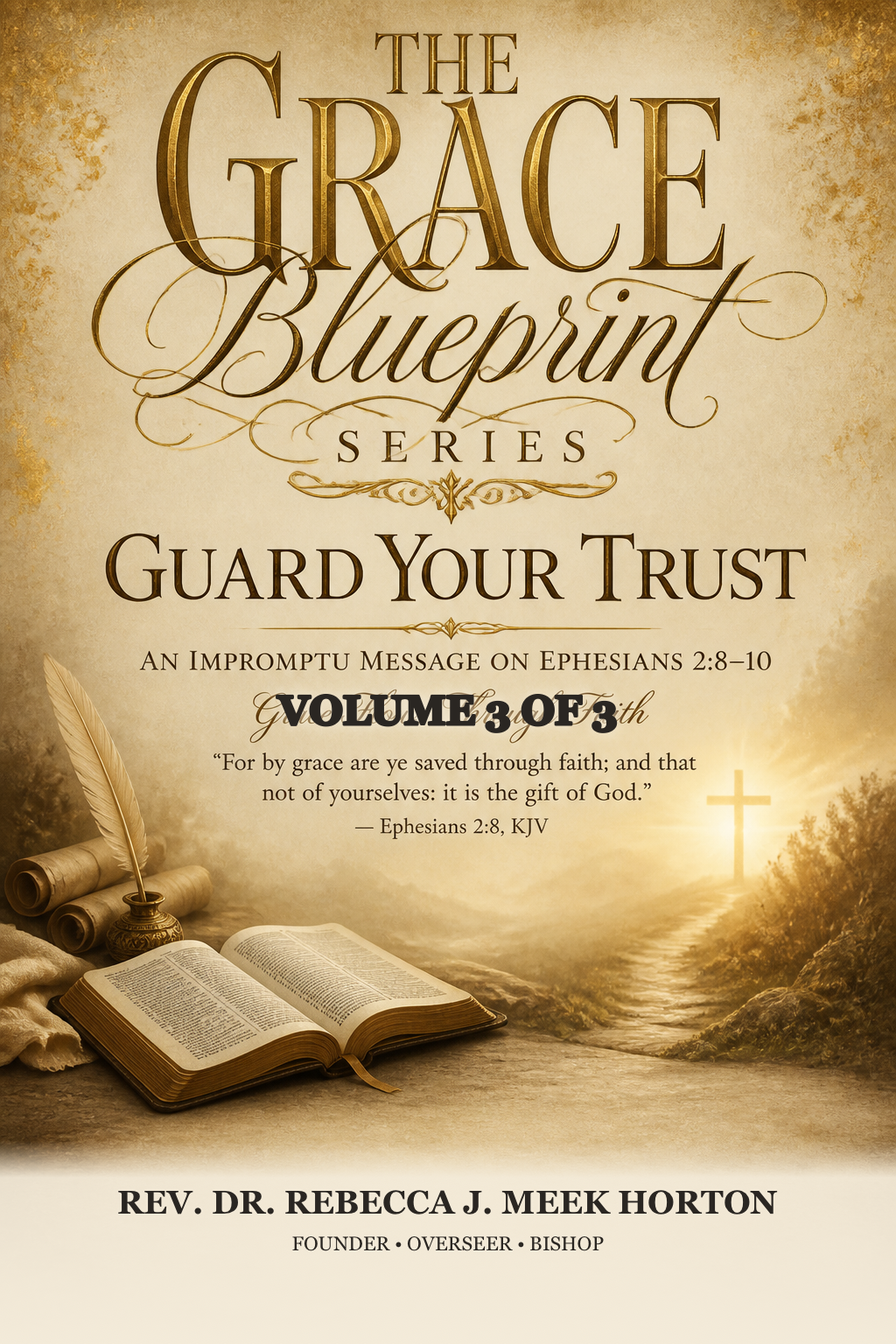
The Grace Blueprint Series · Volume 3
Guard Your TRUST
The importance of intentionally guarding your trust in GOD through His Word and your personal relationship with GOD. AN IMPROMPTU MESSAGE ON EPHESIANS 2:8–10 GUARD YOUR TRUST Grace Flows Through Faith “For by grace are ye saved through faith; and that not of yourselves: it is the gift of God.” — Ephesians 2:8, KJV The Sage, Apostle Prophet REV. DR. REBECCA J. MEEK HORTON Founder • Overseer • Bish
Full publication
NBCNGMI MASTER KNOWLEDGE LIBRARY Featuring the works of The Sage, Apostle Prophet. Rev. Dr. Rebecca J. Meek Horton, Apostolic Prophetic Architect, NewBeing Creation Network Global Ministries, Inc. Integrated Framework Modalities™
Dedication
I dedicate this book to every believer who has had to trust God in the dark, in the delay, and in the place where answers did not come quickly. May you guard your trust, stand on His Word, and remember that the God who saved you by grace is faithful to sustain you by grace.
Purpose
I wrote this book to call believers back to the place where grace is received and trust is guarded: “For by grace are ye saved through faith; and that not of yourselves: it is the gift of God” (Ephesians 2:8, KJV). My prayer is that these pages help you answer lies with Scripture, steady your mind in the character of God, and keep trusting Him when the path is difficult. I want you to remember that grace is the gift, faith receives, trust leans, obedience walks, and God remains faithful.
Preface
This book began in the quiet hours of the morning, when the house was still and my heart was turned toward the Word of God.
On August 25, 2026, at 1:35 a.m., I recorded an impromptu message from Ephesians 2:8–10. I had opened a journal and found these words before me:
“For by grace are ye saved through faith; and that not of yourselves: it is the gift of God.” Ephesians 2:8, KJV
That verse arrested me again.
Grace is the gift. Faith receives. Trust leans. Obedience walks.
I have taught on faith many times, but this message pressed into one particular place: trust. Not only believing that God is real, but guarding our trust in who God is when life becomes painful, confusing, delayed, or difficult.
It is one thing to trust God when the path is bright. It is another thing to trust Him in the prison process, in the waiting season, in the unanswered question, in the place where the enemy tries to make God seem unfaithful. That is where many believers quietly struggle. They still love God, but their trust has been wounded by disappointment, trauma, accusation, loss, or fear.
This book is written for that place.
It is not written to shame the hurting. It is not written to pretend that suffering is simple. Mental illness, trauma, sickness, grief, and deep wounds are not proof that a believer is spiritually inferior. Prayer, Scripture, pastoral care, wise counsel, Christian community, and appropriate professional support can walk together responsibly.
But even in the mess, our trust must be guarded.
The enemy still asks, “Yea, hath God said?” He still attacks the truthfulness of God’s Word and the goodness of God’s character. We must learn to answer lies with truth, not with panic, pride, or fear.
My prayer is that this book will help you return to the Word, strengthen your personal relationship with God, and stand more steadily in grace.
As you read, do not rush. Read with your Bible open. Ask the Lord to show you where trust has been weakened, where lies have been entertained, and where truth must be restored.
Guard your trust.
God is trustworthy.
Introduction
This book begins with a simple verse and opens into a necessary charge: guard your trust.
Ephesians 2:8–10 says, “For by grace are ye saved through faith; and that not of yourselves: it is the gift of God: Not of works, lest any man should boast. For we are his workmanship, created in Christ Jesus unto good works, which God hath before ordained that we should walk in them” (KJV).
That is the foundation. Grace is the gift. Faith receives. Trust leans. Obedience walks.
This book is not written to make faith complicated. It is written to help believers see where trust is being tested, where lies are being entertained, where pain has started interpreting God’s character, and where the Word of God must become the governing voice again.
Many believers believe in God, but still struggle to trust Him when life becomes painful, delayed, confusing, or unjust. We may trust Him in the blessing but question Him in the prison. We may rejoice when doors open but wonder if He has abandoned us when doors close. We may know Scripture in memory, yet still allow fear, shame, disappointment, trauma, or accusation to speak louder than truth.
That is why trust must be guarded intentionally.
The enemy’s attack in the garden was not only against Eve’s behavior. It was against her trust in the Word and goodness of God. “Yea, hath God said?” became the opening for suspicion. If trust is weakened, disobedience can begin to look like protection. If God’s character is questioned long enough, fear can start sounding wise.
Guard Your TRUST calls the believer back to the revealed character of God. Not fantasy. Not denial. Not pretending pain is painless. True faith does not require us to call evil good or act as though wounds do not matter. Joseph’s brothers meant evil against him, but God worked redemptively through what they did not have the authority to define. Genesis 50:20 says, “But as for you, ye thought evil against me; but God meant it unto good” (KJV).
This is one of the central arguments of the book: difficulty is not automatic proof that God has stopped guiding you. Psalm 37:23–24 says, “The steps of a good man are ordered by the LORD: and he delighteth in his way. Though he fall, he shall not be utterly cast down: for the LORD upholdeth him with his hand” (KJV). Ordered steps and falling appear in the same testimony. The Lord’s guidance does not remove every hard place, but His hand upholds His people in the hard place.
Read this book slowly. Do not rush to finish it. Let the Scriptures search you. Let the examples sit with you. When a sentence exposes a lie you have been carrying, pause. Write it down. Bring it into prayer. Answer it with the Word of God.
This book will ask something of you. It will ask you to stop letting circumstances have the final word about God. It will ask you to examine thoughts instead of obeying every thought. It will ask you to forgive without denying wisdom, to wait without surrendering hope, and to trust without demanding control of every outcome.
That cost is real. But the fruit is maturity.
As you read, keep a Bible near you. Keep a journal if you can. Begin building your own Scripture Tactical Attack Kit. Name the recurring lie. Find the Scripture that answers it. Speak the truth. Pray the truth. Practice the next obedient step.
Do not read only to agree. Read to be strengthened.
Do not read only to receive comfort. Read to become steady.
Do not read only to remember what God has done. Read to trust who God is.
Proverbs 3:5–6 gives the path plainly: “Trust in the LORD with all thine heart; and lean not unto thine own understanding. In all thy ways acknowledge him, and he shall direct thy paths” (KJV).
Begin there.
Before you turn the page, ask yourself this one question: What lie, fear, wound, or unanswered question has been trying to weaken my trust in God?
Name it honestly. Then bring it under the truth of His Word.
Chapter 1 — When Trust Is Under Attack
The first crack in a wall is often small.
You may not notice it at first. The paint still looks smooth. The room still feels safe. But water has found an opening. Pressure is working behind what can be seen. If it is ignored, the crack widens. What began as a line becomes damage.
Trust can be attacked that way.
Many believers expect spiritual attack to arrive loud, dark, and obvious. Sometimes it does. But often the first assault is quieter. It does not begin by saying, “Stop believing in God.” It begins by asking whether God can be trusted.
That is the controlling truth of this chapter: the enemy often attacks the trustworthiness of God before he attacks belief in God.
If your trust in God’s Word is weakened, obedience begins to look unreasonable. If your trust in God’s goodness is weakened, sin begins to look like self-protection. If your trust in God’s timing is weakened, impatience begins to feel wise.
This is why we must guard our trust.
The First Question
The first recorded temptation in Scripture did not begin with a denial of God’s existence. It began with a question about God’s Word.
Genesis 3:1–5 (KJV)
Now the serpent was more subtil than any beast of the field which the LORD God had made. And he said unto the woman, Yea, hath God said, Ye shall not eat of every tree of the garden?
And the woman said unto the serpent, We may eat of the fruit of the trees of the garden:
But of the fruit of the tree which is in the midst of the garden, God hath said, Ye shall not eat of it, neither shall ye touch it, lest ye die.
And the serpent said unto the woman, Ye shall not surely die:
For God doth know that in the day ye eat thereof, then your eyes shall be opened, and ye shall be as gods, knowing good and evil.
Notice the movement.
First, the serpent questions what God said.
Then he contradicts what God said.
Then he suggests that God is withholding something good.
The attack is not only against information. It is against trust.
God had already spoken.
Genesis 2:16–17 (KJV)
And the LORD God commanded the man, saying, Of every tree of the garden thou mayest freely eat:
But of the tree of the knowledge of good and evil, thou shalt not eat of it: for in the day that thou eatest thereof thou shalt surely die.
God’s command included both generosity and boundary.
“Of every tree of the garden thou mayest freely eat.” That is abundance.
“But of the tree of the knowledge of good and evil, thou shalt not eat of it.” That is boundary.
The serpent’s question shifted attention away from God’s generosity and toward the restriction. “Yea, hath God said, Ye shall not eat of every tree of the garden?”
That is how suspicion often works. It magnifies what God has withheld until we forget what God has freely given.
A simple example may help. A parent prepares a whole table of food for a child but says, “Do not touch that hot pan.” The boundary is not hatred. It is protection. But if someone whispers, “Why does your parent keep things from you?” the child may begin to see love as control.
That is what happened in the garden. The serpent framed God’s boundary as if it were deprivation.
Guarding trust begins with remembering the whole truth, not only the part that feels restrictive.
Suspicion Changes How We Hear
Suspicion does not always change the words first. Sometimes it changes the way we hear the words.
A command that once sounded protective begins to sound harsh.
A delay that once required patience begins to feel like rejection.
A closed door that may be mercy begins to feel like punishment.
A correction that could save our life begins to feel like an attack.
This is why trust matters. Trust shapes interpretation.
If a trusted doctor says, “This medicine may taste bitter, but it is necessary,” we receive the bitterness differently. If a stranger with bad motives says the same thing, we may resist. The words may be similar, but trust changes how we respond.
The serpent worked to change how Eve heard God.
“Ye shall not surely die” directly opposed God’s warning. Then came the deeper accusation: “For God doth know...” In other words, God knows something He is not telling you. God is keeping you from becoming what you could be. God’s command is not for your good.
That suggestion still appears in different forms.
It may sound like this:
“God is holding you back.”
“Obedience is costing you too much.”
“If God loved you, this would not be so hard.”
“You need to take control because God is moving too slowly.”
“His Word may be true for others, but your situation is different.”
The language changes. The root is old.
The enemy wants the believer to stand before God’s Word with suspicion instead of surrender.
This does not mean Christians should never ask questions. Honest questions can be part of spiritual growth. Scripture is not afraid of sincere seeking. But there is a difference between asking in order to understand and questioning in order to escape obedience.
Mary asked, “How shall this be?” when the angel announced what God would do through her. That was not rebellion. It was a question seeking understanding.
The serpent’s question was not seeking truth. It was sowing distrust.
We must learn the difference.
A sincere question brings us closer to God’s truth.
A corrosive question pulls us away from trusting God’s character.
A sincere question says, “Lord, help me understand so I can obey.”
A corrosive question says, “I will not obey unless God explains Himself to my satisfaction.”
That difference matters.
The Trustworthiness of God’s Word
To guard trust, we must settle this: God’s Word is trustworthy because God is trustworthy.
Scripture does not present God as unstable, deceptive, or careless. His Word carries His character.
Numbers 23:19 (KJV)
God is not a man, that he should lie; neither the son of man, that he should repent: hath he said, and shall he not do it? or hath he spoken, and shall he not make it good?
This verse is not a slogan. It is a foundation.
God does not lie.
God does not manipulate.
God does not speak in order to mislead His people.
When God warns, His warning is faithful. When God commands, His command is not random. When God withholds, He is not being cruel. When God gives, He gives with wisdom. When God says no, His no is not evidence that He has stopped loving us.
Every word of God is pure.
Proverbs 30:5 (KJV)
Every word of God is pure: he is a shield unto them that put their trust in him.
There is that word again: trust.
God’s Word is not given merely to be admired. It is given to be trusted, received, and obeyed.
This is where many believers experience pressure. We may believe the Bible is true in a general sense, but struggle to trust God’s Word in a personal place.
We believe God forgives, but we struggle to trust Him with our shame.
We believe God guides, but we struggle to trust Him with decisions.
We believe God provides, but we struggle to trust Him when resources feel uncertain.
We believe God loves, but we struggle to trust Him when we feel unseen.
That struggle does not mean a believer is fake. It means trust is being tested.
The question is not whether a difficult thought ever comes. The question is what we do with it when it comes.
Do we let suspicion become the teacher?
Do we let fear interpret God?
Do we let pain rewrite Scripture?
Or do we bring the thought back under the truth that God has already revealed?
Guarding trust does not mean pretending life is easy. It means refusing to let the serpent’s question become the governing voice.
The Doorway From Distrust to Disobedience
Sin often enters through a doorway that distrust has opened.
Before the hand reaches, the heart shifts.
Before the action happens, the interpretation changes.
Before disobedience looks desirable, God’s command begins to look doubtful, unfair, or unnecessary.
That is why the garden matters for us. It shows the anatomy of temptation.
First, God’s Word is questioned.
Second, God’s Word is contradicted.
Third, God’s motive is accused.
Fourth, disobedience is presented as gain.
The fruit did not change. The command did not change. God did not change. But the way Eve saw the fruit changed once trust was weakened.
Genesis 3:6 (KJV)
And when the woman saw that the tree was good for food, and that it was pleasant to the eyes, and a tree to be desired to make one wise...
We will stop there for now because this chapter is not mainly about the full consequence of the fall. It is about the trust attack that came first.
A believer may face a similar pattern.
A relationship God has warned against begins to look like comfort.
A dishonest opportunity begins to look like provision.
A bitter response begins to look like justice.
A hidden habit begins to look like relief.
A delayed obedience begins to look like wisdom.
When trust is unguarded, temptation does not have to announce itself as rebellion. It can dress itself as need, logic, fairness, or self-care.
That is why we must be awake.
Not anxious. Awake.
Not suspicious of everything. Discerning.
Not afraid of life. Anchored in God.
The goal is not to live tense and fearful, looking for the enemy behind every ordinary moment. The goal is to live close enough to God’s Word that we recognize when a voice is trying to make Him seem untrustworthy.
Jesus said in John 10:27 (KJV), “My sheep hear my voice, and I know them, and they follow me.”
The believer grows by learning the Shepherd’s voice.
A strange voice may be loud. A familiar fear may be persuasive. A repeated lie may feel believable. But none of those voices deserves the place that belongs to God.
The Cost of Guarding Trust
Guarding trust has a cost.
It will cost you the comfort of suspicion.
Suspicion can feel powerful because it keeps you from surrender. It lets you stand back, accuse, and delay obedience. But suspicion cannot produce peace. It cannot produce intimacy with God. It cannot produce faithful living.
Guarding trust will cost you the right to make your circumstances the judge of God’s character.
There will be days when life hurts. There will be prayers that seem unanswered longer than you expected. There will be commands that confront your preferences. There will be seasons when obedience feels costly and the fruit is not yet visible.
In those moments, guarding trust means saying, “I do not understand all of this, but I will not accuse God of being unfaithful.”
Guarding trust will also cost you the habit of feeding every voice that feeds doubt.
Some conversations do not help you seek truth. They only train your soul to rehearse suspicion. Some content does not strengthen discernment. It weakens reverence. Some inner narratives do not lead to honest repentance or wise action. They lead to distance from God.
This does not mean you must avoid every hard question. It means you must steward what forms you.
Nothing is random. Nothing is wasted.
What you repeatedly hear can shape what you trust. What you repeatedly rehearse can shape what you obey.
Guarding trust is not passive. It is a daily act of spiritual stewardship.
A person guarding a gate does not create the city. He protects access to it.
You did not create the truth. God has spoken.
You are not the source of grace. God gives.
You are not stronger than every temptation. God is faithful.
But you are responsible to guard what you allow to govern your heart.
The first battle is often not over whether God exists. The first battle is over whether God is good, whether God has told the truth, and whether His Word can be trusted when another voice offers a different explanation.
Guard your trust there.
At the first question.
At the first accusation.
At the first suggestion that disobedience will care for you better than God.
Key Takeaways
• The enemy often attacks God’s trustworthiness before he attacks belief in God.
• Suspicion changes how we hear God’s Word and interpret His boundaries.
• Guarding trust requires daily stewardship of the voices we receive and rehearse.
Practice
Take ten quiet minutes today and write one sentence completing this prompt:
“The place where my trust in God feels most pressured right now is...”
Then read Genesis 3:1–5 (KJV) slowly. Ask yourself:
“Is any voice causing me to question God’s Word, God’s goodness, or God’s motive?”
Name it honestly before God in prayer. Do not argue with it all day. Simply bring it into the light and ask the Lord to strengthen your trust in what He has already spoken.
Chapter 2 — Grace Flows Through Faith
A gift can be sitting in your hands and still not be received in your heart.
You may unwrap it. You may hold it. You may even say thank you. But if you keep trying to pay the giver back as though the gift is a debt, you have not yet understood what was given.
Many believers live that way with grace.
We believe Jesus died for us. We confess that salvation is from God. Yet somewhere deep inside, we keep trying to prove that we were worth saving. We try to pay grace back with pressure, performance, religious comparison, and private fear. We know the language of grace, but we carry the weight of earning.
Ephesians 2:8–10 speaks directly to that burden.
“For by grace are ye saved through faith; and that not of yourselves: it is the gift of God: Not of works, lest any man should boast. For we are his workmanship, created in Christ Jesus unto good works, which God hath before ordained that we should walk in them.” Ephesians 2:8–10 (KJV)
The controlling truth of this chapter is simple: grace is God’s gift, faith receives what grace gives, and the life that follows becomes God’s workmanship.
Grace saves us.
Grace sustains us.
Grace forms us.
And because grace is the gift of God, no one gets to boast.
The Gift We Could Not Earn
Paul does not begin with human effort. He begins with grace.
“For by grace are ye saved through faith.”
Grace is not God’s reward for impressive people. Grace is not wages paid to the spiritually disciplined. Grace is not heaven’s applause for those who finally managed to become acceptable.
Grace is God’s unearned favor and active provision toward us in Jesus Christ.
That matters because the human heart is skilled at turning even holy things into self-measurement. We can turn prayer into proof that we are better than someone else. We can turn church attendance into a ladder. We can turn Bible knowledge into a platform. We can turn service into a quiet demand that God owe us a certain outcome.
Paul cuts through all of that.
“And that not of yourselves: it is the gift of God.”
Salvation does not begin inside human strength. It begins in God. We are not saved because we climbed high enough to reach Him. We are saved because Christ came down, gave Himself, shed His blood, rose again, and opened the way.
Romans 3:23–24 says:
“For all have sinned, and come short of the glory of God; Being justified freely by his grace through the redemption that is in Christ Jesus.” Romans 3:23–24 (KJV)
Freely does not mean cheaply. Grace is free to us because Christ paid what we could not pay. The Cross is not God pretending sin does not matter. The Cross is God dealing with sin through the sacrifice of His Son.
This is why boasting has no place.
If a drowning person is pulled from deep water, he does not boast in the strength of his own hand. He gives thanks for the one who rescued him. He may have reached out, but reaching was not the source of rescue. The rescuer was.
Faith is the canal through which grace flows.
Faith is not the source of grace. Faith does not force God to be gracious. Faith receives what God gives. Faith opens the hands. Faith stops arguing with mercy. Faith says, “I cannot save myself. I receive what You have done in Christ.”
That is where Christian life begins.
Not in boasting.
Not in pretending.
Not in self-salvation.
In grace.
The Grace That Keeps Meeting Us
The grace that saves us is also the grace that sustains us.
Some believers receive saving grace, but when weakness appears, they assume grace has run out. They think God helped them enter the family, but now everything depends on their ability to remain strong enough, consistent enough, and useful enough.
That is not the way Scripture speaks of grace.
Paul knew weakness. He knew pressure, suffering, opposition, and limitation. When he pleaded with the Lord concerning the thorn in his flesh, the answer he received was not an explanation of every detail. It was a promise of sufficiency.
“And he said unto me, My grace is sufficient for thee: for my strength is made perfect in weakness.” 2 Corinthians 12:9 (KJV)
Grace does not always remove the pressure immediately. Sometimes grace strengthens us inside it. Sometimes grace keeps us from collapsing. Sometimes grace teaches us to stop trusting our own sufficiency. Sometimes grace gives enough light for the next step, not the whole road.
That can be hard to accept.
We often want grace to mean instant relief. We want grace to mean no more struggle, no more weakness, no more waiting, no more unanswered questions. But sustaining grace is not always dramatic. Sometimes it looks like getting up again. Sometimes it looks like praying honestly. Sometimes it looks like receiving help. Sometimes it looks like refusing to walk away from God when life is not making sense.
A mother caring for a sick child may not feel powerful. A pastor carrying the grief of a congregation may not feel strong. A believer battling discouragement may not feel victorious. Yet grace may be present in the endurance, in the small obedience, in the strength not to quit, and in the quiet mercy that meets them day by day.
John 1:16 says:
“And of his fulness have all we received, and grace for grace.” John 1:16 (KJV)
Grace for grace.
Grace upon grace.
Grace not only at the altar, but in the hospital room. Grace not only in the testimony, but in the process. Grace not only when you feel full of faith, but when you are crying, “Lord, help me.”
This does not mean we become passive. Grace is not an excuse to neglect obedience, wisdom, counsel, repentance, care, or responsibility. Grace sustains us so we can keep walking with God. It does not invite us to collapse into irresponsibility.
Grace is help.
Grace is strength.
Grace is mercy.
Grace is God meeting us where human strength ends.
The Workmanship Grace Forms
Ephesians 2 does not stop at “not of works.”
That is important.
If we stop at verse 9, we may think grace only cancels effort. But verse 10 shows us that grace also creates a new life.
“For we are his workmanship, created in Christ Jesus unto good works.”
Good works do not save us. Good works follow salvation.
They are not the root. They are the fruit.
A tree does not produce fruit in order to become alive. It produces fruit because life is already working in it. In the same way, the believer does not do good works to force God to save him. The believer does good works because God has made him alive in Christ and is forming him as His workmanship.
The word workmanship reminds us that God is not merely forgiving a record. He is forming a person.
Grace does not leave us untouched.
Grace saves the sinner, but it does not celebrate the sin. Grace receives the broken, but it does not build a home for bondage. Grace meets us in weakness, but it also trains us in godliness.
Titus 2:11–12 says:
“For the grace of God that bringeth salvation hath appeared to all men, Teaching us that, denying ungodliness and worldly lusts, we should live soberly, righteously, and godly, in this present world.” Titus 2:11–12 (KJV)
Grace teaches.
That means grace has a classroom.
Grace teaches us what to deny. Grace teaches us how to live. Grace teaches sober judgment, righteous conduct, and godly devotion. Grace is tender, but grace is not careless. Grace is kind, but grace is not weak. Grace is patient, but grace is not permissive of destruction.
Think of an artist restoring a damaged piece. The artist does not despise the piece because it is damaged. The artist also does not leave the damage untouched and call it finished. Love begins the restoration, and skill continues the work.
So it is with God.
You are not your own project. You are His workmanship.
That truth brings comfort and correction.
It comforts us because God is not finished with us. He knows how to work with what is wounded, immature, fearful, confused, and undeveloped.
It corrects us because we are not free to define growth any way we want. The One who saves us also shapes us. He forms us according to Christ, not according to pride, culture, fear, or personal convenience.
Philippians 1:6 gives this assurance:
“Being confident of this very thing, that he which hath begun a good work in you will perform it until the day of Jesus Christ.” Philippians 1:6 (KJV)
God begins the work.
God continues the work.
God completes the work.
Our part is not to boast in ourselves, nor to resist His forming. Our part is to yield, obey, repent, learn, continue, and walk in what He sets before us.
The Boast Grace Removes
Paul is very direct: “Not of works, lest any man should boast.”
Grace removes boasting because boasting poisons trust.
When we boast, we subtly shift our confidence from God’s mercy to our own record. We begin to compare. We measure who prays more, who serves more, who suffers better, who knows more, who appears stronger, who looks more spiritual.
Then the church becomes a room full of ladders.
But the Cross leaves no room for ladders.
Every believer comes by grace.
The longtime saint and the new believer come by grace. The preacher and the person in the back row come by grace. The person with a clean public reputation and the person carrying visible scars come by grace. The educated and the uneducated, the strong and the weak, the known and the unseen all come the same way.
No one is saved by being impressive.
No one is kept by being superior.
No one is formed by self-glory.
This is not meant to diminish obedience. Scripture calls us to obedience. It is meant to put obedience in its rightful place. Obedience is not a throne for boasting. It is the fruit of love and trust. It is the walk of someone who has received mercy and now wants to live before God faithfully.
The cost of this truth is real.
Grace requires us to lay down the pride of earning and the shame of disqualifying ourselves. Pride says, “I am better than others.” Shame says, “I am beyond the reach of God.” Grace confronts both.
Grace says, “You could not save yourself.”
Grace also says, “Christ is sufficient.”
That means the proud must come down, and the ashamed must come out of hiding.
It also means we cannot use grace as a cover for spiritual laziness. The same passage that says salvation is not of works says we are created in Christ Jesus unto good works. Grace does not produce boasting, but it does produce a walk.
“For we are his workmanship, created in Christ Jesus unto good works, which God hath before ordained that we should walk in them.”
Walk.
Not admire them.
Not discuss them only.
Not perform them for applause.
Walk in them.
This is Governed Movement™ in the life of a believer: grace received, trust guarded, obedience practiced, and purpose carried with humility.
Nothing is random. Nothing is wasted.
God does not save you by grace so you can live trapped in fear, pride, comparison, or spiritual confusion. He saves you by grace, sustains you by grace, and forms you by grace so your life can bear witness to His goodness.
The promise of this book rests here.
If grace is God’s gift, then trust must be guarded. If faith is the means by which grace is received, then the enemy will try to corrupt trust, distract faith, and distort the character of God in your mind. But when you return to the Word, remember the gift, and yield to the forming work of God, trust has somewhere solid to stand.
Grace flows through faith.
And the God who gives grace is trustworthy.
Key Takeaways
• Grace is God’s gift, not human achievement.
• Faith receives what grace gives.
• Good works are the fruit of salvation, not the root.
Practice
Read Ephesians 2:8–10 aloud slowly today.
Then write three short sentences:
• I am saved by grace, not by boasting.
• I receive God’s grace through faith.
• I am God’s workmanship, created in Christ Jesus unto good works.
After you write them, choose one simple act of obedience for today. Not to earn God’s love, but to walk as one who has received it.
Chapter 3 — Belief That Leans Its Weight
A child can stand beside a swimming pool and say, “I know my father can catch me.”
That is belief.
But the moment comes when the child must jump.
That is trust.
Many believers live at the edge of that pool. We believe true things about God. We confess that He is real. We say His Word is true. We agree that Jesus Christ is Lord. Yet when life presses on us, we discover that agreement and reliance are not always the same thing.
The single controlling idea of this chapter is simple: mature faith is belief that leans its weight on God.
Belief acknowledges God. Trust rests on Him. Faith, as Scripture teaches it, holds both together. It is not less than belief, but it is more than recognition. It is surrendered reliance on the God who has revealed Himself as true.
A Coin With Two Sides
Faith can be pictured as a coin with two sides. One side is belief. The other side is trust.
If you remove belief, trust has no foundation. You cannot rightly trust a God you do not know, a Christ you do not confess, or a Word you do not receive.
If you remove trust, belief remains thin. It may be correct, but it does not yet carry the weight of surrender.
Hebrews 11:6 says:
“But without faith it is impossible to please him: for he that cometh to God must believe that he is, and that he is a rewarder of them that diligently seek him.” Hebrews 11:6, KJV
Notice the two movements.
“He that cometh to God must believe that he is.”
That is belief.
“And that he is a rewarder of them that diligently seek him.”
That moves toward trust.
The person who comes to God does not merely accept that God exists. The person comes because God is worth seeking. His character is trustworthy. His nature is faithful. His Word is not empty. His presence is not imaginary. His reward is not manipulation; it is the faithfulness of God toward those who seek Him.
A person may say, “I believe God exists,” and still live as though everything depends on self-protection, self-rule, and self-explanation. But biblical faith begins to move the center of weight. It says, “Because God is who He says He is, I can come to Him. I can seek Him. I can obey Him. I can entrust myself to Him.”
Imagine holding a chair in your hand and inspecting it. You can study the wood. You can admire the design. You can say, “This chair is strong.” But the chair is not carrying you until you sit down.
Many believers inspect truth. Mature faith sits down in it.
This does not mean faith becomes careless. It does not mean we stop thinking. It means our thinking learns to bow before the truthfulness of God.
Belief Can Recognize Without Resting
James gives us a sober warning about belief that recognizes truth but does not rest in God.
“Thou believest that there is one God; thou doest well: the devils also believe, and tremble.” James 2:19, KJV
This verse is not written to make believers afraid. It is written to make shallow confidence honest.
The devils believe there is one God. They are not atheists. They recognize reality. They know enough to tremble. But they do not love God. They do not submit to Him. They do not trust Him. Their belief does not become worship, obedience, or surrender.
That means bare recognition is not the fullness of faith.
Someone can believe correct doctrine and still resist the Lord in daily life. Someone can defend the idea of God and still refuse to yield the heart to God. Someone can quote Scripture in conversation but not allow Scripture to govern motives, habits, relationships, and decisions.
This is where the Lord often puts His finger gently but firmly on us.
We may believe God can provide, but still live controlled by fear of lack.
We may believe God forgives, but still punish ourselves after repentance.
We may believe God is wise, but still demand that He explain Himself before we obey.
We may believe God loves us, but still interpret every delay as rejection.
The problem is not always unbelief in the existence of God. Sometimes the deeper struggle is distrust of the character of God.
That is why guarding trust matters.
A person may say, “I know God is real,” but the heart may still ask, “Will He be good to me? Will He hold me? Will He lead me? Will He remember me? Will He still be faithful if this does not turn out the way I hoped?”
Those questions are not reasons for shame. They are places for discipleship.
God is not threatened by honest weakness. The father in Mark 9 cried out to Jesus:
“Lord, I believe; help thou mine unbelief.” Mark 9:24, KJV
That is not polished faith. It is honest faith reaching for help.
There are moments when the believer must pray with that same humility. “Lord, I do believe You. Help the places in me that still pull back. Help the places where fear has trained my reflexes. Help the places where disappointment has made me guarded. Help my belief become trust.”
This is not condemnation. This is RE-Calibration™.
The Lord forms us patiently. He does not despise the trembling hand that reaches toward Him.
Trust Leans on Character
Trust is not faith in faith. Trust is faith in God.
This distinction matters.
Sometimes believers become anxious because they keep measuring the strength of their own faith. They look inward and ask, “Do I feel confident enough? Did I believe hard enough? Did I pray with enough force?”
But faith is not powerful because our emotional intensity is perfect. Faith rests in the One who is faithful.
Paul wrote:
“For the which cause I also suffer these things: nevertheless I am not ashamed: for I know whom I have believed, and am persuaded that he is able to keep that which I have committed unto him against that day.” 2 Timothy 1:12, KJV
Paul did not say, “I know what I have believed” only, though doctrine matters deeply. He said, “I know whom I have believed.”
Faith is personal before it is merely conceptual. It is anchored in the character of God.
A bank may display strong walls, heavy doors, and official signs, but people place valuables there because they trust the institution to guard what is deposited. Paul uses the language of committing something to God. He entrusts what he cannot keep by himself to the One who is able to keep it.
That is trust.
Trust says, “God is able to keep what I have committed to Him.”
Not because I understand every detail.
Not because I control every outcome.
Not because I never feel afraid.
But because I know whom I have believed.
This is where many believers need their language healed. Shame says, “If I were stronger, I would never struggle.” Wisdom says, “I am learning to bring my struggle into the presence of the faithful God.”
Fear says, “I must hold everything together.” Trust says, “I must be faithful with my part and commit what I cannot carry to God.”
Pride says, “I will not move until I can guarantee the result.” Faith says, “I will obey the Lord I trust.”
Trust does not remove responsibility. It puts responsibility in order.
You still pray. You still study. You still repent when needed. You still seek counsel. You still make wise decisions. You still show up for the next faithful step. But you stop pretending that your hands are large enough to be God.
A believer who trusts God is not passive. A believer who trusts God is rightly placed.
God is God.
We are not.
That truth humbles us, but it also frees us.
Obedience Shows Where the Weight Is
Trust becomes visible when weight shifts.
If a man says a bridge is strong but refuses to cross it, his words and his weight disagree. He may admire the bridge. He may speak well of the bridge. He may recommend the bridge to others. But he has not entrusted himself to it.
Obedience is where faith begins to put weight on God.
This does not mean obedience earns salvation. It does not. Grace saves. Faith receives. Works do not create saving grace. But genuine trust begins to produce movement that agrees with God.
Abraham gives us a picture of this. Hebrews says:
“By faith Abraham, when he was called to go out into a place which he should after receive for an inheritance, obeyed; and he went out, not knowing whither he went.” Hebrews 11:8, KJV
Abraham believed God, and that belief leaned. It moved. He went out, not knowing every detail of the destination.
That is not recklessness. That is response.
There is a difference between impulse and obedience. Impulse moves because pressure demands relief. Obedience moves because God is trustworthy. Impulse often refuses counsel, timing, and Scripture. Obedience remains submitted to God.
Do not Force-The-FiT™. Do not call every strong feeling faith. Do not call every open door God’s instruction. Faith listens. Faith weighs. Faith obeys.
But when God has spoken clearly through His Word, trust does not keep negotiating forever.
If God says forgive, trust begins the work of forgiveness.
If God says repent, trust stops defending sin.
If God says seek first His kingdom, trust brings priorities under His rule.
If God says love, trust refuses hatred as a home.
If God says cast your care upon Him, trust stops treating anxiety as lord.
This is where faith becomes practical.
A woman may believe God is her provider, but trust may look like refusing dishonest gain.
A man may believe God is holy, but trust may look like ending a hidden compromise.
A young believer may believe God hears prayer, but trust may look like praying honestly instead of performing religious language.
A leader may believe God builds His church, but trust may look like choosing stewardship over image.
In each case, the question is not only, “What do I say I believe?”
The question is, “Where am I placing my weight?”
The Tension of Letting Go
The cost of this kind of faith is real.
It asks us to surrender the comfort of being merely correct. It is possible to hide behind right words while refusing yielded living. Mature faith will not let us do that.
It asks us to release the illusion of control. Trusting God does not mean we never plan, but it does mean we stop treating our plan as sovereign.
It asks us to obey before all emotions are settled. Sometimes the heart trembles while the feet take the next faithful step.
It asks us to bring disappointment into the light. Some believers do not struggle to believe God exists; they struggle to trust Him after pain. That struggle must be handled tenderly and truthfully. Pain is not healed by pretending. It is healed as we bring it under the care, truth, and presence of God.
It asks us to stop using spiritual language to avoid honest surrender.
That can be uncomfortable.
But it is also where freedom begins.
Jesus does not call us into vague belief. He calls us to Himself. Faith is not a theory we admire from a distance. Faith is the hand that receives grace, the heart that comes to God, and the life that learns to lean on Him.
This leaning may begin small.
Trust God with one fear.
Trust God with one decision.
Trust God with one act of obedience.
Trust God with one wound that still needs healing.
Trust God with one place where belief has not yet become rest.
WISDOM is not yours until YOU WALK IT.
So do not despise the small beginning. A child learning to walk does not cross the whole room perfectly the first time. But each step strengthens the body. Each act of trust strengthens the soul. Each obedient response teaches the heart that God is faithful.
Faith grows as it leans.
Key Takeaways
• Belief acknowledges that God is; trust leans on who God is.
• Recognition alone is not mature faith; even devils believe and tremble.
• Obedience shows where the weight of trust is resting.
Practice
Choose one area where you say you believe God, but you are struggling to lean on Him.
Write one sentence beginning with: “Lord, I believe You concerning…”
Then write one honest sentence beginning with: “Help me trust You with…”
Pray both sentences aloud. After you pray, take one small obedient step that agrees with trust. Keep it simple, clear, and faithful.
Chapter 4 — Trust God in All Thy Ways
The decision looked small.
It was only a conversation to return, an email to send, a meeting to schedule, a purchase to make, a yes to give, a no to hold. No one was standing at a hospital bed. No crisis had erupted. No dramatic sign appeared in the sky. It was ordinary.
And that is where many believers stop acknowledging God.
We pray when the wall is too high. We fast when the door will not open. We cry out when the report is frightening. But in the quiet, practical spaces of life, we often move as if we already know enough.
This chapter’s controlling idea is simple: trust is active and daily, not reserved for crisis moments. To trust God is to acknowledge Him in all our ways, not only in emergencies.
Proverbs gives us the foundation plainly:
Proverbs 3:5–6 (KJV)
Trust in the LORD with all thine heart; and lean not unto thine own understanding.
In all thy ways acknowledge him, and he shall direct thy paths.
Not some ways.
Not desperate ways.
Not church ways only.
All thy ways.
Trust Is More Than a Feeling
Trust is not only what we feel when worship is strong and life is calm. Trust is what we choose when our understanding reaches its limit.
Proverbs does not say, “Trust in the LORD when thou understandest.” It says, “Trust in the LORD with all thine heart.” Then it adds the warning: “and lean not unto thine own understanding.”
Your understanding is not evil. God gave you a mind. Wisdom does not ask you to become careless, passive, or anti-thinking. The problem is not having understanding. The problem is leaning on it as if it can carry what only God can carry.
A chair may look strong, but you do not know whether you trust it until you sit down. Trust leans weight.
In the same way, many believers believe true things about God, but still lean the full weight of their decisions on fear, impulse, pride, pressure, habit, or personal preference. They ask God to bless what they have already decided instead of inviting Him into the decision before it hardens.
A young believer may say, “I prayed about this relationship,” but when asked what God’s Word says, what wise counsel has said, and whether peace is being governed by truth or desire, the answer becomes less clear.
A ministry leader may say, “We are trusting God for expansion,” but never ask whether the current structure can carry more responsibility.
A parent may say, “I want what is best for my child,” but respond from anxiety instead of prayerful wisdom.
A worker may say, “God opened this door,” but ignore the warning signs because the salary looks better.
Trust does not mean every choice becomes easy. Trust means God is invited to govern the choice.
The first practice of daily trust is honesty: “Lord, I have understanding, but my understanding is not enough. I have desire, but my desire must be submitted. I have fear, but fear must not lead me. Direct my path.”
This kind of trust is not weakness. It is maturity.
Acknowledge Him Before You Move
The verse says, “In all thy ways acknowledge him.”
To acknowledge God is not merely to mention Him. It is to recognize His rightful place. It is to bring the way before Him and say, “You are Lord here too.”
Many people acknowledge God after the damage is done. They make the commitment, sign the paper, speak the words, spend the money, enter the partnership, or accept the assignment, and then ask God to fix what was never submitted.
Grace is real. God is merciful. He can redeem unwise choices. But maturity learns to acknowledge Him before movement, not only after consequences.
Think of a person using a map after already driving for hours in the wrong direction. The map still helps, but humility would have saved time if it had been consulted earlier.
Daily acknowledgment can be simple:
“Lord, should I answer now or wait?”
“Lord, help me hear what is really being said.”
“Lord, show me if this opportunity is aligned or merely attractive.”
“Lord, teach me how to respond without pride.”
“Lord, help me not confuse urgency with obedience.”
“Lord, what does Your Word require of me here?”
This is not superstition. This is relationship.
God is not only interested in the religious-looking parts of life. He cares about how we speak when we are irritated. He cares about how we steward money when no one sees. He cares about the counsel we receive, the atmosphere we tolerate, the motives we hide, and the habits we excuse.
Colossians 3:17 (KJV)
And whatsoever ye do in word or deed, do all in the name of the Lord Jesus, giving thanks to God and the Father by him.
“Whatsoever ye do” is a wide field.
That includes words and deeds. That includes public ministry and private reaction. That includes how we lead, serve, rest, spend, forgive, correct, decide, and wait.
A believer does not need a dramatic feeling before acknowledging God. Sometimes the most spiritual thing you can do is pause before answering. Sometimes it is asking for counsel. Sometimes it is reading the Scripture again in context. Sometimes it is admitting, “I am not ready to decide yet.”
Acknowledgment creates space for wisdom.
And wisdom needs space.
All Thy Ways Means Ordinary Ways
We often divide life into sacred and ordinary. Prayer meeting feels sacred. Grocery shopping feels ordinary. A sermon feels sacred. A calendar feels ordinary. A mission trip feels sacred. A budget feels ordinary.
But Scripture does not permit that kind of separation in the life of a believer. If Jesus is Lord, then ordinary ways belong to Him too.
“In all thy ways” includes decisions that do not look spiritual at first.
It includes relationships.
Before you join yourself closely to people, acknowledge God. Ask whether the relationship strengthens obedience or weakens it. Ask whether honesty is present. Ask whether peace is real or manufactured. Ask whether you are ignoring fruit because you want companionship.
It includes assignments.
Before you accept every invitation, acknowledge God. Not every open door is your door. Not every need is your assignment. Not every request is your responsibility. Jesus did the will of the Father, not the will of every crowd.
It includes speech.
Before you repeat the story, acknowledge God. Is it true? Is it necessary? Is it loving? Is it your place to say? Trusting God with your mouth may require silence when your flesh wants release.
Psalm 141:3 (KJV)
Set a watch, O LORD, before my mouth; keep the door of my lips.
It includes planning.
Planning is not unbelief. Presumption is the danger. A believer can plan carefully while remaining submitted to God.
James 4:13–15 (KJV)
Go to now, ye that say, To day or to morrow we will go into such a city, and continue there a year, and buy and sell, and get gain:
Whereas ye know not what shall be on the morrow. For what is your life? It is even a vapour, that appeareth for a little time, and then vanisheth away.
For that ye ought to say, If the Lord will, we shall live, and do this, or that.
James is not condemning calendars, business, or preparation. He is correcting arrogance that plans without reverence. “If the Lord will” is not a phrase to decorate our speech. It is a posture that bows the future before God.
It includes care for the body and mind.
Acknowledge God in health decisions. Pray, seek wisdom, and receive appropriate counsel and care. Trusting God does not require neglecting responsible help. God may lead through Scripture, prayer, wise counsel, medical professionals, rest, boundaries, and disciplined stewardship.
It includes the small repeated habits that quietly form us.
What you do daily is teaching your heart where to lean. If you repeatedly lean on distraction, distraction will feel natural. If you repeatedly lean on worry, worry will feel responsible. If you repeatedly lean on God through prayer, Scripture, obedience, and counsel, trust becomes practiced.
Trust grows where it is exercised.
Direction Is Often Given Step by Step
“He shall direct thy paths.”
This is a promise, but it does not mean God will always reveal the whole road at once. Many believers become frustrated because they want a full map, while God is giving the next faithful step.
A directed path is still a path. Paths are walked.
Sometimes direction comes through a clear command in Scripture. You do not need a private sign to forgive, tell the truth, flee fornication, refuse bitterness, practice generosity, or love your neighbor.
Sometimes direction comes through wisdom. The choice may not be between sin and righteousness, but between what is wise and what is unwise for your season, capacity, calling, and responsibilities.
Sometimes direction comes through restraint. A closed door can be mercy. A delay can be protection. A lack of peace can be a signal to slow down and examine more carefully.
Sometimes direction comes through counsel.
Proverbs 11:14 (KJV)
Where no counsel is, the people fall: but in the multitude of counsellors there is safety.
Counsel does not replace God. Wise counsel helps us see what pride, fear, excitement, or pain may be hiding from us.
Sometimes direction comes while moving in obedience to what is already clear. A parked car is easier to sit in than steer. But a life that refuses the last instruction may not need a new instruction first. It may need obedience.
This is where many believers struggle. They ask God to direct the next ten years while resisting the next ten minutes of obedience.
Make the apology.
Close the browser.
Tell the truth.
Rest.
Stop rehearsing the offense.
Open the Bible.
Ask for help.
Keep your word.
Submit the plan.
Direction often becomes clearer as obedience becomes simpler.
Psalm 119:105 (KJV)
Thy word is a lamp unto my feet, and a light unto my path.
A lamp does not always show the entire journey. It gives enough light for the feet and the path. That is not lesser guidance. That is faithful guidance.
The Cost of Daily Trust
Daily trust will cost you.
It will cost you the illusion of control.
It will require you to stop treating your first reaction as final wisdom. It will require you to pause when impulse wants speed. It will require you to admit that your feelings are real but not always reliable.
Daily trust may cost you approval.
Some people will not understand why you are waiting. Some will call your caution fear. Others will call your obedience extreme. If you acknowledge God in all your ways, you may disappoint people who expected immediate access to your yes.
Daily trust may cost you certain opportunities.
There are doors that look profitable but pull the heart away from God. There are relationships that feel comforting but compromise conviction. There are assignments that increase visibility while draining obedience.
Daily trust may cost you pride.
You may have to say, “I was wrong.” You may have to change direction. You may have to ask questions you thought you were too mature to ask.
But the cost of not trusting is greater.
When we do not acknowledge God, we may gain speed but lose alignment. We may gain attention but lose peace. We may gain an outcome but damage the inner life. We may arrive somewhere we prayed to reach and discover that we did not bring obedience with us.
God’s way is not always the fastest way, but it is the faithful way.
Trusting Him in all your ways does not mean you will never make a mistake. It means you are learning to live submitted, correctable, prayerful, and anchored.
Nothing is random. Nothing is wasted. Even the places where you recognize that you leaned wrongly can become places of RE-Calibration™ if you bring them back under the truth of God.
A Simple Rhythm for Acknowledging God
Daily trust needs a daily practice.
You do not need to make this complicated. Begin with a small rhythm that can travel with you.
Wait.
Do not let noise lead you. Pause long enough to remember that God is present and you are not alone.
Ask.
Bring the real matter before Him. Not the polished version. The real one. Ask for wisdom, correction, restraint, courage, and clarity.
Listen.
Listen through Scripture. Listen for conviction. Listen through wise counsel. Listen for what peace looks like when it is governed by truth, not avoidance.
Keep.
Keep the next faithful step. Do not wait until you feel heroic. Obey what is clear.
This rhythm can be practiced before a meeting, during a conflict, while reviewing finances, before accepting an invitation, or when choosing how to respond to disappointment.
Trust is not proven only by great moments. It is formed in repeated surrender.
The believer who acknowledges God in ordinary ways is being trained for heavier ways. The person who trusts God with words, motives, habits, and small decisions is learning how to lean when the road becomes costly.
Do not wait for crisis to begin trusting.
Begin today.
Key Takeaways
• Trust is active, daily dependence on God, not only emergency prayer.
• To acknowledge God is to give Him rightful place before movement.
• God often directs through Scripture, wisdom, counsel, restraint, and the next faithful step.
Practice
Choose one decision you are currently facing, even if it seems small.
Write it down. Then pray through Proverbs 3:5–6 slowly. Ask God where you may be leaning on your own understanding. Identify one obedient next step: seek Scripture, ask wise counsel, pause before answering, repent, wait, or move forward with humility.
Do that step today.
Chapter 5 — The Ordered Road Can Still Be Hard
The coat was gone before the dream made sense.
Joseph had seen sheaves bowing. He had seen sun, moon, and stars making obeisance. He had carried a glimpse of future honor before he had the maturity to understand its weight. Then, in one violent turn, he was stripped, thrown into a pit, sold by his own brothers, and taken toward Egypt.
If Joseph had judged God’s faithfulness by the next scene alone, he might have concluded that the dream had died.
But the pit was not the end of the promise.
The single truth of this chapter is plain: difficulty does not automatically mean God has stopped guiding. A painful path may still be a directed path where God prepares maturity, restraint, and purpose.
This does not make pain pleasant. It does not make betrayal acceptable. It does not excuse evil. It means that the evil actions of people are not strong enough to overthrow the redemptive wisdom of God.
The Pit Did Not Cancel the Dream
Joseph’s trouble did not begin because he was lazy, rebellious, or useless. His story began with favor, family tension, and dreams he did not fully understand.
Genesis 37:5 says, “And Joseph dreamed a dream, and he told it his brethren: and they hated him yet the more” (KJV).
The dream was real, but Joseph was young. He had a promise, but he did not yet have the process. He had seen something from God, but he still had to be formed for what he had seen.
Many believers struggle here.
We assume that if God has shown us something, the road toward it should be direct, affirming, and easy to explain. But Scripture does not support that assumption. Sometimes the distance between the promise and the fulfillment is where character is built.
Joseph’s brothers hated him. They envied him. They conspired against him. They stripped him of the coat his father had given him and cast him into a pit. Then they sold him.
Genesis 37:23–24 says, “And it came to pass, when Joseph was come unto his brethren, that they stript Joseph out of his coat, his coat of many colours that was on him; And they took him, and cast him into a pit: and the pit was empty, there was no water in it” (KJV).
That line is heavy: “the pit was empty, there was no water in it.”
An empty pit can feel like contradiction. You may ask, “How can this be the road if this place has no supply? How can God be guiding when I feel stripped? How can purpose still be alive when what I am standing in looks barren?”
Joseph’s pit teaches us not to interpret the whole journey from one painful scene.
The pit was real, but it was not final. The stripping was real, but it did not remove God’s knowledge of Joseph. The betrayal was real, but it did not have the authority to cancel what God would later accomplish.
A believer must learn to say, “This hurts, but this is not the whole story.”
That is not denial. That is faith refusing to let one chapter become the judge of God’s character.
The Lord Was With Him in the Wrong Place
Joseph was taken into Egypt and sold into Potiphar’s house. He was far from home. He had not chosen the assignment. He had not applied for this position. He was there because of betrayal.
Yet Scripture says something that steadies us.
Genesis 39:2 says, “And the LORD was with Joseph, and he was a prosperous man; and he was in the house of his master the Egyptian” (KJV).
The Lord was with Joseph in Egypt.
That matters.
God’s presence was not limited to the familiar place. Joseph had lost his coat, his family environment, and his freedom, but he had not lost the presence of God.
This is where trust must mature.
We often associate God’s guidance with comfort. If the door opens easily, we say God is leading. If the relationship feels peaceful, we say God is leading. If the provision comes quickly, we say God is leading.
Sometimes that is true.
But Joseph teaches us that God can be with a person in a place they never wanted to be.
Potiphar’s house became a training ground. Joseph learned responsibility. He learned administration. He learned how to manage what belonged to someone else. He learned faithfulness when life was unfair.
Genesis 39:4 says, “And Joseph found grace in his sight, and he served him: and he made him overseer over his house, and all that he had he put into his hand” (KJV).
Joseph did not wait for ideal circumstances before becoming faithful. He served where he was.
This is not the same as pretending injustice is acceptable. What happened to Joseph was wrong. But Joseph did not allow wrong treatment to make him careless with present responsibility.
That is a hard word for us.
Sometimes we are so focused on the wrongness of how we arrived somewhere that we neglect the stewardship of where we are. We may not have chosen the season. We may not have deserved the wound. We may not understand the delay. But if there is a faithful step available, we can take it.
Stewardship does not require full explanation. It requires present obedience.
Joseph served with integrity in Potiphar’s house. Then the road became harder.
Potiphar’s wife tempted him. Joseph refused. His refusal was not only moral discipline; it was trust in God.
Genesis 39:9 says, “there is none greater in this house than I; neither hath he kept back any thing from me but thee, because thou art his wife: how then can I do this great wickedness, and sin against God?” (KJV).
Joseph understood that secret sin is still sin before God.
He chose righteousness, and righteousness led him to prison.
That is one of the tensions we must be honest about: obedience does not always produce immediate relief. Sometimes obedience costs you. Sometimes doing right does not stop someone else from lying. Sometimes faithfulness is followed by accusation instead of applause.
But accusation did not mean God was absent.
Genesis 39:21 says, “But the LORD was with Joseph, and shewed him mercy, and gave him favour in the sight of the keeper of the prison” (KJV).
The Lord was with Joseph in the house.
The Lord was with Joseph in the prison.
The location changed. God did not.
Hidden Preparation Has Public Purpose
Prison looked like a setback, but it became part of Joseph’s preparation.
Again, we must be careful. We should not call injustice good. False accusation is not good. Imprisonment for righteousness is not good. Betrayal is not good.
But God is able to work redemptively in places that are not good.
In prison, Joseph continued to serve. He was entrusted with responsibility. He noticed the sadness of others. He interpreted the dreams of Pharaoh’s butler and baker, but he gave the credit to God.
Genesis 40:8 says, “And they said unto him, We have dreamed a dream, and there is no interpreter of it. And Joseph said unto them, Do not interpretations belong to God? tell me them, I pray you” (KJV).
Joseph had been harmed, but he had not become self-centered to the point that he could no longer see the pain of others.
That is formation.
Pain can make the heart hard if it is not surrendered to God. It can make a person suspicious, bitter, and closed. But pain can also become a place where God deepens compassion, patience, and discernment.
Joseph’s gift did not disappear in prison. His capacity was still present. His relationship with God was still alive. His usefulness was not cancelled because his environment was confined.
This is important for believers who feel hidden.
Hidden does not mean useless.
Some seasons do not give you a platform; they give you preparation. Some seasons do not give you visibility; they build depth. Some seasons do not give you speed; they build weight.
WOW™ reminds us to consider Order, Weight, Operation, and Wisdom. Joseph’s story shows this in lived form. The order of his life did not make sense from the pit. The weight of future responsibility required maturity. The operation of his gift was tested in private. The wisdom of God’s timing was revealed later.
Nothing is random. Nothing is wasted.
Joseph interpreted the butler’s dream and asked to be remembered. But Genesis 40:23 says, “Yet did not the chief butler remember Joseph, but forgat him” (KJV).
That sentence can feel cruel.
Joseph helped someone who forgot him.
Many believers know that pain. You served. You gave. You helped. You prayed. You stood with someone in their difficult hour. Then, when your name could have been mentioned, they forgot.
But the butler’s forgetfulness did not make God forgetful.
At the appointed time, Pharaoh dreamed. The butler remembered Joseph. Joseph was brought from the prison to stand before Pharaoh. The gift that had operated in hidden places now served a nation.
Genesis 41:16 says, “And Joseph answered Pharaoh, saying, It is not in me: God shall give Pharaoh an answer of peace” (KJV).
Notice Joseph’s humility.
He did not say, “Finally, everyone will see how gifted I am.”
He said, “It is not in me.”
The prison had not destroyed his gift. It had refined his posture.
The Power Required Restraint
Joseph was elevated quickly, but he had not been formed quickly.
There is a difference.
In one day, Joseph came out of prison and stood before Pharaoh. But that day was supported by years of preparation no one could see. He had been formed through betrayal, service, temptation, false accusation, responsibility, delay, and forgottenness.
When Pharaoh placed him over Egypt, Joseph was not just carrying a title. He was carrying responsibility for lives.
Genesis 41:39–40 says, “And Pharaoh said unto Joseph, Forasmuch as God hath shewed thee all this, there is none so discreet and wise as thou art: Thou shalt be over my house, and according unto thy word shall all my people be ruled” (KJV).
The dream had pointed toward elevation, but the purpose of elevation was not Joseph’s ego. It was preservation.
This is where many believers need RE-Calibration™.
We may think the promise is about being seen. God may be preparing us to serve. We may think the position is about vindication. God may be preparing us to preserve others. We may think the open door is about proving people wrong. God may be preparing us to carry responsibility without revenge.
Joseph’s greatest test may not have been the pit or the prison. It may have been power.
When his brothers came to Egypt for food, Joseph had authority over the very men who had harmed him. He could have destroyed them. He could have starved them. He could have used his position to make them feel what he felt.
But Joseph had been formed.
Formation does not mean he felt nothing. Scripture shows emotion in the story. Joseph wept. He remembered. He tested the situation. He did not rush reconciliation without wisdom. But he did not allow bitterness to become his ruler.
Later, he said the line that gathers the whole journey into one testimony.
Genesis 50:20 says, “But as for you, ye thought evil against me; but God meant it unto good, to bring to pass, as it is this day, to save much people alive” (KJV).
Joseph named their evil as evil.
He did not excuse it.
But he also saw that their evil did not have the final word.
That is mature trust.
Mature trust does not call darkness light. It does not pretend the wound never happened. It does not remove the need for wisdom, boundaries, truth, or accountability. Mature trust says, “What they meant for evil, God was still able to govern toward good.”
The cost is real.
If you are going to trust God on a painful path, you must release the demand to understand every turn while you are still walking it. You must remain faithful when the season feels unfair. You must refuse sin when sin appears to offer escape. You must serve without letting hiddenness make you bitter. You must allow God to form restraint before He increases responsibility.
This is not easy.
Trusting God through pain may ask you to obey while confused, forgive without denying truth, wait without becoming passive, and carry responsibility without using it for revenge.
But this is the way of maturity.
A painful road may be preparing a steady vessel.
A hidden season may be building weight.
A delay may be protecting timing.
An unjust place may still become the place where God proves His presence.
The question is not only, “Will God bring me out?”
The deeper question is, “Will I let God form me while I am here?”
Key Takeaways
• Difficulty is not automatic proof that God has stopped guiding.
• God can be with you in places you did not choose.
• Purpose requires maturity, restraint, and faithful stewardship.
Practice
Read Genesis 39 slowly this week.
Write down three places where Joseph remained faithful in unfair circumstances. Then name one present situation where you need to take the next faithful step without having the full explanation.
Pray this simply:
Lord, be with me where I am. Keep me faithful in what is before me. Form in me the maturity needed for what You have assigned. Amen.
Chapter 6 — Guard the Mind Without Fearing Questions
You can close the Bible after a peaceful morning devotion and lose that peace ten minutes later in a comment thread.
One sentence appears on the screen.
“Only foolish people still believe that.”
Then another.
“If God were good, this would not have happened.”
Then another.
“The Bible cannot be trusted.”
At first, you only meant to read. Then you began answering in your head. Then you began feeling unsettled. By lunchtime, the words of strangers have become louder inside you than the Word you read that morning.
This is why the mind must be guarded.
The controlling idea of this chapter is simple: mature believers do not fear honest questions, but they do steward what repeatedly speaks into their inner life.
A question can become a doorway into deeper understanding. A quarrel can become a drain. A sincere conversation can sharpen faith. A corrosive argument can plant suspicion. Wisdom learns the difference.
Questions Are Not the Enemy
A believer should not be afraid of questions.
God is not fragile. Truth is not weakened because someone asks carefully. Scripture itself contains questions from hurting people, confused people, worshiping people, and learning people. The Psalms are full of cries, inquiries, laments, and honest wrestling before God.
There is a difference between asking God from relationship and accusing God from contempt.
There is also a difference between study and suspicion. Study seeks understanding. Suspicion keeps moving the finish line. Study asks, “What does the Scripture say?” Suspicion says, “I will not trust unless every mystery is removed first.”
The Bereans give us a healthy picture of careful examination.
Acts 17:11 (KJV)
These were more noble than those in Thessalonica, in that they received the word with all readiness of mind, and searched the scriptures daily, whether those things were so.
They were not passive. They did not receive teaching without discernment. They searched the Scriptures. But notice their posture: they received the word with readiness of mind. They were not trying to win an argument. They were trying to know what was true.
That matters.
A young believer may ask, “How do I know Jesus is the Son of God?” That question should not be shamed. A grieving parent may ask, “Where was God when this happened?” That question should not be handled with cold slogans. A student may ask, “How do I read this passage in context?” That question should be welcomed.
Honest questions can become part of discipleship.
But not every question is honest. Some questions are not seeking light. Some are designed to pull you into endless defense, emotional agitation, or spiritual exhaustion.
Discernment does not mean you stop learning. It means you learn with wisdom.
Not Every Conversation Deserves Your Inner Room
Your mind has an inner room.
Not everyone should be allowed to sit there.
We often understand boundaries with our homes better than we understand boundaries with our thoughts. You may greet many people at the door. You may speak kindly to many people in public. But you do not hand every person a key to your house.
The same is true of influence.
Some voices may be heard and weighed. Some must be answered briefly. Some must be avoided. Some must be removed from repeated access.
Proverbs 4:23 (KJV)
Keep thy heart with all diligence; for out of it are the issues of life.
The heart, in Scripture, is not only emotion. It includes the inner person: thought, will, desire, affection, and direction. To keep the heart is to guard the center from which life flows.
This does not mean you become fearful, closed, or anti-intellectual. It means you stop pretending that repeated exposure has no effect.
If you listen every day to people who mock prayer, mock holiness, mock Scripture, mock the Church, and mock the character of God, you should not be surprised when your inner life becomes crowded with their words.
You may say, “I am only listening so I can understand.”
Sometimes that is true.
But sometimes “understanding” becomes an excuse for overexposure. You can study an error without making it your daily companion. You can learn how to answer without letting contempt become your tutor.
Here is a simple example.
A believer begins watching one teaching video to understand a challenge to the faith. That may be responsible. But the platform recommends another video, then another, then another. Soon, the believer is not studying with Scripture open, prayerful posture, and wise counsel. The believer is bingeing objections alone at midnight while tired, anxious, and spiritually unanchored.
That is not careful study.
That is unguarded intake.
Wisdom asks: What is this doing in me? Is it making me clearer, humbler, and more grounded? Or is it making me agitated, cynical, and distant from prayer?
Nothing is random. Nothing is wasted. Even repeated words leave weight.
Be Ready to Answer, Not Bound to Argue
Scripture calls believers to be prepared.
1 Peter 3:15 (KJV)
But sanctify the Lord God in your hearts: and be ready always to give an answer to every man that asketh you a reason of the hope that is in you with meekness and fear.
This verse gives us both courage and restraint.
First, “sanctify the Lord God in your hearts.” Before the answer comes from your mouth, the Lord must be honored in your heart. The inner posture matters. If Christ is not settled as Lord within, apologetics can become performance, pride, panic, or debate for debate’s sake.
Second, “be ready.” Readiness requires learning. It is good to study. It is good to know why you believe. It is good to understand the gospel clearly. It is good to learn biblical context, sound doctrine, church history, and how to speak with wisdom.
Third, the answer must be given “with meekness and fear.” Meekness is not weakness. It is strength under control. Fear, in this context, carries reverence. The believer is not trying to humiliate the questioner. The believer is seeking to honor God.
But readiness to answer does not mean obligation to enter every argument.
Second Timothy gives a needed boundary.
2 Timothy 2:23 (KJV)
But foolish and unlearned questions avoid, knowing that they do gender strifes.
Avoiding foolish questions is not cowardice. It is obedience.
Some conversations are not designed for understanding. They are designed to produce strife. You answer one accusation, and three more appear. You clarify one Scripture, and the person twists another. You speak gently, and they mock your gentleness. You provide a reason, and they demand another reason with no intention of considering the first.
At some point, wisdom must say, “This is not a fruitful conversation.”
Jesus Himself did not answer every question the same way. Sometimes He answered directly. Sometimes He asked a question. Sometimes He told a parable. Sometimes He remained silent.
A mature believer learns that silence can be stewardship.
For example, imagine a coworker asks privately, “Why do you still trust God after what you went through?” That may be a sacred opportunity. Answer with humility. Tell the truth. Do not exaggerate. Speak of Christ.
But if someone in a public setting only wants to mock, embarrass, and provoke, you may not owe that moment your full testimony. You may say, “I am willing to have a sincere conversation, but I will not turn this into mockery.” That is not fear. That is order.
Do not confuse being available with being unguarded.
Do not confuse being bold with being baited.
Discern the Voice Behind the Question
A question can carry different motives.
Some questions carry hunger.
Some carry pain.
Some carry pride.
Some carry confusion.
Some carry accusation.
The words may sound similar, but the spirit of the conversation is not the same.
SAPP™ Discernment helps here in a simple way: see the situation truthfully, ask the deeper questions, ponder the motives and costs, and practice the next faithful step.
See: What is really happening in this conversation?
Ask: Is this person seeking understanding, or only trying to provoke?
Ponder: What will this conversation require from me emotionally, spiritually, and relationally?
Practice: What is the next faithful step—answer, ask a clarifying question, pause, redirect, or leave?
This matters because believers can become spiritually exhausted by treating every provocation as an assignment.
Not every need is your assignment. Not every argument is your classroom. Not every critic is your student. Not every platform is your pulpit.
Timing is as important as motive.
There may be a right answer and a wrong moment. There may be a true statement delivered in a way that does not build. There may be a conversation that needs prayer before response. There may be a person who needs compassion more than correction at first.
Philippians 4:8 gives a pattern for mental stewardship.
Philippians 4:8 (KJV)
Finally, brethren, whatsoever things are true, whatsoever things are honest, whatsoever things are just, whatsoever things are pure, whatsoever things are lovely, whatsoever things are of good report; if there by any virtue, and if there be any praise, think on these things.
This does not mean believers deny hard realities. Paul wrote those words in a world full of suffering, persecution, sin, and pressure. He was not teaching denial. He was teaching governance.
The mind needs truthful material to dwell upon.
If the mind only feeds on accusation, mockery, fear, scandal, and endless conflict, trust becomes thin. But if the mind is trained to return to what is true, honest, just, pure, lovely, and of good report, the believer becomes steadier.
This is not automatic. It is practice.
A believer may need to say, “I can study this issue for one hour with Scripture, prayer, and sound resources, but I will not give it my whole night.” Another may say, “I need to speak with my pastor or a mature believer before I keep reading.” Another may say, “This conversation is stirring fear, not faith; I need to step back and regain clarity.”
That is not avoidance of truth.
That is stewardship of the soul.
The Cost of Guarding the Mind
Guarding the mind will cost you.
It may cost you the pleasure of having the last word.
It may cost you the appearance of being the smartest person in the room.
It may cost you certain entertainment, certain conversations, certain online habits, or certain relationships with people who enjoy keeping your spirit unsettled.
It may require humility to admit, “I do not know the answer yet, but I will study.” It may require courage to say, “I cannot keep listening to this.” It may require patience to grow in understanding instead of demanding instant certainty.
And sometimes it will require you to face your own motives.
Do you want to answer because you love the person, or because you want to win?
Do you want to study because you want truth, or because fear is driving you to search compulsively?
Do you want to be informed, or do you want to be constantly stimulated by controversy?
These questions are not meant to condemn. They are meant to bring RE-Calibration™.
The goal is not a small mind. The goal is a guarded mind.
A guarded mind can learn. A guarded mind can listen. A guarded mind can ask. A guarded mind can answer. But a guarded mind does not hand authority to every voice that speaks loudly.
You are allowed to study deeply and still protect your peace.
You are allowed to answer with meekness and still avoid strife.
You are allowed to ask hard questions and still trust God while you are learning.
Faith does not require pretending questions do not exist. Faith requires bringing questions under the lordship of Christ, within the care of Scripture, prayer, wise counsel, and obedient living.
Key Takeaways
• Honest questions can strengthen discipleship when they are brought to Scripture with humility.
• Corrosive arguments often produce strife, not understanding.
• Guarding the mind is stewardship, not fear.
Practice
This week, review one repeated voice in your life: a person, platform, habit, or conversation pattern.
Ask four questions:
• Does this help me love God with a clearer mind?
• Does this lead me toward Scripture, prayer, and obedience?
• Does this produce understanding, or does it repeatedly produce strife?
• What boundary or adjustment is the next faithful step?
Then take one concrete action: limit the intake, seek wise counsel, study the question responsibly, or step away from the unfruitful argument.
Chapter 7 — Answer the Lie With the Word
A thought can enter quietly.
Not every attack announces itself with noise. Sometimes it comes while you are washing dishes, driving to work, trying to sleep, sitting in church, or reading Scripture. It may sound like your own voice, but it carries accusation.
God has forgotten you.
You are too damaged for purpose.
This will never change.
If God were good, this would not have happened.
At first, it may feel like a passing thought. Then it returns. Then it gathers emotion. Then it begins to shape interpretation. If it is not brought under truth, it can start governing the heart.
The controlling idea of this chapter is simple: when a lie rises against your trust in God, do not negotiate with it; name it, take it captive, and answer it with the Word of God.
The Word does not merely give us information. It gives us truth strong enough to confront what tries to weaken faith.
Romans 10:17 says:
“So then faith cometh by hearing, and hearing by the word of God.” Romans 10:17, KJV
Faith is strengthened by what it hears. That means trust must be intentionally fed with truth.
Name the Lie
A lie loses some of its power when it is named plainly.
Many believers suffer because they try to fight vague heaviness without identifying the sentence underneath it. They say, “I feel off,” “I feel discouraged,” or “I feel attacked,” but they never ask, “What is this thought actually saying?”
A feeling may be real, but it may not be telling the truth.
You may feel abandoned. That does not mean God has abandoned you.
You may feel disqualified. That does not mean grace has stopped working.
You may feel afraid. That does not mean fear has the right to lead.
The first step is not pretending the thought is not there. The first step is honest recognition.
If the thought says, “God is not with me,” name it.
If the thought says, “My past is stronger than Christ’s redemption,” name it.
If the thought says, “I am less than other believers because I am hurting,” name it.
If the thought says, “I must control everything or everything will fall apart,” name it.
Naming the lie is not agreeing with it. Naming the lie is bringing it into the light so it can be tested.
This is where many people need RE-Language™. Instead of saying, “I am a failure,” say, “I am facing a thought that is accusing me of being a failure.” That small shift matters. It separates your identity from the accusation.
You are not every thought that passes through your mind.
You are responsible for how you steward the thought once it appears.
A recurring thought may be a temptation, a fear, a wound, a memory, a distortion, or an accusation. It may need prayer, Scripture, pastoral care, wise counsel, and sometimes professional support. But it does not need to be enthroned.
Do not crown a lie because it came with emotion.
Take the Thought Captive
Second Corinthians 10:5 gives us language for mental and spiritual resistance:
“Casting down imaginations, and every high thing that exalteth itself against the knowledge of God, and bringing into captivity every thought to the obedience of Christ.” 2 Corinthians 10:5, KJV
Notice the movement.
Cast down.
Bring into captivity.
Submit to Christ.
This is not passive. The believer is not told to let every imagination roam freely. We are not told to let every thought build a house in the mind. We are commanded to bring thoughts under the obedience of Christ.
A thought becomes dangerous when it exalts itself against the knowledge of God.
That means the thought tries to rise higher than what God has revealed.
God says He will never leave you, but the thought says He has abandoned you.
God says salvation is by grace through faith, but the thought says you must earn your way back into His love.
God says you are His workmanship in Christ Jesus, but the thought says your past has the final word.
God says to cast your care upon Him, but the thought says you must carry what only God can carry.
Taking a thought captive means you stop it at the gate and ask, “Do you agree with the Word of God?”
If it does not agree, it cannot govern.
This does not mean the thought will never return. Some lies are stubborn. Some thoughts come from old wounds. Some accusations have been rehearsed for years. Taking thoughts captive may be a repeated act of obedience.
That repetition does not mean you are failing.
It means you are standing.
Think of a guard at a door. The guard does not resign because the same intruder tries to enter more than once. The guard remains posted. The guard keeps refusing entry.
In the same way, when the lie returns, you do not have to panic. You do not have to say, “If I were truly strong, this thought would never come back.” No. You answer it again. You bring it captive again. You submit it to Christ again.
Guarding your trust is not a one-time emotional victory. It is a practiced obedience.
Build a Scripture Tactical Attack Kit
A believer needs truth ready before the pressure rises.
That is why I teach believers to build a Scripture Tactical Attack Kit, or S.T.A.K. This is a prepared set of Scriptures that answer the recurring lies that try to weaken your trust in God.
The attack is against the lie, not against people.
We do not use Scripture to wound others. We do not use truth as a weapon of pride. We use the Word to resist deception, renew the mind, and remain anchored in God.
Ephesians 6:17 says:
“And take the helmet of salvation, and the sword of the Spirit, which is the word of God.” Ephesians 6:17, KJV
The sword of the Spirit is the Word of God. A sword must be taken up. It must be held. It must be used with discipline.
A Scripture Tactical Attack Kit can be simple.
Write the lie.
Find the truth.
Speak the Scripture.
Choose the obedient next step.
For example:
Lie: “God has abandoned me.”
Truth: God is present and faithful.
Scripture: “God is our refuge and strength, a very present help in trouble.” Psalm 46:1, KJV
Next step: Pray honestly, then do the next faithful thing without agreeing with abandonment.
Another example:
Lie: “Grace will not be enough for this.”
Truth: God’s grace is sufficient.
Scripture: “My grace is sufficient for thee: for my strength is made perfect in weakness.” 2 Corinthians 12:9, KJV
Next step: Ask for help, receive strength for today, and stop demanding tomorrow’s supply before today’s obedience.
Another example:
Lie: “My past has disqualified me from purpose.”
Truth: In Christ, you are made new and created unto good works.
Scripture: “For we are his workmanship, created in Christ Jesus unto good works.” Ephesians 2:10, KJV
Next step: Repent where repentance is needed, receive cleansing where Christ has cleansed, and take one responsible step toward obedience.
Keep your kit where you can reach it.
A journal.
A card in your Bible.
A note in your phone.
A page taped inside a cabinet.
A list in your prayer space.
Do not wait until fear is loud to begin searching for truth. Prepare while you are steady so you can stand when you are shaken.
This is not superstition. We are not treating Scripture like a charm. We are receiving the Word as truth and letting it govern our thinking.
Jesus said:
“Sanctify them through thy truth: thy word is truth.” John 17:17, KJV
The Word does not need our panic to be powerful. It needs our attention, faith, and obedience.
Speak Truth and Walk With It
Answering a lie with Scripture is not only about saying words. It is about returning your agreement to God.
You can quote a verse and still keep obeying fear. You can repeat Scripture and still rehearse the lie all day. The goal is not performance. The goal is alignment.
If the Word says to cast your care upon the Lord, then answering the lie may include prayer and release.
First Peter 5:7 says:
“Casting all your care upon him; for he careth for you.” 1 Peter 5:7, KJV
If the Word says to trust in the Lord, then answering the lie may include refusing a decision driven by panic.
If the Word says there is no boasting in salvation, then answering the lie may include rejecting both pride and shame.
If the Word says to forgive, then answering the lie may include releasing vengeance while maintaining wise boundaries.
Truth must become more than a sentence on a page. It must become the governing voice of the next step.
This is where WALK™ becomes practical.
Wait in stillness.
Ask honestly.
Listen carefully.
Keep the next faithful step.
Sometimes the next faithful step is small.
Turn off the conversation that keeps feeding accusation.
Open Scripture before opening the stream of opinions.
Call a mature believer and ask for prayer.
Write the lie and answer it with the Word.
Rest instead of rehearsing fear all night.
Apologize where conviction is true.
Reject condemnation where Christ has already cleansed.
Do not despise small obedience. A guarded trust is often built through repeated small acts of agreement with God.
The enemy may want drama, but maturity often looks like steadiness.
You do not have to answer every lie with volume. You answer it with truth, humility, and obedience.
The Cost of Refusing the Lie
There is a cost to this practice.
It costs attention.
You cannot guard your trust while letting every voice have equal access to your inner life. Some influences will need to be limited. Some conversations will need to end. Some habits will need to be corrected.
It costs honesty.
You will have to admit what thoughts are actually speaking inside you. Some believers hide behind religious language because they are afraid to say, “I am struggling to trust God here.” But honest confession is not unbelief. It can be the beginning of renewed trust.
It costs discipline.
You may have to answer the same lie again and again. You may have to renew your mind when your emotions have not caught up. You may have to speak truth while tears are still present.
It costs surrender.
Some lies are tied to the desire for control. They tell us that if we worry enough, rehearse enough, or fear enough, we can protect ourselves from pain. But worry is not stewardship. Fear is not lordship. Christ is Lord.
The cost is real, but the fruit is worth it.
A mind governed by truth becomes harder for accusation to control.
A heart fed by the Word becomes steadier in pressure.
A believer who practices thought captivity learns not to confuse every inner sentence with the voice of God.
This does not make life painless. It makes trust guarded.
And guarded trust matters because grace flows through faith. The enemy does not have to make you deny God loudly if he can train you to distrust God quietly. That is why we answer the lie with the Word.
Not tomorrow.
Not only when we feel strong.
Now.
Key Takeaways
• A lie must be named before it can be answered.
• Taking thoughts captive is repeated obedience, not instant perfection.
• Scripture strengthens faith when it is heard, received, spoken, and practiced.
Practice
Build the first page of your Scripture Tactical Attack Kit today.
Write down one recurring lie that weakens your trust in God. Then choose one KJV Scripture that answers it directly. Read the verse aloud, pray it back to God, and write one obedient action that agrees with the truth.
Use this simple form:
Lie:
Truth from Scripture:
My next faithful step:
Keep the page where you can reach it this week. When the lie rises, answer it with the Word and take the next faithful step.
Chapter 8 — Wait Without Losing Hope
The room was quiet except for the clock.
Not a loud clock. Not dramatic. Just steady. Tick. Tick. Tick.
Someone sat with a phone in her hand, waiting for a call about a medical result. Someone else refreshed an email, waiting for a job decision. Another believer lay awake, waiting for a child to come home, a marriage to soften, a door to open, a grief to ease.
Waiting has a sound. It is the sound of life moving slower than desire.
Many believers do not lose hope because they stop believing God exists. They lose hope because the waiting season begins to interpret God for them. Delay starts speaking. Silence starts preaching. Pressure starts making claims about God’s character.
This is the controlling truth of this chapter: waiting without losing hope means trusting God’s character while the outcome is still unseen, and using the waiting season to seek, serve, prepare, and keep obeying.
Hope is not pretending the pressure is small. Hope is refusing to let the pressure become lord.
What Waiting Is and Is Not
Waiting on the Lord is not laziness. It is not denial. It is not sitting still while wisdom tells you to move. Biblical waiting is active dependence.
Isaiah 40:31 says:
But they that wait upon the LORD shall renew their strength; they shall mount up with wings as eagles; they shall run, and not be weary; and they shall walk, and not faint. (KJV)
Notice what the verse promises. Strength is renewed. Movement continues. They mount up. They run. They walk.
Waiting is not the absence of movement. Waiting is movement governed by trust.
There is a difference between waiting on God and avoiding responsibility. A person may say, “I am waiting on the Lord,” when what is really happening is fear, procrastination, or refusal to obey the last clear instruction. That kind of waiting does not strengthen faith. It hides disobedience under religious language.
RE-Language™ helps here. Instead of saying, “I am stuck,” we may need to say, “I am in a season where I must obey the next clear step.” Instead of saying, “Nothing is happening,” we may need to say, “God may be forming what I cannot yet see.” Instead of saying, “I cannot move until I know everything,” we may need to say, “I can do what is faithful with what God has already given.”
Think of a patient gardener. The gardener cannot force the seed to break open by yelling at the soil. But the gardener is not doing nothing. The gardener waters, watches, removes weeds, protects the ground, and waits for what only God can cause to grow.
Some seasons are like that. You cannot force a heart to heal overnight. You cannot force a promise to mature before time. You cannot force another person to repent. You cannot force every door to open.
But you can water what is in your care.
You can pray.
You can study.
You can forgive as an act of obedience.
You can repent where repentance is needed.
You can seek wise counsel.
You can keep your word.
You can guard your mind.
You can remain faithful in the place where you are.
Waiting becomes dangerous when it becomes passive despair. It becomes holy when it becomes active trust.
Hope Needs an Anchor
Hope cannot survive long if it is attached only to a preferred outcome.
If your hope is attached only to “I must get this exact answer by this exact date in this exact way,” then delay will feel like death. But if your hope is anchored in God’s character, you can grieve, ask, struggle, and still remain held.
Hebrews 11:1 says:
Now faith is the substance of things hoped for, the evidence of things not seen. (KJV)
Faith is not the denial of what is visible. Faith is confidence in God while part of the picture is still hidden.
This matters because waiting exposes the real anchor of the heart.
If the anchor is control, waiting will feel like punishment.
If the anchor is public approval, waiting will feel like humiliation.
If the anchor is speed, waiting will feel like failure.
If the anchor is God, waiting can still hurt, but it does not have to destroy hope.
A believer may be waiting for healing. Another may be waiting for direction. Another may be waiting for reconciliation. Another may be waiting for the strength to begin again after loss. In each case, the heart must ask, “What am I using to measure the faithfulness of God?”
We must be careful not to measure God’s faithfulness only by immediate relief.
God is faithful when He delivers quickly.
God is faithful when He strengthens slowly.
God is faithful when He opens the door.
God is faithful when He closes the door we wanted and protects us from what we could not see.
God is faithful when He comforts us in sorrow.
God is faithful when He corrects us in love.
God is faithful because faithfulness is who He is.
Lamentations 3:25–26 says:
The LORD is good unto them that wait for him, to the soul that seeketh him. It is good that a man should both hope and quietly wait for the salvation of the LORD. (KJV)
The soul that waits is also the soul that seeks. That is important. Waiting is not emotional numbness. Waiting includes seeking God while the answer is still forming.
There will be days when hope feels strong. There will be days when hope feels thin. On thin days, do not shame yourself for needing strength. Bring the thin hope to God. A bruised reed He will not break. A smoking flax He will not quench.
Sometimes hope looks like singing. Sometimes hope looks like whispering, “Lord, help me.” Sometimes hope looks like getting out of bed and doing the next faithful thing.
Hope does not always roar. Sometimes hope breathes.
Faith Walks Before It Sees
Second Corinthians 5:7 says:
For we walk by faith, not by sight. (KJV)
The verse does not say we float by faith. It says we walk.
Walking is step-by-step. Walking is not the same as seeing the whole map. Walking means the next step matters.
Many people want God to give them the full blueprint before they obey. But much of Christian maturity is learning to obey the light you have while trusting God with the light you do not yet have.
Psalm 119:105 says:
Thy word is a lamp unto my feet, and a light unto my path. (KJV)
A lamp gives enough light for the next steps. It does not always illuminate the entire road at once.
This is where the WALK™ daily practice becomes useful: Wait in stillness, Ask honestly, Listen carefully, and Keep the next faithful step.
Wait in stillness.
Not because the world is quiet, but because the soul needs to stop spinning long enough to become attentive to God.
Ask honestly.
Not polished questions only. Real questions. “Lord, what are You teaching me?” “What am I avoiding?” “What is mine to obey today?” “Where do I need counsel?” “What lie am I starting to believe?”
Listen carefully.
Listen through Scripture. Listen through prayer. Listen through godly counsel. Listen through the fruit of wisdom, not through panic, pride, or pressure.
Keep the next faithful step.
Do not despise small obedience. Small obedience is often how trust is guarded.
A man waiting for employment can still prepare his resume, apply with diligence, serve his family, manage what little he has, and refuse bitterness.
A woman waiting for clarity can still remain in Scripture, seek counsel, honor commitments, and avoid making a permanent decision out of temporary exhaustion.
A young believer waiting for emotional healing can still attend worship, ask for help, practice truth, and reject the lie that pain means God has abandoned them.
Walking by faith does not mean you never feel fear. It means fear does not get the final vote.
There are moments when sight says, “Nothing is changing.” Faith answers, “God is still worthy of obedience.”
Sight says, “You are behind.” Faith answers, “Timing is as important as motive.”
Sight says, “Take control.” Faith answers, “Trust in the LORD with all thine heart.”
Sight says, “Quit.” Faith answers, “Keep the next faithful step.”
WISDOM is not yours until YOU WALK IT.
The Work Inside the Waiting
Waiting seasons often reveal what busyness concealed.
When life is moving quickly, we may not notice how much fear drives us. We may not notice how deeply we crave approval. We may not notice how quickly we equate productivity with worth. But waiting slows the surface and exposes the roots.
That exposure is not always comfortable. It can feel like loss. But it can also become grace.
God forms people in waiting.
He forms patience when we cannot rush the process.
He forms humility when we cannot control the outcome.
He forms discernment when we must distinguish His voice from pressure.
He forms endurance when obedience must continue without applause.
He forms trust when the answer is not yet visible.
This is part of stewardship. Nothing is random. Nothing is wasted. That does not mean every painful thing is good. It means God is able to work redemptively in what we would never have chosen.
Romans 8:24–25 says:
For we are saved by hope: but hope that is seen is not hope: for what a man seeth, why doth he yet hope for? But if we hope for that we see not, then do we with patience wait for it. (KJV)
Hope and patience walk together.
Patience is not weakness. Patience is strength under government. It is desire submitted to God. It is the refusal to let urgency become rebellion.
There are practical questions to ask in the waiting:
• What has God already said in His Word?
• What responsibility is clearly mine right now?
• What am I trying to control that belongs to God?
• What preparation can I make without forcing an outcome?
• What counsel do I need?
• What lie must I answer with truth?
• What habit is weakening my hope?
• What simple act of obedience is before me today?
Waiting is not wasted when it becomes a place of preparation.
If you are waiting for a ministry door, prepare your character, not only your gift.
If you are waiting for marriage, become faithful in your singleness, not obsessed with comparison.
If you are waiting for healing, receive proper care, pray, rest, and resist shame.
If you are waiting for reconciliation, keep your heart clean while also honoring wisdom and boundaries.
If you are waiting for direction, do not manufacture a voice because silence makes you uncomfortable.
There is a holy discipline in not forcing what God has not released.
Do not Force-The-FiT™.
The Cost Is Real
We must be honest. Waiting can cost you.
It can cost you the comfort of certainty.
It can cost you the applause of people who only respect visible progress.
It can cost you the illusion that you are in control.
It can cost you the quick answer your flesh wanted.
It can cost you the old way you defined success.
Sometimes waiting also brings grief. You may watch others receive what you are still praying for. You may feel overlooked. You may wonder if you missed God. You may have to keep showing up while carrying questions that are not yet resolved.
Faith does not require you to pretend that this is easy.
Psalm 27:14 says:
Wait on the LORD: be of good courage, and he shall strengthen thine heart: wait, I say, on the LORD. (KJV)
The command to be of good courage would not be necessary if waiting never felt frightening.
Courage is needed because the waiting room can become a battleground. The enemy may suggest that delay means denial, that silence means absence, that difficulty means rejection, and that your tears mean weak faith.
Answer those lies with truth.
Delay is not automatically denial.
Silence is not automatically absence.
Difficulty is not automatically rejection.
Tears are not automatically unbelief.
Jesus wept. The psalmists cried out. The prophets lamented. Faith can cry and still cling.
The cost of waiting with hope is that you must keep bringing your interpretation back under God’s truth. You must refuse to let pain write theology for you. You must allow Scripture to correct the conclusions that pressure tries to form.
That is not a one-time act. It is daily.
Some days, hourly.
Wait. Ask. Listen. Keep.
That is governed movement in the soul.
Key Takeaways
• Waiting on God is active trust, not passive despair.
• Hope survives when it is anchored in God’s character, not only a preferred outcome.
• The next faithful step matters while the full outcome is still unseen.
Practice
Choose one situation where you are waiting right now.
Write one sentence naming the pressure honestly. Then write one Scripture beside it that anchors your hope in God’s truth. Pray that Scripture aloud each day for the next seven days, and take one clear step of obedience that is already within your responsibility.
Chapter 9 — Grace Leaves No Higher Seat
Imagine walking into a room where every seat has already been labeled.
Important.
Ordinary.
Gifted.
Wounded.
Successful.
Struggling.
Called.
Disqualified.
Some people would hurry toward the front. Others would stand near the wall, assuming there is no place prepared for them. A few would sit down boldly because they have been told their title gives them the better chair. Others would never sit at all because shame has convinced them they do not belong in the room.
But at the foot of the Cross, grace removes the labels.
The single truth of this chapter is simple: God’s grace leaves no higher seat in salvation. Titles, scars, gifts, suffering, visibility, money, education, health, influence, and human reputation do not create different levels of being saved.
There is one entrance into salvation: the grace of God received through faith in Jesus Christ.
Ephesians 2:8–9 says:
“For by grace are ye saved through faith; and that not of yourselves: it is the gift of God: Not of works, lest any man should boast.” (KJV)
That verse does more than comfort the ashamed. It also corrects the proud.
Grace silences boasting, and grace breaks shame.
One Entrance, One Gift
Salvation is not a ladder we climb. It is not a room we enter because we finally became impressive enough. It is not a reward for the polished, the educated, the stable, the visible, or the religiously fluent.
It is the gift of God.
Romans 3:23–24 says:
“For all have sinned, and come short of the glory of God; Being justified freely by his grace through the redemption that is in Christ Jesus.” (KJV)
Notice the honesty of Scripture. “All have sinned.” That word all removes every human pedestal. No one stands before God with a clean record apart from Christ. No one comes to Him carrying enough personal righteousness to purchase salvation.
But the same passage also says, “Being justified freely by his grace.” That word freely removes despair. If all have sinned, then all need mercy. If justification is by grace, then the wounded believer is not less welcome than the strong believer. The person who came out of a visible past is not less saved than the person whose sins were easier to hide.
Think of a locked door that no one can open from the outside. One person arrives wearing a suit. Another arrives in work clothes. Another comes limping. Another comes weeping. Another comes with a résumé full of ministry experience. Another comes with no church vocabulary at all.
The door does not open because of clothing, confidence, pain, position, or history.
The door opens because Christ has made the way.
Jesus said:
“I am the door: by me if any man enter in, he shall be saved.” John 10:9a (KJV)
Grace does not mean everybody is automatically saved without responding to Christ. Grace means salvation is God’s gift, not our achievement. The gospel calls us to believe in the Lord Jesus Christ, confess Him, and receive what we could never earn.
Romans 10:9 says:
“That if thou shalt confess with thy mouth the Lord Jesus, and shalt believe in thine heart that God hath raised him from the dead, thou shalt be saved.” (KJV)
The way is not complicated by human ranking. Christ is the way. Grace is the gift. Faith receives. Boasting has no legal ground.
Boasting Cannot Survive Grace
There is a kind of religious pride that does not always sound arrogant at first. It may sound like experience. It may sound like position. It may sound like “I have been here longer,” “I know more,” “I serve more,” “I suffer less,” “I lead more,” or “I have never done what they did.”
But Ephesians 2:9 says salvation is “Not of works, lest any man should boast.” (KJV)
Grace does not deny spiritual maturity. Grace does not erase leadership responsibility. Grace does not pretend that obedience, discipline, service, holiness, and growth do not matter. They matter deeply. But they are not the root of salvation. They are fruit that grows from the life God has given.
A mature believer should be humble, not superior.
A leader should be a servant, not a spiritual celebrity.
A gifted person should be grateful, not entitled.
Jesus addressed this heart problem in the parable of the Pharisee and the publican. The Pharisee prayed in a way that compared himself to other people. The publican stood afar off and cried for mercy.
Luke 18:13–14 says:
“And the publican, standing afar off, would not lift up so much as his eyes unto heaven, but smote upon his breast, saying, God be merciful to me a sinner.
I tell you, this man went down to his house justified rather than the other.” (KJV)
The Pharisee had religious language, but the publican had honest dependence.
This should sober us.
It is possible to be near holy things and still miss humility. It is possible to serve in visible ways and begin to forget that we are upheld by mercy. It is possible to know Scripture and use it as a measuring stick for others while refusing to let it search our own heart.
Grace calls us back to the ground.
Not low as in worthless.
Low as in honest.
Low as in dependent.
Low as in no longer pretending that we made ourselves righteous.
Consider two believers in the same church. One preaches with power. One quietly cleans the sanctuary when no one is watching. One stands on a platform. One sits in the back and prays. One has a title. One has a testimony that is still tender to speak aloud.
If both are in Christ, both stand by grace.
Their functions may differ. Their visibility may differ. Their responsibility may differ. Their salvation does not differ.
The platform is not a higher Cross.
Shame Cannot Rewrite Grace
If pride says, “I am more,” shame says, “I am less.”
Grace corrects both.
Some believers do not struggle to believe that God can save others. They struggle to believe that God has truly received them. Their past feels too stained. Their wounds feel too complicated. Their family history feels too heavy. Their emotional struggle feels too embarrassing. Their medical condition, trauma, grief, or mental illness has been misinterpreted by others as spiritual failure.
Let this be clear: suffering is not a salvation ranking system.
Pain does not make you less loved.
Trauma does not make you less redeemable.
Mental illness does not make you spiritually inferior.
A scar is not proof that grace skipped you.
Sin must be confessed. Harm must be addressed. Repentance matters. Accountability matters. Wisdom matters. But shame goes beyond conviction. Conviction calls us toward God for cleansing and change. Shame tries to drive us away by saying, “You are the exception. Grace is for others, not for you.”
That is a lie.
Romans 8:1 says:
“There is therefore now no condemnation to them which are in Christ Jesus.” (KJV)
Condemnation speaks as though Christ has not finished what He came to do. Condemnation keeps a believer chained to an identity God has already judged in Christ. It may use religious words, but it does not carry the voice of the Shepherd.
Grace tells the truth without destroying the person.
Grace can say, “That was sin,” and also say, “Come to Christ.”
Grace can say, “That wound was real,” and also say, “You are not abandoned.”
Grace can say, “You need help,” and also say, “You are not less than the body of Christ.”
This is where RE-Language™ matters. We learn to recognize language that binds us to shame and reframe it toward truth and responsibility.
Instead of saying, “I am disqualified forever,” say, “I need healing, repentance where needed, wisdom, and faithful next steps.”
Instead of saying, “I am less than other believers,” say, “I stand by grace, and I am growing in Christ.”
Instead of saying, “My struggle proves God is done with me,” say, “This struggle needs care, truth, support, and obedience, but it does not outrank the grace of God.”
Grace does not flatter us. Grace restores us.
Different Functions, Same Standing
The body of Christ has many members. The church needs order, leadership, teaching, serving, giving, mercy, administration, prayer, helps, and many other expressions of grace. Scripture does not flatten all function into sameness.
But function is not salvation status.
First Corinthians 12:4–7 says:
“Now there are diversities of gifts, but the same Spirit.
And there are differences of administrations, but the same Lord.
And there are diversities of operations, but it is the same God which worketh all in all.
But the manifestation of the Spirit is given to every man to profit withal.” (KJV)
There are diversities, differences, and operations. But the Spirit is the same. The Lord is the same. God is the same. Gifts are given for the good of the body, not for the inflation of the person.
This matters because believers can easily confuse visibility with value.
The person who sings before many is not more valuable than the person who visits the sick quietly.
The pastor is not more saved than the new believer.
The prophet is not more loved than the person learning how to pray.
The teacher is not more accepted than the student.
The wealthy giver is not more important than the widow who gives faithfully from little.
James warned the church not to practice partiality.
James 2:1 says:
“My brethren, have not the faith of our Lord Jesus Christ, the Lord of glory, with respect of persons.” (KJV)
Respecting persons means we assign worth by outward measures God has not authorized. We treat one person as weightier because of what they appear to bring, and we treat another as lighter because their life looks less impressive.
Grace will not support that system.
Order in the church is not the same as favoritism. Honor is not the same as worship. Leadership is not the same as superiority. Submission to godly order is not permission for anyone to build a throne where only Christ belongs.
Jesus said:
“But he that is greatest among you shall be your servant.” Matthew 23:11 (KJV)
In the kingdom, greater responsibility should produce deeper humility.
The Cost of Equal Ground
This truth sounds beautiful, but it costs us something.
It costs the proud their imagined higher seat.
It costs the ashamed their hiding place.
It costs the church its habit of measuring people by platform, polish, and performance.
It costs leaders the temptation to confuse calling with superiority.
It costs wounded believers the false comfort of agreeing with shame instead of receiving grace.
Equal ground does not mean there is no correction. It does not mean there is no maturity. It does not mean every person should carry the same responsibility at the same time. A new believer should be discipled. A fallen leader may need restoration, time, accountability, and boundaries. A person in crisis may need care before assignment. Stewardship still matters.
But none of those realities create a second class of salvation.
We can tell the truth about maturity without creating a caste system.
We can honor leadership without idolizing leaders.
We can address sin without erasing grace.
We can make room for healing without calling the hurting inferior.
The church becomes healthier when grace governs how we see one another. Not sentimental grace. Not careless grace. Biblical grace. The grace that saves us through faith, removes boasting, calls us to good works, and teaches us to walk as God’s workmanship.
When grace is rightly understood, the visible believer learns humility, and the hidden believer learns courage.
The strong learn gentleness.
The wounded learn hope.
The gifted learn stewardship.
The ashamed learn to stand.
The whole body learns to look again at Christ.
Key Takeaways
• Salvation has one entrance: grace through faith in Jesus Christ.
• Boasting and shame both lose authority at the Cross.
• Different functions do not create different levels of salvation.
Practice
Take ten quiet minutes and write two lists.
First, write any place where pride has tempted you to feel spiritually higher than another believer.
Second, write any place where shame has tempted you to feel spiritually lower than another believer.
Then pray Ephesians 2:8–9 aloud:
“For by grace are ye saved through faith; and that not of yourselves: it is the gift of God: Not of works, lest any man should boast.” (KJV)
After you pray, take one obedient step.
If pride was exposed, honor someone whose service is less visible than yours.
If shame was exposed, speak this truth plainly: “In Christ, I stand by grace, not by ranking.”
Then keep walking. Grace has left no higher seat.
Chapter 10 — Keep Standing in Truth
The house is quiet, but your mind is not.
You have prayed. You have read. You have told yourself, “I know God is faithful.” Then one sentence rises again: What if He does not come through this time?
That is where many believers lose strength. Not always in public rebellion. Not always in obvious sin. Sometimes trust is weakened in the unseen place where fear repeats itself until it starts to sound like wisdom.
This final word is simple: keep standing in truth.
Standing in truth is not a mood. It is not pretending pain is small. It is a daily rhythm of receiving grace, guarding trust, renewing the mind, answering lies with the Word, and taking the next obedient step. You do not have to carry tomorrow’s full weight today. You do have to keep your trust anchored in the God who cannot lie.
The Ground Beneath Your Feet
You stand because grace has already reached you.
This matters. If you try to stand in your own strength, your strength will eventually become the measurement of your security. On strong days, you will feel safe. On weak days, you will wonder whether God has moved away from you.
But salvation does not rest on your emotional weather.
Ephesians 2:8–10 says, “For by grace are ye saved through faith; and that not of yourselves: it is the gift of God: Not of works, lest any man should boast. For we are his workmanship, created in Christ Jesus unto good works, which God hath before ordained that we should walk in them” (KJV).
Grace is the gift. Faith receives. Good works follow as fruit.
This means your standing begins with what God has done, not with what you can prove. You are not holding yourself up by spiritual performance. You are being held by mercy.
Think of a person learning to stand after injury. At first, the body may tremble. The legs may feel uncertain. The work is real. The effort matters. But the floor beneath them is not trembling. The support is steady even while the person is regaining strength.
Grace is not weakness under you. Grace is holy strength under you.
When accusation says, “You are not enough,” answer truthfully: “I was never saved because I was enough. I am saved by grace through faith.”
When pride says, “You are stronger than other believers,” answer truthfully: “I have no ground for boasting. I stand by mercy.”
When shame says, “Your scars place you beneath others,” answer truthfully: “I am His workmanship, created in Christ Jesus unto good works.”
Standing in truth begins here. Receive grace again. Not because grace failed yesterday, but because your heart needs to remember where it stands.
The Voice That Governs the Mind
Your mind will be shaped by the voice you allow to govern it.
Many voices can speak around you: fear, memory, grief, accusation, pride, culture, family history, spiritual confusion, and the enemy’s suggestions. Some voices shout. Some whisper. Some sound reasonable because they use pieces of truth without the government of truth.
God does not call you to be careless with your inner life.
Romans 12:2 says, “And be not conformed to this world: but be ye transformed by the renewing of your mind” (KJV).
Renewing is not a one-time event. It is a continuing work. The mind must be brought back under the truth of God again and again.
This does not mean you should be afraid to think. It does not mean questions are sinful. It does not mean honest grief is unbelief. It means no thought, feeling, argument, memory, or interpretation should be allowed to sit higher than the knowledge of God.
A believer may say, “I know Scripture, but fear still comes.” That can be true. The appearance of fear does not mean truth has failed. It means truth must be applied.
A home does not stay clean because it was cleaned once. Dust returns. Dishes gather. Floors need attention. No wise person says, “Since I cleaned yesterday, why is there work today?” Maintenance is part of stewardship.
The same is true of the mind.
You renew the mind by returning to the Word, prayer, worship, godly counsel, and obedience. You bring your thoughts into the light. You stop letting vague fear remain vague. You let Scripture name what is true.
Jesus prayed, “Sanctify them through thy truth: thy word is truth” (John 17:17, KJV).
The Word does not merely inform you. It sanctifies you. It sets you apart from lies. It corrects the false story fear tries to write. It reminds you that God’s character is not unstable because your circumstances are painful.
Let the Word become the governing voice.
Not the only sound you hear.
The governing voice.
The Lie You Refuse to Crown
A lie becomes more dangerous when it is given authority.
Not every thought that enters your mind deserves a throne. Some thoughts must be arrested. Some thoughts must be examined. Some thoughts must be rejected.
Second Corinthians 10:5 says, “Casting down imaginations, and every high thing that exalteth itself against the knowledge of God, and bringing into captivity every thought to the obedience of Christ” (KJV).
Notice the strength of that language: casting down, bringing into captivity. This is not passive. This is not letting every inward sentence roam freely until it becomes a belief.
You cannot always stop a thought from appearing. You can refuse to crown it.
A thought may say, “God has abandoned me.”
Do not crown it.
A thought may say, “This delay proves the promise is dead.”
Do not crown it.
A thought may say, “Because I am hurting, I must be less spiritual.”
Do not crown it.
A thought may say, “If I cannot control this, I cannot survive it.”
Do not crown it.
Bring the thought before the Word. Ask: Does this agree with what God has revealed? Does this produce trust, repentance, obedience, humility, and love? Or does it produce accusation, despair, pride, panic, and separation from God?
This is where your Scripture Tactical Attack Kit becomes a daily tool, not a decorative idea. You are not attacking people. You are not using Scripture as a weapon against the wounded. You are answering the lie that is trying to weaken trust.
State the lie plainly.
Then answer with truth.
If the lie says, “God has left me,” answer with Hebrews 13:5: “for he hath said, I will never leave thee, nor forsake thee” (KJV).
If the lie says, “Grace is not enough for this weakness,” answer with 2 Corinthians 12:9: “My grace is sufficient for thee: for my strength is made perfect in weakness” (KJV).
If the lie says, “My past is the end of my usefulness,” answer with 2 Corinthians 5:17: “Therefore if any man be in Christ, he is a new creature” (KJV).
If the lie says, “This pain is the final word,” answer with Romans 8:28: “And we know that all things work together for good to them that love God” (KJV).
Do not wait until the lie feels powerful. Answer it when it rises.
Truth may need to be repeated. That does not make truth weak. It means you are learning to let truth govern what fear has rehearsed.
The Step That Keeps You Standing
Standing in truth is proven in the next faithful step.
This is where many believers become stuck. They want a full map before they obey the next instruction. They want all emotion settled before they forgive. They want every fear gone before they move. They want certainty about the outcome before they trust.
But Scripture often calls us to walk before we see everything.
Second Corinthians 5:7 says, “For we walk by faith, not by sight” (KJV).
Walking is not standing still in theory. Walking is movement. It may be slow. It may be trembling. It may be quiet and unseen. But it is still obedience.
James 1:22 says, “But be ye doers of the word, and not hearers only, deceiving your own selves” (KJV).
Doers do not merely admire truth. They respond to it.
If God has shown you to forgive, begin with obedience, even while healing continues.
If God has shown you to repent, stop defending what He has exposed.
If God has shown you to rest, stop calling exhaustion faithfulness.
If God has shown you to seek counsel, do not confuse isolation with strength.
If God has shown you to study, open the Word and begin.
If God has shown you to serve where you are, serve without despising the hidden place.
The next faithful step may not look impressive. It may be making one phone call. Closing one browser tab. Writing one Scripture on a card. Apologizing to one person. Attending one appointment. Drinking water and sleeping because your body is stewardship. Sitting quietly before God instead of rehearsing panic.
Small obedience matters.
WISDOM is not yours until YOU WALK IT.
The Cost of Standing
Standing in truth will cost you.
It will cost you the right to let fear lead without challenge. It will cost you the comfort of rehearsing every injury until bitterness feels justified. It will cost you the illusion of control. It will cost you the pride of spiritual comparison. It will cost you the habit of using confusion as permission to quit.
It may also cost you speed.
Truth often works deeply before it works visibly. Renewing the mind takes patience. Healing may take time. Trust may need to be rebuilt through daily obedience. Some wounds require pastoral care, safe community, and appropriate professional support. Receiving help is not failure. It can be stewardship.
The cost is real, but the fruit is better.
The believer who keeps standing in truth becomes less easily moved by accusation. Less governed by fear. Less addicted to visible proof. Less impressed with pride. More stable in grace. More honest in repentance. More patient in waiting. More faithful in the next step.
Ephesians 6:13 says, “Wherefore take unto you the whole armour of God, that ye may be able to withstand in the evil day, and having done all, to stand” (KJV).
There are days when standing is warfare.
Not shouting.
Not proving.
Not performing.
Standing.
Standing in the truth that God is faithful. Standing in the grace that saved you. Standing with the shield of faith lifted. Standing with the Word of God ready. Standing when feelings are loud. Standing when answers are slow. Standing when obedience is costly.
Nothing is random. Nothing is wasted.
God can use what you would not have chosen. He can strengthen what has been shaken. He can renew what fear tried to occupy. He can teach you to trust Him, not only after the testimony, but inside the process.
Keep standing in truth.
Key Takeaways
• Grace is the ground of your standing, not your performance.
• The Word of God must become the governing voice over fear.
• The next faithful step is how trust keeps walking.
Practice
Today, write one recurring lie that has been weakening your trust in God.
Under it, write one KJV Scripture that answers it.
Then take one obedient step that agrees with that Scripture.
Pray this simply:
Father, I receive Your grace. I bring this thought under the obedience of Christ. Let Your Word govern my mind, guard my trust, and guide my next step. In the name of Jesus Christ, amen.