 NBCNGMI™
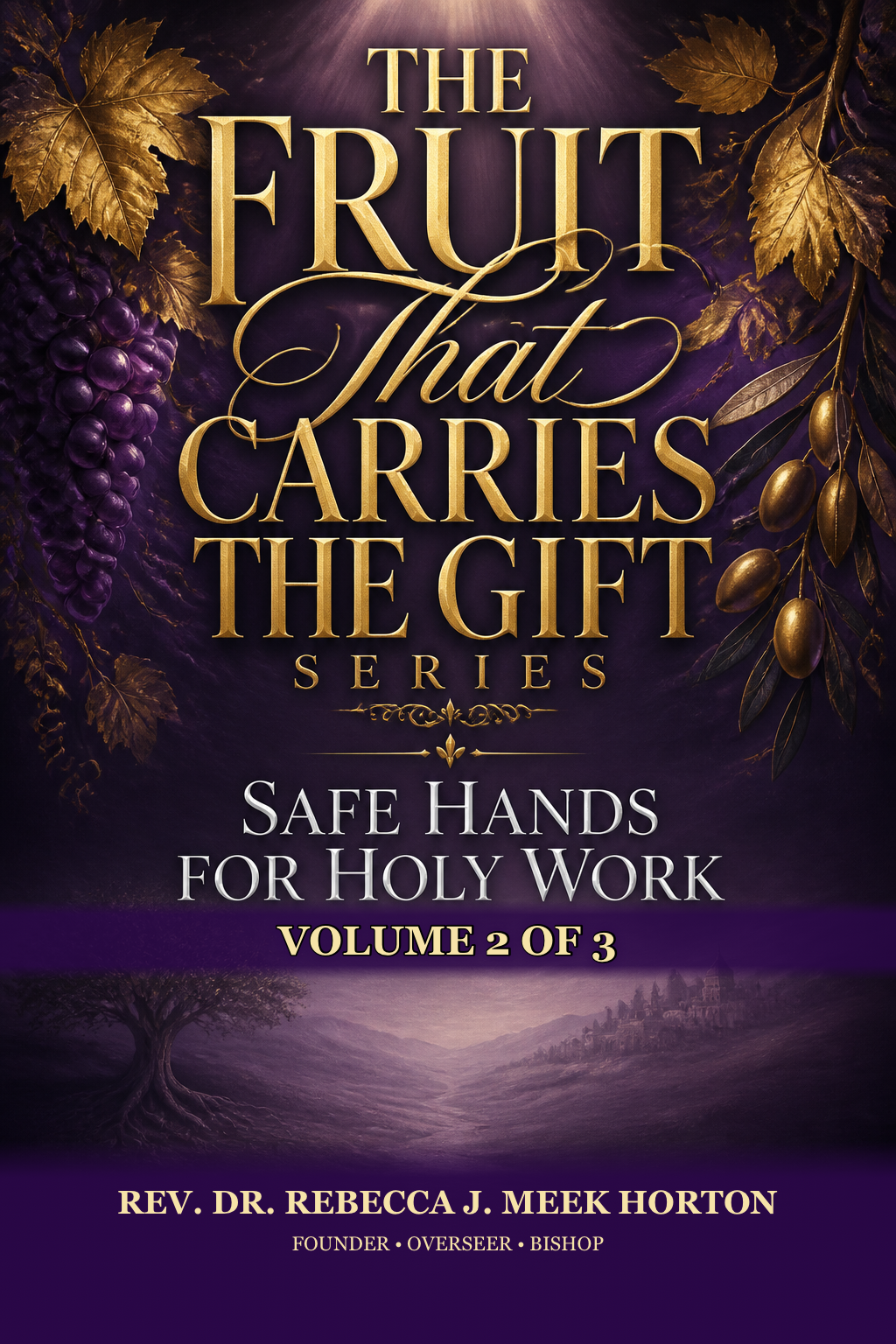
The Fruit That Carries the Gift
Safe Hands for Holy Work — Its Companion Devotional/Journal
Companion Devotional/Journal
Full publication
NBCNGMI MASTER KNOWLEDGE LIBRARY Featuring the works of The Sage, Apostle Prophet. Rev. Dr. Rebecca J. Meek Horton, Apostolic Prophetic Architect, NewBeing Creation Network Global Ministries, Inc. Integrated Framework Modalities™
Chapter 1 — When the Work Gets Heavy
Entry 1
Scripture Reading
Matthew 11:28-30 (KJV) 28 Come unto me, all ye that labour and are heavy laden, and I will give you rest. 29 Take my yoke upon you, and learn of me; for I am meek and lowly in heart: and ye shall find rest unto your souls. 30 For my yoke is easy, and my burden is light.
Devotional
There is a kind of tiredness that comes after the people leave.
The chairs are still warm. The room still holds the sound of worship. Someone is gathering cords, someone is wiping tables, someone is trying not to cry in the hallway. The public moment has ended, but the holy work has not. This is where many servants first learn that ministry is not only a gift expressed. It is weight carried.
Jesus does not shame the heavy laden. He calls them near.
That matters because many servants think they are only useful when they are strong, cheerful, available, and ready. But the Lord does not invite only the polished servant. He invites the one who labours. He invites the one whose heart is tired. He invites the one who served sincerely and still felt the heaviness afterward.
The weight of serving others can expose places in us that need rest, formation, and truth. Sometimes we are not only tired from the work. We are tired from trying to carry the work in our own strength. We are tired from being needed. We are tired from being misunderstood. We are tired from giving answers when we ourselves need wisdom.
Jesus says, “Take my yoke upon you, and learn of me.” This is not an invitation to escape all responsibility. It is an invitation to carry responsibility His way.
His way is meek and lowly in heart. His way does not bruise people to prove authority. His way does not confuse exhaustion with faithfulness. His way does not make servants become saviors. His way teaches us to serve from communion, not pressure.
Safe hands begin here: with a servant who is willing to come to Christ before carrying people.
The work may still be heavy. The need may still be real. The conversation may still require repair. The schedule may still require wisdom. But you do not have to let heaviness become your governor. You can pause. You can breathe. You can come. You can let Jesus teach you how to hold what He has assigned without taking ownership of what belongs to Him.
The room after service may reveal your tiredness, but it can also become an altar. Before you clean the last table, answer the last message, or replay the hard conversation again, come to Him. Let the meek and lowly Christ govern your hands.
Prayer
Father, I come to You with the real weight of service. I confess that I sometimes carry holy work as if everything depends on me. I bring You my tired body, my tender feelings, my questions, and the places where I have tried to be stronger than grace required. Teach me the way of Jesus. Form meekness in my authority and humility in my service. Help me know what is mine to carry and what must be returned to You. Let my hands become safe because my heart stays surrendered. I receive Your rest, not as escape from responsibility, but as strength to serve rightly. Amen.
Journal Prompt
Matthew 11:28-30 names the weary and heavy laden. Where is the work feeling heavy for me right now, and what part of that weight do I need to bring to Christ before I serve again?
Space to Write [Answer Lines]
Entry 2
Scripture Reading
Galatians 5:22-25 (KJV) 22 But the fruit of the Spirit is love, joy, peace, longsuffering, gentleness, goodness, faith, 23 Meekness, temperance: against such there is no law. 24 And they that are Christ's have crucified the flesh with the affections and lusts. 25 If we live in the Spirit, let us also walk in the Spirit.
Devotional
A gift may open the door, but Fruit determines how we stand in the room.
Many people can recognize a gift. A clear teacher. A strong singer. A bold intercessor. A discerning leader. A compassionate caregiver. Gifts can bless people deeply, and we should not despise them. God gives gifts for service, and the Body needs them.
But gifts alone do not make ministry safe.
The real testing often comes after the gift has made room. What happens when growth is slow? What happens when correction comes? What happens when someone misunderstands your heart? What happens when you are tired and still needed? What happens when nobody notices what you carried?
Galatians points us beyond visible ability into Spirit-formed character. The fruit of the Spirit is not decoration. It is evidence of yieldedness. It is the life of Christ being formed in ordinary decisions, strained conversations, quiet commitments, and hidden sacrifices.
Longsuffering helps us stay present without forcing people into outcomes they are not ready to steward. Gentleness helps us tell the truth without making the truth harder to receive. Goodness helps us do what is right when it costs us something. Faith helps us remain dependable when the work is not applauded. Meekness helps us carry strength without bruising others. Temperance helps us guard our mouths, motives, timing, and reactions.
This is safe service.
Safe does not mean easy. Safe does not mean everyone always likes what we say. Safe does not mean we avoid boundaries, correction, or hard truth. Safe means the servant is being governed by the Spirit rather than by ego, fear, fatigue, anger, or the need to be needed.
There is a holy difference between being powerful and being governed.
A powerful gift without Spirit-formed Fruit can draw people close and still wound them. It can speak accurately but harshly. It can serve publicly but resent privately. It can help one moment and control the next. This is why we must let the Holy Spirit form not only what we do, but how we do it.
The question is not only, “Am I gifted?”
The deeper question is, “Am I yielding?”
The Fruit of the Spirit is not manufactured by striving. It grows as we stay surrendered, honest, corrected, obedient, and available. The Holy Spirit forms safe hands in servants who are willing to be searched before they serve.
Prayer
Father, I thank You for every gift You have entrusted to me, but I do not want my gift to outrun my character. I ask You to form the Fruit of the Spirit in me under real pressure. Grow longsuffering where I want quick results. Grow gentleness where my tone becomes sharp. Grow goodness where doing right costs me. Grow faithfulness in hidden places. Grow meekness in my strength and temperance in my reactions. I yield my service to You again. Let what people experience through me be governed by Your Spirit and not by my unformed places. Amen.
Journal Prompt
Galatians 5:22-25 shows the Fruit of the Spirit. Which expression of Fruit do I most need under pressure right now, and what situation is revealing that need?
Space to Write [Answer Lines]
Entry 3
Scripture Reading
2 Corinthians 4:7-9 (KJV) 7 But we have this treasure in earthen vessels, that the excellency of the power may be of God, and not of us. 8 We are troubled on every side, yet not distressed; we are perplexed, but not in despair; 9 Persecuted, but not forsaken; cast down, but not destroyed;
Devotional
The treasure is real, and the vessel is still earthen.
That one truth can save a servant from pride and despair.
There is treasure in the work. The Word of God is treasure. Prayer is treasure. The gospel is treasure. Healing conversations, repentance, discipleship, worship, counsel, mercy, and encouragement are all holy things. When God lets us serve people, we are handling what matters.
But Paul reminds us that the treasure is carried in earthen vessels.
This does not insult us. It locates us truthfully. We are not the source. We are not the Savior. We are not made of stone. We are human servants who need grace, limits, correction, prayer, wisdom, and RE-Calibration™.
Pressure often reveals what is governing us. A hard message comes. A plan changes. Someone is disappointed. A volunteer drops the ball. A leader corrects us. A person we helped misunderstands us. In those moments, the hidden governor rises.
Fear may rush to defend. Pride may refuse to listen. Shame may collapse. People-pleasing may apologize without truth. Avoidance may go silent. Control may tighten its grip.
But the Spirit-formed servant learns to pause.
Not every accusation is true. Not every feeling is final. Not every urgent demand is an assignment. Still, every pressure can become a place of honest discernment. What is really happening? What did I intend? What was actually heard? What does love require now? What does truth require now? What next step protects the person, the work, and my integrity?
This is not weakness. This is governed strength.
Earthen vessels must learn dependence. We need Scripture to search us. We need wise counsel to steady us. We need the Holy Spirit to slow us down before we speak, post, confront, promise, or withdraw. We need enough humility to say, “I may need to understand this better.”
There is comfort here too. Being troubled does not mean being destroyed. Being perplexed does not mean being abandoned. Being cast down does not mean the work is over. God knows how to keep treasure in fragile hands when those hands remain surrendered.
You do not have to pretend you are unbreakable to serve faithfully.
You do have to stay honest.
The excellency of the power is of God, and not of us. That truth lowers pride and lifts despair. It teaches the servant to carry holy work carefully, not fearfully. Humbly, not passively. Faithfully, not as the source.
Prayer
Father, I acknowledge that I carry treasure in an earthen vessel. I am grateful for the holy work, but I am not the source of its power. Search what rises in me under pressure. Show me when fear, pride, shame, control, or avoidance is governing my response. Teach me to pause before reacting. Give me humility to receive correction and courage to act with truth. Help me remember that being troubled is not the same as being destroyed. Keep me dependent on You, anchored in Scripture, open to wise counsel, and willing to be formed. Let Your power be seen, not my performance. Amen.
Journal Prompt
In 2 Corinthians 4:7-9, Paul holds both treasure and weakness together. What recent pressure has revealed my humanity, and how can I let that lead me into dependence instead of defensiveness?
Space to Write [Answer Lines]
Entry 4
Scripture Reading
James 1:2-4 (KJV) 2 My brethren, count it all joy when ye fall into divers temptations; 3 Knowing this, that the trying of your faith worketh patience. 4 But let patience have her perfect work, that ye may be perfect and entire, wanting nothing .
Devotional
There is a work patience does that speed cannot do.
Most servants want fruit quickly. We want the person we are mentoring to mature. We want the team to become dependable. We want the conflict to settle. We want the wound to heal. We want the assignment to make sense. We want the good thing God gave us to grow without so much strain.
But holy work often moves through slow formation.
James does not tell us that trials are pleasant. He does not pretend pressure feels good. He tells us there is something God can work in us through the trying of faith. Patience has a work. If we do not let patience work, we may remain gifted but unsteady, willing but reactive, sincere but unsafe under weight.
This matters in ministry because people rarely grow on our preferred timetable. Some people take steps forward and then backward. Some need truth repeated again and again. Some require boundaries before they can receive help rightly. Some situations require waiting, praying, clarifying, and returning to the next faithful step.
Without patience, we may begin to force outcomes. We may call pressure leadership. We may call control excellence. We may withdraw and call it wisdom, when the truth is that we are weary and disappointed. We may speak too soon because silence feels uncomfortable.
Patience is not passivity. Patience is strength under God’s governance.
It keeps us from rushing the work that belongs to the Holy Spirit. It helps us tell the truth without demanding immediate proof that the truth was received. It allows us to stay faithful in small things while God works in hidden places. It teaches us that formation is often deeper than visible results.
There is also patience we must allow toward our own formation. The Holy Spirit may be showing us that our tone needs gentleness, our schedule needs boundaries, our commitments need honesty, our motives need cleansing, or our reaction needs self-control. We do not shame ourselves for needing growth. We also do not excuse what God is revealing.
We let patience have her perfect work.
That may mean taking ten quiet minutes before responding. It may mean receiving feedback without defending immediately. It may mean choosing one faithful next step instead of trying to fix every broken place today. It may mean staying present without becoming someone’s savior.
The heavy place can become holy formation if we yield.
Not every burden is yours to carry. Not every delay is failure. Not every trial is wasted. Under the hand of God, pressure can reveal, refine, and mature what safe service requires.
Prayer
Father, I ask You to teach me to let patience have her perfect work. I confess that I often want quick results, quick repair, quick growth, and quick relief. Help me not to force what only Your Spirit can form. Give me patience with people without losing truth, and patience with my own growth without making excuses. Show me where I have reacted from fatigue, disappointment, or control. Form steadiness in me. Help me take the next faithful step without demanding the whole outcome today. Let the pressure I am facing become a place of maturity, not bitterness. Amen.
Journal Prompt
James 1:2-4 says patience has a work. Where am I resisting the slow work of patience, and what would it look like to yield to God there this week?
Space to Write [Answer Lines]
Entry 5
Scripture Reading
1 Peter 4:10-11 (KJV) 10 As every man hath received the gift, even so minister the same one to another , as good stewards of the manifold grace of God. 11 If any man speak, let him speak as the oracles of God; if any man minister, let him do it as of the ability which God giveth: that God in all things may be glorified through Jesus Christ, to whom be praise and dominion for ever and ever. Amen.
Devotional
The gift was received. That means the gift must be stewarded.
Peter does not speak of ministry as ownership. He speaks of stewardship. We receive, and then we minister what we have received as good stewards of the manifold grace of God. That one word can purify the servant’s heart.
A steward does not own the house. A steward manages what belongs to another.
This is essential for safe hands in holy work. People do not belong to us. Their stories do not belong to us. Their vulnerability is not ours to spend. Their need is not an invitation to become their savior. Their trust is not a platform. Their pain is not material. The work belongs to God.
That truth does not make us careless. It makes us more careful.
If we speak, we must speak with reverence. Not every true thought needs to be said in the moment. Not every correction needs to be delivered with force. Not every revelation needs an audience. Speaking as one who handles the things of God requires self-control, humility, and fear of the Lord.
If we minister, we must minister from the ability God gives. That means we are not required to pretend we have capacity we do not have. Safe service knows when to pray, when to refer, when to report, when to rest, when to ask for counsel, and when to say, “This is beyond what I can carry alone.”
Boundaries are not the enemy of love. Wise limits protect the servant, the person being served, and the integrity of the work.
This is where Fruit makes the gift trustworthy. Longsuffering does not mean endless access. Kindness does not mean rescuing. Goodness does not mean avoiding hard truth. Faithfulness does not mean saying yes to everything. Meekness does not mean having no authority. Self-control does not mean silence when action is needed.
Fruit is governed strength.
A good steward serves in a way that points glory back to God. That means we must refuse the hidden pride of being needed by everyone. We must refuse the false guilt that says a wise no is failure. We must refuse the temptation to hold people emotionally dependent on us when they need to learn to walk with God, Scripture, counsel, and responsible next steps.
Safe hands remember: I am a servant, not the source.
When that truth stays clean in us, the gift can remain a blessing and not become a burden that bruises.
Prayer
Father, I thank You for what I have received from You. Teach me to steward it faithfully. Keep me from treating people, stories, trust, or pain as if they belong to me. Purify my motives where I have wanted to be needed more than I wanted to be obedient. Help me speak with reverence and minister from the ability You give, not from pressure or pride. Give me wisdom for boundaries, humility for correction, courage for truth, and tenderness for wounded people. Let my service glorify Jesus Christ and not myself. Make my hands safe because my stewardship is surrendered. Amen.
Journal Prompt
1 Peter 4:10-11 calls me to minister as a steward. Where do I need clearer stewardship, wiser limits, or purer motives in the way I serve others?
Space to Write [Answer Lines]
An Apostolic Prophetic Architect Message
Servant of God, hear this with clarity and peace: the heaviness has not been wasted.
The Lord has been teaching you the difference between carrying an assignment and becoming consumed by it. He has been showing you that holy work requires more than an open door, a visible gift, or a willing yes. It requires safe hands, and safe hands are formed under the government of the Holy Spirit.
Do not despise the place where pressure revealed you. Revelation is not rejection. When the Lord shows you impatience, defensiveness, fatigue, fear, pride, avoidance, or the need to be needed, He is not exposing you to shame you. He is inviting you into RE-Calibration™ so the work can be carried with cleaner strength.
Isaiah 40:29-31 (KJV) 29 He giveth power to the faint; and to them that have no might he increaseth strength. 30 Even the youths shall faint and be weary, and the young men shall utterly fall: 31 But they that wait upon the LORD shall renew their strength; they shall mount up with wings as eagles; they shall run, and not be weary; and they shall walk, and not faint.
This is not a call to quit because the work is heavy. It is a call to wait upon the Lord so your strength is renewed in Him and not manufactured by pressure.
You are not the owner of the people. You are not the Savior of the wounded. You are not the source of the power. You are a steward of grace, a servant under authority, and a vessel being formed.
Let the Fruit govern the gift.
Let longsuffering slow your urgency. Let kindness soften your delivery. Let goodness anchor your decisions. Let faithfulness steady your commitments. Let meekness govern your authority. Let self-control guard your mouth, motives, and moment.
Now take the next faithful step. Before you serve again, pause for ten quiet minutes. Name one pressure. Ask what it is revealing. Bring that truth to the Holy Spirit. Then choose one obedient action: repair, rest, apologize, set a boundary, seek counsel, prepare better, or remain faithful in the hidden place.
Nothing is random. Nothing is wasted. The heavy place can become holy formation. Keep your hands open. Keep your heart yielded. Keep the work in God’s hands.
[Journal Page]
[Journal Page]
Chapter 2 — Safe Hands Carry Holy Things
Entry 1
Scripture Reading
Galatians 5:22-23 (KJV) 22 But the fruit of the Spirit is love, joy, peace, longsuffering, gentleness, goodness, faith, 23 Meekness, temperance: against such there is no law.
Devotional
Holy work is not carried safely by talent alone. It is carried by a life being formed by the Spirit.
Galatians does not describe spiritual decoration. The Fruit of the Spirit is not something we display when the room is calm and everyone agrees with us. It is the visible evidence that the Holy Spirit is governing our inner life, our hands, our tone, our decisions, and our timing.
This matters because service often brings pressure. People do not come to us only with simple needs. They come with tender things. A wound. A question. A child. A confidence. A prayer request they can barely speak. A beginning of faith that is still fragile. If we are ungoverned, we may mean well and still mishandle what was placed in our care.
Love keeps service from becoming performance.
Joy keeps bitterness from taking root when no one notices.
Peace steadies the room when anxiety wants to lead.
Longsuffering helps us wait while God is still forming someone.
Gentleness gives truth a safe voice.
Goodness chooses what is right when convenience offers another way.
Faith makes us dependable before God and people.
Meekness keeps strength under holy government.
Temperance guards the moment before damage is done.
This is not perfection. It is formation. The servant of God must be honest enough to say, I still need the Spirit to form me here. I need Him in my mouth before I answer. I need Him in my motives before I serve. I need Him in my schedule before I promise. I need Him in my boundaries before I become resentful.
Safe hands are not born in public. They are formed in surrender.
Before the next message is answered, before the next meeting begins, before the next correction is given, before the next yes is spoken, the Spirit is able to slow us down and make us trustworthy. Not fearful. Not stiff. Not distant. Trustworthy.
The Fruit of the Spirit can become visible reliability in ordinary service. This is how holy things are carried well.
Prayer
Father, I come to You honestly. I do not want to serve from gifting without formation. I need the Fruit of Your Spirit to govern my hands, my words, my timing, my motives, and my boundaries. Form love in me where I have become impatient. Form peace where pressure has made me reactive. Form gentleness where truth has become too sharp. Form faithfulness where I have been inconsistent. Form temperance where I need to pause before speaking or acting. I yield my service to You again. Teach me to carry people and holy things with reverence, humility, and care. Amen.
Journal Prompt
Where do I most need the Fruit of the Spirit to become visible reliability in my service today? What one response can I surrender to the Holy Spirit before I act?
Space to Write [Answer Lines]
Entry 2
Scripture Reading
1 Corinthians 4:2 (KJV) Moreover it is required in stewards, that a man be found faithful.
Devotional
Stewardship is not ownership.
That truth can save a servant from pride, pressure, and confusion. We do not own the people we serve. We do not own the assignment. We do not own the outcome. We are entrusted with a portion, for a season, under God.
This changes the way we carry ministry.
If I think I own the work, I may control it. If I think I own the people, I may overreach. If I think I own the outcome, I may manipulate, rush, pressure, or panic. But if I remember I am a steward, I can serve with both reverence and release.
Paul says it is required in stewards that a man be found faithful. Not impressive. Not constantly available. Not applauded. Faithful.
Faithfulness is often quiet. It looks like showing up when you said you would. It looks like keeping a confidence. It looks like preparing before teaching instead of trusting charm. It looks like telling the truth about your capacity. It looks like doing the unseen work without resentment. It looks like refusing to use influence for personal advantage.
Faithfulness also tells the truth about limits. A steward does not pretend to have what has not been given. A steward does not promise what cannot be carried. A steward does not turn compassion into unhealthy dependence. Safe servants learn to say, This is what I can responsibly carry, and this is where another support is needed.
That is not lack of love. That is clean love.
Many people have been harmed by servants who were gifted but not faithful. A gifted person may gather attention quickly, but a faithful person becomes safe over time. Faithfulness is built in repeated moments. The same tone. The same integrity. The same care with private matters. The same humility when correction comes.
We may not always get it right. Faithful does not mean flawless. It means we return to obedience. We repair when we have wounded. We confess when we have been careless. We learn. We adjust. We let the Spirit train our hands to carry holy things better.
Today, do not despise the ordinary places where faithfulness is being formed. The small responsibility may be carrying more than you think. God sees how you steward what no one else applauds.
Prayer
Father, I acknowledge that I am a steward, not an owner. The people, the work, the gifts, and the outcomes belong to You. Forgive me for the places where I have carried responsibility with pressure, pride, fear, or control. Teach me to be faithful in what You have actually entrusted to me. Help me keep my word, honor confidences, prepare with humility, and tell the truth about my limits. Make my service steady, clean, and dependable. I do not ask only to be used. I ask to be formed so I can carry well. Amen.
Journal Prompt
In light of 1 Corinthians 4:2, what has God entrusted to me in this season? Where do I need to become more faithful without trying to control the outcome?
Space to Write [Answer Lines]
Entry 3
Scripture Reading
Luke 16:10 (KJV) He that is faithful in that which is least is faithful also in much: and he that is unjust in the least is unjust also in much.
Devotional
Small things tell the truth.
This is not meant to shame us. It is meant to wake us with mercy. The little places reveal how we carry weight before the weight becomes visible. A late reply, a small promise, a private confidence, an unseen task, a quiet apology, a moment of restraint, a hidden choice to do what is right when no one is watching — these things are not small to God.
They are formation ground.
Jesus teaches that faithfulness in what is least is connected to faithfulness in much. The least is not worthless. It is revealing. It shows whether we are becoming safe for greater trust.
If I am careless with small confidences, I may not be ready for deeper ones. If I am careless with time, I may place unnecessary weight on others. If I am careless with words, I may wound while intending to help. If I am careless with authority, I may call control leadership.
But the opposite is also true.
If I practice faithfulness in the hidden place, reliability grows. If I pause before reacting, people experience steadier care. If I keep my commitments small enough to honor, others do not have to chase me for what I agreed to do. If I apologize without defending my image, humility becomes visible.
Trust is usually built slowly. It is not built by title. It is built by repeated stewardship.
There is grace here. We do not have to wait for a platform to become trustworthy. We can begin in the next ordinary moment. We can answer one message with care. We can arrive when we said we would. We can tell the truth without drama. We can keep one boundary. We can refuse to repeat what was not ours to share. We can clean up after an event when no one sees. We can honor the quiet faithful servant instead of only noticing the visible one.
Safe hands are trained in ordinary obedience.
Do not despise today’s small responsibility. It may be the very place where God is forming the strength, patience, and integrity your future assignment will require. Nothing is random. Nothing is wasted. The least place can become holy when it is carried before God.
Prayer
Father, I bring You the small things I have been tempted to overlook. Teach me to see ordinary obedience as holy formation. Forgive me for careless words, broken commitments, delayed responsibility, or hidden disorder that has placed weight on others. I do not want to wait for larger assignments before becoming faithful. Form me now. Help me honor the least thing with reverence. Make me dependable in private, consistent in service, humble in correction, and careful with what belongs to another. Let my small choices tell the truth that I am being formed by You. Amen.
Journal Prompt
What small responsibility in my life is revealing how I handle trust? What one act of faithfulness can I complete today in obedience to Luke 16:10?
Space to Write [Answer Lines]
Entry 4
Scripture Reading
Mark 1:35-38 (KJV) 35 And in the morning, rising up a great while before day, he went out, and departed into a solitary place, and there prayed. 36 And Simon and they that were with him followed after him. 37 And when they had found him, they said unto him, All men seek for thee. 38 And he said unto them, Let us go into the next towns, that I may preach there also: for therefore came I forth.
Devotional
Need is real, but need is not always instruction.
That is a hard truth for servants. We care. We see pain. We hear urgency. We know people are looking for help. Sometimes we feel that if we do not answer immediately, stay longer, say yes again, or become available without limits, we have failed love.
But Jesus shows us a different way.
In Mark 1, He rises early, goes to a solitary place, and prays. The needs around Him are still real. People are still seeking Him. The disciples bring Him the pressure of the crowd: All men seek for thee. That sounds urgent. It sounds persuasive. It sounds like the kind of sentence that could make any servant feel guilty for stepping away.
Yet Jesus remains governed by the Father.
He does not ignore people. He does not despise need. He does not become cold. But He also does not surrender His assignment to demand. Prayer keeps Him aligned. Purpose keeps Him steady. He moves to the next towns because He knows why He came.
This is a necessary lesson for holy work.
Boundaries are not the opposite of love. Boundaries help love remain clean. Without boundaries, compassion can become control. Help can become dependency. Availability can become resentment. Service can become exhaustion dressed in spiritual language.
A safe servant asks better questions.
What is mine to carry?
What belongs to another leader, parent, pastor, counselor, or trained professional?
What can I offer without becoming the source?
What limit would protect both the person and the work?
What does love require here, not just relief?
Some of us have been praised for overextending, so rest feels like failure. Some of us are used to being needed, so boundaries feel like loss. Some of us fear disappointing people, so we keep saying yes while our souls become thin.
Jesus gives us permission to be governed, not driven.
Before you answer the urgent demand, return to the solitary place. Wait. Ask. Listen. Keep the next faithful step. The Father is not honored by the destruction of the servant. Holy work needs hands that are rested enough, clear enough, and surrendered enough to carry with wisdom.
Prayer
Father, I confess that I sometimes confuse urgency with instruction. I have answered pressure before I listened for wisdom. I have said yes when I needed to pause. I have feared disappointing people more than I have trusted Your governance. Teach me the way of Jesus. Draw me back to prayer before motion. Help me serve with compassion and clarity. Show me what is mine to carry and what I must release. Give me courage to honor holy boundaries without cruelty, guilt, or pride. Let my availability be governed by obedience, not panic. Amen.
Journal Prompt
What demand or need is trying to govern me right now? According to Mark 1:35-38, what boundary or prayerful pause may help me serve from obedience instead of pressure?
Space to Write [Answer Lines]
Entry 5
Scripture Reading
2 Timothy 2:20-21 (KJV) 20 But in a great house there are not only vessels of gold and of silver, but also of wood and of earth; and some to honour, and some to dishonour. 21 If a man therefore purge himself from these, he shall be a vessel unto honour, sanctified, and meet for the master's use, and prepared unto every good work.
Devotional
Many servants have prayed, Father, use me.
That is a holy prayer. But there is another prayer that must stand beside it: Father, form me so I can carry well what You entrust to me.
Paul writes about vessels prepared for honorable use. The image is simple and searching. A vessel is meant to carry something. Its value is not only in how it appears, but in whether it is clean, set apart, and ready for the master’s use.
Holy work requires prepared vessels.
Preparation includes skill, but it is deeper than skill. It includes surrender. It includes cleansing. It includes correction. It includes hidden obedience. It includes letting God address motives that people may not see yet, but pressure will eventually reveal.
Ministry reveals what is still unformed in us. Delay may reveal whether we manipulate. Conflict may reveal whether we retaliate. Authority may reveal whether we dominate. Access may reveal whether we honor boundaries. Correction may reveal whether we love truth more than image.
This is not a reason to quit. It is a reason to yield.
We do not become safe by pretending we are already safe. We become safe by allowing the Holy Spirit to search us and form us. We repent where we are misaligned. We receive wise counsel. We repair where we have caused harm. We study Scripture carefully before using it to advise others. We practice silence before reaction. We practice truth without drama. We practice limits without guilt.
A vessel prepared for every good work does not have to be loud about readiness. Preparation speaks over time. Faithfulness speaks. Meekness speaks. Temperance speaks. The way we handle pressure speaks.
This preparation has a cost. We may have to slow down when our flesh wants to rush. We may have to apologize when pride wants to explain. We may have to say no when being needed feels good. We may have to serve in hidden places longer than we expected.
But nothing is random. Nothing is wasted.
God is not only preparing work for our hands. He is preparing our hands for the work. The Holy Spirit can form safe hands, clean motives, steady words, wise timing, and holy boundaries. The vessel can be made meet for the Master’s use.
Prayer
Father, I do not want to be only available; I want to be prepared. Search me with mercy and truth. Cleanse what would make my service unsafe. Correct what I have excused. Strengthen what is weak. Govern what is impulsive. Heal what makes me seek importance through service. I yield my gifts, my motives, my words, my boundaries, and my hidden life to You. Make me a vessel unto honour, sanctified and prepared unto every good work. Form me patiently, deeply, and truthfully, so what I carry for You is held in safer hands. Amen.
Journal Prompt
What part of my life needs cleansing, correction, or preparation so I can be meet for the Master’s use? What one practice of yielded preparation will I begin today?
Space to Write [Answer Lines]
An Apostolic Prophetic Architect Message
Beloved servant, hear this with sober encouragement: holy work is not common handling. What God entrusts to your hands must be carried with reverence, clarity, and formed character.
You are not being called to fear people. You are being called to honor God in the way you serve them. You are not being called to perfection. You are being called to yielded preparation. The Spirit of God can form in you the kind of reliability that makes ministry safer: hands that do not grab, words that do not bruise, timing that does not force, motives that do not feed on attention, and boundaries that protect rather than punish.
This is apostolic order for holy service: gift must come under government. Compassion must come with clarity. Authority must bow to meekness. Zeal must be guarded by temperance. Availability must be governed by assignment.
Do not despise the hidden places where God is forming you. The chair you move, the confidence you keep, the apology you make, the boundary you honor, the message you wait to send until your heart is clean — these are not small things. They are training grounds for trustworthy stewardship.
1 Peter 4:10-11 (KJV) 10 As every man hath received the gift, even so minister the same one to another , as good stewards of the manifold grace of God. 11 If any man speak, let him speak as the oracles of God; if any man minister, let him do it as of the ability which God giveth: that God in all things may be glorified through Jesus Christ, to whom be praise and dominion for ever and ever. Amen.
You have received a gift, but the gift must be stewarded. You may speak, but speak under God. You may minister, but minister by the ability God gives. You may carry, but carry as one who knows the weight is holy.
This is confirmation: the Lord is not finished forming you. The pressure has not been wasted. The correction has not been rejection. The waiting has not been denial. God is preparing the vessel, not only opening the door.
So take the next faithful step. Before your next act of service, pause. Ask, What am I carrying? What limit must I honor? Which Fruit do I need today?
Then pray simply: Holy Spirit, form me to carry this well.
[Journal Page]
[Journal Page]
Chapter 3 — Longsuffering: Staying Present Without Forcing Outcomes
Entry 1
Scripture Reading
Galatians 5:22-23 (KJV) 22 But the fruit of the Spirit is love, joy, peace, longsuffering, gentleness, goodness, faith, 23 Meekness, temperance: against such there is no law.
Devotional
Longsuffering is not something we produce by trying harder to look patient. It is fruit. It grows from the life of the Spirit within us. That matters because servants often carry more than the room can see. We carry the conversation that did not go well. The person who left offended. The one who promised change but returned to the same pattern. The assignment that keeps asking for steadiness when our own soul feels tired.
The Spirit does not shame us for needing formation. He forms Christ in us as we remain yielded.
Longsuffering is not passivity. It is not pretending that harmful patterns are harmless. It is not silence when truth is needed. It is steady obedience under pressure. It is the grace to stay present without forcing outcomes, to keep serving without becoming controlling, and to keep loving without surrendering wisdom.
This fruit protects both the servant and the person being served. Without longsuffering, we may rush the process because we want relief. We may push someone into agreement before conviction has taken root. We may measure our value by their progress. Or we may withdraw too quickly because slow growth feels like failure.
But safe hands do not force fruit. Safe hands tend what God has entrusted, then release what belongs to Him.
There is humility in this. The fruit of the Spirit reminds us that holy work must be done in a holy way. We cannot use fleshly pressure to produce spiritual maturity. We cannot shame someone into freedom. We cannot manipulate someone into obedience. We can speak truth. We can pray. We can set boundaries. We can keep showing up in the measure God has assigned. But we cannot become the Holy Ghost in another person’s life.
Longsuffering helps us stay in our lane.
Today, ask the Lord to show you where impatience has been trying to govern your service. Not so you can condemn yourself, but so you can return to Spirit-governed work. The fruit is not forced. It is cultivated. Stay yielded. Stay truthful. Stay steady.
Prayer
Father, I bring You the places where my patience feels thin and my heart wants faster fruit. I confess that I sometimes want people to change quickly so I can feel relieved, successful, or safe. Form in me the fruit of longsuffering. Teach me to serve without pressure, to speak without harshness, and to wait without withdrawing in resentment. Keep me from calling control love, and keep me from calling avoidance patience. Let Your Spirit govern my tone, my timing, my boundaries, and my expectations. I receive Your help for today, not for every imagined future. Make my hands safe for holy work.
Journal Prompt
Where is Galatians 5:22-23 inviting me to yield to the Spirit instead of reacting from pressure, fatigue, or control?
Space to Write
[Answer Lines]
Entry 2
Scripture Reading
1 Corinthians 3:6-9 (KJV) 6 I have planted, Apollos watered; but God gave the increase. 7 So then neither is he that planteth any thing, neither he that watereth; but God that giveth the increase. 8 Now he that planteth and he that watereth are one: and every man shall receive his own reward according to his own labour. 9 For we are labourers together with God: ye are God's husbandry, ye are God's building.
Devotional
There is deep freedom in knowing what is yours to do and what is not yours to control.
Paul planted. Apollos watered. God gave the increase. Each part mattered, but only one part belonged to God. This is one of the great protections for anyone who serves people. We are not called to be inactive. We are called to labor faithfully. But we are also not called to carry the weight of outcomes that only God can produce.
Much of servant work is seed work. You may not see roots. You may not see fruit. You may only see soil that still looks quiet after you have prayed, taught, counseled, listened, corrected, and encouraged. That quiet place can tempt the servant into anxiety. We may stand over the seed with our worry. We may dig it up with our questions. We may pressure the person to prove that something is happening because we need evidence.
But a seed does not become a tree because we panic over it.
Longsuffering lets us keep planting without demanding instant proof. It lets us water without pretending we own the rain. It teaches us to honor process without worshiping process. We do what love requires today, and we trust God with what only He can make alive.
This does not mean we ignore fruit. Safe servants pay attention. We notice patterns. We make adjustments. We do not keep pouring into a structure that is enabling harm without asking wise questions. But even when we adjust, we are not adjusting to force increase. We are stewarding our part with clarity.
There is peace in this order.
If God has asked you to plant, plant well. If God has asked you to water, water faithfully. If God has asked you to step back, step back without bitterness. If God has asked you to continue, continue without making someone else’s pace the measure of your worth.
You are a laborer together with God. That is holy, but it is not ownership. The field is His. The increase is His. The glory is His.
Prayer
Father, I thank You that I do not have to be the source of increase. I confess that I sometimes carry people and outcomes as though everything depends on me. Teach me to plant faithfully, water wisely, and release the growth back to You. Help me discern what is mine to do, what belongs to another person, and what belongs only to You. Keep me from anxiety that digs up seeds too soon. Keep me from pride that takes credit for fruit. Let my labor be honest, humble, and steady. I trust You with the hidden work I cannot see.
Journal Prompt
According to 1 Corinthians 3:6-9, what is mine to plant or water right now, and what increase must I release back to God?
Space to Write
[Answer Lines]
Entry 3
Scripture Reading
Romans 5:3-5 (KJV) 3 And not only so, but we glory in tribulations also: knowing that tribulation worketh patience; 4 And patience, experience; and experience, hope: 5 And hope maketh not ashamed; because the love of God is shed abroad in our hearts by the Holy Ghost which is given unto us.
Devotional
Patience is worked in us. That is not always the message we want to hear, but it is honest. Romans tells us that tribulation worketh patience. Pressure becomes a place where something spiritual is formed, if we will let the Lord govern us in it.
Serving people brings pressure. Not always dramatic pressure. Sometimes it is the slow pressure of repetition. The same conversation. The same resistance. The same disappointment. The same need to forgive, clarify, reset, and continue. It can wear on the heart. It can make a servant wonder if the work is making any difference at all.
But God does not waste the pressure.
Nothing is random. Nothing is wasted. Even the strain of serving can become formation if we bring it under the Spirit instead of letting it turn into resentment. Patience becomes experience. Experience becomes hope. Not shallow hope. Not pretend hope. Hope that has been tested and still knows God is faithful.
This is why longsuffering cannot be separated from love. The love of God is shed abroad in our hearts by the Holy Ghost. We are not asked to serve from an empty place or a self-made strength. We are invited to receive from God what we cannot manufacture on our own.
There will be moments when the pressure exposes what is still unhealed in us. We may discover that we do not only want to help. We want to be appreciated. We do not only want to serve. We want to be understood. We do not only want someone to grow. We want their growth to prove that our labor mattered.
This is not a reason to hide. It is a reason to let God search us.
Longsuffering matures the servant, not only the person being served. It teaches us to stay present without needing to be the savior. It teaches us to keep loving without needing constant affirmation. It teaches us to hold boundaries without becoming cold.
Today, let the pressure become a place of prayer. Ask God not only to change the situation, but to form hope in you while you serve inside it.
Prayer
Father, I bring You the pressure I have been carrying. I do not want tribulation to make me bitter, sharp, controlling, or withdrawn. I want it to form patience, experience, and hope in me. Pour Your love into my heart by the Holy Ghost. Heal the places where I need appreciation too deeply, where I fear being overlooked, and where I want quick results to quiet my anxiety. Teach me to serve from Your love instead of my need for proof. Let this pressure become formation, and let my hope remain rooted in You.
Journal Prompt
How is Romans 5:3-5 helping me see pressure as a place of formation rather than only frustration?
Space to Write
[Answer Lines]
Entry 4
Scripture Reading
James 5:7-8 (KJV) 7 Be patient therefore, brethren, unto the coming of the Lord. Behold, the husbandman waiteth for the precious fruit of the earth, and hath long patience for it, until he receive the early and latter rain. 8 Be ye also patient; stablish your hearts: for the coming of the Lord draweth nigh.
Devotional
The farmer waits, but he does not wait carelessly.
He prepares the ground. He watches the season. He protects what has been planted. He pays attention. But he also knows he cannot command the rain. There is work he must do, and there is work he must leave to God.
James gives this picture to people who need patience. It is not a weak picture. It is a grounded one. The husbandman waits for precious fruit. He does not despise the field because it is slow. He does not abandon the seed because he cannot see everything happening underground. He waits with long patience.
This is holy instruction for those who serve.
People are not projects to be managed. They are precious before God. Their growth may be slow, hidden, uneven, and costly. They may need truth more than once. They may need time to face what they have avoided. They may need correction with dignity, not pressure with shame. Longsuffering helps us remember that God’s work in a soul is deeper than our timeline.
But James also says, stablish your hearts.
That means patience is not only about how we see the other person. It is also about what is happening inside us. An unstable heart will try to force outcomes. An anxious heart will reach for control. A wounded heart may withdraw to protect itself. A proud heart may become offended when people do not respond quickly to its counsel.
So the servant must be established.
Established in God’s timing. Established in God’s ownership. Established in truth. Established in love. Established enough to support without controlling, to care without carrying what belongs to someone else, and to release without despising.
There may be a relationship or assignment in your life where you have been watching the field too anxiously. You are looking for fruit, but your heart is becoming unsettled. Today, return to order. Tend what is yours. Release the rain. Let God establish your heart before you try to manage the field.
Precious fruit is still precious when it takes time.
Prayer
Father, I ask You to establish my heart. I have watched some fields with worry instead of trust. I have wanted precious fruit, but I have sometimes become impatient with the process. Teach me the wisdom of the husbandman. Help me prepare, protect, speak, serve, and wait without trying to control the rain. Show me where my heart is unstable, anxious, offended, or weary. Anchor me again in Your faithfulness. Let me see people as precious before You, not as projects for me to manage. Make me patient, watchful, and faithful in my portion.
Journal Prompt
In James 5:7-8, what does the image of the husbandman teach me about waiting for fruit without trying to control the rain?
Space to Write
[Answer Lines]
Entry 5
Scripture Reading
Galatians 6:9-10 (KJV) 9 And let us not be weary in well doing: for in due season we shall reap, if we faint not. 10 As we have therefore opportunity, let us do good unto all men, especially unto them who are of the household of faith.
Devotional
This passage is tender because it tells the truth. Well doing can make a person weary.
Not wrongdoing. Not rebellion. Not laziness. Well doing.
You can become weary while praying, serving, mentoring, cleaning up after the meeting, preparing again, forgiving again, answering gently again, and taking the next faithful step again. The weariness does not always mean you are outside the will of God. Sometimes it means you have been pouring out for a long time and need to return to the Source.
Galatians does not shame the weary servant. It gives instruction and hope. Do not be weary in well doing. In due season we shall reap, if we faint not.
Due season is not always our preferred season. It may not arrive when our emotions demand it. It may not look like the outcome we imagined. But God is not careless with faithful obedience. He sees the hidden labor. He sees the conversations no one applauded. He sees the restraint when you wanted to react. He sees the boundary you set with tears. He sees the prayer you prayed after you had nothing else to say.
Longsuffering helps us continue without changing our methods into pressure, guilt, manipulation, or withdrawal. Weariness can tempt us to use shortcuts. We may start forcing because waiting feels too slow. We may start enabling because confrontation feels too costly. We may start disappearing because disappointment feels too heavy.
But the call is to keep doing good as we have opportunity.
Opportunity is important. It reminds us that we are not responsible for everything, everywhere, all the time. We are responsible for the faithful good God places before us. Safe hands learn the difference between assignment and overextension. Longsuffering does not mean endless access. It means Spirit-governed faithfulness.
Today, name one place where you are tired in well doing. Then ask a better question: What is the next faithful step that is neither pressure nor withdrawal?
Maybe you need to rest. Maybe you need to speak. Maybe you need to adjust a structure. Maybe you need to keep showing up. Maybe you need to release an outcome back to God.
Keep it simple. Do the good that is truly yours to do.
Prayer
Father, I admit that I can become weary in well doing. I bring You the tired places where I have continued to serve, pray, forgive, lead, and care. Strengthen me without making me hard. Refresh me without making me irresponsible. Show me the difference between faithful endurance and unhealthy overextension. Keep me from using pressure because I am tired. Keep me from withdrawing because I am disappointed. Teach me to do good as You give opportunity, and to trust Your due season. Help me take the next faithful step with clean hands and a steady heart.
Journal Prompt
Where does Galatians 6:9-10 speak to my weariness, and what good is truly mine to do in this season?
Space to Write
[Answer Lines]
An Apostolic Prophetic Architect Message
Servant of God, hear this with clarity and peace: longsuffering is not weakness. It is governed strength. It is the Spirit teaching your hands how to stay safe while the work is still unfinished.
You have not failed because someone is still growing slowly. You have not failed because a conversation must be repeated. You have not failed because the field does not yet look like harvest. But you must not take the field from God. You must not let weariness make you force what only grace can form.
There is a holy order in service. What belongs to you must be done faithfully. What belongs to the other person must not be carried for them. What belongs to God must be released back to Him. This is how ministry stays clean. This is how help remains help and does not become control. This is how support builds maturity instead of dependency.
Hebrews 10:35-36 (KJV) 35 Cast not away therefore your confidence, which hath great recompence of reward. 36 For ye have need of patience, that, after ye have done the will of God, ye might receive the promise.
You have need of patience after you have done the will of God. That is a word for the servant who has obeyed and is still waiting. It is a word for the leader standing after the meeting with chairs still out and questions still unanswered. It is a word for the mentor, the intercessor, the caregiver, the builder, the counselor, the one who keeps showing up in unseen places.
Do not cast away your confidence. RE-Order the burden. RE-Lease the outcome. RE-Commit to the next faithful step.
Longsuffering will not always tell you to stay in the same structure. Sometimes it will lead you to continue. Sometimes it will lead you to speak. Sometimes it will lead you to adjust access, clarify expectation, or step back in wisdom. But it will not lead you to manipulate, shame, strive, or abandon from injury.
Safe hands for holy work are steady hands. Let God strengthen yours. Then serve from peace, not pressure. Obey clearly. Wait faithfully. Speak truthfully. Release fully. God is still the Lord of the harvest.
[Journal Page]
[Journal Page]