 NBCNGMI™
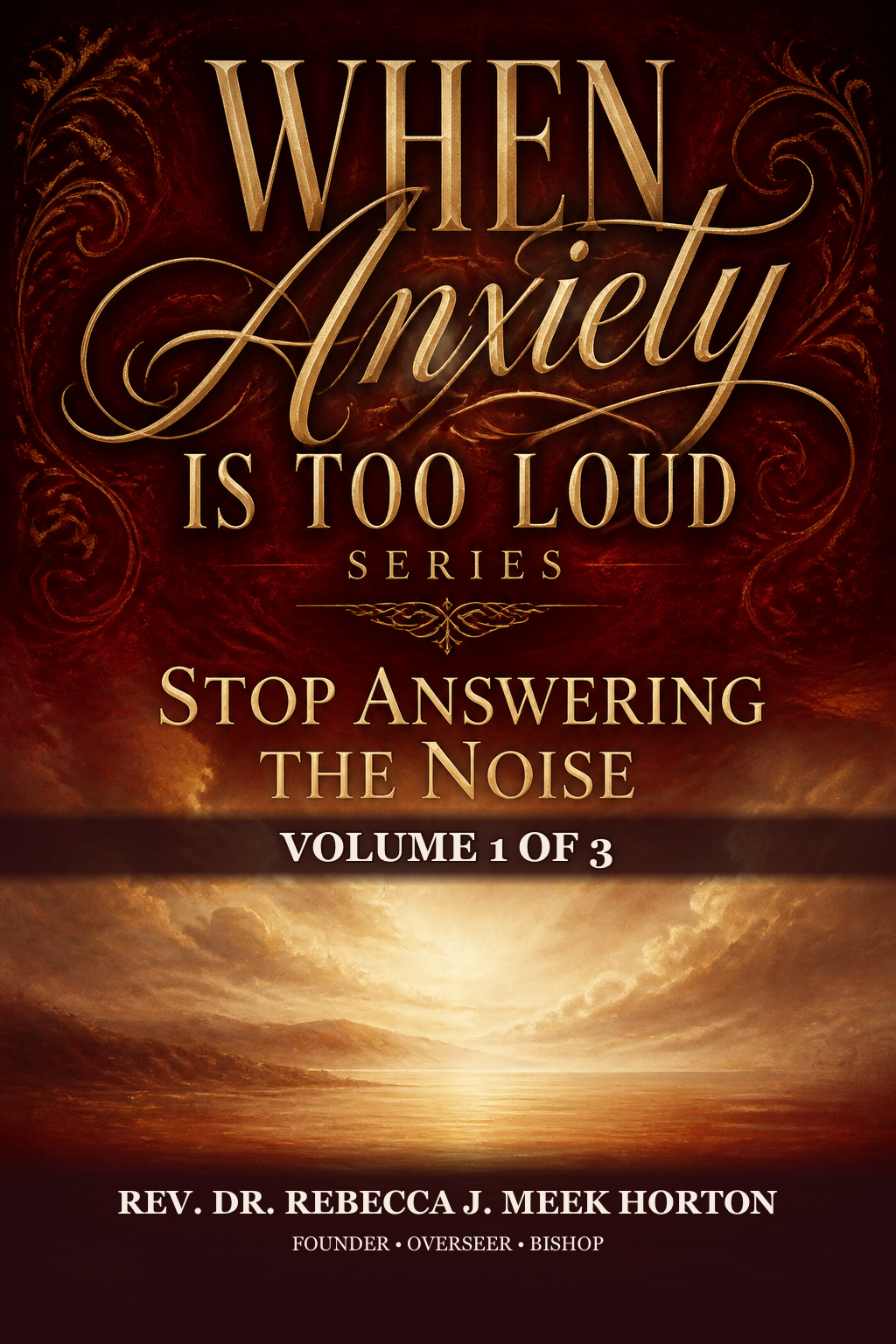
When Anxiety Is Too Loud · Volume 1
Stop Answering the Noise
Part 1 of 3 in the series "When Anxiety Is Too Loud". Series theme: Do not try to fight anxiety or reason with it. Series arc: This three-book series moves from interruption to surrender to steady living. The first book teaches readers to stop arguing with anxiety and create enough quiet to see what is really happening. The second book helps them place fear, control, and uncertainty before God wit
Full publication
NBCNGMI MASTER KNOWLEDGE LIBRARY Featuring the works of The Sage, Apostle Prophet. Rev. Dr. Rebecca J. Meek Horton, Apostolic Prophetic Architect, NewBeing Creation Network Global Ministries, Inc. Integrated Framework Modalities™
Dedication
To every person who has felt trapped inside the noise of anxious thoughts, I dedicate these pages with compassion and hope. May you learn to pause, see clearly, trust God more deeply, and take the next faithful step without surrendering your peace to the pressure.
Purpose
I wrote this book to help you stop treating every anxious thought as a command. My hope is that these pages will help you step back from the noise, see what is really happening, and choose the next faithful response with God’s help.
Anxiety may still speak, but it does not have to govern your movement. May this book help you become still enough to trust God, receive wisdom, and walk one clear step at a time.
Preface
I wrote this book for the moment when anxiety gets loud before wisdom has time to speak.
I know that inner pressure. The sudden demand to answer every thought. The urge to explain, defend, solve, rehearse, prepare, and protect yourself all at once. Anxiety can sound urgent, but urgency is not always truth. Noise can be loud and still be wrong.
This book was born from the need to stop treating every anxious thought like an assignment.
Too often, we try to fight anxiety by arguing with it. We reason with it. We chase it through every possible outcome. We try to prove it wrong, calm it down, or make it promise us certainty. But anxiety does not usually become quiet because we outtalk it. Sometimes the first faithful step is not to answer the noise at all.
Sometimes the first step is to be still long enough to see what is really happening.
Psalm 46:10 (KJV) Be still, and know that I am God: I will be exalted among the heathen, I will be exalted in the earth.
This is not a book about pretending anxiety is not real. It is not a book about shaming fear, denying struggle, or acting spiritually strong while suffering silently. If you need pastoral care, wise counsel, medical help, or professional support, receive it with humility and courage. Stewardship includes knowing when to ask for help.
This book is about learning not to let anxiety become your governor.
An anxious thought may visit, but it does not have to rule. A fearful feeling may rise, but it does not have to decide. A loud inner demand may press you to react, but you can pause, breathe, pray, and choose the next faithful response.
Proverbs 3:5-6 (KJV) Trust in the LORD with all thine heart; and lean not unto thine own understanding. In all thy ways acknowledge him, and he shall direct thy paths.
My prayer is that these pages help you create enough quiet to notice what anxiety is trying to make you obey. Then, with GOD’s help, you can stop answering the noise and begin walking in wisdom.
Before you continue, take one small step: name the loudest anxious demand you are carrying today. Write it down. Then say, “This may be loud, but it is not my Lord.”
Introduction
Anxiety often sounds urgent.
It does not always begin as panic. Sometimes it begins as a sentence inside you: Fix this now. Explain yourself. Prepare for everything. What if this goes wrong? What if they misunderstand you? What if you fail? What if God does not come through the way you hoped?
The noise feels important because it is loud. But loud is not the same as true. Urgent is not the same as wise. A thought can demand your attention without deserving your obedience.
This book begins there.
Stop Answering the Noise is not a book about pretending anxiety is not real. It is not a book about shaming yourself for feeling afraid. It is not a quick formula for becoming calm on command. Anxiety can be complex. For some, it is tied to trauma, health, grief, pressure, exhaustion, or long patterns of fear. If your anxiety is severe, persistent, or affecting your safety or daily functioning, wise support from trusted leaders and qualified professionals may be part of your stewardship.
But this book is written for the moment when anxiety starts talking and you start answering.
You argue with it. You defend yourself to it. You rehearse conversations that have not happened. You solve problems that may never come. You build a case, then build a countercase, then build another one. By the end, nothing has been resolved, but your soul is tired.
The first practice of this book is simple: stop answering the noise long enough to see what is really happening.
Psalm 46:10 (KJV) Be still, and know that I am God: I will be exalted among the heathen, I will be exalted in the earth.
Stillness is not denial. Stillness is not weakness. Stillness is the place where you stop letting fear conduct the whole room. It is the pause where you remember that anxiety may be present, but it is not Lord.
This is Part 1 of the series When Anxiety Is Too Loud. The larger journey moves from interruption to surrender to steady living. This first book focuses on interruption. Before you can surrender fear to God with honesty, you must learn to notice how fear is speaking. Before you can build steady daily practices, you must stop treating every anxious thought as an emergency.
That is the core argument of this book: you do not have to fight anxiety or reason with it in order to respond faithfully. You can step back. You can name what is happening. You can choose the next faithful response.
Proverbs 3:5-6 (KJV) Trust in the LORD with all thine heart; and lean not unto thine own understanding. In all thy ways acknowledge him, and he shall direct thy paths.
Read this book slowly. Do not rush to master anxiety. Begin by observing it. Notice the tone anxiety uses. Notice when it demands certainty. Notice when it pushes you to control outcomes, defend your worth, or rehearse tomorrow before you have lived today.
Each chapter will help you separate the thought from the command. You will learn to say, This is anxiety speaking. This is pressure, not instruction. This is fear asking for control. This is a real concern, but it does not need my panic to become responsible action.
Matthew 6:34 (KJV) Take therefore no thought for the morrow: for the morrow shall take thought for the things of itself. Sufficient unto the day is the evil thereof.
This will cost you something. It may cost you the false comfort of overthinking. It may cost you the habit of calling worry preparation. It may cost you the need to answer every fear before you move. But what you gain is space: space to breathe, space to pray, space to discern, space to obey.
Begin with one small practice. The next time anxiety becomes loud, pause before answering it. Write one sentence: This is a thought, not a command. Then ask, What is the next faithful step I can take without obeying the noise?
Chapter 1 — The Thought That Demands an Answer
The text message was only six words long, but it took over the room.
Call me when you can.
Nothing else.
No explanation. No tone. No details. Just a sentence sitting on the screen.
Within seconds, the mind began to work. Did I do something wrong? Is someone upset? Is this bad news? Should I call now? Should I wait? What if waiting makes it worse? What if calling makes me look anxious? What if I say the wrong thing?
The body joined in. Chest tight. Shoulders lifted. Stomach turned. Breath shortened.
Nothing had happened yet. But inside, it felt like everything had happened.
That is how anxiety often enters. Not always as a full storm. Sometimes it comes as a thought that demands an answer. It arrives with urgency and acts like authority.
This chapter’s central truth is simple: an anxious thought may feel urgent, but urgency does not make it true, and pressure does not make it a command.
You do not have to answer every thought that knocks loudly.
The Demand Beneath the Thought
Anxiety rarely says, “Here is a possibility to consider when you have time.”
It says, “Do something now.”
Explain yourself now.
Fix this now.
Defend your motives now.
Find certainty now.
Prevent pain now.
Make everyone okay now.
That pressure is often more powerful than the thought itself. The thought may be brief, but the demand behind it can pull the whole person into motion.
A parent sees their child withdraw after school and anxiety says, You need to get the whole story right now.
A leader notices someone’s facial expression in a meeting and anxiety says, They are disappointed in you. Repair it immediately.
A friend does not reply to a message and anxiety says, You are being rejected. Send another message. Explain more.
The issue is not that concerns are always wrong. Sometimes a situation does need attention. Sometimes a conversation does need to happen. Sometimes wisdom does require action.
But anxiety does not usually invite wisdom. It demands reaction.
It presses for a response before there has been enough time to see clearly.
This is where RE-Language™ helps. Instead of saying, “I have to fix this now,” we can learn to say, “I am feeling pressure to fix this now.”
That small shift matters.
The first sentence treats anxiety as ruler. The second sentence names anxiety as a signal.
A signal may deserve attention. It does not deserve the throne.
Not Every Thought Is Truth
One of anxiety’s strongest tricks is that it makes thoughts feel like facts.
The thought comes: They are angry with me.
The feeling rises: fear, shame, dread.
The body reacts: tension, heat, restlessness.
Then the mind concludes: This must be true because I feel it so strongly.
But intensity is not accuracy.
A thought can be loud and still incomplete. A thought can feel convincing and still be built on assumption. A thought can arrive quickly and still need to be examined.
Scripture teaches us not to let every thought remain unchallenged or ungoverned.
2 Corinthians 10:5 (KJV)
Casting down imaginations, and every high thing that exalteth itself against the knowledge of God, and bringing into captivity every thought to the obedience of Christ;
This verse does not call us to panic over our thoughts. It calls us to bring them into captivity. That means thoughts are not masters. They are not final authorities. They can be examined, submitted, corrected, and refused.
Anxiety often says, If you thought it, you must answer it.
Wisdom says, If you thought it, notice it. Then weigh it.
There is a difference between having a thought and obeying a thought.
You may think, I am going to fail.
That does not mean failure has been declared.
You may think, Something terrible will happen.
That does not mean fear has become prophecy.
You may think, I cannot handle this.
That does not mean God has left you without help.
A thought is not automatically truth. A feeling is not automatically direction. A body response is not automatically a command.
This does not mean we shame ourselves for anxious thoughts. Shame only adds another voice to the noise. We practice responsibility instead.
Responsible language sounds like this:
“I am having the thought that something is wrong.”
“My body feels alarmed, but I do not yet have enough information.”
“This may need attention, but it may not need immediate reaction.”
“I can pause before I respond.”
This is not denial. It is stewardship.
The Body May Be Alarmed Before the Situation Is Clear
Anxiety is not only mental. It often speaks through the body.
A tight chest.
A racing heart.
A clenched jaw.
A restless need to move.
A sudden heaviness.
A stomach that drops before the facts are known.
Many people become afraid of these sensations. Then anxiety doubles. First comes the worry. Then comes worry about the worry. The person begins thinking, Why do I feel this way? What is wrong with me? Why can’t I calm down?
But the body’s alarm does not always mean danger is present. Sometimes it means the body has recognized uncertainty, memory, pressure, fatigue, or overload.
Think of a smoke alarm. Its sound is serious, but it is not the same thing as fire. Sometimes there is fire. Sometimes there is steam. Sometimes the battery is weak. The alarm must be checked, but it must not be worshiped.
The same is true when the body reacts.
If your body is loud, begin by naming what is happening without surrendering to its interpretation.
“My heart is racing.”
“My shoulders are tight.”
“My breathing is shallow.”
“My mind is trying to rush.”
This is the beginning of SAPP™ Discernment: See the situation truthfully before deciding what it means.
Seeing is not solving. Seeing is not surrendering to fear. Seeing is the first act of order.
An example may help.
You receive an email from your supervisor: “Please stop by before you leave.”
Anxiety says, I am in trouble.
Your body reacts as if the meeting has already happened. You replay the week. You search for mistakes. You prepare a defense. You imagine consequences.
But all you have is one sentence.
The faithful first step is not to write a long explanation or assume the worst. The first step is to see.
Fact: I received a request to stop by.
Fear: I may be in trouble.
Assumption: This must be about something I did wrong.
Body signal: I feel tense and rushed.
That separation does not solve the meeting. It keeps anxiety from controlling the story before the story is known.
Urgency Wants Reaction; Wisdom Requires a Pause
Anxiety often moves quickly because it wants to outrun uncertainty.
Wisdom is slower.
Not careless. Not passive. Slower.
Proverbs connects haste with danger because hurried movement can magnify folly.
Proverbs 14:29 (KJV)
He that is slow to wrath is of great understanding: but he that is hasty of spirit exalteth folly.
The phrase “hasty of spirit” is worth noticing. Anxiety often makes the spirit hasty. It pushes the person to speak before listening, decide before discerning, accuse before asking, withdraw before understanding, or overexplain before trust has had room to breathe.
A pause interrupts that haste.
A pause may be one breath before answering a message.
It may be one sentence: “I need a moment before I respond.”
It may be stepping away from the screen.
It may be waiting until morning before sending the emotional email.
It may be praying simply, “Lord, help me see clearly.”
The pause does not make anxiety disappear. That is not the promise. The pause creates enough space to stop treating anxiety as commander.
This is where the WALK™ rhythm begins quietly.
Wait: Do not rush into the demand.
Ask: What is actually happening?
Listen: What is true, and what is only fear?
Keep: Take the next faithful step.
At this point in the book, we are not trying to build the whole practice. We are learning the first interruption: stop answering the noise as if every anxious thought deserves immediate obedience.
The Cost of Not Answering Every Thought
This sounds simple until anxiety is loud.
The cost is real.
You may feel irresponsible at first. Anxiety may accuse you: If you do not act now, you do not care.
You may feel exposed. If you are used to overexplaining, silence may feel unsafe.
You may feel control slipping. If you normally manage fear by planning every possible outcome, stepping back may feel like weakness.
You may disappoint people who are used to immediate access to your energy, attention, and emotional labor.
You may have to admit that some of your reactions were not discernment. They were fear in a hurry.
That is painful, but it is also mercy.
Because maturity begins when we stop calling every inner alarm wisdom.
This chapter is not asking you to ignore real responsibility. It is asking you to stop confusing pressure with responsibility.
Some things need action.
Some things need prayer.
Some things need counsel.
Some things need time.
Some things need to be left unanswered until truth is clearer.
If anxiety is severely disrupting your life, sleep, health, relationships, or safety, it is wise to seek support from a trusted pastor, counselor, physician, or qualified professional. Asking for help is not failure. It is stewardship.
But even with help, this truth remains: the loudest thought in the room does not have to lead.
Key Takeaways
• An anxious thought may feel urgent without being true.
• Pressure is a signal to notice, not a command to obey.
• A pause gives wisdom room to speak before reaction takes over.
Practice
For the next twenty-four hours, notice one anxious thought that demands an immediate answer.
Write four short lines:
Fact: What actually happened?
Fear: What am I afraid this means?
Pressure: What is anxiety demanding I do right now?
Faithful response: What is one steady step I can take without panic?
Do not try to solve your whole life today.
Just practice not answering the noise as if it is in charge.
Chapter 2 — Quiet Is Not Avoidance
The message arrives at 9:47 p.m.
Not an emergency. Not a crisis. Just a sentence on a screen that lands in your chest like a warning.
“We need to talk tomorrow.”
Your mind starts moving before you do.
What did I do? Are they upset? Is something wrong? Should I answer now? Should I explain? Should I prepare? Should I call?
Your body tightens. Your breath shortens. You reread the message three times, then four. You start building arguments for a conversation that has not happened yet.
Anxiety wants an immediate answer.
But not every urgent feeling is a faithful instruction.
The promise of this chapter is not instant calm. It is something humbler and stronger: enough stillness to see what is really happening. Quiet is not avoidance when it helps you stop reacting to pressure and begin responding with trust.
Psalm 46:10 (KJV) Be still, and know that I am God: I will be exalted among the heathen, I will be exalted in the earth.
Stillness is not pretending there is no trouble. Stillness is remembering that trouble is not God.
The Step Back
Anxiety often accuses quiet of being irresponsible.
If you pause, it says, you are ignoring the problem. If you wait, you are falling behind. If you stop thinking about it, everything will fall apart.
But there is a difference between avoidance and a faithful step back.
Avoidance refuses to face what is true.
Quiet creates space to face what is true without panic driving the response.
Imagine someone hears criticism at work. Their first impulse is to defend themselves in the meeting, explain every detail, and correct every misunderstanding. Their heart is racing. Their words are ready. Their fear says, If you do not answer now, they will think the worst of you.
But they pause.
They take a breath. They listen. They write down what was said. They decide not to respond from heat. Later, with a clearer mind, they can ask, “Can you help me understand the concern more specifically?” That pause did not avoid the issue. It protected the response.
Quiet is not the same as silence forever.
Quiet is the space before speech. The breath before decision. The pause that keeps fear from becoming your leader.
There are moments when action is needed. A child is in danger. A deadline is real. A responsibility must be handled. Stillness does not cancel obedience.
But many anxious moments are not emergencies. They are pressure. And pressure should not be allowed to govern your whole inner life.
The step back may be as simple as not answering the text immediately. Closing the laptop for ten minutes. Sitting in the car before walking into the house. Letting your breathing slow before you speak.
That small pause can become a doorway into wisdom.
Stillness Tells the Truth
Noise mixes everything together.
One concern becomes a disaster. One delay becomes rejection. One mistake becomes identity. One hard conversation becomes proof that everything is unsafe.
Stillness does not solve all of that at once. It simply gives your soul enough room to notice that not every thought deserves the same weight.
A person lies awake at 2:00 a.m. thinking about money. The bills are real. The concern is real. But in the dark, anxiety adds more: You will never recover. You are failing. Nothing will change. You should have known better. You are alone.
The facts and fears have become tangled.
If that person tries to solve the entire future at 2:00 a.m., fear will likely become the architect. But quiet may help them say, “This is a real concern, but this is not the hour to solve everything. I can write down what needs attention and return to it in the morning.”
That is not denial.
That is stewardship.
Stillness tells the truth by lowering the volume of panic long enough for discernment to return. It helps you see the difference between what is happening and what anxiety is adding to what is happening.
This is why Psalm 46:10 matters so deeply. The verse does not say, “Be still because nothing is happening.” Psalm 46 speaks into upheaval, trouble, and shaking. The stillness is not based on calm circumstances. It is based on the knowledge of God.
Be still, and know that I am God.
Not be still and know that you are in control.
Not be still and know that you have every answer.
Not be still and know that nothing will hurt.
Be still, and know that I am God.
Quiet becomes holy when it brings you back to the truth that God is present, God is not panicked, and God does not need anxiety to help Him govern your life.
Trust Can Look Like Pausing
Many people think trust must feel peaceful.
Sometimes it does.
But often, trust feels like staying still when everything in you wants to grasp for control.
Trust may look like not sending the defensive message. Trust may look like not rehearsing the conversation all night. Trust may look like not checking the account again after you already checked it. Trust may look like not asking five more people for reassurance when you already know the next responsible step.
Pausing can be an act of trust because it refuses to treat anxiety as the final authority.
Consider a parent waiting for test results about a child. The waiting is hard. The love is real. The concern is not imaginary. Quiet does not mean they stop caring. Quiet means they refuse to let fear consume every hour before information arrives.
They may pray. They may prepare questions for the doctor. They may hold their child close. They may wash dishes, answer necessary emails, and go to bed at a reasonable hour.
None of that erases concern.
It places concern inside stewardship.
Trust does not always remove trembling from the body. It teaches the body that panic is not the only possible response.
There is a quiet that comes after everything is fixed. Most people know that kind.
But Scripture calls us into a deeper quiet: the stillness of knowing God before the outcome is clear.
That kind of quiet is costly because it asks you to release the false comfort of constant mental control. It asks you to stop confusing worry with faithfulness. It asks you to admit that thinking harder is not the same as trusting better.
This is where RE-Language™ can help.
Instead of saying, “If I stop worrying, I am being careless,” you can reframe it:
“I can care without being ruled by anxiety.”
Instead of saying, “I have to figure this out right now,” you can say:
“I can take the next responsible step when the time is right.”
Instead of saying, “Quiet means I am doing nothing,” you can say:
“Quiet is where I return to God before I respond.”
Words matter. The way you describe the pause will shape whether you receive it as surrender or shame.
What Quiet Will Cost
Quiet sounds gentle, but it may feel uncomfortable at first.
If you have lived under anxious urgency for a long time, stillness may feel unsafe. Your mind may resist it. Your body may protest. You may feel like you are failing because you are not doing something visible.
Quiet will cost you the illusion that constant reacting keeps you safe.
It may cost you the habit of immediate explanation.
It may cost you the rush of being needed, the control of over-planning, or the familiar rhythm of rehearsing every possible outcome.
This does not mean you become passive. It means you become governed.
Governed Movement™ begins when your next step is shaped by wisdom, not panic. In this chapter, that movement starts with the pause. Later, we will practice choosing the next faithful response. For now, the work is simpler: stop long enough to see that anxiety is loud, but it is not Lord.
There may be real matters to address. Quiet does not remove responsibility. It restores order to responsibility.
You may still need to make the call. You may still need to apologize. You may still need to review the budget. You may still need to ask for help. You may still need to face the conversation.
But you do not have to let anxiety drag you into those actions unguarded.
Stillness gives you a small place to stand.
In that place, you remember: God is God. You are not abandoned. The moment is real, but it is not ultimate. You can pause before you answer the noise.
Key Takeaways
• Quiet is not avoidance when it helps you see truthfully.
• Stillness creates space for trust before reaction.
• You can care deeply without letting anxiety govern you.
Practice
The next time anxiety demands an immediate response, take a three-minute faithful pause.
Sit still if you can. Place your feet on the floor. Breathe slowly. Say this aloud or quietly:
“God is God. Anxiety is loud, but it is not Lord. I will not answer from panic.”
Then write one sentence only:
“What is actually required of me right now?”
Do not solve the whole situation. Do not argue with every thought. Just pause, see what is truly required, and take only the next faithful step when it is time.
Chapter 3 — Name the Noise
The text arrived at 9:42 p.m.
Just checking if you meant what you said earlier.
That was all it took.
Your chest tightened. Your mind started running. Did I say something wrong? Are they upset? Should I explain? Should I apologize? Should I call? What if this becomes something bigger?
Nothing had actually happened yet. There was a message on a screen. But inside, a whole courtroom opened. Anxiety became the prosecutor, the witness, the judge, and the sentence.
This is where many of us lose the moment. Not because we are weak, but because anxiety tells the whole story before truth has a chance to speak.
The controlling idea of this chapter is simple: when anxiety gets loud, name the parts of the noise before you decide what the noise means.
Do not rush to solve it. Do not obey it. Do not treat the first anxious interpretation as the truth. First, separate what is happening from what fear is adding.
See what is happening before deciding what it means.
The Noise Has Parts
Anxiety often feels like one large wave. It crashes in so fast that everything becomes blended.
The fact. The fear. The assumption. The memory. The body signal. The imagined outcome. The old wound. The pressure to respond now.
Because it arrives together, we may believe it belongs together. But it does not.
The message on the phone is a fact.
“They hate me now” is a fear.
“I always ruin things” is an old story.
“My chest is tight” is a body signal.
“I need to fix this tonight” is pressure.
These are not the same thing.
Naming them does not make the situation disappear. It gives you enough room to stop letting anxiety control the whole story.
Think of a noisy room where everyone is talking at once. If you try to answer every voice, you will become overwhelmed. But if you ask, “Who is speaking?” the room begins to sort itself.
That is what naming does.
It does not silence everything at once. It separates the voices so you can respond with wisdom instead of panic.
Psalm 139 gives us a prayerful picture of honest searching. David does not pretend there is nothing inside him. He invites God to examine what is there.
Psalm 139:23-24 (KJV) Search me, O God, and know my heart: try me, and know my thoughts: And see if there be any wicked way in me, and lead me in the way everlasting.
This is not frantic self-analysis. It is humble attention before God.
Name what is present. Let God lead you in what is true.
Facts Are Not Fears
A fact is what is actually known.
A fear is what might happen.
An assumption is what you are adding without confirmation.
Anxiety often treats all three as equal. Wisdom does not.
Here is an example.
Fact: My supervisor asked to meet tomorrow.
Fear: I might be in trouble.
Assumption: They are disappointed in me.
Body signal: My stomach dropped when I read the email.
Old story: People only call meetings when something is wrong.
Pressure: I need to prepare a defense tonight.
When these are blended, the person may spend hours rehearsing explanations for a problem that has not been named. By morning, they are exhausted, tense, and already ashamed.
But when the parts are named, the situation becomes clearer.
What do I actually know? There is a meeting tomorrow.
What do I not know? The reason for the meeting.
What is my body doing? Reacting with fear.
What am I assuming? That the meeting means correction.
What is the next responsible step? Prepare what is needed, rest, and wait for the actual conversation.
This is not denial. It is stewardship.
You are not pretending there is no concern. You are refusing to let concern become a false conclusion.
In RE-Language™, this is the shift from “Something bad is happening” to “Something has my attention, and I need to see it clearly.”
That small change matters.
The first sentence hands authority to fear. The second sentence returns responsibility to wisdom.
Body Signals Are Information, Not Instructions
Anxiety often speaks through the body.
A tight chest. A racing heart. A tense jaw. A restless stomach. A sudden headache. A need to move. A need to hide. A feeling that something must be done immediately.
These signals can feel like commands. They are not always commands. Often, they are information.
Your body may be saying, “I feel threatened.” It may be saying, “I remember something like this.” It may be saying, “I am tired.” It may be saying, “I need food, rest, quiet, help, or time.”
A body signal deserves attention, but it should not automatically become the leader.
Imagine a smoke alarm going off while you are cooking. You do not ignore it. You also do not burn the house down because the alarm is loud. You check what is actually happening.
Is there a fire? Is there smoke? Is something overheated? Does a window need to open? Does the alarm need fresh batteries?
Anxiety in the body can be like that alarm. It asks you to look. It does not always tell you the full truth.
This is important because many people feel guilt over anxious body responses. They think, If I trusted God more, I would not feel this.
But feeling anxiety in the body is not the same as surrendering to anxiety in the will.
You can notice the signal without obeying the panic.
You can say, “My heart is racing, and I will slow my response.”
You can say, “My stomach is tight, and I will not make a decision from this place.”
You can say, “My body feels unsafe, but I need to check what is actually happening.”
This is a mature pause. It is not weakness. It is Governed Movement™ beginning inside the moment.
The First Meaning Is Not Always the True Meaning
Anxiety is quick to interpret.
A delayed reply means rejection. A quiet room means judgment. A mistake means failure. A hard day means nothing will change. A closed door means God has forgotten you.
But the first meaning is not always the true meaning.
This is why we slow down.
Not every silence is rejection. Some people are tired. Not every correction is condemnation. Some correction is care. Not every delay is danger. Some delays protect timing. Not every discomfort is warning. Some discomfort is growth. Not every strong feeling is discernment. Some strong feelings are fear, fatigue, or memory.
Naming the noise gives you space to test the meaning before you live from it.
Consider a parent whose child walks past them without speaking after school. Anxiety says, They are angry with me. I did something wrong. We are disconnected.
But the fact may be simple: the child is tired.
The body signal in the parent may be old fear of distance.
The assumption may come from a previous relationship where silence meant punishment.
If the parent responds from anxiety, they may press, question, accuse, or withdraw. If the parent names the noise first, they may simply say, “You seem tired. I’m here when you’re ready.”
Same moment. Different meaning. Different response.
That is the power of seeing clearly.
What This Will Cost
Naming the noise will cost you the rush of certainty.
Anxiety often gives quick conclusions because quick conclusions feel powerful. Even painful certainty can feel safer than waiting.
But truth usually asks for patience.
This practice will also cost you the habit of treating every feeling as final. You may have to admit, “I feel strongly, but I do not yet know clearly.”
That can be humbling.
It may cost you the old comfort of rehearsing every possible outcome. It may ask you to stop building arguments, defenses, and escape plans before you have enough information.
This does not mean you become passive. It means you become honest.
You are not responsible to answer every anxious possibility. You are responsible to see what is real and take the next faithful step from there.
Key Takeaways
• Anxiety blends facts, fears, assumptions, and body signals.
• Naming the parts creates room for wisdom.
• The first meaning is not always the true meaning.
Practice
The next time anxiety gets loud, pause for three minutes and write four short lines:
Fact: What do I actually know?
Fear: What am I afraid might happen?
Assumption: What am I adding without confirmation?
Body: What is my body signaling?
Then write one final sentence:
The next faithful response is ____________________.
Do not solve the whole situation. Just name the noise clearly enough to stop letting it tell the whole story.
Chapter 4 — Stop Arguing With Anxiety
The phone buzzed once, and her chest tightened before she even looked down.
It was only a message from work: Can we talk later?
Seven words.
But anxiety did not read seven words. Anxiety built a courtroom.
What did I do wrong? Are they upset? Did I miss something? Should I explain now? Should I send another message? What if this affects everything?
Within seconds, she was drafting defenses for an accusation no one had made. She reread old emails. She rehearsed possible conversations. She tried to calm herself by finding the perfect explanation. But every answer created another question. Every defense opened another door.
That is how anxiety often keeps us engaged. It does not always overpower us with one terrifying thought. Sometimes it traps us in an argument.
The controlling idea of this chapter is simple: you do not have to debate every anxious thought. Reasoning with anxiety can become a loop that keeps fear in charge. Wisdom learns when to stop answering the noise and redirect attention toward truth, responsibility, and the next faithful step.
The Loop That Looks Like Logic
Anxiety can sound reasonable.
It says, Think this through one more time.
It says, You just need to be prepared.
It says, If you can answer every possibility, you will finally feel safe.
The problem is not thinking. God gave us minds, discernment, memory, planning, and wisdom. The problem is when thinking becomes circular. Instead of leading to clarity, it feeds urgency. Instead of helping you obey, it keeps you rehearsing. Instead of bringing order, it multiplies fear.
You may know the loop.
What if this happens? Then I will do this. But what if that does not work? Then maybe I should do this. But what if I misunderstood? Then I need more information. But what if the information changes? Then I cannot rest yet.
At first, it feels like responsibility. After a while, it becomes captivity.
A mother checks on her sleeping child once. That may be care. She checks again because she heard a sound. That may be attention. But if she checks every two minutes because anxiety keeps saying, What if you missed something?, she is no longer being guided by wisdom. She is being managed by fear.
A leader reviews a decision before making it. That is stewardship. He asks for counsel. That is wisdom. But if he reopens the same decision every night because anxiety will not let him accept any limit, he is not gaining clarity. He is losing peace to a loop.
Not every anxious thought is a command.
Not every question needs an answer.
Not every possibility deserves your attention.
This is where RE-Language™ matters. Instead of saying, I have to figure this out right now, you can say, Anxiety is demanding certainty that I may not be able to provide. I can act responsibly without obeying panic.
That is not denial. That is stewardship.
Taking Thoughts Captive Is Not Taking the Bait
Scripture does not teach us to let every thought rule the inner room. It teaches us to bring thoughts under authority.
2 Corinthians 10:5 (KJV) Casting down imaginations, and every high thing that exalteth itself against the knowledge of God, and bringing into captivity every thought to the obedience of Christ;
Notice the movement.
A thought appears, but it is not automatically trusted. An imagination rises, but it is not automatically obeyed. Something exalts itself, but it must be brought down before the knowledge of God.
Taking a thought captive is not the same as arguing with it all afternoon.
Many people think they are taking thoughts captive when they are actually taking the bait. Anxiety throws out a question, and they chase it. Anxiety makes an accusation, and they defend themselves. Anxiety predicts disaster, and they try to prove it wrong with enough reasons.
But anxiety is rarely satisfied by one good answer.
If you answer, What if I fail?, anxiety may ask, But what if you fail publicly?
If you answer, I prayed about it, anxiety may ask, But what if you did not pray correctly?
If you answer, I made the best decision I could, anxiety may ask, But what if there was a better one?
The goal is not to win the debate. The goal is to stop letting anxiety set the terms of the conversation.
Imagine a stranger knocking on your door at midnight, demanding to come in and inspect every room. You do not have to stand there and explain every piece of furniture. You do not have to prove your home belongs to you. You can recognize the demand as intrusive and close the door.
Some thoughts need that kind of boundary.
You can say, This thought is loud, but it is not Lord.
You can say, This fear is present, but it is not my ruler.
You can say, I will not build my next step around panic.
This is not harshness toward yourself. It is spiritual order.
Truth does not require panic to be true. Responsibility does not require fear to be responsible. Wisdom does not need anxiety’s pressure in order to move.
Redirect Toward What Is True and Responsible
Stopping the argument is only half the work. If you stop arguing with anxiety but do not redirect your attention, the mind often returns to the same loop.
Redirection is not pretending. It is choosing a better governing center.
Philippians 4:8 (KJV) Finally, brethren, whatsoever things are true, whatsoever things are honest, whatsoever things are just, whatsoever things are pure, whatsoever things are lovely, whatsoever things are of good report; if there be any virtue, and if there be any praise, think on these things.
This verse does not tell us to think about fantasy. It tells us to think on what is true, honest, just, pure, lovely, and of good report. That means the mind needs direction, not just correction.
When anxiety says, What if everything goes wrong?, redirection may sound like this:
What is true right now?
What responsibility is actually mine?
What step can I take without fear driving me?
That is SAPP™ Discernment in a simple form: See, Ask, Ponder, Practice.
See what is happening.
Ask what is actually being required.
Ponder what wisdom and Scripture say.
Practice one responsible step.
For example, anxiety may say, They have not texted back. Something is wrong. You should send three more messages.
Redirection says, The fact is that they have not responded yet. The fear is that something is wrong. My responsibility is to wait respectfully unless there is a real emergency. My next step is to put the phone down for thirty minutes and return to what is in front of me.
Anxiety may say, You made a mistake. You have ruined everything.
Redirection says, I may need to review what happened. If I sinned, I can repent. If I erred, I can correct it. If I do not know yet, I can wait for clarity. I do not have to punish myself with panic.
Anxiety may say, You need to solve this entire future now.
Redirection says, I am not assigned to master every outcome. I am responsible for the next faithful act.
This is not passivity. It is Governed Movement™.
You are not freezing. You are not fleeing. You are refusing to let fear write the instructions.
Psalm 119:59 (KJV) I thought on my ways, and turned my feet unto thy testimonies.
The psalmist thought, then turned. Reflection led to movement. That is the difference between wisdom and anxiety’s loop. Wisdom helps you turn your feet. Anxiety often keeps you spinning in place.
What This Will Cost
Stopping the argument will feel uncomfortable at first.
Anxiety may accuse you of being careless.
It may say, If you stop thinking about this, you are being irresponsible.
It may say, If you do not answer this thought, something bad will happen.
It may say, You are avoiding the truth.
This is the tension: anxiety often feels like control, and control can feel safer than trust.
So this practice will cost you the false comfort of constant mental management. It will ask you to release the need to answer every possible outcome before you take one obedient step. It will ask you to tolerate uncertainty without letting uncertainty become your master.
That is not easy.
For some, anxiety is intense, long-standing, or connected to trauma, grief, health concerns, or other serious burdens. If anxiety is disrupting your daily life, sleep, work, relationships, or safety, seeking help from a qualified professional, pastor, counselor, doctor, or trusted support system can be a wise act of stewardship. Getting support is not failure. It is responsible care.
Still, even with support, this truth remains: you are not required to treat every anxious thought as a summons.
The practice is small, but it is costly.
Pause before answering.
Name the demand.
Refuse the debate.
Return to truth.
Take the next responsible step.
WISDOM is not yours until YOU WALK IT.
Key Takeaways
• Anxiety can sound logical while keeping you trapped in a loop.
• Taking thoughts captive means refusing anxiety’s authority, not debating it endlessly.
• Redirection moves attention toward truth, responsibility, and one faithful step.
Practice
Today, when one anxious thought demands an answer, do not argue with it.
Pause and write one sentence for each line:
• Anxiety is demanding that I answer this:
• What is actually true right now is:
• The responsibility that belongs to me is:
• My next faithful step is:
Then do that step, and leave the rest outside the door for now.
Chapter 5 — Trust Beyond Your Own Understanding
The cursor blinks on the screen while you read the same message for the seventh time.
You are not answering it yet. You are studying it. Was the period cold? Was the delay intentional? Did the sentence mean what it said, or what you fear it meant? Your mind begins building cases, defending motives, predicting reactions, preparing explanations.
Nothing has happened yet.
But inside, you are already tired.
Anxiety often promises safety through more understanding. If you can just think long enough, predict enough, explain enough, and prepare enough, maybe you can stop pain before it reaches you.
But overthinking has limits. It can gather information, but it cannot guarantee peace. It can prepare a response, but it cannot control another person’s heart. It can imagine outcomes, but it cannot rule tomorrow.
The controlling truth of this chapter is simple: anxiety loses authority when you stop leaning on your own understanding as the final support and begin acknowledging God as the One who orders your path.
Proverbs 3:5-6 (KJV) Trust in the LORD with all thine heart; and lean not unto thine own understanding. In all thy ways acknowledge him, and he shall direct thy paths.
Trust Is Not the Absence of Thought
Some people hear “trust God” and think it means, “Stop thinking.”
That is not wisdom.
God does not ask you to become careless, passive, or irresponsible. Scripture honors wisdom, counsel, understanding, and instruction. The issue is not whether you think. The issue is what you are leaning on.
There is a difference between using understanding and leaning on it.
Using understanding says, “Let me look at what is true, seek wisdom, and respond responsibly.”
Leaning on understanding says, “I cannot rest until I figure out every possible outcome.”
Using understanding helps you steward your life.
Leaning on understanding makes your mind carry what only God can carry.
Think of a person walking with a cane. The cane is not decoration. It carries weight. When anxiety takes over, your own understanding can become that cane. You put your full weight on what you can explain, predict, prevent, or control. But human understanding was never built to hold the full weight of your security.
A student waiting for test results may study what happened, remember every answer, calculate every score, and imagine every consequence. Some review may be normal. But at some point, review becomes a false refuge. It no longer helps. It only repeats fear in a more organized form.
Trust does not mean the student stops caring.
Trust means the student tells the truth: “I have done what I can do. I cannot become God over the outcome.”
That sentence may not create instant calm. But it begins RE-Alignment™. It moves the soul away from false control and back toward humble dependence.
The Limit of Overthinking
Overthinking often feels productive because it is busy.
It gives the mind something to do. It creates the feeling of movement. It says, “We are solving this.” But much of the time, overthinking is not solving. It is circling.
You rehearse the conversation before it happens.
You answer accusations no one has made.
You prepare for losses that have not arrived.
You replay mistakes that cannot be edited.
You build ten plans for one possibility.
The mind is active, but the heart is not settled.
This is one of anxiety’s hidden costs: it spends today’s strength on imagined versions of tomorrow. It asks the body to live through events that may never come. It makes your nervous system respond as if thought and reality are the same thing.
But a thought is not always a command.
A fear is not always a fact.
A possibility is not always an assignment.
Overthinking says, “If I can understand it completely, I can control it.”
Wisdom says, “I will understand what I can, obey what I know, and trust God with what is beyond me.”
Isaiah 55:8-9 (KJV) For my thoughts are not your thoughts, neither are your ways my ways, saith the LORD. For as the heavens are higher than the earth, so are my ways higher than your ways, and my thoughts than your thoughts.
This does not mean God mocks your need for clarity. It means His wisdom is not limited to the part you can see.
You may see one conversation. God sees the heart.
You may see one closed door. God sees the path.
You may see one delay. God sees timing.
You may see uncertainty. God sees what you are not able to carry yet.
Timing is as important as motive. Sometimes God does not give full understanding because full understanding would not help obedience. It might feed control. It might increase striving. It might make you worship clarity instead of trusting Him.
Acknowledge God in the Actual Place
Proverbs does not say, “In the religious parts of your life acknowledge him.”
It says, “In all thy ways acknowledge him.”
That includes the anxious way.
The uncertain way.
The waiting way.
The medical appointment way.
The parenting way.
The financial way.
The apology way.
The leadership way.
The way you do not want to walk because you cannot see where it leads.
To acknowledge God is not merely to mention Him. It is to recognize Him as present, wise, holy, and worthy of trust in the real situation before you.
It may sound like this:
“Lord, I do not understand this, but I acknowledge You here.”
“Lord, I feel pressure to control this, but I acknowledge You as my Shepherd.”
“Lord, I want to react quickly, but I acknowledge Your wisdom over my urgency.”
“Lord, I have a responsibility here. Show me the faithful step that belongs to me.”
This is not using prayer to panic more quietly. That belongs to the next book in this series, where we will learn more deeply how to place fear before God without turning prayer into another form of striving.
Here, the practice is simpler: acknowledge God before anxiety becomes your guide.
Imagine you are about to enter a difficult meeting. Anxiety tells you to defend yourself before anyone speaks. It tells you to prepare sharp answers, watch every face, and assume danger in every pause.
Acknowledging God changes the posture.
You may still prepare. You may still bring notes. You may still speak clearly. But you enter differently. You do not let anxiety chair the meeting inside your mind.
You might pray quietly, “Lord, govern my words. Help me tell the truth without fear. Help me listen without assuming. Direct my path.”
That is Governed Movement™.
Not panic.
Not passivity.
A steady step shaped by trust.
The Cost of Releasing Control
Releasing control sounds peaceful until you actually have to do it.
Then it feels costly.
It may cost you the comfort of checking one more time.
It may cost you the illusion that worry is protecting you.
It may cost you the identity of being the one who always knows, always plans, always prevents, always holds everything together.
It may cost you the private belief that if anything goes wrong, it must mean you failed to think hard enough.
Trust asks for humility.
It asks you to admit, “My understanding is real, but it is not ultimate.”
That can feel like weakness. But in the Kingdom of God, humility is not collapse. It is proper order. It is the soul returning to its rightful place under God.
Proverbs 3:5 says, “with all thine heart.” Not half. Not only the part that already feels calm. Not only the part that understands the plan. All.
Trust involves the anxious part too.
The part that wants proof.
The part that wants control.
The part that keeps asking, “But what if?”
The practice is not to shame that part of you. Shame only makes anxiety louder. RE-Language™ helps us speak with responsibility instead of accusation.
Instead of saying, “I am failing because I feel anxious,” say, “Anxiety is present, and I am learning not to let it lead.”
Instead of saying, “I must figure this out right now,” say, “I can take the next faithful step without owning the whole outcome.”
Instead of saying, “If I do not control this, everything will fall apart,” say, “I am responsible for obedience, not for being God.”
That is a costly shift. But it is also freeing.
God Directs Paths, Not Panic
The promise in Proverbs 3:6 is not that God will explain every detail before you move.
It is that He shall direct your paths.
A directed path is not always a fully explained path.
Sometimes direction looks like restraint.
Do not send that message yet.
Sometimes it looks like courage.
Tell the truth plainly.
Sometimes it looks like patience.
Wait until you have more information.
Sometimes it looks like counsel.
Do not carry this alone.
Sometimes it looks like repentance.
Go make it right.
Sometimes it looks like rest.
You are not more faithful because you are more frantic.
Anxiety wants a full map. Wisdom often gives the next step.
That may frustrate you if you are used to managing life through prediction. But God is not careless with partial light. He knows how to lead by steps.
Psalm 119:105 (KJV) Thy word is a lamp unto my feet, and a light unto my path.
A lamp does not show the whole road at once. It gives enough light for the place where your feet must go next.
That is mercy.
If you saw everything at once, you might run ahead, freeze in fear, or try to control what has not been assigned to you. God’s direction often protects you from the burden of premature knowledge.
Nothing is random. Nothing is wasted. Even the place where you cannot see can become a place where trust is formed.
Key Takeaways
• Use understanding, but do not lean on it as your savior.
• Acknowledge God in the actual anxious place.
• Trust often means taking one step without owning the whole outcome.
Practice
Choose one anxious concern you have been overthinking.
Write two short columns.
In the first column, write: What I know.
List only facts.
In the second column, write: What I am trying to control.
Be honest.
Then pray one simple sentence aloud:
“Lord, I acknowledge You here. Show me the next faithful step, and help me release what belongs to You.”
After that, take one responsible action you can complete today.
Then stop feeding the loop.
Chapter 6 — Do Today, Not Tomorrow
At 2:13 in the morning, tomorrow can sound very convincing.
You lie still, but your mind is already standing in a meeting, answering a message, paying a bill, having a hard conversation, facing a diagnosis, losing an opportunity, disappointing someone, or trying to prevent a future you cannot control.
Your body is in bed.
Your mind is in tomorrow.
Anxiety loves that split. It pulls tomorrow’s trouble into today’s strength, then asks you to carry both.
This chapter’s controlling idea is simple: God gives grace for today’s obedience, not for tomorrow’s imagined emergencies. The faithful response is not to solve the whole future. It is to do today with God.
Matthew 6:34 (KJV) Take therefore no thought for the morrow: for the morrow shall take thought for the things of itself. Sufficient unto the day is the evil thereof.
Jesus is not teaching carelessness. He is teaching limits.
Tomorrow is real, but it is not your assignment today.
Tomorrow Has Its Own Weight
Anxiety often feels responsible. It says, If I think about this long enough, I will be ready. If I rehearse every outcome, I will be safe. If I imagine the worst, I will not be surprised.
But rehearsing trouble is not the same as receiving wisdom.
There is a difference between preparation and possession. Preparation does what is faithful today. Possession tries to own tomorrow before God has given it.
A mother may need to schedule the appointment, pack the lunch, sign the form, and set the alarm. That is stewardship. But if she spends the whole night imagining every possible thing that could go wrong at school, she has crossed from responsibility into future management.
An employee may need to prepare for a presentation. That is wise. But if he spends hours replaying imagined criticism from people who have not yet spoken, anxiety has moved him out of today’s work and into tomorrow’s fear.
Jesus names the boundary: “Sufficient unto the day is the evil thereof.”
Today has enough weight.
Not because life is hopeless, but because life is real. Today may contain decisions, work, needs, conversations, pain, care, limits, and obedience. God does not ask you to carry today plus every imagined version of tomorrow.
Wisdom does not deny the future. Wisdom refuses to be ruled by it.
This is where RE-Calibration™ begins. We learn to ask, What is actually mine today? Not, What could possibly happen later?
That question can quiet the noise enough to see the next faithful step.
Planning Is Not Panic
Some people hear “do not worry about tomorrow” and think it means they should not plan. That is not wisdom. Scripture honors diligence, stewardship, and preparation.
Proverbs 21:5 (KJV) The thoughts of the diligent tend only to plenteousness; but of every one that is hasty only to want.
Planning becomes panic when it loses trust.
A calm plan says, Here is what I can responsibly prepare.
Panic says, I must control every outcome.
A calm plan has limits. Panic has none.
A calm plan can stop for dinner, rest, prayer, and sleep. Panic keeps asking for one more search, one more message, one more mental rehearsal, one more attempt to secure what cannot be secured.
Think of someone preparing for a move. A wise plan makes a list: call the utility company, label boxes, confirm the date, ask for help, set aside important documents. That plan serves the person.
But anxiety builds another list: What if the movers cancel? What if the money is not enough? What if the new neighbors are difficult? What if this was the wrong decision? What if I regret everything?
Now the person is no longer planning the move. The person is trying to emotionally live every possible future before arriving there.
That is too much weight.
Faithful planning asks, What can I do today that supports tomorrow without trying to possess it?
This is Governed Movement™. It is steady movement shaped by wisdom, not panic.
You may send the email.
You may make the appointment.
You may prepare the document.
You may ask for counsel.
You may adjust the budget.
Then you stop.
Stopping is not weakness. Sometimes stopping is obedience.
Today’s Grace Is for Today’s Obedience
God often gives enough light for the next step, not the whole road.
That can frustrate us. We want the full map. We want proof that every choice will work. We want to know how the story ends before we obey in the middle.
But daily obedience trains trust.
When Israel gathered manna in the wilderness, they received enough for the day. When some tried to keep extra outside God’s instruction, it spoiled. The lesson was not only about food. It was about dependence.
Exodus 16:4 (KJV) Then said the LORD unto Moses, Behold, I will rain bread from heaven for you; and the people shall go out and gather a certain rate every day, that I may prove them, whether they will walk in my law, or no.
A “certain rate every day” is not how anxiety wants to live.
Anxiety wants excess certainty. Excess proof. Excess control. Excess explanation.
But God often forms us through daily trust.
This does not mean you ignore serious matters. If a bill is due, address it. If your health needs attention, make the call. If a relationship needs truth, seek wisdom and prepare to speak. If you are in danger, get help. Faith is not denial.
But once the faithful action for today is clear, do not keep paying tomorrow with today’s peace.
A student facing exams may need to study for two hours today. That is obedience. But after studying, anxiety may demand another three hours of spiraling: What if I fail? What if I disappoint everyone? What if my future is ruined?
The next faithful response may not be more thinking.
It may be closing the book, eating, praying honestly, and sleeping.
WISDOM is not yours until YOU WALK IT.
And sometimes wisdom walks away from the noise.
The Cost of Staying in Today
This practice will cost you something.
It will cost you the false comfort of overthinking.
It will cost you the illusion that worry is protection.
It will cost you the habit of measuring love by how much you panic.
Some of us use worry to prove we care. We think, If I stop worrying, I am being irresponsible. But worry is not the same as love. Panic is not the same as faithfulness. Mental exhaustion is not the same as preparation.
Staying in today may feel uncomfortable at first because it exposes how much control we were trying to hold.
You may feel guilty when you stop.
You may feel restless when you refuse to rehearse.
You may feel vulnerable when you choose one step instead of ten imagined outcomes.
That is part of the cost.
But the fruit is steadiness. Not instant calm. Not a perfect mind. Not a life without pressure. Steadiness.
The ability to say, “This is today’s portion. I will do this with God. I will not borrow tomorrow’s trouble before tomorrow arrives.”
This is not passive.
It is disciplined obedience.
It is WALK™ in practice: Wait before rushing, Ask what is truly required, Listen for wisdom, and Keep the next faithful step.
When anxiety says, “Answer tomorrow now,” wisdom can answer, “I will obey today.”
Key Takeaways
• Tomorrow is real, but it is not your assignment today.
• Planning serves wisdom; panic serves fear.
• God gives grace for today’s obedience, not tomorrow’s imagined emergencies.
Practice
Choose one concern that has been pulling you into tomorrow.
Write two short lists.
First list: “What I fear might happen.”
Second list: “What is mine to do today.”
Then circle one responsible action from the second list and do it before the day ends.
After that, stop rehearsing the future for ten minutes. Sit quietly, breathe slowly, and pray:
“Lord, help me do today with You. I release what is not mine to carry yet.”
Chapter 7 — Choose the Next Faithful Response
At 2:13 in the morning, the message glows on the screen.
It is not long. Only one sentence. But anxiety turns it into a courtroom, a forecast, and a fire alarm.
You need to answer now.
You need to explain yourself.
You need to fix this before it gets worse.
Your heart speeds up. Your mouth gets dry. Your thumb hovers over the keyboard. You type three sentences, erase them, type five more, erase those too. The problem may be small, but the pressure feels large.
In that moment, the issue is not only the message. The issue is who gets to lead your next move.
This chapter is about choosing one clear, responsible response when anxiety is loud. Not the perfect response. Not the response that makes every feeling disappear. One faithful response. This is Governed Movement™: a steady step shaped by wisdom, not panic.
The Step Does Not Have to Solve Everything
Anxiety wants total resolution.
It says, Figure it all out. Say the right thing. Prevent the worst. Control the outcome. Make sure no one misunderstands you.
But faithful movement usually begins smaller than that.
A next faithful response is not the same as a final answer. It is the next responsible step you can take with the light you have. Sometimes that step is sending a calm reply. Sometimes it is waiting until morning. Sometimes it is writing down the facts. Sometimes it is asking for counsel. Sometimes it is turning off the screen and letting your body rest before you decide.
The mistake is believing that if the step is small, it is not spiritual or strong. But many wise steps are small. They are small because they are honest. They fit the moment. They do not pretend to carry what belongs to tomorrow.
Psalm 37:23-24 (KJV) The steps of a good man are ordered by the LORD: and he delighteth in his way. Though he fall, he shall not be utterly cast down: for the LORD upholdeth him with his hand.
Notice the word steps. Not leaps. Not full control. Steps.
A woman feels anxiety rise after a difficult conversation with her adult child. Her first impulse is to send a long explanation, hoping to repair everything at once. But she pauses and chooses one faithful response: I heard you. I need time to think carefully before I answer more. I love you.
That response does not solve the entire relationship. It does something better in that moment. It refuses to let panic become the parent.
A faithful step gives wisdom room to work.
Let Wisdom Govern the Moment
When anxiety is loud, the body often moves before wisdom speaks.
We open the app. We reread the comment. We check the account again. We ask the same person for reassurance. We pace. We replay. We defend. We rush.
The first act of Governed Movement™ is not dramatic. It is a pause long enough to ask, What is wise right now?
Not, What will make this feeling stop fastest?
Not, What will make me feel certain?
Not, What will prove I am safe?
What is wise right now?
James 1:5 (KJV) If any of you lack wisdom, let him ask of God, that giveth to all men liberally, and upbraideth not; and it shall be given him.
Wisdom is not only for major life decisions. Wisdom is for the text message, the meeting, the drive home, the family conversation, the anxious hour when your thoughts are running faster than your discernment.
A simple way to let wisdom govern the moment is to slow the sequence:
See what is happening.
Ask what is actually required.
Ponder the cost of reacting.
Practice one faithful step.
This is not avoidance. It is SAPP™ Discernment in motion. It helps you stop treating anxiety as the assignment-giver.
Imagine you are about to walk into a meeting where you expect criticism. Anxiety says, Defend yourself before anyone attacks. Wisdom may say, Take notes first. Ask one clarifying question. Do not answer from injury. Respond to what is actually said.
That is a different kind of strength.
Anxiety moves to protect itself.
Wisdom moves to steward the moment.
Choose Responsibility Over Reassurance
One of anxiety’s favorite demands is reassurance.
Are we okay?
Are you sure?
What if I made a mistake?
Do you think they are upset?
Should I be worried?
Reassurance may comfort for a few minutes, but it often trains anxiety to ask again. The deeper need is not always more reassurance. Sometimes the deeper need is responsibility.
Responsibility asks better questions.
What belongs to me here?
What does not belong to me?
What can I do with integrity?
What must I release because it is not mine to control?
This is where RE-Language™ helps. Instead of saying, I have to make everyone okay, you can say, I am responsible to act with honesty and care, but I am not responsible to control every reaction.
Instead of saying, I cannot handle this feeling, you can say, This feeling is strong, but I can take one wise step.
Instead of saying, Everything is falling apart, you can say, Something feels uncertain, and I need to identify the next responsible action.
Language does not magically remove anxiety. But clear language can keep anxiety from becoming the whole truth.
Consider a man who notices a charge on his bank account that he does not recognize. Anxiety immediately says, You are ruined. Something is wrong. You should have watched this better. He wants to refresh the page again and again. He wants to accuse himself. He wants to imagine every possible disaster.
A responsible response sounds different.
He writes down the charge. He checks the date. He contacts the bank during business hours. He reviews his recent purchases. If needed, he freezes the card. Then he stops rehearsing the fear.
That is not denial. That is stewardship.
Responsibility does what can be done.
Reassurance keeps asking fear for permission to rest.
The Cost of a Faithful Response
Choosing the next faithful response will cost you something.
It may cost you the rush of reacting.
It may cost you the false comfort of overexplaining.
It may cost you the illusion that if you think long enough, you can prevent all pain.
It may cost you the habit of making anxiety feel like wisdom.
This is not easy. When anxiety is loud, panic can feel more responsible than peace. Rushing can feel safer than waiting. Control can feel holier than trust. But urgency is not always obedience. Intensity is not always discernment.
Proverbs 16:9 (KJV) A man’s heart deviseth his way: but the LORD directeth his steps.
There will be times when the next faithful response is to speak. There will be times when it is to be silent. There will be times when it is to apologize. There will be times when it is to ask for help. There will be times when it is to rest, eat, sleep, or step away from the screen.
And there are times when the next faithful response is to involve another person. If anxiety is leading you toward harm, despair, dangerous choices, or an inability to function, wisdom does not ask you to carry that alone. Call a trusted person. Contact a pastor, counselor, doctor, or emergency support where needed. Seeking help can be a faithful step.
Governed Movement™ is not proving you are strong enough by yourself. It is moving with wisdom, humility, and care.
WISDOM is not yours until YOU WALK IT.
Not until you admire it.
Not until you agree with it.
Not until you write it in a journal.
Until you walk it.
So when anxiety demands an answer, you do not have to enter the argument. You can pause. You can name the pressure. You can ask what is actually required. You can choose one step that honors God, protects integrity, and stewards the moment in front of you.
That one step may feel small.
Take it anyway.
Key Takeaways
• Anxiety demands control, but wisdom chooses one faithful step.
• Governed Movement™ is steady action shaped by truth, not panic.
• Responsibility does what is yours without carrying what is not yours.
Practice
Choose one anxious situation you are facing today. Write one sentence for each prompt:
What is anxiety demanding from me right now?
What is actually mine to do?
What is one faithful response I can take in the next 24 hours?
Then take that one step. Not ten. Not the whole future. One clear, responsible step.
Chapter 8 — A Quiet You Can Carry
The phone lights up on the counter.
No sound. Just light.
Still, your chest tightens. Your mind moves faster than your hand. Who is it? What happened? Did I forget something? Is someone upset? Should I answer now? Should I wait? What if waiting makes it worse?
Nothing has happened yet.
But anxiety has already entered the room and handed you an assignment.
Respond. Explain. Fix. Defend. Decide. Hurry.
This is where the work of this book has been leading. Not to a life where anxious thoughts never appear. Not to a body that never reacts. Not to a mind that never wonders what could go wrong.
The controlling idea of this final chapter is simple: when anxiety gets loud, you need a rhythm you can practice before you feel ready.
Pause. Name. Trust. Respond.
This rhythm will not solve every circumstance. It will not erase every feeling. It will not make surrender effortless. But it will help you stop treating anxious noise as your leader. It will help you create enough room to see what is happening and choose one faithful step.
The Rhythm Must Be Simple
Anxiety complicates.
It multiplies questions. It replays conversations. It predicts outcomes. It pulls old fear into present moments and borrows trouble from days that have not arrived.
So your practice must be simple.
Not shallow. Simple.
A complicated practice will not serve you well when your body is tense and your thoughts are racing. You need something you can remember in the kitchen, in the car, in the meeting, in the hallway, at night, or after reading a message that unsettles you.
Pause. Name. Trust. Respond.
Think of it like a handrail on a stairway. The handrail does not climb the stairs for you. It does not remove the height. It gives you something steady to hold while you take the next step.
A woman sits in her parked car before walking into work. She has already imagined three conflicts, two failures, and one conversation that may never happen. Her first instinct is to rehearse every possible defense.
Instead, she places both hands on the steering wheel and practices the rhythm.
Pause: I will not answer every thought right now.
Name: I am feeling dread. The fact is, I have a meeting at nine. The fear is that I will be exposed as unprepared.
Trust: God sees this day before I enter it.
Respond: I will review my notes for five minutes, then walk in.
Nothing dramatic happens. No lightning. No instant emotional relief.
But something shifts. Anxiety is no longer driving. Wisdom has room to speak.
Pause Before You Answer
The pause is not weakness. It is not delay for delay’s sake. It is not avoidance.
The pause is the moment you refuse to let urgency become lord.
Psalm 46:10 (KJV) Be still, and know that I am God: I will be exalted among the heathen, I will be exalted in the earth.
Stillness is not empty. It is a place where the soul remembers God is God, and anxiety is not.
When anxiety demands an answer, it often wants immediacy more than truth. It pressures you to send the text, make the call, defend yourself, quit the task, control the person, replay the problem, or solve the future before you have even seen the present clearly.
A pause interrupts that pressure.
It may be one breath.
It may be a walk to another room.
It may be waiting ten minutes before responding.
It may be saying, “I need a little time to think before I answer.”
A father hears his child say, “You never listen to me.” His anxiety flares as anger. He wants to defend himself. He wants to list all the ways he has listened.
Instead, he pauses.
He takes one breath before speaking.
That single breath becomes a doorway. He does not surrender authority. He does not let the moment control him. He simply refuses to answer from panic.
Then he says, “I want to understand what made you feel that way.”
That is Governed Movement™. Not passive. Not frantic. Governed.
Name What Is Present
After the pause comes naming.
Naming does not mean explaining everything. It means separating what is present so anxiety cannot control the whole story.
You have practiced this already: facts, fears, assumptions, and body signals.
The fact may be small.
The fear may be loud.
The assumption may be untested.
The body signal may be intense.
When these are tangled together, anxiety feels like truth. When they are named, you begin to see more clearly.
A student opens an email from a teacher: “Please see me after class.” Immediately, the mind says, I failed. I’m in trouble. Something is wrong. Everyone will know.
The body tightens. The stomach drops. The face gets hot.
Naming slows the storm.
Fact: The teacher asked to see me after class.
Fear: I am afraid I did something wrong.
Assumption: I assume the meeting is bad.
Body signal: My stomach is tight and my face is hot.
Once named, the thought loses some authority. The student still feels anxious, but the anxiety is no longer the only narrator.
This is RE-Language™ in practice. Instead of saying, “I know this is going to be terrible,” the student can say, “I am afraid this may be difficult, but I do not yet know what it means.”
That sentence is not denial. It is responsibility.
You are not required to believe every anxious interpretation. You are invited to see what is actually there.
Trust When You Cannot Control
Naming helps you see. Trust helps you release what you cannot govern.
This is where the practice begins to prepare you for the next part of the journey. Book 2 will move more deeply into surrender: placing fear, control, and uncertainty before God without turning prayer into more striving.
But surrender begins here, in small moments where you acknowledge God instead of bowing to anxiety.
Proverbs 3:5-6 (KJV) Trust in the LORD with all thine heart; and lean not unto thine own understanding. In all thy ways acknowledge him, and he shall direct thy paths.
Trust does not mean you understand the whole path. It means you acknowledge the One who directs it.
Anxiety says, “You must know before you move.”
Trust says, “I can obey with limited understanding.”
Anxiety says, “Control the outcome.”
Trust says, “Steward the next step.”
Anxiety says, “If you cannot settle the future, you are unsafe.”
Trust says, “God is present in today.”
Consider someone waiting for medical results, financial news, or an important answer from another person. The mind wants certainty now. It wants to prepare for every possibility. It wants to rehearse grief, defense, disappointment, and rescue plans before the information arrives.
Trust may sound like this:
“Lord, I do not know what this will be. I will not pretend I am calm. But I acknowledge You here. Help me steward this hour.”
That prayer does not force peace. It opens the door to dependence.
Trust is not pretending you have no concern. Trust is bringing concern under God’s care instead of letting it become your commander.
Respond With One Faithful Step
The rhythm does not end with reflection. It ends with response.
WISDOM is not yours until YOU WALK IT.
A faithful response is usually smaller than anxiety wants and steadier than panic allows.
It may be making the appointment.
It may be sending the honest message.
It may be turning the phone over for thirty minutes.
It may be asking for counsel.
It may be apologizing without overexplaining.
It may be doing the next assignment instead of trying to manage next month.
Jesus gives us a boundary for today.
Matthew 6:34 (KJV) Take therefore no thought for the morrow: for the morrow shall take thought for the things of itself. Sufficient unto the day is the evil thereof.
This does not mean you never plan. It means you do not surrender today’s strength to tomorrow’s imagined trouble.
A faithful response asks, “What is mine to do now?”
Not, “How do I make sure nothing hard ever happens?”
Not, “How do I remove all uncertainty?”
Not, “How do I get perfect peace before I obey?”
Just this: “What is the next responsible step?”
A woman lies awake at midnight, anxious about money. Her thoughts race through every possible crisis. She cannot solve the whole situation in bed. But she can choose one faithful response.
She writes down: “Tomorrow at 10 a.m., I will review the account, list what is due, and make one call.”
Then she turns off the light again.
The problem may still exist. The feeling may still be present. But panic has not been given the whole night.
That is progress.
What This Will Cost
This practice will cost you the false comfort of rehearsing every fear.
That may surprise you. Anxiety is painful, but it can also feel productive. Worry can feel like preparation. Overthinking can feel like responsibility. Arguing with anxious thoughts can feel like taking control.
To pause, name, trust, and respond will ask you to give up the illusion that noise keeps you safe.
It will ask you to stop confusing urgency with obedience.
It will ask you to tell the truth about your limits.
It will ask you to take smaller steps than pride prefers.
It may also reveal places where you need support. Some anxiety is connected to deep pain, trauma, ongoing stress, or patterns that should not be carried alone. Seeking wise pastoral care, trusted counsel, or appropriate professional help is not failure. It can be stewardship.
The goal is not to become independent of help. The goal is to stop becoming dependent on anxious noise.
Quiet grows through practice.
Not once. Not perfectly. Repeatedly.
Pause. Name. Trust. Respond.
This is how you begin to carry steadiness into ordinary places.
Key Takeaways
• Anxiety may be loud, but it does not have to lead.
• A simple rhythm gives wisdom room to speak.
• The next faithful step is enough for today.
Practice
Choose one moment today when anxiety gets loud. Before you answer it, practice this rhythm in writing:
Pause: I will not rush to react.
Name: The fact is ______. The fear is ______. The assumption is ______. My body feels ______.
Trust: God, I acknowledge You in this moment.
Respond: My next faithful step is ______.
Do that one step. Then leave tomorrow with God until tomorrow comes.