 NBCNGMI™
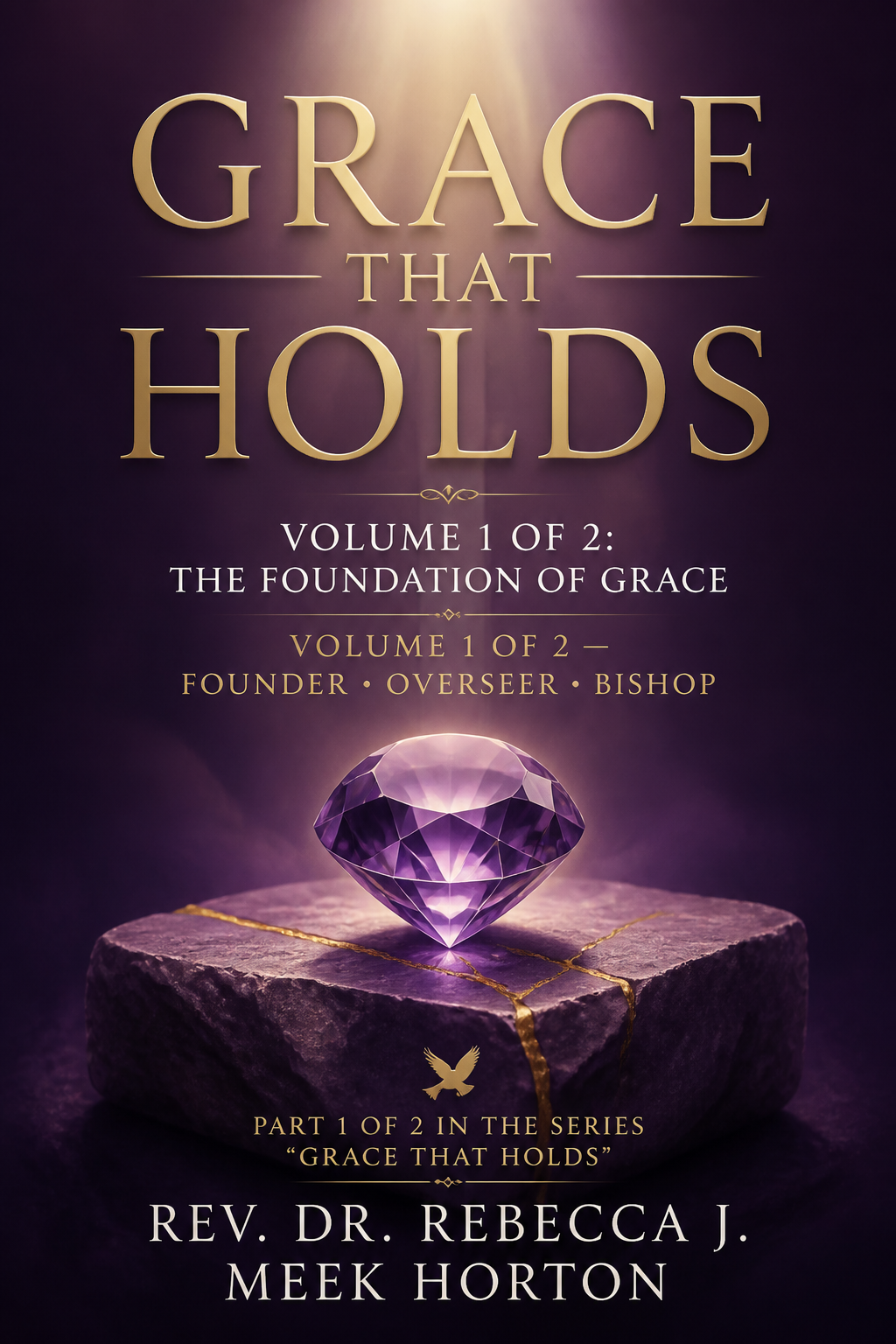
Grace That Holds · Volume 1
The Foundation of Grace
Part 1 of 2 in the series "Grace That Holds". Series theme: Grace flies through trust in GOD. Grace is our sufficiency. Grace empowers all we do in life. Series arc: This two-book series moves from foundation to formation. The first book establishes grace as God’s sufficient gift received through trust in Christ, not earned by striving or sustained by self-effort. The second book shows how that sa
Full publication
NBCNGMI MASTER KNOWLEDGE LIBRARY Featuring the works of The Sage, Apostle Prophet. Rev. Dr. Rebecca J. Meek Horton, Apostolic Prophetic Architect, NewBeing Creation Network Global Ministries, Inc. Integrated Framework Modalities™
Purpose
I wrote this book for every weary believer who needs to remember that grace is not earned by striving or held together by self-effort. Grace is God’s sufficient gift in Christ, received through trust, and strong enough to hold us in weakness (Ephesians 2:8–10; 2 Corinthians 12:9). My prayer is that these pages help you rest again in the grace that saves, steadies, and brings you near to God with confidence (Romans 5:1–2; Hebrews 4:16).
Preface
I have carried this book in my heart for weary believers.
Not weary because they do not love GOD.
Weary because they have tried to keep themselves together by strength they were never meant to supply.
Some are tired from striving. Some are tired from guilt. Some are tired from serving while empty. Some are tired from believing that grace was enough to save them, but not enough to hold them.
This book begins there.
*The Foundation of Grace* was written to return us to the ground beneath our feet: “For by grace you have been saved through faith. And this is not your own doing; it is the gift of God” (Ephesians 2:8). Grace is not an accessory to the Christian life. Grace is the gift of GOD in Christ. Grace is the place we stand. Grace is our sufficiency.
The first movement of this series, *Grace That Holds*, is foundation. Before grace sends us, grace holds us. Before we serve, endure, obey, lead, or pour out, we must learn again how to receive. Romans 5:1–2 says that through Christ “we have also obtained access by faith into this grace in which we stand.” We do not stand in our record. We do not stand in our effort. We stand in grace.
I wrote these pages because many believers know how to work for GOD, but struggle to rest in Him. We know how to repent, rebuild, and press forward, but we often forget how to come boldly to the throne of grace to “receive mercy and find grace to help in time of need” (Hebrews 4:16).
This book is not written to add weight to your shoulders. It is written to help you recognize the weight Christ already carried.
Grace does not excuse sin. Grace does not remove obedience. Grace does not make us passive. But grace does remove the lie that we must become sufficient before we come to GOD.
The Lord told Paul, “My grace is sufficient for you, for my power is made perfect in weakness” (2 Corinthians 12:9). That is where we begin.
Not with performance.
Not with pretending.
Not with self-effort dressed in spiritual language.
We begin with trust.
Grace flies through trust in GOD. And when grace holds us, we can finally stop trying to hold ourselves.
Introduction
If you are weary, this book is not asking you to try harder before you rest.
Many believers are tired, not because they do not love God, but because they have been carrying what grace was meant to hold. They have tried to earn what Christ already gave. They have tried to sustain by self-effort what can only be sustained by God’s power. They have mistaken spiritual maturity for spiritual strain.
Grace does not begin with our strength.
Grace begins with God.
“For by grace you have been saved through faith. And this is not your own doing; it is the gift of God” (Ephesians 2:8). That sentence is the foundation beneath this book. Grace is not a reward for the strong. It is not a wage for the disciplined. It is not God’s approval after we finally become acceptable. Grace is God’s sufficient gift in Christ, received through faith, and trusted in daily.
This is the first book in the *Grace That Holds* series. The series moves from foundation to formation. This book lays the ground: grace holds us before grace sends us. The next book will show how grace becomes strength for obedience, endurance, service, and daily faithfulness. But we must not rush there too quickly. If we try to build formation without foundation, we will turn obedience into striving and service into exhaustion.
Grace flies through trust in GOD.
That means grace is received by faith, not controlled by effort. Romans 5:1–2 says, “Since we have been justified by faith, we have peace with God through our Lord Jesus Christ. Through him we have also obtained access by faith into this grace in which we stand.” We do not stand in grace because we are flawless. We stand in grace because Christ is faithful.
This book will ask simple but weighty questions.
What is grace?
What is grace not?
Why do weary believers struggle to rest in what God freely gives?
How do we come boldly to the throne of grace when we feel weak, ashamed, or unfinished? (Hebrews 4:16)
And what does it mean when the Lord says, “My grace is sufficient for you, for my power is made perfect in weakness”? (2 Corinthians 12:9)
Grace is not an excuse to remain unchanged. It is not permission to live carelessly. It is not a soft word that removes responsibility. True grace saves, steadies, teaches, and transforms. Ephesians 2 does not end at verse 9. Verse 10 says we are “created in Christ Jesus for good works, which God prepared beforehand, that we should walk in them.” But the order matters. Gift comes before good works. Belonging comes before becoming. Christ holds us before He leads us forward.
Read this book slowly.
Do not read it as a project to complete. Read it as ground to stand on. Keep your Bible near. Pause over the Scriptures. Let the Word correct the places where fear, shame, pride, or exhaustion have renamed grace. Some chapters may comfort you. Some may confront you. Both are mercy when they lead you back to Christ.
You may find places where you have been striving to prove you are loved. You may notice where you have confused discipline with earning. You may recognize that your weakness is not the end of your usefulness, but the place where God’s sufficiency becomes clear.
Nothing is random. Nothing is wasted.
Even your weariness can become a doorway into deeper trust, if you bring it honestly before the Lord.
So begin here: not with your performance, but with Christ. Not with what you must carry, but with what He has already carried. Not with fear that you are not enough, but with the truth that His grace is sufficient.
Before you turn the page, take one quiet moment and pray:
Lord, teach me to receive Your grace by faith. Show me where I have been striving. Ground me again in Christ. Amen.
Chapter 1 — When Striving Cannot Hold You
The coffee had gone cold beside her Bible.
She had opened it early, before the house woke up, hoping for peace. But the page blurred. Not because the words were unclear. Because her soul was tired.
She had served. She had prayed. She had shown up. She had tried to be patient, tried to be strong, tried to be consistent, tried to be grateful. She had said yes when she was empty. She had smiled when she was breaking. She had repented for the same fear more times than she could count.
And somewhere along the way, faith began to feel less like life with God and more like a long list of things she was failing to maintain.
Maybe you know that feeling.
You love God, but you are tired.
You believe the gospel, but you are worn down by the pressure to prove that you do. You know you were saved by grace, but you have been trying to stay acceptable by effort. You would never say it that way out loud, but your body knows. Your prayers know. Your exhaustion knows.
This chapter names the problem plainly: **we were not saved by grace so we could be sustained by self-effort.**
Paul asked the Galatians a searching question: “Are you so foolish? Having begun by the Spirit, are you now being perfected by the flesh?” (Galatians 3:3, ESV).
That question is not meant to shame the weary. It is meant to wake us up.
Grace does not begin our life with God and then leave us to carry the rest alone.
## The Quiet Drift from Grace to Performance
Most believers do not wake up one morning and decide to abandon grace.
The drift is usually quieter than that.
It begins with a holy desire. We want to please God. We want to grow. We want to obey. We want our lives to bear fruit. These desires are good. Scripture calls us to walk worthy of the Lord (Colossians 1:10). Jesus calls us to abide in Him and bear fruit (John 15:4–5). Grace never produces indifference toward obedience.
But something can shift inside us.
What began as love becomes pressure.
What began as gratitude becomes fear.
What began as obedience becomes self-measurement.
We start checking our spiritual condition by how well we performed that week. Did I pray enough? Did I feel strong enough? Did I overcome quickly enough? Did I serve cheerfully enough? Did I disappoint anyone? Did I disappoint God?
These questions can sound responsible, but when fear is underneath them, they become heavy.
A believer may still be doing all the right things outwardly while inwardly living under a crushing assumption: “God is pleased with me only when I am doing well.”
That is performance wearing religious clothing.
It can happen in a church pew. It can happen in ministry leadership. It can happen in a home where no one sees the pressure except the person carrying it.
A mother may feel she must never be overwhelmed if she is truly trusting God.
A pastor may feel he must never be weak if he is truly called.
A young believer may feel she must understand everything quickly if her faith is real.
A faithful servant may feel guilty for needing rest.
The drift from grace to performance often shows up as spiritual exhaustion. Not the normal tiredness that comes after faithful labor, but the deeper weariness that comes from trying to carry what only God can carry.
Paul’s question in Galatians 3:3 presses on this very place. The Galatians had received Christ by faith, but they were being tempted to continue by human effort and religious performance. They had begun by the Spirit, but now they were acting as if maturity depended on the flesh.
The word “flesh” here does not simply mean the body. It means human effort apart from dependence on God. It is the self trying to secure what only grace can give.
That old pattern still speaks today.
It tells us, “Try harder and God will be closer.”
It tells us, “Do more and you will finally be enough.”
It tells us, “Hide your weakness until you can present a better version of yourself.”
But the gospel says something better.
“By grace you have been saved through faith. And this is not your own doing; it is the gift of God” (Ephesians 2:8).
Grace begins with God.
And what begins with God must be sustained by God.
## Self-Effort Cannot Carry the Weight of Salvation
Self-effort is not the same as obedience.
This distinction matters.
Obedience is a response to God’s grace. Self-effort is an attempt to replace it.
Obedience says, “Lord, because You have loved me, I will follow.”
Self-effort says, “Lord, if I follow well enough, maybe You will love me.”
One produces humility. The other produces fear.
One leads to dependence. The other leads to exhaustion.
The problem is not that believers care too much about holiness. The problem is that we often try to become holy by carrying ourselves instead of trusting the One who saved us.
Paul told the Philippians, “He who began a good work in you will bring it to completion at the day of Jesus Christ” (Philippians 1:6). Notice who began the work. Notice who completes it.
God does not start the work of salvation and then hand the burden of completion to our anxious strength.
A builder would never pour a foundation and then ask the house to hold itself up. The strength of the building depends on what supports it beneath. If the foundation fails, the whole structure is at risk.
Grace is the foundation beneath the believer’s life.
When we forget this, we begin building on unstable ground. We build on approval. We build on consistency. We build on comparison. We build on emotional strength. We build on ministry output. We build on how we think God must feel about us today.
But none of those can hold the weight.
Your emotions cannot hold you.
Your discipline cannot hold you.
Your usefulness cannot hold you.
Your reputation cannot hold you.
Your ability to “do better next time” cannot hold you.
Only grace can hold what grace has saved.
This does not make effort meaningless. Scripture calls us to “work out” our salvation with fear and trembling, but the next verse tells us why we can: “for it is God who works in you, both to will and to work for his good pleasure” (Philippians 2:12–13).
We work because God is at work in us.
We do not work to make Him begin.
That is a very different life.
Imagine a child learning to walk while holding a parent’s hand. The child is truly walking. The steps are real. The effort is real. But the child is not alone. The strength, safety, and steadiness come from the one holding them.
Grace does not remove our steps. Grace holds us while we learn to walk.
## Weariness Can Reveal a False Burden
Weariness is not always a sign of failure.
Sometimes it is a signal.
It may be telling us that we have been carrying a burden Christ never gave us. It may be revealing that our soul has slipped from trust into strain. It may be showing us that we are trying to maintain our standing with God instead of receiving what Christ has already secured.
Jesus spoke tenderly to burdened people: “Come to me, all who labor and are heavy laden, and I will give you rest” (Matthew 11:28).
He did not say, “Come to me after you have become light.”
He did not say, “Come to me when you can explain why you are tired.”
He said, “Come to me.”
There is mercy in that invitation.
Many weary believers are not rebellious. They are burdened. They are carrying guilt that grace would teach them to lay down. They are carrying expectations God did not assign. They are carrying the fear that if they stop striving, everything will fall apart.
But if everything depends on our striving, then grace is no longer the foundation. Self becomes the foundation. And self is too small for that weight.
This is where RE-Language™ can help us tell the truth more clearly.
Instead of saying, “I am failing as a believer,” we can say, “I may be carrying my faith in my own strength.”
Instead of saying, “God must be tired of me,” we can say, “I need to return to the grace that first received me.”
Instead of saying, “I just need to try harder,” we can say, “I need to trust more deeply and obey from that place.”
This is not excuse-making. It is honest recalibration.
Nothing is random. Nothing is wasted. Even weariness can become a place where God shows us what has been out of order.
A man may discover that his constant need to serve is tied to fear of being unseen.
A woman may discover that her harsh self-talk is not conviction but condemnation.
A young leader may discover that his drive is not faithfulness but anxiety dressed as excellence.
A tired saint may discover that the Lord is not asking for more noise, more speed, or more proving. He is inviting them back to dependence.
The Spirit’s conviction leads us toward Christ. Condemnation drives us away from Him.
“There is therefore now no condemnation for those who are in Christ Jesus” (Romans 8:1).
This does not mean there is no correction. God corrects His children. But His correction is not rejection. His discipline is not abandonment. His voice does not crush the bruised reed (Isaiah 42:3).
Grace tells the truth without destroying the person.
## Beginning Again Where You Began
The way forward is not to despise effort. It is to restore order.
Grace first. Trust first. Dependence first.
Then obedience.
Then service.
Then endurance.
The Galatians did not need a new spiritual trick. They needed to return to the truth they had already received. They began by the Spirit. They needed to continue by the Spirit.
So do we.
This is the first movement of the book because weary believers often need permission to stop pretending they are stronger than they are. Not permission to quit following Jesus. Permission to stop trying to be their own source.
Grace is not fragile. It does not disappear when you are weak. It does not evaporate when you are tired. It does not stand at a distance until you improve.
The grace of God in Christ is not a doorway you passed through long ago and left behind. It is the ground beneath your feet now.
You may need to begin again where you began.
Not by earning.
Not by proving.
Not by performing.
By trusting.
Trust says, “Lord, I cannot hold myself together, but You can hold me.”
Trust says, “Lord, I will obey, but I will not make my obedience my Savior.”
Trust says, “Lord, I bring You the truth of where I am, not the image I wish I had.”
This will feel costly.
It may cost you the illusion of control. It may cost you the pride of being seen as always strong. It may cost you the habit of measuring your worth by your output. It may require you to admit that some of your spiritual activity has been driven by fear, not freedom.
That is not easy.
But it is mercy.
Grace does not humiliate us. It humbles us. Humiliation says, “You are nothing.” Humility says, “You are not God, and you were never meant to be.”
There is rest in that truth.
You are not the foundation.
Christ is.
And because Christ is the foundation, your life with God can be rebuilt from a steadier place.
## Key Takeaways
- You were not saved by grace to be sustained by self-effort.
- Weariness may reveal a burden Christ never asked you to carry.
- Grace restores the order: trust first, then obedience.
## Practice
Take ten quiet minutes today and write one honest sentence to God:
“Lord, I have been trying to carry __________ in my own strength.”
Do not fix it yet. Do not explain it away. Bring it into the light.
Then pray Galatians 3:3 slowly and ask the Lord to return you to dependence on the grace that first received you.
Chapter 2 — Grace Begins with God’s Gift
The envelope sat on the kitchen table for three days.
She knew what was inside. A friend had quietly left it after church with a note that said, “This is for the bill. Please don’t argue. Just receive it.”
But receiving felt harder than needing.
She kept walking past it, picking it up, putting it down, rehearsing reasons she should pay it back, explain herself, or prove she was not the kind of person who needed help. The gift was already given. The debt was already covered. But pride and shame both had hands on the envelope.
Many believers live with grace that way.
We say we believe God gives grace. We sing about it. We teach it to children. We quote it in hard seasons. Yet somewhere deep inside, we keep trying to prove we were worth saving, worth helping, worth keeping.
This chapter’s central truth is simple: grace begins with God’s gift, not our effort. We are saved by grace through faith in Christ, not by works; and the good works that follow are the fruit of grace, not the foundation of it.
Paul says it plainly:
> “For by grace you have been saved through faith. And this is not your own doing; it is the gift of God, not a result of works, so that no one may boast. For we are his workmanship, created in Christ Jesus for good works, which God prepared beforehand, that we should walk in them.” > — Ephesians 2:8–10
Grace does not begin with your grip on God.
Grace begins with God’s mercy reaching for you.
## Grace Saves Before We Can Prove Anything
Ephesians 2 does not begin with human strength. It begins with human need.
Paul says we were “dead in the trespasses and sins” in which we once walked (Ephesians 2:1–2). Dead people do not repair themselves. Dead people do not climb upward. Dead people do not negotiate their recovery.
Then Paul gives the turning point:
> “But God, being rich in mercy, because of the great love with which he loved us…” > — Ephesians 2:4
Those two words, “But God,” carry the weight of grace.
We were not rescued because we were impressive. We were not rescued because we were almost righteous. We were not rescued because God saw future usefulness and decided we were a good investment.
We were rescued because God is rich in mercy.
That matters for weary believers. When faith becomes performance, we start believing God’s nearness rises and falls with our spiritual report card. If we prayed well, served well, resisted temptation well, and kept our emotions under control, we feel welcome. If we failed, grew tired, got angry, or drifted, we feel disqualified.
But grace does not begin with your strongest day.
Grace begins with God’s mercy in Christ.
Imagine a child learning to walk. The child stumbles, falls, cries, reaches upward. A good father does not say, “Come back when you can walk perfectly.” He bends down. He lifts. He steadies. The father’s help is not a reward for balance. It is the very reason the child can learn to stand.
So it is with God’s grace.
We do not come to Christ with spiritual balance already mastered. We come because we cannot save ourselves. We come because sin is not a small stain we can polish out. We come because only Christ can make us alive.
Ephesians 2:5 says God “made us alive together with Christ.” Then Paul adds, “by grace you have been saved.”
Grace is not decoration added to human effort.
Grace is resurrection mercy.
## Grace Is a Gift, Not a Wage
Paul is careful with his words.
He says salvation is “not your own doing; it is the gift of God” (Ephesians 2:8). Then he says it is “not a result of works, so that no one may boast” (Ephesians 2:9).
A wage is earned.
A gift is received.
A wage says, “You did enough.”
A gift says, “This came from the giver’s heart.”
This distinction is not small. If salvation were a wage, then assurance would always be unstable. We would spend our lives wondering if we had done enough, repented enough, believed strongly enough, served faithfully enough, suffered patiently enough.
That kind of religion produces either pride or despair.
Pride says, “I am doing better than others.”
Despair says, “I will never do enough.”
Grace silences both.
No one can boast at the foot of the cross. The strong are not saved differently than the weak. The disciplined are not saved by a better category of mercy. The lifelong church member and the broken sinner crying out for help both come through Christ alone.
Romans 3:23–24 says:
> “For all have sinned and fall short of the glory of God, and are justified by his grace as a gift, through the redemption that is in Christ Jesus.”
Justified by His grace as a gift.
Not rented.
Not borrowed.
Not temporarily extended until you fail again.
Given.
Think of the difference between buying a coat and being wrapped in one. If you buy it, you measure cost, count money, and decide whether you can afford it. If someone wraps it around your shoulders in the cold, your first responsibility is not payment. It is receiving.
Grace wraps the sinner in what Christ has provided.
This does not make grace cheap. It makes it costly in the right direction. Grace is free to us because it was costly to Christ. We do not pay for it with works because Jesus paid for it with His life.
> “In him we have redemption through his blood, the forgiveness of our trespasses, according to the riches of his grace.” > — Ephesians 1:7
The riches of grace do not come from the poverty of our striving.
They come through the blood of Christ.
## Grace Humbles Us Without Crushing Us
Grace humbles us because it tells the truth.
It says, “You could not save yourself.”
But grace does not crush us, because it also says, “God wanted you enough to save you.”
This is one of the tender strengths of the gospel. Grace removes boasting without removing dignity. It strips away pride without leaving shame in its place.
Many people fear humility because they think it means humiliation. But biblical humility is not self-hatred. It is honest placement before God.
We are not the source.
We are not the Savior.
We are not the foundation.
Christ is.
That truth is a relief.
The weary believer does not need another burden of spiritual self-production. You do not need to manufacture worth. You do not need to keep proving that God made a wise choice when He saved you. You do not need to perform gratitude until exhaustion becomes your offering.
Grace teaches us to say, “I am loved because God is merciful, not because I am impressive.”
A man once described his Christian life like this: “I know Jesus saved me, but I feel like the rest is up to me.”
Many of us understand that sentence.
We receive salvation as a gift, then quietly return to striving as a lifestyle. We begin by grace, then try to continue by pressure. We know better in doctrine, but our nervous system still lives under threat. We feel guilty resting. We feel anxious when we are weak. We feel suspicious of peace.
Paul asked the Galatians a piercing question:
> “Are you so foolish? Having begun by the Spirit, are you now being perfected by the flesh?” > — Galatians 3:3
That question belongs near the foundation of this book.
The Christian life does not begin with grace and then graduate into self-sufficiency. Grace is not the entry door only. Grace is the ground beneath the whole house.
Nothing is random. Nothing is wasted. Even the moment when you realize how much you have been striving can become an invitation to return to the gift.
Not to return to carelessness.
Not to return to passivity.
But to return to the truth: God’s grace is sufficient, and Christ remains the foundation.
## Grace Prepares Us for Good Works
Ephesians 2:10 is important because it keeps us from misunderstanding grace.
After Paul says we are not saved by works, he says we are “created in Christ Jesus for good works.”
Works are not the root of salvation.
Works are the fruit of salvation.
This order matters.
If we put works before grace, we become performers trying to earn life. If we remove works from grace, we become hearers who never learn to walk. But when we receive the order Scripture gives, we find freedom: grace saves us, then grace begins shaping a life that can bear witness to God.
Paul calls believers “his workmanship” (Ephesians 2:10). The word carries the sense of something made, crafted, formed. We are not self-made saints. We are God’s workmanship in Christ.
That means your life in Christ is not a frantic attempt to build yourself from scratch. God is forming what He has saved.
A carpenter does not call a pile of wood a finished table. But neither does he despise the wood because it is not finished yet. He sees what he is making. He works with patience, skill, and purpose.
In Christ, God is not merely forgiving you and leaving you untouched. He is making you new. He is preparing you to walk in what He has prepared.
Notice the word “walk.” Paul does not say we were created in Christ Jesus for good works so we could panic in them, boast in them, or build our identity on them. He says “that we should walk in them.”
Walking is steady. Human. Daily.
This chapter is not asking you to abandon obedience. It is asking you to put obedience in the right place.
Grace is the foundation.
Good works are the pathway.
When works become the foundation, the soul grows tired. When grace is the foundation, works become response.
A mother caring for her family, a pastor preaching with trembling faith, a student choosing honesty, a worker serving with integrity, a weary believer praying again after a dry season—all of these can become good works prepared by God. But none of them can carry the weight of being your savior.
Only Christ can carry that.
## The Cost of Receiving Grace
Receiving grace sounds easy until it confronts what we have trusted.
Grace asks us to lay down boasting. That can be painful if we have built our identity on being dependable, disciplined, useful, or spiritually strong.
Grace also asks us to lay down shame. That can be painful if we have used self-condemnation as a way to feel in control. Sometimes we would rather punish ourselves than receive mercy, because punishment feels like payment.
But grace will not let us pay.
It calls us to confess the truth: we need what only God can give.
This is the tension. Grace is free, but receiving it costs our illusion of control. It costs the pride that wants credit. It costs the fear that says we must keep earning our place. It costs the hidden agreement that exhaustion proves devotion.
For the weary believer, this may feel unfamiliar.
You may know how to work for approval.
You may know how to apologize for existing.
You may know how to serve while empty.
But grace invites you to receive before you produce.
That does not make you irresponsible. It makes you rooted.
Stewardship before increase. Foundation before formation. Grace holds us before grace sends us.
## Key Takeaways
- Grace begins with God’s mercy, not our effort. - Salvation is a gift received in Christ, not a wage earned by works. - Good works flow from grace; they do not replace grace as the foundation.
## Practice
Read Ephesians 2:8–10 slowly today.
Then write one sentence and pray it honestly:
“Father, I receive Your grace in Christ as a gift, not a wage, and I will not make my works the foundation You never asked them to be.”
After that, name one good work before you today—a call, an apology, a task, a quiet act of faithfulness—and do it as a response to grace, not an attempt to earn it.
Chapter 3 — The Doorway of Trust
You can stand outside an unlocked door for a long time.
You can read the sign. You can admire the house. You can believe there is bread on the table, warmth in the room, and a chair with your name on it. You can even tell other people the door is open.
But standing near the door is not the same as entering.
Many believers live near grace. We know the words. We sing the songs. We can explain that grace is God’s gift. Yet when the soul is tired, when guilt rises, when prayer feels thin, we often stand outside again. We do not walk in with trust. We wait until we feel worthy. We wait until we have done better. We wait until our emotions agree.
Romans 5:1–2 gives us a steadier way:
“Therefore, since we have been justified by faith, we have peace with God through our Lord Jesus Christ. Through him we have also obtained access by faith into this grace in which we stand, and we rejoice in hope of the glory of God.”
The controlling idea of this chapter is simple: trust is the doorway through which we receive and rest in grace.
Grace comes from God. Christ opens the way. Faith receives access. Trust is not how we earn grace. Trust is how we stop refusing it.
## Peace Comes Before Performance
Paul begins Romans 5 with a settled word: “Therefore.”
He is gathering what he has already taught. We are justified by faith, not by works of the law. We are made right with God through Christ. The result is not anxiety. The result is peace.
“Since we have been justified by faith, we have peace with God through our Lord Jesus Christ” (Romans 5:1).
This peace is not first a feeling. It is a new standing.
A weary believer may say, “I do not feel peace.” That may be honest. Feelings matter, but they are not the foundation. Paul is speaking of peace with God before he speaks of peace within us. The war is over because Christ has reconciled us to God.
This matters because many of us keep trying to perform our way into a peace Christ has already provided.
We think:
If I pray enough, then God will be near. If I obey perfectly, then God will accept me. If I feel spiritual, then I can come close. If I have not failed this week, then I can rest.
But Romans 5 does not say, “Since we have improved ourselves, we have peace with God.”
It says, “Since we have been justified by faith.”
A child who has broken a dish may hide in the hallway, afraid to enter the kitchen. The parent may already be ready to forgive, clean, and teach. But fear keeps the child away. The issue is no longer whether the room is open. The issue is whether the child trusts the heart of the one waiting.
Many believers live in that hallway.
We are not rejecting doctrine. We are struggling to trust what God has said is true in Christ.
The gospel tells us that peace with God is not the wage paid to the impressive. It is the fruit of being justified through Jesus Christ. We do not begin with performance. We begin with peace.
This does not make obedience small. It puts obedience in the right order.
Peace comes first. Then growth has room to breathe.
## Access Is Given Through Christ
Paul continues: “Through him we have also obtained access by faith into this grace in which we stand” (Romans 5:2).
That word “access” is tender and strong.
It means we are not left outside, trying to make ourselves presentable. Through Christ, we are brought near. We are given entrance into grace.
This access is not vague optimism. It is not positive thinking. It is not pretending life is easy. It is access “through him.” Through Jesus.
Christ is the doorway. Faith is the receiving. Grace is the place where we stand.
Imagine being invited into a room you could never enter on your own. Not because you are hated, but because you do not have the right standing to walk in by yourself. Then someone with full authority comes to the door, calls your name, and brings you inside.
That is not arrogance. That is access.
Hebrews says something similar: “We have confidence to enter the holy places by the blood of Jesus” (Hebrews 10:19). Not by our record. Not by our intensity. Not by our religious résumé. By His blood.
Trust honors the sufficiency of Christ.
Self-effort often looks humble, but it can quietly refuse the gift. It says, “I know Jesus opened the way, but I still need to prove I belong here.”
Faith says, “Because of Christ, I may come.”
This is where grace begins to steady the soul. If my access depends on my emotional condition, I will move in and out all day long. If my access depends on my recent performance, I will only come near when I think I have done well. If my access depends on Christ, then I may come honestly, even when I am weak, dull, ashamed, tired, or afraid.
This is not carelessness. It is confidence in the right foundation.
Ephesians 3:12 says, “In whom we have boldness and access with confidence through our faith in him.”
The believer does not barge into God’s presence as if grace were cheap. The believer comes because Christ is worthy, and the Father has opened the way through Him.
Trust is not loud. It may tremble. It may whisper. It may come with tears.
But it comes.
## Grace Is Where We Stand
Paul does not only say we have access into grace. He says we have access “into this grace in which we stand” (Romans 5:2).
That phrase is important.
Grace is not only the doorway behind us. Grace is the ground beneath us.
We do not step into grace for a moment and then move on to self-sufficiency. We stand in grace. We remain there. We live there.
This is where many weary believers need RE-Calibration™. We may have trusted God for salvation, but then we try to stand by strain. We begin in dependence and continue in pressure. We receive grace at the altar and then attempt to carry the Christian life by our own strength.
But Paul says grace is where we stand.
Standing is not rushing. Standing is not striving. Standing is not collapsing. Standing is remaining in the place God has provided.
A person standing on solid ground does not need to create the ground. They need to trust it will hold.
That is hard for those who have learned to survive by control.
Some of us do not know how to stand in grace because we are used to earning our place in every room. We learned to explain ourselves quickly. We learned to anticipate rejection. We learned to measure love by usefulness. So when God gives grace freely through Christ, our hearts may not know what to do with it.
We keep looking for the invoice.
But grace is not a transaction we finish paying later. Grace is God’s sufficient provision in Christ. It holds us while God forms us.
Jesus said, “Abide in me, and I in you” (John 15:4). Abiding is a trusting word. It means remain. Stay. Do not keep leaving the place of life to prove you deserve the life you have been given.
Trust says, “I will stand where God has placed me.”
Not because I feel strong.
Not because I understand everything.
Not because my obedience is complete.
But because Christ is sufficient, and God is faithful.
Nothing is random. Nothing is wasted. Even the moments when we notice our striving can become invitations to return to trust.
## Trust Rests Without Letting Go of Truth
Trust is often misunderstood.
Some think trust means we stop thinking. Scripture does not teach that. Romans 12:2 calls us to be transformed by the renewal of our minds. Trust does not shut the mind down. Trust brings the mind under the truth of God.
Some think trust means we stop feeling. It does not. The Psalms are full of honest feeling. David could say, “When I am afraid, I put my trust in you” (Psalm 56:3). Notice he does not say, “When I am no longer afraid.” He trusts while afraid.
Some think trust means we stop obeying. It does not. Faith works through love (Galatians 5:6). Trust is the root system of obedience, not the enemy of obedience.
Trust rests without letting go of truth.
A weary believer may need to say, “Lord, I am anxious, but Your Word says I have peace with You through Jesus Christ.”
Or, “Lord, I feel far away, but Your Word says I have access by faith.”
Or, “Lord, I feel unstable, but Your Word says I stand in grace.”
This is not denial. This is stewardship of the soul.
We do not pretend the struggle is absent. We place the struggle under the greater truth.
That is part of Walking in Obedience™. WISDOM is not yours until YOU WALK IT. Trust becomes real as we practice it in the places where self-effort usually takes over.
A simple example may help.
A believer wakes up heavy. Before the day begins, the accusations begin too: You are behind. You are not enough. God is disappointed. You need to fix yourself before you pray.
The old pattern says, “Work harder until you feel acceptable.”
Trust says, “Because of Christ, I will come now.”
So the believer sits at the edge of the bed and prays one honest sentence: “Father, I come through Jesus. Help me stand in grace today.”
That may not feel dramatic. But it is faith.
It is a hand on the doorway.
It is a step into the room.
## The Cost of Trust
Trust sounds gentle, but it asks something of us.
It asks us to release the illusion of control.
Self-effort can feel safer because it keeps us at the center. If I can earn it, manage it, prove it, and maintain it, then I never have to be needy. I never have to receive. I never have to admit that I cannot hold myself together.
Grace confronts that pride gently but firmly.
To trust God is to confess, “I am not my own foundation.”
That can feel like loss before it feels like rest.
Trust also asks us to stop using shame as a motivator. Some of us are afraid that if we stop condemning ourselves, we will stop growing. But shame is a cruel teacher. It may produce movement, but it does not produce lasting maturity.
The kindness of God leads us to repentance (Romans 2:4). Grace does not make sin safe. Grace makes return possible.
Trust may also require patience. We may want grace to feel immediately comforting, but learning to stand in grace can take time. Old patterns do not always fall away in one moment. Sometimes we must return again and again.
Not because grace is weak.
Because trust is being formed.
This is the honest tension: we say we believe grace is enough, but we often reach for something we can measure. We count our effort. We count our failures. We count our consistency. God invites us to count Christ faithful.
That is the doorway.
Not striving harder.
Not hiding longer.
Not waiting until we feel worthy.
Trust.
“Through him we have also obtained access by faith into this grace in which we stand” (Romans 5:2).
## Key Takeaways
- Trust receives what grace gives. - Christ gives us access to God. - Grace is the ground where we stand.
## Practice
Today, take five quiet minutes with Romans 5:1–2.
Read it slowly three times.
Then write one sentence beginning with: “Because I have access by faith, today I will stop trying to earn _________.”
Name one specific place where you have been striving for what Christ has already opened.
Pray simply:
“Father, through Jesus Christ, teach me to stand in the grace You have given. Help me trust You in this one place today. Amen.”