 NBCNGMI™
Master Knowledge Library™
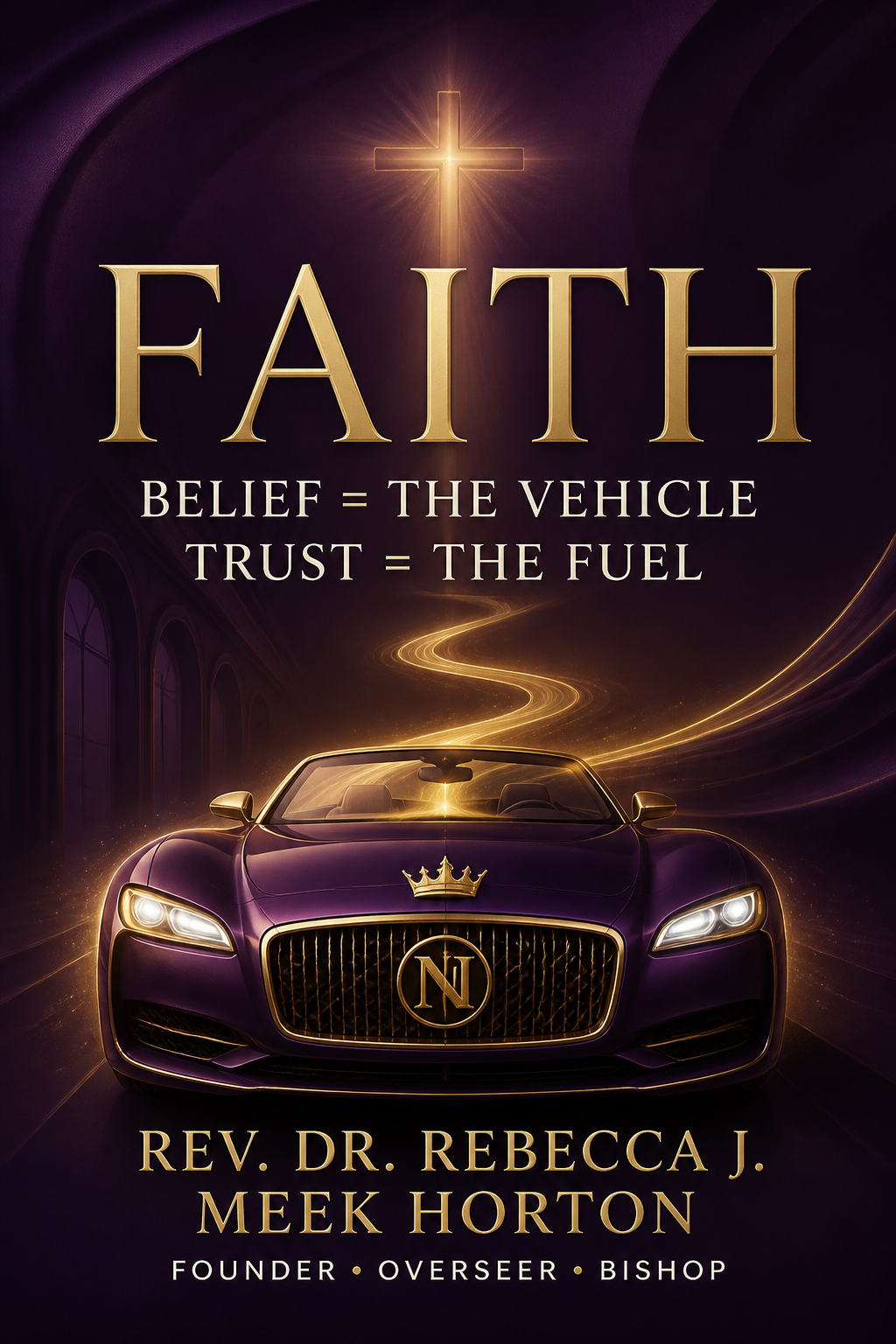
Faith: Belief = The Vehicle- Trust = The Fuel
I believe this should become one of the signature theological statements in the book because it also integrates seamlessly with your earlier work, The Architecture of Grace, where you described: * Belief as the “hardware”—the settled conviction that God is who He says He is. * Trust as the “software”—the living reliance that allows faith to operate daily. Those two concepts complement this chapt
Full publication
NBCNGMI MASTER KNOWLEDGE LIBRARY Featuring the works of The Sage, Apostle Prophet. Rev. Dr. Rebecca J. Meek Horton, Apostolic Prophetic Architect, NewBeing Creation Network Global Ministries, Inc. Integrated Framework Modalities™
Purpose
I wrote this book to help make faith plain: belief is the vehicle that receives God’s truth, and trust is the fuel that keeps us moving with Him. My hope is that you will not only know what God has said, but learn to rely on His faithfulness in daily life, because “the righteous shall live by faith” (Romans 1:17). As you read, take the next honest step God gives you.
Preface
I wrote this book because I have seen many sincere believers carry a quiet frustration: *I believe God, but I do not know how to trust Him here.*
That sentence matters.
For years, I have watched people love the Lord, honor Scripture, pray earnestly, and still struggle to bring their belief into the daily places where fear, waiting, disappointment, and uncertainty live. They are not pretending. They are not careless. Many are simply trying to understand how faith works when life does not move quickly, when answers are delayed, and when obedience costs something.
This book was born from that holy tension.
In my earlier work, *The Architecture of Grace*, I described belief as the “hardware”—the settled conviction that God is who He says He is. I described trust as the “software”—the living reliance that allows faith to operate in real time. That picture stayed with me because it helped give language to something many of us experience but do not always know how to name.
Belief is the vehicle. Trust is the fuel.
Belief says, “God is true.” Trust says, “I will lean on Him today.”
Belief receives the truth of God. Trust rests in the faithfulness of God. Belief anchors the mind. Trust steadies the heart and moves the feet. Together, they form a living faith—not merely something we claim, but something we walk.
Scripture does not invite us into vague optimism. It calls us to a grounded confidence in the living God. “Without faith it is impossible to please Him” (Hebrews 11:6). Yet that faith is not passive. “Trust in the Lord with all your heart, and do not lean on your own understanding” (Proverbs 3:5). Abraham believed God, and his belief was counted as righteousness (Genesis 15:6; Romans 4:3). But that belief also had to walk, wait, surrender, and obey.
That is where many of us are being formed.
My hope is that this book will help you slow down, examine what you believe, and learn how to entrust more of your life to the God you confess. Not perfectly. Not theatrically. But honestly, steadily, and with grace.
As you read, bring your real questions. Bring the places where belief feels clear but trust feels costly. Then take the next faithful step before you. Faith grows as it is practiced. Trust deepens as it is lived.
Introduction
Faith is often spoken of as if it were only a belief to hold. Trust is often treated as if it were only a feeling to summon. But Scripture gives us something richer, stronger, and more livable.
Faith is not bare agreement. Trust is not blind optimism. Together, they form a life of covenant dependence on God.
This book is built around a simple image:
**Belief is the vehicle. Trust is the fuel.**
Belief gives faith its form. It receives what God has revealed. It says, “God is who He says He is. God has done what He says He has done. God will keep what He has promised.” Without belief, faith has no biblical shape. As Hebrews says, “whoever would draw near to God must believe that he exists and that he rewards those who seek him” (Hebrews 11:6).
But trust is what moves belief into lived reliance. Trust takes the truth we confess and places the weight of life upon God’s character. It prays when the answer has not come. It obeys when the path is costly. It waits when the promise feels delayed. “Trust in the LORD with all your heart, and do not lean on your own understanding” (Proverbs 3:5).
Belief may say, “God is faithful.” Trust says, “Because God is faithful, I will take the next step.”
This distinction is helpful, but it must be handled carefully. In Scripture, faith and trust are deeply joined. They are not enemies, and they are not truly separate lives. Biblical faith includes trust, reliance, allegiance, and obedience. Still, many people know the ache of believing true things about God while struggling to entrust their fear, future, grief, money, calling, or relationships to Him. This book is written for that honest place.
You may believe God can provide, yet still panic over provision. You may believe God forgives, yet still live under shame. You may believe God leads, yet still resist surrender. You may believe Christ is Lord, yet still guard certain rooms of your life.
That tension is not named to condemn you. It is named so grace can meet you truthfully.
In earlier language, we might say belief is like the hardware—the settled conviction that God is who He says He is. Trust is like the software—the living reliance that allows faith to operate in the ordinary pressures of daily life. Hardware without working software sits unused. Software without sound hardware has no stable place to run. In the same way, belief without trust remains incomplete, and trust without truth loses its foundation.
So this book will return often to one guiding conviction:
**Faith apprehends God’s truth; trust appropriates God’s faithfulness. Together they become the living conduit through which grace is received, experienced, and expressed.**
This is not a call to manufacture more spiritual energy. It is an invitation to bring your whole self—mind, heart, will, body, history, questions, and wounds—before the God who is already faithful. Faith does not begin with our strength. It begins with God’s revelation. “So faith comes from hearing, and hearing through the word of Christ” (Romans 10:17). Trust grows as we learn to walk with the One we have heard.
Read this book slowly. Do not rush to master the language. Let the language search you. When a sentence exposes fear, pause. When a Scripture steadies you, stay with it. When a question unsettles you, do not hurry past it. God often builds deep trust through honest wrestling, not quick slogans.
Each chapter is meant to help you see, name, and practice the difference between confessing truth and relying on the God of that truth. Some pages will clarify doctrine. Some will invite repentance. Some will comfort. Some will challenge. All of it is aimed at maturity—not dependency on a book, a system, or a voice, but deeper dependence on God Himself.
Begin here: ask the Lord to show you one area where your belief is present but your trust is not yet active. Name it plainly. Then pray, “Lord, I believe; help my unbelief” (Mark 9:24), and take the next faithful step with Him.
Chapter 1 — 1. Faith Begins with God
Faith does not begin with us reaching into the dark and hoping something is there.
Faith begins because God has spoken.
That one sentence changes the whole journey. If faith begins with us, then faith rises and falls with our mood, our discipline, our confidence, our pain, our questions, and our ability to hold everything together. But if faith begins with God, then faith rests on something far stronger than human emotion. It rests on His self-revelation.
God is not hiding behind the universe waiting for the most spiritual people to find Him. He has made Himself known. He has spoken through creation. He has spoken through the prophets. He has spoken finally and fully through His Son. He speaks through His Word by the power of His Spirit.
So faith is not a religious guess. It is not positive thinking with Bible language wrapped around it. It is not pretending we are certain when we are afraid. True faith is a response to the God who reveals Himself.
Hebrews says it plainly:
> “And without faith it is impossible to please him, for whoever would draw near to God must believe that he exists and that he rewards those who seek him.” > — Hebrews 11:6
And Paul gives us the pathway:
> “So faith comes from hearing, and hearing through the word of Christ.” > — Romans 10:17
Faith begins where God’s Word is heard and received.
Not merely heard as sound.
Not merely read as information.
Received.
Welcomed.
Taken seriously.
Allowed to become the ground beneath our feet.
## Faith Is Not Human Optimism
Many people confuse faith with optimism.
Optimism says, “Things will probably get better.”
Faith says, “God is faithful, whether the road gets easier or harder.”
Optimism depends on favorable outcomes. Faith depends on the character of God.
There is nothing wrong with hopefulness. It is a mercy to be able to look ahead and believe that tomorrow may hold good. But biblical faith is deeper than a bright outlook. It does not require us to deny grief, ignore danger, or force a smile when the soul is trembling.
Faith can weep.
Faith can wait.
Faith can ask questions.
Faith can say, “I do not understand,” and still turn toward God.
The Scriptures do not present faith as emotional cheerfulness. Abraham had to leave what was familiar. Moses had to confront Pharaoh. Hannah prayed out of deep anguish. David cried from caves and battlefields. Mary received a word from God that would change her life and cost her reputation. Paul followed Christ through prison, beatings, and weakness.
None of this was mere optimism.
Faith is not confidence that life will always go the way we want. Faith is confidence that God is who He says He is, and that His Word is true, even when life does not go the way we expected.
This matters because shallow definitions of faith cannot carry us through deep suffering. If we think faith means “I should always feel strong,” then weakness will feel like failure. If we think faith means “God will always remove the hard thing quickly,” then waiting will feel like abandonment. If we think faith means “I must never have questions,” then honest struggle will feel like rebellion.
But faith begins with God, not with our emotional condition.
The question is not, “Can I produce enough spiritual energy today?”
The better question is, “What has God said, and will I receive it?”
## God Makes the First Move
From the first pages of Scripture, God is the One who speaks first.
“Let there be light” (Genesis 1:3).
“Where are you?” (Genesis 3:9).
“Go from your country…” (Genesis 12:1).
“I have surely seen the affliction of my people…” (Exodus 3:7).
Again and again, God initiates. He calls. He reveals. He promises. He corrects. He comforts. He commands. He covenants.
Human faith is never the starting point. God’s revelation is.
We do not create God by believing in Him. We do not make His promises true by having enough confidence. We do not bring His kingdom into being by spiritual effort. God is already God. His Word is already true. His grace is already active. Faith is the open hand that receives what God has made known.
This protects us from pride.
If faith began with us, we could boast in the strength of our believing. We could divide people into the strong and the weak, the successful and the struggling, the ones who “have enough faith” and the ones who do not. But Scripture will not let us make faith into a trophy.
Paul writes:
> “For by grace you have been saved through faith. And this is not your own doing; it is the gift of God.” > — Ephesians 2:8
Faith receives grace. It does not manufacture grace.
This also protects us from despair.
If faith depended entirely on our ability to hold tightly to God, then every season of weakness would threaten our standing. But the gospel tells a better story. Before we ever reached for God, God came near to us in Christ.
Jesus is not the reward for impressive faith. He is the foundation of faith.
He is the Word made flesh (John 1:14). He is the image of the invisible God (Colossians 1:15). He is the radiance of God’s glory and the exact imprint of His nature (Hebrews 1:3).
So when we say faith begins with God, we are not speaking in vague spiritual terms. Faith begins because God has revealed Himself in Jesus Christ.
## Faith Comes by Hearing
Romans 10:17 is one of the clearest statements in Scripture about how faith is awakened:
> “So faith comes from hearing, and hearing through the word of Christ.” > — Romans 10:17
Paul is not describing faith as self-generated confidence. He is describing faith as a response to a message.
The gospel is announced.
Christ is proclaimed.
The Word is heard.
Faith comes.
This is humbling because it means we are dependent on revelation. We need God to speak. We need the Word of Christ. We need truth that comes from outside our own thoughts.
Our hearts are not neutral. They can be sincere and still be mistaken. They can desire spiritual things and still resist God. They can confuse comfort with truth, emotion with obedience, and personal preference with divine guidance.
That is why faith must be formed by the Word of God.
Romans 10 is especially concerned with the message of Christ: His lordship, His resurrection, His saving work, and the call to confess and believe. Paul writes:
> “If you confess with your mouth that Jesus is Lord and believe in your heart that God raised him from the dead, you will be saved.” > — Romans 10:9
Faith begins by hearing the good news of Jesus.
Not hearing that we should try harder to be acceptable.
Not hearing that we should become more religious to earn God’s attention.
Not hearing that our moral improvement is the center of the Christian life.
We hear Christ.
Crucified for sinners.
Raised in victory.
Exalted as Lord.
Near to all who call on Him.
The Word of Christ creates the ground on which faith stands.
This is why Scripture must remain central in the life of faith. Not as a decoration. Not as a quote collection. Not as a tool for winning arguments. Scripture is the living witness through which God reveals Himself, corrects us, nourishes us, and calls us forward.
Faith comes by hearing.
So the posture of faith begins with listening.
## Hearing Is More Than Sound
There is a kind of hearing that leaves us unchanged.
We can hear a sermon and only evaluate the preacher.
We can read a passage and only look for something familiar.
We can quote Scripture and still avoid its searching light.
We can keep the Bible near us but not let it speak over us.
Jesus often said, “He who has ears to hear, let him hear” (Matthew 11:15). He was not talking about physical hearing alone. He was calling for receptive hearing. Humble hearing. Obedient hearing.
In the parable of the sower, Jesus described different ways people receive the word (Mark 4:1–20). Some hear, but the word is quickly taken away. Some receive it with joy, but have no root. Some hear, but the cares of the world and the deceitfulness of riches choke the word. Others hear and bear fruit.
The difference is not that the seed changes.
The condition of the soil matters.
This is worth pondering honestly. We can be exposed to Scripture without being yielded to God. We can admire biblical truth without letting it govern our lives. We can agree with sound doctrine and still resist the Lord’s correction.
Faith begins when God’s Word is not merely noticed, but received.
Received means we allow God to tell the truth.
About Himself.
About us.
About sin.
About grace.
About judgment.
About mercy.
About the world.
About what matters.
This kind of hearing requires humility. It means we come to Scripture not merely asking, “Do I like this?” but “Lord, what are You saying?” It means we are willing to be comforted and confronted. It means we stop using the Word only to confirm what we already think, and begin letting it shape what we think.
James gives a sober instruction:
> “But be doers of the word, and not hearers only, deceiving yourselves.” > — James 1:22
Hearing that does not move toward obedience becomes self-deception. Not because obedience earns God’s love, but because true hearing opens the heart to God’s rule.
Faith begins with hearing, but biblical hearing always invites response.
## Faith Requires That We Come to God as He Is
Hebrews 11:6 says:
> “And without faith it is impossible to please him, for whoever would draw near to God must believe that he exists and that he rewards those who seek him.”
This verse is simple, but it is not shallow.
“Whoever would draw near to God must believe that he exists.”
Faith begins by receiving the reality of God. Not the idea of God as we would prefer Him to be. Not a distant force. Not a projection of our values. Not a spiritual symbol. The living God.
The God who creates.
The God who speaks.
The God who judges rightly.
The God who makes covenant.
The God who shows mercy.
The God and Father of our Lord Jesus Christ.
To draw near to God, we must come to Him as He has revealed Himself, not as we have imagined Him.
This is where many people stumble. We may want a God who affirms everything we desire, but the true God loves us too much to be ruled by our desires. We may want a God who explains everything immediately, but the true God calls us to walk with Him even when we see only part of the road. We may want a God who gives blessings without surrender, comfort without correction, salvation without lordship.
But faith does not reshape God into our image.
Faith receives God as He is.
Hebrews also says we must believe “that he rewards those who seek him.”
This does not mean God can be manipulated by religious activity. It does not mean if we perform the right actions, God owes us the life we planned. The reward is not always immediate relief, visible success, or earthly comfort.
The deepest reward of seeking God is God Himself.
His presence.
His mercy.
His wisdom.
His keeping grace.
His eternal promise.
Those who seek Him are not wasting their lives. Those who draw near to Him are not ignored. Those who call upon Him in truth are not abandoned.
Faith believes God is real, and that He is not indifferent to those who seek Him.
## Religious Effort Cannot Replace Faith
Because faith begins with God’s revelation, it cannot be reduced to religious effort.
This is important. Many people live exhausted spiritual lives because they are trying to produce by effort what can only be received by faith.
They attend. They serve. They give. They perform. They compare. They try to keep up appearances. But underneath all the activity, they are not resting in the God who has spoken. Their spiritual life becomes a long attempt to prove they are acceptable.
Religious effort asks, “Have I done enough for God to receive me?”
Faith hears the gospel and says, “Christ is enough, and I receive Him.”
Religious effort often produces either pride or despair. Pride when we think we are doing better than others. Despair when we know we are not doing well enough. But faith turns our attention away from self-measurement and back to God’s mercy.
This does not mean faith is passive or lazy. Scripture never teaches that. Faith obeys. Faith acts. Faith endures. Faith works through love (Galatians 5:6). But the order matters.
We do not obey to create God’s faithfulness.
We obey because God is faithful.
We do not serve to purchase grace.
We serve because grace has reached us.
We do not seek God so that He might become good.
We seek Him because He is good.
The Christian life is not built on human striving. It is built on divine revelation and grace.
When we get this order wrong, our souls suffer. We become anxious, harsh, performative, or secretly bitter. We may keep doing religious things, but joy dries up because we have slipped from response into self-reliance.
Faith begins again when we return to what God has said.
## God’s Word Creates the World Faith Lives In
Faith does not float in the air. It lives inside the world created by God’s Word.
When God speaks, He does not merely pass along information. His Word reveals reality.
If God says we are created in His image, then human life has sacred worth.
If God says sin separates, then sin is not a harmless preference.
If God says Christ died for the ungodly, then grace is not for the deserving but for the needy.
If God says Jesus is risen, then death does not have the final word.
If God says He will never leave nor forsake His people, then loneliness is not the same as abandonment.
Faith learns to inhabit the world as God defines it.
That does not happen all at once. Much of discipleship is the slow healing of our vision. We have learned to see through fear, pride, pain, culture, family history, disappointment, and desire. God’s Word patiently retrains us.
It tells us what is true when our feelings are loud.
It tells us who God is when circumstances are confusing.
It tells us who we are when shame is persuasive.
It tells us what matters when the world is demanding.
This is why the regular hearing of Scripture is not optional for mature faith. We do not live by impressions alone. We live by every word that comes from the mouth of God (Matthew 4:4).
Jesus Himself answered temptation with Scripture. In the wilderness, He did not treat the Word as secondary. He stood in what the Father had spoken.
If the Son of God honored the written Word in the hour of testing, we should not imagine that we can walk faithfully while neglecting it.
## The Word Reveals Before It Requires
Many people approach Scripture mainly as a list of demands.
Do this.
Do not do that.
Try harder.
Be better.
But Scripture first reveals God.
Before we are commanded, we are shown the One who commands. Before we are corrected, we are confronted with the holy and merciful God. Before we are sent, we are called to behold Him.
The Bible is not less than instruction, but it is far more. It is revelation.
God shows us His holiness in the law.
His patience in Israel’s story.
His compassion in the prophets.
His wisdom in the writings.
His heart in Christ.
His power in the resurrection.
His mission in the church.
His promise in the new creation.
Faith grows as God becomes less vague to us.
This is why hurried reading often leaves us thin. We may gather a phrase for the day, but miss the God who is speaking. We may look for quick inspiration, but avoid the deeper work of attention.
To read Scripture faithfully, we must slow down enough to ask:
What does this passage reveal about God?
What does it reveal about human need?
What promise, warning, command, or comfort is being given?
How does this point me toward Christ?
What faithful response is being invited?
These questions help us receive the Word with reverence. They keep us from using Scripture carelessly. They help us listen before we speak.
Faith begins with God’s self-revelation, so our first task is not to master the Word as an object. It is to be mastered by the God who speaks through it.
## Faith Is Personal, Not Private Invention
Faith is deeply personal. No one can believe for you in the fullest sense. You must respond to God yourself. You must hear. You must receive. You must come.
But personal faith is not private invention.
In our time, many people speak of faith as if it means choosing whatever gives personal meaning. “My faith” can become a phrase for private spirituality detached from the Word of God, the lordship of Christ, and the witness of the church.
Biblical faith is personal, but it is not self-authored.
Jude speaks of “the faith that was once for all delivered to the saints” (Jude 3). Paul reminds Timothy that the sacred writings are able to make one “wise for salvation through faith in Christ Jesus” (2 Timothy 3:15). The faith we receive has content. It is anchored in the gospel. It is entrusted to God’s people.
This is freeing.
We do not have to invent a faith strong enough to survive the world. We receive the faith grounded in God’s Word and centered on Jesus Christ.
The church does not create the truth, but it is called to guard, teach, confess, and live it. We need the gathered people of God because we are forgetful. We need preaching, prayer, fellowship, correction, and communion. We need older saints who have endured. We need brothers and sisters who can remind us of what is true when we are weary.
Faith is personal, but God never designed it to be isolated.
The Word comes to us, and often it comes through faithful witnesses.
## The Mercy of a Spoken Word
There is mercy in the fact that God speaks.
Silence would be terrifying. If God never revealed Himself, we would be left to speculation. We would search creation and conscience and still not know the fullness of His saving heart. We might sense glory, guilt, longing, and beauty, but we would not know the cross unless God made it known.
But God has spoken.
He has not left us to guess our way back to Him.
He has not hidden His mercy behind impossible riddles.
He has not required us to climb into heaven by our own strength.
Paul says in Romans 10:
> “The word is near you, in your mouth and in your heart.” > — Romans 10:8
Then he explains that this is the word of faith being proclaimed.
The nearness of the Word is a gift. God brings His truth near enough to be heard, believed, confessed, and lived.
This should soften us. Every open Bible is a mercy. Every faithful sermon is a mercy. Every remembered verse in a hospital room, every whispered promise at a graveside, every gospel word spoken to a guilty conscience, every correction that turns us from ruin—these are gifts.
God speaks because God is merciful.
Faith is born in that mercy.
## When Faith Feels Small
If faith begins with God, then small faith is not hopeless.
This is good news for tired people.
Some imagine that faith must always feel large, bold, and unshakable. But Scripture is honest about frail faith. The disciples were often afraid. Thomas struggled to believe the resurrection testimony until he saw the risen Christ. A desperate father once cried out to Jesus:
> “I believe; help my unbelief!” > — Mark 9:24
That prayer is not polished, but it is honest. And Jesus did not despise it.
There are seasons when faith feels less like a shout and more like a whisper. There are days when all you can do is turn your face toward God and say, “Lord, I am here. Speak to me again.”
That is not nothing.
Faith does not become real only when it feels heroic. Faith is real when it responds to God, however trembling the response may be.
A bruised reed He will not break (Isaiah 42:3). The Lord is patient with the weak. He knows our frame; He remembers that we are dust (Psalm 103:14).
This does not excuse unbelief as harmless. Unbelief can harden the heart. It can refuse God’s Word. It can call God untrustworthy. Scripture warns us seriously about that. But there is a difference between hardened refusal and humble weakness.
If your faith feels small, do not stare at your faith until it grows. Look again to the God who speaks. Return to the Word of Christ. Ask Him to help you receive what He has revealed.
The strength of faith is not found by measuring faith itself. It is found by beholding the Faithful One.
## Receiving the Word Requires Surrender
To receive God’s Word is not merely to collect truth. It is to yield to the One who speaks.
This is where faith becomes costly.
If God has spoken, then we are not free to remain lord over our own lives. We cannot treat His Word as one voice among many, equal to preference, culture, appetite, fear, or ambition. Faith receives God’s Word as authoritative because faith receives God as God.
There will be times when Scripture comforts us deeply.
There will be times when it confronts us directly.
Both are grace.
The same Word that says, “Come to me, all who labor and are heavy laden” (Matthew 11:28), also says, “If anyone would come after me, let him deny himself and take up his cross and follow me” (Matthew 16:24).
The same Lord who forgives sinners also calls sinners to repent.
The same Shepherd who restores our souls also leads us in paths of righteousness.
We should not pretend this is always easy. Receiving the Word may require us to release cherished sin, forgive an enemy, confess wrongdoing, change direction, wait when we want to run, or obey when obedience is misunderstood.
Faith is not human optimism, but neither is it casual agreement.
Faith says, “God has spoken, and I am no longer my own.”
That surrender is not slavery to a cruel master. It is life under the care of the Good Shepherd. But it is surrender all the same.
A faith that never bows has not yet understood the One who speaks.
## The First Movement of Faith: Attend to God
If faith comes by hearing, then one of the most faithful things we can do is make room to hear.
Not as a technique to control God.
Not as a performance to prove devotion.
But as a humble posture.
We cannot force faith to grow by anxiety. We cannot shame ourselves into maturity. But we can place ourselves before the Word. We can quiet the noise. We can ask for ears to hear. We can listen with a willingness to obey.
This is simple, but it is not always easy.
We live in a noisy age. Many of us reach for a screen before we reach for Scripture. We take in headlines, opinions, entertainment, outrage, and comparison before we have received the Word of Christ. Then we wonder why our souls feel scattered.
The issue is not merely technology. The deeper issue is attention.
What forms our hearing will shape our faith.
If fear is the loudest voice, faith will feel fragile.
If pride is the loudest voice, faith will become distorted.
If pain is the loudest voice, faith may become suspicious.
If culture is the loudest voice, faith may become confused.
But when God’s Word is given its proper place, our souls begin to recover order. Not instantly. Not mechanically. But truly.
The first movement of faith is attention to God.
“Speak, Lord, for your servant hears” (1 Samuel 3:9).
That is a prayer of beginning.
## Faith Begins, Then Keeps Beginning
There is an initial beginning of faith, when a person hears the gospel and turns to Christ. That beginning matters eternally.
But there are also many renewed beginnings.
Every morning, faith begins again as we return to God’s Word.
Every trial invites faith to begin again.
Every confession of sin is a beginning again.
Every act of obedience is a beginning again.
Every time we open Scripture after a season of distance, faith begins again.
This is not because God keeps changing. It is because we are continually being called back into living response.
The Christian life is not sustained by yesterday’s attentiveness alone. The manna of yesterday was not meant to replace today’s dependence. We need daily bread. We need present hearing. We need the Spirit to bring the Word home to us again and again.
Jesus taught us to pray:
> “Give us this day our daily bread.” > — Matthew 6:11
Daily bread is humble. It does not flatter our independence. It reminds us that we remain receivers.
Faith matures not by outgrowing dependence, but by deepening it.
## The Ground Beneath the Whole Journey
This chapter is the doorway for everything that follows.
Before we speak of belief as the vehicle of faith, we must know where belief comes from.
Before we speak of trust as the fuel of faith, we must know whom trust is responding to.
Before we speak of practice, testing, obedience, or grace expressed through our lives, we must settle this first truth:
Faith begins with God.
God reveals Himself.
God speaks His Word.
God gives the gospel of Christ.
God calls us to hear and receive.
We respond.
That response may be new and trembling. It may be renewed after years of walking with Him. It may come through tears. It may come after conviction. It may come quietly in the ordinary place where Scripture is opened and the heart finally stops running.
But true faith is always response.
Not invention.
Not optimism.
Not effort.
Response.
The living God has spoken. Faith hears and comes.
## A Simple Practice: Begin by Hearing
Before moving on, take one unhurried step.
Set aside ten quiet minutes today or tomorrow. Read Romans 10:8–17 slowly. If you can, read it aloud.
Then ask three simple questions:
1. **What does this passage reveal about God and His saving work in Christ?** 2. **What word, phrase, or truth do I need to receive rather than merely notice?** 3. **What is one faithful response God is inviting from me today?**
Do not rush to make the moment dramatic. Simply attend to God.
Wait in stillness.
Ask honestly.
Listen carefully.
Keep the next faithful step.
Faith begins where God’s Word is heard and received. So begin there.
Chapter 2 — 2. Belief: The Vehicle of Faith
A vehicle does not create the road, and it does not decide the destination. But if it is sound, it can carry you where you need to go.
Faith is like that.
Before faith moves through trust, before it is tested in trials, before it becomes visible in obedience, it must have something that carries it. That carrying structure is belief.
Belief is not a passing thought. It is not a religious mood. It is not the same as liking an idea about God or admiring the beauty of Christian teaching from a distance. Belief is the settled conviction that God is who He says He is and that His Word is true.
That sentence matters.
Because many people try to live by faith while treating belief as optional, loose, or undefined. They want strength without foundation. They want peace without truth. They want the benefits of faith without the structure that holds faith in place.
But biblical faith is not suspended in the air. It rests on revelation. God has spoken. God has acted. God has made Himself known in creation, in Scripture, and supremely in Jesus Christ. Belief receives that testimony and says, “This is true. God is true. His Word is true. I will stand here.”
John wrote his Gospel with this purpose:
> “But these are written so that you may believe that Jesus is the Christ, the Son of God, and that by believing you may have life in his name.” > — John 20:31
Belief is not presented here as a small religious preference. It is the doorway into life. John says the signs, words, death, and resurrection of Jesus were written so that we may believe rightly about Him: that He is the Christ, the Son of God. And through that belief, we may have life in His name.
Belief is the vehicle of faith because it carries the soul into what God has revealed.
## Belief Has an Object
Everyone believes something.
Even the person who says, “I don’t believe in anything,” usually believes in reason, experience, personal judgment, science, self-determination, or some picture of what life should be. Human beings are not belief-less creatures. We live from convictions, whether we have examined them or not.
The question is not whether we believe.
The question is what we believe, and whether what we believe is true.
Biblical belief is not vague positivity. It is not the power of the human mind to create outcomes. It is not confidence in confidence. Christian belief has an object, and that object is God as He has revealed Himself.
This is why John 20:31 is so specific. John does not simply say, “These things are written so that you may believe.” He tells us what we are to believe:
> “that Jesus is the Christ, the Son of God”
True faith is not built on a general sense that things will work out. It is built on the person and work of Jesus Christ.
To believe in Jesus is to receive the truth of who He is. He is not merely a teacher. He is not merely an example. He is not merely a comfort in hard seasons. He is the Christ, the promised Messiah. He is the Son of God. He is the crucified and risen Lord.
This belief is not invented by the believer. It is received from God’s witness.
That is why belief must be shaped by Scripture. If I build my belief from feelings alone, I will have a faith that rises and falls with my emotional weather. If I build my belief from culture, I will have a faith that changes whenever the world changes its mind. If I build my belief from pain alone, I may form a view of God that is honest about my wounds but not faithful to His revelation.
But when belief is formed by the Word of God, it receives a structure strong enough to carry faith through joy and sorrow, clarity and confusion, waiting and obedience.
## Belief Is More Than Awareness
There is a kind of knowing that never becomes belief.
A person can know Bible verses and still not believe them in the biblical sense. A person can know Christian language and still not rest their soul on the truth it names. A person can grow up around faith, sing the songs, attend the services, respect the tradition, and still remain outside the life that belief is meant to receive.
This is not said to frighten tender consciences. It is said to bring clarity.
Belief is more than awareness.
If I know a bridge exists but refuse to cross it, I am aware of the bridge, but I do not believe in it in the way that matters. If I know a doctor is skilled but will not receive treatment, I may respect the doctor, but I am not entrusting myself to the care provided. If I know the gospel as information but never receive Christ as Lord, then the truth has remained outside of me.
Biblical belief includes knowledge, but it goes deeper than knowledge. It includes agreement, but it goes deeper than agreement. It is the settled conviction of the heart and mind that God’s testimony is true.
The writer of Hebrews gives us a clear description:
> “Now faith is the assurance of things hoped for, the conviction of things not seen.” > — Hebrews 11:1
Faith has assurance and conviction. It is not blind. It is not empty. It is not pretending. It is a God-given confidence anchored in what God has promised, even when the full evidence is not yet visible to our eyes.
This does not mean faith ignores reality. It means faith receives God’s reality as deeper and truer than what we can presently measure.
There are things we do not yet see.
We do not yet see every promise fulfilled. We do not yet see every wrong made right. We do not yet see the full restoration of all things. We do not yet see our prayers answered in all the ways we hoped. We do not yet see the whole story.
But faith has conviction because God has spoken.
Belief is the vehicle that carries that conviction. It says, “I do not see all things clearly, but I know the One who sees. I do not understand every chapter, but I believe the Author is faithful. I do not possess every answer, but I receive what God has revealed.”
## The Vehicle Must Be Built on Truth
A vehicle is only as reliable as its construction.
If the frame is weak, the journey is dangerous. If the wheels are misaligned, the ride will pull you off course. If the engine is missing, it may look impressive but will not carry you far.
Belief works in a similar way. If belief is built on partial truth, distorted truth, or borrowed assumptions, faith becomes unstable.
This is one reason the Christian life requires careful attention to what we believe. Doctrine is not a cold word for scholars only. Doctrine simply means teaching. It is the formed understanding of what is true about God, humanity, sin, salvation, grace, obedience, and hope.
Sound belief matters because life puts weight on it.
When suffering comes, shallow belief will strain. When temptation comes, unclear belief will bend. When delay comes, sentimental belief may grow bitter. When culture challenges the faith, inherited belief may not know how to answer.
This is not a call to become proud about what we know. It is a call to become rooted.
A rooted believer does not need to know everything. No one does. But a rooted believer knows where to stand. They are learning to let Scripture shape their view of God more than fear, opinion, or circumstance.
John did not write so that we would merely feel inspired. He wrote so that we would believe. The testimony was given a purpose. The signs were recorded with intention. The truth was stewarded so that our faith would have a firm place to stand.
This is part of the mercy of God.
God does not ask us to believe without revealing Himself. He does not demand faith while hiding His character. He gives His Word. He gives His Son. He gives witnesses. He gives the Spirit to illuminate truth. He gives the church as a community that confesses and remembers.
Belief is not something we manufacture from within ourselves. It is a response to what God has made known.
## Belief Receives God’s Testimony
At the end of John 20, Thomas stands before the risen Christ.
He had heard the testimony of the other disciples, but he struggled. He wanted to see. He wanted to touch the wounds. His unbelief was not hidden, and Jesus met him with mercy.
Then Jesus said to Thomas:
> “Put your finger here, and see my hands; and put out your hand, and place it in my side. Do not disbelieve, but believe.” > — John 20:27
Thomas answered:
> “My Lord and my God!” > — John 20:28
That confession is belief coming into clarity.
Thomas does not merely say, “I now accept that something unusual happened.” He does not say, “I feel better now.” He confesses Jesus personally and worshipfully: “My Lord and my God.”
Then Jesus says:
> “Have you believed because you have seen me? Blessed are those who have not seen and yet have believed.” > — John 20:29
This blessing reaches beyond Thomas to all who would receive the apostolic witness. We were not in the room. We did not place our hands in the wounds of Christ. We did not see Him with our physical eyes. Yet the written testimony has been given so that we may believe.
This is why Scripture is not an accessory to faith. It is central.
Through Scripture, the testimony of God comes to us. Through Scripture, Christ is proclaimed. Through Scripture, the Spirit bears witness to the truth. Through Scripture, belief is corrected, nourished, strengthened, and guarded.
Belief receives God’s testimony as trustworthy.
There will be moments when our feelings argue. There will be moments when our circumstances seem to contradict what God has promised. There will be moments when the voices around us sound more immediate than the voice of Scripture. In those moments, belief returns to the testimony of God.
Not because the struggle is fake.
Not because questions are forbidden.
Not because pain is unspiritual.
But because God is true, and His Word carries more weight than the shifting conclusions we draw in the dark.
## Belief Gives Faith Shape
Without belief, the word “faith” can mean almost anything.
Some use faith to mean optimism. Some use it to mean a personal dream. Some use it to mean loyalty to a tradition. Some use it to mean a leap into the unknown. Some use it to mean strong desire. But Scripture gives faith shape by rooting it in God’s revealed truth.
Belief answers the question, “Faith in whom? Faith in what?”
Faith in the God who creates, calls, covenants, redeems, judges, forgives, restores, and reigns.
Faith in the Father who sent the Son.
Faith in the Son who became flesh, died for our sins, rose from the dead, and lives as Lord.
Faith in the Holy Spirit who convicts, regenerates, indwells, teaches, comforts, and empowers.
Faith in the Word of God as true and sufficient for what God intends to reveal.
Faith in the promises of God, even when their fulfillment requires waiting.
Belief gives faith its doctrinal frame. It tells faith where to stand and where not to stand. It helps us recognize the difference between biblical confidence and spiritual imagination.
This matters because not every confident statement is faith.
A person may confidently declare something God has not promised. That is not faith; it is presumption. A person may insist on an outcome because they deeply desire it. That may be longing, but longing alone is not faith. A person may feel peaceful about a decision without submitting it to Scripture. That peace may need testing.
Belief keeps faith from becoming untethered.
It brings us back to what God has actually said.
This is a kindness, not a restriction. God’s truth does not shrink our lives. It steadies them. It gives boundaries to our confidence so that we do not have to carry the burden of inventing certainty.
## Belief Is Settled, Yet Still Growing
To call belief “settled conviction” does not mean the believer never wrestles.
A settled conviction is not the absence of questions. It is the presence of an anchor.
There is a difference between doubt that seeks understanding and unbelief that refuses God’s testimony. Many faithful people have walked through seasons of confusion, grief, and deep searching. Scripture does not hide this. The Psalms are full of honest cries. The prophets asked hard questions. The disciples often misunderstood before they matured.
Belief can be real and still growing.
A young believer may truly believe in Christ while still learning the depth of what that belief means. A suffering believer may truly believe God is good while struggling to understand His ways. A weary believer may truly believe God’s Word while needing help to stand under the weight of life.
We should be gentle here.
Some people carry shame because they assume that any question means they have no faith. Others grow careless because they assume that any religious feeling means they do have faith. Scripture gives us a better way.
Belief is not measured by the absence of struggle, but by where the soul turns with the struggle.
Does it turn toward God’s Word or away from it?
Does it bring questions into the light or hide them in resentment?
Does it seek the truth of Christ or settle for whatever is easiest to feel?
Belief grows as it is nourished by Scripture, prayer, worship, obedience, and the fellowship of God’s people. It becomes more settled not because life becomes less mysterious, but because God becomes more trusted as He is more truly known.
This chapter is not yet about trust as the fuel of faith. That comes next. But even here we can say this much: belief prepares the way for trust. The more clearly we know who God is, the more rightly we can rely on Him.
## Belief Must Be Personal
John says his Gospel was written so that “you may believe.”
That word reaches the reader.
It is possible to speak about belief in a distant way. We can discuss Christian doctrine as an idea, a system, a heritage, or a worldview. There is a place for careful study. But belief must become personal.
Not private in the sense of hidden or detached from the body of Christ. But personal in the sense that the truth of God lays claim to us.
Jesus is not only the Savior. He is the Savior I must receive.
He is not only Lord in a general sense. He is Lord over me.
The resurrection is not only an event to be defended. It is the victory that changes my life.
The Word of God is not only true for the church. It is true for my mind, my family, my work, my suffering, my decisions, my future.
Thomas said, “My Lord and my God.”
That little word “my” is not ownership in a selfish sense. It is surrender. It is recognition. It is the soul no longer standing at a distance from the truth.
Belief becomes personal when we stop treating God as a concept to evaluate and begin receiving Him as the Lord who has spoken.
This does not mean we understand everything at once. It means we bow before the truth we have been given.
There is humility in true belief. It says, “God is God, and I am not. His Word judges me; I do not judge His Word from a throne above it. His Son saves me; I do not save myself. His truth forms me; I do not reshape Him into my image.”
That humility is not weakness. It is sanity. It is the beginning of wisdom.
## Belief Carries Faith Through the Unseen
Hebrews 11:1 speaks of “things hoped for” and “things not seen.”
This is important because much of the life of faith is lived between promise and sight.
Abraham was called to go without knowing every detail of where he was going. Moses endured as seeing Him who is invisible. Many saints received promises from afar. They lived in the tension between what God had said and what they had not yet seen fully with their eyes.
Belief carries faith in that tension.
When the promise is not yet visible, belief says, “God’s Word has not failed.”
When obedience is costly, belief says, “God is worthy.”
When the world mocks what it cannot understand, belief says, “Christ is Lord.”
When prayers seem unanswered, belief says, “My Father knows what I do not.”
When death appears final, belief says, “Jesus is the resurrection and the life.”
This is not denial. It is deeper recognition.
The unseen is not unreal. Many of the most important realities in life are unseen: love, meaning, memory, hope, conscience, beauty, truth. We see their effects, but we do not hold them in our hands. Scripture teaches us that the eternal realities of God are not less real because they are unseen. They are more enduring.
Paul writes elsewhere:
> “For we walk by faith, not by sight.” > — 2 Corinthians 5:7
Walking by faith does not mean closing our eyes to the world. It means opening our lives to God’s truth even when sight is incomplete.
Belief is the frame that allows us to walk this way. It gives faith something solid to carry.
## Belief Is Not the Whole Journey, But It Is Necessary
A parked vehicle may be well built, but it is not fulfilling its purpose.
Belief is necessary, but belief is not meant to remain inactive. It is the vehicle of faith, not the entire journey of faith. In the chapters ahead, we will consider trust, surrender, testing, obedience, and daily practice. Those matters are vital.
But we must not rush past belief.
If the vehicle is unsound, the journey will be unstable. If our convictions about God are vague, our reliance on God will be fragile. If our understanding of Scripture is careless, our obedience will often become confused.
Belief is where faith takes form.
So we do well to ask not only, “Do I have faith?” but also, “What is my faith resting on?”
Is it resting on the character of God revealed in Scripture?
Is it resting on the finished work of Christ?
Is it resting on the promises God has actually spoken?
Or is it resting on inherited phrases, emotional impressions, cultural assumptions, or personal wishes?
These questions are not meant to condemn. They are meant to clarify. God is not honored by vague faith when He has given clear truth. He invites us to know Him as He has revealed Himself.
## Belief and the Architecture of Grace
In *The Architecture of Grace*, belief was described as the “hardware” of faith: the settled conviction that God is who He says He is. That picture is helpful here.
Hardware gives form and capacity. It provides the structure through which something can function. If the hardware is broken, the system cannot operate properly, no matter how much potential exists elsewhere.
Belief functions this way in the life of faith.
It holds the essential truths by which grace is received and understood. It gives shape to our confession. It keeps our faith from collapsing into sentiment. It reminds us that grace is not a vague kindness from a vague god, but the covenant mercy of the living God revealed in Jesus Christ.
We are saved by grace through faith, as Paul writes in Ephesians 2:8–9. That saving faith is not contentless. It is faith in Christ. It receives the gospel. It rests on the truth that Jesus died for our sins and rose again. It believes God’s testimony concerning His Son.
Belief, then, is not a work that earns grace. It is the open hand receiving what God gives. Even that open hand is enabled by God’s mercy. We do not boast in our believing as though we created salvation. We give thanks that God has spoken clearly enough to be known and graciously enough to be received.
Belief is the vehicle, but grace is still the gift.
This keeps us humble.
We do not worship our belief. We worship the God in whom we believe. We do not trust the strength of our mental certainty as if certainty saves. We look to Christ, who saves. The strongest vehicle still needs the road God provides, the destination God promises, and the life God gives.
Belief matters because it carries us toward Him.
## Strengthening the Vehicle
If belief is the vehicle of faith, then we should care for it wisely.
A person does not maintain a vehicle by admiring it once and neglecting it afterward. In the same way, belief is strengthened through continual attention to God’s Word.
Here are simple ways to strengthen belief without making the Christian life complicated.
Read Scripture slowly. Do not only search for quick comfort. Look for what the passage reveals about God, Christ, humanity, sin, grace, and obedience.
Ask, “What is true here?” before asking, “How do I feel about this?” Feelings matter, but they must be shepherded by truth.
Learn the core confessions of the faith. Know what Christians have believed about the Trinity, the person of Christ, the cross, the resurrection, salvation, the church, and the hope to come. Not for pride, but for stability.
Bring your questions into the light. Do not let secret confusion become silent distance. Ask mature believers. Study carefully. Pray honestly.
Practice saying what is true. Sometimes the soul needs to hear the mouth confess what Scripture has already revealed: “God is faithful. Christ is risen. The Spirit is present. The Word is true. Grace is sufficient.”
Return to Jesus. Christian belief is not merely belief in doctrines as isolated ideas. Every true doctrine leads us to Him.
This is not about becoming an expert overnight. It is about becoming grounded over time.
Faith grows in a heart that is willing to be taught.
## A Simple Confession
Belief can be expressed in many faithful words, but sometimes a simple confession helps gather the heart.
Try this:
I believe that God is who He says He is. I believe that Jesus is the Christ, the Son of God. I believe that His Word is true. I believe that His grace is sufficient. I believe that what He has promised, He is able to fulfill.
These words are not magic. They do not remove every struggle. They do not answer every question. But they can help us return to the foundation.
There are days when belief feels strong and days when it feels small. The hope of the believer is not that our grip is always steady. Our hope is that the One revealed to us is faithful.
Still, we are called to believe.
Not vaguely.
Not carelessly.
Not proudly.
But truly.
## Reflection and Next Faithful Step
Before moving forward, pause and examine the vehicle.
Ask yourself:
- What do I believe about God that is clearly grounded in Scripture? - Where has my belief been shaped more by fear, pain, culture, or assumption than by God’s Word? - Do I believe that Jesus is the Christ, the Son of God, in a personal and surrendered way? - What truth from Scripture do I need to return to this week?
For the next seven days, read John 20:24–31 once each day. Read slowly. Pay attention to Thomas, to Jesus, and to John’s stated purpose in verse 31.
Then write one sentence each day beginning with:
**“Because Jesus is the Christ, the Son of God, I believe…”**
Keep it simple. Let Scripture give shape to your faith.
Belief is the vehicle. Let it be built on truth. Let it carry you toward life in His name.
Chapter 3 — 3. Trust: The Fuel of Faith
You can sit in a car that is perfectly built, fully equipped, and pointed in the right direction—and still go nowhere if there is no fuel.
Belief matters deeply. It gives faith its shape. It says, “God is real. God is true. God has spoken.” But trust is what moves that belief into the road of daily life. Trust is the living reliance that says, “Because God is who He says He is, I will lean on Him here. I will obey Him now. I will wait for Him in this place.”
Many people believe true things about God but live as though everything still depends on them. They affirm His power, but carry every burden alone. They confess His wisdom, but panic when His timing is slow. They know His promises, but measure their future by what they can control.
That is where trust becomes necessary.
Trust is not a vague feeling that everything will work out. Trust is not pretending that pain is small or questions are easy. Trust is not passive resignation. Biblical trust is active dependence on the character, timing, and faithfulness of God.
Trust takes the truth we believe and places our weight upon it.
## Trust Is Living Reliance
Proverbs gives one of the clearest calls to trust in all of Scripture:
> “Trust in the LORD with all your heart, > and do not lean on your own understanding. > In all your ways acknowledge him, > and he will make straight your paths.” > — Proverbs 3:5–6
This passage does not begin with circumstances. It begins with the Lord.
“Trust in the LORD.”
Not trust in outcomes. Not trust in our ability to understand. Not trust in favorable conditions. Not trust in religious performance. Trust in the Lord Himself.
That distinction matters.
If our trust is mainly in outcomes, we will only feel safe when life goes the way we hoped. If our trust is in our understanding, we will only feel steady when everything makes sense. If our trust is in control, we will only feel secure when nothing threatens our plans.
But Scripture calls us deeper. It calls us to trust the Lord with all our heart.
The heart, in biblical language, is not merely the place of emotion. It is the center of the person—the seat of thought, desire, will, and affection. To trust God with all the heart is to bring the whole self under His care. Not just our Sunday words. Not just our public prayers. Not just our theological agreements. Our fears, decisions, motives, griefs, plans, finances, relationships, wounds, and waiting.
Trust says, “Lord, I am placing the full weight of my life on You.”
This is why trust is more than agreement. Agreement can stay at a distance. Trust comes close.
Agreement says, “That chair can hold me.”
Trust sits down.
Agreement says, “God is faithful.”
Trust obeys when obedience costs something.
Agreement says, “God knows best.”
Trust releases the demand to understand everything before taking the next step.
Agreement says, “God provides.”
Trust gives, serves, waits, and rests under His care.
Belief recognizes the truth. Trust relies on the One who is true.
## Do Not Lean on Your Own Understanding
Proverbs 3:5 does not say, “Do not use your understanding.” Scripture never praises foolishness. God gives wisdom. He calls His people to discern, consider, learn, count the cost, and walk carefully.
The verse says, “Do not lean on your own understanding.”
There is a difference between using understanding and leaning on it.
To use understanding is stewardship. To lean on understanding is dependence.
We are meant to think, but we are not meant to make our own understanding the foundation of our peace. We are meant to plan, but we are not meant to make our plans the source of our security. We are meant to observe reality, but we are not meant to treat what we see as the whole story.
Our understanding is limited. God’s wisdom is not.
We see the moment. God sees the whole road.
We see the delay. God sees what the delay is forming.
We see the closed door. God sees the mercy hidden in it.
We see the loss. God sees what He will redeem.
This does not make pain painless. It does not make confusion easy. Trust does not require us to deny that we are human. It calls us to remember that God is God.
There are seasons when our understanding can explain very little. We pray, and the answer seems slow. We obey, and the road gets harder. We love, and we are misunderstood. We serve, and fruit seems hidden. We repent, and the healing takes longer than expected.
In those places, trust becomes fuel.
Trust keeps faith moving when understanding runs out.
Not because we have stopped caring. Not because we have stopped thinking. Not because the situation is simple. But because God is faithful beyond what we can presently see.
## Trust Acknowledges God in All Our Ways
Proverbs 3:6 continues:
> “In all your ways acknowledge him, > and he will make straight your paths.”
To acknowledge God is more than mentioning Him. It means recognizing Him, honoring Him, and bringing Him into the whole of life.
“In all your ways” leaves very little outside His reach.
Trust does not divide life into sacred and ordinary. It does not say, “God may lead my worship, but I will manage my work. God may have my prayer life, but I will control my relationships. God may speak to my beliefs, but I will decide how I use my time, money, body, and words.”
Trust invites the Lord into every way.
The way we decide.
The way we respond.
The way we wait.
The way we grieve.
The way we forgive.
The way we plan.
The way we speak.
The way we rest.
The way we handle success.
The way we endure disappointment.
Trust asks, “Lord, what does faithfulness look like here?”
That question changes daily life.
It moves faith out of abstraction and into obedience. It turns belief from a statement into a path. It teaches us to stop asking only, “What do I want?” or “What will work?” and begin asking, “What honors God?”
The promise follows: “and he will make straight your paths.”
This does not mean every road will be easy. A straight path is not always a smooth path. It means God will direct, establish, and make the way right according to His wisdom. He will guide His people in what is good. He will not waste their surrender.
Trust does not guarantee that we will know every turn in advance. It assures us that the One leading us is faithful.
## Commit Your Way to the Lord
Psalm 37 gives another faithful picture of trust:
> “Commit your way to the LORD; > trust in him, and he will act.” > — Psalm 37:5
The word “commit” carries the sense of rolling something onto another. It is the picture of transferring weight.
That is what trust does.
It rolls the burden from our shoulders onto the Lord.
Not because the burden is imaginary. Not because responsibility disappears. But because we were never created to carry life apart from God.
Psalm 37 was written for people tempted to anxiety, anger, and envy because of the apparent success of the wicked. David repeatedly tells God’s people not to fret. Not because there is nothing troubling in the world, but because fretting cannot govern the heart of the faithful.
> “Fret not yourself because of evildoers; > be not envious of wrongdoers!” > — Psalm 37:1
Then later:
> “Be still before the LORD and wait patiently for him; > fret not yourself over the one who prospers in his way.” > — Psalm 37:7
Trust, in this psalm, is not separated from real pressure. It grows in the presence of injustice, delay, and visible reasons to worry. The faithful person sees what is wrong but refuses to make fear the final authority.
“Commit your way to the LORD.”
Your way includes your direction, your decisions, your concerns, and your future. It includes the part you can manage and the part you cannot. It includes the visible road and the hidden outcome.
“Trust in him, and he will act.”
This is not a promise that God will act according to our timetable or preference. It is the assurance that God is not absent, idle, or indifferent. He acts in righteousness. He acts in wisdom. He acts in covenant faithfulness.
Trust rests in that.
## Trust Rests on God’s Character
Trust is only as strong as the one being trusted.
This is why biblical trust must be rooted in God’s character. We do not trust God because life is predictable. We trust Him because He is holy, good, wise, loving, sovereign, merciful, and true.
The Lord is not learning how to be faithful. He has never lied, never failed, never sinned, never forgotten, never abandoned His people, and never acted outside His own righteousness.
Moses declared:
> “The Rock, his work is perfect, > for all his ways are justice. > A God of faithfulness and without iniquity, > just and upright is he.” > — Deuteronomy 32:4
The psalmist confessed:
> “The LORD is righteous in all his ways > and kind in all his works.” > — Psalm 145:17
James reminds us:
> “Every good gift and every perfect gift is from above, coming down from the Father of lights, with whom there is no variation or shadow due to change.” > — James 1:17
God’s character does not shift with our circumstances. He is not faithful on good days and uncertain on hard days. He is not near when we feel strong and distant when we feel weak. His nature is steady.
That steadiness is the ground of trust.
When we do not understand God’s hand, we trust His heart.
When we cannot trace His timing, we trust His wisdom.
When we feel weak in obedience, we trust His grace.
When the next step is small, we trust that faithfulness in small things matters to Him.
Trust does not begin by looking inward to see whether we feel strong enough. It begins by looking to God and remembering that He is worthy.
## Trust Submits to God’s Timing
One of the hardest parts of trust is timing.
Many believers can trust God’s power in theory but struggle with His pace in practice. We believe He can act. The deeper ache is often that He has not acted when and how we hoped.
Waiting exposes where trust is still being formed.
Scripture never treats waiting as wasted. Abraham waited for the promised son. Joseph waited through betrayal, slavery, and prison. Israel waited in bondage and wilderness. David waited between anointing and throne. The prophets waited for fulfillment. The disciples waited in Jerusalem for the promised Holy Spirit.
Waiting is not always punishment. Often, it is preparation.
But waiting is costly. It can feel like silence. It can stir fear. It can reveal impatience, anger, and the desire to seize control.
Trust does not pretend waiting is easy. It brings waiting under God’s rule.
Psalm 27:14 says:
> “Wait for the LORD; > be strong, and let your heart take courage; > wait for the LORD!”
Notice that waiting requires strength. It is not weakness. It is not laziness. It is not doing nothing. It is refusing to run ahead of God while remaining ready to obey Him.
Trust says, “Lord, I will not confuse delay with denial unless You make that clear. I will not confuse silence with absence. I will not force a door You have not opened. I will not despise the work You are doing while I wait.”
God’s timing often works at a depth we cannot measure.
Sometimes He is preparing the answer.
Sometimes He is preparing us for the answer.
Sometimes He is protecting us from what we would choose too quickly.
Sometimes He is teaching us to desire Him more than the thing we are asking for.
This is not always comforting at first. But it is true. And truth, received slowly, becomes strength.
## Trust Depends on God’s Faithfulness
Faithfulness means God is reliable to His word, His character, and His covenant purposes. He is not merely able; He is dependable.
This is why trust can keep moving when feelings rise and fall.
Our emotions are real, but they are not always reliable guides. Some days we feel confident. Other days we feel fragile. Some days prayer feels near. Other days it feels like speaking into fog. Some days obedience feels joyful. Other days it feels like walking uphill.
If trust depended on emotional certainty, it would collapse often.
But trust depends on God’s faithfulness.
Jeremiah wrote these words in the middle of deep sorrow:
> “The steadfast love of the LORD never ceases; > his mercies never come to an end; > they are new every morning; > great is your faithfulness.” > —
Chapter 4 — 4. When Belief Stalls Without Trust
You can sit in church, know the verses, believe the doctrine, and still feel frozen when it is time to obey.
That is one of the quiet struggles of faith.
Many sincere believers do not reject God’s truth. They believe it. They can affirm it. They may even defend it. But when pressure comes, when the answer is delayed, when obedience costs more than expected, belief can stall.
Not because God has failed.
Not because His Word has changed.
But because belief has not yet become trust.
Belief says, “God is able.”
Trust says, “I will rest in Him even here.”
Belief says, “God’s Word is true.”
Trust says, “I will take the next step because His Word is true.”
Belief can stand near the doorway of obedience and agree with everything God has said. Trust is what walks through.
This chapter is not written to shame the weary believer. It is written to name a real tension. There are moments when we know more truth than we are living. There are seasons when our confession is ahead of our surrender. There are places in the heart where we believe God generally, but struggle to trust Him personally.
Scripture does not ignore that tension. It meets us there.
James gives us a sober warning:
> “So also faith by itself, if it does not have works, is dead.” > — James 2:17
And a desperate father gives us a prayer many of us recognize:
> “I believe; help my unbelief!” > — Mark 9:24
Together, these passages help us see what happens when belief is present, but trust has not yet fully engaged.
## The Difference Between Agreement and Reliance
Agreement is not the same as reliance.
A person can agree that a bridge is strong and still refuse to walk across it. A patient can agree that a medicine is necessary and still leave it unopened. A traveler can agree that the vehicle works and still sit in the driveway.
In the same way, a person can agree that God is faithful and still resist depending on Him.
This is where many of us live more often than we admit.
We believe God forgives, but we keep carrying shame.
We believe God provides, but we grip our plans in fear.
We believe God leads, but we delay obedience until we can see every outcome.
We believe God is near, but we live as if we are alone.
The problem is not always unbelief in the sense of rejecting truth. Sometimes the problem is unsurrendered belief. The truth has reached the mind, but it has not yet been entrusted with the weight of the life.
Biblical faith includes belief, but it does not stop at belief. It moves toward reliance. It receives what God has said and then leans the whole self upon the God who said it.
James confronts this gap directly. He is not arguing that works save us apart from grace. Scripture is clear that salvation is the gift of God, received by faith, not earned by human effort (Ephesians 2:8–9). James is addressing a different danger: the claim to have faith while that faith produces no movement, no mercy, no obedience, no visible fruit.
He asks:
> “What good is it, my brothers, if someone says he has faith but does not have works? Can that faith save him?” > — James 2:14
The issue is not whether faith is important. The issue is whether the faith being claimed is alive.
Living faith acts because it trusts. Dead faith may speak, but it does not surrender.
## When Faith Becomes Stationary
James 2:17 is direct:
> “So also faith by itself, if it does not have works, is dead.”
That word “dead” can feel severe. But James is not being cruel. He is being clear.
A body without breath is not healthy. A tree without fruit is not flourishing. A lamp without flame is not giving light. In the same way, faith that never moves into obedient trust is not functioning as God designed.
It is stalled.
Stalled faith may still use spiritual language. It may still know correct answers. It may still remember past experiences with God. But it has stopped moving.
Sometimes faith stalls because of fear.
We know what God commands, but we are afraid of what obedience may cost.
Sometimes faith stalls because of disappointment.
We trusted before, and life did not unfold the way we hoped.
Sometimes faith stalls because of control.
We believe God is Lord, but we still want final approval over the details.
Sometimes faith stalls because of delay.
We can believe for a day, or a week, or a season. But when God’s timing stretches longer than our strength, trust begins to tremble.
James does not allow us to hide behind words alone. He teaches that true faith becomes visible. Not performative. Not self-righteous. Not loud. But visible.
Faith feeds the hungry.
Faith bridles the tongue.
Faith cares for the vulnerable.
Faith resists partiality.
Faith obeys when obedience is costly.
Faith becomes embodied trust.
This matters because belief that never becomes trust can deceive us. We may think we are walking by faith simply because we agree with faithful statements. But the question is not only, “Do I believe this is true?” The question is also, “Am I entrusting myself to the God who has spoken?”
That is where faith becomes active.
## The Honest Prayer of a Divided Heart
If James gives us the warning, Mark gives us the cry.
In Mark 9, a desperate father brings his son to Jesus. The boy has suffered terribly. The disciples have not been able to help. The father is weary, wounded, and unsure.
He says to Jesus:
> “But if you can do anything, have compassion on us and help us.” > — Mark 9:22
Jesus responds:
> “‘If you can’! All things are possible for one who believes.” > — Mark 9:23
Then the father answers with one of the most honest prayers in Scripture:
> “I believe; help my unbelief!” > — Mark 9:24
This man is not polished. He is not pretending. He does not offer Jesus a perfect confession wrapped in religious confidence. He brings the truth of his divided heart.
“I believe.”
That is real.
“Help my unbelief.”
That is real too.
Many believers know this prayer from the inside.
We believe, but we are scared.
We believe, but we are tired.
We believe, but the wound is still tender.
We believe, but the silence has been long.
We believe, but we do not know how to release the thing we have been carrying.
The father’s prayer teaches us that struggling trust is not the same as hardened rebellion. Jesus does not turn away from him. Jesus does not demand that he manufacture emotional certainty before receiving mercy. The man brings the faith he has, admits the weakness he carries, and places both before Christ.
That is surrender beginning to move.
The prayer is not, “I do not believe and I do not care.”
It is, “I believe, and I need help where I am not yet whole.”
That distinction matters.
There is a kind of unbelief that resists God proudly. But there is also a trembling weakness that reaches for Him honestly. Jesus is gentle with the trembling soul that comes to Him.
As Isaiah says of the Servant of the Lord:
> “A bruised reed he will not break, and a faintly burning wick he will not quench.” > — Isaiah 42:3
The father’s faith was not impressive in size, but it was pointed in the right direction. He brought his need to Jesus. He asked for help. He did not hide the conflict inside him.
That is often where trust begins again.
## Belief Can Be True and Still Unreleased
One of the most difficult parts of spiritual growth is realizing that a belief can be true and still remain unreleased in us.
We can believe God is sovereign and still panic when life feels uncertain.
We can believe God loves us and still live guarded against Him.
We can believe God is wise and still resent His timing.
We can believe God forgives and still punish ourselves for what He has cleansed.
This does not mean the belief is false. It means the belief has not yet been entrusted with the place where fear is ruling.
There is often a distance between confession and surrender.
Confession says, “This is true.”
Surrender says, “Because this is true, I will yield.”
Confession says, “God is Lord.”
Surrender says, “Not my will, but Yours.”
Confession says, “God is faithful.”
Surrender says, “I will obey without having all the guarantees I want.”
This is where the language of vehicle and fuel helps us. Belief is the vehicle of faith. It gives faith structure. It holds the truth. It carries the framework of what God has revealed.
But trust is the fuel. Trust is what moves belief into daily dependence.
A vehicle without fuel may be well-built, polished, and fully capable, but it will not go anywhere. In the same way, belief without trust may be doctrinally sound but practically inactive.
It can sit in the driveway of the soul.
It can know the destination.
It can even have the map.
But it does not move until trust is engaged.
## Why We Struggle to Trust What We Believe
The gap between belief and trust is not always simple. Human hearts carry history. Pain leaves marks. Disappointment can make obedience feel dangerous. Fear can become familiar enough that we mistake it for wisdom.
So we need to be honest without becoming harsh.
Some struggle to trust because they have confused God with people who failed them. They believe God is good, but their nervous system still expects abandonment, criticism, or betrayal. Trust feels risky because past trust was mishandled.
Some struggle because they have misunderstood faith as control. They thought trusting God meant life would become predictable. When suffering came, they felt betrayed, not because God broke His Word, but because an unspoken expectation had taken root.
Some struggle because obedience exposes idols. We may believe God is enough, but when He asks us to release approval, comfort, security, or control, we discover how tightly those things have held us.
Some struggle because they want certainty before obedience. But trust often requires movement before full clarity. God gives enough light for the next faithful step, not always the whole road.
Psalm 119:105 says:
> “Your word is a lamp to my feet and a light to my path.”
A lamp does not usually illuminate the entire journey. It gives light for the step in front of us.
This is uncomfortable. We prefer floodlights. God often gives a lamp.
Trust learns to walk by the light given.
## The Cost of Stalled Belief
When belief stalls without trust, the cost is real.
First, stalled belief weakens obedience.
We may know what God has said, but delay doing it. We wait for a better time, a stronger feeling, or a clearer guarantee. But delayed obedience often becomes quiet disobedience.
Jesus asked a piercing question:
> “Why do you call me ‘Lord, Lord,’ and not do what I tell you?” > — Luke 6:46
That question is not meant to crush us. It is meant to awaken us. Calling Jesus Lord must become more than language. It must become yielded life.
Second, stalled belief burdens the soul.
When we know truth but refuse to rest in it, we live divided. One part of us confesses God’s faithfulness; another part carries the weight as if everything depends on us. That division is exhausting.
We were not created to hold God’s responsibilities.
Third, stalled belief can dull our witness.
People are not helped by a faith that only speaks. They are helped by a faith that takes shape in love, patience, courage, repentance, mercy, and endurance. The world does not need perfect Christians, but it does need honest ones whose trust in God becomes visible in ordinary life.
Fourth, stalled belief keeps grace at arm’s length.
God’s grace is not earned by our trust. But trust is how we receive what grace supplies. A clenched hand may be near the gift, but it cannot hold it well. Trust opens the hand.
This is not about striving harder to impress God. It is about yielding more deeply to the God who is already faithful.
## Trust Is Not Pretending
We must be clear: trust is not pretending everything is fine.
The father in Mark 9 did not pretend. He cried out. He admitted weakness. He brought pain into the presence of Jesus.
Trust is not denial.
Trust does not require us to call evil good, pain easy, or grief small. Trust does not silence lament. Many psalms are filled with honest sorrow, confusion, and waiting.
Psalm 13 begins:
> “How long, O LORD? Will you forget me forever? How long will you hide your face from me?” > — Psalm 13:1
That is not unbelief masquerading as prayer. That is trust honest enough to bring anguish to God instead of away from Him.
Trust does not mean we understand everything.
Trust means we entrust ourselves to God when we do not.
Trust does not mean we feel calm immediately.
Trust means we turn toward God with the fear we actually have.
Trust does not mean we never wrestle.
Trust means we wrestle in His presence.
This matters because some believers condemn themselves for having questions, tears, or trembling. But the issue is not whether we feel weak. The issue is where we take our weakness.
The father said, “Help my unbelief,” and he said it to Jesus.
That is the beginning of living trust.
## The Movement from Stalled to Surrendered
How does belief begin moving again?
Not usually through dramatic speeches or forced emotions. Often, it begins with one honest surrender.
A stalled believer may need to stop saying, “I should trust God more,” and start praying, “Lord, here is the place I do not trust You yet.”
That is a different kind of prayer.
It is specific.
It is humble.
It is open to grace.
The Lord already knows where our trust is thin. Naming it before Him is not informing Him. It is consenting to His work there.
David prayed:
> “Search me, O God, and know my heart! Try me and know my thoughts!” > — Psalm 139:23
That kind of prayer invites God into the hidden places. It gives Him access not because He lacks authority, but because love does not force fellowship. The Lord calls us to bring the real heart, not the edited one.
From there, trust often grows through simple obedience.
Not grand gestures.
Not public declarations.
Not spiritual performance.
One step.
Make the apology.
Tell the truth.
Release the resentment.
Ask for help.
Open the Scripture.
Pray honestly.
Give generously.
Wait without grasping.
Say yes to what God has already made clear.
Trust is strengthened as it is practiced. We do not wait until trust feels complete before obeying. Often, obedience is the place where trust grows.
Jesus said:
> “If you love me, you will keep my commandments.” > — John 14:15
Obedience is not a way to purchase His love. It is a way to respond to it. We trust the One we love, and we learn to love Him more as we walk with Him.
## Faith That Works Is Faith That Trusts
James says faith without works is dead. That means living faith will take form.
But we must understand what kind of works James has in mind. He is not calling for empty religious activity. He is not asking us to build an impressive spiritual résumé. He is not inviting us into anxious striving.
He is describing faith that has become active through trust.
Works are not the replacement for faith. They are the evidence that faith is alive.
A living root produces fruit. The fruit does not make the root alive, but it shows that life is present.
In the same way, obedience does not create saving grace. Grace creates faith, and living faith bears the fruit of obedience.
This protects us from two errors.
The first error is passive belief: “I believe the right things, so it does not matter how I live.”
James says no. Faith that never moves is not healthy faith.
The second error is anxious performance: “I must work hard enough to prove I am worthy.”
The gospel says no. Christ is worthy. We obey from acceptance, not for acceptance.
True trust stands between passivity and performance.
It refuses to sit still when God calls.
It also refuses to carry what only Christ can carry.
Trust obeys because God is faithful, not because we are trying to become our own savior.
## Bringing the Stalled Place to Jesus
Every believer has places where trust still needs to grow.
That should humble us, but it should not surprise us.
Sanctification is not instant maturity. The Lord patiently brings His truth into more rooms of the heart. We may trust Him in one area and struggle deeply in another.
You may trust Him with your salvation but struggle to trust Him with your future.
You may trust Him with your church life but struggle to trust Him with your finances.
You may trust Him with your gifts but struggle to trust Him with your wounds.
You may trust Him with your theology but struggle to trust Him with your children, your singleness, your marriage, your calling, your grief, or your unanswered prayer.
The invitation is not to pretend the stalled place does not exist.
The invitation is to bring it to Jesus.
Like the father in Mark 9, we can say, “I believe; help my unbelief.”
That prayer is not failure. It is faith turning toward its source.
It is belief asking for fuel.
It is the stalled heart reaching for movement.
And Jesus is not offended by honest need.
Hebrews 4:16 invites us:
> “Let us then with confidence draw near to the throne of grace, that we may receive mercy and find grace to help in time of need.”
Notice what we find there: mercy and grace to help.
Not contempt.
Not rejection.
Not impatience.
Mercy and grace.
The throne is a throne of grace because the King seated there is gracious.
## A Simple Practice for Unstalled Faith
Stalled belief often needs a simple practice, not a complicated formula.
Here is one way to begin.
### 1. Name the truth you believe
Write one sentence from Scripture that speaks to the place where you feel stalled.
For example:
> “The LORD is my shepherd; I shall not want.” > — Psalm 23:1
Or:
> “Cast all your anxiety on him because he cares for you.” > — 1 Peter 5:7
Or:
> “For we walk by faith, not by sight.” > — 2 Corinthians 5:7
Do not choose a verse as a slogan. Receive it as God’s Word. Read it slowly. Let it speak before you try to use it.
### 2. Name the place you struggle to trust
Be honest and specific.
“Lord, I believe You provide, but I am afraid of not having enough.”
“Lord, I believe You forgive, but I keep returning to shame.”
“Lord, I believe You lead, but I am afraid to obey without knowing the outcome.”
“Lord, I believe You are good, but I am struggling with what You allowed.”
This is not disrespect. This is honest prayer.
### 3. Pray the Mark 9 prayer
Say it plainly:
“Lord, I believe; help my unbelief.”
You may need to pray it more than once. You may need to pray it through tears. You may need to pray it when you feel nothing.
That is all right.
The power is not in the eloquence of the prayer. The hope is in the mercy of Christ.
### 4. Take one obedient step
Ask, “What is the next faithful thing God has already made clear?”
Not the next ten things.
One thing.
If you need to forgive, begin by praying for willingness.
If you need to repent, stop defending and tell the truth.
If you need to obey, take the first step available.
If you need to wait, wait without reaching for sinful control.
If you need to ask for help, ask.
Trust grows as belief moves.
## The Grace Beneath the Movement
The goal of this chapter is not to make tender believers feel accused. It is to invite stalled faith back into motion.
There is a holy warning here: faith without works is dead.
We must hear it.
But there is also deep mercy here: “I believe; help my unbelief.”
We must hear that too.
God is not asking you to manufacture faith apart from Him. He is calling you to bring your real heart to Him and to act on the truth He has given.
If your belief has stalled, do not hide.
Do not decorate the vehicle and pretend you are moving.
Do not condemn yourself into deeper paralysis.
Bring the stalled place to Jesus.
Tell Him the truth.
Receive His mercy.
Take the next faithful step.
Belief is a gift to be lived, not merely stored. And when belief is joined with trust, faith begins to move again.
## Reflection and Next Step
Take a few quiet minutes with these questions:
1. Where do I believe God’s truth but struggle to rest in Him? 2. What fear, wound, delay, or desire for control may be keeping my belief stalled? 3. What Scripture speaks truth to this place? 4. What is one obedient step I can take today?
Then pray:
> Lord Jesus, I believe. > Help my unbelief. > Show me where my faith has stalled. > Teach me to trust You there. > Give me grace for the next faithful step. > Amen.
Chapter 5 — 5. When Trust Drifts Without Belief
There is a kind of trust that sounds holy but has no anchor.
It says, “I just believe everything will work out,” but it never asks what God has actually promised.
It says, “I feel peace about it,” but it never pauses to test that peace against Scripture.
It says, “God told me,” but it is not willing to be corrected by the written Word of God.
That kind of trust may feel strong for a season, but it is drifting. And drifting is dangerous because it usually feels gentle at first. A boat does not have to crash to be in trouble. It only has to lose its anchor.
Trust is essential to faith. But trust must be grounded in truth. If belief is not shaped by the Word of God, trust can become emotion, presumption, or vague spirituality. It may carry religious language, but it will not carry the weight of real obedience.
Biblical trust is not confidence in our feelings. It is not confidence in our interpretation of circumstances. It is not confidence in a desired outcome.
Biblical trust is confidence in God as He has revealed Himself.
And God has chosen to reveal Himself through His Word.
## Trust Must Have an Object
Everyone trusts something.
Some trust their instincts. Some trust their experience. Some trust their plans. Some trust the voices they admire. Some trust the feeling they get when a decision seems right. Some trust a version of God they have pieced together from comfort, memory, and desire.
But Christian trust is not trust in trust.
Christian trust has an object: the living God.
That matters because the strength of trust is not found first in the person trusting, but in the One being trusted. Weak trust placed in a faithful God is safer than strong trust placed in a false hope.
A child may hold a parent’s hand with trembling fingers, but the parent’s grip is what keeps the child steady. In the same way, faith does not stand because our emotional confidence is always strong. Faith stands because God is true.
Romans 10:17 says:
> “So faith comes from hearing, and hearing through the word of Christ.” > — Romans 10:17
Faith comes from hearing. Not imagining. Not assuming. Not wishing. Hearing.
And what is heard is not a vague spiritual message. It is “the word of Christ.” Faith is born and nourished where God’s Word is received. Trust grows healthy when it is fed by what God has actually said.
This is why trust without belief eventually drifts. If trust is not tethered to God’s revealed truth, it will attach itself to something else. It may attach itself to emotion. It may attach itself to expectation. It may attach itself to a desired result. It may attach itself to a spiritual phrase that sounds comforting but has no biblical root.
Trust must be able to answer a simple question:
**What truth about God am I standing on?**
Not merely, “What do I want?”
Not merely, “What do I feel?”
Not merely, “What outcome am I hoping for?”
But, “What has God revealed about Himself, His will, His ways, and His promises?”
That question brings trust home.
## Emotion Is a Gift, Not a Foundation
God made us emotional beings. We are not called to love Him with less than our whole selves. Scripture is filled with longing, grief, joy, fear, peace, sorrow, delight, and hope. The Psalms do not flatten human experience. They teach us to bring it before God.
So the concern is not that emotion exists. Emotion is not the enemy of faith.
The concern is when emotion becomes the foundation.
Feelings can be real and still not be reliable. They can alert us, but they cannot govern us. They can reveal what is happening inside us, but they cannot always tell us what is true outside us.
A person may feel abandoned, while God has said, “I will never leave you nor forsake you” (Hebrews 13:5). A person may feel condemned, while Scripture says, “There is therefore now no condemnation for those who are in Christ Jesus” (Romans 8:1). A person may feel unseen, while God is the One who sees, searches, and knows His people (Psalm 139:1–12).
Feelings matter. But feelings must be pastored by truth.
When trust drifts without belief, it often takes the shape of emotional certainty. We begin to say, “I know this is God because I feel it so strongly.” But strong feeling is not the same as spiritual discernment.
A desire can be intense and still be unwise. A fear can be loud and still be false. A peace can feel comforting and still be premature if it refuses the counsel of Scripture.
This is why we need the Word of God not only when we are confused, but also when we feel certain. Certainty can be one of the most dangerous places in the soul if it has not been humbled before Scripture.
The Bible does not ask us to deny our emotions. It teaches us to submit them to God.
The Psalms often move this way. The psalmist pours out honest emotion, then returns to what is true about the Lord. “Why are you cast down, O my soul?” he asks. Then he speaks truth to his own heart: “Hope in God; for I shall again praise him, my salvation and my God” (Psalm 42:11).
That is not emotional suppression. That is spiritual ordering.
Trust says, “Lord, this is what I feel. But Your Word is truer than my feeling.”
## Presumption Borrows the Language of Faith
Another way trust drifts without belief is through presumption.
Presumption sounds confident. It often uses bold spiritual language. It may even quote Scripture. But it uses Scripture carelessly, without reverence for context, humility, or obedience.
Presumption does not truly trust God. It tries to obligate Him.
It says, “God must do this because I believe He will.” It says, “If I have enough faith, this outcome is guaranteed.” It says, “I claimed the promise, so God has to perform it the way I expect.”
But biblical trust does not command God. Biblical trust surrenders to God.
There is a difference between standing on God’s promises and standing over God’s purposes. One is faith. The other is pride dressed in religious clothing.
When Satan tempted Jesus in the wilderness, he quoted Scripture. He said:
> “If you are the Son of God, throw yourself down, for it is written, > ‘He will command his angels concerning you,’ > and > ‘On their hands they will bear you up, > lest you strike your foot against a stone.’” > — Matthew 4:6
Satan quoted from Psalm 91. But he twisted it. He used Scripture as a tool of manipulation rather than a call to trust and obedience.
Jesus answered:
> “Again it is written, ‘You shall not put the Lord your God to the test.’” > — Matthew 4:7
Jesus did not answer presumption with panic. He answered it with rightly handled Scripture.
This matters. Trust that is not grounded in belief can become reckless. It can mistake impulse for obedience. It can call avoidance “waiting on God.” It can call poor stewardship “faith.” It can call self-will “being led.”
A person may say, “I am trusting God for provision,” while ignoring wisdom, work, counsel, and responsibility. Another may say, “I am trusting God with this relationship,” while refusing to honor what Scripture teaches about purity, honesty, forgiveness, or covenant. Another may say, “I am trusting God to open the door,” while forcing it open through manipulation.
True trust is never an excuse to disobey what God has already made clear.
If Scripture has spoken, trust does not ask for permission to ignore it.
## Vague Spirituality Cannot Sustain Obedience
Trust also drifts when it becomes vague.
Vague spirituality speaks often about “the universe,” “energy,” “good vibes,” “manifesting,” or “a higher power,” but it resists the holy clarity of the God who has spoken through Scripture and revealed Himself in Jesus Christ.
Sometimes this vagueness enters Christian language quietly. We may say “God” but mean mostly comfort. We may say “blessing” but mean mostly ease. We may say “purpose” but mean mostly personal fulfillment. We may say “peace” but mean mostly the absence of difficulty.
But the God of the Bible is not a spiritual mood. He is the Lord.
He is merciful and holy. Near and exalted. Patient and just. Tender and truthful. Savior and King.
To trust Him rightly, we must know Him as He has made Himself known.
Vague spirituality may comfort us for a moment, but it cannot form us in obedience. It cannot correct us when we are wrong. It cannot call sin what it is. It cannot teach us to forgive enemies, carry a cross, endure suffering, confess pride, practice holiness, or love truth more than comfort.
Only the Word of God can do that with authority.
Paul writes to Timothy:
> “All Scripture is breathed out by God and profitable for teaching, for reproof, for correction, and for training in righteousness, > that the man of God may be complete, equipped for every good work.” > — 2 Timothy 3:16–17
This passage is deeply practical. Scripture is not given merely to inform the mind. It is given to form the person.
It teaches us what is true. It reproves us where we are wrong. It corrects us by bringing us back into alignment. It trains us in righteousness so we can live faithfully before God.
And notice the goal: “complete, equipped for every good work.”
That is what drifting trust lacks. It may be sincere, but it is not equipped. It may be passionate, but it is not steady. It may be hopeful, but it is not trained in righteousness.
God’s Word does not crush trust. It strengthens it.
Scripture gives trust bones.
## The Word of God Tests What We Call Trust
Not every spiritual impression is from God.
That may be uncomfortable to say, but it is necessary.
Scripture calls believers to discernment. John writes:
> “Beloved, do not believe every spirit, but test the spirits to see whether they are from God.” > — 1 John 4:1
Paul tells the Thessalonians:
> “Do not despise prophecies, but test everything; hold fast what is good. Abstain from every form of evil.” > — 1 Thessalonians 5:20–22
Testing is not unbelief. Testing is obedience.
A mature believer does not receive every thought, feeling, opportunity, or impression as though it must be from God. A mature believer brings these things under the authority of Scripture, in prayer, with humility, and often with wise counsel.
The Word of God tests what we call trust.
It asks:
Does this agree with the character of God? Does this align with the commands of Scripture? Does this honor Christ? Does this produce humility, holiness, love, truth, and obedience? Does this require me to compromise what God has already said? Does this make me more dependent on God or more impressed with myself?
These questions are not meant to make us fearful. They are meant to keep us faithful.
The enemy is not only interested in making people doubt God. Sometimes he is content to let people feel spiritual, as long as their spirituality remains detached from truth.
A drifting person may still use religious words. They may still speak of destiny, blessing, favor, and breakthrough. But if these words are no longer governed by Scripture, they become empty containers. They can be filled with almost anything.
The Word of God guards us from that emptiness.
It gives meaning to our language. It gives boundaries to our desires. It gives correction to our assumptions. It gives substance to our hope.
## Trust Grows by Hearing, Not Guessing
Romans 10:17 gives us a gracious pattern:
> “So faith comes from hearing, and hearing through the word of Christ.” > — Romans 10:17
Faith comes from hearing.
This means faith is not self-generated. We do not manufacture it by emotional pressure. We do not strengthen it by pretending we have no questions. We do not deepen it by repeating spiritual phrases without understanding.
Faith comes as God’s Word is heard and received.
This hearing is more than sound entering the ear. It is the receptive posture of the heart before God. It is the willingness to let God speak before we conclude. It is the humility to let Scripture correct what we assumed, comfort what is wounded, expose what is hidden, and establish what is true.
Many believers struggle because they are trying to trust God while starving their faith.
They listen to fear all day and wonder why trust feels weak. They listen to comparison all week and wonder why contentment is absent. They listen to outrage, noise, and hurry, then wonder why discernment is thin.
The heart does not grow strong by accident.
If faith comes by hearing the word of Christ, then trust is strengthened as we return again and again to that Word. Not as a ritual to earn God’s favor, but as a means of receiving what God has graciously given.
The Word does not merely give us information about God. It brings us into communion with God. We hear His truth. We learn His ways. We remember His works. We receive His promises. We are corrected by His holiness and comforted by His mercy.
Trust grows when God’s voice becomes weightier than every competing voice.
## The Cost of Being Grounded
Being grounded in Scripture sounds peaceful, and in many ways it is. But it also has a cost.
The Word of God will not simply affirm every desire we bring to it. It will confront us. It will slow us down. It will tell us no. It will call us to forgive when bitterness feels justified. It will call us to patience when we want control. It will call us to purity when compromise seems easier. It will call us to generosity when fear says hoard. It will call us to truth when silence would protect our image.
This is why some people prefer vague trust. It allows them to feel spiritual without being submitted.
But Jesus does not invite us into vague spirituality. He says:
> “If you abide in my word, you are truly my disciples, and you will know the truth, and the truth will set you free.” > — John 8:31–32
Notice the order. Abide in His word. Be His disciples. Know the truth. Be set free.
Freedom is connected to truth. And truth is connected to abiding.
To abide is to remain. To stay. To dwell. To continue.
Not visit the Word only when we are desperate. Not quote the Word only when it supports our plans. Not use the Word only to win arguments or confirm preferences.
Abide.
Let the Word of Christ become the place where your trust lives.
This will cost us our self-made versions of God. It will cost us the comfort of selective listening. It will cost us the illusion that faith means getting every outcome we desire. But what we gain is better: a trust that can survive disappointment because it is rooted in God Himself.
A trust grounded in Scripture can say, “I do not understand, but I know the Lord is faithful.” It can say, “This is painful, but God has not abandoned me.” It can say, “My plan has failed, but His character has not changed.” It can say, “I will obey what He has made clear while I wait for what He has not yet revealed.”
That is not drift. That is rootedness.
## Scripture Does More Than Set Boundaries
Sometimes we think of Scripture only as a fence. It keeps us from danger, and it does. That is mercy.
But Scripture is more than a fence. It is also food.
Jesus said:
> “Man shall not live by bread alone, but by every word that comes from the mouth of God.” > — Matthew 4:4
The Word of God sustains life. It feeds the soul. It nourishes trust. It gives strength for obedience.
If we only think of Scripture as restriction, we will come to it reluctantly. But if we understand it as bread, we will come hungry.
God’s commands are not given to rob us of life. They are given by the One who knows what life is. God’s promises are not vague encouragements. They are the faithful words of the covenant-keeping Lord. God’s warnings are not harsh interruptions. They are loving protections. God’s corrections are not rejection. They are part of His fatherly care.
Trust deepens when we begin to see Scripture not as a barrier between us and joy, but as the path into true joy.
The psalmist says:
> “Your word is a lamp to my feet and a light to my path.” > — Psalm 119:105
A lamp does not usually show the whole road. It gives enough light for the next step.
That is often how God forms trust. Not by giving us control over the whole journey, but by giving us light for faithful obedience now.
Drifting trust wants the whole map. Biblical trust receives the lamp.
## A Grounded Trust Is Not Fragile
Trust rooted in emotion alone becomes fragile because emotions change.
Trust rooted in circumstances becomes fragile because circumstances shift.
Trust rooted in outcomes becomes fragile because outcomes may disappoint.
But trust rooted in God’s Word has a different strength. It can bend without breaking. It can grieve without despairing. It can ask questions without walking away. It can endure silence without inventing answers.
This does not mean grounded believers never struggle. Scripture gives no such illusion. Faithful people lament. Faithful people wait. Faithful people wrestle.
But their wrestling has a place to return.
They return to what God has said. They return to who God has revealed Himself to be. They return to the cross and resurrection of Jesus Christ. They return to the promises that do not depend on the mood of the moment.
The difference between drifting and wrestling is direction.
Drifting moves away from the anchor. Wrestling holds on while seeking understanding.
The father who cried out to Jesus, “I believe; help my unbelief!” was not drifting away from Christ. He was bringing his struggle to Christ (Mark 9:24). That is a faithful place to bring weakness.
Grounded trust does not require pretending. It requires returning.
Again and again, we return to the Word.
## How Trust Drifts in Ordinary Life
Drift rarely announces itself.
It often begins with small neglect.
A believer stops reading Scripture slowly and begins living on memory alone. Then memory becomes thin. Prayer becomes reactive. Decisions become driven by pressure. The counsel of God’s Word becomes background noise instead of daily bread.
Or drift begins with disappointment.
A prayer was not answered the way someone hoped. A door closed. A loss came. The person still wants to trust God, but pain begins to rewrite theology. Instead of bringing grief to Scripture, they begin forming beliefs around the wound.
Or drift begins with success.
Life is going well. Plans are working. Confidence grows. But slowly the confidence shifts from God to self. Trust language remains, but dependence weakens.
Or drift begins with spiritual comparison.
Someone else shares a story of guidance, blessing, or breakthrough. We begin to crave the same kind of story. We want certainty, signs, and special words. Ordinary faithfulness starts to feel too plain. Scripture starts to feel less exciting than novelty.
In each case, the answer is not shame. The answer is return.
Return to the Word. Return to prayer. Return to the fellowship of faithful believers. Return to obedience in what is already clear. Return to the God who receives repentant people with mercy.
The Lord is not honored by pretending we have not drifted. He is honored when we come back.
## Reading Scripture With a Trusting Heart
If Scripture is the foundation of trust, then how we come to Scripture matters.
We do not come as consumers looking for a quick spiritual product. We do not come as critics standing above the text. We do not come as manipulators searching for verses to support what we already decided.
We come as servants before the Lord.
A simple way to practice this is to move slowly.
First, read the passage in context. Ask, “What is being said here?” Not, “What can I make this mean?” but, “What has God given in this text?”
Second, interpret faithfully. Ask, “What did this mean to the original hearers, and how does it bear witness to God’s truth now?” This protects us from careless use of Scripture.
Third, ponder honestly. Ask, “What does this reveal in me? Where does it comfort, confront, correct, or call me?”
Fourth, steward responsibly. Ask, “What should I now believe, confess, obey, or share?”
This kind of Scripture engagement forms grounded trust. It teaches us not only to quote the Bible, but to be shaped by it.
And over time, something steady happens. The Word begins to train our instincts. We become slower to call every desire guidance. We become quicker to recognize what is untrue. We become more patient when God has not explained everything. We become more willing to obey without needing applause.
Trust becomes less dramatic, perhaps, but more durable.
And durable trust is precious.
## Returning From Drift
If you recognize drift in your own heart, do not panic. Do not hide. Do not punish yourself with spiritual noise.
Return simply.
Open the Scriptures again. Begin where you are. Let God’s Word speak with authority and mercy.
You may need to confess, “Lord, I have trusted my feelings more than Your Word.” Or, “Lord, I have called my own desire faith.” Or, “Lord, I have wanted comfort without correction.” Or, “Lord, I have used spiritual language while avoiding obedience.”
These are not easy prayers, but they are freeing prayers.
God is not fragile. He is not threatened by honest confession. He is faithful to forgive and restore those who come to Him through Christ.
The goal is not to become suspicious of every feeling or afraid of every decision. The goal is to become anchored. To let belief shape trust. To let Scripture govern confidence. To let God define Himself rather than asking Him to fit the shape of our preferences.
Trust is beautiful when it is true.
And trust becomes true when it rests on the God who has spoken.
## A Simple Practice for This Week
Choose one area where you are trying to trust God right now.
It may be a decision, a relationship, a burden, a fear, a desire, or a season of waiting.
Then take these four steps:
1. **Wait in stillness.** Sit quietly before God for a few minutes. Do not rush to explain or solve.
2. **Ask honestly.** Pray: “Lord, what am I trusting in here? Your Word, my feelings, my desired outcome, or my own understanding?”
3. **Listen through Scripture.** Read Romans 10:17 and 2 Timothy 3:16–17 slowly. Then choose one additional passage that speaks to the area you are facing. Read it in context.
4. **Keep the next faithful step.** Write down one act of obedience that Scripture makes clear. Not ten steps. One. Then do it.
Trust does not need to drift.
It can return to its anchor.
Faith comes by hearing, and hearing through the word of Christ. Let your trust hear again.
Chapter 6 — 6. Covenant Partners: Faith and Trust Together
A bridge is not complete because it exists on paper.
The drawing may be accurate. The materials may be strong. The design may be sound. But a bridge becomes what it was made to be when weight is placed upon it and passage becomes possible.
So it is with faith.
Belief gives faith its shape. Trust gives faith its movement. Belief says, “God is true.” Trust says, “Because God is true, I will lean my life upon Him.” Belief receives what God has spoken. Trust walks with the God who spoke.
These are not enemies. They are not competing ideas. They are covenant partners.
Faith is not merely the possession of correct doctrine. Nor is it merely a feeling of confidence in difficult moments. Biblical faith includes both the truth God reveals and the reliance God invites.
Without belief, trust loses its foundation. Without trust, belief remains unmoved.
Together, belief and trust become the living conduit through which grace is received, experienced, and expressed.
## The Principle Stated Simply
Within the NBCNGMI Integrated Framework™, this chapter formalizes the following doctrinal principle:
> Faith and trust are covenant partners. Faith apprehends God’s truth; trust appropriates God’s faithfulness. Faith without trust remains incomplete, and trust without faith lacks biblical foundation. Together they form the living conduit through which God’s grace is continually received, experienced, and expressed.
This statement is not meant to make faith complicated. It is meant to make faith clear.
Faith begins with God. God speaks. God reveals Himself. God makes promises. God shows His character. God acts in history. God sends His Son. God gives His Spirit.
Faith is our response to His self-revelation.
But that response has more than one movement.
There is the movement of conviction: “I believe what God has said.”
And there is the movement of reliance: “I entrust myself to the God who has said it.”
The first apprehends truth. The second appropriates faithfulness.
To apprehend means to grasp, receive, or lay hold of what is true. Faith apprehends God’s truth when it receives His Word as trustworthy.
To appropriate means to take hold of what has been given and live from it. Trust appropriates God’s faithfulness when it relies on Him in real life.
This matters because many people stop at one side of faith.
Some know what is true but struggle to entrust themselves to God. Others want to trust God but have not rooted that trust in what He has actually revealed.
Scripture calls us into the fullness of faith: truth received, faithfulness relied upon, grace lived out.
## Faith Apprehends God’s Truth
Faith is not a leap into darkness. It is a response to light.
Hebrews says:
> “Now faith is the assurance of things hoped for, the conviction of things not seen.” > — Hebrews 11:1
Faith includes assurance and conviction. It is not wishful thinking. It is not positive energy. It is not pretending uncertainty does not exist. Faith rests on the character and Word of God.
The unseen realities of God are not imaginary. They are unseen to us, but they are known to Him. Faith believes God’s testimony about what we cannot yet fully see.
This is why Scripture is essential. Faith cannot be separated from the Word of God.
> “So faith comes from hearing, and hearing through the word of Christ.” > — Romans 10:17
Faith apprehends God’s truth by hearing what God has spoken and receiving it as true.
This is why belief matters.
Belief is not shallow agreement. It is not nodding at religious statements while keeping the heart untouched. Biblical belief is settled conviction. It is the inward acknowledgment that God is who He says He is, that His Word is true, and that His promises are worthy of confidence.
Jesus prayed to the Father and said:
> “Sanctify them in the truth; your word is truth.” > — John 17:17
God’s Word does not merely contain helpful thoughts. It is truth. It reveals what is real, even when our emotions, fears, or circumstances argue otherwise.
Faith begins by receiving that truth.
When God says He is holy, faith does not reduce Him.
When God says He is merciful, faith does not hide from Him.
When God says Christ is enough, faith does not add another savior.
When God says His grace is sufficient, faith does not treat weakness as disqualification.
Faith apprehends God’s truth. It lays hold of what God has revealed and says, “Amen. This is so.”
But faith does not end there.
Truth apprehended must become truth relied upon.
## Trust Appropriates God’s Faithfulness
Trust is belief made personal.
It is one thing to say, “God is faithful.” It is another thing to place the weight of your fear, your future, your obedience, and your waiting into His hands.
Trust does not create God’s faithfulness. It receives and relies on it.
The psalmist writes:
> “Commit your way to the LORD; trust in him, and he will act.” > — Psalm 37:5
To commit your way is to roll your life toward God. It is to bring Him not only your worship, but your decisions, burdens, timing, grief, and uncertainty.
Proverbs gives the same call:
> “Trust in the LORD with all your heart, and do not lean on your own understanding. In all your ways acknowledge him, and he will make straight your paths.” > — Proverbs 3:5–6
Notice the honesty of this command. It does not say, “Trust in the Lord when you understand everything.” It says, “Do not lean on your own understanding.”
This does not mean understanding has no value. God gave us minds, and wisdom honors careful thought. But our understanding was never meant to be our final support. We are not strong enough to be our own foundation.
Trust leans on God.
Trust says, “I do not see all that You see, but I know You are faithful.”
Trust says, “I do not control the outcome, but I will obey the next step.”
Trust says, “I feel the weight of this, but I will not carry it as though I am alone.”
Trust appropriates God’s faithfulness by taking what is true of Him and depending on Him in the ordinary pressure of life.
This is where many of us feel the cost.
Belief may be confessed in a moment. Trust is practiced over time.
Belief may be clear in the mind. Trust must often pass through trembling hands.
Belief may say, “God provides.” Trust must still face the unpaid bill.
Belief may say, “God heals.” Trust must still sit in the waiting room.
Belief may say, “God guides.” Trust must still take the next step without the whole map.
This does not make trust less spiritual. It makes it real.
## Covenant Partners, Not Isolated Parts
Faith and trust belong together because God Himself deals with His people in covenant faithfulness.
A covenant is not a casual arrangement. It is a faithful bond established by promise. In Scripture, God binds Himself to His people by His own word and character. He is not fickle. He does not speak lightly. He does not abandon what He has pledged.
When we call faith and trust “covenant partners,” we are not saying they are equal to God’s covenant. God is the covenant Maker and covenant Keeper. Our faith does not force His hand. Our trust does not make Him faithful.
Rather, belief and trust are covenant partners in our response to Him.
Belief receives the covenant truth: God has spoken, promised, redeemed, and remained faithful.
Trust responds to the covenant God: I will walk with Him, depend on Him, and obey Him because He is faithful.
This pattern runs throughout Scripture.
God called Abraham and gave him a promise. Abraham believed God.
> “And he believed the LORD, and he counted it to him as righteousness.” > — Genesis 15:6
Paul later reflects on Abraham’s faith:
> “No unbelief made him waver concerning the promise of God, but he grew strong in his faith as he gave glory to God, fully convinced that God was able to do what he had promised.” > — Romans 4:20–21
Abraham’s faith had conviction: God was able to do what He promised.
But Abraham’s life also required trust. He left his country. He waited for a son. He lived between promise and fulfillment. He did not do this perfectly, and Scripture does not hide his failures. But the direction of his life was shaped by reliance on the God who called him.
That is important.
Biblical faith is not sinless performance. It is covenant reliance on the faithful God.
God is not looking for people who never tremble. He is forming people who keep turning toward Him.
## Grace Is Received Through Faith
Grace is never earned. It is received.
Paul writes:
> “For by grace you have been saved through faith. And this is not your own doing; it is the gift of God.” > — Ephesians 2:8
Grace is the gift. Faith is the receiving hand.
Even that receiving does not become a boast, because salvation is “not your own doing.” We do not congratulate ourselves for having faith as though faith were a spiritual achievement. Faith is dependence, not pride.
This protects the heart from two errors.
First, it protects us from self-salvation. We do not come to God with a résumé. We come empty-handed to Christ.
Second, it protects us from passive unbelief. Receiving grace is not the same as ignoring grace. Faith receives what God gives.
Belief matters here because grace must be received according to the truth God has revealed. We do not define grace however we want. Grace is not permission to remain unchanged. Grace is not God overlooking sin without the cross. Grace is God’s holy, undeserved favor given to us in Jesus Christ.
Trust matters here because grace must be personally received. It is possible to speak accurately about grace and still live as though everything depends on us. It is possible to defend grace doctrinally while carrying shame, fear, and control as daily masters.
Faith apprehends the truth: salvation is by grace through faith in Christ.
Trust appropriates the faithfulness: Christ is enough for me, here and now.
Grace is received when belief and trust come together before God.
## Grace Is Experienced in Daily Dependence
There is a difference between knowing grace is true and living from grace as true.
Many believers affirm grace but still live under the pressure of proving themselves. They believe God forgives, but they struggle to rest. They believe God provides, but they are consumed with fear. They believe God loves them, but they measure His love by the ease of their circumstances.
This is where trust becomes necessary.
Grace is not only the doorway into salvation. Grace is the atmosphere of the Christian life.
The Lord said to Paul:
> “My grace is sufficient for you, for my power is made perfect in weakness.” > — 2 Corinthians 12:9
Paul did not receive that word in comfort. He received it in affliction. He had pleaded for relief, and God answered with sufficient grace rather than immediate removal.
That is not an easy truth. We should not make it sound easy.
Sometimes grace strengthens us while the thorn remains.
Sometimes grace keeps us faithful before it changes our circumstances.
Sometimes grace meets us not by removing weakness, but by revealing Christ’s power within it.
Faith apprehends the truth: God’s grace is sufficient.
Trust appropriates the faithfulness: I will rely on His grace in this weakness.
This is not denial. Trust does not pretend pain is pleasant. Trust does not call evil good. Trust does not silence lament.
The Bible gives us language for tears. The Psalms teach us to bring distress into the presence of God. Jesus Himself wept at the tomb of Lazarus (John 11:35). Trust is not emotional numbness. It is honest dependence.
Grace is experienced when the truth we believe becomes the mercy we lean on.
## Grace Is Expressed Through Faithful Living
Grace received becomes grace expressed.
Paul says:
> “But by the grace of God I am what I am, and his grace toward me was not in vain.” > — 1 Corinthians 15:10
Grace did not make Paul passive. It made him fruitful. Yet even his labor was not self-generated pride.
He continues:
> “On the contrary, I worked harder than any of them, though it was not I, but the grace of God that is with me.” > — 1 Corinthians 15:10
This is mature faith: working without boasting, obeying without self-reliance, serving without forgetting the Source.
Grace received through faith becomes grace expressed through love, obedience, endurance, forgiveness, generosity, and witness.
James writes:
> “I will show you my faith by my works.” > — James 2:18
Works do not replace faith. They reveal living faith.
Belief gives obedience its truth. Trust gives obedience its courage.
We forgive because we believe God has forgiven us in Christ, and we trust Him to handle justice better than we can.
We give because we believe God is Provider, and we trust Him with what remains in our hands.
We obey when it costs because we believe God’s way is right, and we trust His faithfulness beyond what we can see.
We wait because we believe God is wise, and we trust His timing.
We speak truth because we believe God’s Word stands, and we trust Him with the results.
This is how grace becomes visible.
Not through loud claims alone, but through a life increasingly shaped by reliance on God.
## What This Union Protects
Holding belief and trust together guards the soul.
Belief without trust can become cold correctness. A person may know biblical language and still live guarded, fearful, bitter, or self-protective. Truth is affirmed, but not inhabited.
Trust without belief can become unstable spirituality. A person may speak often of “trusting God,” but if that trust is not rooted in Scripture, it can drift into emotion, presumption, or personal desire baptized with religious words.
Together, belief and trust keep faith both grounded and alive.
Belief asks, “Has God spoken?”
Trust asks, “Will I rely on Him?”
Belief asks, “What is true?”
Trust asks, “What does faithfulness look like now?”
Belief anchors the heart.
Trust moves the feet.
Belief keeps us from chasing every feeling.
Trust keeps us from hiding behind mere information.
We need both.
A church needs both.
A family needs both.
A disciple needs both.
When belief and trust walk together, faith becomes sturdy without becoming rigid, tender without becoming shallow, obedient without becoming proud, and hopeful without becoming naïve.
## Christ: The Center of Faith and Trust
We must be clear: faith and trust do not save us as abstract virtues. Christ saves.
Faith is only as strong as its object.
A weak hand can receive a strong Savior.
A trembling heart can cling to a faithful Lord.
The power is not in the intensity of our believing but in the sufficiency of the One believed.
Jesus said:
> “Believe in God; believe also in me.” > — John 14:1
He did not call His disciples to vague religious confidence. He called them to Himself.
Christian faith is Christ-centered faith. Christian trust is Christ-centered trust.
We believe He is the Son of God. We trust His finished work.
We believe He died for our sins and rose again. We trust His victory over sin and death.
We believe He intercedes for us. We trust His ongoing mercy.
We believe He will return. We trust His final kingdom.
This keeps faith from becoming faith in faith.
We are not saved because we admire belief. We are saved because Christ is faithful.
Paul says:
> “The life I now live in the flesh I live by faith in the Son of God, who loved me and gave himself for me.” > — Galatians 2:20
The Christian life is not merely faith in a principle. It is faith in the Son of God.
He loved me.
He gave Himself for me.
That truth is apprehended by faith.
That faithfulness is appropriated by trust.
## A Simple Picture for the Soul
Think of belief as the structure that carries faith, and trust as the living reliance that moves within it.
A house may have strong walls, but a family must still live inside it.
A road may be paved, but someone must walk upon it.
A lamp may be wired, but the current must flow.
Belief provides the truthful frame. Trust lives within that frame.
This helps us avoid confusion.
If a person says, “I believe God is good,” but refuses to bring grief, fear, or decisions to Him, faith has not yet moved into reliance.
If a person says, “I trust God,” but ignores His Word, resists correction, or defines God by personal preference, trust has lost its foundation.
The Lord is gracious with our growth. He does not despise small faith. Jesus welcomed the cry:
> “I believe; help my unbelief!” > — Mark 9:24
That prayer is honest. It does not pretend faith is complete. It brings the gap to Jesus.
Sometimes the most faithful prayer is not, “Lord, I trust You perfectly.”
Sometimes it is, “Lord, I believe what You have said. Help me trust You where I am afraid.”
That is not failure. That is formation.
## The Living Conduit of Grace
A conduit carries what it receives.
Faith and trust together form the living conduit through which grace is received, experienced, and expressed.
This does not mean God’s grace is mechanically controlled by us. Grace remains God’s gift. The Spirit blows where He wills. The Father is generous beyond our deserving. Christ is faithful even when our faith is weak.
But Scripture consistently calls us to receive, abide, walk, obey, and continue.
Jesus said:
> “Abide in me, and I in you.” > — John 15:4
Abiding is not earning. It is remaining.
It is the posture of dependent life.
A branch does not produce fruit by self-effort. It bears fruit by remaining connected to the vine. Yet the branch must remain. It must not pretend independence is life.
So it is with us.
Belief recognizes the truth: Christ is the vine.
Trust practices dependence: I will abide in Him.
Grace flows into the life that remains open to God.
Received grace reconciles us to God.
Experienced grace sustains us in weakness.
Expressed grace bears fruit through love.
This is the shape of living faith.
## A Pastoral Checkpoint
It may help to pause and ask a few honest questions.
Not to condemn yourself. Not to measure yourself against someone else. But to let the Lord search you kindly and truthfully.
**Where has my belief become inactive?** Is there a truth I affirm but do not practice? Do I say God is Provider while living in constant panic? Do I say God is Father while keeping Him at a distance? Do I say Scripture is true while refusing its correction?
**Where has my trust become ungrounded?** Am I calling something “trust” that God has not promised? Am I following a feeling more than the Word? Am I asking God to bless a path He has not endorsed?
**Where is grace being received but not experienced?** Do I believe I am saved by grace, yet live under the burden of proving my worth? Do I confess forgiveness but still wear shame as identity?
**Where is grace being experienced but not expressed?** Have I received mercy but withheld mercy? Have I been comforted but remained closed to comforting others? Have I been given truth but avoided obedience?
These questions are not meant to crush the heart. They are meant to open it.
God matures His people with truth and tenderness.
## The Next Faithful Step
Faith and trust together do not usually grow through dramatic declarations. They grow through daily surrender.
A simple rhythm can help.
**Wait.** Begin in stillness before God. Do not rush to manage what He has not asked you to control.
> “Be still, and know that I am God.” > — Psalm 46:10
**Ask.** Bring the real question. Not the polished version. The real one.
“Lord, what truth do You want me to believe here?” “Where are You asking me to trust You?” “What step of obedience is before me?”
**Listen.** Open Scripture. Pay attention. Let God’s Word correct your assumptions and steady your heart.
**Keep.** Take the next faithful step. Not every step. Not the whole future. Just the next one.
Faith apprehends God’s truth.
Trust appropriates God’s faithfulness.
Grace meets us there.
## Reflection and Practice
Before moving on, take a few quiet minutes with the Lord.
Write two sentences.
First:
**“Lord, I believe You are…”**
Complete it with a truth from Scripture. For example: faithful, near, holy, merciful, wise, sufficient, Provider, Shepherd, Savior.
Then write:
**“Because You are faithful, I will trust You by…”**
Name one concrete step. Forgive. Wait. Pray. Give. Tell the truth. Rest. Obey. Ask for help. Release control. Return to Scripture. Make the call. Take the responsibility. Lay down the fear.
Keep it simple.
Faith does not mature by abstraction alone.
It matures when belief and trust walk together with God.
Chapter 7 — 7. The Architecture of Grace in Daily Life
A person can own a beautiful lamp, place it in the right room, and still sit in darkness if it is never plugged in.
The lamp may be well made. The switch may be in place. The bulb may be new. Everything necessary may be present, but until the lamp is connected to power, its design remains unused.
Many believers live with something like that tension.
They believe God is real. They believe Scripture is true. They believe Jesus died and rose again. They believe grace is not earned but received. Yet in the ordinary rooms of life—money, fear, waiting, forgiveness, parenting, grief, calling, obedience—they often sit in the dark. Not because God has failed. Not because His Word is weak. But because what is believed has not yet been relied upon in that moment.
This is where the architecture of grace matters.
Belief gives faith its structure. Trust gives faith its movement. Belief is the settled conviction that God is who He says He is. Trust is the living reliance that brings that conviction into daily obedience.
In the language of an earlier picture, belief is like the hardware. Trust is like the software. Hardware gives form and capacity. Software activates function and responsiveness. One without the other leaves something unfinished.
Grace does not call us to hold ideas about God at a distance. Grace brings us into living fellowship with Him. It teaches us to stand on what is true and to walk in dependence on the One who is faithful.
“For we walk by faith, not by sight” (2 Corinthians 5:7).
Not merely think by faith.
Not merely speak by faith.
Walk.
Daily life is where faith becomes visible.
## Grace Has an Architecture
When we speak of the architecture of grace, we are not saying grace is mechanical. Grace is personal because it comes from the living God. It is not a system we control. It is not a formula we operate. It is the generous action of God toward us in Christ, received by faith and worked into us by the Holy Spirit.
“For from his fullness we have all received, grace upon grace” (John 1:16).
Grace has fullness. Grace has flow. Grace has order.
God is not careless with what He gives. His grace saves, teaches, strengthens, corrects, sustains, and sends. Paul wrote, “For the grace of God has appeared, bringing salvation for all people, training us…” (Titus 2:11–12). That is important. Grace not only forgives us; grace trains us.
Grace trains the mind to believe what God has said.
Grace trains the heart to trust who God is.
Grace trains the life to obey what God commands.
This means grace is not opposed to structure. Grace creates holy structure. It rebuilds what sin has disordered. It establishes a new foundation, a new identity, and a new way of walking.
Paul says it this way:
“Therefore, as you received Christ Jesus the Lord, so walk in him, rooted and built up in him and established in the faith” (Colossians 2:6–7).
Notice the language: received, walk, rooted, built up, established.
That is architecture.
We receive Christ by faith. Then we walk in Him. We are rooted in Him. We are built up in Him. We are established in the faith. The Christian life is not a random collection of spiritual moods. It is a life being built by grace on the foundation of Christ.
Belief and trust are both necessary in that building.
Belief receives the truth: Christ is Lord.
Trust walks in the reality: I will follow Him today.
## Belief as the Hardware of Daily Faith
Hardware is the structure that allows something to hold, process, and function. In the life of faith, belief serves that role. Belief is not a thin opinion. It is not a religious preference. It is the inner framework formed by God’s Word.
Belief says:
God is holy.
God is good.
God is faithful.
Jesus is Lord.
The cross is enough.
The resurrection is true.
The Spirit is present.
The Word of God is trustworthy.
These convictions matter because daily life is full of pressure. Feelings shift. Circumstances change. People disappoint us. Our own hearts can be unstable. If faith is built only on emotion, it will rise and fall with the weather of the day.
But belief gives faith a place to stand.
“Your word is a lamp to my feet and a light to my path” (Psalm 119:105).
A lamp does not remove the whole night. It gives enough light for the next step. That is often how belief works in daily life. It may not answer every question at once, but it holds us near what is true.
When anxiety says, “You are alone,” belief answers, “The Lord is near” (Philippians 4:5).
When shame says, “You are condemned,” belief answers, “There is therefore now no condemnation for those who are in Christ Jesus” (Romans 8:1).
When weakness says, “You cannot continue,” belief answers, “My grace is sufficient for you” (2 Corinthians 12:9).
When waiting says, “God has forgotten,” belief answers, “The Lord is not slow to fulfill his promise” (2 Peter 3:9).
Belief stores truth so the soul is not left empty when life presses hard.
This is why Scripture must shape belief. If the hardware is faulty, the life will be unstable. If our convictions about God are shaped mostly by fear, disappointment, culture, or personal assumption, then our faith will carry those distortions into everyday decisions.
We do not need a God made in our image.
We need to know the God who has revealed Himself.
“All Scripture is breathed out by God and profitable for teaching, for reproof, for correction, and for training in righteousness” (2 Timothy 3:16).
Grace uses Scripture to correct what we have misunderstood, strengthen what is weak, and establish what is true.
Belief is the framework. It matters what it is built from.
## Trust as the Software of Daily Reliance
If belief is the hardware, trust is the software that moves through it.
Trust takes what belief knows and brings it into action.
A believer may confess, “God provides.” Trust prays honestly, works faithfully, refuses dishonest gain, and rests when provision does not come on the preferred timeline.
A believer may confess, “God forgives.” Trust brings sin into the light, receives mercy, and stops trying to pay for what Christ has already carried.
A believer may confess, “God leads.” Trust takes the next obedient step without demanding the whole map.
This is where faith becomes personal. Not just, “God is faithful,” but, “I will rely on His faithfulness here.”
“Commit your way to the Lord; trust in him, and he will act” (Psalm 37:5).
The command is not only to admire the Lord’s way. It is to commit our way to Him. That means handing over the road we are actually on—the real decision, the real wound, the real fear, the real responsibility.
Trust is not pretending. Trust does not deny pain. Trust does not call confusion clarity. Trust is not the absence of trembling.
Trust is reliance.
A child learning to walk may still wobble while moving toward the parent. In the same way, trust may begin with shaking hands. It may sound like, “Lord, I believe; help my unbelief!” (Mark 9:24). That prayer is not polished, but it is honest. And honest dependence is often where grace does deep work.
Trust activates belief in the ordinary.
It moves truth from the page into the day.
It carries doctrine into conversation.
It brings Sunday worship into Monday pressure.
Without trust, belief can remain correct but unused. With trust, belief becomes a living pathway.
## Grace Works Through Conviction and Reliance
Grace does not ask us to choose between conviction and reliance. It forms both.
Some people lean heavily on conviction but struggle with reliance. They know biblical truth. They can explain doctrine. They value sound teaching. But when life becomes uncertain, they grip for control. Their belief is real, but trust is still learning to breathe.
Others lean heavily on reliance language but lack rooted conviction. They say, “I’m trusting God,” but what they mean may be little more than hoping things work out. Without Scripture, trust becomes vague. It may follow feelings and call them faith.
Grace matures us beyond both imbalances.
It gives us truth deep enough to stand on and relationship near enough to lean into.
The apostle Paul held these together when he wrote, “I know whom I have believed, and I am convinced that he is able to guard until that Day what has been entrusted to me” (2 Timothy 1:12).
“I know whom I have believed.” That is conviction.
“He is able to guard.” That is reliance.
Paul’s confidence was not in his strength, reputation, comfort, or circumstances. His confidence was in the character and ability of God. He knew the One he trusted.
This is vital: Christian trust is not trust in trust. It is trust in God.
We are not saved because we have strong feelings of faith. We are saved by grace through faith in Christ.
“For by grace you have been saved through faith. And this is not your own doing; it is the gift of God” (Ephesians 2:8).
Faith receives. Grace gives. Christ secures.
Daily life with God grows from that same pattern. We do not graduate from grace after salvation. We live by grace. We wake by grace. We repent by grace. We endure by grace. We obey by grace.
Belief says, “God’s grace is sufficient.”
Trust says, “Then I will take the next step without demanding another source of security.”
## The Difference Between a Faith Moment and a Faith Framework
Many people think of faith mainly as a moment.
A moment at the altar.
A moment of prayer.
A moment of crisis.
A moment when the heart feels stirred.
Those moments can be real and holy. We should not despise them. God meets people in moments. He interrupts, awakens, convicts, comforts, and calls.
But faith is not meant to remain only a moment. Faith becomes a framework.
A moment may open the door. A framework shapes the house.
A moment may say, “Yes, Lord.” A framework teaches us how to keep saying yes when life becomes quiet, costly, or unclear.
Jesus described the wise person as one who hears His words and does them:
“Everyone then who hears these words of mine and does them will be like a wise man who built his house on the rock” (Matthew 7:24).
The foolish person also heard. The difference was not exposure to truth. The difference was response.
One heard and built.
The other heard and did not build.
The storm revealed the architecture.
Daily faith is built before the storm, in small obedient choices. We forgive when bitterness would be easier. We tell the truth when concealment would protect our image. We pray when worry wants to run the room. We give when fear wants to hoard. We rest when pride wants to prove worth through exhaustion.
These are not dramatic moments, but they are building materials.
Grace often forms us through ordinary faithfulness.
The architecture of grace is not seen only in public victories. It is seen in hidden surrender.
## Where Grace Meets the Ordinary
It is easy to imagine grace for the great emergencies of life. We know we need God in the hospital room, the funeral home, the courtroom, the wilderness, the crisis.
But grace is also for the kitchen table.
Grace is for the commute.
Grace is for the budget.
Grace is for the apology.
Grace is for the unanswered email.
Grace is for the tired parent.
Grace is for the lonely evening.
Grace is for the decision no one else sees.
If faith is a living framework, then no part of life is outside the reach of God’s care and command.
“Whatever you do, work heartily, as for the Lord and not for men” (Colossians 3:23).
Whatever you do.
That phrase widens the room. It means daily life matters to God. The small places are not spiritually empty. They are places where belief and trust learn to walk together.
Consider a few ordinary rooms.
### In Decisions
Belief says God is wise.
Trust asks Him for wisdom and refuses to be ruled by panic.
“If any of you lacks wisdom, let him ask God… and it will be given him” (James 1:5).
This does not mean every decision becomes easy. Sometimes we still must weigh counsel, timing, responsibility, and consequence. Trust does not remove the need for wisdom. It brings us to the God who gives it.
### In Waiting
Belief says God is not absent.
Trust stops treating delay as denial.
“I wait for the Lord, my soul waits, and in his word I hope” (Psalm 130:5).
Waiting is one of the places where trust becomes honest. It exposes what we think God owes us and what we fear He will not do. Grace does not always shorten the wait, but it can deepen the soul while we wait.
### In Weakness
Belief says God’s power is not limited by our insufficiency.
Trust brings weakness to Him instead of hiding it.
“My grace is sufficient for you, for my power is made perfect in weakness” (2 Corinthians 12:9).
Weakness is not pleasant. It humbles us. It slows us down. It reminds us we are not self-sustaining. But weakness can also become a doorway to deeper dependence.
### In Relationships
Belief says every person bears the image of God and that Christ commands love.
Trust obeys even when pride wants to win.
“Be kind to one another, tenderhearted, forgiving one another, as God in Christ forgave you” (Ephesians 4:32).
Trust does not mean enabling harm or ignoring wisdom. Forgiveness, reconciliation, boundaries, and accountability must be handled truthfully. But trust refuses to let bitterness become lord.
### In Work
Belief says our labor can honor God.
Trust works faithfully without making work an idol.
“Whatever you do, do all to the glory of God” (1 Corinthians 10:31).
Grace teaches us to work with diligence and rest with humility. Both require faith.
In each room, the pattern is the same.
Belief receives what God says.
Trust relies on who God is.
Grace supplies what obedience requires.
## The Holy Spirit Makes the Framework Living
A framework of faith is not self-powered. The Christian life is not a self-improvement project dressed in religious language.
We need the Holy Spirit.
Jesus told His disciples, “Apart from me you can do nothing” (John 15:5). That is not exaggeration. It is mercy. Christ tells us the truth before we waste our lives trying to produce spiritual fruit apart from Him.
The branch does not create life. It abides in the vine.
“Abide in me, and I in you” (John 15:4).
Abiding is trust with roots.
It is remaining in Christ, drawing life from Christ, responding to Christ, depending on Christ. The fruit comes from union, not strain.
This protects us from turning the hardware and software image into something cold. We are not machines. We are beloved children being conformed to the image of Christ. The point of the metaphor is not to reduce faith to technology. The point is to help us see that structure and operation belong together.
Sound belief matters.
Living trust matters.
But both depend on the grace of God and the work of the Spirit.
Paul prayed that believers would be “strengthened with power through his Spirit in your inner being, so that Christ may dwell in your hearts through faith” (Ephesians 3:16–17).
That is the inner architecture of grace: strengthened by the Spirit, indwelt by Christ, rooted and grounded in love.
We do not build ourselves apart from God. God builds us as we receive, respond, and remain.
## When the System Needs Renewal
Every believer knows what it is to have misalignment inside.
We believe God is good, but suspicion rises.
We believe God provides, but fear tightens.
We believe God forgives, but shame lingers.
We believe God leads, but we keep demanding control.
This does not always mean faith is false. It often means faith is being formed.
Grace is patient, but it is not passive. It will put its finger on the place where belief and trust are not yet joined. Not to condemn us, but to heal us.
David prayed, “Search me, O God, and know my heart! Try me and know my thoughts!” (Psalm 139:23).
That is a brave prayer. It invites God into the hidden architecture.
Sometimes the Lord reveals a false belief: “I think You will love me more if I perform better.”
Sometimes He reveals misplaced trust: “I rely on approval more than Your presence.”
Sometimes He reveals old fear: “I expect abandonment, so I struggle to rest in Your care.”
Sometimes He reveals disobedience: “I know what You have said, but I have delayed surrender.”
These discoveries are not comfortable. But they are grace.
A cracked beam should be found before the house falls under pressure. A hidden wound should be treated before infection spreads. A false belief should be corrected before it governs a life.
Renewal often begins when we stop defending what God is trying to heal.
“Create in me a clean heart, O God, and renew a right spirit within me” (Psalm 51:10).
A right spirit is not a flawless emotional state. It is an inner life brought back into alignment with God.
Belief renewed by truth.
Trust renewed by surrender.
Grace received again.
## Faith in Daily Life Has a Shape
If faith becomes a living framework, what does it look like?
It looks like returning.
Returning to Scripture when thoughts become crowded.
Returning to prayer when fear becomes loud.
Returning to obedience when compromise feels convenient.
Returning to community when isolation feels safer.
Returning to Christ when shame says to hide.
The shape of daily faith is not perfection. It is direction.
A faithful life is not a life without struggle. It is a life that keeps turning toward God.
“The righteous falls seven times and rises again” (Proverbs 24:16).
We must be careful here. This is not permission to treat sin lightly. Sin wounds. Disobedience costs. Some choices leave consequences that cannot be quickly undone. Grace is not an excuse for carelessness.
But neither is grace fragile.
When we fall, grace calls us to rise through repentance and faith. When we drift, grace calls us home. When we become weary, grace strengthens what remains.
Faith has a daily shape because love has a daily shape.
Jesus said, “If you love me, you will keep my commandments” (John 14:15).
Obedience is not how we purchase His love. It is how we respond to it. Trust expresses itself through obedience because trust believes the Lord’s way is better than our own.
This is where the architecture becomes visible.
Not in how much we know only, but in how we walk.
Not in how loudly we confess only, but in how we rely.
Not in how spiritual we appear only, but in how quickly we return to Christ.
## Grace Received, Experienced, and Expressed
Within the NBCNGMI Integrated Framework™, faith and trust are covenant partners. Faith apprehends God’s truth; trust appropriates God’s faithfulness. Faith without trust remains incomplete, and trust without faith lacks biblical foundation. Together they form the living conduit through which God’s grace is continually received, experienced, and expressed.
That statement matters because grace is not meant to stop with us.
We receive grace from God.
We experience grace as it transforms us.
We express grace toward others.
This movement is woven throughout the Christian life.
We receive forgiveness, then forgive.
We receive comfort, then comfort.
We receive patience, then become patient.
We receive generosity, then give.
We receive truth, then speak truth in love.
Peter wrote, “As each has received a gift, use it to serve one another, as good stewards of God’s varied grace” (1 Peter 4:10).
Grace is varied. It meets different needs in different seasons. But it is never meant to be hoarded. We steward what we receive.
Belief helps us recognize grace as grace. We do not confuse it with luck, self-effort, or entitlement.
Trust helps us release grace into action. We do not cling to comfort when God calls us to serve.
A person who believes God is merciful but refuses to show mercy has a blockage in the conduit. A person who says they trust God but refuses His Word has lost the foundation. Grace trains both the receiving and the giving.
The life of faith is not merely, “God helped me.”
It becomes, “God helped me, and now His grace will be visible through me.”
That is daily witness.
## A Simple Picture for the Road
Think again of belief as hardware and trust as software.
Belief is the structure of truth.
Trust is the living response.
Grace is the power and gift of God working through both.
If the structure is missing, the response becomes unstable.
If the response is missing, the structure remains unused.
If grace is forgotten, the whole thing becomes self-reliance.
So we return to the center: Christ Himself.
He is not only the object of our belief. He is the One we trust.
He is not only the foundation laid beneath us. He is the life within us.
Paul said, “I have been crucified with Christ. It is no longer I who live, but Christ who lives in me” (Galatians 2:20).
That is more than religious confidence. That is a new operating life.
“The life I now live in the flesh I live by faith in the Son of God, who loved me and gave himself for me.”
The life I now live.
Not only the life I hope for later.
Not only the life I remember from conversion.
The life I now live—in this body, in this season, with these responsibilities, under these pressures—I live by faith in the Son of God.
That is the architecture of grace in daily life.
Belief carries the truth of Christ.
Trust moves in reliance upon Christ.
Grace keeps supplying life from Christ.
## Reflection: Where Does Belief Need to Become Trust?
Take a quiet moment before moving on. Do not rush to answer. Let the Lord search gently and truthfully.
Ask yourself:
1. What truth about God do I say I believe, but struggle to rely on in daily life? 2. Where am I tempted to trust my control, performance, fear, or understanding more than the Lord? 3. What Scripture is God using to rebuild my inner framework? 4. What ordinary place in my life needs to become a place of obedience?
Then take one next faithful step.
Name one area where belief needs to become trust. Write a simple sentence of surrender, such as:
> Lord, I believe You are faithful with __________. Teach me to trust You by __________.
Keep it clear. Keep it honest. Keep it small enough to obey today.
Faith is not only a moment of agreement. It is a life being built by grace.
And grace, when received with belief and walked out in trust, will teach you how to live in the light.
Chapter 8 — 8. Tested Faith, Deepened Trust
Faith is easy to describe when the road is smooth.
We can speak clearly about God’s goodness when the bills are paid, the body is well, the family is whole, and the future feels open. We can say, “I believe God is faithful,” and mean it sincerely.
But trials ask a deeper question.
Not only, “Do you believe this is true?”
But, “Will you trust Him here?”
Testing does not create faith from nothing. It reveals what has already been forming in us. It brings hidden convictions to the surface. It exposes whether belief is only something we affirm with our mouths, or whether it has begun to govern our surrender, our patience, our obedience, and our hope.
This is not a small matter. Tested faith can hurt. It can confuse. It can humble us. It can take us into places where our answers feel too thin for the weight we are carrying.
Yet Scripture teaches that trials, while painful, are not wasted in the hands of God.
James writes:
> “Consider it a great joy, my brothers and sisters, whenever you experience various trials, because you know that the testing of your faith produces endurance. And let endurance have its full effect, so that you may be mature and complete, lacking nothing.” > — James 1:2–4
Peter says something similar:
> “You rejoice in this, even though now for a short time, if necessary, you suffer grief in various trials so that the proven character of your faith—more valuable than gold which, though perishable, is refined by fire—may result in praise, glory, and honor at the revelation of Jesus Christ.” > — 1 Peter 1:6–7
Faith is not proven in theory. It is proven in fire.
And by God’s grace, the fire that tests faith can also deepen trust.
## Trials Reveal What We Actually Rely On
A trial has a way of stripping life down.
Before the pressure comes, we may think we know where our confidence rests. We may assume our trust is settled. But pressure reveals the truth.
A diagnosis reveals what we believe about God’s nearness.
A delay reveals what we believe about God’s timing.
A loss reveals what we believe about God’s goodness.
A closed door reveals what we believe about God’s guidance.
A betrayal reveals what we believe about God’s justice.
A season of silence reveals what we believe about God’s presence.
This does not mean every struggle is a spiritual failure. Tears are not unbelief. Questions are not rebellion. Grief is not weakness. Some of the most faithful people in Scripture cried out honestly before God.
David asked, “How long, Lord?” (Psalm 13:1).
Job lamented deeply, even while refusing to curse God (Job 1:20–22; 2:10).
Jesus Himself wept at the tomb of Lazarus (John 11:35), and in Gethsemane He prayed with anguish before surrendering to the Father’s will (Matthew 26:39).
Biblical trust is not pretending the pain is painless.
Trust is bringing the pain into the presence of God and refusing to let go of Him.
Trials reveal what we actually rely on because they remove the illusion of control. Much of life can feel manageable when our plans are working. But suffering reminds us that we are not as self-sufficient as we imagined.
This is mercy, though it may not feel like mercy at first.
Because whatever we depend on more than God will eventually fail under enough weight.
Our wisdom has limits.
Our strength runs out.
Our plans change.
Our resources can disappear.
Our relationships, even the best ones, cannot carry the full weight of our souls.
Only God can.
So testing exposes false foundations, not to shame us, but to rescue us from building our lives on what cannot hold.
## James: Joy Is Not Denial
James begins his letter with a sentence that can sound impossible if we read it too quickly:
> “Consider it a great joy, my brothers and sisters, whenever you experience various trials…” > — James 1:2
He does not say trials feel joyful.
He does not say trials are good in themselves.
He does not say pain should be minimized, explained away, or spiritualized.
He says to “consider” it joy. That word calls for spiritual judgment. It means we learn to evaluate trials through the larger truth of what God is doing.
Joy is not the same as happiness.
Happiness often rises and falls with circumstances. Joy is deeper. Joy is anchored in God’s character and purpose, even when circumstances are grievous.
James tells us why joy is possible:
> “…because you know that the testing of your faith produces endurance.” > — James 1:3
The trial is not the joy.
The pain is not the joy.
The loss is not the joy.
The joy is that God is able to produce endurance in His people through what they would never choose on their own.
Endurance is faith with staying power.
It is belief that keeps breathing under pressure.
It is trust that keeps walking when the path is not clear.
It is the grace to remain with God when escape would feel easier than obedience.
James continues:
> “And let endurance have its full effect, so that you may be mature and complete, lacking nothing.” > — James 1:4
This is important. Endurance must be allowed to finish its work.
Many of us want relief before formation. We want the trial to end before endurance has grown. That desire is understandable. God is not offended by our desire for relief. Scripture gives us language to ask for deliverance.
But James teaches that there is something God forms over time that cannot be rushed.
Maturity is not instant.
Completeness is not produced by comfort alone.
There are depths of trust that are formed only when we must keep depending on God beyond our preferred timeline.
This is costly.
It means the believer may have to pray again after yesterday’s prayer seemed unanswered.
It means choosing obedience when feelings are tired.
It means confessing truth when circumstances argue against it.
It means letting God be God, even when He does not explain Himself as fully as we wish.
Tested faith does not always feel strong. Sometimes it sounds like a trembling prayer:
“Lord, I am still here.”
And sometimes that is endurance.
## Peter: Faith Refined by Fire
Peter writes to believers who are suffering. He does not treat their grief lightly. He says:
> “You rejoice in this, even though now for a short time, if necessary, you suffer grief in various trials…” > — 1 Peter 1:6
Notice the honesty.
They rejoice, and they suffer grief.
Both are present.
Christian faith does not require us to choose between hope and sorrow. In Christ, we may carry both. We grieve, but not as those without hope (1 Thessalonians 4:13). We rejoice, but not because life is easy. We rejoice because our inheritance in Christ is secure (1 Peter 1:3–5).
Peter says these trials have a refining purpose:
> “…so that the proven character of your faith—more valuable than gold which, though perishable, is refined by fire—may result in praise, glory, and honor at the revelation of Jesus Christ.” > — 1 Peter 1:7
Gold is refined by fire so impurities rise and are removed. The fire does not make gold valuable. The gold is already valuable. The fire reveals and purifies what is there.
So it is with faith.
Faith is precious before it is tested. But testing proves its character. It reveals that faith is not merely a religious mood, not merely inherited language, not merely a public identity, but a living reliance on the living God.
Peter says tested faith is “more valuable than gold.”
That is a strong statement.
Gold can buy many things, but it cannot save the soul.
Gold can survive economies, but it cannot survive eternity.
Gold can impress people, but it cannot make a person holy.
Faith, by contrast, joins us to Christ. Faith receives grace. Faith lays hold of the promises of God. Faith endures beyond what is seen.
So God values the refining of faith more than the preserving of our comfort.
That may be difficult to receive. But it is not cruel.
A surgeon values healing more than avoiding the necessary cut.
A parent values a child’s maturity more than protecting them from every hard lesson.
A shepherd values the sheep’s life more than the sheep’s momentary preference.
God is not careless with His people. He does not waste pain. He does not delight in our suffering. But He is committed to forming in us something more durable than ease.
He is forming proven faith.
And proven faith deepens trust.
## Genesis 22: The Cost of Trust
Few passages show the testing of faith more soberingly than Genesis 22.
The chapter begins with a direct statement:
> “After these things God tested Abraham…” > — Genesis 22:1
This matters. God tested Abraham. He did not tempt him to evil. Scripture is clear that God does not tempt anyone with evil (James 1:13). Testing and tempting are not the same.
Temptation seeks to destroy faith.
Testing reveals and refines faith.
Abraham had already walked with God for years. He had heard God’s promise. He had left his homeland. He had waited long for a son. He had seen God do what human strength could not do.
Isaac was not only Abraham’s beloved son. Isaac was the child of promise.
God had said:
> “Your offspring will be traced through Isaac.” > — Genesis 21:12
Then came the command:
> “Take your son…your only son Isaac, whom you love, go to the land of Moriah, and offer him there as a burnt offering on one of the mountains I will tell you.” > — Genesis 22:2
There is no way to make this easy.
The command was severe. It reached into the deepest place of Abraham’s heart. It touched love, promise, future, identity, and obedience all at once.
This is where shallow readings of Scripture can become dangerous. We must not use Genesis 22 carelessly. This passage is not permission for religious extremism, harm, or irrational violence. God stopped Abraham. God did not permit Isaac to be sacrificed. The passage belongs within the unfolding story of redemption, promise, covenant, and God’s own provision.
But we also must not soften the text until it no longer searches us.
Abraham was tested at the point where the gift of God could have become more precious to him than God Himself.
That is often where testing comes.
Not always through sinful things. Sometimes through good things.
A relationship.
A calling.
A ministry.
A dream.
A child.
A promise.
A place of blessing.
The heart can cling even to God’s gifts in a way that competes with trust in God. The test reveals whether Abraham trusts only the promise he can hold, or the God who gave the promise.
Genesis tells us:
> “So Abraham got up early in the morning…” > — Genesis 22:3
There is a quiet obedience here that is difficult to comprehend. The text does not tell us all Abraham felt. It does not describe his tears, his confusion, or his inward wrestling. Scripture often leaves room for reverent silence.
But it does show us his movement.
He rose.
He prepared.
He went.
Trust often looks less dramatic than we imagine. Sometimes it is simply the next obedient step taken with a trembling heart.
When Isaac noticed that something was missing, he asked:
> “My father… The fire and the wood are here, but where is the lamb for the burnt offering?” > — Genesis 22:7
Abraham answered:
> “God himself will provide the lamb for the burnt offering, my son.” > — Genesis 22:8
This is one of the great sentences of trust in Scripture.
Abraham did not know exactly how God would provide. But he trusted that God would remain faithful to His promise.
Hebrews gives us a window into Abraham’s faith:
> “He considered God to be able even to raise someone from the dead…” > — Hebrews 11:19
Abraham’s belief had structure. He knew God had promised Isaac. He knew God could not lie. He knew God was able. Therefore, in the mystery of obedience, he trusted God with what he could not reconcile.
That is tested faith.
Not faith that understands everything.
Faith that obeys because it knows the One who does.
## The Lord Will Provide
At the final moment, God intervened.
> “But the angel of the Lord called to him from heaven and said, ‘Abraham, Abraham!’ > He replied, ‘Here I am.’ > Then he said, ‘Do not lay a hand on the boy or do anything to him. For now I know that you fear God, since you have not withheld your only son from me.’” > — Genesis 22:11–12
Abraham looked up and saw a ram caught in the thicket. God provided the sacrifice.
> “And Abraham named that place The Lord Will Provide…” > — Genesis 22:14
This name was not theory to Abraham. It was learned at the altar.
“The Lord will provide” did not mean Abraham avoided the test.
It meant God met him in it.
This is often how trust deepens. Not by being spared every hard place, but by discovering God’s faithfulness within the hard place.
We may prefer to learn God as Provider through abundance. Sometimes we do. Every meal, every breath, every friendship, every open door is mercy.
But there is a kind of knowing that comes when provision arrives after surrender.
When strength comes after weakness.
When peace comes after prayer.
When wisdom comes after waiting.
When God gives enough light for the next step, though not the whole road.
Abraham’s trust was not deepened because the test was easy. It was deepened because God proved faithful in the costly place.
## Testing Separates Possession from Surrender
One of the quiet dangers of blessing is possession.
God gives, and we receive with gratitude. But over time, what we received as a gift can become something we hold with a closed hand.
We begin to say, “This is mine.”
My plan.
My future.
My ministry.
My success.
My family.
My comfort.
My reputation.
My security.
Then a trial comes, and suddenly we realize how tightly we were holding what was never ours to own absolutely.
Testing asks: Can this be surrendered back to God?
This does not mean we stop loving what God has given. Abraham did not love Isaac less because he trusted God more. True surrender does not make us cold. It makes our love rightly ordered.
We can love deeply without worshiping.
We can steward faithfully without possessing fearfully.
We can receive gladly without clinging desperately.
This is part of mature faith.
Belief says, “God is the giver.”
Trust says, “God is still good if He asks me to open my hand.”
That sentence is easy to write and hard to live.
There are surrenders that feel like death. There are altars we approach slowly. There are prayers we can barely speak.
God knows this.
He is not harsh with the trembling heart. But He is faithful enough to lead us out of bondage to lesser securities.
Sometimes what we call safety is only attachment.
Sometimes what we call wisdom is fear wearing respectable clothes.
Sometimes what we call responsibility is control.
Testing brings these things into the light.
And in the light, God does not merely expose us. He invites us.
“Trust Me here.”
## The Test Is Not the Absence of Love
When trials come, one of the first lies we may face is this: “If God loved me, this would not be happening.”
That lie is powerful because pain often makes love feel absent.
But Scripture will not let us measure God’s love only by the ease of our circumstances.
The cross stands at the center of our faith. There, the beloved Son suffered according to the saving purpose of God (Acts 2:23). The suffering of Jesus was not evidence that the Father had stopped loving Him. Nor was it evidence that God had lost control.
It was the costly path of redemption.
This does not mean our suffering is the same as Christ’s atoning work. It is not. Jesus alone is Savior. But the cross teaches us that pain and divine love are not always opposites.
A hard season does not automatically mean God has abandoned us.
A delayed answer does not mean God has forgotten us.
A severe mercy does not mean God is against us.
Peter wrote to suffering believers and reminded them that they were “guarded by God’s power through faith” (1 Peter 1:5). Their grief was real, but so was God’s keeping power.
This is deeply comforting.
The believer may be tested, but not abandoned.
Pressed, but not forsaken.
Grieving, but not hopeless.
Confused, but not unseen.
God’s love is not proven by a life without trials. God’s love is proven finally and fully in Jesus Christ.
> “But God proves his own love for us in that while we were still sinners, Christ died for us.” > — Romans 5:8
When trials make God’s love feel distant, we return to the cross. Not as a slogan, but as an anchor.
There, we remember: God has not dealt with us lightly. He has given His Son. He has bound His faithfulness to us in Christ. He will not fail to finish what He began.
## What Tested Faith May Look Like
Tested faith does not always look victorious from the outside.
Sometimes it looks like worship through tears.
Sometimes it looks like refusing bitterness one more day.
Sometimes it looks like asking for help.
Sometimes it looks like opening Scripture when your heart feels numb.
Sometimes it looks like going to counseling, making the appointment, confessing the struggle, or telling the truth.
Sometimes it looks like staying faithful in a hidden assignment.
Sometimes it looks like forgiving slowly, with obedience ahead of emotion.
Sometimes it looks like praying, “Lord, I believe; help my unbelief” (Mark 9:24).
We must be careful not to define tested faith only by visible strength. There is a kind of faith that shouts, and there is a kind of faith that whispers. God hears both.
The bruised reed He will not break (Isaiah 42:3).
The weak believer is not unwanted.
The weary saint is not disqualified.
The struggling Christian is not abandoned because the struggle is real.
Testing reveals weakness, yes. But revealed weakness can become the place where trust grows.
Paul heard the Lord say:
> “My grace is sufficient for you, for my power is perfected in weakness.” > — 2 Corinthians 12:9
That is not an invitation to enjoy weakness for its own sake. It is an invitation to discover that weakness is not the end of usefulness, belovedness, or faithfulness.
When we are weak, we learn to rely.
And reliance is the language of trust.
## The Difference Between Being Tested and Being Crushed
Some readers may need this said plainly: God’s purpose in testing is not to crush His children.
There are burdens people carry that are severe. Abuse, trauma, abandonment, deep loss, chronic illness, depression, and long seasons of sorrow should never be handled with careless words. No one should be told to stay in harm’s way because “God is testing your faith.” Wisdom seeks safety. Love protects. Truth does not enable evil.
If you are in danger, seek help. Tell someone trustworthy. Contact appropriate authorities or support services. God does not call His people to confuse suffering for righteousness with remaining in destructive harm.
There is a difference between faithful endurance and harmful passivity.
James is speaking of trials that test faith, not sin that should be excused. Peter is encouraging believers under suffering, not commanding them to deny injustice. Genesis 22 reveals God’s provision and Abraham’s surrender, not a pattern for human harm.
Faith must be handled faithfully.
Testing may be painful, but God’s heart is redemptive. He forms, refines, strengthens, and keeps. The enemy seeks to devour (1 Peter 5:8). God shepherds His people toward life.
So when we speak of tested faith, we do so with reverence. We do not rush to interpret another person’s pain. We do not stand over the wounded with easy explanations. We sit low, speak gently, pray honestly, and point to the faithfulness of God.
## How Trials Deepen Trust
Trust deepens when we meet God in the place where we used to depend on something else.
If I depend on certainty, then uncertainty becomes the place where I learn to trust God’s wisdom.
If I depend on control, then disruption becomes the place where I learn to trust God’s rule.
If I depend on approval, then rejection becomes the place where I learn to trust God’s acceptance in Christ.
If I depend on comfort, then hardship becomes the place where I learn to trust God’s sustaining grace.
If I depend on quick answers, then waiting becomes the place where I learn to trust God’s timing.
This does not happen automatically.
Trials can harden us if we turn inward in resentment. They can make us cynical if we feed unbelief. They can make us controlling if we refuse surrender.
But when trials are brought before God, they can become holy ground.
Not because the pain is holy in itself, but because God meets us there.
James says endurance must have its full effect. Peter says faith is refined by fire. Abraham names the place, “The Lord Will Provide.”
All three teach us that tested faith is not passive. It responds.
It brings the trial to God.
It tells the truth.
It remembers the promise.
It obeys the next step.
It waits for provision.
It refuses to let suffering have the final word.
Trust is not deepened by pretending. It is deepened by walking with God through what is real.
## The Witness of Proven Faith
Tested faith becomes a witness.
Not a performance. Not an image. Not a polished testimony that skips the hard parts.
A witness.
When someone continues to trust God after loss, it speaks.
When someone remains tender after betrayal, it speaks.
When someone waits without surrendering to despair, it speaks.
When someone obeys without applause, it speaks.
When someone says, “God was faithful,” and you know they did not learn that sentence in comfort, it carries weight.
Peter says proven faith will “result in praise, glory, and honor at the revelation of Jesus Christ” (1 Peter 1:7). The full meaning of tested faith will not be seen in this age. Some of what God is forming in us will only be fully revealed when Christ appears.
That means no faithful endurance is wasted.
No hidden obedience is forgotten.
No tear offered to God is meaningless.
No costly surrender is unseen.
There are seasons when the only thing you may have to offer God is continued trust. No great achievement. No visible breakthrough. No emotional high. Just the daily offering of staying with Him.
That offering is precious.
The world often celebrates outcomes. God also sees endurance.
The world often honors speed. God forms maturity.
The world often praises visible strength. God receives dependent trust.
Proven faith may not always look impressive now. But in the kingdom of God, it is more valuable than gold.
## The Grace Beneath the Test
It is important to remember that testing does not mean we are left to prove ourselves apart from grace.
God is not standing far away with folded arms, waiting to see if we can survive.
He is present.
He sustains what He refines.
He strengthens what He tests.
He provides what He requires.
This is why Abraham’s story does not end with Abraham’s heroic obedience, but with God’s provision. The lasting name of the place is not “Abraham Was Strong.” It is “The Lord Will Provide” (Genesis 22:14).
That matters.
The point of tested faith is not self-confidence. It is deeper God-confidence.
We do not come through trials saying, “Now I know how strong I am.”
We come through saying, “Now I know more deeply that God is faithful.”
Even endurance is grace.
Even obedience is grace.
Even the ability to keep praying is grace.
The believer’s confidence is not in the perfection of personal trust, but in the perfection of the God who is trusted.
This keeps us humble. It also keeps us hopeful.
If your faith is being tested, you do not have to manufacture strength. You can ask for it.
If your trust feels thin, you can bring that honestly to God.
If your obedience is trembling, you can still take the next step.
God does not despise small faith placed in Him.
A weak hand can still receive strong grace.
## Let the Trial Search You, Not Define You
A trial may reveal things in you that are hard to see.
Fear.
Impatience.
Anger.
Control.
Unbelief.
Attachment.
Weariness.
Do not be surprised by this. Testing brings hidden things to the surface. But what is revealed is not revealed for condemnation in Christ. It is revealed for healing, repentance, surrender, and growth.
Let the trial search you, but do not let it define you.
Your suffering is not your name.
Your weakness is not your identity.
Your questions are not your future.
Your season is not your Savior.
Christ is your life.
When faith is tested, return to what is true:
God is holy.
God is faithful.
God is wise.
God is near.
God keeps His promises.
God provides what He commands.
God refines what He values.
God finishes what He begins.
The test may be real, but it is not ultimate.
God is.
## A Simple Practice for Tested Faith
If you are in a season of testing, do not begin with grand promises. Begin with honest presence before God.
Take a quiet moment and walk through these four movements.
**Wait.** Sit before God without rushing to fix, explain, or perform. Let your soul become honest.
**Ask.** Name the real question. Not the polished one. The real one. “Lord, what am I afraid to surrender?” “Where am I relying on control more than Your faithfulness?” “What promise do You want me to remember here?”
**Listen.** Open Scripture slowly. Read James 1:2–4, 1 Peter 1:6–7, or Genesis 22:1–14. Do not use the passage to force quick answers. Let it search you. Let it steady you.
**Keep.** Take the next faithful step. Not every step. The next one. Pray the prayer. Make the call. Tell the truth. Release the outcome. Obey what is clear.
Tested faith matures one surrendered step at a time.
## Reflection and Next Step
Consider one trial you are facing now, or one you have recently walked through.
Ask yourself:
- What has this trial revealed about what I rely on? - What truth about God do I need to hold firmly? - What am I being invited to surrender? - What would trust look like in the next twenty-four hours? - Where do I need support, prayer, counsel, or help?
Then pray simply:
> Father, I believe You are faithful. > Teach me to trust You here. > Refine what needs refining. > Strengthen what is weak. > Provide what I cannot produce. > Help me take the next faithful step with You. > Amen.
Do not waste the trial by pretending it does not hurt.
Do not waste it by walking through it alone.
Bring it to God. Bring it into the light. Let endurance have its full effect.
The fire is not greater than the Refiner.
The test is not greater than the promise.
And the place of surrender can still become the place where you learn to say, with deeper trust than before:
The Lord will provide.
Chapter 9 — 9. Practicing Faith One Step at a Time
Faith is often practiced in places that do not feel dramatic.
It is practiced at the kitchen table before the day begins. It is practiced in the car after a hard conversation. It is practiced in the quiet decision to tell the truth, forgive again, make the call, open the Bible, pay the bill, apologize first, or wait without trying to force an outcome.
Most of us do not struggle with faith because we lack big spiritual language. We struggle because the next step feels unclear, costly, or too small to matter.
But faith does not usually mature by taking grand leaps in public. It matures by taking faithful steps in private.
Belief gives faith its vehicle. Trust gives faith its fuel. But daily obedience is where that vehicle actually moves.
Faith becomes practical when we learn to walk with God one step at a time.
## Faith Must Become Walkable
It is possible to speak about faith in ways that sound strong but remain distant from daily life. We can affirm that God is faithful and still wake up anxious. We can believe that His Word is true and still hesitate to obey it. We can sing of surrender and still clutch the steering wheel of our lives with both hands.
This does not mean our faith is fake. It means our faith must be practiced.
Faith is not only a conviction we hold. It is a way we walk.
Micah gives us one of the clearest pictures of this kind of life:
> “He has told you, O man, what is good; > and what does the LORD require of you > but to do justice, and to love kindness, > and to walk humbly with your God?” > — Micah 6:8
Notice the simplicity. The Lord does not begin with spectacle. He calls His people to a humble walk.
Do justice. Love kindness. Walk humbly with God.
This is not shallow. It is simple. And simple obedience often searches us more deeply than complicated ideas.
A walk is made of steps. Not speeches. Not intentions. Not religious excitement. Steps.
The question is not only, “Do I believe in God?” The question also becomes, “What is the next faithful step God is calling me to keep?”
That is where faith becomes visible.
## Wait: Begin in Stillness
The first step in practicing faith is not movement. It is stillness.
That may feel strange. We often assume faith means immediate action. Sometimes it does. But hurried action is not always faithful action. Sometimes it is fear wearing religious clothing.
Psalm 46 gives us a better beginning:
> “Be still, and know that I am God. > I will be exalted among the nations, > I will be exalted in the earth!” > — Psalm 46:10
This verse is often quoted as a gentle invitation to quietness, and it is that. But in its setting, it is also a strong command in the middle of upheaval. The psalm speaks of trouble, shaking mountains, roaring waters, raging nations, and tottering kingdoms. Yet God is present with His people as refuge and strength.
Stillness is not denial. It is not pretending nothing is wrong. It is remembering who God is while everything else is loud.
To wait before the Lord is to refuse the panic that says, “If I do not fix this immediately, everything will fall apart.”
Waiting is an act of faith because it admits, “I am not God.”
We do not wait because we are passive. We wait because we are dependent.
Stillness helps us return to truth before we react from fear. It gives the soul room to remember what belief has already confessed: God is present. God is faithful. God is not confused. God is not late. God is not absent from this moment.
This does not mean every problem disappears when we sit quietly. Stillness is not magic. It is surrender.
A simple practice may help:
Before beginning the day, pause for a few minutes. Put the phone down. Let the room be quiet. Take a breath. Pray honestly:
“Lord, You are God, and I am not. Help me begin this day with You, not ahead of You.”
That small prayer may not feel powerful. But it places the soul in the right posture.
Faith that cannot be still will often become driven by anxiety. Faith that learns to wait becomes available to God.
## Ask: Bring the Real Question
After we wait, we ask.
Jesus said:
> “Ask, and it will be given to you; seek, and you will find; knock, and it will be opened to you.” > — Matthew 7:7
This is not permission to treat God like a machine. It is an invitation to come to the Father with honest dependence.
Asking is one of the clearest signs of trust. We ask because we believe God hears. We ask because we know we do not have all wisdom in ourselves. We ask because we are children, not orphans.
Yet many of us struggle to ask honestly.
We ask polished prayers while hiding the real question. We ask for “guidance” when we are afraid to name our fear. We ask for “peace” while refusing to confess our anger. We ask for “blessing” when what we really need is correction, courage, or repentance.
God is not honored by pretending.
The Lord already knows what is in us. Honest prayer does not inform Him. It opens us.
The father in Mark 9 prayed one of the most honest prayers in Scripture:
> “I believe; help my unbelief!” > — Mark 9:24
That prayer belongs in the life of faith. It is not a failure of faith to confess struggle. It is an act of trust to bring the struggle to Jesus.
Asking does not mean we demand our preferred outcome. It means we bring our need into the presence of the One who is wise, good, and faithful.
We can ask:
“Lord, what is true here?”
“Lord, what am I afraid of?”
“Lord, what part of Your Word am I resisting?”
“Lord, where do I need to obey?”
“Lord, give me wisdom for the next step.”
James tells us to ask for wisdom with confidence in God’s generosity:
> “If any of you lacks wisdom, let him ask God, who gives generously to all without reproach, and it will be given him.” > — James 1:5
Faith grows when prayer becomes specific. Not because God needs details, but because specific prayer teaches us to depend on Him in real places.
A vague faith often produces vague obedience. Honest asking helps us locate the place where trust is needed.
So ask plainly.
Ask as a child. Ask as one who needs mercy. Ask as one who believes the Father is not annoyed by your need.
## Listen: Pay Attention to the Shepherd
Waiting quiets the soul. Asking opens the heart. Listening teaches us to follow.
Jesus said:
> “My sheep hear my voice, and I know them, and they follow me.” > — John 10:27
This is a tender promise. Jesus knows His sheep. His sheep hear His voice. They follow Him.
But this verse also requires care. Listening to God is not the same as chasing every impression, feeling, or inward impulse. The voice of the Shepherd will never contradict the Word He has given.
God has spoken clearly and authoritatively in Scripture. The Bible is not one voice among many. It is the measuring line for all discernment.
Paul writes:
> “All Scripture is breathed out by God and profitable for teaching, for reproof, for correction, and for training in righteousness.” > — 2 Timothy 3:16
So when we listen, we begin with Scripture.
We read slowly. We read in context. We ask what the passage meant before we ask how it applies to us. We allow the Word to search us before we use it to solve someone else. We receive it with humility.
Listening may include a quiet prompting, wise counsel, a burden that will not lift, or a door that opens or closes. But these must be tested. God does not call us to be gullible. He calls us to be attentive and discerning.
A helpful question is this:
“Is what I am sensing consistent with Scripture, shaped by love, marked by humility, and leading toward obedience?”
The Shepherd’s voice does not flatter our pride. He does not feed bitterness. He does not excuse sin. He does not rush us into fear. He leads us in truth.
Sometimes His voice comforts. Sometimes it corrects. Sometimes it calls us to wait longer. Sometimes it calls us to move when we would rather stay.
Listening is not merely hearing information. It is receiving direction from the One who knows us.
This requires patience. Many of us want instant clarity. We want the whole map. God often gives a lamp.
> “Your word is a lamp to my feet > and a light to my path.” > — Psalm 119:105
A lamp does not show the whole road. It gives enough light for the next step.
That is not because God is withholding goodness. It is because He is forming trust.
If He gave us the whole map, we might trust the plan more than the Planner. But when He gives enough light for today, we learn to walk with Him.
## Keep: Obey the Next Faithful Step
Faith is not complete when we have waited, asked, and listened. We must keep the next faithful step.
Micah 6:8 brings faith down to the ground:
> “Do justice, and love kindness, and walk humbly with your God.”
There is something wonderfully ordinary about this command. It does not require us to know everything. It does not require us to fix everything. It calls us to obey what God has made clear.
Do justice.
Love kindness.
Walk humbly.
The next faithful step is often simpler than we want it to be.
Tell the truth.
Make peace where you can.
Repent without excuses.
Serve without needing attention.
Give generously.
Rest without guilt.
Forgive as Christ has forgiven you.
Open the Word.
Pray before responding.
Keep your promise.
Care for the person in front of you.
The danger is that we can become so focused on discovering God’s hidden will that we neglect His revealed will.
We may say, “Lord, show me what to do with my future,” while ignoring what He has already shown us about our character, relationships, money, speech, body, and time.
The next faithful step is not always impressive. But it is holy.
Obedience is where trust becomes embodied. It is where we say with our lives, “God, I believe You enough to follow You here.”
Sometimes the next step is joyful. Sometimes it is costly. Sometimes it is misunderstood. Sometimes it feels small and unseen. But the Lord sees.
Jesus said:
> “If you love me, you will keep my commandments.” > — John 14:15
Obedience is not a way to earn His love. It is a response to His love. We do not obey to become accepted by God. In Christ, we obey because we have been received by grace.
This matters. If obedience becomes a way to prove our worth, it will crush us. But if obedience becomes a way to walk with the One who loves us, it will form us.
Keeping the next step does not mean we will do it perfectly. We will stumble. We will need mercy. We will return again and again to grace.
But grace does not make obedience unnecessary. Grace makes obedience possible.
## The Daily Rhythm of Faith
A walk with God is not sustained by occasional intensity alone. It is formed by daily rhythm.
One simple rhythm is this:
Wait. Ask. Listen. Keep.
Wait in stillness.
Ask honestly.
Listen carefully.
Keep the next faithful step.
This is not a formula. It is not a spiritual trick. It is a way of practicing dependence.
You can carry this rhythm through an ordinary day.
In the morning, wait.
Before the noise begins, remember God. Even one minute of surrendered stillness can reorient the heart. Say, “Lord, You are my refuge today.”
Then ask.
Bring the day before Him. Ask for wisdom, strength, patience, courage, and love. Ask about the decision in front of you. Ask about the conversation you are avoiding. Ask Him to reveal what needs attention.
Then listen.
Open Scripture. Read slowly. Do not rush to extract a quick thought. Let the Word have authority over you. Pay attention to conviction, comfort, and correction. If you sense direction, test it by Scripture and wise counsel.
Then keep.
Do the next thing God has made clear. Not the next ten things. Not the whole life plan. The next faithful step.
At midday, repeat the rhythm briefly.
Pause before reacting. Ask for help before responding. Listen for what love requires. Keep the step in front of you.
In the evening, return again.
Wait before God. Ask Him to search the day. Listen with humility. Keep the step of confession, gratitude, rest, or reconciliation.
This rhythm helps faith become integrated. Not confined to church. Not limited to crisis. Not dependent on emotion.
Faith becomes the way we live before God.
## When You Do Not Feel Faithful
There will be days when this rhythm feels dry.
You will wait and feel distracted. You will ask and feel unsure. You will listen and feel like you heard nothing. You will try to obey and still feel weak.
Do not confuse weakness with failure.
The life of faith is not measured by constant spiritual intensity. It is measured by returning to God.
Some days the most faithful prayer is, “Lord, help me.”
Some days the next step is getting out of bed and refusing despair.
Some days obedience looks like silence when you want to strike back.
Some days trust looks like doing the right thing without immediate relief.
The Lord is patient with His people. He knows our frame. He remembers that we are dust.
> “As a father shows compassion to his children, > so the LORD shows compassion to those who fear him. > For he knows our frame; > he remembers that we are dust.” > — Psalm 103:13–14
This compassion does not excuse disobedience, but it does meet us in our weakness.
Faith grows slowly. Like walking, it develops through repeated practice. A child does not learn to walk without falling. The falling is not the end of the learning. It is often part of it.
When you stumble, return.
Do not make peace with sin. Do not hide in shame. Do not quit because you are not yet mature.
Return to the Father.
Wait again. Ask again. Listen again. Keep the next step again.
## When the Next Step Is Costly
Sometimes the next faithful step costs us something.
It may cost comfort. It may cost approval. It may cost control. It may cost the version of the future we preferred.
This is where trust becomes more than a word.
It is easy to trust God in theory. It is harder to trust Him when obedience threatens something we were holding tightly.
But Jesus never presented discipleship as costless.
> “If anyone would come after me, let him deny himself and take up his cross daily and follow me.” > — Luke 9:23
Daily.
That word matters.
Faith is practiced daily because surrender is practiced daily. We do not take up yesterday’s cross for today’s obedience. We come again, with open hands, and follow.
This does not mean every hard thing is automatically God’s will. Wisdom is needed. Counsel is needed. Scripture is needed. But when God’s Word makes the path clear, faith does not wait for obedience to become comfortable.
Trust says, “Lord, if You are calling me here, You will be faithful here.”
That may not remove the pain. But it gives the pain a place to rest.
The next step may be difficult, but it is not taken alone.
The Shepherd does not merely point from a distance. He leads.
## Faith Is Practiced in Community
Although this chapter focuses on daily practice, we should not imagine faith as a private project carried alone.
God often strengthens our next step through His people.
A brother reminds us of truth when fear is loud. A sister prays when we feel weak. A pastor opens Scripture with care. A friend asks the honest question we were avoiding. A small act of encouragement helps us keep going.
The Christian life is personal, but it is not solitary.
> “And let us consider how to stir up one another to love and good works, not neglecting to meet together.” > — Hebrews 10:24–25
Community does not replace personal trust in God. It supports it.
There is wisdom in inviting trusted believers into your walk. Not everyone needs access to your deepest questions. But someone should know where you are trying to obey. Someone should be able to pray with you, encourage you, and lovingly challenge you.
Faith matures when we stop pretending we can walk alone.
Sometimes the next faithful step is simply to ask for help.
That too is humility.
## The Grace Beneath Every Step
We must remember this: the rhythm of waiting, asking, listening, and keeping is not a ladder we climb to reach God.
It is a way of walking with the God who has already come near in grace.
We are not saved by the quality of our daily rhythm. We are saved by grace through faith in Jesus Christ.
> “For by grace you have been saved through faith. And this is not your own doing; it is the gift of God.” > — Ephesians 2:8
Daily practices do not earn grace. They help us receive, recognize, and respond to grace.
This protects us from pride when we are consistent and from despair when we are weak.
If you wait well, grace helped you.
If you ask honestly, grace drew you.
If you listen carefully, grace opened your ears.
If you keep the next faithful step, grace strengthened your feet.
And if you fail, grace calls you back.
Faith is not self-improvement with Bible verses attached. It is life with God through Christ.
The One who calls you to walk also sustains you as you walk.
## A Simple Practice for Today
Do not wait for a perfect season to begin practicing faith. Begin today.
Set aside ten quiet minutes if you can. If you cannot, begin with two.
Move slowly through this rhythm.
**Wait.** Sit before the Lord. Let your body become still. Pray, “Be still, my soul. The Lord is God.”
**Ask.** Name what is real. What decision, burden, fear, temptation, or need are you carrying? Bring it honestly to the Father.
**Listen.** Read a short passage of Scripture. You might begin with Psalm 46:10, Matthew 7:7–11, John 10:27–30, or Micah 6:8. Read slowly. Ask, “Lord, what is true? What are You showing me? What obedience is clear?”
**Keep.** Write down one next faithful step. Make it simple and concrete. Then do it.
Not five steps. One.
Call the person.
Confess the sin.
Send the encouragement.
Make the appointment.
Pray before deciding.
Open Scripture again tomorrow.
Rest.
Tell the truth.
Give what you can.
Wait without forcing the door.
One faithful step matters because it is taken before God.
## Reflection
Consider these questions prayerfully:
1. Where am I moving too quickly without waiting on God? 2. What honest question have I been afraid to bring to Him? 3. Is there any area where I am seeking guidance while ignoring clear obedience? 4. What Scripture is shaping my discernment right now? 5. What is the next faithful step I can take today?
A simple prayer:
“Father, teach me to walk with You. Quiet my anxious striving. Help me ask honestly, listen carefully, and obey what You make clear. Give me grace for the next faithful step. I trust You to lead me, one step at a time. In Jesus’ name, amen.”
Faith does not have to conquer the whole road today.
It only has to follow the Shepherd into the next step.
Chapter 10 — 10. Faith That Receives and Reflects Grace
There comes a moment when faith must leave the page.
Not because the page is unimportant. Scripture is never merely ink and paper. The Word of God is living and active, able to search us, strengthen us, correct us, and restore us. But the Word we receive is meant to become the life we walk. The truth we confess is meant to shape the way we pray, forgive, wait, work, suffer, serve, and love.
That is where this whole journey has been leading.
Belief carries faith. Trust moves faith. Grace flows through both.
Belief says, “God is who He says He is.”
Trust says, “I will rely on Him because He is faithful.”
Grace says, “What you could never produce on your own, God freely gives in Christ.”
Faith is not a private idea we keep locked away for religious moments. It is the living conduit through which grace is received, experienced, and expressed. It begins with God’s self-revelation. It is formed by His Word. It is strengthened through surrender. And it becomes visible in a life that reflects the One it trusts.
This final chapter is not meant to add a new burden. It is meant to gather what has already been given and help us walk forward with clarity.
Faith receives grace.
Faith reflects grace.
And both are gifts of God.
## Grace Is the Ground, Not the Reward
The apostle Paul writes:
> “For you are saved by grace through faith, and this is not from yourselves; it is God’s gift—not from works, so that no one can boast. For we are his workmanship, created in Christ Jesus for good works, which God prepared ahead of time for us to do.” > — Ephesians 2:8–10
These verses hold the order of the Christian life with beautiful simplicity.
We are saved by grace.
We receive that grace through faith.
This salvation is not from ourselves.
It is God’s gift.
Our good works do not purchase grace. They proceed from grace.
This matters because many weary souls live as if grace is something God gives only after they have proven themselves. They believe enough to know God is real, but they struggle to trust that His mercy is truly sufficient. So they live with an invisible ledger in their hearts, trying to balance failures with effort, weakness with performance, and fear with religious activity.
But Scripture does not say, “By effort you have earned grace.”
It says, “By grace you have been saved through faith.”
Grace is not God’s applause after we finally get it right. Grace is God’s undeserved favor given in Christ to people who could not save themselves. It is the ground beneath our feet before we take one obedient step.
This does not make obedience unimportant. Ephesians 2:10 makes that clear. We are God’s workmanship, created in Christ Jesus for good works. But the works come after the gift. They are fruit, not the root. They are evidence, not the payment.
Faith receives what grace gives.
Belief accepts the truth of the gospel: Christ has done what we could not do.
Trust rests in the sufficiency of Christ: His death is enough, His resurrection is enough, His intercession is enough, His faithfulness is enough.
When belief and trust are joined, grace is no longer only a doctrine we affirm. It becomes the air we breathe.
## Faith Receives Before It Reflects
We must receive grace before we can reflect it.
This sounds simple, but it reaches deep places in us. Many of us are more comfortable working for God than receiving from God. We understand responsibility. We understand effort. We understand sacrifice. But receiving can feel vulnerable because it requires open hands.
To receive grace is to admit need.
It is to confess that we are not the source of our own salvation, wisdom, holiness, or strength. It is to come before God without pretending, bargaining, or hiding.
Faith does not receive grace by becoming impressive. Faith receives grace by trusting the Giver.
Paul’s words in Galatians make this deeply personal:
> “I have been crucified with Christ, and I no longer live, but Christ lives in me. The life I now live in the body, I live by faith in the Son of God, who loved me and gave himself for me.” > — Galatians 2:20
This is not distant theology. This is the shape of a surrendered life.
“I have been crucified with Christ.”
That means the old life of self-rule has been brought to the cross. The need to justify ourselves, save ourselves, define ourselves, and secure ourselves apart from God has met its end in Christ.
“I no longer live, but Christ lives in me.”
That means Christian faith is not merely trying harder to imitate Jesus from a distance. It is Christ’s life at work within His people by the Spirit.
“The life I now live in the body, I live by faith in the Son of God.”
That means faith is not only the doorway into salvation. Faith is the daily manner of life for the redeemed.
“Who loved me and gave himself for me.”
That is the heart of trust. We rely on the One who loved us unto death.
Faith receives grace because it looks away from self and looks to Christ. It does not deny human responsibility, but it refuses human boasting. It does not excuse sin, but it refuses despair. It does not make obedience optional, but it roots obedience in union with Christ.
The believer does not say, “I live by faith in my strength, my wisdom, my record, my plans, or my feelings.”
The believer says, “I live by faith in the Son of God.”
This is grace received.
## Belief Carries the Gospel Truth
Belief is not a light thing. It is not a loose opinion or a hopeful guess. Biblical belief is the settled conviction that God is who He says He is and that His Word is true.
Without belief, faith loses its vehicle. There is no structure to carry it. There is no truth to hold it. There is no gospel to receive.
The grace of God is not vague kindness floating in the air. It is revealed in the person and work of Jesus Christ. God has acted in history. Christ came. Christ lived without sin. Christ died for sinners. Christ rose from the dead. Christ reigns. Christ will return.
These are not optional ideas for the Christian life. They are the truth faith apprehends.
Paul reminds the Corinthians:
> “Now I want to make clear for you, brothers and sisters, the gospel I preached to you, which you received, on which you have taken your stand and by which you are being saved, if you hold to the message I preached to you—unless you believed in vain. For I passed on to you as most important what I also received: that Christ died for our sins according to the Scriptures, that he was buried, that he was raised on the third day according to the Scriptures.” > — 1 Corinthians 15:1–4
Notice the language: received, taken your stand, being saved, hold to the message.
Faith has content. The Christian does not simply believe in believing. We believe the gospel. We believe God’s testimony concerning His Son. We believe that salvation is by grace through faith, not by works. We believe that Jesus loved us and gave Himself for us.
Belief is the vehicle because it carries the truth that grace has revealed.
But a parked vehicle does not take anyone anywhere.
Belief is necessary, but belief alone, if isolated from trust, can remain unmoved. A person may affirm true things about God and still struggle to rest in Him. A person may know the vocabulary of grace and still live under the weight of fear. A person may confess Christ with their mouth and yet need the Spirit to teach their heart how to rely on Him in the ordinary pressures of life.
This is where trust becomes essential.
## Trust Moves Grace Into Daily Life
Trust is living reliance on God’s character, timing, wisdom, and faithfulness.
If belief carries the truth, trust leans the whole self upon it.
Trust turns doctrine into dependence. It takes what the mind affirms and brings it into the places where anxiety, waiting, disappointment, obedience, and weakness live.
Trust says, “Because God is faithful, I will obey Him even when I do not see the full outcome.”
Trust says, “Because Christ loved me and gave Himself for me, I will not define myself by shame.”
Trust says, “Because grace is a gift, I will stop trying to earn what Jesus has already secured.”
Trust says, “Because God is wise, I can surrender the timing I cannot control.”
This does not mean trust is easy. Scripture never treats trust as shallow positivity. Trust often grows in the soil of tension. It is tested when prayers seem delayed, when obedience is costly, when the next step is clear but the destination is not.
But trust is not blind. Trust rests on God’s revealed character.
We trust because God has spoken.
We trust because Christ has come.
We trust because the cross has proven God’s love.
We trust because the resurrection has proven God’s power.
We trust because the Spirit bears witness with our spirit that we belong to God.
When trust is joined with belief, grace begins to shape the daily life. Not only the altar moment. Not only the Sunday confession. Not only the crisis prayer. The daily life.
Grace meets the parent who feels inadequate.
Grace steadies the leader who feels unseen.
Grace humbles the gifted person who is tempted to boast.
Grace restores the repentant person who thought failure had the final word.
Grace strengthens the sufferer who must keep walking through a valley they did not choose.
Grace teaches us to receive, and then grace teaches us to reflect.
## The Conduit of Grace
Within the NBCNGMI Integrated Framework™, faith and trust are covenant partners:
**Faith apprehends God’s truth; trust appropriates God’s faithfulness. Faith without trust remains incomplete, and trust without faith lacks biblical foundation. Together they form the living conduit through which God’s grace is continually received, experienced, and expressed.**
This principle helps us keep the whole picture together.
Faith apprehends God’s truth. That means faith takes hold of what God has revealed. It does not invent its own foundation. It listens to the Word of God. It receives the gospel. It confesses what is true.
Trust appropriates God’s faithfulness. That means trust lives upon what faith has received. It does not merely admire truth from a distance. It draws near to God with dependence. It places weight upon His promises. It walks in obedience because He is trustworthy.
Together they become a conduit of grace.
A conduit does not create what flows through it. It simply carries what has been supplied. In the same way, faith does not manufacture grace. Faith receives grace from God. Trust does not create God’s faithfulness. Trust relies on the faithfulness that is already there.
This protects us from two errors.
First, it protects us from self-reliance. We do not save ourselves by the strength of our faith. Even faith itself is part of the gift of God’s saving work. Our confidence is not in the size of our faith but in the sufficiency of Christ.
Second, it protects us from passivity. Grace does not leave us unchanged. The grace that saves also trains, forms, corrects, strengthens, and sends. We are not saved by works, but we are created in Christ Jesus for good works.
The conduit receives and releases.
Faith receives grace from God.
Faith reflects grace before others.
## Grace Reflected Is Grace Made Visible
A life of faith does not display human perfection. It displays divine mercy.
This is important because many people think reflecting grace means appearing strong all the time. But grace is often most visible in people who know they are held by God in their weakness.
Grace is reflected when we repent instead of hiding.
Grace is reflected when we forgive because we have been forgiven.
Grace is reflected when we serve without needing applause.
Grace is reflected when we tell the truth with humility.
Grace is reflected when we suffer without surrendering to despair.
Grace is reflected when we confess, “I do not have enough in myself, but Christ is enough for me.”
The world does not need a church that pretends to be self-made. It needs witnesses of God’s faithfulness. People who can say, not with arrogance but with quiet conviction, “We have received mercy.”
Peter writes:
> “But you are a chosen race, a royal priesthood, a holy nation, a people for his possession, so that you may proclaim the praises of the one who called you out of darkness into his marvelous light.” > — 1 Peter 2:9
We reflect grace because we have been called out of darkness. We do not proclaim our own greatness. We proclaim His praises.
This does not require every believer to have a platform. Most grace is reflected in ordinary places: kitchens, workplaces, hospital rooms, classrooms, small churches, quiet acts of generosity, private prayers, reconciled relationships, faithful endurance.
Grace becomes visible when faith becomes embodied.
Belief says, “God has called me into His light.”
Trust says, “I will walk as one who belongs to that light.”
## Good Works Without Boasting
Ephesians 2:10 says we are God’s workmanship.
That word carries dignity. We are not spiritual accidents. We are not abandoned projects. We are not merely damaged people trying to become useful. In Christ, we are God’s workmanship—His making, His creation, His redeemed people.
And we are created in Christ Jesus for good works.
This means grace gives purpose. It does not only rescue us from sin’s penalty; it restores us to a life of meaningful obedience. God prepares paths of faithfulness for His people. Some are public. Many are hidden. All of them matter when done unto Him.
But the order remains important.
Good works flow from grace. They do not replace grace.
If we forget this, even obedience can become a place of bondage. We begin serving to prove our worth instead of serving because we are loved. We begin comparing our calling to someone else’s. We become proud when we perform well and crushed when we fail.
Grace frees us from both pride and despair.
When fruit appears, we give thanks. When weakness is exposed, we return to Christ. When obedience is costly, we ask for strength. When we stumble, we repent and keep walking.
There is no room for boasting because all is grace.
There is no room for laziness because grace is active.
Paul says elsewhere:
> “But by the grace of God I am what I am, and his grace toward me was not in vain. On the contrary, I worked harder than any of them, yet not I, but the grace of God that was with me.” > — 1 Corinthians 15:10
This is a mature sentence.
Paul worked, but he did not boast in the work.
He labored, but he knew grace was the source.
He did not deny his effort, but he refused to make effort his savior.
That is what faith looks like when belief and trust are held together. We believe God’s grace is real. We trust God’s grace as sufficient. Then we work from grace, not for grace.
## Living by Faith in the Son of God
Galatians 2:20 brings us back to the center: “The life I now live in the body, I live by faith in the Son of God.”
Faith is not an escape from embodied life. Paul says, “The life I now live in the body.” That means faith belongs in the real world.
Bills, bodies, decisions, grief, temptation, conflict, calling, aging, waiting, serving—this is where faith lives.
We do not live by faith only when we understand everything. We live by faith when we entrust ourselves to Christ in the middle of what we do not understand.
We do not live by faith only when we feel strong. We live by faith when we bring our weakness to the One whose power is made perfect in weakness.
We do not live by faith only when the road is smooth. We live by faith when the road is narrow and obedience costs us something.
And we do not live by faith in a principle alone. We live by faith in a Person.
The Son of God loved me and gave Himself for me.
This personal love does not make faith self-centered. It makes faith secure. The believer can say, “Christ loved me,” while also rejoicing that Christ has loved a people for Himself. His love is personal without being private. It draws us into communion with God and fellowship with His body.
When life presses hard, this is where trust returns.
Not to vague optimism.
Not to self-confidence.
Not to religious performance.
To Christ.
The One who loved me.
The One who gave Himself for me.
The One who lives in me.
The One who will complete what He began.
## A Witness of God’s Faithfulness
The end of this journey is not merely that we understand faith better. Understanding matters, but understanding is meant to become witness.
A witness does not have to know everything. A witness tells what is true.
The faithful life says:
“God has been merciful to me.”
“Christ is worthy of trust.”
“Grace has met me in my weakness.”
“The Word of God has held me.”
“I am still being formed, but I am not forsaken.”
This kind of witness is not loud by necessity. Sometimes it is quiet and steady. Sometimes it looks like returning to prayer after disappointment. Sometimes it looks like choosing integrity when compromise would be easier. Sometimes it looks like forgiving slowly, with tears, because grace is teaching the heart to release vengeance. Sometimes it looks like getting up again after failure and running back to the Father instead of running away from Him.
A faithful witness is not someone who has never struggled. It is someone who has learned where to bring the struggle.
The world may not understand all our doctrine at first, but it can often see when grace has made a person different. Not flawless. Different.
Less ruled by fear.
Less driven by pride.
More ready to repent.
More able to endure.
More willing to love.
More anchored in hope.
This is faith reflecting grace.
## The Daily Shape of Receiving and Reflecting
So how do we walk forward?
Not by trying to feel faithful every moment. Not by pretending trust is automatic. Not by turning this chapter into another pressure to perform.
We walk by returning to simple, faithful practices that keep us near to God.
Receive the Word. Return to prayer. Remember the gospel. Rely on the Spirit. Respond with obedience.
This is not complicated, but it is costly. It requires attention in a distracted world. It requires humility in a self-sufficient world. It requires patience in an urgent world.
A simple daily rhythm can help:
**Wait.** Begin in stillness before God. Let Him be God before you rush to manage the day. Psalm 46:10 says, “Stop fighting, and know that I am God.”
**Ask.** Bring the real questions. Not the polished ones only. Ask for wisdom, mercy, courage, and faith. Jesus says, “Ask, and it will be given to you” (Matthew 7:7).
**Listen.** Attend to God’s Word. Do not treat Scripture as background noise. Let it read you. Jesus said, “My sheep hear my voice, I know them, and they follow me” (John 10:27).
**Keep.** Take the next faithful step. Not every possible step. Not the step you wish you understood. The next faithful one. Micah 6:8 says, “Mankind, he has told each of you what is good and what it is the LORD requires of you: to act justly, to love faithfulness, and to walk humbly with your God.”
This is how grace is received and reflected in ordinary time.
Not all at once.
Not perfectly.
But faithfully.
## When You Feel Weak
Before we close, we need to speak tenderly to the reader who feels weak.
Perhaps you believe the truth, but trust still feels difficult. Perhaps you know grace is biblical, but your heart keeps drifting back into fear. Perhaps you have stumbled so many times that you wonder whether your faith is real. Perhaps trials have left you tired, and you are not sure how much more you can carry.
Do not confuse weakness with absence of faith.
Weak faith can still cling to a strong Christ.
The strength of faith is not measured by how brave you feel in every moment. It is seen in where you turn. If you turn to Christ, even trembling, you are turning in the right direction.
Bring Him the honest prayer: “I do believe; help my unbelief!” (Mark 9:24).
Bring Him the weary prayer: “Lord, have mercy.”
Bring Him the surrendered prayer: “Not my will, but yours, be done” (Luke 22:42).
The grace of God is not fragile. It does not collapse under the weight of your need. Christ is not surprised by weakness. He came for sinners. He restores the broken. He strengthens the faint. He intercedes for His own.
So come again.
Receive again.
Trust again.
Take the next step again.
Faith is not proven by never needing grace. Faith is proven by continually receiving grace from the One who gives it.
## The Whole Matter Gathered
We began with a simple image:
**Belief is the vehicle. Trust is the fuel.**
Belief gives faith its structure. It carries the truth God has revealed.
Trust gives faith its movement. It relies on the faithfulness of God in daily life.
Grace is what God supplies in Christ, freely and fully, received through faith and reflected through obedience.
If belief is separated from trust, faith can become stalled—true things confessed but not lived in dependence.
If trust is separated from belief, faith can drift—sincere feelings without biblical foundation.
But when belief and trust are joined, faith becomes a living conduit of grace.
It receives what God gives.
It rests in who God is.
It responds with obedience.
It reflects Christ in the world.
This is not the end of faith’s journey. It is the beginning of a steadier walk.
The life you now live in the body, live by faith in the Son of God.
The work you now do, do from grace.
The burden you now carry, carry with trust.
The truth you now confess, embody with humility.
The grace you have received, reflect with love.
God is faithful.
Christ is sufficient.
The Spirit is present.
The Word is true.
Grace is still flowing.
## Reflection and Next Faithful Step
Take a few quiet minutes before God and consider these questions:
1. **Where have I been trying to earn what God gives by grace?** 2. **What truth about God do I need to believe again today?** 3. **Where is God inviting me to trust Him with my next step?** 4. **How can I reflect the grace I have received to one person this week?**
Then pray simply:
> Father, > thank You for saving me by grace through faith. > Teach me to believe Your Word and trust Your heart. > Help me stop striving to earn what Christ has already secured. > Let the life I now live be lived by faith in the Son of God, > who loved me and gave Himself for me. > Make me a witness of Your faithfulness. > Amen.
Now take one faithful step.
Receive grace.
Rely on Christ.
Reflect His love.
And keep walking.