 NBCNGMI™
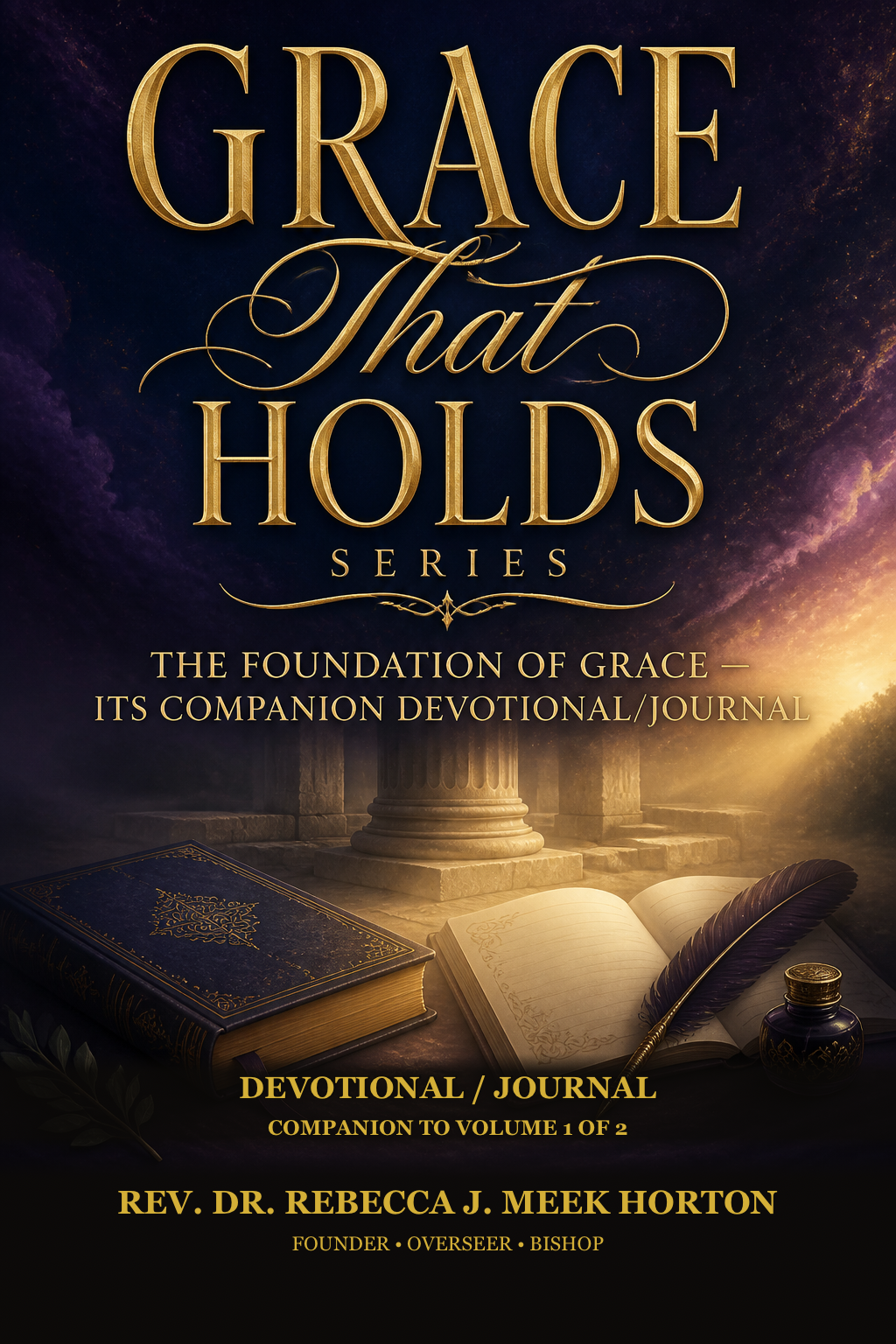
Grace That Holds
The Foundation of Grace — Its Companion Devotional/Journal
Companion Devotional/Journal
Full publication
NBCNGMI MASTER KNOWLEDGE LIBRARY Featuring the works of The Sage, Apostle Prophet. Rev. Dr. Rebecca J. Meek Horton, Apostolic Prophetic Architect, NewBeing Creation Network Global Ministries, Inc. Integrated Framework Modalities™
Chapter 1 — Receive Grace at the Foundation
A house can look strong from the road and still have trouble at the foundation.
The paint may be fresh. The porch may be swept. The lights may be warm in the windows. But if the foundation is cracked, everything above it feels the strain. Doors begin to stick. Floors begin to slope. Walls begin to separate in quiet places.
The soul can be like that too.
A person can serve, pray, smile, give, attend, and still be trying to build spiritual life on striving instead of grace. The outside may look faithful, but inside there is pressure: I must do more. I must prove more. I must be better before God will receive me.
This chapter brings us back to the foundation.
Grace is not the reward for your performance. Grace is the gift of God through Jesus Christ. You do not begin with shame. You do not begin with striving. You do not begin with proving. You begin with Christ and His finished work.
That does not make obedience small. It puts obedience in its proper place. We do not obey to purchase grace. We obey because grace has first reached us, saved us, and begun to form us.
Take these entries slowly. Let the Word of God settle beneath the noise. Let prayer become honest. Let the journal space become a place where you stop pretending and start receiving.
The Foundation Is Gift
Entry One
Ephesians 2:8-10 (KJV)
For by grace are ye saved through faith; and that not of yourselves: it is the gift of God: Not of works, lest any man should boast. For we are his workmanship, created in Christ Jesus unto good works, which God hath before ordained that we should walk in them.
Grace begins where boasting ends.
This is hard for the tired heart, because many of us have learned to measure our worth by what we can produce. We count prayers, tears, failures, good days, bad days, answered requests, spiritual energy, and visible fruit. Then we try to decide whether we are close enough to God.
But Ephesians 2 does not begin with your record. It begins with God’s gift.
For by grace are ye saved through faith.
Grace is not something you forced out of God by being impressive. Grace is His gift. Faith receives what God gives. Your salvation is not built on the unstable ground of your mood, your strength, your history, or your ability to hold everything together. It is built on Christ.
This is a holy relief.
You are not saved by works. You are not kept by spiritual performance. You are not invited near because you finally became easy to love. You are His workmanship, created in Christ Jesus unto good works.
Notice the order. Grace first. Salvation first. Gift first. Then good works.
When the order is wrong, the soul becomes weary. We start living as though God’s love must be earned each morning and protected each night. We become afraid of weakness because weakness feels like disqualification. We hide sin instead of confessing it. We pretend to be strong instead of coming honestly.
Grace restores the order.
You are not working for a place in Christ. You are working from the place grace has given you in Christ.
Prayer
Father, bring me back to the foundation of grace. Forgive me for trying to earn what You have given through Jesus Christ. Teach me to receive without pride and without shame. Let my obedience flow from love, not fear. Let my heart rest in the finished work of Christ. Amen.
Journal Prompt
Where have I been trying to prove myself to God instead of receiving His grace through faith?
Space to Write
Use this space to answer honestly before the Lord. Do not polish your words. Tell the truth.
The Peace Grace Gives
Entry Two
Romans 5:1-2 (KJV)
Therefore being justified by faith, we have peace with God through our Lord Jesus Christ: By whom also we have access by faith into this grace wherein we stand, and rejoice in hope of the glory of God.
Peace with God is not the same as a quiet schedule.
A person can have a full calendar and still have peace with God. A person can sit in a silent room and still be troubled by accusation. The peace Paul speaks of in Romans 5 is deeper than circumstances. It is the peace that comes from being justified by faith through our Lord Jesus Christ.
This peace is not fragile. It is not based on whether you felt spiritual today. It is not removed every time you feel weak. It does not disappear because you are learning, growing, confessing, and being corrected.
We have peace with God through our Lord Jesus Christ.
That sentence matters.
Your peace with God is not through your perfection. It is not through your emotional consistency. It is not through your ability to explain every part of your journey. It is through Jesus Christ.
Grace gives access.
Sometimes weary believers live as though they are standing outside a locked door, hoping God will eventually let them in. But Romans says we have access by faith into this grace wherein we stand. The believer does not stand in rejection. The believer stands in grace.
This does not mean we become careless. Grace is not permission to drift. Grace is the place where we can finally stop hiding and begin healing. It is the ground where truth can be told without fear that God will throw us away.
If you have been living under constant inner accusation, pause here.
Ask: Is this conviction leading me toward God with repentance and hope, or is this shame driving me away from God with despair?
The Spirit of God convicts with truth and calls us toward life. Shame accuses without mercy and tells us to hide. Grace teaches us to come.
Prayer
Lord Jesus, thank You for making peace with God possible. I confess that I have often stood in fear when You have called me to stand in grace. Quiet the accusations that do not come from You. Teach me to receive the peace that is mine through faith. Amen.
Journal Prompt
What accusation has been making me feel as though I cannot stand in grace?
Space to Write
Write the accusation plainly. Then write this sentence beneath it: In Christ, I stand in grace.
Mercy Came First
Entry Three
Titus 3:5-7 (KJV)
Not by works of righteousness which we have done, but according to his mercy he saved us, by the washing of regeneration, and renewing of the Holy Ghost; Which he shed on us abundantly through Jesus Christ our Saviour; That being justified by his grace, we should be made heirs according to the hope of eternal life.
Mercy came before your improvement.
This truth may feel uncomfortable if you are used to earning acceptance. Many people do not know how to receive mercy without immediately trying to repay it. They say thank you with their mouth, but inside they are already building a repayment plan.
I will pray harder. I will never struggle again. I will make myself worthy. I will prove God did not waste grace on me.
But grace is not wasted on the needy. Grace is given to the needy.
Titus says God saved us not by works of righteousness which we have done, but according to his mercy. That means mercy did not wait for you to become impressive. Mercy met you in need. Mercy moved toward you because of God’s character, not because of your credentials.
This humbles us.
It also heals us.
If salvation depended on works of righteousness which we have done, none of us could rest. We would always wonder whether we had done enough. We would compare ourselves with others. We would hide our weakness. We would become proud on good days and crushed on bad days.
But mercy removes both boasting and despair.
You cannot boast, because you did not save yourself.
You do not have to despair, because saving you was God’s mercy, not your achievement.
This is where RE-Language™ helps the weary heart.
Not, “I am too broken for grace.”
But, “I am exactly the kind of person mercy came to save.”
Not, “I must become worthy before I come.”
But, “I come because Christ is worthy.”
Not, “My weakness cancels God’s grace.”
But, “My weakness is a place where I need to receive what God gives.”
This is not excuse-making. It is truth-telling. Grace does not deny sin. Grace brings sin into the light where mercy, cleansing, and renewal are found.
Prayer
Father, thank You that mercy came first. I lay down the pride that wants to earn salvation and the shame that says I am beyond Your reach. Renew me by Your Spirit. Let me receive grace with humility and walk as one who belongs to You. Amen.
Journal Prompt
What would change in my heart if I truly believed mercy met me before I improved?
Space to Write
Write slowly. Let this become personal. Where do you need to stop negotiating with grace?
Come to the Throne of Grace
Entry Four
Hebrews 4:15-16 (KJV)
For we have not an high priest which cannot be touched with the feeling of our infirmities; but was in all points tempted like as we are, yet without sin. Let us therefore come boldly unto the throne of grace, that we may obtain mercy, and find grace to help in time of need.
The throne of grace is not a place for pretending.
It is a place for coming.
Hebrews tells us that Jesus is not untouched by our infirmities. He is not distant, cold, or unable to understand human weakness. He was tempted, yet without sin. He is holy, and He is compassionate. He is exalted, and He is near.
Because of Him, we are told to come boldly.
Not arrogantly. Not carelessly. Not pretending. Boldly.
This boldness is not confidence in ourselves. It is confidence in our High Priest. We come because Jesus has made the way. We come because mercy is available. We come because grace helps in time of need.
Many believers wait until they feel strong to pray honestly. They wait until they have dried their tears, fixed their attitude, and organized their thoughts. Then they approach God with a cleaned-up version of the truth.
But the verse says to come in time of need.
Need is not a barrier to grace. Need is the reason you come.
When a child falls and gets hurt, a loving parent does not say, “Come back when you are no longer bleeding.” The wound is why the child comes close. In the same way, your weakness is not a reason to run from God. It is a reason to come to the throne of grace.
There is a cost here.
Receiving grace asks you to stop hiding behind spiritual language. It asks you to tell the truth. It asks you to admit need without turning need into shame. It asks you to let Jesus be Savior, not merely Teacher, Example, or distant Lord.
You may have learned to survive by appearing fine. Grace invites you to live by coming honestly.
Prayer
Lord Jesus, You are my High Priest. You understand weakness without being overcome by sin. Teach me to come boldly to the throne of grace. I need mercy. I need help. I need Your grace in the places I have tried to manage alone. Amen.
Journal Prompt
What need have I been hiding from God, from myself, or from trusted help?
Space to Write
Name the need. Then write a simple prayer asking for mercy and grace to help.
It Is Finished
Entry Five
John 19:30 (KJV)
When Jesus therefore had received the vinegar, he said, It is finished: and he bowed his head, and gave up the ghost.
There are words that hold the weight of eternity.
It is finished.
Jesus did not say, “It is almost finished.” He did not say, “I have done My part; now finish the rest by striving.” He declared completion.
The cross was not an unfinished foundation. The work of redemption was not left unstable. Christ gave His life. The Lamb of God bore sin. The debt was not ignored; it was answered in Him.
This is where the heart must return when shame becomes loud.
It is finished.
When performance says, “Do more so God will receive you,” the cross says, “It is finished.”
When shame says, “You can never come near after what you have done,” the cross says, “It is finished.”
When pride says, “Surely I contributed something to my salvation,” the cross says, “It is finished.”
When weariness says, “I cannot hold myself together,” the cross says, “Christ has already held the weight you could never carry.”
This does not mean your growth is finished. It means the saving work of Christ is finished. There is still formation, obedience, repentance, healing, learning, and walking. But these do not become the foundation. Christ is the foundation.
A building becomes dangerous when people confuse scaffolding with foundation. Scaffolding helps work continue, but it cannot bear the whole structure. Spiritual practices matter. Prayer matters. Journaling matters. Gathering with believers matters. Serving matters. But none of these can replace Christ.
If your confidence is in your practice, you will panic when your practice feels weak.
If your confidence is in Christ, you can return to practice without using it as payment.
That is grace at the foundation.
Prayer
Lord Jesus, thank You for Your finished work. I confess every place where I have tried to add striving to what You completed. Bring my heart back to the cross. Let my life be built on You, not on fear, shame, or performance. Amen.
Journal Prompt
What have I been treating as my foundation instead of the finished work of Christ?
Space to Write
Write what comes to mind. Then complete this sentence: Because Christ finished the work, I can receive grace today by faith.
The Honest Cost of Receiving
Grace is free, but receiving it will cost you some things.
It will cost you the illusion of control.
It will cost you the pride of self-salvation.
It will cost you the habit of using shame as proof that you are serious.
It will cost you the false safety of hiding.
It will cost you the right to boast over someone else who also needs mercy.
This is good loss.
Grace humbles every person at the same ground. No one stands higher at the cross. No one receives salvation as wages. No one brings enough righteousness to make grace unnecessary.
And no one is too weary to come.
If your heart has been trained by pressure, grace may feel too simple at first. You may want something heavier, something more complicated, something that lets you feel like you are paying your way.
But the gospel is not weak because it is simple. It is strong because Christ is enough.
Receive again.
Not with perfect emotion. Not with polished words. Not with a promise that you will never struggle.
Receive by faith.
Key Takeaways
• Grace is God’s gift, not your achievement.
• Peace with God comes through Jesus Christ, not performance.
• The finished work of Christ is the foundation beneath all faithful obedience.
Practice
Set aside ten quiet minutes today.
Read Ephesians 2:8-10 aloud slowly. Then place one hand over your heart and pray this simple prayer:
Father, I receive Your grace through faith in Jesus Christ. I stop striving to earn what You have given. Teach me to live from grace, not for grace. Amen.
After you pray, write one sentence in your journal:
Today, I will receive grace at the foundation by releasing ____________________.
Chapter 2 — Stand in Grace When Life Presses
Some days life does not simply happen. It presses.
It presses on the mind before the feet touch the floor. It presses through unfinished conversations, unpaid bills, delayed answers, tired bodies, strained relationships, and thoughts that do not wait politely for permission to speak. A person can love God and still feel crowded inside.
Pressure has a way of making everything sound urgent.
Decide now.
Fix it now.
Explain it now.
Prove you are strong now.
But grace does not rush the weary into performance. Grace brings the weary back under truth.
The single aim of this chapter is simple: when pressure, weakness, delay, and inner accusation rise, bring them under the Word of God and take the next faithful step. Not the perfect step. Not the impressive step. The faithful one.
You do not have to pretend pressure is light. You do not have to call weakness strength. You do not have to deny delay. You do not have to agree with accusation.
You can come honestly.
You can receive grace again.
You can let Scripture govern what pressure is trying to explain.
Entry One
Pressure Is Not Proof That Grace Has Left
2 Corinthians 12:9-10 (KJV)
And he said unto me, My grace is sufficient for thee: for my strength is made perfect in weakness. Most gladly therefore will I rather glory in my infirmities, that the power of Christ may rest upon me. Therefore I take pleasure in infirmities, in reproaches, in necessities, in persecutions, in distresses for Christ's sake: for when I am weak, then am I strong.
Paul did not write these words from a life without trouble. He knew distress. He knew limitation. He knew the ache of asking God to remove something and hearing God answer in a way that did not remove the pressure.
That matters.
Sometimes we think grace means the hard thing will leave quickly. Sometimes it does. God is able to deliver suddenly. But sometimes grace comes as strength inside the thing we wanted removed.
The Lord told Paul, “My grace is sufficient for thee.”
Sufficient does not mean small. It means enough. Enough for the moment. Enough for the weakness. Enough for the pressure. Enough for the next step.
Pressure often tries to make us measure God’s care by how fast circumstances change. But Scripture teaches us to measure God’s care by His faithful presence, His keeping power, and His Word that cannot fail.
There is a cost here. Receiving sufficient grace means releasing the demand to feel strong before you obey. It means admitting weakness without letting weakness become your identity. It means saying, “Lord, I do not have what this day requires, but I believe You are enough for me in it.”
That is not denial.
That is dependence.
Prayer
Father, I bring You the pressure I am carrying. I do not want to pretend it is easy. I do not want to be ruled by it either. Teach me to receive Your sufficient grace today. Let the power of Christ rest upon me where I feel weak. Help me stop measuring Your love by the speed of relief. Help me trust Your presence in this moment. In Jesus’ name, amen.
Journal Prompt
Where do I feel pressure today, and what would it look like to receive God’s sufficient grace in that exact place?
Space to Write
Entry Two
Weakness Can Come Near
Hebrews 4:15-16 (KJV)
For we have not an high priest which cannot be touched with the feeling of our infirmities; but was in all points tempted like as we are, yet without sin. Let us therefore come boldly unto the throne of grace, that we may obtain mercy, and find grace to help in time of need.
Weakness often makes people hide.
We hide because we are embarrassed. We hide because we think we should be further along. We hide because we do not want anyone to know how tired, tempted, afraid, or uncertain we really are.
But Hebrews gives the weary believer a different direction.
Come boldly.
Not because you are flawless.
Not because you are composed.
Not because you have already mastered the lesson.
Come because Jesus is a merciful High Priest. Come because He is not untouched by human suffering. Come because the throne you approach is a throne of grace.
There is mercy there.
There is grace to help there.
The phrase “in time of need” is tender. It means help is not only for the strong believer who has everything in order. Help is for the needy. Help is for the one who knows, “I cannot carry this without You.”
Grace does not shame need. Grace meets need.
This does not mean we avoid responsibility. It means we stop using shame as a substitute for responsibility. Shame says, “Hide.” Grace says, “Come, receive mercy, and walk in truth.”
A weary believer may need prayer. A weary believer may need counsel. A weary believer may need rest, medical care, community, repentance, boundaries, or practical support. None of those needs cancel faith. They may be part of faithful stewardship.
The cost is humility. You may have to stop pretending you are fine. You may have to ask for help. You may have to let God meet you as you are, not as you wish you were.
That is holy ground.
Prayer
Lord Jesus, thank You for being my High Priest. Thank You that You are not distant from my weakness. I come to the throne of grace today. I ask for mercy. I ask for grace to help in my time of need. Teach me to come instead of hide. Teach me to receive help without shame. In Your name, amen.
Journal Prompt
What weakness have I been hiding from God, from myself, or from wise help? What would it mean to come boldly instead?
Space to Write
Entry Three
Delay Does Not Get to Define God
Psalm 27:13-14 (KJV)
I had fainted, unless I had believed to see the goodness of the LORD in the land of the living. Wait on the LORD: be of good courage, and he shall strengthen thine heart: wait, I say, on the LORD.
Delay is one of the hardest pressures on trust.
It is one thing to believe God when the answer is visible. It is another thing to believe while waiting, when nothing seems to move and the heart grows tired of hoping.
David speaks honestly here. He does not pretend waiting is easy. He says he would have fainted unless he had believed to see the goodness of the Lord.
That is a real sentence for real people.
Waiting can make the soul feel faint. Waiting can expose fears we did not know were ruling us. Waiting can make us vulnerable to wrong conclusions.
Maybe God forgot.
Maybe I prayed wrong.
Maybe it will never change.
Maybe I am on my own.
Those thoughts may feel powerful, but they are not Lord. Delay does not get to define God.
The psalm gives an instruction, not a slogan: “Wait on the LORD.” Waiting on the Lord is not passive despair. It is trust with breath still in it. It is continuing to turn toward God while the answer is not yet in your hands.
It also says, “be of good courage.” Courage is needed because waiting costs something. It costs control. It costs the false comfort of panic. It costs the habit of trying to force a door open before God has led you through it.
But the promise is not empty. “He shall strengthen thine heart.”
Sometimes the answer comes by a changed circumstance. Sometimes the first answer is a strengthened heart.
Both are grace.
Prayer
Father, I bring You the places where I am tired of waiting. I confess that delay has tried to speak loudly to me. Help me not to let delay define Your character. Strengthen my heart. Give me courage to wait without surrendering to fear. Teach me to believe in Your goodness while I am still on the road. In Jesus’ name, amen.
Journal Prompt
What delay is testing my trust right now? What false explanation has tried to attach itself to this waiting season?
Space to Write
Entry Four
Accusation Is Not the Voice of Grace
Romans 8:1 (KJV)
There is therefore now no condemnation to them which are in Christ Jesus, who walk not after the flesh, but after the Spirit.
Inner accusation can sound spiritual at first.
It may use religious words. It may remind you of real failures. It may point to places where you need growth. But its fruit is not repentance and return. Its fruit is despair, hiding, heaviness, confusion, and distance from God.
Conviction and condemnation are not the same.
Conviction tells the truth and calls you back to God.
Condemnation crushes you and tells you there is no way back.
Conviction is specific enough to obey.
Condemnation is vague enough to torment.
Conviction leads to confession, cleansing, and change.
Condemnation leads to shame, self-punishment, and fear.
Romans 8:1 is not permission to live carelessly. It is truth for those who are in Christ Jesus. The believer does not stand before God on the foundation of self-perfection. The believer stands in Christ.
This is where many weary believers need RE-Language™.
Not, “I am condemned because I am still growing.”
But, “I am in Christ, and grace is teaching me to walk after the Spirit.”
Not, “God is finished with me.”
But, “God is forming me with truth, mercy, and correction.”
Not, “My weakness proves I do not belong.”
But, “My need drives me back to the grace that holds me.”
This shift matters because accusation drains the strength needed for obedience. Grace restores responsibility without shame. Grace does not flatter sin. Grace does not excuse disobedience. Grace brings us back to Christ, where confession is possible and change can begin.
The cost is that you must stop partnering with the voice that keeps you punished but unchanged. You must let the Word of God have more authority than the accusation you have rehearsed.
Prayer
Father, help me discern the difference between conviction and condemnation. Where I have sinned, lead me to confession and obedience. Where I have agreed with accusation, teach me to reject it by Your Word. Thank You that there is no condemnation to them which are in Christ Jesus. Help me walk after the Spirit today. In Jesus’ name, amen.
Journal Prompt
What accusation has been repeating in my mind? Is it leading me to repentance and life, or to shame and distance from God?
Space to Write
Entry Five
The Next Faithful Step Is Enough for Today
Psalm 119:105 (KJV)
Thy word is a lamp unto my feet, and a light unto my path.
A lamp does not show the whole road at once.
It gives enough light for the step in front of you.
That can feel frustrating when you want the whole map. You may want to know how everything will work, when the pressure will lift, how the relationship will heal, where the provision will come from, and why God allowed the road to be so hard.
Some answers may come later. Some may not come in the way you expect. But God has not left you without light. His Word gives enough light to obey.
The next faithful step may be small.
Pray before answering the message.
Tell the truth without attacking.
Rest instead of proving.
Repent without delay.
Ask for counsel.
Open Scripture before opening fear.
Make the appointment.
Set the boundary.
Forgive as obedience, even while healing takes time.
Keep showing up where God has assigned you.
Small obedience is not small to God.
The weary believer often despises small steps because pain wants immediate resolution. But maturity is often formed through repeated obedience in ordinary places. The next faithful step keeps you from surrendering to paralysis.
You are not responsible to control the whole outcome. You are responsible to obey the light you have been given.
There is a cost. You may have to release the need to feel certain before moving. You may have to obey while still emotional. You may have to take a step without applause, without full understanding, and without immediate relief.
But grace meets you there too.
The Word is still a lamp.
The path is still under God’s care.
Prayer
Lord, I want more than a lamp sometimes. I want the whole road explained. Help me trust You with what I cannot see. Show me the next faithful step. Give me courage to obey what Your Word has made clear. Keep me from paralysis, panic, and delay. Let my obedience be simple, honest, and steady. In Jesus’ name, amen.
Journal Prompt
What is one next faithful step God is showing me through His Word, wise counsel, or clear responsibility?
Space to Write
The Honest Cost
This practice asks something of you.
It asks you to stop letting pressure become your teacher.
It asks you to stop treating weakness as proof that grace has failed.
It asks you to wait without letting delay rewrite God’s character.
It asks you to answer accusation with Scripture instead of rehearsing shame.
It asks you to move in obedience before every emotion settles.
That is not easy. It is costly because it touches the places where fear has been managing you. It touches the places where control has felt safer than trust. It touches the places where you have confused being tired with being abandoned.
But grace is not only for the beginning of the journey. Grace is for the pressured middle.
Grace helps you breathe.
Grace helps you tell the truth.
Grace helps you repent.
Grace helps you wait.
Grace helps you obey.
Grace helps you stand when life is pressing and your own strength is not enough.
You do not need to perform peace. You can receive help. You can bring the real burden to God. You can let the Word correct the story pressure has been telling you.
Nothing is random. Nothing is wasted.
Even here, God is able to form trust that is deeper than mood, stronger than accusation, and steadier than circumstance.
Key Takeaways
• Pressure is not proof that grace has left.
• Weakness can come boldly to the throne of grace.
• The next faithful step is enough for today.
Practice
Choose one pressure you are carrying right now.
Write it plainly in one sentence.
Then place it under one Scripture from this chapter. Pray that Scripture back to God in your own words. After you pray, write one next faithful step you can take within the next twenty-four hours.
Keep it simple.
One pressure.
One Scripture.
One prayer.
One faithful step.
Chapter 3 — Steward Grace in Daily Obedience
An ordinary morning can become holy without becoming dramatic.
The Bible is open. The coffee has cooled. The house is beginning to stir. There are dishes in the sink, decisions waiting, messages unanswered, and a body that may already feel tired before the day has fully begun.
This is where grace must be stewarded.
Not only in a church service. Not only in a breakthrough moment. Not only when the heart feels lifted and clear.
Grace must be carried into the ordinary.
The single truth of this closing chapter is simple: grace is stewarded through daily obedience, one honest prayer, one Scripture, one reflection, and one next faithful step at a time.
This is not striving. This is not performance. This is not trying to prove that you deserved what God freely gave.
This is stewardship.
Grace saves us by the finished work of Christ. Then grace teaches us how to live. The believer does not mature by leaving grace behind. The believer matures by learning to walk in it with responsibility.
Begin Where Grace Already Stands
Ephesians 2:10 (KJV)
For we are his workmanship, created in Christ Jesus unto good works, which God hath before ordained that we should walk in them.
You are not beginning from emptiness.
You are His workmanship.
That means your life in Christ is not random. You are not a spiritual accident. You are not a project God regrets. You are not a believer trying to build yourself from scratch.
You are His workmanship, created in Christ Jesus unto good works.
Notice the order. The good works come after grace. They do not purchase grace. They flow from grace.
This matters because many weary believers try to obey from fear. They think, If I do enough, maybe God will stay pleased with me. If I pray enough, serve enough, give enough, endure enough, maybe I will be safe.
But fear cannot carry holy obedience for long. It may produce movement, but it cannot produce rest.
Grace teaches a different way.
Grace says, You belong to Christ. Now walk as one who belongs.
A person who has been rescued from deep water does not keep swimming to prove the rescuer was real. The rescue is already done. But when their feet touch solid ground, they learn to walk again.
That is daily obedience.
You are not trying to become loved. You are learning to walk as one who is loved.
Prayer
Father, thank You that I am Your workmanship in Christ Jesus. Deliver me from obedience that is driven by fear, shame, or performance. Teach me to walk in the grace You have already given. Let my daily choices reflect that I belong to You. Amen.
Journal Prompt
Where have I been trying to earn what God has already given by grace?
Space to Write
................................................................................
................................................................................
................................................................................
................................................................................
................................................................................
................................................................................
Let the Word Govern the Day
Psalm 119:105 (KJV)
Thy word is a lamp unto my feet, and a light unto my path.
A lamp does not show the whole road.
It gives enough light for the next step.
Many believers become discouraged because they want the full map before they obey. They want every answer, every outcome, every timeline, every assurance that nothing will hurt and nothing will be misunderstood.
But God often gives light for obedience, not control.
His Word becomes the lamp. Not our fear. Not our mood. Not pressure from people. Not the loudest voice in the room.
The Word of God teaches us what is true when feelings are loud. It corrects us when we are drifting. It comforts us when we are faint. It steadies us when decisions feel heavy.
This is why Scripture must become a daily place of return, not a last resort.
A weary believer may not be able to read five chapters every morning. There are seasons when grief, sickness, caregiving, depression, work pressure, or exhaustion makes long study difficult. God knows our frame.
But a small portion of Scripture received honestly can still give light.
Read slowly. Read with reverence. Read until one truth stands before you. Then ask, Lord, what does obedience look like today?
Do not use the Bible only to gather information. Let it govern your steps.
For example, if the Word says to forgive, your next step may be praying honestly about the wound before you are ready for the conversation.
If the Word says to speak truth, your next step may be ending the habit of hiding behind silence.
If the Word says to cast your care upon God, your next step may be writing the burden down and refusing to rehearse it all day as if worry is worship.
Daily obedience begins when the Word becomes more trusted than the pressure.
Prayer
Lord, make Your Word a lamp unto my feet today. Slow me down enough to receive it. Give me humility to be corrected, courage to obey, and discernment to know the next faithful step. Amen.
Journal Prompt
What Scripture is giving light to my next step right now?
Space to Write
................................................................................
................................................................................
................................................................................
................................................................................
................................................................................
................................................................................
Pray Before You Perform
Hebrews 4:16 (KJV)
Let us therefore come boldly unto the throne of grace, that we may obtain mercy, and find grace to help in time of need.
There is grace to help.
Not only grace to save. Not only grace to forgive. Grace to help.
This is a mercy for ordinary days.
There is grace to help you answer gently when you are tired.
There is grace to help you repent when you were wrong.
There is grace to help you make the phone call, keep the boundary, finish the assignment, ask for counsel, rest without guilt, and keep going when the road feels long.
But many of us perform first and pray later.
We rush into the day with our own strength, our own planning, our own assumptions, and our own emotional weather. Then, when we are depleted, we ask God to repair what we tried to carry without Him.
The throne of grace is not an emergency room only. It is a place of daily dependence.
Prayer is not a delay of responsibility. Prayer is how responsibility is rightly carried.
A mother may whisper a prayer while packing lunches. A worker may pray before entering a hard meeting. A caregiver may pray while washing sheets. A leader may pray before making a decision that affects others. A grieving person may pray with no words except, Help me, Lord.
That counts.
Do not despise simple prayer.
A short prayer from an honest heart can become the doorway to grace for the next moment.
Prayer does not always change the task. Sometimes it changes the way you carry it. It brings the task under God’s presence. It reminds the soul, I am not alone. I am not my own source. I can obtain mercy. I can find grace to help.
Prayer
Father, forgive me for performing before I depend on You. Teach me to come boldly to the throne of grace. I need mercy. I need grace to help. Meet me in the real needs of this day and form obedience in me. Amen.
Journal Prompt
What am I trying to carry today without first bringing it to the throne of grace?
Space to Write
................................................................................
................................................................................
................................................................................
................................................................................
................................................................................
................................................................................
Write What Must Be Remembered
Psalm 77:11-12 (KJV)
I will remember the works of the LORD: surely I will remember thy wonders of old. I will meditate also of all thy work, and talk of thy doings.
Forgetting can become dangerous.
Not ordinary forgetting, like misplacing keys or missing an appointment. There is a deeper forgetting that happens when pain becomes louder than memory.
We forget how God carried us before.
We forget prayers He answered.
We forget mercy He showed.
We forget how many times grace met us when we had no strength left.
This is why journaling can become an act of stewardship.
Writing does not have to be polished. It does not have to sound spiritual. It does not have to be long.
It only needs to be honest.
A journal can hold what the mind keeps circling. It can help you name the fear, identify the lie, remember the truth, and record the next step.
Sometimes what feels overwhelming inside becomes clearer once it is written down.
You may write:
Lord, I am afraid.
Lord, I feel delayed.
Lord, I need wisdom.
Lord, this is the lie I keep hearing.
Lord, this is the Scripture I am choosing to answer with.
Lord, this is the step I will take today.
That is not small. That is stewardship.
Writing helps you slow down enough to see what is really happening. It helps you stop letting vague heaviness rule your day. It gives language to prayer and shape to obedience.
Over time, your journal may become a record of grace.
You will see patterns. You will see growth. You will see where God corrected you gently. You will see where He sustained you quietly. You will see that you were not abandoned in the hidden days.
Not every page will feel victorious. Some pages may carry tears. Some may carry repentance. Some may carry questions that are still unresolved.
That is all right.
Truthful pages can become holy ground.
Prayer
Lord, help me remember Your works. Teach me to write with honesty and humility. Let my journal become a place where I bring fear into the light, answer lies with truth, and remember Your faithfulness. Amen.
Journal Prompt
What do I need to write down so I can stop carrying it vaguely and bring it honestly before God?
Space to Write
................................................................................
................................................................................
................................................................................
................................................................................
................................................................................
................................................................................
Keep the Next Faithful Step
James 1:22 (KJV)
But be ye doers of the word, and not hearers only, deceiving your own selves.
Grace does not make obedience optional.
Grace makes obedience possible.
There is a difference.
A person can hear truth and still remain unchanged if truth is never practiced. James speaks plainly. Hearing without doing can become self-deception. We may feel comforted by the Word while refusing to obey the Word.
Daily obedience protects us from that.
The next faithful step may be small, but small does not mean insignificant.
It may be apologizing.
It may be resting.
It may be telling the truth.
It may be opening the Bible before opening the noise.
It may be asking for help.
It may be forgiving again.
It may be creating a boundary.
It may be serving without needing to be seen.
It may be saying no because your yes belongs somewhere else.
It may be staying when leaving would be avoidance.
It may be leaving when staying would be compromise.
Wisdom is needed. Counsel may be needed. Time may be needed. But once the next faithful step is clear, obedience must become movement.
Not dramatic movement.
Faithful movement.
This is where many weary believers need mercy. They think maturity means they should be able to take ten steps at once. But God often leads one step at a time.
The question is not, Can I fix my whole life today?
The question is, What is the next faithful step before me?
One step taken in obedience is better than a hundred intentions left unpracticed.
Prayer
Lord, make me a doer of Your Word. Show me the next faithful step and give me grace to take it. Deliver me from delay that hides behind overthinking. Help me obey with humility, courage, and love. Amen.
Journal Prompt
What is one clear step of obedience I can take within the next twenty-four hours?
Space to Write
................................................................................
................................................................................
................................................................................
................................................................................
................................................................................
................................................................................
The Cost of Daily Obedience
Daily obedience has a cost.
It costs comfort when the flesh wants ease.
It costs pride when repentance is required.
It costs hurry when God calls you to wait.
It costs secrecy when truth must come into the light.
It costs control when trust must be practiced.
It costs the old habit of calling delay disobedience and the old habit of calling fear wisdom.
This is why grace is necessary.
If obedience were easy, we would not need grace to help. But obedience often presses against the places where we have learned to protect ourselves. It touches our motives. It confronts our excuses. It asks for consistency in places no one applauds.
There will be days when you do not feel like praying.
Pray honestly anyway.
There will be days when Scripture feels quiet.
Read reverently anyway.
There will be days when journaling reveals something you would rather avoid.
Tell the truth anyway.
There will be days when the next faithful step feels too small to matter.
Take it anyway.
This is not cold discipline. This is love learning to walk.
Jesus said:
John 14:15 (KJV)
If ye love me, keep my commandments.
Love is not proven by noise. Love is often proven in quiet obedience.
Not perfect obedience. Faithful obedience.
When you fall short, return quickly. Confess sin. Receive mercy. Repair what can be repaired. Do not build a home in condemnation.
Grace does not teach you to pretend. Grace teaches you to return.
A Daily Rhythm of Stewarding Grace
A durable practice does not need to be complicated.
Begin simply.
Wait.
Ask.
Listen.
Keep.
Wait before the Lord before the day runs away with you.
Ask Him what is true, what is needed, and what obedience requires.
Listen through His Word, conviction, wisdom, and godly counsel.
Keep the next faithful step.
This rhythm is not meant to create dependency on a system. It is meant to help you practice dependence on God with maturity.
You can do this in ten minutes.
You can do it at a kitchen table, in a parked car, beside a hospital bed, during a lunch break, or before sleep.
The power is not in the location. The power is in returning to God with an honest heart.
Here is a simple pattern:
• Read one Scripture slowly.
• Write one sentence of truth from that Scripture.
• Pray one honest prayer.
• Name one burden or decision.
• Choose one faithful step.
That is enough to begin.
Do not despise enough.
Grace often forms maturity through repeated, ordinary obedience.
An Apostolic Prophetic Architect Message
Beloved, grace is not fragile.
Grace is not intimidated by your weakness, your questions, your tears, or your unfinished places. Grace came from God before you knew how to reach for Him. Grace met you in Christ. Grace saved you, and grace will teach you how to walk.
Do not turn this devotional and journal into another burden.
Let it be a meeting place.
Come with your Bible. Come with your pen. Come with your honest heart. Come when you feel strong, and come when you feel like you have only a whisper left.
God is not asking you to perform spiritual strength. He is inviting you to steward what He has given.
Nothing is random. Nothing is wasted.
The prayer you pray with tears is not wasted.
The Scripture you read slowly is not wasted.
The repentance no one sees is not wasted.
The boundary you set in obedience is not wasted.
The forgiveness you practice before your feelings catch up is not wasted.
The quiet yes you give God today is not wasted.
You do not need to know the whole road to obey the next step.
Keep coming to Christ.
Keep receiving grace.
Keep guarding your trust.
Keep answering lies with written truth.
Keep walking.
The foundation is grace, and the way forward is grace-shaped obedience.
Key Takeaways
• Grace is not earned by obedience; grace teaches obedience.
• Daily practice keeps truth close when pressure rises.
• The next faithful step is enough light for today.
Practice
For the next seven days, use this simple rhythm once each day.
• Read one KJV Scripture.
• Write one truth God is showing you.
• Pray one honest prayer.
• Name one burden, fear, or decision.
• Take one faithful step within twenty-four hours.
Complete this sentence before you close this chapter:
This week, I will steward grace by taking this next faithful step:
................................................................................
................................................................................
................................................................................
Continued Journal Pages
Day One
Scripture I read:
................................................................................
Truth I received:
................................................................................
Prayer I prayed:
................................................................................
Next faithful step:
................................................................................
Day Two
Scripture I read:
................................................................................
Truth I received:
................................................................................
Prayer I prayed:
................................................................................
Next faithful step:
................................................................................
Day Three
Scripture I read:
................................................................................
Truth I received:
................................................................................
Prayer I prayed:
................................................................................
Next faithful step:
................................................................................
Day Four
Scripture I read:
................................................................................
Truth I received:
................................................................................
Prayer I prayed:
................................................................................
Next faithful step:
................................................................................
Day Five
Scripture I read:
................................................................................
Truth I received:
................................................................................
Prayer I prayed:
................................................................................
Next faithful step:
................................................................................
Day Six
Scripture I read:
................................................................................
Truth I received:
................................................................................
Prayer I prayed:
................................................................................
Next faithful step:
................................................................................
Day Seven
Scripture I read:
................................................................................
Truth I received:
................................................................................
Prayer I prayed:
................................................................................
Next faithful step:
................................................................................
Final Reflection
Where have I seen grace helping me walk in obedience this week?
................................................................................
................................................................................
................................................................................
................................................................................
What do I need to continue practicing with God?
................................................................................
................................................................................
................................................................................
................................................................................
Grace brought you here.
Grace will carry you forward.
Keep the next faithful step.