 NBCNGMI™
Fruit Before Fire · Volume 2
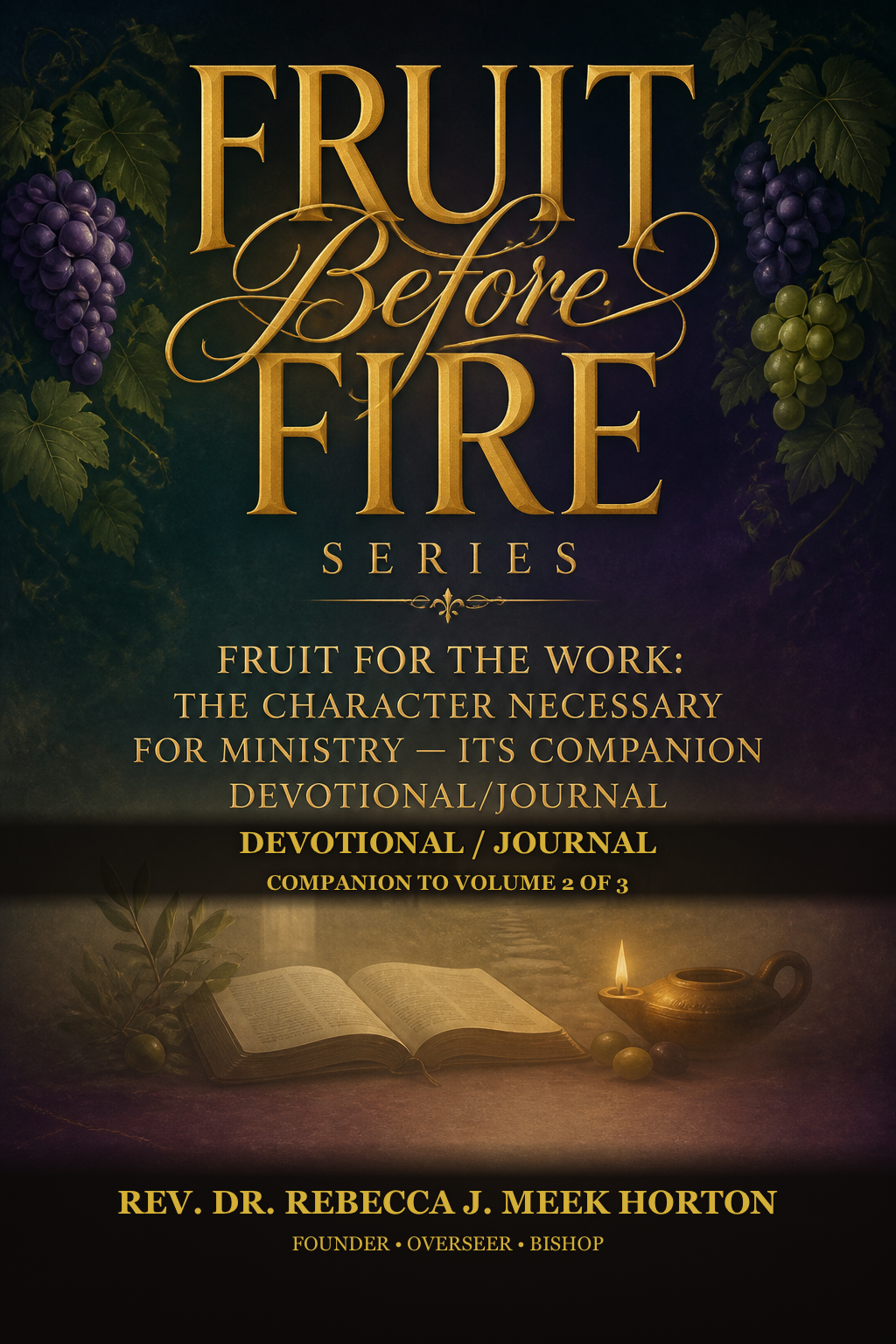
Fruit for the Work: The Character Necessary for Ministry — Its Companion Devotional/Journal
A companion devotional and journal for "Fruit for the Work: The Character Necessary for Ministry". Each chapter becomes five entries — a KJV Scripture reading, a devotional, a prayer, a journal prompt, and space to write — closing with An Apostolic Prophetic Architect Message and lined journal pages.
Full publication
NBCNGMI MASTER KNOWLEDGE LIBRARY Featuring the works of The Sage, Apostle Prophet. Rev. Dr. Rebecca J. Meek Horton, Apostolic Prophetic Architect, NewBeing Creation Network Global Ministries, Inc. Integrated Framework Modalities™
Chapter 1 — When Ministry Outruns Character
Entry 1
Scripture Reading
Galatians 5:22-23 (KJV) 22 But the fruit of the Spirit is love, joy, peace, longsuffering, gentleness, goodness, faith, 23 Meekness, temperance: against such there is no law.
Devotional
Ministry is not sustained by motion. It is sustained by the life of the Spirit forming Christlike character in the servant. The work may require skill, planning, prayer, teaching, singing, leading, organizing, serving, and showing up when others do not. But underneath all of that, the question remains simple: what kind of fruit is being produced in me while I serve?
Galatians does not call these qualities the fruits of personality. It calls them the fruit of the Spirit. Love, joy, peace, longsuffering, gentleness, goodness, faith, meekness, and temperance are not religious decoration. They are evidence that the Holy Spirit is governing the inner life.
This matters because ministry can become active before the heart becomes yielded. A person can know how to do the work and still wound people in the process. A person can serve consistently and still carry resentment. A person can speak truth but speak it without gentleness. A person can help others publicly while resisting correction privately.
The fruit of the Spirit brings the work back under holy governance.
Love asks, “Am I serving people, or using people to feel important?”
Joy asks, “Can I remain steady when no one celebrates me?”
Peace asks, “Am I carrying this assignment from trust or from anxiety?”
Longsuffering asks, “Can I endure process without becoming harsh?”
Gentleness asks, “Do people experience care when they encounter my strength?”
Goodness asks, “Is my private life agreeing with my public service?”
Faith asks, “Am I obeying God when results are not visible?”
Meekness asks, “Can I receive correction without rebellion?”
Temperance asks, “Am I governed when I am provoked?”
This is not condemnation. This is RE-Calibration™. The Spirit does not expose us to destroy us. He exposes what needs surrender so our service can become healthier, safer, and more faithful.
Ministry must never outrun character. The fruit is not optional for the servant of God. It is necessary. It protects the people we serve. It protects the work we carry. It protects our own soul from confusing usefulness with obedience.
Today, do not only ask God to bless your assignment. Ask Him to form your heart while you carry it.
Prayer
Father, I come to You honestly. I do not want my service to become louder than my surrender. I do not want to carry ministry activity while resisting the fruit of Your Spirit. Search my heart and show me where love, joy, peace, longsuffering, gentleness, goodness, faith, meekness, or temperance needs to grow. Teach me to yield without pretending. Help me not to hide behind giftedness, busyness, or religious language. I want my life to reflect You, not only reference You. Govern my motives, my tone, my reactions, and my obedience. Form in me the character necessary for the work You have entrusted to me. Amen.
Journal Prompt
From Galatians 5:22-23, which attribute of the fruit of the Spirit is most needed in your ministry, service, leadership, or daily influence right now? What situation is revealing that need?
Space to Write
[Answer Lines]
Entry 2
Scripture Reading
Matthew 7:21-23 (KJV) 21 Not every one that saith unto me, Lord, Lord, shall enter into the kingdom of heaven; but he that doeth the will of my Father which is in heaven. 22 Many will say to me in that day, Lord, Lord, have we not prophesied in thy name? and in thy name have cast out devils? and in thy name done many wonderful works? 23 And then will I profess unto them, I never knew you: depart from me, ye that work iniquity.
Devotional
These words of Jesus are not casual. They are not soft. They interrupt every shallow measurement of ministry success.
Jesus speaks to people who had religious language and visible works. They said, “Lord, Lord.” They pointed to prophecy, deliverance, and many wonderful works. Their ministry résumé looked strong. Their activity was not small. Their words sounded spiritual.
But Jesus looked deeper.
The issue was not only what they did. The issue was whether they were known by Him and obedient to the Father’s will. This is where the servant of God must become sober. Applause is not approval. Response is not always righteousness. A full room cannot prove a submitted heart. A powerful moment cannot prove obedient character.
This passage does not exist to torment sincere believers who are growing, repenting, and yielding to Christ. Weakness is not the same as rebellion. Process is not the same as iniquity. Needing correction is not the same as refusing God.
But this passage does warn every servant who is tempted to hide behind activity while resisting obedience.
We can become impressed with what others see and neglect what God knows. We can learn how to perform strength while avoiding surrender. We can speak spiritual language while refusing spiritual governance. We can keep the calendar full so no one looks too closely at the condition of the heart.
Jesus is merciful, but He is not fooled.
This is why ministry ethics must begin before the microphone, before the schedule, before the invitation, before the public moment. The deeper question is not only, “Did people respond?” The deeper question is, “Did I obey?” Not only, “Was the work excellent?” but “Was my heart submitted?” Not only, “Did others approve?” but “Did I walk in the Spirit?”
There is safety in honest examination. There is mercy in slowing down. There is wisdom in letting God correct what people may never notice.
Ministry must never outrun character because Christ is not only forming the assignment. He is forming the servant. The work matters, but the worker matters too. Today, let this passage sober you without crushing you. Let it call you back to the one thing no platform can replace: knowing Christ and doing the will of the Father.
Prayer
Father, I hear the warning of Jesus, and I do not want to dismiss it. I do not want religious words, visible works, or public response to become a covering for private disobedience. I want to be known by Christ and submitted to Your will. Search the places where I have measured faithfulness by activity more than obedience. Deliver me from image-protection, spiritual performance, and hidden resistance. Teach me to slow down where I need formation. Give me courage to repent quickly, receive correction humbly, and serve from a clean and yielded heart. Let my work agree with Your will. Amen.
Journal Prompt
In Matthew 7:21-23, Jesus separates visible works from obedient relationship. Where do you need to ask, “Did I obey?” instead of only asking, “Did I produce results?”
Space to Write
[Answer Lines]
Entry 3
Scripture Reading
1 Corinthians 13:1-3 (KJV) 1 Though I speak with the tongues of men and of angels, and have not charity, I am become as sounding brass, or a tinkling cymbal. 2 And though I have the gift of prophecy, and understand all mysteries, and all knowledge; and though I have all faith, so that I could remove mountains, and have not charity, I am nothing. 3 And though I bestow all my goods to feed the poor, and though I give my body to be burned, and have not charity, it profiteth me nothing.
Devotional
The apostle Paul brings us to a hard and holy truth: a gift can function while love is absent. A voice can sound impressive and still become noise. A person can understand mysteries, possess knowledge, exercise faith, give sacrificially, and still miss the governing mark of charity.
This should humble every servant.
Ministry without love may still be active, but it is not healthy. It may still be admired, but it is not whole. It may still appear sacrificial, but Paul says it profits nothing if charity is not present.
Love is not weakness. Love is not people-pleasing. Love is not avoiding truth, correction, boundaries, or accountability. Love is the holy character of God expressed through yielded action and attitude. Love asks whether the person in front of us is being treated as someone God values, not as a problem to manage or a tool to use.
This is where ministry can quietly outrun character. A singer may move a congregation and still treat the team harshly. A teacher may handle Scripture and still become cutting when questioned. A leader may build systems and still rush past wounded people because the schedule feels more important than care. A servant may give time and energy but secretly bargain for recognition.
Activity can continue while love is thinning.
Paul does not allow us to hide behind spiritual ability. He does not say, “If your gift is strong enough, love is optional.” He says the opposite. Without charity, even the most impressive expression becomes empty before God.
This is not a call to shame. It is a call to RE-Alignment™. If love has been displaced by pressure, ambition, offense, fatigue, or the need to be seen, bring that truth into the light. Do not protect the image. Steward the heart.
Love may require an apology. Love may require a slower response. Love may require listening before correcting. Love may require serving quietly without announcing the cost. Love may require releasing comparison when someone else is chosen.
The work of ministry needs love because people are not assignments only. They are souls. They are image-bearers. They are not interruptions to the ministry. Many times, they are the ministry.
Today, let charity examine the way you serve. Not to condemn you, but to govern you. The gift may open the door, but love determines whether people are safe when you walk through it.
Prayer
Father, I confess that I can become focused on doing the work and forget the spirit in which I am doing it. I do not want to become sounding brass or a tinkling cymbal. I do not want my gifts to move while love is missing. Teach me charity that is truthful, patient, humble, and clean. Show me where pressure has made me harsh, where ambition has made me careless, and where fatigue has made me dismissive. Help me see people the way You see them. Let my words, service, correction, leadership, and sacrifice be governed by Your love. Amen.
Journal Prompt
According to 1 Corinthians 13:1-3, what ministry activity in your life needs to be examined by charity? Where might your gift be present, but love needs to become stronger?
Space to Write
[Answer Lines]
Entry 4
Scripture Reading
John 15:4-5 (KJV) 4 Abide in me, and I in you. As the branch cannot bear fruit of itself, except it abide in the vine; no more can ye, except ye abide in me. 5 I am the vine, ye are the branches: He that abideth in me, and I in him, the same bringeth forth much fruit: for without me ye can do nothing .
Devotional
Fruit does not come from strain. Fruit comes from abiding.
Jesus gives a simple picture: vine and branches. The branch does not manufacture life by effort. It bears fruit because it remains connected to the vine. The life that flows through the vine produces what the branch could never produce by itself.
This is a mercy for every servant who has been trying to carry ministry in their own strength.
There is a kind of service that looks faithful on the outside but is slowly becoming disconnected on the inside. Prayer becomes rare. Rest becomes guilt. Correction feels like attack. People become burdens. The work keeps moving, but the heart is drying out. The branch is active, but abiding is neglected.
Jesus does not say, “Without Me ye can do less.” He says, “Without me ye can do nothing.” That does not mean we cannot schedule, speak, lead, organize, sing, preach, post, plan, or perform. It means that apart from Him, we cannot produce the fruit that carries eternal life and holy character.
This is why slowing down is sometimes obedience. Hidden formation is not wasted time. Quiet prayer is not less important than public ministry. Stillness before God is not inactivity. It is alignment. It is the place where the branch returns to the Source.
Ministry outruns character when activity separates from abiding. We start measuring fruit by motion, response, and visibility. But Jesus measures fruit by life that flows from union with Him.
Abiding will often confront our pace. It may require us to pause before saying yes. It may require us to confess that the schedule is full but the soul is thin. It may require us to receive counsel, rebuild prayer, restore rest, or step back from a role for a season. This can feel costly, especially when identity has become attached to being needed.
But slowing down to abide protects the servant and the work.
You are not called to be the vine. You are not the source. You are not responsible to produce fruit apart from Christ. You are called to remain, yield, listen, obey, and let His life govern yours.
Today, return to the Vine. Before the next visible assignment, choose the next faithful connection.
Prayer
Father, I need You. I cannot bear true fruit apart from Christ. Forgive me for the times I have tried to serve from pressure, habit, fear, or the need to be needed. I do not want activity without abiding. Draw me back into living connection with You. Restore prayer where it has become rushed. Restore stillness where I have been driven. Restore obedience where I have been distracted. Teach me to serve as a branch, not as the source. Let my ministry flow from union with Christ, not from self-effort. Keep me fruitful, yielded, and close. Amen.
Journal Prompt
John 15:4-5 teaches that fruit comes from abiding. What part of your service has become active but disconnected from prayer, rest, or obedience?
Space to Write
[Answer Lines]
Entry 5
Scripture Reading
James 3:13-18 (KJV) 13 Who is a wise man and endued with knowledge among you? let him shew out of a good conversation his works with meekness of wisdom. 14 But if ye have bitter envying and strife in your hearts, glory not, and lie not against the truth. 15 This wisdom descendeth not from above, but is earthly, sensual, devilish. 16 For where envying and strife is, there is confusion and every evil work. 17 But the wisdom that is from above is first pure , then peaceable, gentle, and easy to be intreated, full of mercy and good fruits, without partiality, and without hypocrisy. 18 And the fruit of righteousness is sown in peace of them that make peace.
Devotional
James teaches us that wisdom is not proven only by what a person knows. Wisdom is shown by the life that carries the knowledge. A person may be informed, skilled, articulate, and experienced, but if the heart is filled with bitter envying and strife, something is out of order.
This is deeply important for ministry.
Knowledge without meekness can become sharp. Leadership without peace can become controlling. Correction without gentleness can wound. Zeal mixed with envy can create confusion. Service mixed with strife can damage the very people it was meant to strengthen.
James does not let us separate the message from the manner. He tells the wise person to show works “with meekness of wisdom.” That phrase matters. True wisdom has a posture. It does not need to dominate the room. It does not need to prove itself through harshness. It does not confuse aggression with authority.
The wisdom from above is first pure, then peaceable, gentle, and easy to be intreated. It is full of mercy and good fruits. It is without partiality and without hypocrisy.
This is the kind of wisdom ministry needs.
When ministry outruns character, people may become hard to approach. They may call it strength, but it is really defensiveness. They may call it discernment, but it is really suspicion. They may call it excellence, but it is really control. They may call it passion, but it is really strife.
Fruit tells the truth.
A servant governed by wisdom from above can be corrected. They can listen. They can make peace without pretending there is no problem. They can tell the truth without cruelty. They can carry authority without crushing people. They can admit when their tone, motive, or method needs RE-Calibration™.
This does not mean the servant becomes passive. Peaceable does not mean powerless. Gentle does not mean unclear. Easy to be intreated does not mean easily manipulated. It means the heart is not locked in pride. It means wisdom has made the servant teachable.
Today, examine not only what you know, but how you carry what you know. Ask whether your works are being shown with meekness of wisdom. Ask whether your ministry environment is producing peace or confusion. Ask whether you are easy to be entreated by God, by Scripture, and by wise correction.
The fruit of righteousness is sown in peace.
Prayer
Father, I ask You to give me wisdom from above. I do not want knowledge without meekness or ministry without peace. Search my heart for envy, strife, defensiveness, partiality, or hypocrisy. Show me where I have confused harshness with strength or control with stewardship. Teach me to be pure, peaceable, gentle, and easy to be intreated. Help me receive correction without pride and give correction without cruelty. Let my works be carried with meekness of wisdom. Make me a servant who sows righteousness in peace and protects the people affected by my influence. Amen.
Journal Prompt
James 3:13-18 describes wisdom from above. Where do you need to become more peaceable, gentle, or easy to be intreated in your ministry, leadership, family, or service?
Space to Write
[Answer Lines]
An Apostolic Prophetic Architect Message
Beloved servant, hear this with sobriety and hope: God is not only calling you to carry the work. He is forming you to be safe for the work.
The assignment matters. The people matter. The timing matters. The fruit matters. There is a reason the Spirit has brought you through these readings. Nothing is random. Nothing is wasted. Even the pressure that exposed impatience, fear, pride, harshness, resentment, or hidden striving can become mercy when you let it lead you into obedience.
Do not despise the slowing down. Do not reject the correction. Do not call pruning punishment when the Lord is protecting the root. Some doors are delayed because character is being strengthened. Some visibility must wait because the inner structure needs RE-Ordering™. Some assignments must be carried quietly before they can be carried publicly.
God is not trying to embarrass you. He is inviting you into governed fruitfulness.
Psalm 139:23-24 (KJV) 23 Search me, O God, and know my heart: try me, and know my thoughts: 24 And see if there be any wicked way in me, and lead me in the way everlasting.
This is the prayer of a servant who wants truth more than image. This is the posture of a heart that can be trusted with formation. When you can say, “Search me,” you are already stepping away from hiding. When you can say, “Lead me,” you are already returning to obedience.
Ministry must never outrun character. But hear the grace in that statement: character can grow. Patterns can be interrupted. Alignment can be restored. The Holy Spirit can cultivate what pressure revealed was missing.
You are not being called to flawless performance. You are being called to yielded stewardship. Repent where you must. Apologize where you should. Pause where wisdom requires it. Ask for counsel where pride would isolate you. Serve quietly where your soul needs cleansing from applause. Return to prayer before you return to platform.
The fire of ministry must be governed by the fruit of the Spirit. Let love lead. Let peace guard. Let meekness receive. Let temperance govern. Let faith remain. Let Christ be seen, not merely referenced.
Take the next faithful step before the next visible assignment.
[Journal Page]
[Journal Page]
Chapter 2 — The Fruit That Makes Ministry Trustworthy
Entry 1
Scripture Reading
Galatians 5:22-23 (KJV) 22 But the fruit of the Spirit is love, joy, peace, longsuffering, gentleness, goodness, faith, 23 Meekness, temperance: against such there is no law.
Devotional
The first thing ministry must carry is not visibility. It must carry the character of Christ. Gifts may open a door, but fruit determines whether people are safe once they enter the room. This is why Galatians 5:22-23 is not a decoration for ministry life. It is a foundation.
Paul does not say the fruits of the Spirit, as though we may choose one and ignore another. He says the fruit of the Spirit. This is a single fruit with multiple attributes, produced in the life of a believer as they yield to the Spirit’s work. Love, joy, peace, longsuffering, gentleness, goodness, faith, meekness, and temperance belong together. They reveal whether the servant is being governed while serving.
Trust is not built by an announcement. Trust is built by repeated evidence. Can I be corrected without becoming defensive? Can I serve when no one sees me? Can I tell the truth without pride? Can I wait without manipulating? Can I hold responsibility without control? These are not personality questions. These are fruit questions.
Natural temperament is not the same as spiritual formation. A person can be naturally calm and still avoid the peace of God. A person can be warm and still lack holy love. A person can be disciplined and still lack Spirit-governed temperance. Natural traits may help us serve, but they cannot replace surrender.
The tension often begins in hidden places. A servant keeps showing up, but keeps score. A leader keeps producing, but resents correction. A gifted person keeps ministering, but becomes harder to approach. Outwardly, the work continues. Inwardly, the fruit is being tested.
This is where RE-Sponsibility becomes holy and necessary. Instead of saying, That is just how I am, maturity says, This is where I need the Spirit to form me. Instead of saying, They made me respond that way, maturity says, I am responsible for my response. This is not shame. This is stewardship.
The Spirit does not form fruit to embarrass us. He forms fruit to make us trustworthy for service. The work belongs to Christ. The people belong to Christ. The gift came from Christ. Therefore, the servant must remain under the government of Christ.
Today, do not ask only, Am I capable? Ask, Am I yielded? That question will protect the work, the people, and your own soul.
Prayer
Father, I come to You as a servant who needs more than ability. I need Your Spirit to form me where no one else can see. Teach me to stop hiding behind gifts, activity, or good intentions. Search my motives, my tone, my reactions, and my private thoughts. Where service has outrun surrender, bring me back into alignment. I do not want to build ministry with ungoverned places in me. I want love, joy, peace, longsuffering, gentleness, goodness, faith, meekness, and temperance to be seen in how I serve. Make me trustworthy, not for my name, but for Your glory. Amen.
Journal Prompt
Galatians 5:22-23 names the fruit of the Spirit. Which attribute is being most tested in your current season of service, and what would yielded obedience look like there?
Space to Write
[Answer Lines]
Entry 2
Scripture Reading
Ephesians 4:11-16 (KJV) 11 And he gave some, apostles; and some, prophets; and some, evangelists; and some, pastors and teachers; 12 For the perfecting of the saints, for the work of the ministry, for the edifying of the body of Christ: 13 Till we all come in the unity of the faith, and of the knowledge of the Son of God, unto a perfect man, unto the measure of the stature of the fulness of Christ: 14 That we henceforth be no more children, tossed to and fro, and carried about with every wind of doctrine, by the sleight of men, and cunning craftiness , whereby they lie in wait to deceive; 15 But speaking the truth in love, may grow up into him in all things, which is the head, even Christ: 16 From whom the whole body fitly joined together and compacted by that which every joint supplieth, according to the effectual working in the measure of every part , maketh increase of the body unto the edifying of itself in love.
Devotional
Ephesians 4 corrects our understanding of ministry. Ministry gifts were never given so the worker could become the center. They were given for the perfecting of the saints, for the work of the ministry, and for the edifying of the Body of Christ. The assignment is not display. The assignment is stewardship.
This is a necessary correction because visibility can quietly confuse the heart. A person can begin with obedience and slowly become attached to being needed. A servant can begin by strengthening others and slowly become threatened when others mature. A leader can begin with a burden for the Body and slowly become more concerned with how they are perceived than whether the saints are being built.
The passage gives us the true measurement. Are people being perfected, equipped, edified, matured, stabilized, and built up in love? Are they growing up into Christ, or are they growing more dependent on the personality of the worker? Are they becoming steady in truth, or tossed by every wind? Are they learning to supply their part, or only to admire someone else’s part?
The worker is not the destination. Christ is.
This is why fruit is necessary. Gifts can gather people. Fruit helps build them safely. A teacher may explain Scripture well, but without love, correction becomes cutting. An administrator may bring order, but without gentleness, order becomes pressure. An intercessor may pray with intensity, but without temperance, intensity becomes domination. A servant may give generously, but without joy and peace, giving becomes hidden resentment.
Fruit does not weaken ministry. Fruit purifies ministry. It protects the purpose from becoming self-display.
A Body-centered servant asks different questions. Not, How did I come across? but, Were the saints strengthened? Not, Did they notice me? but, Did they see Christ more clearly? Not, Am I still needed? but, Are others being equipped to obey God?
This kind of ministry requires humility. It may mean teaching someone else how to do what you do. It may mean rejoicing when another person is chosen. It may mean stepping back so the Body can grow stronger. It may mean letting the work continue without needing your name attached to every part.
Nothing is random. Nothing is wasted. Every joint supplies. Every faithful part matters. But every part must remain connected to the Head, even Christ.
Today, let this passage RE-Focus your service. Ministry is not about proving your value. It is about building the Body in love.
Prayer
Father, I thank You for every gift You have given to the Body of Christ. I confess that I can sometimes measure ministry by visibility, approval, or results I can count. RE-Focus my heart. Teach me to serve for the perfecting of the saints and the edifying of the Body. Deliver me from needing to be the center. Help me rejoice when others grow, mature, and supply their part. Let my service point people to Christ, not to myself. Form in me the fruit that protects the purpose of the work. Make me a faithful joint, rightly connected and rightly supplying. Amen.
Journal Prompt
Ephesians 4:11-16 shows that ministry is for the building of the Body. Who is your current service meant to strengthen, equip, or mature, and how can you serve them without self-display?
Space to Write
[Answer Lines]
Entry 3
Scripture Reading
1 Corinthians 13:1-3 (KJV) 1 Though I speak with the tongues of men and of angels, and have not charity, I am become as sounding brass, or a tinkling cymbal. 2 And though I have the gift of prophecy, and understand all mysteries, and all knowledge; and though I have all faith, so that I could remove mountains, and have not charity, I am nothing. 3 And though I bestow all my goods to feed the poor, and though I give my body to be burned, and have not charity, it profiteth me nothing.
Devotional
First Corinthians 13 is often read at weddings, but it also belongs in the back room before ministry begins. It belongs where the chairs are being set up, where the microphones are being checked, where decisions are being made, where tensions are being felt, and where servants are being tested.
Paul is clear. Speech without charity becomes noise. Spiritual gifting without charity becomes empty. Sacrifice without charity profits nothing. That is a sobering truth because ministry can be active and still lack love. It can be impressive and still be unsafe. It can be sacrificial and still be ungoverned.
Love is not merely a warm feeling toward people. Love is the unconditional, sacrificial love of God demonstrated through the believer’s actions and attitudes. In ministry, love shows up in how we correct, how we listen, how we share space, how we handle disappointment, how we treat those who cannot benefit us, and how we respond when our ideas are not chosen.
This is where trust is tested. A person may serve every week, but if the service is filled with bitterness, the atmosphere will eventually feel it. A leader may carry authority, but if authority is used to silence others, love is missing. A gifted person may speak powerful words, but if the words leave people wounded by pride instead of strengthened in truth, the gift is not being governed by charity.
Love does not mean there is no correction. Scripture corrects. Leadership sometimes must confront. Ministry sometimes requires hard conversations. But love refuses to use truth as a weapon for ego. Love refuses to confuse cruelty with courage. Love refuses to build the work while damaging the people.
This is not softness. This is spiritual strength.
Without love, ministry becomes performance. With love, ministry becomes service. Without love, people are used to support the worker’s image. With love, the worker uses the gift to strengthen people for Christ. Without love, sacrifice becomes a ledger. With love, sacrifice becomes worship.
The Spirit forms love in us because the Body is precious. People are not practice material for unhealed ambition. The name of Christ must not be attached to careless conduct. If we minister in His name, we must be willing to be formed in His nature.
Today, ask the honest question. Is my service making noise, or is it carrying love? That question may cost pride, but it will protect trust.
Prayer
Father, I do not want my service to become sounding brass. I do not want to speak, give, lead, pray, or sacrifice without charity. Search the places where I have served from pressure, resentment, pride, or the need to be seen. Teach me to love people the way You require, not only when it is easy, but when I am tired, disappointed, or corrected. Let my words carry truth with tenderness. Let my actions strengthen instead of wound. Bring my gifts under the government of Your love. Make my ministry profitable for the Body and pleasing to You. Amen.
Journal Prompt
1 Corinthians 13:1-3 warns that giftedness and sacrifice without charity profit nothing. Where does your ministry activity need to be RE-Aligned with the love of God?
Space to Write
[Answer Lines]
Entry 4
Scripture Reading
1 Peter 5:2-3 (KJV) 2 Feed the flock of God which is among you, taking the oversight thereof, not by constraint, but willingly; not for filthy lucre, but of a ready mind; 3 Neither as being lords over God's heritage, but being ensamples to the flock.
Devotional
Ministry always carries influence. Even when the role seems small, influence is present. A greeter can shape someone’s first sense of welcome. A teacher can shape how someone understands God. A worship leader can influence the atmosphere of a gathering. A parent can minister to a child’s view of faith. A friend can strengthen or weaken another person’s courage to obey.
Because influence is real, safety matters.
Peter’s words are direct. Feed the flock of God. Take oversight willingly. Do not lord over God’s heritage. Be examples to the flock. This passage reminds every servant that the people do not belong to us. They are God’s heritage. That means our influence must remain submitted, careful, and accountable.
Safe ministry does not mean everyone is comfortable all the time. Truth can convict. Correction can be necessary. Boundaries can be loving. Leadership sometimes must make decisions that are not popular. But safe ministry means power is not used to manipulate, humiliate, exploit, silence, or control.
Fruit helps keep influence submitted to Christ.
Love refuses to use people. Joy refuses to make ministry a complaint. Peace refuses to feed chaos. Longsuffering refuses to quit people too quickly. Gentleness refuses to call harshness strength. Goodness refuses corrupt motives. Faith refuses to live by sight alone. Meekness refuses prideful force. Temperance refuses emotional excess and misused authority.
These are holy safeguards.
A ministry without fruit may call impatience urgency. It may call control order. It may call harshness truth. It may call emotional reaction passion. It may call self-promotion vision. Fruit helps us tell the truth.
Before responding to ministry tension, slow down. See what is really happening. Ask what motive is leading. Ponder what Scripture requires and what counsel is needed. Practice the next faithful step, not the most dramatic step.
This is how SAPP™ Discernment protects the worker and the people. A fruit-governed response does not avoid truth. It stewards truth. It may still address repeated mistakes, but it does so with dignity, clarity, training, boundaries, and follow-through. It does not publicly shame what could be privately corrected. It does not confuse irritation with righteousness.
The flock is God’s. The heritage is God’s. The oversight is stewardship, not ownership.
Today, examine your influence. Where do you need to lead less by force and more by example? Trustworthy ministry does not dominate people. It feeds, guards, guides, and models Christ.
Prayer
Father, I acknowledge that every influence I carry must be submitted to You. I do not own Your people. I am a steward. Teach me to feed, guide, correct, and serve with a ready mind and a clean heart. Deliver me from control disguised as order and harshness disguised as truth. Form meekness and temperance in me so that I do not misuse authority, attention, or access. Help me slow down before I respond. Let my example strengthen the flock and never wound what You have called me to guard. Make my ministry safer because it is governed by Your Spirit. Amen.
Journal Prompt
1 Peter 5:2-3 calls leaders to serve as examples, not as lords over God’s heritage. Where do you carry influence, and how can you steward it with greater gentleness, clarity, and accountability?
Space to Write
[Answer Lines]
Entry 5
Scripture Reading
Colossians 3:12-17 (KJV) 12 Put on therefore, as the elect of God, holy and beloved, bowels of mercies, kindness, humbleness of mind, meekness, longsuffering; 13 Forbearing one another, and forgiving one another, if any man have a quarrel against any: even as Christ forgave you, so also do ye. 14 And above all these things put on charity, which is the bond of perfectness. 15 And let the peace of God rule in your hearts, to the which also ye are called in one body; and be ye thankful. 16 Let the word of Christ dwell in you richly in all wisdom; teaching and admonishing one another in psalms and hymns and spiritual songs, singing with grace in your hearts to the Lord. 17 And whatsoever ye do in word or deed, do all in the name of the Lord Jesus, giving thanks to God and the Father by him.
Devotional
Colossians 3 brings ministry out of performance and back into daily clothing. Put on mercies. Put on kindness. Put on humbleness of mind. Put on meekness. Put on longsuffering. Put on charity. Let peace rule. Let the word of Christ dwell richly. Do all in the name of the Lord Jesus.
This is the wardrobe of trustworthy ministry.
Many people prepare for ministry by preparing the visible parts. The lesson is ready. The plan is ready. The room is ready. The announcement is ready. These things matter, but they are not enough. The servant must also be dressed inwardly. A prepared message carried by an unprepared spirit can still wound. A well-organized event carried by bitterness can still strain the Body. A strong assignment carried without peace can still produce confusion.
Paul says to let the peace of God rule in your hearts. The word rule carries the sense of governing. Peace is not only something we feel. It is something we allow to govern our responses. When peace rules, we do not have to answer every tension from panic. We do not have to speak before listening. We do not have to carry more than God assigned. We do not have to make pressure sound like obedience.
This is where WALK™ Daily Practice becomes a simple rhythm for servants. Wait in stillness. Ask honestly. Listen carefully. Keep the next faithful step.
Wait before you rush. Ask before you assume. Listen before you speak. Keep the step God has given you.
Faithful ministry is often slow, hidden, and hard to count. A quiet prayer. A corrected attitude. A private apology. A meal delivered. A lesson taught to three people with the same care you would give to three hundred. A decision to tell the truth when exaggeration would make the report sound better. A refusal to build a following around yourself.
Nothing is random. Nothing is wasted.
But faithfulness must stay connected to formation. If we serve without being formed, we may continue religious activity while becoming less like Christ. If we reflect without serving, we may mistake private insight for obedience. The Spirit forms us while we walk, while we answer, while we forgive, while we wait, while we show up again with a clean heart.
Whatever you do in word or deed, do all in the name of the Lord Jesus. That makes even the hidden act holy. It also makes the heart behind the act accountable.
Today, do not only prepare your task. Prepare your spirit. Put on what reflects Christ before you carry what represents Him.
Prayer
Father, I want to be clothed inwardly for the work You have given me. Put mercies, kindness, humility, meekness, longsuffering, and charity in me in a way that can be seen in my words and deeds. Let Your peace rule in my heart before pressure rules my reactions. Let the word of Christ dwell in me richly, not lightly. Teach me to wait, ask, listen, and keep the next faithful step. Help me serve hidden or seen with the same surrendered heart. Whatever I do, let it be done in the name of the Lord Jesus and for Your glory. Amen.
Journal Prompt
Colossians 3:12-17 calls you to put on Christlike character and let peace rule. Before your next act of ministry, what do you need to put on, and what reaction do you need to lay down?
Space to Write
[Answer Lines]
An Apostolic Prophetic Architect Message
Beloved servant, hear this with clarity and peace: the Lord is not only interested in what you build. He is forming who carries it. The work is holy because it belongs to Him. The people are precious because they belong to Him. The gift is entrusted because it came from Him. Therefore, the servant must remain yielded under His hand.
This is confirmation and correction together. You are not disqualified because you are still being formed. But you are not excused from formation because you are gifted. The grace of God does not remove RE-Sponsibility. It gives you strength to walk in it. Trustworthy ministry is not flawless ministry. It is submitted ministry. It can repent. It can listen. It can be corrected. It can slow down. It can receive counsel. It can serve without needing to be seen.
1 Corinthians 3:6-9 (KJV) 6 I have planted, Apollos watered; but God gave the increase. 7 So then neither is he that planteth any thing, neither he that watereth; but God that giveth the increase. 8 Now he that planteth and he that watereth are one: and every man shall receive his own reward according to his own labour. 9 For we are labourers together with God: ye are God's husbandry, ye are God's building.
This passage seals the matter. You may plant. Another may water. But God gives the increase. That truth will deliver you from striving, comparison, control, and self-display. You are not the source. You are a labourer together with God. You are not the owner of the field. You are a steward in the field. You are not the head of the Body. Christ is.
So serve with courage, but stay tender. Lead with clarity, but stay correctable. Carry authority, but stay meek. Work faithfully, but do not worship the work. Let the Fruit of the Holy Spirit govern what the gift can do.
Nothing is random. Nothing is wasted. The hidden obedience matters. The quiet apology matters. The corrected motive matters. The faithful no matters. The gentle answer matters. The unseen prayer matters.
Now take the next step without self-display. Wait in stillness. Ask honestly. Listen carefully. Keep the next faithful step. Let the ministry become healthier, safer, and more faithful because the servant is being formed by the Spirit while serving in the name of Christ.
[Journal Page]
[Journal Page]
Chapter 3 — Love Governs the Work
Entry 1
Scripture Reading
Galatians 5:22-23 (KJV) 22 But the fruit of the Spirit is love, joy, peace, longsuffering, gentleness, goodness, faith, 23 Meekness, temperance: against such there is no law.
Devotional
Love is not an accessory to ministry. Love is the first evidence that the Spirit is forming the worker.
Galatians does not say the fruit of personality is love. It does not say the fruit of visibility is love. It says the fruit of the Spirit is love. That means love is not something we manufacture so people will think we are kind. Love is what the Holy Spirit produces as we yield our hearts, motives, language, and service to God.
This matters because ministry can look fruitful before it is truly governed. A person can be busy, gifted, available, and admired, yet still be driven by the need to be seen. Another person may serve quietly, with no announcement, no applause, and no immediate thanks, yet their labor carries the fragrance of Christ because love is governing the work.
The question for today is not only, “What am I doing?” The deeper question is, “What is being formed in me while I do it?”
Love brings RE-Calibration™ to the worker before the worker touches the work. It searches the hidden place where pride, insecurity, fear, and control can disguise themselves as service. It does not shame us for having mixed motives. It invites us to bring those motives into the light so the Spirit can govern what we cannot purify by effort alone.
This is part of ministry maturity. We stop using assignments to prove worth. We stop measuring obedience by recognition. We stop calling resentment sacrifice. We learn to serve from belonging, not for belonging.
Love also gives order to the rest of the fruit. Joy without love can become shallow celebration. Peace without love can become avoidance. Longsuffering without love can become silent bitterness. Gentleness without love can become performance. Goodness without love can become moral display. Faith without love can become spiritual pride. Temperance without love can become control.
Love keeps the fruit whole.
Today, let the Spirit examine the spirit in which you serve. Not to condemn you, but to form you. Nothing is random. Nothing is wasted. Even the hidden motive can become holy ground when surrendered to God.
Prayer
Father, I bring my heart before You before I bring my hands to the work. I do not want to serve from pride, fear, resentment, or the need to be noticed. I want the fruit of the Spirit to be formed in me in a real and lasting way. Search my motives gently and truthfully. RE-Calibrate what has drifted. Teach me to serve because I am loved by You, not because I am trying to prove myself to people. Let love govern my words, my labor, my attitude, and my obedience. Make my ministry trustworthy because my heart is yielded to You. Amen.
Journal Prompt
From Galatians 5:22-23, where do I most need the Spirit to form love in the way I serve, speak, lead, or respond?
[Answer Lines]
Entry 2
Scripture Reading
1 Corinthians 13:1-3 (KJV) 1 Though I speak with the tongues of men and of angels, and have not charity, I am become as sounding brass, or a tinkling cymbal. 2 And though I have the gift of prophecy, and understand all mysteries, and all knowledge; and though I have all faith, so that I could remove mountains, and have not charity, I am nothing. 3 And though I bestow all my goods to feed the poor, and though I give my body to be burned, and have not charity, it profiteth me nothing.
Devotional
This passage is a holy interruption.
Paul names things believers often admire: spiritual speech, prophecy, understanding, knowledge, faith, giving, and sacrifice. These are not small things. These are visible, weighty, and often celebrated. Yet Paul says that without charity, without love, they lose their true spiritual profit.
That should slow every servant down.
Love tests the motive beneath the ministry. It asks what applause cannot ask. It asks, “Am I serving this person, or am I using this moment?” It asks, “Am I obeying God, or am I trying to be admired?” It asks, “If no one thanks me, will I still be faithful?” It asks, “If God tells me to stop, will I release the assignment without offense?”
Those questions are not meant to make ministry heavy. They make ministry clean.
A person can speak truth and still bruise people unnecessarily. A person can give much and still make others feel indebted. A person can sacrifice and still keep a silent ledger. A person can appear devoted and still be governed by self. Love exposes this not to embarrass us, but to rescue the work from performance.
This is where RE-Language™ becomes important. Instead of saying, “They do not appreciate me,” love teaches us to say, “I need to examine why appreciation has become the measure of my obedience.” Instead of saying, “I have to prove I belong,” love teaches us to say, “I am called to serve faithfully, not perform for identity.”
That shift is not just better language. It is RE-Sponsibility. It is the decision to own what is happening inside us without shame and without excuse.
The worker governed by love can serve in the open or in the hidden place. The worker governed by love can receive honor without becoming dependent on it. The worker governed by love can give, speak, lead, and sacrifice without making the ministry moment about personal validation.
Today, do not only ask God to bless your work. Ask Him to purify what is governing your work. Love gives spiritual weight to spiritual activity. Without it, noise can sound impressive, but it will not carry the character of Christ.
Prayer
Father, I do not want my service to become noise in Your house. I do not want my words, gifts, knowledge, faith, giving, or sacrifice to be empty because love is absent. I bring my motives before You. Show me where I have served to be noticed, praised, needed, or approved. I receive Your correction without condemnation. Teach me to minister from love and not from hunger for recognition. Let my obedience have true weight because it is governed by Your Spirit. Help me serve people for their good and Your glory, not for my own display. Amen.
Journal Prompt
From 1 Corinthians 13:1-3, what ministry activity in my life needs a love check, and what motive do I need to surrender to God?
[Answer Lines]
Entry 3
Scripture Reading
Ephesians 4:15 (KJV) But speaking the truth in love, may grow up into him in all things, which is the head, even Christ:
Devotional
Love does not silence truth. Love governs truth.
There will be moments when something must be said. Disorder may need to be corrected. Harm may need to be named. A pattern may need to be addressed. A boundary may need to be set. A person may need instruction, warning, accountability, or comfort. Ministry that refuses truth in the name of love is not mature. But truth spoken without love can become pride wearing religious language.
Ephesians 4:15 gives both the method and the aim. Truth is spoken in love, and the goal is growth into Christ. The goal is not to win. The goal is not to expose. The goal is not to prove authority. The goal is maturity under Christ.
That means love checks the posture before correction is given.
It is possible to say something accurate in a way that wounds unnecessarily. It is possible to use Scripture as a cover for frustration. It is possible to correct someone publicly because private care would require patience. It is possible to call something bold when it is really unhealed anger. Love slows the servant down enough for wisdom to enter.
Before speaking, SAPP™ Discernment helps us become honest.
See the situation truthfully. What actually happened? Not what did I assume, not what did I fear, not what did I add to the story, but what do I know?
Ask the deeper questions. What is needed here? Instruction, warning, accountability, comfort, boundary, repentance, or restoration?
Ponder the motives and costs. Why do I want to speak? Am I grieved because righteousness has been violated, or irritated because my preference was challenged?
Practice the next faithful step. What action serves truth while protecting dignity as much as possible?
Love does not make correction weak. Love makes correction trustworthy. It can be firm without being cruel. It can be clear without being shaming. It can name harm without reducing a person to their failure.
This costs us something. It costs the pleasure of harsh speech. It costs the quick release of emotional reaction. It costs the pride of sounding strong. But it protects the work and the person.
Today, if you must speak truth, let love govern tone, timing, words, and aim. Truth should not become a weapon for emotional release. In the hands of love, truth becomes a tool for growth.
Prayer
Father, I ask You to govern my mouth before I speak into anyone’s life. I do not want to hide from truth, and I do not want to use truth with pride. Teach me to pause, see clearly, ask wisely, ponder honestly, and practice the next faithful step. If correction is needed, let it come from love and not irritation. If a boundary is needed, let it be firm and clean. If comfort is needed, let my words carry grace. Grow me into Christ in the way I speak, lead, correct, and respond. Amen.
Journal Prompt
From Ephesians 4:15, where do I need to speak truth in love, and what must be purified in my tone, timing, or motive before I speak?
[Answer Lines]
Entry 4
Scripture Reading
Galatians 5:13 (KJV) For, brethren, ye have been called unto liberty; only use not liberty for an occasion to the flesh, but by love serve one another.
Devotional
By love serve one another.
This simple phrase gives ministry its posture. Service is not a ladder. It is not a stage. It is not a bargaining chip. It is not a way to secure identity. Service is love made practical.
Many ministry wounds begin when service becomes attached to visibility. If the work is noticed, the servant feels valuable. If the work is hidden, the servant feels rejected. If someone else is honored, the servant feels erased. If correction comes, the servant feels dishonored. This is not always rebellion. Sometimes it is an unhealed need looking for ministry to become proof of worth.
Love brings RE-Ordering™ to that place.
It reminds us that identity comes before assignment. We do not serve to become loved by God. We serve because we are loved by God. We do not minister to become important. We minister because people matter to God.
This does not mean appreciation is wrong. Healthy honor matters. Encouragement matters. Wise leaders should not exploit hidden labor or ignore faithful servants. But love keeps the worker from becoming dependent on recognition. There is a difference between receiving thanks with gratitude and needing attention to feel secure.
A servant governed by love can help fold chairs when no one asks. A servant governed by love can unload boxes in the back room while others greet the crowd. A servant governed by love can clean what others used, pray for people who never know it, and support a work without needing every contribution announced.
Love also allows a person to serve visibly without becoming performative. Public ministry is not automatically pride. Hidden ministry is not automatically humility. The issue is the spirit carrying the assignment.
Love asks, “Where am I needed, and what has God entrusted to me?”
That question is freeing. It releases us from comparison. It protects us from resentment. It allows us to celebrate another person’s assignment without shrinking and step into our own without arrogance.
Today, pay attention to your response when your service is unseen. Notice the language that rises in your heart. If it says, “Nobody values me,” bring that to God. Let love reframe it: “My obedience is seen by God, and my value is not measured by visibility.”
Love makes service clean, steady, and free.
Prayer
Father, I thank You for calling me to serve by love. I confess that hidden service can reveal places in me that still want attention, approval, or public validation. I do not want to use ministry to prove my worth. RE-Order my heart so my identity rests in You before I touch any assignment. Teach me to serve faithfully in visible and hidden places. Help me receive honor without pride and remain steady when no one notices. Let my service be love made practical, not insecurity made active. Govern my hands, my attitude, and my expectations. Amen.
Journal Prompt
From Galatians 5:13, how do I respond when my service is unseen, and what would it look like to serve by love instead of visibility?
[Answer Lines]
Entry 5
Scripture Reading
1 Peter 4:8-10 (KJV) 8 And above all things have fervent charity among yourselves: for charity shall cover the multitude of sins. 9 Use hospitality one to another without grudging. 10 As every man hath received the gift, even so minister the same one to another , as good stewards of the manifold grace of God.
Devotional
Love protects sacrifice from becoming control.
Ministry requires sacrifice. Time will be given. Energy will be spent. Plans will change. Comfort will be interrupted. Some assignments will cost more than people know. That cost is real, and God sees it. But when sacrifice is not governed by love, it can become a ledger.
A ledger says, “I did this, so you owe me.” Love says, “I minister what I have received as a steward.”
A ledger says, “I have been here longer, so I should control the outcome.” Love says, “The work belongs to God.”
A ledger says, “After all I have done, no one should question me.” Love says, “My sacrifice does not place me above accountability.”
Peter connects charity, hospitality, gifts, ministry, and stewardship. That connection matters. Love does not only shape how we feel. Love shapes how we use what God has given. We are not owners of the gift. We are stewards of grace.
A steward manages what belongs to another. The gift belongs to God. The people belong to God. The opportunity belongs to God. The fruit belongs to God. This truth keeps the servant’s hands open.
Love can pour deeply into people and still release them to grow. Love can mentor without possessing. Love can lead without gripping. Love can give without manipulating. Love can bless someone who no longer needs the same level of care. Love can let another person step forward without treating their growth as betrayal.
This is not easy. It may cost the pride of being needed. It may cost the comfort of control. It may require an apology where sacrifice has been used as pressure. It may require a boundary where sacrifice has turned into exhaustion. Love is not codependency. Love is not self-erasure. Love is governed obedience for the good of another under the authority of God.
That means love can say yes. Love can say no. Love can stay. Love can step back. Love can correct. Love can cover. Love can release.
Today, ask God where sacrifice has become tight in your hands. The Lord does not despise what you have given. But He may be inviting you to release ownership and return to stewardship. The work is safer when love governs the worker.
Prayer
Father, I thank You for every opportunity You have given me to serve, give, lead, help, and sacrifice. I confess that sacrifice can become control when my heart is tired, unguarded, or hungry for repayment. Teach me to minister as a good steward of Your grace. Help me release what belongs to You. Heal any place where I have kept a ledger instead of walking in love. Show me where to continue, where to set boundaries, and where to let go. Let my giving be clean, my leadership be humble, and my service be governed by love. Amen.
Journal Prompt
From 1 Peter 4:8-10, where have I treated sacrifice like ownership, and what would stewardship require me to release or RE-Calibrate?
[Answer Lines]
An Apostolic Prophetic Architect Message
Beloved servant, hear this with sobriety and hope: love is not the soft part of ministry. Love is the governing strength that keeps ministry holy.
The Lord is not only forming what you do. He is forming who you are while you do it. That is why the hidden motive matters. That is why the tone matters. That is why the private resentment, the quiet need to be noticed, the urge to control, and the desire to be proven right must all come under the authority of Christ.
This is not condemnation. This is confirmation that God is maturing the worker for the weight of the work.
John 15:12-13 (KJV) 12 This is my commandment, That ye love one another, as I have loved you. 13 Greater love hath no man than this, that a man lay down his life for his friends.
The love of Christ is not performance. It is not possession. It is not manipulation. It is not silence when truth is needed, and it is not harshness when correction is required. The love of Christ lays down self-rule so obedience can live.
This is the apostolic order of the matter: the work belongs to God, the people belong to God, the gifts come from God, and the fruit must honor God. You are a steward, not an owner. You are a servant, not a performer. You are a vessel, not the source.
And this is the prophetic encouragement: God can purify what you are willing to bring into the light. Nothing is random. Nothing is wasted. Even the place where your motive was mixed can become a place of RE-Calibration™. Even the place where service became resentment can become a place of RE-Ordering™. Even the place where sacrifice became control can become a place of freedom.
Do not run from the love check. Receive it.
Before the next meeting, pause. Before the next correction, pause. Before the next act of service, pause. Before the next sacrifice, pause. Let the Spirit ask the deeper question: “What is governing you here?”
Then answer honestly, surrender quickly, and take the next faithful step.
Love governs the work so the worker does not misuse the work. Let love govern you, and the work will carry the character of Christ.
[Journal Page]
[Journal Page]
Chapter 4 — Joy and Peace Steady the Servant
Entry 1
Scripture Reading
Psalm 16:11 (KJV) Thou wilt shew me the path of life: in thy presence is fulness of joy; at thy right hand there are pleasures for evermore.
Devotional
Joy begins where the servant returns to God.
Not to the assignment first. Not to the people first. Not to the pressure first. To God. Psalm 16:11 teaches us that fulness of joy is found in His presence. That means joy is not something ministry has to create for us. Joy is something God gives as we remain near Him.
This matters because ministry can become noisy. Needs speak loudly. Expectations speak loudly. Disappointment speaks loudly. Even success can speak loudly if we begin to measure our value by applause, attendance, response, or recognition. A servant can leave a room full of people and still feel empty inside because the work was done from pressure instead of presence.
Joy is not excitement about ministry. Excitement rises and falls. Joy is deeper. Joy is the Spirit’s steadiness inside the believer. It reminds us that God is our portion before the assignment, during the assignment, and after the assignment.
The servant must be careful not to become only a worker in the Father’s house while forgetting to be a child at the Father’s table. You are not loved because you served well today. You serve because you are loved. You are not valuable because someone noticed your sacrifice. You are valuable because you belong to God.
This is where RE-Cognition™ is important. Notice what you are drawing joy from. If your joy rises only when people affirm you, then criticism will steal it. If your joy depends only on visible fruit, then hidden seasons will threaten it. If your joy rests in the presence of God, you may still feel tired, but you will not be emptied in the same way.
The work may be real. The burden may be honest. The fatigue may need attention. But the source of joy must remain God Himself.
Before you serve again, come back to presence. Sit with the Lord without performing. Let Him be enough before you do anything for anyone else. Joy does not remove responsibility. Joy restores the servant beneath the responsibility.
The path of life is shown in His presence. Do not let ministry pull you away from the place where your life is renewed.
Prayer
Father, I come back to You as Your child, not only as Your servant. I confess that I have sometimes looked for joy in being seen, thanked, affirmed, or needed. Bring my heart back to Your presence. Teach me to receive joy from You before I try to pour out for others. Help me notice when ministry pressure is replacing communion with You. I do not want to serve from emptiness, resentment, or striving. I want my work to be rooted in Your life. Restore delight where duty has become heavy. Steady me with the joy that comes from being near You. Amen.
Journal Prompt
In light of Psalm 16:11, where have I been trying to receive joy from response, recognition, or results instead of the presence of God?
Space to Write
[Answer Lines]
Entry 2
Scripture Reading
John 15:9-11 (KJV) 9 As the Father hath loved me, so have I loved you: continue ye in my love. 10 If ye keep my commandments, ye shall abide in my love; even as I have kept my Father's commandments, and abide in his love. 11 These things have I spoken unto you, that my joy might remain in you, and that your joy might be full.
Devotional
Jesus speaks of joy as something that can remain.
That is a holy word for servants who are tired of joy coming and going with the condition of the day. Many people know how to feel encouraged when ministry is smooth. Fewer know how to remain joyful when the work is hidden, misunderstood, delayed, or costly.
Jesus connects remaining joy with abiding love and obedience. This is not shallow happiness. This is the joy formed in a life that stays connected to Him. The servant who abides does not have to draw identity from the assignment. The servant who obeys does not have to control the outcome. The servant who remains in Christ’s love can keep serving without needing ministry to become a substitute source of worth.
There is a quiet danger in ministry. We can become so focused on doing something for God that we stop receiving life from God. We prepare, teach, lead, organize, pray, and help, but inwardly we drift from abiding into managing. Then joy begins to leak. The work continues, but the heart becomes strained.
Jesus does not invite us into fruitfulness without fellowship. He calls us to continue in His love. That means ministry must stay relational before it becomes functional. We are not machines of service. We are branches that must remain connected to the Vine.
When joy remains, the servant becomes less reactive. A correction does not destroy them. A delay does not define them. A lack of applause does not empty them. They can feel disappointment without letting disappointment become lord over their inner life.
This is not automatic. It requires a daily return. It requires the humility to say, I cannot carry ministry well if I am not abiding well. It requires RE-Ordering™ the heart so that obedience comes from love, not fear; from communion, not pressure.
The joy of Christ is not borrowed from circumstances. It is received from Him. It remains because He remains faithful.
Today, do not ask only, What must I do? Ask also, Where must I abide? The quality of your service will be shaped by the source of your strength. Let His love hold you before the work needs you.
Prayer
Father, I receive the words of Jesus today. Help me continue in His love. I do not want to serve disconnected, driven, or dry. I confess that I sometimes move quickly into work and slowly into abiding. Teach me to obey from love instead of fear. Let the joy of Christ remain in me when ministry is visible and when it is hidden, when people understand and when they do not. Guard me from using assignment as identity. Bring my heart back to fellowship with You. Let my service flow from abiding, and let my joy be full in Christ. Amen.
Journal Prompt
According to John 15:9-11, what would it look like for me to continue in Christ’s love before I continue in ministry activity?
Space to Write
[Answer Lines]
Entry 3
Scripture Reading
Philippians 4:6-7 (KJV) 6 Be careful for nothing; but in every thing by prayer and supplication with thanksgiving let your requests be made known unto God. 7 And the peace of God, which passeth all understanding, shall keep your hearts and minds through Christ Jesus.
Devotional
Peace is not pretending there is no pressure. Peace is bringing pressure under the care and rule of God.
Philippians 4 does not deny that servants carry concerns. It simply tells us what to do with them. In every thing, by prayer and supplication with thanksgiving, we are to make our requests known unto God. This is not religious language for avoiding reality. This is stewardship of the inner life.
Ministry pressure often enters quietly. A difficult message. A changed plan. A misunderstood motive. A need larger than your capacity. A burden no one else seems to notice. Then the heart becomes troubled and the mind becomes crowded. If we are not careful, anxiety begins to interpret everything.
A delay feels like rejection. A question feels like criticism. A correction feels like accusation. A gap in the schedule feels like failure. The servant may keep working, but inwardly peace is no longer guarding the heart and mind.
God’s peace is described as keeping us. That word matters. Peace does not merely comfort us after the damage is done. Peace stands guard. Peace helps us pause before reacting. Peace teaches us to pray before replying. Peace gives us the strength to address what is real without becoming ruled by it.
This is where RE-Language™ becomes practical. Instead of saying, I cannot handle this, we can say, I need to bring this care before God and take the next faithful step. Instead of saying, they are making me lose my peace, we can say, my peace must be guarded in Christ while I deal honestly with what happened.
That is not denial. That is maturity.
Peace often requires interruption. Interrupt the spiral. Interrupt the assumption. Interrupt the quick reply. Interrupt the need to defend yourself immediately. Sometimes the most spiritual thing a servant can do is step away for a moment, pray honestly, write down the concern, and return with a governed heart.
The issue may still need attention. The conversation may still need to happen. The responsibility may still be yours. But it does not have to govern you.
Let peace keep your heart and mind today. You are not called to be careless. You are called to be prayerful. The God who receives your requests is able to steady you while you obey.
Prayer
Father, I bring my cares before You instead of carrying them alone. I confess that anxiety has sometimes governed my thoughts, my tone, and my timing. Teach me to pray before I react. Help me make my requests known to You with honesty and thanksgiving. Let Your peace keep my heart where pressure has tried to trouble me. Let Your peace guard my mind where fear has crowded my thoughts. I do not want to serve from panic or defensiveness. I want to respond from trust. Show me the next faithful step, and help me release what belongs to You. Amen.
Journal Prompt
Reading Philippians 4:6-7, what care do I need to bring before God today before I answer, decide, serve, or speak?
Space to Write
[Answer Lines]
Entry 4
Scripture Reading
Matthew 6:31-33 (KJV) 31 Therefore take no thought, saying, What shall we eat? or, What shall we drink? or, Wherewithal shall we be clothed? 32 (For after all these things do the Gentiles seek:) for your heavenly Father knoweth that ye have need of all these things. 33 But seek ye first the kingdom of God, and his righteousness; and all these things shall be added unto you.
Devotional
The Father knows.
That sentence steadies the servant. The Father knows the need. The Father knows the gap. The Father knows the weight you are carrying. The Father knows the resources that are missing, the help that has not arrived, the questions that remain unanswered, and the places where your strength feels thin.
Jesus does not shame human need. He redirects the heart toward the Father. He teaches us that anxiety about provision must not become the ruler of our decisions. The servant is not the provider. The servant is faithful to the Provider.
This distinction is necessary for healthy ministry. Pressure says, If I do not make this happen, it will fail. Provision says, God is faithful, and I must obey my part. Pressure says, I need to be everywhere. Provision says, I need to be faithful where I am assigned. Pressure says, their response determines whether my service mattered. Provision says, obedience belongs to me; outcomes belong to God.
When servants live from pressure, they often overfunction. They say yes too quickly. They carry what was never assigned. They confuse exhaustion with faithfulness. They may even feel guilty resting because the need is always larger than their capacity.
But the Fruit of the Holy Spirit does not grow well in a life governed by panic.
Seeking first the kingdom of God is not passive. It is ordered. It means we bring our desires, fears, plans, and responsibilities under God’s rule. It means we do not let scarcity become our master. It means we serve with diligence, but not drivenness.
SAPP™ Discernment helps the servant slow down in wisdom. See what is really happening. Ask what is yours to carry. Ponder motive, timing, counsel, and cost. Practice the next faithful step. Many ministry wounds come from skipping this process. We feel pressure, assume full responsibility, move too quickly, and then become bitter when others do not notice the burden.
The Father knows. Because He knows, you can be honest without being frantic. You can ask for help without shame. You can serve within a faithful scope. You can plan wisely and still trust deeply.
Today, let provision speak louder than pressure. Seek first the kingdom. Obey your part. Release the throne that never belonged to you.
Prayer
Father, I believe that You know what I need. I believe You see the ministry needs, the personal concerns, and the hidden pressures I have been carrying. Forgive me for acting as if provision depends only on me. Teach me to seek first Your kingdom and Your righteousness. Help me know the difference between diligence and drivenness. Show me what is truly mine to carry and what I must release back to You. Give me courage to ask for help, wisdom to serve within my assignment, and peace to trust Your provision. I receive steadiness from You today. Amen.
Journal Prompt
From Matthew 6:31-33, where am I serving from pressure instead of trusting the Father’s knowledge and provision?
Space to Write
[Answer Lines]
Entry 5
Scripture Reading
James 1:19-20 (KJV) 19 Wherefore, my beloved brethren, let every man be swift to hear, slow to speak, slow to wrath: 20 For the wrath of man worketh not the righteousness of God.
Devotional
Emotional reaction is not spiritual authority.
This is a necessary truth for every servant. Ministry will bring emotion to the surface. You may feel grief, concern, disappointment, frustration, weariness, or anger. Spiritual maturity does not mean you never feel. It means your feelings do not govern your obedience, your tone, your timing, or your treatment of people.
James gives a simple pathway that protects the servant and the people being served. Be swift to hear. Be slow to speak. Be slow to wrath. This is not weakness. This is governed strength.
Many ministry wounds happen because someone was right about an issue but wrong in their spirit. A leader sees disorder and responds with control. A teacher knows truth and speaks it harshly. A helper serves generously and then punishes others emotionally for not noticing. An intercessor carries burden but communicates it with anxiety. The concern may be real, but the delivery may still do harm.
The wrath of man does not work the righteousness of God. Human anger, when it governs us, cannot produce God’s righteous purpose. It may produce compliance. It may produce fear. It may produce temporary correction. But it does not build the Body in love.
Joy and peace steady the servant before the servant acts. Joy cleanses motive. Peace slows reaction. Together, they help us ask better questions. Have I listened fully? Am I responding from prayer or pressure? Is this the right time to speak? Am I protecting the work, or am I protecting my image? Is my tone carrying the character of Christ?
This is not avoiding truth. Truth still matters. Correction still matters. Boundaries still matter. But truth must be carried with maturity.
Sometimes the most faithful response is to wait before speaking. Sometimes it is to speak privately instead of publicly. Sometimes it is to write down the concern, pray through it, and return when your heart is steady enough to address the issue without shaming the person.
The servant does not have to choose between honesty and gentleness. In Christ, both can be held together.
Today, do not let emotion take the lead. Let the Spirit govern what you feel, what you say, when you speak, and how you serve. The work is too precious, and people are too valuable, for reaction to become authority.
Prayer
Father, I bring my reactions under Your care. I confess that I have sometimes spoken too quickly, assumed too much, or allowed frustration to shape my tone. Teach me to be swift to hear, slow to speak, and slow to wrath. Help me understand what I feel without letting it govern me. Give me peace before I correct, joy before I serve, and humility before I speak. I do not want to use truth in a way that wounds unnecessarily. Let my words carry maturity, love, and righteousness. Form in me the character necessary for the work You have entrusted to me. Amen.
Journal Prompt
In light of James 1:19-20, where do I need to slow down before speaking, correcting, deciding, or responding?
Space to Write
[Answer Lines]
An Apostolic Prophetic Architect Message
Beloved servant, joy and peace are not optional ornaments for ministry. They are necessary character for the work. The Lord is not only forming what you do. He is forming who you are while you do it.
Some of you have served while trembling in the car afterward. Some have smiled in the room while carrying heaviness in the heart. Some have called it faithfulness when it was really exhaustion without order. Some have confused being needed with being assigned. The Spirit of God is not condemning you. He is inviting you into RE-Calibration™.
You do not have to keep serving from pressure with spiritual language wrapped around it. You can return to presence. You can receive joy from the Lord instead of borrowing it from applause. You can bring your cares to the Father instead of letting anxiety govern your heart. You can obey your part and release the outcomes that belong to God.
Galatians 5:22-23 (KJV) 22 But the fruit of the Spirit is love, joy, peace, longsuffering, gentleness, goodness, faith, 23 Meekness, temperance: against such there is no law.
This Fruit is not produced by performance. It is produced by the Spirit as you yield. Ministry may reveal what is strained, but the Spirit forms what is steady. Do not despise the place where God shows you that your joy has been tied to visibility or your peace has been tied to control. That RE-Cognition™ is mercy. Once a pattern is seen, it can be brought under truth.
There is a steadier way to serve. It is not passive. It is governed. It is not careless. It is faithful. It is not detached. It is rooted.
Let this be confirmed in your spirit: you are not the source. You are a steward. You are not the Savior. You are a servant. You are not called to force fruit. You are called to abide, obey, and carry the character of Christ into the work entrusted to you.
Nothing is random. Nothing is wasted. Even the hidden strain can become holy formation when brought before God. Receive joy. Receive peace. Serve from presence. Move with wisdom. Keep the next faithful step.
[Journal Page]
[Journal Page]
Chapter 5 — Patience Keeps Obedience Alive
Entry 1
Scripture Reading
Galatians 5:22-23 (KJV) 22 But the fruit of the Spirit is love, joy, peace, longsuffering, gentleness, goodness, faith, 23 Meekness, temperance: against such there is no law.
Devotional
Patience in ministry is not simply waiting for something to happen. It is longsuffering. It is the Spirit forming endurance in us without letting resentment take over our hearts.
The servant who arrives before anyone sees, prays before anyone thanks, prepares before anyone responds, and stays faithful before fruit is visible is being formed in a deep place. The hidden place is not punishment. It is often preparation. It is where the Lord teaches us how to carry obedience without needing constant applause to keep going.
The Fruit of the Spirit is not decoration for ministry. It is necessary character for ministry. Gifts may open doors, but fruit keeps the servant safe inside the door. Without patience, we become reactive. We rush people. We force outcomes. We call pressure leadership. We mistake delay for rejection. But Spirit-formed patience slows the soul enough to remain clean while the work is still unfolding.
Longsuffering does not mean pretending nothing hurts. It means we bring the hurt to God before we let it govern our tone, decisions, or service. It means we can say truthfully, I am tired, I feel unseen, I need wisdom, and still refuse to turn pain into bitterness.
This is RE-Cognition™. We recognize what is happening inside us before it becomes behavior outside us. We let the Spirit search our motives. Am I serving God, or am I serving the outcome? Am I obeying because He instructed me, or because I need people to notice me? These questions are not condemnation. They are mercy. God reveals what He intends to heal and mature.
Patience keeps obedience alive because it teaches us to stay yielded. We do not have to become hard to keep serving. We do not have to become passive to remain gentle. We do not have to abandon accountability to walk in grace. Patience gives us strength with softness, endurance with truth, and faithfulness without force.
Today, do not despise the slow work. If God assigned it, it matters. If He sees it, it is not wasted. Let longsuffering have its holy work in you.
Prayer
Father, I come to You honestly. I confess that waiting can reveal places in me that still want quick results, recognition, and reassurance. I do not want my obedience to become bitter because the fruit is slow or hidden. Form longsuffering in me by Your Spirit. Teach me to serve with a clean heart, to wait without resentment, and to continue without forcing what belongs to You. Help me recognize my emotions without surrendering leadership to them. Keep me tender, steady, truthful, and obedient. I receive the grace to stay faithful in the place You have assigned me today. Amen.
Journal Prompt
From Galatians 5:22-23, where do I need the Spirit to form longsuffering in me right now, and what response would show patience instead of pressure?
Space to Write [Answer Lines]
Entry 2
Scripture Reading
James 5:7-8 (KJV) 7 Be patient therefore, brethren, unto the coming of the Lord. Behold, the husbandman waiteth for the precious fruit of the earth, and hath long patience for it, until he receive the early and latter rain. 8 Be ye also patient; stablish your hearts: for the coming of the Lord draweth nigh.
Devotional
James gives us the picture of a farmer. The farmer works, but the farmer also waits. He prepares the soil. He plants the seed. He watches the season. He receives the rain. What he does not do is pull the crop out of the ground and call it harvest.
This is a needed word for every servant. Some ministry work grows quickly, but much of it grows underground first. A person hears truth but does not change immediately. A child receives prayer but does not yet surrender. A team hears correction but still needs time to mature. A class remains small, even though the teaching has been prepared with care. Slow does not always mean unsuccessful. Sometimes slow means roots are forming.
The instruction in this passage is clear: stablish your hearts. Before we try to manage everyone else’s growth, we must let God establish us. An unstable heart will turn ministry into pressure. It will demand fruit before the season. It will confuse urgency with faith. It will call control stewardship.
Patience does not mean we do nothing. The farmer is not lazy. He is faithful to his part and surrendered about God’s part. That is governed waiting. In ministry, this means we teach, pray, prepare, correct, encourage, and serve. But we do not try to become the Holy Spirit in someone else’s life.
There is peace in knowing what belongs to us and what belongs to God. It belongs to us to obey. It belongs to God to give increase. It belongs to us to speak truth with love. It belongs to God to awaken the heart. It belongs to us to plant and water faithfully. It belongs to God to govern the harvest.
When the work is slow, use SAPP™ Discernment in a simple way. See what is really happening. Ask the deeper question. Ponder the motive and cost. Practice the next faithful step. Maybe the next step is correction. Maybe it is rest. Maybe it is another week of preparation. Maybe it is asking for wise counsel. Patience is not avoidance. It is obedience under God’s timing.
Today, do not judge the field only by what is visible. Ask God to establish your heart while the seed is still hidden.
Prayer
Father, I confess that I often want harvest before roots have formed. Teach me the patience of the husbandman. Help me work faithfully without taking over what belongs to You. Establish my heart when I feel anxious, discouraged, or unseen. Give me discernment to know the difference between slow growth and resistance, between my assignment and Your work. I do not want frustration to become my leader. I choose to plant, water, pray, teach, serve, and wait under Your timing. Make my obedience steady and my heart clean while I trust You for the fruit. Amen.
Journal Prompt
From James 5:7-8, what field in my life or ministry am I trying to rush, and what would it mean for God to establish my heart there?
Space to Write [Answer Lines]
Entry 3
Scripture Reading
Romans 5:3-5 (KJV) 3 And not only so, but we glory in tribulations also: knowing that tribulation worketh patience; 4 And patience, experience; and experience, hope: 5 And hope maketh not ashamed; because the love of God is shed abroad in our hearts by the Holy Ghost which is given unto us.
Devotional
Tribulation does not feel productive while we are inside it. Pressure rarely announces itself as formation. Delay rarely feels like mercy. Yet Scripture teaches that tribulation worketh patience. Something is being formed in the faithful servant that comfort alone could not produce.
This does not mean we celebrate pain for pain’s sake. It means we learn to recognize that God can use pressure without wasting it. Nothing is random. Nothing is wasted. The hard place may reveal what was hidden. The slow place may expose motives. The misunderstood place may teach restraint. The unseen place may purify obedience.
Romans shows a holy progression. Tribulation works patience. Patience works experience. Experience works hope. This is formation language. God is not only working through the servant. He is working in the servant.
Many people begin ministry with sincere zeal and still need formation. We may truly want to serve, but also want to be praised for serving. We may want to lead, but also want control because uncertainty feels unsafe. We may want to help, but become resentful when help is not appreciated. Delay brings these mixtures to the surface.
That revelation is not meant to shame us. It is an invitation to RE-Calibration™. We cannot steward what we refuse to see. A truthful servant can say, I feel overlooked, but I will not let that feeling corrupt my obedience. I feel tired, but I will seek wisdom instead of quitting in silence. I feel misunderstood, but I will not make vindication my master.
Patience gives the heart room to tell the truth without letting pain write the whole story. This is maturity. This is ministry safety. A servant who cannot endure disappointment without becoming harsh will wound the very people they are called to serve. But a servant formed by patience becomes steadier, safer, and less easily ruled by offense.
Hope comes after the work of patience. Not shallow optimism. Not denial. Hope that has been tested and found anchored in God. This kind of hope does not make ashamed because it is not built on quick outcomes. It is built on the love of God shed abroad in the heart by the Holy Ghost.
Let the pressure produce what God intends, not what frustration demands.
Prayer
Father, I bring You the places where pressure has been revealing my heart. I do not want to waste tribulation by only complaining through it. Help me see what You are forming in me. Work patience in me without allowing my heart to become hard. Let experience grow wisdom, and let hope rise stronger than disappointment. When I feel overlooked, tired, or misunderstood, teach me to respond from Your love instead of my wound. I yield to Your RE-Calibration™. Form me as a servant who can carry obedience with purity, endurance, and hope. Amen.
Journal Prompt
From Romans 5:3-5, what is pressure currently revealing in me, and how can I let God turn that place into patience, experience, and hope?
Space to Write [Answer Lines]
Entry 4
Scripture Reading
Galatians 6:7-10 (KJV) 7 Be not deceived; God is not mocked: for whatsoever a man soweth, that shall he also reap. 8 For he that soweth to his flesh shall of the flesh reap corruption; but he that soweth to the Spirit shall of the Spirit reap life everlasting. 9 And let us not be weary in well doing: for in due season we shall reap, if we faint not. 10 As we have therefore opportunity, let us do good unto all men, especially unto them who are of the household of faith.
Devotional
The Word does not deny weariness. It speaks to it directly. Let us not be weary in well doing. That means well doing can become tiring. Obedient work can stretch us. Serving faithfully can cost strength. The issue is not whether weariness comes. The issue is whether weariness becomes fainting.
There is a due season. Not our rushed season. Not the season demanded by comparison. Not the season created by pressure. Due season belongs to God.
This is where many servants need comfort and correction. Comfort, because God sees the sowing. Correction, because we must not confuse visibility with fruitfulness. A thing can be visible and unhealthy. A thing can be small and holy. A thing can be quiet and deeply fruitful.
You may be sowing in prayer, preparation, repentance, forgiveness, consistency, restraint, and service. Much of that sowing may be hidden. People may not know the tears you prayed through, the temptation you resisted, the apology you made, the lesson you prepared for a small room, or the kindness you gave when you were tired. But hidden does not mean unfruitful.
At the same time, patience is not overextension. Some servants keep sowing while ignoring stewardship. They never rest. They never ask for help. They never admit fatigue. They spiritualize exhaustion and call it faithfulness. But patience keeps obedience alive, and stewardship keeps the servant healthy enough to obey.
If you are weary, do not only ask, Should I quit? Ask better questions. Is this assignment still mine? Is my rhythm wise? Do I need support? Is my resentment warning me that my heart needs care? Have I confused doing good with doing everything?
The passage also reminds us that sowing matters. We can sow to the flesh even while doing religious work. We can sow control, bitterness, comparison, pride, and resentment. Or we can sow to the Spirit through humility, truth, love, patience, and faithful obedience.
Today, do not faint in well doing. But also do not ignore the condition of the one doing the work. Bring your weariness to God. Let Him renew your rhythm, purify your sowing, and strengthen your heart for the due season He governs.
Prayer
Father, I bring You my weariness without pretending I am stronger than I am. I thank You that You see every hidden seed of obedience. Help me not faint in well doing, but also help me steward my life with wisdom. Show me where I have been sowing from the flesh through pressure, resentment, or comparison. Teach me to sow to the Spirit with patience, truth, and a clean heart. If my rhythm needs RE-Calibration™, give me humility to receive it. Strengthen me to continue what is mine and release what belongs to You. Amen.
Journal Prompt
From Galatians 6:7-10, where am I weary in well doing, and what kind of seed am I sowing through my current attitude and actions?
Space to Write [Answer Lines]
Entry 5
Scripture Reading
Hebrews 10:35-36 (KJV) 35 Cast not away therefore your confidence, which hath great recompence of reward. 36 For ye have need of patience, that, after ye have done the will of God, ye might receive the promise.
Devotional
There is a space after obedience and before promise. Hebrews speaks directly to that space. After ye have done the will of God, ye might receive the promise.
Many servants stumble in the after. After the yes, when provision is still unfolding. After the apology, when trust is still rebuilding. After the sermon, when change is not visible. After the correction, when the relationship feels strained. After the service, when no one says thank you. After obedience, when confirmation is quiet.
This is where patience is necessary. Not optional. Necessary.
Impatience in the after tries to seize control. It over-explains. It sends too many messages. It forces doors. It demands immediate understanding. It calls anxiety discernment. It abandons assignments because the first signs were not impressive. But Spirit-formed patience teaches the servant to stay faithful without making the promise an idol.
Confidence must not be cast away just because the process is slow. Confidence is not confidence in our timing. It is confidence in God’s faithfulness. It is the settled trust that obedience is never wasted in His hands.
This does not mean every assignment continues forever. Some assignments end. Some shift. Some doors close by the wisdom of God. But there is a difference between a completed assignment and an abandoned one. Patience helps us discern the difference without panic.
When you feel ready to quit, slow down. Use RATE™ Decision Readiness. Reflect on the why. Assess resources and readiness. Test against counsel and conscience. Execute with clarity. Do not quit only because it is slow. Do not stay only because you are afraid. Bring the assignment into prayer, Scripture, wise counsel, and honest capacity.
Patience is active obedience under God’s timing. If God has told you to apologize, do not call avoidance patience. If God has told you to prepare, do not call procrastination waiting. If God has told you to set a righteous boundary, do not call fear longsuffering. True patience keeps moving in the next faithful step.
Today, ask God for patience in the after. You do not need the whole map to obey. You need the next faithful step, a clean heart, and confidence that God is not unrighteous to forget.
Prayer
Father, I need patience after obedience. I confess that I sometimes want quick confirmation so I can feel secure. Help me not cast away my confidence when the promise has not yet appeared. Teach me to trust Your timing without becoming passive, fearful, or forceful. Give me wisdom to know when to continue, when to correct, and when to release. I bring my assignment into Your light. Search my motives. Strengthen my heart. Help me take the next faithful step without trying to control the outcome. My confidence is in You, not in speed. Amen.
Journal Prompt
From Hebrews 10:35-36, where am I living in the space after obedience and before promise, and what is the next faithful step God is asking me to take?
Space to Write [Answer Lines]
An Apostolic Prophetic Architect Message
Beloved servant, patience is not weakness. Patience is governed strength. It is the Spirit’s work in you that keeps your obedience alive when the room is still empty, the chairs are still stacked, the promise is still unseen, and the fruit is still underground.
Do not despise the hidden place. Heaven sees what people overlook. The Lord sees the prayer before the platform, the preparation before the response, the restraint before the explanation, and the clean heart you are fighting to keep. Hidden obedience is not wasted obedience.
Isaiah 40:31 (KJV) But they that wait upon the LORD shall renew their strength; they shall mount up with wings as eagles; they shall run, and not be weary; and they shall walk, and not faint.
This is not passive waiting. This is holy waiting. This is waiting that listens, obeys, prepares, discerns, rests, and moves when God says move. The servant who waits upon the Lord is not idle. That servant is being renewed.
Receive this confirmation: God is forming durability in you. Not hardness. Durability. Not bitterness. Maturity. Not performance. Stewardship. The work may be slower than you expected, but slowness does not mean absence. Seeds are not dead because they are buried. Roots are not useless because they are unseen.
But hear this with wisdom: patience must walk with truth. Do not call avoidance patience. Do not call burnout faithfulness. Do not call silence holiness when God has instructed you to speak. Do not call fear discernment when God has already given the next step. Let the Holy Spirit purify your waiting so that it becomes active obedience under divine timing.
Your assignment is not to control the harvest. Your assignment is to steward the obedience. Prepare with care. Pray with faith. Correct with righteousness. Rest with humility. Ask for counsel when needed. Set the boundary if God requires it. Show up again with a clean heart if He has not released you.
Patience keeps obedience alive. Let the Lord establish your heart, strengthen your hands, and govern your pace. The due season belongs to Him. The next faithful step belongs to you.
[Journal Page]
[Journal Page]
Chapter 6 — Kindness and Goodness Shape Ministry Conduct
Entry 1
Scripture Reading
Ephesians 4:32 (KJV) And be ye kind one to another , tenderhearted, forgiving one another, even as God for Christ's sake hath forgiven you.
Devotional
Kindness is not a small thing in the hands of a servant. It is one of the ways the character of Christ becomes visible in ordinary ministry moments.
Ephesians 4:32 places kindness beside tenderheartedness and forgiveness. That matters. Kindness is not simply being polite. It is the conduct of a person who remembers mercy. It is how we handle people when we have the power to embarrass them, dismiss them, or make them feel like a burden.
In ministry, kindness is tested in small disruptions. The spill in the hallway. The late arrival. The confused visitor. The child who does not know how to sit still. The volunteer who forgot the instruction. The person who asks the same question again. These moments reveal what is forming in us.
A kind servant does not need to perform frustration. A kind servant does not announce every sacrifice. A kind servant does not use weariness as permission to wound. Kindness slows down enough to see the person, not only the problem.
This does not mean kindness avoids truth. The Scripture does not call us to sentimental weakness. A kind person may still correct. A kind leader may still set boundaries. A kind ministry may still say no. But kindness carries truth in a way that remembers the worth of the person being addressed.
There is a holy difference between correction that restores and correction that humiliates. There is a holy difference between order that protects and order that becomes cold. Kindness keeps ministry approachable. It gives people room to breathe, listen, repent, learn, and grow.
Today, the invitation is simple: let your conduct remember how God has dealt with you. He did not crush you when He corrected you. He did not shame you when He restored you. He did not expose you carelessly when He called you forward.
Kindness is strength under stewardship. It is not the absence of authority. It is authority governed by love.
When kindness shapes ministry conduct, people encounter more than organization. They encounter care. And sometimes care is the door through which truth can finally be received.
Prayer
Father, I come before You asking for a heart that remembers mercy. I do not want to serve with harsh hands or careless words. Teach me to be kind one to another, tenderhearted, and forgiving as You have forgiven me for Christ’s sake. Help me notice the person in front of the need. Slow me down when I am rushing past pain. Correct my tone when I am tempted to make my frustration known. Give me strength that is governed by Your Spirit, not by my mood. Let my service make room for people to encounter Your truth without unnecessary injury. Shape my conduct until it reflects Your care. Amen.
Journal Prompt
Ephesians 4:32 calls me to kindness, tenderheartedness, and forgiveness. Where has my conduct needed RE-Calibration™ in the way I respond to interruptions, mistakes, or people who need extra care?
Space to Write
[Answer Lines]
Entry 2
Scripture Reading
Ephesians 5:8-10 (KJV) 8 For ye were sometimes darkness, but now are ye light in the Lord: walk as children of light: 9 (For the fruit of the Spirit is in all goodness and righteousness and truth;) 10 Proving what is acceptable unto the Lord.
Devotional
Goodness has weight. It is not shallow sweetness. It is not image management. It is not the need to be seen as nice. Goodness is righteousness in motion.
Ephesians 5 tells us to walk as children of light. Then it joins goodness with righteousness and truth. That means goodness cannot be separated from what is right before God. It is not measured by how many people are pleased. It is measured by whether our conduct agrees with the character of God.
In ministry, goodness asks a clean question: What is the right thing to do here?
That question is not always comfortable. Sometimes goodness will require us to address what we hoped would disappear. Sometimes it will require us to protect people from harmful conduct, even when the person causing harm is gifted, familiar, or well-liked. Sometimes goodness will require us to tell the truth when silence would preserve our comfort.
Goodness does not cover dysfunction in the name of grace. It also does not expose people carelessly in the name of truth. Spirit-formed goodness carries righteousness with clean hands. It seeks truth. It protects dignity. It makes room for repentance. It refuses favoritism. It does not use people to preserve a ministry image.
This is where ministry ethics become spiritual fruit. Goodness is visible in how money is handled, how promises are made, how volunteers are treated, how the vulnerable are protected, and how leaders respond when no one is applauding. A ministry can be active and still lack goodness in its systems. Growth does not excuse unclean conduct. Visibility does not replace integrity.
Goodness also tests our private motives. Am I doing this because it is right, or because it makes me look merciful? Am I avoiding correction because I am patient, or because I fear discomfort? Am I calling something grace when it is really avoidance?
The children of light do not walk perfectly, but they walk honestly. They allow the Spirit to examine their decisions, their tone, their processes, and their motives. They prove what is acceptable unto the Lord, not what is merely convenient.
Goodness makes the work trustworthy. It gives people confidence that the message is not being contradicted by the manner of the ministry.
Today, choose goodness over appearance. Choose righteousness over ease. Choose truth with clean hands.
Prayer
Father, I ask You to form goodness in me beyond personality and public appearance. Teach me to walk as a child of light. Help me prove what is acceptable unto You, not merely what is acceptable to people. Search my motives where I have avoided truth, protected comfort, or excused disorder. Give me courage to do what is right without cruelty, pride, or self-importance. Let goodness shape my decisions, my leadership, my stewardship, and my private conduct. I do not want my work to look fruitful while my ways remain unclean. Make my service trustworthy before You. Amen.
Journal Prompt
Ephesians 5:8-10 connects goodness with righteousness and truth. Where do I need to choose the right thing over the comfortable thing in my ministry conduct?
Space to Write
[Answer Lines]
Entry 3
Scripture Reading
Romans 12:10-13 (KJV) 10 Be kindly affectioned one to another with brotherly love; in honour preferring one another; 11 Not slothful in business; fervent in spirit; serving the Lord; 12 Rejoicing in hope; patient in tribulation; continuing instant in prayer; 13 Distributing to the necessity of saints; given to hospitality.
Devotional
Hospitality is one of the clearest tests of kindness and goodness. It takes love out of theory and places it at the door, in the room, at the table, in the email, in the follow-up, and in the way people are guided when they do not know what everyone else knows.
Romans 12 gives a picture of ministry conduct that is both warm and responsible. We are called to be kindly affectioned, to honor one another, to serve the Lord with fervency, to continue in prayer, and to be given to hospitality. Hospitality is not entertainment. It is not performance. It is not showing people how well we can arrange a room. It is the willing practice of making space for others in a way that honors God and serves people.
A hospitable ministry does not shame people for not knowing what has never been explained. It does not make newcomers feel foolish for asking where to go. It does not expect volunteers to guess expectations. It does not confuse warmth with disorder.
Kindness welcomes. Goodness orders. Kindness softens the entrance. Goodness strengthens the path.
When a new person enters a ministry space, they are carrying more than their body into the room. They may be carrying grief, church hurt, nervousness, shame, or uncertainty. Hospitality notices. It does not smother them, but it also does not leave them invisible. It offers clear welcome without pressure and clear guidance without control.
This also applies to those already serving. A kind and good ministry does not use people because they are available. It prepares them. It gives instruction. It names responsibility. It provides boundaries. It allows questions. It teaches people how to participate with maturity.
Hospitality should never build dependency. It should build welcome with clarity. The goal is not to keep people helpless so they always need rescue. The goal is to help people become responsible, connected, and equipped.
Even correction needs hospitality. When someone makes a mistake, do they still have a place to grow? Can repentance happen without unnecessary shame? Can accountability be given without rejection? Goodness will not minimize sin or irresponsibility, but kindness keeps the door open for restoration where restoration is possible.
Today, look at the spaces you influence. Are they approachable? Are they clear? Are they safe for learning? Are they ordered enough for people to grow?
Hospitality is fruit with a doorway.
Prayer
Father, I ask You to make me kindly affectioned and given to hospitality. Teach me to honor people in the way I welcome, guide, instruct, and correct. Open my eyes to the gaps others may experience when they enter spaces I understand well. Help me not to shame people for what they have not been taught. Give me wisdom to build welcome with clarity, not dependency. Let my service be fervent in spirit and grounded in prayer. Make the spaces I steward safer to approach, cleaner to follow, and more faithful to Your heart. Amen.
Journal Prompt
Romans 12:10-13 calls me to honor, service, prayer, and hospitality. Where can I make one space, process, or relationship more welcoming and more clear?
Space to Write
[Answer Lines]
Entry 4
Scripture Reading
James 3:17-18 (KJV) 17 But the wisdom that is from above is first pure , then peaceable, gentle, and easy to be intreated, full of mercy and good fruits, without partiality, and without hypocrisy. 18 And the fruit of righteousness is sown in peace of them that make peace.
Devotional
Conflict does not create character. It reveals it.
When ministry is calm, kindness may feel easy. Goodness may feel simple. But when plans change, pressure rises, resources run low, criticism comes, or people disagree, the conduct beneath the calling begins to show.
James 3 describes the wisdom that is from above. It is pure, peaceable, gentle, easy to be intreated, full of mercy and good fruits, without partiality, and without hypocrisy. This is not weak wisdom. This is governed wisdom. It is clean enough to tell the truth and humble enough to remain approachable.
Conflict tempts us into false choices. Some choose kindness without goodness. They keep things pleasant on the surface but never address what is wrong. Over time, hidden disorder grows. Others choose goodness without kindness. They name the issue but do so with sharpness, shame, or domination. They may win the moment, but they wound the witness.
Spirit-formed conduct refuses both errors.
Goodness guards truth. Kindness guards people. Together, they guard the witness of the ministry.
This kind of conduct requires slowing down. Many ministry wounds are caused by fast reactions dressed in spiritual confidence. We feel something strongly, assume we see clearly, and speak before wisdom has governed our response. SAPP™ Discernment helps us pause: See what is really happening, Ask the deeper questions, Ponder motives and costs, and Practice the next faithful step.
Before responding in conflict, ask what actually happened. Ask what you are assuming. Ask what righteousness requires. Ask what kindness requires. Ask who needs protection. Ask who needs correction. Ask what step is faithful, not merely emotional.
These questions will not remove the cost of conflict. They will make the process cleaner.
Being easy to be intreated does not mean being easily manipulated. It means we are not so proud, defensive, or hardened that no one can approach us. It means our authority has a listening posture. It means our confidence does not need to crush others to stand firm.
The fruit of righteousness is sown in peace. That does not mean peace without truth. It means truth carried in a peaceable spirit.
Today, let wisdom govern your conflict before your emotions do.
Prayer
Father, I ask for the wisdom that is from above. Make my heart pure, peaceable, gentle, and easy to be intreated. When conflict comes, keep me from reacting quickly and calling it discernment. Help me see what is really happening, ask deeper questions, ponder motives and costs, and practice the next faithful step. Teach me to guard truth without wounding people unnecessarily. Teach me to guard people without avoiding righteousness. Remove partiality and hypocrisy from my conduct. Let my words sow peace where righteousness must be established. Amen.
Journal Prompt
James 3:17-18 describes wisdom that is pure, peaceable, gentle, and full of good fruits. In a current or recent conflict, where do I need to slow down and respond with both kindness and goodness?
Space to Write
[Answer Lines]
Entry 5
Scripture Reading
Matthew 5:14-16 (KJV) 14 Ye are the light of the world. A city that is set on an hill cannot be hid. 15 Neither do men light a candle, and put it under a bushel, but on a candlestick; and it giveth light unto all that are in the house. 16 Let your light so shine before men, that they may see your good works, and glorify your Father which is in heaven.
Devotional
Most ministry is not dramatic. It is chairs, calls, prayer lists, meals, preparation, cleaning, listening, visiting, planning, following up, and showing up again. Daily service is where fruit becomes visible.
Jesus said to let your light so shine that people may see your good works and glorify your Father which is in heaven. The works are visible, but the glory belongs to God. That means the way we work matters. If our service draws attention to our irritation, pride, control, or bitterness, the light is being clouded.
Good works are not only what we do. They are also how we do it.
Can we serve when the task was not our idea? Can we help when nobody thanks us? Can we do something small without making it small in our heart? Can we be kind to the person who interrupts our plan? Can we choose goodness when a shortcut would be easier? Can we admit when our conduct did not match our calling?
These are not small questions. They are formation questions.
A gifted teacher still needs goodness in preparation. A strong leader still needs kindness toward those who support the work. A generous servant still needs integrity in private obligations. A passionate prayer warrior still needs patience with the weak. Fruit must shape the whole life, not only the visible assignment.
This does not mean we will be perfect. It means we must remain correctable. Kindness and goodness require ongoing RE-Calibration™. We notice where our conduct has drifted. We name it honestly. We adjust without shame. We return to the Spirit’s formation with humility.
RE-Language™ matters here. Instead of saying, That is just how I am, we can say, This is an area where I need RE-Alignment™. Instead of saying, People are too sensitive, we can say, I need to steward my words more carefully. Instead of saying, Nobody appreciates me, we can say, I need to bring my weariness to God without making others pay for it.
Language can excuse immaturity, or it can open the door to growth.
Today, do not despise the small place of service. The floor cleaned quietly, the message answered patiently, the expectation clarified kindly, the apology given sincerely, the task completed faithfully: these are places where light shines.
Let the Fruit shape the work.
Prayer
Father, I want my light to shine in a way that glorifies You. Search the way I serve, not only the fact that I serve. Correct the places where irritation, pride, control, or weariness has clouded the witness of my work. Teach me to honor small assignments and hidden obedience. Make me correctable without condemnation and responsible without shame. Help me use language that opens the door to growth. Let kindness and goodness shape my daily service until my conduct agrees with the message I carry. May my good works point people back to You. Amen.
Journal Prompt
Matthew 5:14-16 teaches that good works should glorify the Father. What small act of service can I do this week with clean conduct, without complaint, and with God’s glory as my aim?
Space to Write
[Answer Lines]
An Apostolic Prophetic Architect Message
Beloved, kindness and goodness are not soft decorations on ministry. They are structural necessities in the house of service. They shape the door, the table, the conversation, the correction, the decision, and the daily labor. Where they are absent, the work may continue, but the witness becomes strained. Where they are present, the work becomes safer to approach and more trustworthy to follow.
Galatians 5:22-23 (KJV) 22 But the fruit of the Spirit is love, joy, peace, longsuffering, gentleness, goodness, faith, 23 Meekness, temperance: against such there is no law.
This Fruit is not produced by performance. It is produced by the Spirit in yielded servants. That means you do not have to manufacture kindness in your own strength or pretend goodness while avoiding truth. You are invited to yield. You are invited to let the Spirit govern your tone, your timing, your motives, your decisions, and your hands.
There is confirmation here: the small places are not wasted. The cleaned floor, the gentle answer, the corrected process, the honest conversation, the protected person, the quiet apology, the faithful follow-through: these matter. Nothing is random. Nothing is wasted.
But there is also holy instruction. Do not use gifting to excuse conduct. Do not use busyness to justify harshness. Do not use grace to cover dysfunction. Do not use truth as permission to wound. Ministry must be carried cleanly.
Acts 10:38 (KJV) How God anointed Jesus of Nazareth with the Holy Ghost and with power: who went about doing good, and healing all that were oppressed of the devil; for God was with him.
Jesus carried power and went about doing good. Let that pattern settle in you. Power and goodness belong together. Authority and kindness belong together. Truth and tenderness belong together. Correction and restoration belong together when hearts are yielded to God.
So take the next faithful step. Choose one place where your conduct needs RE-Calibration™. Do not make it vague. Name it. Adjust it. Practice it. Send the apology. Clarify the expectation. Welcome the overlooked person. Correct the issue cleanly. Serve the small task without complaint.
Let the Fruit shape the work, and let the work testify of the Father.
[Journal Page]
[Journal Page]
Chapter 7 — Faithfulness, Gentleness, and Self-Control Guard the Gifts
Entry 1
Scripture Reading
Galatians 5:22-23 (KJV)
But the fruit of the Spirit is love, joy, peace, longsuffering, gentleness, goodness, faith, Meekness, temperance: against such there is no law.
Devotional
The Fruit of the Spirit is not decoration for ministry. It is the character of Christ being formed in the servant. Gifts may make room for service, but fruit keeps the room safe. A person may teach, lead, pray, sing, counsel, organize, prophesy, or serve with visible strength, but if the inner life is ungoverned, the work can become unsafe.
This passage reminds us that the fruit is singular. The Spirit is not producing scattered traits in us like separate ornaments on a tree. He is forming one unified life that carries the nature of Christ. Love, joy, peace, longsuffering, gentleness, goodness, faith, meekness, and temperance belong together. When one area is ignored, the whole witness is affected.
In this chapter, faithfulness, gentleness, and self-control stand as guardrails. They keep the gift from becoming pressure. They keep correction from becoming cruelty. They keep leadership from becoming control. They remind us that ministry is not only about what flows through us; it is also about what is being formed in us.
Faithfulness asks whether the gift can be trusted over time. Gentleness asks whether the person is being protected while truth is being spoken. Self-control asks whether the servant is submitted enough to pause before impulse becomes action. These are not small matters. They are holy matters.
The Spirit does not form fruit in us to shame us. He forms fruit because people are precious to God. The wounded, the new, the tired, the confused, the hungry, and the growing should not have to survive our gift. They should be built up by what God has entrusted to us.
This requires honesty. We may need to admit that we have called harshness truth. We may need to admit that we have called inconsistency freedom. We may need to admit that we have called emotional reaction discernment. That admission is not defeat. It is the beginning of RE-Calibration™.
Nothing is random. Nothing is wasted. Even the place where conviction touches us can become the place where maturity begins. The Spirit is not only empowering the work. He is forming the worker.
Prayer
Father, I come before You with my gift and my character. I do not want to be useful in public and unformed in private. I ask You to grow the Fruit of the Spirit in me in a way that can be seen, felt, and trusted by those I serve. Teach me faithfulness where I have been inconsistent. Teach me gentleness where my words have carried unnecessary force. Teach me self-control where impulse has moved faster than wisdom. I yield my service, my tone, my timing, my emotions, and my motives to You. Let my gift be guarded by Your Spirit, and let my life build up Your Body. Amen.
Journal Prompt
From Galatians 5:22-23, which part of the Fruit of the Spirit is most needed in the way I currently serve, lead, speak, or care for others? What would growth in that area look like this week?
Space to Write
[Answer Lines]
Entry 2
Scripture Reading
1 Corinthians 4:2 (KJV)
Moreover it is required in stewards, that a man be found faithful.
Devotional
Faithfulness is not loud, but it is powerful. It does not always draw attention, but it carries weight. In ministry, family, leadership, friendship, and daily service, faithfulness makes the gift reliable. It tells the people around us, “You can trust my yes. You can trust my care. You can trust that I will tell the truth about my capacity.”
Paul does not say that it is required in stewards that a person be impressive. He does not say famous, celebrated, constantly available, or emotionally exciting. He says faithful. That word brings the gift back under stewardship. What God entrusts to us is not ours to handle casually.
A faithful servant understands that people are affected by consistency. When we overpromise and underdeliver, disappear without communication, show up only when inspired, or serve only when appreciated, the Body carries the cost. The gift may still be real, but the strain around the gift begins to speak.
Faithfulness is not perfection. This is important. Faithfulness does not mean we never need rest, help, correction, or adjustment. A faithful person can say, “I need a smaller role.” A faithful person can say, “I cannot commit to that right now.” A faithful person can say, “I dropped this responsibility, and I need to make it right.” Faithfulness is not pretending to have unlimited strength. It is honest stewardship.
This is where RE-Sponsibility™ becomes a holy practice. Instead of saying, “I am just bad at follow-through,” we can say, “I need to steward my commitments more honestly.” Instead of saying, “They should understand my gift,” we can say, “My gift must not create unnecessary burden for the Body.” That shift matters. Shame keeps us stuck. Stewardship helps us move.
The hidden places guard the public places. Preparation, punctuality, communication, prayer, correction, and follow-through may not feel as exciting as visible ministry, but they protect what God has entrusted. They make the gift dependable. They keep the work from leaning on personality alone.
Faithfulness is love with a calendar. It is obedience with follow-through. It is humility that tells the truth before others are forced to carry our confusion. It honors God by honoring what He has placed in our hands.
Prayer
Father, I ask You to make me faithful in the places that are seen and unseen. Help me not to measure stewardship by applause or visibility. Teach me to keep my word, prepare with care, communicate with honesty, and serve without needing to be centered. Where I have overcommitted, help me tell the truth. Where I have been careless, help me repair what I can. Where I have hidden behind shame, lead me into RE-Sponsibility™. I want my gift to be reliable, not burdensome. I want my service to strengthen the Body, not strain it. Form faithfulness in me by Your Spirit. Amen.
Journal Prompt
From 1 Corinthians 4:2, where is God inviting me to become more faithful in stewardship? Is there one commitment I need to clarify, keep, repair, or release responsibly?
Space to Write
[Answer Lines]
Entry 3
Scripture Reading
Galatians 6:1 (KJV)
Brethren, if a man be overtaken in a fault, ye which are spiritual, restore such an one in the spirit of meekness; considering thyself, lest thou also be tempted.
Devotional
Gentleness keeps authority safe. It does not remove truth. It governs the way truth is carried. In Galatians 6:1, correction is not treated as a moment for superiority. It is treated as a ministry of restoration. The person overtaken in a fault is not to be crushed, displayed, mocked, or handled with pride. They are to be restored in the spirit of meekness.
This is a sober word for every gifted servant. Sometimes the concern is valid, but the tone becomes harmful. Sometimes the correction is needed, but the delivery injures more than it heals. Sometimes we speak truth, but we speak it from frustration, ego, fear, or control. The issue may be real, but the spirit behind our handling still matters.
Gentleness is not weakness. It is strength under the rule of God. It takes strength to slow down before speaking. It takes strength to care about how truth lands. It takes strength to correct without humiliating. It takes strength to remember that the person in front of us belongs to God.
Paul adds a necessary guardrail: considering thyself. That phrase brings the corrector down from the high place. It reminds us that we are not above temptation. We are not the Savior. We are not the Holy Spirit. We are servants under mercy helping another servant return to alignment.
Gentleness asks hard and holy questions. Is my correction restoring or humiliating? Is my tone serving truth or serving my frustration? Have I listened before I concluded? Have I prayed before I spoke? Am I protecting the work, or am I protecting my ego?
In ministry, people often come at tender points in their lives. They may be wounded, ashamed, defensive, immature, grieving, anxious, or afraid. If we handle them harshly, they may comply, but compliance is not always growth. Sometimes it is survival. Spirit-formed ministry does not aim to produce fearful compliance. It aims to build mature disciples.
Gentleness may cost us speed. It may cost us the pleasure of “saying it how we feel.” It may cost us the immediate release of frustration. But that cost is holy. A guarded gift does not use truth to bruise people. It uses truth to restore, strengthen, and build.
Prayer
Father, I ask You to form gentleness in my spirit. Teach me to speak truth without pride, correction without cruelty, and authority without control. Forgive me for the times I have cared more about making a point than protecting a person. Help me remember that I also stand by mercy. Before I correct, teach me to consider myself. Before I speak, teach me to listen. Before I react, teach me to pray. Let my words restore where restoration is needed. Let my tone carry humility. Let those I serve experience truth and safety together. Govern my authority by Your Spirit. Amen.
Journal Prompt
From Galatians 6:1, where do I need to practice restoring others in the spirit of meekness? How can I correct, respond, or speak this week in a way that protects both truth and the person?
Space to Write
[Answer Lines]
Entry 4
Scripture Reading
Proverbs 25:28 (KJV)
He that hath no rule over his own spirit is like a city that is broken down, and without walls.
Devotional
Self-control is spiritual protection. Proverbs gives us a picture we can understand: a city broken down and without walls. In the ancient world, walls mattered. They protected what was inside. They helped govern what entered and exited. Without walls, a city was exposed.
The same is true of the servant who has no rule over their own spirit. Every feeling gets access. Every offense gets a voice. Every fear gets a plan. Every impulse gets permission. Every reaction can become a decision. When this happens in ministry, the gift may still operate, but it becomes vulnerable to misuse.
Self-control is not emotional shutdown. It is not pretending not to feel. It is not coldness. It is the Spirit-formed ability to bring real feelings under the governance of God. It teaches us to pause before responding, pray before confronting, rest before deciding, and ask, “Is this wisdom, or is this adrenaline?”
Ministry can stir strong emotions. There is pressure, disappointment, misunderstanding, criticism, fatigue, unmet expectation, conflict, and sometimes betrayal. Without self-control, we may preach our frustration, pray our anxiety, lead from fear, correct from anger, withdraw to punish, or overwork to feel needed. The gift then becomes driven by the worker’s emotional state instead of submitted to the Spirit.
Self-control rebuilds the walls. It helps us separate conviction from irritation. It helps us recognize when urgency is trying to rule our yes. It helps us recognize when offense is trying to rule our no. It helps us stop using spiritual language to cover emotional reaction.
This kind of governance is practical. If we know we speak too quickly, we can practice waiting. If we know criticism destabilizes us, we can avoid processing it alone in the dark. If we know we overcommit, we can stop giving immediate answers. If we know we use silence to punish, we can name it and repent. If we know fear makes us controlling, we can ask, “What am I trying to protect that belongs to God?”
Self-control does not make ministry smaller. It makes ministry safer. It allows the gift to serve without being ruled by impulse. It gives the Holy Spirit room to lead our response, not just empower our activity.
Prayer
Father, I bring my spirit before You. I do not want to be like a city broken down and without walls. Teach me to live governed by Your Spirit. Help me pause when I want to react, pray when I want to defend myself, and seek wisdom when my emotions feel loud. Show me where urgency, offense, fear, or fatigue has been shaping my decisions. I surrender my mouth, my schedule, my emotions, my desires, and my need to be understood. Build holy boundaries in me. Let self-control protect the gift You have entrusted to me, and let my responses honor You. Amen.
Journal Prompt
From Proverbs 25:28, where do I most need rule over my own spirit right now: my words, emotions, schedule, reactions, appetites, or decisions? What one practice will help me pause before impulse leads?
Space to Write
[Answer Lines]
Entry 5
Scripture Reading
1 Peter 4:10-11 (KJV)
As every man hath received the gift, even so minister the same one to another, as good stewards of the manifold grace of God. If any man speak, let him speak as the oracles of God; if any man minister, let him do it as of the ability which God giveth: that God in all things may be glorified through Jesus Christ, to whom be praise and dominion for ever and ever. Amen.
Devotional
The gift is not given for self-display. It is given for stewardship. Peter says that as every person has received the gift, we are to minister the same one to another as good stewards of the manifold grace of God. That means the gift is grace entrusted, not personal possession to control.
This truth protects us from making the gift our identity. We are not more valuable because we are visible. We are not less valuable because our assignment is hidden. We are not owners of the grace that works through us. We are stewards. A steward handles what belongs to another with care, faithfulness, accountability, and reverence.
Peter also gives boundaries for both speaking and serving. If anyone speaks, let him speak as the oracles of God. That means words must be handled with seriousness, humility, and truth. A gifted mouth still needs a submitted heart. A strong voice still needs a governed spirit. We do not get to use speaking gifts carelessly because people call us anointed.
If anyone ministers, let him do it as of the ability which God giveth. This is both empowering and humbling. We serve with the strength God supplies, not the strength we pretend to have. We do not have to manufacture capacity. We do not have to prove worth through exhaustion. We do not have to carry every need to feel useful.
The goal is clear: that God in all things may be glorified through Jesus Christ. Not that we are admired. Not that our platform grows. Not that our name is centered. God is glorified when the gift is submitted, the servant is stewarding well, and the Body is built up rather than burdened.
Accountability belongs here. Because the gift affects others, the gift needs honest covering, counsel, correction, and clarity. We should be able to answer simple questions: Who can correct me? Who can tell me no? Who knows how I am really doing? Where am I most tempted to minister from insecurity, control, or fatigue?
These questions do not shame the gift. They protect it. A gift can attract rooms that character is not ready to steward. Wisdom before expansion. Let the fruit guard the work. Let faithfulness make the gift reliable. Let gentleness keep authority safe. Let self-control keep power submitted. Then the grace entrusted to us can serve the Body with strength and safety.
Prayer
Father, I thank You for every gift You have entrusted to me. I confess that the gift belongs to You before it ever serves through me. Teach me to minister as a good steward of Your grace. Let my speaking be submitted to Your truth. Let my serving come from the ability You give, not from striving or pride. Protect me from making the gift my identity. Surround me with wise accountability, and make me willing to receive correction. Let faithfulness, gentleness, and self-control guard the work. Above all, let You be glorified through Jesus Christ in all I do. Amen.
Journal Prompt
From 1 Peter 4:10-11, how am I currently stewarding the gift, role, or influence God has given me? Who can help me keep that gift submitted, useful, and safe?
Space to Write
[Answer Lines]
An Apostolic Prophetic Architect Message
Beloved, hear this with both comfort and sobriety: God is not only concerned with the gift moving through you. He is concerned with the life being formed in you. The room may notice the gift first, but Heaven weighs the stewardship. The Body of Christ does not need unguarded brilliance. The Body needs submitted servants whose gifts are governed by the Fruit of the Holy Spirit.
Romans 12:4-5 (KJV)
For as we have many members in one body, and all members have not the same office: So we being many are one body in Christ, and every one members one of another.
You are not isolated. Your obedience affects the Body. Your tone affects the Body. Your consistency affects the Body. Your self-control affects the Body. Your healing, your humility, your correction, and your willingness to be accountable all matter. This is not pressure to perform. This is an invitation to steward.
Faithfulness, gentleness, and self-control are not small virtues. They are spiritual guardrails. Faithfulness makes the gift reliable. Gentleness makes authority safe. Self-control keeps power submitted. Together, they protect the servant, the assignment, and the people God allows the servant to touch.
Do not despise the place where God is correcting you. Correction is not rejection. Exposure is not destruction. When the Lord reveals inconsistency, harshness, overreaction, fear, pride, or overextension, He is not trying to shame you. He is calling you into RE-Calibration™ so the gift can remain clean, useful, and safe.
Let this be sealed in your understanding: a guarded gift becomes a safer gift. A submitted servant becomes a stronger servant. A corrected heart becomes a trustworthy vessel.
So take the next faithful step. Tell the truth about the place where fruit must govern the gift more deeply. Invite accountability. Repair where needed. Slow down where wisdom requires it. Speak with gentleness. Keep your commitments. Let your spirit be ruled by the Holy Spirit, not by urgency, offense, or fear.
Nothing is random. Nothing is wasted. Even this moment of reflection is part of formation. Let the Lord build in you what can carry what He placed on you.
[Journal Page]
[Journal Page]
Chapter 8 — Works of Faith With Fruit That Remains
Entry 1
Scripture Reading
James 2:17-18 (KJV) 17 Even so faith, if it hath not works, is dead, being alone . 18 Yea, a man may say, Thou hast faith, and I have works: shew me thy faith without thy works, and I will shew thee my faith by my works.
Devotional
There is a holy quiet that comes after the work is done. The people have gone home. The chairs are stacked. The lights are off. The last assignment has been completed. In that quiet place, the heart may ask a deeper question than, Did we finish?
The better question is, Did faith move through us?
James does not let faith remain only in our language. He brings faith into the place of visible obedience. This is not because works save us. They do not. Grace saves through faith. But living faith does not stay seated when God has called it to move. Living faith responds. Living faith serves. Living faith obeys.
A ministry assignment can be completed without being carried by living faith. A person can show up, perform the task, and still remain inwardly untouched. But when faith is alive, the work becomes more than activity. It becomes evidence that the heart is responding to God.
This is where we must be honest without becoming ashamed. If our work has become cold, resentful, anxious, or performative, that does not mean we are worthless servants. It means the work is revealing something that needs RE-Calibration™. The Spirit is not exposing us to destroy us. He is revealing what must be brought back into alignment.
Faith with works is not religious busyness. It is surrendered obedience. It is the nursery worker who serves with love when no one sees. It is the intercessor who prays when there is no applause. It is the leader who tells the truth with humility. It is the servant who completes the assignment without making recognition the reward.
We do not work to prove we belong to God. We work because grace has already reached us. We do not obey to purchase acceptance. We obey because faith has taken root.
Today, let your work become visible faith. Not loud faith. Not pressured faith. Not faith that needs to be photographed, announced, or defended. Just living faith, moving with clean hands and a yielded heart.
Ask the Lord to show you where belief needs to become obedience. Then take one faithful step. Not ten. One.
Because faith that lives will move.
Prayer
Father, I come before You with my faith and my work. I do not want to serve from pressure, fear, pride, or the need to be seen. I want my obedience to come from a heart that trusts You. Show me where I have spoken faith but resisted action. Show me where I have been active but not surrendered. RE-Calibrate my motives and bring my service back under grace. Let my works reveal living faith, not hidden striving. Teach me to obey simply, humbly, and faithfully. I offer You the next step in front of me. Help me complete it with love and integrity. Amen.
Journal Prompt
In light of James 2:17-18, where does my faith need to become visible through one act of obedience today?
Space to Write
[Answer Lines]
Entry 2
Scripture Reading
Romans 12:1-2 (KJV) 1 I beseech you therefore, brethren, by the mercies of God, that ye present your bodies a living sacrifice, holy, acceptable unto God, which is your reasonable service. 2 And be not conformed to this world: but be ye transformed by the renewing of your mind, that ye may prove what is that good, and acceptable, and perfect, will of God.
Devotional
Paul begins with mercy before he calls for presentation. That order matters.
He does not say, Present yourself so God will be merciful. He says, by the mercies of God, present your body. Mercy comes first. Grace comes first. The offering of our lives is a response, not a transaction.
This truth can cleanse the way we serve.
When ministry is carried by the need to earn worth, every assignment becomes heavy. We begin to measure our value by who noticed, who thanked us, who promoted us, who agreed with us, or who depended on us. Correction feels like rejection. Hidden service feels like neglect. Delay feels like failure. The work may continue, but the heart becomes tired.
But when we serve from mercy, the work changes. It becomes an offering. We are not trying to prove that we matter. We are presenting ourselves because God has already been merciful. We are not trying to force identity out of activity. We are bringing our bodies, minds, time, gifts, and obedience back to the One who redeemed us.
Romans 12 also tells us that transformation involves the renewing of the mind. That means the way we think about ministry must be renewed. We cannot keep worldly measures and expect holy fruit. The world trains us to chase visibility, speed, comparison, and applause. The Spirit forms us in surrender, wisdom, faithfulness, and love.
Sometimes the work exposes an old thought pattern. I must do more to be loved. I cannot rest or people will think less of me. If I am not needed, I am not valuable. If I am corrected, I have failed. Those thoughts need truth-aligned renewal.
Use RE-Language™ today. Instead of saying, I am burned out because nobody cares, say, I need to assess what I am carrying and bring my weariness to God with wisdom. Instead of saying, I have to prove myself, say, I am presenting myself to God from mercy, not fear.
Your body is not a machine for ministry production. Your life is a living sacrifice. That means God cares not only about what you do, but how you are being formed while you do it.
Serve from mercy today. Let grace set the pace. Let renewal govern the mind. Let obedience become worship.
Prayer
Father, I receive Your mercy before I offer my work. I confess that I have sometimes served as if I had to earn my place, prove my value, or secure approval. Renew my mind. Teach me to present my body as a living sacrifice without turning ministry into striving. I give You my energy, my time, my motives, my limits, and my obedience. Help me reject the pressure to conform to worldly measures of success. Form in me a clean heart for service. Let my reasonable service flow from gratitude, not fear. I belong to You, and I offer today back to You. Amen.
Journal Prompt
According to Romans 12:1-2, am I serving from mercy or from pressure? What thought about ministry needs to be renewed?
Space to Write
[Answer Lines]
Entry 3
Scripture Reading
Galatians 5:22-23 (KJV) 22 But the fruit of the Spirit is love, joy, peace, longsuffering, gentleness, goodness, faith, 23 Meekness, temperance: against such there is no law.
Devotional
The Fruit of the Spirit is not decoration for ministry. It is evidence of what is carrying the work.
A person can be gifted and still ungentle. A person can be accurate and still unloving. A person can be faithful in attendance and still full of resentment. A person can lead with strength and still lack self-control. This is why fruit matters. Fruit tells the truth about what is being formed inside us while we serve.
Galatians names the fruit clearly: love, joy, peace, longsuffering, gentleness, goodness, faith, meekness, and temperance. These are not personality traits reserved for easy people. They are Spirit-produced attributes formed as believers yield to God. The Fruit of the Holy Spirit is a single fruit with multiple attributes, produced in the life of a believer as they yield to the Spirit's work.
That means fruit cannot be manufactured by image. It cannot be borrowed from another person’s maturity. It cannot be replaced by spiritual language. Fruit is formed in surrender.
Consider the work you are carrying right now. What is it producing in you? Is love present, or has the assignment become a place of irritation? Is joy present, or has service become a private complaint? Is peace present, or are you spreading anxiety through the room? Is longsuffering present, or are you forcing results because growth feels too slow? Is gentleness present, or has truth become a weapon? Is temperance present, or are your emotions governing your words?
These are not questions meant to shame you. They are stewardship questions. They help you see what needs RE-Alignment™ before the work wounds you or others.
Fruit makes ministry trustworthy. Fruit keeps correction from becoming cruelty. Fruit keeps leadership from becoming control. Fruit keeps service from becoming performance. Fruit keeps strength submitted to Christ.
The work may be necessary, but the spirit carrying the work must also be examined. God is not only forming outcomes through you. He is forming character in you.
Today, do not only ask, What needs to be done? Ask, What fruit needs to govern how I do it?
Then yield before you move. Wait long enough to let the Spirit check your tone, your motive, your pace, and your response. The work of ministry becomes safer, cleaner, and more God-honoring when it is carried by fruit.
Prayer
Father, I yield my heart to the work of Your Spirit. I do not want to be gifted without love, active without peace, faithful without joy, or truthful without gentleness. Search the way I serve. Show me what my work is carrying. Where I have allowed resentment, anxiety, pride, harshness, or impatience to lead me, bring me back into alignment. Produce in me love, joy, peace, longsuffering, gentleness, goodness, faith, meekness, and temperance. I cannot form this fruit by my own strength. I surrender to You. Let my ministry become trustworthy because my character is being formed by You. Amen.
Journal Prompt
Looking at Galatians 5:22-23, which attribute of the Fruit of the Spirit is most present in my current work, and which one needs intentional surrender?
Space to Write
[Answer Lines]
Entry 4
Scripture Reading
John 15:16 (KJV) Ye have not chosen me, but I have chosen you, and ordained you, that ye should go and bring forth fruit, and that your fruit should remain: that whatsoever ye shall ask of the Father in my name, he may give it you.
Devotional
Jesus speaks of fruit that remains.
That phrase slows us down. Much can be produced quickly, but not everything remains. Events can be planned quickly. Announcements can be made quickly. Numbers can rise quickly. Attention can gather quickly. But remaining fruit is different. Remaining fruit is formed through abiding, obedience, surrender, patience, correction, and love.
Jesus says that He has chosen and ordained His people to go and bring forth fruit. This means fruitful work is not self-invented ambition. It is not ministry driven by the need to be impressive. It is assigned life. It is chosen life. It is sent life. We go because He has ordained us, and we bear fruit because we remain connected to Him.
Many servants become discouraged because they cannot see immediate results. They taught the lesson, but no one seemed moved. They prayed, but the situation still looks difficult. They served faithfully, but someone else was recognized. They planted, but the ground still appears quiet.
But fruit that remains is not always fast fruit.
Some fruit grows in hidden places. Some fruit appears years after the seed was planted. Some fruit is forming in the heart of a child who cannot yet explain it. Some fruit is being preserved in a family through one quiet act of obedience. Some fruit is being developed in the servant through the very season that feels unproductive.
Nothing is random. Nothing is wasted.
The prayer prayed in weakness is not wasted. The apology offered in humility is not wasted. The unseen act of service is not wasted. The meeting where you chose peace instead of control is not wasted. The decision to obey without applause is not wasted.
Faithful ministry does not make sight its master. We evaluate with wisdom, but we do not worship visible outcomes. We plan, steward, assess, and adjust. But we remember that God sees more than our reports can measure.
Today, release the demand to see all the fruit before you obey. Ask the Lord for the next faithful step. Take it prayerfully. Let Him govern the results.
Remaining fruit belongs to Him. Your part is to stay yielded, stay faithful, and keep the work clean.
Prayer
Father, I thank You that You have chosen me and called me to bear fruit that remains. I confess that I often want fast evidence, visible results, and immediate confirmation. Help me not to make sight my master. Teach me to obey when the fruit is hidden and to trust You when growth is slow. Strengthen me for faithful work that does not depend on applause. Keep my heart clean while I wait. Let every seed planted in obedience belong to You. Help me go where You send me, serve how You lead me, and trust You with what only You can produce. Amen.
Journal Prompt
From John 15:16, where do I need to trust God with fruit I cannot yet see? What is the next faithful step He has placed before me?
Space to Write
[Answer Lines]
Entry 5
Scripture Reading
Ephesians 4:15-16 (KJV) 15 But speaking the truth in love, may grow up into him in all things, which is the head, even Christ: 16 From whom the whole body fitly joined together and compacted by that which every joint supplieth, according to the effectual working in the measure of every part , maketh increase of the body unto the edifying of itself in love.
Devotional
Ministry is not for the display of the worker. Ministry is for the maturing of the Body.
Ephesians gives us a picture of order, connection, growth, and love. Christ is the Head. The Body is joined together in Him. Every joint supplies something. Every part has a measure. Increase comes as the Body is edified in love.
This matters because ministry can become misaligned when the worker becomes the center. Sometimes people carry what was never assigned to them. Sometimes they refuse what God has placed in their hands. Sometimes they serve in the right place but with the wrong rhythm. Sometimes they are gifted but unaccountable. Sometimes they are available but unformed. Sometimes they are weary and need RE-Fueling™ before they mistake exhaustion for disobedience.
Alignment asks honest questions.
Is this work faithful to God’s Word? Is it building up the Body? Is it connected to Christ as Head? Is it being carried in love? Is it within the measure God has entrusted to me? Am I supplying my part, or am I trying to be every part?
These questions are not signs of weakness. They are signs of stewardship.
The Body of Christ is harmed when people serve outside of wisdom for too long. A leader without rest may call exhaustion sacrifice. A helper without boundaries may call overextension love. A teacher without accountability may call independence obedience. A servant carrying offense may call bitterness discernment.
But truth spoken in love brings growth. Love without truth becomes avoidance. Truth without love becomes injury. Together, truth and love help the Body mature.
Today, examine the work. Align the work. Take the next faithful step.
Examine the fruit by asking what your service is producing in you and through you. Align the work by bringing your assignment back under Christ, Scripture, wise counsel, capacity, and love. Then take one faithful step. Not a dramatic step. Not a pressured step. One obedient step.
Maybe the step is to apologize. Maybe it is to ask for help. Maybe it is to finish what you promised. Maybe it is to rest without guilt. Maybe it is to release a role that belongs to someone else. Maybe it is to pick up the responsibility you have been avoiding.
Every part matters. But every part must remain joined to Christ.
Prayer
Father, I submit my place in the Body to You. I do not want to serve for display, control, comparison, or self-importance. I want to supply my part in love, under Christ as Head. Show me where my work needs alignment. Reveal where I am carrying too much, avoiding what is mine, or serving with an unguarded heart. Teach me to speak the truth in love and to receive truth with humility. Help me honor the measure You have given me. Strengthen the Body through faithful obedience, clean motives, and Spirit-formed fruit. Today, I choose one next step in wisdom. Amen.
Journal Prompt
Considering Ephesians 4:15-16, what part am I called to supply in this season, and what needs to be RE-Ordered™ so I can serve in love?
Space to Write
[Answer Lines]
An Apostolic Prophetic Architect Message
Beloved, the work is holy, but the worker must remain yielded.
You have walked through five movements of truth: faith that moves, mercy that carries service, fruit that reveals character, obedience that trusts unseen growth, and alignment that strengthens the Body. This is not a small journey. This is the architecture of faithful ministry. It is how God forms servants who can carry the work without letting the work corrupt the heart.
John 15:5 (KJV) I am the vine, ye are the branches: He that abideth in me, and I in him, the same bringeth forth much fruit: for without me ye can do nothing .
Hear this clearly: without Christ, you may stay busy, but you cannot bear the kind of fruit that remains. Without Christ, you may organize, speak, lead, serve, and build, but eternal fruit flows from abiding. The branch does not strain fruit into existence. The branch remains connected to the Vine.
So return to the Vine.
Return before the meeting. Return after the event. Return when you are celebrated. Return when you are overlooked. Return when correction comes. Return when weariness rises. Return when the fruit is hidden and the results are slow.
Do not despise the quiet work of God in you. Character is not wasted time. Hidden obedience is not wasted seed. Waiting is not wasted ground. RE-Calibration™ is not failure. It is mercy making room for maturity.
The Lord is not only asking, What did you complete? He is also asking, What did the work carry? Did it carry love? Did it carry peace? Did it carry faithfulness? Did it carry gentleness? Did it carry self-control? Did it build the Body in love?
Let this be sealed in you: fruit for the work is not optional decoration. It is ministry safety, spiritual maturity, and holy evidence.
Now take the next faithful step. Examine the fruit. Align the work. Obey simply. Then abide again.
Nothing is random. Nothing is wasted. Return to the Vine, and let the fruit remain.
[Journal Page]
[Journal Page]