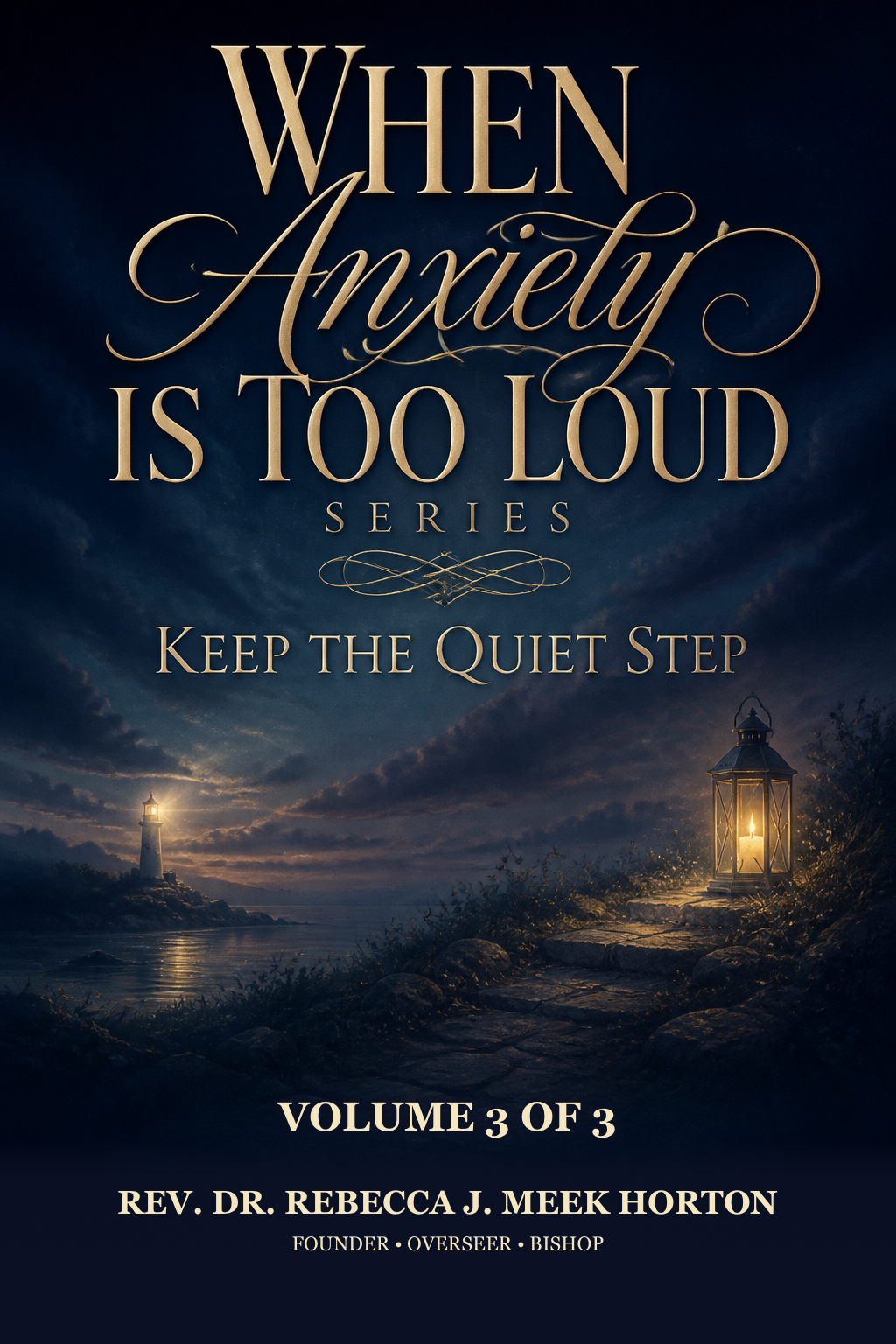
 NBCNGMI™
When Anxiety Is Too Loud · Volume 3
Keep the Quiet Step
Part 3 of 3 in the series "When Anxiety Is Too Loud". Series theme: Do not try to fight anxiety or reason with it. Series arc: This three-book series moves from interruption to surrender to steady living. The first book teaches readers to stop arguing with anxiety and create enough quiet to see what is really happening. The second book helps them place fear, control, and uncertainty before God wit
Full publication
NBCNGMI MASTER KNOWLEDGE LIBRARY Featuring the works of The Sage, Apostle Prophet. Rev. Dr. Rebecca J. Meek Horton, Apostolic Prophetic Architect, NewBeing Creation Network Global Ministries, Inc. Integrated Framework Modalities™
Dedication
I dedicate this book to every soul learning to keep walking while anxiety is still loud. May you discover that peace is not proven by perfect feelings, but by one quiet, faithful step with God. May your daily obedience become a path of steady trust.
Purpose
I wrote this book to help you keep walking faithfully after the first surrender, even when anxiety has not fully disappeared. My hope is that these pages give you a quiet daily rhythm of waiting, asking, listening, and taking one obedient step at a time, anchored in God’s Word and His peace. May you learn to live with steadiness, wisdom, and courage, trusting that the Lord can guide your next step even when the whole path is not yet clear.
Preface
I wrote this book for the tender place after surrender.
That place is not always loud. Sometimes it is very quiet. You have prayed. You have stopped arguing with anxiety. You have placed fear, control, and uncertainty before God. You have meant it.
And still, anxiety may speak again.
That can feel discouraging. Many people think peace means the anxious voice disappears completely. But in real life, growth often looks more like this: anxiety is still present, but it no longer gets to govern the next step.
This book was born from that truth.
Keep the Quiet Step is not a book about pretending you are never afraid. It is not a book about forcing yourself into confidence. It is not a replacement for wise counsel, pastoral care, medical support, or professional help when those are needed. It is a companion for daily stewardship. It is for the morning decision, the hard conversation, the unfinished work, the needed boundary, the quiet return to God when your thoughts begin to race again.
The first surrender matters. But faithfulness is learned in the steps that follow.
Isaiah 26:3 (KJV)
Thou wilt keep him in perfect peace, whose mind is stayed on thee: because he trusteth in thee.
That verse does not describe a life with no pressure. It describes a mind being kept. A mind stayed on God. A heart learning trust in the middle of real life.
This is the movement of the book: wait, ask, listen, and keep the next faithful step. Not ten steps. Not the whole future. One obedient step at a time.
There is a cost here. Quiet steps require humility. They ask us to slow down when we want control, to seek wisdom when we want certainty, to rest when we feel guilty, and to keep doing good when results are not immediate.
But there is also grace here.
You do not have to wait until anxiety vanishes to live faithfully. You can begin where you are. You can let God steady your mind, order your day, guide your decisions, and teach your feet how to walk in peace.
My prayer is that these pages help you stop measuring your growth by the absence of anxiety and begin recognizing the presence of wisdom, obedience, and quiet courage.
WISDOM is not yours until YOU WALK IT.
So begin gently.
Keep the quiet step.
Introduction
Anxiety can become quieter without disappearing.
That sentence matters for this final book. Many people believe faithful living begins only after anxiety is gone. They wait to make decisions until fear is silent. They wait to rest until the mind stops racing. They wait to obey until they feel completely steady. But anxiety does not have to vanish before you can take a faithful step.
Keep the Quiet Step is about life after the first surrender.
The first book in this series helped you stop arguing with anxiety long enough to see what was really happening. The second book helped you bring fear, control, and uncertainty before God without turning prayer into another form of striving. This third book moves from surrender into practiced stewardship.
The question now is not, “How do I make anxiety disappear?”
The question is, “How do I live faithfully when anxiety is still speaking but no longer gets to lead?”
That is the work of this book.
Isaiah 26:3 (KJV) Thou wilt keep him in perfect peace, whose mind is stayed on thee: because he trusteth in thee.
Peace is not always the absence of pressure. Sometimes peace is the guarded place where your mind returns when pressure rises. It is the grace to pause before reacting, ask for wisdom before deciding, listen before assuming, and keep the next obedient step before trying to control the whole road.
This book will give you a simple daily rhythm:
Wait. Ask. Listen. Keep.
Wait before you rush. Ask honestly, without performing strength. Listen for what is true, wise, and faithful. Keep the next step you have been given.
Psalm 119:105 (KJV) Thy word is a lamp unto my feet, and a light unto my path.
A lamp does not show the whole journey at once. It gives enough light for the next step. That is often how God forms steadiness in anxious seasons. Not by giving us every answer at once, but by teaching us to walk with Him in the amount of light we have.
You will see this rhythm applied to ordinary places: decisions, relationships, work, rest, boundaries, disappointment, and the return of anxious thoughts. The goal is not to build a life where nothing ever shakes you. The goal is to become someone who knows how to return to God, receive wisdom, and move with obedience instead of panic.
James 1:5 (KJV) If any of you lack wisdom, let him ask of God, that giveth to all men liberally, and upbraideth not; and it shall be given him.
Read this book slowly. Do not use it as another project to master. Use it as a practice guide. Each chapter will ask you to notice what is happening, name what anxiety is trying to lead, and choose one faithful response. Small steps matter. Repeated obedience matters. Returning matters.
There will be tension. Keeping the quiet step may cost you the comfort of overexplaining, overplanning, overchecking, and overcontrolling. It may ask you to stop rehearsing every possible outcome. It may require an honest boundary, a delayed answer, a humble apology, a simpler schedule, or a quieter way of making decisions.
But maturity is often built there.
Galatians 6:9 (KJV) And let us not be weary in well doing: for in due season we shall reap, if we faint not.
This book is not asking you to pretend you are never anxious. It is inviting you to stop giving anxiety governing authority. Anxiety may speak. It may rise again. It may knock loudly at familiar doors. But through God’s Word, prayer, wisdom, and practiced obedience, you can learn to answer differently.
Begin here: choose one area of your life where anxiety has been trying to lead. Do not solve the whole thing today. Simply write it down, bring it before God, and ask, “What is the next quiet step of obedience?” Then take that step.
Chapter 1 — When Anxiety Still Speaks
The room is quiet now.
The prayer has been prayed. The tears have slowed. The decision has been made: I will not let anxiety rule me.
Then morning comes.
The body wakes before the mind is ready. The chest tightens. The old questions return. What if this happens? What if I cannot handle it? What if I made the wrong choice? Nothing dramatic has occurred, but anxiety is speaking again.
Maybe the phone has not even rung yet. Maybe no one has said anything unkind. Maybe the calendar looks ordinary. Still, the body remembers old alarms. The mind reaches for old patterns. Before your feet touch the floor, anxiety is already offering instructions.
Check everything.
Rehearse everything.
Prepare for the worst.
Do not trust peace.
This is where many people feel confused. They thought surrender would make anxiety disappear. They thought peace would arrive like a permanent silence. They thought giving the fear to God meant they would never feel it again.
But life after surrender is often quieter than that.
The controlling idea of this chapter is simple: anxiety may still speak, but it does not have to lead. Steady faithfulness is possible when you learn to keep the next step with God, even before every feeling is calm.
Isaiah gives us a promise strong enough for ordinary days.
Isaiah 26:3 (KJV)
Thou wilt keep him in perfect peace, whose mind is stayed on thee: because he trusteth in thee.
Perfect peace does not mean a life without pressure. It means a kept life. A guarded life. A mind brought back, again and again, to the One who is faithful.
That word kept matters. It does not sound dramatic. It sounds steady. Held. Watched. Guarded. Preserved.
This is the promise we need after the first surrender. Not a promise that anxiety will never make noise again. Not a promise that every question will be answered before noon. A promise that God is able to keep the one whose mind returns to Him in trust.
You may still feel something.
You may still notice the old tremor.
You may still need to pause.
But anxiety is not the shepherd of your day.
You are not starting over every time anxiety speaks. You are learning a new order. You are learning that a feeling can be present without being in charge. You are learning that peace is not proven by the absence of pressure, but by the presence of God keeping you in the middle of it.
This is where the quiet step begins.
Not in a perfect morning.
Not in a fearless body.
Not in a future where nothing can go wrong.
The quiet step begins in the honest place where anxiety is still talking, but you choose not to hand it the lead.
Surrender Is Not the End of Practice
Surrender is real. But surrender is not the end of your formation.
When you place fear before God, you are not signing a contract that says you will never tremble again. You are changing leadership. You are saying, “Anxiety may be present, but it is no longer my authority.”
That distinction matters.
A person can feel anxiety and still obey God.
A person can feel uncertain and still choose wisdom.
A person can feel unsettled and still speak gently, work faithfully, rest honestly, and make a responsible decision.
This truth may feel small at first, but it is deeply freeing. Many people wait for a completely calm inner life before they take the next step. They think, When I feel peaceful, I will obey. When I feel settled, I will decide. When I feel brave, I will have the conversation. When I feel certain, I will move.
But obedience often begins before the feeling catches up.
This does not mean you ignore what is happening in your body. It does not mean you shame yourself for being anxious. It does not mean you pretend. It means you stop treating anxiety as the final authority over what faithfulness is possible today.
Surrender opens the door. Practice teaches you how to walk through it.
Think of a person learning to walk after an injury. The first standing moment matters. It is a victory. But strength is rebuilt through repeated steps. Small steps. Slow steps. Steps that do not look impressive to anyone watching.
The person may still feel weakness in the leg. They may still need support. They may still move with care. But every faithful step retrains the body to carry weight again.
The same is true here.
You may have had a moment of release in prayer. You may have finally stopped arguing with the fear. You may have named control for what it was and handed it to God. That was not fake because anxiety returned the next day.
It means the work is becoming daily.
Jesus spoke of daily discipleship, not one dramatic moment that removes all need for walking.
Luke 9:23 (KJV)
And he said to them all, If any man will come after me, let him deny himself, and take up his cross daily, and follow me.
Daily does not diminish surrender. Daily proves it.
There is grace for the moment at the altar, at the bedside, in the car, or at the kitchen sink when you finally say, “Lord, I give this to You.” There is also grace for the Tuesday morning when you must live that surrender in a crowded inbox, a hard decision, a tired body, or a conversation you would rather avoid.
This book is about that daily work. Not striving. Not panic management as a lifestyle. Not pretending. It is about practiced stewardship: learning to live faithfully without waiting for anxiety to vanish.
Practice is not punishment. Practice is how surrender becomes a way of life.
A surrendered life still needs rhythms.
A surrendered life still needs wisdom.
A surrendered life still needs boundaries, rest, counsel, patience, confession, and correction.
We sometimes treat surrender as if it should erase the need for training. But Scripture teaches us that following Jesus is lived out in daily obedience. The first yes matters. The next yes matters too.
A person may forgive someone sincerely and still need to practice new boundaries.
A person may trust God with provision and still need to make a budget.
A person may surrender a relationship and still need to stop checking for signs of control.
A person may release fear and still need to learn how to begin the morning without letting anxious thoughts organize the day.
That is not failure. That is formation.
Anxiety often argues, “If you were really free, you would not feel this anymore.”
That is not the voice of wisdom. Freedom is not always the immediate absence of feeling. Sometimes freedom is the new ability to refuse an old master. Sometimes freedom is the grace to pause where you used to panic. Sometimes freedom is the strength to take one obedient step while your emotions are still catching up.
Paul teaches believers to cast care on God, not because care is imaginary, but because God is faithful with what we cannot carry rightly.
1 Peter 5:7 (KJV)
Casting all your care upon him; for he careth for you.
Casting is not pretending the care does not exist. It is transferring the weight. It is refusing to carry as lord what belongs before the Lord.
There may be days when you must cast the same care again. Not because God failed to receive it, but because your hands reached back for it. Be honest about that. Then return without shame.
The daily work is not to perform peace. The daily work is to practice trust.
You may need to say, “Lord, I gave this to You last night, and I feel it again this morning. I am bringing it back. Teach me the next faithful step.”
That prayer is not weakness. It is stewardship.
It names the truth.
It refuses shame.
It returns leadership to God.
Peace Can Keep You While You Are Still Learning
Isaiah 26:3 does not say you keep yourself in perfect peace. It says, “Thou wilt keep him.”
That is mercy.
Anxiety often makes peace feel like something you must manufacture. If you can think correctly enough, pray perfectly enough, plan carefully enough, or control enough variables, then maybe you can feel safe.
But biblical peace begins with God’s keeping power.
Your part is not to become your own keeper. Your part is to stay your mind on Him. To return your attention. To trust again. To refuse the anxious invitation to build your whole day around imagined danger.
A stayed mind is not a mind that never wanders. It is a mind that knows where to return.
That matters because anxious thoughts often move quickly. One thought becomes ten. One possibility becomes a prediction. One message becomes a whole story. One unknown becomes evidence that something is wrong.
A stayed mind does not always stop the first thought from arriving. It learns not to host every thought as truth.
For example, you may begin the day steady, then receive a message that unsettles you. Anxiety rushes in with a full report. It gives you conclusions without evidence. It urges you to respond quickly, defend yourself, cancel everything, or rehearse the worst outcome.
A stayed mind pauses.
It may say, “This is anxiety speaking. I do not need to answer from this place.”
It may return to Scripture.
It may breathe, pray, and wait before replying.
It may ask for counsel instead of spiraling alone.
It may do the next faithful thing already in front of it.
This is not weakness. This is Governed Movement™. You are not being dragged by urgency. You are allowing peace to govern attention before action.
Paul gives a similar invitation when he teaches believers to bring care to God rather than be ruled by it.
Philippians 4:6-7 (KJV)
Be careful for nothing; but in every thing by prayer and supplication with thanksgiving let your requests be made known unto God. And the peace of God, which passeth all understanding, shall keep your hearts and minds through Christ Jesus.
Notice again the word keep.
Peace is not presented as something you force into existence by mental effort. The peace of God keeps the heart and mind through Christ Jesus. It stands guard where anxiety wants to take over. It does not always explain everything. It passes understanding. It may steady you before you can fully describe how.
That is why the quiet step matters. You are learning to live under the keeping of God in real moments, not only in spiritual moments that feel calm.
At the office, peace may keep you from sending the harsh reply.
In the family conversation, peace may keep you from withdrawing into silence as punishment.
At night, peace may keep you from checking the same thing again and again.
In uncertainty, peace may keep you from forcing a decision that wisdom has not confirmed.
Peace can keep you while you are still learning.
Nothing is random. Nothing is wasted. Even the moment anxiety rises can become a place of RE-Calibration™ if you let it teach you where your mind needs to return.
You do not have to despise the moment of return. Returning is part of maturity. The child learning to walk is not mocked for reaching for the steady hand. The believer learning peace is not condemned for needing to come back again.
A stayed mind may look very ordinary.
It may look like closing your eyes for thirty seconds before you answer the question.
It may look like saying, “I need a little time to think before I respond.”
It may look like reading one verse before checking the news.
It may look like turning your attention from the imagined disaster back to the actual responsibility in front of you.
It may look like telling yourself the truth slowly: “God is here. This is today. I do not have to live tomorrow yet.”
Peace often begins with a return of attention.
Anxiety pulls attention forward, backward, outward, and inward all at once. It drags you into what might happen, what already happened, what someone may think, what you may lose, what you did wrong, what you must fix, what you cannot know.
The kept mind is not careless. It is gathered.
It comes back to God.
It comes back to truth.
It comes back to the present assignment.
It comes back to the next faithful step.
Jesus gives peace differently than the world gives it. The world often offers peace by promising favorable conditions. Jesus gives peace in Himself.
John 14:27 (KJV)
Peace I leave with you, my peace I give unto you: not as the world giveth, give I unto you. Let not your heart be troubled, neither let it be afraid.
This is not a command meant to shame a trembling heart. It is an invitation to receive a peace that does not depend on everything around you becoming manageable.
The world says, “When everything is settled, then you can be at peace.”
Jesus says, “My peace is given to you.”
That peace may not remove every problem at once. But it can keep you from being ruled by the problem. It can steady your heart enough to speak wisely, wait honestly, work faithfully, rest humbly, and refuse the anxious command to become your own savior.
You are still learning.
Peace can keep you there too.
Anxiety Can Speak Without Leading
One of the most important shifts in this final part of the journey is learning to hear anxiety without obeying it.
Anxiety is loud because it wants authority.
It does not usually present itself as a suggestion. It sounds like command. Check again. Ask again. Hide now. Fix it now. Decide now. Escape now. Prove it now.
But volume is not lordship.
Just because anxiety speaks first does not mean it speaks truth. Just because it feels urgent does not mean it is wise. Just because your body reacts does not mean your next step must be ruled by fear.
This is where RE-Language™ becomes important.
Instead of saying, “I cannot function because I am anxious,” you may learn to say, “Anxiety is present, and I can take one faithful step.”
Instead of saying, “I have no peace, so I must not move,” you may say, “I do not feel fully calm, but I can move with wisdom.”
Instead of saying, “This feeling means something bad is coming,” you may say, “This feeling is asking for attention, but God will help me discern what is true.”
That shift is not denial. It is responsibility.
You are not shaming yourself for feeling anxious. You are also not handing anxiety the keys.
Picture a child shouting from the back seat while a parent is driving. The child may be afraid. The fear may be real to them. A wise parent does not mock the child. But the parent also does not let the child grab the steering wheel.
The parent may speak calmly. “I hear you. We are not turning the wheel from the back seat. I am driving.”
That is a picture of wise inner leadership.
Anxiety can be acknowledged without being obeyed.
You can say, “I hear the fear.” Then you can keep your hands on the wheel of obedience.
This is not the same as suppressing. Suppression says, “Nothing is happening.” Stewardship says, “Something is happening, and I will respond wisely.”
There is a difference.
If anxiety is alerting you to a real responsibility, you can take the responsible step. Pay the bill. Make the appointment. Ask the clarifying question. Apologize where needed. Prepare with integrity. Seek help where help is wise.
But if anxiety is demanding control beyond your responsibility, you can refuse the demand. You do not have to rehearse every outcome. You do not have to solve everyone’s response. You do not have to know the whole future to obey God in the next ten minutes.
Jesus gave a clear boundary for anxious attention.
Matthew 6:34 (KJV)
Take therefore no thought for the morrow: for the morrow shall take thought for the things of itself. Sufficient unto the day is the evil thereof.
This does not mean planning is wrong. Scripture honors wisdom, diligence, and preparation. But Jesus confronts the anxious reach that tries to live tomorrow before tomorrow arrives.
Anxiety says, “You must carry tomorrow now.”
Wisdom says, “Receive today’s light. Keep today’s step.”
There is a simple test that can help when anxiety starts giving orders.
Ask, “Is this a responsibility, or is this a demand for control?”
A responsibility has a faithful next step. It may be hard, but it is clear enough to begin.
A demand for control usually multiplies without end. It asks you to manage what belongs to God, predict what has not happened, and secure what cannot be secured by human effort.
Responsibility says, “Prepare the document.”
Control says, “Make sure no one ever misunderstands you.”
Responsibility says, “Ask the honest question.”
Control says, “Keep asking until you feel completely safe.”
Responsibility says, “Care for your body today.”
Control says, “Monitor every sensation until you are certain nothing is wrong.”
Responsibility says, “Tell the truth in love.”
Control says, “Make sure the other person responds exactly as you hope.”
Anxiety often disguises control as responsibility. That is why discernment matters.
SAPP™ Discernment can slow the moment down.
See what is really happening.
Ask what anxiety is demanding and what wisdom is requiring.
Ponder motive, timing, counsel, and Scripture.
Practice the next faithful step.
This is not complicated, but it is not always easy. Anxious urgency does not like being slowed. It wants immediate obedience. It wants you to move before wisdom has spoken.
But you can learn a different rhythm.
You can say, “I will not Force-The-FiT™. I will not turn pressure into proof. I will not make urgency my shepherd.”
Sometimes the faithful step will be action.
Sometimes it will be waiting.
Sometimes it will be asking for help.
Sometimes it will be choosing silence until your words can be governed by peace.
Sometimes it will be doing the ordinary thing anxiety says is too small to matter.
That may mean folding laundry instead of spiraling.
It may mean attending the meeting instead of hiding.
It may mean eating breakfast instead of beginning the day on dread alone.
It may mean answering the one email you can answer, not the whole future of your career.
It may mean saying, “I cannot solve this tonight. I will write down what is mine to do tomorrow, and I will rest.”
Anxiety can speak without leading.
This sentence will need to be practiced.
Not once.
Often.
The goal is not to silence every anxious thought by force. The goal is to stop giving anxious thoughts governing authority over your obedience.
The Cost of a Kept Mind
This will cost you something.
It will cost you the false relief of reacting quickly.
It will cost you the familiar comfort of rehearsing every possible outcome.
It will cost you the old belief that you must feel certain before you can be faithful.
It may also cost you the identity anxiety helped you build. Some people have lived so long in emergency mode that peace feels irresponsible. Slowness feels unsafe. Trust feels like losing control.
That is an honest tension.
When urgency has been your normal, quiet can feel strange. When overthinking has felt like protection, simplicity can feel careless. When you have been rewarded for overfunctioning, rest can feel like failure. When you have survived by scanning for danger, peace may feel unfamiliar before it feels safe.
So the kept mind must be trained gently but firmly.
It must learn, “I can be responsible without being ruled by fear.”
It must learn, “I can care deeply without controlling everything.”
It must learn, “I can prepare without worshiping certainty.”
It must learn, “I can move slowly and still be obedient.”
This is part of RE-Calibration™. Not a quick emotional adjustment, but a steady returning of your attention, language, decisions, and habits under the care of God.
But anxiety is a costly leader.
It spends tomorrow’s strength today. It turns relationships into places of suspicion. It makes ordinary decisions feel like trials. It confuses preparation with control. It can make rest feel like danger and obedience feel too small to matter.
Anxiety may promise protection, but it often produces exhaustion.
It may promise readiness, but it often produces paralysis.
It may promise control, but it often produces bondage.
The kept mind learns another way.
It does not demand a full map before taking the next step. It receives enough light for today. It learns to ask, “What is mine to do now?” and “What must I leave with God?”
Those two questions are simple, but they can interrupt many anxious cycles.
What is mine to do now?
Maybe the answer is to tell the truth kindly.
Maybe it is to wash the dishes.
Maybe it is to stop scrolling.
Maybe it is to go to sleep.
Maybe it is to ask for wisdom.
Maybe it is to wait before deciding.
What must I leave with God?
The other person’s reaction.
The outcome you cannot force.
The timing you cannot control.
The future you cannot see.
The approval you cannot secure.
The burden you were never assigned to carry.
This is where steady faithfulness begins.
Not with a dramatic vow.
Not with a perfect emotional state.
Not with a life where nothing presses you.
Steady faithfulness begins when you stop waiting for anxiety to be silent before you obey what is clear.
You answer one email without panic.
You have one honest conversation without rehearsing it twenty times.
You take one rest period without apologizing for being human.
You pray one simple prayer without turning it into mental labor.
You do the next right thing, and then the next.
This is not glamorous. It may not feel like breakthrough. But it is the kind of obedience that rebuilds a life.
Galatians 6:9 (KJV)
And let us not be weary in well doing: for in due season we shall reap, if we faint not.
Weariness is real. The verse does not deny it. It teaches endurance in the middle of it. Well doing still matters when you are tired. The quiet step still matters when you cannot see fruit yet. The kept mind is not formed by one moment of courage, but by repeated returns to what is true.
WISDOM is not yours until YOU WALK IT.
This cost is not meant to discourage you. It is meant to tell the truth.
There may be a cost in your relationships. If anxiety has trained you to overexplain, people may be surprised when you speak more simply. If anxiety has trained you to rescue everyone, people may be uncomfortable when you begin to practice healthy boundaries. If anxiety has trained you to say yes quickly so no one is disappointed, faithfulness may require you to pause before answering.
There may be a cost in your work. If anxiety has driven you to overfunction, you may need to learn the difference between diligence and self-punishment. If anxiety has kept you avoiding responsibilities, you may need to take small honest steps back into stewardship. Either way, anxiety does not get to define faithfulness.
There may be a cost in your inner life. You may have to let go of the belief that constant mental labor equals care. You may have to stop calling worry love. You may have to admit that rehearsing every outcome has not made you safer; it has made you tired.
That honesty is part of healing.
Not everything anxiety taught you was wisdom.
Some of it was survival.
Some of it was habit.
Some of it was control wearing the clothes of concern.
The quiet step asks you to let God retrain what anxiety trained. That takes time. Be patient, but be honest. Be gentle, but do not hand the wheel back to fear.
If anxiety is severe, persistent, or interfering with your ability to function, seeking support from wise pastoral care, trusted counsel, or a qualified professional can be a faithful step. Help is not failure. Stewardship sometimes includes receiving care instead of trying to carry everything alone.
The goal is not isolation.
The goal is governed, faithful movement.
A kept mind is not a mind that refuses help. It is a mind learning where to return, what to release, and how to obey with the light it has.
The Promise of Kept Steps
This book will not ask you to fight anxiety as if your mind is a battlefield you must win by force. It will not ask you to reason with every fear until you are exhausted. It will not teach you to chase a feeling of perfect calm before you live.
It will invite you into kept steps.
A kept step is a small act of obedience held under God’s peace.
It may look unimpressive. It may not remove every symptom. It may not answer every question. But it returns leadership to God.
You wait before moving.
You ask for wisdom.
You listen for the next right thing.
You keep the step in work, rest, relationships, and responsibility.
And when anxiety rises again, you return to peace without shame.
This is not a lesser life. This is maturity.
Maturity is not proven by never feeling fear. Maturity is seen when fear is no longer allowed to rule the house. It is seen when you can notice the anxious thought, bring your mind back to God, ask for wisdom, and keep the step that belongs to you.
Some days the step will be outward. Make the call. Finish the task. Set the boundary. Keep the commitment.
Some days the step will be inward. Release the outcome. Confess the control. Stop rehearsing the accusation. Receive mercy.
Some days the step will be relational. Speak honestly. Listen without defending. Apologize without overexplaining. Let someone help.
Some days the step will be rest. Close the laptop. Put the phone down. Eat the meal. Take the walk. Sleep without solving everything.
None of these are small when they are done in obedience.
Psalm 119:105 (KJV)
Thy word is a lamp unto my feet, and a light unto my path.
A lamp does not show the whole road at once. It gives enough light for the next step. Anxiety wants a floodlight over the entire future. God often gives a lamp for your feet.
That is not abandonment. That is training in trust.
The promise of Isaiah 26:3 is not that you will keep yourself by constant control. The promise is that God keeps the one whose mind is stayed on Him. Your daily practice is to return. His faithful work is to keep.
So when anxiety still speaks, do not be surprised. Do not call the whole surrender false. Do not begin arguing again. Do not hand fear the authority Jesus has not given it.
Pause.
Return.
Ask, “What is the next faithful step?”
Then keep it.
Not because you feel perfectly calm.
Because God is faithful, His Word gives light, and peace can govern one step at a time.
This is the promise of kept steps: your life can become steady without becoming easy. Your obedience can become clear without every uncertainty being removed. Your peace can become deeper without every anxious sensation disappearing first.
You can live today.
Not the whole year.
Not every possible version of tomorrow.
Today.
You can receive enough light for the step in front of you. You can ask God for wisdom. You can wait before moving. You can listen for what is true. You can keep one faithful action. And if anxiety rises again before the day is over, you can return again.
Returning is not defeat.
Returning is discipleship.
Every return says, “My mind belongs back with God.”
Every kept step says, “Anxiety may speak, but it is not leading.”
Every small obedience says, “Peace is not a mood I must manufacture. Peace is a gift of God that can govern this moment.”
This is how a life is rebuilt after surrender.
Not by arguing with anxiety.
Not by waiting for perfect calm.
Not by forcing a future you cannot see.
But by walking with God in the light He gives.
One quiet step at a time.
Key Takeaways
• Anxiety may still speak, but it does not have to lead.
• Peace begins with God’s keeping power, not your perfect control.
• Steady faithfulness grows through one kept step at a time.
Practice
Today, when anxiety speaks, do not argue with it. Pause and write one sentence:
“Anxiety is present, but it is not leading this next step.”
Then name one faithful action you can take in the next ten minutes. Keep it small, clear, and obedient.
Closing Prayer
Father, teach me how to live after surrender. When anxiety speaks again, help me not to panic, argue, or return to old control. Keep my mind stayed on You. Train my attention to come back to Your truth, my body to slow down under Your peace, and my steps to follow Your wisdom.
Show me what is mine to do today, and help me release what belongs in Your hands. Give me courage for one faithful step, humility to ask for help when needed, and grace to return without shame when I drift. Let Your Word be a lamp unto my feet and a light unto my path.
In Jesus’ name, Amen.
Chapter 2 — The Quiet Step Is Not a Small Step
The dishes were still in the sink.
That was the first thing she noticed after she prayed.
She had knelt beside the bed with her hands open and told God the truth. The fear. The pressure. The tired thoughts that kept circling the same problem. She did not hide behind polished words. She surrendered what she could name and what she could not.
Then she stood up.
Her chest was still tight.
The room was still quiet, but not peaceful in the way she had hoped. No sudden wave of relief. No clear answer written across the ceiling. No feeling that everything was fixed.
Only the dishes.
So she walked to the kitchen, turned on the water, washed one cup, then another. Not because the dishes were the whole answer. Not because clean plates could heal anxiety. But because one faithful step was available.
This is the controlling idea of this chapter: progress is not always measured by how calm you feel; sometimes progress is measured by the faithful step you keep while anxiety is still speaking.
That step is not small.
It may look ordinary. It may feel unimpressive. It may not make a good testimony in the moment. But when you choose obedience over panic, stewardship over collapse, and presence over escape, something holy is being strengthened in you.
The quiet step is not a small step.
Progress Is Not Always Dramatic
Many of us want relief to feel dramatic.
We want the moment when fear breaks, peace floods in, and every anxious thought goes silent. Sometimes God gives mercy like that. Sometimes He calms the storm quickly. We should thank Him when He does.
But steady maturity is often quieter.
It may look like answering one message with honesty instead of avoiding it.
It may look like eating a simple meal when anxiety has taken away your appetite.
It may look like apologizing without overexplaining.
It may look like going to bed instead of rehearsing every possible outcome.
It may look like saying, “I do not have to solve this tonight.”
It may look like opening the bill instead of letting dread decide the whole evening.
It may look like turning off the news because your soul has had enough noise.
It may look like walking outside for ten minutes, not because the problem vanished, but because your body needs care while your mind is under pressure.
Anxiety often tells us that only big change counts. If we are not fully calm, fully clear, fully confident, then we assume we are not growing.
That is not true.
A farmer does not despise the seed because it is not yet a harvest. A builder does not despise the foundation because it is not yet a finished house. A believer must not despise the faithful step because it does not feel like full deliverance.
Zechariah 4:10 (KJV) For who hath despised the day of small things? for they shall rejoice, and shall see the plummet in the hand of Zerubbabel with those seven; they are the eyes of the LORD, which run to and fro through the whole earth.
The day of small things is still a day God can use.
A small act of obedience is not wasted. A quiet refusal to be ruled by fear is not wasted. A moment of stillness before reacting is not wasted.
Nothing is random. Nothing is wasted.
When anxiety is loud, faithfulness may not feel powerful. But it is powerful because it places leadership back where it belongs. Anxiety may still be present, but it does not get to govern the next step.
Think about a person recovering after a storm has passed through the neighborhood. The sky may be clear, but branches are still on the ground. The power may flicker. The fence may lean. Nobody looks at that person sweeping glass from the porch and says, “This is meaningless because the whole house is not repaired yet.”
No. That sweeping matters.
It is part of recovery.
In the same way, after surrender, your life may still have things to tend. Your nerves may still feel unsettled. Your mind may still reach for old patterns. Your body may still remember the alarm. But the quiet step says, “I will begin where grace has given me light.”
You do not have to rebuild the whole house in one afternoon.
Wash the cup.
Make the call.
Take the walk.
Tell the truth.
Close the laptop.
Pray the honest prayer.
Do the next faithful thing.
Progress is not always a breakthrough you can announce. Sometimes it is a stewardship you quietly keep.
Stop Measuring Maturity by Calm
Calm is a gift, but calm is not the only evidence of growth.
This matters because anxious people often become anxious about being anxious. They think, I should be past this by now. I prayed. I surrendered. Why do I still feel this?
That question can become another burden.
There is a better way to speak.
Instead of saying, “I am failing because I still feel anxious,” try this:
“Anxiety is present, but I can steward this next step.”
That is RE-Language™. It does not deny the struggle. It refuses to turn the struggle into your identity.
Feeling anxious does not automatically mean you are faithless. It may mean your body is tired. It may mean your mind has been carrying too much. It may mean an old fear has been touched. It may mean a real decision needs wisdom. It may mean you need support, rest, counsel, or care.
Maturity is not pretending none of that exists.
Maturity is learning not to hand the steering wheel to anxiety.
Think of a parent walking with a child across a busy street. The child is scared. The cars are loud. The parent does not shame the child for trembling. The parent gives a hand and says, “Stay with me. Take the next step.”
God is not confused by your trembling.
He knows how to lead people who are still learning peace.
Psalm 37:23-24 (KJV) The steps of a good man are ordered by the LORD: and he delighteth in his way. Though he fall, he shall not be utterly cast down: for the LORD upholdeth him with his hand.
The verse speaks of steps, not leaps.
Steps can be ordered by the Lord even when the person taking them feels weak. The promise is not that you will never stumble. The promise is that the Lord upholds.
So do not use your emotional state as the only measure of your spiritual condition.
Ask better questions.
Did I pause before reacting?
Did I tell the truth instead of hiding?
Did I ask God for wisdom?
Did I do the next responsible thing?
Did I return when I drifted?
Did I receive help instead of isolating?
Did I choose what was faithful over what was frantic?
These questions build maturity. They move you from shame to stewardship.
They also help you recognize peace differently. Peace is not always the absence of every anxious sensation. Sometimes peace begins as a new center of leadership. The anxious thought may still knock, but it no longer owns the house.
Isaiah 26:3 (KJV) Thou wilt keep him in perfect peace, whose mind is stayed on thee: because he trusteth in thee.
A stayed mind is not a mind that never feels pressure. It is a mind being held, returned, and re-centered in God.
That returning matters.
You may have to return many times in one day. Return while driving. Return before replying. Return after a difficult conversation. Return when the old fear says, “Here we go again.” Return when your chest tightens and your thoughts begin to scatter.
Returning is not failure.
Returning is practice.
The person who learns an instrument does not become mature because every note is perfect on the first day. They become mature because they return to the lesson, return to the rhythm, return to the discipline, and let repeated practice form skill.
The same is true here.
You are learning to be governed by wisdom, not by anxiety. That kind of formation usually happens step by step.
The Rhythm of a Kept Step
This book will keep returning to a simple rhythm:
Wait.
Ask.
Listen.
Keep.
This is not a formula for controlling outcomes. It is a daily practice for remaining led when anxiety wants to take over.
Wait means you do not let urgency become your master. You pause long enough to remember that fear is not Lord.
Ask means you bring the real question to God. Not the polished question. Not the religious question. The real one. “Lord, what is wise here?” “What is mine to carry?” “What is not mine?” “What is the next faithful step?”
Listen means you pay attention to Scripture, godly counsel, conscience, fruit, and the steady witness of wisdom. You do not chase every inner alarm as if it were instruction.
Keep means you obey the next step you have been given. Not the whole future. Not every answer. Just the next faithful step.
That rhythm is simple, but it is not shallow.
It protects you from becoming a servant of urgency. It gives your soul a way to slow down without shutting down. It helps you stop treating every anxious message as a command.
Anxiety says, “Move now.”
Wisdom may say, “Wait.”
Anxiety says, “Figure out the whole future.”
Wisdom may say, “Ask for today’s light.”
Anxiety says, “Listen to every possible danger.”
Wisdom may say, “Listen for what is true, faithful, and responsible.”
Anxiety says, “Do everything or do nothing.”
Wisdom may say, “Keep the next step.”
A man overwhelmed by work may practice it like this. Before opening his laptop, he sits quietly for two minutes. He breathes. He stops rehearsing disaster. He asks, “Lord, what needs my attention first?” He notices the one task he has been avoiding because it feels heavy. He does not solve the entire week. He completes the first honest task.
That is a kept step.
A woman anxious about a relationship may practice it like this. She waits before sending the long message. She asks God for wisdom, not control. She listens to the fruit of her own words. Are they clear, kind, truthful, and necessary? Then she sends a shorter message that tells the truth without accusation.
That is a kept step.
A student afraid of failing may practice it like this. He waits instead of spiraling. He asks for help. He listens to wise instruction. He studies for twenty focused minutes instead of staring at the whole mountain.
That is a kept step.
A caregiver who feels stretched thin may practice it like this. She waits before agreeing to one more request. She asks, “What is mine to carry today?” She listens to the limits showing up in her body and the responsibilities already in her hands. Then she says a kind, honest no to what she cannot carry well.
That is a kept step.
A leader under pressure may practice it like this. He waits before making a public decision out of private fear. He asks for wisdom. He listens to counsel, Scripture, timing, and the fruit of the possible decision. Then he takes the next responsible action without trying to impress everyone.
That is a kept step.
The quiet step does not always remove anxiety immediately. But it trains the soul to move under wisdom instead of panic.
Matthew 6:34 (KJV) Take therefore no thought for the morrow: for the morrow shall take thought for the things of itself. Sufficient unto the day is the evil thereof.
Jesus did not deny that tomorrow has concerns. He taught us not to let tomorrow’s concerns consume today’s obedience.
That is part of the quiet step.
You are not being asked to carry all the grace you will need for every imagined future. You are being invited to receive grace for the step in front of you.
Today has enough work.
Today also has enough mercy.
What This Will Cost
This way of living will cost you the drama of all-or-nothing thinking.
Anxiety often prefers extremes. Do everything now. Quit completely. Fix it perfectly. Avoid it forever. Say yes to everyone. Trust no one. Hurry. Hide. Control.
The quiet step resists those extremes.
It asks you to live more honestly.
That may cost you the comfort of pretending you are fine. It may cost you the habit of using urgency to feel safe. It may cost you the pride of wanting every step to look impressive. It may cost you the false peace of avoidance.
It may also cost you the identity of being the person who always handles everything. Sometimes the next faithful step is not doing more. Sometimes it is admitting, “I cannot carry this wisely alone.”
It may cost you the familiar pattern of rehearsing pain before it happens. Anxiety often calls that preparation. Sometimes it is only suffering in advance.
It may cost you the need to make everyone understand your process. Quiet obedience is not always visible. People may not know how much courage it took for you to answer the email, attend the appointment, finish the meal, rest without guilt, or tell the truth without collapsing.
God knows.
It may also require you to receive help.
For some readers, anxiety is not only a passing feeling. It may be persistent, severe, or connected to trauma, health, grief, or long-term patterns. Faithful stewardship may include prayer, Scripture, pastoral care, wise counsel, medical support, therapy, rest, or practical changes in your environment. Seeking appropriate help is not failure. It can be part of the next faithful step.
The cost is real.
But so is the fruit.
Luke 16:10 (KJV) He that is faithful in that which is least is faithful also in much: and he that is unjust in the least is unjust also in much.
Faithfulness in what seems least is not lesser faithfulness.
The small step is where trust becomes practice. The quiet choice is where surrender becomes daily life. The ordinary act of obedience is where anxiety loses the right to lead.
You are not waiting for anxiety to disappear before you live faithfully.
You are learning to live faithfully while God forms steadiness in you.
That is not small.
That is wisdom becoming a walk.
WISDOM is not yours until YOU WALK IT.
A Prayer for the Quiet Step
Father, I come to You honestly.
Anxiety has been loud, and I have often measured my progress by how calm I feel. Teach me a better way.
Help me not to despise the quiet step. Help me recognize the obedience available to me today.
When fear speaks, remind me that fear is not my Lord.
When urgency rises, teach me to wait.
When I do not know what to do, teach me to ask.
When noise fills my mind, teach me to listen for what is true.
When You show me the next faithful step, give me grace to keep it.
Strengthen me in ordinary places. At the sink. At the desk. In the conversation. In the appointment. In the moment before I react. In the moment when I want to run.
I surrender the need to feel perfectly calm before I obey. I receive Your help for the step before me.
Order my steps. Uphold me with Your hand. Keep my mind stayed on You.
In Jesus’ name, Amen.
Key Takeaways
• Progress is not only calm; progress is kept obedience.
• Anxiety may speak, but it does not have to lead.
• Wait, ask, listen, and keep the next faithful step.
Practice
Choose one ordinary area today where anxiety has been trying to lead.
Do not choose the hardest thing. Choose one faithful step you can actually keep.
Write this sentence and complete it:
“Anxiety is present, but my next faithful step is…”
Then do that one step within the next twenty-four hours.
Keep it simple.
Keep it honest.
Keep the quiet step.
Chapter 3 — Wait Before You Move
The message came at 9:17 p.m.
It was short, sharp, and full of pressure. A decision was needed. A reply was expected. Your chest tightened before your mind caught up. Your hand reached for the phone. You started typing the first sentence that anxiety offered.
Then something in you knew: If I answer from this place, I may obey the pressure instead of the Lord.
That moment matters.
The single idea of this chapter is simple: stillness is stewardship, not avoidance. A quiet pause can interrupt anxious urgency before it becomes a decision, a sentence, a commitment, or a reaction you later have to repair.
Waiting does not mean you are doing nothing. Waiting means you are refusing to let anxiety govern your movement.
Psalm 46:10 (KJV) Be still, and know that I am God: I will be exalted among the heathen, I will be exalted in the earth.
The Pause Is a Place of Stewardship
Anxiety often speaks in commands.
Answer now.
Fix this now.
Explain yourself now.
Decide now.
Leave now.
Agree now.
Anxiety treats delay like danger. It tells you that if you do not move quickly, everything will fall apart.
Sometimes quick action is necessary. Emergencies require movement. Responsibility matters. If a child is in danger, you move. If a deadline is real and known, you honor it. If someone needs a clear answer from you because others are depending on it, you do not hide behind spirituality.
But many anxious decisions are not emergencies. They are reactions wearing the clothing of urgency.
A pause helps you see the difference.
Stillness gives your soul room to return to God before your behavior runs ahead of wisdom. It creates enough quiet to ask:
What is actually happening here?
What responsibility belongs to me?
What pressure am I carrying that may not be mine to carry?
This is not a long process at first. Sometimes the pause is one breath before you speak. Sometimes it is putting the phone down and walking away for five minutes. Sometimes it is waiting until morning. Sometimes it is telling someone, I need time to think before I answer.
That small space can protect a large part of your life.
Imagine a parent whose child brings home a problem from school. The child is upset. The parent feels anger rise. Anxiety says, Send the email tonight. Correct everybody. Protect your child immediately.
Love may be present. Concern may be real. The parent may need to ask questions, advocate, and take action. But if the parent pauses, they may notice that the first draft of the email is full of fear, accusation, and assumptions.
Waiting until morning does not mean the parent is careless. It may mean the parent is stewarding their response.
The pause protects the child, the parent, and the conversation.
It gives the parent time to listen to the child again, check the facts, pray, and respond with clarity. It allows protection to be governed by wisdom instead of driven by panic.
Stillness is not passivity. It is governed attention.
There is a difference between being still because you are afraid and being still because you are submitted.
Fearful stillness freezes.
Faithful stillness returns.
It returns to God. It returns to truth. It returns to responsibility without surrendering the steering wheel to anxiety.
In that return, you begin to remember: I do not have to be ruled by the first feeling that rises in me.
A simple prayer can begin the pause:
Lord, I am here. I feel the pressure to move quickly. Help me wait with You before I answer, decide, agree, defend, or run. Govern my attention. Lead me in truth. Amen.
Urgency Is Not Always Obedience
Many people confuse movement with faithfulness. If they are doing something, they feel responsible. If they are waiting, they feel guilty.
But Scripture does not honor haste as wisdom.
Proverbs 19:2 (KJV) Also, that the soul be without knowledge, it is not good; and he that hasteth with his feet sinneth.
This verse is plain. Zeal without knowledge is not good. Haste can lead the feet into sin.
That does not mean every fast decision is wrong. It means speed is not proof of wisdom.
Anxiety wants movement before understanding.
Wisdom seeks understanding before movement.
This matters in ordinary decisions.
You may feel pressure to accept an invitation because you do not want to disappoint someone.
You may feel pressure to spend money because fear tells you this is your only chance.
You may feel pressure to respond to criticism because silence feels like weakness.
You may feel pressure to make a life change because staying feels uncomfortable.
You may feel pressure to explain yourself because being misunderstood feels unbearable.
You may feel pressure to say yes because someone else’s urgency has become your assignment.
In each case, the question is not, Do I feel pressure?
The question is, Is this pressure producing faithful movement or anxious reaction?
A quiet step begins with a quiet pause.
Consider a worker who receives a correction from a supervisor. Anxiety rises quickly. The mind starts defending, explaining, and building a case. The worker wants to reply immediately with a long message.
But they wait.
They take ten minutes. They breathe slowly. They read the correction again. They separate tone from truth. They notice one part that is unfair and one part that may be accurate.
By waiting, they do not become weak. They become clearer.
The next response may still be honest. It may still set a boundary. It may still ask for clarification. But it will not be driven by panic.
That is maturity.
Maturity is not the absence of feeling. Maturity is the refusal to let feeling rule without wisdom.
A person can feel shaken and still speak carefully.
A person can feel afraid and still choose truth.
A person can feel misunderstood and still refuse to sin with their mouth.
This is where waiting becomes spiritual formation.
It trains you to notice the difference between pressure and prompting.
Pressure pushes.
Wisdom leads.
Pressure often demands immediate relief.
Wisdom can carry responsibility without rushing into confusion.
Lamentations 3:25-26 (KJV) The LORD is good unto them that wait for him, to the soul that seeketh him. It is good that a man should both hope and quietly wait for the salvation of the LORD.
Quiet waiting is not wasted time. It is a place where hope is trained.
Give Peace Your First Attention
Waiting before you move is not only about slowing down your body. It is also about where you place your attention.
Anxiety pulls attention toward threat. It scans for what could go wrong, who might reject you, what you might lose, and how you can regain control.
The mind becomes crowded. The body tightens. The next step feels buried under noise.
Peace begins when attention is returned to God.
Isaiah 26:3 (KJV) Thou wilt keep him in perfect peace, whose mind is stayed on thee: because he trusteth in thee.
The promise is not that every circumstance becomes easy. The promise is that God keeps the one whose mind is stayed on Him.
Stayed means held, fixed, supported.
Anxiety scatters attention. Trust gathers it back.
This is why a daily moment of stillness matters.
Not a dramatic hour you cannot sustain.
Not a perfect prayer room.
Not a performance of calm.
A moment.
You can sit in a chair before the day begins. You can pause in the car before walking into work. You can place your hand on the kitchen counter before answering a difficult text. You can close your eyes before entering a meeting.
The point is not the location. The point is the return.
You are training your attention to come back under peace before you move.
This may feel too simple to matter. But much of faithful living is built in small returns.
One pause before a reply.
One breath before an accusation.
One prayer before a purchase.
One moment of stillness before saying yes to something you cannot carry.
The quiet step is formed there.
This is the Wait part of the rhythm.
Before asking for wisdom, before listening for direction, before keeping the next faithful step, you wait. You let your soul come out of the rush. You let your attention return to God. You let your body learn that not every pressure deserves immediate obedience.
Start small.
Choose one ordinary time each day. Before checking messages. Before starting work. Before making dinner. Before bed.
Sit or stand quietly for two minutes.
No phone.
No planning.
No solving.
No rehearsing conversations.
Just wait before God.
If thoughts come, notice them and return. If anxiety speaks, do not argue. Let it pass through the room without handing it the keys. If you feel restless, stay anyway.
You are not trying to create perfect calm. You are practicing availability to God.
You may need a simple structure at first.
Place both feet on the floor.
Relax your hands.
Take one slow breath.
Whisper, Lord, I am here.
Let the next breath be slower than the first.
Then sit quietly.
If a concern rises, do not chase it. Name it briefly before God: Lord, You see this.
If a task comes to mind, do not build a plan around it. Let it wait.
If your body feels tense, do not judge it. Let your body learn that stillness is safe in the presence of God.
This is not emptying your mind. It is staying your mind on Him.
Over time, this small practice begins to travel with you. You may notice a pause forming before you react. You may recognize pressure before it becomes speech. You may catch yourself before saying yes from fear or no from exhaustion.
You may begin to say, I do not need to answer this in panic.
You may begin to say, I can be responsible without being rushed.
You may begin to say, I will wait before I move.
Nothing is random. Nothing is wasted.
Even two quiet minutes can train a faithful life.
The Cost of Waiting
Waiting will cost you something.
It may cost you the satisfaction of a quick reply.
It may cost you the illusion of control.
It may cost you the approval of people who expect immediate access to you.
It may cost you the old comfort of overexplaining.
It may cost you the rush that comes from fixing something fast.
It may cost you the identity of being the one who always responds, always rescues, always absorbs pressure, always makes everything easier for everyone else.
This is why stillness can feel uncomfortable. Anxiety has trained many people to feel responsible for everything immediately. When they pause, they do not feel peaceful at first. They feel exposed.
Waiting may reveal how much you have depended on speed to manage fear.
That revelation is not shame. It is an invitation to RE-Calibration™.
You are not saying, I am irresponsible because I need a pause.
You are learning to say, I am pausing so I can respond responsibly.
That is RE-Language™. It moves you from shame to stewardship.
Language matters in anxious moments. If you say, I am avoiding this, when you are actually taking time to pray and think, shame may push you back into haste. If you say, I am weak because I cannot answer immediately, anxiety may use that accusation to hurry you.
But if you say, I am creating space for wisdom, your language begins to support obedience.
There is also a practical cost. Some situations do need a response. Waiting cannot become avoidance. Stillness is not an excuse to ignore hard conversations, delay obedience, or disappear when others are affected by your choices.
The difference is honest.
Avoidance says, I do not want to face this.
Stewardship says, I need to face this with wisdom.
Avoidance keeps delaying.
Stewardship sets a time to return.
Avoidance hides behind silence.
Stewardship uses silence to prepare for faithful speech or action.
Avoidance leaves people guessing.
Stewardship communicates what is appropriate with clarity.
If you need more time, say so plainly when appropriate: I received your message. I need time to think and pray before I respond. I will follow up tomorrow.
That sentence is simple, mature, and clear.
It does not make anxiety the leader. It does not punish the other person. It creates order.
There will be people who do not like your pause. Some may be used to your immediate response. Some may interpret your stillness as rejection. Some may press harder because your slower pace exposes their own urgency.
You cannot control every interpretation. You can steward your obedience.
Waiting before you move asks you to release the need to be instantly understood.
That is not easy.
But peace often requires boundaries around access, speech, and timing. Timing is as important as motive. A right word given from a rushed spirit can still wound. A needed decision made from panic can still create unnecessary repair.
A pause can be the mercy that protects what haste would damage.
A Prayer Before Moving
Lord, teach me to wait before I move.
When anxiety speaks in commands, help me hear Your truth more clearly. When pressure rises in my body, steady my mind in You. When I want to answer too quickly, defend too strongly, agree too easily, or run too soon, call me back to peace.
Give me wisdom to know the difference between responsibility and anxious urgency. Give me courage to act when obedience requires action. Give me humility to pause when my first response is not yet faithful.
I surrender the need to control every outcome. I surrender the fear of disappointing people. I surrender the habit of using speed to quiet my fear.
Let my words be governed. Let my timing be submitted. Let my next step be faithful.
Keep my mind stayed on You.
In Jesus’ name, Amen.
Key Takeaways
• Stillness is stewardship, not avoidance.
• Anxiety urges haste, but wisdom creates space.
• A daily pause trains attention to return to God.
Practice
Today, choose one decision, message, or task that feels urgent but is not an emergency.
Before you move, take two quiet minutes.
Sit still. Breathe slowly. Pray one simple sentence: Lord, keep my mind stayed on You before I take this step.
Then ask yourself: Am I moving from peace, responsibility, and obedience, or from pressure?
Take only the next faithful step.
Chapter 4 — Ask for Wisdom, Not Certainty
You are standing in the kitchen with your hand on the refrigerator door, but you are not thinking about food.
You are thinking about the email you have not answered, the bill that is due soon, the child who seems distant, the appointment you keep replaying in your mind, the decision that feels too large for the strength you have today.
Anxiety has a question.
What if this goes wrong?
Then another.
What if I choose badly?
Then another.
What if I miss God?
Before long, you are not asking for wisdom anymore. You are asking for certainty. You want the fear removed, the outcome explained, the risk erased, and the future shown before you take the next step.
This chapter’s single truth is simple: God invites you to ask for wisdom, not demand certainty. Wisdom gives enough light for obedience, even when anxiety wants guarantees.
James 1:5 (KJV) If any of you lack wisdom, let him ask of God, that giveth to all men liberally, and upbraideth not; and it shall be given him.
That verse does not shame the person who lacks wisdom. It gives them a place to go.
It tells the anxious heart, You do not have to pretend you know. You do not have to hide your need. You do not have to solve the whole future before you come to God.
You may ask.
Not as a performance. Not as a panic bargain. Not as a way to control God. You may ask as a child who needs help walking the next part of the path.
Anxiety Asks for Control
Anxiety often dresses itself as responsibility.
It says, I am only trying to be prepared.
Sometimes that is true. Planning is not wrong. Counting the cost is wise. Asking questions can be faithful. A mature person does not ignore facts, dismiss consequences, or call impulsiveness faith.
But anxiety does not stop at preparation. It often keeps pressing until preparation becomes control. It wants to know everything before doing anything. It wants a promise that no pain will come, no mistake will happen, no disappointment will appear, and no one will misunderstand.
That is not wisdom. That is a demand for a life without vulnerability.
Consider a woman trying to decide whether to have a difficult conversation with a friend. She knows something needs to be addressed. She has prayed. She has written notes. She has checked her own motive. But anxiety keeps asking, What if she gets angry? What if I say it wrong? What if the friendship changes?
Those questions may be honest, but they cannot become rulers.
If she waits for a guarantee that the conversation will go perfectly, she may never obey. She may call her avoidance peace. She may call delay patience. She may call fear discernment.
This is one of anxiety’s quiet tricks. It borrows wise language and uses it to protect fear.
I am just being careful.
I am waiting for peace.
I do not want to make the wrong move.
I need more confirmation.
Any of those sentences can be faithful in the right place. But they can also become hiding places when God has already given enough light for the next step.
This is where RE-Language™ becomes important. We RE-Cognize™ the anxious sentence, then RE-Frame™ it toward responsibility.
Instead of, I cannot move unless I know how this will turn out.
We say, I can ask God for wisdom, prepare with humility, and take the next faithful step.
Instead of, If I feel anxious, I must not be ready.
We say, Anxiety may be present, but wisdom can still lead.
Instead of, I need this to be risk-free before I obey.
We say, I need God’s wisdom, honest preparation, and a willing heart.
That does not remove all discomfort. It restores rightful leadership. Anxiety may still speak, but it does not get to govern the question.
There is a difference between stewardship and control.
Stewardship asks, What has God placed in my hands to handle faithfully?
Control asks, How can I make sure nothing hurts me?
Stewardship can pray, plan, seek counsel, count the cost, and move with humility.
Control keeps circling the same fear until obedience feels impossible.
Proverbs 3:5-6 (KJV) Trust in the LORD with all thine heart; and lean not unto thine own understanding. In all thy ways acknowledge him, and he shall direct thy paths.
Trust does not mean you stop thinking. It means your thinking is no longer the highest authority. You acknowledge God in the way. You bring Him the decision, the fear, the facts, the motive, and the timing. Then you refuse to make your own understanding the god of the process.
God Welcomes Real Questions
Some people think faith means pretending not to have questions.
That is not biblical maturity. God is not threatened by honest need. James does not say, If any of you lack wisdom, hide it. He says to ask of God.
Asking is an act of humility. It admits, I do not see everything. I do not know enough by myself. I need wisdom from above.
There is a difference between asking God and interrogating God.
Asking God sounds like this:
Lord, what is the wise step here?
Lord, what am I responsible for today?
Lord, what motive needs correction in me?
Lord, what counsel should I seek?
Lord, what part of this decision belongs to me, and what part must I entrust to You?
Interrogating God sounds different:
Tell me exactly how this will end.
Prove nothing painful will happen.
Show me every possible consequence before I obey.
Remove all risk, then I will trust You.
One posture seeks wisdom. The other tries to negotiate control.
A father may pray about a job change. He needs provision. He wants to lead his family well. He is not wrong to ask questions about income, stability, commute, calling, and timing. But if anxiety takes over, every question becomes a demand for certainty.
What if the new job is harder?
What if the old job becomes better after I leave?
What if I regret it?
What if people judge me?
Wisdom may not answer every what if. Wisdom may say, Review the facts. Seek counsel. Examine your motive. Count the cost. Do not move from panic. Do not stay from fear. Take the next faithful step.
That is not as dramatic as a full map. But it is often how God trains us to walk.
A student may face a decision about school. A caregiver may face a decision about an aging parent. A leader may face a decision about a strained team. A single mother may face a decision about money, time, and help. In each case, the anxious mind may demand an outcome before it will release the next action.
But God often meets us in the asking, not in the demanding.
He teaches us to name the need without worshiping certainty.
He teaches us to bring the question without surrendering the whole room to fear.
He teaches us to ask again, not because He is unwilling, but because we are learning dependence.
Matthew 6:34 (KJV) Take therefore no thought for the morrow: for the morrow shall take thought for the things of itself. Sufficient unto the day is the evil thereof.
Jesus does not deny that tomorrow has concerns. He teaches us not to live tomorrow’s burdens before tomorrow comes.
That is mercy.
Anxiety tries to make you live many days at once. Wisdom brings you back to the day you are actually in.
What is the question for today?
What is the responsibility for today?
What is the obedience for today?
What is not yours to carry today?
Those are not small questions. They are the beginning of a quieter life.
Wisdom Gives Enough Light
Anxiety wants floodlights. God often gives a lamp.
A floodlight would show the whole road. A lamp shows the next step.
That can feel frustrating when you are afraid. You may want God to explain the next ten years before you send one message, make one appointment, set one boundary, or begin one act of obedience.
But daily faithfulness is not built by seeing everything. It is built by trusting God with the light you have been given.
Wisdom does not always make the path easy. It makes the next act clear enough to obey.
For example, a person overwhelmed by debt may pray, Lord, what do I do?
Anxiety may answer first.
You have ruined everything.
You will never recover.
Do not look at the numbers.
Just work more.
Just ignore it.
Just panic.
Wisdom sounds steadier.
Open the accounts.
Write down what is true.
Ask for help from someone trustworthy.
Do not make a new commitment from fear.
Take one responsible step today.
Notice that wisdom does not pretend the problem is small. It also does not bury the person under shame. It gives light for stewardship.
Or consider someone facing a medical concern. Anxiety may rush into extremes, searching every possibility late into the night. Wisdom may say, Make the appointment. Write down your symptoms. Ask clear questions. Do not diagnose yourself through fear. Receive appropriate care. Pray honestly. Let today have today’s obedience.
Wisdom is practical. It is not vague spirituality. It helps you steward the part that is yours without pretending you control the part that belongs to God.
This is important because anxiety often confuses information with wisdom.
More information can help. But more information does not always bring peace. Sometimes more information gives anxiety more material to twist. You read one more article, ask one more person, imagine one more outcome, and still feel no closer to obedience.
Wisdom is not the same as collecting endless possibilities.
Wisdom helps you weigh what matters.
Wisdom helps you notice motive.
Wisdom helps you slow down urgency.
Wisdom helps you choose counsel carefully.
Wisdom helps you act without pretending you are sovereign.
If you are making a decision, SAPP™ Discernment can help you slow the process without surrendering it to fear.
See what is really happening.
Ask the deeper questions.
Ponder motive, timing, counsel, and cost.
Practice the next faithful step.
That is different from anxious spinning. Anxious spinning asks the same fear-driven question again and again. Discernment asks honest questions in an ordered way and then moves toward obedience.
A simple notebook can become a place of wisdom. Write the concern at the top of the page. Then write four lines:
What is true?
What am I assuming?
What is mine to do?
What must I entrust to God?
That small practice will not solve every problem. But it can interrupt the fog. It can help you separate facts from fears, obedience from outcome, responsibility from control.
Wisdom usually has a steadier tone than anxiety.
Anxiety rushes, threatens, shames, and exaggerates.
Wisdom may correct you, but it does not crush you.
Wisdom may tell you to act, but it does not drive you with panic.
Wisdom may tell you to wait, but it does not hide behind avoidance.
Wisdom may tell you to ask for help, but it does not call you weak for needing it.
The more you practice asking for wisdom, the more you learn the difference between pressure and guidance.
A Prayer for Wisdom
Sometimes the most faithful thing you can do is stop mid-spiral and pray honestly.
Not beautifully.
Not perfectly.
Honestly.
You do not have to clean up the fear before bringing it to God. You do not have to understand your own heart fully before you ask for help. You can come with trembling hands, tired thoughts, and unfinished sentences.
Here is a prayer you can use when anxiety wants certainty but your soul needs wisdom:
Father, I come to You in the name of Jesus. I confess that I do not see everything. I do not know the whole path. I feel the pull of fear, control, and anxious urgency. I ask You for wisdom as Your Word invites me to ask. Teach me what is true. Correct what is false in my thinking. Show me what belongs to me today, and help me release what belongs to You. Guard me from panic, pride, avoidance, and impulsive choices. Give me enough light for obedience. Help me keep the quiet step with humility, courage, and trust. Amen.
You may need to pray that more than once.
Not because God did not hear you the first time, but because your heart may need to return to the truth more than once. Returning is not failure. Returning is practice.
If the fear rises again later in the day, you can shorten the prayer:
Lord, give me wisdom for this moment. Show me what is mine to do, and help me release what is not mine to control.
That small prayer can interrupt the demand for certainty. It brings you back to dependence. It reminds you that you are not alone with the question.
WALK™ Daily Practice gives this kind of prayer a simple rhythm.
Wait in stillness.
Ask honestly.
Listen carefully.
Keep the next faithful step.
You do not have to master the whole road. You are learning to walk with God in the part of the road where you are standing.
The Cost of Asking Differently
Asking for wisdom instead of certainty will cost you something.
It will cost you the illusion that you can make life safe by thinking hard enough.
It will cost you the habit of rehearsing every possible disaster as if worry were protection.
It will cost you the comfort of delay when delay is being used to avoid obedience.
It will cost you the pride of needing to feel fully prepared before you take a faithful step.
This is tender work.
Many anxious patterns were formed because uncertainty once felt dangerous. You may have learned to scan, plan, predict, and prepare because something in your life taught you that surprises hurt. So when you begin asking for wisdom instead of certainty, it may feel like losing protection.
Be gentle, but be honest.
Anxiety is not your savior.
Control is not your peace.
Overthinking is not obedience.
God does not mock you for needing wisdom. James says He gives liberally and upbraideth not. You can come without pretending to be stronger than you are.
But you must come willing to receive wisdom as wisdom. Not as a guarantee. Not as control. Not as a promise that obedience will be painless. Wisdom may lead you to apologize, wait, speak, rest, decide, ask for help, simplify, or stop carrying what was never yours to carry.
Sometimes wisdom will lead you into a conversation that still feels uncomfortable.
Sometimes wisdom will lead you to rest when anxiety calls rest irresponsible.
Sometimes wisdom will lead you to make a decision after you have gathered enough, though not everything.
Sometimes wisdom will lead you to admit, I need help.
Sometimes wisdom will lead you to say no, even when someone is disappointed.
Sometimes wisdom will lead you to say yes, even while your hands shake.
This is why asking for wisdom is not passive. It is not a softer name for doing nothing. It is a disciplined surrender of the demand to control the outcome before obeying God in the present.
The question becomes simple:
Am I willing to obey with enough light, or am I demanding certainty before I trust?
That question is not meant to condemn you. It is meant to locate you.
If you have been demanding certainty, you can return. You can ask again. You can place the real question before God without letting anxiety write the terms.
You can pray, Lord, I have been asking for guarantees. Teach me to ask for wisdom.
That sentence may become a doorway.
Key Takeaways
• Anxiety asks for guarantees; wisdom asks for light.
• God welcomes honest questions without shame.
• The next faithful step may be clear before the whole future is.
Practice
Today, write down one decision or concern where you have been asking for certainty.
Then rewrite your request as a wisdom prayer.
Use this simple form:
Lord, I do not know everything about this situation. I am asking You for wisdom. Show me what is mine to do today. Correct my motive where needed. Lead me away from fear, control, and avoidance. Give me enough light for the next faithful step. Amen.
After you pray, choose one responsible action you can take within the next twenty-four hours.
Not the whole solution.
Not the final outcome.
One quiet step.
Chapter 5 — Listen for the Next Right Thing
You are standing in the kitchen with your phone in your hand.
One message sits unanswered.
Your chest tightens. Your mind begins to run.
Answer now.
Do not answer at all.
Explain everything.
Say nothing.
Fix it before it gets worse.
Walk away before you make a mistake.
The problem is no longer only the message. The problem is the noise around the message. Anxiety has filled the room with options, warnings, pressure, and predictions. Some of them sound responsible. Some sound spiritual. Some sound urgent.
But not every loud thought is wise direction.
This is the work of this chapter: listening for the next right thing means learning to discern the difference between anxious noise, avoidance, impulse, and wise direction.
You do not need to solve your whole life in one moment. You need enough light to obey the next faithful step.
John 10:27 (KJV) My sheep hear my voice, and I know them, and they follow me:
Jesus does not say His sheep hear every answer at once. He says they hear His voice, and they follow. Listening is not passive. It is the beginning of obedience.
The anxious mind often wants the whole map before it will move. Jesus often gives the next step and teaches trust as we walk. That can feel uncomfortable, especially when anxiety keeps asking, What if this is not enough?
But God’s guidance is not weak because it comes step by step. A lamp does not light the whole road. It lights enough ground for your foot to land faithfully.
Psalm 119:105 (KJV) Thy word is a lamp unto my feet, and a light unto my path.
This is mercy. If you had the whole future at once, anxiety would still try to control it. God often gives enough light for obedience, not enough information for control.
That is why listening matters.
Name the Noise Before You Obey It
Anxiety often sounds like urgency.
It says, Do something now, or everything will fall apart.
Sometimes quick action is necessary. There are moments when love, safety, integrity, or responsibility requires immediate movement. But anxious urgency often presses you to act before you have seen clearly. It pushes you to respond from fear instead of wisdom.
Anxious noise usually has certain marks.
It rushes.
It exaggerates.
It predicts disaster.
It makes one moment feel like the whole future.
It treats discomfort as danger.
It uses words like always, never, ruined, impossible, and too late.
It makes a feeling sound like a command.
Imagine someone receives a short reply from a friend: Fine.
Anxiety may immediately build a story.
They are angry.
I did something wrong.
I need to explain.
I need to pull away.
I need to send three more messages.
I need to fix this before the relationship changes.
But the next right thing may be much simpler: wait, breathe, and do not build a conclusion from one word.
The word fine may mean the friend is upset. It may also mean they are busy, tired, distracted, driving, caring for a child, sitting in a meeting, or simply answering quickly. Anxiety does not like open possibilities. It prefers frightening conclusions because conclusions feel like control.
But fear-based certainty is not the same as truth.
Naming the noise does not mean shaming yourself. It means telling the truth about what is happening.
You are not weak because anxiety got loud. You are practicing maturity when you stop and say, This is noise. This is pressure. This is a prediction, not a command.
RE-Language™ helps here.
Instead of saying, I am losing control, you can say, Anxiety is loud right now, but I do not have to obey it.
Instead of saying, I must fix this immediately, you can say, I can pause long enough to choose wisely.
Instead of saying, This feeling means something terrible is happening, you can say, This feeling needs attention, but it does not get authority by itself.
Instead of saying, I cannot handle this, you can say, I can take the next faithful step with God’s help.
That small change matters. It moves you from panic to stewardship.
Language can either hand anxiety the steering wheel or return responsibility to your hands before God. You may not be able to silence every anxious thought in the moment, but you can refuse to crown it as lord.
Noise may be present. But presence is not permission.
A simple practice can help.
Before you respond, ask, What is the noise saying? Then ask, What is wisdom asking?
Noise may say, Defend yourself now.
Wisdom may ask, Is this the right time to answer?
Noise may say, If you do not decide today, everything will be lost.
Wisdom may ask, What information is missing?
Noise may say, They will reject you if you are honest.
Wisdom may ask, What does truth require, spoken with love?
This is not overthinking. It is discernment. It is the pause that keeps urgency from becoming your master.
Watch for Avoidance and Impulse
Anxiety does not always make people move too fast. Sometimes it makes them stop moving altogether.
Avoidance sounds like peace, but it is often fear wearing quiet clothes.
It says, Do not open the bill.
Do not make the call.
Do not have the conversation.
Do not look at the schedule.
Do not ask for help.
Do not check the result.
Do not tell the truth yet.
Do not begin, because beginning will make it real.
For a moment, avoidance feels like relief. The body calms because the difficult thing has been delayed. But delayed responsibility does not become peace. It often becomes heavier.
The unopened bill still exists.
The ignored email still waits.
The conversation still needs truth.
The appointment still needs to be made.
The apology still needs to be offered.
Avoidance may lower the volume for an hour, but it usually raises the cost later.
This is why relief is not always peace. Relief can come from obedience, but it can also come from escape. Peace can remain after truth has been faced. Avoidance usually needs the issue to stay hidden.
Impulse is the other side.
Impulse says, Quit today.
Send the message now.
Buy it.
Post it.
Confront them.
Change the plan without counsel.
End the relationship without conversation.
Say yes before you know whether you have capacity.
Say no because fear made the request feel dangerous.
Avoidance refuses the next right thing. Impulse runs past it.
A wise step is usually neither escape nor explosion. It is governed movement.
Consider a person under pressure at work. They feel overwhelmed by criticism from a supervisor. Avoidance tells them to stop checking email. Impulse tells them to resign immediately. Wisdom may say, Write down what happened, pray before responding, ask one trusted person for counsel, and request a clear conversation tomorrow.
That step may not feel dramatic. It may not remove all anxiety. But it is responsible.
Or imagine someone who has been putting off a medical appointment because fear keeps whispering, What if it is bad? Avoidance says, Do not call. Impulse may say, Search every symptom for three hours and scare yourself further. Wisdom may say, Make the appointment, write down your questions, and stop feeding fear with endless searching.
The next right thing is often very plain.
Open the envelope.
Make the call.
Ask the question.
Take the walk.
Tell the truth.
Rest before you answer.
Apologize without overexplaining.
Wait before deciding.
This kind of obedience is not small. It is how steadiness is built.
Hebrews 5:14 (KJV) But strong meat belongeth to them that are of full age, even those who by reason of use have their senses exercised to discern both good and evil.
Discernment grows by use. We learn as we practice. We become steadier as we notice what fear sounds like, what avoidance feels like, what impulse demands, and what wisdom produces.
The phrase by reason of use matters. Discernment is exercised. It strengthens through repeated practice, not merely through wishing to be calmer.
Every time you pause instead of panic, you practice.
Every time you tell the truth instead of hiding, you practice.
Every time you wait instead of rushing, you practice.
Every time you obey while still nervous, you practice.
WISDOM is not yours until YOU WALK IT.
Let Scripture, Counsel, Conscience, and Fruit Guide You
When anxiety is loud, you need steady guides.
Not every inner impression should be treated as direction. Not every feeling is false either. Wisdom does not despise emotion, but it does not let emotion govern alone.
Feelings can alert you. They can show you where you are afraid, grieved, angry, tired, or pressured. But feelings need formation. They need truth. They need patience. They need the Word of God, wise counsel, a conscience trained by truth, and attention to fruit.
Four guides can help you listen well.
First, Scripture.
God’s Word gives boundaries, correction, comfort, and light. Scripture will not always name the exact email to send or the exact timing of a decision, but it will form the kind of person who can decide with wisdom.
If a thought leads you toward deceit, bitterness, revenge, pride, panic, or disobedience, do not call it peace because it gives temporary relief. Scripture searches the step.
A person may feel relief after deciding to avoid someone they need to forgive. But Scripture will not call bitterness peace.
A person may feel powerful after sending a harsh message. But Scripture will not call cruelty courage.
A person may feel safe after hiding the truth. But Scripture will not call dishonesty protection.
Scripture does not exist to make anxiety worse. It exists to give light. It helps you ask, Does this step agree with the character and commands of God?
If you are unsure, begin with what is clear.
Does this step require me to lie?
Does it feed fear?
Does it honor love?
Does it make room for repentance?
Does it protect what God has entrusted to me?
Does it move me toward obedience or away from it?
You may not know everything. But the Word can keep your feet from moving in darkness.
Second, counsel.
Wise counsel helps you hear beyond your own fear. Counsel is not a crowd of opinions. It is the careful help of mature, trustworthy people who love truth more than drama.
Proverbs 11:14 (KJV) Where no counsel is, the people fall: but in the multitude of counsellors there is safety.
Counsel is especially important when anxiety keeps looping the same question. You think through the issue again and again, but each circle ends in the same fear. A wise person can help interrupt the loop.
Good counsel does not simply say what you want to hear. It does not feed panic, flatter pride, or rush you into a decision just to make you feel better. Good counsel helps you slow down, tell the truth, consider responsibility, and choose a faithful step.
A good counselor, pastor, mentor, friend, or mature believer may ask:
What do you know is true?
What are you assuming?
What responsibility is yours?
What is not yours to control?
What does Scripture make clear?
What step can you take without pretending to know the whole outcome?
That kind of counsel can feel uncomfortable because it does not let fear lead. It also does not shame you for being afraid. It helps you return to stewardship.
Be careful who gets access to your fear. Some people will amplify it. Some will minimize it. Some will use it. Some will make your anxious story more dramatic because drama feels like concern.
Seek counsel from people who are steady, truthful, prayerful, and responsible.
Third, conscience.
Conscience is not the same as anxiety.
Anxiety often accuses vaguely. It says, Something is wrong, and you are not safe.
Conscience gives moral weight. It says, This specific thing needs honesty, repentance, courage, or correction.
Anxiety says, You are terrible.
Conscience says, You need to apologize for that sentence.
Anxiety says, Everything is ruined.
Conscience says, Tell the truth about what happened.
Anxiety says, You must make everyone okay with you.
Conscience says, Obey God and speak with integrity.
A tender conscience should be formed by Scripture, not ruled by fear. If you cannot tell the difference, pause and seek counsel.
This is important because anxiety can imitate conviction. It can make you feel guilty for being limited, tired, unavailable, or unable to meet every expectation. But being human is not sin. Needing rest is not rebellion. Having a boundary is not hatred. Taking time to answer is not always neglect.
At the same time, do not use anxiety as a reason to ignore true conviction. If you know you lied, make it right. If you know you avoided responsibility, return to it. If you know you wounded someone, seek repair where possible.
Conscience, rightly formed, does not crush you. It calls you toward light.
Fourth, fruit.
Jesus taught that fruit matters. The direction may feel right in the moment, but what does it produce over time?
Matthew 7:20 (KJV) Wherefore by their fruits ye shall know them.
Does this step produce humility, honesty, love, patience, self-control, courage, and obedience?
Or does it produce secrecy, confusion, exhaustion, manipulation, resentment, and more fear?
A step can be hard and still bear good fruit. An apology may feel painful but produce repair. A boundary may feel uncomfortable but produce peace and order. Rest may feel irresponsible to an anxious mind but produce strength for obedience.
Fruit does not always appear instantly. But wise direction can be tested by what it is likely to grow.
For example, a person may feel anxious about saying no to another commitment. Impulse says yes to escape disappointment. Avoidance ignores the request. Wisdom asks about fruit.
If I say yes, will I become resentful, exhausted, and less faithful to what is already assigned to me?
If I say no with kindness, will it protect truth, capacity, and peace?
The wise step may be, Thank you for asking me. I cannot commit to that right now.
Anxiety may still protest. But the fruit may be honesty and order.
Another person may feel anxious about confessing a mistake. Avoidance says, Hide it. Impulse says, Overconfess to everyone and drown in shame. Wisdom asks, Who needs to know? What truth must be told? What repair is possible?
The next right thing may be one honest conversation with the right person.
Fruit helps you look beyond the emotional weather of the moment.
The Cost of Listening Slowly
Listening for the next right thing will cost you the rush of immediate relief.
That is honest.
Anxiety wants fast certainty. Avoidance wants fast escape. Impulse wants fast release. Wisdom often asks for a slower obedience.
This may mean you do not answer the message tonight.
It may mean you do answer the bill, the task, or the hard conversation you have been avoiding.
It may mean you ask for help when pride wants privacy.
It may mean you admit that a decision is not ready yet.
It may mean you take a small step while still feeling nervous.
It may mean you stop asking ten people for reassurance and sit with one clear instruction.
It may mean you choose truth even when your body still feels unsettled.
The cost is control.
The gift is steadiness.
There will be moments when listening feels less efficient than reacting. But reaction often creates work you must repair later. Listening may feel slow, but it protects your obedience.
One mother feels anxiety rising as her teenager walks in late and quiet. Her first impulse is to lecture. Her avoidance says, Let it go; I cannot handle this tonight.
Wisdom helps her listen.
She notices the child’s face. She notices her own anger. She notices the need for both truth and care. She refuses both extremes: explosion and silence.
Her next right thing is not a full speech. It is one steady sentence: I am glad you are home. We need to talk about what happened, but I want to do it without shouting. We will sit down in ten minutes.
That is not weakness. That is governed strength.
A leader receives criticism and wants to defend every motive. Anxiety says, If you do not answer every accusation, people will misunderstand you. Avoidance says, Ignore it all. Impulse says, Send the long response now.
The next right thing may be to listen, write down what is true, reject what is false, and respond after prayer and counsel.
A tired believer feels ashamed for being anxious again. Shame says, You should be past this by now. Anxiety says, God must be disappointed. Avoidance says, Do not pray until you feel calmer. Impulse says, Make a big promise so you can feel spiritual again.
The next right thing may be to return to God without performing calm, open Scripture, and take one responsible action before the day ends.
Listening does not mean you will never feel anxiety. It means anxiety no longer gets the first and final word.
This is practiced stewardship. This is WALK™ in ordinary life: wait in stillness, ask honestly, listen carefully, and keep the next faithful step.
You wait before the anxious answer.
You ask for wisdom instead of demanding certainty.
You listen through Scripture, counsel, conscience, and fruit.
You keep the step that can be obeyed today.
When the noise is loud, prayer does not have to be long to be honest. You are not praying to perform calm. You are bringing your real state before God and asking Him to govern your next step.
A simple prayer may sound like this:
Lord Jesus, quiet the noise within me. Help me recognize fear without obeying it. Show me the difference between anxious pressure, avoidance, impulse, and wisdom. Let Your Word be a lamp unto my feet. Give me humility to seek wise counsel, courage to obey my conscience, and patience to look for fruit. I do not ask for control over the whole future. I ask for wisdom for the next faithful step. Help me keep it with You. Amen.
This is how steady living is formed.
Not by never feeling fear.
Not by solving every possible outcome.
Not by becoming so strong that you never need help.
But by returning, listening, praying, and obeying again.
Nothing is random. Nothing is wasted. Even the moments when anxiety rises again can become places of practice. You can learn the sound of fear without surrendering to it. You can learn the pace of wisdom without despising small steps. You can learn to follow Jesus with a trembling hand and a willing heart.
The next right thing may not impress anyone.
It may be washing the dishes.
It may be sending the honest email.
It may be closing the laptop.
It may be reading one Psalm.
It may be taking medication as prescribed.
It may be calling a trusted friend.
It may be going to bed.
It may be saying, I was wrong.
It may be saying, I need time to think.
It may be saying nothing until your words can serve peace.
The quiet step is not a small step when it is obedient.
Key Takeaways
• Anxiety may be loud, but loud is not the same as wise.
• Avoidance and impulse both pull you away from faithful stewardship.
• Scripture, counsel, conscience, and fruit help you discern the next right thing.
Practice
Today, choose one decision, conversation, or responsibility where anxiety has been loud.
Before you act, write four short lines:
• Scripture: What biblical truth should guide this?
• Counsel: Who is one wise person I can ask if needed?
• Conscience: What honest responsibility is before me?
• Fruit: What step is most likely to grow peace, truth, and obedience?
Then pray one honest sentence before you move:
Lord, give me wisdom for the next faithful step.
Then take one next right step.
Not the whole staircase.
Just the step that can be kept.
Chapter 6 — Keep the Step in Work, Rest, and Responsibility
The laundry was still in the basket.
The email was still unanswered.
The child needed lunch money. The car needed gas. The calendar was full of small boxes that somehow felt like heavy stones.
And there you were, standing in the middle of an ordinary day, trying to decide whether to push harder, shut down, or wait until you felt peaceful enough to begin.
This is where anxiety often tries to lead again.
Not always in a crisis. Sometimes at the kitchen counter. Sometimes at the desk. Sometimes in the space between one responsibility and the next.
The controlling idea of this chapter is simple: the quiet step must be practiced in ordinary life, not only in quiet rooms. Faithfulness grows when we keep the next obedient step in work, rest, and responsibility without overfunctioning, quitting, or waiting for perfect peace.
The Step Belongs in the Ordinary
It is easier to trust God in a prepared moment than in a crowded one.
A prepared moment has a chair, a Bible, a journal, and quiet. A crowded moment has notifications, bills, decisions, people, deadlines, and fatigue. But life is lived mostly in the crowded moments.
If the quiet step only works when everything is calm, it will not carry you through real life.
The quiet step is not an escape from responsibility. It is a way of carrying responsibility without letting anxiety govern it.
You may not feel calm before you make the phone call.
You may not feel settled before you begin the project.
You may not feel strong before you apologize, clean the room, open the bill, or ask for help.
But you can still take the next faithful step.
Colossians 3:23 (KJV)
And whatsoever ye do, do it heartily, as to the Lord, and not unto men;
This verse does not make ordinary work less ordinary. It makes it accountable to God.
The email can be answered as unto the Lord.
The meal can be prepared as unto the Lord.
The meeting can be entered as unto the Lord.
The boundary can be held as unto the Lord.
The quiet step brings sacred attention into common tasks. It says, “I do not have to be driven by fear to be faithful here.”
This matters because anxiety often divides life into two categories: spiritual moments and survival moments. It may let you pray in the morning, then try to take over when the day begins to move. It may let you surrender fear at the altar, then whisper panic when you open your calendar.
But God is not only present in the still room.
He is present when you are making breakfast. He is present when you are reading the text message. He is present when you are deciding what can be done today and what must wait. He is present when your hands are tired and your thoughts are loud.
The quiet step teaches you to bring your whole life under His care, not just your formal prayer life.
Imagine a woman named Elise who feels anxious every morning before work. Her mind starts listing everything that might go wrong before she even leaves the house. In the past, she responded by rushing, snapping at her family, and arriving already exhausted.
Now she practices one quiet step.
Before opening her laptop, she waits for one minute. She asks, “Lord, what is mine to carry first?” She listens by looking honestly at what is urgent, what is important, and what is not hers to solve. Then she keeps one step: she writes the first email instead of staring at all twenty.
Nothing dramatic happens.
But something steady begins.
The first email does not fix her whole week. It does not silence every anxious thought. It does not guarantee that the day will go smoothly. But it interrupts the old pattern.
Instead of anxiety setting the pace, obedience sets the pace.
That is maturity in ordinary clothes.
Sometimes the quiet step is loading the dishwasher without rehearsing the whole day. Sometimes it is sending one honest message. Sometimes it is sitting down to eat instead of treating your body like an inconvenience. Sometimes it is saying, “I need ten minutes before I answer.”
None of these steps may look impressive from the outside. But heaven is not confused by ordinary obedience.
Faithfulness is often built in hidden moments where no one claps, no one notices, and nothing feels dramatic.
Nothing is random. Nothing is wasted.
Work Without Overfunctioning
Anxiety often turns work into overfunctioning.
Overfunctioning happens when you carry more than your assignment, move faster than wisdom, and take responsibility for outcomes you cannot control.
It can look productive from the outside.
You answer every message immediately. You say yes before you think. You rescue people from consequences. You stay late again. You redo work no one asked you to redo. You confuse exhaustion with excellence.
But overfunctioning is not stewardship. It is often fear dressed as responsibility.
The quiet step asks a better question: What is mine to do faithfully today?
Not everything that needs doing is yours.
Not everything urgent is obedient.
Not everything possible is wise.
This is hard to accept when anxiety has trained you to believe that care means constant availability. You may feel responsible for everyone’s reaction, every delay, every unmet expectation, and every possible mistake.
But responsibility has limits.
Stewardship requires limits.
You cannot faithfully carry what God has not assigned to you. You may touch it for a moment. You may help with it for a season. You may offer counsel, support, or service. But you are not called to become the savior of every situation.
Jesus did not heal every sick person in every city during His earthly ministry. He did what the Father gave Him to do. That should sober us. If the Son of God walked in assignment, we must not treat anxious overextension as virtue.
John 5:19 (KJV)
Then answered Jesus and said unto them, Verily, verily, I say unto you, The Son can do nothing of himself, but what he seeth the Father do: for what things soever he doeth, these also doeth the Son likewise.
Jesus moved in obedience, not anxious proving.
He was compassionate, but He was not frantic. He was faithful, but He was not driven by every demand. He was available to the Father, not enslaved to pressure.
That gives us a holy correction.
Some of us have called it excellence when it was fear. Some of us have called it love when it was control. Some of us have called it service when it was the inability to let others be responsible.
A man named Caleb manages a team. Whenever someone struggles, he takes the task back. He tells himself, “It is just easier if I do it.” But his body is tired, his patience is thin, and his team is not growing.
His quiet step is not to abandon responsibility. It is to stop stealing responsibility that belongs to others.
He waits before responding.
He asks, “Am I helping, or am I controlling?”
He listens for wisdom through the facts: the person has been trained, the deadline allows correction, and the mistake is not catastrophic.
Then he keeps the step: he coaches instead of rescues.
That step feels slower. It may even feel unsafe to his anxiety. But it is more faithful.
Work becomes healthier when we do what is ours and release what is not.
This may require RE-Language™.
Instead of saying, “I have to fix this,” you may need to say, “I need to discern my part.”
Instead of saying, “If I do not do it, everything will fall apart,” you may need to say, “I am responsible to be faithful, not to control every outcome.”
Instead of saying, “I cannot let them struggle,” you may need to say, “Growth sometimes requires space, truth, and appropriate consequences.”
This does not make you careless. It makes you honest.
There are times to work hard. There are times to stay late. There are times to sacrifice. Love sometimes costs energy. Responsibility sometimes requires inconvenience.
But anxiety will try to make sacrifice a lifestyle, then call burnout faithfulness.
The quiet step resists that lie.
It does not ask, “How much can I carry before I break?”
It asks, “What has God given me grace and responsibility to carry today?”
That question will not always give you an easy answer. But it will slow the panic. It will bring the work back into order. It will help you move with wisdom instead of urgency.
Rest Without Guilt
Anxiety does not always make people lazy. Often, it makes them unable to rest.
Rest can feel irresponsible when there is still work undone. And there is almost always work undone.
Another dish.
Another message.
Another need.
Another concern.
Another “what if.”
But God did not design the body or the soul to live without rest. Rest is not proof that you do not care. Rest is part of how you remain able to care rightly.
Psalm 127:2 (KJV)
It is vain for you to rise up early, to sit up late, to eat the bread of sorrows: for so he giveth his beloved sleep.
There is a sorrowful way to work.
It rises early in panic. It sits up late in fear. It eats worry as if worry can nourish the soul.
But worry does not feed you. It consumes you.
Rest is an act of trust because it admits, “I am not God. I am limited. I can stop without the world falling out of His hands.”
This is not weakness. This is truth.
You have a body. You have limits. You need sleep, food, quiet, movement, connection, and space to recover. Anxiety may treat those needs as interruptions, but wisdom treats them as stewardship.
There is no holiness in pretending not to be human.
Even Jesus withdrew.
Luke 5:16 (KJV)
And he withdrew himself into the wilderness, and prayed.
The needs around Him were real. The crowds were real. The suffering was real. Yet He withdrew and prayed.
If Jesus made room for withdrawal, we must not call constant depletion spiritual maturity.
Rest is not the enemy of obedience. Rest strengthens obedience.
This does not mean every season allows the same kind of rest. A parent with a newborn, a caregiver, a student in exams, or a leader in a demanding season may need to practice rest in smaller portions. But small rest is still rest.
Five quiet minutes in the car before walking inside.
A screen-free meal.
A real bedtime twice this week.
A walk without trying to solve every problem.
A Sabbath hour where you do not produce, fix, or prove.
A pause before answering one more message.
A breath before entering the house.
A moment to drink water and tell the truth about your fatigue.
Small rest matters because it tells anxiety, “You are not allowed to keep me in constant motion.”
Consider Dana, who feels guilty whenever she sits down. Her anxiety says, “If you rest, something will fall apart.” So she keeps moving until her body forces her to stop.
Her quiet step is to plan rest before collapse.
She waits and notices her fatigue without shaming it.
She asks, “What would responsible rest look like today?”
She listens to the truth: she has done what was needed for this day, and one task can wait until morning.
Then she keeps the step: she turns off the light.
Rest may feel costly at first. But so does healing when you have lived long under pressure.
At first, rest may not feel peaceful. You may lie down and hear the list. You may sit still and feel guilt rise. You may stop working and suddenly notice how tired you are. Do not let that surprise you.
Sometimes rest reveals what anxiety has been covering.
You are not failing because rest feels uncomfortable. You are learning a new obedience.
Rest may need to be practiced before it feels natural.
You can begin simply.
Do not make rest another performance. Do not turn it into a perfect routine that creates more pressure. Receive rest as a faithful limit.
You can say, “Lord, I have done what I can do today. I leave what remains in Your hands.”
Then turn off the light.
Responsibility Without Anxiety Leading
Responsibility is good.
Anxiety leading responsibility is not.
There is a difference between faithful concern and anxious control. Faithful concern sees what matters and responds with wisdom. Anxious control sees what matters and tries to dominate every outcome.
You can pay the bill without imagining ruin.
You can schedule the appointment without rehearsing disaster.
You can have the hard conversation without deciding ahead of time that everything will collapse.
You can care deeply without letting fear become your shepherd.
Matthew 11:28-30 (KJV)
Come unto me, all ye that labour and are heavy laden, and I will give you rest. Take my yoke upon you, and learn of me; for I am meek and lowly in heart: and ye shall find rest unto your souls. For my yoke is easy, and my burden is light.
Jesus does not invite the weary to pretend they have no burden. He invites them to come under His yoke.
A yoke means there is still movement. Still walking. Still obedience. Still responsibility.
But it is no longer carried alone, and it is no longer carried under the harsh rule of fear.
The quiet step helps you ask, “What does obedience look like under the yoke of Jesus, not under the yoke of anxiety?”
That question changes the way responsibility feels in your hands.
Under anxiety’s yoke, responsibility becomes pressure without peace.
Under Jesus’ yoke, responsibility becomes obedience with help.
Under anxiety’s yoke, you must predict everything.
Under Jesus’ yoke, you ask for wisdom.
Under anxiety’s yoke, you are only safe if you control the outcome.
Under Jesus’ yoke, you are kept while you obey the next step.
This does not mean the task becomes easy in the way we often want easy to mean. Some conversations are still hard. Some bills are still heavy. Some responsibilities still require discipline, courage, and patience.
But the burden changes when fear is no longer allowed to lead.
A mother notices her teenager pulling away. Anxiety tells her to interrogate, monitor, accuse, and force closeness. Responsibility tells her not to ignore the change. Wisdom teaches her to move differently.
She waits before reacting.
She asks God for wisdom.
She listens to what is actually happening: the child is tired, guarded, and less talkative, but not in immediate danger.
She keeps one step: “I’ve noticed you seem quieter lately. I’m not here to pressure you, but I am here. Let’s take a drive later if you want.”
That is responsibility without anxiety leading.
It does not guarantee the outcome. It does not remove the discomfort. But it keeps love from becoming control.
This is where the quiet step becomes very practical.
You may still need to make the appointment.
You may still need to check the account balance.
You may still need to set the boundary.
You may still need to return the call.
You may still need to tell someone, “I cannot take that on.”
The difference is not always in the task. The difference is in the leader.
Is anxiety leading, or is wisdom leading?
Is fear deciding the pace, or is obedience deciding the pace?
Is your body obeying panic, or are you bringing your body back under truth?
Responsibility without anxiety leading may sound like this:
“I will look at the facts before I believe the fear.”
“I will take the next step without rehearsing every possible disaster.”
“I will ask for help instead of pretending I am fine.”
“I will do what is mine and release what belongs to God or others.”
“I will not wait for perfect peace before I obey.”
This is not self-talk as denial. It is RE-Language™ that brings your words back into agreement with truth.
The words you use matter because they shape the way you carry the day.
If you keep saying, “I cannot handle this,” your mind and body may begin to obey despair.
If you say, “This is hard, and I can take one faithful step,” you are telling the truth without surrendering leadership to fear.
Truthful language does not minimize the pressure. It puts pressure in its proper place.
A Prayer for the Ordinary Day
Lord, I come to You in the middle of ordinary responsibility.
You see the work, the needs, the decisions, the fatigue, and the pressure I am carrying. You also see where anxiety has tried to lead me.
Teach me to wait before I move in panic.
Teach me to ask for wisdom instead of demanding control.
Teach me to listen for truth through Your Word, wise counsel, conscience, and honest fruit.
Teach me to keep the next faithful step without overfunctioning, quitting, or waiting for perfect peace.
Help me work as unto You.
Help me rest without guilt.
Help me carry responsibility under the yoke of Jesus, not under the rule of fear.
Show me what is mine to do today, and give me grace to release what is not mine to carry.
Keep my mind stayed on You. Govern my pace. Guard my words. Strengthen my obedience.
In Jesus’ name, Amen.
What This Will Cost
Keeping the quiet step in ordinary life will cost you the false comfort of extremes.
Overfunctioning gives a temporary sense of control.
Quitting gives a temporary sense of relief.
Waiting for perfect peace gives a temporary excuse to delay.
The quiet step refuses all three.
It asks you to work without worshiping productivity.
It asks you to rest without apologizing for being human.
It asks you to carry responsibility without turning fear into a leader.
This will feel uncomfortable if anxiety has trained you to measure faithfulness by intensity. You may feel guilty when you stop. You may feel afraid when you do only your part. You may feel exposed when you take one step instead of building a whole plan for every possible outcome.
But maturity is not proven by how much pressure you can survive.
Maturity grows as you learn to move with God in truth, order, and wisdom.
The quiet step is not passive. It is governed movement.
You are not doing nothing.
You are doing the next faithful thing.
And sometimes the next faithful thing will look too small to your anxiety.
It may say, “That is not enough.”
But anxiety often calls anything small useless because it wants control, not faithfulness.
God can use small obedience.
A returned call.
A folded basket of clothes.
A closed laptop.
A quiet apology.
A budget reviewed without panic.
A no spoken without shame.
A yes spoken without resentment.
A ten-minute walk.
A prayer whispered before the meeting.
These are not small when they are done in obedience.
Galatians 6:9 (KJV)
And let us not be weary in well doing: for in due season we shall reap, if we faint not.
Well doing can become wearying. Scripture does not deny that. It tells us not to faint.
That does not mean never feeling tired. It means not surrendering the path of obedience because the process is slow, hidden, or uncomfortable.
You do not have to conquer the whole future today.
You have to keep the step given to you today.
Wisdom before expansion.
Stewardship before increase.
WISDOM is not yours until YOU WALK IT.
Key Takeaways
• The quiet step belongs in ordinary responsibilities.
• Overfunctioning is not the same as faithfulness.
• Rest is stewardship, not failure.
Practice
Choose one responsibility you have been carrying with anxiety this week.
Write it down in one sentence.
Then answer these four questions:
• Wait: What happens in my body and mind when I think about this responsibility?
• Ask: Lord, what is actually mine to do next?
• Listen: What does Scripture, wise counsel, conscience, and honest fruit show me?
• Keep: What one faithful step will I take today without overfunctioning, quitting, or waiting for perfect peace?
Pray this before you move:
Lord, I give You this responsibility as it truly is, not as anxiety has enlarged it. Show me what is mine to do. Help me release what is not mine to control. Give me courage to take one faithful step and humility to stop where obedience stops. Let peace govern my movement. In Jesus’ name, Amen.
Take that one step within the next twenty-four hours. Then stop and thank God for helping you move without anxiety leading.
Chapter 7 — Return to Peace When Anxiety Rises Again
At 2:13 in the morning, the room is quiet but your mind is not.
A thought arrives first. Then another. Then your body answers. Your chest tightens. Your stomach turns. You replay a conversation from earlier. You imagine tomorrow going badly. You reach for your phone, not because it will help, but because stillness feels too exposed.
Then comes the heavier thought.
I thought I was past this.
That thought can hurt more than the anxiety itself. It turns a hard moment into a verdict. It tells you that rising anxiety means you failed, that your surrender did not count, that your progress was not real.
But that is not true.
The controlling idea of this chapter is simple: when anxiety rises again, you have not returned to zero. You can return to God, reset your language, and resume obedience without shame.
Peace is not proven by never feeling anxious again. Peace is practiced by knowing where to return when anxiety speaks loudly.
Galatians 6:9 (KJV) And let us not be weary in well doing: for in due season we shall reap, if we faint not.
Endurance is not glamorous. It is faithful returning.
Rising Again Is Not Returning to Zero
Anxiety may rise again after a good day, a strong prayer, a wise decision, or a peaceful season. That does not mean nothing changed.
A wave returning to the shore does not mean the whole sea has won. It means you are still living in a world where pressure, memory, responsibility, uncertainty, fatigue, and fear can touch the nervous system and the soul.
The question is not, “Why is anxiety here again?”
A better question is, “Who gets to lead now?”
There is a difference between anxiety speaking and anxiety governing.
Anxiety speaks when a fear, pressure, or concern becomes loud inside you. Anxiety governs when it starts choosing your words, your pace, your decisions, your relationships, and your obedience.
This distinction matters because shame often enters quietly. It does not always sound cruel at first. Sometimes it sounds like analysis. It says, “You should examine why you are still like this.” Sometimes it sounds like responsibility. It says, “If you were really growing, this would not happen.” Sometimes it sounds spiritual. It says, “If your faith were stronger, you would not feel this.”
But shame is not the same as conviction.
Conviction brings you back to God with clarity. Shame drives you inward with accusation. Conviction names what needs attention. Shame attacks who you are. Conviction can lead to repentance, wisdom, and restored obedience. Shame usually leads to hiding, spiraling, or trying to prove you are better than the moment you are in.
A relapse moment becomes more dangerous when shame takes the microphone.
Shame says, “You are back where you started.”
Wisdom says, “This is a return moment. Come back to what is true.”
Psalm 56:3 (KJV) What time I am afraid, I will trust in thee.
The verse does not say, “If I am never afraid, I will trust.” It says, “What time I am afraid.” Fear may be present, and trust may still be practiced. Anxiety may be loud, and God may still be your refuge.
Think of someone learning to walk after an injury. A stumble does not erase therapy, strength, or healing. It shows where balance needs attention. The wise response is not to throw away the progress. The wise response is to pause, steady the body, and take the next supported step.
So it is with anxiety.
If anxiety rises again, do not make a speech against yourself. Do not announce defeat. Do not turn one hard hour into an identity.
Name it plainly: “Anxiety is loud right now.”
That sentence is different from, “I am anxious and nothing is working.”
The first sentence tells the truth. The second sentence hands over authority.
You can also add one more sentence: “This is not my whole life.”
That does not deny the difficulty of the moment. It places the moment in its proper size. Anxiety often tries to make one hour feel like a whole future. Wisdom brings the hour back into the presence of God.
Return Before You Respond
When anxiety rises, urgency often follows. You may want to send the text, cancel the meeting, quit the plan, overexplain the silence, check the account again, confront the person, or solve everything before morning.
But urgency is not always wisdom.
Returning to peace begins before responding to pressure.
This does not mean ignoring real problems. It means refusing to let anxiety set the pace of your response.
Isaiah 26:3 (KJV) Thou wilt keep him in perfect peace, whose mind is stayed on thee: because he trusteth in thee.
A stayed mind is not a mind with no concerns. It is a mind brought back to its true center.
Returning may be very simple.
Sit up. Put your feet on the floor. Breathe slowly. Open your hands. Say, “Lord, I am here. This is loud, but You are still God.”
Then wait for a moment before you act.
Not forever. Not in avoidance. Just long enough to stop moving under panic.
The pause is not passivity. It is stewardship. It gives your body a moment to come out of alarm. It gives your words a moment to become honest instead of reactive. It gives your spirit a moment to remember that anxiety may demand speed, but wisdom often begins with stillness.
Many anxious responses create more work later.
The message sent too quickly has to be repaired. The decision made in fear has to be untangled. The harsh word has to be apologized for. The unnecessary commitment has to be carried. The avoidance has to be faced again.
A quiet return before response can protect what anxiety would spend carelessly.
One parent described the pattern this way. Whenever anxiety rose, she started correcting everyone in the house. The children were too loud. The counters were too messy. The schedule was too full. Her words became sharp, not because the house was falling apart, but because her inner world felt threatened.
Her return step was small. Before correcting anyone, she went to the sink, washed her hands, and prayed one sentence: “God, govern my mouth before I speak.”
That pause did not remove every stressful moment. But it changed who led the next one.
A return to peace is often a return to governance.
Another person noticed that late-night anxiety always pushed him toward his email. He would read messages, imagine problems, and begin drafting replies from fear. His return step became practical. If anxiety woke him, he could write the concern on paper, pray, and wait until morning before answering anything that did not require immediate action.
That was not denial. It was order.
God does not require you to be calm before you come. He invites you to come so your next step can be governed.
Philippians 4:6-7 (KJV) Be careful for nothing; but in every thing by prayer and supplication with thanksgiving let your requests be made known unto God. And the peace of God, which passeth all understanding, shall keep your hearts and minds through Christ Jesus.
Prayer is not a performance of calm. It is the place where the request is brought back under God’s care.
A prayer in an anxious moment does not have to be long. It does not have to sound polished. It can be one honest return:
Father, I am anxious, but I am here. Help me not to move faster than wisdom. Keep my heart and mind through Christ Jesus. Show me the next faithful step. Amen.
That prayer may not erase every feeling. But it can interrupt the false leadership of panic.
Reset the Sentence
Anxiety often grows through language.
The words may sound reasonable at first.
“I can’t handle this.”
“What if everything falls apart?”
“I always do this.”
“This will never change.”
“I should be stronger by now.”
These sentences may feel true in the moment, but many of them are not faithful, accurate, truthful, or simple. They are heavy with fear. They confuse a moment with a future. They turn weakness into identity.
This is where RE-Language™ matters.
Recognize the sentence that is harming you or confusing you.
Reframe it toward clarity and responsibility.
Not pretend. Not deny. Reframe.
Instead of “I can’t handle this,” say, “This is hard, and I need to take one faithful step.”
Instead of “I am back where I started,” say, “Anxiety is loud again, but I know how to return.”
Instead of “Everything is falling apart,” say, “Some things feel uncertain. I will name what is actually in front of me.”
Instead of “I should be over this,” say, “Growth takes practice, and I can keep walking.”
This is not wordplay. It is stewardship.
Words can either feed panic or make room for wisdom.
A man preparing for a difficult work conversation kept saying, “This is going to destroy me.” Each time he said it, his body reacted as if destruction had already arrived. A wiser sentence did not make the meeting easy, but it made it more honest: “This conversation may be uncomfortable, but it is not my destruction. I can speak truthfully and listen carefully.”
That reset gave him a step.
Anxiety prefers exaggerated language because exaggeration creates urgency. Wisdom uses accurate language because accuracy creates steadiness.
Tell the truth at the right size.
This may feel unnatural at first. If your mind has practiced fearful sentences for years, truthful sentences may sound too simple. But simple does not mean weak. A simple sentence can become a handrail.
Try this when anxiety rises again.
First, write the sentence exactly as it comes.
Do not clean it up. Do not judge it. Put it on paper where you can see it.
Second, ask, “Is this faithful, accurate, truthful, and simple?”
Faithful: Does this sentence agree with what is true before God?
Accurate: Does this sentence describe what is actually happening, or is it predicting and exaggerating?
Truthful: Does this sentence admit the tension without turning it into despair?
Simple: Can I say this in a way that gives me one responsible step?
Then rewrite it.
“I cannot do anything right” becomes, “I made a mistake, and I can take responsibility for the next step.”
“No one cares” becomes, “I feel alone right now, and I can reach out wisely.”
“This anxiety proves I have failed” becomes, “This anxiety is a signal to return, not a verdict on my growth.”
“I need to fix this now” becomes, “I need wisdom before I respond.”
Your words do not save you. God does. But your words can either cooperate with fear or cooperate with wisdom.
When anxiety rises again, let your language become a place of RE-Calibration™.
Resume the Good You Can Do
When anxiety rises again, you may be tempted to stop doing good until you feel steady.
You may stop answering what needs an answer. Stop resting because rest feels unproductive. Stop serving because you feel unworthy. Stop working because the task feels too large. Stop praying because your mind wanders. Stop connecting because you do not want to explain yourself.
But Galatians 6:9 gives a better way.
Galatians 6:9 (KJV) And let us not be weary in well doing: for in due season we shall reap, if we faint not.
The verse does not pretend weariness is imaginary. It speaks to weary people. It tells them not to faint in well doing.
That means there is a kind of good that must be continued quietly.
Not frantic doing. Not overfunctioning. Not proving your worth by exhaustion.
Well doing.
The next faithful good.
Wash the dish. Send the honest message. Take the walk. Keep the appointment. Read the verse. Ask for counsel. Go to bed. Apologize. Finish the small task. Let the unanswered thing remain unanswered until wisdom comes.
Resuming obedience is not a punishment for being anxious. It is how you refuse to let anxiety close your life.
This is important because anxiety often narrows your world. It tells you to cancel, hide, delay, control, or collapse. Sometimes rest is wise. Sometimes saying no is obedience. Sometimes stepping back is stewardship. But anxiety does not usually ask those questions carefully. It simply presses for escape.
Wisdom asks a better question: “What good can I do faithfully today?”
Not everything.
Not the whole plan.
Not the life you imagined you would already have mastered.
One good thing.
A woman who had been making progress with anxiety found herself overwhelmed after an unexpected family conflict. Her first thought was to withdraw from everyone and abandon the small routines that had been helping her. She did not want to pray. She did not want to walk. She did not want to answer a kind message from a friend.
So she chose one good thing. She put on her shoes and walked to the end of the street and back. During the walk, she did not feel victorious. She did not have a dramatic breakthrough. But when she returned home, she answered the message honestly: “Today is heavy. I do not need advice right now, but I am grateful you checked on me.”
That was well doing.
It was not impressive from the outside. It was faithful from the inside.
This will cost you something.
It will cost the comfort of dramatic conclusions. It will cost the strange relief of quitting before you can be disappointed. It will cost the habit of waiting to obey until every feeling agrees.
Steady faithfulness often feels unimpressive while it is forming you.
But fruit grows through kept steps.
You may not see the harvest in the hour you choose not to spiral. You may not see it the day you choose not to send the fearful message. You may not see it when you return to prayer after a restless night.
But nothing is random. Nothing is wasted.
The kept step matters.
When anxiety rises again, you can pray like this:
Father, I come to You honestly. Anxiety is loud, but I do not want it to lead me. Steady my mind and govern my next step. Help me return without shame, speak truth without fear, and continue in the good You have placed before me. Teach me to trust You in this moment, not only after I feel calm. Give me wisdom for what is mine to do and humility to leave the rest with You. Strengthen me not to grow weary in well doing. Keep me faithful in the quiet step before me. In Jesus’ name, Amen.
You may need to pray that more than once.
That is not failure. That is returning.
You may need to reset the same sentence again tomorrow.
That is not failure. That is practice.
You may need to resume the same small good after another restless night.
That is not failure. That is endurance.
WISDOM is not yours until YOU WALK IT. Not perfectly. Not loudly. Not with every feeling settled. You walk it by returning, resetting, and resuming the good you can do.
Key Takeaways
• Anxiety rising again is not proof that you failed.
• Peace is practiced by returning, resetting, and resuming.
• Endurance grows through the next faithful good.
Practice
The next time anxiety rises, do not argue with it. Take five minutes and do three things.
First, return: sit still and pray, “Lord, govern my next step.”
Second, reset: write the anxious sentence, then rewrite it truthfully and simply.
Third, resume: choose one small good action you can complete today.
Keep the quiet step. Not because anxiety is gone, but because anxiety no longer gets to lead.
Chapter 8 — A Life Led by Light
The flashlight did not show the whole trail.
It showed the next few feet.
That was enough to keep from stumbling over the root in front of me, enough to see where the path curved, enough to take one more careful step. I wanted the full map. I wanted the end of the trail. I wanted to know how long the darkness would last.
But the light was not given for the whole journey at once.
It was given for the next step.
That is the life this book has been leading toward. Not a life where anxiety never speaks again. Not a life where every decision feels easy. Not a life where you are promised full certainty before obedience.
The controlling idea is simple: God often leads His people by enough light for the next faithful step, and steady living grows when we learn to trust that light.
Psalm 119:105 (KJV) Thy word is a lamp unto my feet, and a light unto my path.
A lamp does not remove the entire darkness. It tells your feet where to go next.
The Lamp Is Close
We often want God to light the distance.
We want to know how the conversation will end, whether the decision will work, when the anxiety will leave, and what life will look like six months from now. Anxiety feeds on distance. It keeps asking questions about places you have not reached.
What if this happens?
What if I cannot handle it?
What if I choose wrong?
What if peace never comes?
God’s Word brings the light back close. A lamp unto my feet. A light unto my path. Not a spotlight for every future possibility, but a faithful light for present obedience.
This does not mean God does not care about your future. It means He does not require you to carry the whole future today.
Imagine standing in a dark hallway with a small lamp in your hand. You cannot see every room. But you can see the next door, the next step, the next safe place to put your foot. If you refuse to move until the whole house is lit, you may stand still in fear for a long time.
Anxiety says, “Do not move until you know everything.”
Wisdom says, “Walk in the light you have been given.”
This is not reckless. It is not denial. It is Governed Movement™. You are not pretending there is no darkness. You are refusing to let darkness become your master.
There is a difference between wisdom and control.
Wisdom asks, “What has God shown me to do now?”
Control demands, “Show me everything before I trust You.”
Anxiety often hides control inside caution. It may sound responsible. It may say, “I am just trying to be prepared.” Preparation is good. But preparation becomes bondage when you cannot obey until every possible outcome has been rehearsed and managed.
The lamp calls you back to today.
Today, tell the truth.
Today, make the appointment.
Today, apologize.
Today, rest your body.
Today, answer the message with clarity.
Today, stop feeding the thought that keeps leading you away from trust.
God’s light is not weak because it is near. It is merciful because it is near. He gives you what your feet need for faithful movement.
A Practice You Can Carry
By now, the quiet-step rhythm should feel familiar:
Wait.
Ask.
Listen.
Keep the next faithful step.
This rhythm is not complicated because daily faithfulness cannot depend on complicated systems. You need something you can carry into a kitchen, a workplace, a car, a waiting room, a hard conversation, and an ordinary Tuesday.
Wait means you begin in stillness, not panic.
Ask means you bring the real question to God.
Listen means you attend to Scripture, wisdom, counsel, conscience, and the fruit of the Spirit.
Keep means you obey the next faithful step instead of rehearsing fear.
This is a small rhythm, but it can hold a real life.
You do not need to wait until you are in crisis to practice it. In fact, the quiet step becomes stronger when you practice it in ordinary moments first. Practice it before you check the news. Practice it before you respond to a difficult text. Practice it before you agree to another responsibility. Practice it before you decide that one hard morning means the whole day is ruined.
Wait.
Ask.
Listen.
Keep.
James teaches us to ask for wisdom, not as a performance, but as dependence.
James 1:5 (KJV) If any of you lack wisdom, let him ask of God, that giveth to all men liberally, and upbraideth not; and it shall be given him.
That verse gives relief to the anxious heart. You are allowed to lack wisdom. You are allowed to need help. You are allowed to ask.
Anxiety often shames you for not already knowing. God invites you to ask.
Consider a woman sitting at her desk before opening an email she has been dreading. Her chest tightens. Her mind starts building outcomes. She wants to avoid it, then she wants to overexplain, then she wants to quit the whole responsibility.
Instead, she pauses.
She waits for thirty seconds and breathes slowly.
She asks, “Lord, give me wisdom for the next faithful response.”
She listens by remembering what is true: answer with honesty, do not defend what does not need defending, do not let fear write the message.
Then she keeps the step. She opens the email, reads it once, takes notes, and replies with clarity instead of panic.
The anxiety may still be present.
But it is no longer leading.
That is maturity. Not the absence of feeling, but the presence of faithful obedience.
This practice also protects you from turning prayer into another form of striving. You are not praying to force a feeling. You are not praying to make anxiety disappear on command. You are coming before God as you are, asking for wisdom, and receiving enough light to obey.
Some days, your prayer may be short.
“Lord, help me not run.”
“Lord, show me the next faithful step.”
“Lord, keep my mind stayed on You.”
“Lord, give me wisdom before I answer.”
Short prayers can be sincere prayers. God is not measuring the length of your words. He is forming the direction of your trust.
Light for Ordinary Places
A life led by light is not only about large spiritual moments. It is formed in ordinary places.
It shows up in how you answer your phone.
It shows up in how you rest.
It shows up in what you agree to carry.
It shows up in whether you apologize when you were sharp.
It shows up in whether you tell the truth without decorating it.
It shows up in whether you stop calling overfunctioning “love.”
It shows up in whether you return to God before anxiety turns one hard moment into a whole false story.
The quiet step may look like making the appointment you have delayed.
It may look like going to bed instead of searching for more reassurance.
It may look like saying, “I cannot commit to that right now.”
It may look like finishing one task instead of staring at ten.
It may look like asking for help without shame.
It may look like forgiving someone while still keeping a wise boundary.
It may look like staying faithful in a season that does not feel fruitful yet.
Galatians 6:9 (KJV) And let us not be weary in well doing: for in due season we shall reap, if we faint not.
Well doing can become wearying when results are slow. Anxiety wants immediate proof that obedience is working. But much of faithful living grows like seed under soil. Hidden. Quiet. Real.
A man trying to rebuild order in his life may not feel different after one honest budget, one truthful conversation, or one evening of rest. But if he keeps walking in the light he has, his life begins to receive shape again.
Nothing is random. Nothing is wasted.
Small obedience is not small when it is repeated before God.
Think of the ordinary places where anxiety often tries to lead.
A schedule that feels too full.
A relationship that feels tense.
A body that feels tired.
A responsibility that feels larger than your capacity.
A decision that feels unclear.
A memory that rises at the wrong time.
A quiet step does not solve every layer at once. It brings you back to stewardship.
What is mine to do today?
What is not mine to carry?
What truth must govern this moment?
What step would be faithful, even if I still feel afraid?
This matters because anxiety often blurs responsibility. It makes small things feel enormous and enormous things feel impossible. It can make you feel responsible for other people’s reactions, future outcomes, hidden motives, and imagined disasters.
Light helps you separate what is yours from what is not yours.
You can be faithful in your tone.
You cannot control whether another person receives it well.
You can prepare for the meeting.
You cannot control every opinion in the room.
You can rest when your body is worn down.
You cannot punish yourself into peace.
You can tell the truth.
You cannot make truth painless.
A life led by light is not passive. It is responsible without being ruled by fear. It is active without overfunctioning. It is humble enough to receive help and grounded enough to keep moving when emotions shift.
When the Path Feels Narrow
This life will cost you something.
It will cost you the demand to feel ready before you obey.
It will cost you the habit of using anxiety as a final authority.
It will cost you the comfort of overthinking instead of acting responsibly.
It will cost you the illusion that peace means you will never feel pressure.
It may also cost you some old language.
Instead of saying, “I cannot handle this,” you may need to say, “I can take the next faithful step.”
Instead of saying, “Everything is falling apart,” you may need to say, “This is hard, and I need wisdom.”
Instead of saying, “I will never change,” you may need to say, “I am practicing a new way of walking.”
This is not pretending. This is stewardship of your words.
Words can feed fear or support obedience. They can trap you in shame or call you back to responsibility. RE-Language™ does not deny the struggle. It reframes the struggle so truth can govern it.
There will be days when anxiety rises again.
Do not turn that into failure.
Return to the lamp.
Return to the Word.
Return to prayer without striving.
Return to the next faithful step.
The path may feel narrow because you are no longer giving yourself every anxious option. You are learning to walk with God in a simpler way. That can feel uncomfortable at first. Anxiety likes many exits. Wisdom often gives one clear step.
WISDOM is not yours until YOU WALK IT.
Narrow does not always mean wrong. Sometimes narrow means focused.
A narrow step may be the boundary you do not want to set.
A narrow step may be the apology your pride wants to delay.
A narrow step may be closing the laptop and sleeping.
A narrow step may be saying no without giving a long explanation.
A narrow step may be staying with a responsibility you would rather escape.
A narrow step may be asking someone mature and trustworthy to help you see clearly.
This is where steady living becomes honest. The quiet step is not always comfortable. It does not always feel spiritual. Sometimes obedience feels plain, even unimpressive. But a plain step taken in faith may be exactly where peace begins to return.
Jesus did not promise that life would be free from trouble. He gives peace in the middle of real life.
John 14:27 (KJV) Peace I leave with you, my peace I give unto you: not as the world giveth, give I unto you Let not your heart be troubled, neither let it be afraid.
Peace from Christ is not fragile. It does not depend on every circumstance becoming easy. It steadies the heart under the government of His presence and Word.
That does not mean you will never need support. Sometimes faithful obedience includes asking for pastoral care, wise counsel, medical help, or trusted community support. Seeking help is not failure. It may be one of the quiet steps God uses to strengthen your life.
Do not let shame call isolation wisdom.
Do not let fear call avoidance peace.
Do not let anxiety call control obedience.
Return to the light.
Enough Light for Today
You do not need to know the whole road to walk with God today.
You need light for your feet.
You need truth near enough to obey.
You need humility to ask for wisdom.
You need courage to take the step you already know is faithful.
Some days the step will be active. Make the call. Do the work. Tell the truth. Set the boundary. Keep the promise.
Some days the step will be quiet. Rest. Wait. Receive help. Stop forcing the outcome. Let God search what anxiety has been hiding.
Some days the step will be returning. You lost your peace. You reacted quickly. You gave fear the microphone again. Come back without performing shame. Confess what needs confession. Repair what needs repair. Begin again.
The Lord is not asking you to become your own savior. He is teaching you to walk.
Isaiah 26:3 (KJV) Thou wilt keep him in perfect peace, whose mind is stayed on thee: because he trusteth in thee.
A stayed mind is not a mind that never hears noise. It is a mind that keeps returning to God.
That is the durable practice.
Return.
Receive light.
Take the step.
Keep walking.
This is how the series closes, but it is not where your practice ends. The work now moves from the page into the day.
When anxiety is too loud, you do not have to argue with it.
When fear rises, you do not have to turn prayer into striving.
When surrender has happened and anxiety still speaks, you do not have to wait for perfect calm before you live faithfully.
You can keep the quiet step.
You can let the Word become a lamp.
You can ask for wisdom without demanding certainty.
You can listen for the next right thing.
You can keep walking in work, rest, responsibility, relationships, and return.
You can let God form steadiness in you one obedient step at a time.
A Prayer for the Quiet Step
Father, I come to You with the life I actually have, not the life I wish I could present. You see the anxiety that has spoken loudly. You see the places where fear has tried to lead, where control has tried to protect me, and where uncertainty has made obedience feel hard.
Teach me to walk by Your light.
Let Your Word be a lamp unto my feet and a light unto my path. Bring my attention back from distant fears to present faithfulness. Give me wisdom for the next step, courage to obey what You make clear, and humility to receive help when I need it.
When anxiety rises again, keep me from shame. Help me return to You quickly. Help me speak truthfully, rest wisely, repair honestly, and move faithfully.
I do not ask to become my own savior. I ask You to teach me to walk with You.
Keep my mind stayed on You. Let peace govern what fear once ruled. Let my steps become steady, not because I know the whole road, but because I trust the One who gives light for the path.
In Jesus’ name, Amen.
Key Takeaways
• God gives enough light for the next faithful step.
• Anxiety may speak, but it does not have to lead.
• Steady obedience grows through daily practice, not perfect calm.
Practice
Choose one moment tomorrow to practice the quiet-step rhythm before you move.
Write this on paper or in your phone:
Wait: I will pause for one full minute.
Ask: Lord, what is the next faithful step?
Listen: I will notice Scripture, wisdom, counsel, conscience, and fruit.
Keep: I will take one obedient step without demanding full certainty.
Then name the step in one sentence.
Do not make it dramatic. Make it faithful.