 NBCNGMI™
For God So Loved: A Three-Book Journey into the Width of Grace · Volume 2
Whoever Believes
Part 2 of 3 in the series "For God So Loved: A Three-Book Journey into the Width of Grace". Series theme: John 3:16 Series arc: This series follows the movement of John 3:16 from revelation to reception to witness. Book One opens the heart of God, showing that His love begins with His own character and reaches the whole world. Book Two walks through the barriers that keep people from receiving tha
Full publication
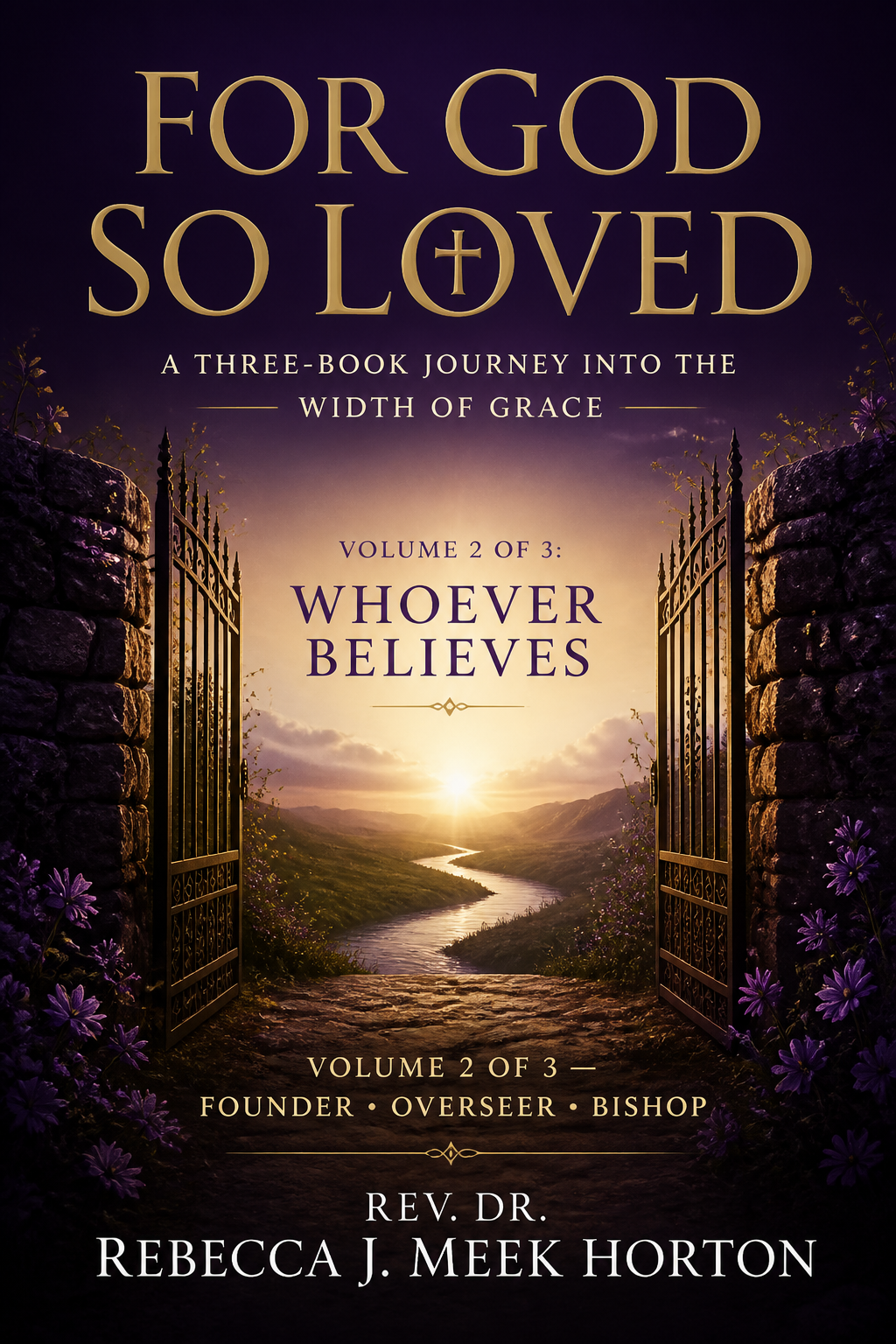
NBCNGMI MASTER KNOWLEDGE LIBRARY Featuring the works of The Sage, Apostle Prophet. Rev. Dr. Rebecca J. Meek Horton, Apostolic Prophetic Architect, NewBeing Creation Network Global Ministries, Inc. Integrated Framework Modalities™
Purpose
I wrote this book for every person who has heard “whoever believes” and still wondered, “Does that include me?”
My hope is to walk gently through the barriers that keep us from receiving the love of God—shame, sin, fear, pride, exclusion, and misunderstanding—while keeping the invitation of John 3:16 clear and open.
May these pages help you see that the welcome is wide, the response is real, and “everyone who calls on the name of the Lord will be saved” (Romans 10:13).
Preface
I have returned to John 3:16 many times, and each time I am met by the same holy wonder: “For God so loved the world…” That love is wider than our fear, deeper than our failure, and steadier than our questions. But the verse does not stop with the love of God revealed. It moves toward a response: “that whoever believes in Him should not perish but have everlasting life.”
This book was born in that word: **whoever**.
I have sat with people who wondered if they were included. I have listened to the quiet ache behind questions like, “After what I’ve done, can God still receive me?” “Do I have to fix myself first?” “What if I do not understand everything yet?” I have also seen another barrier rise in the heart: pride that resists surrender, fear that avoids trust, and pain that mistakes God’s invitation for another door that may close.
So I wrote this book for the person standing near the doorway of grace, unsure whether to enter.
The gospel is not narrow in welcome. Jesus tells of a father running toward a returning son in Luke 15. Peter declares that “God shows no partiality” in Acts 10:34–35. Paul writes, “Everyone who believes in Him will not be put to shame” and “everyone who calls on the name of the Lord will be saved” in Romans 10:11–13. The invitation is wide.
But the response is real.
Believing is not pretending. It is not religious performance. It is not merely agreeing with an idea about God while holding the heart back from Him. To believe is to trust Christ, to come into the light, to receive mercy, and to begin walking in new life. Grace welcomes us as we are, but it does not leave us unchanged.
My prayer is that this book will help remove false barriers without removing the truth. Shame must not keep you away. Sin must not be renamed as harmless. Fear must not be allowed to lead. Pride must bow. Misunderstanding must be gently corrected. And exclusion must be confronted by the wideness of Christ’s call.
If you have ever wondered whether “whoever” includes you, come slowly, honestly, and with an open heart.
The invitation of Jesus is still alive.
Whoever believes may come.
Introduction
“Whoever believes.”
Those two words are easy to pass over until you realize how much weight they carry.
In John 3:16, Jesus does not say, “For God so loved the qualified,” or “the clean,” or “the confident,” or “the people who already know how to belong.” He says, “whoever believes in him should not perish but have eternal life” (John 3:16). The invitation is wide enough to reach the whole world, and personal enough to reach one wounded, weary, resistant heart.
This book is about receiving the love of God.
Book One opened the heart of God. It reminded us that the gospel begins in Him, not in us. God loved first. God gave first. Grace begins in the character of God before it ever becomes the hope of the world.
But love revealed must still be received.
That is where many of us struggle.
Some cannot receive because shame has taught them to hide. Some cannot receive because sin has become familiar. Some fear that if they come near to God, He will expose them only to reject them. Some are kept back by pride, not because they feel strong, but because surrender feels unsafe. Some have been told, directly or quietly, that the word “whoever” does not really include them.
This book will walk carefully through those barriers.
We will not pretend that believing is shallow or simple in the way slogans sometimes make it sound. Faith is not merely agreeing with an idea about God. It is trust. It is turning. It is receiving Christ as Savior and Lord. It includes grace, and it includes repentance. It welcomes the broken, and it also calls the broken into new life.
Jesus’ parables in Luke 15 show us a God who seeks the lost, rejoices over the found, and welcomes the returning child. Acts 10:34–35 reminds us that “God shows no partiality.” Romans 10:11–13 declares that “everyone who calls on the name of the Lord will be saved.” Galatians 3:26–28 shows us that in Christ, old dividing walls lose their power to define who may belong.
The gospel is wide in welcome.
It is also clear in response.
That tension matters. If we speak only of welcome and never of repentance, we may comfort people without leading them into life. If we speak only of repentance and lose the sound of welcome, we may make the doorway seem narrower than Jesus made it. The call of Christ holds both together: “Come to me” (Matthew 11:28), and “Follow me” (Matthew 4:19).
As you read, move slowly. Do not rush past the places that name your own resistance. This is not a book for judging who is in or out. It is a book for hearing the invitation again with honesty. Let the word “whoever” search you. Let it comfort you. Let it correct what fear, pride, shame, or misunderstanding have taught you about God.
Each chapter will carry one central truth and one practice. The goal is not to collect religious information. The goal is to make room for a faithful response. Read with Scripture open. Pray honestly. If something unsettles you, do not run from it too quickly. Sometimes the place that feels tender is the place where grace is doing careful work.
God’s love is not vague affection from a distance.
It is a holy love that comes near, tells the truth, gives the Son, opens the door, and calls us by faith into life.
Whoever believes means the invitation is real.
It also means the response is yours.
Chapter 1 — 1. The Word That Opens the Door
A door can be open and still feel hard to enter.
You may have stood at one like that before. A hospital room after bad news. A home after an argument. A church sanctuary after years away. The handle is there. The welcome may even be real. But something inside you hesitates.
John 3:16 has that kind of doorway in it.
“For God so loved the world, that he gave his only Son, that whoever believes in him should not perish but have eternal life.”
The first movement is God’s: He loved. He gave.
The next movement is ours: whoever believes.
This chapter begins the path of this book with one clear truth: grace is wide enough to welcome anyone, and clear enough to call for a real response. The word “whoever” opens the door. The word “believes” tells us how we enter.
## The Gift Comes Before the Response
John 3:16 does not begin with human effort.
It does not say, “For the world finally became worthy.” It does not say, “For the religious improved themselves.” It does not say, “For the ashamed cleaned up enough to be considered.”
It says, “For God so loved the world, that he gave…”
The giving love of God comes first.
This matters because many people hear the gospel backward. They assume God is waiting at the end of a long moral staircase. If they climb high enough, pray well enough, stop enough habits, fix enough damage, and prove enough sincerity, maybe God will receive them.
But John 3:16 begins on God’s side of the distance.
God loved. God gave. God moved toward us in His Son.
Jesus spoke these words to Nicodemus, a religious leader who came to Him at night (John 3:1–2). Nicodemus had knowledge, position, and discipline. Still, Jesus did not tell him he needed a little more polish. He told him he needed new birth (John 3:3).
That is humbling. It is also mercy.
The gospel does not flatter the strong or shame the weak. It tells the truth about everyone. We do not save ourselves. We receive the One God has given.
Think of a child who has fallen into deep water. The rescuer does not stand on the shore and shout instructions on swimming technique. He enters the water. He reaches. The child still must stop fighting the rescue, but the rescue begins with the rescuer.
So it is with grace.
The door is open because God opened it.
## “Whoever” Is Wider Than We Expect
The word “whoever” is small, but it carries a holy wideness.
It means the invitation is not limited to one kind of person. Not one nation. Not one background. Not one temperament. Not one story. Not one level of religious experience.
Whoever believes.
That word reaches the careful and the careless. The near and the far. The person raised with Scripture and the person who has only begun to wonder if God is real. The person with a clean public reputation and the person carrying a private history they can barely name.
Romans 10:11 says, “Everyone who believes in him will not be put to shame.” Romans 10:13 adds, “For everyone who calls on the name of the Lord will be saved.”
Everyone.
This does not make faith vague. It makes grace available.
We often narrow what God has made wide. Sometimes we do it with obvious prejudice. Sometimes we do it quietly. We imagine certain people are too far gone, too complicated, too resistant, too different, too late. At times, we even place ourselves outside the word “whoever.”
But “whoever” belongs to God.
We are not permitted to make it smaller.
A church may have a front door everyone can see, but still carry invisible doors people feel they cannot pass through. A single mother wonders if she will be judged. A man with a prison record wonders if his past will be louder than his presence. A young adult with questions wonders if doubt disqualifies them. An older person wonders if they waited too long.
John 3:16 speaks before those fears finish their sentence.
Whoever believes.
Not whoever understands everything.
Not whoever has no wounds.
Not whoever has never failed.
Whoever believes in Him.
## “Believes” Is More Than Agreement
The door is wide, but entering still matters.
John 3:16 does not say, “whoever admires him.” It does not say, “whoever knows about him.” It does not say, “whoever respects Christian values.” It says, “whoever believes in him.”
Biblical belief is not bare agreement. It is trust. It is reliance. It is receiving Christ as the One God has given.
A person can agree that a chair is sturdy and still refuse to sit down. Agreement stays at a distance. Trust puts weight on what it claims is true.
Believing in Christ means we put the weight of our life on Him.
This includes the mind, but it does not stop with the mind. It includes the heart, but it is not ruled by feeling. It includes a decision, but it is deeper than a moment of emotion. Faith is surrendered reception.
John says those who believe “have eternal life” (John 3:16). Eternal life is not merely a future destination. It is life from God, through Christ, beginning now and continuing forever. Jesus later prayed, “And this is eternal life, that they know you, the only true God, and Jesus Christ whom you have sent” (John 17:3).
So belief is not just agreeing to an idea about Jesus. It is coming to Jesus.
It is the difference between reading a menu and eating the meal. The menu may be accurate. It may describe nourishment beautifully. But it cannot feed you unless you receive what is offered.
Many people live near the language of faith without receiving Christ Himself. They know verses. They respect church. They believe God exists. They believe Jesus matters. Yet they remain guarded, self-led, and distant.
John 3:16 invites more than religious familiarity.
It invites trust.
## The Welcome Is Wide, and the Response Is Real
We must hold both truths together.
If we only say the welcome is wide, people may think response does not matter. If we only stress the response, people may think grace must be earned. John 3:16 will not let us choose one half of the truth.
God so loved the world.
Whoever believes.
The love is wide. The call is clear.
This is where the tension begins. Receiving love sounds gentle, but it can feel costly. To believe in Christ is to stop standing outside the door explaining why we cannot come in. It is to stop hiding behind shame, performance, pride, fear, or delay. It is to let God name both our need and His mercy.
That is not always easy.
Some would rather remain in control than be rescued. Some would rather keep their defenses than be known. Some would rather manage guilt than bring it into the light. Some would rather keep God as an idea than trust Him as Lord.
Jesus does not coerce. But He does call.
In John 3, Jesus speaks of light and darkness. “Whoever does what is true comes to the light” (John 3:21). Coming to the light can feel exposing. But the light of Christ does not expose in order to destroy. It reveals in order to heal, cleanse, and make new.
This book will walk slowly through some of the barriers that make receiving grace hard. Shame. Sin. Fear. Pride. Exclusion. Misunderstanding. We will not rush past them, and we will not let them have the final word.
The first word is still God’s love.
The open door is still Christ.
The invitation is still whoever believes.
Nothing is random. Nothing is wasted. Even the hesitation at the threshold can become a place where grace meets us truthfully.
The question is not whether God’s love is wide enough.
The question is whether we will receive the Son He has given.
## Key Takeaways
- God’s gift comes before our response. - “Whoever” is God’s wide invitation. - Belief means trusting Christ with your life.
## Practice
Read John 3:16 slowly three times today.
The first time, notice what God does: “loved” and “gave.”
The second time, notice the invitation: “whoever believes.”
The third time, pray honestly:
“Lord Jesus, show me where I am standing at the door but not yet trusting You. Help me receive Your grace with a surrendered heart. Amen.”
Chapter 2 — 2. Why Receiving Love Can Feel Hard
The envelope sat on the kitchen table for three days.
Her name was written across the front in familiar handwriting. Inside was a gift she had not earned, from someone she had avoided, after a season she could not undo. She knew it was there. She had touched it twice. But she had not opened it.
“It feels wrong,” she said quietly. “Like if I receive it, I’m pretending nothing happened.”
Sometimes love is hardest to receive when we need it most.
John 3:16 says, “that whoever believes in him should not perish but have eternal life.” The word “whoever” opens the door wide. But many people stand at the threshold with trembling hands. Not because grace is too small. Not because Christ is unwilling. But because shame, fear, pride, and misunderstanding make trust difficult.
The controlling idea of this chapter is simple: receiving God’s love is not mere agreement with a truth; it is surrendered reception of a Person. To believe in Christ is to entrust ourselves to Him.
## The Door Is Open, but Trust Still Feels Costly
There is a difference between knowing a door is open and walking through it.
A person may believe, in a general way, that God is loving. They may believe Jesus died for sinners. They may even know the words of John 3:16 by memory. But when the invitation becomes personal—when “the world” becomes “me”—something inside may resist.
John writes, “To all who did receive him, who believed in his name, he gave the right to become children of God” (John 1:12). Notice how receiving and believing stand together. Biblical belief is not distant approval. It is not nodding at an idea from across the room. It is receiving Christ Himself.
That can feel costly because receiving love requires openness. It asks us to stop hiding, stop performing, stop defending, and stop pretending we can save ourselves.
Imagine someone drowning near the shore. A rescuer reaches out, but the drowning person keeps clutching the broken piece of wood that is barely keeping them afloat. The rescuer is near. The help is real. But receiving rescue means releasing what cannot save.
This is why belief can feel frightening. Grace is free, but it is not shallow. It comes as gift, but it also tells the truth: we need saving.
“For by grace you have been saved through faith. And this is not your own doing; it is the gift of God” (Ephesians 2:8). A gift still must be received. Faith is the empty hand that receives what God gives in Christ.
## Shame Makes Us Hide from the Love We Need
Shame has a cruel way of preaching.
It says, “You are too late.” It says, “You are too stained.” It says, “If God really knew you, He would turn away.”
Shame does not merely say, “You did wrong.” It says, “You are wrong beyond repair.” And when people believe that voice, they may assume grace is for others—cleaner people, stronger people, people with better stories.
But the gospel does not begin with our worthiness. It begins with God’s love.
“God shows his love for us in that while we were still sinners, Christ died for us” (Romans 5:8). Not after we cleaned ourselves up. Not after we became impressive. While we were still sinners.
A man may sit in church for years and still feel like an outsider to mercy. He sings about grace but keeps his real wounds locked away. He smiles at the door, serves where needed, and believes forgiveness is true in theory. But in the quiet, he thinks, “Not for me. Not after what I’ve done.”
That is one reason receiving love can feel hard. Shame trains the soul to expect rejection. So when God offers mercy, the heart does not always know how to trust it.
This does not mean shame is stronger than grace. It means the heart may need to learn a new language. Not the language of hiding, but the language of honest return.
Conviction brings us into the light so we can be healed. Condemnation drives us into the dark so we stay bound. The Holy Spirit does not flatter us, but He also does not crush those who come to Christ. “There is therefore now no condemnation for those who are in Christ Jesus” (Romans 8:1).
## Fear Protects Us from Surrender
Fear often dresses itself as wisdom.
It says, “Be careful.” It says, “Do not get your hopes up.” It says, “If you trust God fully, He may ask for more than you want to give.”
And here is the honest part: faith does involve surrender. Jesus never invited people into a life where they remained untouched and unchanged. He said, “If anyone would come after me, let him deny himself and take up his cross daily and follow me” (Luke 9:23).
That is not a small invitation.
Some people hesitate to receive God’s love because they know love has authority. If Christ is Savior, He is also Lord. If He forgives, He also leads. If He welcomes us, He also begins to form us.
A person may fear losing control more than they fear staying bound. They may think, “If I give myself to Christ, what will happen to my plans? My relationships? My habits? My image? My future?”
These are real questions. We should not dismiss them lightly.
But self-protection has a cost too. The life we try to control can become the life that controls us. The secrets we guard can become our prison. The future we try to secure without God can become heavy with anxiety.
Jesus said, “Come to me, all who labor and are heavy laden, and I will give you rest” (Matthew 11:28). He does not call us into surrender to harm us. He calls us because our souls are not safe in our own hands.
Faith is not pretending we have no fear. Faith is bringing our fear to the One who is faithful.
## Pride Would Rather Earn Than Receive
Pride does not always look loud.
Sometimes pride looks responsible. Capable. Moral. Religious. Hardworking.
It says, “I can fix this.” It says, “I am not like those people.” It says, “I will come to God when I have something better to bring.”
But grace cannot be earned. That is what makes it grace.
Paul writes that salvation is “not a result of works, so that no one may boast” (Ephesians 2:9). The gospel closes the door on boasting, not to shame us, but to free us. If salvation depended on our performance, none of us could rest. We would always wonder if we had done enough.
Pride resists the mercy it cannot manage.
Think of a child with a broken toy, gripping the pieces tightly while a parent offers to repair it. The child says, “I can do it.” But the pieces are too small, the break too deep, the hands too unsteady. The parent is not offended by the child’s weakness. The parent is waiting for the child to release what is broken.
Many adults stand before God that way.
We would rather improve ourselves than be rescued. We would rather contribute something impressive than confess need. We would rather be admired for effort than humbled by mercy.
But the way into the kingdom is not through achievement. It is through trust. Jesus said, “Unless you turn and become like children, you will never enter the kingdom of heaven” (Matthew 18:3).
Childlike faith is not childish thinking. It is humble dependence.
## Misunderstanding Keeps Grace at a Distance
Some people struggle to receive God’s love because they have misunderstood what belief means.
They think belief means having no questions. But Scripture includes people who cried out honestly, “I believe; help my unbelief!” (Mark 9:24).
They think belief means feeling worthy. But the gospel is for the unworthy who come to Christ.
They think belief means joining a performance system where God’s love must be constantly maintained by perfect behavior. But Jesus says His sheep hear His voice, He knows them, and they follow Him (John 10:27). The Christian life is relational before it is performative.
They think belief means only agreeing with facts about Jesus. But saving faith is more than information. It is trust, surrender, and reception.
A chair can be studied, admired, and described. But sitting down is different. Sitting down places weight on it.
So it is with Christ. We may study His words, admire His compassion, and respect His sacrifice. But belief places the weight of the soul on Him.
This is where the invitation becomes personal. “Whoever believes” means the door is open. It also means we must stop standing outside with explanations in our hands.
## The Honest Cost of Receiving Love
Receiving God’s love asks something of us.
It asks us to let shame lose its authority. It asks us to bring fear into the light. It asks us to lay pride down. It asks us to let God correct our misunderstandings. It asks us to stop treating grace as an idea and begin receiving Christ as Lord.
This is not easy. The old ways of hiding, controlling, earning, and defending may feel safer because they are familiar. But familiar bondage is still bondage.
Jesus does not call us to receive love so we can remain unchanged. He calls us into life.
“Whoever believes” is wide enough for anyone. It is also clear enough to call for a real response. Not performance. Not self-repair. Not pretending. Trust.
The question is not only, “Do I believe grace exists?”
The deeper question is, “Am I willing to receive the One who gives it?”
## Key Takeaways
- Grace is wide, but it must be received personally. - Belief is surrendered trust, not mere agreement. - Shame, fear, pride, and misunderstanding can keep us at the threshold.
## Practice
Take ten quiet minutes today and write one honest sentence to God beginning with:
“Lord, receiving Your love feels hard because…”
Do not edit it. Do not make it sound spiritual. Tell the truth.
Then pray this simple prayer:
“Jesus, I bring You what keeps me at the threshold. Teach me to receive Your love with trust. Help me believe not only with my mind, but with my whole life. Amen.”
Chapter 3 — 3. The Father Who Runs Toward the Lost
A porch light left on at night says something.
It does not drag the child home. It does not pretend the child has not wandered. It simply shines into the dark as a steady witness: there is still a place for you here.
Luke 15 is that porch light in Scripture.
Jesus tells three stories—a lost sheep, a lost coin, and two lost sons—to show us what God is like toward the lost. The chapter does not make wandering harmless. It does not make repentance optional. But it corrects a deep fear many people carry: the fear that God is reluctant to receive them.
The controlling idea of this chapter is simple: repentance is not crawling back to a cold God; repentance is returning to the Father who is already watching the road.
## Jesus Told This Story to the Wrong Crowd
Luke tells us why Jesus gave these parables.
“Now the tax collectors and sinners were all drawing near to hear him. And the Pharisees and the scribes grumbled, saying, ‘This man receives sinners and eats with them’” (Luke 15:1–2).
That complaint opened the door to one of the clearest windows into the heart of God.
The religious leaders were not upset because Jesus taught sinners. They were upset because He welcomed them. He shared a table with people whose lives carried public stain. Tax collectors were known for betrayal and greed. “Sinners” was not a vague insult. It referred to people considered morally and socially unclean.
So Jesus answered with stories.
A shepherd leaves the ninety-nine to find one lost sheep (Luke 15:3–7). A woman searches carefully for one lost coin (Luke 15:8–10). A father receives a son who has wasted everything (Luke 15:11–32).
In each story, what is lost matters.
The sheep is not dismissed because there are ninety-nine others. The coin is not ignored because the woman has nine left. The son is not replaced because another son stayed home.
This is not sentimentality. This is revelation.
Jesus is showing us that the Father’s love is not casual toward the lost. God does not shrug at human ruin. He seeks. He waits. He restores. Heaven rejoices when one sinner repents (Luke 15:7, 10).
Imagine a parent in a crowded store who suddenly realizes a small child is missing. Everything else stops. The cart is left in the aisle. The schedule no longer matters. The parent searches because love gives weight to the one who is lost.
Luke 15 tells us God gives weight to the lost.
Nothing is random. Nothing is wasted. Even the stories Jesus chooses are ordered to reveal the Father’s heart.
## The Far Country Always Costs More Than It Promises
The younger son begins with a demand: “Father, give me the share of property that is coming to me” (Luke 15:12).
It is a painful request. In that culture, asking for the inheritance early was more than financial impatience. It was a way of saying, “I want your gifts without your presence. I want what you can give me, but I do not want to live under your roof.”
The father gives him the inheritance. The son leaves. He gathers everything and travels into a far country, where he wastes his property in reckless living (Luke 15:13).
At first, the far country may have felt like freedom.
No father. No household rhythms. No accountability. No older brother. No boundaries.
But false freedom eventually sends a bill.
A famine comes. The money runs out. The friends disappear. The son attaches himself to a citizen of that country and ends up feeding pigs, longing to eat what the pigs eat (Luke 15:14–16).
Jesus does not rush past this part.
The lost son is hungry. Degraded. Empty. No one gives him anything.
This is where many people misunderstand grace. They think grace means God pretends the far country did not damage anything. But grace is not denial. Grace tells the truth without closing the door.
Sin always promises more room than it can provide. It says, “You will be free,” but it slowly teaches the soul to live beneath its calling.
We see this in ordinary life. A person may leave honesty for gain, thinking they are protecting their future. Over time, they lose peace. Another may leave covenant for pleasure, thinking they are claiming themselves. Over time, they lose trust, stability, and tenderness. Another may leave prayer, community, and obedience, not with a loud rebellion, but through slow neglect. Over time, the soul grows thin.
The far country is not always dramatic. Sometimes it is simply the place where we learn to live without the Father while still using His gifts.
But then comes mercy.
“When he came to himself…” (Luke 15:17).
That phrase matters.
Repentance often begins when illusion breaks. The son sees clearly. He remembers his father’s house. He rehearses a confession: “Father, I have sinned against heaven and before you. I am no longer worthy to be called your son” (Luke 15:18–19).
He does not blame the famine. He does not excuse the waste. He does not demand restoration. He rises and goes to his father.
This is repentance: truth, turning, and return.
## The Father Was Watching the Road
The most stunning sentence in the story may be this one:
“But while he was still a long way off, his father saw him and felt compassion, and ran and embraced him and kissed him” (Luke 15:20).
The son is still far off.
He has not yet finished his speech. He has not yet proven himself. He has not yet worked off the debt. He has not yet demonstrated years of improved behavior.
But the father sees him.
That means the father was looking.
Jesus wants us to see the posture of God. The father is not inside the house, arms crossed, waiting to be convinced. He is watching the road. When he sees the son, he runs.
In that culture, dignified men did not run in public. Running required lifting the robe, exposing the legs, surrendering composure. But the father is not protecting his image. He is moving toward his son.
The son begins his confession: “Father, I have sinned against heaven and before you. I am no longer worthy to be called your son” (Luke 15:21).
That confession is necessary. The son tells the truth.
But the father interrupts the rest of the plan. The son had intended to ask to become a hired servant (Luke 15:19). The father does not let that become his identity.
He says, “Bring quickly the best robe… put a ring on his hand, and shoes on his feet” (Luke 15:22). Then he calls for a feast.
Why?
“For this my son was dead, and is alive again; he was lost, and is found” (Luke 15:24).
The father restores him as a son, not because the son’s sin was small, but because the father’s mercy was great.
This is the good news inside “whoever believes.” The invitation is not only wide; it is personal. The Father does not receive returning sinners as case files. He receives sons and daughters.
A person may come to God with rehearsed language: “I will stay near the back. I will be tolerated. I will serve, but I will never belong.” But the Father’s mercy is deeper than our self-punishment. He does not save us so we can live forever as hired servants in the yard. In Christ, He brings us home.
John writes, “To all who did receive him, who believed in his name, he gave the right to become children of God” (John 1:12).
Belief is not merely agreeing that the Father is kind. It is coming home to Him.
## The Older Son Was Lost at Home
The story does not end with the feast.
The older son comes in from the field and hears music. When he learns that his brother has returned and that the father has killed the fattened calf, he becomes angry and refuses to go in (Luke 15:25–28).
Now the father goes out again.
This matters.
The father runs to the younger son in his shame. He also goes out to the older son in his resentment.
The older son has stayed near the house, but his heart is far from the father’s joy. He says, “Look, these many years I have served you, and I never disobeyed your command” (Luke 15:29). He sees himself as a servant, not a son. He sees obedience as leverage. He sees his brother as undeserving. He sees the father’s generosity as unfair.
The father answers tenderly: “Son, you are always with me, and all that is mine is yours” (Luke 15:31).
Then he names what is fitting: “It was fitting to celebrate and be glad, for this your brother was dead, and is alive; he was lost, and is found” (Luke 15:32).
The older son exposes another barrier to receiving love: resentment toward grace when it is given to someone else.
Sometimes the lost are not only in the far country. Sometimes they are in the field, doing the work, keeping the rules, but unable to rejoice in the Father’s mercy.
This is a quiet warning.
We can be near religious activity and still misunderstand the Father. We can obey outwardly and still treat grace as wages. We can resent the “whoever” because we secretly believe mercy should be rationed according to our measure.
The cost here is honest. To receive the Father’s love, we must lay down both rebellion and self-righteousness. The younger son must come home from the far country. The older son must come in from the field. Both must trust the father’s heart.
Repentance asks us to stop managing our distance from God.
It asks the ashamed person to come home.
It asks the resentful person to come in.
It asks all of us to let the Father define mercy.
## Key Takeaways
- The Father is not reluctant to receive the repentant. - Repentance is truth, turning, and return. - Both shame and resentment can keep us outside the feast.
## Practice
Read Luke 15:11–32 slowly today. Ask yourself one honest question: **Where am I standing right now—far country, road home, field, or feast?** Then take one step toward the Father in prayer, using the son’s words if needed: “Father, I have sinned… I am coming home.”
Chapter 4 — 4. Shame at the Threshold
She sat in the church parking lot with her hand on the door handle.
Inside, people were singing. She could hear the music through the walls. She had driven there because something in her wanted to come home to God. But something else kept whispering, *If they knew everything, they would not want you here. If God knew everything, He would not either.*
So she stayed in the car.
Shame often meets people at the threshold. Not far away from grace. Not uninterested in God. Not hardened beyond feeling. Right at the door.
This chapter carries one clear truth: shame says you are too stained to be welcomed, but the gospel says, “Everyone who believes in him will not be put to shame” (Romans 10:11).
There is a difference between conviction and condemnation. Conviction tells the truth so we can come into the light. Condemnation uses the truth, or half-truth, to keep us hiding. One leads us toward God. The other tells us to stay away.
## Shame Speaks in the Language of Identity
Guilt says, “I did wrong.”
Shame says, “I am wrong.”
That difference matters.
Guilt can become a doorway to repentance. When the Holy Spirit convicts us, He does not flatter us. He does not pretend our choices have no weight. Jesus said the Spirit would convict the world concerning sin, righteousness, and judgment (John 16:8). Conviction is one of God’s mercies. It tells us the truth before the damage becomes deeper.
But shame goes further than truth. Shame takes what we have done, what was done to us, what we regret, what we fear people may discover, and turns it into a name.
Unclean.
Rejected.
Unworthy.
Too late.
Too much.
Not enough.
That is why shame is so heavy. It does not only accuse the action. It attacks the person.
Think of Adam and Eve in Genesis 3. After sin entered, they hid. They covered themselves. When God came near, they moved away. Shame made them afraid of the very One they most needed.
That is still how shame works.
A man who has failed his family may stop praying because he assumes God is tired of him. A woman carrying a secret may avoid Christian community because she believes exposure would mean rejection. A young person may hear the word “holy” and only feel disqualified.
Shame tells them, “Do not come close.”
But Romans 10:11 answers, “Everyone who believes in him will not be put to shame.”
Everyone.
Not the polished only. Not the people with simple stories only. Not those who can explain every wound, failure, and delay. Everyone who believes in Him.
## Conviction Leads Home
Conviction may feel painful, but its purpose is restoration.
When Peter preached at Pentecost, the people were “cut to the heart” and asked, “Brothers, what shall we do?” (Acts 2:37). That was not hopelessness. That was awakening. Peter did not answer, “Hide from God.” He said, “Repent and be baptized every one of you in the name of Jesus Christ for the forgiveness of your sins” (Acts 2:38).
Conviction opened a path.
Condemnation closes one.
Condemnation says, “You are exposed, so run.”
Conviction says, “You are exposed, so come.”
This distinction is not always easy to feel at first. Both may involve sorrow. Both may bring tears. Both may make us aware of what is wrong. But they do not produce the same fruit.
Godly grief leads to repentance and life. Paul writes, “Godly grief produces a repentance that leads to salvation without regret, whereas worldly grief produces death” (2 Corinthians 7:10).
Godly grief is honest, but not hopeless.
It does not excuse sin. It does not blame everyone else. It does not cover the wound with religious language. It simply turns toward God and says, “Lord, have mercy on me.”
Condemnation has a different sound. It is vague and final.
“You always ruin everything.”
“You will never change.”
“God may forgive others, but not you.”
“You should not even try.”
Those statements do not lead to obedience. They lead to paralysis. They may sound serious, but they do not produce holiness. They produce hiding.
The voice of the Shepherd may correct, but He does not crush the brokenhearted. “A bruised reed he will not break, and a faintly burning wick he will not quench” (Isaiah 42:3; Matthew 12:20).
If the message you are hearing drives you away from Christ, it is not the full voice of Christ.
## The Cross Answers Exposure with Mercy
Many people fear coming to God because they believe He will reveal what is hidden and then reject them.
The gospel tells a better truth.
God does bring things into the light. But in Christ, light is not given to destroy the repentant. Light is given to heal what darkness has been feeding.
First John says, “God is light, and in him is no darkness at all” (1 John 1:5). That can sound frightening if we are hiding. But the same passage continues, “If we walk in the light, as he is in the light, we have fellowship with one another, and the blood of Jesus his Son cleanses us from all sin” (1 John 1:7).
Light and cleansing belong together.
This is why shame loses power at the cross. At the cross, Jesus does not minimize sin. He bears it. He does not pretend our condition is small. He gives Himself for us.
“He himself bore our sins in his body on the tree” (1 Peter 2:24).
The cross tells the truth more deeply than shame ever could. Shame says, “You are exposed.” The cross says, “Yes, and Christ has come for you.” Shame says, “You are guilty.” The cross says, “Christ died for the ungodly” (Romans 5:6). Shame says, “You cannot be clean.” The cross says, “The blood of Jesus his Son cleanses us from all sin” (1 John 1:7).
A child covered in mud does not need to stand outside the house until he becomes clean enough to enter. He needs someone who loves him to bring him in and wash him.
That is not permission to love the mud.
It is permission to come home.
## Faith Steps Past the Threshold
Romans 10 does not give us a vague comfort. It gives us a call.
“Everyone who believes in him will not be put to shame” (Romans 10:11).
Belief is not pretending nothing happened. It is not positive thinking. It is not saying religious words while staying hidden. Belief is entrusting yourself to Christ. It is stepping toward Him with the truth of your life in your hands.
That may look simple, but it is not always easy.
For some, the next step is confession to God without editing the story.
For some, it is receiving forgiveness instead of rehearsing failure.
For some, it is asking a mature believer, pastor, or counselor to walk with them in the light.
For some, it is returning to prayer after years of silence.
For some, it is opening the Bible again without expecting every page to accuse them.
Faith often begins with one honest sentence:
“Lord Jesus, I am here, and I need mercy.”
That prayer is not weak. It is the doorway of grace.
The promise is not that people will never misunderstand you. They may. The promise is not that confession will have no consequences. Sometimes truth requires repair, accountability, and patient rebuilding. The promise is that whoever believes in Christ will not be finally disgraced before God.
In Him, shame does not get the last word.
## The Cost of Coming Into the Light
There is a real cost here.
Leaving shame behind does not mean avoiding honesty. It may mean naming what you have hidden. It may mean admitting harm. It may mean receiving help. It may mean letting go of an old identity you have worn for so long that freedom feels unfamiliar.
Sometimes shame feels safer than grace because shame lets us stay in control. If I keep calling myself condemned, I never have to risk being loved. If I stay hidden, I never have to change. If I reject mercy before it reaches me, I never have to trust anyone with my need.
Grace asks us to surrender that false safety.
Christ does not shame us into the kingdom. But He does call us out of hiding.
And when He calls, He gives what He commands. The One who says, “Come to me” also says, “I will give you rest” (Matthew 11:28).
## Key Takeaways
- Shame names you by your wound; Christ names you by His mercy. - Conviction leads you into the light; condemnation keeps you hiding. - Everyone who believes in Christ will not be put to shame.
## Practice
Take ten quiet minutes today and write two columns.
On the left, write: **What shame says.**
On the right, write: **What Scripture says.**
Begin with Romans 10:11: “Everyone who believes in him will not be put to shame.”
Then pray one honest prayer:
“Lord Jesus, help me bring into Your light what shame has taught me to hide. Lead me by conviction, not condemnation. Teach me to receive Your mercy and walk in truth. Amen.”
Chapter 5 — 5. Sin Is Real, and Grace Is Greater
The stain on the shirt was small at first.
A drop of coffee near the cuff. Easy to ignore. Then someone reached for a napkin and rubbed it hard. The stain spread. What could have been treated honestly became larger because no one wanted to stop and deal with it carefully.
Sin can be like that.
We may minimize it. Hide it. Rename it. Compare it to someone else’s. Try to scrub it out with effort, promises, discipline, religion, or denial. But the gospel does not heal us by pretending the stain is not there.
The controlling idea of this chapter is simple: grace does not make sin unreal; grace makes sin no longer final. God’s welcome is wide, but it is not vague. Christ receives sinners by telling the truth, calling us to repentance, and giving us new life that self-repair could never produce.
“For God so loved the world, that he gave his only Son, that whoever believes in him should not perish but have eternal life” (John 3:16). The word “perish” tells us something. Love came because danger was real. Grace came because sin was not harmless.
## Grace Begins With Truth
A doctor who refuses to name the illness is not being kind.
If something is wrong in the body, we do not want a physician who smiles and says, “Everything is fine,” when it is not. We want someone skilled enough and loving enough to tell the truth without cruelty. Truth may be painful, but denial is dangerous.
Scripture speaks of sin with this kind of honest mercy.
“All have sinned and fall short of the glory of God” (Romans 3:23). That sentence leaves no one untouched. It does not say some have sinned, or only the openly broken, or only those whose failures are public. It says all.
Sin is not only the worst thing we have done. It is the condition of a heart turned from God. It shows up in actions, desires, omissions, motives, and loves that have become disordered. It is choosing our own way over the life of God.
This is why the gospel does not flatter us.
Jesus did not come to congratulate humanity on being almost well. He came to save. “Those who are well have no need of a physician, but those who are sick. I came not to call the righteous, but sinners” (Mark 2:17).
That is not insult. That is invitation.
The person who knows they are sick can receive healing. The person who knows they are lost can be found. The person who stops defending the wound can finally bring it into the light.
Grace begins with truth because God does not heal what we keep pretending is whole.
## Sin Damages What God Loves
When Scripture names sin, it is not because God is eager to shame us. It is because sin damages what God loves.
Sin damages communion with God. It dulls hearing, hardens the heart, and teaches us to hide. In Genesis 3, after Adam and Eve sinned, they covered themselves and hid among the trees (Genesis 3:7–8). That scene is not only ancient history. It is the pattern of the human heart.
Sin damages people. Words can wound. Lust can consume. Greed can exploit. Bitterness can poison a home. Neglect can starve a relationship. Pride can make repentance feel like death.
Sin damages the sinner too. It promises freedom while quietly forming chains. James writes, “Each person is tempted when he is lured and enticed by his own desire. Then desire when it has conceived gives birth to sin, and sin when it is fully grown brings forth death” (James 1:14–15).
A man may say, “My anger is just how I am.” But his children learn to walk softly around him.
A woman may say, “My secrecy protects me.” But the hidden life grows heavier.
A leader may say, “The results justify the compromise.” But the soul bends under the weight of what success required.
This is why grace cannot mean God simply waves sin away as though nothing happened. That would not be love. Love protects what is holy. Love restores what is broken. Love refuses to call death life.
The cross shows us both the seriousness of sin and the greatness of grace. If sin were small, the cross would be unnecessary. If grace were small, the cross would be insufficient.
But Christ crucified tells the truth: sin is real, and grace is greater.
## Repentance Is Turning Toward Life
Repentance is often misunderstood.
Some hear the word and imagine humiliation, punishment, or religious performance. Others think repentance means feeling bad enough to earn forgiveness. But repentance is not self-hatred. It is not emotional payment. It is not crawling toward God hoping He might soften.
Repentance is a Spirit-awakened turning. It is turning from sin and turning toward God.
Peter preached, “Repent therefore, and turn back, that your sins may be blotted out” (Acts 3:19). The call is clear, but so is the promise. Sins can be blotted out. A new beginning is possible.
Think of a driver going the wrong way down a road. The loving thing is not to say, “Keep going; direction does not matter.” The loving thing is to warn, stop, and turn. Repentance is that turn.
It may include tears. It may include confession. It may include making wrongs right where possible. It may require ending habits, relationships, patterns, or practices that have been feeding death. But at its heart, repentance is not despair. It is hope in motion.
“If we say we have no sin, we deceive ourselves, and the truth is not in us,” John writes. “If we confess our sins, he is faithful and just to forgive us our sins and to cleanse us from all unrighteousness” (1 John 1:8–9).
Notice the order.
We do not confess because God is unpredictable. We confess because He is faithful. We do not come into the light because cleansing is uncertain. We come because Christ has made mercy available.
Repentance is not the enemy of grace. Repentance is one of the ways grace brings us home.
## New Life Is More Than Self-Repair
Many people try to fix themselves before coming to God.
They say, “Once I get this under control, I will pray again.”
“Once I become better, I will return to church.”
“Once I stop failing, I will believe God can receive me.”
But that is not the gospel. That is self-repair dressed in spiritual language.
The gospel does not say, “Improve yourself until you are acceptable.” It says, “Come to Christ, and receive the life you cannot produce on your own.”
Paul writes, “But God, being rich in mercy, because of the great love with which he loved us… made us alive together with Christ—by grace you have been saved” (Ephesians 2:4–5).
Made alive.
Not merely polished. Not merely adjusted. Not merely inspired to try harder. Made alive.
This matters because sin is deeper than behavior. Behavior matters, but sin reaches into desire, worship, identity, and trust. We need more than advice. We need resurrection life.
Romans 6 says, “We were buried therefore with him by baptism into death, in order that, just as Christ was raised from the dead… we too might walk in newness of life” (Romans 6:4).
Grace does not only forgive the past. Grace opens a new way to walk.
A person who has lied can learn truth.
A person who has been enslaved can learn freedom.
A person who has harmed others can learn humility, restitution, and repair.
A person who has lived far from God can learn communion.
This new life is not instant maturity. It is not perfection by tomorrow morning. It is a real beginning with a real Savior. The believer learns to confess, receive mercy, obey, fall, rise, and keep walking with Christ.
WISDOM is not yours until YOU WALK IT.
## The Cost of Honest Grace
There is a cost to receiving grace honestly.
We must stop defending what is destroying us.
We must let God name what we have renamed. We must release the comfort of excuses. We must stop confusing conviction with rejection. We must allow the cross to tell us the truth about both our sin and God’s mercy.
This can feel painful.
It is easier to say, “Everyone does it,” than to say, “Lord, have mercy on me.”
It is easier to manage appearances than to confess.
It is easier to promise self-improvement than to surrender.
But the cost of honesty is not greater than the cost of hiding. Hidden sin does not stay still. It grows roots. It shapes speech, appetite, imagination, relationships, and worship.
Grace invites us to bring the whole truth to the whole mercy of God.
Not because sin is small.
Because Christ is sufficient.
Paul gives the good news plainly: “Where sin increased, grace abounded all the more” (Romans 5:20). That does not make sin safe. It makes grace mighty. The next chapter asks, “Are we to continue in sin that grace may abound?” and answers, “By no means!” (Romans 6:1–2).
Grace is not permission to remain bound. Grace is power to be made new.
The door is open. The welcome is real. The call is clear.
Come as you are, yes.
But do not come planning to stay as sin has made you.
Come to Christ, who receives sinners, forgives sin, breaks chains, and teaches us to walk in newness of life.
## Key Takeaways
- Grace tells the truth without turning away. - Repentance is turning from death toward life. - Christ offers new life, not self-repair.
## Practice
Set aside ten quiet minutes today.
Pray Psalm 139:23–24 slowly: “Search me, O God, and know my heart… and lead me in the way everlasting.”
Then write one honest sentence beginning with: “Lord, I need to stop hiding…”
Confess that to God. Receive His mercy in Christ. Then take one faithful step of repentance today.
Chapter 6 — 6. Fear and the Risk of Trust
The hand reached for the doorknob and stopped.
On the other side was a conversation that needed to happen. An apology. A confession. A decision. A step toward God that could no longer be delayed. Nothing dramatic was happening in the hallway, but inside the person standing there, everything felt exposed.
“What if I open this door and I lose control?”
Fear often sounds reasonable. It asks careful questions. What if I am disappointed? What if God asks too much? What if I trust Him and things still hurt? What if I surrender and cannot get back what I gave up?
This chapter’s controlling idea is simple: believing in Christ requires trust when we cannot control the outcome. Fear becomes a barrier to faith when self-protection feels safer than surrender.
John 3:16 says, “whoever believes in him shall not perish but have eternal life.” Believing is not only agreeing that Jesus is true. It is entrusting ourselves to Him. It is placing our weight on Him. It is opening the door.
## Fear Often Grows Where Control Feels Necessary
Fear is not always loud. Sometimes it hides beneath planning, hesitation, distance, or delay.
A person may say, “I’m just being careful,” when the deeper truth is, “I am afraid to trust.” Another may say, “I need more time,” when what they really mean is, “I do not want to lose control.” Careful thought is wise. Avoiding God is not.
Scripture does not mock human fear. Again and again, God meets fearful people with mercy.
When Joshua stood at the edge of leadership after Moses died, the Lord said, “Be strong and courageous. Do not be frightened, and do not be dismayed, for the LORD your God is with you wherever you go” (Joshua 1:9). God did not pretend the road would be easy. He gave Joshua His presence.
When Mary received the angel’s announcement, she was “greatly troubled” (Luke 1:29). The angel said, “Do not be afraid, Mary, for you have found favor with God” (Luke 1:30). Favor did not remove the cost of obedience. It steadied her within it.
Fear grows when we believe we must hold everything together. The gospel meets us with a different truth: we are not saved by our ability to manage life. We are saved by Christ.
A child learning to swim may cling to the side of the pool with both hands. The instructor stands nearby, arms ready. The child is not being asked to trust the water more than the instructor. The child is being invited to release the wall because someone trustworthy is present.
Faith is not pretending the deep places are shallow. Faith is trusting the One who holds us there.
## Self-Protection Can Become a False Refuge
Self-protection often begins as survival. People who have been hurt learn to keep distance. People who have been disappointed learn to lower hope. People who have felt unsafe learn to stay guarded.
There is compassion here. Some fears have history. Some hesitation comes from real wounds.
But what once protected us can begin to imprison us.
Proverbs 18:10 says, “The name of the LORD is a strong tower; the righteous man runs into it and is safe.” Fear offers another tower. It says, “Run into control. Run into distance. Run into numbness. Run into cynicism. Run into independence.” These towers look sturdy, but they cannot save.
Fear tells us, “If you do not trust, you cannot be disappointed.”
But distrust has a cost. It may reduce risk, but it also reduces reception. We cannot receive love with closed hands. We cannot follow Christ while keeping every exit open.
Jesus said, “Come to me, all who labor and are heavy laden, and I will give you rest” (Matthew 11:28). That invitation is gentle, but it still requires movement. Come. Bring the burden. Stop carrying alone. Receive rest from Me.
Imagine someone sitting in a doctor’s office with a serious wound hidden under a coat. They came because they need help, but when the doctor asks to see the wound, they pull the coat tighter. The doctor is not trying to shame them. He is trying to heal what remains hidden.
Fear says, “Do not expose it.”
Mercy says, “Bring it to Me.”
The Lord is not reckless with what we place in His hands. Psalm 56:8 says, “You have kept count of my tossings; put my tears in your bottle.” God does not ignore trembling trust. He sees it.
## Trust Is Not Control; Trust Is Surrender to a Person
Many people struggle with faith because they think belief means understanding everything first.
But trust is not the same as full explanation.
Abraham went “not knowing where he was going” (Hebrews 11:8). Peter stepped out of the boat before he had control over the water (Matthew 14:28–29). The woman who touched Jesus’ garment reached for Him before she knew how He would respond (Mark 5:27–34).
In each case, faith moved toward God without possessing the whole outcome.
This matters because Christian faith is not trust in a system, a mood, or a vague hope. It is trust in Jesus Christ.
John 10:11 gives us His own words: “I am the good shepherd. The good shepherd lays down his life for the sheep.” We are not asked to surrender to a stranger. We are invited to trust the Shepherd who gave Himself for us.
Fear often asks, “What will happen if I give myself to Christ?”
The cross answers, “Look at what Christ has already given for you.”
Romans 8:32 says, “He who did not spare his own Son but gave him up for us all, how will he not also with him graciously give us all things?” This does not mean life will go exactly as we prefer. It means God’s heart toward us has been revealed in Christ.
The risk of faith is real. We may have to release cherished sins, old defenses, false identities, private bitterness, or the illusion that we are in charge. But the greater risk is refusing the mercy that saves.
A person standing on a broken bridge may fear stepping toward the rescuer. That fear is understandable. But staying on what is collapsing is not safety.
Christ does not call us away from safety into danger. He calls us away from false safety into Himself.
## Mercy Steadies the Trembling Step
Faith does not always feel bold.
Sometimes faith whispers, “Lord, I believe; help my unbelief!” (Mark 9:24). Jesus did not reject that father. He met him in the honest place.
That prayer may be one of the most faithful prayers a fearful person can pray. It tells the truth. It does not pretend confidence. It brings weakness to Christ instead of hiding it.
Fear loses power when it is brought into the presence of God.
Psalm 34:4 says, “I sought the LORD, and he answered me and delivered me from all my fears.” The verse does not say David had no fears. It says he sought the Lord with them.
This is important. Fear is not defeated by scolding ourselves. Fear is not healed by pretending. Fear is not overcome by waiting until we feel fearless.
Fear is answered by turning toward God.
One person may begin by praying honestly for the first time in years. Another may open Scripture and sit with the words of Jesus. Another may tell a trusted believer, “I want to follow Christ, but I am afraid.” Another may repent of a hidden area not because they feel strong, but because they believe God is merciful.
These are not small steps. They are sacred steps.
Believing does not mean you can explain everything ahead. It means you are no longer willing to make fear your lord.
## The Cost: Letting God Be God
The tension is this: trust asks us to release control before we receive clarity.
That is costly.
We may want God to guarantee every outcome before we obey. We may want the comfort of knowing no relationship will change, no habit will be confronted, no desire will be reshaped, no plan will be interrupted.
But Christ does not offer managed religion. He offers new life.
Jesus said, “If anyone would come after me, let him deny himself and take up his cross daily and follow me” (Luke 9:23). This is not a call to self-hatred. It is a call to stop enthroning the self as master.
Fear says, “Protect yourself at all costs.”
Jesus says, “Follow Me, and I will teach you life.”
There is a cost to trust. But there is also a cost to fear. Fear keeps people near the door but not through it. It keeps prayers unprayed, wounds unoffered, obedience delayed, and mercy admired from a distance.
The mercy of God is steady enough for the trembling person. You do not have to feel fearless to come to Christ. You only have to come.
## Key Takeaways
- Faith is trust in Christ, not control over outcomes. - Fear may explain hesitation, but it does not have to govern obedience. - God’s mercy is steady enough for a trembling step.
## Practice
Name one place where fear is keeping you from trusting Christ.
Write this sentence and complete it honestly:
“Lord, I am afraid to trust You with __________.”
Then pray Mark 9:24 in your own words: “Lord, I believe; help my unbelief.”
Take one concrete step of trust today: pray, confess, open Scripture, ask for counsel, or obey the thing God has already made clear.
Chapter 7 — 7. Pride at the Door of Mercy
He stood in the doorway with his arms folded.
Inside the room, the table was already set. Bread was warm. Chairs were pulled out. There was room for him. Nothing in the house said he was unwanted.
But he would not come in.
Not because the door was locked.
Not because the Father had refused him.
Not because there was no place.
He stayed outside because mercy had offended him.
That is one of the quiet dangers of pride. Pride can stand very near grace and still refuse to enter. It can know the language of God, the habits of religion, and the rules of righteousness, yet resist the mercy that welcomes the undeserving.
The single truth of this chapter is simple: pride resists grace because grace cannot be earned, managed, or used for boasting. The gospel humbles every person and frees us to come empty-handed before God.
John 3:16 does not say, “whoever proves enough.” It does not say, “whoever deserves.” It says, “whoever believes.” Belief is not a trophy for the strong. It is the open hand of the needy.
## Pride Wants to Bring a Receipt
Pride does not always look loud.
Sometimes pride looks responsible. It keeps a careful list. It remembers every sacrifice, every obedient act, every way it has done better than someone else.
In Luke 15, when the younger son returns home, the father runs, embraces him, clothes him, and celebrates. But the older son stands outside the celebration angry. He says to his father, “Look, these many years I have served you, and I never disobeyed your command” (Luke 15:29).
He is not lying about his service.
But his service has become a receipt.
He believes his obedience should give him control over the father’s generosity. He cannot rejoice over mercy because he thinks mercy has violated fairness. He cannot see his brother’s restoration as life from the dead because he is measuring the feast by merit.
This is how pride works at the door of mercy.
It says, “I have been good enough.”
Or, “I have worked too hard.”
Or, “I am not like them.”
But grace does not ask us to bring a receipt. Grace asks us to receive a gift.
Paul writes, “For by grace you have been saved through faith. And this is not your own doing; it is the gift of God, not a result of works, so that no one may boast” (Ephesians 2:8–9).
No one may boast.
That sentence is not meant to shame us. It is meant to free us. We do not have to keep proving we are worthy of being loved by God. We do not have to turn obedience into currency. We do not have to stand at the door rehearsing our résumé.
The mercy of God is not purchased by our performance. It is received by faith in Christ.
## Grace Humbles Everyone the Same Way
Pride loves comparison because comparison creates distance.
If I can find someone worse, I can feel safe. If I can find someone weaker, I can feel strong. If I can find someone more visibly broken, I can avoid telling the truth about my own need.
But the gospel closes that escape route.
Romans 3:23 says, “For all have sinned and fall short of the glory of God.” The word “all” leaves no room for spiritual superiority. The respected and the rejected, the disciplined and the disordered, the religious and the rebellious — all stand in need of mercy.
Then Romans 3:24 continues, “and are justified by his grace as a gift, through the redemption that is in Christ Jesus.”
All have sinned.
All who are saved are saved by grace.
That means the ground is level at the cross.
Imagine two people walking into a hospital. One has a broken arm. The other has a failing heart. One injury is easier to see, but both need a physician. It would be foolish for the person with the broken arm to boast, “At least I am not like that patient.” Need is still need.
Jesus told a parable about this very thing. A Pharisee prayed by comparing himself to others. A tax collector stood far off and prayed, “God, be merciful to me, a sinner!” Jesus said the tax collector went home justified, rather than the man who boasted in himself (Luke 18:9–14).
The difference was not that one man had no sin and the other did.
The difference was that one man came full of himself, and the other came empty before God.
Grace humbles everyone the same way. It tells the truth: we cannot save ourselves. But it also tells the good news: Christ is sufficient to save.
## Pride Tries to Manage Mercy
There is another kind of pride that hides beneath control.
It does not say, “I do not need grace.”
It says, “I will accept grace on my terms.”
This pride wants forgiveness without surrender. Comfort without repentance. Association with Jesus without trust in Jesus. It wants to keep ownership of the life while receiving the benefits of the kingdom.
But believing in Christ is not managing Him from a safe distance. It is entrusting ourselves to Him.
John 3:16 says that “whoever believes in him should not perish but have eternal life.” The invitation is wide, but it is not vague. The object of faith is Christ. We do not merely believe that mercy exists. We believe in Him.
That means grace is not permission to remain unchanged. It is power to be made new.
A person may say, “I want God’s help, but I do not want Him touching this part of my life.” Most of us understand that sentence, even if we have never spoken it aloud. We want the peace of God, but not His correction. We want rescue, but not relinquishment. We want mercy, but not lordship.
This is where pride feels the cost of faith.
Christ does not save us so we can stay enthroned over ourselves. He saves us to belong to Him.
Paul writes, “You are not your own, for you were bought with a price” (1 Corinthians 6:19–20). That is not harsh ownership. That is holy rescue. The One who gave Himself for us now calls us into life under His mercy, His wisdom, and His reign.
Pride hears that as loss.
Faith learns to hear it as freedom.
## Coming Empty-Handed Is Not Coming Worthless
Some people fear that humility means self-hatred.
It does not.
To come empty-handed before God is not to say, “I have no value.” It is to say, “I have no claim.” My worth is not the same as my merit. I am made in the image of God (Genesis 1:27). I am loved by God. But I am not saved because I have earned salvation.
That distinction matters.
Humility does not deny the gifts God has given us. It refuses to use those gifts as bargaining power. Humility does not pretend obedience is meaningless. It refuses to turn obedience into boasting. Humility does not call us trash. It calls us dependent.
Think of a child asleep in the back seat while a parent drives through the night. The child contributes nothing to the driving, the direction, or the protection. But the child is not worthless. The child is loved. The child is carried.
So it is with grace.
We are not saved by our grip on God, but by His grace toward us in Christ. We respond with faith, repentance, and obedience, but we do not become our own savior.
This is why pride is such a dangerous barrier. It keeps trying to add something to the finished work of Christ. It wants to say, “Jesus saved me, but I made myself acceptable.” The gospel will not allow that boast.
Galatians 6:14 says, “But far be it from me to boast except in the cross of our Lord Jesus Christ.”
The cross is the end of self-salvation.
It is also the beginning of true life.
## The Cost of Laying Pride Down
Pride is costly to keep, but it is also costly to surrender.
Laying pride down may mean admitting you were wrong. It may mean asking forgiveness without defending yourself. It may mean receiving mercy for the very thing you wanted to hide. It may mean celebrating grace in someone else’s life when part of you thinks they do not deserve it.
It may mean letting go of the need to be seen as the strong one, the right one, the faithful one, the impressive one.
That is not easy.
Pride often protected us before it imprisoned us. It helped us survive embarrassment, rejection, failure, or being overlooked. It gave us a way to feel safe. But what once felt like protection can become a wall between us and mercy.
Jesus does not humiliate us to heal us. He humbles us to free us.
The invitation remains: whoever believes.
Not whoever has the cleanest record.
Not whoever can explain everything.
Not whoever has never failed.
Not whoever can bring God a receipt.
Whoever believes.
The door of mercy is open, but pride cannot walk through while carrying its throne. We come to Christ empty-handed, or we do not truly come.
And when we come, we find that empty hands are exactly what grace can fill.
## Key Takeaways
- Grace leaves no room for boasting. - Pride resists mercy by trying to earn, manage, or measure it. - Coming empty-handed to Christ is the beginning of freedom.
## Practice
Take ten quiet minutes today and pray Luke 18:13 in your own words: “God, be merciful to me, a sinner.”
Then name one place where pride is resisting grace. Do not excuse it. Do not dramatize it. Simply bring it to Christ and take one humble step: confess, apologize, receive forgiveness, or release your need to be right.
Chapter 8 — 8. No Partiality at the Table
The chair was empty, but everyone knew who it was not meant for.
Sometimes exclusion does not need a sign on the door. It lives in a glance, a pause, a private assumption, a quiet change in tone. It is the seat no one offers. The invitation never sent. The conversation that stops when someone walks in.
Many people have learned to stand at the edge of the table, wondering if God’s welcome is as wide as people say, or if there are hidden rules they have not been told.
Acts 10 answers that question with holy clarity.
Peter says, “Truly I understand that God shows no partiality, but in every nation anyone who fears him and does what is right is acceptable to him” (Acts 10:34–35).
The controlling truth of this chapter is simple: God’s welcome is not governed by ethnicity, status, history, or human favoritism. “Whoever” is God’s word, not ours to narrow.
## God Had to Widen Peter Before Peter Could Widen His Welcome
Acts 10 begins with two men who should not have been sitting together.
Cornelius was a Roman centurion. He was a Gentile, a military officer, and part of the occupying power. Yet Scripture describes him as devout, prayerful, generous, and reverent toward God (Acts 10:1–2).
Peter was a Jewish apostle of Jesus. He had walked with Christ, preached at Pentecost, and seen thousands respond to the gospel. But Peter still carried boundaries he had inherited and practiced. Some of those boundaries were tied to Jewish ceremonial law. Some had hardened through history, pain, and separation.
Then God gave Peter a vision.
A sheet came down from heaven filled with animals Peter considered unclean. A voice said, “Rise, Peter; kill and eat” (Acts 10:13). Peter refused. The voice answered, “What God has made clean, do not call common” (Acts 10:15).
This was not mainly about Peter’s diet. God was preparing Peter’s heart.
While Peter was still trying to understand the vision, Cornelius’s messengers arrived. The Spirit told Peter to go with them “without hesitation” (Acts 10:20). That phrase matters. God knew hesitation would be present. Peter would have to cross a threshold inside himself before he crossed the threshold of Cornelius’s house.
This is often where grace confronts us.
It is one thing to believe God loves the world. It is another thing to sit across the table from someone we have been taught to keep at a distance.
Peter had preached Christ. Now he had to let Christ correct his categories.
## Partiality Shrinks the Gospel to Fit Our Comfort
When Peter entered Cornelius’s house, he said something honest: “You yourselves know how unlawful it is for a Jew to associate with or to visit anyone of another nation” (Acts 10:28). Then he added, “but God has shown me that I should not call any person common or unclean.”
That sentence is a doorway.
Peter did not pretend the boundary had never existed. He named it. But he also submitted it to what God had shown him.
Partiality happens when we treat people as more or less worthy of welcome based on human categories God has not made final.
It may appear through ethnicity, class, age, disability, education, past behavior, church background, family name, accent, clothing, politics, neighborhood, or immigration story. Sometimes it is obvious. Sometimes it is polite. Sometimes it hides behind phrases like “people like that,” “not our kind,” or “they would not fit here.”
But the gospel does not belong to one culture, one class, one history, or one human preference.
John 3:16 says, “whoever believes in him should not perish but have eternal life.” Romans 10:12 says, “For there is no distinction between Jew and Greek; for the same Lord is Lord of all, bestowing his riches on all who call on him.” Revelation 7:9 gives us a picture of the end: “a great multitude that no one could number, from every nation, from all tribes and peoples and languages,” standing before the throne.
The kingdom of God is not colorless. It is not cultureless. It is not a gathering where everyone becomes the same in personality, language, or story.
It is a redeemed family where Christ is Lord over all.
Partiality shrinks that vision. It turns God’s table into our private dining room. It makes comfort the gatekeeper. It asks people to become acceptable to us before we believe they can be acceptable to God.
But Peter learned better.
So must we.
## “Whoever” Does Not Mean “Whatever”
God’s welcome is wide, but it is not vague.
Acts 10:34–35 does not teach that all paths are the same or that repentance is unnecessary. Peter does not enter Cornelius’s house and say, “You are sincere, so nothing else matters.”
He preaches Jesus.
He speaks of Christ’s life, death, resurrection, and appointed authority as judge of the living and the dead (Acts 10:36–42). Then he says, “To him all the prophets bear witness that everyone who believes in him receives forgiveness of sins through his name” (Acts 10:43).
There it is again: everyone.
But the welcome comes through Christ.
This matters because some people confuse inclusion with the removal of truth. Others confuse truth with the removal of welcome. The gospel refuses both errors.
God does not show partiality. He welcomes people from every nation, background, and story. And He calls every person to the same Savior.
No one is excluded because of ethnicity or status.
No one is included apart from Christ.
The table is wide because Jesus is sufficient. The response is clear because Jesus is Lord.
This protects the gospel from two distortions. One distortion says, “Only people like us truly belong.” The other says, “Belonging means nothing has to change.” But the grace of God does something better. It opens the door and forms a new people.
Cornelius did not have to become Jewish to receive the Holy Spirit. Peter did have to stop treating Gentiles as unclean. Both men were brought under the authority of Christ.
That is what grace does. It does not flatter one group and shame another. It humbles all of us before the same Lord.
## The Spirit Fell Before the Room Could Vote
While Peter was still speaking, “the Holy Spirit fell on all who heard the word” (Acts 10:44).
This is one of the most beautiful interruptions in Scripture.
Before anyone could form a committee, before anyone could debate whether Gentiles were ready, before anyone could decide if Cornelius’s household should be given a lower seat, God acted.
The Jewish believers who came with Peter were amazed “because the gift of the Holy Spirit was poured out even on the Gentiles” (Acts 10:45).
Even on the Gentiles.
That little word “even” tells the truth about their surprise. They were watching God welcome people they had not expected Him to welcome in that way.
Peter understood the moment. He asked, “Can anyone withhold water for baptizing these people, who have received the Holy Spirit just as we have?” (Acts 10:47).
Just as we have.
That is the language of shared grace.
Peter did not say, “They received a lesser mercy.” He did not say, “Let us keep them nearby but not fully among us.” He recognized that God had given them the same Spirit.
The church did not create the welcome. The church had to recognize the welcome God had already given.
This is a necessary word for us.
We are not owners of the table. We are stewards. We do not get to narrow “whoever” because someone’s story makes us uncomfortable. We do not get to require what Christ has not required. We do not get to withhold dignity from people God is drawing.
The question is not, “Would I have chosen them?”
The question is, “Has God made room?”
And if God has made room, then we must not stand in the doorway.
## The Cost of No Partiality
This chapter asks something of us.
It asks us to examine the quiet boundaries we have baptized as wisdom but may actually be fear, habit, pride, pain, or preference.
It asks churches to look at who feels at home and who always feels like a visitor.
It asks families to notice which people are easy to bless and which people are quietly discussed but rarely embraced.
It asks leaders to make sure welcome is not just stated from the platform but practiced in the hallway, at the meal, in the small group, and around the decision-making table.
No partiality will cost us comfort.
It may require repentance for assumptions we inherited but never questioned. It may require listening to people whose experiences expose what we have missed. It may require sharing space, influence, and belonging in ways that feel unfamiliar.
But this is not loss. This is RE-Alignment™ with the heart of God.
When “whoever” becomes more than a word we admire, it becomes a table we help set.
## Key Takeaways
- God’s welcome is wider than human favoritism. - “Whoever” is God’s word, not ours to narrow. - The table is wide because Christ is Lord of all.
## Practice
This week, ask God to show you one person or group you have kept at a distance through assumption, discomfort, or habit.
Then take one faithful step: pray for them by name, listen to their story, offer genuine welcome, or make room at a table where they have been absent.
Do not make the gesture performative. Make it obedient.
“Truly I understand that God shows no partiality” (Acts 10:34). Let that truth move from confession into practice.
Chapter 9 — 9. One Family by Faith
The baptismal robe was too big for him.
He was a young man, nervous and smiling, standing near the water while the church sang softly. The white garment hung from his shoulders like borrowed clothing. He kept pulling at the sleeves, trying to make it fit.
An older deacon leaned over and whispered, “Don’t worry. You’ll grow into it.”
That is not a bad picture of Christian belonging.
When we believe in Christ, we are not only forgiven as individuals. We are brought into a new identity and a new family. Galatians 3:26–28 says, “for in Christ Jesus you are all sons of God, through faith… There is neither Jew nor Greek, there is neither slave nor free, there is no male and female, for you are all one in Christ Jesus.”
The single truth of this chapter is simple: receiving grace means learning to live as family in Christ.
Faith opens the door. But grace does not leave us standing alone in the doorway. It brings us into a people, a shared life, a place where we are named, formed, corrected, comforted, and sent.
## Faith Gives Us a New Name
Paul writes, “for in Christ Jesus you are all sons of God, through faith” (Galatians 3:26).
That word “sons” is not meant to exclude women. In Paul’s world, sonship carried the meaning of inheritance, standing, and family identity. In Christ, every believer—male and female, Jew and Gentile, slave and free—is given full family standing before God.
This is not a small thing.
Many people come to God carrying old names.
Rejected.
Unclean.
Failure.
Outsider.
Too late.
Too much.
Not enough.
The gospel does not simply improve those names. It gives us a truer one. In Christ, we are children of God. Not guests who may be asked to leave. Not employees trying to prove our worth. Not strangers hoping to be tolerated. Children.
John says it this way: “But to all who did receive him, who believed in his name, he gave the right to become children of God” (John 1:12).
A child may still need to grow. A child may still need correction. A child may still carry wounds from old places. But a child belongs.
Think of a person adopted into a family. The legal papers may be signed in a moment, but learning to live as a beloved child can take time. They may flinch at affection. They may hide mistakes. They may wonder if love will be withdrawn. The family name is given before the child fully knows how to rest in it.
So it is with us.
Faith gives us a new name before we have fully learned to live from it. That is why discipleship matters. We are not working to become God’s children. We are learning to walk as those who already are.
## Baptism Marks a New Belonging
Paul continues, “For as many of you as were baptized into Christ have put on Christ” (Galatians 3:27).
Baptism is not a private religious decoration. It is a public sign of union with Christ. It tells the truth that we belong to Him now. We have been joined to His death and resurrection. We have “put on Christ.”
Clothing matters in Scripture. Garments often speak of identity, covering, and calling. In the parable of the prodigal son, the father commands, “Bring quickly the best robe, and put it on him” (Luke 15:22). The robe did not erase the son’s story, but it did announce his restoration.
In Christ, we are clothed with a belonging we did not earn.
This matters because many of us keep wearing old garments long after grace has met us.
We wear the garment of shame.
We wear the garment of performance.
We wear the garment of suspicion.
We wear the garment of self-protection.
But Paul says those who belong to Christ have “put on Christ.” His righteousness covers us. His life claims us. His people receive us.
Imagine walking into a family gathering where everyone has been told, “This one belongs to us now.” Some may still need time to learn your story. You may still need time to trust the room. But the announcement has been made.
Baptism says, “I am with Christ, and Christ is not ashamed to call me His own.”
Hebrews 2:11 says, “That is why he is not ashamed to call them brothers.”
If Christ is not ashamed to call us His, we must be careful not to make people feel homeless in the very house where grace has welcomed them.
## Grace Forms a New Family
Paul then names old dividing lines: “There is neither Jew nor Greek, there is neither slave nor free, there is no male and female” (Galatians 3:28).
He is not saying these differences disappear in every earthly sense. Ethnicity, social location, and embodied life still exist. Scripture does not flatten people into sameness.
Paul is saying these differences no longer determine access, worth, inheritance, or standing before God.
In Christ, no group stands closer to the Father by nature of background, status, or human category. No believer is second-class at the table of grace.
This was not an abstract teaching in the early church. Jews and Gentiles had to learn to eat together. Masters and servants had to kneel at the same Lord’s Table. Men and women had to receive one another as co-heirs of grace (1 Peter 3:7). The gospel created a family that the surrounding world did not know how to explain.
The church still has to learn this.
We may say “whoever believes” with our mouths while quietly sorting people in our hearts. We may welcome people to salvation but hesitate to welcome them into shared life. We may accept them as forgiven while keeping them at a distance socially, culturally, or emotionally.
But grace does not only reconcile us to God. It reconciles us to one another.
Ephesians 2:14 says of Christ, “For he himself is our peace, who has made us both one and has broken down in his flesh the dividing wall of hostility.”
A divided church cannot clearly display a reconciling gospel.
This does not mean Christian family is easy. Families carry history. Churches carry wounds. People misunderstand each other. Cultures collide. Preferences become arguments. Some have been deeply hurt in spiritual communities and need time, wisdom, and safe care.
Still, the answer to wounded belonging is not isolated faith.
The New Testament has no category for a Christian life that refuses the body of Christ. We are members of one another (Romans 12:5). We bear one another’s burdens (Galatians 6:2). We forgive one another (Ephesians 4:32). We encourage one another (Hebrews 10:24–25).
Grace brings us into a family where Christ is Lord, not our comfort.
## Belonging Means Being Formed
It is possible to want the comfort of belonging without the formation that family requires.
But the family of faith is not only a place where we are received. It is a place where we are shaped.
A healthy church does not merely say, “You are welcome here.” It also says, “Let us walk with Christ together.” Welcome without formation becomes sentiment. Formation without welcome becomes harsh. The gospel gives us both.
Colossians 3:12–14 describes the clothing of this new family: “Put on then, as God’s chosen ones, holy and beloved, compassionate hearts, kindness, humility, meekness, and patience… And above all these put on love, which binds everything together in perfect harmony.”
Notice the family language underneath the instruction. God’s people are “chosen,” “holy,” and “beloved.” Then they are told how to live.
Identity comes before conduct, but conduct still matters.
In a family, you learn new rhythms. You learn how to speak. You learn when to listen. You learn how to apologize. You learn that not every feeling should lead the room. You learn to show up when you would rather withdraw.
The same is true in Christ.
A believer who has lived years in rejection may need to learn trust.
A believer who has survived by control may need to learn surrender.
A believer who has been praised for achievement may need to learn humility.
A believer who has been overlooked may need to learn that their gifts matter.
This formation usually happens slowly. Around tables. In worship. Through Scripture. In correction. Through service. In conflict handled with maturity. In ordinary faithfulness.
Nothing is random. Nothing is wasted.
God often uses the very people we did not choose to teach us the love we cannot produce on our own.
## The Cost of Becoming Family
This chapter asks something costly.
It asks us to give up private Christianity.
It asks us to stop treating the church as a service provider and begin receiving it as a family of formation.
It asks us to let Christ define who belongs, not our preferences, fears, or familiar circles.
It asks us to be known.
That may be the hardest part.
Some people avoid Christian community because they have been hurt. That pain should not be dismissed. Trust may need to be rebuilt slowly, with wisdom and boundaries. Others avoid community because isolation protects pride. No one can challenge what no one can see.
Belonging will cost us convenience. It will require patience with imperfect people. It will expose places in us that still need healing. It will call us to forgive, serve, listen, repent, and remain when leaving would be easier.
But this is where grace becomes visible.
Jesus said, “By this all people will know that you are my disciples, if you have love for one another” (John 13:35).
Not love in theory.
Love around real people.
Love across difference.
Love after misunderstanding.
Love that tells the truth and stays tender.
The invitation of John 3:16 is “whoever believes.” Galatians 3 shows us what happens to whoever comes: they become children, they put on Christ, and they are made one family by faith.
## Key Takeaways
- Faith gives us a new name: child of God. - Grace brings us into a real family. - Belonging includes formation, not just welcome.
## Practice
This week, take one concrete step toward Christian belonging.
Choose one:
- Attend worship and introduce yourself to one person. - Join a small group, class, or Bible study. - Invite a mature believer to coffee and ask, “How can I grow in Christ?” - If you have withdrawn because of hurt, pray and ask God to show you one wise, safe step toward community.
Do not try to fix everything at once.
Take one faithful step.
Grace welcomed you into the family. Now learn to walk with the family.
Chapter 10 — 10. Calling on the Name of the Lord
The phone rang just after midnight.
A man sat on the edge of his bed, tired in a way sleep could not fix. He had tried to think his way out. He had tried to behave better. He had tried to disappear into work, noise, and silence. But that night, with no sermon playing and no one watching, he whispered the only prayer he had left.
“Lord, help me.”
It was not polished. It was not impressive. But it was honest.
There are moments when faith becomes very simple. Not shallow. Not easy. Simple.
Romans 10:12–13 says, “For there is no distinction between Jew and Greek; for the same Lord is Lord of all, bestowing his riches on all who call on him. For ‘everyone who calls on the name of the Lord will be saved.’”
This chapter’s single idea is this: the wide invitation of “whoever believes” becomes personal when we call on the name of the Lord with trust, repentance, and a willingness to walk with Him.
Calling is not religious performance. It is surrendered response.
## The Invitation Becomes Personal
John 3:16 gives us the wide door: “whoever believes in him.” Romans 10 brings us to the threshold and says, “Call.”
Not everyone who hears an invitation receives it. A person can stand near the door and never enter. A person can admire grace from a distance and still refuse to trust the One offering it.
Paul is clear: “Everyone who calls on the name of the Lord will be saved” (Romans 10:13). He is quoting the promise first spoken through the prophet Joel: “Everyone who calls on the name of the LORD shall be saved” (Joel 2:32). Peter also preached this on the day of Pentecost when the gospel began moving outward with power (Acts 2:21).
This has always been God’s mercy: He does not save only the impressive, the clean, the confident, or the well-taught. He saves those who call on Him.
Think of a child lost in a store. At first, the child may try to solve the problem alone. Walk down one aisle. Then another. Pretend not to be afraid. But when the fear becomes stronger than pride, the child cries out, “Mom!” or “Dad!”
That cry is not weakness in the wrong sense. It is recognition. It says, “I cannot bring myself home. I need the one who can.”
Calling on the Lord is like that. It is the soul telling the truth.
## Calling Is More Than Saying Words
There is a kind of prayer that is only sound. Jesus warned about empty words when He said, “This people honors me with their lips, but their heart is far from me” (Matthew 15:8).
So calling on the name of the Lord is not a formula. It is not magic language. It is not a sentence that lets us keep control while asking God to bless our control.
To call on His name is to turn toward who He is.
His name carries His character. Lord. Savior. Christ. Shepherd. King. Redeemer.
When a person calls on Jesus as Lord, they are not merely asking for relief. They are yielding to His mercy and His authority. Romans 10:9 says, “If you confess with your mouth that Jesus is Lord and believe in your heart that God raised him from the dead, you will be saved.”
This is why belief cannot remain only agreement. A person may agree that a chair can hold them and still refuse to sit down. Trust is when the weight shifts.
A woman may know the doctor can treat her illness, but healing begins when she stops hiding the symptoms and places herself under care. She may still have questions. She may still be afraid. But she has moved from distance to surrender.
Faith does the same.
We bring our shame, but we do not let shame lead us anymore.
We confess our sin, but we do not pretend sin is our truest name.
We admit our fear, but we do not let fear keep the final word.
We lay down pride, because grace cannot be received by clenched hands.
Calling on the Lord gathers the whole journey into one honest response: “Jesus, I need You. I trust You. Save me. Lead me.”
## The Same Lord Is Lord of All
Paul says, “There is no distinction between Jew and Greek; for the same Lord is Lord of all” (Romans 10:12).
This does not erase people’s stories, cultures, histories, or wounds. It means none of those things make someone too far from mercy. It also means none of those things give someone a higher seat before God.
The ground is level at the cross.
The person raised in church must call on the Lord.
The person who has never felt welcome in church must call on the Lord.
The moral person must call.
The ashamed person must call.
The religious expert must call.
The outsider must call.
This is both comfort and correction.
It comforts the one who wonders, “Can this really be for me?” Yes. Everyone means everyone.
It corrects the one who thinks, “Surely grace is for people like me more than people like them.” No. The same Lord is Lord of all.
Imagine a table where everyone arrives hungry. One person comes in a suit. Another comes in work clothes. Another comes embarrassed because they have nothing to bring. Another comes used to being honored. But the meal is not served based on appearance. It is given because the host is generous.
The gospel table works this way.
No one is saved by background. No one is excluded by background. Christ is not poor in mercy. Paul says He is “bestowing his riches on all who call on him” (Romans 10:12).
The riches are not first money, comfort, or ease. They are forgiveness, reconciliation, adoption, the Spirit’s presence, new life, and hope that does not die.
## A Durable Practice of Daily Calling
The first call matters. There is a real turning to Christ, a real receiving of salvation, a real passage from death to life. Jesus said, “Whoever hears my word and believes him who sent me has eternal life” (John 5:24).
But calling on the Lord is not only the doorway. It becomes the way we walk.
We call when we repent.
We call when temptation is strong.
We call when old shame speaks again.
We call when pride rises.
We call when fear tells us to protect ourselves from obedience.
We call when we do not know what to do next.
This is not dependency in the unhealthy sense. It is communion. It is daily trust. It is Walking in Obedience™ one step at a time.
A believer does not mature by needing God less. A believer matures by trusting God more honestly, more quickly, and more fully.
Peter gives us a picture. When he stepped onto the water and saw the wind, he began to sink. His prayer was short: “Lord, save me” (Matthew 14:30). Jesus did not wait for Peter to compose better theology. “Jesus immediately reached out his hand and took hold of him” (Matthew 14:31).
There will be days when your prayers are that short.
“Lord, save me.”
“Lord, forgive me.”
“Lord, teach me.”
“Lord, help me obey.”
“Lord, keep me near.”
These are not lesser prayers. They are often the prayers that keep us walking.
## The Cost of Calling
We should be honest. Calling on the Lord will save you, but it will not leave you untouched.
Grace is free, but it is not casual.
To call Jesus Lord means surrendering the illusion that we belong to ourselves. It means letting Him tell the truth about our sin and our belovedness. It means receiving forgiveness without pretending repentance is optional. It means entering a family where we learn patience, humility, reconciliation, and love.
There is a cost to trusting Christ.
You may have to release the identity shame gave you.
You may have to confess what pride protected.
You may have to forgive someone, seek forgiveness, or stop excusing what God is asking you to bring into the light.
You may have to belong to people imperfectly while Christ forms you patiently.
Jesus never hid this cost. He said, “If anyone would come after me, let him deny himself and take up his cross daily and follow me” (Luke 9:23).
But the cost of following Him is not greater than the cost of remaining lost.
Self-protection cannot save.
Pride cannot heal.
Shame cannot cleanse.
Fear cannot shepherd.
Only Christ can save.
And He does.
## Key Takeaways
- Everyone who calls on the Lord is welcomed by the same Lord of all. - Calling is not empty words; it is surrendered trust in Christ. - The first call becomes a daily practice of repentance, prayer, and obedience.
## Practice
Set aside ten quiet minutes today.
Pray Romans 10:13 slowly: “Everyone who calls on the name of the Lord will be saved.”
Then make it personal:
“Lord Jesus, I call on You. I trust You with my sin, my shame, my fear, and my future. Save me, lead me, and teach me to walk with You today.”
After you pray, write one sentence:
**My next faithful step with Christ today is __________.**