 NBCNGMI™
The Grace Blueprint Series · Volume 1
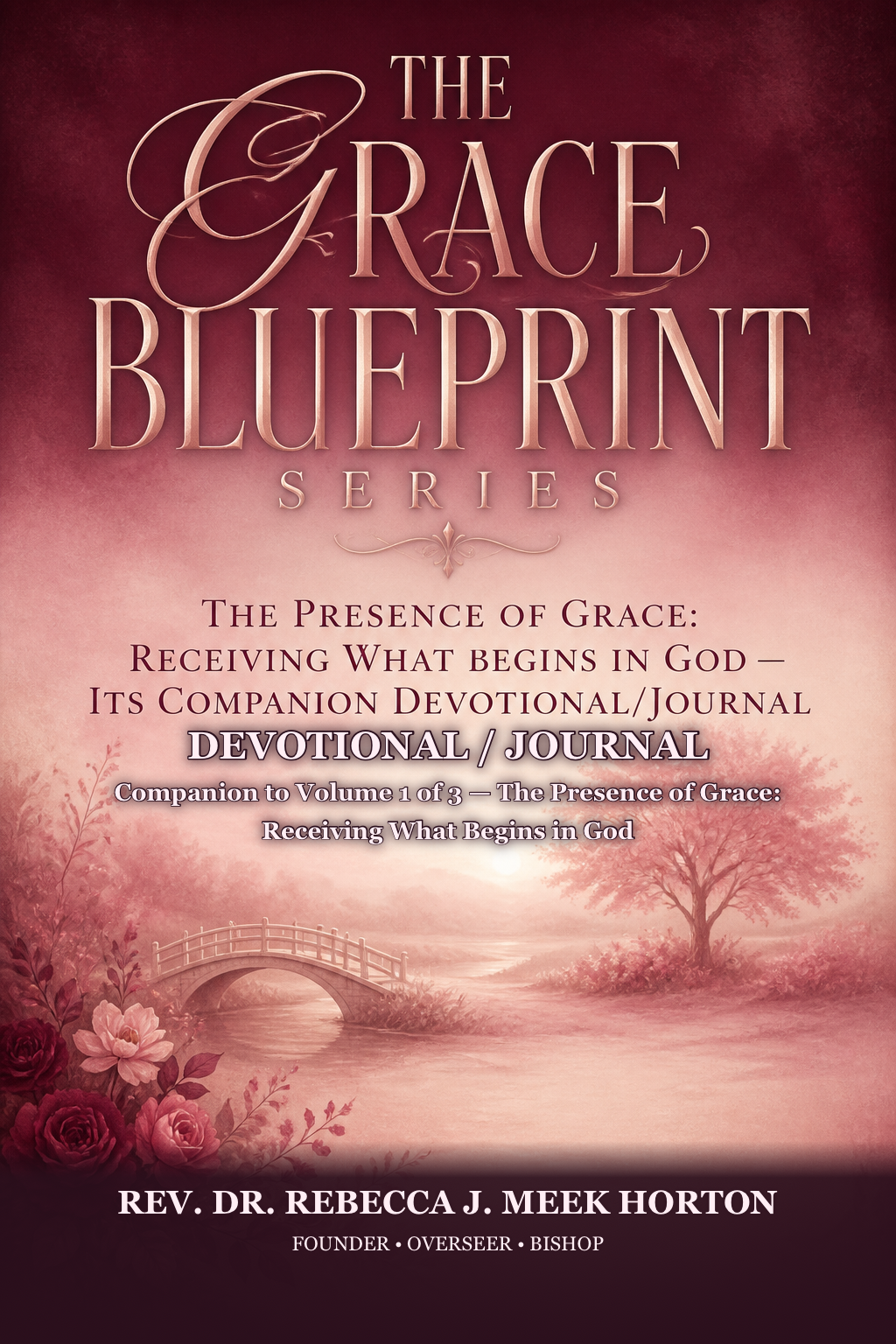
The Presence of Grace: Receiving What Begins in God — Its Companion Devotional/Journal
A companion devotional and journal for "The Presence of Grace: Receiving What Begins in God". One entry per chapter: a reflective KJV devotional, five journal prompts with Scripture references, and lined journal pages.
Full publication
NBCNGMI MASTER KNOWLEDGE LIBRARY Featuring the works of The Sage, Apostle Prophet. Rev. Dr. Rebecca J. Meek Horton, Apostolic Prophetic Architect, NewBeing Creation Network Global Ministries, Inc. Integrated Framework Modalities™
Dedication
I dedicate this companion devotional and journal to every believer learning to trust the Grace of GOD in the place where the Call feels heavier than your strength. May these pages remind you that what begins in GOD is sustained by GOD, and His Grace is sufficient for the next faithful step.
Purpose
I wrote this companion devotional and journal to help you slow down, sit with GOD’s Word, and receive the Grace that begins in Him before you try to carry the Call He has placed on your life. My prayer is that each reflection, prompt, and journal page will help you move from striving to surrender, from shame to stewardship, and from fear to faithful obedience. May you come to know, in a lived and lasting way, that His Grace is sufficient for you, as He says in 2 Corinthians 12:9.
Preface
There are seasons when the Call of GOD feels heavier than our strength. We love the Lord, we want to obey, and yet we still wonder if we have enough wisdom, enough discipline, enough courage, enough healing, enough time, enough faith.
This companion devotional and journal was written for that place.
It grew out of the conviction that Grace is not only something we believe in for salvation, but something we must learn to receive for obedience. Grace begins in GOD. It does not start with our striving, our performance, or our ability to hold everything together. It begins in His heart, His will, His provision, and His presence.
2 Corinthians 12:9 (KJV)
And he said unto me, My grace is sufficient for thee: for my strength is made perfect in weakness. Most gladly therefore will I rather glory in my infirmities, that the power of Christ may rest upon me.
I wrote this companion for the believer who needs space to slow down and sit with what GOD is saying. The main book teaches. This devotional and journal invites you to linger, pray, reflect, and respond.
Each entry follows the chapters of The Presence of Grace: Receiving What Begins in God. You will find a short devotional reflection, journal prompts rooted in Scripture, and lined pages for your own prayers, questions, confessions, and next steps.
You do not have to rush through these pages. Grace is not rushed. Growth is not forced. Obedience is often learned one surrendered response at a time.
My prayer is that you will stop measuring your Call by your weakness and begin receiving it through GOD’s sufficiency. The Lord is not surprised by your limits. He already knew them when He called you. Your need does not disqualify you. It becomes the place where His strength is revealed.
Nothing is random. Nothing is wasted.
As you write, be honest with GOD. Bring Him the fear, the weariness, the questions, and the desire to obey. Let Scripture search you, steady you, and RE-Align™ your heart.
Begin simply: read slowly, pray honestly, write truthfully, and take the next faithful step.
Introduction
Some days the Call feels clear. Other days it feels heavier than your hands can hold.
You may love GOD deeply and still wonder if you have enough strength, wisdom, discipline, courage, or consistency to finish what He has placed before you. You may have said yes to the Lord and still wrestle with delay, weakness, fear, comparison, weariness, or the quiet question: Is GOD’s Grace really sufficient for this?
This companion devotional and journal was written for that place.
The Presence of Grace: Receiving What Begins in God teaches that Grace is not something we create, earn, perform, or force. Grace begins in GOD. We receive it, walk in it, grow through it, and steward it. This devotional/journal is designed to help that truth move from reading into reflection, prayer, obedience, and daily practice.
2 Corinthians 12:9 (KJV)
And he said unto me, My grace is sufficient for thee: for my strength is made perfect in weakness. Most gladly therefore will I rather glory in my infirmities, that the power of Christ may rest upon me.
Grace does not deny weakness. Grace meets weakness with the strength of Christ.
That is the steady argument of this companion: what begins in GOD must be received from GOD, sustained by GOD, and returned to GOD in faithful stewardship. Your Call is not proof that you are enough in yourself. Your Call is an invitation to depend on the One who is enough.
Each entry in this book corresponds with a chapter from The Presence of Grace. You will find a reflective devotional rooted in the King James Version of Scripture, five journal prompts with Scripture references, and lined pages for prayer, reflection, confession, questions, and next steps.
Do not rush this work.
This journal is not meant to be completed like a task list. It is meant to be carried like a conversation with GOD. Read slowly. Write honestly. Let Scripture search you before you try to explain yourself. Let the Holy Spirit bring RE-Cognition™ where patterns need to be seen, RE-Alignment™ where motives need to be adjusted, and RE-Commitment™ where obedience needs to be renewed.
Some prompts may comfort you. Some may confront you. Both can be Grace.
Grace is not always soft in the way we expect. Sometimes Grace strengthens. Sometimes Grace corrects. Sometimes Grace slows us down so we stop building from fear. Sometimes Grace sends us forward when hiding feels safer. Sometimes Grace teaches us that nothing is random. Nothing is wasted.
Philippians 1:6 (KJV)
Being confident of this very thing, that he which hath begun a good work in you will perform it until the day of Jesus Christ:
This is not a book about striving harder. It is a book about receiving more truthfully.
As you read and write, bring your real life to the page: the unanswered questions, the delayed promises, the places where you feel unqualified, the burdens you have mistaken for assignments, and the assignments you have avoided because they felt too costly.
Grace will not excuse disobedience, but it will empower obedience.
Grace will not remove every burden, but it will teach you what is yours to carry and what belongs to GOD.
Grace will not make the Call effortless, but it will make faithfulness possible.
Begin with prayer. Keep your Bible close. Choose a quiet place if you can. Read one entry at a time. Answer the prompts with honesty, not performance. When you do not know what to write, write the truth: “Lord, I need Your Grace here.”
Your next faithful step is simple: set aside a regular time, open the first entry, read the Scripture aloud, and ask GOD to help you receive what He has already begun.
Chapter 1 — When Grace Finds the Tired Soul
Devotional
There is a kind of tiredness that sleep alone cannot heal.
It is the tiredness of carrying too much for too long. The tiredness of serving while secretly wondering if you are still safe with God. The tiredness of showing up, praying for others, answering needs, holding responsibility, and still feeling strangely far from the rest your soul was promised.
Jesus does not ignore that place. He speaks directly into it.
Come unto me, all ye that labour and are heavy laden, and I will give you rest. Take my yoke upon you, and learn of me; for I am meek and lowly in heart: and ye shall find rest unto your souls. For my yoke is easy, and my burden is light. Matthew 11:28-30 (KJV)
This invitation is not given to the impressive. It is given to the weary. Not to those who have finally proven they can carry everything, but to those who are honest enough to admit they cannot.
Grace begins there.
Not with your strength reaching upward, but with God’s mercy coming near. Not with your perfect consistency, but with Christ calling your burdened soul to Himself. Grace is God’s holy initiative before it is ever your spiritual achievement.
This matters because tired souls often reverse the order. We begin to think, If I pray enough, serve enough, give enough, endure enough, then maybe God will draw near. But the gospel tells a better truth. God has drawn near in Christ. Now we come, not to earn His presence, but to receive what He has already made available.
This does not make obedience unimportant. It puts obedience in the right place. We do not obey to force God to become gracious. We obey because grace has found us, lifted us, corrected us, and taught us how to walk.
Some burdens are easy to name. Grief. sickness. finances. family strain. ministry pressure. Other burdens hide inside good things. The burden of proving you are really changed. The burden of fearing one failure cancels your calling. The burden of believing God loves you most when you are useful.
A burden can hide inside a good thing when we carry it in the wrong strength.
The Lord is not honored by our pretending. He is honored when we trust Him enough to come. Coming empty may feel costly because it means surrendering the illusion that performance can save, sustain, or sanctify us. But grace does not shame our need. Grace meets us in truth.
Today, you may not need to quit your calling. You may need to come back to Christ within it. You may not need more shame. You may need more honesty. You may not need to prove your worth. You may need to receive again the rest that begins in Him.
Before the call, Christ.
Before the assignment, Christ.
Before the fruit, Christ.
Before the labor, Christ.
Let this be your first faithful step today: come without pretending. Tell Him where you are tired. Name what you have been carrying. Then let grace find you there.
Journal Prompts
1. Matthew 11:28 (KJV) says Christ calls those who labour and are heavy laden. What burden have I been carrying that I have not honestly brought to Him? [Answer Lines]
2. Matthew 11:29 (KJV) speaks of learning from Christ, who is meek and lowly in heart. What would it look like for me to learn rest from Him instead of performing strength before Him? [Answer Lines]
3. Titus 2:11 (KJV) says the grace of God that bringeth salvation hath appeared to all men. Where have I been acting as if grace must be earned instead of received? [Answer Lines]
4. 2 Corinthians 12:9 (KJV) says God’s grace is sufficient and His strength is made perfect in weakness. What weakness am I tempted to hide, and how might I bring it to Christ honestly? [Answer Lines]
5. Psalm 46:10 (KJV) says, “Be still, and know that I am God.” What would stillness expose in me today, and what one burden can I surrender to God in prayer? [Answer Lines]
[Journal Page]
[Journal Page]
Chapter 2 — Grace Begins in God
Devotional
“But God, who is rich in mercy, for his great love wherewith he loved us, Even when we were dead in sins, hath quickened us together with Christ, by grace ye are saved;” Ephesians 2:4–5, KJV
Grace does not begin with your strength.
That is hard to receive when you have spent years trying to prove you are faithful, useful, ready, healed, or worthy of being trusted with what God placed before you. Many believers love GOD sincerely and still live under a quiet pressure to keep presenting evidence. Evidence that they belong. Evidence that they are serious. Evidence that they can carry the call.
But Paul does not begin with human evidence. He begins with God.
“But God.”
Those two words interrupt despair. They interrupt shame. They interrupt the weary cycle of trying to become enough before you come close. Scripture tells the truth about our condition apart from Christ, but it does not leave us staring at ourselves. It turns our eyes to the One who is rich in mercy.
Grace begins in God because mercy is not something He borrows. Mercy is part of His own heart. He is not reluctant to move toward need. He is not surprised by weakness. He is not waiting for you to become impressive before He is willing to help.
This does not mean sin is small. Grace never lies. God is holy, and His grace is holy. Grace will not call darkness safe, but grace will call the child home. Grace will not flatter what needs correction, but grace will not crush the one who needs mercy.
This is where the soul begins to breathe again.
If grace began in you, then every weak day would threaten your belonging. Every tired prayer would feel like failure. Every unfinished assignment would become evidence against you. But grace began in God. His mercy came first. His love came first. His life came to us when we could not produce life for ourselves.
“We love him, because he first loved us.” 1 John 4:19, KJV
First matters.
Your obedience is real, but it is response. Your repentance is necessary, but it is response. Your service is meaningful, but it is response. You are not creating grace by working harder. You are learning to live from the grace that has already come to you in Christ.
This truth has a cost. It costs pride. It costs control. It costs the habit of measuring your worth by what you can carry. It asks you to stop using shame as proof that you care. Shame is not holiness. Fear is not maturity. Self-punishment is not spiritual depth.
Grace teaches a different way.
You can tell the truth without despair. You can repent without running from God. You can serve without trying to purchase belonging. You can admit, “Lord, I am not enough,” and find that this confession is not the end of your call. It may be the beginning of a truer walk.
Nothing is random. Nothing is wasted. Even the place where you feel your insufficiency can become holy ground if it leads you back to the God whose grace never began in you.
It began in Him.
Today, before you look at the assignment, look at the God who called you. He is rich in mercy. He has great love. He is holy. He gives life.
Let your next faithful step begin there.
Journal Prompts
1. Reflect on Ephesians 2:4, KJV. Where have I been acting as though God’s mercy must be earned before it can be received?
[Answer Lines]
2. Reflect on Ephesians 2:5, KJV. What part of my life reminds me that I cannot make myself alive, strong, or sufficient apart from Christ?
[Answer Lines]
3. Reflect on 1 John 4:19, KJV. How would my obedience change if I truly lived from God’s first love instead of working for His attention?
[Answer Lines]
4. Reflect on Isaiah 6:3, KJV. Where do I need to let holy grace correct me without believing correction means rejection?
[Answer Lines]
5. Reflect on 2 Corinthians 12:9, KJV. What is one place in my calling where I can stop proving myself and begin depending on the sufficiency of God’s grace?
[Answer Lines]
[Journal Page]
[Journal Page]
Chapter 3 — Jesus Christ, the Face of Grace
Devotional
There are seasons when grace feels like a word we know but cannot see. We can say it, sing it, teach it, and still sit quietly in the back place of the heart wondering, What does grace look like when I am tired? What does grace look like when I have failed? What does grace look like when the call of God feels heavier than my strength?
The answer is not first an explanation. The answer is Jesus Christ.
John 1:14-17 (KJV)
And the Word was made flesh, and dwelt among us, and we beheld his glory, the glory as of the only begotten of the Father,) full of grace and truth.
John bare witness of him, and cried, saying, This was he of whom I spake, He that cometh after me is preferred before me: for he was before me.
And of his fulness have all we received, and grace for grace.
For the law was given by Moses, but grace and truth came by Jesus Christ.
Grace has a face. Grace has hands. Grace has a voice. Grace came near in the Person of Jesus Christ.
This matters because many believers live as if God’s help is far away. We believe He is real, but we quietly assume we must climb up to Him by being stronger, cleaner, wiser, or more consistent. But Jesus shows us the heart of God differently. The Word was made flesh. God came down.
He did not wait for humanity to become impressive. He did not wait for the world to prepare a worthy welcome. Grace moved first. Christ entered our condition without becoming stained by our sin. He came near to real grief, real weakness, real need, and real failure.
And He came full of grace and truth.
That phrase is mercy for the honest soul. Jesus does not give grace without truth, as if nothing matters. He does not give truth without grace, as if your weakness makes you disposable. He is full of both. His truth does not crush the humble. His grace does not excuse what is destroying them. In Him, truth becomes light for healing, and grace becomes power for restoration.
So you do not have to edit your condition before you come to Christ. You do not have to make your fear sound spiritual. You do not have to hide your weariness beneath religious language. Jesus already knows the truth about you, and He is still the One from whose fullness you receive.
That is good news for the called and weary believer. Your calling matters, but your calling is not fed by your own fullness. Your obedience matters, but obedience is not sustained by pressure alone. Your growth matters, but growth begins by receiving from Christ.
Of His fullness have all we received, and grace for grace.
Today, do not stare harder at your emptiness. Behold Christ. Let Him correct the false picture of God that fear, disappointment, shame, or harshness may have built in you. Grace is not merely a doctrine to manage. Grace is the gift of God revealed in Jesus Christ.
Nothing is random. Nothing is wasted. Even your weariness can become the place where you stop reaching for an idea and begin receiving the Person.
Journal Prompts
1. John 1:14 (KJV): Where have I been treating grace as distant, when Jesus shows me that God has come near? What part of my life needs to receive His nearness today? [Answer Lines]
2. John 1:14 (KJV): Jesus is full of grace and truth. Where am I tempted to avoid truth, and where am I afraid grace will not meet me there? [Answer Lines]
3. John 1:16 (KJV): What emptiness, weakness, or weariness am I trying to carry from my own supply? How can I receive from Christ’s fullness instead? [Answer Lines]
4. Colossians 1:15 (KJV): What picture of God may need to be corrected by looking again at Jesus Christ? What do I see in Him that fear has tried to hide? [Answer Lines]
5. Hebrews 1:3 (KJV): How does seeing Jesus as the brightness of God’s glory strengthen my trust in grace? What one faithful step can I take today from that place of trust? [Answer Lines]
[Journal Page]
[Journal Page]
Chapter 4 — Receiving Before Responding
Devotional
There is a holy order in the life of grace: receive, then respond.
Many of us reverse that order without meaning to. We come before God carrying the weight of our promises, our failures, our service, our tears, and our desire to do better. We do not always say it out loud, but somewhere inside we may believe we must bring enough sincerity to be welcomed, enough discipline to be loved, enough progress to be safe.
But grace does not begin with our spiritual résumé. Grace begins in God.
Ephesians 2:8-10 says, “For by grace are ye saved through faith; and that not of yourselves: it is the gift of God: Not of works, lest any man should boast. For we are his workmanship, created in Christ Jesus unto good works, which God hath before ordained that we should walk in them” (KJV).
The order matters.
Saved by grace. Through faith. Not of yourselves. The gift of God. Not of works. Then created unto good works.
God does not erase obedience. He restores its proper place. Works are not the root of salvation. Works are the fruit of grace received. When we confuse the root and the fruit, our souls become tired. Prayer turns into payment. Bible reading becomes proof. Serving becomes self-defense. Repentance becomes panic instead of return.
But when grace is received first, response begins to heal.
You do not have to stand outside the door of grace wondering if you have finally become acceptable enough to enter. In Christ, God is not asking you to purchase what He has already given. Faith comes with empty hands. Faith says, “Lord, I cannot save myself. I receive what You have given.”
That may feel vulnerable. Receiving grace costs us the illusion of control. It also costs us boasting. If salvation is gift, then no one gets to stand above another as though mercy were earned. Grace lowers pride and lifts the weary. It tells the truth about sin without shaming the soul into hiding. It brings us into the light where Christ is sufficient.
This does not make us passive. It makes us honest.
The believer who receives grace is not being excused from growth. The believer is being rooted for growth. A tree does not grow in order to be planted. It grows because it has been planted. In the same way, you do not obey in order to make yourself saved. You learn to walk because grace has made you alive.
Today, let the order be restored.
Receive before you respond. Rest before you prove. Trust before you strive. Then take the next faithful step from grace, not fear.
Nothing is random. Nothing is wasted. Even the place where you have been exhausted by trying may become the place where you learn to receive.
Journal Prompts
1. Reflect on Ephesians 2:8-9 (KJV). Where have I been trying to earn what God gives by grace, and what would it look like to receive it by faith today? [Answer Lines]
2. Reflect on Ephesians 2:10 (KJV). What good work may God be forming in me as fruit of grace, not as proof that I deserve grace? [Answer Lines]
3. Reflect on Titus 3:5 (KJV). What part of my spiritual record have I been trusting too much, and how does God’s mercy re-center my confidence? [Answer Lines]
4. Reflect on John 15:5 (KJV). Where have I been trying to produce fruit without abiding, and what simple practice would help me return to Christ? [Answer Lines]
5. Reflect on Romans 5:1 (KJV). If I am justified by faith, where do I need to stop living in fear and begin walking in peace with God? [Answer Lines]
[Journal Page]
[Journal Page]
Chapter 5 — Still Enough to Be Loved
Devotional
The soul can be in a quiet room and still be running.
Many of us know that place. The phone is down, the house is still, the Bible is open, but the heart is measuring itself again. Did I pray enough? Did I obey enough? Did I disappoint God? Am I behind? The body has stopped, but the inner striving has not.
Into that kind of weariness, the Lord speaks with mercy, not pressure.
“Be still, and know that I am God: I will be exalted among the heathen, I will be exalted in the earth.” Psalm 46:10, KJV
Stillness is not a way to earn the love of God. Stillness is a place where we become present enough to receive what grace has already given in Christ. It is not withdrawal from obedience. It is ordered dependence. It is the soul laying down self-defense, self-proving, and self-condemnation long enough to remember that God is God, and we are not.
This is hard for tired believers because striving can start to feel like faithfulness. We can call anxiety responsibility. We can call exhaustion devotion. We can think that if we stop moving, everything will fall apart. But grace tells the truth more gently than fear does. We are responsible for obedience, not for being God.
Jesus was never careless with His assignment, yet He was never ruled by the demands around Him. He served fully, but He also withdrew to pray. “And in the morning, rising up a great while before day, he went out, and departed into a solitary place, and there prayed.” Mark 1:35, KJV
If the Son of God made space for prayer, we do not need to be ashamed of needing stillness.
Stillness may reveal what noise has been covering. Grief may rise. Fear may speak. Weariness may finally tell the truth. Do not be afraid of what comes up in the quiet. Bring it to God. Stillness is not pretending to be peaceful. It is becoming honest in the presence of the Prince of Peace.
There, the soul can begin RE-Calibration™. “I am failing because I need rest” can become, “I am receiving strength so I can obey with a clear heart.” “I must prove I am called” can become, “I will steward what God has placed before me today.” “God is far because I feel empty” can become, “I will sit before Him honestly and let His Word steady me.”
Start small. Five minutes can be holy when they are surrendered. Wait. Ask. Listen. Keep the next faithful step. Do not turn stillness into another performance. Return gently. Return again.
The grace of God is not fragile. You are not powerful enough to exhaust His mercy by needing Him slowly.
Journal Prompts
1. Psalm 46:10, KJV — Where is my soul still striving even when my surroundings are quiet? What would it look like today to be still before God without trying to prove myself? [Answer Lines]
2. Mark 1:35, KJV — What demand, pressure, or responsibility has been making me feel guilty for needing prayer and quiet? How can I follow Jesus’ pattern of withdrawing to be with the Father? [Answer Lines]
3. Isaiah 30:15, KJV — What would returning and rest look like in my real life right now? Where do I need quietness and confidence instead of urgency and fear? [Answer Lines]
4. Luke 10:39, KJV — In what ways have I been serving while neglecting to sit and hear the Lord’s word? What might Jesus be inviting me to receive before I continue working? [Answer Lines]
5. Colossians 3:3, KJV — How does knowing my life is hid with Christ in God challenge the pressure to build my worth through performance? What is one next faithful step I can take from rest, not striving? [Answer Lines]
[Journal Page]
[Journal Page]
Chapter 6 — The Cross That Silences Shame
Devotional
Shame often speaks when the room gets quiet. It waits until the day slows down, then begins to rehearse what you did, what you failed to do, where you delayed, and why you should not come near to God again.
Some of what shame names may be real. Grace does not require you to pretend. Sin should be confessed. Harm should be repaired where possible. Patterns should be brought into the light. But shame does something conviction does not do. Shame tells you that your failure has become your final name.
That is where the cross speaks louder.
“There is therefore now no condemnation to them which are in Christ Jesus, who walk not after the flesh, but after the Spirit.” Romans 8:1 (KJV)
Now no condemnation.
Not when you finally feel strong enough. Not when you have proven yourself for several months. Not when your calling feels clean and your emotions feel settled. Now, in Christ, condemnation has been answered.
This does not mean there is no correction. The Father corrects His children. The Spirit convicts with holy precision. But conviction leads you toward God. Condemnation pushes you into hiding. Conviction says, “Bring this into the light.” Condemnation says, “You cannot come anymore.” Conviction makes repentance possible. Condemnation makes despair feel spiritual.
If your heart has become a courtroom, remember this mercy: “For if our heart condemn us, God is greater than our heart, and knoweth all things.” 1 John 3:20 (KJV)
God knows more than your heart knows. He knows the whole truth, not only the painful fragments. He knows the sin and the wound. He knows the weakness and the grace. He knows the immaturity and the formation still happening in you. Your heart may accuse loudly, but it is not Lord.
This matters deeply when you are trying to walk in your call. Many believers believe their weakness has disqualified them before obedience can even begin. They confuse correction with rejection. They think delay means denial. They assume emotional struggle means grace has run out.
But the call of God is not carried by self-confidence. It is carried by dependence. Calling does not remove your need for grace; it reveals it. Christ is not only the One who called you. He is the One who keeps you, intercedes for you, corrects you, and teaches you how to walk forward truthfully.
So today, do not use shame as a substitute for repentance. Do not call self-punishment holiness. Do not demand an emotional sign before you believe the Word of God.
Come into the light. Confess what must be confessed. Receive what Christ has secured. Let Scripture answer the accuser.
Your past may explain some battles, but it does not get to define your standing in Christ. The cross has spoken. Let your soul learn to agree.
Journal Prompts
1. Romans 8:1 (KJV): Where have I been living as though condemnation still has the final word over me? What would it look like today to receive the “now” of God’s grace? [Answer Lines]
2. 1 John 3:20 (KJV): What accusations has my heart been repeating? How does the truth that God is greater than my heart steady me? [Answer Lines]
3. Romans 8:34 (KJV): When shame asks, “Who can speak for you?” how does Christ’s death, resurrection, and intercession answer that question? [Answer Lines]
4. Hebrews 7:25 (KJV): Where have I feared that Christ can save others, but not me “to the uttermost”? What part of my life do I need to bring to Him again? [Answer Lines]
5. Psalm 32:5 (KJV): Is there anything I need to confess honestly instead of hiding under shame? What is one faithful step of repentance, repair, or obedience I can take today? [Answer Lines]
[Journal Page]
[Journal Page]
Chapter 7 — The Gift of Adoption
Devotional
There is a kind of grace that forgives the debt, and we praise God for it. But there is a deeper receiving that many believers are still learning to trust. Grace does not only clear the record. Grace brings us home.
Some of us have lived too long at the edge of the room. We know we have been invited, but we are not yet settled in belonging. We pray like visitors. We worship like tolerated guests. We serve like workers trying to prove we are worth keeping. Then one weakness, one failure, one dry season, and we quietly step back toward the wall.
But the Father has not received you halfway.
Romans 8:15-17 (KJV) says, “For ye have not received the spirit of bondage again to fear; but ye have received the Spirit of adoption, whereby we cry, Abba, Father. The Spirit itself beareth witness with our spirit, that we are the children of God: And if children, then heirs; heirs of God, and joint heirs with Christ; if so be that we suffer with him, that we may be also glorified together.”
This is not small comfort. This is household language. This is table language. This is the language of a child who has been brought near enough to cry, “Father.”
Fear will try to keep you standing where grace has already seated you. Fear says, “Do not get too comfortable.” Fear says, “You are one mistake away from being unwanted.” Fear says, “Work harder, hide better, prove more.” But the Spirit of adoption does not lead you back into bondage. He teaches your heart to call on the Father from the place of belonging.
This does not make sin light. It makes grace weighty. The Father corrects His children because He loves them. Correction is not rejection. Conviction is not condemnation. The Father’s discipline is not Him pushing you out of the house; it is Him forming you in the ways of the house.
Belonging also has a cost. You may have to release the old language of rejection. You may have to stop calling yourself an outsider when Christ has brought you near. You may have to let the Father love you without requiring yourself to perform for every plate of bread. You may have to obey when the old life would be easier.
Adoption is comfort, but it is also formation.
A child does not become part of the family by acting perfect. A child learns the family’s ways because he already belongs. So do you. In Christ, you are not serving to become loved. You are learning to serve because you are loved.
Today, come away from the edge of the room. Let the Word of God speak louder than the fear in your memory. Let the Spirit bear witness again. You are not an orphan fighting for scraps. You are not a stranger hoping to be noticed. If you are in Christ, you are a child of God.
Grace has given you a place at the table. Sit there, receive there, and walk from there.
Journal Prompts
1. Reflecting on Romans 8:15 (KJV), where have I been living under fear instead of receiving the Spirit of adoption? What would it look like for me to come to the Father honestly today? [Answer Lines]
2. Reflecting on Romans 8:16 (KJV), what feelings have been louder than the witness of the Spirit in my life? How can I return to what God has said about me in Christ? [Answer Lines]
3. Reflecting on John 1:12 (KJV), where am I still trying to earn what God has given through Christ? What sentence of faith do I need to write and practice this week? [Answer Lines]
4. Reflecting on Galatians 4:6-7 (KJV), how has my service been shaped by fear, pressure, or performance? How can I begin serving from belonging instead? [Answer Lines]
5. Reflecting on Ephesians 5:1 (KJV), what part of the Father’s household ways is He forming in me right now? What is one obedient step I can take as His dear child? [Answer Lines]
[Journal Page]
[Journal Page]
Chapter 8 — A New Name in Christ
Devotional
“Therefore if any man be in Christ, he is a new creature: old things are passed away; behold, all things are become new.” 2 Corinthians 5:17 (KJV)
Some names are spoken over us before we know how to resist them. Failure. Too much. Not enough. Broken. Difficult. Forgotten. We may not choose them, but we can learn to answer to them. Over time, an old label can become an inward agreement. It shapes how we pray, how we serve, how we receive love, and how quickly we expect rejection.
But grace comes with truth.
In Christ, your identity is not built from the ruins of what happened to you or the record of what you have done. Your identity begins in Him. This is not denial. This is redemption. Grace does not ask you to pretend the wound was small or the sin was harmless. Grace gives you a truer place to stand so you can tell the truth without being swallowed by shame.
The Scripture says, “if any man be in Christ.” That phrase matters. Not in reputation. Not in achievement. Not in yesterday. Not in the opinion of people. In Christ. The new name is received before it is performed. You do not obey your way into belonging. You belong to Christ, and from that place you learn to walk in obedience.
This is where RE-Language™ becomes holy practice. We are not playing with words. We are bringing our speech into agreement with grace.
“I am a failure” becomes, “I failed, but in Christ I can repent, learn, and walk forward.”
“I am too broken” becomes, “I have wounds that need care, but my life is hid with Christ in God.”
“I do not belong” becomes, “I am accepted in the beloved.”
The old things were real, but they are not lord. The past may explain some of your battles, but it does not own your future. Shame may still know your former name, but it no longer has authority to name you.
There is a cost to receiving a new name. You may have to release familiar sorrow. You may have to stop using old labels as hiding places. You may have to let trusted truth confront the inner voice that has sounded wise but has only kept you small. Grace is tender, but it is not passive. It comforts, and it calls you forward.
Today, do not wait until you feel completely new before you believe what God has said. Newness in Christ is first received by faith, then practiced in daily steps. When you fail, confess. When you are corrected, listen. When you are afraid, pray. When shame speaks, answer with the truth of Christ.
Nothing is random. Nothing is wasted. Even the place where you once carried the wrong name can become a place of wisdom when surrendered to God.
Lord Jesus, teach me to receive the name You give. Help me release shame-language and walk in grace-formed responsibility. I belong to You. Amen.
Journal Prompts
1. Reflect on 2 Corinthians 5:17 (KJV). What old label have you continued to answer to, even after coming to Christ? What would it look like to receive your identity as something given by grace rather than earned by effort? [Answer Lines]
2. Reflect on Galatians 2:20 (KJV). Where have you been trying to improve yourself apart from deeper dependence on Christ? How does union with Christ change the way you see growth? [Answer Lines]
3. Reflect on Colossians 3:3 (KJV). What part of your life have you hidden in shame, performance, or fear? How does it speak to you that your life is hid with Christ in God? [Answer Lines]
4. Reflect on Ephesians 1:6 (KJV). Where do you still feel the need to prove that you belong? What would change if you practiced living from being accepted in the beloved? [Answer Lines]
5. Reflect on Romans 12:2 (KJV). What shame-based sentence needs to be renewed in your mind today? Write a grace-formed sentence that tells the truth without returning to self-hatred. [Answer Lines]
[Journal Page]
[Journal Page]
Chapter 9 — Learning to Receive Through Scripture
Devotional
The Bible can be open while the soul stays guarded. We may sit with verses we have known for years and still wonder why they are not reaching the tender places inside us. This does not always mean we need a new word. Sometimes grace is inviting us to receive the Word already given with a slower heart.
Romans 10:17 says, “So then faith cometh by hearing, and hearing by the word of God.” Romans 10:17 (KJV)
Faith is nourished by hearing. Not hurried hearing. Not hearing that grabs one phrase and runs. Not hearing that only searches for relief. The Word of God is not a slogan to quiet pain without understanding. It is the living testimony of God, given to reveal Christ, form faith, correct what is false, and steady what is weak.
Paul wrote, “All scripture is given by inspiration of God, and is profitable for doctrine, for reproof, for correction, for instruction in righteousness: That the man of God may be perfect, throughly furnished unto all good works.” 2 Timothy 3:16-17 (KJV)
Notice the mercy in the fullness. Scripture teaches, reproves, corrects, and instructs. Grace does not keep us from truth. Grace brings us into truth without destroying us. The same Word that comforts us may also correct us. The same Word that assures us may also expose what fear, pride, shame, or self-reliance has built inside us.
This is why we receive the Word before we use the Word.
If we only use Scripture to defend ourselves, we may avoid conviction. If we only use it to comfort ourselves, we may resist correction. If we only use it to prove ourselves, we may miss Christ. But when we receive Scripture, we come as listeners. We let the Word tell the truth about God, and we let it tell the truth about us.
Slow reading is not wasted time. Nothing is random. Nothing is wasted. The verse you thought you already knew may become fresh when you stop rushing it. “The LORD is my shepherd; I shall not want” is not only a promise of provision. It is also an invitation to be led, fed, corrected, protected, and made to lie down.
Grace often comes to us through a simple rhythm.
Read the text. Let it speak before you explain it away.
Interpret it faithfully. Keep grace joined to truth in Christ.
Ponder it honestly. Let the Word search your motives, fears, and desires.
Steward what you receive. Take the next faithful step.
This will cost something. It may cost hurry. It may cost control. It may cost the habit of using Scripture only to calm panic. It may cost the familiar shame-language that says, “I should already be stronger.” Grace teaches us to say, “Faith cometh by hearing, and I am placing myself under the Word again.”
You do not have to master the whole Bible today. Begin with one passage. Sit with it. Write it. Ask what it says. Ask what it reveals about God. Ask what obedience looks like now.
The aim is not to collect verses.
The aim is to know God, trust Christ, and walk in the grace He gives.
Journal Prompts
1. Romans 10:17 (KJV) says faith cometh by hearing. Where have I been rushing the Word instead of receiving it, and what would it look like to listen more slowly this week? [Answer Lines]
2. 2 Timothy 3:16 (KJV) teaches that all scripture is profitable for doctrine, reproof, correction, and instruction in righteousness. Which part of Scripture’s work do I welcome most easily, and which part do I tend to resist? [Answer Lines]
3. Psalm 119:105 (KJV) says God’s Word is a lamp unto my feet and a light unto my path. What next step is Scripture lighting for me right now, even if the whole path is not clear? [Answer Lines]
4. Hebrews 4:12 (KJV) says the word of God is quick, powerful, and sharper than any twoedged sword. What is the Word gently exposing in me that grace is inviting me to bring into the light? [Answer Lines]
5. James 1:22 (KJV) calls me to be a doer of the word, and not a hearer only. What one small act of obedience will help me steward what I have received from Scripture today? [Answer Lines]
[Journal Page]
[Journal Page]
Chapter 10 — Resting in the Presence of Grace
Devotional
Resting in the presence of grace is not escaping life. It is learning where to begin before life begins speaking.
The chair by the window may not be quiet. The room may not be still. The needs may already be gathering around you. But grace does not require a perfect setting. Grace invites an honest heart. Sometimes the most faithful prayer is not long, polished, or strong. Sometimes it is simply, “Lord, I am here.”
Hebrews 4:16 says, “Let us therefore come boldly unto the throne of grace, that we may obtain mercy, and find grace to help in time of need” (KJV).
This is the mercy of GOD: need has been given a place to go. You do not have to edit yourself before you come. You do not have to prove that yesterday was better than it was. You do not have to dress fear in religious language. The throne is a throne of grace because Christ has opened the way.
Come boldly does not mean come loudly. It means come trusting Christ more than you trust your own record. It means bringing the real condition of your soul before the real kindness and holiness of GOD.
Grace is not an excuse to avoid obedience. Grace is the strength that makes honest obedience possible. It teaches us to stop pretending, stop performing, and stop carrying what the Father never assigned to us. Some burdens feel noble because they keep us busy, but not every burden is obedience. Stillness helps us notice the difference.
Jesus said, “Come unto me, all ye that labour and are heavy laden, and I will give you rest” (Matthew 11:28, KJV).
There is rest in Christ, but there is also learning. We come heavy, and He does not shame us for needing help. He gives rest. Then He teaches us how to walk differently. The Christian life continues the way it began: receiving from GOD through Jesus Christ.
Today, grace may meet you in a small place. Five quiet minutes. One open Bible. One honest sentence. One verse read slowly. One next faithful step written down and kept.
Do not despise the smallness of that. WISDOM is not yours until YOU WALK IT.
The cost of living this way is real. It will cost you the pride of self-sufficiency. It will cost you the false peace of pretending. It may cost you the pace that made people admire you but left your soul thin. Wisdom pauses what pride tries to push.
But what grace gives is better than what striving promises.
Grace gives mercy for the real need.
Grace gives assurance when accusation rises.
Grace gives Scripture to answer shame.
Grace gives strength for the next step.
Grace gives rest without making you passive, and responsibility without making you strive.
So come boldly today. Not because you are strong. Because Christ is enough. Receive humbly. Walk steadily. Nothing is random. Nothing is wasted.
Journal Prompts
1. Reflect on Hebrews 4:16 (KJV): Where do I need to come boldly to GOD instead of coming with fear, apology, or pretending? What mercy and help do I need today? [Answer Lines]
2. Reflect on Psalm 46:10 (KJV): What noise, pace, or pressure has been keeping me from being still before GOD? What might stillness reveal that hurry has been hiding? [Answer Lines]
3. Reflect on Matthew 11:28 (KJV): What heaviness am I carrying right now? Have I confused this burden with obedience, or is Christ inviting me to bring it to Him? [Answer Lines]
4. Reflect on Romans 8:1 (KJV): What accusation or shame-language do I need to reject in the light of being in Christ Jesus? What truthful sentence can I write and return to today? [Answer Lines]
5. Reflect on James 1:22 (KJV): What is the next faithful step grace is calling me to keep today? How can I make that step simple, obedient, and real? [Answer Lines]
[Journal Page]
[Journal Page]