 NBCNGMI™
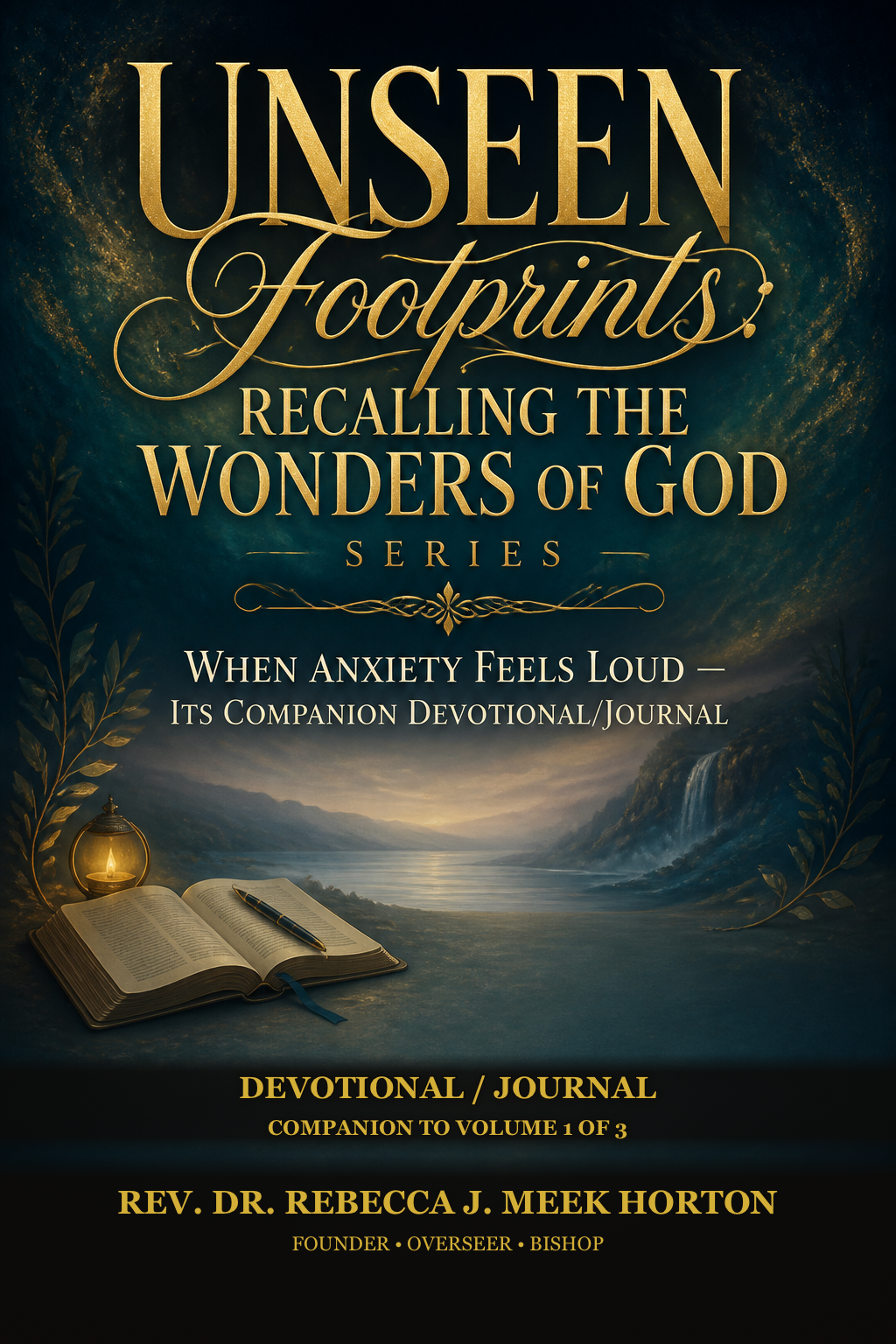
Unseen Footprints: Recalling the Wonders of GOD
When Anxiety Feels Loud — Its Companion Devotional/Journal
Companion Devotional/Journal
Full publication
NBCNGMI MASTER KNOWLEDGE LIBRARY Featuring the works of The Sage, Apostle Prophet. Rev. Dr. Rebecca J. Meek Horton, Apostolic Prophetic Architect, NewBeing Creation Network Global Ministries, Inc. Integrated Framework Modalities™
Dedication
I dedicate this companion devotional and journal to every soul whose anxiety has felt louder than peace. May these pages help you bring your fears honestly before God, breathe again in His presence, and take the next faithful step. I pray Philippians 4:6-7 becomes more than a passage you read—it becomes a truth you practice with Him.
Purpose
I prepared this companion devotional and journal for every heart that needs a quiet place to meet God when anxiety feels loud. My prayer is that these pages help you slow down with Scripture, pray honestly, name what you are carrying, and let the peace of God in Philippians 4:6-7 become more than words on a page. May this book help you listen for truth, steward your thoughts with grace, and take the next faithful step with God.
Preface
This devotional journal was prepared for the moments when anxiety feels louder than truth.
I know what it means to sit with a thought that will not quiet down. I know what it means to love God and still feel pressure in the mind, heaviness in the body, and questions in the heart. Anxiety can make ordinary moments feel crowded. It can make tomorrow feel threatening before it arrives. It can make a person feel ashamed for struggling, even while they are still trying to trust God.
This companion was not created to rush you past that place. It was created to help you meet God there with honesty, Scripture, prayer, and one faithful next step.
Philippians 4:6-7 (KJV)
Be careful for nothing; but in every thing by prayer and supplication with thanksgiving let your requests be made known unto God. And the peace of God, which passeth all understanding, shall keep your hearts and minds through Christ Jesus.
These pages are simple on purpose. Each chapter from When Anxiety Feels Loud becomes five gentle entries: a KJV Scripture reading, a devotional reflection, a prayer, a journal prompt, and space to write. You do not have to perform here. You do not have to have polished words. You may bring the real thing: the fear, the fatigue, the questions, the tears, the racing thoughts, and the quiet desire to be steady again.
Writing can become a form of stewardship. When we slow down enough to name what is happening, we begin to separate truth from noise. We begin to notice what needs prayer, what needs counsel, what needs rest, what needs obedience, and what needs to be released.
This journal is not a substitute for wise care, medical support, pastoral help, or trusted community when those are needed. Receiving help is not failure. It can be part of faithful stewardship.
My prayer is that this companion helps you breathe, listen, pray, and write your way back toward the truth of God’s presence. Anxiety may feel loud, but it is not Lord. God is still near. His Word is still alive. His grace is still sufficient.
Nothing is random. Nothing is wasted.
Take your time. Open your Bible. Pick up your pen. Begin with today.
Introduction
Anxiety can get loud in ordinary places.
It can rise in the morning before your feet touch the floor. It can sit beside you in traffic, follow you into a meeting, tighten your chest during a conversation, or whisper worst-case endings while everyone else thinks you are fine. Sometimes it comes with a clear reason. Sometimes it arrives without asking permission.
This companion devotional and journal was created for that kind of moment.
The argument of this book is simple: anxiety may be loud, but it does not have to be Lord. The voice of fear may press, repeat, and demand control, but the Word of God gives you a steadier place to stand. You do not have to shame yourself for feeling anxious. You also do not have to surrender your thoughts, choices, or future to anxiety’s interpretation of your life.
God meets us with care, truth, wisdom, and instruction.
Philippians 4:6-7 (KJV)
Be careful for nothing; but in every thing by prayer and supplication with thanksgiving let your requests be made known unto God. And the peace of God, which passeth all understanding, shall keep your hearts and minds through Christ Jesus.
This does not mean every anxious feeling disappears instantly. It means anxiety is not the final authority. Prayer becomes a place of honest release. Scripture becomes a lamp. Journaling becomes a way to slow down, tell the truth, and notice what is happening inside you before you react outside of you.
Each chapter from When Anxiety Feels Loud becomes five entries in this companion:
• A KJV Scripture reading to anchor your attention in God’s Word
• A devotional to help you understand and apply the truth
• A prayer to bring your cares before the Lord honestly
• A journal prompt to help you name what is happening within you
• Space to write, process, and steward what God is showing you
Do not rush through these pages. This is not a performance book. It is not a test of how spiritual you are. It is a place to practice returning.
Some days your writing may be clear and full. Other days you may only write one sentence. That is enough. The goal is not to impress yourself. The goal is to come honestly before God, receive truth, and take the next faithful step.
1 Peter 5:7 (KJV)
Casting all your care upon him; for he careth for you.
The word casting carries movement. It asks you to do something with what you are carrying. Not deny it. Not decorate it. Not let it rule silently. Bring it into the presence of God.
As you read, keep a Bible near. Read the Scripture slowly. Let it search you before you use it. If a sentence in the devotional stands out, pause there. If the prayer gives language to something you could not name, pray it again in your own words. If a journal prompt feels difficult, do not skip it too quickly. Sometimes the place we avoid is the place where God wants to bring light.
This book also carries a pastoral boundary. Prayer, Scripture, worship, and journaling are holy and helpful practices, but they are not meant to make you reject wise care. If anxiety is affecting your sleep, health, safety, relationships, or ability to function, please seek appropriate support from a trusted pastor, mature Christian community, medical professional, or licensed counselor. Receiving help is not failure. Stewardship is wisdom.
At the end of this companion, you will find An Apostolic Prophetic Architect Message and additional lined journal pages. Use them slowly. Let them become a record of God’s faithfulness, your honest prayers, your growth, and the truth you are learning to carry.
Nothing is random. Nothing is wasted.
Before you begin, take one quiet minute. Place your hand over your heart if that helps you focus. Breathe slowly. Then write one sentence:
Lord, the anxiety that feels loud today is ____________________.
Bring that sentence to Him.
Then begin.
Chapter 1 — When the Room Gets Loud
Entry 1
Scripture Reading
Psalm 77:1-3 (KJV) 1 To the chief Musician, to Jeduthun, A Psalm of Asaph. I cried unto God with my voice, even unto God with my voice; and he gave ear unto me. 2 In the day of my trouble I sought the Lord: my sore ran in the night, and ceased not: my soul refused to be comforted. 3 I remembered God, and was troubled: I complained, and my spirit was overwhelmed. Selah.
Devotional
There are nights when the room is quiet, but the soul is not. Nothing outside is demanding you, but everything inside feels awake. A conversation replays. A fear grows. Your body feels as if danger has entered, even when nothing has changed in the room.
Psalm 77 does not begin with a calm person giving perfect words to God. It begins with a cry. That matters. The first movement of faith here is not composure. It is direction. The psalmist turns his trouble toward God.
Sometimes we think prayer must sound steady before it counts. We think we need to settle down, organize the feelings, and present God with a cleaner version of ourselves. But this passage gives us a mercy-filled beginning. The cry itself is prayer. The reach itself is faith.
Distress is not proof that faith has failed. Anxiety can be loud and faith can still be present. A trembling hand can still be lifted toward God. A tired voice can still be heard by Him. A scattered mind can still say, Lord, I need You.
The psalmist says, “my soul refused to be comforted.” That is honest language. There are moments when comfort is offered, but it does not land. Someone says the right thing, but your heart cannot receive it yet. You remember truth, but the body still feels afraid. You pray, but the room still feels crowded.
God did not remove that sentence from Scripture. He preserved it. That tells us something about His tenderness. He is not offended by the prayer that comes before relief. He is not ashamed of the child who cries before understanding. He gives anxious souls words when they do not know how to explain themselves.
This is the doorway: I cried unto God with my voice. Not after I felt better. Not after I understood everything. Not after I proved I was strong. I cried, and He gave ear unto me.
Today, let this be enough to begin. You do not have to perform peace. You do not have to pretend the room is quiet when your inner life is loud. Bring the true condition of your heart to the Lord. Let the cry stand before Him. God hears before everything feels resolved.
Prayer
Father, I come to You without pretending. I admit that some places in me feel loud, tired, and unsettled. I have tried to quiet myself, explain myself, and sometimes shame myself into feeling better. Today I choose to cry unto You with my voice. I believe You give ear to me, even when my words are weak and my spirit feels overwhelmed. Teach me not to hide from You in distress. Teach me to bring the whole truth of my heart into Your presence. I receive Your welcome before I feel fully calm. Hold me steady as I learn to pray honestly. Amen.
Journal Prompt
Psalm 77:1-3 shows an honest cry before comfort arrives. What is one sentence you need to say to God today without polishing it?
Space to Write
[Answer Lines]
Entry 2
Scripture Reading
Psalm 34:17-18 (KJV) 17 The righteous cry, and the LORD heareth, and delivereth them out of all their troubles. 18 The LORD is nigh unto them that are of a broken heart; and saveth such as be of a contrite spirit.
Devotional
One of the cruelest things anxiety can do is make you feel alone inside your own body. People may be near, but the fear still feels private. The room may be full, but your heart may feel hidden. You may know how to smile, answer questions, and keep moving, while inwardly you are saying, Lord, I am not okay.
Psalm 34 gives a clear mercy: the Lord hears the cry. He is not distant from the brokenhearted. He is nigh. Near.
That one word can become a place to rest.
The Lord is not near only to people who can explain their pain well. He is not near only to those who are emotionally composed. He is not near only to those whose prayers sound strong. He is near to them that are of a broken heart.
Brokenness does not disqualify you from His presence. It may become the very place where you learn His nearness in a deeper way.
This does not mean every anxious feeling disappears at once. Deliverance can unfold in ways we do not control. Sometimes God delivers by calming the storm quickly. Sometimes He delivers by strengthening us through wise counsel, honest prayer, steady support, medical care, rest, boundaries, and time. Sometimes He delivers us one breath at a time.
But this passage anchors us in something anxiety cannot change: the Lord hears.
Shame says, If you were stronger, you would not feel this. Scripture says, The righteous cry, and the Lord heareth. Notice that crying and righteousness are not enemies in this verse. The righteous cry. The Lord hears. God’s people are not presented as untouched by trouble. They are presented as heard in trouble.
That is good news for the person whose chest feels tight. Good news for the one who wakes in the night. Good news for the believer who loves God but still feels afraid. Your cry is not evidence that you are abandoned. Your cry can become evidence that you know where to turn.
Let this truth RE-Language the accusation in your mind. Not, I am alone because I am anxious. But, I am heard by God while I am anxious. Not, God must be far because I feel broken. But, the Lord is nigh unto them that are of a broken heart.
Today, you do not have to climb your way into His attention. Cry honestly. He hears.
Prayer
Father, I thank You that You are near to the brokenhearted. I bring You the places where I have felt alone, even when others could not see it. I confess that anxiety has sometimes made me question whether You are close. Let Your Word correct that fear. You hear the righteous cry, and You are not far from me in weakness. Help me receive Your nearness without demanding that I feel instantly fixed. Lead me into the deliverance You know I need, in the way You choose to provide it. Keep me from shame, and help me keep turning toward You. Amen.
Journal Prompt
Psalm 34:17-18 says the Lord is nigh to the brokenhearted. Where do you need to believe God is near, even before your emotions feel settled?
Space to Write
[Answer Lines]
Entry 3
Scripture Reading
Philippians 4:6-7 (KJV) 6 Be careful for nothing; but in every thing by prayer and supplication with thanksgiving let your requests be made known unto God. 7 And the peace of God, which passeth all understanding, shall keep your hearts and minds through Christ Jesus.
Devotional
When anxiety feels loud, this passage can sometimes feel hard to read. “Be careful for nothing” can sound impossible when the body is already tense and the mind is already moving fast. Some people read these words and immediately feel accused. They think, I am failing because I feel anxious.
But Scripture is not given to crush the weary. It is given to lead us.
The invitation here is not to pretend there is no concern. It is to bring every concern into prayer. “In every thing” means nothing is too small, too tangled, too embarrassing, or too repeated to bring before God. The Lord is not asking you to manage the whole storm alone. He is calling you to make your requests known unto Him.
Anxiety often tries to make the mind carry what only God can govern. It turns possibilities into predictions. It turns memories into accusations. It turns uncertainty into danger. It asks the heart to solve every outcome before morning.
Prayer interrupts that false assignment.
Prayer does not always begin with peace. Sometimes prayer begins with a trembling list. Father, I am afraid of this. Father, I do not know what to do about that. Father, I need help in my body. Father, I need wisdom for this conversation. Father, I need You to keep me tonight.
This passage teaches us to bring requests with thanksgiving. Thanksgiving is not denial. It is not pretending the burden is light when it feels heavy. Thanksgiving is remembrance. It tells the anxious mind, This is not the first time God has been faithful. This is not the first night He has kept me. This is not the first need He has seen.
Then comes the promise: the peace of God shall keep your hearts and minds through Christ Jesus. Peace keeps. Peace guards. Peace does not always explain. It “passeth all understanding.” That means God can give a keeping peace before you have a complete explanation.
This matters because anxiety often demands understanding before it will rest. But God’s peace is not limited by our ability to figure everything out. His peace can stand guard where our thoughts have been running unprotected.
Today, do not use this Scripture as a weapon against yourself. Receive it as a path. Bring the thing. Name the request. Add remembrance. Ask the peace of God to keep what anxiety has been trying to govern.
Prayer
Father, I bring my requests to You today. I do not want to carry concerns as if I am the one who must control every outcome. I confess that my mind often tries to solve what belongs in Your hands. Teach me to pray instead of spinning. Teach me to give thanks without denying what is hard. I ask You to guard my heart and mind through Christ Jesus. Let Your peace stand where fear has been standing. Let Your presence steady me beyond what I can understand. I receive Your keeping power for this day and this night. Amen.
Journal Prompt
Philippians 4:6-7 calls you to make your requests known unto God. What request have you been rehearsing in worry that you need to write as a prayer?
Space to Write
[Answer Lines]
Entry 4
Scripture Reading
Matthew 11:28-30 (KJV) 28 Come unto me, all ye that labour and are heavy laden, and I will give you rest. 29 Take my yoke upon you, and learn of me; for I am meek and lowly in heart: and ye shall find rest unto your souls. 30 For my yoke is easy, and my burden is light.
Devotional
Jesus does not say, “Come unto me, all ye who have already calmed down.” He does not say, “Come unto me, all ye who can explain your anxiety correctly.” He does not say, “Come unto me, all ye who are never overwhelmed.”
He says, “Come unto me, all ye that labour and are heavy laden.”
That is an invitation for tired people.
Anxiety can feel like labour. The mind works and works. The body stays alert. The heart tries to prepare for what may never happen. Even rest can become work when you are trying hard to become peaceful. You may lie down, but still feel like you are carrying something heavy.
Jesus does not shame the heavy laden. He calls them near.
This is the first mercy of the invitation. You are not required to become light before you come. You come because you are heavy. You come because you have been labouring. You come because your soul needs rest that self-management cannot produce.
There is a holy honesty in admitting, Father, I am carrying too much. That admission is not weakness in the shameful sense. It is truth. And truth is often the beginning of healing.
Jesus also says, “learn of me.” Rest is not only a moment we receive. It is a way we learn. We learn His meekness. We learn His lowliness of heart. We learn that He is not harsh with the weary. We learn to stop treating ourselves with a severity He has not placed on us.
Some of us are tired not only from anxiety, but from judging ourselves for having anxiety. We carry the fear, then carry shame about the fear. We feel the trembling, then accuse ourselves for trembling. But Jesus does not add that burden. His burden is light.
This does not mean the road has no cost. Learning rest may require us to release control. It may require us to ask for help. It may require us to stop rehearsing fear as if rehearsal can keep us safe. It may require new rhythms, wise care, boundaries, and obedience one small step at a time.
But the center is still His voice: Come unto me.
Today, do not wait until you feel worthy of rest. Come because Jesus invited the weary. Bring the crowded room of your inner life to Him. Let Him teach your soul how to rest under His care.
Prayer
Father, I come to Jesus today because I am weary and heavy laden. I have tried to carry fear, responsibility, and shame in my own strength. I confess that I do not always know how to rest. Teach me the way of Christ. Teach me His meekness and lowliness of heart. Help me release the burdens You never assigned to me. Show me what obedience looks like without striving. I receive the invitation to come before I feel composed. Let my soul find rest in Your presence, not because everything is easy, but because Jesus is faithful and near. Amen.
Journal Prompt
Matthew 11:28-30 invites the heavy laden to come to Jesus. What burden are you still trying to carry alone, and what would it look like to bring it to Him today?
Space to Write
[Answer Lines]
Entry 5
Scripture Reading
1 Peter 5:6-7 (KJV) 6 Humble yourselves therefore under the mighty hand of God, that he may exalt you in due time: 7 Casting all your care upon him; for he careth for you.
Devotional
Casting your care upon God sounds simple until the care has wrapped itself around your thoughts. Anxiety does not always feel like something you are holding. Sometimes it feels like something holding you. It grips the body. It crowds the mind. It follows you from room to room.
Yet this Scripture gives a faithful next step: cast the care.
To cast is not to deny the care exists. It is to transfer the weight. It is the honest movement of saying, Father, this is real, but it is not mine to carry as lord over my life. I place it under Your mighty hand.
The verse before the casting matters. “Humble yourselves therefore under the mighty hand of God.” Anxiety often tempts us toward a painful form of control. We may try to predict every outcome, manage every response, and prepare for every disappointment. It feels responsible, but it can become exhausting.
Humility admits that we are not God.
That is not a harsh truth. It is a freeing one. We are not built to know everything, fix everything, prevent everything, or carry everything. We are called to walk with God in truth, wisdom, obedience, and trust. His hand is mighty. Ours is limited. Peace begins when we stop pretending our hands can do what only His can do.
But this casting is not cold surrender. The reason given is deeply personal: “for he careth for you.” God is not asking you to throw your concerns into emptiness. He is inviting you to place them upon One who cares. His care is not casual. His care is covenantal, faithful, attentive, and near.
This matters when the room gets loud. Anxiety may say, If you do not carry this, no one will. Scripture says, Cast it upon Him, for He careth for you. Anxiety may say, You must solve this tonight. Scripture says, Humble yourself under the mighty hand of God. Anxiety may say, You are alone with this. Scripture says, He careth for you.
Today, choose one care. Not every care at once if that feels too much. One care. Name it plainly. Write it down if you need to. Then pray the transfer: Father, I cast this care upon You because You care for me.
If the care comes back to mind, cast it again. That is not failure. That is practice. Keep the next faithful step.
Prayer
Father, I humble myself under Your mighty hand. I admit that I cannot carry everything I have been trying to carry. I have treated some cares as if they belong only to me, and I am tired. Today I cast my care upon You because Your Word says You care for me. Help me trust Your care more than my fear. Help me release the need to control what I cannot govern. Teach me to return this burden to You each time it rises again. I receive Your faithful attention, Your timing, and Your keeping grace. Amen.
Journal Prompt
1 Peter 5:6-7 tells you to cast all your care upon God. What is one specific care you need to transfer to Him today, and what makes it hard to release?
Space to Write
[Answer Lines]
An Apostolic Prophetic Architect Message
Beloved, hear this with tenderness and strength: the loud room is not your final authority. The anxious moment may be real, but it is not sovereign. Your body may feel crowded, your mind may feel pressed, and your prayers may feel smaller than the storm, but God has not stepped away from you.
The first movement was never performance. The first movement is coming. The cry. The reach. The honest sentence spoken from the place where you really are.
Psalm 61:1-2 (KJV) 1 To the chief Musician upon Neginah, A Psalm of David. Hear my cry, O God; attend unto my prayer. 2 From the end of the earth will I cry unto thee, when my heart is overwhelmed: lead me to the rock that is higher than I.
This is the word to seal in your spirit: when your heart is overwhelmed, there is still a Rock higher than you. Higher than the fear. Higher than the memory. Higher than the imagined future. Higher than the shame that tried to attach itself to your distress.
Do not let anxiety become your identity. Do not let shame become your interpreter. Do not let one hard night write a false doctrine over your life. Distress is not proof that faith has failed. It may be the very place where faith learns to reach without pretending.
You are being invited into RE-Alignment™ with truth. Not truth as a slogan, but truth as a place to stand. God hears. God is near. God receives the cry. God keeps the heart and mind through Christ Jesus. God cares for you.
This does not remove the need for wisdom. If anxiety is affecting your sleep, body, relationships, decisions, or daily functioning, receive help without shame. Prayer, Scripture, pastoral care, trusted community, counseling, and appropriate medical support can work together as stewardship. You are not less spiritual because you need support. You are human, and God is faithful.
Now take the next faithful step. Tonight, when the room gets loud, do not argue with every thought. Do not rehearse every fear. Put one sentence before God: Father, I cry unto You, and You hear me.
Let that sentence stand.
Nothing is random. Nothing is wasted. Even here, God can meet you, steady you, and teach you how to walk forward in truth.
[Journal Page]
[Journal Page]
Chapter 2 — You Do Not Have to Calm Down First
Entry 1
Scripture Reading
Psalm 77:1-2 (KJV) 1 To the chief Musician, to Jeduthun, A Psalm of Asaph. I cried unto God with my voice, even unto God with my voice; and he gave ear unto me. 2 In the day of my trouble I sought the Lord: my sore ran in the night, and ceased not: my soul refused to be comforted.
Devotional
Psalm 77 does not begin with a calm person. It begins with a crying person.
That matters for the anxious heart.
Sometimes anxiety makes us feel disqualified from prayer. We think we have to get quiet first. We think we have to sound steady. We think we have to explain ourselves in a way that makes spiritual sense. But this psalm gives us a different doorway. The psalmist says, I cried unto God with my voice.
Not with polished words.
Not with controlled emotion.
Not after everything settled.
With his voice, in trouble, while his soul refused to be comforted.
There are moments when comfort does not land quickly. Someone may say the right thing, and your heart may still feel tight. You may know the truth in your mind, but your body is still trembling. You may want to rest, but your thoughts keep circling. This does not mean you are beyond help. It means you are human, and God is still near enough to hear the cry.
The cry is not the opposite of faith. Many times, the cry is faith reaching for God before the feelings have caught up. It says, I do not know how to carry this, but I know where to turn. It says, I am not calm, but I am coming. It says, Father, hear me here.
You do not have to shame yourself for the sound your distress makes. God is not startled by the unsteady voice. He does not turn away because your prayer comes with tears, pauses, or repeated sentences. He gave ear to the psalmist, and He is not less merciful toward you.
This is not permission to let anxiety rule the day. It is an invitation to stop hiding from God while anxiety is loud. The Lord can shepherd what you honestly bring to Him. He can meet you in the car, in the hallway, in the bathroom, at the kitchen sink, before the meeting, after the message, in the night when your soul refuses to be comforted.
Start where you are.
If all you can pray is, Father, I need You, that is still prayer.
God receives the cry before the calm.
Prayer
Father, I come to You before I feel settled. I bring the tightness, the racing thoughts, the fear, and the shame that tells me I should be stronger. I do not want to hide behind a polished version of myself. I want to come honestly. Teach me to trust that You hear me when my voice shakes. Help me stop measuring my faith by how calm I feel in the moment. Receive my cry, Lord, and begin Your work in me. Hold me close while I learn to breathe, listen, and take the next faithful step with You. Amen.
Journal Prompt
Read Psalm 77:1-2 again. Where have you been waiting to feel calm before you come to God, and what honest cry do you need to bring Him today?
Space to Write
[Answer Lines]
Entry 2
Scripture Reading
1 Peter 5:6-7 (KJV) 6 Humble yourselves therefore under the mighty hand of God, that he may exalt you in due time: 7 Casting all your care upon him; for he careth for you.
Devotional
Casting care begins with humility.
That may not be what we expect. We often think humility means thinking less of ourselves, speaking softly, or stepping back. But in this passage, humility is connected to releasing what we cannot carry rightly on our own. To cast care upon God is to admit, Father, this is too heavy for me to govern without You.
Anxiety often convinces us that holding the burden is responsible. We review the details again. We imagine every possible outcome. We rehearse the conversation before it happens. We try to prepare for pain before pain arrives. We call it wisdom, but sometimes it is fear wearing responsible clothing.
The Scripture does not say, Cast only the care that makes sense. It does not say, Cast only the care you have not prayed about before. It does not say, Cast only the care that seems important enough. It says, Casting all your care upon him.
All includes the burden you are embarrassed to name.
All includes the worry that keeps returning.
All includes the small thing that feels too small and the large thing that feels too tangled.
All includes the care under the care. The fear beneath the schedule. The grief beneath the irritability. The shame beneath the anxiety.
But casting is not denial. You are not pretending the burden does not exist. You are not saying the situation is easy. You are not avoiding responsibility. You are bringing the real weight under the mighty hand of God. You are choosing not to let fear be your master.
And the reason is tender: for he careth for you.
God does not ask you to cast your care because He is annoyed with your feelings. He asks because He cares for you. His care is not thin. His care is not impatient. His care does not disappear when your nervous system feels loud or your thoughts feel crowded. He is Father, and He knows what the weight has been doing to your soul.
Sometimes the feeling will lift quickly. Sometimes it will not. Casting care is not a trick for instant calm. It is a faithful act of trust. You may cast the care and still need rest, counsel, boundaries, medical care, pastoral support, or a wise next step. That is not failure. That is stewardship.
Today, do not wait until the burden becomes respectable.
Bring the actual weight.
Prayer
Father, I humble myself under Your mighty hand. I confess that I have been carrying some cares as if everything depends on me. I have confused control with responsibility and worry with wisdom. Today, I bring You all my care, not only the parts I can explain well. I bring the fear, the pressure, the unknowns, and the hidden weight beneath my functioning. Thank You that You care for me. Help me receive that truth slowly and deeply. Show me what I need to release, what I need to steward, and what next faithful step belongs to today. Amen.
Journal Prompt
Read 1 Peter 5:6-7 again. What care have you been gripping with both hands, and what would it look like to cast that care upon God without abandoning your responsibility?
Space to Write
[Answer Lines]
Entry 3
Scripture Reading
Hebrews 4:14-16 (KJV) 14 Seeing then that we have a great high priest, that is passed into the heavens, Jesus the Son of God, let us hold fast our profession. 15 For we have not an high priest which cannot be touched with the feeling of our infirmities; but was in all points tempted like as we are, yet without sin. 16 Let us therefore come boldly unto the throne of grace, that we may obtain mercy, and find grace to help in time of need.
Devotional
The anxious heart often expects rejection before it asks for help.
That expectation may have a history. Maybe you learned to stay composed so people would not be disappointed. Maybe your distress was minimized. Maybe you were taught that strong believers do not struggle like this. Maybe you have carried the silent thought, If I admit how anxious I am, I will prove something is wrong with my faith.
Hebrews answers that fear by showing us Jesus.
We do not come to a cold throne. We come to the throne of grace. We do not come without representation. We have a great high priest, Jesus the Son of God. We do not come to One who is untouched by weakness. The Scripture says He is touched with the feeling of our infirmities.
This does not make Jesus anxious in the way we experience anxiety. He is without sin. But it does mean He is merciful, near, and fully able to meet human weakness with holy compassion. He knows what it is to live in a body, face temptation, suffer pressure, endure sorrow, and obey the Father in costly places.
So the invitation is not, Come when you have repaired yourself.
It is, come boldly.
Boldly does not mean casually. It does not mean demanding. It means you do not have to crawl into God’s presence as if mercy might not be there. You come because Christ has made the way. You come because grace is available. You come because help is promised in time of need.
Anxiety can make the need feel shameful, but Scripture calls it a place where mercy and grace can be found.
This is important: honesty is not irreverence. Honest prayer does not make the self the final authority. Honest prayer brings the self before God. It says, Father, this is what is happening in me, and I need Your mercy here. It does not accuse God. It reaches for Him.
The polished version of you cannot be healed. The pretending version cannot be comforted. The hidden version cannot receive what it refuses to bring into the light. But the honest soul can obtain mercy.
Today, you do not have to perform your way into God’s care.
Because of Jesus, you may come.
Prayer
Father, I come boldly to the throne of grace because Jesus has made the way. I do not come pretending I am stronger than I am. I come needing mercy and grace to help me in this time of need. Thank You that Jesus is not untouched by human weakness. Thank You that I do not have to hide my anxiety from You. Teach me the difference between reverence and performance. Remove the fear that honest prayer dishonors You. Help me hold fast to my profession while bringing my whole burden into Your presence. I receive mercy from You today. Amen.
Journal Prompt
Read Hebrews 4:14-16 again. What part of your need have you been afraid to bring boldly before God, and how does Jesus as your great high priest change the way you pray?
Space to Write
[Answer Lines]
Entry 4
Scripture Reading
Psalm 62:8 (KJV) Trust in him at all times; ye people, pour out your heart before him: God is a refuge for us. Selah.
Devotional
Trust does not mean you hide your heart.
Psalm 62:8 holds together two truths we often separate. Trust in him at all times. Pour out your heart before him. God does not command trust and then forbid honesty. He invites both.
This matters when anxiety feels loud. Many of us try to prove we trust God by staying quiet about the storm inside. We call it faith, but sometimes it is fear. Fear says, Do not say too much. Shame says, Do not let God see how unsettled you are. Pride says, You should be able to handle this without needing help.
But the Scripture says, pour out your heart before him.
To pour out your heart is not to give God a careful summary. It is not to hand Him the edited report. It is to bring what is actually there. The confusion. The anger. The weariness. The dread. The repeated question. The ache you wish you did not still have. The anxiety you thought would be gone by now.
Pouring out is not the same as being ruled by every feeling. It is bringing every feeling into the presence of the One who is refuge. God is not asking you to let anxiety lead your life. He is inviting you to stop letting anxiety live hidden and unchallenged in the dark.
A refuge is not needed because the weather is pleasant. A refuge is needed because there is danger, pressure, exposure, or fear. When Scripture says God is a refuge, it does not deny the storm. It tells you where to go with it.
Some days, pouring out your heart may sound like a long prayer. Other days, it may be one sentence written in a journal: Father, what I am really carrying is this. Other days, it may be tears before words. That is still movement toward God.
Selah invites us to pause. Not rush past the verse. Not treat it like a slogan. Pause and let the truth become personal: God can be trusted with my unedited heart.
You do not have to choose between trust and honesty.
In God’s presence, honesty can become an act of trust.
Prayer
Father, I trust in You, and I pour out my heart before You. I have tried to keep parts of myself contained because I thought that would prove faith. But Your Word invites me to bring my heart honestly. You are my refuge, not only when I feel strong, but when I feel exposed and afraid. Help me stop hiding from You. Help me pour out what is true without letting anxiety become my ruler. Receive my words, my tears, my silence, and my need. Teach me to pause, breathe, and remember that You are safe for my soul. Amen.
Journal Prompt
Read Psalm 62:8 again. What would you pour out before God if you were not trying to sound composed, and where do you need to experience Him as refuge today?
Space to Write
[Answer Lines]
Entry 5
Scripture Reading
Matthew 11:28-30 (KJV) 28 Come unto me, all ye that labour and are heavy laden, and I will give you rest. 29 Take my yoke upon you, and learn of me; for I am meek and lowly in heart: and ye shall find rest unto your souls. 30 For my yoke is easy, and my burden is light.
Devotional
Jesus does not say, Calm down, then come.
He says, Come unto me.
That is the mercy at the center of this invitation. The weary are not told to repair themselves before approaching Him. The heavy laden are not asked to prove they can carry more. The ones who labour are not shamed for being tired. They are invited.
Anxiety often makes us feel like we are failing before we have even begun. We look at the responsibilities in front of us and feel behind. We see the people who need us and feel inadequate. We hear the inner accusation: I should be stronger than this. I should be able to handle this. I should not need so much help.
But Jesus does not begin with accusation. He begins with invitation.
Come.
This does not mean He ignores the weight. He names it. Labour. Heavy laden. He sees the strain. He sees the person still functioning while inwardly bending under the load. He sees the one sitting in the car, keys in hand, trying to gather enough strength to go inside. He sees the parent, the caregiver, the leader, the worker, the student, the grieving one, the faithful one whose trust is tired.
And He does not ask for the polished version.
He asks for you.
Then He says, Take my yoke upon you, and learn of me. Rest is not only the removal of pressure. It is learning to walk with Jesus under His leadership. His way may still include responsibility. It may still include hard conversations, limits, obedience, patience, and wise care. But His yoke is not the crushing rule of fear. His burden is not the unbearable weight of self-salvation.
He is meek and lowly in heart. That means you do not have to fear coming near with weakness. He is not harsh with the bruised soul that turns toward Him.
Sometimes rest begins before the circumstances change. It begins when you stop standing outside the invitation, trying to become worthy of it. It begins when you say, Jesus, I am weary, and I am coming to You now.
You do not have to calm down first.
Come now.
Learn of Him.
Let your soul find rest in the One who called you near.
Prayer
Father, I come to Jesus with the weariness I have been trying to manage alone. I bring the labour, the heaviness, the anxiety, and the accusation that says I should be stronger. Thank You that Jesus invites me before I feel composed. Teach me to take His yoke and learn of Him. I do not want fear to lead me. I want Christ to shepherd me into true rest. Help me receive His meekness and lowliness of heart. Show me the responsibility that is mine, the burden I must release, and the next faithful step I can take with Him today. Amen.
Journal Prompt
Read Matthew 11:28-30 again. What heavy burden have you been trying to carry before coming to Jesus, and what would it mean to come to Him now instead of waiting to feel calm?
Space to Write
[Answer Lines]
An Apostolic Prophetic Architect Message
Beloved, let this be sealed in your spirit with clarity: you do not have to calm down first to come to God.
The enemy will use anxiety, then add shame on top of it. He will tell you the tight chest disqualifies you, the racing thought embarrasses you, and the trembling prayer proves you are weak. But the Word of the Lord gives another witness. The Father hears the cry. The Son welcomes the weary. The throne is called the throne of grace. The care can be cast because God careth for you.
This is a RE-Alignment™ moment. Not a moment to perform. Not a moment to pretend. A moment to turn. You are being invited out of hiding and into honest communion with God.
Psalm 34:17-18 (KJV) 17 The righteous cry, and the LORD heareth, and delivereth them out of all their troubles. 18 The LORD is nigh unto them that are of a broken heart; and saveth such as be of a contrite spirit.
The righteous cry, and the Lord heareth. That is not weakness. That is covenant mercy. That is the faithfulness of God meeting the frailty of His people.
Do not despise the small beginning of an honest prayer. One unpolished sentence can become a doorway. Father, what I am really carrying is this. That sentence may feel simple, but it breaks agreement with hiding. It tells the truth. It places the burden before the One who can carry what you cannot govern by fear.
And hear this with wisdom: coming honestly does not mean ignoring stewardship. Some burdens need prayer and rest. Some need Scripture and counsel. Some need boundaries. Some need medical care, trauma care, pastoral care, or community support. None of that makes you spiritually inferior. It means you are stewarding your life before God with humility.
Nothing is random. Nothing is wasted. Even this anxious place can become a place where trust is guarded, truth is restored, and the next faithful step becomes visible.
So today, come.
Come before calm.
Come before perfect words.
Come before you understand the whole feeling.
Come to the Father who hears. Come through the Son who intercedes. Come by the Spirit who helps your weakness.
Your next step is simple: pray one honest sentence, then breathe, then obey the light God gives for today.
[Journal Page]
[Journal Page]
Chapter 3 — Cry Out Without Pretending
Entry 1
Scripture Reading
Psalm 77:1-3 (KJV) 1 To the chief Musician, to Jeduthun, A Psalm of Asaph. I cried unto God with my voice, even unto God with my voice; and he gave ear unto me. 2 In the day of my trouble I sought the Lord: my sore ran in the night, and ceased not: my soul refused to be comforted. 3 I remembered God, and was troubled: I complained, and my spirit was overwhelmed. Selah.
Devotional
There are days when prayer does not begin with strength. It begins with a cry.
Psalm 77 gives us permission to stop pretending. Asaph does not enter the presence of God with a polished report. He does not hide the night. He does not rush past the trouble so he can sound more faithful. He says what is true. He cried unto God with his voice. He sought the Lord in the day of his trouble. His soul refused to be comforted. His spirit was overwhelmed.
That is not neat language. It is honest language.
Sometimes anxiety makes us feel as if we must choose between being honest and being spiritual. We may think, If I say how scared I am, does that mean I do not trust God? If I admit I cannot sleep, does that mean my faith is weak? If I tell the truth about the heaviness, will God be disappointed in me?
Psalm 77 answers with mercy. The cry is not the opposite of faith. The cry may be the place where faith is still breathing.
Asaph cried unto God. He did not simply cry into the air. He did not only rehearse the trouble within himself. He turned the cry toward the One who could hear him. That is a holy movement. It may not feel strong, but it is real.
You do not have to wait until your heart is calm to come to God. You do not have to edit your pain into acceptable religious sentences. You can begin with the plain truth. Father, I am afraid. Father, I am tired. Father, I do not know what to do with what I am carrying.
Honest prayer does not make anxiety your master. It brings anxiety into the presence of your Father.
There is also tenderness in the words, he gave ear unto me. God is not distant from the distressed cry of His people. He gives attention. He hears what is spoken, and He understands what cannot yet be explained.
Today, let prayer begin where you actually are. Not where you wish you were. Not where others assume you are. Not where shame tells you to perform from. Bring the real burden to the real God.
Plain words are enough to begin.
Prayer
Father, I come to You without pretending today. I admit that there are places in me that feel overwhelmed, tired, and hard to explain. I have tried at times to sound stronger than I am, but You already know the truth. Teach me to trust Your care more than my composure. Help me cry out to You instead of hiding inside my own thoughts. Give me courage to name the burden plainly and place it before You. I believe You hear me, even when my prayer is not polished. Receive my cry, steady my heart, and lead me one faithful step at a time. Amen.
Journal Prompt
Psalm 77:1-3 shows distress being brought honestly to God. What sentence have you been afraid to pray plainly, and what would it look like to bring that sentence to Him today?
Space to Write [Answer Lines]
Entry 2
Scripture Reading
Psalm 34:17-18 (KJV) 17 The righteous cry, and the LORD heareth, and delivereth them out of all their troubles. 18 The LORD is nigh unto them that are of a broken heart; and saveth such as be of a contrite spirit.
Devotional
Brokenness can make a person feel far from God, but Scripture tells a different story.
Psalm 34 says the LORD is nigh unto them that are of a broken heart. Near. Not disgusted. Not impatient. Not waiting across the room until you pull yourself together. Near.
This matters because anxiety often lies about distance. It whispers that God must be far away because you feel unsettled. It tells you that if you were really walking in faith, you would feel stronger, calmer, and more certain. It suggests that your broken heart is evidence of spiritual failure.
But the Word does not say the Lord is near only to the composed. It says He is near to the brokenhearted.
That means your ache does not disqualify you from His presence. Your tears do not make you less welcome. Your trembling does not cancel His compassion.
The righteous cry, and the LORD heareth. Notice that Scripture does not say the righteous never cry. It does not say the righteous always know what to say. It does not say the righteous handle every painful season without visible need. It says they cry, and the Lord hears.
There is a kind of religious pressure that teaches people to hide pain under acceptable language. We learn to say we are blessed when we are actually breaking. We learn to say we are fine when fear has been sitting on our chest all night. But God does not heal the version of us we pretend to be. He meets us in truth.
To cry out without pretending is not to make pain the center. It is to bring pain to the One who is center.
This does not mean every trouble lifts immediately. Psalm 34 speaks of deliverance, but deliverance may unfold through process, counsel, endurance, rest, repentance, support, or time. God’s nearness is not always measured by instant relief. Sometimes His nearness is known as strength to breathe again, courage to tell the truth, wisdom to ask for help, or grace to make it through the next hour.
You may be brokenhearted and still beloved. You may be anxious and still held. You may be in trouble and still heard.
Today, do not measure God’s nearness by the volume of your emotions. Let Scripture tell you what anxiety cannot. The Lord is near.
Prayer
Father, I receive the truth that You are near to the brokenhearted. I confess that when I feel anxious or fragile, I sometimes assume You are far away. Forgive me for believing the voice of fear over the witness of Your Word. Help me bring my broken places into Your care instead of covering them with performance. Teach me to cry out with trust, knowing that You hear the righteous and You are faithful in trouble. I ask You for deliverance in the way and timing that is wise before You. Keep me honest, humble, and open to the help You provide. Amen.
Journal Prompt
Psalm 34:17-18 says the Lord is near to the brokenhearted. Where have you assumed your brokenness made God distant, and how does this passage correct that thought?
Space to Write [Answer Lines]
Entry 3
Scripture Reading
Matthew 14:28-31 (KJV) 28 And Peter answered him and said, Lord, if it be thou, bid me come unto thee on the water. 29 And he said, Come. And when Peter was come down out of the ship, he walked on the water, to go to Jesus. 30 But when he saw the wind boisterous, he was afraid; and beginning to sink, he cried, saying, Lord, save me. 31 And immediately Jesus stretched forth his hand, and caught him, and said unto him, O thou of little faith, wherefore didst thou doubt?
Devotional
Peter’s prayer while sinking was not long, but it was true.
He did not have time to organize his fear into a beautiful speech. He did not explain the wind. He did not defend why he was afraid. He cried out from the place where he was sinking, and Jesus immediately stretched forth His hand.
There is mercy in that word immediately.
Sometimes anxiety makes us feel as if help is far away. The mind begins to race. The body reacts. The heart starts interpreting the wind. What if this gets worse? What if I cannot handle it? What if I fail? What if I sink and no one sees me?
But Jesus saw Peter.
He saw the step of faith. He saw the fear. He saw the sinking. He heard the cry.
This passage does not pretend Peter had no doubt. Jesus names it. Faithfulness is not the same as denial. There was real fear in Peter. There was real danger. There was also a real Savior close enough to catch him.
This is important for the anxious heart. The presence of fear does not mean the absence of Jesus. The feeling of sinking does not mean you are beyond His reach. Your short prayer, spoken in distress, is not too small for Him.
There may be days when your prayer is simply, Father, help me. There may be nights when you cannot form many words. There may be moments when the most honest thing you can do is stop performing and reach toward Christ with whatever faith remains.
That is not failure. That is turning.
Peter began to sink when he saw the wind boisterous. We understand that. Anxiety often fixes our attention on what is loud, unstable, and threatening. The wind becomes large in our sight. Jesus becomes less visible, not because He moved, but because fear crowded the frame.
Crying out helps us RE-Focus. It turns the soul back toward the One who is present in the storm.
Jesus did not leave Peter to drown while teaching him a lesson. He caught him. Correction came in the safety of His hand. That is the heart of Christ toward His own.
Today, if you feel like you are sinking, do not wait to sound composed. Cry out. The Savior is not offended by urgent need.
Prayer
Father, I admit that I often look at the wind and become afraid. When anxiety feels loud, I can feel as if I am sinking inside my own thoughts. Help me turn toward Jesus quickly and honestly. Teach me that a short prayer from a desperate place still matters to You. I do not want to pretend I am calm when I need Your hand. Strengthen my faith, but also meet me in my weakness. Catch me where fear has pulled my attention away from You. Help me receive both Your rescue and Your correction with trust. Amen.
Journal Prompt
Matthew 14:28-31 shows Peter crying out while beginning to sink. What “wind” has been pulling your attention away from Jesus, and what plain prayer do you need to pray from that place?
Space to Write [Answer Lines]
Entry 4
Scripture Reading
1 Peter 5:6-7 (KJV) 6 Humble yourselves therefore under the mighty hand of God, that he may exalt you in due time: 7 Casting all your care upon him; for he careth for you.
Devotional
Casting care requires honesty.
We cannot cast what we keep disguising. We cannot place a burden before God while pretending it is lighter than it is. If the real weight is fear, but we only call it concern, we may sound composed, but the fear remains unnamed. If the real ache is loneliness, but we only call it tiredness, we may avoid exposure, but the deeper burden stays hidden.
1 Peter invites us into a humble exchange. We come under the mighty hand of God, and we cast all our care upon Him. Not some of it. Not the respectable part only. Not the portion we think sounds spiritual enough. All our care.
This is not carelessness. It is stewardship. God is not asking us to deny responsibility. He is teaching us not to carry responsibility as if we are God.
Anxiety often grows when responsibility turns into false ownership. We begin to believe everything depends on us. We rehearse outcomes we cannot control. We carry conversations that have not happened. We try to manage other people’s responses, tomorrow’s provision, our reputation, our health, our children, our calling, and our future. Some of these concerns are real. But we are not built to carry them alone.
The passage gives the reason we can cast our care: He careth for you.
That is not a small sentence. It is not decorative comfort. It is the foundation beneath the practice. We cast because He cares. We release because His hand is mighty. We humble ourselves because we are not abandoned.
Honest prayer may feel humbling because it admits need. It says, Father, I cannot carry this as if I am in control. It tells the truth about limits. It stops pretending that strength means never needing help.
But humility is not humiliation. God does not shame the one who brings the burden. He receives what we cast upon Him because He cares.
Today, name the care in your hand. Be specific. Not vague. Not polished. What are you carrying in your mind, body, and spirit? What have you been rehearsing as if worry could secure the outcome?
Then cast it. You may need to do it more than once. That is not failure. Sometimes the soul learns release through repeated obedience.
Prayer
Father, I humble myself under Your mighty hand. I confess that I have carried cares as if everything depends on me. I have disguised some burdens because I wanted to seem strong, but You know what is really in my heart. Teach me to cast all my care upon You, not because I am avoiding responsibility, but because I trust Your care for me. Show me what I need to do, what I need to release, and what I need to stop rehearsing. I receive Your mercy for my limits. Help me walk today with open hands and honest faith. Amen.
Journal Prompt
1 Peter 5:6-7 connects humility with casting care on God. What specific care have you been carrying as if it belongs only to you, and how can you cast it on Him today?
Space to Write [Answer Lines]
Entry 5
Scripture Reading
Hebrews 4:14-16 (KJV) 14 Seeing then that we have a great high priest, that is passed into the heavens, Jesus the Son of God, let us hold fast our profession. 15 For we have not an high priest which cannot be touched with the feeling of our infirmities; but was in all points tempted like as we are, yet without sin. 16 Let us therefore come boldly unto the throne of grace, that we may obtain mercy, and find grace to help in time of need.
Devotional
The throne of grace is not only for the calm.
It is for the one in need.
Hebrews tells us to come boldly, not because we have no weakness, but because Jesus is our great high priest. He is not untouched by the feeling of our infirmities. He is not cold toward human frailty. He does not look upon need with contempt. He understands weakness without being overcome by sin, and He welcomes His people to come for mercy and grace.
This is where pretending loses its power.
If the place we are invited to is a throne of grace, then we do not have to approach as if we have no need for grace. If mercy is offered there, then we do not have to hide the places that need mercy. If help is available in time of need, then our need is not an embarrassment. It is the very reason we come.
Anxiety often trains the soul to brace for rejection. We may expect criticism, correction without compassion, or silence. We may carry old experiences into prayer and assume God will treat us the way people did when we were not okay.
But Jesus is not careless with weakness.
This does not mean He leaves us unchanged. Grace is not permission to stay bound. Mercy does not call fear truth. But the order matters. We come. We obtain mercy. We find grace to help. God meets us in truth so He can form us in truth.
The anxious heart may ask, Can I come boldly if I am trembling?
Yes. Boldness is not the absence of trembling. Boldness is confidence in the One who receives you.
You may come with tears. You may come with unfinished sentences. You may come with a journal full of questions. You may come needing to say, Father, I am not okay. The throne remains grace.
This passage also calls us to hold fast our profession. Honest prayer is not abandoning faith. It is holding faith where life is hard. It is refusing to let shame drive you away from the very mercy you need.
Today, come plainly. Come reverently. Come honestly. The help you need is not found in pretending you have no need. It is found at the throne of grace.
Prayer
Father, I come boldly to Your throne of grace because Jesus has opened the way. I do not come pretending I have no weakness. I come because I need mercy and grace to help me today. Thank You that Jesus is not untouched by my infirmities and that my need does not make me unwelcome. Help me stop hiding from You when anxiety feels loud. Teach me to hold fast my faith while telling the truth about my struggle. Meet me with mercy, correct me with love, and strengthen me to take the next faithful step. Amen.
Journal Prompt
Hebrews 4:14-16 invites you to come to the throne of grace in time of need. What need have you been trying to hide, and what mercy or help are you asking God for today?
Space to Write [Answer Lines]
An Apostolic Prophetic Architect Message
Beloved, hear this clearly: honest prayer is not weakness leaving the faith. Honest prayer is faith refusing to leave God.
You have walked through five movements of truth. You have seen the cry of distress, the nearness of the Lord to the brokenhearted, the hand of Jesus reaching toward the sinking disciple, the call to cast your care, and the open throne of grace. These are not separate encouragements scattered across Scripture. They are a witness. They confirm one thing: God is not offended by the honest cry of His people.
Romans 8:26-27 (KJV) 26 Likewise the Spirit also helpeth our infirmities: for we know not what we should pray for as we ought: but the Spirit itself maketh intercession for us with groanings which cannot be uttered. 27 And he that searcheth the hearts knoweth what is the mind of the Spirit, because he maketh intercession for the saints according to the will of God.
There will be moments when you know exactly what to say, and there will be moments when the burden has no clean sentence. Do not despise those moments. The Spirit of God is not confused by your groaning. Heaven is not limited by your vocabulary. The Father searches the heart, and He knows what is beneath the words.
This is a RE-Alignment for the anxious soul. You do not have to perform peace in order to receive peace. You do not have to disguise fear in order to be faithful. You do not have to call distress something smaller so others will remain comfortable. Bring the real burden to the real God.
But do not stop at naming the burden. Steward what God has shown you. If you need prayer, ask for it. If you need rest, honor the limit. If you need counsel, seek wise care. If you need to answer a lie, answer it with written truth. Faith matures when honesty becomes obedience.
I confirm this over you with pastoral firmness: your cry has not disqualified you. Your need has not removed you from grace. Your trembling has not made Jesus step away.
Today, take the next faithful step. Write the plain sentence. Pray it without editing. Cast the care without pretending. Then rise gently and walk with God from the place of truth.
[Journal Page]
[Journal Page]
Chapter 4 — Ask the Questions You Are Afraid to Say
Entry 1
Scripture Reading
Psalm 77:1-4 (KJV) 1 To the chief Musician, to Jeduthun, A Psalm of Asaph. I cried unto God with my voice, even unto God with my voice; and he gave ear unto me. 2 In the day of my trouble I sought the Lord: my sore ran in the night, and ceased not: my soul refused to be comforted. 3 I remembered God, and was troubled: I complained, and my spirit was overwhelmed. Selah. 4 Thou holdest mine eyes waking: I am so troubled that I cannot speak.
Devotional
There are nights when anxiety does not whisper. It speaks loudly inside the mind, inside the body, inside the place where rest should come. The house may be still, but the heart is not. You may be tired enough to sleep and troubled enough to stay awake.
Psalm 77 does not hide that kind of night. Asaph says he cried unto God with his voice. He sought the Lord in the day of trouble. His soul refused to be comforted. He remembered God and was troubled. He was so overwhelmed that he could not speak.
This is not polished prayer. This is honest prayer.
Sometimes we think prayer only counts when we can say it neatly. We believe we need the right tone, the right words, the right emotional strength. But this passage shows us a person bringing distress to God without pretending it is smaller than it is. Even the inability to speak becomes part of the prayer.
That matters for the anxious soul.
When anxiety feels loud, shame often comes behind it. Shame says, I should be past this. I should know better. I should not be asking where God is. But Psalm 77 gives us another way. It lets us come to God with the trembling still in us.
The first movement of faith may not be a strong declaration. It may be a cry. It may be whispering God’s name when no other sentence will come. It may be sitting on the edge of the bed and saying, Father, I do not know how to pray this, but I am here.
God does not require you to clean up the room of your heart before you let Him enter. He is not frightened by the overturned furniture. He already knows the fear, the confusion, the question, the exhaustion. Prayer is not informing God of what He missed. Prayer is turning toward Him with what you can no longer carry alone.
Today, if you cannot speak much, do not despise the small prayer. Do not measure your faith by the volume of your confidence. Bring Him the cry. Bring Him the silence. Bring Him the place where your soul refuses comfort.
Honest questions can belong inside faith when they are brought to God instead of used to run from Him. Begin there. He gave ear unto Asaph. He can hear you too.
Prayer
Father, I come to You with the places in me that feel overwhelmed. I do not want to hide my distress or pretend I am stronger than I am. I confess that anxiety can make me feel ashamed, especially when I cannot organize my thoughts or speak a careful prayer. Teach me to come anyway. Receive my cry, my silence, my tiredness, and my questions. Help me remember that You are not distant from me in the night. You are able to hear what I cannot explain. Keep me near when my heart feels loud, and give me grace to trust You one honest breath at a time. Amen.
Journal Prompt
Psalm 77:1-4 shows a troubled soul still crying out to God. What have you been afraid to say to God because it does not sound strong or polished?
Space to Write
[Answer Lines]
Entry 2
Scripture Reading
Psalm 77:5-9 (KJV) 5 I have considered the days of old, the years of ancient times. 6 I call to remembrance my song in the night: I commune with mine own heart: and my spirit made diligent search. 7 Will the Lord cast off for ever? and will he be favourable no more? 8 Is his mercy clean gone for ever? doth his promise fail for evermore ? 9 Hath God forgotten to be gracious? hath he in anger shut up his tender mercies? Selah.
Devotional
There are questions on the surface, and there are questions underneath the questions.
On the surface, you may be asking, Why am I still anxious? Why did that conversation hurt so much? Why has the answer not come yet? Why do I feel tired again after I prayed again?
Those questions matter. But Psalm 77 helps us see that anxiety often reaches deeper. Asaph does not only ask about his circumstances. He asks about God’s character. Will the Lord cast off for ever? Is His mercy gone? Does His promise fail? Has God forgotten to be gracious?
That is where many weary hearts quietly live.
A delayed answer can start to feel like rejection. A hard season can start to feel like punishment. A closed door can start to feel like abandonment. Anxiety takes the facts of pain and tries to turn them into a story about God. It says, If He cared, you would not feel this. If He remembered you, this would be easier. If His promise was sure, you would see more by now.
But fear is not a faithful interpreter.
Asaph’s questions are serious, but he brings them into the presence of God. He does not bury them. He does not dress them up. He lets his spirit make diligent search. That is not unbelief running away. That is faith refusing to let hidden fear rule in the dark.
There is mercy in naming the deeper question.
When you write down the question you are afraid to say, you may discover that the real wound is not only about the situation. It may be about whether you feel remembered, loved, chosen, forgiven, protected, or seen. God can meet you there, but you must stop spending your strength pretending you are somewhere else.
This does not mean every question is correct. Some questions carry wrong assumptions. Some are shaped by pain, disappointment, trauma, or exhaustion. But God is wise enough to search what is true and heal what is wounded.
Today, do not be afraid of the question beneath the question. Bring it to Him. Let His Word examine it. Let His Spirit steady you. You are not asked to resolve everything in one sitting. You are invited to stop hiding from the place that needs His care.
Prayer
Father, I bring You the questions underneath my questions. I confess that anxiety sometimes makes me wonder if You have changed toward me. When answers are delayed, I can begin to feel forgotten. When I am weak, I can begin to feel disqualified. Search my heart with mercy and truth. Show me where fear has been interpreting my life. Heal the places where pain has written conclusions about Your character. I do not want to run from You with my questions. I want to bring them toward You. Keep me honest, keep me humble, and keep me close while I wait for Your light. Amen.
Journal Prompt
Psalm 77:5-9 asks hard questions about mercy, promise, and grace. What deeper fear about God may be hiding underneath your present anxiety?
Space to Write
[Answer Lines]
Entry 3
Scripture Reading
Psalm 62:8 (KJV) Trust in him at all times; ye people, pour out your heart before him: God is a refuge for us. Selah.
Devotional
Trust does not mean you have nothing to pour out.
Psalm 62:8 holds two truths together that many of us separate. It says to trust in Him at all times, and it says to pour out your heart before Him. This means trust is not silent suppression. Trust is not pretending you are fine. Trust is not keeping your questions locked away because you think God only welcomes the calm version of you.
The verse says pour out your heart.
Not pour out a rehearsed speech. Not pour out only the acceptable parts. Not pour out what sounds spiritually impressive. Your heart. The real one. The tired one. The anxious one. The one that still loves God but is afraid to admit how loud the fear has become.
A refuge is not needed by people who are not in danger. A refuge is for the pursued, the exposed, the weary, the overwhelmed. God does not call Himself a refuge so we can admire the idea from a distance. He reveals Himself as refuge so we can come under His care.
This is important when anxiety makes you feel ashamed of needing help. Many people think maturity means needing less. But spiritual maturity is not self-sufficiency. Maturity is knowing where to take the truth. The child of God does not grow by hiding need. The child of God grows by learning to bring need into the presence of the Father.
Pouring out your heart may be messy. It may include questions you would never say in a group. It may include grief, anger, disappointment, fear, confusion, or weariness. But when you pour it out before God, you are choosing direction. You are not using the pain as a door out of trust. You are bringing the pain to the One who can hold it without breaking and correct it without crushing you.
There is also a pause in this verse. Selah. It invites us not to rush past the truth. Trust Him. Pour out your heart. God is a refuge.
Today, you do not have to choose between honesty and faith. In Scripture, they meet. You can trust God enough to tell Him the truth. You can pour out the anxious question and still remain near. You can say, Father, this is what I feel, and I need You to help me know what is true.
That is not failure. That is a faithful next step.
Prayer
Father, I trust You, and I also need to pour out my heart before You. I confess that I have often tried to manage my emotions instead of bringing them honestly to You. I have hidden questions because I thought they made me weak. Teach me that You are my refuge, not my accuser. Help me bring my whole heart into Your presence, including the anxious places I do not fully understand. Give me courage to be honest without running away from faith. Let truth meet me gently, and let Your care become stronger in me than the fear I have been carrying. Amen.
Journal Prompt
Psalm 62:8 invites you to trust God and pour out your heart. What would you write if you stopped editing your prayer and told God the truth today?
Space to Write
[Answer Lines]
Entry 4
Scripture Reading
Habakkuk 1:2-4 (KJV) 2 O LORD, how long shall I cry, and thou wilt not hear! even cry out unto thee of violence, and thou wilt not save! 3 Why dost thou shew me iniquity, and cause me to behold grievance? for spoiling and violence are before me: and there are that raise up strife and contention. 4 Therefore the law is slacked, and judgment doth never go forth: for the wicked doth compass about the righteous; therefore wrong judgment proceedeth.
Devotional
Habakkuk teaches us that asking God a hard question is not new.
He cries, O LORD, how long. He asks why. He looks at violence, grievance, strife, contention, wickedness, and wrong judgment, and he brings his distress directly to God. His question is not mild. It is not tidy. It comes from the ache of seeing what is wrong and not understanding why God has not acted in the way he expected.
Many anxious hearts understand that tension.
There are seasons when what you see does not match what you know. You know God is righteous, but you see injustice. You know God hears, but you feel unheard. You know God is able, but you are still waiting. You know God cares, but your body still trembles, your mind still races, and your circumstances still look unresolved.
Faith does not require you to deny that tension.
The difference is what you do with it.
Habakkuk brings his complaint to the Lord. He does not pretend evil is good. He does not numb himself with religious phrases. He does not act like the suffering is imaginary. He names what he sees, and he speaks to God from inside the ache.
This is holy direction.
There is a kind of question that becomes accusation and distance. It stands away from God and demands control. But there is another kind of question that comes close and says, Lord, I do not understand, but I am still speaking to You. I am still looking toward You. I am still bringing this to the only One who can judge rightly and save fully.
When anxiety feels loud, it may tempt you to believe that your questions disqualify you. But Scripture gives us prophets and psalmists who asked God what they did not understand. Their questions were not the end of faith. They were part of the conversation of faith.
This does not mean God will answer every question the way we prefer or on the timeline we demand. Prayer is not control. It is communion. We bring the question, and we bring ourselves. We wait with God, not away from Him.
Today, let your hard question move in the right direction. Do not let it become a wall. Let it become a prayer.
Prayer
Father, I bring You the questions that begin with how long and why. I confess that I do not always understand what You allow, what You delay, or what You are doing in hidden places. Help me not to turn my pain into distance from You. Teach me to bring my complaint into Your presence with reverence and honesty. I do not want anxiety to make me accuse You falsely or shut down my heart. Keep me close enough to keep speaking. Give me patience when answers are slow, courage when the tension remains, and faith to trust Your righteousness while I wait. Amen.
Journal Prompt
Habakkuk 1:2-4 brings the how long and why questions to God. What question in your life needs to become prayer instead of silent distance?
Space to Write
[Answer Lines]
Entry 5
Scripture Reading
1 Peter 5:6-7 (KJV) 6 Humble yourselves therefore under the mighty hand of God, that he may exalt you in due time: 7 Casting all your care upon him; for he careth for you.
Devotional
There is a quiet humility in casting your care on God.
It means admitting that you cannot carry everything by yourself. It means releasing the burden of being your own protector, interpreter, defender, and provider. It means coming out of the exhausting posture of self-management and placing your care where Scripture tells you it belongs.
Casting all your care upon Him is not denial. It is not pretending the problem is small. It is not saying the anxiety does not feel real. It is agreeing with God that His hands are stronger than yours.
The verse begins with humility. Humble yourselves therefore under the mighty hand of God. Anxiety often pushes us toward control. We want to figure out every outcome, rehearse every conversation, prevent every loss, and answer every uncertainty before it happens. But humility says, Father, I am responsible to obey You, but I am not sovereign. I can take the next faithful step, but I cannot hold the whole future.
That surrender has a cost.
It costs us the illusion of control. It costs us the image of being unshaken. It costs us the private pride of proving we can carry what was never meant to rest on human shoulders. But what we receive is better than the image we lose. We receive the care of God.
For He careth for you.
Do not rush past that. God’s care is not reserved for the composed version of you. His care is not withheld until your questions sound mature enough. His care is not waiting for you to become less needy. He calls you to cast all your care because He already cares for you.
All means all. The fear you keep explaining away. The question you keep swallowing. The pressure you keep minimizing. The worry that returns at night. The ache underneath the brave face. The concern you think is too small. The grief you think is too old. Cast it.
This does not mean you never seek help from people. Sometimes casting your care on God will include receiving wise care through a pastor, counselor, doctor, mentor, or mature friend. Humility can look like prayer, and humility can also look like asking for help.
Today, do not carry the question alone. Name it before God. Place it under His mighty hand. Then take the next faithful step without demanding the whole map.
Prayer
Father, I humble myself under Your mighty hand. I confess that I have tried to carry cares that are too heavy for me. I have mistaken control for safety and silence for strength. Today I bring You my anxiety, my questions, my fears, and the burdens I keep picking back up. Teach me to cast all my care upon You, not because life is easy, but because You care for me. Help me receive Your care without shame. Show me the next faithful step, and give me courage to take it while trusting You with what I cannot control. Amen.
Journal Prompt
1 Peter 5:6-7 invites you to cast all your care upon God. What care or question do you need to place under His mighty hand today, and what is one next faithful step you can take?
Space to Write
[Answer Lines]
An Apostolic Prophetic Architect Message
Beloved, hear this with a steady heart: the question you have been afraid to say is not too heavy for God.
This devotional journey has not been calling you into louder anxiety. It has been calling you into truthful communion. There is a difference between rehearsing fear and bringing fear into the presence of the Father. There is a difference between using pain to walk away and carrying pain honestly toward the One who can hold it.
The Lord is not asking you to manufacture composure. He is inviting you to maturity. Maturity does not mean you never tremble. It means you learn where to take the trembling. It means you stop letting hidden fear govern your interpretation of God. It means you bring the question into the light and allow truth to search it, heal it, and RE-Align™ it.
Psalm 77:10-12 (KJV) 10 And I said, This is my infirmity: but I will remember the years of the right hand of the most High. 11 I will remember the works of the LORD: surely I will remember thy wonders of old. 12 I will meditate also of all thy work, and talk of thy doings.
There is the turn. Not denial. Not performance. Not pretending the infirmity is not real. Asaph names the weakness, and then he chooses remembrance. This is wisdom-centered movement. He does not let the night have the final word. He does not let anxiety become the architect of his theology. He remembers the works of the Lord.
I confirm this over you: your honest question can become a place of deeper formation if you bring it to God instead of burying it in shame. Nothing is random. Nothing is wasted. Even the question can become a doorway into truth when surrendered to the Lord.
So do not despise the trembling page in your journal. Do not despise the prayer that begins with Father, I do not understand. Do not despise the small next step. Bring the question. Search the heart. Receive the care. Seek wise help where needed. Then keep walking.
Today’s faithful step is simple: write the question plainly before God, then write one truth from Scripture beside it. Let the question be heard, but let the Word govern the answer.
[Journal Page]
[Journal Page]
Chapter 5 — Let Memory Interrupt the Spiral
Entry 1
Scripture Reading
Psalm 77:7-12 (KJV)
Will the Lord cast off for ever? and will he be favourable no more? Is his mercy clean gone for ever? doth his promise fail for evermore? Hath God forgotten to be gracious? hath he in anger shut up his tender mercies? Selah. And I said, This is my infirmity: but I will remember the years of the right hand of the most High. I will remember the works of the LORD: surely I will remember thy wonders of old. I will meditate also of all thy work, and talk of thy doings.
Devotional
There are questions that come from rebellion, and there are questions that come from pain. Psalm 77 lets us hear the second kind. Asaph is not pretending to be calm. He is not hiding the ache behind religious language. He asks what many weary hearts have asked in the dark: Has God forgotten? Is mercy gone? Will this always feel this way?
That honesty matters. Anxiety often gets louder when we think we must hide what is already happening inside us. We try to sound steady while the hallway of the mind has every door open. One fear opens another. One unanswered question wakes up five more. Before long, the room feels narrow, and the only thing that seems real is what might go wrong.
But then Asaph turns.
He does not deny the distress. He names it. Then he says, “but I will remember.” That small turn is holy resistance. It is not vague optimism. It is not a forced smile. It is the faithful decision to bring God’s works back into view when fear has filled the frame.
Sometimes the first act of trust is not feeling peaceful. Sometimes it is choosing what to place before your mind next. Anxiety says, “Look only at the threat.” Holy memory says, “Look also at the Lord.” Anxiety says, “This is all there is.” Remembrance answers, “No, there is more. There is God. There is mercy. There is history. There is grace.”
The turning may feel slow. That is all right. Asaph does not rush from anguish to praise in one breath. He moves with intention. He remembers. He meditates. He talks of God’s doings. He lets memory interrupt the spiral.
Today, your fear may still be present after you pray. Your body may still feel tense. The circumstance may still be unresolved. But the storm is not the only witness in the room. God’s faithfulness has a testimony too.
Reach for that testimony. Remember one work of the Lord in Scripture. Remember one mercy He has shown in your life. Let that memory become a lamp in the house while the storm passes over.
Prayer
Father, I come to You honestly. I do not want to pretend that I am calm when my thoughts feel loud. I bring You the questions I have been carrying and the fears I have rehearsed in secret. Help me make the holy turn from panic to remembrance. Teach me to say, “but I will remember,” even when my feelings have not settled yet. Bring Your works back into view. Remind me of Your mercy, Your strength, Your nearness, and Your faithfulness. Let memory interrupt the spiral today, not as denial, but as truth. I receive grace for this next breath and this next faithful step. Amen.
Journal Prompt
From Psalm 77:7-12, what question have I been carrying before God, and what work of the Lord can I choose to remember today?
Space to Write
[Answer Lines]
Entry 2
Scripture Reading
Deuteronomy 8:2-3 (KJV)
And thou shalt remember all the way which the LORD thy God led thee these forty years in the wilderness, to humble thee, and to prove thee, to know what was in thine heart, whether thou wouldest keep his commandments, or no. And he humbled thee, and suffered thee to hunger, and fed thee with manna, which thou knewest not, neither did thy fathers know; that he might make thee know that man doth not live by bread only, but by every word that proceedeth out of the mouth of the LORD doth man live.
Devotional
God told Israel to remember “all the way.” Not only the easy places. Not only the moments when water flowed and bread appeared. All the way. The wilderness, the hunger, the testing, the humbling, the provision they could not explain. Memory was not meant to decorate their faith. It was meant to mature it.
Anxiety often wants us to remember selectively. It brings back the painful part but hides the sustaining grace. It remembers the hunger but forgets the manna. It remembers the pressure but forgets the presence. It remembers the fear but forgets that somehow, by God’s help, we are still here.
Holy memory tells the fuller truth.
Israel really was hungry. The wilderness really was hard. God did not ask them to call lack abundance or difficulty comfort. He asked them to remember that the hard road was not an abandoned road. The Lord led them. The Lord fed them. The Lord taught them that life is held by more than what can be counted, stored, predicted, or controlled.
That is important for the anxious heart.
Anxiety often says, “If I cannot see enough, I do not have enough.” It wants a full map, full supply, full explanation, and full certainty before the next step. But wilderness faith learns another way. God may not always give the whole future in advance. He may give daily bread, daily strength, daily wisdom, and daily grace.
This does not make the cost unreal. Waiting costs something. Trusting when you cannot see costs something. Remembering God’s past faithfulness while facing present uncertainty costs something. But that cost is not wasted. It trains the heart to live by the Word of the Lord, not only by visible supply.
Think back carefully. There were seasons you did not know how you would make it through. Yet help came. Strength came. Counsel came. A door opened. A Scripture held you. A person stood with you. A small mercy arrived at the right time.
Do not let anxiety erase the manna.
Today, remember all the way. Not to control tomorrow, but to steady your heart in the truth that the God who led you before is still worthy of trust now.
Prayer
Father, I remember that You have led me through more than I often acknowledge. Forgive me for remembering the fear while forgetting the mercy. Help me see all the way with truth. You have carried me through wilderness places, fed me with grace I did not know how to ask for, and sustained me when I felt weak. Teach me to live by Your Word and not by my need to control every outcome. When anxiety tells me I do not have enough, remind me that You are enough for the next faithful step. I receive Your daily provision with humility and trust. Amen.
Journal Prompt
From Deuteronomy 8:2-3, where have I remembered the hardship but forgotten the provision? What “manna” can I name from my own story?
Space to Write
[Answer Lines]
Entry 3
Scripture Reading
Psalm 105:1-5 (KJV)
O give thanks unto the LORD; call upon his name: make known his deeds among the people. Sing unto him, sing psalms unto him: talk ye of all his wondrous works. Glory ye in his holy name: let the heart of them rejoice that seek the LORD. Seek the LORD, and his strength: seek his face evermore. Remember his marvellous works that he hath done; his wonders, and the judgments of his mouth;
Devotional
Psalm 105 gives the anxious heart a rhythm: give thanks, call, make known, sing, talk, seek, remember. These are not empty religious activities. They are ways the heart returns to truth when fear has crowded the room.
Notice the instruction: “talk ye of all his wondrous works.” Sometimes the spiral continues because fear is the only thing being spoken. We talk about what might happen. We rehearse what could go wrong. We repeat the problem until the problem becomes larger than anything else in view. There are times we need to name the concern honestly. But if we only talk about the threat, anxiety keeps the microphone.
Holy remembrance gives another testimony a voice.
This does not mean we become careless with real problems. It means we stop letting anxiety narrate the whole story. The works of the Lord must be spoken too. His mercy must be named. His nearness must be acknowledged. His strength must be sought. His faithfulness must be brought back into the conversation.
There is humility in this practice. We are admitting that our minds need help. We are acknowledging that our attention can drift toward fear and stay there. We are choosing, with God’s grace, to RE-Focus on what is true.
The psalm also says, “Seek the LORD, and his strength.” That is tender. God does not simply command His people to be strong. He invites them to seek His strength. When anxiety feels loud, you do not have to manufacture peace from an empty place. You can seek the Lord. You can ask for strength that is not your own. You can call upon His name with short prayers if long prayers feel too heavy.
A simple sentence can become a doorway: “Lord, help me remember.” Another can follow: “Lord, give me strength for today.” Then another: “Lord, show me one mercy I can name.”
Memory becomes stronger when it is spoken. Write it. Pray it. Tell a trusted believer. Say aloud what the Lord has done, even if your voice trembles. The trembling does not cancel the truth.
Today, do not let fear be the only conversation. Talk of His wondrous works. Seek His face. Remember His marvellous works. Let the room widen again.
Prayer
Father, I call upon Your name today. My thoughts have talked long enough about fear, and I need Your truth to have room in me again. Help me speak of Your wondrous works with honesty and faith. Remind me of what You have done in Scripture and what You have done in my life. Teach me to seek Your strength instead of pretending I have enough strength on my own. When my voice trembles, let truth still come out. When anxiety tries to take over the conversation, help me answer with remembrance, thanksgiving, and prayer. I seek Your face today. Amen.
Journal Prompt
From Psalm 105:1-5, what work of God do I need to talk about instead of only talking about my fear? Who, if anyone, can I share that remembrance with today?
Space to Write
[Answer Lines]
Entry 4
Scripture Reading
Lamentations 3:21-24 (KJV)
This I recall to my mind, therefore have I hope. It is of the LORD'S mercies that we are not consumed, because his compassions fail not. They are new every morning: great is thy faithfulness. The LORD is my portion, saith my soul; therefore will I hope in him.
Devotional
Lamentations is not written from a comfortable place. It is full of grief, loss, and sorrow. That makes these words even weightier: “This I recall to my mind, therefore have I hope.” Hope rises here, not because life has become easy, but because truth is being recalled in the middle of pain.
That is the work of holy memory.
It does not deny sorrow. It interrupts despair. It does not pretend the wound is small. It brings the mercy of God into the room where the wound is speaking loudly.
Anxiety often feels like being consumed. Consumed by thoughts. Consumed by what ifs. Consumed by a future that has not arrived but already feels heavy on the body. In that place, the mind may say, “I cannot bear this.” The soul may whisper, “I am not going to make it.” But Lamentations gives us a sentence to recall: “It is of the LORD'S mercies that we are not consumed.”
Not because we are strong enough.
Not because the circumstances are simple.
Not because we understand the whole story.
Because His compassions fail not.
There is a difference between remembering as a mental exercise and recalling truth to the mind as an act of stewardship. To recall is to bring something back. It means I do not wait for hope to wander in by accident. I participate. I place truth before my mind. I remind my soul that mercy has not run out. I tell my fear that God’s compassions are not exhausted.
“They are new every morning.” That does not mean every morning feels new. Some mornings feel like yesterday’s burden continued. But the mercy of God is not stale. The compassion of God is not depleted. The faithfulness of God is not weakened by the night you just survived.
Great is His faithfulness.
Today’s grace may not answer every question about tomorrow. It may not remove every symptom of anxiety. It may not make the hard thing disappear. But it is real grace for real need. It is mercy for this morning. Strength for this obedience. Light for this step.
Let your soul speak again: “The LORD is my portion.” Not control. Not certainty. Not the approval of people. Not a perfect outcome. The Lord Himself.
Therefore, you can hope in Him.
Prayer
Father, I recall Your mercy to my mind today. When anxiety makes me feel consumed, help me remember that Your compassions fail not. I do not have to live from yesterday’s fear or tomorrow’s imagined trouble. I receive the mercy You give for this morning. Great is Your faithfulness, even when my feelings are unsettled. Teach my soul to say, “The LORD is my portion.” Let that truth become stronger than my need for control. I bring You the burden I cannot carry alone, and I ask You for grace to take the next faithful step with hope in You. Amen.
Journal Prompt
From Lamentations 3:21-24, what truth do I need to recall to my mind today? How would my next step change if I believed His mercies are new this morning?
Space to Write
[Answer Lines]
Entry 5
Scripture Reading
Philippians 4:6-8 (KJV)
Be careful for nothing; but in every thing by prayer and supplication with thanksgiving let your requests be made known unto God. And the peace of God, which passeth all understanding, shall keep your hearts and minds through Christ Jesus. Finally, brethren, whatsoever things are true, whatsoever things are honest, whatsoever things are just, whatsoever things are pure, whatsoever things are lovely, whatsoever things are of good report; if there be any virtue, and if there be any praise, think on these things.
Devotional
Paul does not tell us to think about what is easy. He tells us to think about what is true.
That distinction matters when anxiety feels loud. Anxiety can sound convincing because it often attaches itself to something real. There may be a real appointment, real bill, real conflict, real symptom, real uncertainty, or real grief. Scripture does not ask us to pretend those things are not present. It teaches us how to bring them into the presence of God and how to govern what we keep rehearsing.
“Let your requests be made known unto God.” That is an invitation to pray specifically. Not polished. Not vague. Not only, “Lord, bless me.” Bring the real request. Bring the real fear. Bring the pressure that has been tightening your chest and shortening your prayers. The Father is not surprised by what you name.
But Paul adds thanksgiving. Thanksgiving is not denial. It is remembrance in prayer. It says, “Father, I am asking from a place of need, but I am also remembering Your faithfulness.” Thanksgiving keeps the request from becoming the only reality in view. It lets memory interrupt the spiral while the need is still being carried.
Then Paul speaks of the peace of God keeping hearts and minds through Christ Jesus. This keeping is not fragile. It is not dependent on our ability to understand everything. The peace of God “passeth all understanding.” That means peace may guard you before the explanation arrives. Peace may stand watch while the circumstance is still unresolved. Peace may hold the doorway of your mind when fear tries to rush in again.
Then comes the instruction to think on what is true, honest, just, pure, lovely, and of good report. This is not positive thinking without foundation. This is disciplined attention. It is stewardship of the mind under God.
Ask gently: What has anxiety been asking me to think on again and again? Is it true, or is it only possible? Is it honest, or is it fear exaggerating? Is it of good report, or is it a rehearsed disaster?
Today, do not shame yourself for anxious thoughts. Bring your requests to God. Add thanksgiving. Then choose one true thing to think on. Let truth take up space in the room.
Prayer
Father, I bring my requests to You instead of carrying them alone. I name what feels heavy, and I ask for Your help with honesty. Teach me to pray with thanksgiving, remembering what You have already done while I wait for what I still need. Let Your peace keep my heart and mind through Christ Jesus. Help me think on what is true, not merely what is frightening. Give me wisdom to recognize when anxiety is exaggerating, narrowing, or rehearsing disaster. I surrender my thoughts to You today and receive grace to RE-Focus on truth, one faithful thought at a time. Amen.
Journal Prompt
From Philippians 4:6-8, what request do I need to make known to God today, and what true thing will I choose to think on afterward?
Space to Write
[Answer Lines]
An Apostolic Prophetic Architect Message
Beloved, this is a confirming word for the tired mind and the guarded heart: anxiety may be loud, but it is not Lord. Fear may speak quickly, but it does not have final authority. The spiral may feel strong, but it can be interrupted by truth, prayer, and holy memory.
You have not been asked to pretend. You have not been asked to call pain small when it has felt heavy. You have been invited to bring the whole burden before the Lord and let His works stand in the room with your questions.
Memory is not nostalgia. In the hand of God, memory becomes a tool of RE-Alignment™. It brings the soul back into agreement with what is true. It widens the room when anxiety has narrowed it. It reminds you that the present pressure is not the whole story.
Isaiah 46:9-10 (KJV)
Remember the former things of old: for I am God, and there is none else; I am God, and there is none like me, Declaring the end from the beginning, and from ancient times the things that are not yet done, saying, My counsel shall stand, and I will do all my pleasure:
Hear the wisdom in that command: “Remember.” God does not call His people to remember because He is insecure. He calls us to remember because we are human. We forget under pressure. We shrink under noise. We rehearse danger and lose sight of deliverance. So the Lord, in mercy, teaches us to bring His former works back into view.
This is your next faithful step: do not let anxiety be the only witness. Put Scripture on the stand. Put mercy on the stand. Put provision on the stand. Put the cross and resurrection of Jesus Christ on the stand. Let the testimony of God answer the accusation of fear.
Nothing is random. Nothing is wasted. Even this practice of remembering is forming maturity in you. You are learning not to outsource your peace to circumstances. You are learning to steward your thoughts before God. You are learning to pause, recall, pray, and walk.
May the Lord strengthen your memory with truth, steady your heart with grace, and widen the room again.
[Journal Page]
[Journal Page]
Chapter 6 — Name What God Has Done
Entry 1
Scripture Reading
Psalm 77:11-15 (KJV) 11 I will remember the works of the LORD: surely I will remember thy wonders of old. 12 I will meditate also of all thy work, and talk of thy doings. 13 Thy way, O God, is in the sanctuary: who is so great a God as our God? 14 Thou art the God that doest wonders: thou hast declared thy strength among the people. 15 Thou hast with thine arm redeemed thy people, the sons of Jacob and Joseph. Selah.
Devotional
Anxiety has a way of making the present moment feel like the whole story. It gathers the pressure, the uncertainty, the unanswered question, the unfinished grief, and says, This is all there is. But Psalm 77 teaches us another way.
Asaph does not pretend. He does not rush himself into easy comfort. He chooses to remember. That matters. Holy remembrance is not always automatic. Sometimes it must be chosen carefully, slowly, and honestly.
He says, I will remember the works of the Lord. He reaches for substance. He does not simply say, I will feel better. He says, I will remember what God has done. He lets the record of God’s faithfulness become larger than the noise of the moment.
This is a wise practice for anxious days. Before you try to explain everything happening in your life, begin with what Scripture has already shown you about God. He is holy. He is great. He works wonders. He redeems His people. These truths do not remove every hard thing, but they give your heart a place to stand.
Anxiety often asks, What if God does not come through? Remembrance answers, God has already shown His character. He has acted in history. He has kept covenant. He has made a way. He has carried His people through waters they could not cross by themselves.
You do not need to force a feeling today. You do not need to make your story sound easier than it is. You are invited to name what is true. God has done wonders. God has redeemed. God has helped before.
This is not denial. It is anchoring.
A boat does not drop anchor because the waters are calm. It drops anchor because the waters can move. In the same way, you name God’s works not because anxiety is silent, but because anxiety is loud. You are giving your soul a stronger testimony to hold.
Today, let your remembrance be simple. One work of God in Scripture. One mercy from your own life. One sentence of trust. Do not rush past it. Name it. Sit with it. Let it become a stone under your feet.
Nothing is random. Nothing is wasted. God has been faithful, and His faithfulness is still worthy of remembrance today.
Prayer
Father, I come to You with the places in me that feel crowded and loud. I confess that anxiety often rehearses fear faster than my heart remembers Your works. Teach me to remember with honesty and faith. Bring Your Word back to my mind. Help me name what You have done in Scripture and what You have done in my life without pretending everything is easy. I do not want my fear to become the whole story. I want Your faithfulness to have the governing word in me. Steady my heart today. Help me remember, meditate, and speak of Your doings with humility and trust. Amen.
Journal Prompt
From Psalm 77:11-15, what work of God do I need to remember today, and what personal mercy can I honestly name without forcing a feeling?
Space to Write
[Answer Lines]
Entry 2
Scripture Reading
Exodus 14:13-14 (KJV) 13 And Moses said unto the people, Fear ye not, stand still, and see the salvation of the LORD, which he will shew to you to day: for the Egyptians whom ye have seen to day, ye shall see them again no more for ever. 14 The LORD shall fight for you, and ye shall hold your peace.
Devotional
There are moments when anxiety feels like being trapped between what is behind you and what is in front of you. Israel knew that place. Egypt was behind them. The sea was before them. Human strength could not solve the moment. Running backward meant bondage. Moving forward seemed impossible.
Into that pressure, Moses said, Fear ye not, stand still, and see the salvation of the Lord.
Standing still is not always easy. When anxiety rises, the body wants movement. The mind wants answers. The heart wants control. Panic says, Do something now. Wisdom may say, Wait long enough to see what God is doing.
This does not mean we become passive or careless. It means we refuse to let fear become our leader. There is a kind of action that is faithful, and there is a kind of action that is only panic wearing the clothes of responsibility. The difference matters.
Israel needed deliverance they could not produce. That is hard for us to admit. We like to believe that if we think long enough, plan hard enough, or worry thoroughly enough, we can make a way. But worry does not part seas. Fear does not redeem. Anxiety may alert us to pressure, but it cannot become our savior.
The Lord told His people that He would fight for them. This was not a call to pride. It was a call to trust. They were not strong enough to defeat Egypt, but they belonged to the God who had already acted on their behalf.
When anxiety says, You are trapped, Scripture gives you words. God has delivered His people before. God has made a way where there was no visible way. God is not confused by the places that overwhelm you.
Your Red Sea may not open in the way or timing you imagine. That is part of the tension of faith. We do not use remembrance to demand that God repeat Himself exactly. We use remembrance to trust His character faithfully.
Today, you may need to stand still before you decide. You may need to stop rehearsing every possible disaster and name what is true: the Lord sees, the Lord knows, the Lord is able, and the Lord has not abandoned me.
Let this be your handrail. Not all the answers. Not the whole map. Just enough truth for the next faithful step.
Prayer
Father, I admit that I often feel trapped when anxiety grows loud. I look behind me and see what hurt me. I look ahead and see what I cannot control. Teach me how to stand still without shutting down. Teach me how to trust without pretending I am not afraid. I need Your salvation more than I need the illusion of control. Help me discern the difference between faithful action and fearful reaction. Fight for me in the ways only You can, and quiet my heart where panic has been speaking too loudly. I choose to remember that You have made a way before. Amen.
Journal Prompt
From Exodus 14:13-14, where am I being invited to stand still before God instead of reacting from fear?
Space to Write
[Answer Lines]
Entry 3
Scripture Reading
Joshua 4:6-7 (KJV) 6 That this may be a sign among you, that when your children ask their fathers in time to come, saying, What mean ye by these stones? 7 Then ye shall answer them, That the waters of Jordan were cut off before the ark of the covenant of the LORD; when it passed over Jordan, the waters of Jordan were cut off: and these stones shall be for a memorial unto the children of Israel for ever.
Devotional
God knows we forget.
He knows that a miracle can become distant. A mercy can become normal. A deliverance can become a sentence we used to say instead of a testimony we still carry. So after Israel crossed the Jordan, God gave them a practice. Take stones. Build a memorial. Let the next generation ask, What mean ye by these stones?
The stones did not create the deliverance. They remembered it. They stood as witnesses that God had brought His people through waters they could not manage on their own.
This is a tender practice for anxious hearts. Anxiety often collects evidence too. It keeps old disappointments close. It stores pain in the mind and body. It points to previous losses and says, See, you are not safe. If fear is allowed to build its own memorials, it will keep preaching the same sermon.
But faith is invited to build memorials too.
Not fake memorials. Not polished stories where every wound is explained and every loss is tied into a neat lesson. Honest stones. Simple stones. Stones that say, God kept me when I did not know how I would keep going. God sent help through a person at the right time. God gave me strength for one more day. God forgave me. God protected me. God met me in the Word.
Your stones may be a note in your Bible. A date in your journal. A photograph that reminds you that you were carried. A small sentence written where you can see it. They do not need to impress anyone. They only need to tell the truth.
Careful remembrance is different from pressure. We are not saying, God did this before, so He must do the same thing in the same way again. We are saying, God has been faithful, so I will not let anxiety erase His record.
There may be grief mixed with remembrance. That is allowed. Sometimes naming what God has done also reminds us of what still aches. Bring that too. The Lord is not asking for a clean story. He is inviting an honest heart.
Today, ask yourself, What stones need to be gathered? What mercies have survived in the drawer of memory, tucked under ordinary things, waiting to be named again?
When anxiety grows loud, do not only ask what is wrong. Ask what God has already done. Then write it down.
Prayer
Father, I thank You that You understand my forgetfulness. You know how quickly anxiety can cover over the mercies You have already given. Help me gather stones of remembrance with humility. Show me the moments where You carried me, helped me, corrected me, protected me, and gave me grace. I do not want to exaggerate my story or force meaning where I do not yet have understanding. I simply want to name what is true. Teach me to remember Your faithfulness in a way that steadies my heart and blesses those who come after me. Let my life carry honest memorials of Your goodness. Amen.
Journal Prompt
From Joshua 4:6-7, what are three stones of remembrance I can write down from my own life today?
Space to Write
[Answer Lines]
Entry 4
Scripture Reading
James 1:17 (KJV) Every good gift and every perfect gift is from above, and cometh down from the Father of lights, with whom is no variableness, neither shadow of turning.
Devotional
Sometimes we miss mercy because we are waiting for it to look dramatic.
We expect God’s help to arrive with a loud announcement, but many gifts come quietly. A meal. A phone call. A moment of sleep after a long night. A bill paid. A Scripture remembered. A friend who did not have perfect words but stayed near. A breath when the heart was racing. Strength for the next appointment, the next conversation, the next hour.
James tells us that every good gift and every perfect gift is from above. This teaches the anxious heart to look again. Not to invent blessings. Not to deny pain. But to notice mercy where anxiety has trained us to notice only threat.
Anxiety narrows the field of vision. It makes the mind scan for danger. That response may feel protective, but when it rules the heart, it hides the goodness of God in ordinary places. You can be surrounded by mercies and still feel abandoned if fear is the only interpreter allowed to speak.
James gives us a better interpreter. Good gifts come from the Father of lights. His character does not shift like shadows. He is not kind one day and cruel the next. He is not faithful when life feels easy and absent when life becomes hard. His goodness is not fragile.
This does not mean everything that happens is good. Scripture never asks us to call evil good or pain pleasant. But it does teach us to recognize that God’s kindness can be present even in hard seasons. A gift can come in the middle of grief. Mercy can meet you in weakness. Provision can arrive while questions remain unanswered.
Naming ordinary mercies is one way to guard your trust. It slows the anxious rush. It trains your heart to say, God has not been absent here. I have been helped. I have been held. I have received more than fear wanted me to notice.
This practice must stay humble. We do not worship the gift. We let the gift point us back to the Giver. The person who helped you is a mercy, but God is the Source. The open door is a mercy, but God is the Keeper. The strength for today is a mercy, but God is the Sustainer.
Today, name one good gift. Keep it simple. Let gratitude become a quiet act of resistance against the lie that God has forgotten you.
Prayer
Father, I confess that anxiety often makes me overlook Your gifts. I can become so focused on what feels unresolved that I miss the mercies You have placed in my day. Open my eyes without asking me to pretend. Help me recognize good gifts from Your hand, even when life is still hard. Teach me to receive ordinary grace with gratitude. I do not want to worship the gift or demand that every gift look the same. I want each mercy to lead me back to You, the Father of lights. Steady my trust in Your unchanging character today. Amen.
Journal Prompt
From James 1:17, what good gift can I name from this season, and how does it point me back to the Father?
Space to Write
[Answer Lines]
Entry 5
Scripture Reading
Romans 8:31-32 (KJV) 31 What shall we then say to these things? If God be for us, who can be against us? 32 He that spared not his own Son, but delivered him up for us all, how shall he not with him also freely give us all things?
Devotional
All Christian remembrance eventually comes to the cross.
We remember the exodus. We remember the Jordan. We remember answered prayers, daily mercies, and quiet strength. But the deepest anchor is this: God gave His Son. The cross is not a small proof of love. It is the great declaration that God is for His people in Christ.
Anxiety often asks, Is God really for me here? It asks when the answer is delayed. It asks when the body is tired. It asks when the mind feels crowded. It asks when the same fear returns after you thought you had already overcome it.
Romans 8 does not answer with shallow comfort. It points to the costliest gift. He that spared not his own Son, but delivered him up for us all. This is not fragile love. This is not uncertain mercy. This is the settled character of God revealed through Jesus Christ.
That does not mean every circumstance will become easy. It does not mean God will give us everything we want in the way we want it. The verse is not an invitation to control God with our expectations. It is an invitation to trust the Father whose love has already been proven at the highest cost.
When shame says, God is finished with you, look to the cross. When fear says, Suffering has the final word, look to the risen Christ. When anxiety says, You are alone, remember that God has already moved toward you in mercy before you ever knew how to move toward Him.
The cross does not answer every question in the way our pain may demand. Some things remain hard. Some losses still ache. Some prayers still require waiting. But the cross answers the deepest accusation: God does not love you. In Christ, that accusation falls.
The empty tomb also tells us that suffering is not sovereign. Death does not get the final word. Fear does not get the final word. Anxiety does not get the final word. Christ is risen, and His life is stronger than the grave.
Today, let your remembrance rest there. Not in your ability to feel calm. Not in your ability to understand everything. Not in your performance. Rest in what God has done through Jesus Christ.
God has spoken. God has acted. God has redeemed. And because of that, your loudest feeling does not have to become your final truth.
Prayer
Father, I bring my anxious questions to the cross of Jesus Christ. When fear asks if You are truly for me, help me remember that You did not spare Your own Son. When shame speaks loudly, help me see Your mercy more clearly. When suffering feels final, turn my heart toward the risen Christ. I do not understand everything You allow, and I will not pretend that waiting is easy. But I choose to anchor my trust in what You have already done. Let the cross correct every lie that says I am abandoned. Teach me to receive Your love and take the next faithful step. Amen.
Journal Prompt
From Romans 8:31-32, what accusation against God’s love needs to be answered by the cross today?
Space to Write
[Answer Lines]
An Apostolic Prophetic Architect Message
Beloved, do not let anxiety become the historian of your life. Fear will tell the story with missing pages. It will underline wounds, circle delays, and erase mercies. But the Spirit of God calls you into truthful remembrance. Not denial. Not exaggeration. Not performance. Truth.
You are being invited to name what God has done so your heart can RE-Align with His proven character. This is holy stewardship. You are not collecting memories to control tomorrow. You are gathering testimony so fear does not govern today.
There is an order to remembrance. First, let Scripture speak. Before your pain interprets God, let God’s Word interpret your pain. Then, with humility, name the mercies in your own life. Some will be large. Some will be quiet. Some will still carry grief around the edges. Do not force them to become neat. Just tell the truth: God helped me. God kept me. God corrected me. God carried me. God gave me grace.
Lamentations 3:21-24 (KJV) 21 This I recall to my mind, therefore have I hope. 22 It is of the LORD'S mercies that we are not consumed, because his compassions fail not. 23 They are new every morning: great is thy faithfulness. 24 The LORD is my portion, saith my soul; therefore will I hope in him.
This is the movement: recall, hope, mercy, faithfulness. The prophet did not say the pain was imaginary. He said he recalled truth to his mind. That is a disciplined act of faith. That is a next faithful step.
So today, build your stones. Write your God has done list. Speak the Word aloud. Let your journal become a witness. Let your testimony mature beyond emotion into wisdom.
Anxiety may still speak, but it does not have authority to seal the story. God has already sealed His love in Christ. His mercies have not failed. His faithfulness has not expired. His hand has not shortened. Name what He has done, and keep walking with Him one faithful step at a time.
[Journal Page]
[Journal Page]
Chapter 7 — Receive Peace One Prayer at a Time
Entry 1
Scripture Reading
Philippians 4:6-7 (KJV) 6 Be careful for nothing; but in every thing by prayer and supplication with thanksgiving let your requests be made known unto God. 7 And the peace of God, which passeth all understanding, shall keep your hearts and minds through Christ Jesus.
Devotional
There are hours when anxiety feels louder than every verse you know. The house may be still, but your thoughts are walking the floors. You may try to pray and find that your words scatter before they settle. Philippians 4:6-7 does not shame you for that human place. It gives you a path.
Be careful for nothing does not mean you must become calm before you come to God. It means anxiety does not have to become your master. It means the thing pressing on your chest is not the place where you must build your home. God is inviting you to bring the pressure into His presence.
Notice the order. Prayer. Supplication. Thanksgiving. Requests made known unto God. Then peace.
This is not a formula for controlling outcomes. It is a faithful way of turning toward the Father when your mind wants to run in every direction. Prayer brings you near. Supplication names the burden. Thanksgiving remembers what anxiety forgets. And the peace of God stands guard over the places fear keeps trying to enter.
Some of us have treated worry like responsibility. We rehearse every possible outcome because we think it means we are being careful. But there is a difference between faithful stewardship and anxious control. Stewardship asks, What is mine to do today? Anxiety demands, How can I carry tomorrow before it arrives?
God is not asking you to carry tomorrow tonight.
He is inviting you to bring this moment, this fear, this need, this request. One prayer at a time. Not polished. Not impressive. Honest.
The promise is not that every circumstance will change before morning. The promise is that the peace of God, which passeth all understanding, shall keep your hearts and minds through Christ Jesus. Peace may not always remove the storm at once, but it can keep the storm from ruling the whole room.
So begin where you are. If your prayer is small, pray it. If your thanksgiving is quiet, offer it. If your request is trembling, make it known. The Father is not waiting for perfect words. He is receiving His child.
Prayer
Father, I bring my anxious heart to You today. I confess that I often try to carry more than You have given me to carry. I name my need before You instead of hiding it beneath worry. Teach me to pray honestly, ask humbly, and give thanks even when my emotions are unsettled. Let Your peace guard my heart and my mind through Christ Jesus. Help me not to use worry as my shelter. Help me return to You one prayer at a time. I receive Your mercy for this moment, and I trust You with the next step. Amen.
Journal Prompt
From Philippians 4:6-7, what is one specific request I need to make known unto God today, and what is one true thanksgiving I can offer beside it?
[Answer Lines]
Entry 2
Scripture Reading
Psalm 77:1-3 (KJV) 1 To the chief Musician, to Jeduthun, A Psalm of Asaph. I cried unto God with my voice, even unto God with my voice; and he gave ear unto me. 2 In the day of my trouble I sought the Lord: my sore ran in the night, and ceased not: my soul refused to be comforted. 3 I remembered God, and was troubled: I complained, and my spirit was overwhelmed. Selah.
Devotional
Psalm 77 gives language to the person who cannot pretend. Asaph does not begin with neatness. He does not begin by saying everything is fine. He begins with a cry. He begins in the day of trouble. He tells the truth that his soul refused to be comforted.
This matters because anxiety often comes with a second burden: the burden of feeling ashamed that we are anxious at all. We may think real faith should sound composed. We may believe mature prayer should rise calm and clean from the heart. But Scripture gives us honest prayers from honest people. God is not fragile. He can receive the cry that comes before the clarity.
I cried unto God with my voice. That is not a failure of faith. That is direction. The pain is real, but the cry is turned toward God. The trouble is real, but the seeking is toward the Lord.
There are nights when prayer may feel like bringing loose pieces to God. You may not know how to explain the fear. You may only know that your chest is tight, your thoughts are circling, and your soul is tired. Psalm 77 reminds you that the Lord hears more than polished speech. He hears the voice of need.
The verse says, and he gave ear unto me. That is mercy. Before Asaph understands, before the psalm resolves, before his emotions settle, God gives ear. The listening of God comes into the trouble.
Sometimes the first faithful step is not to make yourself feel peaceful. It is to stop hiding the unrest. It is to say, Father, this is the day of my trouble. This is what is sore in the night. This is where my spirit feels overwhelmed.
Prayer is the place we bring the noise.
Not because the noise is stronger than God, but because it needs to come under His care. What stays hidden often grows heavier. What is brought into God’s presence can be touched by truth, comfort, correction, and grace.
Your cry may not feel strong. Bring it anyway. Your words may be few. Speak them anyway. Your soul may feel slow to receive comfort. Stay with God anyway.
He gives ear.
Prayer
Father, I come to You with the places in me that are not calm yet. I do not want to hide my distress or dress it up to seem stronger than I am. I bring You the cry, the night, the repeated thought, and the overwhelmed place in my spirit. Thank You that You give ear to me. Teach me to seek You in the day of trouble instead of turning inward and carrying it alone. Help me believe that honest prayer is not weakness. It is trust moving toward You. Hold me as I bring the noise into Your presence. Amen.
Journal Prompt
In Psalm 77:1-3, Asaph brings his distress directly to God. What trouble have I been trying to manage silently, and what would it sound like to cry unto God with my voice about it?
[Answer Lines]
Entry 3
Scripture Reading
Matthew 6:7-8 (KJV) 7 But when ye pray, use not vain repetitions, as the heathen do: for they think that they shall be heard for their much speaking. 8 Be not ye therefore like unto them: for your Father knoweth what things ye have need of, before ye ask him.
Devotional
Anxiety can make prayer feel complicated. We may worry that we are not saying enough, not saying it the right way, or not feeling enough faith while we say it. We may keep circling the same request, not because we are resting in God, but because we are trying to make our words strong enough to produce peace.
Jesus gently corrects that pressure.
Your Father knoweth what things ye have need of, before ye ask him.
This does not mean asking is unnecessary. Jesus still teaches His people to pray. But it does mean prayer is not a performance to earn God’s attention. You are not informing a distant God. You are coming before a Father who already knows.
That truth can soften the anxious heart.
When anxiety feels loud, it often tells us we must explain everything perfectly. We think if we leave out one detail, God will not understand the weight. But your Father knows the need beneath the words. He knows the fear beneath the request. He knows the history, the wound, the pressure, the responsibility, and the hidden place where you are tired.
So petition can become honest and simple.
Father, I am afraid. Father, I need wisdom. Father, help my child. Father, provide what is needed. Father, steady my mind. Father, teach me what to do next.
The power is not in the length of the prayer. The power belongs to God. Long prayers can be faithful, and short prayers can be faithful. The question is not whether you have used many words. The question is whether you are turning toward the Father in truth.
There is also a cost here. We must release the belief that we can control God through anxious repetition. We must stop treating prayer like a lever and begin receiving it as communion. Prayer is not manipulation. Prayer is relationship. It is the child coming near to the Father who knows and cares.
This brings humility. It also brings rest.
You do not have to be impressive to be heard. You do not have to have every sentence in order. You do not have to convince God to pay attention. In Christ, you are invited to come.
Ask plainly. Trust deeply. Then take the next faithful step that is actually yours to take today.
Prayer
Father, I come to You because You already know what I need. I lay down the pressure to pray perfectly or explain myself completely. Help me stop using anxious repetition as a way to feel in control. Teach me to speak simply, honestly, and faithfully. I trust that You understand what my words cannot fully express. I trust that You see the burden beneath the request. Father, form in me a quieter confidence, not because life is easy, but because You are near and wise. Lead me in the next faithful step. Amen.
Journal Prompt
Matthew 6:7-8 says the Father knows what I need before I ask. How does that truth change the way I bring one specific anxiety to Him today?
[Answer Lines]
Entry 4
Scripture Reading
1 Peter 5:6-7 (KJV) 6 Humble yourselves therefore under the mighty hand of God, that he may exalt you in due time: 7 Casting all your care upon him; for he careth for you.
Devotional
Casting care upon God sounds simple until the care has become familiar. Some burdens have been carried so long they feel like part of us. We may not like the weight, but we know its shape. We know how to rehearse it, how to return to it, how to let it follow us through the day and meet us again at night.
Peter connects casting care with humility. That is worth noticing. Humility is not self-hatred. Humility is truthful placement before God. It says, I am not God. I am not built to carry final outcomes. I am not strong enough to hold every possibility in my hands. I need the mighty hand of God.
Anxiety often tempts us into a false throne. It says that if we worry enough, imagine enough, plan enough, or fear enough, we can somehow protect ourselves from pain. But worry cannot be sovereign. It cannot save. It cannot guarantee tomorrow. It only keeps the heart living under pressure God never asked it to bear alone.
Casting care is not carelessness. It is not pretending that responsibilities do not matter. It is not refusing wise action. It is bringing the weight to the One whose hand is mighty and whose heart is caring.
For he careth for you.
That phrase is not small. It is the reason you can release what you cannot rule. God does not ask you to cast your care upon Him because He is annoyed with your weakness. He invites you to cast your care upon Him because His care is real.
There may be a practical step to take after prayer. Make the appointment. Have the conversation. Ask for help. Open the bill. Rest your body. Call the counselor. Speak with the pastor. Apologize where needed. Set the boundary. Faith does not mean doing nothing. It means doing your part without pretending your part is everything.
One prayer at a time, you can practice casting.
Father, I give You this fear. Father, I give You this outcome. Father, I give You this child. Father, I give You this diagnosis. Father, I give You what I cannot fix tonight.
You may have to cast the same care more than once. That does not mean you failed. It means you are learning a new way to live. Keep coming back. Keep releasing the weight. His hand is mighty. His care is personal.
Prayer
Father, I humble myself under Your mighty hand. I confess that I have carried cares as if worry could protect me. I bring You the weight I cannot manage, the outcome I cannot control, and the fear I keep rehearsing. Teach me to cast my care upon You because You care for me. Show me what responsibility is mine today, and help me release what belongs only to You. Give me courage to seek wise help where I need it. Let Your care become more real to me than my anxiety. Amen.
Journal Prompt
According to 1 Peter 5:6-7, what care do I need to cast upon God today, and what part of this situation is actually mine to steward?
[Answer Lines]
Entry 5
Scripture Reading
John 14:27 (KJV) Peace I leave with you, my peace I give unto you: not as the world giveth, give I unto you. Let not your heart be troubled, neither let it be afraid.
Devotional
Jesus speaks peace differently than the world does. The world often offers peace through control, comfort, avoidance, or escape. If the bank account is stable, if the body feels well, if the relationship is repaired, if the report comes back clear, if the future looks predictable, then the world says peace is possible.
Jesus says something deeper.
Peace I leave with you, my peace I give unto you.
His peace is not shallow comfort. It is not dependent on perfect circumstances. Jesus spoke these words to His disciples before suffering, betrayal, grief, and confusion would shake them. He did not promise them an easy night. He gave them His peace before the hard road unfolded.
This is important for the anxious heart. Sometimes we think peace can only come after everything is resolved. After the answer. After the healing. After the provision. After the apology. After the door opens. But Jesus gives peace in the middle of unfinished things.
Not as the world giveth.
The peace of Christ does not require you to deny reality. It does not ask you to pretend the storm is not real. It does not shame you for needing help, support, counsel, rest, or care. The peace of Christ meets you truthfully and holds you steadily.
Let not your heart be troubled, neither let it be afraid. This is not a harsh command thrown at a trembling soul. It is the voice of the Shepherd calling the heart back from the edge of fear. It is Jesus reminding His people that fear may speak, but it does not get the final authority.
Receiving peace one prayer at a time means you may have to pause many times in one day. You may have to breathe, pray, and return. You may have to say, Jesus, Your peace is not like the world’s peace. I receive what You give right here.
This is not weakness. This is practice.
The anxious heart often needs repeated truth because fear has repeated itself for a long time. Do not despise small returns to God. They are holy movements. One honest prayer at the sink. One whispered request in the car. One thanksgiving before bed. One moment of surrender before the appointment.
Peace is given by Christ. Your part is to receive, return, and keep walking.
Prayer
Father, I receive the peace of Jesus today. I admit that I often look for peace through control, certainty, and changed circumstances. Teach me to receive the peace Christ gives, not as the world gives. When my heart feels troubled, call me back to Your presence. When fear rises, help me answer it with truth. I do not want anxiety to have the final word over my day. I want to be guarded, steadied, and led by Christ. Help me practice returning to You one prayer at a time. Amen.
Journal Prompt
In John 14:27, Jesus gives His peace differently than the world gives. Where have I been looking for peace, and how can I receive His peace in that place today?
[Answer Lines]
An Apostolic Prophetic Architect Message
Beloved, receive this confirmation with a steady heart: the Lord is not measuring you by the loudness of your anxiety. He is inviting you into the faithfulness of return. Anxiety may be loud, but it is not Lord. Fear may speak, but it is not final. The peace of God is not manufactured by your emotional strength. It is received in Christ, one prayer at a time.
There is an order being restored in you. Not rushed. Not forced. Restored. Prayer brings the noise into the presence of God. Petition lays the burden down with a name. Thanksgiving lets remembrance rise in the room. Peace stands guard where anxiety tried to rule.
This is wisdom for the weary soul. Do not wait until you feel untroubled to come. Come while your hands are shaking. Come while your thoughts are scattered. Come while the answer is still unknown. The Father is not offended by your need. He is teaching you how to stop using worry as a way of survival and start walking in trust as a way of life.
Isaiah 26:3-4 (KJV) 3 Thou wilt keep him in perfect peace, whose mind is stayed on thee: because he trusteth in thee. 4 Trust ye in the LORD for ever: for in the LORD JEHOVAH is everlasting strength:
Perfect peace does not mean perfect circumstances. It means the keeping power of God reaches the mind that is learning to stay on Him. This staying is not always dramatic. Sometimes it is one sentence prayed again. Sometimes it is one Scripture held close. Sometimes it is one thanksgiving spoken through tears. Sometimes it is asking for wise help and refusing shame.
Nothing is random. Nothing is wasted. Even this place can become a place of formation. The Lord is teaching your heart where to go when fear rises. He is strengthening your spiritual reflex to return instead of spiral, to pray instead of hide, to ask instead of carry alone, to give thanks instead of letting anxiety have the only voice.
Today, do not try to conquer the whole future. Bring one burden. Pray one honest prayer. Take one faithful step. The God of peace is with you, and He knows how to keep what you cannot control.
[Journal Page]
[Journal Page]
Chapter 8 — Take the Next Faithful Step
Entry 1
Scripture Reading
Psalm 77:19-20 (KJV) 19 Thy way is in the sea, and thy path in the great waters, and thy footsteps are not known. 20 Thou leddest thy people like a flock by the hand of Moses and Aaron.
Devotional
There are seasons when the way of God does not look like a way at all. It looks like water. It looks like pressure. It looks like a place where no human footprint can remain. Psalm 77 does not hide that tension from us. It tells the truth: God’s way was in the sea, His path was in the great waters, and His footsteps were not known.
That means God was leading, even when the evidence of His leading could not be traced by sight.
Anxiety often wants visible proof before it will be quiet. It wants the whole map. It wants the outcome. It wants the explanation. It wants the feeling of safety before obedience. But faith is often formed in the place where God gives enough light for the next step, not enough information to control the entire road.
This is not shallow encouragement. It costs something to trust God when His footsteps are unseen. It costs us the illusion that we can hold every answer in our hands. It costs us the right to let fear become the final interpreter of the season. It costs us the familiar habit of standing still until we feel completely certain.
But the passage also gives us comfort. The same God whose footsteps were not known still led His people like a flock. He was not distant. He was not guessing. He was not confused by the waters. He was shepherding them through what they could not have survived without Him.
You may not see the footprint today. You may not understand why this path has become wet, dark, slow, or heavy. But unseen does not mean absent. Hidden does not mean unfaithful. Quiet does not mean careless.
The next faithful step may be very small today. It may be opening the Bible before opening the flood of messages. It may be breathing slowly and praying one honest sentence. It may be doing the ordinary task in front of you without demanding that your whole future make sense first.
Small obedience is still obedience.
Let this truth steady you: God can make a path where no path can hold a footprint. He can lead you through waters without explaining every wave. He can shepherd you one step at a time.
Prayer
Father, I come to You with the places where I cannot see Your footprints. I confess that I want proof, control, and full relief before I move. Help me trust that Your hidden way is still holy and faithful. Lead me like a shepherd today. Keep me from letting anxiety define what You are doing. Teach me to stop calling unseen the same as absent. Give me enough grace for the next step, enough courage to obey, and enough humility to walk without having to understand everything. I place this day in Your hands, and I choose to follow You through it.
Journal Prompt
Where do I feel unable to see God’s footsteps right now, and what is one small step of trust Psalm 77:19-20 is inviting me to take?
Space to Write
[Answer Lines]
Entry 2
Scripture Reading
Exodus 14:13-15 (KJV) 13 And Moses said unto the people, Fear ye not, stand still, and see the salvation of the LORD, which he will shew to you to day: for the Egyptians whom ye have seen to day, ye shall see them again no more for ever. 14 The LORD shall fight for you, and ye shall hold your peace. 15 And the LORD said unto Moses, Wherefore criest thou unto me? speak unto the children of Israel, that they go forward:
Devotional
There is a holy tension in this passage. Moses tells the people, “stand still,” and then the Lord tells Moses to tell them, “go forward.” Both are true. Both belong to faith.
There are moments when fear is so loud that the first act of obedience is to stop running inside. Stand still. Do not let panic govern your mouth. Do not let dread write the next decision. Do not let anxiety push you into a reaction you will have to untangle later. Stand still long enough to remember that the Lord is present.
But standing still does not always mean staying where you are forever. The Lord also said, “go forward.” Israel could not camp permanently at the edge of the sea. The place of terror became the place of movement. The barrier became the road. The waters they feared became the path God used.
This is important for the anxious heart. Sometimes we call it waiting on God when we are really avoiding the next faithful step. And sometimes we call it wisdom when fear has simply trained us to stay frozen. The Lord is gentle, but He is also faithful to lead us out of paralysis.
Your next step does not have to be dramatic. Israel did not have to understand oceanography. They had to obey the word of the Lord in front of them. Your step may be sending the message you have delayed. It may be making the appointment. It may be asking for prayer. It may be paying the bill you can pay instead of staring at the whole stack. It may be washing your face, eating a meal, and returning to the task God has given you today.
Anxiety often says, “If you cannot solve everything, do nothing.” God often says, “Take the step I have put in front of you.”
Stand still enough to stop being ruled by fear.
Go forward enough to stop being ruled by avoidance.
The Lord did not abandon His people between the army and the sea. He met them there. He fought for them there. He led them there. He can meet you in the narrow place too.
Today, do not measure obedience by how fearless you feel. Measure it by whether you are willing to move with God while fear is still losing its voice.
Prayer
Father, I bring You the places where I feel trapped between what is behind me and what is in front of me. I confess that fear sometimes makes me freeze, react, or avoid what is faithful. Teach me when to stand still and when to go forward. Quiet the panic that tries to command me. Help me believe that You fight for me even when I feel surrounded. Give me a clear next step, not for control, but for obedience. I do not need to feel impressive today. I need to walk with You. Lead me forward in Your wisdom and peace.
Journal Prompt
In light of Exodus 14:13-15, where do I need to stand still before God, and where do I need to go forward in obedience?
Space to Write
[Answer Lines]
Entry 3
Scripture Reading
Philippians 4:6-7 (KJV) 6 Be careful for nothing; but in every thing by prayer and supplication with thanksgiving let your requests be made known unto God. 7 And the peace of God, which passeth all understanding, shall keep your hearts and minds through Christ Jesus.
Devotional
This passage does not tell us to pretend we have no concerns. It tells us where to carry them.
Anxiety often keeps requests trapped inside the mind. Thoughts circle. Questions repeat. Possible outcomes multiply. The heart works all night trying to solve what only God can carry. Philippians 4 gives a different movement: in every thing, pray. In every thing, bring the request. In every thing, add thanksgiving as an act of remembrance.
This is not denial. Thanksgiving does not mean the problem is small. It means God is still God inside the problem. It means the anxious heart pauses long enough to remember mercy, provision, forgiveness, rescue, strength, and daily grace. Thanksgiving helps the soul tell the truth more fully. Yes, this is hard. Yes, I am afraid. Yes, I have a real request. And yes, God has been faithful before.
Then comes the promise: the peace of God shall keep your hearts and minds through Christ Jesus.
The word “keep” is tender and strong. Peace is not described as a decoration. It is a guard. That means the presence of peace does not always mean there is no threat nearby. A guard is needed where something must be protected. God’s peace stands watch over the heart and mind when anxiety tries to break in and take over the room.
This peace passes understanding. That matters because anxiety often demands understanding before it will release control. It says, “Explain this first. Solve this first. Guarantee this first.” But the peace of God can keep you before the explanation arrives. It can steady you while the question is still open. It can hold your heart while the outward situation is still unfinished.
Today, prayer may be your next faithful step.
Not polished prayer. Not perfect words. Not religious performance. Honest prayer. Prayer that says, “Father, here is what feels loud.” Prayer that names the request. Prayer that remembers one mercy. Prayer that opens the hand again.
If you have already given the care to God and picked it back up by noon, bring it again. That is not failure. That is practice. The whole path becomes a practice of returning.
Let your requests be made known. Let thanksgiving rise as much as you are able. Let the peace of God do what your overthinking cannot do. Let Christ keep what anxiety has tried to shake.
Prayer
Father, I bring You the requests I have been carrying in my mind instead of placing in Your hands. I confess that I have tried to think my way into peace, and it has left me tired. Teach me to pray honestly and thankfully. Help me remember what You have already done, even while I wait for what I still need. Let Your peace guard my heart and my mind through Christ Jesus. When anxious thoughts return, help me return too. I give You this concern again, and I receive Your keeping grace for today.
Journal Prompt
What request do I need to make known to God today from Philippians 4:6-7, and what is one mercy I can remember with thanksgiving?
Space to Write
[Answer Lines]
Entry 4
Scripture Reading
Matthew 6:33-34 (KJV) 33 But seek ye first the kingdom of God, and his righteousness; and all these things shall be added unto you. 34 Take therefore no thought for the morrow: for the morrow shall take thought for the things of itself. Sufficient unto the day is the evil thereof.
Devotional
Jesus does not shame us for living in a world where real needs exist. In Matthew 6, He speaks about food, drink, clothing, and tomorrow. These are not imaginary concerns. They are daily concerns. The Lord is not dismissing human need. He is reordering human trust.
Anxiety often drags tomorrow into today and demands that we carry both at once. It says, “You must solve next month, next year, and every possible outcome before you can breathe.” Jesus gives a merciful boundary: tomorrow has its own trouble. Today has its own assignment.
That boundary is not weakness. It is wisdom.
You were not created to carry every future fear in one day. You were not designed to live under the full weight of every possible outcome. The mind can imagine more trouble than the body has grace to carry. Jesus calls us back to the day we actually have.
“Seek ye first the kingdom of God, and his righteousness.” This makes the next faithful step clearer. The question is not, “How do I control everything that might happen?” The question is, “What does faithfulness look like today?”
Today, seeking first the kingdom may look ordinary. It may look like telling the truth instead of hiding. It may look like forgiving one person in prayer, even if the relationship still needs wise boundaries. It may look like doing your work with integrity. It may look like turning away from the habit that feeds fear. It may look like caring for your body because stewardship is part of obedience. It may look like opening Scripture before letting anxiety preach to you.
Jesus does not say tomorrow has no trouble. He says tomorrow is not today’s assignment.
That is a relief, but it is also a correction. Anxiety wants to make us feel responsible for what God has not placed in our hands. Faith receives today from God and walks in it with Him.
So ask gently and directly: What is mine to obey today? Not what is mine to predict. Not what is mine to control. Not what is mine to fear. What is mine to obey?
The next faithful step is usually concrete. It can be named. It can be practiced. It can be done with the grace God gives now.
Do not try to live tomorrow before it comes. Seek God first in this day. Grace will meet you here.
Prayer
Father, I confess that I often borrow trouble from tomorrow and bring it into today. I have carried fears You did not assign to me. Help me seek Your kingdom first in the day You have actually given me. Show me what righteousness, obedience, and trust look like right now. Teach me to release the future without becoming careless about responsibility. I receive Your boundary as mercy. I do not have to solve every tomorrow today. Give me wisdom for what is in front of me, and help me take the next faithful step with You.
Journal Prompt
According to Matthew 6:33-34, what future concern do I need to release to God, and what is today’s faithful assignment?
Space to Write
[Answer Lines]
Entry 5
Scripture Reading
1 Peter 5:6-7 (KJV) 6 Humble yourselves therefore under the mighty hand of God, that he may exalt you in due time: 7 Casting all your care upon him; for he careth for you.
Devotional
Casting care is an act of humility.
That may surprise us. We often think humility means thinking less of ourselves, speaking softly, or not asking for too much. But this passage connects humility with releasing weight to God. To humble ourselves under His mighty hand means we stop pretending we are strong enough to carry what belongs in His care.
Anxiety can become a private kingdom. It can give us the feeling that if we worry enough, rehearse enough, plan enough, and brace enough, we are somehow keeping life from falling apart. But worry is not lordship. Fear is not wisdom. Control is not peace.
God invites us to cast all our care upon Him because He cares for us.
Not some care. Not only the spiritual-looking care. Not only the care we can explain without embarrassment. All your care. The fear about your family. The pressure about money. The health concern. The conversation you dread. The grief that still rises. The future you cannot see. The weakness you wish you did not have. The anxiety you already prayed about and picked back up again.
Bring it.
Casting is not always a one-time event. Sometimes we cast the care in the morning and find it back in our hands by afternoon. When that happens, we do not need to drown in shame. We return. We say, “Father, I took this back. I am giving it to You again.” This repeated surrender is not fake faith. It is honest formation.
The reason we cast our care is not because the care is meaningless. It is because God is mighty and God is tender. His hand is strong enough to hold what overwhelms us, and His heart is kind enough to receive us without contempt.
This does not mean we become passive. Casting care may lead us into action. We may need to make the appointment, ask for counsel, set the boundary, confess the truth, take the medicine, rest the body, or return to prayer. But we do those things as stewards, not as saviors.
You are not carrying yourself.
You are under the mighty hand of God. Due time belongs to Him. Care belongs with Him. The next faithful step belongs to today.
Lay the weight down again. Then obey from a quieter place.
Prayer
Father, I humble myself under Your mighty hand. I confess that I have tried to carry cares that are too heavy for me. I have treated worry like responsibility and fear like wisdom. Forgive me and teach me a better way. I cast my care upon You because You care for me. Receive the burdens I name and the burdens I do not know how to explain. When I pick them back up, help me return without shame. Show me the next faithful step that belongs to me, and help me leave the weight that belongs to You in Your hands.
Journal Prompt
What care do I need to cast upon God from 1 Peter 5:6-7, and what responsible next step remains mine to take?
Space to Write
[Answer Lines]
An Apostolic Prophetic Architect Message
Beloved, the Lord has been building something steady in you through these five movements. He has not asked you to deny the waters. He has not asked you to pretend the army is not behind you, the night is not dark, or the care is not heavy. He has called you into a wiser order: bring the burden, remember His works, receive His peace, seek Him first today, and cast the care back into His mighty hand.
This is not random. This is not wasted. The place where anxiety has been loud can become the place where obedience becomes clear.
The enemy would love to make your fear feel final. But fear is not your shepherd. Anxiety is not your prophet. The living God is still Lord over the sea, the wilderness, the hallway, the appointment, the conversation, and the day you did not know how to face.
Psalm 119:105 (KJV) Thy word is a lamp unto my feet, and a light unto my path.
A lamp does not always show the whole road. It gives light for the feet. That is not lack. That is mercy. God knows how much light is needed for obedience, and He knows how to grow trust while you walk.
So hear this with confirmation and courage: the next faithful step counts. The prayer whispered through tears counts. The call made with trembling hands counts. The Scripture opened again counts. The care cast again counts. The honest journal line counts. The choice to seek God first today counts.
You do not have to become dramatic to be faithful. You do not have to become fearless to be obedient. You do not have to see His footprints to know His way is trustworthy.
Take the step in front of you. Keep it concrete. Keep it honest. Keep it surrendered. If you stumble, return. If fear rises again, pray again. If the care comes back into your hands, cast it again.
The Lord is forming steadiness in you one obedient step at a time. His Word is enough light for today. His hand is strong enough for the weight. His care is real. Keep walking with Him.
[Journal Page]
[Journal Page]