 NBCNGMI™
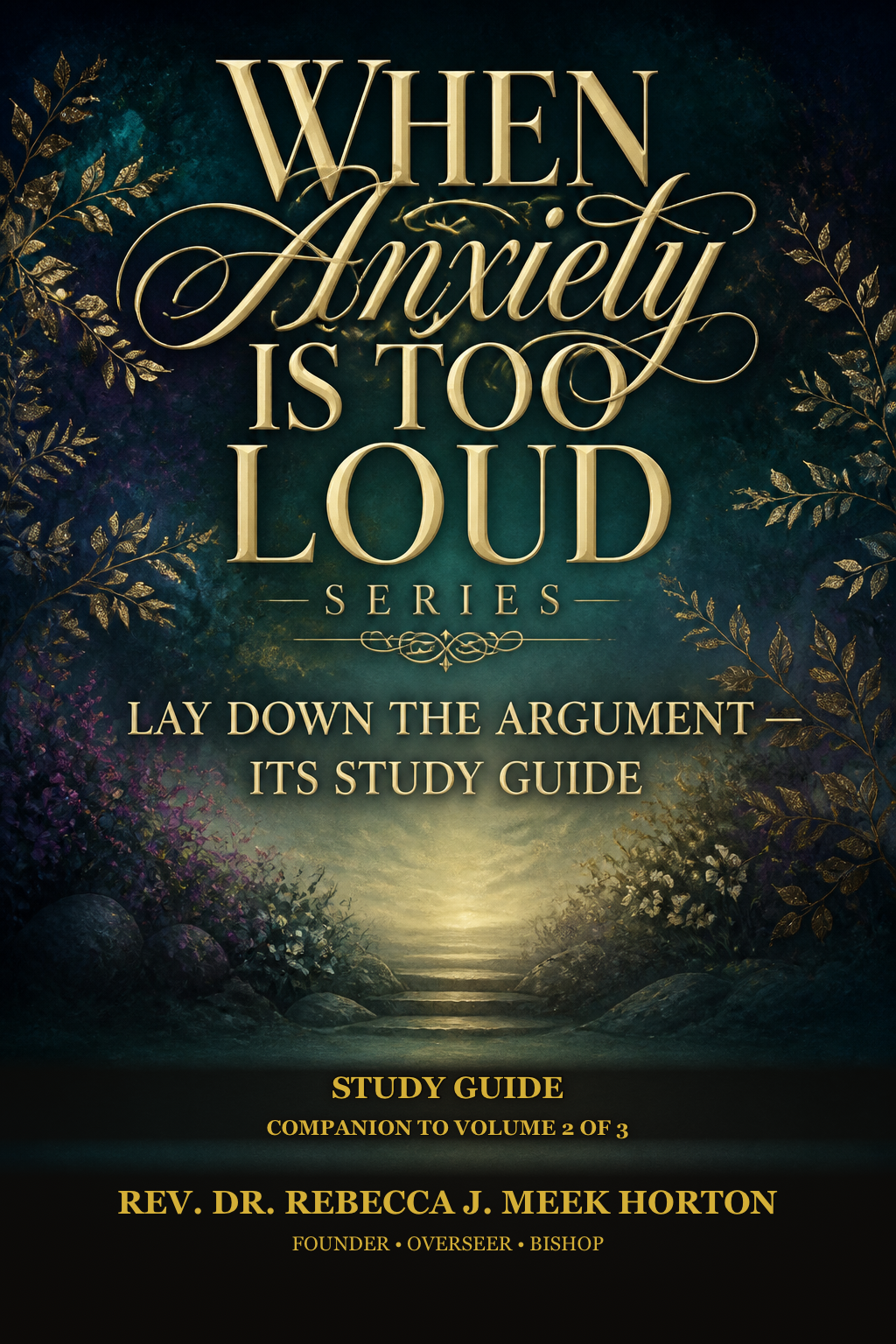
When Anxiety Is Too Loud · Volume 2
Lay Down the Argument — Its Study Guide
A study guide for "Lay Down the Argument". Every written chapter becomes a study session: chapter summary, key truths, the Scriptures in full, word study, ten study questions, personal application, and a memory verse.
Full publication
NBCNGMI MASTER KNOWLEDGE LIBRARY Featuring the works of The Sage, Apostle Prophet. Rev. Dr. Rebecca J. Meek Horton, Apostolic Prophetic Architect, NewBeing Creation Network Global Ministries, Inc. Integrated Framework Modalities™
Dedication
I dedicate this study guide to every heart learning to lay down the argument and receive the truth with humility. May the Lord use these pages to strengthen your obedience, renew your mind, and help you walk in the freedom of 2 Corinthians 10:5.
Purpose
I wrote this study guide to help you slow down, sit with the truth, and let each chapter of Lay Down the Argument become more than something you read. My prayer is that Scripture, reflection, and honest application will help you recognize where argument has taken root and choose the next faithful step toward peace, humility, and obedience. May this guide help you become “swift to hear, slow to speak, slow to wrath” as James 1:19 teaches.
Preface
I wrote this study guide because I know how easily an argument can become more than words. It can become a wall. It can become a habit. It can become a place where pride hides, pain speaks, and love gets pushed to the side.
Lay Down the Argument was written from a burden to help us slow down, listen better, and let God govern what comes out of our mouths. This study guide was created to help that message move from reading into practice.
Sometimes the hardest thing to lay down is not the issue itself. It is the need to be right, the need to be heard first, the need to defend what God may be asking us to surrender. This guide is not about silence without truth. It is not about avoiding hard conversations. It is about learning how to speak, listen, pause, repent, and respond in a way that honors God.
James 1:19-20 (KJV)
Wherefore, my beloved brethren, let every man be swift to hear, slow to speak, slow to wrath: For the wrath of man worketh not the righteousness of God.
Each session follows the written chapters of Lay Down the Argument. You will find a chapter summary, key truths, Scriptures in full, word study, study questions, personal application, and a memory verse. The goal is not to rush through the material. The goal is to let the Holy Spirit reveal what needs to be healed, corrected, strengthened, and practiced.
As you move through this guide, be honest with yourself. Notice where your words are carrying fear, frustration, control, or old wounds. Notice where God is inviting you into peace, humility, wisdom, and restraint.
This is a study guide, but it is also a mirror. Come to it prayerfully. Bring your real relationships, your real conversations, and your real heart before the Lord.
My prayer is that you will not only learn how to lay down the argument, but also how to pick up wisdom, peace, and love in its place.
Introduction
Most arguments do not begin with raised voices. They begin with a defended heart.
A word is misunderstood. A correction feels personal. A memory gets touched. A fear rises. Before we know it, we are no longer seeking truth; we are protecting position. We may call it explaining, clarifying, standing up for ourselves, or making a point. Sometimes those things are needed. But there is a difference between speaking truth and feeding strife.
Lay Down the Argument is built on one simple truth: not every argument deserves your agreement, your energy, or your mouth. Some arguments must be answered with humility. Some must be corrected with wisdom. Some must be left alone. And some must be laid down before they become a doorway to pride, offense, confusion, and division.
James 1:19-20 (KJV)
Wherefore, my beloved brethren, let every man be swift to hear, slow to speak, slow to wrath: For the wrath of man worketh not the righteousness of God.
This study guide is here to help you slow down long enough to let the Word of God examine what is happening beneath your response. It is not written to shame you for having strong feelings. It is not written to silence necessary truth. It is written to help you discern the difference between a Spirit-led response and a flesh-led reaction.
That difference matters.
A soft answer is not weakness. Silence is not always surrender. Correction is not always conflict. Peace is not pretending. Biblical maturity does not mean avoiding every hard conversation. It means entering necessary conversations with a governed spirit, a truthful mouth, and a heart submitted to God.
Proverbs 15:1 (KJV)
A soft answer turneth away wrath: but grievous words stir up anger.
Each session in this guide follows the written chapters of Lay Down the Argument. Every chapter becomes a study session so you can move from reading to understanding, and from understanding to practice.
You will find:
• A chapter summary to help you remember the central message
• Key truths to identify what must be carried forward
• Scriptures in full so the study remains anchored in the Word
• A word study to deepen understanding
• Ten study questions for reflection, discussion, or journaling
• Personal application to bring the lesson into real life
• A memory verse to keep truth close after the session ends
Read slowly. Do not rush to finish. The goal is not to complete pages; the goal is to become more faithful in how you hear, speak, respond, apologize, forgive, and obey.
Some sessions may feel simple. Others may uncover places where anger, fear, pride, grief, rejection, or control have shaped your responses more than you realized. Let the Lord meet you there. Transformation often begins when we stop defending what God is trying to heal.
This will cost something. Laying down the argument may cost you the satisfaction of having the last word. It may cost you the habit of rehearsing your side. It may require apology, restraint, patience, or a new way of speaking. But the fruit is worth it: clearer discernment, quieter strength, healthier relationships, and a heart that is easier for God to lead.
As you study, keep one question close: What is the next faithful step?
Do not try to fix every conversation at once. Begin with one word, one response, one prayer, one act of obedience. Ask God to show you where argument has become a pattern, where peace needs to be practiced, and where truth needs to be spoken with love.
Start by reading the first session with an honest heart. Before you answer the questions, pause and pray: Lord, teach me when to speak, when to listen, and when to lay the argument down.
Chapter 1 — The Argument Is Wearing You Out
Chapter Summary
This chapter establishes that anxiety becomes exhausting when we treat every anxious demand as a command that must be answered. It shows how anxiety often disguises itself as responsibility, wisdom, planning, protection, or care. Because some concerns are real, the chapter does not shame careful living. Instead, it helps the reader discern the difference between faithful stewardship and endless mental negotiation.
The chapter teaches that fear is rarely satisfied by one answer. It keeps building new questions because it is often seeking control, not truth. Regret and imagined outcomes can also become arguments that keep the mind circling without repentance, repair, learning, or peace. The cost is real: attention, rest, discernment, prayer, and relationships can all be affected.
The first movement toward surrender is not solving every fear. It is recognizing the argument without entering it. The reader is invited to stop confusing mental strain with faithfulness and to take one faithful step without trying to secure every outcome.
Key Truths
Anxiety wears us down when we treat every anxious demand as something that must be answered.
Responsibility is healthy, but endless mental negotiation is not the same as stewardship.
Wisdom takes the next faithful step, while fear tries to remove all uncertainty.
Regret can teach when it leads to repentance, repair, and learning, but anxious regret only punishes.
Urgent thoughts are not always truthful, obedient, or wise.
Laying down the argument may feel irresponsible at first, but surrender is not neglect.
The beginning of peace is learning to notice anxiety without letting it run the meeting.
Scriptures for Study
Matthew 6:27 (KJV) Which of you by taking thought can add one cubit unto his stature?
Word Study
Taking thought means anxious care or worried striving. It matters here because Jesus exposes the limit of worry. Some thinking feels productive, but it cannot add life or control outcomes.
Argument means the inner debate anxiety tries to start. It matters here because the chapter teaches that not every mental debate deserves our attention or participation.
Stewardship means faithfully caring for what God has actually entrusted to us. It matters here because stewardship takes responsible action without pretending to control everything.
Control means the attempt to secure outcomes that belong beyond our power. It matters here because anxiety often demands certainty where God has not given certainty.
Next faithful step means one clear act of obedience or responsibility for today. It matters here because surrender becomes practical when we stop trying to solve everything at once.
Study Questions
1. What ordinary example opens the chapter, and how does it show the way anxiety works?
2. According to the chapter, what demand does anxiety often make of the mind?
3. Why can anxiety be difficult to recognize when it sounds like responsibility or wisdom?
4. What is the difference between real responsibility and endless mental negotiation?
5. How does Matthew 6:27 speak to the limits of anxious thought?
6. Why does fear keep asking more questions even after one question has been answered?
7. What is the difference between a wise question and an anxious question?
8. How can regret become unhealthy when it keeps reopening the same scene without movement?
9. Which cost of arguing with anxiety do you recognize most in your own life: attention, rest, discernment, prayer, or relationships?
10. What is one anxious argument you need to recognize this week without entering it?
Personal Application
1. Write down one anxious demand in this sentence: Anxiety is asking me to argue about ____________________.
2. Pause for two minutes before answering the demand. Breathe slowly and ask, Is this a real responsibility for today, or an imagined outcome I am trying to control?
3. Choose one faithful step you can take today, then leave the rest with God instead of continuing the mental debate.
Memory Verse
Matthew 6:27 (KJV) Which of you by taking thought can add one cubit unto his stature?
Notes and Answers [Answer Lines]
[Journal Page]
[Journal Page]
Chapter 2 — The Place Where Fear Can Be Put
Chapter Summary
This chapter establishes that fear does not have to be defeated in the mind before it can be brought to God. Through Lena’s unopened envelope and other everyday examples, the chapter shows how anxiety turns a real burden into an ongoing inner argument. Fear circles when it has nowhere holy to land, but Scripture gives the believer a different practice: bring the burden to God through prayer, supplication, thanksgiving, and honest casting of care. The chapter is careful not to promise instant emotional silence. Peace may begin as being kept, guarded, and sustained even while the storm is still loud. The burden may still need attention. The envelope may still need to be opened. The meeting, appointment, bill, or conversation may still remain. But the believer is no longer carrying it alone or allowing fear to sit in the place of authority. This chapter moves the reader from mental wrestling toward active trust. Fear needs placement, not endless argument. God can receive what we cannot resolve.
Key Truths
Fear needs a place to go, not another argument to win.
God invites us to bring the real burden, not a polished version of it.
Prayer is not proof that we feel calm; prayer is placement before God.
The peace of God may guard us before our emotions become quiet.
Casting care on God is an act of trust, not avoidance.
Surrender does not remove responsibility; it restores proper order.
Fear may come with us, but it must not lead us.
Scriptures for Study
Philippians 4:6-7 (KJV) 6 Be careful for nothing; but in every thing by prayer and supplication with thanksgiving let your requests be made known unto God. 7 And the peace of God, which passeth all understanding, shall keep your hearts and minds through Christ Jesus.
1 Peter 5:7 (KJV) Casting all your care upon him; for he careth for you.
Psalm 55:22 (KJV) Cast thy burden upon the LORD, and he shall sustain thee: he shall never suffer the righteous to be moved.
Word Study
Careful means full of care, anxious, or troubled with worry. In Philippians 4:6, this matters because God is not commanding emotional denial; He is inviting the believer to stop being ruled by anxious care.
Supplication means a humble, specific request made to God. This matters because the chapter teaches us to bring the real burden honestly, not vaguely or with spiritual performance.
Casting means throwing, placing, or transferring a weight onto another. This matters because 1 Peter 5:7 and Psalm 55:22 show that fear is not meant to remain enthroned inside the mind.
Keep means to guard, protect, or watch over. This matters because the peace of God may first appear as protection over the heart and mind, even before feelings become calm.
Sustain means to uphold, support, and hold together. This matters because God may not remove the burden immediately, but He promises to carry and strengthen His people as they obey.
Study Questions
1. What object caused Lena’s anxiety at the beginning of the chapter, and why was it powerful even before she opened it?
2. What does the chapter mean when it says anxiety turns a burden into an argument?
3. In Philippians 4:6-7, what are believers told to do “in every thing”?
4. How does 1 Peter 5:7 describe God’s invitation to those carrying care?
5. Why is it important that God can receive what we cannot resolve?
6. What is the difference between bringing fear to God and pretending we are not afraid?
7. How does the chapter explain peace as being “kept” rather than always feeling instantly quiet?
8. What does Psalm 55:22 teach about the difference between removal and sustaining?
9. What familiar forms of mental wrestling can feel like safety, preparation, or responsibility?
10. What is one fear in your life that needs to be relocated before God this week, and what is your next faithful step after placing it there?
Personal Application
Choose one specific fear that keeps pulling you into mental argument, and write one honest sentence that begins, “Lord, I am carrying…”
Read 1 Peter 5:7 aloud slowly each day this week, then take one physical action of release, such as opening your hands, kneeling quietly, or placing the written fear in a drawer.
Take one responsible next step connected to the burden, without letting fear become your master before you do it.
Memory Verse
1 Peter 5:7 (KJV) Casting all your care upon him; for he careth for you.
Notes and Answers
[Answer Lines]
[Journal Page]
[Journal Page]
Chapter 3 — Name the Burden Honestly
Chapter Summary
This chapter establishes that surrender begins with honest naming. Anxiety often hides behind vague words such as stress, overwhelmed, or a lot going on. Those words may be true in part, but they can also keep the real burden blurred. The chapter teaches that God invites His people to bring the real weight into His presence, not a polished or spiritual-sounding version of it.
Lena’s unopened envelope shows how avoidance can delay truth but cannot remove the burden. The true weight was not simply stress; it was fear, shame, dread, and the belief that not looking would somehow make the problem easier to bear. This chapter helps readers slow down and ask, “What am I actually carrying?”
Naming the burden does not mean making it your identity. The chapter carefully separates truthful confession from shame-based labeling. Through RE-Language™, readers learn to move from vague and condemning statements toward responsible, specific, and actionable truth.
Honest prayer is presented as placement, not performance. God does not ask for pretending. He invites His people to cast the real burden upon Him and take the next faithful step.
Key Truths
Surrender begins when we tell the truth about what we are actually carrying.
Vague language can become a hiding place for anxiety.
Naming the burden helps us place it before God without making it our identity.
Honest prayer brings the real weight to God instead of performing calm.
God cares for us in the place where the burden is real.
Truth may feel costly at first, but denial carries a greater cost.
The next faithful step often becomes clearer after the burden is named.
Scriptures for Study
Psalm 62:8 (KJV) Trust in him at all times; ye people, pour out your heart before him: God is a refuge for us. Selah.
Philippians 4:6-7 (KJV) 6 Be careful for nothing; but in every thing by prayer and supplication with thanksgiving let your requests be made known unto God. 7 And the peace of God, which passeth all understanding, shall keep your hearts and minds through Christ Jesus.
1 Peter 5:7 (KJV) Casting all your care upon him; for he careth for you.
Psalm 55:22 (KJV) Cast thy burden upon the LORD, and he shall sustain thee: he shall never suffer the righteous to be moved.
Psalm 139:23-24 (KJV) 23 Search me, O God, and know my heart: try me, and know my thoughts: 24 And see if there be any wicked way in me, and lead me in the way everlasting.
Word Study
Burden means the real weight a person is carrying. It matters here because surrender cannot begin with pretending; the burden must be named before it can be placed before God.
Pour out your heart means to bring the whole inner concern before God honestly. It matters here because God invites truth, not performance.
Be careful means to be anxious, troubled, or full of care. It matters here because Philippians 4:6 calls believers to bring every concern to God in prayer instead of letting anxiety rule privately.
Casting means placing or throwing the weight onto another. It matters here because 1 Peter 5:7 and Psalm 55:22 show that God does not ask us to carry alone what He invites us to give Him.
Made known means brought into the open before God. It matters here because honest prayer stops hiding and brings the real request, fear, or need into God’s presence.
Study Questions
1. What burden was Lena avoiding by leaving the envelope unopened?
2. What vague words does the chapter identify as possible hiding places for anxiety?
3. According to Psalm 62:8, what are God’s people invited to do with their hearts?
4. Why does the chapter say anxiety loves vague words?
5. What is the difference between naming a burden and becoming the burden?
6. How does Philippians 4:6-7 connect honest prayer with the peace of God?
7. What does the chapter mean when it says honest prayer is placement, not performance?
8. Which RE-Language™ example in the chapter stood out to you most, and why?
9. What burden in your life have you been describing too generally?
10. What is one next faithful step you can take after naming that burden honestly before God?
Personal Application
Take ten quiet minutes and write this sentence: Lord, what I am actually carrying is… Finish it plainly without decorating the words.
Choose one vague or shame-based phrase you have been using and rewrite it into specific, responsible language.
Pray one honest prayer this week, naming the real burden before God and asking Him to show you what is yours to steward, what to release, and what next step to take.
Memory Verse
1 Peter 5:7 (KJV) Casting all your care upon him; for he careth for you.
Notes and Answers [Answer Lines]
[Journal Page]
[Journal Page]
Chapter 4 — Stop Managing Every Outcome
Chapter Summary
This chapter establishes the difference between faithful stewardship and anxious control. Through Elena’s late-night checking and rehearsing, we see how anxiety can disguise itself as responsibility. It tells us that if we think long enough, check often enough, or prepare hard enough, we can prevent uncertainty. But the chapter teaches that preparation is not the same as possession. Preparation asks for the next wise step. Possession demands control over outcomes that belong to God.
The chapter does not shame planning, concern, or wise action. It honors responsibility while placing limits around it. We are responsible for obedience, preparation, truthful words, repentance, tone, and the next faithful step. We are not responsible for another person’s response, tomorrow’s trouble, hidden motives, timing, or final outcomes.
Letting go may feel unsafe at first because control often becomes familiar. Yet Scripture calls us to cast our care upon God, not because every outcome is certain, but because He cares for us. The chapter invites readers to stop managing what they cannot hold and practice trust through one clear act of obedience today.
Key Truths
Anxiety often disguises control as responsibility.
Faithful stewardship does what is mine to do without trying to carry what belongs to God.
Preparation asks for the next wise step, but control demands certainty before rest.
Planning is wise when it remains humble before the Lord.
Letting go may feel costly, but carrying divine weight costs more.
Trust is not neglect; trust is stopping after obedience and leaving the outcome with God.
God is a better keeper than anxiety.
Scriptures for Study
Matthew 6:34 (KJV) Take therefore no thought for the morrow: for the morrow shall take thought for the things of itself. Sufficient unto the day is the evil thereof.
Proverbs 16:9 (KJV) A man's heart deviseth his way: but the LORD directeth his steps.
James 4:13-15 (KJV) 13 Go to now, ye that say, To day or to morrow we will go into such a city, and continue there a year, and buy and sell , and get gain : 14 Whereas ye know not what shall be on the morrow. For what is your life? It is even a vapour, that appeareth for a little time, and then vanisheth away. 15 For that ye ought to say, If the Lord will, we shall live , and do this, or that.
Whereas ye know not what shall be on the morrow. For what is your life? It is even a vapour, that appeareth for a little time, and then vanisheth away.
For that ye ought to say, If the Lord will, we shall live, and do this, or that.
1 Peter 5:7 (KJV) Casting all your care upon him; for he careth for you.
Word Study
Stewardship — Stewardship means faithfully caring for what has been entrusted to you. It matters here because the chapter does not call the reader to be careless; it calls the reader to be rightly responsible.
Control — Control means trying to secure, force, or manage what is beyond your true authority. It matters here because anxiety often feels productive while quietly pushing us into God’s role.
Morrow — Morrow means tomorrow or the time still ahead. It matters in Matthew 6:34 because Jesus teaches that tomorrow has its own weight, and we are not called to carry tomorrow before it arrives.
Deviseth — Deviseth means plans, considers, or works out a way. It matters in Proverbs 16:9 because planning is not rejected, but it is placed under the Lord’s direction.
Vapour — Vapour means a mist or breath that appears briefly and then disappears. It matters in James 4:14 because it reminds us that life is fragile, limited, and dependent on God.
Study Questions
1. What was Elena doing at 2:14 in the morning, and what does her behavior reveal about anxiety?
2. According to the chapter, what is the difference between preparation and possession?
3. What does Matthew 6:34 teach about trying to carry tomorrow’s concerns today?
4. Why does the chapter say that dragging tomorrow into today increases weight without increasing authority?
5. In Proverbs 16:9, what belongs to the person, and what belongs to the Lord?
6. How can control wear a responsible mask in everyday life?
7. What are some signs that responsibility has crossed over into control?
8. How does the phrase “If the Lord will” in James 4:15 correct proud certainty?
9. What might it cost a person to let go of managing every outcome?
10. What is one current concern in your life that needs to be divided into “Mine to steward” and “God’s to hold”?
Personal Application
1. Draw two columns this week. Label one “Mine to steward” and the other “God’s to hold.” Place one current concern under those two headings honestly.
2. Choose one action from the “Mine to steward” column and complete it without adding extra checking, rehearsing, or controlling.
3. When anxiety pushes you to manage the outcome, speak this RE-Language™ sentence aloud: “I am responsible to take the next faithful step, but I am not responsible to control the final outcome.”
Memory Verse
1 Peter 5:7 (KJV) Casting all your care upon him; for he careth for you.
Notes and Answers [Answer Lines]
[Journal Page]
[Journal Page]
Chapter 5 — Pray Without Striving
Chapter Summary
This chapter establishes that prayer is not another place to strive, perform, or argue our way into peace. It teaches that anxious prayer can become pressure when we treat prayer like a spiritual technique that must produce immediate emotional relief. Instead, prayer is the place where we meet God honestly, yield the burden, ask for help, listen with trust, and entrust what we cannot carry. The chapter does not shame repeated prayer. It makes a clear difference between faithful return and vain repetition. God is not moved by performance, panic, or perfect wording; He already knows what we need before we ask. The reader is invited to pray as a child before a faithful Father, not as someone presenting a legal case. Through Philippians 4:6-7, 1 Peter 5:7, Psalm 46:10, and Psalm 55:22, the chapter shows that peace may come as calm, but it may also come as sustaining grace for the next faithful step. Prayer without striving costs us control, but it leads us into trust.
Key Truths
Prayer is not a way to force relief; it is a place of honest surrender.
God already knows what we need before we ask Him.
Repeated prayer can be faithful return when it comes from trust instead of performance.
We can ask God for help without gripping how or when the answer must come.
Peace may come as calm, or it may come as grace to obey while we are still trembling.
Stillness before God is not passivity; it is governed attention.
God may not remove every burden immediately, but He promises to sustain His people.
Scriptures for Study
Matthew 6:7-8 (KJV) 7 But when ye pray, use not vain repetitions, as the heathen do: for they think that they shall be heard for their much speaking. 8 Be not ye therefore like unto them: for your Father knoweth what things ye have need of, before ye ask him.
Philippians 4:6-7 (KJV) 6 Be careful for nothing; but in every thing by prayer and supplication with thanksgiving let your requests be made known unto God. 7 And the peace of God, which passeth all understanding, shall keep your hearts and minds through Christ Jesus.
1 Peter 5:7 (KJV) Casting all your care upon him; for he careth for you.
Psalm 46:10 (KJV) Be still, and know that I am God: I will be exalted among the heathen, I will be exalted in the earth.
Psalm 55:22 (KJV) Cast thy burden upon the LORD, and he shall sustain thee: he shall never suffer the righteous to be moved.
Word Study
Vain repetitions means empty, anxious, or performative speaking that assumes many words can make God listen. This matters because the chapter is not correcting honest repeated prayer; it is correcting prayer that tries to force God’s care.
Careful means full of care, anxious, or troubled in mind. This matters because Philippians 4:6 does not shame human concern; it teaches us where to place it.
Supplication means humble, earnest asking for help. This matters because prayer without striving still asks God plainly and honestly.
Casting means placing, throwing, or transferring a burden onto another. This matters because 1 Peter 5:7 and Psalm 55:22 both call us to release care to God instead of holding it in inner custody.
Be still means to stop striving, cease frantic movement, and recognize God’s rule. This matters because stillness helps fear lose its authority over the pace of the soul.
Study Questions
1. What signs in the chapter show that prayer has become another form of striving?
2. According to Matthew 6:7-8, what mistake can people make when they pray?
3. Why does the chapter say the problem is not repeated prayer, but the belief that many words can force God to care?
4. In Philippians 4:6-7, what three movements are connected to bringing requests before God?
5. What is the difference between asking God for help and gripping the answer?
6. How does 1 Peter 5:7 ground our casting of care in God’s character?
7. What does Psalm 46:10 teach us about stillness, trust, and God’s authority?
8. Why might peace sometimes look like steadiness to obey rather than an immediate feeling of calm?
9. Where are you most tempted to measure whether prayer “worked” by checking your feelings too quickly?
10. What is one burden you need to entrust to God this week without taking the whole weight back?
Personal Application
1. Pray for five quiet minutes each day using the WALK™ rhythm: Wait, Ask, Listen, Keep.
2. Practice RE-Language™ when anxiety follows prayer. Instead of saying, “Prayer did not work because I still feel afraid,” say, “Prayer is communion, surrender, and faithful return.”
3. Choose one next faithful step after prayer, such as resting, apologizing, asking for counsel, making the appointment, or waiting until you have more information.
Memory Verse
1 Peter 5:7 (KJV) Casting all your care upon him; for he careth for you.
Notes and Answers [Answer Lines]
[Journal Page]
[Journal Page]
Chapter 6 — Let Confession Break the Loop
Chapter Summary
This chapter establishes confession as a truthful release that breaks the anxious loop created by hidden guilt, regret, resentment, secrecy, or fear of exposure. It is careful not to blame all anxiety on sin or concealment, but it names an honest reality: some anxiety grows louder when truth has been avoided. Confession is not self-punishment, and it is not an attempt to earn God’s love. It is bringing what is hidden into the presence of God and, when needed, into wise counsel.
The chapter shows that silence can become heavy, as David described in Psalm 32. What remains hidden often echoes through the body, mind, emotions, relationships, and prayer life. Confession opens the hand before God. It tells the truth because God is safe, faithful, just, forgiving, and cleansing.
The chapter also teaches that confession must be joined with wisdom. Not everything belongs in public, but some things require trusted counsel, responsible repair, restitution, boundaries, or changed behavior. Confession may cost pride, image, comfort, and convenience, but secrecy costs more. The way forward is not to fix everything at once, but to bring the truth into the light and take the next faithful step.
Key Truths
Confession breaks the loop by bringing hidden things into the light before God.
Not all anxiety comes from sin, but some anxiety becomes louder when truth is avoided.
Confession is not self-punishment; it is truthful release.
God is not surprised by our confession, because He already knows the truth.
Wise confession does not mean telling everyone everything.
Confession and forsaking belong together when real change is needed.
There is a cleaner pain than hiding, because truthful pain can lead toward healing.
Scriptures for Study
Psalm 32:3-5 (KJV) 3 When I kept silence, my bones waxed old through my roaring all the day long. 4 For day and night thy hand was heavy upon me: my moisture is turned into the drought of summer. Selah. 5 I acknowledged my sin unto thee, and mine iniquity have I not hid. I said, I will confess my transgressions unto the LORD; and thou forgavest the iniquity of my sin. Selah.
David describes the physical and spiritual weight of silence. His hidden sin did not stay quiet inside him. It affected his strength, his peace, and his inner life. But when he acknowledged his sin and confessed to the Lord, forgiveness met him there.
1 John 1:9 (KJV) If we confess our sins, he is faithful and just to forgive us our sins, and to cleanse us from all unrighteousness.
This verse shows the character of God in confession. God is faithful. God is just. God forgives. God cleanses. Confession does not make God merciful; it brings us into agreement with the mercy He has already made available.
James 5:16 (KJV) Confess your faults one to another, and pray one for another, that ye may be healed. The effectual fervent prayer of a righteous man availeth much.
James teaches that some confession belongs in faithful relationship. This is not careless exposure. It is humble truth-telling within wise, prayerful care. Healing can come when secrecy gives way to godly support.
Proverbs 28:13 (KJV) He that covereth his sins shall not prosper: but whoso confesseth and forsaketh them shall have mercy.
This verse joins confession with forsaking. To confess is to tell the truth. To forsake is to turn away from what truth has exposed. Mercy meets the person who stops covering and begins walking in responsibility.
Word Study
Confession means telling the truth before God about what has been hidden, denied, minimized, or avoided. It matters here because confession interrupts secrecy and brings the soul back into alignment with truth.
The loop means the repeated cycle of anxious thoughts, fear, regret, hiding, and inner accusation. It matters here because the chapter teaches that confession can break the cycle instead of letting it keep circling.
Hidden means kept in the dark, concealed, or carried alone. It matters here because hidden things often become heavier over time and can affect the mind, body, relationships, and prayer life.
Forsake means to leave, turn from, or stop holding on to what has been confessed. It matters here because confession is not only emotional relief; it calls for obedient action and responsible change.
Wise counsel means help from a mature, trustworthy person who can respond with truth, prayer, confidentiality, and responsibility. It matters here because some burdens should not be carried alone, but they also should not be exposed carelessly.
Study Questions
1. What kinds of thoughts does the chapter describe as circling in the mind during the quiet of the night?
2. How does the chapter carefully distinguish between anxiety in general and anxiety connected to hidden truth?
3. In Psalm 32:3-5, what words or phrases show the cost of David’s silence?
4. What changed when David acknowledged his sin and confessed to the Lord?
5. According to 1 John 1:9, what does God promise when we confess our sins?
6. Why does the chapter say confession does not inform God, but aligns us with truth before Him?
7. What is the difference between confession and careless exposure?
8. How does Proverbs 28:13 connect confession with forsaking?
9. What might responsible repair look like when another person has been harmed?
10. What is one hidden burden, regret, resentment, or avoided truth that you need to bring before God this week?
Personal Application
Set aside ten quiet minutes this week and write one honest sentence that begins, “Lord, what I need to bring into the light is…”
Confess plainly to God without vague language, excuses, or self-condemnation.
If another person was harmed or the burden needs support, ask God for wisdom and contact one mature, trustworthy person for counsel this week.
Memory Verse
1 John 1:9 (KJV) If we confess our sins, he is faithful and just to forgive us our sins, and to cleanse us from all unrighteousness.
Notes and Answers [Answer Lines]
[Journal Page]
[Journal Page]
Chapter 7 — Receive Help Without Handing Over Your Life
Chapter Summary
This chapter establishes a wise middle path between isolation and unhealthy dependence. It teaches that surrender to God does not require a person to carry every burden alone. God often helps His people through counsel, community, spiritual care, and steady support. At the same time, receiving help does not mean giving another person control over your life, choices, discernment, or obedience. Healthy help strengthens maturity. It helps you see clearly, pray honestly, and take the next faithful step. Unhealthy dependence weakens responsibility by making another person the rescuer, decision-maker, or source of peace. The chapter also shows that community must not become a place where anxiety is rehearsed endlessly without movement toward truth. Love comforts, but love also calls a person forward. People may help carry a weight for a season, but each person still has responsibilities only they can steward before God. The Lord remains the source of help, even when people become channels of help. The invitation is simple and costly: receive support, keep responsibility, use discernment, and walk with God one obedient step at a time.
Key Truths
Surrender to God does not require isolation from people.
Healthy help strengthens responsibility instead of replacing it.
Wise counsel helps you see clearly without taking over your life.
Community should comfort you and call you toward faithful action.
Not every loving voice is a wise voice for your vulnerable places.
People may be channels of help, but the Lord remains the source.
You can receive support without handing over your discernment, obedience, or stewardship.
Scriptures for Study
Galatians 6:2 (KJV) Bear ye one another's burdens, and so fulfil the law of Christ.
Proverbs 11:14 (KJV) Where no counsel is, the people fall: but in the multitude of counsellors there is safety.
Galatians 6:5 (KJV) For every man shall bear his own burden.
Psalm 121:1-2 (KJV) 1 A Song of degrees. I will lift up mine eyes unto the hills, from whence cometh my help. 2 My help cometh from the LORD, which made heaven and earth.
Word Study
Burdens: Heavy weights that may be too much for one person to carry alone. This matters because Galatians 6:2 shows that loving support is part of life in the body of Christ.
Counsel: Wise guidance that helps a person see more clearly. This matters because counsel is meant to bring safety, not control.
Own burden: The personal responsibility each person must carry before God. This matters because Galatians 6:5 reminds us that no one else can obey, repent, decide, forgive, or take the next faithful step for us.
Help: Support, strength, aid, or rescue in time of need. This matters because Psalm 121:1-2 teaches that people may assist us, but our true help comes from the Lord.
Discernment: The ability to recognize what is wise, true, safe, and spiritually sound. This matters because not every voice should have the same access to your vulnerable places.
Study Questions
1. What fear or hesitation does the opening scene reveal about asking for help?
2. According to the chapter, what is the controlling idea about healthy help?
3. What does Galatians 6:2 teach about bearing one another’s burdens?
4. What does Galatians 6:5 teach about personal responsibility?
5. How can both Galatians 6:2 and Galatians 6:5 be true at the same time?
6. Why does the chapter say that counsel is not control?
7. What is the difference between seeking counsel and collecting pressure?
8. How can community become an escape instead of a place of healing?
9. What signs might show that a helping relationship is becoming unhealthy dependence?
10. Who is one trusted, mature person you could ask for specific support this week, and what clear request will you make?
Personal Application
Choose one trusted, mature person and ask for a specific kind of support. Be clear that you are not asking them to fix you or decide for you.
Before the conversation, write down what you need: listening, prayer, counsel, accountability, or help identifying one faithful next step.
After the conversation, write one sentence of truth you received and one action you will take. Then take that action within the week.
Memory Verse
Psalm 121:2 (KJV) My help cometh from the LORD, which made heaven and earth.
Notes and Answers
[Answer Lines]
[Journal Page]
[Journal Page]
Chapter 8 — Carry Less, Walk Faithfully
Chapter Summary
This chapter establishes that faithful living is not the same as carrying everything. Anxiety often keeps an argument open after the day is done, but God invites His people to place the burden before Him and take the next faithful step. The chapter teaches that surrender is not usually a one-time dramatic event. It is a daily practice of returning, releasing, receiving, and obeying. Some burdens come back, but their return does not mean prayer failed. It means the heart is learning a new pattern of trust.
The chapter also shows that peace is not always instant emotional quiet. According to Philippians 4:6-7, God’s peace keeps the heart and mind through Christ Jesus while the believer continues to walk. This is Governed Movement™ in daily life: not rushing because fear is loud, and not freezing because uncertainty remains.
The chapter gives a simple rhythm for burdened days: Wait, Ask, Listen, Keep. It also calls the reader to RE-Language™ anxious thoughts into responsible, faithful action. The goal is not passivity. The goal is stewardship: place the burden, receive sustaining grace, and obey the next step God has made clear enough for today.
Key Truths
You do not have to win every anxious argument in your mind.
Repeated surrender is not failure; it is daily practice.
God cares for you and invites you to cast your care upon Him.
Peace may not remove all pressure, but it can guard you while you keep walking.
Faithful stewardship asks what God has given you to do today.
Anxiety demands control over every possible outcome, but obedience takes the next faithful step.
Receiving wise help can be part of faithful stewardship, not a sign of failure.
Scriptures for Study
1 Peter 5:7 (KJV) Casting all your care upon him; for he careth for you.
Philippians 4:6-7 (KJV) 6 Be careful for nothing; but in every thing by prayer and supplication with thanksgiving let your requests be made known unto God. 7 And the peace of God, which passeth all understanding, shall keep your hearts and minds through Christ Jesus.
Psalm 55:22 (KJV) Cast thy burden upon the LORD, and he shall sustain thee: he shall never suffer the righteous to be moved.
Word Study
Casting: To throw, place, or put something onto another. This matters because the chapter does not ask the reader to deny the burden, but to place it before God.
Care: A concern, anxiety, or weight pressing on the heart. This matters because God does not shame repeated cares; He invites them to be brought to Him.
Supplication: A humble, honest request made to God. This matters because prayer is not performance. It is bringing the real burden to the Lord.
Keep: To guard, protect, or watch over. This matters because Philippians 4:7 teaches that God’s peace guards the heart and mind while the believer keeps walking.
Sustain: To support, uphold, or carry through. This matters because Psalm 55:22 does not promise that life will never feel heavy; it promises that God will uphold the one who casts the burden on Him.
Study Questions
1. What picture does the chapter give of the mind at the end of a long day?
2. According to 1 Peter 5:7, what are believers invited to do with their care?
3. What reason does 1 Peter 5:7 give for casting care upon God?
4. In Philippians 4:6-7, what practices are connected to the peace of God?
5. What does the chapter mean when it says peace can guard you while you walk?
6. How does the chapter distinguish between stewardship and anxiety?
7. Why is repeated surrender described as practice instead of failure?
8. Which part of the rhythm Wait, Ask, Listen, Keep feels most needed in your life right now?
9. What anxious sentence do you need to RE-Language™ into a more faithful and responsible sentence?
10. What is one next faithful step you can take this week without trying to control the whole outcome?
Personal Application
Name one burden anxiety keeps bringing back, and pray it honestly before God each day this week.
Use the rhythm Wait, Ask, Listen, Keep when anxiety becomes loud, even if you only have one quiet minute.
Write one next faithful step that is small enough to obey, and take that step without demanding full certainty first.
Memory Verse
1 Peter 5:7 (KJV) Casting all your care upon him; for he careth for you.
Notes and Answers
[Answer Lines]
[Journal Page]
[Journal Page]