 NBCNGMI™
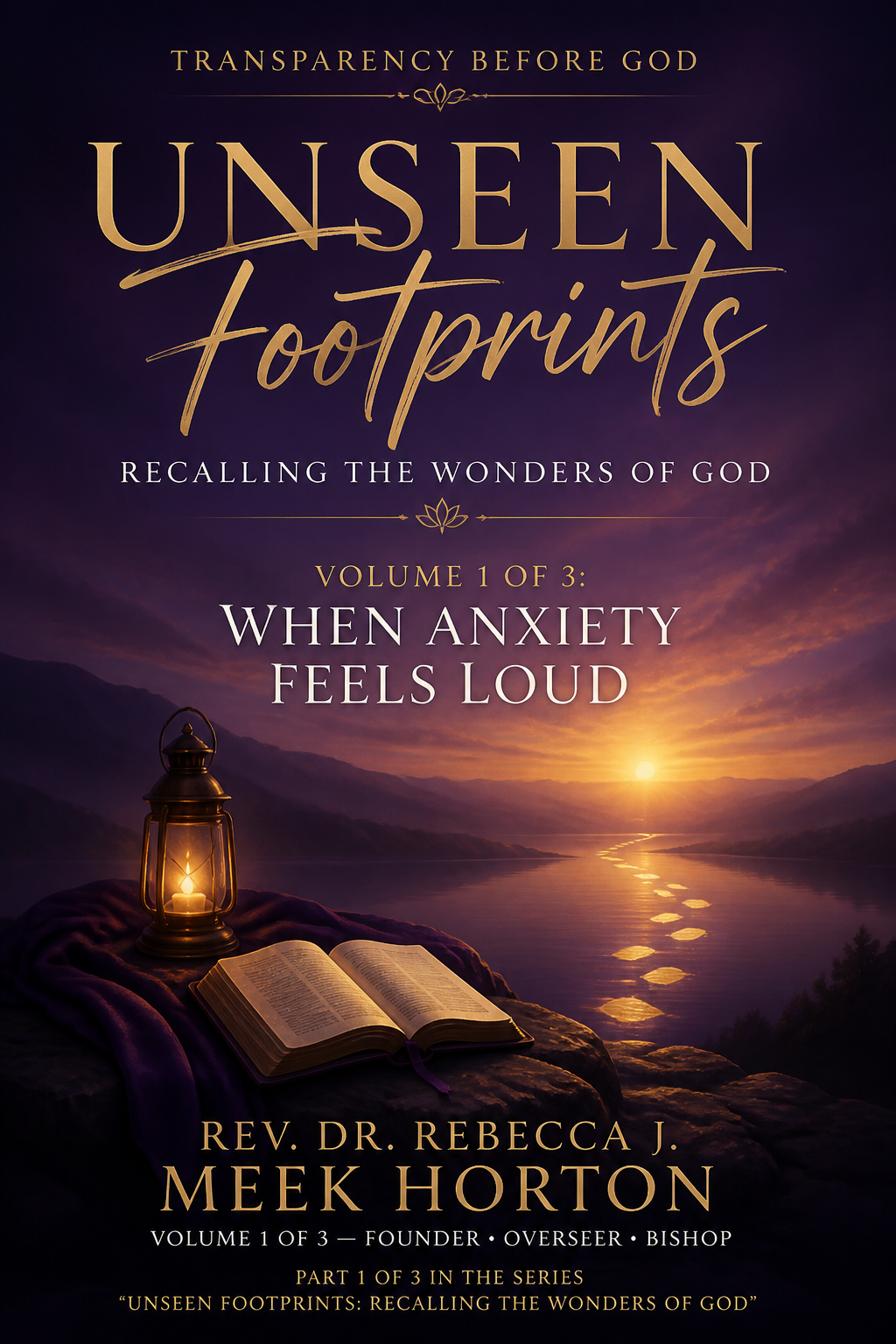
Unseen Footprints: Recalling the Wonders of GOD · Volume 1
When Anxiety Feels Loud
Part 1 of 3 in the series "Unseen Footprints: Recalling the Wonders of GOD". Series theme: Transparency Before GOD Series arc: This three-book series moves from honest distress to holy remembrance to steady trust. The first book begins where the source manuscript begins: Psalm 77 and the freedom to bring anxiety, unanswered questions, and the whole self before God. The second book widens the lens,
Full publication
NBCNGMI MASTER KNOWLEDGE LIBRARY Featuring the works of The Sage, Apostle Prophet. Rev. Dr. Rebecca J. Meek Horton, Apostolic Prophetic Architect, NewBeing Creation Network Global Ministries, Inc. Integrated Framework Modalities™
Dedication
I dedicate this book to every heart that has cried out to GOD in the night and wondered if anxiety made them weak. May these pages remind you that you can come honestly, remember faithfully, and take the next step with Him.
Purpose
I wrote this book for the person whose anxiety feels loud, whose prayers feel unfinished, and whose heart needs permission to come before God honestly. Rooted in Psalm 77, my hope is that these pages help you cry out without shame, ask your real questions, remember the wonders of GOD, and receive the peace He promises in Philippians 4:6-7. May you learn to cast your care upon Him, as 1 Peter 5:7 teaches, and take the next faithful step with God.
Preface
This book began with Psalm 77.
Not as a neat lesson, but as a mercy. I was listening for the honest sound of prayer when the heart is not settled yet. Psalm 77 does not begin with polished confidence. It begins with crying. It begins with trouble in the night. It begins with a soul that cannot be quickly comforted.
That matters to me.
It matters because many people love GOD and still feel anxious. Many still pray and still wrestle. Many still believe and still carry questions they are afraid to say out loud. Somewhere along the way, some of us learned to think we had to calm down before coming to God. But Psalm 77 teaches another way. We come to Him with the whole self. The trembling self. The questioning self. The tired self. The honest self.
Psalm 77:1-3 (KJV) I cried unto God with my voice, even unto God with my voice; and he gave ear unto me. In the day of my trouble I sought the Lord: my sore ran in the night, and ceased not: my soul refused to be comforted. I remembered God, and was troubled: I complained, and my spirit was overwhelmed. Selah.
When Anxiety Feels Loud is the first book in Unseen Footprints: Recalling the Wonders of GOD. This first part begins with transparency before GOD because honest prayer is not a failure of faith. It is often the first faithful step back into trust.
In these pages, we will move with the psalm: cry out, ask honestly, remember specifically, and trust God one step at a time. We will not pretend anxiety is small. We will not shame the weary. We will not make quick answers where Scripture gives us a holy process.
We will learn to cast our care on the One who cares for us.
1 Peter 5:7 (KJV) Casting all your care upon him; for he careth for you.
As you read, keep your Bible near. Move slowly. Tell the truth. Let GOD meet you in the place you have been trying to hide.
Nothing is random. Nothing is wasted.
Your next faithful step is simple: come before GOD honestly today, even if your voice shakes.
Introduction
Anxiety can feel loud enough to drown out prayer.
It can fill the room before anyone else speaks. It can make the body tense, the mind race, and the soul wonder whether something is wrong with its faith. Some people suffer quietly because they think God only welcomes calm prayers, clean emotions, and carefully chosen words.
Psalm 77 teaches us something better.
Psalm 77 does not begin with a settled heart. It begins with a cry. It gives language to the person who is troubled, sleepless, overwhelmed, and full of questions. The psalmist does not hide distress from God. He brings it before Him.
Psalm 77:1-3 (KJV) I cried unto God with my voice, even unto God with my voice; and he gave ear unto me. In the day of my trouble I sought the Lord: my sore ran in the night, and ceased not: my soul refused to be comforted. I remembered God, and was troubled: I complained, and my spirit was overwhelmed. Selah.
This book begins there.
When Anxiety Feels Loud is a devotional guide for people who feel anxious, ashamed, spiritually weak, emotionally tired, or afraid to tell God the whole truth. Its message is simple: distress is not the absence of faith. Honest prayer is not failure. God does not require you to calm down before you come to Him.
Transparency before God is the first act of faithful prayer.
This is Part 1 of the Unseen Footprints: Recalling the Wonders of GOD series. The full series moves from honest distress to holy remembrance to steady trust. This first book stays close to the beginning place: the courage to come before God without pretending. Before we can remember rightly, we must stop hiding. Before trust becomes steady, prayer must become honest.
Psalm 77 gives us a faithful movement for loud anxiety:
Cry out.
Ask honestly.
Remember specifically.
Trust God one step at a time.
This is not a formula to control God. It is a path of return. It teaches the soul how to move when fear is speaking, when answers are delayed, and when God’s presence does not feel obvious.
Philippians 4 reminds us that anxious care can be brought to God in prayer. Not denied. Not decorated. Brought.
Philippians 4:6-7 (KJV) Be careful for nothing; but in every thing by prayer and supplication with thanksgiving let your requests be made known unto God. And the peace of God, which passeth all understanding, shall keep your hearts and minds through Christ Jesus.
First Peter gives the same tender invitation.
1 Peter 5:7 (KJV) Casting all your care upon him; for he careth for you.
As you read, do not rush. Let each chapter meet you where you are. Keep a Bible nearby. Keep a journal if you can. When a question rises, write it down. When a memory of God’s faithfulness returns, write that down too. This book is not asking you to perform peace. It is inviting you to practice coming near.
There is also a necessary kindness here. Anxiety, trauma, grief, medical conditions, and mental health struggles are not proof that you are spiritually inferior. Prayer matters. Scripture matters. Wise pastoral care, safe community, and appropriate professional support can also be part of faithful stewardship.
God is not afraid of your trembling.
He is not offended by your honest cry.
He is near enough to receive the whole self: body, mind, memory, fear, faith, and need.
Begin with one honest sentence before God today. Do not polish it. Do not explain it away. Simply pray, Lord, this is what feels loud in me right now. Then sit with Psalm 77 and let God teach you how to come.
Chapter 1 — When the Room Gets Loud
The room is quiet, but your body does not know it.
The lights are off. The house has settled. No one is asking you a question. No phone is ringing. No emergency is in front of you. Still, something inside feels crowded.
Your mind replays the conversation.
Your chest tightens.
Your thoughts move faster than your prayers.
You tell yourself to stop. You remind yourself of what you believe. You may even quote a verse, hoping it will work like a switch. But the noise keeps rising.
And then another fear enters the room: *If I really trusted God, would I feel this way?*
That second fear can be heavier than the first. Anxiety is painful enough. Shame makes it lonelier.
This chapter begins with a simple truth: distress is not proof that faith has failed. Psalm 77 shows us that God receives the anxious cry before anything feels resolved.
The psalm does not begin with calm. It begins with a voice.
“I cry aloud to God, aloud to God, and he will hear me” (Psalm 77:1).
Not after the trembling stops.
Not after the questions are answered.
Not after the person praying has become composed.
The cry comes first.
## The Noise Inside Is Real
Anxiety can make a normal room feel full.
A small concern becomes a loop. A memory becomes an accusation. A possible future becomes a threat. The body responds as if danger has already arrived. Sleep becomes difficult. Silence becomes uncomfortable. Prayer can feel strained.
For many believers, this is where confusion begins. We know God is faithful. We know Scripture tells us not to fear. We know Jesus cares for His people. So when anxiety remains loud, we may assume something is wrong with us spiritually.
We may think mature Christians should be steadier than this.
We may think strong faith should feel peaceful all the time.
We may think God is disappointed that we are still struggling.
Psalm 77 gives us a more honest place to begin.
The psalmist, Asaph, does not hide his distress. He does not soften it. He says, “In the day of my trouble I seek the Lord; in the night my hand is stretched out without wearying; my soul refuses to be comforted” (Psalm 77:2).
That is not a polished sentence from a person pretending to be fine. It is the language of someone awake in the night, reaching toward God while still feeling unrest.
“My soul refuses to be comforted.”
Many people know that feeling. Comfort is offered, but it does not land. Advice is given, but it does not quiet the mind. You tell yourself true things, but your heart still feels unsettled.
Psalm 77 does not shame that experience. It gives it words.
That matters because unnamed pain often grows in the dark. When anxiety is treated as something we must hide from God, we become divided. We bring God the acceptable parts of ourselves and manage the rest alone.
But prayer was never meant to be performance.
Prayer is where the whole self comes before the living God.
## Faith Can Cry Aloud
Psalm 77 opens with repetition: “I cry aloud to God, aloud to God” (Psalm 77:1).
The repeated phrase carries weight. This is not a passing thought. This is not a quiet religious habit tucked neatly into a calm morning. This is urgent prayer.
A cry is not always graceful. It may be broken. It may be brief. It may sound like, “Lord, help me.” It may sound like, “I do not know what to do.” It may sound like tears with no sentence attached.
Still, it can be faith.
Faith is not measured by how calm your voice sounds. Faith is seen in where you turn with your distress.
A child crying in the night is not rejecting the parent. The cry is a form of reaching. The child may be afraid, confused, or overwhelmed, but the cry says, “Come near. I need you.”
In Psalm 77, Asaph cries to God. His distress does not drive him away from God; it drives him toward God. That movement matters.
There is a difference between bringing our anguish to God and using our anguish to avoid Him. Psalm 77 teaches the first way. It gives permission to come honestly, without waiting for emotional control to arrive first.
This is important because some people were taught, directly or indirectly, that faith should always sound certain. They learned to speak in clean sentences even when their souls were unraveling. They learned to say “God is good” while quietly believing they were not allowed to say, “I am afraid.”
But Scripture is not afraid of honest prayer.
The Bible includes lament, tears, protest, waiting, silence, and groaning. The Lord does not require His people to deny their trouble in order to honor Him. He invites them to bring their trouble into His presence.
Psalm 34:18 says, “The LORD is near to the brokenhearted and saves the crushed in spirit.”
Near.
Not far from them because they are crushed.
Not waiting until they are stronger.
Near.
## God Hears Before You Feel Better
The promise in Psalm 77:1 is not that Asaph immediately feels better. The promise is that God hears.
“I cry aloud to God, aloud to God, and he will hear me.”
That is a different kind of comfort than many of us first want.
We often want immediate relief. We want the anxious thoughts to stop. We want our bodies to settle. We want assurance we can feel. Those are good desires. God is kind, and peace is a real gift.
But Psalm 77 begins deeper than relief. It begins with relationship.
God hears His people.
A person can be heard before the situation changes. A person can be held before the symptoms lift. A person can be received by God before the inner storm quiets.
Think of someone sitting beside a hospital bed. They cannot fix the diagnosis. They cannot erase the pain. But they stay. They listen. They keep watch. Their presence does not answer every question, but it changes the loneliness of the room.
God’s hearing is not passive like human listening can be. He is not merely aware of sound. He is attentive, faithful, covenant-keeping, and near. When His people cry, their cries do not disappear into the ceiling.
This does not mean we will always feel heard right away.
Psalm 77 is honest about that too. In verse 3 Asaph says, “When I remember God, I moan; when I meditate, my spirit faints.”
That sentence may surprise us. Remembering God does not immediately soothe him. Meditation does not instantly strengthen him. Even spiritual thoughts feel heavy.
There are seasons when prayer itself feels difficult. You try to think about God, and your spirit feels faint. You try to remember what is true, and the ache rises with it.
Psalm 77 does not cut that line out.
God preserved it for us.
That means He is not embarrassed by the prayers we are embarrassed to pray.
## The First Promise Is Welcome
This book begins here because many anxious people assume they must become less anxious before they come to God.
Psalm 77 says otherwise.
The first promise is not that you will understand everything. It is not that you will never feel afraid again. It is not that every prayer will end with immediate calm.
The first promise is welcome.
God receives the cry.
That welcome does not make anxiety good. Anxiety can be exhausting. It can distort perspective. It can make obedience feel costly. It can affect the body, relationships, work, and rest. Some anxiety also needs wise care from doctors, counselors, pastors, and trusted companions. Seeking help is not failure. It can be one way of stewarding your life before God.
But anxiety does not make you untouchable to God.
You do not have to hide until you are steady.
You do not have to edit your prayers until they sound impressive.
You do not have to pretend the room is quiet when it is not.
The way forward in Psalm 77 begins with transparency before God. Not drama for its own sake. Not despair as an identity. Not rehearsing fear until it rules the heart. But honest coming.
“I cry aloud to God.”
That is the doorway.
The tension is that this kind of prayer asks us to stop managing our image before God. It asks us to tell the truth. That can feel vulnerable, especially if we are used to measuring spiritual health by how composed we appear.
But God is not helped by our pretending.
And we are not healed by hiding.
The anxious cry is not the end of the journey. Psalm 77 will move through questions, remembrance, and trust. But it starts here, because this is where many of us are.
In the loud room.
With tired bodies.
With scattered thoughts.
With faith that may feel small but is still reaching.
And God hears.
## Key Takeaways
- Distress is not proof that faith has failed.
- Psalm 77 begins with an honest cry, not a calm heart.
- God receives you before everything feels resolved.
## Practice
Tonight, or the next time anxiety feels loud, pray one plain sentence from where you are.
Do not polish it.
Do not explain everything.
Simply say:
“God, I cry aloud to You, and I need You to hear me.”
Then sit quietly for one minute. Let the sentence stand before God. If more words come, offer them. If no words come, stay there. The cry itself is prayer.
Chapter 2 — You Do Not Have to Calm Down First
You sit in the car after everyone else has gone inside.
The keys are still in your hand. The engine is off. Your phone is face down because one more message may be too much. You know you should go in, answer the question, make the meal, return the call, smile at the people you love.
But your chest is tight.
Your thoughts are moving faster than your body can follow.
And somewhere under all of it is a quiet accusation: _I should be stronger than this._
Many people do not only feel anxious. They feel ashamed that they feel anxious. They believe they must become calm, clear, and composed before they can come to God.
Psalm 77 begins in a different place: “I cry aloud to God, aloud to God, and he will hear me” (Psalm 77:1).
The controlling idea of this chapter is simple: you do not have to calm down first. Coming to God honestly is not spiritual weakness. It is faithful prayer.
God does not ask for a polished version of you. He invites the whole burden.
## God Receives the Cry Before the Calm
Psalm 77 does not begin with peace. It begins with sound.
“I cry aloud to God, aloud to God, and he will hear me” (Psalm 77:1).
That phrase matters. The psalmist does not say, “I sorted myself out, then I prayed.” He does not say, “I waited until I could explain it well.” He cries aloud.
There is urgency here. There is ache. There is a person who needs God and knows it.
Many of us have learned to treat prayer like a formal room. We lower our voices. We straighten our thoughts. We try not to bring anything messy across the threshold. But Psalm 77 shows us that prayer is also a place for trembling hands, broken sentences, and tears that arrive before words do.
A child who wakes from a nightmare does not first regulate his breathing, prepare a speech, and then call for his father. He cries out. The cry itself is a form of trust. He calls because he believes someone can hear.
So it is with God.
The cry is not the failure of faith. Sometimes it is the first honest act of faith. It says, “I cannot carry this alone.” It says, “I do not know what to do, but I know where to turn.” It says, “God, hear me.”
Psalm 77:1 gives us permission to start there.
Not with calm.
Not with strength.
Not with polished language.
With a cry.
## Casting Means Bringing the Weight
Peter writes, “Casting all your anxieties on him, because he cares for you” (1 Peter 5:7).
That word _all_ is tender and demanding. It leaves little room for the secret pile we keep hidden. It includes the anxiety we think is too small, too embarrassing, too repetitive, or too complicated to bring to God again.
Casting is not pretending the burden is light. It is bringing the actual weight.
If you have ever carried a heavy bag too long, you know what happens. At first, you adjust your grip. Then you switch hands. Then your shoulder burns. Then your whole body starts compensating for the strain.
Anxiety can work the same way. We adjust. We manage. We hide. We keep functioning. But inwardly we are bent under something we were not made to carry alone.
God’s invitation is not, “Cast your anxieties on Me once they become respectable.” It is not, “Cast the parts you can explain.” It is not, “Cast the burdens that prove you have enough faith.”
It is, “Casting all your anxieties on him.”
Why?
“Because he cares for you” (1 Peter 5:7).
The reason we bring the burden is not that we have handled it well. The reason is the character of God. He cares.
That care is not thin. It is not impatient. It is not surprised by your fear. It is not offended by your weakness. The Father does not turn away from His children because they arrive shaking.
He invites the whole person.
The anxious mind.
The tired body.
The unanswered question.
The shame under the fear.
The fear under the shame.
All of it can be brought to Him.
## Honesty Is Not Irreverence
Some people hold back from honest prayer because they fear it will dishonor God. They think reverence means keeping distress quiet. They imagine God is pleased by spiritual composure and disappointed by emotional honesty.
But Scripture gives us a fuller picture.
Psalm 77 is not careless with God. It is honest before God. There is a difference.
Irreverence uses pain as an excuse to turn from God. Honest prayer brings pain into God’s presence. Irreverence demands that God answer on our terms. Honest prayer admits need and keeps speaking to Him. Irreverence makes the self the final judge. Honest prayer lets God remain God, even while the heart is troubled.
This matters because many believers confuse silence with trust.
There is a kind of silence that is holy. We will need that later. But there is also a silence that comes from fear. Fear says, “If I tell God what I really feel, He may reject me.” Shame says, “If I admit this, I will prove I am not faithful.” Pride says, “I should be able to handle this without needing help.”
Honest prayer refuses all three.
Imagine a friend who only tells you what sounds acceptable. They never say when they are hurting. They never ask for help. They always answer, “I’m fine,” even when their eyes say otherwise. That relationship may look peaceful on the surface, but it is not yet deeply honest.
God is not asking for performance. He is calling us into communion.
He already knows what is in us.
To pray honestly is not to inform God of something He missed. It is to stop hiding from the One who sees us completely and loves us faithfully.
As Hebrews reminds us, “No creature is hidden from his sight, but all are naked and exposed to the eyes of him to whom we must give account” (Hebrews 4:13). That could terrify us if God were cruel. But the next verses point us to our merciful High Priest and invite us to draw near to the throne of grace (Hebrews 4:14–16).
Seen fully.
Invited near.
That is the mercy of God.
## The Polished Version Cannot Be Healed
There is a version of ourselves we know how to present.
The steady one.
The agreeable one.
The one who says the right thing.
The one who keeps the room comfortable.
Sometimes that version helps us move through ordinary responsibilities. But when it becomes the only version we allow before God, prayer becomes shallow. Not because God is shallow, but because we are bringing Him a mask.
Masks cannot be comforted.
Masks cannot be healed.
Masks cannot be strengthened.
Only the true self can receive true mercy.
This does not mean every feeling is wise. It does not mean every anxious thought is true. It does not mean we should let fear lead our lives. God’s invitation to honesty is not permission to be ruled by anxiety.
It is the beginning of being shepherded through it.
A person sitting with a doctor must name the real pain. “It hurts here.” “It started then.” “I ignored it for a while.” “I am afraid of what it might mean.” The doctor is not helped by a polished report that hides the symptoms.
In a far deeper way, prayer gives us room to come truthfully before the Lord. We do not diagnose ourselves perfectly. We do not have to understand everything we feel. But we can say, “Father, this is what I am carrying. This is where I am afraid. This is what I do not know how to release.”
That kind of prayer is not the end of the journey. It is the honest beginning.
Psalm 77 will move forward. The psalmist will ask hard questions. He will remember the works of the Lord. He will come to a deeper trust. But he does not skip the cry.
Neither should we.
## The Cost of Coming Honestly
This invitation sounds gentle, and it is. But it is not always easy.
Coming to God honestly may cost you the illusion that you are in control. It may expose how tired you are. It may require you to stop calling anxiety “just being responsible” when it has become a burden you are gripping with both hands.
It may also require patience.
Casting your anxieties on God does not always mean the feeling disappears immediately. Sometimes you pray and still feel unsettled. Sometimes the room is still loud. Sometimes your body needs rest, your mind needs truth, your schedule needs limits, and your heart needs time.
Prayer is not a trick for instant calm. It is a real turning toward a real Father.
That means we do not measure God’s care only by how quickly our emotions change. We measure His care by His Word, His character, and His invitation: “Casting all your anxieties on him, because he cares for you” (1 Peter 5:7).
The cost is honesty.
The gift is nearness.
You do not have to calm down first.
You can come now.
## Key Takeaways
- God receives the anxious cry before anything feels resolved. - Casting your anxiety means bringing the whole burden to Him. - Honest prayer is not weakness; it is faithful trust.
## Practice
Before the day ends, take five quiet minutes and pray one unpolished sentence to God.
Start here:
“Father, what I am really carrying is…”
Do not edit it. Do not make it sound better than it is. Write it or say it aloud. Then read 1 Peter 5:7 slowly:
“Casting all your anxieties on him, because he cares for you.”
Let that be enough for today.
Chapter 3 — Cry Out Without Pretending
The text message was written, deleted, written again, and deleted again.
Not because the words were complicated.
They were simple.
“I am not okay.”
But simple words can feel dangerous when we have spent years trying to sound stronger than we are. We know how to say, “Pray for me.” We know how to say, “It has been a hard season.” We know how to ask God to “help us trust Him more.”
But sometimes the truest prayer is much less polished.
“Lord, I am scared.”
“God, I cannot sleep.”
“Father, I feel like I am falling apart.”
Psalm 77 begins there. Not with a lesson. Not with a tidy testimony. Not with calm language from a calm heart.
“I cry aloud to God, aloud to God, and he will hear me” (Psalm 77:1).
The first movement of faithful prayer is not pretending. It is bringing distress into God’s presence with plain words.
You do not have to pray from where you think you should be. You can pray from where you are.
## Prayer Begins With Truth
Asaph does not hide the volume of his distress.
“I cry aloud to God,” he says. Then he says it again: “aloud to God” (Psalm 77:1).
That repetition matters. It is not elegant. It is not carefully balanced. It sounds like someone who is trying to survive the night. His prayer has breath in it. Strain in it. Need in it.
Many of us have learned to edit ourselves before God. We soften the sentence before we pray it. We make the fear more respectable. We remove the anger. We hide the confusion. We try to sound like someone who has already learned the lesson.
But prayer is not a performance for God. Prayer is communion with God.
The Lord is not waiting for us to organize our distress into acceptable language before He listens. He already knows the heart. David writes, “Before a word is on my tongue, behold, O LORD, you know it altogether” (Psalm 139:4). If God already knows the truth, then pretending does not protect us. It only keeps us from bringing our whole selves into His care.
Plain words are not shallow words. They are often the most faithful words we can offer.
A child who wakes afraid in the dark does not come to a parent with polished sentences. The child cries. The cry itself says, “I need you.” A loving parent does not despise that cry because it lacks structure. The cry is received because the child is beloved.
So it is with God.
There may be prayers that begin with Scripture, confession, praise, and careful thanksgiving. Those are good gifts. But there are also prayers that begin with, “Help.” There are prayers that begin with tears. There are prayers that barely make it past the mouth.
God is not offended by need.
## Crying Out Is Not Losing Faith
One quiet lie often follows anxiety: “If your faith were stronger, you would not feel this way.”
That lie sounds spiritual, but it does not come from Scripture.
Psalm 77 gives us a different picture. Asaph is distressed, but he is not faithless. He is troubled, but he is praying. His pain has not driven him away from God. It has driven him toward God.
“In the day of my trouble I seek the Lord” (Psalm 77:2).
That sentence is simple and strong. Trouble came. Asaph sought the Lord.
He did not wait until the trouble passed. He did not wait until his emotions were calm. He did not wait until he had language that would impress anyone. He sought the Lord in the day of his trouble.
This is important because many believers carry shame about their distress. They assume anxiety disqualifies them from honest prayer. They feel they must choose between being honest and being faithful.
Psalm 77 refuses that false choice.
Faith is not the absence of trembling. Faith is turning toward God while you tremble.
Think of Peter walking on the water in Matthew 14. When he saw the wind, he was afraid and began to sink. His prayer was not long. It was not impressive. “Lord, save me” (Matthew 14:30). And Jesus did not say, “Come back when you can say that with more confidence.” He immediately reached out His hand.
There are moments when the most faithful prayer is not a full paragraph. It is a cry from deep need.
“Lord, save me.”
“Lord, hold me.”
“Lord, I do not know what to do.”
Crying out does not mean faith has failed. It may mean faith is still breathing.
## Plain Words Bring the Real Burden
Pretending has a cost. It keeps the real burden unnamed.
If I tell God, “I am a little tired,” when the truth is, “I feel crushed,” I have not brought the real thing to Him. If I say, “I am concerned,” when the truth is, “I am terrified,” I may sound more composed, but I remain alone with the deeper fear.
God can meet us in the place we are willing to bring before Him.
This does not mean we must say everything perfectly. It means we begin honestly.
Psalm 77:2 says, “My hand is stretched out without wearying; my soul refuses to be comforted.” That is a hard sentence. Asaph is not rushing himself into relief. He admits that comfort feels out of reach. He is not making his pain smaller so the prayer will sound more acceptable.
There is mercy in that kind of honesty.
Some prayers need to begin with a plain naming of the burden:
“God, I am anxious about tomorrow.”
“Father, I am ashamed of how weak I feel.”
“Lord, I am exhausted from carrying this.”
“God, I feel alone even though I know You are near.”
These are not final conclusions. They are starting places. We do not build our whole theology on the feeling of the moment. But we do bring the feeling of the moment into the presence of the God who is true.
Plain words keep prayer from becoming theater.
They also help us see what we are actually carrying. Anxiety often grows louder when it stays vague. It becomes a fog. We feel threatened, but we cannot name the threat. We feel heavy, but we cannot tell where the weight sits.
Plain prayer gives the burden a shape.
Not to control it.
Not to fix it instantly.
But to place it before God.
Peter writes, “Cast all your anxieties on him, because he cares for you” (1 Peter 5:7). Casting begins with recognizing what is in your hands. You cannot cast a burden you keep disguising.
## The Cost of Honest Prayer
Honest prayer is simple, but it is not always easy.
It asks us to stop managing our image before God. That can feel exposing. Many of us are used to being the dependable one, the mature one, the strong one, the one who helps others. To pray plainly may feel like stepping out from behind a role.
It also asks us to trust God’s character more than our composure.
That is the real tension. We often trust our ability to appear okay more than we trust God to receive us when we are not okay. We may believe God is merciful in doctrine, but still hesitate to come to Him in distress.
Psalm 77 invites us to take the risk of being fully known.
Not recklessly. Not dramatically. Not to make pain our identity. But faithfully.
There is also a cost in refusing to use prayer as a mask. Sometimes we say spiritual words to avoid telling the truth. We say, “God is good,” which is true, but we use it to silence the fact that we are hurting. We say, “He is in control,” which is true, but we use it to avoid admitting that we feel afraid.
Truth should not be used to hide from truth.
God’s goodness is strong enough to hold your grief. God’s sovereignty is not threatened by your trembling. God’s care is not reserved for the version of you that sounds calm.
The goal of crying out is not to stay in distress. The goal is to bring distress into the presence of the Lord.
That presence may not change the circumstances immediately. It may not quiet every thought at once. But it changes the place where the burden is held.
You are no longer carrying it alone in the dark.
## Key Takeaways
- Faith can cry out without pretending.
- Plain words are welcome in God’s presence.
- Honest prayer brings the real burden to the real God.
## Practice
Set a timer for five quiet minutes.
Begin with Psalm 77:1: “I cry aloud to God, aloud to God, and he will hear me.”
Then write or speak three plain sentences to God, beginning with:
“Lord, I am carrying…”
“Lord, I feel…”
“Lord, I need…”
Do not edit the words to sound stronger. Do not explain them away. Bring them honestly, and end with this simple prayer:
“Father, receive what I do not know how to carry. Amen.”
Chapter 4 — Ask the Questions You Are Afraid to Say
The question sits on the edge of your tongue.
You may be driving home in silence. You may be lying awake while the house is dark. You may be sitting in church, singing words your heart cannot feel. On the outside, you look composed. Inside, one question keeps rising.
“God, where are You?”
Then another one comes.
“Have You forgotten me?”
And almost as quickly, shame follows. *I should not be asking this. I should be stronger than this. Real faith does not sound like this.*
Psalm 77 tells the truth about that moment. Asaph does not only cry out to God. He asks God the questions many of us are afraid to say.
The controlling idea of this chapter is simple: honest questions can belong inside faith when they are brought to God instead of used to run from Him.
Faith is not the absence of questions. Faith is learning where to take them.
## When the Night Makes Questions Louder
Asaph begins this part of the psalm in a place many anxious people know well:
> “You hold my eyelids open; > I am so troubled that I cannot speak.” > — Psalm 77:4
That is a painfully honest sentence.
He is awake, but not rested. Troubled, but unable to explain it. The distress has moved beyond words. He cannot organize himself into a neat prayer.
Sometimes anxiety feels loudest at night because the day no longer gives us tasks to hide behind. There are no emails to answer. No dishes to wash. No conversations to manage. The room becomes quiet, and the inner noise grows.
Asaph does not pretend this is peaceful reflection. He says God has held his eyelids open. That does not mean God is cruel. It means Asaph is bringing even his sleeplessness into the presence of God. He is saying, “This is what it feels like to me.”
There is tenderness in that kind of honesty.
Many of us edit our prayers before God ever hears them from our lips. We remove the fear. We soften the anger. We leave out the confusion. We say, “Lord, I know You are good,” while avoiding the deeper sentence: “But I do not understand what You are doing.”
Asaph does not clean up the room first. He lets God see the overturned furniture of his heart.
A person may sit on the edge of the bed at 2:13 a.m., exhausted and ashamed, whispering, “God, I cannot even pray right.” Psalm 77 gives that person language. Even the inability to speak can be brought before God.
Silence, trembling, and confusion are not barriers to prayer when they are turned toward Him.
## The Questions Under the Questions
Asaph continues:
> “I consider the days of old, > the years long ago. > I said, ‘Let me remember my song in the night; > let me meditate in my heart.’ > Then my spirit made a diligent search.” > — Psalm 77:5–6
Before the psalm turns toward remembrance, Asaph searches his own heart. He does not rush. He does not force a quick conclusion. He lets the ache speak.
Then come the questions:
> “Will the Lord spurn forever, > and never again be favorable? > Has his steadfast love forever ceased? > Are his promises at an end for all time? > Has God forgotten to be gracious? > Has he in anger shut up his compassion?” > — Psalm 77:7–9
These are not small questions. They reach toward the character of God.
Asaph is not merely asking, “Will my situation improve?” He is asking, “Has God changed toward me?” “Has His love run out?” “Can His promises fail?” “Has mercy been closed?”
That is often what anxiety does. It turns pain into interpretation. A delayed answer begins to feel like rejection. Silence begins to feel like absence. Weakness begins to feel like abandonment.
For example, someone may pray for relief and still wake up anxious. After weeks of this, the surface question is, “Why am I still struggling?” But beneath it is a deeper fear: “Is God disappointed in me?” Or, “Did I do something wrong?” Or, “Does He care as much about me as He seems to care about others?”
Psalm 77 does not shame those deeper questions. It brings them into the light.
This matters because unnamed questions do not disappear. They often harden underground. What we refuse to bring to God may begin to shape how we see Him.
Asaph teaches us to name the question before God, not because every question is correct, but because hidden fear cannot be healed by pretending.
## The Difference Between Asking and Leaving
There is a kind of questioning that moves toward God, and there is a kind that moves away from Him.
The words may sound similar, but the direction is different.
A question that moves away from God says, “Unless You answer me on my terms, I am done.” It uses pain as a door out of trust.
A question that moves toward God says, “I do not understand, but I am bringing this to You because You are the only One who can hold it.” It may be confused. It may be tearful. It may be blunt. But it is still prayer.
Asaph’s questions are hard, but they are addressed within the life of faith. He is not performing doubt for an audience. He is not trying to win an argument. He is taking his fear into the presence of the Lord.
Scripture gives us room for this. Habakkuk asks, “O LORD, how long shall I cry for help, and you will not hear?” (Habakkuk 1:2). The psalmists often ask, “How long, O LORD?” (Psalm 13:1). Even Jesus, on the cross, prays the opening line of Psalm 22: “My God, my God, why have you forsaken me?” (Matthew 27:46; Psalm 22:1).
These prayers are not unbelief dressed up in religious words. They are anguish brought before God.
Think of a child who comes to a parent with tears and says, “Why didn’t you come sooner?” The question may be full of pain. It may not understand everything the parent was doing. But the child is still coming close. The child is still speaking to the one they believe should care.
That is different from walking out and refusing to speak at all.
God is not threatened by honest questions. But He also does not promise to answer every question on our schedule. Prayer is not control. It is communion. We bring the question, and we also bring ourselves.
That is why the posture matters.
We can say, “Lord, I am afraid You have forgotten me. I know that fear may not be telling the truth, but it is what I feel. Help me bring it into Your light.”
That is a faithful prayer.
## The Cost of Telling the Truth
Asking honest questions before God will cost us something.
It will cost us the image of being spiritually unshaken. Many of us would rather be seen as strong than be known as dependent. But anxiety often exposes what was already true: we are not self-sustaining creatures. We need mercy.
It will also cost us the comfort of quick answers. When Asaph asks, “Has his steadfast love forever ceased?” the psalm does not immediately interrupt with a simple resolution. There is space. There is searching. There is tension.
That can be hard. We want God to answer before the next breath. Sometimes He gives comfort quickly. Sometimes He teaches us to stay with Him while the question remains open.
This does not mean we should sit alone in distress forever. Honest prayer may also lead us to seek help. A trusted pastor, counselor, doctor, mentor, or mature friend can be part of God’s care. Bringing questions to God does not require isolation. In many seasons, humility means letting others help us carry what feels too heavy.
The cost is real. But so is the gift.
When you tell God the truth, you stop spending your strength on hiding. You no longer have to maintain a polished version of yourself in prayer. You can stand before Him as you are: anxious, confused, needy, and still invited.
First Peter says it plainly:
> “Cast all your anxieties on him, because he cares for you.” > — 1 Peter 5:7
Not some of your anxieties. Not the acceptable ones. All.
Even the anxious questions.
God’s care is not reserved for the calm version of you. His mercy is not waiting on the other side of your composure. You may come with the question still shaking in your hands.
## Key Takeaways
- Honest questions can belong inside faithful prayer. - Anxiety often asks deeper questions about God’s care. - Bring the question toward God, not away from Him.
## Practice
Read Psalm 77:4–9 slowly.
Then write one question you have been afraid to say to God. Begin with His name: “Lord, my question is…”
Do not correct it yet. Do not explain it away. Bring it honestly.
Then pray this simple prayer:
“God, I bring this question to You. Search what is true, heal what is wounded, and keep me near while I wait.”
Chapter 5 — Let Memory Interrupt the Spiral
The mind can feel like a hallway with every door open.
One thought runs into another. One fear wakes up five more. A small concern becomes a future you can almost see. Your body tightens. Your prayers get shorter. Your world shrinks until the only thing that feels real is what might go wrong.
This is part of anxiety’s noise. It does not only speak loudly. It narrows the room.
Psalm 77 understands this narrowing. Asaph has cried out to God. He has stayed awake in distress. He has asked hard questions: “Will the Lord spurn forever?” “Has his steadfast love forever ceased?” “Has God forgotten to be gracious?” (Psalm 77:7–9).
Then something turns.
“I will appeal to this, to the years of the right hand of the Most High. I will remember the deeds of the LORD; yes, I will remember your wonders of old. I will ponder all your work, and meditate on your mighty deeds.” (Psalm 77:10–12)
The chapter’s controlling idea is simple: when anxiety narrows the heart, holy memory helps reopen it.
Not vague optimism. Not pretending. Not saying, “Everything will be fine,” when you do not know what tomorrow holds.
Holy remembrance is different. It is the faithful choice to bring God’s proven works back into view when fear has filled the frame.
## Anxiety Narrows the Story
Anxiety often tells a partial story and calls it the whole truth.
It may point to a real problem. A diagnosis. A bill. A strained relationship. A child you cannot reach. A future you cannot control. Anxiety is not always making things up. Sometimes it is reacting to something painful and possible.
But anxiety becomes loud when it starts editing the story. It shows you the threat but hides the mercy. It shows you your weakness but hides God’s strength. It shows you what could happen but hides what God has already done.
Asaph is honest about this. Earlier in the psalm, his memory seems painful: “When I remember God, I moan” (Psalm 77:3). Even thoughts of God feel heavy because his distress is so deep.
Many believers know that place.
You remember God, but you do not feel comforted. You pray, but your chest still feels tight. You read Scripture, but your mind keeps circling the same fear. Then shame joins the noise: _If I really trusted God, I would not feel this way._
Psalm 77 does not shame the sufferer. It shows the slow movement of a real soul before a real God.
Asaph does not leap from panic to praise in one clean sentence. He turns. He chooses where to look next.
“I will remember the deeds of the LORD” (Psalm 77:11).
That is not a denial of distress. It is resistance against distress becoming the only voice in the room.
Think of someone standing in a dark house during a storm. The thunder is real. The wind is real. But then they reach for a lamp. The lamp does not stop the storm. It changes what they can see inside the storm.
Holy memory is like that. It does not always remove anxiety at once. It gives the heart light enough to take the next breath with God.
## Vague Optimism Cannot Carry the Soul
There is a kind of comfort that sounds kind but has no weight.
“Stay positive.”
“It will all work out.”
“Don’t worry about it.”
“Everything happens for a reason.”
People may mean well when they say these things. But vague optimism is too thin for real distress. It asks the anxious person to rise above pain without giving them solid ground to stand on.
Psalm 77 gives us something stronger.
Asaph does not say, “I will think happy thoughts.” He says, “I will remember the deeds of the LORD” (Psalm 77:11). He does not reach for a mood. He reaches for history. He remembers God’s works, God’s wonders, God’s mighty deeds.
This matters.
Faith is not built on the idea that life is easy. Faith is built on the character and action of God.
The Bible never asks us to trust a foggy hope. It gives us names, places, covenants, deliverance, mercy, judgment, rescue, wilderness provision, and resurrection. It tells us what God has done so we can learn who God is.
When Israel was afraid, God often called them to remember.
“Remember that you were slaves in Egypt and the LORD your God redeemed you” (Deuteronomy 15:15).
“Remember the wondrous works that he has done” (Psalm 105:5).
When Jesus gave His disciples bread and cup, He said, “Do this in remembrance of me” (Luke 22:19). Christian faith is a remembering faith because God has acted in time, in history, in flesh and blood.
Vague optimism says, “Maybe things will turn out okay.”
Holy remembrance says, “God has been faithful. God has delivered. God has sustained His people. God has raised Jesus from the dead. My fear is real, but it is not ultimate.”
That difference matters when the room gets loud.
Imagine two people walking through a hospital hallway. One says, “I’m sure everything will be fine.” The other says, “I do not know what the doctor will say, but I know the Lord is near to the brokenhearted (Psalm 34:18). I know He gives grace for today (2 Corinthians 12:9). I know Christ has gone before us into suffering and death, and He lives.”
The second person has not explained away the pain. But they have placed the pain inside a larger truth.
That is what holy remembrance does.
## Memory Must Become Specific
Anxiety is often specific.
It names the appointment. The conversation. The bank account. The deadline. The symptom. The fear at 2:00 a.m.
So remembrance must become specific too.
Asaph says, “I will ponder all your work, and meditate on your mighty deeds” (Psalm 77:12). The words are slow words. Ponder. Meditate. He is not rushing past his fear with a religious phrase. He is sitting with the works of God until they become visible again.
This is not the same as forcing yourself to feel better. It is choosing to remember carefully.
Specific remembrance may begin with Scripture.
God heard Israel’s groaning in Egypt and remembered His covenant (Exodus 2:24). God made a way through the sea when His people were trapped (Exodus 14:21–22). God fed them in the wilderness when they had no supply (Exodus 16:4). God preserved Elijah when he was exhausted and afraid, giving him food, rest, and a gentle word (1 Kings 19:5–13). God sent His Son while we were still sinners (Romans 5:8). God raised Jesus, turning the place of death into the beginning of new creation (1 Peter 1:3).
These are not decorative truths. They are anchors.
Specific remembrance may also include personal mercies, held with humility.
Not every story ends the way we prayed. Not every sickness is healed in this life. Not every relationship is restored. Not every loss is explained. We must be careful not to turn remembrance into a demand that God repeat the past in the exact way we prefer.
But we can still remember.
The day help arrived when you thought you could not continue.
The person who called at the right time.
The strength that came for one more step.
The Scripture that held you when your feelings could not.
The forgiveness you received.
The provision you did not expect.
The season you survived by grace.
These memories do not control God. They testify to Him.
They say, “The Lord has been present. The Lord has carried me. The Lord has not been absent from my story.”
A simple example may help.
Suppose your anxiety keeps saying, “You are alone. No one will help. You will not make it.”
A vague response might be, “I should not think like that.”
A specific remembrance says, “Last winter, when I felt overwhelmed, God sustained me through daily prayer, a friend’s kindness, and the wisdom to ask for help. He did not abandon me then. I can ask for help again today.”
That kind of memory interrupts the spiral because it gives your mind a true place to stand.
## Remembering Has a Cost
Holy remembrance sounds gentle, but it is not always easy.
It asks us to pause when everything in us wants to panic. It asks us to resist the false relief of rehearsing fear over and over. It asks us to admit that our anxious thoughts may be loud without being Lord.
There is a cost in slowing down.
There is a cost in opening Scripture when your mind feels scattered.
There is a cost in saying, “I do not know what will happen, but I will remember what is true.”
There may also be grief in remembrance. Sometimes remembering God’s past kindness makes present pain feel sharper. You may wonder why help came one way before and has not come that way now. You may remember a season of joy and feel the ache of what has changed.
Psalm 77 gives room for that tension. The psalm does not treat remembrance as a quick fix. It treats it as a faithful turn.
Asaph’s circumstances may not have changed between verse 9 and verse 10. But his attention begins to change. He brings another reality into the room: the works of the Lord.
This is the practice before us.
Not to silence anxiety by force.
Not to shame ourselves into peace.
Not to pretend the future is simple.
But to let memory interrupt the spiral.
When fear says, “This is all there is,” remembrance answers, “No. There is more. There is God. There are His works. There is His mercy. There is His Son. There is grace for this step.”
The apostle Paul writes, “Whatever is true… think about these things” (Philippians 4:8). He does not tell us to think about what is easy. He tells us to think about what is true.
Holy remembrance is one way we obey that invitation.
We place before our minds what anxiety has pushed out of sight.
We remember the deeds of the Lord.
We ponder His work.
We meditate on His mighty deeds.
And slowly, sometimes quietly, the room begins to widen again.
## Key Takeaways
- Anxiety narrows the story; remembrance widens it. - Vague optimism is thin; God’s works are solid. - Holy memory is a faithful turn, not a quick fix.
## Practice
Take five quiet minutes today and write one sentence from each prompt:
1. **A work of God in Scripture I can remember is:** 2. **A mercy God has shown in my life is:** 3. **One fear I am bringing into that larger story is:**
Then pray simply:
“Lord, my fear feels loud, but it is not the whole story. Help me remember Your works and take the next faithful step with You. Amen.”
Chapter 6 — Name What God Has Done
The old photo was tucked inside a drawer beneath receipts, batteries, and keys that no longer opened anything.
It was not framed. It was not protected. It had simply survived.
When she found it, she stopped cleaning. The picture was from a season she had almost forgotten how to describe. She was thinner then, tired in the eyes, standing beside people who had carried her through a hard year. Nothing in the photo erased what had happened. But it reminded her of something anxiety had been trying to hide: she had been helped before.
Sometimes we need more than the command to remember.
We need to name what God has done.
That is the controlling idea of this chapter: when anxiety grows loud, we resist it by carefully naming God’s faithfulness in Scripture and in our own lives, not to force a feeling, but to anchor our hearts in His proven character.
Psalm 77 does not move from pain to peace by pretending. It moves by remembering with substance.
“I will remember the deeds of the LORD; yes, I will remember your wonders of old. I will ponder all your work, and meditate on your mighty deeds” (Psalm 77:11–12).
Asaph does not reach for vague comfort. He names the works of God. He lets the story of God become larger than the pressure of the moment.
## Remember the Deeds of the Lord
Asaph begins with intention: “I will remember.”
That sentence matters because memory is not always automatic. Fear has a memory too. Anxiety can quickly rehearse what went wrong, what might go wrong, who left, what failed, what hurt, and what could happen next.
Holy remembrance is not the denial of those things. It is the decision not to let them become the only things in view.
Psalm 77:11 says, “I will remember the deeds of the LORD.” The focus is not first on Asaph’s ability to feel strong. The focus is on what the Lord has done.
This is where careful remembrance begins.
We remember the Lord’s deeds in Scripture before we interpret the meaning of our own lives. Scripture gives us a true record of God’s character. It shows us that God hears His people, keeps covenant, judges evil, shows mercy, rescues the helpless, and remains faithful when His people are weak.
Asaph likely has the exodus in mind. Later he says, “You with your arm redeemed your people, the children of Jacob and Joseph” (Psalm 77:15). He is recalling the God who brought Israel out of Egypt. The God who made a way where there was no way. The God whose power was not theoretical.
A simple example may help.
When fear says, “You are trapped,” Scripture lets us answer, “God has delivered His people before” (Exodus 14:13–14).
When shame says, “You are too far gone,” Scripture lets us answer, “God is merciful and gracious, slow to anger and abounding in steadfast love” (Psalm 103:8).
When weakness says, “You cannot endure,” Scripture lets us answer, “My grace is sufficient for you, for my power is made perfect in weakness” (2 Corinthians 12:9).
This is not positive thinking. It is truthful remembering.
We are not making up a better story. We are returning to the story God has already told.
## Let Scripture Give You Words
Anxiety often makes language small.
It can reduce prayer to a few tired sentences: “Help me.” “I can’t do this.” “Where are You?” Those prayers are real, and God receives them. But Scripture gives us more words when our own words wear thin.
Psalm 77:13–14 says, “Your way, O God, is holy. What god is great like our God? You are the God who works wonders; you have made known your might among the peoples.”
Notice what Asaph names.
God’s way is holy.
God is great.
God works wonders.
God makes His might known.
These are not decorations. They are anchors.
To say “Your way is holy” is to confess that God is not careless, corrupt, or confused. His ways may be beyond us, but they are never unclean or unjust.
To say “What god is great like our God?” is to put fear in its proper place. Fear may feel great. Pressure may feel great. The diagnosis, the bill, the conflict, the loneliness may feel great. But they are not God.
To say “You are the God who works wonders” is to remember that the Lord is not limited to what we can currently see.
One way to practice this is to borrow Scripture’s language when your own heart feels crowded.
You might pray:
“Lord, Your way is holy, even when I do not understand it.”
“You are the God who works wonders, even when I cannot see the wonder yet.”
“You have redeemed Your people before. Teach me to trust You here.”
This is not a script for perfect faith. It is a handrail.
A handrail does not remove the stairs. It gives you something firm to hold while you take the next step.
## Name Your Own Mercies Carefully
There is also a place for remembering what God has done in your own life.
This must be done with care and humility.
Not every story resolves neatly. Not every wound has an obvious lesson. Not every prayer was answered the way you hoped. Some memories are tender. Some are still confusing. We should not force our lives into simple slogans.
But if we are honest, many of us have evidence of mercy we forget to name.
A person who called at the right time.
A bill paid when you did not know how it would be paid.
A strength that came for one more day.
A Scripture that met you in the dark.
A door closed that later proved to be protection.
A sin confessed and forgiven.
A grief you did not think you would survive, yet you are still here.
Naming these mercies does not mean every part of your story feels good. It means God’s kindness has not been absent from your story.
The apostle James says, “Every good gift and every perfect gift is from above, coming down from the Father of lights” (James 1:17). This helps us receive ordinary mercies without worshiping the mercy itself. The gift points beyond itself to the Giver.
Here is the difference between careless and careful remembrance.
Careless remembrance says, “God did this for me, so He must do the same thing again in the same way.”
Careful remembrance says, “God has been faithful to me, so I can trust His character even now.”
Careless remembrance compares: “God helped them faster. Why not me?”
Careful remembrance worships: “Lord, You are good, and I need You to help me receive today’s grace.”
Careless remembrance becomes pressure.
Careful remembrance becomes gratitude.
One small example: a man keeps a note in his Bible with three dates written on it. Beside each date is one sentence.
“God kept me when I lost my job.”
“God met me through the church when my mother died.”
“God gave me courage to tell the truth.”
None of the sentences tells the whole story. They are not polished testimonies. They are stones of remembrance.
In Joshua 4, after Israel crossed the Jordan, God commanded them to take twelve stones from the riverbed as a sign for future generations. When their children asked, “What do these stones mean?” they were to tell the story of God’s deliverance (Joshua 4:6–7).
Your written mercies can become stones too.
Not idols. Not trophies. Not proof that life will be easy.
Stones.
Reminders that God has not abandoned you.
## Let God’s Character Be the Anchor
The goal of naming what God has done is not to become obsessed with the past. The goal is to see God more clearly in the present.
Psalm 77:15 says, “You with your arm redeemed your people, the children of Jacob and Joseph.”
Asaph remembers redemption. He remembers that God acted for His people. He remembers that the Lord’s strength was used to save.
For the Christian, all remembrance moves toward the greatest act of redemption: Jesus Christ crucified and risen.
When anxiety accuses you, look to the cross.
When shame says God is finished with you, look to the empty tomb.
When fear says suffering has the final word, look to the risen Christ.
Romans 8:32 says, “He who did not spare his own Son but gave him up for us all, how will he not also with him graciously give us all things?”
This does not mean God will give us everything we want. It means He has already given the deepest proof of His love. His character is not undecided. His mercy is not fragile. His faithfulness is not new.
The cross does not answer every question in the way we may want. But it does answer the deepest question: “Is God for His people?”
In Christ, the answer is yes.
This is why naming what God has done matters. Anxiety wants the present fear to become the whole truth. Remembrance brings in a greater truth.
God has spoken.
God has acted.
God has redeemed.
God has kept His promises.
And because of that, the loudest feeling does not get the final word.
## The Cost of Remembering Honestly
This practice asks something of us.
It asks us to slow down when panic wants speed.
It asks us to tell the truth when denial would be easier.
It asks us to let Scripture correct our interpretation of the moment.
It may also bring grief to the surface. When you remember God’s past kindness, you may feel the ache of what still has not changed. You may wonder why He helped then and seems quiet now.
Bring that honestly to Him.
Faithful remembrance is not a way to silence sorrow. It is a way to keep sorrow in conversation with God’s character.
You do not have to make your story sound cleaner than it is. You do not have to call everything good. You are simply invited to name what is true: God has done wonders. God has shown mercy. God has redeemed His people. God has carried you in ways you may only now be able to see.
This is a humble practice.
And over time, it can steady the heart.
## Key Takeaways
- Anxiety forgets; faith learns to remember with care.
- Scripture gives us true words for God’s proven character.
- Naming mercies anchors us without pretending life is easy.
## Practice
Take ten quiet minutes and make a simple “God has done” list.
Write two sections:
**In Scripture, God has done:** List three works of God from the Bible, with references. For example: “God delivered Israel from Egypt — Exodus 14.” “God raised Jesus from the dead — Luke 24.” “God forgave sinners through Christ — Ephesians 1:7.”
**In my life, God has done:** List three specific mercies you can honestly name. Keep them simple. Do not force a lesson. Just name the mercy.
Then pray Psalm 77:14 aloud:
“You are the God who works wonders; you have made known your might among the peoples.”
Ask God to help you remember truthfully and trust Him for the next step.
Chapter 7 — Receive Peace One Prayer at a Time
The clock says 2:13 a.m.
The room is dark, but your mind is lit up. One thought leads to another. A bill. A diagnosis. A child. A conversation you wish you could redo. A future you cannot control. You try to pray, but even prayer feels scattered.
You remember the verse: “Do not be anxious about anything.” And instead of comfort, you feel accused.
Because you are anxious.
So what now?
Philippians 4:6–7 is not a command to become untroubled before you come to God. It is an invitation to bring the trouble to Him, one prayer at a time. The peace of God is not a prize for people who have mastered their emotions. It is a guard for people who bring their anxious hearts into the presence of Christ.
That is the single idea of this chapter: God teaches us to carry anxiety through prayer, petition, and thanksgiving, not as a formula to control Him, but as a faithful way to be held by Him.
## Prayer Is the Place We Bring the Noise
Paul writes, “Do not be anxious about anything, but in everything by prayer and supplication with thanksgiving let your requests be made known to God” (Philippians 4:6).
Those words were not written from a quiet vacation. Paul wrote Philippians from imprisonment. His circumstances were uncertain. His body was confined. His future was not in his hands.
So when Paul says, “Do not be anxious,” he is not speaking as a person untouched by pressure. He is speaking as a man who has learned where to take it.
That matters.
Anxiety often makes us feel like we have to solve everything before we speak to God. We think prayer should sound steady. We think our words should be calm, well-ordered, and spiritually impressive. But Psalm 77 has already shown us another way.
Asaph begins, “I cry aloud to God, aloud to God, and he will hear me” (Psalm 77:1). He does not begin with composure. He begins with need.
Philippians 4 does not cancel Psalm 77. It carries the same movement forward. The anxious heart is not told to hide. It is told where to go.
Prayer is not pretending the room is quiet. Prayer is opening the door to God while the room is still loud.
Think of a child carrying a broken toy to a parent. The child may not explain the damage well. There may be tears, panic, and pieces missing. But the point is not the quality of the explanation. The point is the direction of the child’s trust.
So it is with prayer.
You may come with unfinished sentences. You may come with trembling hands. You may come with the same concern you brought yesterday. God is not confused by your repetition. He is not offended by your need.
Prayer is the first act of turning toward Him.
## Petition Names the Burden Honestly
Paul says to bring everything “by prayer and supplication” (Philippians 4:6). Supplication means asking. It is the humble act of naming what you need before God.
This is where many of us hesitate.
We can speak generally: “Lord, help me.” That is a good prayer. Sometimes it is all we have. But there are also moments when God invites us to speak more plainly.
“Lord, I am afraid of losing my job.”
“Lord, I do not know how to forgive this.”
“Lord, my body feels weak.”
“Lord, I am worried about my child.”
“Lord, I need wisdom for tomorrow.”
Petition does not inform God of something He does not know. Jesus said, “Your Father knows what you need before you ask him” (Matthew 6:8). But asking still matters because it brings the burden out of hiding.
Anxiety thrives in the fog. It grows when fears stay unnamed and swirl together until everything feels like one large darkness. Petition helps us hold one concern at a time before God.
This does not mean every fear is reasonable. It does not mean every anxious thought is true. But it does mean every burden can be brought into God’s presence for care, correction, and help.
Picture a person emptying a heavy bag onto a table. While the bag is closed, everything inside presses down together. But when the contents are laid out, one thing can be seen, touched, and handled at a time.
Petition is like that.
It says, “Lord, here is what I am carrying.”
Not because God is distant.
Because we are learning to stop carrying it alone.
Peter says it this way: “Cast all your anxieties on him, because he cares for you” (1 Peter 5:7). Not some anxieties. Not only the ones that sound mature. All your anxieties.
The reason is not that your anxieties are small.
The reason is that His care is real.
## Thanksgiving Keeps Anxiety from Having the Only Voice
Paul adds two words that can feel difficult: “with thanksgiving” (Philippians 4:6).
Thanksgiving does not mean we call painful things good. It does not mean we force a smile or rush past grief. Biblical thanksgiving is not denial. It is remembrance spoken back to God.
This connects us again to Psalm 77. Asaph moves from distress to remembrance. He says, “I will remember the deeds of the LORD; yes, I will remember your wonders of old” (Psalm 77:11). He does not erase his questions. He lets memory interrupt them.
Thanksgiving is one way memory becomes prayer.
When anxiety speaks, it often speaks in absolutes.
“Nothing will change.”
“No one understands.”
“I will not make it through.”
“God is far away.”
Thanksgiving does not silence anxiety by force. It brings another true voice into the room.
“Lord, You have helped me before.”
“Lord, You gave me strength yesterday.”
“Lord, You have not abandoned Your people.”
“Lord, You gave Your Son for me.”
“Lord, You are near, even now.”
This kind of thanksgiving may be quiet. It may feel small. It may come through tears. That is all right.
A candle is still real light, even when it is small.
Thanksgiving helps us remember that our present fear is not the whole story. God’s faithfulness did not begin with this crisis, and it will not end here.
This is not vague optimism. It is not saying, “Everything will be fine,” when we do not know what tomorrow holds. It is saying, “God has been faithful, God is faithful, and God will not stop being Himself.”
The cross gives thanksgiving its deepest ground. “He who did not spare his own Son but gave him up for us all,” Paul writes, “how will he not also with him graciously give us all things?” (Romans 8:32).
We may not receive every outcome we desire. But in Christ, we have received the clearest proof of God’s mercy.
So we give thanks, not because life is easy, but because God is good.
## Peace Guards What Anxiety Attacks
Paul continues, “And the peace of God, which surpasses all understanding, will guard your hearts and your minds in Christ Jesus” (Philippians 4:7).
Notice what the verse promises.
It does not say every circumstance will immediately change. It does not say every question will be answered by morning. It does not say the anxious feeling will always disappear at once.
It says the peace of God will guard.
That word matters. A guard stands watch where there is still something to protect. God’s peace does not always mean the battle is over. Sometimes it means God is keeping your heart and mind in the middle of the battle.
This peace “surpasses all understanding.” That does not mean it is irrational. It means it is deeper than our ability to explain. It is not produced by perfect conditions. It comes from God Himself.
Peace is not the same as numbness.
Peace is not the same as control.
Peace is not the same as getting the answer we wanted.
Peace is the steadying presence of God in Christ, holding us when we cannot hold ourselves.
Imagine a storm pressing against the windows of a house. The wind is real. The danger may be real. But inside, a strong frame holds. The frame does not deny the storm. It keeps the storm from becoming the whole world.
That is how the peace of God guards us.
It guards the heart, where fear can distort desire.
It guards the mind, where anxious thoughts can run without rest.
And it does this “in Christ Jesus” (Philippians 4:7). Not in our emotional strength. Not in our ability to pray perfectly. Not in our record of calm responses. In Christ.
This is mercy.
You can receive peace one prayer at a time because peace is not something you manufacture. It is something God gives.
## The Cost: Letting Go of Control as a Way of Survival
This way of prayer is simple, but it is not easy.
It asks us to stop using worry as a form of control.
Many of us know worry does not fix anything, but we still cling to it because it feels responsible. If we keep rehearsing the problem, we feel like we are doing something. If we imagine every outcome, we feel less exposed.
But prayer invites a different kind of responsibility.
Not denial.
Not passivity.
Not pretending we do not care.
Prayer teaches us to act where we can, ask where we must, give thanks for what is true, and leave the final weight with God.
That can feel like loss at first.
It may feel like setting down a burden you have carried so long you no longer know who you are without it. It may require confessing, “Lord, I have trusted my worry more than Your care.” It may require asking for help from a pastor, counselor, doctor, or trusted friend when anxiety is overwhelming. Faithful prayer does not forbid wise support.
The cost is real.
But so is the invitation.
God is not asking you to become fearless in a moment. He is inviting you to return to Him in this moment.
Then the next.
Then the next.
One prayer at a time.
## Key Takeaways
- Prayer brings the anxious heart to God without pretending.
- Petition names the burden so it is no longer carried alone.
- Thanksgiving remembers God’s faithfulness while peace guards the heart.
## Practice
Take five quiet minutes today and pray Philippians 4:6–7 in your own words.
Write down one specific anxiety. Name it honestly before God. Ask Him for what you need. Then write one true thanksgiving, however small.
End with this prayer:
“Father, I bring this to You because You care for me. Guard my heart and mind in Christ Jesus. Help me take the next faithful step. Amen.”
Chapter 8 — Take the Next Faithful Step
The path through the woods looked clear at first.
Then the rain came.
The dirt softened. The leaves stuck to the ground. The markers on the trees grew harder to see. What had felt like a simple walk became a slow search for the next place to put your foot. Not the whole path. Not the final clearing. Just the next step that would not sink.
Anxiety often feels like that.
You may want God to show you the whole map. You may want the fear to lift all at once. You may want the questions answered before you move again. But often, God gives enough light for obedience before He gives full relief.
This is the final movement of Psalm 77. Asaph has cried out. He has asked hard questions. He has remembered the works of the Lord. And then he says something quiet and strong:
“Your way was through the sea, your path through the great waters; yet your footprints were unseen.” — Psalm 77:19
The controlling idea of this chapter is simple: when God’s footprints are unseen, His way is still trustworthy, and the faithful response is to take the next step with Him.
Not a dramatic step.
Not a perfect step.
The next faithful step.
## Faith Does Not Always See the Footprints
Psalm 77 does not end with every detail explained.
That matters.
Asaph remembers the exodus, when God led Israel through the Red Sea. God made a way where there was no visible way. The waters divided. The people passed through. But Psalm 77:19 adds a striking line: “yet your footprints were unseen.”
God was truly leading, but His tracks were not visible.
That is often how trust feels.
We may look back and see that God carried us. But in the middle of the water, we may not see much at all. We may see pressure on both sides. We may hear fear behind us. We may feel the ground trembling under our feet.
The absence of visible footprints is not the absence of God.
Think of Israel standing between Pharaoh’s army and the sea. From a human view, they were trapped. From God’s view, they were standing at the edge of deliverance. Moses said, “Fear not, stand firm, and see the salvation of the Lord” (Exodus 14:13). Then God told them to go forward (Exodus 14:15).
Stand firm.
Go forward.
Both belonged to faith.
There are moments when faith waits. There are moments when faith moves. In anxiety, the next faithful step may be small: get out of bed, make the call, tell the truth, open Scripture, ask for prayer, eat a meal, take a walk, go to counseling, confess the fear, go back to the task in front of you.
Small does not mean shallow.
A small step taken with God is still obedience.
## The Whole Path Becomes a Practice
This book has followed the movement of Psalm 77: cry out, ask honestly, remember specifically, and trust God one step at a time.
That is not a formula to control outcomes. It is a faithful path for bringing your whole self before God.
Cry out when the room gets loud.
Ask the questions you are afraid to say.
Remember what God has done.
Then take the next faithful step.
These movements may happen in order, but they may also circle back. Some days you will begin with remembrance. Other days you will barely be able to cry, “Lord, help me.” Some days thanksgiving will rise naturally. Other days it will feel like lifting a heavy stone.
God is not surprised by the unevenness.
Psalm 77 gives us a way to pray when we do not feel steady. Philippians 4:6–7 gives similar guidance: “Do not be anxious about anything, but in everything by prayer and supplication with thanksgiving let your requests be made known to God.” Then comes the promise of peace that “will guard your hearts and your minds in Christ Jesus.”
Notice the order.
Bring the requests.
With thanksgiving.
Receive guarding peace.
The passage does not say you will always receive instant explanation. It does not say the problem will vanish before sunset. It says the peace of God will guard you in Christ Jesus.
A guard does not mean there is no threat nearby. A guard means you are not left alone with the threat.
Picture a child walking through a dark hallway while holding a parent’s hand. The hallway may still be dark. The child may still feel afraid. But the hand changes the walk.
Prayer is not pretending the hallway is bright.
Prayer is taking the Father’s hand in the dark.
## The Next Step Is Usually Concrete
Anxiety often pushes us toward extremes.
It says, “Fix your whole life today.”
Or, “Do nothing because nothing will change.”
God often meets us with something much more concrete.
The next step.
Jesus teaches this plainly in Matthew 6. After speaking about anxiety over food, drink, and clothing, He says, “Seek first the kingdom of God and his righteousness” (Matthew 6:33). Then He adds, “Do not be anxious about tomorrow, for tomorrow will be anxious for itself. Sufficient for the day is its own trouble” (Matthew 6:34).
Jesus does not mock the trouble.
He limits its assignment.
Today has its own trouble. Tomorrow belongs to God. Your calling is not to carry every possible future at once. Your calling is to seek God faithfully in the day you have been given.
So ask a simple question: What is the next faithful step in front of me?
Not the most impressive step.
Not the step that makes me feel completely safe.
Not the step that guarantees no pain.
The faithful step.
For one person, it may be telling a trusted friend, “I am not doing well, and I need prayer.” For another, it may be turning off the phone at night because the noise is feeding fear. For another, it may be making an appointment with a counselor or doctor. For another, it may be returning to church after a season of shame. For another, it may be sitting quietly with Psalm 77 and reading it out loud.
The next step should be specific enough to obey.
“Trust God more” is true, but it may be too broad for a tired mind.
“Before bed tonight, I will write one honest prayer and one remembered mercy” is clearer.
God often grows trust through concrete obedience.
A seed is small. A step is small. A prayer may be short. But God is not limited by size.
## Trust Is Costly, but You Are Not Alone
We should be honest: taking the next faithful step may not feel peaceful at first.
It may feel like loss.
You may have to release the demand to understand everything before you obey. You may have to stop rehearsing fears that feel familiar, even when they hurt you. You may have to invite someone into your struggle instead of managing your image. You may have to admit that anxiety has become louder than God’s Word in your daily habits.
That is not easy.
Transparency before God sounds gentle, and it is. But it is also costly. It asks us to come out of hiding. It asks us to stop polishing our prayers. It asks us to let God meet us in places we would rather deny.
First Peter 5:7 says, “casting all your anxieties on him, because he cares for you.”
Casting is not casual. It means placing the weight somewhere else. And sometimes we pick the weight back up. When that happens, we cast it again. Not with shame. With honesty.
“Lord, I gave this to You this morning, and I have taken it back by noon. Here it is again.”
That, too, is faithful prayer.
The cost of trust is that you cannot keep anxiety as your private kingdom. You cannot let fear be the final authority and call it wisdom. You cannot wait until you feel strong before you come to God.
But the gift is greater than the cost.
You are not carrying yourself.
The God who led His people through the sea is not confused by your waters. The God whose footprints were unseen was still making a path. The God who received Asaph’s troubled cry can receive yours. The God who guards hearts and minds in Christ Jesus is not waiting for you to become impressive.
He invites you to come.
And when you cannot see far ahead, He gives enough grace for the next step.
## Key Takeaways
- God’s footprints may be unseen, but His way is trustworthy.
- Faith often moves by the next step, not the whole map.
- Anxiety can be carried to God again and again.
## Practice
Today, take one next faithful step.
Write four short lines:
1. **Cry:** “God, here is what feels loud right now: ______.”
2. **Ask:** “The question I am carrying is: ______.”
3. **Remember:** “One thing You have done is: ______.”
4. **Step:** “Today, with Your help, I will: ______.”
Keep the step small and concrete.
Then pray this aloud:
“Lord, Your way may pass through waters I do not understand. Your footprints may be unseen. But You are faithful. Receive my cry, steady my heart, and help me take the next faithful step with You. Amen.”