 NBCNGMI™
When Anxiety Is Too Loud · Volume 1
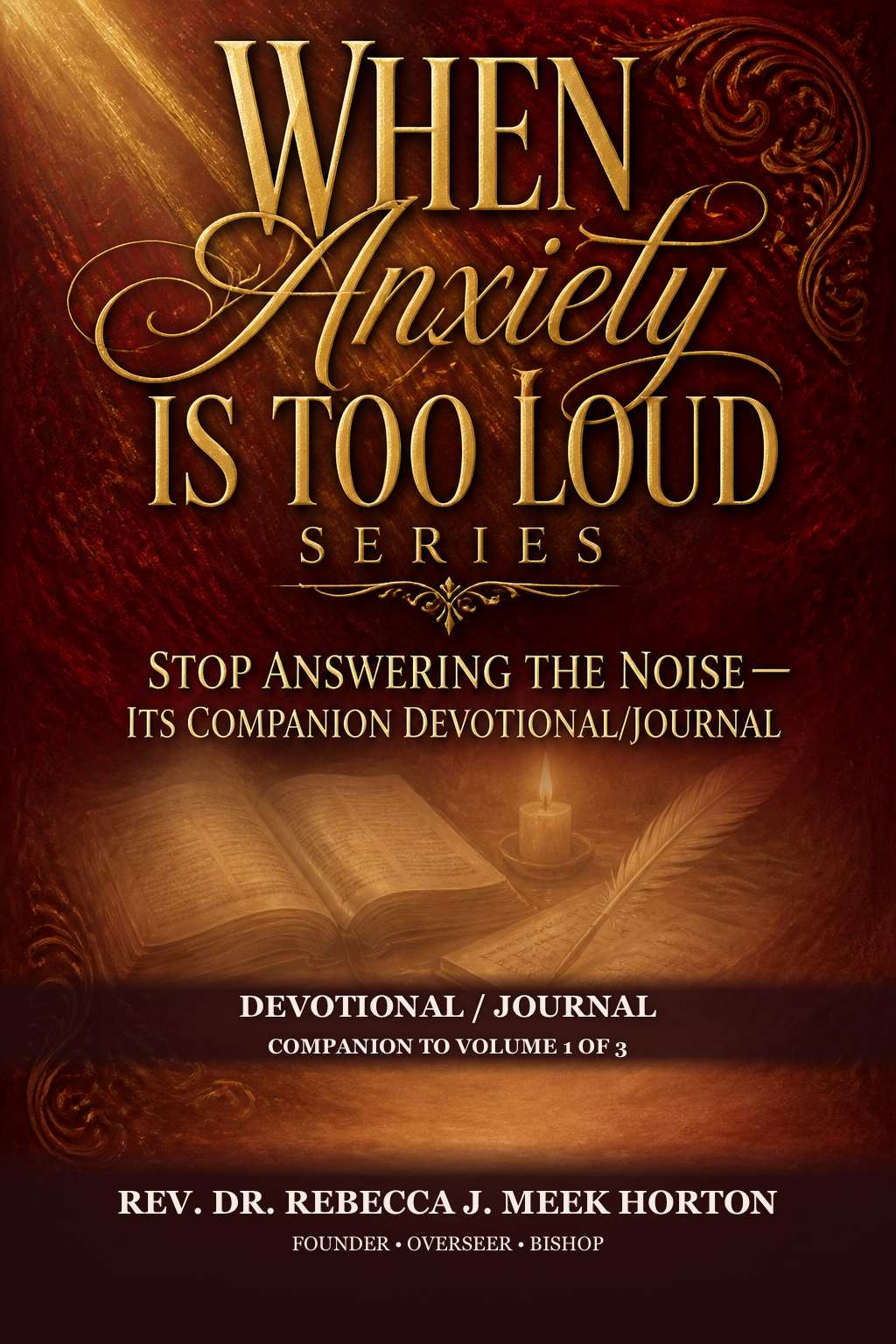
Stop Answering the Noise — Its Companion Devotional/Journal
A companion devotional and journal for "Stop Answering the Noise". Each chapter becomes five entries — a KJV Scripture reading, a devotional, a prayer, a journal prompt, and space to write — closing with An Apostolic Prophetic Architect Message and lined journal pages.
Full publication
NBCNGMI MASTER KNOWLEDGE LIBRARY Featuring the works of The Sage, Apostle Prophet. Rev. Dr. Rebecca J. Meek Horton, Apostolic Prophetic Architect, NewBeing Creation Network Global Ministries, Inc. Integrated Framework Modalities™
Dedication
I dedicate this devotional journal to every soul learning to stop answering the noise and return to the voice of GOD with a quiet, obedient heart. May these pages help you hear clearly, pray honestly, write truthfully, and take the next faithful step with wisdom, courage, and peace.
Purpose
I wrote this companion devotional and journal to help you stop giving your attention, agreement, and strength to the noise that keeps pulling you away from GOD’s voice, wisdom, and peace. Each entry is designed to slow you down with KJV Scripture, honest reflection, prayer, and written response so the truth can move from reading into daily practice. My hope is that these pages help you become quieter within, stronger in discernment, and more faithful in your next step of obedience.
Preface
I wrote this companion devotional and journal because I know how tiring it can be to live surrounded by constant noise.
Noise does not always come loudly. Sometimes it comes as pressure, opinion, urgency, comparison, fear, memory, offense, distraction, or the need to explain yourself to people who were never assigned to understand your obedience. If we are not careful, we can spend our strength answering what GOD never told us to answer.
This book was created as a slower place.
Stop Answering the Noise teaches the principle. This companion devotional and journal helps you practice it day by day. Each entry invites you to sit with the Word of GOD, receive a clear devotional thought, pray honestly, reflect deeply, and write what is being revealed in your own life. The goal is not to fill pages. The goal is to become quiet enough to hear rightly, respond faithfully, and walk in governed obedience.
John 10:27 (KJV) My sheep hear my voice, and I know them, and they follow me:
That verse carries the heart of this journal. GOD’s voice must become weightier than the noise around us. His instruction must become stronger than our reactions. His timing must become more trusted than our urgency.
I have learned that silence is not weakness when GOD is governing it. Restraint is not fear when wisdom is leading it. Stillness is not inactivity when obedience is being formed inside of it.
This devotional and journal is for anyone who is tired of being pulled in every direction. It is for the believer who needs RE-Calibration™. It is for the leader who must stop carrying every voice. It is for the wounded heart learning not to answer from pain. It is for the seeker who needs sacred space to listen, write, pray, and begin again.
Move through these pages slowly. Let each Scripture search you. Let each prayer steady you. Let each prompt help you name what needs to be surrendered, strengthened, corrected, or obeyed.
Nothing is random. Nothing is wasted.
May this companion help you stop answering the noise and begin keeping the next faithful step with clarity, courage, and peace.
Introduction
Noise is not only sound. Noise is anything that pulls your attention away from truth, peace, obedience, and godly order.
Some noise comes from the outside: opinions, pressure, urgency, conflict, comparison, fear, and constant information. Some noise comes from the inside: old wounds, anxious thoughts, pride, shame, impatience, and the need to prove something. Not every voice deserves your answer. Not every demand is your assignment. Not every open door is your next step.
This devotional and journal was created as a companion to Stop Answering the Noise. The main book teaches the call to stop reacting, stop striving, and stop letting noise govern your movement. This companion helps you practice that truth day by day. It turns the message into a rhythm of Scripture, devotion, prayer, reflection, and written response.
Psalm 46:10 (KJV) Be still, and know that I am God: I will be exalted among the heathen, I will be exalted in the earth.
Stillness is not weakness. Stillness is disciplined trust. It is the place where your soul stops running long enough to hear clearly, see honestly, and respond faithfully.
Each chapter theme from Stop Answering the Noise becomes five devotional entries in this journal. Each entry includes a KJV Scripture reading, a short devotional, a prayer, a journal prompt, and space to write. The goal is not to rush through pages. The goal is to let truth settle, expose what needs RE-Calibration™, and guide you into one faithful step.
Read this book slowly. Bring your real life to the page. Do not write what sounds spiritual if it is not honest. Write what is true. Name the noise. Name the pressure. Name the places where you have answered what GOD never assigned you to carry. Then ask for grace to return to order.
John 10:27 (KJV) My sheep hear my voice, and I know them, and they follow me:
This is the heart of the journal: hearing and following. Discernment is not only recognizing what is wrong. Discernment is learning what to stop answering so you can obey what is right.
Some entries may comfort you. Others may confront you. Let both be part of the work. GOD’s correction is not rejection. His instruction is mercy. If a prompt slows you down, let it. If a prayer touches something tender, pause. If a Scripture reveals a pattern you have excused, do not turn away. Wisdom instructs before expansion is released.
This journal is not meant to create dependency. It is meant to strengthen maturity. You are not being asked to perform for the page. You are being invited to listen, reflect, and walk. WISDOM is not yours until YOU WALK IT.
At the end of the devotional entries, you will find An Apostolic Prophetic Architect Message and additional lined journal pages. Use them for deeper prayer, notes, decisions, patterns you are noticing, and next steps you must steward. Nothing is random. Nothing is wasted. Even what you write in weakness can become part of your growth when brought honestly before GOD.
Begin with one clear decision: you will not answer every noise.
Before you continue, take a quiet moment. Ask GOD to show you one voice, pressure, habit, or reaction that has been governing your attention. Write it down. Then pray simply: Lord, teach me what to stop answering, and help me keep the next faithful step.
Chapter 1 — The Thought That Demands an Answer
Entry 1
Scripture Reading
2 Corinthians 10:5 (KJV) Casting down imaginations, and every high thing that exalteth itself against the knowledge of God, and bringing into captivity every thought to the obedience of Christ;
Devotional
Some thoughts enter quietly. Others enter like they own the room.
An anxious thought often comes with pressure attached to it. It does not simply say, Consider this. It says, Answer me now. Fix this now. Explain yourself now. Prepare for the worst now. That demand can feel so strong that the thought begins to sound like truth.
But Scripture gives us another way to live with our thoughts. We are not told to obey every imagination. We are not told to treat every inner alarm as wisdom. We are told to cast down imaginations and bring every thought into captivity to the obedience of Christ.
That means your thoughts can be governed.
This is not shame. This is stewardship. You are not wrong because a fearful thought came. You are not faithless because your body reacted before the facts were clear. But you are invited to slow down and notice what has taken the throne in your inner room.
The thought may say, Something is wrong. Wisdom asks, What do I actually know?
The thought may say, They are upset with me. Wisdom asks, Is that fact, fear, or assumption?
The thought may say, I must respond immediately. Wisdom asks, Is this urgency from responsibility, or is it pressure trying to rule me?
There is a holy difference between having a thought and surrendering to a thought. A thought can knock. It does not have to govern. A feeling can rise. It does not have to command. A body signal can alert you. It does not have to define reality.
Today, the practice is simple but not easy: do not let the loudest thought become the leader. Bring it before Christ. Name it plainly. Weigh it honestly. Refuse the parts that exalt themselves above God’s truth.
RE-Language™ may help you begin. Instead of saying, I have to fix this now, say, I am feeling pressure to fix this now. That one shift takes anxiety off the throne and puts responsibility back in its proper place.
Nothing is random. Nothing is wasted. Even this moment of pressure can become a place of formation. The anxious thought may be loud, but Christ is still Lord over the mind.
Prayer
Father, I bring my thoughts before You. I confess that I have often treated anxious pressure like authority. I have answered fear too quickly, reacted before I could see clearly, and allowed assumptions to shape my peace. Help me cast down imaginations that rise against Your truth. Teach me to bring my thoughts into obedience to Christ without shame and without panic. Give me the courage to pause, name what is happening, and refuse what is not true. Let my mind be governed by Your Word, not by noise. I receive Your help for this day, one thought at a time. Amen.
Journal Prompt
From 2 Corinthians 10:5, what anxious thought has been demanding an answer from you, and how can you bring it into obedience to Christ today?
Space to Write [Answer Lines]
Entry 2
Scripture Reading
Philippians 4:6-7 (KJV) 6 Be careful for nothing; but in every thing by prayer and supplication with thanksgiving let your requests be made known unto God. 7 And the peace of God, which passeth all understanding, shall keep your hearts and minds through Christ Jesus.
Devotional
Anxiety often tells you that prayer is too slow.
It says the message needs an answer now. The conversation needs to be repaired now. The uncertainty needs to be solved now. The outcome needs to be controlled now. Anxiety does not like the space between not knowing and understanding. It wants to close that space with action, explanation, defense, or control.
But Scripture does not tell us to be careless. It tells us to be careful for nothing. That means we do not have to carry care as if we are the only ones responsible for holding life together.
There is a difference between responsibility and anxious ownership. Responsibility asks, What is mine to steward? Anxious ownership says, Everything depends on me right now. Responsibility can pray, wait, listen, and act with wisdom. Anxiety rushes ahead and calls the rush obedience.
Paul gives a different rhythm. In every thing, bring the matter to God. Not after you have rehearsed every fear. Not after you have already reacted. Not after you have exhausted your strength trying to settle your own soul. Bring it first.
Prayer is not avoidance. Prayer is ordered dependence. Supplication is not weakness. It is honest need brought before the Father. Thanksgiving is not denial of difficulty. It is a decision to remember that God is present before the outcome is clear.
Then comes a promise: the peace of God shall keep your hearts and minds through Christ Jesus. Notice what peace does. It keeps. It guards. It stands watch over the places anxiety tries to invade.
This peace may not answer every question immediately. It may not remove every consequence. It may not make every person respond the way you hoped. But it can keep your heart and mind from being ruled by the demand beneath the thought.
Today, when anxiety presses you to answer the noise, let prayer answer first. Before the extra text. Before the long explanation. Before the imagined argument. Before the panic decision. Stop and say, Father, here is what I know. Here is what I fear. Here is what I need. Govern me in this moment.
You do not have to solve your whole life today. You can make your request known unto God and let His peace keep what anxiety tried to seize.
Prayer
Father, I come to You with the cares I have been carrying. I admit that I have tried to answer anxiety with control instead of bringing my requests to You. Teach me to pray before I react. Teach me to ask honestly without pretending I am not afraid. Help me receive the peace that keeps my heart and mind through Christ Jesus. I do not want to be careless, but I also do not want to be ruled by care. Show me what is mine to steward and what I must release to You. Govern my response today. Amen.
Journal Prompt
From Philippians 4:6-7, what care do you need to bring to God before you answer it with reaction, and what request will you make known to Him?
Space to Write [Answer Lines]
Entry 3
Scripture Reading
Proverbs 14:29 (KJV) He that is slow to wrath is of great understanding: but he that is hasty of spirit exalteth folly.
Devotional
Anxiety can make the spirit hasty.
It may not look like anger at first. Sometimes it looks like overexplaining. Sometimes it looks like checking the phone again and again. Sometimes it looks like sending one more message, replaying one more conversation, preparing one more defense, or deciding what someone meant before you have asked.
Haste is not always loud. Sometimes haste happens quietly inside the mind.
The Scripture says that the one who is slow to wrath is of great understanding, but the hasty of spirit exalts folly. This speaks to more than temper. It speaks to movement. A hasty spirit moves before wisdom has room to speak.
An anxious thought often says, If you pause, something will get worse. If you wait, you are being irresponsible. If you do not act now, you do not care. But wisdom teaches us that a pause is not neglect. A pause can be obedience. A pause can protect the words you cannot take back. A pause can keep you from building a whole story out of one sentence.
The text message says, Call me when you can. Anxiety hears, Something is wrong. A hasty spirit starts preparing for trouble. Wisdom pauses and says, All I know is that I received a request.
That pause is not small. It is spiritual maturity in motion.
There are moments when immediate action is necessary. Wisdom does not teach passivity. But many anxious reactions are not true emergencies. They are inner alarms demanding outer movement. If we move every time fear demands it, we train the soul to obey pressure instead of truth.
SAPP™ Discernment begins with seeing. See what is actually happening. Ask what is being assumed. Ponder the motive, timing, and cost. Practice one faithful step. This protects you from hasty movement that feels relieving for a moment but creates confusion later.
Today, do not rush to answer everything that stirs you. Let understanding have time to form. Let prayer have time to settle you. Let facts have time to arrive. Let your spirit slow down enough to become teachable.
A hasty spirit exalts folly, but a governed spirit makes room for wisdom.
Prayer
Father, I acknowledge the places where I become hasty in spirit. I have moved too quickly under pressure, spoken before listening, assumed before asking, and tried to settle fear by reacting. Teach me to slow down without becoming passive. Help me recognize when urgency is wisdom and when urgency is anxiety trying to lead. Give me great understanding. Govern my mouth, my messages, my decisions, and my inner pace. I do not want to exalt folly through rushed reactions. I want to walk in obedience with a steady heart and a teachable spirit. Amen.
Journal Prompt
From Proverbs 14:29, where has anxiety made your spirit hasty, and what pause would help you move with greater understanding today?
Space to Write [Answer Lines]
Entry 4
Scripture Reading
Isaiah 26:3 (KJV) Thou wilt keep him in perfect peace, whose mind is stayed on thee: because he trusteth in thee.
Devotional
The mind needs a place to stay.
When anxiety enters, the mind often runs from one imagined outcome to another. It searches faces, messages, silence, delays, tone, timing, and memory. It gathers fragments and tries to build certainty. But anxiety’s certainty is usually expensive. It costs peace, rest, clarity, and sometimes relationships.
Isaiah gives us a different picture. Perfect peace belongs to the one whose mind is stayed on God, because trust has become the foundation.
To stay the mind is not to pretend nothing is wrong. It is not spiritual performance. It is not forcing yourself to feel calm. It is returning the mind to the One who remains steady when the situation is unclear.
The anxious thought demands, Look at me until you solve me. Faith says, I can notice the thought, but I will not make it my dwelling place.
This is important because attention feeds authority. What you keep staring at begins to feel larger. What you rehearse begins to feel final. What you imagine repeatedly begins to feel true. Anxiety knows this. It pulls your attention toward the possible threat and tries to keep it there.
But trust redirects attention.
Trust says, I do not have all the facts, but God is still present. Trust says, My body may be alarmed, but God is not confused. Trust says, I can wait for truth without surrendering to dread. Trust says, I can take the next faithful step without panic.
Perfect peace does not mean life becomes painless. It means the mind is kept while life is unfinished. It means you are not left alone with the noise. It means there is a guarding grace available when you choose to stay your mind on God.
Today, when a thought demands your full attention, gently redirect. Not once, but as often as needed. You may need to say, Father, my mind is running again. I return my attention to You. You may need to step away from the screen, breathe slowly, read the Scripture again, or write down the difference between fact and fear.
This is WALK™ in daily practice. Wait in stillness. Ask honestly. Listen carefully. Keep the next faithful step.
Your mind does not have to live inside the demand. It can be stayed on God.
Prayer
Father, I bring my restless mind to You. I admit that I have stayed too long with anxious thoughts, rehearsed fearful outcomes, and allowed uncertainty to occupy my attention. Teach me to trust You in the space where I do not yet know. Keep me in Your peace. Help me return my mind to You without condemning myself when it wanders. I choose to notice the noise without dwelling in it. I choose to remember that You are steady, present, and faithful. Let my thoughts be stayed on You today, and let my next step come from trust. Amen.
Journal Prompt
From Isaiah 26:3, what has your mind been staying on, and what practice will help you return your attention to God today?
Space to Write [Answer Lines]
Entry 5
Scripture Reading
1 Peter 5:7 (KJV) Casting all your care upon him; for he careth for you.
Devotional
Care becomes heavy when we carry it alone.
There are real concerns in life. People do send unclear messages. Children do withdraw. Leaders do face hard conversations. Friends do misunderstand. Bodies do react before facts arrive. The invitation is not to become numb or careless. The invitation is to stop carrying care as if care belongs only to you.
Peter says to cast all your care upon Him. Not some care. Not only the care that looks spiritual. Not only the care you have already cleaned up and made presentable. All your care.
That includes the small anxious thought that embarrassed you because it seemed too dramatic. It includes the pressure to fix what is not yours to fix. It includes the fear behind the repeated checking. It includes the need to be understood immediately. It includes the dread that rose from one sentence on a screen.
The reason is tender and strong: for He careth for you.
God does not tell you to cast your care because your care does not matter. He tells you to cast it because you matter to Him. This is not rejection of your concern. It is rescue from being ruled by it.
Some people hold care tightly because they believe letting go means losing control. But many times, what we call control is only exhaustion with a plan. Casting care is not abandoning responsibility. It is placing the weight where it belongs so you can respond with wisdom instead of panic.
You may still need to make the call. You may still need to have the conversation. You may still need counsel, rest, repentance, repair, or help from a trusted pastor, counselor, physician, or qualified professional. Casting care does not erase responsibility. It restores order.
First, cast the care. Then, take the next faithful step.
This is the difference between being driven and being led. Anxiety drives with pressure. Wisdom leads with clarity. Fear says, Carry it now or everything will fall apart. The Father says, Cast it upon Me, because I care for you.
Today, name one care plainly. Do not dress it up. Do not argue with it for an hour. Say what it is. Then give it to God in prayer. After that, choose one steady step that does not come from panic.
WISDOM is not yours until YOU WALK IT. Walk this truth today.
Prayer
Father, I cast my care upon You. I confess that I have carried worry as if carrying it proved my love, responsibility, or faithfulness. I have held pressure in my body and allowed anxious thoughts to direct my movement. Thank You for caring for me. Thank You that I do not have to pretend my concerns are small in order to bring them to You. Help me release what belongs in Your hands and steward what belongs in mine. Teach me to act from peace, not panic. Today, I give You this care and receive Your help for the next faithful step. Amen.
Journal Prompt
From 1 Peter 5:7, what care are you still carrying as if it belongs only to you, and what would it look like to cast it upon God today?
Space to Write [Answer Lines]
An Apostolic Prophetic Architect Message
Beloved, the work of these five entries has not been to silence every thought. It has been to restore order.
A thought may knock, but it does not have to rule. A feeling may rise, but it does not have to lead. A body alarm may sound, but it does not have to write the story. This is where maturity begins: when you stop treating urgency as authority and start bringing your inner life under the government of God.
There is a holy strength in the pause. The pause is not weakness. The pause is not avoidance. The pause is the place where wisdom can interrupt reaction. It is where you learn to see the difference between fact and fear, pressure and responsibility, discernment and anxiety in a hurry.
Psalm 46:10 (KJV) Be still, and know that I am God: I will be exalted among the heathen, I will be exalted in the earth.
Be still does not mean be careless. It means stop bowing to the noise as if it has the final word. Stillness gives the soul room to remember who God is. When God is restored to the center, thoughts can be examined without panic. Decisions can be made without haste. Conversations can be entered without fear demanding control.
This is confirmation for the one who has felt ashamed of anxious thoughts: shame is not your teacher. Wisdom is. The presence of anxiety does not disqualify you from growth. It reveals a place where God is inviting RE-Calibration™, RE-Alignment™, and deeper trust.
Nothing is random. Nothing is wasted. Even the thought that demanded an answer can become a training ground for peace, order, and obedience.
So today, do not try to master your whole mind in one moment. Practice one faithful interruption. Name the fact. Name the fear. Name the pressure. Then choose the faithful response. That is Governed Movement™. That is Walking in Obedience™.
The loudest thought in the room does not have to lead. Let God govern the room. Let truth take its place. Let wisdom rise before reaction. And when the noise knocks again, remember: you are not required to answer everything that demands you. You are called to answer God with trust.
[Journal Page]
[Journal Page]
Chapter 2 — Quiet Is Not Avoidance
Entry 1
Scripture Reading
Psalm 46:10 (KJV) Be still, and know that I am God: I will be exalted among the heathen, I will be exalted in the earth.
Devotional
Quiet is not avoidance when it brings you back to God.
There are moments when anxiety feels like instruction. A message arrives. A tone changes. A meeting is scheduled. A delay stretches longer than expected. Before anything has truly happened, your inner world begins to answer. You rehearse. You defend. You imagine. You prepare for conversations that have not yet taken place.
But Psalm 46:10 calls the soul into a different order.
Be still, and know that I am God.
Stillness is not a refusal to face reality. It is the place where reality is placed back under the authority of God. The verse does not invite us into denial. It invites us into recognition. God is God before the answer comes. God is God before the conversation happens. God is God before your emotions settle.
This matters because anxiety often tries to become lord over the moment. It demands immediate obedience. It tells you to answer now, explain now, fix now, fear now. But anxious urgency is not the same as holy direction.
Quiet helps you see what is actually required.
Maybe you do need to respond, but not from panic. Maybe you do need to prepare, but not by rehearsing disaster. Maybe you do need to ask a question, but not because fear is dragging you. Quiet does not erase responsibility. Quiet restores order to it.
There is a faithful pause that says, I will not let fear choose my tone. I will not let pressure govern my timing. I will not confuse worry with wisdom.
That pause may feel small. Three minutes. One breath. One hand resting over your heart. One sentence whispered before God. But small obedience can become a doorway into Governed Movement™.
Nothing is random. Nothing is wasted. Even the moment that stirred anxiety can become a place of RE-Calibration™ if you stop long enough to return to truth.
Today, stillness may not feel peaceful at first. That is all right. Stillness is not proven by how calm you feel. It is proven by where you turn. You are not avoiding the matter. You are refusing to let the matter become larger than God.
Quiet is where you remember: the moment is real, but it is not ultimate.
Prayer
Father, I come before You with the places in me that rush, tighten, and prepare for the worst. I confess that I have often answered anxiety as though it had authority over me. Teach me to be still without calling it avoidance. Help me know You again in the middle of pressure, delay, and uncertainty. Settle my spirit before I speak. Govern my thoughts before I decide. Give me courage to pause when panic demands movement. I do not want to react from fear. I want to respond from trust. Father, restore order within me and help me remember that You are God. Amen.
Journal Prompt
Where is Psalm 46:10 inviting me to pause before I respond, and what would it look like today to be still without avoiding my responsibility?
Space to Write
[Answer Lines]
Entry 2
Scripture Reading
Proverbs 3:5-6 (KJV) 5 Trust in the LORD with all thine heart; and lean not unto thine own understanding. 6 In all thy ways acknowledge him, and he shall direct thy paths.
Devotional
Trust is not always loud. Sometimes trust looks like not leaning into the thought that keeps pulling you toward panic.
Proverbs 3:5-6 does not tell us to stop thinking. It tells us not to lean on our own understanding as the final support. That distinction matters. God gave you a mind, but He did not ask your mind to become your savior. He gave you discernment, but He did not call anxiety discernment. He gave you responsibility, but He did not require you to carry the whole future in one night.
When pressure rises, the mind often reaches for control. It wants to build the whole path before taking the next step. It asks questions that may not have answers yet. What will they say? What if this goes wrong? What if I cannot fix it? What if I missed something? The questions may feel responsible, but if they keep you trapped in fear, they are not leading you into wisdom.
Trust in the LORD with all thine heart.
That means the heart must be gathered back from scattered places. Back from imagined outcomes. Back from rehearsed arguments. Back from the need to know every detail before obedience begins.
Quiet becomes an act of trust when it makes space to acknowledge God. Not after the problem is solved. Not after the tension leaves. Not after the message is clarified. In all thy ways acknowledge him.
That includes the anxious way. The uncertain way. The way where you feel tempted to over-explain, over-plan, over-check, or over-control.
To acknowledge God is to bring Him into the actual moment, not the polished version of yourself. It is to say, Father, this is what I know, this is what I do not know, and this is where I need Your direction.
Then comes the promise: he shall direct thy paths.
Direction is not always the full map. Often, it is the next faithful step. Wait until morning. Ask one honest question. Write down the concern. Make the call at the right time. Apologize simply. Rest tonight. Do not answer from panic.
Wisdom instructs before expansion is released. In the same way, trust steadies before movement is released. You do not have to force the path open. Do not Force-The-FiT™. Acknowledge God, steward the next step, and let Him direct what anxiety cannot govern.
Prayer
Father, I acknowledge You in this moment. I bring You the places where I have leaned on my own understanding and called it preparation. I bring You the thoughts that circle, the questions that pull me out of rest, and the pressure to control what I cannot see. Teach me to trust You with all my heart, not just with the parts that feel calm. Direct my path with wisdom. Help me take the next responsible step without forcing answers that are not ready. I surrender the need to solve everything at once. Lead me in Your order. Amen.
Journal Prompt
According to Proverbs 3:5-6, where am I leaning on my own understanding, and what is one way I can acknowledge the Lord before I take my next step?
Space to Write
[Answer Lines]
Entry 3
Scripture Reading
Isaiah 30:15 (KJV) For thus saith the Lord GOD, the Holy One of Israel; In returning and rest shall ye be saved; in quietness and in confidence shall be your strength: and ye would not.
Devotional
Quiet will often cost you the habit of running.
Isaiah 30:15 carries both invitation and correction. The Lord speaks of returning, rest, quietness, confidence, and strength. But the verse ends with a sobering truth: and ye would not.
That ending matters because stillness is not always refused by unbelief alone. Sometimes it is refused by fear. Sometimes by habit. Sometimes by the hidden belief that if we stop striving, everything will fall apart.
Many of us have learned to move quickly when we feel unsafe. We explain quickly. Decide quickly. Answer quickly. Defend quickly. We call it being responsible, but sometimes it is fear wearing responsible language.
This is where RE-Language™ is needed.
Instead of saying, If I rest, I am being careless, we can say, Rest helps me return to God before I respond.
Instead of saying, I have to fix this immediately, we can say, I can take the next faithful step when wisdom gives it weight.
Instead of saying, Quiet means I am doing nothing, we can say, Quiet is where God restores order in me.
In returning and rest shall ye be saved.
Returning is not passive. It is movement back to the right center. Back from panic to prayer. Back from assumption to truth. Back from anxious control to holy dependence. Rest is not the absence of concern. It is the refusal to let concern become master.
In quietness and in confidence shall be your strength.
The world often teaches us to measure strength by visible action. Who answered first? Who defended hardest? Who stayed busiest? Who sounded most certain? But Scripture shows us another strength: the strength to pause, return, rest, and trust.
This does not mean you ignore what is required. It means you stop letting anxiety decide what is required. Quiet helps you separate duty from panic. It helps you see the difference between a true assignment and an anxious impulse.
There may be a conversation to face. There may be a bill to address. There may be a hard truth to speak. But if you return first, your movement can become governed. If you rest first, your response can carry wisdom instead of heat.
The cost of quiet is real. You may have to release the illusion that constant motion keeps you safe. But the fruit is stronger: quiet confidence, restored strength, and a soul that is no longer driven by every alarm.
Prayer
Father, I admit that I have sometimes refused quiet because I was afraid of what might happen if I stopped moving. I have trusted urgency more than rest and called anxious striving responsibility. Draw me back to You. Teach me the strength of returning, the wisdom of rest, and the confidence that comes from depending on You. Help me recognize the difference between obedience and panic. I do not want to run from what is true, but I also do not want fear to lead me. Restore quiet strength in me today. Amen.
Journal Prompt
How does Isaiah 30:15 expose my resistance to rest, and where do I need to return to God instead of running under anxious pressure?
Space to Write
[Answer Lines]
Entry 4
Scripture Reading
James 1:19-20 (KJV) 19 Wherefore, my beloved brethren, let every man be swift to hear, slow to speak, slow to wrath: 20 For the wrath of man worketh not the righteousness of God.
Devotional
Quiet protects the response.
James 1:19-20 gives a simple order that can change the way we move through pressure: swift to hear, slow to speak, slow to wrath. This is not weakness. This is spiritual governance. It is the discipline of refusing to let the first surge inside you become the final word from you.
Many anxious moments become worse because we speak from the heat of the first feeling. We answer the text too quickly. We send the long explanation before we understand the concern. We defend ourselves before we have listened. We assume tone, motive, and meaning before the full matter is known.
Then the response creates another problem.
Quiet is not avoidance when it keeps your mouth from being ruled by fear, anger, or self-protection. It is not silence forever. It is the sacred space before speech where wisdom can examine what anxiety wants to say.
Be swift to hear.
That means I must slow down enough to receive what is actually being communicated. Not what my fear added. Not what my history assumed. Not what my insecurity predicted. What was actually said? What is actually being asked? What is actually required?
Be slow to speak.
That means I do not owe every feeling an immediate sentence. I can wait. I can ask for clarity. I can say, I need a little time to think before I respond. I can write the response and not send it yet. I can pray before I speak.
Be slow to wrath.
Wrath is not always loud. Sometimes it hides inside defensiveness, sarcasm, withdrawal, or the need to prove ourselves right. But the wrath of man worketh not the righteousness of God. Pressure may explain my reaction, but it does not sanctify it.
Quiet helps me return to responsibility.
There may be truth to speak, but it must be spoken from a governed place. There may be correction to give, but it must not be carried by panic. There may be a boundary to set, but it does not need to be born from rage.
WISDOM is not yours until YOU WALK IT. Today, wisdom may look like closing the message and praying first. It may look like listening without interrupting. It may look like letting your breathing slow before you answer.
A quiet mouth can become a guarded gate for a wiser heart.
Prayer
Father, I bring You my words before I release them. I confess that I have sometimes spoken too quickly because I felt threatened, misunderstood, or afraid. Teach me to be swift to hear, slow to speak, and slow to wrath. Help me listen for what is true instead of reacting to what anxiety adds. Govern my tone, timing, and motive. If I need to speak, let my words be honest and seasoned with wisdom. If I need to wait, give me humility to wait. I want my response to honor You, not simply relieve my pressure. Amen.
Journal Prompt
In light of James 1:19-20, where do I need to slow my speech so my response is shaped by wisdom instead of anxiety or anger?
Space to Write
[Answer Lines]
Entry 5
Scripture Reading
Philippians 4:6-7 (KJV) 6 Be careful for nothing; but in every thing by prayer and supplication with thanksgiving let your requests be made known unto God. 7 And the peace of God, which passeth all understanding, shall keep your hearts and minds through Christ Jesus.
Devotional
Prayer is where anxiety is brought under the care of God.
Philippians 4:6-7 does not pretend that life gives us nothing to care about. The concerns are real. Conversations are real. Responsibilities are real. Bills, health, relationships, decisions, and waiting seasons are real. But the passage teaches us not to be governed by anxious care.
Be careful for nothing.
This is not a command to become indifferent. It is a call to stop carrying concern as though you are alone with it. Anxiety often isolates the heart. It tells you that everything depends on your next move, your perfect words, your constant watchfulness, your ability to predict and prevent every outcome.
But Scripture gives another way.
In every thing by prayer and supplication with thanksgiving let your requests be made known unto God.
Every thing means the late message. The hard conversation. The financial concern. The child you are worried about. The decision you cannot yet see clearly. The apology you may need to make. The uncertainty that keeps pressing on your chest.
You do not have to dress it up before you bring it to God. You can bring the real request. The trembling request. The unfinished request. The request that still has questions inside it.
Prayer does not always remove the issue immediately. Sometimes the message still waits until tomorrow. The appointment still has to happen. The budget still needs review. The conversation still must be faced. But prayer changes where the weight is placed.
And the peace of God, which passeth all understanding, shall keep your hearts and minds through Christ Jesus.
Peace that passes understanding does not require every detail to make sense first. It keeps the heart and mind while the matter is still unfolding. It guards the places anxiety tries to invade.
This is not instant emotional perfection. It is divine keeping. It is grace meeting you in the pause. It is God teaching your heart that panic is not the only possible response.
Quiet is not avoidance when it becomes prayer. It is not withdrawal from responsibility. It is the place where responsibility is surrendered, clarified, and carried with God.
Today, do not solve the whole situation in your head. Make your request known. Then ask one faithful question: What is actually required of me right now?
That is enough for the next step.
Prayer
Father, I bring every anxious care before You. I bring the things I understand and the things I cannot yet name. I bring the messages, conversations, decisions, and responsibilities that have been weighing on my heart. Teach me to pray instead of rehearsing fear. Help me make my requests known to You with honesty and thanksgiving. Guard my heart and mind through Christ Jesus. Let Your peace keep me while the situation is still unfinished. Show me what is actually required of me today, and help me obey that step without being ruled by panic. Amen.
Journal Prompt
How does Philippians 4:6-7 invite me to turn one specific anxiety into prayer, and what request do I need to make known to God today?
Space to Write
[Answer Lines]
An Apostolic Prophetic Architect Message
Beloved, quiet is not your enemy. Quiet is a holy room where God teaches you how to stop answering the noise as though noise has authority.
This chapter has not called you into avoidance. It has called you into order. There is a difference between hiding from responsibility and returning to God before you respond. Avoidance refuses truth. Quiet helps you face truth without panic becoming your leader.
Psalm 46:10 (KJV) Be still, and know that I am God: I will be exalted among the heathen, I will be exalted in the earth.
This is the confirmation: stillness does not make you careless. Stillness makes you available for wisdom.
You may still need to answer the message. You may still need to face the conversation. You may still need to ask for clarity, make the call, review the numbers, apologize, set the boundary, or take the next responsible step. But you do not have to let anxiety drag you into obedience ungoverned.
That is the work of this devotional journey. It is RE-Calibration™. It is RE-Alignment™. It is the movement from reaction to stewardship, from panic to prayer, from pressure to Governed Movement™.
Do not confuse speed with faithfulness. Do not confuse worry with love. Do not confuse constant mental rehearsal with preparation. WISDOM is not yours until YOU WALK IT, and sometimes walking wisdom begins by standing still long enough to remember who God is.
Nothing is random. Nothing is wasted. Even the anxious moment can become a place of formation when you bring it under the presence, purpose, and power of God.
So today, do not answer from panic. Do not Force-The-FiT™. Do not let fear write the first draft of your response. Pause. Breathe. Pray. Ask what is truly required. Then take the next faithful step with a governed heart.
Quiet is not absence. Quiet is alignment.
And in that quiet, you are learning this truth: anxiety may be loud, but it is not Lord.
[Journal Page]
[Journal Page]
Chapter 3 — Name the Noise
Entry 1
Scripture Reading
Psalm 139:23-24 (KJV) 23 Search me, O God, and know my heart: try me, and know my thoughts: 24 And see if there be any wicked way in me, and lead me in the way everlasting.
Devotional
Anxiety becomes dangerous when it is allowed to speak without being searched. It moves quickly. It pulls one sentence, one look, one delay, one text message, and builds a whole conclusion before truth has entered the room.
This is why the prayer of Psalm 139 matters. David does not run from what is inside him. He does not pretend his thoughts are always clean, clear, or faithful. He brings his heart before God and asks to be known. That is not shame. That is maturity.
When the noise gets loud, the first faithful movement is not always an answer. Sometimes it is an honest pause. Father, search me. Father, know my heart. Father, try my thoughts. Before I respond from fear, show me what is actually present.
Naming the noise is not the same as accusing yourself. It is not frantic self-examination. It is holy attention. You are learning to separate the fact from the fear, the assumption from the truth, the body signal from the instruction, and the old wound from the present moment.
A text message is a fact. The panic that says everything is falling apart may be fear. The thought that says you always ruin things may be an old story. The tightness in your chest may be a body signal. The pressure to fix everything tonight may be urgency wearing the voice of wisdom.
But wisdom is not frantic.
God can search what anxiety tries to blend. He can show you what is real without crushing you. He can reveal what needs correction without condemning you. He can lead you in the way everlasting, but you must first stop letting the noise lead you in circles.
This practice will cost you the rush of immediate certainty. It will ask you to slow down when everything in you wants to react. It will require humility to say, I feel strongly, but I do not yet know clearly.
That is not weakness. That is RE-Calibration™.
Nothing is random. Nothing is wasted. Even the anxious moment can become a place of instruction when you bring it before God. Do not answer every voice at once. Ask who is speaking. Then let the Lord lead you in truth.
Prayer
Father, I come before You honestly. Search my heart and know my thoughts. I do not want anxiety to become the voice I obey. Help me slow down before I respond, explain, defend, or withdraw. Show me the difference between what is true and what fear is adding. Reveal any old story that is shaping this moment without my permission. Lead me away from panic and into wisdom. I receive Your correction without shame and Your comfort without denial. Teach me to name the noise clearly so I can walk in the way that honors You. In Jesus’ name, Amen.
Journal Prompt
Psalm 139:23-24 invites God to search the heart and thoughts. What parts of your current anxiety need to be named before God instead of obeyed immediately?
[Answer Lines]
Space to Write
Entry 2
Scripture Reading
Proverbs 3:5-6 (KJV) 5 Trust in the LORD with all thine heart; and lean not unto thine own understanding. 6 In all thy ways acknowledge him, and he shall direct thy paths.
Devotional
Anxiety often feels like understanding. It sounds certain. It gives reasons. It gathers evidence. It tells you what that message meant, what that silence meant, what that facial expression meant, and what is probably going to happen next.
But certainty is not always wisdom.
Proverbs teaches us not to lean on our own understanding. This does not mean we stop thinking. It means we stop treating our first interpretation as final. We bring our understanding under the Lord’s direction.
When anxiety rises, it usually asks you to lean hard on what you think you know. They are upset. This will go badly. I need to fix it now. I am in trouble. They are pulling away. I failed again.
Some of those thoughts may feel believable because they are connected to real experiences. Maybe there was a time when silence did mean punishment. Maybe a meeting once did lead to correction. Maybe a delayed reply once became rejection. But the presence of a memory does not prove the meaning of the moment.
Trusting the Lord with all your heart includes trusting Him with the part of your heart that wants to decide too quickly.
Acknowledge Him before you answer the text. Acknowledge Him before you rehearse the defense. Acknowledge Him before you assign motive to someone else. Acknowledge Him before you turn a fact into a verdict.
This is Governed Movement™ in daily life. It is the decision to slow the inward rush long enough to say, Father, direct my path in this moment. Not just my future. Not just my calling. This moment. This response. This conversation. This silence.
The cost is real. You may have to release the false comfort of figuring everything out immediately. You may have to sit with not knowing. You may have to choose prayer before explanation and patience before pressure.
But the promise is also real. He shall direct thy paths.
The Lord is not confused by the parts of your noise. He can help you see what you actually know, what you do not yet know, what your body is signaling, and what responsible step belongs to today.
Do not Force-The-FiT™ between fear and facts. Let God direct the path.
Prayer
Father, I trust You with my heart, including the anxious places that want quick answers. I confess that I often lean on my own understanding when fear feels loud. Help me acknowledge You before I interpret, respond, or assume. Direct my path in this situation. Teach me to wait for truth instead of building conclusions from fear. Give me the humility to say, I do not yet know clearly. Give me the courage to take the next faithful step without trying to control the whole outcome. I choose Your wisdom over my anxious certainty. In Jesus’ name, Amen.
Journal Prompt
Proverbs 3:5-6 calls you to trust the Lord instead of leaning on your own understanding. Where are you treating an anxious interpretation as if it is already confirmed truth?
[Answer Lines]
Space to Write
Entry 3
Scripture Reading
2 Corinthians 10:5 (KJV) Casting down imaginations, and every high thing that exalteth itself against the knowledge of God, and bringing into captivity every thought to the obedience of Christ;
Devotional
Not every thought deserves a throne.
Some thoughts need to be named, tested, and brought into captivity. Not because you are bad for having them, but because ungoverned thoughts can build a world that truth did not authorize.
Anxiety is skilled at imagination. It can take a small fact and construct an entire courtroom. One message becomes a trial. One delay becomes a rejection. One mistake becomes a life sentence. Before anything has been clarified, the mind has already argued the case, judged the motive, assigned the outcome, and punished the heart.
This is why 2 Corinthians 10:5 is so practical. It teaches us that thoughts are not always neutral. Some imaginations rise up against the knowledge of God. Some arguments exalt themselves. Some conclusions try to govern us before Christ has been acknowledged.
Bringing a thought into captivity is not pretending it does not exist. It is refusing to let it rule unexamined.
You can say, This is a thought, not a command.
You can say, This is an assumption, not a fact.
You can say, This is fear speaking from memory, not wisdom speaking from truth.
You can say, This feeling is strong, but it is not my final authority.
That kind of naming interrupts the cycle. It makes room for obedience.
The obedience of Christ may look very ordinary. It may look like waiting until morning to respond. It may look like asking a clarifying question instead of making an accusation. It may look like breathing, praying, drinking water, and refusing to write the whole story from one sentence on a screen.
This is not passivity. It is stewardship.
You are responsible for what you allow to lead your response. You may not control every first thought that enters your mind, but by God’s help, you can learn not to build a house for every imagination.
WISDOM is not yours until YOU WALK IT.
Today, do not fight every anxious thought with panic. Bring it into order. Name it. Test it. Submit it. Let Christ govern the inner courtroom. Anxiety may present evidence, but it does not get to be prosecutor, witness, judge, and sentence.
Truth must be given room to speak.
Prayer
Father, I bring my thoughts before You. I admit that anxiety sometimes builds imaginations and calls them truth. Help me cast down what rises against the knowledge of You. Teach me to bring every thought into captivity to the obedience of Christ. I do not want fear to govern my words, my decisions, or my relationships. Give me discernment to separate facts from assumptions and feelings from instructions. Strengthen me to pause before I react. Let my mind be renewed, my response be measured, and my obedience be real. In Jesus’ name, Amen.
Journal Prompt
2 Corinthians 10:5 speaks of bringing thoughts into captivity. What thought, assumption, or imagined outcome needs to be named and submitted to Christ today?
[Answer Lines]
Space to Write
Entry 4
Scripture Reading
Philippians 4:6-7 (KJV) 6 Be careful for nothing; but in every thing by prayer and supplication with thanksgiving let your requests be made known unto God. 7 And the peace of God, which passeth all understanding, shall keep your hearts and minds through Christ Jesus.
Devotional
Anxiety often enters through the body before the mind can explain it.
Your chest tightens. Your stomach drops. Your jaw clenches. Your heart races. Your shoulders rise. Suddenly, the body is sounding an alarm, and the mind begins searching for a reason.
The danger is not that your body speaks. The danger is when the body signal becomes the leader.
Philippians 4 does not shame us for having cares. It gives us a holy place to bring them. In every thing, prayer. In every thing, supplication. In every thing, thanksgiving. This means the anxious moment is not excluded from God’s presence. The tight chest, the racing thoughts, the trembling hands, the pressure to respond now—all of it can be brought before the Father.
The peace of God does not always begin by giving you every answer. Sometimes peace begins by keeping you while you do not yet have the answer.
That matters because anxiety wants resolution immediately. It says, Do something now. Fix it now. Explain now. Decide now. But peace says, Bring it to God first. Let your heart and mind be kept through Christ Jesus.
Kept does not mean you feel nothing. Kept means you are not surrendered to the storm inside you.
You can notice your body without obeying panic. You can say, My heart is racing, and I will slow my response. My stomach is tight, and I will not decide from fear. My body feels unsafe, and I will check what is actually happening.
This is not denial. It is disciplined care.
A smoke alarm deserves attention, but it does not always mean the house is burning down. You check. You observe. You open a window if needed. You respond wisely.
In the same way, your body signal may be information. It may tell you that you are tired, hungry, overwhelmed, reminded of a former wound, or facing uncertainty. It may ask for rest, prayer, quiet, counsel, or time. But it should not automatically write the meaning of the moment.
Prayer turns the alarm into an invitation. Father, here is what I feel. Here is what I fear. Here is what I know. Here is what I do not know. Keep my heart. Keep my mind.
Peace may not remove every question at once, but it can guard the place anxiety wanted to govern.
Prayer
Father, I bring my cares to You instead of letting them rule me. I acknowledge what my body is signaling, but I will not let panic become my instruction. Keep my heart and my mind through Christ Jesus. Teach me to pray before I respond, to breathe before I decide, and to seek truth before I assume. Thank You that Your peace is greater than my understanding. I do not need to solve everything in this moment. Help me receive Your keeping power and take only the next faithful step. In Jesus’ name, Amen.
Journal Prompt
Philippians 4:6-7 connects prayer with the guarding of the heart and mind. What is your body signaling right now, and how can you bring that signal to God before obeying it?
[Answer Lines]
Space to Write
Entry 5
Scripture Reading
James 1:5 (KJV) If any of you lack wisdom, let him ask of God, that giveth to all men liberally, and upbraideth not; and it shall be given him.
Devotional
There is no shame in needing wisdom.
James does not say, If any of you lack wisdom, hide it. He does not say, pretend you know. He does not say, rush into the strongest feeling and call it discernment. He says to ask God.
That invitation is mercy.
When anxiety is loud, we often feel pressured to know immediately. We think we must answer the text, solve the tension, prepare the defense, explain the silence, control the outcome, and protect ourselves from every possible future.
But wisdom does not always arrive as a full map. Sometimes wisdom begins as one honest question: Father, what do I actually know?
Then another: What am I afraid might happen?
Then another: What am I adding without confirmation?
Then another: What is my body signaling?
Then one final question: What is the next faithful response?
This is how anxiety begins to lose its authority. Not because every problem disappears, but because the parts of the noise are no longer blended into one command.
God gives wisdom liberally. He does not shame you for asking. He does not despise the trembling prayer. He does not reject the believer who says, I do not know what to do from here.
The lack of wisdom becomes dangerous only when pride tries to cover it or fear tries to replace it.
Asking God for wisdom is an act of stewardship. It means you are not willing to hand the moment over to panic. It means you are willing to be taught. It means you understand that timing is as important as motive. A right response given from a rushed spirit can still cause unnecessary harm.
Sometimes the next faithful response is to ask a clarifying question. Sometimes it is to wait until morning. Sometimes it is to prepare what is responsible and stop rehearsing what is imagined. Sometimes it is to apologize. Sometimes it is to rest. Sometimes it is to seek counsel.
Wisdom will not always satisfy the anxious demand for control, but it will lead you toward obedience.
Do not despise the small step. Naming the noise may look simple, but it is holy work. It is RE-Focusing™ the heart. It is RE-Aligning™ the mind. It is choosing truth over the rush of fear.
Ask God. Receive wisdom. Walk it.
Prayer
Father, I acknowledge that I need wisdom. I do not want to move from fear, pride, pressure, or assumption. Thank You that I can ask You without being shamed. Give me clarity about what is fact, what is fear, what is assumption, and what my body is signaling. Help me take the next faithful response instead of trying to control the whole situation. Teach me to wait when waiting is wise, speak when speaking is needed, and rest when striving is only feeding anxiety. I receive Your wisdom and choose to walk it in obedience. In Jesus’ name, Amen.
Journal Prompt
James 1:5 invites you to ask God for wisdom. What specific wisdom do you need today before you respond to the noise?
[Answer Lines]
Space to Write
An Apostolic Prophetic Architect Message
Beloved, naming the noise is not a small practice. It is a work of spiritual maturity, emotional stewardship, and disciplined obedience. Many have lost peace not because the situation was final, but because anxiety was allowed to interpret it first.
You are learning a different way.
You are learning to pause before panic becomes policy. You are learning to separate the fact from the fear, the assumption from the evidence, the body signal from the instruction, and the old wound from the present moment. This is not denial. This is Governed Movement™.
Psalm 46:10 (KJV) Be still, and know that I am God: I will be exalted among the heathen, I will be exalted in the earth.
Stillness is not weakness. Stillness is not avoidance. Stillness is the place where your inner courtroom is interrupted by the authority of God. Anxiety may be loud, but loud is not the same as Lord. Urgency may press, but pressure is not always wisdom. The first meaning is not always the true meaning.
This is your confirmation: you do not have to answer every anxious possibility. You are responsible to see what is real and take the next faithful step from there.
Nothing is random. Nothing is wasted. Even the moment that made your chest tighten can become a place where God teaches you to discern, breathe, pray, and respond with maturity. The noise may reveal where healing is needed. It may reveal where assumptions have been governing. It may reveal where old stories are still trying to speak for your future.
Do not condemn yourself for noticing the noise. Bring it into the light. Name it. Test it. Submit it. Let wisdom have room to work.
WISDOM is not yours until YOU WALK IT.
So today, walk it simply. When anxiety rises, do not rush to solve the whole matter. Write what you know. Write what you fear. Write what you are assuming. Write what your body is signaling. Then ask the Father for the next faithful response.
That is how noise loses its throne.
That is how peace begins to govern again.
[Journal Page]
[Journal Page]
Chapter 4 — Stop Arguing With Anxiety
Entry 1
Scripture Reading
2 Corinthians 10:5 (KJV) Casting down imaginations, and every high thing that exalteth itself against the knowledge of God, and bringing into captivity every thought to the obedience of Christ;
Devotional
Anxiety often arrives dressed like logic. It does not always shout. Sometimes it whispers a question that sounds responsible. What if you missed something? What if they are upset? What if this ruins everything? Before long, the mind is not thinking clearly. It is building a courtroom.
This Scripture gives us a holy boundary. Every thought is not entitled to rule the room. Every imagination is not worthy of agreement. Every fear that rises with confidence is not speaking with authority. The Word teaches us to cast down what exalts itself against the knowledge of God and to bring thoughts into captivity to the obedience of Christ.
That does not mean we argue with anxiety all day. Many times, what we call taking thoughts captive is really taking the bait. Anxiety asks a question, and we spend hours trying to answer it. Anxiety raises an accusation, and we rush to defend ourselves. Anxiety predicts disaster, and we search for enough reasons to feel safe.
But fear is rarely satisfied by explanation.
Wisdom does not require you to win every mental debate. Wisdom teaches you to discern what deserves your attention. Some thoughts need correction. Some need prayer. Some need counsel. Some need practical action. And some simply need to be denied access.
You can say, This thought is loud, but it is not Lord.
You can say, This fear is present, but it is not my ruler.
You can say, I will not build my next step around panic.
This is not denial. This is spiritual order. It is RE-Language™ that moves you from shame to responsibility. Instead of saying, I have to figure this out right now, you can say, Anxiety is demanding certainty I may not be able to provide, but I can still act faithfully.
Today, you do not have to open the door to every thought that knocks. You do not have to explain yourself to fear. You can pause, name what is happening, bring the thought under the authority of Christ, and take the next faithful step.
Nothing is random. Nothing is wasted. Even this anxious moment can become training ground for governed peace.
Prayer
Father, I bring my thoughts before You. I confess that I have often answered anxiety as if it had authority over me. I have rehearsed fear, defended myself against accusations no one made, and tried to secure peace through mental control. Teach me to recognize imaginations that rise against Your truth. Help me cast down what does not belong and bring my thoughts into obedience to Christ. I receive Your order in my mind today. I will not be harsh with myself, but I will be responsible with what I allow to govern me. Strengthen me to pause, discern, and obey. In Jesus’ name, Amen.
Journal Prompt
From 2 Corinthians 10:5, what anxious thought has been demanding authority in your mind, and what truth must you bring it under today?
[Answer Lines]
Entry 2
Scripture Reading
Philippians 4:6-7 (KJV) 6 Be careful for nothing; but in every thing by prayer and supplication with thanksgiving let your requests be made known unto God. 7 And the peace of God, which passeth all understanding, shall keep your hearts and minds through Christ Jesus.
Devotional
Anxiety tells us that peace will come after we solve everything. After the conversation happens. After the answer arrives. After the bill is paid. After the child is safe. After the decision is final. After every possible outcome has been managed.
But Scripture gives us another way.
Paul does not tell us to wait until life becomes simple before we pray. He says in every thing. Not after every thing is settled. Not after every thing makes sense. Not after every thing feels safe. In every thing, we are invited to bring our requests before God.
This matters because anxiety often keeps the mind in conversation with fear when the heart is being invited into conversation with the Father. Anxiety says, Think about it again. Prayer says, Bring it here. Anxiety says, You are alone with this. Prayer says, Make your request known unto God.
There is a difference between responsible thought and anxious rehearsal. Responsible thought helps you identify what is yours to do. Anxious rehearsal keeps reopening what you cannot control. Responsible thought leads to clarity. Anxious rehearsal leads to exhaustion. Responsible thought can become prayer. Anxious rehearsal often becomes a loop.
The peace of God is not presented here as something we manufacture. It is not the reward for perfect emotional control. It is the keeping power of God over the heart and mind through Christ Jesus. That word keep carries protection. The Lord is able to guard the inner room where fear has been pacing.
This does not mean every circumstance instantly changes. It means anxiety does not get to be the only voice inside the circumstance.
Prayer with thanksgiving RE-Calibrates the soul. Thanksgiving reminds us that God has been faithful before. Supplication teaches us to ask honestly instead of pretending we are not afraid. Prayer gives the anxious demand a new direction. Instead of answering panic, we address the Father.
Today, when anxiety demands a debate, do not meet it on its terms. Turn the demand into prayer. Name the real request. Thank God for one evidence of His faithfulness. Then let the peace of God begin to guard what anxiety has been trying to occupy.
Prayer
Father, I come to You with the real condition of my heart. I do not want to dress fear in religious language or hide my anxious thoughts from You. I bring my requests before You with honesty and thanksgiving. Teach me the difference between wise responsibility and anxious rehearsal. Guard my heart where fear has pressed hard. Guard my mind where questions have multiplied. I receive the peace that comes through Christ Jesus, not because I have solved everything, but because I belong to You. Help me stop answering panic and start bringing my concerns to You first. In Jesus’ name, Amen.
Journal Prompt
From Philippians 4:6-7, what request do you need to make known unto God today, and what can you thank Him for before the answer comes?
[Answer Lines]
Entry 3
Scripture Reading
Psalm 119:59 (KJV) I thought on my ways, and turned my feet unto thy testimonies.
Devotional
There is a kind of thinking that leads to obedience, and there is a kind of thinking that keeps us spinning.
The psalmist gives us a simple pattern. I thought on my ways, and turned my feet unto thy testimonies. He did not ignore his life. He examined it. He did not avoid reflection. He practiced it. But his reflection did not become a prison. It became movement.
That is one of the clear differences between wisdom and anxiety. Wisdom helps you turn your feet. Anxiety often keeps you circling the same floor.
Anxiety says, Think about this until you feel completely certain. Wisdom says, Think honestly, then obey what is clear. Anxiety says, Review every possible outcome. Wisdom says, Identify what is true, what is yours, and what is next. Anxiety says, You cannot move until you feel no fear. Wisdom says, You can take one faithful step while still depending on God.
This verse does not celebrate impulsive movement. It begins with thought. There is holy value in slowing down to consider your ways. But thought was never meant to replace obedience. Reflection should become turning. Understanding should become walking. WISDOM is not yours until YOU WALK IT.
Maybe today you are facing a conversation, a decision, an apology, a boundary, or a delay. Anxiety may be pressing you to solve the whole future before you take one step. But the Lord may be asking for something simpler and more faithful. Think on your ways. Tell the truth about where you are. Then turn your feet toward His Word.
This is Governed Movement™. You are not rushing. You are not freezing. You are allowing truth to direct your next action.
If you have sinned, repent. If you have misunderstood, seek clarity. If you need counsel, ask. If you need to wait, wait with discipline. If you need to put the phone down, put it down. If you need to stop reopening a closed decision, stop.
The next faithful step may feel small, but obedience often begins small. Peace is not always found by answering every question. Sometimes peace begins when your feet finally stop following fear.
Prayer
Father, I ask You to help me think rightly and move faithfully. I do not want to confuse endless rehearsal with wisdom. Show me where my thoughts have become a loop instead of a path. Teach me to examine my ways honestly without condemning myself or obeying panic. Where I need to repent, give me humility. Where I need to act, give me courage. Where I need to wait, give me discipline. Turn my feet toward Your testimonies today. Let my reflection become obedience, and let my obedience become peace. I choose the next faithful step before You. In Jesus’ name, Amen.
Journal Prompt
From Psalm 119:59, what have you been thinking about repeatedly, and what one turn of obedience is now required?
[Answer Lines]
Entry 4
Scripture Reading
Isaiah 26:3 (KJV) Thou wilt keep him in perfect peace, whose mind is stayed on thee: because he trusteth in thee.
Devotional
A stayed mind is not an empty mind. It is a governed mind.
Many people think peace means no troubling thought ever comes. But the issue is not whether a thought appears. The issue is where the mind settles. Anxiety may visit, but it does not have to become home. Fear may speak, but it does not have to become the governing voice. A question may arise, but it does not have to take the throne.
Isaiah 26:3 gives a promise with a posture. God keeps in perfect peace the one whose mind is stayed on Him. The keeping belongs to God. The staying is the posture of trust.
To stay the mind on God means we return. Again and again, we return. We return from imagined accusations. We return from future disasters. We return from rehearsed conversations. We return from the need to prove, fix, manage, and control every possible thing.
This does not mean we ignore responsibility. Trust is not carelessness. Trust does not cancel planning, counsel, boundaries, or action. But trust refuses to let anxiety become the source of instruction.
Anxiety says, Stay with me until I give you certainty. God says, Stay your mind on Me and trust.
That will cost something. It may cost the false comfort of constant mental management. It may cost the habit of checking, explaining, rereading, and replaying. It may cost the belief that if you think long enough, you can keep every painful thing from happening.
But anxiety cannot keep you. God can.
If anxiety is deeply affecting your sleep, work, relationships, body, or safety, seeking wise support is not failure. Pastoral care, trusted counsel, medical help, or qualified professional support can be a responsible part of stewardship. Help is not weakness. It can be one way you stop letting anxiety isolate you.
Still, the daily practice remains: return the mind to God. Wait in stillness. Ask honestly. Listen carefully. Keep the next faithful step. That is WALK™ in the middle of mental noise.
Today, your mind may wander. Do not be ashamed. Return. Stay again. Trust again. The Father is not asking you to manufacture peace. He is teaching you where to rest your attention.
Prayer
Father, I want my mind to be stayed on You. I confess that I have allowed fear, uncertainty, and imagined outcomes to pull my attention away from Your faithfulness. Teach me to return without shame. Keep me in Your peace as I practice trust. Help me release the false safety of trying to manage every possibility in my mind. Show me where I need support, counsel, rest, or a wiser boundary. I receive Your keeping power today. I will not let anxiety become my ruler. I choose to stay my mind on You, one return at a time. In Jesus’ name, Amen.
Journal Prompt
From Isaiah 26:3, where has your mind been settling, and what practice will help you return your attention to God today?
[Answer Lines]
Entry 5
Scripture Reading
Matthew 6:34 (KJV) Take therefore no thought for the morrow: for the morrow shall take thought for the things of itself. Sufficient unto the day is the evil thereof.
Devotional
Anxiety often tries to make tomorrow your assignment today.
It brings future conversations, future bills, future reactions, future failures, future losses, and future responsibilities into the present moment and demands that you answer them all now. It says, Solve this entire future before you sleep. Prepare for every outcome. Build a defense for every accusation. Make yourself safe by mastering what has not yet arrived.
Jesus gives a different instruction. Take therefore no thought for the morrow. This is not a call to irresponsibility. Scripture does not forbid wise preparation. But Jesus confronts the anxious grasping that tries to carry tomorrow before tomorrow comes.
There is mercy in this command. Today has enough weight of its own. God gives grace for the day you are in. He gives light for the step before you. He gives wisdom for what is actually assigned. Anxiety, however, tries to make you live under borrowed trouble.
You cannot steward today well while obeying every imagined demand of tomorrow.
This is where SAPP™ Discernment becomes practical. See what is really happening. Ask what is actually required. Ponder what wisdom, Scripture, and counsel confirm. Practice one clear, responsible step.
Not ten steps. Not the whole future. One step.
If the message says, Can we talk later?, the fact is simple. A conversation has been requested. Anxiety may build a courtroom, but wisdom waits for evidence. Your responsibility may be to breathe, pray, continue your work, and prepare to listen when the conversation comes. You do not have to write a defense for an accusation that has not been made.
If tomorrow brings correction, God will give grace for correction. If tomorrow brings clarity, God will give grace for clarity. If tomorrow brings an action step, God will give grace for obedience. But today, your calling is not to panic ahead of grace.
The next faithful step is not always dramatic. Sometimes it is closing the mental courtroom. Sometimes it is putting the phone down. Sometimes it is eating, resting, working, apologizing, waiting, or praying. Simple obedience is still obedience.
Do not Force-The-FiT™ between today’s grace and tomorrow’s uncertainty. Stay with what God has actually given you. Steward this day. Walk this truth.
Prayer
Father, I confess that I have tried to carry tomorrow before it arrived. I have answered fears that were not yet facts and rehearsed outcomes that were not yet assigned to me. Help me receive the grace You have given for today. Teach me to prepare wisely without obeying panic. Show me what is actually mine to do and what I must leave in Your hands. I release the need to solve every future possibility right now. Strengthen me to steward this day with faith, clarity, and obedience. I will take the next faithful step and trust You with tomorrow. In Jesus’ name, Amen.
Journal Prompt
From Matthew 6:34, what future concern have you been trying to carry today, and what responsibility actually belongs to this day?
[Answer Lines]
An Apostolic Prophetic Architect Message
Beloved, this is the seal of the matter: stop answering what God has not assigned to govern you.
Anxiety may be loud, but volume is not authority. Fear may be persistent, but persistence is not truth. A thought may come again and again, but repetition does not make it Lord. You are being invited into a deeper order, one where your mind is no longer managed by every anxious demand but brought under the peace, truth, and authority of Jesus Christ.
This is not a shallow peace. This is not pretending. This is not ignoring responsibility. This is the maturity of knowing when to think, when to pray, when to seek counsel, when to act, and when to stop rehearsing what fear keeps replaying.
John 14:27 (KJV) Peace I leave with you, my peace I give unto you: not as the world giveth, give I unto you. Let not your heart be troubled, neither let it be afraid.
The peace of Christ is not fragile. It does not need perfect circumstances in order to stand. It does not require you to answer every what if before it becomes available. His peace is given differently from the world’s peace. The world often gives peace after control. Christ gives peace through trust.
So receive this instruction with gentleness and seriousness: not every anxious thought deserves a seat at your table. Not every fear needs a response. Not every imagined accusation requires a defense. Some doors must be closed so obedience can begin.
This is your RE-Calibration™: from mental argument to spiritual order, from panic management to faithful stewardship, from anxious rehearsal to Governed Movement™.
When the noise rises, pause. Name it. Bring it under truth. Ask what is actually yours. Take the next faithful step.
You are not being careless when you refuse to obey panic. You are practicing wisdom. You are learning to walk free from the courtroom anxiety built inside your mind.
Nothing is random. Nothing is wasted. Even this battle can become formation.
Now walk it. WISDOM is not yours until YOU WALK IT.
[Journal Page]
[Journal Page]
Chapter 5 — Trust Beyond Your Own Understanding
Entry 1
Scripture Reading
Proverbs 3:5-6 (KJV) 5 Trust in the LORD with all thine heart; and lean not unto thine own understanding. 6 In all thy ways acknowledge him, and he shall direct thy paths.
Devotional
There is a difference between thinking and leaning.
Thinking is part of stewardship. God does not ask you to become careless with your life, your words, your decisions, or your responsibilities. Wisdom considers. Wisdom listens. Wisdom asks. Wisdom gathers what is true.
But leaning is different. Leaning gives weight. Leaning depends. Leaning says, “This is what is holding me up.”
Anxiety begins to gain authority when your own understanding becomes the thing carrying your full weight. You reread the message. You rehearse the conversation. You study the silence. You imagine what someone meant, what they might do, what you should have said, what you must say next. Your mind is busy, but your soul is not resting.
Proverbs 3:5 does not say, “Do not use understanding.” It says, “lean not unto thine own understanding.” Your understanding has value, but it does not have throne authority. It can help you respond responsibly, but it cannot become your savior. It can observe what is before you, but it cannot rule what is beyond you.
Trust begins when you tell the truth about your limit without shaming yourself for having one. You can say, “I do not see the whole picture.” You can say, “I do not know how this will unfold.” You can say, “I am responsible for obedience, not for being God.”
That is not weakness. That is order.
“In all thy ways acknowledge him” means you do not wait until the situation feels spiritual enough to invite God into it. You acknowledge Him in the anxious way. The uncertain way. The waiting way. The conversation you dread. The decision you cannot fully predict. The outcome you cannot control.
Acknowledging God may not give you every answer at once. But it changes who is leading. Anxiety does not get to chair the meeting inside your mind. Fear does not get to write the final interpretation. Control does not get to call itself wisdom.
God promises to direct your paths. Not your panic. Not your assumptions. Not every imagined outcome. Your paths.
Today, let trust become practical. Name the place where you have been leaning too hard on your own understanding. Then acknowledge God there, not vaguely, but honestly. This is where RE-Alignment™ begins: when the soul stops using overthinking as support and returns its weight to the LORD.
Prayer
Father, I acknowledge You in the place where I have been trying to understand everything before I trust You. I confess that I have used my own thoughts as a place of safety, even when they have only made me more tired. Teach me to use wisdom without leaning on control. Help me bring my anxious questions into Your presence without letting them govern me. I trust You with my heart, my path, my timing, and the parts I cannot see. Direct me today. Show me the next faithful step, and give me grace to take it without demanding the whole map. I choose to lean on You. Amen.
Journal Prompt
Where have I been leaning on my own understanding instead of acknowledging God, according to Proverbs 3:5-6? What one anxious situation needs to be placed back under His direction today?
Space to Write [Answer Lines]
Entry 2
Scripture Reading
Isaiah 55:8-9 (KJV) 8 For my thoughts are not your thoughts, neither are your ways my ways, saith the LORD. 9 For as the heavens are higher than the earth, so are my ways higher than your ways, and my thoughts than your thoughts.
Devotional
One of anxiety’s strongest temptations is the demand to understand everything now.
Not later. Not in process. Not after prayer, counsel, time, and obedience. Now.
Anxiety tells you that if you can just think long enough, you can become safe. If you can explain every motive, predict every response, prepare for every disappointment, and rehearse every outcome, then maybe pain will not surprise you. But overthinking cannot give you the authority it promises. It can make you feel busy. It can make you feel prepared. It can even make fear sound intelligent. But it cannot make you sovereign.
God speaks through Isaiah with holy clarity: “my thoughts are not your thoughts, neither are your ways my ways.” This is not God belittling you. This is God locating you. He is God. You are not. His wisdom is higher. His sight is fuller. His timing is purer. His ways are not trapped inside the small room of your present perception.
That truth can feel uncomfortable when you want certainty. But it is also mercy.
If God’s thoughts were no higher than yours, then your fear would be final. Your interpretation would be the ceiling. Your anxiety would have the last word. But God sees more than the message on the screen, more than the expression on the face, more than the delay, more than the closed door, more than the unanswered question.
You may see one moment. God sees the path.
You may see one reaction. God sees the heart.
You may see uncertainty. God sees what you are not ready to carry yet.
Sometimes God does not give full understanding because full understanding would not produce trust. It might feed control. It might invite you to run ahead. It might make you worship clarity instead of walking in obedience.
Timing is as important as motive. The fact that you want to know does not mean you are meant to carry all knowledge right now.
Today, you are invited to release the need to make your understanding equal to God’s wisdom. You can seek clarity without bowing to control. You can ask questions without letting questions become your master. You can tell the truth: “I do not understand this fully, but I acknowledge that God’s thoughts are higher than mine.”
Nothing is random. Nothing is wasted. Even the place where you cannot understand can become the place where trust is formed.
Prayer
Father, I admit that I often want Your wisdom to fit inside my understanding before I feel safe. I have asked for answers, but sometimes I have also demanded control. Forgive me for treating my thoughts as the highest place. Teach me to honor Your ways when I cannot trace them. Help me stop forcing conclusions where You are calling me to wait, listen, and obey. I bring You the situation I have been trying to figure out in my own strength. Your thoughts are higher than mine, and Your ways are higher than mine. Give me humility, patience, and a quiet heart to trust You today. Amen.
Journal Prompt
In light of Isaiah 55:8-9, where am I demanding full understanding before obedience? What would humility look like in that situation today?
Space to Write [Answer Lines]
Entry 3
Scripture Reading
Psalm 119:105 (KJV) Thy word is a lamp unto my feet, and a light unto my path.
Devotional
A lamp does not show the whole road.
It gives light where your feet must go next.
That may frustrate the anxious mind, because anxiety wants a full map. It wants the beginning, middle, ending, detours, risks, conversations, outcomes, and emotional impact all explained before taking the next step. Anxiety says, “If I cannot see everything, I cannot move.” But God often leads with enough light for obedience, not enough light for control.
Psalm 119:105 gives us a tender and steady image: “Thy word is a lamp unto my feet, and a light unto my path.” The Word of God does not flatter panic. It does not invite recklessness. It gives direction. It brings the next step into view.
Sometimes that step is restraint.
Do not send the message yet.
Sometimes that step is courage.
Tell the truth plainly.
Sometimes that step is stillness.
Wait before you decide.
Sometimes that step is counsel.
Do not carry this alone.
Sometimes that step is repentance.
Go make it right.
Sometimes that step is rest.
You are not more faithful because you are more frantic.
The lamp does not remove the need to walk. It makes walking possible. This is why trust must become practice. WISDOM is not yours until YOU WALK IT. You may know the verse. You may agree with the truth. You may even teach someone else that God directs paths. But the truth becomes formed in you when you stop feeding the loop and take the faithful step God has actually given.
Anxiety often tries to make possibility feel like assignment. A thought comes, and suddenly you feel responsible to solve it. A fear appears, and suddenly you feel required to prepare for it. But every possibility is not your assignment. Every fear is not a command. Every unknown is not an emergency.
The Word of God helps you separate noise from instruction.
Today, ask a simpler question: “Lord, what is the step in front of my feet?” Not the whole path. Not the entire outcome. Not what someone else will choose. The step.
This is Governed Movement™. Not rushing ahead. Not freezing in fear. Not demanding more light than obedience requires. Just walking by the light God gives, with humility and attention.
Prayer
Father, I thank You that Your Word gives light for my path. I confess that I often want the whole road before I obey the next step. I have allowed anxiety to make uncertainty feel unsafe, and I have treated every possibility like it was my responsibility. Bring my heart back into order. Teach me to receive the light You give without demanding the light You have not given. Show me what belongs to my feet today. Help me obey with steadiness, speak with wisdom, wait with patience, and rest without guilt. I trust You to lead me one faithful step at a time. Amen.
Journal Prompt
According to Psalm 119:105, what next step is God’s Word giving light to today? What larger outcome do I need to stop trying to manage?
Space to Write [Answer Lines]
Entry 4
Scripture Reading
Philippians 4:6-7 (KJV) 6 Be careful for nothing; but in every thing by prayer and supplication with thanksgiving let your requests be made known unto God. 7 And the peace of God, which passeth all understanding, shall keep your hearts and minds through Christ Jesus.
Devotional
There is a kind of prayer that brings fear to God, and there is a kind of prayer that simply rehearses fear with religious language.
This is not said to shame you. Many of us have done it. We kneel with anxious hearts, but instead of surrendering the burden, we keep turning it over in our minds while speaking to God. We tell Him what might happen. We tell Him what could go wrong. We tell Him what we cannot afford to lose. But we leave prayer still holding the whole weight.
Philippians 4:6-7 invites us into another way.
“Be careful for nothing” does not mean you stop caring. It means anxiety does not get to govern your care. It means you are not called to live mastered by distress. The instruction is clear: “in every thing by prayer and supplication with thanksgiving let your requests be made known unto God.”
Every thing includes this thing.
The message you keep rereading.
The health concern you cannot stop searching.
The financial pressure you keep calculating.
The child you are worried about.
The relationship that feels fragile.
The decision that seems too heavy.
You are invited to make your request known unto God. Not because He is unaware, but because surrender has to become honest. Prayer gives the anxious heart a place to stop pretending it can carry what belongs to God.
Then comes the promise: “the peace of God, which passeth all understanding, shall keep your hearts and minds through Christ Jesus.”
Peace that passes understanding is not peace that denies reality. It is peace that is not controlled by your ability to explain reality. It stands guard where anxiety has been trying to rule. It keeps the heart. It keeps the mind. It does not always answer every question first. Sometimes it guards you while questions remain.
That is grace.
Today, do not use prayer as another form of overthinking. Bring the concern to the Father plainly. Ask honestly. Give thanks deliberately. Then pause long enough to receive His keeping. You may still need to take responsible action. You may still need counsel, a conversation, a plan, or a boundary. But you do not have to let panic lead the process.
RE-Language™ may help you here. Instead of saying, “I cannot stop worrying,” say, “Worry is present, and I am practicing bringing every thing to God.” That is not denial. That is responsibility under grace.
Prayer
Father, I bring You the concerns that have been occupying my heart and mind. I do not want to turn prayer into another place where I rehearse fear. I want to make my requests known to You with honesty, supplication, and thanksgiving. I thank You that You are present, wise, faithful, and able to keep me. Guard my heart where it feels exposed. Guard my mind where it has been circling. Teach me to care without being controlled by anxiety. Show me what responsible action belongs to me, and help me release what belongs to You. Let Your peace rule where fear has been loud. Amen.
Journal Prompt
How does Philippians 4:6-7 invite me to bring this concern to God differently? What request do I need to make known, and what thanksgiving can I offer with it?
Space to Write [Answer Lines]
Entry 5
Scripture Reading
James 1:5-6 (KJV) 5 If any of you lack wisdom, let him ask of God, that giveth to all men liberally, and upbraideth not; and it shall be given him. 6 But let him ask in faith, nothing wavering. For he that wavereth is like a wave of the sea driven with the wind and tossed.
Devotional
There is no shame in needing wisdom.
James does not say, “If any of you lack wisdom, hide it.” He does not say, “Pretend you know.” He does not say, “Punish yourself for not having the answer already.” He says, “let him ask of God.”
That sentence is a mercy.
Anxiety often turns uncertainty into accusation. You do not know what to do, so you begin to criticize yourself. You should know better. You should be stronger. You should have seen this coming. You should have figured this out by now.
But Scripture gives a different pathway. If you lack wisdom, ask God.
The Father is not offended by your need. He “giveth to all men liberally, and upbraideth not.” He does not shame the sincere request for wisdom. He does not despise the person who comes honestly. He is generous toward those who ask in faith.
This matters because overthinking often disguises itself as wisdom-seeking. But there is a difference. Wisdom-seeking turns toward God. Overthinking turns in circles around the self. Wisdom-seeking asks, listens, weighs, and obeys. Overthinking asks, rehearses, fears, and delays. Wisdom-seeking produces steadiness. Overthinking often leaves the soul “driven with the wind and tossed.”
God is not calling you to know everything. He is calling you to ask Him for wisdom and walk in faith with what He gives.
That may mean you ask before answering the message.
It may mean you ask before making the decision.
It may mean you ask before assuming the worst.
It may mean you ask before speaking from pressure.
SAPP™ Discernment gives us a helpful rhythm here: See what is really happening. Ask the deeper questions. Ponder the motives and costs. Practice the next faithful step. This keeps you from reacting out of anxiety while also keeping you from hiding behind endless delay.
Faith does not mean you never feel a wave. It means you do not let the wave become your master. You return to God. You ask again. You receive wisdom. You take the step.
Today, let your lack become an invitation, not an accusation. You do not have to perform certainty. You can ask the God who gives wisdom generously. Then, when He gives light, practice it. WISDOM is not yours until YOU WALK IT.
Prayer
Father, I come to You because I need wisdom. I do not want to pretend that I know what to do when I am uncertain. I also do not want to let anxiety drive me from thought to thought like a wave tossed by the wind. You give liberally, and You do not shame those who ask. So I ask You for wisdom in this situation. Help me see clearly, ask honestly, ponder rightly, and practice the next faithful step. Strengthen my faith where I have been wavering. Teach me to receive Your instruction and obey it with steadiness. I trust You to guide me with grace and truth. Amen.
Journal Prompt
Where do I lack wisdom today, according to James 1:5-6? What would it look like to ask God in faith and then practice the wisdom He gives?
Space to Write [Answer Lines]
An Apostolic Prophetic Architect Message
Beloved, this is the place where the noise must lose its authority.
You have walked through trust, higher thoughts, the lamp of the Word, prayer with peace, and wisdom that comes from God. These are not separate lessons. They are one formation. God is teaching you how to stop making anxiety your interpreter, your counselor, your prophet, and your guide.
The noise may still speak, but it does not have to lead.
There is a holy RE-Calibration™ taking place when you can say, “My understanding is limited, but my God is not.” That sentence may feel small, but it breaks the agreement with false control. It brings the soul back into order. It reminds you that you were created to trust God, not replace Him.
Hear this with steadiness: you are not irresponsible because you release what belongs to God. You are not careless because you stop feeding the loop. You are not weak because you need wisdom, counsel, prayer, and time. You are becoming governed.
Governed Movement™ is not frantic movement. It is not frozen movement. It is movement submitted to God’s wisdom, God’s Word, God’s timing, and God’s peace.
1 Peter 5:7 (KJV) Casting all your care upon him; for he careth for you.
You cannot cast what you keep clutching. You cannot receive peace while worshiping prediction. You cannot walk in obedience while demanding to see every outcome before you take the next step.
This is where the work becomes practical.
When the mind begins circling, pause. Ask, “What do I know, and what am I trying to control?” When fear begins interpreting silence, pause. Ask, “Have I acknowledged God here?” When the path feels unclear, return to the lamp. The Word will give light for the step your feet must take.
Nothing is random. Nothing is wasted. Even this anxious place can become a place of maturity if you let God govern it.
So I encourage you: do not Force-The-FiT™. Do not force an answer, a reaction, a conclusion, or an outcome because anxiety wants relief. Wait in stillness. Ask honestly. Listen carefully. Keep the next faithful step.
Wisdom has instructed you. Now walk it.
[Journal Page]
[Journal Page]
Chapter 6 — Do Today, Not Tomorrow
Entry 1
Scripture Reading
Matthew 6:34 (KJV) Take therefore no thought for the morrow: for the morrow shall take thought for the things of itself. Sufficient unto the day is the evil thereof.
Devotional
Tomorrow can speak loudly when the house is quiet. It can stand beside the bed and name every unfinished thing. It can remind you of bills, meetings, children, health reports, conversations, deadlines, and decisions. It can sound urgent, responsible, and wise. But not every urgent thought is an assignment.
Jesus gives a boundary that love often needs and anxiety often resists. Take therefore no thought for the morrow. He is not calling you to ignore responsibility. He is calling you out of possession. Tomorrow belongs to God before it ever belongs to you.
There is a difference between doing what wisdom requires today and trying to live tomorrow before it arrives. Today may ask you to make the call, prepare the paper, tell the truth, set the alarm, apologize, rest, or ask for help. That is obedience. But after obedience has been offered, anxiety may still demand more. It may ask for mental rehearsals, imagined arguments, and future emergencies that have not happened.
That is when RE-Calibration™ becomes necessary. You pause and ask, What is actually mine today? Not what could happen. Not what I fear. Not what I cannot control. What is mine today?
This question is not small. It is a doorway back into grace.
God gives strength for today’s obedience. He does not ask you to carry today, tomorrow, and every imagined version of both. Today has enough weight. Today has enough instruction. Today has enough opportunity to walk with God.
Staying in today may feel like letting go of control. It may feel unsafe at first because worry has pretended to be protection for so long. But worry is not protection. Worry is not preparation. Worry is not proof that you care.
Faithfulness is doing the next true thing with God.
When tomorrow tries to pull your mind out of your body, come back. Notice where you are. Breathe. Pray. Name one obedient step. Then take it. This is Governed Movement™. Not frantic movement. Not frozen waiting. A steady walk with God in the day He has actually given.
Tomorrow is real, but it is not your assignment today.
Prayer
Father, I come back to this day. I confess that my mind often runs ahead of Your grace and tries to carry what You have not given me to carry. Teach me the holy boundary of today. Help me discern the difference between faithful preparation and fearful possession. Show me what is actually mine to do, and give me courage to do it with You. I release imagined emergencies, rehearsed conversations, and outcomes I cannot control. Govern my thoughts, steady my heart, and train me to obey in the present moment. I choose today’s grace for today’s obedience. In Jesus’ name, Amen.
Journal Prompt
Matthew 6:34 tells me today has its own portion. What tomorrow-concern have I been trying to carry today, and what one obedient action is actually mine right now?
Space to Write
[Answer Lines]
Entry 2
Scripture Reading
Proverbs 21:5 (KJV) The thoughts of the diligent tend only to plenteousness; but of every one that is hasty only to want.
Devotional
Planning is not the enemy of peace. Panic is.
Some believers feel guilty for planning because they think trust means having no structure. Others feel trapped in planning because every list becomes a door into fear. Wisdom teaches a better way. The thoughts of the diligent tend only to plenteousness. Diligence is not panic. Diligence is ordered attention.
A calm plan serves your obedience. It helps you see what must be done, what can wait, what requires counsel, and what is not yours to carry. Panic does not serve you. Panic multiplies possibilities until your soul is exhausted and your body cannot rest.
A calm plan can stop.
That may be one of the clearest differences. A calm plan knows when the faithful action has been completed for today. Panic always asks for one more search, one more message, one more check, one more imagined scenario, one more attempt to secure what only God can hold.
The Scripture also warns that haste tends to want. Haste may look productive, but it often moves without wisdom. It reacts before it discerns. It answers noise before it hears instruction. It burns today’s strength trying to guarantee tomorrow’s outcome.
You may need a list. Make the list. You may need to pay a bill, schedule an appointment, prepare for a meeting, study for an exam, pack a bag, or write the email. Do it with diligence. Do it prayerfully. Do it honestly.
Then stop where obedience stops.
Stopping is not laziness when the assignment for today is complete. Stopping can be stewardship. Rest can be obedience. Silence can be RE-Alignment™. There are moments when continuing is no longer preparation; it is fear wearing responsible clothing.
Ask God for wisdom to know the difference.
The diligent person does not ignore tomorrow. The diligent person prepares today without trying to own tomorrow. That is mature stewardship. That is Governed Movement™. It carries order, weight, operation, and wisdom. It does not Force-The-FiT™. It does not confuse pressure with instruction.
Today, let your plan be simple and faithful. Write what must be done. Remove what belongs to fear. Complete one responsible step. Then let your soul learn that God is still God when your hands are no longer working.
Prayer
Father, I ask You to teach me the difference between diligence and panic. I do not want to use planning as a hiding place for fear, and I do not want to avoid responsibility in the name of trust. Give me a calm and faithful mind. Help me write what is true, do what is necessary, and stop when today’s obedience is complete. Deliver me from hasty movement, anxious striving, and the need to control every outcome. Let my preparation be governed by wisdom and my rest be governed by trust. I receive Your help for this day. In Jesus’ name, Amen.
Journal Prompt
Proverbs 21:5 honors diligent thought. Where do I need a calm plan today, and where has my planning crossed into panic?
Space to Write
[Answer Lines]
Entry 3
Scripture Reading
Exodus 16:4 (KJV) Then said the LORD unto Moses, Behold, I will rain bread from heaven for you; and the people shall go out and gather a certain rate every day , that I may prove them, whether they will walk in my law, or no.
Devotional
God knows how to feed His people one day at a time.
In the wilderness, Israel did not receive a warehouse of manna. They received a daily portion. They had to go out, gather, trust, and return again. The provision was real, but it was measured. The lesson was not only about bread. It was about dependence.
A certain rate every day can feel uncomfortable to an anxious heart. Anxiety wants extra proof. Extra certainty. Extra control. It wants enough information to never feel vulnerable again. But God often trains trust through daily obedience, not excessive assurance.
This is difficult because we would often prefer the full map. We want to know how the conversation will go before we speak. We want to know the result before we obey. We want the strength for next month, next year, and every possible crisis before we take today’s step.
But grace is given in relationship. God does not merely hand us answers so we can walk away self-sufficient. He teaches us to walk with Him.
There is mercy in the daily portion. If God gave us the full weight of the future all at once, we might collapse under information we were never meant to carry yet. So He gives light for the next step. Bread for the day. Strength for the assignment at hand.
This does not make life easy. Israel was still in the wilderness. The ground was still wilderness ground. The questions were still real. But God was present, providing, instructing, and proving whether they would walk in His law.
Your wilderness may look like waiting, uncertainty, recovery, rebuilding, parenting, grieving, studying, leading, or starting again. The temptation may be to demand tomorrow’s manna today. But today’s portion has wisdom in it.
Ask, What has God given me for today? Not what do I wish I had for the whole journey. Not what do I fear I will lack later. What has He given today?
Maybe He has given one conversation. One apology. One boundary. One hour of work. One phone call. One honest prayer. One night of rest.
WISDOM is not yours until YOU WALK IT. Gather today’s portion. Walk today’s instruction. Let tomorrow’s manna remain in God’s hand until tomorrow comes.
Prayer
Father, I receive today’s portion from Your hand. I confess that I often want more certainty than You have given and more control than I can faithfully carry. Teach me to trust You in daily obedience. Help me gather what You provide today without despising its size or demanding tomorrow’s supply. Strengthen me to walk in Your instruction one step at a time. When I feel afraid in the wilderness, remind me that You are not absent. You are present, providing, correcting, and sustaining. I choose to honor today’s grace and follow today’s light. In Jesus’ name, Amen.
Journal Prompt
Exodus 16:4 shows God giving a daily portion. What is today’s portion for me, and where am I demanding tomorrow’s provision before tomorrow arrives?
Space to Write
[Answer Lines]
Entry 4
Scripture Reading
Lamentations 3:22-23 (KJV) 22 It is of the LORD'S mercies that we are not consumed, because his compassions fail not. 23 They are new every morning: great is thy faithfulness.
Devotional
Every morning carries mercy you did not manufacture.
That truth matters when you wake up already tired. It matters when yesterday followed you into today. It matters when your first thought is not gratitude, but pressure. It matters when the mind reaches for tomorrow before your feet touch the floor.
The Scripture says His compassions fail not. They are new every morning. Not occasional. Not fragile. Not dependent on your emotional condition. God’s mercy is not exhausted because you are weary. His faithfulness is not reduced because your thoughts feel scattered.
Anxiety often speaks as if mercy is scarce. It says, You must preserve yourself because help may not come. You must overthink because wisdom may not arrive. You must control tomorrow because today’s grace may not be enough.
But the Word testifies differently. Great is thy faithfulness.
This does not mean every morning feels easy. Some mornings are heavy. Some mornings begin with unresolved questions, real responsibilities, and pain that did not disappear overnight. Faith does not pretend otherwise. Truthfulness is part of maturity.
But even a hard morning can become a holy beginning when you stop answering the noise and start receiving mercy.
New mercy invites you into today. Not yesterday’s regret. Not tomorrow’s fear. Today.
This is a practical grace. You can pause before your phone. You can breathe before the list. You can ask God for the first obedient step before answering every demand. You can refuse to let anxiety assign your pace before wisdom speaks.
WALK™ begins here. Wait in stillness. Ask honestly. Listen carefully. Keep the next faithful step.
Do not underestimate the power of beginning again. Some transformations are not dramatic at first. They look like choosing not to rehearse the future for ten minutes. They look like opening Scripture instead of opening worry. They look like saying, Father, I am here, and I need Your mercy for this day.
Nothing is random. Nothing is wasted. Even the morning that begins with weakness can become ground for dependence. Even the day that feels ordinary can become a place where God teaches steadiness.
His mercy met you before the noise did. Receive it. Then do today with Him.
Prayer
Father, I receive Your mercy for this morning. I do not want to begin my day under the government of fear, pressure, or imagined trouble. Your compassions fail not, and I need them now. Teach me to pause before I rush, to listen before I react, and to trust Your faithfulness before I answer the noise. Where yesterday still feels heavy, give me grace. Where tomorrow feels threatening, give me steadiness. Help me walk in today’s mercy with humility, attention, and obedience. I thank You that You are faithful before I am strong. In Jesus’ name, Amen.
Journal Prompt
Lamentations 3:22-23 says God’s compassions are new every morning. What would change in my day if I received mercy before answering pressure?
Space to Write
[Answer Lines]
Entry 5
Scripture Reading
James 4:13-15 (KJV) 13 Go to now, ye that say, To day or to morrow we will go into such a city, and continue there a year, and buy and sell , and get gain : 14 Whereas ye know not what shall be on the morrow. For what is your life? It is even a vapour, that appeareth for a little time, and then vanisheth away. 15 For that ye ought to say, If the Lord will, we shall live , and do this, or that.
Devotional
James does not condemn planning. He confronts presumption.
There is a way to speak about tomorrow as if we own it. We will go. We will continue. We will buy and sell. We will get gain. The plans may be practical, but the posture may be proud. It is possible to plan with a calendar in hand and no surrender in the heart.
James brings us back to truth. Ye know not what shall be on the morrow.
That sentence is not meant to make us afraid. It is meant to make us humble. The uncertainty of tomorrow is not an invitation to panic. It is an invitation to depend on God.
For that ye ought to say, If the Lord will, we shall live, and do this, or that. This is not a religious phrase to attach to our plans without thought. It is a posture of surrendered stewardship. It means I will prepare, but I will not pretend to be sovereign. I will act, but I will not worship my control. I will plan, but I will leave room for God to govern what I cannot see.
This kind of humility brings peace to the anxious heart. Anxiety often becomes loud when we secretly believe we must guarantee the future. But we are not God. We are stewards. Stewardship carries responsibility, but it also has limits.
You are responsible to obey what is clear. You are not responsible to control what only God can rule.
This is where SAPP™ discernment helps us slow down. See what is really happening. Ask what is truly required. Ponder motive, timing, and cost. Practice the next faithful step. That is different from rushing into tomorrow under the pressure of fear.
Maybe today you need to adjust a plan. Maybe you need to surrender a plan. Maybe you need to make a plan you have been avoiding. The issue is not whether you write things down. The issue is whether you are walking in dependence.
If the Lord will is not passive language. It is governed language. It helps the soul remember who holds breath, time, opportunity, and outcome.
Do today. Plan wisely. Release ownership. Walk humbly. Tomorrow is not yours to possess, but today is yours to steward.
Prayer
Father, I surrender my plans to You. I confess that I often speak, think, and worry as though tomorrow belongs to me. Forgive my presumption and calm my fear. Teach me to plan with humility, work with diligence, and trust Your will above my preferred outcome. Help me see what is mine to steward and what belongs only to You. I do not want to be passive, and I do not want to be controlling. Form in me a surrendered obedience that can say, If the Lord will, and mean it with peace. Guide my steps today. In Jesus’ name, Amen.
Journal Prompt
James 4:13-15 calls me to humble planning. Where have I been trying to own tomorrow, and how can I surrender that plan while still stewarding today?
Space to Write
[Answer Lines]
An Apostolic Prophetic Architect Message
There is a steadiness being built in you when you stop answering the noise of tomorrow and begin obeying God in today. This is not small work. This is formation. This is discipline. This is spiritual maturity learning how to stand under pressure without becoming ruled by pressure.
The future may still speak. The concern may still knock. The unfinished matter may still need attention. But you are learning the holy difference between instruction and intrusion. Instruction carries wisdom. Intrusion carries torment. Instruction gives you a next faithful step. Intrusion demands that you carry what God has not assigned to this day.
Receive this confirmation with humility: God is not asking you to solve the whole road before you walk the next step. He is calling you into Governed Movement™. Wait. Ask. Listen. Keep. Do not Force-The-FiT™ by trying to make tomorrow give you answers before wisdom has prepared you to hold them.
Philippians 4:6-7 (KJV) 6 Be careful for nothing; but in every thing by prayer and supplication with thanksgiving let your requests be made known unto God. 7 And the peace of God, which passeth all understanding, shall keep your hearts and minds through Christ Jesus.
The peace of God is not shallow. It is not denial. It does not require you to pretend that responsibility is not real. It keeps your heart and mind through Christ Jesus while you bring real requests to the Father. That means prayer becomes a place of transfer. You bring what is heavy. You name what is true. You receive what is needed. Then you walk out one obedient step.
Nothing is random. Nothing is wasted. Even the night thoughts, the unfinished lists, and the moments when you realize worry has been driving can become places of RE-Calibration™. Do not despise the moment you notice the noise. Noticing is mercy. Once you see it, you can stop serving it.
Today, do not measure faithfulness by how much you fear. Measure faithfulness by obedience. What is mine today? What has God given grace for now? What must I release until its appointed time?
Wisdom instructs before expansion is released. So let wisdom instruct your pace. Let peace guard your mind. Let obedience define your day.
Do today with God. Tomorrow will meet you with the God who is already there.
[Journal Page]
[Journal Page]
Chapter 7 — Choose the Next Faithful Response
Entry 1
Scripture Reading
Psalm 37:23-24 (KJV) 23 The steps of a good man are ordered by the LORD: and he delighteth in his way. 24 Though he fall, he shall not be utterly cast down: for the LORD upholdeth him with his hand.
Devotional
Anxiety often demands a leap. It wants the whole future settled before you breathe again. It wants certainty before obedience, control before trust, and a complete answer before morning comes. But this passage gives us a quieter word: steps.
The LORD orders steps. Not every explanation. Not every outcome. Not every person’s reaction. Steps.
This matters when the noise is loud. A message arrives. A situation shifts. A conversation feels unfinished. Your body may react before your spirit settles. Your mind may begin building courtrooms, forecasts, and fire alarms. But the presence of pressure does not mean pressure gets to lead.
A next faithful response may be small, but small does not mean weak. Sometimes the strongest thing you can do is pause before replying. Sometimes the wisest thing you can do is write down the facts instead of rehearsing fear. Sometimes the most faithful thing is to say, I need time to answer carefully. Sometimes your next step is sleep, prayer, counsel, or silence.
The step does not have to solve everything. It only needs to be faithful with what is in front of you.
Psalm 37 also tells us that falling is not the end of the story. The righteous person may stumble, but he is not utterly cast down, because the LORD upholds him. That means you do not have to make panic your protection. GOD is not asking you to be flawless. He is forming you to be governed.
Governed Movement™ is steady movement under wisdom. It is not frantic motion. It is not fear dressed as responsibility. It is one obedient step taken with humility, truth, and care.
Today, ask yourself what anxiety is demanding. Then ask what wisdom is actually requiring. Those may not be the same thing.
You may not be able to settle the whole situation today. You may not be able to make everyone understand. You may not be able to remove every uncomfortable feeling. But you can take one ordered step.
Let that be enough for this moment.
Prayer
Father, I bring You the pressure I feel to answer everything quickly and perfectly. I confess that anxiety often tries to make me leap ahead of Your wisdom. Teach me to trust the steps You order. Help me stop measuring faithfulness by how much I can control. Uphold me where I feel unsteady. Quiet the need to fix every outcome, and show me the one responsible response I can take today. I receive Your care over my mind, my body, my words, and my timing. Let my movement be governed by You, not by fear. In Jesus’ name, Amen.
Journal Prompt
Psalm 37:23-24 speaks of ordered steps. What is one anxious situation where you are trying to leap into control, and what is one faithful step you can take instead?
Space to Write [Answer Lines]
Entry 2
Scripture Reading
James 1:5 (KJV) If any of you lack wisdom, let him ask of God, that giveth to all men liberally, and upbraideth not; and it shall be given him.
Devotional
When anxiety is loud, wisdom can feel far away. The thoughts come quickly. The body tightens. The mind begins to rehearse what might happen, what could go wrong, what someone may think, or what you should have said sooner.
In that moment, anxiety often sounds urgent. Wisdom usually sounds slower.
James does not shame the one who lacks wisdom. The verse does not say, If any of you lack wisdom, hide it. It does not say, pretend you already know. It says ask of God. That is mercy. You are allowed to pause and ask.
This is important because anxiety often tries to turn uncertainty into accusation. It says, You should already know what to do. You should answer now. You should fix this immediately. But Scripture invites a different posture. Lack of wisdom is not a reason to panic. It is a reason to pray.
Asking for wisdom is not passive. It is the first movement of stewardship.
Before you answer the message, ask for wisdom. Before you send the explanation, ask for wisdom. Before you assume the worst, ask for wisdom. Before you confront, withdraw, apologize, defend, or decide, ask for wisdom.
This is not about delaying obedience. It is about refusing to let fear assign your next move.
Wisdom helps you see what is actually happening. It helps you separate facts from fear. It helps you notice what belongs to you and what does not. It helps you respond to the moment instead of reacting to the imagined disaster.
SAPP™ Discernment gives language to this movement. See the situation truthfully. Ask the deeper question. Ponder the motive, timing, and cost. Practice the next faithful step. This rhythm slows the rush without avoiding responsibility.
The promise in James is generous. God gives wisdom liberally. He does not upbraid the one who asks. He is not irritated by your need for guidance. He is not offended by your weakness. He invites you to come.
So today, do not let anxiety make you ashamed of needing wisdom. Need is not failure. Asking is alignment.
Pause long enough to pray one honest sentence: Father, what is wise right now?
Then listen for the next faithful response.
Prayer
Father, I lack wisdom in more moments than I like to admit. I often move too quickly when I feel uncertain, and I sometimes call urgency obedience. Today I ask You for wisdom. Help me see clearly, ask honestly, ponder carefully, and practice one faithful step. Do not let anxiety become the voice I obey. Teach me to slow down without avoiding what is mine to do. Give me words when I need to speak, restraint when I need to wait, courage when I need to act, and humility when I need counsel. Govern my response. In Jesus’ name, Amen.
Journal Prompt
James 1:5 invites you to ask God for wisdom. What decision, message, or situation do you need to bring before Him before you respond?
Space to Write [Answer Lines]
Entry 3
Scripture Reading
Philippians 4:6-7 (KJV) 6 Be careful for nothing; but in every thing by prayer and supplication with thanksgiving let your requests be made known unto God. 7 And the peace of God, which passeth all understanding, shall keep your hearts and minds through Christ Jesus.
Devotional
Anxiety wants to turn every concern into a command. It says, answer now, check again, explain more, ask for reassurance, prepare for the worst. It does not simply inform you that something matters. It tries to govern you.
Philippians gives a different instruction. In every thing, bring the matter to God. Not after you have worried it into exhaustion. Not after you have refreshed the page ten times. Not after you have rehearsed every possible outcome. Bring it into prayer.
This does not mean you deny the concern. Prayer is not pretending nothing happened. Supplication is honest. It brings need, pressure, fear, confusion, and desire before the Father. It says, This is what I am carrying. This is what I do not understand. This is what I want to control. This is what I need You to govern.
The passage also includes thanksgiving. Thanksgiving does not erase the problem. It repositions the heart. It reminds you that the present pressure is not the only reality. GOD has kept you before. He is present now. He is able to guide the next step.
Then comes the promise of peace. Not peace that always explains itself. Not peace that depends on the other person answering correctly. Not peace that waits until every outcome is safe. The peace of God keeps hearts and minds through Christ Jesus.
Kept hearts and kept minds matter when anxiety is loud.
A kept heart does not have to chase every reassurance. A kept mind does not have to obey every fearful thought. A kept person can still take responsibility, but without surrendering to panic.
Responsibility and prayer belong together. Prayer does not excuse you from action. It purifies the action. It helps you ask, What is mine to do? What is not mine to carry? What step can I take with integrity, and what outcome must I release to GOD?
This is RE-Language™ in practice. Instead of saying, I have to make this okay, say, I will bring this to God, do what is mine with honesty, and release what I cannot control.
Today, let prayer interrupt the anxious command. Before you ask another person to settle what only God can keep, let your request be made known unto Him.
The next faithful response may begin on your knees.
Prayer
Father, I bring every anxious demand before You. I confess that I sometimes seek reassurance before I seek Your presence. I want peace, but I often try to manufacture it through control. Teach me to pray honestly and give thanks faithfully, even when I do not understand the outcome. Keep my heart through Christ Jesus. Keep my mind from running ahead of wisdom. Show me what is mine to do, and help me release what belongs to You. Let my next response come from prayer, not pressure. I receive Your peace as my guard today. In Jesus’ name, Amen.
Journal Prompt
Philippians 4:6-7 teaches prayer instead of anxious care. What concern do you need to bring to God before seeking more reassurance from people?
Space to Write [Answer Lines]
Entry 4
Scripture Reading
Proverbs 15:28 (KJV) The heart of the righteous studieth to answer: but the mouth of the wicked poureth out evil things.
Devotional
Not every answer should come quickly.
That may feel uncomfortable in a world that rewards instant response. Messages arrive immediately. Comments demand reaction. Conflict can travel through a screen before wisdom has had time to breathe. Anxiety uses that speed. It tells you that waiting is dangerous, silence is weakness, and a delayed answer means you are losing control.
But Proverbs gives dignity to a studied answer.
The heart of the righteous studieth to answer. That means the righteous person does not pour out words simply because pressure is present. There is a holy pause between receiving and responding. There is space to consider truth, motive, tone, timing, and cost.
This is not avoidance. Avoidance refuses responsibility. A studied answer prepares to carry responsibility well.
Many of us know the regret of words spoken too soon. We answered from injury. We defended what had not been attacked. We explained more than the moment required. We tried to fix discomfort with a flood of language. But overexplaining is not always honesty. Sometimes it is anxiety asking words to do what only peace can do.
A faithful response may be brief. It may be calm. It may say, I need time to think before I answer fully. It may say, I hear you. I will respond tomorrow. It may say, I need to clarify what you mean before I assume. It may also say nothing until the right time.
Timing is as important as motive.
A true word at the wrong time can still wound. A necessary answer carried in panic can become heavier than it needed to be. A delayed response, held in wisdom, can protect both integrity and relationship.
This is part of Governed Movement™. You are not refusing movement. You are refusing to be moved by the wrong governor.
Today, consider where your mouth wants to move before your heart has studied. Is anxiety pushing you to answer from fear? Is pride pushing you to prove yourself? Is insecurity pushing you to overexplain? Pause there.
Let the heart study first.
Study does not mean endless rumination. It means bringing the response under wisdom. It means asking, What is true? What is necessary? What is kind? What is mine to say now? What may need to wait?
The righteous heart does not have to pour out. It can prepare, pray, and then answer with integrity.
Prayer
Father, I surrender my rushed words to You. I confess that I have sometimes answered from fear, injury, or the need to be understood immediately. Teach my heart to study before my mouth speaks. Give me patience when anxiety wants speed. Give me humility when I want to defend myself. Give me courage when a clear answer is required. Help me know when to speak, when to wait, and when to ask for understanding. Let my words be governed, truthful, and responsible. Keep me from pouring out what has not been purified by wisdom. In Jesus’ name, Amen.
Journal Prompt
Proverbs 15:28 speaks of studying to answer. Where do you need to pause before responding, and what must your heart consider before your mouth moves?
Space to Write [Answer Lines]
Entry 5
Scripture Reading
Proverbs 3:5-6 (KJV) 5 Trust in the LORD with all thine heart; and lean not unto thine own understanding. 6 In all thy ways acknowledge him, and he shall direct thy paths.
Devotional
Anxiety leans hard on its own understanding.
It gathers fragments and calls them facts. It takes a tone, a delay, a facial expression, a memory, or one sentence on a screen and builds an entire future. It says, I know what this means. I know where this is going. I know what they think. I know what I must do now.
But Proverbs calls us to another way.
Trust in the LORD with all thine heart. This is not shallow optimism. It is not pretending the situation does not matter. It is a decision to stop making your limited understanding the final authority over your next move.
Lean not unto thine own understanding. That phrase is tender and costly. It means your interpretation may not be complete. Your fear may not be accurate. Your urgency may not be wisdom. Your need for control may not be obedience.
This does not make you foolish. It makes you human.
Trust becomes practical when you acknowledge Him in all your ways. Not just in church ways. Not only in major decisions. In all your ways. In the text message. In the family tension. In the financial concern. In the meeting. In the late-night spiral. In the decision to rest instead of rehearse fear.
To acknowledge the LORD is to bring Him into the movement before the movement carries you away. It is to say, Father, You see more than I see. You know what is true. Direct my path.
The promise is direction. He shall direct thy paths.
Direction may not come as a full map. Often it comes as one faithful response. Tell the truth. Wait until morning. Ask for counsel. Apologize. Do not send the long message. Make the phone call. Eat. Rest. Write the facts. Pray before deciding. Step away from the screen.
WISDOM is not yours until YOU WALK IT.
Today, trust may look like a small act of obedience that refuses panic. It may look like releasing the need to be fully understood by everyone. It may look like doing what belongs to you and leaving the reaction with GOD.
Nothing is random. Nothing is wasted. Even this anxious moment can become a place of RE-Calibration™ if you let wisdom govern your response.
Do not Force-The-FiT™. Do not force certainty. Do not force control. Acknowledge Him, and take the next directed step.
Prayer
Father, I choose to trust You with all my heart, even where my understanding feels loud and incomplete. I confess that I have leaned on fear, assumptions, and the need to control outcomes. Today I acknowledge You in this situation. Direct my path. Show me the next faithful response, and give me grace to walk it without demanding the whole map. Help me release what is not mine to carry. Teach me to move with humility, courage, and peace. Let my trust become visible through obedience, not just words. Govern my steps today. In Jesus’ name, Amen.
Journal Prompt
Proverbs 3:5-6 calls you to trust and acknowledge the LORD. What understanding are you leaning on too heavily, and what directed step might trust require today?
Space to Write [Answer Lines]
An Apostolic Prophetic Architect Message
Beloved, the noise will always try to convince you that urgency is authority. It will press upon your mind, your body, your relationships, your words, and your timing. It will tell you that if you do not answer quickly, everything will fall apart. But every demand does not deserve your obedience.
You are not called to be governed by noise. You are called to be governed by GOD.
There is a holy maturity that rises when you stop making anxiety the assignment-giver. You begin to see differently. You begin to ask better questions. You begin to recognize that every moment of pressure is also an invitation to practice wisdom. This is where transformation becomes visible. Not only in what you know, but in how you respond.
2 Timothy 1:7 (KJV) For God hath not given us the spirit of fear; but of power, and of love, and of a sound mind.
Receive that truth with responsibility. Fear may speak, but fear does not have to govern. Power does not mean control over every outcome. Love does not mean overexplaining until you are empty. A sound mind does not mean you never feel pressure. It means you allow GOD to bring order where anxiety wanted chaos.
This is the place of Governed Movement™. One faithful response. One responsible sentence. One wise pause. One honest prayer. One call for help when help is needed. One step that honors GOD, protects integrity, and refuses panic.
I encourage you to stop despising the small step. The small step may be the doorway to your next level of maturity. The pause may be protection. The delayed answer may be discipline. The calm reply may be evidence that wisdom is taking root.
WISDOM is not yours until YOU WALK IT.
So walk it today. Do not wait until the noise disappears. Do not wait until every feeling agrees. Do not wait until you can guarantee the outcome. See what is true. Ask what wisdom requires. Ponder the cost of reaction. Practice the next faithful step.
Nothing is random. Nothing is wasted.
Even here, GOD can form steadiness in you. Even here, your response can become worship.
[Journal Page]
[Journal Page]
Chapter 8 — A Quiet You Can Carry
Entry 1
Scripture Reading
Psalm 46:10 (KJV) Be still, and know that I am God: I will be exalted among the heathen, I will be exalted in the earth.
Devotional
There is a quiet that does not depend on the room being silent.
The phone may still light up. The email may still arrive. The question may still sit unanswered. The body may still feel the first pull of anxiety before the mind can organize itself. Quiet does not always begin as a feeling. Sometimes quiet begins as a decision to pause before answering the noise.
Psalm 46:10 does not invite us into emptiness. It calls us into remembrance. Be still, and know that I am God. Stillness is not pretending nothing is happening. Stillness is refusing to let what is happening become greater than God in the moment.
Anxiety often comes quickly and starts assigning work. Fix this. Explain that. Hurry. Defend yourself. Prepare for the worst. Answer now. But not every assignment belongs to you. Not every urgent feeling is a faithful instruction. The pause is where you begin to separate pressure from wisdom.
A pause may be small. One breath before you speak. Ten minutes before you send the message. Turning the phone face down while you pray. Saying, I need a moment before I answer. That is not weakness. That is governed movement. You are not abandoning responsibility. You are refusing to be led by panic.
The stillness of God becomes a handrail for the anxious soul. It may not remove the stairs. It may not erase the height. But it gives you something steady to hold while you take the next faithful step.
This is where quiet begins to become portable. Not because life stops making noise, but because you stop giving every noise the right to govern you. You learn to carry a pause into the kitchen, the meeting, the car, the hallway, the midnight hour, and the moment before the reply.
Nothing is random. Nothing is wasted. Even the anxious moment can become a place of training if you let God meet you there.
Today, do not measure growth by whether anxious thoughts appear. Measure growth by what leads you after they appear. Anxiety may be loud, but it does not have to lead. Pause. Let your soul remember. God is God, and the noise is not.
Prayer
Father, I come to You with the places in me that rush before they rest. I confess that anxiety often feels urgent, and I have sometimes treated urgency like instruction. Teach me to pause before I answer the noise. Help me be still long enough to remember that You are God and I am not required to control every outcome. Govern my breath, my thoughts, my words, and my timing. Give me courage to wait without calling waiting weakness. Let stillness become a holy place where wisdom can speak and my next step can become clear. I receive Your steadiness for this moment.
Journal Prompt
Psalm 46:10 calls me to be still and know that God is God. Where do I most need to pause before responding today, and what anxious assignment do I need to refuse?
Space to Write
[Answer Lines]
Entry 2
Scripture Reading
Proverbs 3:5-6 (KJV) 5 Trust in the LORD with all thine heart; and lean not unto thine own understanding. 6 In all thy ways acknowledge him, and he shall direct thy paths.
Devotional
Trust is often tested in the space between what you know and what you cannot control.
Anxiety wants certainty before movement. It wants the whole path explained, the outcome guaranteed, the other person managed, the future settled, and the risk removed. But Proverbs 3:5-6 teaches another way. Trust in the LORD with all thine heart. Lean not unto thine own understanding. Acknowledge Him. Let Him direct the path.
This does not mean you stop thinking. It means your thinking is no longer the highest authority in the room. It means your understanding has a place, but it does not have the throne.
When anxiety gets loud, the mind often tries to build safety through control. It replays conversations. It predicts rejection. It imagines failure. It prepares defenses for accusations that have not come. It borrows trouble from a day that has not arrived. The mind is trying to help, but ungoverned understanding can become a noisy counselor.
Trust interrupts that cycle.
Trust says, I do not know everything, but God is not absent.
Trust says, I can acknowledge God before I understand the outcome.
Trust says, I can steward this hour without pretending to master tomorrow.
That is not passive. That is mature. The person who trusts God still makes the appointment, still asks the question, still apologizes where needed, still prepares for the meeting, still seeks counsel, still takes responsibility. But they do not let fear become the architect of their next step.
In all thy ways acknowledge him. That means this moment counts. The small moment. The phone lighting up. The message that unsettles you. The meeting you dread. The waiting room. The financial concern. The conversation you cannot control. You do not have to wait until you feel calm to acknowledge God. You can acknowledge Him while your chest is tight and your thoughts are moving fast.
This is the quiet you can carry. It is not the quiet of perfect certainty. It is the quiet of holy acknowledgment. God, You are here. God, You see. God, direct me. God, help me not lean on panic dressed up as wisdom.
WISDOM is not yours until YOU WALK IT. So today, trust must become a practiced step. Not a slogan. Not a wish. A step. Pause. Name what is present. Acknowledge God in the middle of it. Then take the next faithful action without demanding the whole map first.
Prayer
Father, I acknowledge You in the places where I want control. I admit that I often lean on my own understanding when I feel uncertain, and my thoughts become louder than Your truth. Teach me to trust You with all my heart, not only with the parts that feel settled. Help me bring my fears, assumptions, and questions under Your care. Direct my path today. Show me the next faithful step, and give me humility to take it without demanding the entire outcome. I will not call anxiety wisdom. I will acknowledge You here, in this moment, and trust You to lead me with mercy and truth.
Journal Prompt
Proverbs 3:5-6 tells me not to lean on my own understanding. Where am I trying to create certainty through control, and how can I acknowledge the LORD in that exact place today?
Space to Write
[Answer Lines]
Entry 3
Scripture Reading
Philippians 4:6-7 (KJV) 6 Be careful for nothing; but in every thing by prayer and supplication with thanksgiving let your requests be made known unto God. 7 And the peace of God, which passeth all understanding, shall keep your hearts and minds through Christ Jesus.
Devotional
Prayer is not a spiritual way to keep rehearsing fear.
Sometimes we bring anxiety into prayer, but instead of releasing it before God, we keep turning it over in His presence. We explain every possible outcome. We build every argument. We imagine every loss. We call it prayer, but our heart is still being governed by noise.
Philippians 4:6-7 gives us a different pattern. Be careful for nothing. Bring everything. Pray. Supplicate. Give thanks. Make the requests known unto God. Then receive the promise that the peace of God shall keep your heart and mind through Christ Jesus.
The word keep matters. Anxiety does not only disturb the heart; it tries to take custody of it. It does not only trouble the mind; it tries to manage it. The peace of God stands guard where anxiety wants access.
But notice the movement. The passage does not say you must feel peaceful before you pray. It teaches you to bring the anxious matter into prayer. In everything. That includes the thing you are embarrassed to still be worried about. The thing that feels small but keeps rising. The thing you cannot fix tonight. The thing you keep checking, refreshing, rereading, or replaying.
This is where naming becomes stewardship.
You can pray more honestly when you name what is present. The fact is this. The fear is this. The assumption is this. My body feels this. Lord, here is my request. Here is what I cannot govern. Here is what I need. Here is where I thank You before I see the answer.
Thanksgiving does not deny pain. It reminds the soul that God has been faithful before this moment and will not stop being faithful inside this moment.
Peace that passeth all understanding does not always explain itself. It may not remove every question. It may not change the report, the email, the meeting, or the delay. But it can keep you from being conquered by them.
That is the mercy of God. He does not shame you for needing help. He invites you to bring the need into His presence in a way that transfers leadership back to Him.
Today, when anxiety gets loud, do not only think about the concern. Pray it. Name it clearly. Request honestly. Thank God intentionally. Let His peace stand guard where your strength has grown tired.
Prayer
Father, I bring my anxious thoughts into Your presence without pretending they are not there. I do not want to use prayer as another place to rehearse fear. I want to make my requests known to You with honesty, humility, and thanksgiving. Guard my heart where it feels exposed. Guard my mind where it keeps replaying what I cannot control. Teach me to name the facts, fears, assumptions, and body signals without letting them become my leader. I thank You for Your faithfulness before I see the outcome. Let the peace of God keep me through Christ Jesus today.
Journal Prompt
Philippians 4:6-7 invites me to bring everything to God in prayer. What anxious concern do I need to name clearly before Him today, and what thanksgiving can I offer in the same place?
Space to Write
[Answer Lines]
Entry 4
Scripture Reading
Matthew 6:34 (KJV) Take therefore no thought for the morrow: for the morrow shall take thought for the things of itself. Sufficient unto the day is the evil thereof.
Devotional
Tomorrow can become very loud before it ever arrives.
Anxiety loves to pull tomorrow into today and demand that you carry both at once. It asks you to solve next week while you are still standing in this hour. It asks you to answer questions that have not been asked, grieve losses that have not happened, and defend yourself against accusations no one has made.
Jesus gives a boundary for today. Take therefore no thought for the morrow. This is not a command to live carelessly. It is not a rejection of planning, preparation, wisdom, or responsibility. It is a refusal to surrender today’s grace to tomorrow’s imagined trouble.
Sufficient unto the day is the evil thereof. In simple language, today has enough. Today has its own assignments. Today has its own mercy. Today has its own obedience. You were not created to live under the weight of every possible future at once.
This is why the rhythm matters. Pause. Name. Trust. Respond.
Pause, because tomorrow’s fear may be trying to rush your hand.
Name, because not every thought about tomorrow is a fact.
Trust, because God is already present in the day you have not entered.
Respond, because there is still something faithful to do now.
A faithful response is usually smaller than anxiety wants. Anxiety wants the whole future settled. Wisdom asks, What is mine to do today?
That question can bring RE-Calibration™ to the soul. Instead of saying, I have to figure out everything, you can say, I need to steward the next step. Instead of saying, If I do not solve the future, I am unsafe, you can say, God has given me grace for today, and He will meet me when tomorrow becomes today.
This does not remove the cost. It may cost you the false comfort of overthinking. It may cost you the illusion that worry is preparation. It may cost you the pride of wanting a bigger step than the one God is asking you to take.
But there is freedom in receiving the size of today.
Today, do not try to live three months from now. Do not give the whole night to a problem that cannot be addressed until morning. Write down the next responsible step. Pray over what is not yours to carry yet. Then return to the day God has actually given you.
Prayer
Father, I confess that I often drag tomorrow into today and call it responsibility. I have rehearsed future trouble as if worry could protect me. Teach me to receive the boundary Jesus gives. Help me plan with wisdom without surrendering to fear. Show me what belongs to today and what must be left with You until the right time. Give me grace for the next faithful step, not the illusion of control over every possible outcome. I release the future I cannot govern. I receive the mercy You have provided for this day. Keep me steady in today’s obedience.
Journal Prompt
Matthew 6:34 teaches me not to surrender today to tomorrow’s trouble. What future concern am I carrying too early, and what is the one faithful step that belongs to today?
Space to Write
[Answer Lines]
Entry 5
Scripture Reading
2 Timothy 1:7 (KJV) For God hath not given us the spirit of fear; but of power, and of love, and of a sound mind.
Devotional
Fear can be loud without being your source.
There are moments when anxiety feels so present that it seems like truth. The body reacts. The thoughts race. The heart tightens. The mind begins building a story. If you are not careful, you may treat that story as instruction simply because it arrived with intensity.
But 2 Timothy 1:7 gives you a clear dividing line. God hath not given us the spirit of fear. Fear may be present, but it is not God’s gift to govern you. God gives power, love, and a sound mind.
This verse does not shame you for feeling afraid. It helps you discern what should lead. There is a difference between noticing fear and obeying fear. There is a difference between feeling anxiety and letting anxiety become lord over your words, timing, decisions, and relationships.
A sound mind is not a mind that never feels pressure. It is a mind being brought under godly order. It can pause. It can name. It can trust. It can respond. It can say, The fact is this. The fear is this. The assumption is this. My body feels this. My next faithful step is this.
That is not denial. That is responsibility.
Power does not always look dramatic. Sometimes power is waiting ten minutes before answering. Sometimes power is asking for help instead of hiding. Sometimes power is telling the truth without overexplaining. Sometimes power is going to sleep because nothing more can be solved tonight.
Love also governs the response. Anxiety often makes us self-protective. It can push us to defend, accuse, withdraw, or control. Love helps us respond with steadiness instead of panic. Love asks, How can I speak truth without fear taking over? How can I honor God and the person in front of me?
A sound mind brings both power and love into order.
Quiet you can carry is not emotional numbness. It is not pretending you are unbothered. It is the practiced ability to stop, recognize what is happening, bring it under God’s truth, and choose one faithful response.
This will take practice. Not once. Not perfectly. Repeatedly. But practice matters. WISDOM is not yours until YOU WALK IT.
Today, when fear speaks, do not automatically answer as if it sent from God. Pause long enough to remember what God has given you. Power. Love. A sound mind. Then walk the next step from that place.
Prayer
Father, I receive the truth that fear is not what You have given me to lead my life. I admit that fear has sometimes shaped my words, my silence, my urgency, and my decisions. Bring my mind under Your order. Strengthen me with power that does not have to panic, love that does not have to control, and a sound mind that can see clearly. Help me notice fear without obeying it. Teach me to pause, name, trust, and respond in a way that honors You. I choose to practice wisdom today, one faithful step at a time.
Journal Prompt
2 Timothy 1:7 tells me what God has and has not given. Where has fear been leading my response, and what would power, love, and a sound mind look like in that same situation?
Space to Write
[Answer Lines]
An Apostolic Prophetic Architect Message
There is a quiet that must be built before it can be carried.
Not built by striving. Not built by pretending. Not built by denying what the body feels or what the mind fears. Built through repeated obedience in ordinary moments. Built when you pause before reacting. Built when you name what is true instead of surrendering to what is loud. Built when you acknowledge GOD in the place you cannot control. Built when you take one faithful step and leave tomorrow with Him until tomorrow comes.
This is not small work. This is formation.
The noise has trained many people to answer quickly, defend quickly, decide quickly, and fear quickly. But GOD is teaching a different rhythm. He is not asking you to become untouched by pressure. He is teaching you to become governed in the presence of pressure.
John 14:27 (KJV) Peace I leave with you, my peace I give unto you: not as the world giveth, give I unto you. Let not your heart be troubled, neither let it be afraid.
The peace of Jesus is not fragile. It is not dependent on every circumstance becoming easy. It is not the world’s peace, which often requires control before it can rest. His peace can enter the unsettled room. His peace can meet you before the answer comes. His peace can keep your heart while wisdom teaches your hands what to do next.
Hear this with clarity and encouragement: anxiety may be loud, but it does not have the authority to define your obedience. Fear may knock, but it does not have to sit in the seat of government. Urgency may rise, but it does not have to become lord.
Pause. Name. Trust. Respond.
This is Governed Movement™ for the anxious moment. This is RE-Calibration™ for the inner life. This is how wisdom becomes practice. This is how quiet becomes something you carry, not something you keep waiting for life to provide.
Nothing is random. Nothing is wasted. Even the moments that exposed your fear can become the moments where GOD forms steadiness.
Do not despise the small step. Do not Force-The-FiT™. Do not demand perfect calm before faithful obedience. Take the next step with GOD.
WISDOM is not yours until YOU WALK IT.
[Journal Page]
[Journal Page]