 NBCNGMI™
Master Knowledge Library™
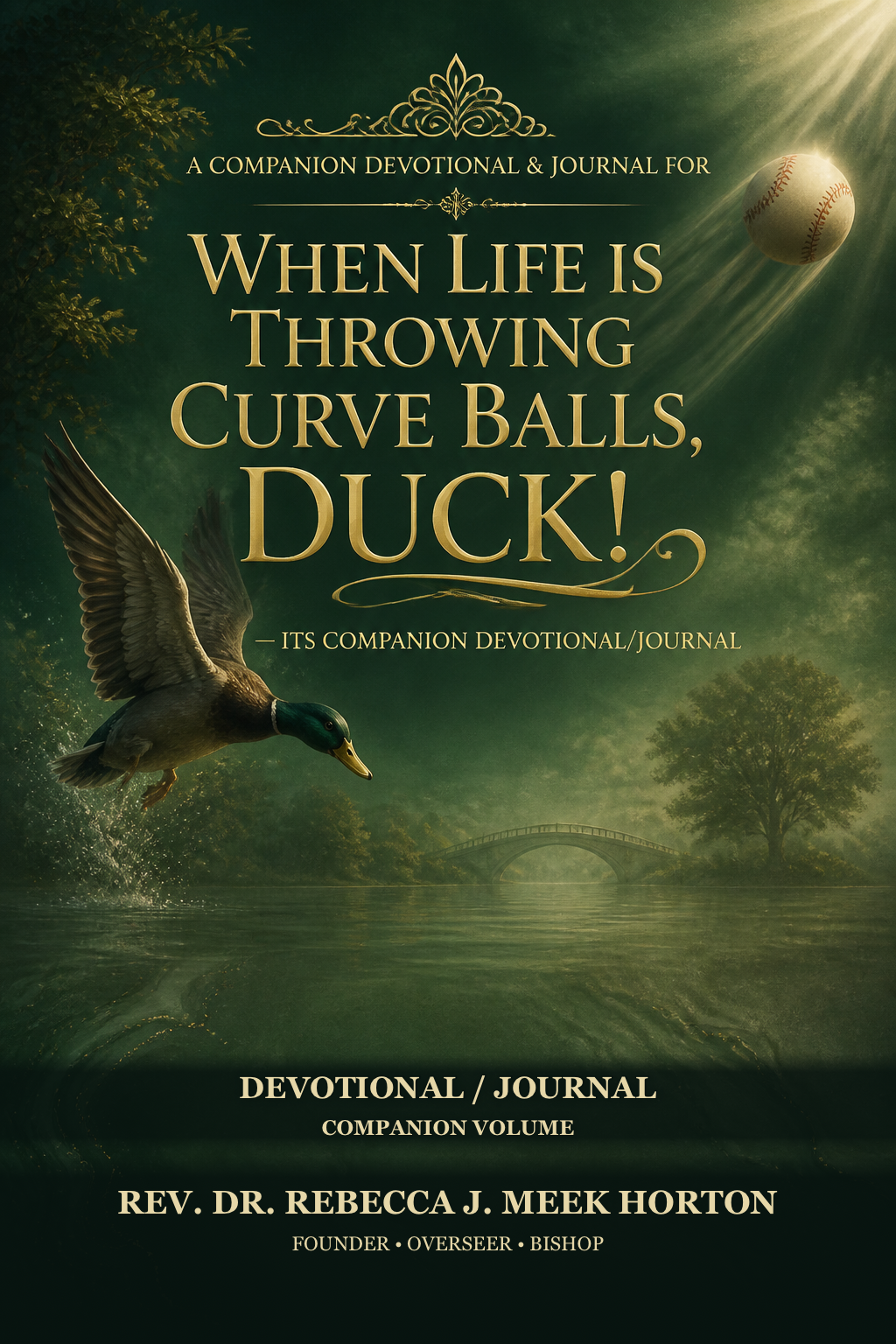
When Life is Throwing Curve Balls, Duck! — Its Companion Devotional/Journal
A companion devotional and journal for "When Life is Throwing Curve Balls, Duck!". Each chapter becomes five entries — a KJV Scripture reading, a devotional, a prayer, a journal prompt, and space to write — closing with An Apostolic Prophetic Architect Message and lined journal pages.
Full publication
NBCNGMI MASTER KNOWLEDGE LIBRARY Featuring the works of The Sage, Apostle Prophet. Rev. Dr. Rebecca J. Meek Horton, Apostolic Prophetic Architect, NewBeing Creation Network Global Ministries, Inc. Integrated Framework Modalities™
Chapter 1 — When the Curve Ball Comes
Entry 1
Scripture Reading
Proverbs 22:3 (KJV)
A prudent man foreseeth the evil, and hideth himself: but the simple pass on, and are punished.
Devotional
The curve ball often comes faster than we expected. We were standing where we thought we were supposed to stand. We had our eyes open. We were trying to be faithful. Then suddenly something changed. A report came. A call came. A bill came. A betrayal came. A responsibility became heavier than our present strength.
In that moment, wisdom does not shame us for needing to pause. Wisdom teaches us to pay attention.
Proverbs 22:3 does not call the prudent person fearful. It calls him prudent. He sees danger and responds. He does not keep walking forward simply because he started in that direction. He does not confuse motion with maturity. He does not prove bravery by ignoring what is real.
There is a holy difference between courage and carelessness. Courage obeys God when fear is present. Carelessness ignores warning signs and calls it faith. Courage may stand when God has assigned it to stand. But courage may also duck when wisdom says, “Get low for a moment.”
Some of us have been trained to keep going at all costs. We mop the floor before we find the leak. We answer every call before we ask what our soul can carry. We keep saying yes because we fear what will happen if people see our limits. But the prudent person learns to stop and look.
What is actually happening here?
How far has this spread?
Is this safe?
Do I need help?
That pause is not defeat. It is stewardship.
A curve ball can expose the places where our pace was not sustainable. It can reveal what we were carrying without support. It can show us the difference between assignment and pressure. Nothing is random. Nothing is wasted. Even disruption can become a messenger when we are willing to listen without shame.
Today, do not rush to prove that you are fine. Begin with truth. Name the curve ball. Notice the warning signs. Ask God for wisdom before you swing again.
Wisdom begins where denial ends.
Prayer
Father, I come to You honestly today. I admit that some things have come at me faster than I expected. I have tried to keep moving, but I need wisdom more than I need appearance. Teach me to recognize danger without panic and to respond without shame. Help me not confuse prudence with fear or constant motion with faithfulness. Show me where I need to pause, ask for help, change pace, or take cover. I trust that You are not disappointed by my limits. Lead me into wise stewardship of what You have placed in my hands. Amen.
Journal Prompt
In light of Proverbs 22:3, what warning sign have I been tempted to ignore, and what would prudence ask me to notice today?
Space to Write [Answer Lines]
Entry 2
Scripture Reading
Psalm 61:1-4 (KJV)
Hear my cry, O God; attend unto my prayer.
From the end of the earth will I cry unto thee, when my heart is overwhelmed: lead me to the rock that is higher than I.
For thou hast been a shelter for me, and a strong tower from the enemy.
I will abide in thy tabernacle for ever: I will trust in the covert of thy wings. Selah.
Devotional
The overwhelmed heart is not disqualified from prayer.
That truth may need to settle slowly. When life throws a curve ball, many people feel ashamed that their heart is not steadier. They wonder why they are crying so easily, why they cannot focus, why they feel numb, or why small things suddenly feel too heavy. They may believe that if their faith were stronger, they would not feel so shaken.
But Psalm 61 gives language to the overwhelmed heart. David does not pretend. He does not perform. He does not wait until he is calm enough to sound spiritual. He cries out from the end of the earth and says, “when my heart is overwhelmed.”
Not if.
When.
There are moments when the soul cannot organize everything neatly. The news came too fast. The loss cut too deep. The responsibility became too much. Shock can make time feel strange. Your body may keep moving while your heart is still standing where the news first hit.
God is not offended by that honesty.
David’s prayer does not end with overwhelm. It turns toward God: “lead me to the rock that is higher than I.” That is the movement. He admits his condition, then asks to be led beyond the limits of his present strength. He does not claim to be the rock. He asks to be led to the Rock.
This is where many of us need RE-Calibration™. We have tried to be the strong tower for everyone else. We have tried to be the stable place, the answer, the fixer, the one who never needs a covering. But there is mercy in admitting, “I need something higher than me.”
The shelter of God is not an escape from responsibility. It is the place where responsibility is brought back into right order. Under His covering, we remember that we are servants, not saviors. Stewards, not sources. Held, not abandoned.
If your heart is overwhelmed today, do not let shame silence your cry. Pray from the place where you are. Tell the truth. Ask to be led.
The curve ball may have startled you, but it did not remove God’s shelter. You can still cry. You can still be led. You can still find cover beneath His wings.
Prayer
Father, I bring my overwhelmed heart to You. I do not want to pretend that I am stronger than I am. I cry out from the place where I feel scattered, tired, and unsure. Lead me to the rock that is higher than I. Be my shelter where I have tried to be my own covering. Be my strong tower where I have felt exposed. Teach me to trust You without hiding the truth from You. Help me rest in Your presence before I try to carry what is next. Amen.
Journal Prompt
Psalm 61:2 says, “when my heart is overwhelmed.” Where do I need to stop performing strength and ask God to lead me to the rock that is higher than I?
Space to Write [Answer Lines]
Entry 3
Scripture Reading
Psalm 103:13-14 (KJV)
Like as a father pitieth his children, so the LORD pitieth them that fear him.
For he knoweth our frame; he remembereth that we are dust.
Devotional
God remembers what many of us forget.
He remembers our frame. He remembers that we are dust.
That is not an insult. It is mercy. The Lord is not confused about what He made. He did not create us to be infinite. He did not ask us to carry life as though we have no need for rest, recovery, counsel, grief, or help. He knows the frame. He knows the pressure. He knows the history behind the reaction. He knows when the curve ball shook us more deeply than we expected.
Sometimes we live as if God forgot we were dust, so we try to prove we are iron.
We push past warnings. We apologize for needing time. We feel guilty for being tired. We believe love means constant availability. We believe calling means no limits. We believe faith means never admitting strain. But Psalm 103 brings us back into truth. The Father has compassion on His children. He knows.
There is a difference between avoiding responsibility and stewarding capacity. Avoidance runs from what has been assigned. Stewardship tells the truth about how that assignment must be carried. It says, “This matters, and because it matters, I must carry it in a way that honors God and protects what He has entrusted.”
Your limits are not proof that you are failing. They are part of your humanity. They help you recognize when the pace is no longer sustainable. They help you know when to ask for help. They remind you that you are not the Savior of your family, the foundation of the church, the answer to every crisis, or the source of everyone’s peace.
You are a steward.
That is holy enough.
When the curve ball comes, shame may say, “If you were stronger, this would not affect you.” Wisdom says, “You are human. Pay attention.” Shame drives without mercy. Wisdom leads with truth.
Today, let God’s knowledge of your frame become permission to tell the truth. Not to quit. Not to collapse into helplessness. But to stop pretending you are unlimited.
The Father is not condemning you for being dust. He is inviting you to walk with Him as His child.
Prayer
Father, I thank You that You know my frame. I have often tried to carry life as if I were stronger than I am. Forgive me for confusing pressure with purpose and exhaustion with faithfulness. Teach me to receive Your compassion without shame. Help me steward my body, mind, heart, and assignments with honesty. Show me where I need rest, counsel, support, or a slower pace. I am not my own savior. I am Your child, held by Your mercy and guided by Your wisdom. Amen.
Journal Prompt
According to Psalm 103:14, God remembers my frame. What limit have I been ashamed of, and how can I steward it with honesty instead of condemnation?
Space to Write [Answer Lines]
Entry 4
Scripture Reading
Matthew 10:16 (KJV)
Behold, I send you forth as sheep in the midst of wolves: be ye therefore wise as serpents, and harmless as doves.
Devotional
Jesus did not send His disciples into the world foolish.
He named the danger. He told them they were being sent as sheep in the midst of wolves. Then He gave them instruction: be wise and harmless. That means faithfulness is not blindness. Obedience does not require us to ignore what is harmful. Love does not demand that we walk into every situation unguarded.
This matters when life throws a curve ball. Some curve balls come through circumstances. Some come through people. Some come through systems that were not prepared to carry the weight placed upon them. Some come through sudden changes that expose what our normal rhythm cannot handle.
In those moments, wisdom must learn to read more than desire. Desire says, “I want to keep going.” Wisdom asks, “What is actually happening?” Desire says, “I should be able to handle this.” Wisdom asks, “What is this costing me and those connected to me?” Desire says, “I do not want people to think I am weak.” Wisdom asks, “What damage will pride create if I refuse to adjust?”
Jesus’ words hold both innocence and discernment together. “Harmless as doves” means we do not become bitter, cruel, manipulative, or vengeful. “Wise as serpents” means we do not become naïve, exposed, careless, or easily pulled into harm.
You can have a tender heart and still set a boundary.
You can love people and still pause a destructive conversation.
You can forgive and still refuse to pretend trust has been rebuilt.
You can be called and still require order.
You can be faithful and still step back from the noise long enough to hear God clearly.
The curve ball may require you to duck, but ducking does not mean you have lost your heart. It means you are responding to what is present. A player who ducks a wild pitch is not quitting the game. He is staying alive to keep playing.
Today, ask the Lord to help you remain both wise and harmless. Do not let pain make you hard. Do not let pressure make you foolish. Let wisdom govern your movement.
Stewardship before increase. Clarity before reaction. Prudence before another swing.
Prayer
Father, I ask You to make me wise and harmless. Help me recognize danger without becoming afraid of everything. Help me set boundaries without becoming hard. Help me speak truth without cruelty and pause without shame. When pressure rises, teach me not to react from pride, panic, or people-pleasing. Give me discernment to know when to stand, when to speak, when to be silent, and when to step back. Keep my heart tender before You and my steps ordered by wisdom. Amen.
Journal Prompt
Matthew 10:16 calls me to be wise and harmless. Where do I need both discernment and a clean heart in my response to a current curve ball?
Space to Write [Answer Lines]
Entry 5
Scripture Reading
Isaiah 30:15 (KJV)
For thus saith the Lord GOD, the Holy One of Israel; In returning and rest shall ye be saved; in quietness and in confidence shall be your strength: and ye would not.
Devotional
Rest can feel costly when we are used to proving ourselves through motion.
Isaiah 30:15 speaks with both invitation and grief. The Lord offers returning, rest, quietness, and confidence. But the people would not. They resisted the very place where strength was being offered.
Many of us understand that resistance. When life throws a curve ball, stillness may feel unsafe. If we stop, we may have to feel what happened. If we rest, we may have to admit how tired we are. If we return, we may have to release the illusion that we were managing everything well. If we choose quietness, we may have to hear the truth we have been outrunning.
So we keep moving.
We keep explaining. We keep answering. We keep taking on more. We keep trying to show that we are fine. We turn the music louder so we do not hear the warning light. We cover the pain with productivity. We call it commitment, but sometimes it is fear.
The Lord’s way is different.
“In returning and rest shall ye be saved.” Returning is not failure. It is coming back to God, back to truth, back to order, back to the place where our soul can be led again. Rest is not laziness. It is trust with a body attached. It is humility that says, “I am not God, and I was not created to live without recovery.”
“In quietness and in confidence shall be your strength.” Not in frantic proving. Not in constant defense. Not in running faster because the curve ball startled us. Quietness makes room for wisdom. Confidence rests in God’s faithfulness, not our ability to control every outcome.
The painful line is, “and ye would not.” It reminds us that wisdom can be offered and still refused. That is why today matters. We do not have to refuse rest because we are afraid of what stillness will reveal. God meets us in truth, not performance.
A pause can be protection, not failure.
Returning can be obedience, not retreat.
Quietness can be strength, not weakness.
Today, receive the invitation. Get low if you need to. Come back to the Father. Let Him reorder what the curve ball scattered.
Prayer
Father, I return to You. I confess that I have often resisted rest because I was afraid to stop. I have mistaken motion for strength and noise for control. Teach me the wisdom of quietness. Help me trust You enough to pause, breathe, listen, and recover clarity. Save me from refusing the very mercy You are offering. Lead me back into order, not through striving, but through confidence in You. I receive Your invitation to rest without shame and to move again only with wisdom. Amen.
Journal Prompt
Isaiah 30:15 connects strength with returning, rest, quietness, and confidence. Which of these is hardest for me to receive right now, and why?
Space to Write [Answer Lines]
An Apostolic Prophetic Architect Message
Beloved, the curve ball did not disqualify you.
It revealed where wisdom must now govern your movement. It showed you that what worked in one season may not carry the weight of this one. That is not failure. That is information. And when information is brought before God, it can become instruction.
Hear the Word of the Lord in Scripture:
Proverbs 3:5-6 (KJV)
Trust in the LORD with all thine heart; and lean not unto thine own understanding.
In all thy ways acknowledge him, and he shall direct thy paths.
This is not the hour to lean on panic, pride, shame, or performance. This is the hour to acknowledge Him in all your ways, including the way you pause, the way you grieve, the way you ask for help, the way you set a boundary, the way you rest, and the way you return.
Do not despise the wisdom that tells you to duck. There are times to stand tall, and there are times to get low so the thing sent to damage you does not take you out. Ducking is not denial of faith. Ducking can be faith applying wisdom in real time.
You are not being called into careless motion. You are being called into Governed Movement™. Nothing is random. Nothing is wasted. Even the shock, the tears, the tiredness, and the warning signs can be stewarded when they are brought into the presence of God.
Let shame lose its authority here. Needing to pause is not quitting. Being overwhelmed is not rebellion. Having limits is not lack of love. You are a steward, and stewardship requires truth.
So take the next step with sobriety and peace. Name what happened. Notice what it exposed. Ask what prudence requires. Then wait for the Lord to direct your path.
Wisdom begins where denial ends. And when wisdom leads, even a pause can become preparation for your next faithful step.
[Journal Page]
[Journal Page]
Chapter 2 — Retreat Is Not Defeat
Entry 1
Scripture Reading
Mark 6:30-32 (KJV)
And the apostles gathered themselves together unto Jesus, and told him all things, both what they had done, and what they had taught.
And he said unto them, Come ye yourselves apart into a desert place, and rest a while: for there were many coming and going, and they had no leisure so much as to eat.
And they departed into a desert place by ship privately.
Devotional
There are seasons when life does not slow down enough for you to breathe. People are coming and going. Needs are real. Assignments are active. Responsibility keeps speaking your name. You may even be doing good work, faithful work, necessary work. Still, Jesus sees what service can cost the servant.
The disciples were not rebuked because they were tired. They had not failed. They had not walked away from purpose. They had been serving, teaching, moving, pouring out. Yet Jesus said, “Come ye yourselves apart.” That invitation matters. It tells us that retreat is not always a sign of weakness. Sometimes it is the Shepherd protecting His servants from collapse.
Many people wait until they break before they give themselves permission to rest. They believe exhaustion proves commitment. They think being needed means they must remain available without limit. But the chapter reminds us that the bench is not the grave. A pause is not the end of assignment. A quiet place is not abandonment. Retreat can become the place where God restores what responsibility has drained.
Jesus did not tell them to rest because the work was unimportant. He told them to rest because they were important to Him. That is a different kind of love. The crowd was still there. The needs were still there. The ministry still mattered. But Jesus was not ruled by demand. He moved by wisdom.
This is where we must let the Word RE-Language™ our thinking. Instead of saying, “I am failing because I need a break,” we can say, “I am stewarding my strength so I can return rightly.” Instead of saying, “If I step back, I am quitting,” we can say, “I am obeying the wisdom of Jesus, who called tired workers apart.”
Faith does not require you to stand in the path of every fast-moving thing. Sometimes the most faithful move is to get low, step away, breathe, and hear the Lord again. Nothing is random. Nothing is wasted. The pause Jesus gives is not empty space. It is mercy.
Today, let His invitation reach you without shame. Come apart before you fall apart. Rest a while, not because you are finished, but because you are loved and still being formed.
Prayer
Father, I receive Your invitation to come apart and rest a while. I confess that I have often measured faithfulness by how much I can carry and how long I can keep moving. Help me release the pressure to prove myself through exhaustion. Teach me to recognize the difference between obedience and overextension. Give me humility to step back when wisdom is calling me to recover. Restore my strength, settle my heart, and help me hear You without the noise of demand. I trust that You care for the work, but You also care for me. Lead me into rest that prepares me to return rightly. In Jesus’ name, amen.
Journal Prompt
Read Mark 6:30-32 again. Where might Jesus be inviting me to come apart and rest a while before strain becomes damage?
Space to Write
[Answer Lines]
Entry 2
Scripture Reading
Proverbs 22:3 (KJV)
A prudent man foreseeth the evil, and hideth himself: but the simple pass on, and are punished.
Devotional
Prudence is not panic. It is not fear. It is not weakness. Prudence is the quiet wisdom that sees danger ahead and responds before damage becomes unavoidable. Proverbs tells us that the prudent man foreseeth the evil and hideth himself. He does not need applause. He does not need to prove bravery to the crowd. He recognizes what is coming and takes cover.
That is not defeat. That is wisdom.
When the curve ball comes high and inside, the batter does not stand tall to prove courage. He ducks. His body understands what pride may argue against. If he stays upright, he can be hurt. There are moments in life when the wisest response is not to swing harder, explain longer, or keep pushing. Sometimes wisdom says, “Step back now.”
Many of us have ignored warning lights because we did not want to look weak. We felt the fatigue, but we kept going. We heard the tension in our voice, but we kept answering. We sensed confusion rising, but we kept deciding. We noticed resentment growing, but we kept serving from depletion. We passed on, because we thought stopping would cost too much.
But continuing unwisely has a cost too.
The evil Proverbs speaks of can be many things. It may be a relationship conversation that keeps becoming destructive. It may be overcommitment. It may be burnout. It may be a schedule that leaves no room for prayer, sleep, or tenderness. It may be a decision being made from pressure instead of peace. It may be the slow hardening of a heart that has carried too much for too long.
Retreat protects what matters. It protects speech. It protects discernment. It protects health. It protects the people who would have to live with the version of you that never stopped. Retreat is not hiding from obedience when it creates space to return in obedience.
There is a difference between avoidance and stewardship. Avoidance refuses responsibility. Stewardship respects responsibility enough to protect the vessel carrying it. Quitting says, “I am done because I refuse the cost.” Recovery says, “I am pausing because I respect the cost.”
Ask God for prudence today. Not fear. Not escape. Prudence. The ability to see what is ahead, tell the truth about your limits, and respond before movement becomes damage. Wisdom pauses what pride tries to push.
Prayer
Father, I ask You for prudence today. Help me see clearly where I have been passing on when wisdom has been telling me to pause. I do not want fear to lead me, but I also do not want pride to keep me standing in harm’s way. Teach me to recognize warning signs in my body, my spirit, my emotions, my relationships, and my decisions. Give me courage to retreat when retreat is stewardship. Help me stop before my words wound, before my weariness hardens, and before my obedience becomes mixed with resentment. I choose wisdom over performance. I choose stewardship over pride. In Jesus’ name, amen.
Journal Prompt
Read Proverbs 22:3. What warning sign have I been minimizing, and what wise retreat could help me respond before damage deepens?
Space to Write
[Answer Lines]
Entry 3
Scripture Reading
Psalm 46:10-11 (KJV)
Be still, and know that I am God: I will be exalted among the heathen, I will be exalted in the earth.
The Lord of hosts is with us; the God of Jacob is our refuge. Selah.
Devotional
Stillness can feel threatening when your identity has been tied to motion. If you have always been the responsible one, the strong one, the available one, the one who keeps going, then stillness may feel like failure. Quiet may feel like emptiness. A pause may feel like loss of control.
But the Word does not say, “Be still, and prove that you are strong.” It says, “Be still, and know that I am God.”
There is a knowing that only comes when the noise settles. There is a clarity that cannot rise while every plate is spinning. There is a truth about God that becomes precious when we stop performing long enough to remember that we are not holding the world together.
Retreat asks a holy question: Do I trust God when I am not producing?
That question is not always easy. Many of us have learned to feel valuable only when we are useful. We say yes too quickly because being needed feels like being secure. We keep responding because silence feels like neglect. We overwork because rest feels like falling behind. But God is not asking us to become machines. He formed us with limits. He remembers our frame. He knows we are dust.
Faith without pretending is honest before God. It does not call exhaustion strength. It does not call overextension obedience. It does not call performance faith. True faith can say, “Father, I am tired.” True faith can put the phone down. True faith can close the laptop. True faith can take a walk without noise. True faith can be still.
The Lord of hosts is with us. That means God is not absent when we pause. He is not only present when we are busy, visible, and productive. He is our refuge, not just our assignment-giver. A refuge is a place to enter, not a place to impress. It is a shelter, not a stage.
There may be people who do not understand your stillness. Some may measure your commitment by your availability. Some may pressure you to return too soon. That is part of the cost. But obedience matters more than appearance. Governed Movement™ means we do not move just because there is pressure. We move when wisdom gives order.
Be still today. Not forever. Not in avoidance. Be still so you can know again who God is, who you are, and what is actually yours to carry.
Prayer
Father, I come before You honestly. I have often been afraid to be still because stillness exposes what motion helps me avoid. Help me trust that You are God even when I am not producing, proving, or explaining. Teach me to rest without shame and to pause without fear. Let my soul remember that You are my refuge, not just the One who gives me work to do. Quiet the pressure in me that says everything depends on my constant movement. I surrender performance, hurry, and false responsibility. Meet me in stillness, and restore my knowing of You. In Jesus’ name, amen.
Journal Prompt
Read Psalm 46:10-11. What makes stillness difficult for me, and what truth about God do I need to remember when I stop?
Space to Write
[Answer Lines]
Entry 4
Scripture Reading
Matthew 11:28-30 (KJV)
Come unto me, all ye that labour and are heavy laden, and I will give you rest.
Take my yoke upon you, and learn of me; for I am meek and lowly in heart: and ye shall find rest unto your souls.
For my yoke is easy, and my burden is light.
Devotional
Jesus does not deny that people get heavy laden. He names it. He speaks to the ones who labour, the ones who have carried too much, the ones whose shoulders feel pressed down by responsibility, grief, demand, disappointment, and the long obedience of ordinary days.
His invitation is simple: “Come unto me.”
Not come to more noise. Not come to more pressure. Not come to another performance. Come unto Me.
Rest is not merely the absence of activity. Rest is the presence of Jesus meeting the soul beneath the weight. You can sit down and still be restless inside. You can take time off and still carry anxiety in your chest. You can step away from people and still rehearse every burden in your mind. That is why Jesus does not only offer a break. He offers Himself.
He also says, “Learn of me.” This means rest has to be learned. Many of us have learned how to push, produce, endure, and keep smiling. But we may not have learned how to carry life with Jesus instead of carrying life to impress people. We may not have learned how to say no. We may not have learned how to stop before bitterness enters our service. We may not have learned the difference between assignment and every urgent need that appears.
Retreat gives us a classroom with Christ.
In that place, He teaches us what is ours and what is not. He teaches us that love is not the same as limitless availability. He teaches us that meekness is not weakness and lowliness is not defeat. He teaches us to move under His yoke instead of under the yoke of fear, guilt, pride, or demand.
The chapter tells us that the bench is not the grave. It is a place where the coach can speak, the body can breathe, and the player can return with strength. In the same way, coming to Jesus is not the end of usefulness. It is the restoration of right carrying.
Some burdens are heavy because life is hard. Others are heavy because we picked up what Jesus never assigned. Retreat helps us tell the difference. It gives the heart room to ask, “Lord, did You place this on me, or did pressure hand it to me?”
Today, hear the tenderness of the invitation. Come unto Him. Bring the labor. Bring the heaviness. Let Him teach you the rest your soul has needed.
Prayer
Father, I come to You with the weight I have been carrying. I confess that I do not always know how to rest, and sometimes I carry burdens You did not assign to me. Teach me the way of Jesus. Help me learn His meekness, His lowliness, His pace, and His wisdom. Show me what is mine to carry and what I must release. I do not want to serve from depletion or move from guilt. I want my life to be yoked to Christ, not driven by fear or pressure. Give rest to my soul, and help me return to responsibility with clarity and peace. In Jesus’ name, amen.
Journal Prompt
Read Matthew 11:28-30. What burden feels heavy right now, and what might Jesus be asking me to learn from Him about carrying it?
Space to Write
[Answer Lines]
Entry 5
Scripture Reading
Psalm 103:13-14 (KJV)
Like as a father pitieth his children, so the Lord pitieth them that fear him.
For he knoweth our frame; he remembereth that we are dust.
Devotional
There is mercy in being remembered rightly by God.
Psalm 103 says the Lord knows our frame. He remembers that we are dust. He does not forget what we are made of. He does not confuse us with Himself. He does not expect human bodies to live without limits, human minds to carry without rest, or human hearts to pour out without receiving care.
We often forget our frame. We push as if limits are enemies. We treat tiredness like a character flaw. We call warning signs inconvenience. We spiritualize overextension and then wonder why our speech becomes sharp, our prayers become thin, and our joy becomes distant.
But God knows.
This truth does not excuse irresponsibility. It does not bless laziness. It does not invite us to hide from obedience. It invites us into honest stewardship. The body is not a machine to be used until it breaks. The soul is not a container to be emptied without refill. Your life is entrusted to you, and stewardship includes knowing when to pause.
Retreat is not defeat when it is guided by wisdom, grounded in humility, and held before God. It can be holy. It can be obedient. It can be the very thing that protects your tenderness, your discernment, your health, your relationships, and your assignment.
There is a difference between quitting and recovering. Quitting abandons assignment. Recovery protects assignment. Quitting says, “I refuse the cost.” Recovery says, “I respect the cost.” That distinction matters because shame often speaks too loudly when we need to step back.
This is a moment for RE-Language™. Instead of saying, “I am weak because I need to stop,” say, “I am stewarding my strength.” Instead of saying, “I am disappointing God,” say, “God knows my frame.” Instead of saying, “I cannot keep up, so I must be failing,” say, “I am recognizing my limits honestly.” Instead of saying, “I have to prove I can handle it,” say, “I am trusting God enough to obey wisdom.”
A small retreat can interrupt great damage. Ten quiet minutes before entering the house. A walk without noise. A bedtime that honors tomorrow. A prayer before answering a hard message. A simple, honest no. These are not small when they protect obedience.
God’s compassion is not offended by your humanity. Let that settle in you today. You are dust, and you are loved. You have limits, and you have purpose. Wisdom may invite you to duck so you can live to stand again.
Prayer
Father, I thank You that You know my frame and remember that I am dust. Help me stop treating my limits as shameful. Teach me to receive Your compassion and practice honest stewardship over my body, soul, time, and strength. I repent for the times I ignored warning signs because I wanted to prove myself. I release the pressure to be unlimited. Show me where I need recovery, not performance. Help me pause without quitting, rest without guilt, and return without resentment. Let my retreat protect my obedience and keep my heart tender before You. In Jesus’ name, amen.
Journal Prompt
Read Psalm 103:13-14. Where have I forgotten my frame, and what would it look like to receive God’s compassion in that place?
Space to Write
[Answer Lines]
An Apostolic Prophetic Architect Message
Beloved, retreat is not defeat when wisdom is governing the movement. The Lord is not calling His people into careless collapse and calling it faithfulness. He is teaching us the difference between endurance and overextension, between obedience and performance, between assignment and pressure.
Hear the Word of the Lord in its written authority: “And he said unto them, Come ye yourselves apart into a desert place, and rest a while: for there were many coming and going, and they had no leisure so much as to eat.” Mark 6:31 (KJV)
Jesus called faithful workers apart. He did not shame their limits. He did not accuse their weariness. He gave instruction that protected their capacity. This confirms the truth built through these five entries: a holy pause can preserve a holy assignment.
You are not being asked to disappear from responsibility. You are being invited to steward it rightly. There are moments when standing in the batter’s box is courage, and there are moments when ducking is wisdom. Do not let pride name your retreat as failure when God may be using it as protection.
Some of you have carried too much for too long. You have answered every call, absorbed every need, and ignored the warning light because you thought stopping would make you less faithful. But brokenness is not proof of faithfulness. Bitterness is not the fruit of obedience. Collapse is not the only way to prove you care.
Now let wisdom RE-Language™ the matter. You are not quitting. You are recovering. You are not weak. You are stewarding strength. You are not abandoning purpose. You are protecting the vessel that must carry it.
The Scripture declares, “Be still, and know that I am God” Psalm 46:10 (KJV). Stillness is not emptiness when God is there. Stillness becomes a place of knowing, healing, correction, and renewed clarity.
So take the small retreat. Make the honest adjustment. Step away from noise long enough to hear again. Let the Father restore tenderness where fatigue has made you sharp. Let Him restore discernment where demand has made you reactive. Let Him restore peace where pressure has made you perform.
Nothing is random. Nothing is wasted. The pause you honor today may protect the obedience required tomorrow. Wisdom instructs before expansion is released. Duck when wisdom says duck, and trust God to teach you how to stand again.
[Journal Page]
[Journal Page]
Chapter 3 — Learn to Read the Pitch
Entry 1
Scripture Reading
James 1:5-8 (KJV)
If any of you lack wisdom, let him ask of God, that giveth to all men liberally, and upbraideth not; and it shall be given him.
But let him ask in faith, nothing wavering. For he that wavereth is like a wave of the sea driven with the wind and tossed.
For let not that man think that he shall receive any thing of the Lord.
A double minded man is unstable in all his ways.
Devotional
Life can throw a pitch so fast that your first response is not wisdom, but motion. A phone call comes. A bill arrives. A need speaks loudly. Someone asks for an answer before you have had time to breathe. The pressure says, “Swing now.” But the Spirit of wisdom teaches us another way.
James does not shame the person who lacks wisdom. He gives an invitation. Ask God. Ask freely. Ask before you decide. Ask before you answer. Ask before you explain. Ask before you carry a weight you have not examined.
That is a tender mercy. God does not upbraid the asking heart. He does not mock you because you need help. He does not despise you because the pitch confused you. He gives wisdom liberally. But asking requires a pause. You cannot truly ask for wisdom while still being governed by hurry.
A pause is not weakness. A pause is stewardship. It gives your soul time to tell the truth. It gives your body time to come out of bracing. It gives your mind space to stop rehearsing fear. It gives your spirit room to listen.
Sometimes we ask God to bless the swing we already took. We move first, then pray for peace later. But wisdom invites us into a cleaner order. Ask. Receive. Then move.
This does not mean every decision will be easy. It does not mean every answer will come with full detail. But it does mean you are no longer letting pressure set the pace. You are no longer treating every loud demand as an emergency. You are learning to read the pitch.
There are moments that require immediate action. Wisdom is not passivity. But many things that feel urgent are only uncomfortable, inconvenient, or emotionally charged. They may matter deeply, but important does not always mean immediate.
Today, let this truth settle in you: you are not obligated to match the speed of the pressure. You may say, “I need to pray and think before I answer.” You may wait before replying. You may refuse to commit while tired. You may slow down enough to see clearly.
Nothing is random. Nothing is wasted. Even the pressure can become a classroom if you pause long enough to ask God for wisdom.
Prayer
Father, I come to You admitting that I need wisdom. I do not want to be ruled by pressure, fear, people’s expectations, or the need to prove I can handle everything. Teach me to pause before I respond. Help me ask before I move. Give me a steady heart and a sound mind when life comes fast. I receive Your mercy where I have rushed, overcommitted, or reacted without discernment. Help me trust that waiting before You is not weakness. It is obedience. Father, I ask You for wisdom today, and I believe You are generous toward me. Lead me in the way I should go. Amen.
Journal Prompt
James 1:5-8 invites me to ask God for wisdom before I move. Where am I currently moving faster than I am praying, and what would it look like to pause before responding?
Space to Write
[Answer Lines]
Entry 2
Scripture Reading
Proverbs 14:15 (KJV)
The simple believeth every word: but the prudent man looketh well to his going.
Devotional
Not every pitch deserves your swing. Not every word deserves your agreement. Not every invitation deserves your yes. Not every crisis belongs in your hands.
Proverbs gives us a simple but weighty contrast. The simple person believes every word. The prudent person looks well to his going. That means wisdom does not only listen to what is being said. Wisdom watches direction. Wisdom pays attention to what a choice is producing. Wisdom asks, “Where is this leading me?”
When life throws a curve ball, your first work is not always to answer. Sometimes your first work is to observe. What is actually happening? What is being asked of me? What tone is driving this moment? Is this a true emergency, or is this pressure wearing the clothes of urgency?
A prudent person does not live suspiciously, but they do live awake. They do not believe every emotional surge. They do not treat every demand as divine instruction. They do not let guilt write the schedule. They look well to their going.
This matters because reaction can feel responsible while still being unwise. You may answer quickly because you care. You may agree quickly because you do not want to disappoint anyone. You may explain quickly because you do not want to be misunderstood. But speed is not the same as obedience.
Reading the pitch requires honest attention. You may need to watch what keeps repeating. Does your quick yes keep producing resentment? Does one person’s need keep becoming your responsibility? Do you keep calling exhaustion faithfulness? Do you keep letting volume decide urgency?
Patterns tell the truth that isolated moments hide. This is not for shame. This is for RE-Calibration™. God may use a repeated situation to show you where your boundaries, language, motives, or habits need to come back into order.
There is grace in noticing. A pattern noticed can become a pattern interrupted. A repeated pitch can become a place of wisdom instead of another place of collapse.
Today, do not rush past what your life is showing you. Look well to your going. Ask where this road leads if you keep answering the same way. Ask what wisdom has already been teaching you through experience.
You are not failing because you need to slow down. You are learning to steward what is truly yours.
Prayer
Father, I do not want to be simple in my responses. I do not want to believe every word, every pressure, every fear, or every demand without discernment. Teach me to look well to my going. Help me notice the patterns that keep repeating without condemning myself. Give me courage to tell the truth about what my choices are producing. Where I have confused reaction with obedience, bring me back into wisdom. Where I have ignored warning signs, help me pay attention. Father, make me prudent, steady, and teachable. Help me read the pitch before I swing. Amen.
Journal Prompt
Proverbs 14:15 says the prudent man looks well to his going. What repeated pattern in my life is asking for honest attention, and what might wisdom be showing me through it?
Space to Write
[Answer Lines]
Entry 3
Scripture Reading
Galatians 6:7-9 (KJV)
Be not deceived; God is not mocked: for whatsoever a man soweth, that shall he also reap.
For he that soweth to his flesh shall of the flesh reap corruption; but he that soweth to the Spirit shall of the Spirit reap life everlasting.
And let us not be weary in well doing: for in due season we shall reap, if we faint not.
Devotional
Patterns have seeds. That is not only a warning. It is also mercy.
Galatians reminds us that life has order. What we sow will produce something. The words we repeat, the boundaries we ignore, the fears we obey, the yes we give under pressure, the rest we keep postponing, the counsel we refuse, the motives we never examine; all of it becomes seed.
When the same kind of curve ball keeps coming, wisdom asks more than, “Why is this happening?” Wisdom also asks, “What has been sown here?” That question is not meant to crush you. It is meant to free you from living as if everything is random.
Nothing is random. Nothing is wasted.
Maybe you have been reaping resentment because you keep sowing unexamined yeses. Maybe you have been reaping exhaustion because you keep sowing overextension and calling it sacrifice. Maybe you have been reaping confusion because you keep sowing decisions made in haste. Maybe you have been reaping disappointment because you keep expecting others to steward what they never agreed to carry.
This is not the place for shame. Shame says, “This is who I am.” Wisdom says, “This is what has been happening, and by God’s grace, this can be brought into order.”
The beautiful part of this Scripture is that sowing can change. You are not bound to the old pattern because you finally see it. You can begin sowing to the Spirit. You can sow prayer before response. You can sow truth instead of pretending. You can sow rest where you once sowed striving. You can sow counsel where you once sowed isolation. You can sow patience where pressure demanded speed.
And do not miss the encouragement: let us not be weary in well doing. Reading the pitch takes practice. You may not get it perfect in one day. You may pause and still feel anxious. You may say no and still grieve disappointing someone. You may choose wisdom and still feel the pull of old patterns.
Keep sowing. Keep practicing. Keep letting God renew your responses.
Due season is not always immediate, but it is real. A governed life is grown through faithful seeds.
Prayer
Father, I bring my patterns before You with honesty. Help me see what I have been sowing without falling into shame. Show me where my choices, habits, fears, and rushed responses have produced fruit I no longer want to keep harvesting. Teach me to sow to the Spirit. Help me sow prayer before pressure, truth before performance, and obedience before image. Strengthen me when new patterns feel slow. I do not want to faint in well doing. I trust that Your wisdom can help me interrupt what has repeated and walk in a new way. Amen.
Journal Prompt
Galatians 6:7-9 teaches that what I sow produces a harvest. What seed have I been sowing through my repeated responses, and what new seed do I need to begin sowing today?
Space to Write
[Answer Lines]
Entry 4
Scripture Reading
Mark 1:35-38 (KJV)
And in the morning, rising up a great while before day, he went out, and departed into a solitary place, and there prayed.
And Simon and they that were with him followed after him.
And when they had found him, they said unto him, All men seek for thee.
And he said unto them, Let us go into the next towns, that I may preach there also: for therefore came I forth.
Devotional
“All men seek for thee” sounds like a reason to stay.
The need was real. The people were looking. The demand was present. But Jesus did not let the crowd determine His movement. He had been with the Father. He had prayed. He was clear. So He moved according to assignment, not pressure.
This is deeply important for faithful people. If you care, you may feel responsible for every need you see. If you are capable, others may assume you are available. If you have helped before, people may expect you to keep helping. If you are gifted, every open space may look like your responsibility.
But need is not the same as assignment.
Jesus was compassionate, but He was not governed by every demand. He healed. He taught. He withdrew. He obeyed the Father. His life teaches us that love does not mean letting people’s urgency become our master.
This truth may be uncomfortable because many of us have built identity around being needed. We feel faithful when we are busy. We feel valuable when people depend on us. We feel secure when we are the one who can fix it. But pressure often rushes your yes. Assignment can withstand prayer.
Pressure says, “If you do not do this now, everything will fall apart.” Assignment says, “Be faithful to what God has entrusted to you.”
Pressure uses guilt. Assignment invites obedience.
Pressure corners you. Assignment may stretch you, but it carries a clean weight.
Pressure fears people’s opinion. Assignment fears the Lord.
Reading the pitch means you learn to separate what is loud from what is yours. That does not make you selfish. It makes you a steward. A steward does not own the whole house. A steward is faithful over what has been entrusted.
There will always be more needs than you can meet. There will always be more requests than you can answer. There will always be more opportunities than you can carry. If you force yourself into every open space, you become less available for the place where you are truly assigned.
Do not Force-The-FiT™.
Today, follow the pattern of Jesus. Make room to pray before you are found by the demands of the day. Let the Father clarify what pressure tries to confuse. You may still serve. You may still sacrifice. You may still say yes. But let your yes come from assignment, not anxiety.
Prayer
Father, I want to be faithful to what You have entrusted to me. Help me separate assignment from pressure. I confess that I sometimes say yes because I fear disappointing people, looking weak, or missing an opportunity. Bring my heart back to obedience. Teach me to pray before I answer. Help me follow the example of Jesus, who moved with compassion but was not controlled by the crowd. Give me courage to say yes with integrity and no with humility. I trust You to care for what is not mine to carry. Amen.
Journal Prompt
Mark 1:35-38 shows Jesus choosing assignment over public demand. Where do I need to ask whether I am being led by assignment or pressured by expectation?
Space to Write
[Answer Lines]
Entry 5
Scripture Reading
Psalm 139:23-24 (KJV)
Search me, O God, and know my heart: try me, and know my thoughts:
And see if there be any wicked way in me, and lead me in the way everlasting.
Devotional
Discernment has a cost. Sometimes the cost is that you can no longer pretend you do not see what you see.
When David prayed, “Search me, O God,” he was not asking for a surface glance. He was opening his inner life to the Lord. His heart. His thoughts. His ways. His direction. That is a brave prayer. It is also a freeing prayer.
Reading the pitch is not only about seeing what is coming at you. It is also about seeing what is happening in you. The curve ball may reveal fear. It may reveal pride. It may reveal exhaustion. It may reveal a pattern of performing strength when you actually need help. It may reveal how quickly you obey guilt. It may reveal that busyness has become a hiding place.
This is tender ground. Do not rush past it.
God does not search you to shame you. He searches you to lead you. He does not expose what is hidden so you can collapse under accusation. He brings truth into the light so you can walk in the way everlasting.
Sometimes we swing at everything because we are afraid of being replaced. Sometimes we carry too much because being needed makes us feel valuable. Sometimes we say yes because no feels like rejection. Sometimes we call pressure loyalty, panic discernment, pride excellence, and overextension sacrifice.
Clarity is kind, but it is not always comfortable.
Once you see the pitch, you become responsible for your response. That is not punishment. That is maturity. God is inviting you into a life that is not governed by panic, image, or old patterns. He is teaching you to walk humbly, listen carefully, and respond wisely.
This is where your language must come into alignment. Instead of saying, “I am failing because I cannot handle everything,” say, “I am learning to steward what is truly mine.” Instead of saying, “I am weak because I need time,” say, “I am practicing wisdom before response.” Instead of saying, “I always mess this up,” say, “This pattern is showing me where I need RE-Calibration™.”
That is not denial. That is truth with responsibility.
Today, let God search without fear. Let Him show you what is true. Let Him lead you out of frantic living and into ordered obedience. You do not have to hit every pitch. You have to walk with God.
Prayer
Father, I open my heart to You. Search me and know me. Try my thoughts and show me what is true. Reveal where panic, pride, fear, guilt, or image have been shaping my responses. I do not want to keep pretending. I want to be led in the way everlasting. Help me receive Your correction as mercy, not condemnation. Teach me to speak truth over my life with responsibility and grace. Bring me into RE-Calibration™ where my habits, motives, and responses need order. Father, lead me gently, clearly, and faithfully. Amen.
Journal Prompt
Psalm 139:23-24 asks God to search the heart and thoughts. What might God be revealing within me when I feel pressured to respond too quickly?
Space to Write
[Answer Lines]
An Apostolic Prophetic Architect Message
Beloved, hear this with steadiness: the pitch is not greater than the wisdom of God. Life may come fast, but you are not without covering, counsel, discernment, or grace. The Father has not called you to frantic living. He has called you to faithful walking.
The Scripture says, “He hath shewed thee, O man, what is good; and what doth the LORD require of thee, but to do justly, and to love mercy, and to walk humbly with thy God?” Micah 6:8 (KJV)
Walk humbly. That is the word that gathers these five entries. Humility pauses. Humility asks. Humility observes patterns. Humility separates assignment from pressure. Humility lets God search the heart. Humility does not need to prove strength by swinging at everything.
There is a holy maturity rising in you when you stop calling hurry obedience. There is alignment being formed when you stop letting panic set the pace. There is stewardship being restored when you no longer force yourself into every available space. Do not Force-The-FiT™. What God assigns, He gives grace to carry. What pressure assigns, it will demand without mercy.
This chapter has called you to read the pitch. Not to fear it. Not to avoid all responsibility. Not to become hard or unavailable. But to become discerning, ordered, and faithful.
Some of you are realizing that the same curve ball has been coming under different names. Different people. Different rooms. Different seasons. Same pressure. Same fear. Same overextension. Do not condemn yourself. Recognize the invitation. This is a place for RE-Calibration™.
Nothing is random. Nothing is wasted. Even what repeated can now become what teaches. Even what pressured you can now become what clarifies you. Even what exposed you can now become a doorway into wisdom.
So pause before you swing. Pray before you answer. Count the cost before you commit. Ask for counsel before you expand. Let God search your heart before you name the moment.
Wisdom is not yours until you walk it. Today, walk it with courage, humility, and peace.
[Journal Page]
[Journal Page]
Chapter 4 — Stop Kicking Against the Wall
Entry 1
Scripture Reading
And Saul, yet breathing out threatenings and slaughter against the disciples of the Lord, went unto the high priest,
And desired of him letters to Damascus to the synagogues, that if he found any of this way, whether they were men or women, he might bring them bound unto Jerusalem.
And as he journeyed, he came near Damascus: and suddenly there shined round about him a light from heaven:
And he fell to the earth, and heard a voice saying unto him, Saul, Saul, why persecutest thou me?
And he said, Who art thou, Lord? And the Lord said, I am Jesus whom thou persecutest: it is hard for thee to kick against the pricks.
And he trembling and astonished said, Lord, what wilt thou have me to do? And the Lord said unto him, Arise, and go into the city, and it shall be told thee what thou must do.
Acts 9:1-6 (KJV)
Devotional
Saul was moving, but he was not aligned. He had permission from people, energy in his body, conviction in his mind, and direction on paper. Yet he was resisting the very Lord he thought he was serving. That is a sobering mercy for us, because it reminds us that movement is not always obedience.
Sometimes we are pushing with all our strength because we believe the door should open. We have invested time. We have told people. We have prayed around it. We have bruises that feel like proof of faithfulness. But a bruise is not always confirmation. Sometimes it is information. Sometimes pain is showing us where we keep kicking against correction.
Jesus did not meet Saul to destroy him. He met him to stop him. The interruption felt severe, but it was mercy. Saul fell, but he was not finished. He was blinded, but he was being prepared to see differently. He was stopped on the wrong road so he could be redirected into the will of God.
That is the grace hidden in a holy stop. The Lord can interrupt what is injuring us before it becomes destruction. He can confront the place where zeal has outrun wisdom. He can speak to the pride beneath the push and still preserve the person He is correcting.
This is not a call to fear every hardship. Some resistance must be endured. Some pressure must be walked through faithfully. But there is also resistance that asks us to stop, listen, and become teachable. The question is not only, “How hard am I pushing?” The better question is, “What am I pushing against?”
If the same place keeps wounding your peace, your integrity, your body, your family, or your obedience, do not ignore it. Ask the Lord what wisdom is trying to reveal. Ask without performing. Ask without defending yourself.
A hard stop can be mercy. A blocked road can be mercy. A truthful interruption can be mercy. Nothing is random. Nothing is wasted. Even the wrong road can become a place of awakening when we are willing to say, “Lord, what wilt thou have me to do?”
Prayer
Father, I come to You with the places where I have been pushing without peace. I admit that movement can make me feel responsible, even when I have not slowed down to ask if I am aligned. Help me recognize the difference between holy endurance and stubborn resistance. If I have mistaken intensity for instruction, correct me with mercy. If pride, fear, or grief is driving my push, bring it into the light. I do not want to keep injuring myself against what You are using to redirect me. Make me teachable. Give me courage to stop where I need to stop, and grace to obey when You show me the next step. Amen.
Journal Prompt
Acts 9:1-6 shows Saul being stopped on the wrong road. Where in my life might the Lord be using repeated resistance to get my attention, and how have I been responding?
Space to Write
[Answer Lines]
Entry 2
Scripture Reading
Abide in me, and I in you. As the branch cannot bear fruit of itself, except it abide in the vine; no more can ye, except ye abide in me.
I am the vine, ye are the branches: He that abideth in me, and I in him, the same bringeth forth much fruit: for without me ye can do nothing.
John 15:4-5 (KJV)
Devotional
Jesus does not invite us first into production. He invites us into abiding. That matters because many bruises come from trying to produce fruit while disconnected from the Vine. We may still be active. We may still be busy. We may still answer the calls, carry the responsibilities, meet the deadlines, and keep the calendar full. But activity without abiding eventually becomes strain.
The branch does not bear fruit by proving itself. It bears fruit by remaining connected. That is a different way of living. It is quieter than striving. It is humbler than forcing. It recognizes that what is produced through pressure alone will not carry the same life as what is produced through communion with Christ.
When life is throwing curve balls, the temptation is to swing harder at everything. We feel the pressure to respond, fix, explain, defend, and push. But Jesus brings us back to the root. “Abide in me.” Stay connected. Do not let panic become your source. Do not let applause become your source. Do not let fear become your source. Do not let urgency become your vine.
There are doors that seem to demand all our strength, but God may be asking for our surrender. There are walls we keep striking, but wisdom may be asking us to step back and examine what this motion is doing to our soul. The Lord cares about the servant, not only the service. He cares about the branch, not only the fruit.
If the only way to keep something moving is to become frantic, resentful, dishonest, spiritually numb, or physically worn down, something needs RE-Calibration™. That does not always mean quitting. Sometimes it means returning to the Vine before making another decision. Sometimes it means resting before responding. Sometimes it means admitting, “I have been moving from pressure, not presence.”
Abiding will not always make life easy. But it will make obedience possible. It will teach us when to continue, when to wait, when to yield, and when to stop forcing what grace is not sustaining.
Without Him, we can do nothing. With Him, we can bear fruit that does not require the loss of our soul.
Prayer
Father, I confess that I often measure faithfulness by how much I am doing. I can become busy and still be disconnected from You. I can keep pushing and call it obedience when my heart is tired, anxious, and unstill. Draw me back into abiding. Teach me to remain in Christ before I respond to pressure. Help me stop trusting frantic motion as proof that I am fruitful. I want fruit that comes from connection, not performance. Show me where I have been trying to carry what only Your life can produce. Let my choices today come from communion, wisdom, and peace. Amen.
Journal Prompt
John 15:4-5 teaches that fruit comes from abiding. What area of my life has become more about pushing than remaining connected to Christ?
Space to Write
[Answer Lines]
Entry 3
Scripture Reading
The way of a fool is right in his own eyes: but he that hearkeneth unto counsel is wise.
Proverbs 12:15 (KJV)
Devotional
One of the hardest parts of stopping the push is listening. Not every voice is wise, and not every opinion deserves access to your decision. But Proverbs gives us a clear warning: when a person can only see their own way, danger is near.
The wall becomes more painful when we refuse counsel. Someone may say, “You are pushing the wrong door.” Someone may say, “This pace is hurting you.” Someone may say, “This relationship is not mutual.” Someone may say, “This launch needs more structure.” If our first response is always defense, we may need to ask what we are protecting.
Counsel is not the same as criticism. Criticism often tries to diminish. Counsel tries to help us see. Criticism may shame us for slowing down. Counsel may love us enough to say, “You are bleeding.” A wise person learns the difference.
There is humility in hearing. It does not mean you obey every word spoken over your life. It does not mean you let people govern your conscience. It means you are not unreachable. You are willing to test what is being said. You are willing to ask, “Is there truth here that I need to receive?”
Sometimes the bruised shoulder keeps arguing because pride does not want to admit the door was wrong. Sometimes we keep kicking the wall because we already announced our plans. Sometimes we would rather be seen as consistent than become corrected. But coming far in the wrong direction does not make the direction right.
Wisdom listens before damage spreads. Wisdom asks better questions. Am I continuing because God assigned this, or because I am afraid to stop? Have faithful people named the same concern more than once? Is my resistance to counsel rooted in discernment, or is it rooted in embarrassment?
This is where RE-Language™ helps us. Do not say, “If I listen, I look weak.” Say, “If I listen, I may preserve what God entrusted to me.” Do not say, “Changing direction means I failed.” Say, “Correction can be part of obedience.”
Hearing counsel is not weakness. It is stewardship. It is one way God protects us from becoming prisoners of our own certainty.
Prayer
Father, I ask You to make me wise enough to listen. I do not want to reject counsel simply because it touches my pride or interrupts my plan. Help me discern the difference between criticism that wounds and counsel that protects. Give me grounded, prayerful, truthful voices, and give me humility to hear them without defending myself too quickly. If I have become right in my own eyes, open my understanding. If embarrassment has kept me pushing, give me courage to pause. I want to be teachable. I want to walk in wisdom before unnecessary damage spreads. Amen.
Journal Prompt
Proverbs 12:15 connects wisdom with hearing counsel. What counsel have I resisted, and what fear or pride may be making it hard for me to listen?
Space to Write
[Answer Lines]
Entry 4
Scripture Reading
I will instruct thee and teach thee in the way which thou shalt go: I will guide thee with mine eye.
Be ye not as the horse, or as the mule, which have no understanding: whose mouth must be held in with bit and bridle, lest they come near unto thee.
Psalm 32:8-9 (KJV)
Devotional
God does not desire to drag us into wisdom. He offers instruction. He teaches. He guides. That is tender, but it also asks something of us. We must become willing to be led.
Psalm 32 gives us both comfort and correction. The comfort is this: the Lord will instruct and teach us. We are not left to guess our way through every wall, delay, and difficult decision. We can ask for wisdom. We can wait for clarity. We can be guided by His eye.
The correction is this: do not become like the horse or mule with no understanding, needing bit and bridle to be turned. In other words, do not require force before you listen. Do not wait until collapse becomes the teacher. Do not wait until your body, family, soul, or integrity can no longer carry the strain.
There is a difference between surrender and collapse. Collapse says, “I cannot go on.” Surrender says, “I will not keep ignoring truth.” Collapse often comes after we have pushed past warning signs. Surrender is chosen when humility hears wisdom early enough to respond.
Many of us have been taught to admire the person who never stops. We praise the one who keeps going no matter the cost. But Scripture does not call us to be unbreakable machines. The Lord cares for His servants. He knows our frame. He understands our limits. He leads us as a Shepherd, not as a taskmaster.
A wise pause may preserve the assignment. A slower pace may protect the family. A delayed decision may save the relationship from careless words. A step back may keep a good thing from being damaged by wrong timing.
The wall in front of you may not mean “never.” It may mean “not this way.” It may mean “not now.” It may mean “not with this motive.” It may mean “not at this cost.” Wisdom teaches us to discern the difference.
Do not Force-The-FiT™. Do not make something work by damaging what God entrusted to you. Let the Lord instruct you before life has to shout louder. Being guided is better than being dragged.
Prayer
Father, I thank You that You are willing to instruct me and teach me. I do not want to be dragged into wisdom after unnecessary pain. Make me sensitive to Your guidance. Help me notice the early warnings before they become deep wounds. If I have ignored limits, counsel, peace, or truth, give me humility to surrender before collapse. Teach me the way I should go. Guide my steps, my words, my pace, and my decisions. I trust that Your correction is not rejection. Your guidance is mercy. Help me yield while there is still room to heal, repair, and obey. Amen.
Journal Prompt
Psalm 32:8-9 invites me to be guided rather than forced. Where do I need to surrender before collapse becomes the teacher?
Space to Write
[Answer Lines]
Entry 5
Scripture Reading
Then said Jesus unto his disciples, If any man will come after me, let him deny himself, and take up his cross, and follow me.
For whosoever will save his life shall lose it: and whosoever will lose his life for my sake shall find it.
For what is a man profited, if he shall gain the whole world, and lose his own soul? or what shall a man give in exchange for his soul?
Matthew 16:24-26 (KJV)
Devotional
There is a cost to following Jesus, and there is also a cost to refusing wisdom. Sometimes we only count the cost of obedience. We think about what surrender may require, what people may say, what we may have to release, and what plans may need to change. But Jesus asks a deeper question: what does it profit a person to gain the whole world and lose his own soul?
A person can gain applause and lose peace. Gain reputation and lose honesty. Gain productivity and lose tenderness. Gain control and lose rest. Gain the image of being strong while quietly disappearing under the weight of that image.
This is why the push must be examined. If the push is costing your soul, it is time to stop and listen.
Stopping may cost applause. Some people only celebrate you while you are producing. They may not understand your pause, especially if your overextension made their life easier. But applause is too unstable to lead a life.
Stopping may cost control. You may have to release the fantasy that pressure can make people, plans, or outcomes become what you hoped. That can feel like grief. It can feel like loss. But control is too heavy for a human soul. God never asked you to be sovereign.
Stopping may cost an old identity. If you have been the rescuer, the fixer, the strong one, or the always-available one, wisdom may feel strange at first. You may feel guilty even when you are obeying. But guilt is not always conviction. Sometimes guilt is the ache of an old pattern losing power.
Jesus does not call us to save a false life. He calls us to follow Him into true life. That may require denying the version of self that must always be needed, always be right, always be certain, and always be in motion.
This is not abandonment. This is stewardship. This is not weakness. This is truth entering the room. This is the soul being protected from the damage of forced living.
Nothing is random. Nothing is wasted. The life you surrender to Christ is not lost in His hands. It is found there.
Prayer
Father, I bring You the places where I have tried to save an image, a plan, a role, or a sense of control. I do not want to gain approval and lose my soul. I do not want to keep pushing just to protect pride, fear, or an old identity. Teach me what it means to follow Jesus with honesty. Give me courage to deny the false self that demands constant performance. Help me release what I cannot carry in truth. I trust that surrender to You is not loss without purpose. It is the place where real life can be found. Amen.
Journal Prompt
Matthew 16:24-26 asks me to consider the condition of my soul. What have I been trying to gain or protect, and what has it been costing me inwardly?
Space to Write
[Answer Lines]
An Apostolic Prophetic Architect Message
Teach me thy way, O LORD, and lead me in a plain path, because of mine enemies.
Psalm 27:11 (KJV)
Beloved, receive this with sobriety and hope: being stopped is not always failure. Sometimes it is mercy. Sometimes it is protection. Sometimes it is the wisdom of God interrupting a motion that was wounding what He still intends to use.
You have walked through five places of examination: the wrong road, the disconnected push, the resisted counsel, the needed surrender, and the cost of the soul. Do not rush past what has been revealed. This is not shame work. This is stewardship work.
A wall can expose pride, but it can also preserve purpose. A blocked door can humble you, but it can also keep you from entering a place that would have required a version of you God never called you to become. A repeated bruise may be saying, “Slow down. Listen. Ask again. Let wisdom speak before damage spreads.”
The apostolic work here is alignment. The prophetic clarity here is not drama; it is discernment. You are being invited to stop confusing motion with obedience. You are being invited to stop calling every resistance an attack when some resistance may be instruction. You are being invited to become teachable before collapse becomes necessary.
Do not Force-The-FiT™. Do not make a relationship, assignment, pace, plan, or identity work by sacrificing peace, truth, health, family, or obedience. The Lord does not need you frantic to prove you are faithful. He desires yieldedness. He desires truth in the inward parts. He desires a people who can be led by His wisdom, not dragged by repeated pain.
Now take the plain path seriously. Not the impressive path. Not the rushed path. Not the path built to satisfy everyone watching. The plain path. The path you can walk with God, with integrity, with counsel, and with peace.
Write the sentence. Name the place. Seek the wise voice. Pray without defending yourself. Then obey the light you are given.
Nothing is random. Nothing is wasted. Even the place where you were stopped can become the place where sight begins.
[Journal Page]
[Journal Page]
Chapter 5 — Duck Without Shame
Entry 1
Scripture Reading
Romans 8:1-2 (KJV)
There is therefore now no condemnation to them which are in Christ Jesus, who walk not after the flesh, but after the Spirit.
For the law of the Spirit of life in Christ Jesus hath made me free from the law of sin and death.
Devotional
Shame speaks quickly. It does not usually wait for prayer, counsel, rest, or truth. It rushes into the room and tries to interpret your pause before wisdom can say a word.
When you step back, shame may say, “You are weak.” When you need rest, shame may say, “You are failing.” When you admit that something is too much for your present capacity, shame may say, “You are not enough.”
But Romans 8:1 gives the believer a holy boundary: there is no condemnation in Christ Jesus. That does not mean there is no correction. It does not mean there is no responsibility. It does not mean we excuse what needs to be repented of or repaired. It means condemnation does not get to name us.
Conviction brings us into the light. Condemnation tries to bury us under accusation.
This matters when life throws a curve ball high and inside. Sometimes the wisest move is not to swing harder. Sometimes the wisest move is to duck. Not because you are faithless. Not because you are quitting. Not because you are less than the people watching. You duck because the ball is dangerous, the timing is sharp, and stewardship requires a clean decision.
There is a holy difference between fear and wisdom. Fear hides from obedience. Wisdom responds to reality under God’s care.
You may need to RE-Language™ the way you speak about your pause. Instead of saying, “I am failing,” say, “I am telling the truth about capacity.” Instead of saying, “I should be able to handle this,” say, “I am responsible to handle this wisely, not proudly.” Instead of saying, “I am letting everyone down,” say, “I am refusing to harm what God has entrusted to me by pretending I have no limits.”
This is not wordplay. This is truth-telling.
If you are in Christ, your limit is not your identity. Your tiredness is not your name. Your need for help is not your disqualification. You are not condemned because you need to step back and breathe.
A wise pause can become a doorway back to clarity.
Let shame lose the microphone today. Let Scripture speak first.
Prayer
Father, I come to You without pretending. I confess that shame often speaks before wisdom does. I have called myself weak when I was tired, failing when I was honest, and selfish when I needed to steward my life. Help me receive the truth of no condemnation in Christ Jesus. Teach me the difference between conviction and accusation. Give me courage to tell the truth without beating myself with it. Help me pause when wisdom requires it, repent when correction is needed, and keep walking without shame. Father, I choose to let Your Word name me before my fear does. Amen.
Journal Prompt
Romans 8:1-2 says there is no condemnation in Christ Jesus. Where have I been allowing shame to interpret my need to pause, rest, or step back?
Space to Write
[Answer Lines]
Entry 2
Scripture Reading
Matthew 2:13-14 (KJV)
And when they were departed, behold, the angel of the Lord appeareth to Joseph in a dream, saying, Arise, and take the young child and his mother, and flee into Egypt, and be thou there until I bring thee word: for Herod will seek the young child to destroy him.
When he arose, he took the young child and his mother by night, and departed into Egypt:
Devotional
Joseph did not stay to prove courage.
That is worth sitting with.
He had been entrusted with Mary and the young child Jesus. Danger was real. Herod was not a feeling, not a rumor, not a small inconvenience. Herod was a threat. And when instruction came, Joseph moved.
He did not confuse staying with faithfulness. He did not confuse exposure with obedience. He did not risk what had been entrusted to him so he could appear strong in front of people who may not have understood the assignment.
He arose and departed.
That retreat was not shameful. It was obedient.
Some of us have been taught to believe that backing away always means we are afraid. But Scripture shows us something deeper. There are moments when retreat protects the promise. There are moments when stepping out of sight preserves what God is still forming. There are moments when leaving a place is not abandoning purpose, but guarding it.
Joseph’s obedience came with cost. Egypt was not convenient. Moving by night was not comfortable. He had to accept disruption, uncertainty, and displacement. Stewardship does not always feel easy. Sometimes wisdom will ask you to move before you can explain yourself to everyone.
This is why timing matters. Timing is as important as motive.
You may love the work and still need to step back from the pace. You may care deeply for people and still need distance from constant access. You may have a real assignment and still need protection from what is trying to destroy your clarity, peace, health, or family.
There is no glory in standing where wisdom told you to move.
Ask yourself gently: What has God entrusted to me that needs protection right now? My body? My family? My peace? My integrity? My prayer life? My ability to serve without bitterness?
A wise duck is not always dramatic. Sometimes it looks like turning the phone off. Sometimes it looks like saying no. Sometimes it looks like taking the long way home so your soul can settle before you walk through the door. Sometimes it looks like leaving a room before your mouth says what exhaustion wants to say.
Joseph teaches us that obedience may look like withdrawal.
Not weak.
Not scared.
Wise.
Prayer
Father, I ask You to teach me obedient movement. I do not want to stay in danger just to protect an image of strength. I do not want to call presumption faith or call exposure courage. Help me recognize what has been entrusted to me and protect it with humility. Give me wisdom to know when to stand, when to speak, when to endure, and when to move. If stepping back is obedience in this season, help me do it without shame. Father, I choose stewardship over appearance and obedience over pressure. Amen.
Journal Prompt
Matthew 2:13-14 shows Joseph protecting what was entrusted to him. What in my life needs protection through a wise step back?
Space to Write
[Answer Lines]
Entry 3
Scripture Reading
2 Corinthians 4:7-9 (KJV)
But we have this treasure in earthen vessels, that the excellency of the power may be of God, and not of us.
We are troubled on every side, yet not distressed; we are perplexed, but not in despair;
Persecuted, but not forsaken; cast down, but not destroyed;
Devotional
There is treasure in you, but you are still an earthen vessel.
Both truths must be held together.
The treasure matters. The calling matters. The service matters. The people matter. The responsibility matters. But the vessel also matters. God did not place treasure in you because He was confused about your humanity. He knows your frame. He knows your limits. He knows when you are serving from strength and when you are running on fumes.
Many faithful people have been trained to honor the treasure while neglecting the vessel. We believe the work is holy, so we treat the worker as disposable. We believe people need us, so we ignore the warning signs in our body, our emotions, our marriage, our prayer life, and our peace.
But God receives no glory from pretending we are endless.
Paul did not deny pressure. He named it. Troubled. Perplexed. Persecuted. Cast down. Those are honest words. But he also did not let pressure become his identity. Not distressed. Not in despair. Not forsaken. Not destroyed.
This is mature language. It tells the truth without surrendering to shame.
You may be tired, but not abandoned. You may be stretched, but not worthless. You may need help, but not disqualified. You may need to adjust the load, but not forsake obedience.
Honest limits honor God because they tell the truth about stewardship. A resentful yes is often a dishonest yes. It may sound noble for a moment, but eventually it bears fruit. Irritation. Withdrawal. Bitterness. Quiet contempt. Exhaustion with a smile on top.
A truthful no can be holy. A truthful pause can be wise. A truthful request for help can protect the very thing pride would have damaged.
You are not the whole body. You are a member of the body. You are not the source. You are a steward. You are not called to carry everything simply because you can see everything.
The earthen vessel must be cared for, not worshiped, not ignored.
Today, let this truth settle: needing limits does not mean the treasure is less real. It means the treasure has been placed in a vessel that must be stewarded with wisdom.
Prayer
Father, I thank You for the treasure You have placed in an earthen vessel. I confess that I have sometimes treated my body, mind, and soul as if they were disposable. I have confused sacrifice with self-neglect and availability with love. Teach me to honor You by stewarding what You made. Help me tell the truth about pressure without letting pressure name me. Show me where my yes has become resentful and where my no needs to become honest. Father, strengthen me to carry what is mine and release what is not mine to carry. Amen.
Journal Prompt
2 Corinthians 4:7-9 reminds me that treasure is carried in an earthen vessel. Where do I need to steward the vessel, not just honor the work?
Space to Write
[Answer Lines]
Entry 4
Scripture Reading
Proverbs 18:20-21 (KJV)
A man's belly shall be satisfied with the fruit of his mouth; and with the increase of his lips shall he be filled.
Death and life are in the power of the tongue: and they that love it shall eat the fruit thereof.
Devotional
The words you use over your pause matter.
If you call it failure, your heart will start preparing for collapse. If you call it selfish, your soul may spend the whole season punishing itself. If you call it weakness, you may rush back before wisdom has finished its work.
But if you call it stewardship, you can begin to listen.
Proverbs tells us that death and life are in the power of the tongue. That does not mean words are magic. It means words carry direction. They frame what we believe, what we expect, and how we respond. Language can trap us under accusation, or it can lead us into truth.
This is where RE-Language™ becomes a holy tool for maturity.
Instead of, “I am quitting,” say, “I am pausing so I can steward this with wisdom.”
Instead of, “I am weak,” say, “I am recognizing where my strength needs renewal.”
Instead of, “I am disappointing people,” say, “I am accepting that I cannot be governed by every expectation.”
Instead of, “I should be able to handle this,” say, “I am responsible to handle this wisely, not proudly.”
Instead of, “I am done,” say, “I will not make a permanent decision from temporary exhaustion.”
Truthful language does not excuse disobedience. It does not soften what needs correction. It does not make responsibility disappear. It simply refuses to let shame distort the facts.
There is a difference between hiding and healing. There is a difference between avoiding and discerning. There is a difference between rebellion and honest limitation. There is a difference between quitting and pausing.
When the words become clearer, the next step often becomes clearer too.
Maybe you need to step back from social media so your attention can return. Maybe you need to ask for help in caregiving because love does not require isolation. Maybe you need to take a lighter load because learning should not become survival. Maybe you need to cancel something that was scheduled from pressure, not purpose.
The sentence matters.
Speak life, not flattery. Speak truth, not shame. Speak responsibility, not accusation.
Your mouth may become the first place where stewardship returns.
Prayer
Father, I ask You to help me hear my own words. Show me where I have been speaking shame over places that need wisdom. Teach me to tell the truth without condemning myself. I do not want to use soft words to avoid responsibility, but I also do not want to use harsh words to punish what You are trying to heal. Help me RE-Language™ my pause with clarity, humility, and faith. Let my mouth agree with truth. Let my words lead me toward obedience, not fear. Father, fill my lips with life-giving honesty. Amen.
Journal Prompt
Proverbs 18:20-21 teaches that words bear fruit. What shame sentence do I need to rewrite into stewardship language today?
Space to Write
[Answer Lines]
Entry 5
Scripture Reading
Hebrews 4:13-16 (KJV)
Neither is there any creature that is not manifest in his sight: but all things are naked and opened unto the eyes of him with whom we have to do.
Seeing then that we have a great high priest, that is passed into the heavens, Jesus the Son of God, let us hold fast our profession.
For we have not an high priest which cannot be touched with the feeling of our infirmities; but was in all points tempted like as we are, yet without sin.
Let us therefore come boldly unto the throne of grace, that we may obtain mercy, and find grace to help in time of need.
Devotional
Stepping back can cost you.
It can cost you the comfort of being understood. It can cost you the feeling of being needed. It can cost you the image of always being available, always being strong, always being in the room. Some people may misunderstand. Some may be disappointed. Some may judge what they do not know.
And then there is another cost: you may have to face yourself.
Busyness can become a covering. Constant motion can keep grief quiet. Being needed can hide fear. Overcommitment can disguise anger. Productivity can cover emptiness. When you step back, the noise lowers, and what has been buried may begin to speak.
This is not condemnation. This is mercy.
Hebrews reminds us that all things are naked and opened before God. He sees clearly. He sees the exhaustion under the smile. He sees the resentment under the yes. He sees the fear under the performance. He sees the grief that activity kept postponing.
But the passage does not leave us exposed without comfort. It points us to Jesus, our great high priest. He is not untouched by our infirmities. He is not distant from human weakness. He is not ashamed to meet us in our need.
So we come boldly to the throne of grace.
Not proudly. Not pretending. Boldly.
There is mercy there. There is grace to help there. Not grace to keep performing. Not grace to maintain an image. Grace to help in time of need.
This is where a pause can become holy. When you step back and bring the truth to God, the retreat becomes more than escape. It becomes a place of RE-Calibration™. A place where the heart gets honest. A place where wisdom can speak louder than pressure.
You do not have to prove you are faithful by destroying yourself. You do not have to stay exposed to what is breaking you just to avoid criticism. You do not have to call exhaustion obedience when grace is inviting you to come closer.
There are moments to stand. There are moments to endure. And there are moments to duck.
If this is your moment to duck, do it at the throne of grace.
Prayer
Father, I come boldly to Your throne of grace because I need mercy and help. I confess that stepping back feels costly. I do not always like being misunderstood, and I do not always like facing what busyness has hidden. But I trust that You see me clearly and still invite me near. Meet me in the truth. Show me what needs healing, what needs correction, and what needs release. Help me stop performing strength and start receiving grace. Father, make this pause holy. Teach me to obey You with a clean heart, a clear mind, and a stewarded life. Amen.
Journal Prompt
Hebrews 4:13-16 invites me to come boldly for mercy and grace. What truth do I need to bring to God during this pause?
Space to Write
[Answer Lines]
An Apostolic Prophetic Architect Message
Beloved, hear this with a steady heart: you are not less faithful because wisdom taught you when to duck.
The season you are in may have tried to shame you for needing space, breath, counsel, rest, or recalibration. But shame is not your shepherd. Pressure is not your prophet. Exhaustion is not your proof of obedience.
The Word of the Lord gives us this invitation:
Matthew 11:28-30 (KJV)
Come unto me, all ye that labour and are heavy laden, and I will give you rest.
Take my yoke upon you, and learn of me; for I am meek and lowly in heart: and ye shall find rest unto your souls.
For my yoke is easy, and my burden is light.
Rest is not rebellion when Christ is the One calling you near. A lighter yoke is not failure when the Lord Himself is teaching you how to carry. Some burdens are heavy because they are holy. Some are heavy because they are not yours. Discernment is the difference.
This is the work of maturity: to stop calling every demand an assignment and to stop calling every pause a defeat.
You are a steward. You are not the source. You are not the Savior. You are not the whole body. You are a vessel carrying treasure, and the vessel must be handled with wisdom.
So let this be sealed in your spirit with clarity: a wise retreat is not the death of purpose. A holy pause is not the end of obedience. A truthful no is not the absence of love. Sometimes stepping back protects the very thing God still intends to use.
Do not Force-The-FiT™. Do not let pride choose your posture. Do not hand shame the microphone first.
Let wisdom speak.
Let Scripture speak.
Let sober counsel speak.
Let your limits tell the truth without becoming your identity.
Nothing is random. Nothing is wasted. Even this pause can be stewarded. Even this duck can preserve your life. Even this quiet place can become a place of instruction, healing, and renewed obedience.
You are not quitting. You are learning how to carry with wisdom.
Now walk gently, honestly, and faithfully. Wisdom is not yours until you walk it.
[Journal Page]
[Journal Page]
Chapter 6 — Find the Place of Rest
Entry 1
Scripture Reading
Psalm 23:1-2 (KJV)
The LORD is my shepherd; I shall not want. He maketh me to lie down in green pastures: he leadeth me beside the still waters.
Devotional
Rest begins when I let the Lord be Shepherd.
That sounds simple, but it is not always easy. Many of us know how to keep moving. We know how to answer, serve, manage, plan, fix, and hold ourselves together. We know how to keep showing up even when the soul is worn thin. But a sheep was never created to shepherd itself.
David says, “The LORD is my shepherd; I shall not want.” That means rest is not first about a quiet room, a clear calendar, or a finished list. Rest begins with who is leading me. If I am leading myself from fear, pressure, guilt, or control, I may stop moving and still not be resting. My body may sit down while my mind keeps running.
“He maketh me to lie down” is mercy. Sometimes the Shepherd has to lead me away from the pace I thought proved my faithfulness. He does not lead with cruelty. He leads with care. Green pastures and still waters are not rewards for people who never get tired. They are provision for those who need to be restored.
There is a difference between being stopped and being settled. Stopping may happen because I ran out of strength. Settling happens when I surrender to the Shepherd’s care. I stop trying to prove that I can handle everything. I stop calling exhaustion obedience. I stop drinking from troubled waters just because they are familiar.
This is not laziness. This is stewardship.
If the Lord is my Shepherd, I am allowed to need guidance. I am allowed to need nourishment. I am allowed to need a place where I am not performing strength for everyone else. I am allowed to say, “Lord, I am tired,” and let that be the beginning of honest prayer.
Today, the invitation is not to escape life. It is to return to God. Find the chair, the bedside, the kitchen table, the parked car, the quiet corner. Let the Shepherd meet you there. Do not turn rest into another assignment. Sit long enough to be led.
The Shepherd knows the terrain better than you do.
Prayer
Father, I come to You as one who needs to be shepherded. I confess that I have often kept moving when You were inviting me to lie down. I have called pressure responsibility and sometimes called fear faithfulness. Teach me to receive Your care without shame. Lead me beside still waters. Quiet the noise in me that keeps reaching for something to fix. Help me stop performing strength and start trusting Your provision. I receive the mercy of being led. I receive the gift of being held. Restore my soul as I follow You today. Amen.
Journal Prompt
Psalm 23:1-2 says the Lord leads His sheep to green pastures and still waters. Where do I need to stop striving and let the Shepherd lead me into true rest?
Space to Write
[Answer Lines]
Entry 2
Scripture Reading
Matthew 11:28-30 (KJV)
Come unto me, all ye that labour and are heavy laden, and I will give you rest. Take my yoke upon you, and learn of me; for I am meek and lowly in heart: and ye shall find rest unto your souls. For my yoke is easy, and my burden is light.
Devotional
Jesus does not scold the weary. He invites them.
“Come unto me.” That is where rest begins. Not with fixing everything. Not with explaining everything. Not with becoming stronger before we approach Him. The invitation is given to those who labour and are heavy laden. The tired are not disqualified from coming. They are named.
Sometimes the most faithful sentence I can pray is, “Father, I am carrying more than I can carry well.” That is not unbelief. That is honesty. Faith does not pretend it is not tired. Faith comes to Jesus tired.
There is rest He gives, and there is rest I find as I learn His way. Jesus says, “Take my yoke upon you, and learn of me.” This means rest is not only a moment of relief. Rest is also a training. I learn what belongs to me and what does not. I learn the difference between assignment and pressure. I learn that urgency is not always obedience. I learn that being needed by everyone is not the same as being led by God.
A yoke joins me to a way of walking. If the yoke I am carrying is crushing my soul, I must ask where it came from. Did Jesus place this on me, or did fear? Did obedience require this, or did pride? Did love ask this of me, or did the need to prove myself?
Jesus does not always remove every responsibility immediately. Children still need care. Bills still need attention. Work still needs faithfulness. Ministry still requires service. But He changes the yoke. He removes the false weight of proving, rescuing, controlling, and never needing help.
His yoke is easy. His burden is light. That does not mean life becomes effortless. It means I am no longer carrying life apart from Him.
Today, come honestly. Come before the next task. Come before the next decision. Come before you answer from exhaustion. Come before you rehearse the conflict again. Come with your real weariness, not the polished version.
Rest is received, not achieved.
Prayer
Father, I come to You because Jesus invited the weary, and I am weary. I bring the burdens I have carried too long and the ones I was never assigned to carry. Teach me Your yoke. Teach me Your pace. Teach me the freedom of meekness and lowliness of heart. I do not want to confuse pressure with obedience or pride with faithfulness. Help me receive rest instead of trying to earn it. Show me what is mine to steward today and what I must release back to You. Amen.
Journal Prompt
Matthew 11:28-30 speaks of coming to Jesus and learning His yoke. What burden have I been carrying that may not be mine to carry in this season?
Space to Write
[Answer Lines]
Entry 3
Scripture Reading
Isaiah 30:15 (KJV)
For thus saith the Lord GOD, the Holy One of Israel; In returning and rest shall ye be saved; in quietness and in confidence shall be your strength: and ye would not.
Devotional
Quiet can feel uncomfortable when I have been living by motion.
There is a part of the soul that becomes trained by noise. Messages, demands, meetings, scrolling, unfinished tasks, old conversations, future concerns. When all of that becomes normal, quiet may feel like emptiness instead of healing. Stillness may feel irresponsible. Rest may feel like losing ground.
But the Lord says, “In returning and rest shall ye be saved; in quietness and in confidence shall be your strength.” Strength does not always look like pushing through. Sometimes strength looks like returning. Returning to God. Returning to truth. Returning to the place where my soul can breathe again.
The painful part of this verse is the ending: “and ye would not.” It tells the truth about resistance. God offered rest, but the people refused it. That still speaks to us. Sometimes we say we want rest, but we keep choosing the pace that drains us. We say we trust God, but we live as though everything depends on our constant touch. We say we need quiet, but we keep filling the quiet with noise.
Quiet asks for trust.
It asks me to believe that God can work while I am not visible. It asks me to believe that my worth is not measured by constant availability. It asks me to believe that I do not have to answer every demand immediately to be faithful. It asks me to believe that the unfinished parts of life do not have the right to rule my spirit.
Quiet is not wasted when it becomes a place of returning.
This does not mean neglecting responsibility. It means refusing to turn restlessness into a calling. Responsibility asks, “What is mine to steward faithfully?” Restlessness says, “If I do not keep touching everything, it will fall apart.” Those are not the same.
Today, let quiet become an altar. Even if it is only five minutes. Sit before the Lord with no performance. Read the verse slowly. Let the words “returning,” “rest,” “quietness,” and “confidence” search you. Where have you been rushing because you were afraid to trust? Where have you been resisting the very rest God is offering?
The place of rest is not escape. It is return.
Prayer
Father, I return to You. I admit that quiet has not always felt safe to me. I have filled silence with noise and called restlessness responsibility. Teach me to receive strength through quietness and confidence. Help me trust that You are still working when I am not controlling every detail. Show me where I have resisted Your invitation to rest. I do not want to run from the place where You are calling me to be restored. Settle my heart in Your presence and teach me to move from trust, not fear. Amen.
Journal Prompt
Isaiah 30:15 connects returning, rest, quietness, and confidence. What noise or restless habit may be keeping me from returning to God in this season?
Space to Write
[Answer Lines]
Entry 4
Scripture Reading
Psalm 23:4-5 (KJV)
Yea, though I walk through the valley of the shadow of death, I will fear no evil: for thou art with me; thy rod and thy staff they comfort me. Thou preparest a table before me in the presence of mine enemies: thou anointest my head with oil; my cup runneth over.
Devotional
Rest is not always found after the valley. Sometimes rest is found in the valley because God is there.
David does not deny the shadow. He does not pretend danger is not real. He does not say, “I will fear no evil because there is no valley.” He says, “for thou art with me.” Presence is the promise. That is where trust begins to breathe.
Many of us are waiting to rest until everything settles. Until the report changes. Until the money comes. Until the relationship heals. Until the child returns. Until the decision is clear. Until the pressure lifts. But the Shepherd knows how to give rest while the circumstance is still unresolved.
This kind of rest is not denial. It is not pretending the storm is not real. It is refusing to let the storm become larger than God in my soul.
When I am weary, I must be careful with my conclusions. Weariness can make every shadow look permanent. It can make a delay feel like rejection. It can make a needed pause feel like failure. It can turn fear into a counselor and panic into a prophet. But fear is not my shepherd.
“Thy rod and thy staff they comfort me.” The Shepherd protects and guides. I need both. I need protection from fear that attacks the soul when I am tired. I need guidance because exhaustion can make every path look confusing. Rest gives me room to receive comfort before I make decisions out of depletion.
Then David says, “Thou preparest a table before me in the presence of mine enemies.” The enemies are still present, but God prepares a table. That means nourishment can come before opposition disappears. Peace can be received before every question is answered. Grace can be given in the middle of what has not yet changed.
The place of rest may not be a cabin or a quiet retreat. It may be a hospital waiting room. It may be the edge of your bed at midnight. It may be your car before you walk into the building. It may be the kitchen sink with tears in your eyes.
Wherever you stop pretending you are alone and turn toward the Shepherd, that place can become rest.
Prayer
Father, I thank You that Your presence is with me even in the valley. I confess that I often wait for everything to change before I allow myself to rest. Teach me to trust You while the shadow is still present. Comfort me with Your rod and Your staff. Protect me from fear, panic, and weary conclusions. Guide me before I answer, decide, or react. Prepare my heart to receive nourishment from You even when opposition has not moved. Let my cup be filled by Your presence, not by my control. Amen.
Journal Prompt
Psalm 23:4-5 says the Lord is with me in the valley and prepares a table before me. Where do I need to receive God’s presence and nourishment before the situation changes?
Space to Write
[Answer Lines]
Entry 5
Scripture Reading
Psalm 34:18-19 (KJV)
The LORD is nigh unto them that are of a broken heart; and saveth such as be of a contrite spirit. Many are the afflictions of the righteous: but the LORD delivereth him out of them all.
Devotional
Real rest may reveal what I have been too busy to feel.
When the noise lowers, grief may speak. Fatigue may rise. Tears may come. The ache that was covered by activity may finally have room to breathe. This can make rest feel unsafe at first. I may think, “If I stop, I will fall apart.” But God does not bring me into quiet to shame me. He brings me there to meet me.
“The LORD is nigh unto them that are of a broken heart.” Nearness is mercy. The Lord does not stand far away from the tired, the grieving, the overwhelmed, or the contrite. He comes near. I do not have to clean up my exhaustion before I come. I do not have to make my tears presentable. I do not have to turn pain into a lesson too quickly.
Rest tells the truth.
It tells the truth about my limits. It tells the truth about what I have been carrying. It tells the truth about the places where I have been functioning without being whole. It tells the truth about the false yokes I have called normal.
That truth may cost me something. It may cost the image of being endlessly available. It may cost the comfort of being needed. It may cost the illusion that I can control every outcome. It may cost the pride of saying, “I can handle it.”
But truth in the presence of God becomes a doorway to healing.
There is a difference between escape and recovery. Escape says, “I just need to get away.” Recovery says, “I need to get near to God.” Escape numbs. Recovery receives. Escape delays the pain. Recovery lets the Shepherd touch it.
The righteous are not promised a life without affliction. Psalm 34 says, “Many are the afflictions of the righteous.” That is honest. Scripture does not insult our pain by pretending life is always easy. But it also says, “the LORD delivereth him out of them all.” Deliverance belongs to the Lord. Timing belongs to the Lord. Nearness belongs to the Lord.
Today, do not be afraid of what rest reveals. If brokenness comes up, let it come up in the presence of the One who is near. If tears come, let them pray. If weakness shows, let it be held. You do not have to earn rest by falling apart first.
You can come now.
Prayer
Father, I come to You with the parts of me that are tired, tender, and broken. I thank You that You are near to the brokenhearted and that You do not despise a contrite spirit. Help me stop hiding behind constant motion. Give me courage to rest honestly, not as escape, but as recovery in Your presence. Touch what pressure has bruised. Heal what busyness has covered. Teach me to receive help without shame and to trust Your deliverance in Your time. I choose to come near instead of numbing my pain. Amen.
Journal Prompt
Psalm 34:18-19 reminds me that the Lord is near to the brokenhearted. What might God be inviting me to bring into His nearness instead of hiding behind busyness?
Space to Write
[Answer Lines]
An Apostolic Prophetic Architect Message
Beloved, hear this with a settled heart: rest is not a retreat from responsibility. Rest is the place where responsibility is brought back under the Shepherd.
You have walked through five invitations. The Shepherd leads. Jesus calls. Quiet restores. Presence steadies. Nearness heals. This is not random. Nothing is random. Nothing is wasted. Even your weariness is revealing where the Lord desires to meet you with mercy, order, and truth.
The place of rest is not always beautiful at first. Sometimes it begins with trembling hands, a tired body, an honest sentence, and a chair by the window. Sometimes it begins when you stop performing strength and simply say, “Lord, I am tired from carrying this.” That sentence can become holy ground when it is spoken to God.
There remaineth therefore a rest to the people of God. For he that is entered into his rest, he also hath ceased from his own works, as God did from his. Let us labour therefore to enter into that rest, lest any man fall after the same example of unbelief. Hebrews 4:9-11 (KJV)
There is a rest that belongs to the people of God. It is not laziness. It is not avoidance. It is not the abandonment of assignment. It is the ceasing from self-rule, self-proving, self-rescuing, and self-sustaining. It is coming back under divine order.
Wisdom instructs before expansion is released. If your soul is stirred, do not rush to make permanent decisions from temporary exhaustion. If your heart is heavy, do not confuse silence with failure. If you need help, receive help without shame. If you need to say no, let that no protect the yes God has given.
The Shepherd is not offended by your limits. He built you with the need to be led, fed, restored, and covered. Let Him shepherd you.
Now seal this work with practice. Choose the place. Set the time. Bring the Bible, the pen, and the honest sentence. Sit with God before you solve. Let quiet become recovery. Let rest become trust. Let the Shepherd restore your soul.
[Journal Page]
[Journal Page]
Chapter 7 — Let the Pause Tell the Truth
Entry 1
Scripture Reading
Let us search and try our ways, and turn again to the LORD.
Lamentations 3:40 (KJV)
Devotional
A pause can feel like someone turned the volume up on what you were trying not to hear.
When life is full, we can explain away almost anything. We can call exhaustion responsibility. We can call avoidance wisdom. We can call fear discernment. We can call a crowded calendar faithfulness. Sometimes it is faithfulness. Sometimes there really is much to do. But sometimes motion becomes the covering. Sometimes we stay busy because quiet would ask us a question we have not wanted to answer.
How am I really?
Lamentations gives us a simple and holy order: search, try, turn. That order matters. It is not search, shame, and collapse. It is not try, condemn, and hide. It is search, try, and turn again to the Lord.
This is the mercy of the pause. It does not create the truth; it reveals what has already been there. The pause may show fatigue. It may show grief. It may show fear. It may show resentment that has been quietly growing under good behavior. It may show that your pace has outgrown your peace.
That revelation is not condemnation. It is invitation.
There is a difference between accusation and examination. Accusation says, “You are the problem.” Examination says, “Something needs attention.” Accusation drives you into hiding. Examination, when held before God, leads you toward healing, correction, and wisdom.
This is where RE-Calibration™ begins. Not with a dramatic announcement. Not with proving anything to anyone. It begins when you stop defending the pattern long enough to let truth speak.
You do not have to be afraid of what the pause reveals. The Lord already knows. He is not startled by your tears. He is not offended by your tiredness. He is not confused by your questions. He invites you to turn again, not because you are worthless, but because you are loved enough to be led back into order.
Let today be gentle, but honest. Do not rush to fix everything. Do not weaponize what you see. Sit with the Lord and say, “Show me what I need to see, and help me turn toward You.”
Nothing is random. Nothing is wasted. Even the quiet can become a doorway back to truth.
Prayer
Father, I come to You without pretending. I admit that busyness has sometimes helped me avoid what needed attention. I ask You to help me search my ways without falling into shame. Teach me to examine my patterns with humility and courage. Where I have been moving without peace, help me slow down. Where I have covered pain with performance, help me bring it into the light. I do not want to hide from truth. I want to turn again to You. Lead me with mercy. Correct me with love. Restore order where I have become scattered. Let this pause become the beginning of honest RE-Calibration™ in my life. Amen.
Journal Prompt
Based on Lamentations 3:40, what is one area of your life that needs to be searched honestly before the Lord, and what would it look like to turn again to Him there?
Space to Write
[Answer Lines]
Entry 2
Scripture Reading
And as he lay and slept under a juniper tree, behold, then an angel touched him, and said unto him, Arise and eat.
And he looked, and, behold, there was a cake baken on the coals, and a cruse of water at his head. And he did eat and drink, and laid him down again.
And the angel of the LORD came again the second time, and touched him, and said, Arise and eat; because the journey is too great for thee.
And he arose, and did eat and drink, and went in the strength of that meat forty days and forty nights unto Horeb the mount of God.
1 Kings 19:5-8 (KJV)
Devotional
Sometimes the pause reveals that you are not failing. You are tired.
There is a kind of tiredness that comes after faithful work. There is another kind that comes from carrying too much for too long without renewal. That deeper fatigue can frighten a faithful person. You may wonder why you cannot bounce back. You may question your strength. You may think, “What is wrong with me?”
But fatigue is not always failure. Sometimes it is information. Sometimes your body and soul are reporting strain that your schedule refused to honor.
Elijah had seen the power of God. Fire had fallen. Victory had been visible. Yet soon after, he was under a juniper tree depleted, afraid, and asking for his life to end. The Lord did not begin by scolding him. He gave him sleep. He gave him food. He gave him time. Then He continued the conversation.
That order is tender.
God knew Elijah needed care before he needed explanation. He knew the journey was too great for him in his depleted condition. The Lord did not call his need weakness. He met it.
Many people try to keep moving when what they need first is restoration. They try to solve from exhaustion, lead from depletion, serve from resentment, and answer from pressure. But wisdom knows that a worn-down soul can misread the season. Fatigue can make everything look heavier than it is. It can turn a simple request into a burden. It can turn a needed boundary into guilt. It can turn a temporary valley into a final sentence.
If the pause has revealed fatigue, do not rush to rebuke yourself. Ask what the fatigue is teaching. Is your schedule without margin? Are you carrying what was never assigned to you? Have you confused being needed with being obedient? Have you been human for a long time without permission to be human?
RE-Language™ matters here. Instead of saying, “I am failing,” say, “My life is reporting strain.” Instead of saying, “I should be stronger,” say, “I need to steward my limits honestly.” Instead of saying, “I cannot continue,” say, “I need RE-Calibration™ before I continue.”
Rest is not the enemy of responsibility. Rest can be the stewardship that makes obedience sustainable.
Let the pause tell the truth. If you are tired, tell God the truth. Then receive the care that wisdom requires.
Prayer
Father, I admit that I have not always honored my limits. I have pushed through, performed, and kept going when my body and soul were asking for care. Help me not to call fatigue failure. Help me receive it as information that needs wisdom. Teach me how to rest without guilt and how to ask for help without shame. Show me what I have carried that You did not assign to me. Restore my strength in the way that only You can. Feed what is depleted. Quiet what is driven. Lead me into a rhythm that can sustain obedience, not just activity. Amen.
Journal Prompt
Based on 1 Kings 19:5-8, where might God be inviting you to receive care before continuing the journey?
Space to Write
[Answer Lines]
Entry 3
Scripture Reading
For God hath not given us the spirit of fear; but of power, and of love, and of a sound mind.
2 Timothy 1:7 (KJV)
Devotional
Fear often sounds louder in stillness.
When you are busy, fear can hide behind productivity. It can dress itself like urgency. It can speak through over-answering, over-explaining, overworking, and over-controlling. You may not say, “I am afraid.” You may say, “I just need to handle this.” You may say, “If I do not do it, no one will.” You may say, “I cannot stop right now.”
Sometimes those words are true. Sometimes they are fear wearing a work shirt.
A pause gives fear fewer places to hide. When the meetings stop, when the phone is face down, when the house grows quiet, fear may step forward and finally say what it has been saying underneath everything.
Fear of being forgotten. Fear of disappointing people. Fear of losing momentum. Fear of being replaced. Fear that if you rest, everything will fall apart. Fear that if you say no, love will be withdrawn.
This is tender ground. Fear should not be mocked. Fear often points to the place where safety has been attached to something unstable. The goal is not to pretend you are never afraid. The goal is to stop letting fear make decisions while calling it responsibility.
Paul tells Timothy that God has not given us the spirit of fear. That does not mean concern will never visit. It means fear is not meant to govern. God gives power, love, and a sound mind.
A sound mind can pause before answering. A sound mind can say, “I need to pray before I commit.” A sound mind can say, “I feel pressure, but pressure will not set my pace.” A sound mind can seek counsel instead of surrendering to panic.
The pause may reveal where fear has been leading from the shadows. That revelation is mercy. Once fear is named before God, it can be brought under wisdom. It can be prayed through. It can be counseled through. It can be answered with Scripture, boundaries, obedience, and time.
You do not have to shame yourself for feeling afraid. But you do have to tell the truth about what fear has been influencing.
Let the pause help you separate faithfulness from fear. Let it help you recognize the difference between obedience and panic. God is not asking you to be ruled by fear. He is inviting you into power, love, and a sound mind.
Prayer
Father, I bring my fear into Your light. I admit that fear has sometimes sounded like urgency, control, or responsibility in my life. Help me recognize when I am being led by panic instead of wisdom. I do not want fear to set my pace, shape my yes, or silence my no. Thank You that You have not given me the spirit of fear. Teach me to walk in power, love, and a sound mind. Help me pause before I react. Help me seek counsel when I need it. Help me trust You enough to obey without being driven. Amen.
Journal Prompt
Based on 2 Timothy 1:7, where has fear been influencing your decisions, and what would a sound mind look like in that area?
Space to Write
[Answer Lines]
Entry 4
Scripture Reading
To every thing there is a season, and a time to every purpose under the heaven.
Ecclesiastes 3:1 (KJV)
Devotional
A thing can be good and still be out of season.
That is one of the truths a pause may reveal. Not everything that drains you is evil. Not every heavy thing is wrong. Not every responsibility must be thrown away. Sometimes the issue is not that the thing has no value. Sometimes the issue is timing, proportion, placement, capacity, or order.
Misalignment often drains quietly. It may not announce itself with collapse. It may show up as irritation. Thin joy. Rushed prayer. Heaviness around small requests. Resentment toward what you once loved. A tiredness that does not lift because the problem is not only rest, but order.
Movement does not always mean alignment.
A car can still move while it is pulling to one side. At first, the driver compensates. They grip the wheel tighter. They adjust without thinking. But over time, the strain begins to show. The tires wear unevenly. The ride becomes rough. What was ignored in motion becomes costly over distance.
Life can do the same.
You may be serving, building, helping, managing, and producing. But the pause may reveal that your life is pulling to one side. Too much here. Not enough there. A yes that was sincere but now needs review. A role that once fit but now requires adjustment. A responsibility accepted without prayer, counsel, or capacity.
Ecclesiastes reminds us that there is a season and a time to every purpose under heaven. Wisdom is not only knowing what matters. Wisdom is knowing what belongs where, when, and how much.
RE-Calibration™ is not always quitting. It is honest review. It asks: What is out of order? What has become too heavy? What needs to be reduced, delayed, delegated, repaired, or returned to God?
This work requires humility because misalignment often hides inside good intentions. We may defend a pattern because it once worked. We may keep carrying something because people expect it. We may confuse a past assignment with a present command.
Let the pause tell the truth without panic. Do not tear everything down in exhaustion. Do not make permanent decisions from temporary depletion. Begin with prayerful naming.
This is too much. This is out of season. This needs structure. This needs help. This needs a boundary. This needs to be brought back to God.
Small obedience can restore order. One honest conversation. One calendar adjustment. One delegated task. One protected day of rest. One no spoken in peace.
Stewardship before increase. Order before overflow.
Prayer
Father, I ask You to help me discern the season I am in. I admit that I have sometimes kept carrying what needed review because it was good, familiar, or expected. Show me where my life is out of alignment. Help me not to make sudden decisions from fatigue, but also help me not to ignore what You are revealing. Teach me what belongs in this season and what needs to be reduced, delayed, released, or repaired. Give me humility to ask for help and courage to set wise boundaries. Bring my life back into honest order before You. Amen.
Journal Prompt
Based on Ecclesiastes 3:1, what good thing in your life may need review because of timing, capacity, or season?
Space to Write
[Answer Lines]
Entry 5
Scripture Reading
The LORD is nigh unto them that are of a broken heart; and saveth such as be of a contrite spirit.
Psalm 34:18 (KJV)
Devotional
Sometimes the pause reveals grief.
This can surprise you. You thought you were tired, but you were grieving. You thought you were angry, but you were grieving. You thought you were unmotivated, but you were grieving. You thought you had moved on, but you had only moved fast.
Grief does not always arrive with tears. Sometimes it looks like numbness. Sometimes it looks like irritation. Sometimes it looks like overworking. Sometimes it looks like withdrawal. Sometimes it looks like a heaviness that does not seem to match the day.
A pause can uncover the losses you did not have time to mourn.
A relationship changed. A season ended. A dream closed. A door did not open. Someone died. Someone left. Someone stayed but changed. A version of life you expected never came. And because life kept requiring you, you kept moving. The bills still came. People still needed you. Work still expected performance. Ministry still needed attention. So grief waited.
But what waits does not always disappear. Hidden grief can color the way you hear people. It can make simple questions feel like pressure. It can make joy feel far away. It can make you say, “I am fine,” because the fuller truth feels too heavy to explain.
Psalm 34:18 gives a tender promise. The Lord is near to the brokenhearted. He does not stand far from honest sorrow. He does not demand that you clean up your grief before He comes close. He is near.
John 11:35 says, “Jesus wept” (KJV). Those two words give holy permission to be human in the presence of loss. The Son of God stood near a tomb and wept. If Jesus wept, you do not have to apologize for tears.
The pause gives grief a chair at the table. Not the throne, but a real chair. It lets grief speak truthfully without allowing grief to rule everything.
You may need to say, “I miss what was.” You may need to say, “I am disappointed.” You may need to say, “I did not know that still hurt.” You may need to write what you never said. You may need to talk with a trusted pastor, counselor, friend, or wise guide.
This is not weakness. This is stewardship of the heart.
Let grief speak. Let God comfort. Let truth settle. Let healing take the time it needs. The Lord is near here too.
Prayer
Father, I bring my grief to You. I admit that I have kept moving through losses I did not fully name. I have called myself fine when my heart still needed care. Thank You for being near to the brokenhearted. Meet me in the places I have tried to avoid. Help me grieve honestly without giving grief the throne. Teach me how to remember without being ruled by sorrow. Lead me to safe support where I need it. Give me patience with my healing. I receive Your nearness in the tender places, the disappointed places, and the places where I still have questions. Amen.
Journal Prompt
Based on Psalm 34:18, what grief may need to be honestly named before the Lord, and where do you need to receive His nearness?
Space to Write
[Answer Lines]
An Apostolic Prophetic Architect Message
Beloved, the pause is not your enemy. The pause is a holy interruption when it is surrendered to God. It is the place where motion stops speaking louder than truth. It is the place where the hidden thing can come into the light without destroying you. It is the place where wisdom says, “Let us look honestly, and let us return rightly.”
The truth revealed in the pause is not released to shame you. It is released so you can steward what has been speaking beneath the surface. Fatigue needs care. Fear needs light. Misalignment needs order. Grief needs comfort. Sin needs confession. Wounds need healing. Limits need honesty. Assignments need review.
This is not the season to punish yourself for what the pause revealed. This is the season to walk with God in what has now been brought into view.
Search me, O God, and know my heart: try me, and know my thoughts:
And see if there be any wicked way in me, and lead me in the way everlasting.
Psalm 139:23-24 (KJV)
That is the prayer of a life ready for RE-Calibration™. Not a life trying to impress God. Not a life pretending to be untouched. A life saying, “Lord, search me and lead me.”
Do not confuse exposure with rejection. God reveals to restore. He corrects to recover. He brings truth into the light so mercy can meet it there.
There may be changes after this pause. Some commitments may need to be adjusted. Some conversations may need to happen. Some rhythms may need to slow. Some help may need to be received. Some tears may need to be honored. Some no may need to be spoken so a truer yes can live.
This is governed movement. This is stewardship before increase. This is wisdom before expansion.
Let the pause tell the truth, and then do not leave the truth unattended. Walk it out. WISDOM is not yours until YOU WALK IT.
Take the next honest step with God. Not every step. Not all at once. Just the next one in the light He has given you.
Nothing is random. Nothing is wasted. Even this pause can become a place of holy return.
[Journal Page]
[Journal Page]
Chapter 8 — Rebuild Your Rhythm
Entry 1
Scripture Reading
Ecclesiastes 3:1-8 (KJV)
To every thing there is a season, and a time to every purpose under the heaven:
A time to be born, and a time to die; a time to plant, and a time to pluck up that which is planted;
A time to kill, and a time to heal; a time to break down, and a time to build up;
A time to weep, and a time to laugh; a time to mourn, and a time to dance;
A time to cast away stones, and a time to gather stones together; a time to embrace, and a time to refrain from embracing;
A time to get, and a time to lose; a time to keep, and a time to cast away;
A time to rend, and a time to sew; a time to keep silence, and a time to speak;
A time to love, and a time to hate; a time of war, and a time of peace.
Devotional
After a storm, the sky may clear before the ground is ready. The sun can shine while branches still block the walkway. The rain can stop while water still sits in the low places. That is how life often feels after a needed retreat. You may breathe again. You may feel hope returning. You may sense strength coming back into your body and spirit. But strength is not the same as structure.
Ecclesiastes reminds us that life has seasons, and wisdom learns how to move with the season instead of arguing with it. There is a time to stop, and there is a time to begin again. There is a time to heal, and there is a time to build up. The mistake many of us make is trying to turn the first day of relief into the first day of full speed.
Pressure will try to speak quickly after a pause. It will tell you that you are behind. It will tell you to prove you are still capable. It will push you to answer every message, accept every request, and recover lost time by losing yourself again. But pressure is not Lord. Pressure does not get to set the schedule of your return.
Ask a better question today: What season am I actually in?
If you are in a rebuilding season, then small order matters. Pray before planning. Eat before overworking. Make one list before making ten promises. Return one call instead of opening every door. Take one obedient step without demanding that you rebuild the whole road in one day.
This is not weakness. This is stewardship.
God is not honored by hurry that breaks what rest began to heal. He is honored by obedience, by order, by a rhythm that can be carried with peace. You are not behind when you are moving at the right pace in the right season.
Let today be simple. Do not ask, What does everyone need from me? Ask, Father, what is mine to do first? Then trust Him enough to begin there.
Prayer
Father, I receive the wisdom of Your timing today. I confess that pressure often tries to sound like responsibility in my heart. Help me not to rebuild my life in a hurry or return to old strain just because the storm has passed. Teach me to honor the season I am in. Show me what belongs to today, what belongs to later, and what does not need to return at all. I ask You to order my steps, steady my mind, and help me obey without panic. I choose stewardship over pressure and peace over performance. In Jesus’ name, amen.
Journal Prompt
Ecclesiastes 3:1-8 teaches that everything has a season. What season are you actually in right now, and what is one thing you need to stop forcing into this moment?
[Answer Lines]
Entry 2
Scripture Reading
Matthew 5:33-37 (KJV)
Again, ye have heard that it hath been said by them of old time, Thou shalt not forswear thyself, but shalt perform unto the Lord thine oaths:
But I say unto you, Swear not at all; neither by heaven; for it is God's throne:
Nor by the earth; for it is his footstool: neither by Jerusalem; for it is the city of the great King.
Neither shalt thou swear by thy head, because thou canst not make one hair white or black.
But let your communication be, Yea, yea; Nay, nay: for whatsoever is more than these cometh of evil.
Devotional
A rebuilt rhythm needs clean edges.
Jesus said, “Yea, yea; Nay, nay.” That sounds simple, but it reaches deep into the way we live. Many of us do not lose our rhythm because we do not care. We lose it because our yes becomes crowded, our no becomes weak, and our lives become open fields where every request walks through.
Boundaries are not rejection. Boundaries are stewardship. They are the fence around what God is growing in you. A fence does not mean the garden hates people. It means the garden has fruit, soil, seed, and tender growth that must be protected. Without edges, what is growing gets trampled.
After retreat, one of the most loving things you can do is rebuild your boundaries before you rebuild your responsibilities. If you take on everything too quickly, you may recreate the very strain God just gave you space to step away from. You may feel responsible, but responsibility without order slowly becomes bondage.
A truthful no may sound like, “I cannot take that on this week.” A clean yes may sound like, “I can help with one part, but not the whole thing.” A wise pause may sound like, “I need time to pray before I answer.” These words are not harsh. They are honest. They help your life become clear enough to carry what God has actually assigned to you.
There is a cost to this kind of order. Someone may be disappointed. Someone may not understand why you are returning slowly. Your own pride may protest when you are no longer available for everything. But peace often requires the courage to disappoint the expectations that were draining you.
You are not called to prove your love by living without limits. Even your yes needs stewardship. If everything has access to you, the right things may not receive the strength they deserve.
Today, let your communication become clean again. Do not exaggerate. Do not overpromise. Do not agree out of fear. Let yes be yes. Let no be no. Let prayer have room before pressure has control.
A clean life is not built on endless availability. It is built on ordered obedience.
Prayer
Father, I ask You to help me speak with truth and peace. I confess that I have sometimes said yes when fear was leading me, and I have sometimes avoided saying no because I did not want to disappoint people. Teach me the difference between love and overextension. Help me rebuild boundaries that protect what You are restoring in me. Give me courage to be honest, gentle, and clear. Let my yes be clean, and let my no be free from guilt. I want my communication to honor You and protect the rhythm You are rebuilding in my life. In Jesus’ name, amen.
Journal Prompt
Matthew 5:33-37 teaches clean communication. Where has your yes become crowded or your no become weak, and what boundary needs to be restored this week?
[Answer Lines]
Entry 3
Scripture Reading
Psalm 127:1-2 (KJV)
Except the LORD build the house, they labour in vain that build it: except the LORD keep the city, the watchman waketh but in vain.
It is vain for you to rise up early, to sit up late, to eat the bread of sorrows: for so he giveth his beloved sleep.
Devotional
The hidden rhythms carry the visible life.
Meetings, ministry, work, parenting, deadlines, bills, calls, and responsibilities are visible. People can see them. People may applaud them. People may measure your faithfulness by them. But underneath the visible life are the quiet rhythms that no one may celebrate: sleep, prayer, Scripture, meals, silence, breath, stillness, honest tears, and time to recover.
Psalm 127 tells us that labor can become vain when the Lord is not the builder. It also tells us that rising early, sitting up late, and eating the bread of sorrows is not the same as faithful living. Sometimes we call it dedication when it is really depletion. Sometimes we call it sacrifice when it is really fear. Sometimes we keep pushing because we do not trust rest to be holy.
But God gives His beloved sleep.
That sentence is tender. Sleep is not laziness. Rest is not a lack of spiritual fire. The body is not an enemy to be ignored; it is a stewardship to be cared for. When the hidden rhythms are neglected, the visible life becomes heavier. You may still function, but you may function with less patience, less discernment, less joy, and less peace.
Rebuilding rhythm means returning to what holds you when no one is watching.
Set a bedtime that helps your body recover. Eat in a way that supports steadiness. Take short pauses between tasks. Read Scripture slowly instead of only quickly. Pray without performing. Let silence become normal again. Let your day begin with God’s voice before the world’s urgency begins shouting.
Small order repeated over time becomes strength.
Maybe your first hidden rhythm is not complicated. Perhaps it is fifteen quiet minutes in the morning before the phone. Perhaps it is turning off the screen earlier at night. Perhaps it is one Psalm read slowly. Perhaps it is breathing and praying, “Lord, order my steps today.”
Do not despise small beginnings. A rebuilt rhythm often starts in places no one else notices.
If the Lord builds the house, the house can stand. If the Lord orders the rhythm, the life can breathe. Let Him build—not only what people see, but what keeps you steady when they do not.
Prayer
Father, I need You to build my life again from the inside out. I do not want to labor in vain or call exhaustion faithfulness. Teach me to honor the hidden rhythms that strengthen my visible responsibilities. Help me receive sleep as a gift, prayer as breath, Scripture as nourishment, and stillness as trust. Where I have been eating the bread of sorrows, show me how to release what I was never meant to carry overnight. Build my house, Lord. Keep my heart. Order my rest and my work so my life can carry peace. In Jesus’ name, amen.
Journal Prompt
Psalm 127:1-2 speaks of the Lord building and giving sleep. What hidden rhythm has been neglected in your life, and what small practice can you restore this week?
[Answer Lines]
Entry 4
Scripture Reading
Luke 5:15-16 (KJV)
But so much the more went there a fame abroad of him: and great multitudes came together to hear, and to be healed by him of their infirmities.
And he withdrew himself into the wilderness, and prayed.
Devotional
Need did not control Jesus.
That is a holy sentence to sit with. Luke tells us that the fame of Jesus spread, and great multitudes came together to hear Him and to be healed. Real people. Real needs. Real pain. Real opportunity. If anyone could have justified constant availability, it was Jesus. Yet the next verse says, “And he withdrew himself into the wilderness, and prayed.”
He withdrew.
He did not withdraw because He lacked compassion. He withdrew because communion with the Father governed His movement. Prayer was not an emergency tool for Jesus. Prayer was rhythm. Prayer was alignment. Prayer was the hidden place where public ministry remained surrendered.
This matters when you are rebuilding your own rhythm. After a retreat, after a storm, after a hard season, the needs around you may still be real. People may still want answers. Work may still be waiting. Family may still need care. Ministry may still have demands. But real need does not always mean immediate assignment.
You can love people and still withdraw to pray. You can care deeply and still move slowly. You can be faithful and still refuse to let urgency become your first voice of the day.
Prayer helps you discern what is yours and what is not. It keeps compassion from turning into overfunctioning. It helps responsibility stay clean. It reminds your soul that you are not the Savior. Jesus is.
A simple prayer rhythm can begin today.
In the morning: “Lord, order my steps.” At midday: “Lord, show me what is mine and what is not.” In the evening: “Lord, help me release what I cannot carry overnight.”
This is not complicated. It is faithful.
Do not wait until you are overwhelmed to withdraw. Build withdrawal into the rhythm before the crowd gathers. Protect moments of prayer the way you protect important appointments, because they are important appointments. They are appointments with God.
The wilderness was not wasted time for Jesus. It was ordered time. It was governed movement. It was the place where He remained aligned while needs increased around Him.
Let your life learn that pattern. Do not let every demand enter before prayer has spoken. Withdraw, pray, return with clarity.
Prayer
Father, I come to You because I need my movement to be governed by communion with You. I confess that I sometimes let need, pressure, and urgency decide my pace before I have listened for Your wisdom. Teach me to withdraw without guilt and pray without performance. Help me remember that I am responsible to obey You, but I am not responsible to be everything for everyone. Give me discernment for what is mine today and grace to release what is not. Let prayer become rhythm in my life, not only rescue in crisis. In Jesus’ name, amen.
Journal Prompt
Luke 5:15-16 shows Jesus withdrawing to pray while needs were increasing. Where do you need to make room for prayer before you respond to pressure?
[Answer Lines]
Entry 5
Scripture Reading
Proverbs 11:14 (KJV)
Where no counsel is, the people fall: but in the multitude of counsellors there is safety.
Devotional
A wise return is rarely built alone.
After a hard season, your heart may feel clearer, but your judgment may still be tender. You may feel better, but that does not always mean you are ready to carry everything again. Relief can feel like readiness. Energy can feel like permission. The desire to prove that you are dependable can pull you back into old patterns before your rhythm has been rebuilt.
This is why counsel is a gift.
Proverbs says that where no counsel is, the people fall, but in the multitude of counsellors there is safety. Counsel is not control. Wise counsel does not take your responsibility away from you. It helps you see more clearly so you can steward that responsibility well.
Counsel may come through a pastor, a trusted leader, a mature friend, a mentor, a counselor, a doctor when health is involved, or someone who has walked faithfully through similar terrain. The point is not to gather many voices so you can avoid obedience. The point is to receive grounded wisdom so you do not rebuild in isolation.
Ask simple questions.
What do you see in my rhythm that I may not see? Where do I tend to overcommit? What should I not pick back up yet? What would a wise first month look like? Where do I need accountability?
These questions require humility. They also create safety.
There is a cost to receiving counsel. You may hear that you need to move slower than you wanted. You may be advised to keep a boundary that feels uncomfortable. You may need to release a responsibility that once made you feel important. You may need to admit that the old pace was not sustainable.
Order often feels like loss before it feels like peace.
But do not let guilt rebuild what grace gave you space to lay down. There is a difference between responsibility and bondage. Responsibility has order. Bondage has fear. Responsibility can rest after obedience. Bondage never feels finished.
If you are rebuilding rhythm, do not do it in secrecy. Let someone trustworthy see the plan. Let someone ask you how you are sleeping, praying, working, resting, and saying no. Safety is not weakness. It is wisdom.
God can use counsel to protect the new rhythm He is restoring in you.
Prayer
Father, I thank You for the safety of wise counsel. I confess that I have sometimes tried to rebuild alone because I wanted to seem strong, capable, or fully recovered. Help me choose humility over image. Lead me to trustworthy voices who honor You, tell the truth, and help me steward my life with order. Give me grace to hear what is wise, even when it costs me comfort. Teach me not to confuse relief with readiness or pressure with assignment. I want my rhythm to be rebuilt with safety, accountability, and obedience. In Jesus’ name, amen.
Journal Prompt
Proverbs 11:14 says there is safety in counsel. Who is one trustworthy person you can invite to review your return rhythm, and what question do you need to ask them?
[Answer Lines]
An Apostolic Prophetic Architect Message
Isaiah 58:12 (KJV)
And they that shall be of thee shall build the old waste places: thou shalt raise up the foundations of many generations; and thou shalt be called, The repairer of the breach, The restorer of paths to dwell in.
Beloved, hear this with peace: the pause was not punishment. The retreat was not failure. The slowing down was not the end of your usefulness. God can use the quiet place to show you what hurry kept hiding. He can use the storm to reveal what needed strengthening. Nothing is random. Nothing is wasted.
But now, do not rush the rebuilding.
You are not being called to return to the same rhythm that drained you and simply call it faithfulness again. You are being invited to return with order. Return with prayer. Return with boundaries. Return with counsel. Return with sleep. Return with a smaller, cleaner yes.
The Scripture says, “thou shalt raise up the foundations.” Foundations are not raised in panic. They are raised with care, with measurement, with patience, with wisdom. A foundation must carry weight. So before you celebrate movement, ask whether the rhythm can carry what is coming.
This is confirmation for the one who has been feeling the tension between guilt and wisdom. Guilt says, “Pick everything back up.” Wisdom says, “Discern what belongs.” Guilt says, “Prove you are strong.” Wisdom says, “Steward the strength God restored.” Guilt says, “If they need you, you must go.” Wisdom says, “Pray, then obey.”
You are not abandoning responsibility by rebuilding rhythm. You are making responsibility sustainable.
Let the next seven days become a holy beginning. Write the plan. Keep it small enough to obey. Name the boundary. Restore the hidden rhythm. Invite counsel. Let God teach you the difference between assignment and pressure.
You are not just surviving curve balls. You are learning how to live governed after they pass. The storm moved some things. Now wisdom will help you put things back in order.
Begin again, but do not begin in hurry.
Begin with God.
[Journal Page]
[Journal Page]
Chapter 9 — Return With Wisdom, Not Hurry
Entry 1
Scripture Reading
Proverbs 19:2 (KJV)
Also, that the soul be without knowledge, it is not good; and he that hasteth with his feet sinneth.
Devotional
The first danger after a wise retreat is often not the storm you left. It is the pressure to run back too fast.
When you have stepped away to breathe, heal, listen, or be restored, the return can feel urgent. Messages are waiting. People are asking. Needs are still present. Some may ask if you are better now, and that question can pull on the part of you that wants to prove you are strong. But strength is not proven by hurry. Strength is stewarded through wisdom.
Proverbs teaches us that haste without knowledge is not good. The issue is not movement. The issue is movement without understanding. You can be busy and still be unclear. You can be needed and still be unready for the full weight. You can be sincere and still move too fast.
This is where wisdom slows the feet so the soul can catch up.
A wise return asks honest questions. What did God show me in the pause? What limits did I discover? What patterns must not be repeated? What responsibilities are mine now, and what needs to wait? These questions are not signs of fear. They are signs of stewardship.
Hurry often says, “I have to make up for lost time.” Wisdom says, “Time spent being restored was not wasted.” If God used the retreat to restore your breath, reorder your heart, or interrupt a harmful cycle, then that pause had purpose. Nothing is random. Nothing is wasted.
You do not have to return by proving you can carry everything again. You can return with a slower yes, a cleaner no, and a clearer understanding of what obedience requires. You can return without apologizing for the wisdom that now guards your pace.
There is a difference between returning and rushing. Returning listens. Rushing reacts. Returning is aware. Rushing is pressured. Returning asks for light. Rushing runs on demand.
Today, let your feet be taught by wisdom. Before you answer too quickly, pause. Before you resume too much, consider. Before you call overload faithfulness, ask the Lord for truth.
You are not behind because you healed. You are not failing because you are moving carefully. A wise return may look slow, but ordered steps are still steps.
Prayer
Father, I come to You honestly. I confess that I sometimes hurry because I want to be seen as strong, useful, or dependable. Teach me not to mistake pressure for obedience. Give me wisdom for my return. Help me notice what You restored in the pause and protect it with humility. Let my yes be honest, my no be clean, and my pace be governed by truth. I do not want to rush back into what You helped me step away from. Help me move with knowledge, prayer, and peace. I trust that what You restored is worth stewarding well. In Jesus’ name, amen.
Journal Prompt
Proverbs 19:2 warns against haste without knowledge. Where am I tempted to move too quickly, and what knowledge or wisdom do I need before I take the next step?
Space to Write
[Answer Lines]
Entry 2
Scripture Reading
John 21:15-17 (KJV)
So when they had dined, Jesus saith to Simon Peter, Simon, son of Jonas, lovest thou me more than these? He saith unto him, Yea, Lord; thou knowest that I love thee. He saith unto him, Feed my lambs.
He saith to him again the second time, Simon, son of Jonas, lovest thou me? He saith unto him, Yea, Lord; thou knowest that I love thee. He saith unto him, Feed my sheep.
He saith unto him the third time, Simon, son of Jonas, lovest thou me? Peter was grieved because he said unto him the third time, Lovest thou me? And he said unto him, Lord, thou knowest all things; thou knowest that I love thee. Jesus saith unto him, Feed my sheep.
Devotional
Jesus did not restore Peter by demanding performance. He restored him by calling him back to love and obedience.
That matters for your return.
After a retreat, a failure, an illness, a season of exhaustion, or a necessary pause, there can be a quiet ache to prove you are still valuable. You may want people to know you are fine. You may want to silence questions. You may want to show that the pause did not weaken you. But Jesus does not ask Peter to perform his way back into worth. He asks him a heart question: “Lovest thou me?”
Then He gives Peter a clear assignment.
This is the mercy of Jesus. He restores without shame, but He also restores with order. Peter is not left wandering in guilt. He is not pushed into frantic usefulness. He is called back into faithful responsibility.
There is a difference between performance and obedience. Performance says, “Let me show you I am still useful.” Obedience says, “Let me carry what the Lord has given me to carry.” Performance is often loud because it is afraid. Obedience can be quiet because it trusts God.
When you return, beware of the old version of yourself trying to take the lead. The always-available version. The over-functioning version. The smiling-while-exhausted version. The version that said yes before checking capacity. The version that made everyone comfortable because your boundaries did not inconvenience them.
That version may be familiar, but familiar is not always faithful.
If the retreat taught you something, let the return show it. Let love for Christ shape your assignment. Let obedience decide your pace. Let wisdom help you distinguish between what is yours to feed and what you are trying to carry because you are afraid to disappoint people.
Peter’s restoration was real, but it was not reckless. Jesus did not erase the past by pretending nothing happened. He met Peter truthfully and moved him forward with purpose.
You can return that way too.
You do not have to prove your healing by carrying everything again. You do not have to prove your faith by moving before you have clarity. You do not have to prove your value by becoming immediately useful to everyone.
Let Jesus ask the deeper question. Let Him restore the heart before the hands rush back to work.
Prayer
Father, I thank You that You do not restore me through shame. You restore me through love, truth, and obedience. I bring You every place where I feel pressure to prove myself. Search my heart and quiet the fear that says I must become useful quickly to be valuable. Teach me to return because I love You, not because I need applause or approval. Give me clarity about the assignments that are mine in this season. Help me serve without performing and obey without striving. Let my return be marked by humility, order, and peace. In Jesus’ name, amen.
Journal Prompt
In John 21:15-17, Jesus restores Peter through love and assignment. Where am I tempted to perform, and what would obedience look like instead?
Space to Write
[Answer Lines]
Entry 3
Scripture Reading
James 1:5-8 (KJV)
If any of you lack wisdom, let him ask of God, that giveth to all men liberally, and upbraideth not; and it shall be given him.
But let him ask in faith, nothing wavering. For he that wavereth is like a wave of the sea driven with the wind and tossed.
For let not that man think that he shall receive any thing of the Lord.
A double minded man is unstable in all his ways.
Devotional
You are allowed to ask God for wisdom before you answer people.
That simple truth may sound obvious, but many of us forget it when pressure starts speaking. The phone rings. The text comes. The request arrives. The need is real. The tone is urgent. Suddenly we feel pulled to respond before we have prayed, weighed, or listened.
James gives us a better way. If we lack wisdom, we are invited to ask God. Not a God who shames us for needing help. Not a God who mocks our questions. Not a God who withholds clarity because we should have known better. The Scripture says He “giveth to all men liberally, and upbraideth not.”
That means wisdom is not out of reach.
When you return from retreat, clarity must set the pace. Pressure says, “Jump back in.” Wisdom asks, “What is actually being required?” Pressure says, “You are behind.” Wisdom asks, “What matters first?” Pressure says, “Everyone needs an answer now.” Wisdom asks, “What answer can I give truthfully?”
There is a difference between being responsive and being reactive. You can honor people without surrendering your discernment. You can care about needs without accepting every assignment. You can be available in measure without becoming fully loaded again.
Some demands are loud because they are important. Others are loud because they are unmanaged. You need wisdom to know the difference.
This is why the return needs prayer. Not long, complicated prayer only, but honest prayer. “Father, what is mine?” “Father, what is not mine?” “Father, what can I carry faithfully now?” “Father, where am I being driven instead of led?”
Double mindedness creates instability. One part of us wants peace. Another part wants approval. One part knows we need order. Another part fears disappointing people. One part heard God in the pause. Another part wants to forget the lesson because returning to old patterns feels easier.
Ask God to steady you.
You do not have to answer everything today. You can say, “I need to pray before I commit.” You can say, “I need to review my capacity.” You can say, “I can return to this part, but not the whole.” That is not rejection. That is stewardship.
Wisdom is not yours until you walk it. Today, walk it slowly enough to stay whole.
Prayer
Father, I ask You for wisdom. I admit that I do not always know how to return well. Sometimes I feel divided between peace and pressure, obedience and approval, truth and fear. Steady my heart. Teach me to ask before I answer and to listen before I move. I receive Your invitation to come without shame. Give me clarity for the responsibilities before me. Help me recognize what is mine, what is not mine, and what is not yet. Let my decisions be rooted in faith and not tossed by urgency. I trust You to guide my steps. In Jesus’ name, amen.
Journal Prompt
James 1:5-8 invites me to ask God for wisdom. What decision, request, or responsibility do I need to bring before God before I respond?
Space to Write
[Answer Lines]
Entry 4
Scripture Reading
Luke 14:28-30 (KJV)
For which of you, intending to build a tower, sitteth not down first, and counteth the cost, whether he have sufficient to finish it?
Lest haply, after he hath laid the foundation, and is not able to finish it, all that behold it begin to mock him,
Saying, This man began to build, and was not able to finish.
Devotional
Counting the cost is not unbelief. It is wisdom.
Jesus’ words in Luke remind us that faithful building requires honest evaluation. Before a tower rises, someone must sit down. That detail matters. The builder does not count the cost while running. The builder sits. The builder considers. The builder asks whether there is sufficient strength, supply, and capacity to finish.
Your return needs that same honesty.
After retreat, it is tempting to resume everything at once. One meeting becomes five. One yes becomes a full calendar. One small responsibility becomes the old pattern again. People may be glad you are back, and you may be glad to feel useful. But gladness is not the same as readiness.
Before you say yes again, count the cost.
Can your body carry this? Can your mind stay clear in this? Can your spirit remain tender in this? Can your family, work, ministry, or calling sustain this pace? Is this obedience, or is this old pressure wearing new clothes?
That last question is important. Old pressure often returns dressed like responsibility. It says, “They need me.” It says, “No one else can do it.” It says, “If I say no, they will be disappointed.” It says, “I should be stronger by now.”
But wisdom is not moved by guilt. Wisdom is moved by truth.
A measured return may look like beginning with one assignment for thirty days. It may look like returning to communication before returning to leadership. It may look like serving in a limited way while your strength is still being rebuilt. It may look like saying, “I can carry this part, but not the whole.”
That language may feel uncomfortable if you are used to overextending. But RE-Language™ matters. You are not saying, “I do not care.” You are saying, “I want to steward this honestly.” You are not saying, “I refuse responsibility.” You are saying, “I am learning to carry responsibility with order.”
A bridge does not reopen to full traffic the moment repairs begin. There is inspection, limited access, testing, and measured reopening. No one calls that fear. They call it safety.
Let your life be treated with the same wisdom.
Start with what can carry weight. Do not add more because people are pleased. Add more when wisdom, capacity, and counsel agree.
Prayer
Father, I ask for the humility to count the cost. Deliver me from careless yeses and pressure-driven commitments. Help me sit down long enough to tell the truth about my capacity. Show me what I can carry faithfully now, what needs to wait, and what needs to be shared. Teach me that counting the cost is not fear, but stewardship. I do not want to begin what I cannot carry with integrity. Let my return be ordered, honest, and sustainable. Give me courage to communicate clearly and peace to move at the pace wisdom allows. In Jesus’ name, amen.
Journal Prompt
Luke 14:28-30 teaches the wisdom of counting the cost. What responsibility am I considering, and what is the true cost of saying yes right now?
Space to Write
[Answer Lines]
Entry 5
Scripture Reading
Proverbs 11:14 (KJV)
Where no counsel is, the people fall: but in the multitude of counsellors there is safety.
Devotional
One sign of hurry is secret decision-making.
When we are trying to prove ourselves, we may avoid counsel. We do not want anyone to slow us down. We do not want the hard question. We do not want someone to say, “Are you sure you are ready?” But wise return welcomes honest voices.
Proverbs tells us there is safety in counsel. This does not mean we give everyone access to our process. It does not mean we collect opinions until we are confused. It means we receive wisdom from steady people who love truth, honor God, understand our assignment, and are not dependent on our overextension.
You need people who are not impressed by your busyness. You need people who do not benefit from your lack of boundaries. You need people who can celebrate your obedience even when it makes you less available to them.
Wise counsel may ask, “Are you returning from peace or pressure?” “Are you saying yes from obedience or fear?” “What has changed in the situation?” “What has changed in you?” “Are you rebuilding, or are you proving?”
Those questions may feel uncomfortable, but discomfort is not always harm. Sometimes discomfort is the sound of truth interrupting an old cycle.
Isolation can feel easier because no one questions you there. But after retreat, isolation can leave you alone with old patterns, old fears, and old pressure. You may call it privacy when it is really avoidance. You may call it confidence when it is really pride. You may call it strength when it is really fear of being slowed down.
Let someone trustworthy help you see.
The right counsel will not control your life. It will help you see your life more clearly. It will not replace prayer, Scripture, or personal obedience. It will help you walk them out with sobriety.
A wise return has a cost. You may disappoint people who preferred your overextended self. You may have to say no when yes would make you feel needed. You may have to move slowly while others move fast. You may have to let some opportunities pass.
But the cost of wisdom is lighter than the cost of repeating collapse.
Return with counsel, not isolation. Return with clear limits. Return with honest capacity. Return with ordered steps. You do not have to rush to prove that the retreat worked. A wise return is one of the ways you show that it did.
Prayer
Father, I thank You for the gift of wise counsel. Help me not to hide when I need clarity. Give me humility to invite honest voices into my return. Lead me to people who love truth, honor my limits, and care more about my wholeness than my availability. Guard me from isolation, pride, and pressure-driven decisions. Teach me to listen without surrendering responsibility for my own obedience. Help me receive questions that protect me, even when they slow me down. Let my return be covered in prayer, counsel, and wisdom. In Jesus’ name, amen.
Journal Prompt
Proverbs 11:14 connects counsel with safety. Who is one wise, trustworthy person I can ask for honest counsel before I resume a responsibility?
Space to Write
[Answer Lines]
An Apostolic Prophetic Architect Message
Beloved, the return is part of the test.
It is one thing to step away when life is throwing curve balls. It is another thing to come back without surrendering the wisdom God gave you in the pause. Do not despise the quiet season. Do not rush past what it taught you. If God restored your breath, corrected your pace, revealed your limits, or exposed an old pattern, then the retreat was not wasted.
Nothing is random. Nothing is wasted.
Hear this with clarity: you are not required to return to the version of yourself that nearly broke. You are not required to call overload faithfulness. You are not required to prove your healing by becoming immediately available to every voice, every need, and every expectation.
The Word says:
Psalm 37:23-24 (KJV)
The steps of a good man are ordered by the LORD: and he delighteth in his way.
Though he fall, he shall not be utterly cast down: for the LORD upholdeth him with his hand.
Ordered steps are still steps. They may not impress everyone, but they can please God. They may not move at the speed of pressure, but they can move in the strength of obedience.
This is your confirmation: wisdom must now govern your re-engagement. Let clarity set the pace. Let counsel protect the path. Let capacity speak truth. Let prayer go before your yes. Let your no become clean. Let your return carry evidence that you listened while you were away.
Apostolic order does not celebrate motion without stewardship. Prophetic insight does not push people into collapse. True wisdom builds what can last. It restores foundations. It weighs timing. It honors assignment. It knows that timing is as important as motive.
So return, but do not rush.
Return with prayer.
Return with counsel.
Return with honest language.
Return with boundaries that protect obedience.
Return with enough humility to start small and enough courage to stay steady.
You are not behind. You are being formed. You are not less faithful because you move with care. You are learning Governed Movement™. Stewardship before increase. Wisdom before expansion. Wholeness before applause.
Now take the next ordered step. Not every step. The next one.
[Journal Page]
[Journal Page]
Chapter 10 — A Life That Knows When to Duck
Entry 1
Scripture Reading
Proverbs 22:3 (KJV)
A prudent man foreseeth the evil, and hideth himself: but the simple pass on, and are punished.
Devotional
Wisdom begins before the impact.
So many wounds in life do not come because we are careless people. They come because we keep moving when God, our bodies, our relationships, and our spirits are already giving warning. We feel the pressure, but we call it normal. We feel the strain, but we call it commitment. We see the pattern repeating, but we keep telling ourselves, “I can handle this.”
Proverbs tells us something simple and merciful. The prudent person sees. The prudent person notices. The prudent person does not prove strength by standing in the path of what wisdom already warned them about.
This is not fear. Fear imagines danger everywhere. Discernment recognizes what is actually happening. Fear freezes. Discernment moves wisely. Fear makes the danger bigger than God. Discernment keeps God in view while telling the truth about the danger.
A life that knows when to duck is a life that pays attention. It notices the tight chest, the short temper, the repeated conflict, the spiritual dryness, the exhaustion that sleep alone is not fixing. It notices when peace is leaving a decision. It notices when an opportunity is requiring too much force. It notices when a yes is being offered from guilt instead of grace.
Noticing is not negativity. Noticing is stewardship.
The prudent person hides himself. That does not mean he abandons responsibility. It means he responds with wisdom before damage becomes necessary. There are moments when stepping back is the most faithful thing you can do. There are moments when slowing down protects what rushing would destroy. There are moments when taking cover is not weakness. It is obedience.
You do not have to be hit by everything that comes your way. You do not have to stand in the open just to prove you are strong. You do not have to keep moving simply because people expect you to.
Today, ask God for the grace to see what is really coming. Ask Him to sharpen your attention without filling you with anxiety. Ask Him to teach you the difference between danger and imagination, pressure and assignment, urgency and obedience.
Nothing is random. Nothing is wasted. Even the warning may be mercy.
Prayer
Father, I ask You to help me notice before I react. I do not want to confuse pressure with purpose or motion with obedience. Teach me to see what is happening without fear taking over my heart. Help me pay attention to the signals in my body, my relationships, my spirit, and my daily rhythm. Give me wisdom to step back when I need to step back, and courage to stop pretending I am fine when I am not. I receive Your mercy in the warning. I trust You to guide me with clarity, not panic. Make me prudent, steady, and awake before You.
Journal Prompt
From Proverbs 22:3, what warning signs have I been overlooking, and what would it look like to respond with wisdom instead of continuing as usual?
Space to Write
[Answer Lines]
Entry 2
Scripture Reading
James 1:5-8 (KJV)
If any of you lack wisdom, let him ask of God, that giveth to all men liberally, and upbraideth not; and it shall be given him.
But let him ask in faith, nothing wavering. For he that wavereth is like a wave of the sea driven with the wind and tossed.
For let not that man think that he shall receive any thing of the Lord.
A double minded man is unstable in all his ways.
Devotional
There is no shame in needing wisdom.
Sometimes life changes direction faster than your emotions can process. The call comes. The door closes. The relationship shifts. The diagnosis lands. The responsibility increases. The thing you thought was stable begins to move under your feet.
In that moment, the first question is not, “Am I strong enough?” The better question is, “Am I wise enough to ask God before I answer?”
James gives us a gentle invitation. If any of you lack wisdom, let him ask of God. Not earn from God. Not pretend before God. Not perform for God. Ask of God.
That means you are allowed to pause. You are allowed to say, “I do not know yet.” You are allowed to take the matter into prayer before you take it into action. You are allowed to wait for clarity before you commit your life, your peace, your home, your health, or your assignment to something that has not been weighed.
Wisdom is not panic dressed in religious language. Wisdom is not rushing because people are waiting. Wisdom is not saying yes because silence feels uncomfortable. Wisdom is not making a permanent decision from a temporary storm.
Ask God.
Ask Him without wavering between obedience and approval. Ask Him without trying to keep one hand on His leading and the other hand on people’s expectations. Ask Him with a heart that is willing to be corrected, slowed, strengthened, or redirected.
A life that knows when to duck does not only duck from obvious danger. It ducks from double-mindedness. It ducks from reactive decisions. It ducks from the inner demand to prove something before clarity has come.
You may not receive the whole map at once. Often wisdom comes as the next wise step. Pause here. Sleep tonight. Make the call tomorrow. Seek counsel. Say no. Wait. Apologize. Rest. Rebuild the rhythm. Do not Force-The-FiT™.
This is how steadiness forms. Not through pretending you never lack wisdom, but through learning where to go when you do.
God does not shame you for asking. He gives liberally. He is not irritated by your need for guidance. He is not offended by your honest question.
The curve ball may have surprised you. It did not surprise Him. Ask.
Prayer
Father, I come to You because I need wisdom. I do not want to be driven by fear, guilt, pressure, or the need to be approved. I ask You to steady my heart and teach me how to ask in faith. Where I am wavering, bring me into alignment. Where I am reacting, slow me down. Where I am trying to force an answer, help me wait with trust. I believe You are generous in wisdom, and You do not shame me for needing You. Give me the next wise step, and give me the humility to walk it.
Journal Prompt
From James 1:5-8, where do I need to ask God for wisdom before I make another move, and what would asking in faith require of me today?
Space to Write
[Answer Lines]
Entry 3
Scripture Reading
Mark 6:30-32 (KJV)
And the apostles gathered themselves together unto Jesus, and told him all things, both what they had done, and what they had taught.
And he said unto them, Come ye yourselves apart into a desert place, and rest a while: for there were many coming and going, and they had no leisure so much as to eat.
And they departed into a desert place by ship privately.
Devotional
Jesus knew when His servants needed rest.
That truth matters. The disciples had been working. They had been teaching. They had been moving in assignment. They were not lazy. They were not rebellious. They were not avoiding purpose. They were tired.
And Jesus did not shame them for it.
He said, “Come ye yourselves apart into a desert place, and rest a while.”
There is a kind of pressure that will keep asking from you until you forget you are human. There were many coming and going. There was need everywhere. There were people to serve, voices to answer, situations to handle, and demands pressing against the moment. Scripture says they had no leisure so much as to eat.
That sounds familiar to many lives.
You can be so surrounded by coming and going that you stop tending to the basic stewardship of your own life. You skip meals. You lose sleep. You answer every message. You carry every burden. You tell yourself you will rest later. But later keeps moving farther away.
Jesus interrupts that pattern with an invitation. Come apart.
There are moments when apart is obedience.
Apart from noise. Apart from pressure. Apart from constant availability. Apart from the need to explain yourself to everyone. Apart from the false belief that if you step back, everything will fall apart.
Ducking without shame means you do not make a speech every time wisdom tells you to rest. You do not have to apologize for having limits. You do not have to prove that you are still faithful while you obey the Lord’s invitation to be restored.
Rest is not the enemy of assignment. Rest protects assignment.
If you continue carrying what you were meant to carry without ever coming apart with Jesus, the work may remain outwardly visible while the soul grows weary underneath it. And a weary soul can begin to serve with resentment, decide with confusion, and respond with irritation.
Jesus called them privately. There is tenderness in that. Not every restoration is public. Not every recalibration needs witnesses. Some healing happens in hidden places with the Lord.
Today, hear the invitation without arguing with it.
Come apart.
Rest a while.
Not forever. Not in avoidance. Not in fear. But with Jesus, where your humanity is not condemned and your soul can breathe again.
Prayer
Father, I receive Your invitation to come apart and rest a while. I confess that I often keep moving when I am tired, and I sometimes call exhaustion faithfulness. Teach me the difference. Help me stop apologizing for the limits You already know I have. Lead me away from noise, pressure, and constant availability into honest rest with You. Restore the places in me that have been serving while weary. Give me courage to step back without shame and return only with wisdom, order, and peace. I trust You with what I cannot carry today.
Journal Prompt
From Mark 6:30-32, where is Jesus inviting me to come apart and rest, and what pressure makes that invitation hard for me to receive?
Space to Write
[Answer Lines]
Entry 4
Scripture Reading
Psalm 23:1-3 (KJV)
The LORD is my shepherd; I shall not want.
He maketh me to lie down in green pastures: he leadeth me beside the still waters.
He restoreth my soul: he leadeth me in the paths of righteousness for his name's sake.
Devotional
Rest is not only stopping. Rest is being shepherded.
Many people step away from activity but never enter restoration. They leave the meeting and carry the anxiety. They close the door and rehearse the conflict. They take the break and scroll through more noise. They lie down, but their mind keeps running.
The body may pause while the soul remains driven.
Psalm 23 brings us back to the Shepherd. The Lord does not merely point toward rest and leave us to figure it out. He leads. He maketh me to lie down. He leadeth me beside the still waters. He restoreth my soul.
That is deeper than a cleared schedule.
Some weariness is not solved by an empty calendar alone. Some weariness needs the Shepherd. It needs the quiet presence of God restoring what pressure has scattered. It needs the soul to remember that God is the source, not us. God is the keeper, not us. God is the Shepherd, not us.
A life that knows when to duck also knows where to go after it ducks. It does not duck into more fear. It does not duck into endless analysis. It does not duck into bitterness, isolation, or distraction. It ducks into the care of God.
Green pastures and still waters may look ordinary in your life. A quiet morning. A slower evening. Scripture read without rushing. A prayer that does not perform. A walk with no agenda. A meal eaten with gratitude. A night of sleep without guilt. A clean boundary. A simple “not today.”
Do not despise ordinary rest.
God made you with a soul and a body. He knows how to restore both. Sometimes the holy thing is to pray. Sometimes the wise thing is to sleep. Sometimes the obedient thing is to stop answering messages after a certain hour. Sometimes the spiritual thing is to let the Shepherd lead you instead of trying to lead yourself out of exhaustion.
“He restoreth my soul” is not a small promise. It means what has been worn down can be strengthened. What has been scattered can be gathered. What has been bruised can be tended. What has been hurried can be quieted.
Let Him shepherd the whole of you.
Not just your calling. Not just your productivity. Not just your public responsibilities. Let Him shepherd your breath, your pace, your thoughts, your grief, your limits, and your return.
Still waters are not wasted places. They are places where wisdom can speak without competing with survival.
Prayer
Father, I receive You as my Shepherd. I confess that I have tried to lead myself through weariness instead of allowing You to restore my soul. Teach me to lie down where You make room for rest. Lead me beside still waters, away from striving, noise, and the pressure to prove myself. Restore what has been worn down in me. Gather what has been scattered. Quiet what has been racing. I trust that rest with You is not wasted time. Shepherd my body, my mind, my spirit, and my return. I want to move from restoration, not survival.
Journal Prompt
From Psalm 23:1-3, what part of my soul needs restoration, and what still waters is the Lord leading me toward in this season?
Space to Write
[Answer Lines]
Entry 5
Scripture Reading
Romans 12:1-2 (KJV)
I beseech you therefore, brethren, by the mercies of God, that ye present your bodies a living sacrifice, holy, acceptable unto God, which is your reasonable service.
And be not conformed to this world: but be ye transformed by the renewing of your mind,
that ye may prove what is that good, and acceptable, and perfect, will of God.
Devotional
Return is not the same as going back.
After you duck, after you rest, after God begins restoring your soul, there comes a moment when you must consider how to re-engage. But wisdom does not rush the return. Wisdom asks, “What needs to be different now?”
Romans calls us to present our bodies to God. That means our bodies are not separate from obedience. Your pace matters. Your sleep matters. Your stress matters. Your yes and your no matter. Your schedule is not just a calendar issue. It can become a stewardship issue.
Many people rest just long enough to feel better, then return to the same pattern that made rest necessary. They recover strength, but not wisdom. They regain energy, but not order. They step back into the same overcommitment, the same people pleasing, the same urgency, the same refusal to ask for help.
But Scripture says, “be ye transformed by the renewing of your mind.”
Renewal changes the way you think. It changes how you understand faithfulness, responsibility, limits, and obedience. Maybe you were conformed to urgency. Maybe you were conformed to approval. Maybe you were conformed to productivity. Maybe you were conformed to the belief that rest must be earned.
RE-Calibration™ is the honest work of letting God adjust what has drifted. It is not condemnation. It is mercy with structure. It is the Lord helping you return with order instead of returning with the same wound open.
A wise return may look smaller than the old pattern. It may look like fewer commitments. It may look like answering slowly. It may look like saying, “I can do this, but not that.” It may look like asking for help before crisis comes. It may look like rebuilding your mornings around prayer instead of panic.
Some people may not understand your new pace. They may prefer the version of you that overextended. They may miss the version of you that never said no. But return does not mean you owe everyone the old version of you.
Transformation has a cost. It will cost you the comfort of constant approval. It will cost you the pride of being endlessly available. It will cost you the habit of forcing what wisdom told you to pause.
Still, the cost of wisdom is lighter than the cost of ignoring it.
WISDOM is not yours until YOU WALK IT.
So return, but return renewed. Return with a submitted body, a renewed mind, a steadier pace, and an ordered yes.
Prayer
Father, I present myself to You again. My body, my mind, my pace, my limits, my calling, and my return belong to You. I do not want to recover strength only to spend it in the same unhealthy patterns. Renew my mind. Teach me to think differently about obedience, rest, responsibility, and approval. Show me what needs RE-Calibration™ before I re-engage. Give me courage to return with order, not guilt. Help me accept the cost of wisdom and trust You with the people who may not understand. Make my next step faithful, clear, and governed by Your truth.
Journal Prompt
From Romans 12:1-2, what pattern of thinking needs renewal before I return, and what one ordered change will help me walk in wisdom?
Space to Write
[Answer Lines]
An Apostolic Prophetic Architect Message
Beloved, this is the seal of the matter: you are not called to live hit by everything that comes toward you. You are called to live awake, submitted, restored, and governed by wisdom.
A life that knows when to duck is not a life of fear. It is a life of discernment. It is a life that has stopped worshiping motion. It is a life that no longer confuses exhaustion with faithfulness, pressure with assignment, or approval with obedience.
Hear the Word of the Lord as Scripture has already spoken:
Proverbs 3:5-6 (KJV)
Trust in the LORD with all thine heart; and lean not unto thine own understanding.
In all thy ways acknowledge him, and he shall direct thy paths.
There is direction for the one who acknowledges Him. There is steadiness for the one who refuses to lean only on human understanding. There is a path for the one who will trust the Lord with all the heart, not just the religious part, not just the public part, not just the part that knows how to keep going.
The curve ball did not come to define you. It came through a world where things shift, people fail, bodies get tired, systems strain, and plans must be weighed. But wisdom can meet you there. Grace can meet you there. God can restore order there.
Do not be ashamed of the pause that preserved your obedience. Do not despise the rest that restored your soul. Do not ignore the correction that brought you back into alignment. Nothing is random. Nothing is wasted.
Now carry the fivefold practice with maturity.
Notice.
Duck.
Rest.
Recalibrate.
Return.
Let this become more than language. Let it become a holy rhythm. When pressure rises, notice. When wisdom warns, duck. When weariness speaks, rest with God. When drift is exposed, recalibrate honestly. When the time comes to move again, return with order.
You are not quitting. You are learning stewardship.
You are not shrinking. You are being governed.
You are not weak. You are becoming wise.
And remember this: WISDOM is not yours until YOU WALK IT. So walk it gently. Walk it clearly. Walk it with God.
[Journal Page]
[Journal Page]