 NBCNGMI™
For God So Loved: A Three-Book Journey into the Width of Grace
Whoever Believes — Its Companion Devotional/Journal
Companion Devotional/Journal
Full publication
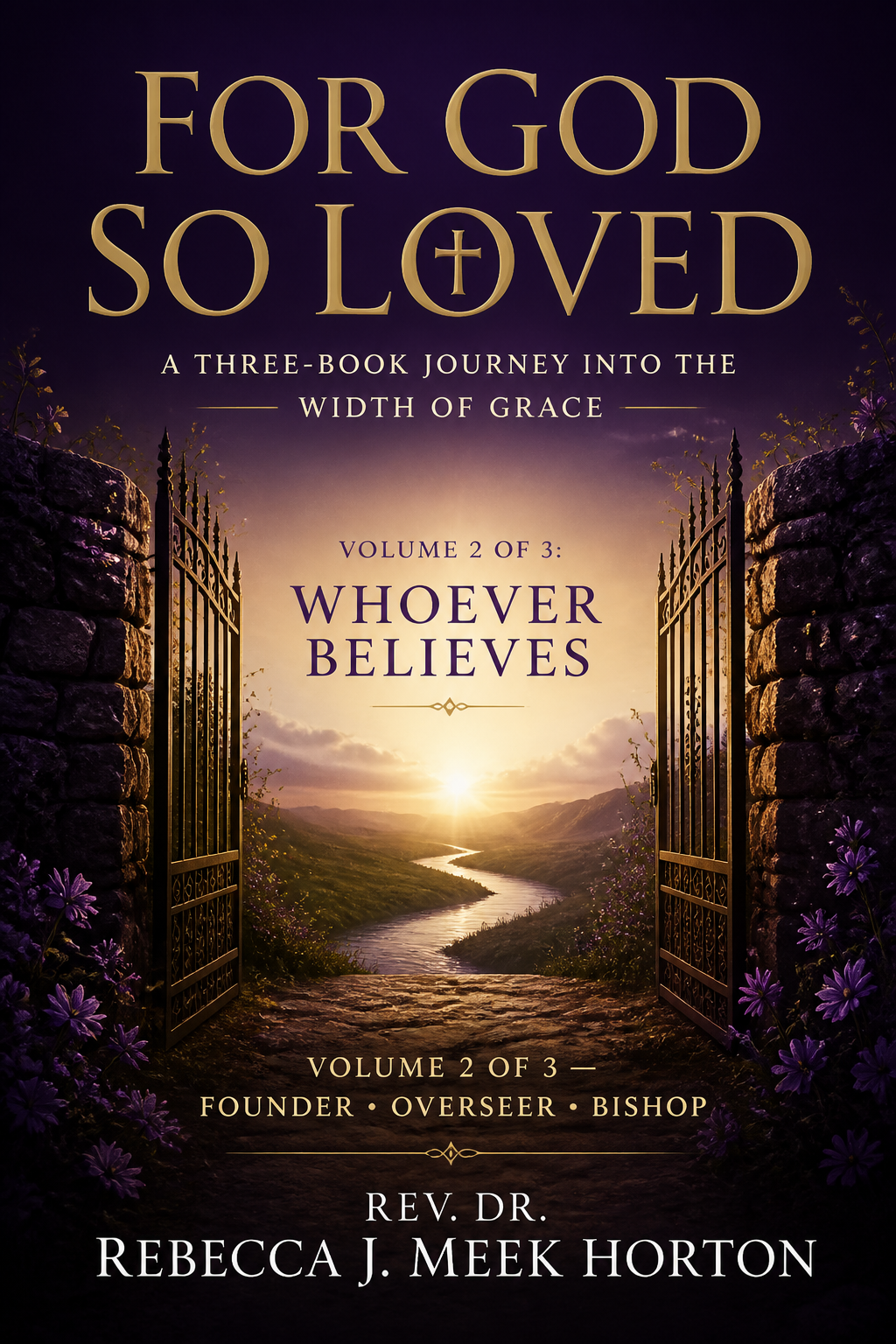
NBCNGMI MASTER KNOWLEDGE LIBRARY Featuring the works of The Sage, Apostle Prophet. Rev. Dr. Rebecca J. Meek Horton, Apostolic Prophetic Architect, NewBeing Creation Network Global Ministries, Inc. Integrated Framework Modalities™
Chapter 1 — 1. The Word That Opens the Door
Entry 1
Scripture Reading
John 3:16-17 (KJV) 16 For God so loved the world, that he gave his only begotten Son, that whosoever believeth in him should not perish, but have everlasting life. 17 For God sent not his Son into the world to condemn the world; but that the world through him might be saved.
Devotional
The door of grace opens from God’s side.
That is where John 3:16 begins. Not with our strength. Not with our record. Not with our ability to repair what we have broken. It begins with God loving and God giving. Before we ever knew how to respond rightly, God had already moved toward us in His Son.
This matters when your heart hesitates at the doorway.
Sometimes we do not stay away from God because we hate Him. Sometimes we stay away because we are tired, ashamed, uncertain, or afraid of what coming close might expose. We may wonder if the invitation is truly for us. We may believe grace exists and still struggle to believe grace is available here, now, for this story, with this history, in this condition.
But the Word says, “whosoever.”
That word is not careless. It is holy. It reaches farther than our labels, farther than our past, farther than our fear. It reaches the person who came to church as a child and wandered away. It reaches the person who never learned how to pray. It reaches the one who has done well publicly and is weary privately. It reaches the one who has failed loudly and wonders if there is any way home.
The welcome is wide, but the response is real. God gave His Son. We are called to believe in Him.
Believing is more than admiring Jesus from a distance. It is more than knowing the verse. It is more than agreeing that the gospel is beautiful. To believe is to put the weight of your life on the One God has given. It is to stop negotiating from the threshold and begin receiving the mercy of Christ.
John 3:17 tells us something tender and strong: the Son was not sent to condemn the world, but that the world through Him might be saved. The light will tell the truth, yes. Grace does not lie. But Christ does not expose in order to destroy. He reveals in order to save.
Today, do not let shame finish the sentence before God speaks. Do not let fear narrow what God has made wide. The door is open because God opened it. The gift has come because God gave Him.
Come to Christ honestly. Believe Him personally. Receive Him with a surrendered heart.
Prayer
Father, I come to You with the place in me that still hesitates. I have heard the invitation, but sometimes fear, shame, or old patterns make me stand at the door instead of entering by faith. Thank You for loving first. Thank You for giving Your only begotten Son. I do not want to treat grace like an idea while keeping my life guarded from You. Help me believe in Christ with my whole heart. Teach me to receive what I could never earn. Let Your truth become louder than condemnation, and let Your love lead me into honest surrender. In Jesus’ name, amen.
Journal Prompt
John 3:16-17 shows that God loved and gave before I responded. Where am I still standing at the door instead of trusting Christ, and what fear or shame is keeping me there?
Space to Write
[Answer Lines]
Entry 2
Scripture Reading
Ephesians 2:8-10 (KJV) 8 For by grace are ye saved through faith; and that not of yourselves: it is the gift of God: 9 Not of works, lest any man should boast. 10 For we are his workmanship, created in Christ Jesus unto good works, which God hath before ordained that we should walk in them.
Devotional
Grace comes before the walk.
That order is mercy.
Many weary souls carry the gospel backward. They think God is waiting for them at the end of improvement. They imagine they must climb toward Him with better habits, cleaner motives, stronger emotions, fewer questions, and a more respectable story. They keep trying to become acceptable enough to receive what only grace can give.
But Ephesians 2:8-10 will not let us confuse the order.
We are saved by grace through faith. It is the gift of God. Not of works. Not of boasting. Not of self-rescue. Not of spiritual performance polished enough to impress heaven.
The gift comes first.
This does not make obedience small. It puts obedience in the right place. We are not saved by good works, but we are created in Christ Jesus unto good works. Grace does not leave us dead, hidden, and unchanged. Grace makes us alive. Grace forms a new walk. Grace teaches us how to live as God’s workmanship.
That word is tender. Workmanship means you are not an accident in God’s hand. You are not a discarded project. You are not merely the sum of what happened to you or what you did before you knew better. In Christ, God is making something redeemed, useful, beautiful, and faithful.
Nothing is random. Nothing is wasted.
Even the places you wish had never been part of your story can become places where grace tells the truth and forms maturity. This does not mean sin was good. It does not mean pain was good. It means God is wise, merciful, and able to work where we could not save ourselves.
Faith receives the gift. Trust begins to lean. Obedience learns to walk.
So today, if you feel pressure to prove you deserve God’s mercy, stop and return to the Word. Grace is not wages. Salvation is not a trophy. Christ is not given to the already worthy. He is given because God is rich in mercy.
You may have a real next step to take. There may be repentance, confession, reconciliation, discipline, or obedience ahead. But do not take that step as someone trying to purchase love. Take it as someone who has been loved first.
The door is open. The gift is given. Now walk as one who has received grace.
Prayer
Father, I thank You that I am saved by grace through faith, and not by my own works. I confess that I sometimes try to earn what You have already given in Christ. I sometimes measure Your welcome by my performance instead of Your mercy. Teach me the right order. Let grace humble me without shaming me. Let faith receive what pride cannot achieve. Make me faithful in the good works You have prepared, not so I can boast, but so my life can honor You. I receive Your gift again today, and I ask You to form my walk. In Jesus’ name, amen.
Journal Prompt
Ephesians 2:8-10 says salvation is the gift of God and that I am His workmanship. Where have I been trying to earn grace, and what would it look like to walk today as someone who has received it?
Space to Write
[Answer Lines]
Entry 3
Scripture Reading
Romans 10:9-13 (KJV) 9 That if thou shalt confess with thy mouth the Lord Jesus, and shalt believe in thine heart that God hath raised him from the dead, thou shalt be saved. 10 For with the heart man believeth unto righteousness; and with the mouth confession is made unto salvation. 11 For the scripture saith, Whosoever believeth on him shall not be ashamed. 12 For there is no difference between the Jew and the Greek: for the same Lord over all is rich unto all that call upon him. 13 For whosoever shall call upon the name of the Lord shall be saved.
Devotional
Grace is wide enough to reach every person, and clear enough to call every person to respond.
Romans 10 gives us that holy balance. It does not make salvation vague. It does not turn faith into a private feeling with no confession. It also does not build a wall where God has opened a door. It says, “Whosoever believeth on him shall not be ashamed.” It says, “Whosoever shall call upon the name of the Lord shall be saved.”
Whosoever.
There are people who can believe that word for others but not for themselves. They can preach mercy to a friend, comfort a child, encourage a stranger, and still secretly think their own story is too tangled for grace. They hear “whosoever” and somehow step outside of it.
But “whosoever” belongs to God.
We are not permitted to make it smaller, not even against ourselves.
The Lord is rich unto all that call upon Him. That does not mean everyone comes from the same place, carries the same burden, or needs the same kind of healing. It means the same Lord is Lord over all. The careful and the careless must come the same way. The religious and the rebellious must come the same way. The wounded and the proud must come the same way. We come by faith in Jesus Christ.
Romans 10 also reminds us that belief is not bare agreement. With the heart man believeth unto righteousness, and with the mouth confession is made unto salvation. Faith has an inward trust and an outward confession. It is personal, but it is not hidden forever. When grace reaches the heart, the mouth learns to confess the Lord Jesus.
This may feel costly. To confess Christ is to stop managing an image of neutrality. It is to stop keeping Jesus as a respectable idea while refusing His lordship. It is to call on Him, not as one option among many, but as Savior and Lord.
Still, hear the promise: you shall not be ashamed.
The shame that says you are too late does not have the final word. The shame that says you are too dirty does not have the final word. The shame that says others may come but you cannot does not have the final word.
Christ has the final word.
Call upon Him. Believe in Him. Confess Him. The door is open, and His grace is not poor. The Lord is rich unto all that call upon Him.
Prayer
Father, I call upon the name of the Lord today. I believe that Jesus is Lord and that You raised Him from the dead. I confess that I have sometimes let shame argue with Your invitation. I have sometimes acted as if “whosoever” could include others but not me. Forgive me for narrowing what You have spoken wide. Let my heart trust You, and let my mouth confess You with courage and humility. I do not want hidden religion. I want surrendered faith. Thank You that the same Lord over all is rich unto all that call upon Him. I receive Your mercy today. In Jesus’ name, amen.
Journal Prompt
Romans 10:9-13 connects believing, confessing, and calling on the Lord. What would honest confession of Jesus look like in my life right now, and where has shame tried to silence me?
Space to Write
[Answer Lines]
Entry 4
Scripture Reading
John 1:11-13 (KJV) 11 He came unto his own, and his own received him not. 12 But as many as received him, to them gave he power to become the sons of God, even to them that believe on his name: 13 Which were born, not of blood, nor of the will of the flesh, nor of the will of man, but of God.
Devotional
Receiving Christ is not passive.
John 1 tells us that Jesus came unto His own, and His own received Him not. That is a sobering sentence. It is possible for Christ to come near and still be resisted. It is possible to have religious history, spiritual language, and familiarity with holy things, yet not receive Him.
But the next verse opens mercy again: “But as many as received him.”
There it is again. The welcome is wide, and the response is real.
To receive Christ is to welcome the One God has given, not only as comfort, but as Lord. It is not receiving an idea about Him while keeping distance from Him. It is not receiving church culture while guarding the heart from surrender. It is not receiving the benefits of His name while refusing the authority of His life.
As many as received Him, to them gave He power to become the sons of God.
This is grace with identity in it.
The gospel does not merely forgive a record; it brings us into sonship. It gives a new standing, a new belonging, a new birth that human effort could never manufacture. John makes that plain. This birth is not of blood, nor of the will of the flesh, nor of the will of man, but of God.
That truth humbles every proud heart and heals every ashamed heart.
It humbles the proud because no one enters God’s family by natural advantage, family name, religious pedigree, or personal willpower. It heals the ashamed because no one is excluded because their background was broken, their start was messy, or their past was complicated. New birth is of God.
Nicodemus had to learn this. He had knowledge, position, and discipline, but Jesus told him he needed to be born again. That was not insult. That was mercy. Jesus was showing him that the kingdom is not entered by polish. It is entered by life from above.
Today, ask honestly: Have I received Him, or have I only stayed near Him?
There is a difference between standing in the doorway and coming in. There is a difference between respecting Christ and resting the weight of your life on Him. There is a difference between knowing about grace and receiving the Son.
You do not have to create the new birth. That is of God. But you are called to receive Christ.
Open the guarded place. Stop arguing your disqualification. Stop trusting your own qualification. Receive Him.
Prayer
Father, I do not want to stand near Christ and still refuse Him. I want to receive Him truly. I confess that I have sometimes trusted my background, my effort, my understanding, or my image more than I have trusted Your Son. I have also sometimes believed my brokenness could keep me from belonging to You. Thank You that new birth is of God. Thank You that as many as receive Christ are given power to become the sons of God. Help me welcome Jesus as Savior and Lord in every guarded place. Teach me to live from the identity grace gives. In Jesus’ name, amen.
Journal Prompt
John 1:11-13 speaks of receiving Christ and becoming the sons of God. Where have I stayed near Jesus without fully receiving His lordship, and what guarded place needs to open today?
Space to Write
[Answer Lines]
Entry 5
Scripture Reading
John 3:19-21 (KJV) 19 And this is the condemnation, that light is come into the world, and men loved darkness rather than light, because their deeds were evil. 20 For every one that doeth evil hateth the light, neither cometh to the light, lest his deeds should be reproved. 21 But he that doeth truth cometh to the light, that his deeds may be made manifest, that they are wrought in God.
Devotional
Coming to the light can feel hard, even when the door is open.
That is the honest tension of faith. Grace welcomes us, but it does not leave us hidden. Christ receives us, but He also reveals us. The light of God does not flatter our darkness. It tells the truth.
For some, that is the place of hesitation.
We may not doubt that God is loving. We may not doubt that Jesus saves. But we may fear what will happen if we bring the whole truth into the light. The secret sin. The old wound. The hidden resentment. The private fear. The part of the story we have managed, defended, buried, or renamed.
John 3 tells us that light is come into the world. That Light is not an accusation floating in the air. That Light is Christ Himself. He is holy, and He is merciful. He exposes what is false, not because He is cruel, but because darkness cannot heal us.
The light of Christ does not expose in order to destroy. It reveals in order to save, cleanse, and make new.
Still, the cost is real. To come to the light, we must stop hiding behind shame, pride, performance, and delay. We must stop explaining why we cannot obey yet. We must stop calling darkness safety. We must let God name what is true.
This is why John 3:21 is so important: “But he that doeth truth cometh to the light.”
Doing truth begins with honesty before God. Not dramatic language. Not self-hatred. Not excuses. Just truth. Father, this is where I am. This is what I have done. This is what I fear. This is what I cannot fix without You. This is where I need mercy and change.
That kind of honesty is not rejection of grace. It is a step into grace.
Many people remain stuck because they confuse conviction with condemnation. Conviction calls you into the light so you can be restored. Condemnation tells you to hide because you are hopeless. Learn the difference. The Spirit of God will tell the truth, but He will not lie about the power of Christ to save.
Today, come to the light in one specific place. Do not try to fix everything at once. Bring one hidden thing to God. Name it plainly. Receive mercy. Take the next faithful step.
The open door is still Christ. The invitation is still real. The Light is safe because the Light is Lord.
Prayer
Father, I come to the light today. I confess that I have sometimes treated darkness like protection because I was afraid of being exposed. I have hidden behind delay, excuses, shame, and control. Thank You that Jesus is the Light who saves. Help me tell the truth without running from Your mercy. Show me the difference between conviction and condemnation. Give me courage to bring one hidden place before You honestly. Cleanse what needs cleansing, heal what needs healing, and lead me in the next faithful step. I want my life to be made manifest as a work of Your grace. In Jesus’ name, amen.
Journal Prompt
John 3:19-21 says that the one who does truth comes to the light. What is one specific place I need to bring into Christ’s light today, and what next faithful step will I take?
Space to Write
[Answer Lines]
An Apostolic Prophetic Architect Message
Beloved, the Word has opened the door, and now you must discern what you will do at the threshold.
This is not a season to stand near truth and remain unchanged by it. The Lord is not calling you into confusion. He is calling you into Christ. The gift has already been given. The love of God has already moved toward you. The door is not open because you became strong enough to force it. The door is open because the Father gave His only begotten Son.
Now hear this with clarity: wide grace does not mean vague response. The invitation is whosoever, but the entrance is believing. Not performing. Not pretending. Not admiring Jesus from a safe distance. Believing. Receiving. Trusting. Coming to the light. Confessing the Lord Jesus. Letting the full weight of your life lean on the One God has given.
John 10:9 (KJV) I am the door: by me if any man enter in, he shall be saved, and shall go in and out, and find pasture.
Jesus did not say He is one decoration on the doorway. He said, “I am the door.” That means your salvation is not hidden in your striving. Your belonging is not secured by your image. Your future is not built on your ability to rescue yourself. By Him, if any man enter in, he shall be saved.
There is confirmation here for the weary heart: you are not too far for the word “whosoever.” There is correction here for the proud heart: you are not so strong that you can enter another way. There is encouragement here for the hesitant heart: the light of Christ is not calling you forward to destroy you, but to save, cleanse, lead, and make you whole.
Do not make an altar out of hesitation. Do not let shame become your counselor. Do not let fear explain God to you. Let the Word govern the moment. Let the Spirit steady your response.
The next faithful step is simple and holy: come through the Door. Name where you have been standing outside. Bring the guarded place into the light. Believe on the Lord Jesus Christ. Receive the grace that has already moved toward you.
Nothing is random. Nothing is wasted. Even this threshold can become testimony when you enter by faith.
[Journal Page]
[Journal Page]
Chapter 2 — 2. Why Receiving Love Can Feel Hard
Entry 1
Scripture Reading
John 1:12-13 (KJV) 12 But as many as received him, to them gave he power to become the sons of God, even to them that believe on his name: 13 Which were born, not of blood, nor of the will of the flesh, nor of the will of man, but of God.
Devotional
There is a holy tenderness in the words, received him. John does not speak of people simply admiring Jesus from a distance. He does not describe a crowd that approved of Him, studied Him, or respected Him only as a teacher. He says, as many as received him.
Receiving is personal.
A gift can sit unopened on the table. A door can stand open while someone remains outside. Love can be offered, and still the heart can tremble at the thought of letting it come near. Many people believe God is loving in a general way, but when His love comes close enough to call them son or daughter, something inside may resist.
The Scripture joins receiving and believing together. To believe on His name is not only to agree that Jesus is true. It is to entrust yourself to Him. It is to stop standing at the threshold with explanations in your hands and come in by faith.
This is where receiving love can feel hard. Love asks us to be known. It asks us to stop hiding behind performance, distance, religious words, or the old story that says, Not me. Not after what I have done. Not after where I have been. But the Word says, as many as received him. That is wide enough for the wounded. Wide enough for the ashamed. Wide enough for the tired soul who knows the right words but has struggled to place full weight on Christ.
God does not make you His child by the strength of your family name, your willpower, your self-improvement, or your ability to repair yourself. The passage says this birth is of God. That means grace begins where your control ends.
You do not receive Christ by becoming impressive. You receive Him by trusting Him. You open the envelope. You walk through the door. You release the broken piece of wood and let the Rescuer hold you.
Today, do not make receiving God’s love more complicated than Scripture makes it. Bring Him your hesitation. Bring Him the part of you that still feels unworthy. Bring Him the place where belief has stayed in your mind but not yet settled into trust.
He is not offering you a theory. He is offering Himself.
Prayer
Father, I come to You honestly today. I admit that I can know Your truth and still hesitate to receive Your love personally. I have stood at the threshold with fear, shame, and questions in my hands. Teach me to believe on the name of Jesus with more than my words. Help me receive Him as Savior, Lord, and the One who calls me into Your family. I lay down the lie that I must make myself worthy before I come. I thank You that new life is born of You, not of my striving. Father, I receive Your love by faith today. Help me live like Your child. Amen.
Journal Prompt
John 1:12-13 (KJV) connects receiving Christ with believing on His name. Where have I agreed with truth but hesitated to receive Christ personally and fully?
Space to Write
[Answer Lines]
Entry 2
Scripture Reading
Romans 5:6-8 (KJV) 6 For when we were yet without strength, in due time Christ died for the ungodly. 7 For scarcely for a righteous man will one die: yet peradventure for a good man some would even dare to die. 8 But God commendeth his love toward us, in that, while we were yet sinners, Christ died for us.
Devotional
Shame often tells the soul, You must become better before God can love you. It speaks with confidence, but it does not speak the gospel.
Romans 5 brings us back to the foundation. Christ did not die for us after we became strong. He did not wait until we were clean enough, wise enough, disciplined enough, or safe enough to love. The passage says, when we were yet without strength. It says, while we were yet sinners.
That is not permission to stay bound. It is the mercy that makes freedom possible.
There is a difference between conviction and condemnation. Conviction tells the truth so we can come into the light. Condemnation uses truth like a weapon and tells us to hide. Conviction may grieve us, but it leads us toward Christ. Condemnation crushes us and whispers that grace is for other people.
But God commendeth his love toward us. He revealed it. He proved it. He put His love on display at the cross, not when humanity was at its best, but when we were unable to rescue ourselves.
This matters because many people are still trying to negotiate with shame. They keep saying, If I can pray better, serve better, think better, feel better, then maybe I can receive God’s love without feeling guilty. But the gospel does not begin with your strength. It begins with Christ’s sacrifice.
You may have real things to confess. You may have damage to face, habits to surrender, apologies to make, and healing to pursue. Grace does not erase responsibility. It makes honest responsibility possible without despair.
Shame says, You are too stained to come.
The cross says, Christ died for sinners.
Shame says, You are without strength, so there is no hope.
The gospel says, when you were without strength, Christ came for you.
Today, let the Word RE-Language™ the accusation. Not, I am beyond the reach of love. But, I am the kind of person Christ came to save. Not, I must hide until I am whole. But, I must come to Christ because He alone can make me whole.
Receiving love may feel hard when shame has trained you to expect rejection. But God’s love is not fragile. It is not surprised by your need. It met you while you were yet a sinner, and it is able to lead you into life.
Prayer
Father, I bring You the shame I have carried, spoken and unspoken. I confess that I have sometimes believed condemnation more quickly than I believed Your love. I have treated my weakness as proof that I should stay away, when Your Word says Christ died for the ungodly and for those without strength. Help me receive the love You have already shown through Jesus Christ. Teach me the difference between conviction that leads me home and condemnation that drives me into hiding. I will not call myself beyond repair when Christ has died for sinners. Father, help me come into the light and receive mercy with humility. Amen.
Journal Prompt
Romans 5:6-8 (KJV) says Christ died for us while we were yet sinners. What shame has made me feel disqualified from receiving God’s love?
Space to Write
[Answer Lines]
Entry 3
Scripture Reading
Matthew 11:28-30 (KJV) 28 Come unto me, all ye that labour and are heavy laden, and I will give you rest. 29 Take my yoke upon you, and learn of me; for I am meek and lowly in heart: and ye shall find rest unto your souls. 30 For my yoke is easy, and my burden is light.
Devotional
Fear often sounds careful. It tells us to protect ourselves. It tells us not to trust too deeply, not to hope too much, not to surrender too fully. Sometimes fear even uses spiritual language. It says, I am just being wise. I am just being cautious.
But wisdom and fear do not bear the same fruit.
Jesus does not call the weary to come so He can increase their harm. He says, Come unto me. He speaks to those who labour and are heavy laden. He knows the weight is real. He knows the soul can become tired from carrying what it was never meant to carry alone.
Still, receiving His love may feel frightening because His invitation includes surrender. He says, Take my yoke upon you, and learn of me. He does not offer distance. He offers relationship. He does not offer a life where we remain untouched and unchanged. He offers rest under His lordship.
That is where the heart may tremble.
If I come to Him, what will He ask me to release?
If I trust Him, what will happen to my plans?
If I let Him love me, will I have to stop controlling everything?
These are honest questions. The Christian life does cost us our self-rule. Jesus does not hide that. But we must also tell the truth about the cost of refusing Him. The life we try to control can become the life that controls us. The image we protect can become a prison. The burden we refuse to lay down can become heavier with every year.
Jesus is meek and lowly in heart. That means the One calling you is not harsh with the broken who come honestly. He is not careless with bruised trust. He is not confused by your fear. He invites you to learn Him, not merely learn about Him.
Rest is found in coming, taking, and learning. Coming to Christ with the burden. Taking His yoke instead of the one fear made. Learning His heart until fear no longer gets to explain His character.
Today, you do not have to surrender every imagined future at once. Begin with the next faithful step. Bring one fear into the presence of Jesus. Tell Him the truth. Ask Him to teach your soul that His love is safer than your control.
Prayer
Father, I come to You with the fear I have called wisdom. I admit that I have tried to protect myself from surrender, even when my own control has made me tired. Jesus invites the heavy laden to come, and today I answer that invitation. Teach me to trust His heart. Help me believe that His yoke is not meant to crush me, but to lead me. I lay down one burden I was never created to carry alone. I ask for courage to receive love that also has authority. Father, help me come, take, learn, and find rest for my soul. Amen.
Journal Prompt
Matthew 11:28-30 (KJV) invites the heavy laden to come to Jesus and learn of Him. What fear has made surrender feel unsafe to me?
Space to Write
[Answer Lines]
Entry 4
Scripture Reading
Ephesians 2:8-10 (KJV) 8 For by grace are ye saved through faith; and that not of yourselves: it is the gift of God: 9 Not of works, lest any man should boast. 10 For we are his workmanship, created in Christ Jesus unto good works, which God hath before ordained that we should walk in them.
Devotional
Pride does not always announce itself with arrogance. Sometimes it looks like trying harder. Sometimes it looks like being the strong one. Sometimes it looks like refusing help because need feels embarrassing.
Many people do not reject grace because they hate God. They resist grace because grace humbles them. It tells the truth: salvation is not of ourselves. It is the gift of God.
That truth frees us, but it also confronts us. We cannot boast at the foot of the cross. We cannot arrive with a spiritual résumé and ask God to admire our effort. We cannot purchase what Christ gives by mercy. We cannot repair ourselves into resurrection.
Grace is gift.
Faith is receiving.
Good works come after.
This order matters. If we reverse it, we will either become proud or exhausted. Proud, if we think we are doing enough to deserve God. Exhausted, if we keep fearing we have not done enough to keep Him. But the passage says we are saved by grace through faith, not of works. Then it says we are His workmanship, created in Christ Jesus unto good works.
God does not save us because we are already formed. He saves us and begins forming us. Grace is not shallow permission to remain unchanged. Grace is the power and kindness of God that brings us into a new life.
Receiving love can feel hard when we would rather earn than receive. Earning lets us feel in control. Receiving admits dependence. Earning gives us something to count. Receiving gives us Someone to trust.
But the gospel is not an employment contract. It is not God saying, Perform well enough and I will love you. It is the Father giving His Son, calling the dead to life, and making us His workmanship.
Today, lay down the pressure to bring God something impressive. Bring Him honesty. Bring Him need. Bring Him the broken pieces you have been gripping. Then ask Him to form in you the good works He has ordained for you to walk in.
You are not saved by your works. You are saved for a life that grace will teach you to walk.
Prayer
Father, I confess that I have sometimes tried to earn what You have given as a gift. I have wanted to feel capable, deserving, and in control. Your Word says salvation is by grace through faith, not of myself. Help me receive that truth without resistance. Deliver me from pride that refuses mercy and from exhaustion that tries to perform for love. I thank You that I am Your workmanship in Christ Jesus. Form me in the order of grace. Let good works flow from Your saving work in me, not from fear or boasting. Father, teach me to receive, trust, and walk. Amen.
Journal Prompt
Ephesians 2:8-10 (KJV) says salvation is the gift of God, not of works. Where have I been trying to earn what God is asking me to receive?
Space to Write
[Answer Lines]
Entry 5
Scripture Reading
Mark 9:23-24 (KJV) 23 Jesus said unto him, If thou canst believe, all things are possible to him that believeth. 24 And straightway the father of the child cried out, and said with tears, Lord, I believe; help thou mine unbelief.
Devotional
There is mercy in the father’s cry. He does not pretend to have perfect faith. He does not dress his struggle in polished religious language. He brings Jesus the truth: Lord, I believe; help thou mine unbelief.
Some people think belief means never having a question, never feeling fear, never trembling at the edge of trust. But Scripture is more honest than that. This man believed enough to come to Jesus, and still he knew there was weakness in him. He did not hide the weakness. He offered it.
That is a faithful place to begin.
Misunderstanding can keep grace at a distance. We may think, I cannot come until my faith feels strong. I cannot receive love while part of me still feels afraid. I cannot trust Christ unless every question is settled first. But the father in Mark 9 teaches us another way. Bring the belief you have. Bring the unbelief you cannot fix. Bring it all to Jesus.
Faith is not pretending the struggle is absent. Faith is turning toward Christ inside the struggle.
This matters because receiving love often exposes divided places in the heart. One part of us wants to trust. Another part remembers disappointment. One part knows the Word is true. Another part still flinches because rejection has been familiar. One part says yes to God. Another part whispers, But what if I am let down again?
Jesus is not threatened by honest need. He is not asking for theatrical confidence. He is calling for trust, and trust can begin with tears.
The father’s prayer is also a model of surrendered responsibility. He does not say, Lord, I believe, so I need nothing else. He says, help. That word is humble. It admits dependence. It opens the door to grace.
Today, let this prayer become your own. Not as an excuse to remain unbelieving, but as an honest return to Christ. Tell Him where belief is present. Tell Him where unbelief still aches. Ask Him to help you receive His love not only in your thoughts, but in the places of the heart that have been slow to trust.
Whoever believes does not mean whoever feels flawless. It means the door is open to the one who will entrust themselves to Christ. Even if the first step is tearful, take it.
Prayer
Father, I come to You with honest faith. I do believe, and I also need help where unbelief still speaks. I will not pretend before You. I bring the questions, fears, disappointments, and guarded places that have made receiving love hard. Thank You that Jesus did not reject the father who cried out with tears. Help me place the weight of my soul on Christ, even while You are still strengthening me. Teach me to trust You with my whole life, not only with the parts that feel confident. Father, help my unbelief and grow in me surrendered faith. Amen.
Journal Prompt
Mark 9:23-24 (KJV) shows a man bringing both belief and unbelief to Jesus. What honest sentence do I need to bring to Christ today about the place where my trust feels divided?
Space to Write
[Answer Lines]
An Apostolic Prophetic Architect Message
Beloved, hear this with a steady heart: the Lord is not intimidated by the place where receiving love has felt hard for you. He already sees the threshold where you have stood. He knows the envelope on the table. He knows the gift you have touched but hesitated to open.
This is not the season to keep calling hesitation humility. Shame is not humility. Fear is not wisdom. Pride is not strength. Misunderstanding is not protection. The Spirit of God is calling you into holy truth so you can receive holy love.
John 3:16-17 (KJV) 16 For God so loved the world, that he gave his only begotten Son, that whosoever believeth in him should not perish, but have everlasting life. 17 For God sent not his Son into the world to condemn the world; but that the world through him might be saved.
That word whosoever is still standing open. Do not make yourself the exception when God has made Christ the invitation. Do not rehearse old accusations until they sound more true than the cross. Do not hold on to broken wood when the Rescuer has come near.
I confirm this over your life: grace is not asking you to perform your way into love. Grace is calling you to receive the One who has already come. Belief is not distant agreement. Belief is surrendered reception. It is placing the weight of your soul on Jesus Christ.
There will be cost. The old hiding must come down. The old control must bow. The old earning must cease. The old misunderstanding must be corrected by the Word. But the cost of receiving Christ is not the cost of harm. It is the cost of being delivered from what could never save you.
So take the next faithful step. Write the honest sentence. Pray the honest prayer. Open the gift. Come through the door. Let love have access to the place that has been guarded by pain.
The Father is not calling you to pretend nothing happened. He is calling you to trust that Christ is enough for what happened, enough for what is happening, and enough for the life He is forming in you now.
[Journal Page]
[Journal Page]
Chapter 3 — 3. The Father Who Runs Toward the Lost
Entry 1
Scripture Reading
Luke 15:1-7 (KJV) 1 Then drew near unto him all the publicans and sinners for to hear him. 2 And the Pharisees and scribes murmured, saying, This man receiveth sinners, and eateth with them. 3 And he spake this parable unto them, saying, 4 What man of you, having an hundred sheep, if he lose one of them, doth not leave the ninety and nine in the wilderness, and go after that which is lost, until he find it? 5 And when he hath found it, he layeth it on his shoulders, rejoicing. 6 And when he cometh home, he calleth together his friends and neighbours, saying unto them, Rejoice with me; for I have found my sheep which was lost. 7 I say unto you, that likewise joy shall be in heaven over one sinner that repenteth, more than over ninety and nine just persons, which need no repentance.
Devotional
Jesus gave this story because religious people were offended by mercy. They could not understand why He would receive sinners and eat with them. They saw stains. Jesus saw souls. They saw disruption. Jesus saw people drawing near to hear Him.
That matters for your day.
There may be places in you that feel unworthy to come close. Maybe you have wandered in choices, thoughts, habits, neglect, or fear. Maybe you have not gone to a far country outwardly, but inwardly you know you have drifted. The Shepherd does not treat the lost one as disposable. He goes after that which is lost, until he find it.
This is not permission to wander. It is revelation of the Father’s heart.
Grace does not call wandering harmless. Grace calls the lost one worth seeking. The sheep could not boast about finding its way back. It was carried. It was laid upon the shepherd’s shoulders. The rejoicing belonged to the one who found what was lost.
Sometimes we think repentance begins with God being angry at the road. But in this passage, heaven is ready to rejoice over one sinner that repenteth. The movement back to God is not met with cold suspicion. It is met with holy joy.
Let this RE-Frame the way you speak to your own soul. Not, I am too far gone. Not, God is tired of me. Not, I have to clean myself up before I can come near. Say instead, I am being called back by the Shepherd who knows how to find what is lost.
There is cost in repentance. You may need to tell the truth. You may need to leave a pattern. You may need to ask for help. You may need to stop defending what has been damaging you. But the cost of returning is not greater than the cost of remaining lost.
The porch light is still on. The Shepherd is not indifferent. Heaven does not mock the returning one. Heaven rejoices.
Today, do not let shame keep you silent. Let the Word search you without crushing you. Let the Shepherd’s mercy give you courage. The one who is lost still matters to God. And the one who returns becomes part of heaven’s joy.
Nothing is random. Nothing is wasted. Even this reading may be a lamp on the road home.
Prayer
Father, I come to You honestly today. I confess that I have sometimes believed my wandering made me unwanted. I have listened to shame, fear, and distance more than I have listened to Your Word. Thank You for revealing Your heart through Jesus. Thank You that the lost one matters to You. Search me without letting shame rule me. Show me where I have drifted, and give me grace to return. I receive Your mercy with humility, not pride. I do not want to hide from You. I want to be found, carried, corrected, and restored. Teach me to rejoice in repentance and to trust Your shepherding love. In Jesus’ name, amen.
Journal Prompt
From Luke 15:1-7, where do I sense the Shepherd calling me back today, and what shame-filled sentence do I need to RE-Frame with truth?
Space to Write [Answer Lines]
Entry 2
Scripture Reading
Luke 15:8-10 (KJV) 8 Either what woman having ten pieces of silver, if she lose one piece, doth not light a candle, and sweep the house, and seek diligently till she find it? 9 And when she hath found it, she calleth her friends and her neighbours together, saying, Rejoice with me; for I have found the piece which I had lost. 10 Likewise, I say unto you, there is joy in the presence of the angels of God over one sinner that repenteth.
Devotional
The lost coin did not stop being valuable because it was lost.
It was still silver. It still belonged. It was still worth searching for. Its location changed, but its value did not disappear.
This is a tender truth for the weary heart. Some people feel that because they have been hidden under dust, buried in confusion, or lost in the clutter of life, they are no longer worth the searching. But Jesus tells a story where the woman lights a candle, sweeps the house, and seeks diligently till she find it.
Diligently is a strong word. It carries patience. It carries intention. It carries refusal to quit too quickly.
The Father’s love is not careless. He does not glance once into the room and say, It is gone. He searches. He brings light. He uncovers. He moves what has been hiding what belongs to Him.
Sometimes God’s mercy feels like comfort. Sometimes it feels like sweeping.
He may move through areas of your life you have not wanted touched. He may expose what has been covering truth. He may bring conviction to places where you have made peace with spiritual dust. That is not rejection. That may be rescue.
We often ask God to find us without disturbing anything around us. But the woman in the parable had to light the candle and sweep the house. Recovery involved movement. Restoration involved uncovering.
So today, do not despise the light. If the Lord is showing you a pattern, a motive, a fear, a compromise, or a grief, He is not exposing it to humiliate you. He is revealing what must be brought into truth so you can be restored.
There is also joy in this passage. The finding becomes a shared celebration. This reminds us that repentance is not merely private sorrow. It is heaven’s gladness over restoration. The Father is not reluctant to receive the one who turns back. The presence of the angels of God carries joy over one sinner that repenteth.
You may feel small today. You may feel like one piece among many. But one matters. One is searched for. One is celebrated.
Let the candle of the Word shine. Let the Spirit sweep with wisdom. Let what has been lost be found.
Prayer
Father, I thank You that my value is not erased by my hiding place. I have sometimes felt buried under failure, fear, distraction, and delay. I ask You to shine Your light in me with mercy and truth. Sweep what needs to be swept. Uncover what I have ignored. Help me not resist Your correction when it is actually Your care. I do not want to remain hidden in old patterns. I want to be found in Your will, restored in Your presence, and steady in Your love. Teach me to welcome Your diligent work in my life. Let repentance become joy, not shame. In Jesus’ name, amen.
Journal Prompt
From Luke 15:8-10, what might God be gently uncovering in my life, and how can I respond to His light with honesty instead of fear?
Space to Write [Answer Lines]
Entry 3
Scripture Reading
Luke 15:11-20 (KJV) 11 And he said, A certain man had two sons: 12 And the younger of them said to his father, Father, give me the portion of goods that falleth to me. And he divided unto them his living. 13 And not many days after the younger son gathered all together, and took his journey into a far country, and there wasted his substance with riotous living. 14 And when he had spent all, there arose a mighty famine in that land; and he began to be in want. 15 And he went and joined himself to a citizen of that country; and he sent him into his fields to feed swine. 16 And he would fain have filled his belly with the husks that the swine did eat: and no man gave unto him. 17 And when he came to himself, he said, How many hired servants of my father's have bread enough and to spare, and I perish with hunger! 18 I will arise and go to my father, and will say unto him, Father, I have sinned against heaven, and before thee, 19 And am no more worthy to be called thy son: make me as one of thy hired servants. 20 And he arose, and came to his father. But when he was yet a great way off, his father saw him, and had compassion, and ran, and fell on his neck, and kissed him.
Devotional
The far country always costs more than it promises.
At first, it may look like freedom. No accountability. No boundaries. No household rhythm. No one asking hard questions. The younger son had what he asked for, but he did not have what he needed. He had goods, but he left the father’s house. He had movement, but not wisdom. He had options, but not covering.
Sin often begins by offering distance without consequence. It whispers that life will be larger if we can have the Father’s gifts without the Father’s presence. But false freedom slowly empties the soul. The money runs out. The famine comes. The appetite remains, but the supply is gone.
Jesus does not soften the condition of the son. He is hungry. He is lowered. He is in want. No man gives unto him. Grace does not lie about damage. Grace tells the truth and keeps the road open.
Then mercy begins with awakening. The Scripture says he came to himself. That phrase is powerful. Repentance often begins when illusion breaks. We stop calling bondage freedom. We stop blaming only the famine. We stop pretending the far country can feed us. We tell the truth.
This is not shame. This is clarity.
The son’s next movement matters. He does not only feel sorry. He arises. He goes to his father. Repentance is truth, turning, and return. It is not just regret over consequences. It is movement toward the Father.
And then Jesus shows us the heart of God. While the son is still a great way off, the father sees him, has compassion, runs, falls on his neck, and kisses him. The father was watching the road.
Take that into your day. The Father is not waiting for you to crawl. He is not standing coldly with crossed arms. He is holy. He is truthful. He is not casual about sin. But He is not reluctant in mercy toward the repentant.
Where are you standing today? Far country, road home, or afraid to arise? Do not wait for perfect words. Begin with honest ones. Father, I have sinned. Father, I am coming home. Father, I need mercy.
The porch light is still on. Rise and return.
Prayer
Father, I confess that I have sometimes mistaken distance for freedom. I have wanted Your gifts while resisting Your nearness. I have trusted my own way and found places in me empty, hungry, and tired. Today I come to myself by Your mercy. I will not keep defending what is damaging me. I will arise and come to You. Give me the courage to tell the truth without running back into shame. Thank You for watching the road. Thank You for compassion that meets repentance. I receive Your correction, Your mercy, and Your welcome. Lead me out of the far country and back into Your presence. In Jesus’ name, amen.
Journal Prompt
From Luke 15:11-20, where have I been trying to live with the Father’s gifts but without the Father’s presence, and what is my next honest step home?
Space to Write [Answer Lines]
Entry 4
Scripture Reading
Luke 15:21-24 (KJV) 21 And the son said unto him, Father, I have sinned against heaven, and in thy sight, and am no more worthy to be called thy son. 22 But the father said to his servants, Bring forth the best robe, and put it on him; and put a ring on his hand, and shoes on his feet: 23 And bring hither the fatted calf, and kill it; and let us eat, and be merry: 24 For this my son was dead, and is alive again; he was lost, and is found. And they began to be merry.
Devotional
The son told the truth, but the father did not let shame write the ending.
That is important.
The son’s confession was necessary. He did not return with excuses. He did not blame the famine, the citizens of the far country, or the conditions around him. He named sin before heaven and before his father. Repentance requires truth. It does not hide behind soft language.
But the father answered with restoration.
The son had prepared to live as less than a son. He had rehearsed a lower identity because shame often tries to manage mercy. Shame says, I may be allowed near, but I must never belong again. I may serve, but I must not receive. I may stand in the yard, but I must not sit at the table.
The father interrupts that script.
He calls for the best robe. He calls for a ring. He calls for shoes. He calls for a feast. These are not small details. They reveal belonging, covering, dignity, and restored place. The father is not pretending the son never left. He is declaring that the son has come home.
Some of us need to let God interrupt our self-punishment.
There is a kind of false humility that keeps saying, I am not worthy, while refusing to receive what the Father gives in Christ. It sounds humble, but it can become another way of controlling distance. We keep ourselves outside the fullness of mercy because we are more familiar with shame than sonship.
The Father’s mercy is not shallow. It cost heaven dearly. Grace is not God ignoring sin. Grace is God making a way for sinners to be received, restored, and made new through Christ.
This is where whoever believes becomes deeply personal. The invitation is not merely to agree that God is merciful. The invitation is to receive Him. To come home. To let the Father define you by His redeeming love, not by the far country.
You may still need healing. You may still need growth. You may still need to rebuild trust with people. Restoration with God does not erase every earthly consequence overnight. But do not confuse consequences with rejection. The Father can receive you while He also forms you.
Today, let the robe silence the shame. Let the ring remind you of belonging. Let the shoes call you to walk differently. You were not brought home to remain stuck. You were brought home to live.
Prayer
Father, I come before You with honest confession. I have sinned against You, and I do not want to hide or excuse what needs to be brought into Your light. But I also ask You to deliver me from the false identity of shame. Help me receive the mercy You give through Christ. Teach me to live as Your child, not as a hired servant standing outside Your love. Put Your truth over my mind, Your dignity over my life, and Your order into my steps. I accept both Your forgiveness and Your formation. Let my return become a new walk of obedience, humility, and gratitude. In Jesus’ name, amen.
Journal Prompt
From Luke 15:21-24, what part of the father’s restoration is hardest for me to receive: covering, belonging, dignity, or celebration?
Space to Write [Answer Lines]
Entry 5
Scripture Reading
Luke 15:25-32 (KJV) 25 Now his elder son was in the field: and as he came and drew nigh to the house, he heard musick and dancing. 26 And he called one of the servants, and asked what these things meant. 27 And he said unto him, Thy brother is come; and thy father hath killed the fatted calf, because he hath received him safe and sound. 28 And he was angry, and would not go in: therefore came his father out, and intreated him. 29 And he answering said to his father, Lo, these many years do I serve thee, neither transgressed I at any time thy commandment: and yet thou never gavest me a kid, that I might make merry with my friends: 30 But as soon as this thy son was come, which hath devoured thy living with harlots, thou hast killed for him the fatted calf. 31 And he said unto him, Son, thou art ever with me, and all that I have is thine. 32 It was meet that we should make merry, and be glad: for this thy brother was dead, and is alive again; and was lost, and is found.
Devotional
The older son was close to the house but far from the father’s joy.
That is a sobering truth. He was not in the far country. He was in the field. He was working. He was present. He could list his service. But when mercy was given to his brother, resentment rose in him and he refused to go in.
This shows us that lostness is not only distance through rebellion. Sometimes lostness hides inside religious activity, obedience without tenderness, service without sonship, and work without joy.
The father goes out again.
Do not miss that mercy. The father ran toward the ashamed son on the road, and he came out to the resentful son in the field. The Father’s heart addresses both kinds of distance. He calls home the one who has wasted much, and He entreats the one who has worked long but misunderstood love.
The older son speaks like a servant. He measures his years. He compares reward. He cannot call the returning son his brother. Resentment narrows his language. It turns family into accusation. It turns grace into offense.
We need to let the Word search us here.
Have you ever struggled when God showed mercy to someone you thought should have waited longer, suffered more, or stood farther back? Have you ever obeyed outwardly while inwardly keeping a ledger? Have you ever felt that your faithfulness should give you control over how generous the Father is allowed to be?
This is not a place for shame. It is a place for truth.
The father answers, Son, thou art ever with me, and all that I have is thine. The older son had access he was not enjoying because comparison had blinded him. He was standing near abundance but living from scarcity.
Resentment keeps us outside the feast. It makes us unable to celebrate resurrection in somebody else’s life. It makes us suspicious of mercy because we have forgotten that we also live by grace.
The call today is simple, but it may cost pride. Come in from the field. Let the Father soften the ledger in your heart. Stop managing who deserves celebration. Let mercy belong to God.
Both sons needed the father. Both sons were invited. The feast is not built on human deserving. It is built on the father’s joy over life restored.
Come in.
Prayer
Father, I come to You honestly about resentment, comparison, and hidden ledgers in my heart. I have sometimes served You while forgetting the joy of being with You. I have sometimes judged Your mercy when it reached someone else. Forgive me. Teach me to live as a child, not as a servant trying to earn love. Help me rejoice when the lost are found and when the dead are made alive. Deliver me from scarcity thinking in the middle of Your abundance. Soften my words, my thoughts, and my reactions. I choose to come in from the field and receive Your heart. In Jesus’ name, amen.
Journal Prompt
From Luke 15:25-32, where do I see older-son thinking in myself, and what would it look like for me to come into the Father’s joy?
Space to Write [Answer Lines]
An Apostolic Prophetic Architect Message
Beloved, the Father has been revealing His heart through these five entries. Do not rush past what He has shown you. The lost sheep, the lost coin, the younger son, and the older son all carry one holy announcement: the Father is not reluctant to restore what belongs to Him.
But restoration must be received in truth.
Do not call the far country freedom when it has been emptying your soul. Do not call shame humility when it keeps you from receiving mercy. Do not call resentment righteousness when it keeps you outside the feast. This is a moment for RE-Cognition and RE-Alignment. See where you are standing. Ask the honest question. Ponder what it is costing you to remain outside. Practice the next faithful step toward the Father.
John 1:12 (KJV) But as many as received him, to them gave he power to become the sons of God, even to them that believe on his name:
This is the grace inside whoever believes. The Father is not building a house full of tolerated servants. In Christ, He receives sons and daughters. He restores identity. He teaches obedience. He forms maturity. He brings the wandering heart into holy belonging.
And hear this clearly: repentance is not crawling back to a cold God. Repentance is returning to the Father who has been watching the road. The porch light is still on. The door is not closed. The table is not empty. The robe, the ring, and the shoes speak of mercy with movement. You are not restored to remain passive. You are restored to walk.
Luke 15:32 (KJV) It was meet that we should make merry, and be glad: for this thy brother was dead, and is alive again; and was lost, and is found.
So today, take your place in truth. If you are far away, arise. If you are on the road, keep coming. If you are standing in shame, receive mercy. If you are in the field with resentment, come in.
Nothing is random. Nothing is wasted. The Father is still receiving, restoring, and forming whoever believes.
[Journal Page]
[Journal Page]
Chapter 4 — 4. Shame at the Threshold
Entry 1
Scripture Reading
Romans 10:11-13 (KJV) 11 For the scripture saith, Whosoever believeth on him shall not be ashamed. 12 For there is no difference between the Jew and the Greek: for the same Lord over all is rich unto all that call upon him. 13 For whosoever shall call upon the name of the Lord shall be saved.
Devotional
Shame often tries to meet us right at the door. Not always when we are running from God, but sometimes when we are trying to come back. It whispers that we are too stained, too late, too complicated, too known, or too unknown to be welcomed.
But the Word gives us a stronger word: whosoever.
That word matters. Whosoever does not leave room for shame to decide who is allowed to come. Whosoever does not ask if your story is simple. Whosoever does not require you to have already repaired everything before you call on the Lord. Whosoever turns the heart toward Christ and says, If you will believe on Him, you will not be ashamed.
The gospel does not deny sin. It does not make light of what has been done, what has been hidden, or what must be healed. But it does tell the truth in the right order. Christ is Lord. Christ is rich unto all that call upon Him. Christ saves those who call upon His name.
Shame speaks in the language of identity. It says, You are what happened. You are what you did. You are what they said. You are what you fear people will find out. But faith speaks in the language of trust. Faith says, I will bring my whole self to Christ, because He is able to save, cleanse, restore, and lead me into truth.
There is a difference between being exposed by condemnation and being called by mercy. Condemnation corners the soul and says, Stay hidden. Conviction opens the door and says, Come into the light. The same God who sees truthfully is the God who saves mercifully.
Today, you may not feel brave. You may only have enough strength to call on the name of the Lord with one honest sentence. That is still a faithful beginning.
Do not wait until shame gives you permission. It never will. Let the Scripture give you permission. Whosoever believeth on Him shall not be ashamed.
You can come to Him today.
Prayer
Father, I come to You with the parts of my life shame has tried to name. I confess that I have sometimes believed the whisper that I am too stained to be welcomed. Help me hear Your Word above that voice. Teach me to believe on Christ, not on my own ability to appear clean. I call upon Your name with honesty, need, and hope. Where I have hidden, draw me into Your light. Where I have agreed with condemnation, lead me into truth. I receive Your mercy by faith, and I ask You to help me take the next faithful step without running back into shame. Amen.
Journal Prompt
Romans 10:11-13 says whosoever shall call upon the name of the Lord shall be saved. What has shame told you about your right to come to God, and what would it look like to call on Him honestly today?
Space to Write
[Answer Lines]
Entry 2
Scripture Reading
Genesis 3:8-10 (KJV) 8 And they heard the voice of the LORD God walking in the garden in the cool of the day: and Adam and his wife hid themselves from the presence of the LORD God amongst the trees of the garden. 9 And the LORD God called unto Adam, and said unto him, Where art thou? 10 And he said, I heard thy voice in the garden, and I was afraid, because I was naked; and I hid myself.
Devotional
The first movement of shame was hiding.
Adam and Eve heard the voice of the Lord God, and instead of coming near, they moved away. Sin had entered. Fear had entered. Covering had entered. The presence that once meant life now felt threatening to them.
That is what shame still does. It makes the presence of God feel unsafe, even when He is the only One who can truly restore us.
Notice the tenderness in the question God asks: Where art thou? God was not confused. He was not lacking information. He knew where Adam was. But the question gave Adam a place to answer. It invited the hidden man to come into truth.
Shame does not want truth spoken in the presence of God. Shame wants truth buried, managed, performed around, or disguised. It wants you to keep your hand on the door handle without walking in. It tells you that if God really knew, He would turn away.
But God already knows.
This is not meant to frighten you. It is meant to free you. You do not have to inform God before He can love you. You do not have to edit the story before He can call you. You do not have to keep hiding among the trees of your explanations, distractions, and religious appearances.
Conviction asks, Where are you? Not to shame you, but to locate you. Not to destroy you, but to bring you out of hiding. It helps you see what is really happening so you can take responsibility without being swallowed by condemnation.
There may be a place in your life where you have said, I was afraid, and I hid myself. That place needs compassion, but it also needs truth. Hiding may feel protective, but it cannot heal you. The wound that stays in darkness stays under shame’s instruction. The place brought into God’s light can begin to be cleansed, ordered, and restored.
Today, listen for the question of mercy: Where art thou?
Not where you pretend to be. Not where others assume you are. Not where shame says you are forever. Where are you, truly, before God?
Answer Him there. The first step out of shame is not performance. It is honest presence.
Prayer
Father, I hear Your question asking where I am. I do not want to hide from You anymore. I confess that fear has sometimes made me move away from the very presence that can heal me. Help me tell the truth without being ruled by shame. Teach me the difference between conviction that leads me home and condemnation that keeps me hidden. I bring You the places where I feel exposed, afraid, and uncovered. Cover me in Your mercy, lead me in repentance, and restore my trust in Your heart. I want to answer You honestly and walk with You again. Amen.
Journal Prompt
In Genesis 3:8-10, Adam says he was afraid and hid himself. Where have fear and shame caused you to hide from God, prayer, community, or truth?
Space to Write
[Answer Lines]
Entry 3
Scripture Reading
Acts 2:37-39 (KJV) 37 Now when they heard this, they were pricked in their heart, and said unto Peter and to the rest of the apostles, Men and brethren, what shall we do? 38 Then Peter said unto them, Repent, and be baptized every one of you in the name of Jesus Christ for the remission of sins, and ye shall receive the gift of the Holy Ghost. 39 For the promise is unto you, and to your children, and to all that are afar off , even as many as the Lord our God shall call .
Devotional
Conviction can be painful, but pain is not always punishment. Sometimes pain is awakening.
When the people heard Peter’s preaching, they were pricked in their heart. Something pierced them. They could not stay neutral. They could not pretend they had not heard. They asked a simple and serious question: What shall we do?
That question is one of the great signs of grace at work in a person. Condemnation does not ask, What shall I do? Condemnation says, There is nothing you can do. Shame says, You are finished. Fear says, Hide before anyone sees. But conviction creates movement. It tells the truth and then opens the path toward obedience.
Peter did not answer them with hopelessness. He did not say, You are too guilty to respond. He did not tell them their sorrow was the end of the story. He called them to repent, to be baptized in the name of Jesus Christ, and to receive the gift of the Holy Ghost.
Conviction leads home.
This matters because many people mistake every painful spiritual feeling for condemnation. They feel sorrow over sin and assume God must be rejecting them. They feel exposed and assume the only safe response is withdrawal. But the Holy Spirit can bring deep conviction without destroying hope. He can show us sin without naming us by sin. He can confront what is wrong while still calling us forward.
Godly conviction gives you something faithful to do.
It may be confession. It may be repentance. It may be asking forgiveness. It may be making restitution where possible. It may be seeking wise counsel. It may be beginning again after a long silence. It may be one quiet prayer that says, Lord, I will stop defending what You are asking me to surrender.
The promise in this passage reaches farther than the moment. It is unto you, and to your children, and to all that are afar off. That is mercy with reach. That is grace that can find a person in the crowd, in the car, in the back pew, in the private room, in the late-night ache, in the place where shame said they were too far away.
If your heart is pricked today, do not run from God. Ask Him, What shall I do? Then take the next faithful step He gives.
Prayer
Father, I bring You the places where my heart feels pricked. I do not want to confuse Your conviction with condemnation. Help me recognize Your mercy even when truth is uncomfortable. Show me what repentance looks like in my real life, not in vague words only. Give me courage to obey without hiding, blaming, or delaying. I receive the promise of Your grace through Jesus Christ, and I ask You to fill me with Your Spirit so I can walk forward in truth. Let my sorrow become surrender, and let my surrender become faithful obedience. Amen.
Journal Prompt
Acts 2:37-39 shows conviction leading to a clear response. What is one area where God may be asking you, not to hide, but to repent and take a faithful next step?
Space to Write
[Answer Lines]
Entry 4
Scripture Reading
1 John 1:5-9 (KJV) 5 This then is the message which we have heard of him, and declare unto you, that God is light, and in him is no darkness at all. 6 If we say that we have fellowship with him, and walk in darkness, we lie, and do not the truth: 7 But if we walk in the light, as he is in the light, we have fellowship one with another , and the blood of Jesus Christ his Son cleanseth us from all sin. 8 If we say that we have no sin, we deceive ourselves, and the truth is not in us. 9 If we confess our sins, he is faithful and just to forgive us our sins, and to cleanse us from all unrighteousness.
Devotional
God is light. That can sound frightening when we are hiding. Light reveals. Light exposes. Light shows what darkness allowed us to avoid.
But in this passage, light and cleansing stand together.
That is the gospel answer to shame. Shame says exposure means rejection. Scripture says confession meets the faithfulness and justice of God in Christ. Shame says if the truth comes out, you will be cast away. Scripture says if we confess our sins, He forgives and cleanses.
God does not bring us into the light to humiliate the repentant. He brings us into the light so darkness can stop feeding what is killing us.
There is a false comfort in hiding. It lets us manage appearances. It lets us delay hard conversations. It lets us avoid the cost of repair. But hiding is expensive. It costs peace. It costs fellowship. It costs clarity. It trains the soul to fear the very light that carries healing.
Walking in the light does not mean having no need for mercy. It means refusing to build your life around concealment. It means telling the truth before God. It means letting confession become a doorway instead of a death sentence. It means receiving cleansing, not because you earned it, but because the blood of Jesus Christ His Son cleanseth from all sin.
All sin.
Shame hates those words. Shame wants exceptions. Shame wants to keep one place outside the reach of mercy. Shame wants to say, God may cleanse other people, but not this. But Scripture does not give shame the authority to edit the promise.
This does not make sin small. The cross tells us sin is serious. But the cross also tells us mercy is stronger than shame, and cleansing is deeper than the stain.
Today, you may need to practice walking in the light in one simple way. Name before God what you have been avoiding. If needed, ask Him who can safely and wisely help you carry the next step. A pastor, mature believer, counselor, or trusted support may be part of faithful stewardship.
You do not have to tell everyone everything. But you do need to stop letting shame be your shepherd.
Come into the light. The blood of Jesus is not weak.
Prayer
Father, I come into Your light because You are light. I confess that I have sometimes feared being seen, exposed, and known. I have believed that darkness could protect me, but I see that it cannot heal me. I confess my sin to You without excuse and without performance. Thank You that You are faithful and just to forgive me and to cleanse me from all unrighteousness. Help me receive cleansing where shame has told me to keep rehearsing the stain. Lead me into honest fellowship, wise support, and obedient repair where it is needed. Teach me to walk in the light with humility and hope. Amen.
Journal Prompt
In 1 John 1:5-9, walking in the light is connected to fellowship and cleansing. What truth do you need to bring into God’s light, and what wise support might help you steward that step?
Space to Write
[Answer Lines]
Entry 5
Scripture Reading
Matthew 11:28-30 (KJV) 28 Come unto me, all ye that labour and are heavy laden, and I will give you rest. 29 Take my yoke upon you, and learn of me; for I am meek and lowly in heart: and ye shall find rest unto your souls. 30 For my yoke is easy, and my burden is light.
Devotional
Jesus does not call the unburdened only. He calls those who labour and are heavy laden.
That includes the person tired from carrying shame. Tired from replaying failure. Tired from hiding. Tired from wondering whether mercy is for other people but not for them. Tired from standing at the threshold with a hand on the door, wanting to come home but afraid of what will happen if they enter.
The invitation of Jesus is not vague. Come unto me.
He does not say, Clean yourself first. He does not say, Explain everything perfectly first. He does not say, Wait until you feel worthy first. He calls the weary to Himself. But He does call us to learn of Him. That means coming to Christ is not only comfort; it is formation.
Grace receives us, and grace teaches us.
This is important because shame can make us afraid of rest. We may feel that we must keep punishing ourselves to prove we are sorry. We may think that if we receive peace too soon, we are not taking sin seriously. But self-punishment is not repentance. Rest in Christ is not denial. It is trust.
There may still be work to do. Truth may require repair. Relationships may require patience. Patterns may need to be broken. Counsel may need to be received. Consequences may have to be walked through with humility. But none of that means you must carry shame as your identity.
Jesus offers a yoke. That means He does not invite you into a disconnected life without responsibility. He invites you into a joined life with Him. A yoke means you learn His pace, His way, His heart, His obedience. He is meek and lowly in heart. He does not crush the weary soul that comes honestly.
Shame says, Stay outside until you are no longer heavy.
Jesus says, Come unto me, all ye that labour and are heavy laden.
The difference is life.
Today, do not measure your welcome by the weight you are carrying. Measure it by the words of Christ. If you are weary, you are not disqualified from the invitation. You are named in it.
Come to Him. Learn of Him. Let Him give rest to your soul.
Prayer
Father, I come to Jesus with the weariness I have carried. I am tired of letting shame decide whether I am allowed to draw near. I hear the invitation of Christ, and I choose to come, not because I feel worthy, but because He has called me. Teach me to receive rest without denying truth. Teach me to take His yoke and learn His way. Where repair is needed, give me humility. Where healing is needed, give me patience. Where obedience is needed, give me courage. I lay down the false burden of shame and receive the faithful care of Christ. Amen.
Journal Prompt
Matthew 11:28-30 invites the heavy laden to come to Christ and learn of Him. What burden of shame do you need to bring to Jesus today, and what would His rest look like in that place?
Space to Write
[Answer Lines]
An Apostolic Prophetic Architect Message
Beloved, hear this with a settled spirit: shame is not your shepherd. Shame may have met you at the threshold, but it does not own the door. Christ is the Door. Mercy has a voice. Grace has authority. The Word of God has already spoken over the one who believes.
Romans 10:11 (KJV) For the scripture saith, Whosoever believeth on him shall not be ashamed.
This is not shallow comfort. This is kingdom truth. The Lord is not asking you to build a life on hiding, performance, religious appearance, or self-condemnation. He is calling you into light, truth, repentance, cleansing, and movement. Conviction is not your enemy. Conviction is the mercy of God interrupting what shame wanted to keep buried.
But you must discern the voice. If the voice says, Stay away from Christ, it is not leading you into life. If the voice says, You can never be restored, it is not carrying the witness of the gospel. If the voice says, Your wound is your name and your failure is your future, it must be answered with written truth.
The Spirit of the Lord does not flatter sin, and He does not crush the soul that comes home. He tells the truth so you can walk free. He brings what is hidden into light so cleansing can begin. He leads you beyond the threshold so you do not spend another season sitting outside grace while music is playing inside the house.
Isaiah 61:7 (KJV) For your shame ye shall have double; and for confusion they shall rejoice in their portion: therefore in their land they shall possess the double: everlasting joy shall be unto them.
I speak this over the honest heart: you are not too far for mercy, not too stained for cleansing, not too late for obedience, and not too broken for formation. Come out of hiding one faithful step at a time. Confess what must be confessed. Receive the help that is wise. Repair what can be repaired. Release the identity shame gave you.
Christ has called you forward. Keep the next faithful step.
[Journal Page]
[Journal Page]
Chapter 5 — 5. Sin Is Real, and Grace Is Greater
Entry 1
Scripture Reading
Romans 3:23-24 (KJV) 23 For all have sinned, and come short of the glory of God; 24 Being justified freely by his grace through the redemption that is in Christ Jesus:
Devotional
Grace begins where pretending ends.
That may sound simple, but it can take courage to live there. Many of us have learned how to manage the stain instead of bringing it into the light. We minimize it. We compare it. We explain it. We say, “At least I am not like them.” But Romans does not leave room for spiritual comparison. It says all have sinned. All have come short. All need grace.
That truth is not meant to crush you. It is meant to bring you out of hiding.
The gospel does not begin by flattering us. It begins by telling the truth. Sin is real. It is not only the worst thing you have done; it is the condition of the heart turned away from God. It reaches into motives, desires, habits, fears, and the places we try to keep private. But the same passage that tells the truth about sin also tells the truth about grace. We are justified freely by His grace through the redemption that is in Christ Jesus.
Freely.
That word matters. Grace is not earned by panic. Grace is not purchased with shame. Grace is not given only after you prove you will never struggle again. Grace comes through Christ, and Christ is sufficient.
But honest grace does not make sin safe. It makes sin no longer final. God does not call you to confess so He can humiliate you. He calls you to confess so He can cleanse, restore, and lead you into life. The enemy wants you either to hide sin or to make peace with it. Jesus calls you to bring it into the light.
Today, do not let shame write the interpretation of your condition. Let Scripture speak first. All have sinned, yes. But grace is real, redemption is real, and Christ is greater than the stain you could not remove.
You do not need to scrub harder in your own strength. You need to come honestly to the One who redeems. The blood of Jesus is not weak. The mercy of God is not vague. The invitation is not for people who are almost well. It is for sinners who need saving, cleansing, and new life.
Grace tells the truth without turning away.
Prayer
Father, I come to You honestly today. I stop pretending that sin is small, harmless, or manageable in my own strength. I confess that I have sinned and come short of Your glory. I also receive the truth that redemption is in Christ Jesus. Teach me not to hide in shame or defend what You are calling me to surrender. Let Your grace meet me in truth, not in denial. Wash me, correct me, restore me, and lead me in the way that honors You. I receive Your mercy with humility, and I ask for the courage to take the next faithful step. In Jesus’ name, amen.
Journal Prompt
Romans 3:23-24 says all have sinned and are justified freely by grace through Christ. Where have I been tempted to minimize sin, and where do I need to receive grace honestly?
Space to Write
[Answer Lines]
Entry 2
Scripture Reading
Mark 2:16-17 (KJV) 16 And when the scribes and Pharisees saw him eat with publicans and sinners, they said unto his disciples, How is it that he eateth and drinketh with publicans and sinners? 17 When Jesus heard it, he saith unto them, They that are whole have no need of the physician, but they that are sick: I came not to call the righteous, but sinners to repentance.
Devotional
Jesus is not afraid to sit near sinners.
That is good news for every person who has wondered if their brokenness makes them too difficult, too stained, too complicated, or too far gone. The religious leaders saw Jesus eating with publicans and sinners, and they questioned it. Their concern sounded spiritual, but it revealed a heart that did not understand mercy.
Jesus answered with clarity. Whole people do not need a physician. Sick people do.
That does not mean some people are truly whole without Him. It means only those who know their need will receive Him rightly. The person who insists, “I am fine,” will not seek healing. The person who keeps defending the wound will not place it before the Physician. But the one who can say, “Lord, I am sick here,” has already begun to move toward mercy.
Sin is real, and Jesus names it. He does not call sinners to remain as they are. He calls sinners to repentance. But His call is not cold. It is not rejection wearing a religious face. It is the voice of the Physician who loves enough to tell the truth and has power enough to heal.
Some of us need to RE-Language the way we hear conviction. Conviction is not the same as condemnation. Conviction says, “This is harming you. Bring it to Christ.” Condemnation says, “Hide, because you are beyond help.” The voice of Jesus does not flatter sin, but neither does He abandon the sinner who comes to Him.
Today, you may need to stop arguing with the diagnosis. A physician cannot treat what you refuse to name. If anger is damaging your home, name it. If secrecy is growing roots, name it. If bitterness has become familiar, name it. If pride keeps you from repentance, name it.
Not to drown in shame.
To come to Christ.
Grace does not pretend sickness is wellness. Grace brings the sick to the Savior. The mercy of Jesus is not weak sentiment. It is holy love with healing power. He calls sinners to repentance because repentance is the turn toward life.
You do not have to become whole before coming. You come because He is the Physician.
Prayer
Father, I come to You as one who needs the Physician. I confess that I have sometimes defended what You wanted to heal. I have sometimes feared Your correction because I mistook conviction for rejection. Help me hear the voice of Jesus clearly. Teach me to bring my sin, my wounds, my patterns, and my excuses into Your presence without hiding. I do not want to pretend I am whole where I am sick. I want Your healing, Your truth, and Your life. Lead me in repentance that is honest, humble, and hopeful. Thank You that Jesus receives sinners and calls us toward life. Amen.
Journal Prompt
In Mark 2:16-17, Jesus calls sinners to repentance as the Physician who heals. What area of my life needs to be brought honestly to Him instead of hidden or defended?
Space to Write
[Answer Lines]
Entry 3
Scripture Reading
1 John 1:8-9 (KJV) 8 If we say that we have no sin, we deceive ourselves, and the truth is not in us. 9 If we confess our sins, he is faithful and just to forgive us our sins, and to cleanse us from all unrighteousness.
Devotional
Confession is not crawling toward an unpredictable God.
It is coming to the faithful One who has already told us what He does with honest repentance. If we confess our sins, He is faithful and just to forgive us and to cleanse us. That promise is not vague. It is not fragile. It is grounded in the character of God and the finished work of Christ.
Still, confession can feel costly.
It costs us the comfort of denial. It costs us the protection of excuses. It costs us the image we were trying to maintain. It may cost us secrecy, pride, and the false peace that comes from avoiding the truth. But the cost of honesty is not greater than the cost of hiding.
Hidden sin does not stay still. It forms habits. It shapes speech. It dulls tenderness. It teaches the soul to live divided. That is why John begins with a warning. If we say we have no sin, we deceive ourselves. Self-deception is dangerous because it allows us to feel safe while remaining unhealed.
Grace interrupts that deception.
Grace says, “Tell the truth and come into the light.” Not because God is eager to expose you for shame, but because He is faithful to forgive and cleanse. Forgiveness addresses guilt. Cleansing addresses defilement. God does not only remove the record; He begins to wash the residue. He restores what sin has stained and reorders what sin has bent.
This is important for the tired believer who keeps thinking, “I should be past this by now.” Maturity does not mean you never confess. Maturity means you come quicker, softer, humbler, and more willing to obey. A hardened heart hides. A growing heart returns.
Do not let the enemy use your need for confession as proof that grace has failed. The very invitation to confess is evidence of mercy. God has made a way for you to come truthfully, not theatrically; humbly, not hopelessly.
Today, let confession become a doorway, not a prison. Name what needs to be named before God. Do not embellish it. Do not excuse it. Do not accuse someone else while pretending you are confessing. Bring your part into the light.
He is faithful.
He is just.
He forgives.
He cleanses.
Prayer
Father, I confess that I need Your forgiveness and cleansing. I do not want to deceive myself or hide behind excuses. Search my heart and help me tell the truth without fear. Where I have sinned in thought, word, action, motive, or omission, I bring it before You. Thank You that You are faithful and just to forgive me and cleanse me through Christ. Teach me to come into the light quickly and humbly. Remove the shame that keeps me hiding, and remove the pride that keeps me defending myself. I receive Your mercy, and I ask for grace to walk clean before You. Amen.
Journal Prompt
1 John 1:8-9 connects confession with forgiveness and cleansing. What do I need to confess plainly to God today, and what would it look like to receive cleansing instead of returning to hiding?
Space to Write
[Answer Lines]
Entry 4
Scripture Reading
Ephesians 2:4-5 (KJV) 4 But God, who is rich in mercy, for his great love wherewith he loved us, 5 Even when we were dead in sins, hath quickened us together with Christ, (by grace ye are saved;)
Devotional
The gospel is not self-repair.
That sentence may need to settle deeply in the heart. Many people spend years trying to fix themselves enough to come to God. They make promises. They start again. They create rules. They measure progress by how long it has been since the last failure. And when they fall, they conclude they must not be welcome yet.
But Ephesians says something stronger and more beautiful. God loved us even when we were dead in sins. He made us alive together with Christ. By grace we are saved.
Dead people do not improve themselves into life. They must be made alive.
This is why grace is greater than sin. Grace does not merely polish the surface. Grace reaches the place where sin has brought death and brings life in Christ. The Lord does not stand far off saying, “Try harder until you become acceptable.” He comes in mercy and gives what we could not produce.
This does not make obedience unnecessary. It puts obedience in the right order. We do not obey to make ourselves alive. We obey because grace has made us alive in Christ. New life begins to learn a new walk.
That matters in daily life. A person who has lied does not simply need better consequences; they need a truthful heart formed by grace. A person trapped in bitterness does not merely need better manners; they need mercy to soften what pain has hardened. A person who has lived in secrecy does not only need exposure; they need resurrection life strong enough to bring them into the light.
Self-repair keeps the focus on our strength. Grace turns our eyes to Christ.
There may be practical steps to take. You may need counsel. You may need boundaries. You may need accountability. You may need to make wrongs right where possible. But those steps are not your savior. Christ is your Savior. The steps matter because grace is forming a new life in you.
Do not despise small beginnings. New life is real even when maturity is still growing. The believer learns to confess, receive mercy, obey, fall, rise, and keep walking with Christ. That is not hypocrisy. That is formation.
Sin is real. Death was real. But God is rich in mercy.
And mercy made life possible.
Prayer
Father, I thank You that You are rich in mercy and great in love. I confess that I have tried to repair myself in my own strength, and I have grown weary from trying to become acceptable without fully resting in Christ. Teach me to receive the life You give. Make me alive in the places sin has dulled, hardened, or bound me. Let my obedience flow from grace, not from fear. Help me take responsible steps without trusting those steps more than I trust You. I receive Your mercy today, and I ask You to form new life in me through Jesus Christ. Amen.
Journal Prompt
Ephesians 2:4-5 says God made us alive together with Christ even when we were dead in sins. Where have I been trying to repair myself instead of receiving and walking in grace?
Space to Write
[Answer Lines]
Entry 5
Scripture Reading
Romans 6:1-4 (KJV) 1 What shall we say then? Shall we continue in sin, that grace may abound? 2 God forbid . How shall we, that are dead to sin, live any longer therein ? 3 Know ye not, that so many of us as were baptized into Jesus Christ were baptized into his death? 4 Therefore we are buried with him by baptism into death: that like as Christ was raised up from the dead by the glory of the Father, even so we also should walk in newness of life.
Devotional
Grace is not permission to stay bound.
Paul asks the question plainly. Shall we continue in sin, that grace may abound? His answer is strong: God forbid. Grace is mighty enough to forgive, but it is also mighty enough to transform. The mercy of God does not excuse the chains that Christ died to break.
This is where honest grace becomes costly and beautiful.
It is costly because we must stop making peace with what is destroying us. We must let God name what we have renamed. We must release the excuse that says, “This is just how I am.” We must stop using grace as a cover for delay when the Spirit is calling us to turn.
But it is beautiful because the call away from sin is also a call into life.
Romans 6 does not only say no to sin. It says yes to newness of life. In Christ, the old rule has been broken. The believer is not called to manage bondage more politely. The believer is called to walk in the life made possible through the death and resurrection of Jesus.
Walk.
That word matters. Newness of life is not only a belief we admire. It is a path we practice. WISDOM is not yours until YOU WALK IT. Grace received becomes grace obeyed. Mercy believed becomes mercy practiced. Truth heard becomes truth carried into conversations, choices, habits, and relationships.
This does not mean instant perfection. It means a new direction. If you fall, you do not build a house in the fall. You confess, receive mercy, rise, and keep walking. If you see a pattern, you do not pretend it is harmless. You bring it to Christ, seek wise help, and take the next faithful step.
The enemy wants to trap you between two lies. One lie says sin is no big deal. The other lie says your sin is too big for grace. The gospel answers both. Sin is real, and grace is greater. Sin is deadly, and Christ is risen. Sin must not be obeyed, and the Spirit of God will help you walk in newness of life.
Today, do not ask only, “Can I be forgiven?” In Christ, yes.
Also ask, “What new step is grace teaching me to walk?”
Prayer
Father, I thank You that grace is not permission to remain bound. I hear Your call to walk in newness of life. I confess any place where I have used delay, excuse, fear, or shame to avoid obedience. Help me not to continue in what Christ died to free me from. Give me courage for repentance, strength for the next step, and humility to receive help where I need it. Teach me to walk, not merely wish. Let my life show that Your grace forgives, cleanses, and forms me. I belong to Christ, and I want to live like one made new. Amen.
Journal Prompt
Romans 6:1-4 says we should walk in newness of life. What is one specific pattern I must stop continuing in, and what is one new step of obedience I will practice today?
Space to Write
[Answer Lines]
An Apostolic Prophetic Architect Message
Beloved, receive this with clarity: grace is not fragile, and sin is not harmless. The Lord is not calling you into shame. He is calling you into truth, because truth is where freedom begins.
The five readings you have walked through have built one faithful witness. All have sinned. Jesus receives sinners. Confession opens the door to forgiveness and cleansing. God makes alive by grace. And those made alive are called to walk in newness of life.
Do not let the enemy twist this moment. Conviction is not rejection. Correction is not abandonment. Repentance is not the loss of hope. Repentance is hope in motion. It is the turn from death toward the One who is Life.
Hear the Word of the Lord:
Psalm 139:23-24 (KJV) 23 Search me, O God, and know my heart: try me, and know my thoughts: 24 And see if there be any wicked way in me, and lead me in the way everlasting.
This is not a prayer of fear. This is a prayer of trust. Only a soul that believes God is merciful can ask to be searched. Only a heart learning grace can say, “Show me what is wicked, and lead me in the way everlasting.”
There is apostolic order here. Truth comes before transformation. Confession comes before cleansing. Mercy comes before maturity. And wisdom must become a walk. Do not stay in vague sorrow. Do not hide behind general prayers. Let the Spirit put His finger gently and truthfully on the place that needs surrender, and then take the next faithful step.
There is prophetic confirmation here also: the stain is not stronger than the blood of Jesus. The chain is not stronger than the risen Christ. The pattern is not greater than the grace that makes new. You may have fallen, but you are not required to live fallen. You may have hidden, but you are being invited into light.
Come honestly. Confess plainly. Receive mercy. Make the turn. Keep walking.
Sin is real, and grace is greater.
[Journal Page]
[Journal Page]
Chapter 6 — 6. Fear and the Risk of Trust
Entry 1
Scripture Reading
John 3:16-17 (KJV) 16 For God so loved the world, that he gave his only begotten Son, that whosoever believeth in him should not perish, but have everlasting life. 17 For God sent not his Son into the world to condemn the world; but that the world through him might be saved.
Devotional
There is a place in the heart where belief must become trust.
Many people can agree that Jesus is real and still hesitate to place the weight of their life on Him. Agreement can stand at the door and think about opening it. Trust turns the knob. Trust comes near. Trust says, Lord, I cannot control what happens next, but I believe You are worthy of me.
John 3:16 does not speak to a polished people. It speaks to the world God loved. That includes the weary, the afraid, the cautious, the wounded, and the ones who have been trying to manage life with both hands clenched. God gave His only begotten Son so that whosoever believeth in Him should not perish, but have everlasting life. The invitation is wide, but it is not shallow. Believing in Christ is not merely admiring Him from a distance. It is receiving Him, trusting Him, and yielding to the life He gives.
Fear often asks, What if I trust and still hurt?
That is an honest question. Faith does not require us to pretend pain is impossible. The cross itself tells us that God does not save us by avoiding suffering. He enters it, carries it, conquers through it, and brings life where death tried to rule.
Verse 17 reminds us that the Son was not sent into the world to condemn the world, but that the world through Him might be saved. Fear often imagines God waiting to expose us in shame. The gospel shows us God coming to save. He does not ignore sin, but He does not heal by crushing the trembling soul. He calls us into the light so mercy can do what hiding never could.
Today, you may be standing at an inward door. On the other side may be confession, obedience, surrender, forgiveness, repentance, or a conversation you have delayed. You may not know the whole outcome. You may not feel brave.
But you can trust the One who gave Himself for you.
The next faithful step may be small, but it is not small to God. Open the door by faith. Not because you control what is next, but because Christ is trustworthy.
Prayer
Father, I come to You honestly. I confess that I have sometimes treated belief like an idea instead of a surrender. I have wanted assurance without risk, answers without obedience, and comfort without coming fully into the light. Help me trust the love You revealed in Jesus Christ. Teach me to receive Your mercy without hiding behind fear. Where I have stood at the door and delayed, give me courage to take the next faithful step. I do not place my confidence in my ability to manage the outcome. I place my confidence in Your Son, who came not to condemn, but to save. Father, I believe. Help me walk like I believe. Amen.
Journal Prompt
From John 3:16-17 (KJV), what does God’s giving of His Son reveal about His heart toward you, and where do you need to trust that heart today?
Space to Write [Answer Lines]
Entry 2
Scripture Reading
Joshua 1:9 (KJV) Have not I commanded thee? Be strong and of a good courage; be not afraid, neither be thou dismayed: for the LORD thy God is with thee whithersoever thou goest.
Devotional
Fear often grows at the edge of responsibility.
Joshua stood where Moses had stood. The wilderness was behind him, the promise was before him, and the people were watching. The Lord did not tell Joshua that leadership would be easy. He did not remove every enemy from the land before Joshua took a step. He gave him something greater than a full explanation. He gave him His presence.
The command was clear: be strong and of a good courage. Be not afraid. Neither be thou dismayed. But God did not leave Joshua to produce courage by human effort. The reason for courage was this: for the LORD thy God is with thee whithersoever thou goest.
That is still the foundation of faithful movement.
Fear says, I cannot go forward unless I know everything.
Faith says, I can take the next step because God is with me.
This does not mean we rush. Wisdom does not despise preparation, counsel, or careful thought. There is a difference between being careful and being controlled by fear. Careful thought asks, What is faithful here? Fear asks, How can I avoid all risk? Careful thought listens for God. Fear delays until obedience feels unnecessary.
Sometimes the most spiritual thing we can do is tell the truth: I am not waiting because I need more wisdom. I am waiting because I am afraid to obey.
That truth is not meant to shame us. It is meant to bring us back into alignment. God is merciful with trembling people, but He does not mature us by letting fear become lord. He meets us, steadies us, and calls us forward.
Joshua could not cross the Jordan by controlling the land ahead. He had to move with God. That is often how trust is formed. Not in the absence of pressure, but in the presence of God within pressure.
Today, the step before you may not look like Joshua’s. It may be a phone call, a confession, an apology, a boundary, a decision, a return to prayer, or the beginning of obedience in an area you have postponed. You may still feel the tremble.
Do not wait for fear to disappear before you obey. Bring your fear under the truth of God’s presence. Then take the next faithful step.
Prayer
Father, I acknowledge the places where responsibility has made me afraid. I have wanted to move only when I could see the whole path and protect myself from every possible outcome. Forgive me for letting fear delay what You have already made clear. Teach me the difference between wisdom and avoidance. Give me courage that is rooted in Your presence, not in my control. When I feel dismayed, remind me that You are with me. When I feel weak, help me obey one step at a time. I do not ask to be fearless in my own strength. I ask to be faithful because You are near. Amen.
Journal Prompt
From Joshua 1:9 (KJV), what step has fear made feel too heavy, and how does God’s presence speak to that fear?
Space to Write [Answer Lines]
Entry 3
Scripture Reading
Proverbs 18:10 (KJV) The name of the LORD is a strong tower: the righteous runneth into it, and is safe.
Devotional
Fear offers shelters that cannot save.
It may offer control. It may offer distance. It may offer silence. It may offer numbness. It may offer the appearance of strength through independence. At first, these places can feel like protection, especially when pain has history. A person who has been hurt may learn to keep the heart guarded. A person who has been disappointed may learn to expect less. A person who has been betrayed may learn to trust no one too deeply.
There is compassion for that story. The Lord is not harsh with wounded places. He knows where fear began. He sees the tears that taught the soul to hide.
But what once helped us survive can begin to imprison us.
Proverbs 18:10 gives us a true refuge: the name of the LORD. Not the tower of control. Not the tower of avoidance. Not the tower of bitterness. Not the tower of self-protection. The name of the LORD is a strong tower, and the righteous runneth into it and is safe.
That word runneth matters. Safety is not found by standing outside the tower and admiring it. Safety is received by entering. Trust moves toward God. Trust brings the wound out from under the coat. Trust says, Lord, this is where I have been hiding. This is what I have been protecting. This is the place I need You to touch.
Fear says, If you expose it, you will be ashamed.
Mercy says, Bring it to Me.
There are some things we cannot receive with closed hands. We cannot fully receive love while defending ourselves from it. We cannot follow Christ while keeping every exit open. We cannot be healed by hiding from the Physician.
The Lord is not reckless with what you place in His hands. He is a strong tower, not a fragile shelter. He is able to hold what fear told you to guard alone.
Today, ask the Holy Spirit to show you the false refuge you have been running to. Do not condemn yourself. Tell the truth. Then RE-Language™ the fear into responsibility: I am not abandoned. I am being invited to run to the Lord.
The tower is strong. Come in.
Prayer
Father, I confess that I have sometimes run to false refuges. I have trusted control, distance, silence, and self-protection more than I have trusted Your name. I thank You for having compassion on the wounds that shaped my fear, but I do not want fear to become my prison. Teach me to run to You. Show me where I have been hiding and help me bring that place into Your presence. I believe Your name is a strong tower. I believe You are safer than the defenses I built. Father, help me loosen my grip and receive the safety that only You can give. Amen.
Journal Prompt
From Proverbs 18:10 (KJV), what false tower have you been running to, and what would it look like to run to the name of the LORD instead?
Space to Write [Answer Lines]
Entry 4
Scripture Reading
Mark 9:23-24 (KJV) 23 Jesus said unto him, If thou canst believe, all things are possible to him that believeth. 24 And straightway the father of the child cried out, and said with tears, Lord, I believe; help thou mine unbelief.
Devotional
Some of the most faithful prayers are not polished.
The father in Mark 9 did not come to Jesus with perfect confidence. He came with need. He came with history. He came with a child he loved and a heart that had been stretched by pain. When Jesus spoke to him about believing, the man did not pretend to be stronger than he was. He cried out with tears, Lord, I believe; help thou mine unbelief.
That prayer is honest. It holds faith and struggle in the same hands. It does not deny belief, and it does not hide unbelief. It brings both to Jesus.
Many people think fear disqualifies them from coming to Christ. They assume that if trust trembles, it must not be real. But trembling trust can still be trust. Weak faith can still reach toward a strong Savior. The issue is not whether we feel fearless. The issue is whether we bring the fear to Jesus or let it govern us.
This father did not make unbelief his hiding place. He made it his confession.
That is an important difference.
Fear loses power when it is brought into the presence of God. Hidden fear becomes a private ruler. Confessed fear becomes a place where mercy can meet us. Jesus is not offended by honest weakness. He is opposed to pride, but He is gentle with those who come truthfully.
Maybe your prayer today is not long. Maybe it is not eloquent. Maybe it comes with tears you did not plan to cry. Bring it anyway.
Father, I believe, but I am afraid.
Father, I trust You, but I am tired.
Father, I want to obey, but I do not know how to release control.
These are not failures when they are offered to God. They are openings. They are doors turning on their hinges. They are sacred places where the soul stops pretending and starts receiving.
Faith is not strengthened by acting like fear does not exist. Faith is strengthened by turning toward Christ with the fear in your hands.
Today, do not wait to feel whole before you pray. Do not wait to feel bold before you come. Cry out from the honest place. The mercy of God is steady enough for the trembling step.
Prayer
Father, I come like the man who cried out with tears. I believe, and I also need help in the places where unbelief still speaks loudly. I do not want to pretend before You. You already know my heart. You know the fears I carry, the questions I avoid, and the places where trust has been wounded. Meet me there with mercy. Help me bring fear into Your presence instead of letting it rule in secret. Strengthen what is weak. Correct what is false. Heal what is wounded. Teach me to trust You one honest prayer and one faithful step at a time. Amen.
Journal Prompt
From Mark 9:23-24 (KJV), where do you need to pray, Lord, I believe; help thou mine unbelief, and what fear are you ready to bring into the light?
Space to Write [Answer Lines]
Entry 5
Scripture Reading
Luke 9:23-24 (KJV) 23 And he said to them all, If any man will come after me, let him deny himself, and take up his cross daily , and follow me. 24 For whosoever will save his life shall lose it: but whosoever will lose his life for my sake, the same shall save it.
Devotional
Trust has a cost, but fear has a cost too.
Jesus never offered a managed religion where the self remains in control and God simply blesses the plan. He said, If any man will come after me, let him deny himself, and take up his cross daily, and follow me. That is not a call to despise the life God gave you. It is a call to stop enthroning yourself as master.
Fear says, Protect yourself at all costs.
Jesus says, Follow Me.
The tension is real. We may want God to guarantee every outcome before we obey. We may want Him to promise that no relationship will change, no desire will be confronted, no habit will be touched, no plan will be interrupted, and no comfort will be disturbed. But Christ does not save us into a life where our control remains lord. He saves us into Himself.
Denying self is not the same as ignoring pain or refusing wise care. It is not spiritual neglect. It is surrendering the false rule of self-protection, self-will, and self-sufficiency. It is saying, Father, I am not God. My fear is not God. My plan is not God. You are God.
There is a loss in following Jesus. We may lose the right to nurse bitterness. We may lose the comfort of hidden sin. We may lose the image we carefully managed. We may lose the illusion that we can secure ourselves by holding everything tightly.
But what fear calls safety may actually be bondage.
Jesus tells the truth. Whosoever will save his life shall lose it. When we cling to life on our own terms, we do not become free. We become trapped by the constant labor of protecting what we cannot ultimately keep. But whosoever will lose his life for Christ’s sake, the same shall save it. Surrender to Christ is not collapse. It is life rightly placed.
Today, the cross may look like one concrete act of obedience. A confession. A release. A boundary. A repentance. A yes. A no. A return.
Do not measure the step by how dramatic it appears. Measure it by whether it follows Jesus.
Prayer
Father, I confess that I have wanted trust without surrender. I have wanted You to lead me while I kept final control. Forgive me for the places where fear has sat on the throne of my decisions. Teach me what it means to deny myself in a way that is holy, honest, and obedient. Help me release the false safety of self-protection and follow Jesus with my real life, not just my words. I know there is a cost to trust, but I also see the cost of fear. Lead me into life that is truly life. Today, I choose one faithful step with You. Amen.
Journal Prompt
From Luke 9:23-24 (KJV), what part of self-rule is Jesus asking you to surrender, and what daily step of following Him is clear today?
Space to Write [Answer Lines]
An Apostolic Prophetic Architect Message
Romans 8:31-32 (KJV) 31 What shall we then say to these things? If God be for us, who can be against us? 32 He that spared not his own Son, but delivered him up for us all, how shall he not with him also freely give us all things?
Beloved, hear this with a steady heart: the risk of trust is real, but the character of God is more real than the fear trying to govern you.
Fear has been speaking in the language of caution, but the Spirit of the Lord is calling you into discernment. Not recklessness. Not denial. Not emotional rushing. Wisdom-centered trust does not ignore cost. It sees the cost, asks the deeper questions, and still takes the next faithful step when God has made the way clear.
You are not being asked to surrender to uncertainty. You are being called to surrender to Christ within uncertainty. That is different. The outcome may not be in your control, but you are not abandoned to the outcome. The Father has already revealed His heart through the giving of His Son. He that spared not his own Son is not careless with your life.
There are doors you have stood before long enough. Some doors are conversations. Some are confessions. Some are decisions. Some are places of obedience you have renamed as waiting. The Lord is not shaming you. He is strengthening you. He is RE-Aligning™ your trust so fear no longer gets to define wisdom for you.
Do not attack yourself. Do not attack people. Attack the lie. The lie says control is safer than God. The lie says hiding will heal you. The lie says delayed obedience is protection. The truth says the name of the LORD is a strong tower. The truth says Christ came to save. The truth says trembling faith can still move toward Jesus.
So today, gather the fear, ground it in Scripture, let God grow courage in you, give Him the next yes, and glorify Him with obedience that may begin quietly but carries eternal weight.
Nothing is random. Nothing is wasted. The hallway is not your home. Open the door with God. Take the next faithful step.
[Journal Page]
[Journal Page]
Chapter 7 — 7. Pride at the Door of Mercy
Entry 1
Scripture Reading
John 3:16-17 (KJV) 16 For God so loved the world, that he gave his only begotten Son, that whosoever believeth in him should not perish, but have everlasting life. 17 For God sent not his Son into the world to condemn the world; but that the world through him might be saved.
Devotional
The mercy of God begins before we ever have a receipt to bring Him. John 3:16 does not open the door to the impressive, the deserving, the religiously polished, or the ones who can explain their record well enough. It says whosoever believeth.
That word meets us honestly. It takes away the hiding place of pride and the hiding place of despair. Pride says, “I should be accepted because I have done enough.” Despair says, “I cannot come because I have failed too much.” But the gospel answers both with Christ. The Father gave His only begotten Son. The Son came that the world through Him might be saved.
Pride resists this because grace cannot be controlled. Grace does not let me stand above another person. Grace does not let me use my obedience as bargaining power. Grace does not let me boast in my own goodness. It brings me to the same doorway as everyone else: needy, loved, invited, and unable to save myself.
This is not humiliation. This is freedom.
When I stop trying to prove that I deserve mercy, I can finally receive mercy. When I stop comparing my life to someone else’s life, I can finally come into the house. When I stop folding my arms at the door because grace has offended my sense of fairness, I can hear the Father’s heart again.
God did not send His Son to condemn the world, but that the world through Him might be saved. That does not make sin small. It makes Christ sufficient. The cross tells the truth about our need and the truth about God’s love at the same time.
Today, the invitation is not to bring God a spiritual résumé. The invitation is to believe in His Son. Come with empty hands. Come without pretending. Come without rehearsing why you are better than someone else or worse than everyone else. Come to Christ.
Mercy is not locked away from you. The table is set. The door is open. The Father has already given the Gift.
Prayer
Father, I come to You without a receipt and without an argument. I confess that pride has made me want to prove myself, defend myself, and compare myself to others. I thank You for giving Your only begotten Son, not because I earned Him, but because You loved the world. Teach me to receive grace with humility. Help me stop standing at the door of mercy as though I must qualify myself before I enter. I believe in Jesus Christ, and I trust that He is sufficient to save, cleanse, and keep me. Let Your mercy soften what pride has hardened in me. Amen.
Journal Prompt
Where does John 3:16-17 expose a place where I have been trying to prove, earn, or manage what God has given through Christ?
Space to Write
[Answer Lines]
Entry 2
Scripture Reading
Luke 15:25-32 (KJV) 25 Now his elder son was in the field: and as he came and drew nigh to the house, he heard musick and dancing. 26 And he called one of the servants, and asked what these things meant. 27 And he said unto him, Thy brother is come; and thy father hath killed the fatted calf, because he hath received him safe and sound. 28 And he was angry, and would not go in: therefore came his father out, and intreated him. 29 And he answering said to his father, Lo, these many years do I serve thee, neither transgressed I at any time thy commandment: and yet thou never gavest me a kid, that I might make merry with my friends: 30 But as soon as this thy son was come, which hath devoured thy living with harlots, thou hast killed for him the fatted calf. 31 And he said unto him, Son, thou art ever with me, and all that I have is thine. 32 It was meet that we should make merry, and be glad: for this thy brother was dead, and is alive again; and was lost, and is found.
Devotional
The older son was close to the house but far from the father’s heart. He heard the music. He knew there was a celebration. He was not locked out. No one had removed his place. Yet he would not go in.
That is the danger of pride at the door of mercy. Pride can be near the Father’s house, familiar with the Father’s work, and still offended by the Father’s generosity. The older son had served. His service was real. But somewhere along the way, service became a receipt. He began to believe that his obedience gave him the right to control the father’s response to someone else.
Many of us understand this more than we want to admit. We may not say it out loud, but the heart can whisper, “After all I have done, why are they being celebrated?” Or, “Why did mercy meet them so quickly?” Or, “Why does grace seem to make room for people who made such a mess?”
The Father does not shame the older son. He comes out and intreats him. That is mercy too. The father’s tenderness is not only toward the returning son. It is also toward the angry son standing outside.
This matters. Sometimes we need mercy for our rebellion. Sometimes we need mercy for our resentment. Sometimes we need mercy because we have served God outwardly while inwardly measuring everyone else.
The father says, “Son, thou art ever with me, and all that I have is thine.” He reminds him of relationship. Pride was counting wages. The father was calling him back to sonship.
The celebration was not about rewarding sin. It was about rejoicing over restoration. The brother was dead and alive again. Lost and found. Mercy was not an insult to righteousness. Mercy was the father’s heart revealed.
Today, ask God to show you where mercy in someone else’s life has offended you. Do not dramatize it. Do not excuse it. Just tell the truth. Pride loses power when it is brought into the light.
There is room in the house for you too. But you cannot enter the celebration while clinging to your grievance. Lay the receipt down. Come in.
Prayer
Father, I confess that I have sometimes stood outside the joy of mercy because I was measuring what someone else received. I have wanted You to notice my service, my sacrifice, and my obedience in ways that made me resentful instead of grateful. Forgive me for turning service into a receipt. Bring my heart back into sonship. Help me rejoice when the lost are found and when the dead are made alive. Teach me to trust Your generosity without needing to manage it. I lay down resentment, comparison, and the need to be proven right. Bring me into the house with a clean heart. Amen.
Journal Prompt
In Luke 15:25-32, where do I see myself most clearly: serving, resenting, refusing, or being invited back into the Father’s joy?
Space to Write
[Answer Lines]
Entry 3
Scripture Reading
Ephesians 2:8-10 (KJV) 8 For by grace are ye saved through faith; and that not of yourselves: it is the gift of God: 9 Not of works, lest any man should boast. 10 For we are his workmanship, created in Christ Jesus unto good works, which God hath before ordained that we should walk in them.
Devotional
Grace is the gift, and faith is the receiving. That truth sounds simple until pride tries to add something to it. Pride wants to stand before God with proof. It wants to say, “I helped make myself acceptable.” It wants salvation to be partly grace and partly personal achievement.
But Ephesians 2 is clear. We are saved by grace through faith. It is not of ourselves. It is the gift of God. Not of works, lest any man should boast.
No boasting.
That sentence is not cruel. It is mercy. God removes boasting because boasting keeps us anxious, competitive, defensive, and tired. If my standing with God depends on my ability to perform, then I must keep proving. I must keep comparing. I must keep hiding the parts of me that reveal need. But if salvation is the gift of God, then I can stop pretending to be my own savior.
Grace does not make obedience unnecessary. Verse 10 tells us that we are created in Christ Jesus unto good works. But notice the order. Good works do not create our salvation. They flow from God’s workmanship in us. We do not obey to purchase grace. We obey because grace has reached us, raised us, and begun to form us.
This is where pride needs RE-Alignment™. Pride says, “My works prove my worth.” Grace says, “Christ is your salvation, and now you may walk in the life He prepared for you.” Pride turns obedience into currency. Grace turns obedience into worship.
Maybe you have been tired because you have been carrying what only Christ can carry. Maybe you have been trying to earn peace, earn belonging, earn forgiveness, or earn the right to come near. The gospel calls you back to the true order. Gift first. Faith receiving. Then good works as the fruit of a life made new.
Come empty-handed does not mean come careless. It means come honest. It means bring your whole life to Christ without pretending your record can save you.
You are His workmanship. That means God is not finished with you. The same grace that saves you will also form you. Lay down the boast. Pick up the walk.
Prayer
Father, I thank You that I am saved by grace through faith, and that it is not of myself. I confess that I have tried to make my works carry the weight of my salvation, my identity, and my peace. Forgive me for boasting outwardly or secretly in what I have done. Teach me the right order of grace. Let my obedience flow from love, not fear. Let my service come from gratitude, not striving. I receive Your gift with humility. I trust that I am Your workmanship, created in Christ Jesus unto good works. Form me, lead me, and help me walk faithfully today. Amen.
Journal Prompt
According to Ephesians 2:8-10, where do I need to stop striving for acceptance and start walking as God’s workmanship?
Space to Write
[Answer Lines]
Entry 4
Scripture Reading
Luke 18:9-14 (KJV) 9 And he spake this parable unto certain which trusted in themselves that they were righteous, and despised others: 10 Two men went up into the temple to pray; the one a Pharisee, and the other a publican. 11 The Pharisee stood and prayed thus with himself, God, I thank thee, that I am not as other men are, extortioners, unjust, adulterers, or even as this publican. 12 I fast twice in the week, I give tithes of all that I possess. 13 And the publican, standing afar off, would not lift up so much as his eyes unto heaven, but smote upon his breast, saying, God be merciful to me a sinner. 14 I tell you, this man went down to his house justified rather than the other: for every one that exalteth himself shall be abased; and he that humbleth himself shall be exalted.
Devotional
Jesus tells this parable to people who trusted in themselves that they were righteous and despised others. That is a serious combination. Self-trust often produces contempt. When I use my own righteousness as my refuge, I will need someone beneath me to keep the illusion alive.
The Pharisee prayed with religious language, but Jesus says he prayed “with himself.” That phrase is sobering. It is possible to stand in a holy place, speak God’s name, list spiritual practices, and still be trapped inside self. His prayer was full of comparison. He measured himself against other people and called that gratitude.
The publican had no list to present. He did not lift his eyes. He did not negotiate. He did not explain why his sin was understandable. He simply said, “God be merciful to me a sinner.”
That is not self-hatred. That is truth. He came empty-handed, but not worthless. He came without a claim, but not without hope. He knew mercy was his only way home.
Jesus said this man went down to his house justified rather than the other. Not because sin is better than discipline. Not because obedience does not matter. But because God justifies the humble who come to Him for mercy, not the proud who use religion to exalt themselves.
This passage searches us gently but deeply. Where have we used discipline to avoid dependence? Where have we used spiritual habits to feel superior instead of surrendered? Where have we thanked God in a way that secretly despised another person?
Pride does not always keep us out of church. Sometimes it follows us into prayer. It sits beside us while we read Scripture. It hides inside our good works. That is why we must let the Word examine the posture of the heart, not only the behavior of the hands.
The prayer of the publican is a doorway prayer. “God be merciful to me a sinner.” It is short, honest, and powerful. It leaves no room for performance. It creates space for grace.
Today, pray it slowly. Not as punishment. Not as religious drama. Pray it as a return. The Father is not looking for a speech. He receives the humble heart that tells the truth.
Prayer
Father, I come to You with the prayer of the publican: be merciful to me a sinner. I confess that I have sometimes trusted in myself and compared myself to others. I have used what I do right to avoid naming what still needs Your mercy. Forgive me for contempt, spiritual pride, and hidden self-righteousness. Search my heart without letting shame drive me away from You. Teach me humility that tells the truth and receives grace. I do not want to pray with myself. I want to meet You honestly. Let mercy form a clean, quiet, obedient heart in me. Amen.
Journal Prompt
In Luke 18:9-14, what comparison do I need to lay down so I can pray honestly before God?
Space to Write
[Answer Lines]
Entry 5
Scripture Reading
1 Corinthians 6:19-20 (KJV) 19 What? know ye not that your body is the temple of the Holy Ghost which is in you, which ye have of God, and ye are not your own? 20 For ye are bought with a price: therefore glorify God in your body, and in your spirit, which are God's.
Devotional
Pride does not only try to earn mercy. Sometimes it tries to manage mercy. It says, “I want forgiveness, but not surrender. I want comfort, but not correction. I want help, but not lordship.” It wants the benefits of Christ while keeping the throne of self.
But Scripture speaks clearly: “ye are not your own.” These words may feel costly because they are. Faith in Christ is not a distant agreement with mercy. It is entrusting the whole life to the One who bought us with a price.
This is not harsh ownership. This is holy rescue. The One who calls us His is the One who gave Himself for us. Christ does not claim us to crush us. He claims us to deliver us from sin, pride, shame, death, and the exhausting rule of self. We belong to the One who loved us enough to pay the price we could never pay.
Pride hears “ye are not your own” as loss. Faith learns to hear it as freedom.
When I belong to myself, I must save myself, defend myself, define myself, and protect myself at all costs. That is too heavy for any soul. But when I belong to Christ, my life has a new center. My body, my spirit, my choices, my relationships, my words, my habits, and my hidden places come under His mercy and wisdom.
This does not mean surrender is easy. Laying pride down may feel like losing control. It may mean confessing sin, apologizing without defending, receiving correction, or releasing the need to be seen as strong. It may mean letting Jesus touch the one area you have kept behind a locked door.
But nothing good is lost when it is surrendered to Christ. What pride calls control may actually be bondage. What faith calls surrender becomes life.
Grace is not permission to remain unchanged. Grace is power to be made new. The same Christ who saves you now teaches you how to glorify God in your body and in your spirit.
Today, ask plainly: “Lord, what part of my life am I still treating as my own?” Then listen. Do not be afraid of the answer. The Father’s correction is not rejection. It is mercy opening another door.
Prayer
Father, I confess that I have wanted mercy on my terms. I have asked for help while still trying to keep ownership of certain places in my life. Your Word says I am not my own, and I receive that truth with humility. Thank You that I was bought with a price through Jesus Christ. Teach me to hear surrender as freedom, not loss. Show me the places where pride is still sitting on the throne. Help me glorify You in my body and in my spirit. I give You my hidden places, my habits, my decisions, and my future. Lead me in holy rescue. Amen.
Journal Prompt
As I read 1 Corinthians 6:19-20, what area of my life have I been treating as my own instead of surrendering it to Christ?
Space to Write
[Answer Lines]
An Apostolic Prophetic Architect Message
Beloved, hear this with a steady heart: the door of mercy is open, but pride cannot carry its throne through that door. The Lord is not calling you to perform your way into His love. He is calling you to believe, receive, surrender, and walk.
This is a holy RE-Ordering™. Grace comes first. Faith receives. Obedience follows. Good works have their place, but they do not sit in the seat of the Savior. Your sacrifice is not your savior. Your discipline is not your savior. Your religious record is not your savior. Jesus Christ is the Savior, and the cross leaves no room for boasting.
Romans 3:23-24 (KJV) 23 For all have sinned, and come short of the glory of God; 24 Being justified freely by his grace through the redemption that is in Christ Jesus:
All have sinned. That truth humbles us. Being justified freely by His grace gives us hope. This is why you do not have to stand outside comparing, defending, resenting, or rehearsing what you have done. You can come in by faith in Christ.
I confirm this over your life: humility is not the loss of your value. Humility is the recovery of right order. You are not worthless because you come empty-handed. You are loved, pursued, corrected, and carried by God. Empty hands are not a shame when they are lifted toward the One who fills them with mercy.
Now steward this word. Do not only admire it. Practice it. Name the place where pride has been resisting grace. Bring it into prayer. If you need to confess, confess. If you need to apologize, apologize. If you need to receive forgiveness, receive it without punishing yourself afterward. If you need to celebrate mercy in someone else’s life, do it with a clean heart.
Nothing is random. Nothing is wasted. Even the place where pride was exposed can become the place where grace begins to govern more deeply.
Come through the door. The Father is not finished forming you. The table is not empty. Mercy is not weak. Christ is sufficient. Keep the next faithful step.
[Journal Page]
[Journal Page]
Chapter 8 — 8. No Partiality at the Table
Entry 1
Scripture Reading
Acts 10:34-35 (KJV) 34 Then Peter opened his mouth, and said, Of a truth I perceive that God is no respecter of persons: 35 But in every nation he that feareth him, and worketh righteousness, is accepted with him.
Devotional
Peter did not arrive at this confession lightly. God had to deal with him before God could send him. Peter had preached Jesus, walked with Jesus, and seen the power of God move through his life. Yet there were still places in his understanding that needed to be widened by the Spirit.
That should comfort us and sober us.
We can love God and still carry assumptions God wants to correct. We can be sincere and still have boundaries in our hearts that the Lord did not build. We can be faithful in one season and still need formation in the next. Peter’s confession, Of a truth I perceive, shows us that growth often begins when we allow God to show us what we did not see before.
God is no respecter of persons. That means His welcome is not ruled by the categories we use to measure people. He is not impressed by status. He is not limited by ethnicity. He is not controlled by family name, history, accent, income, education, or human approval. The Lord sees the heart, and the gospel opens its arms to whoever believes.
But this truth must move from doctrine into practice. It is possible to say God has no partiality while still keeping certain people at the edge of our table. It is possible to believe in a wide gospel but live with a narrow welcome. The Spirit does not expose this to shame us. He exposes it to mature us.
Today, let Peter’s confession become personal. Where do I still need to say, Of a truth I perceive? Where has God been trying to widen my love, my listening, my welcome, my courage?
The table belongs to the Lord. We are not owners of the invitation. We are stewards of grace. If God has made room, we must not stand in the doorway.
Prayer
Father, I come before You with honesty. I do not want to speak a wide gospel and live with a narrow heart. Show me where I have judged by appearance, history, comfort, or fear. Teach me to see people through the truth of Christ and not through assumptions I inherited or protected. I repent for every place where I have treated someone as less welcome than You have made them. Give me humility like Peter, courage to be corrected, and grace to obey quickly. Let my table, my words, and my actions reflect Your heart. In Jesus’ name, amen.
Journal Prompt
From Acts 10:34-35, where is God asking me to confess, Of a truth I perceive, because He is correcting something I did not see clearly before?
Space to Write
[Answer Lines]
Entry 2
Scripture Reading
James 2:1-4 (KJV) 1 My brethren, have not the faith of our Lord Jesus Christ, the Lord of glory, with respect of persons. 2 For if there come unto your assembly a man with a gold ring, in goodly apparel, and there come in also a poor man in vile raiment; 3 And ye have respect to him that weareth the gay clothing, and say unto him, Sit thou here in a good place; and say to the poor, Stand thou there, or sit here under my footstool: 4 Are ye not then partial in yourselves, and are become judges of evil thoughts?
Devotional
James brings the issue close to the room where believers gather. He does not speak first about strangers far away. He speaks about what happens in the assembly, in the place where faith is supposed to be visible.
Two people enter. One looks impressive. One looks poor. One is quickly honored. One is quietly lowered. No one has to make a public announcement for partiality to be present. It can live in seating, tone, access, attention, and assumptions.
This is why the table matters.
A person can feel whether they are truly welcomed or merely tolerated. They can hear it in how long someone listens. They can see it in who is introduced and who is ignored. They can sense it when honor is given quickly to the polished but withheld from the wounded.
James tells us that faith in Jesus Christ cannot be practiced with respect of persons. The Lord of glory did not come only for the impressive. He did not save us because we looked worthy. He did not draw near because we had no need. Grace found us poor in spirit, unable to purchase our own salvation, and dependent on mercy.
When we remember that, it becomes harder to rank people at the door.
Partiality often grows where we forget our own need for grace. We begin to treat people as though their value depends on what they can add, how they appear, who they know, or whether they make us comfortable. But the gospel tells the truth about all of us. We are all needy before God. We are all invited through Christ. We are all called to humility.
Today, notice the room you are in. Not just the physical room, but the room of your attention. Who receives your warmth quickly? Who has to work harder to be seen? Who do you instinctively move toward, and who do you quietly avoid?
The Spirit may not ask you to fix everything in one day. But He may ask you to move one chair, start one conversation, offer one welcome, or repent of one hidden judgment. That is a holy beginning.
Prayer
Father, I do not want to honor people by appearance while missing Your heart. I ask You to search the way I welcome, listen, speak, and make room. Forgive me for any place where I have valued people by wealth, image, usefulness, or familiarity. Remind me that I stand by grace, not by superiority. Teach me to honor the person who is easy to overlook. Help me practice the faith of our Lord Jesus Christ without respect of persons. Let my presence become a place of dignity, not quiet dismissal. In Jesus’ name, amen.
Journal Prompt
From James 2:1-4, who might feel unseen or lowered around me, and what one act of genuine honor can I practice this week?
Space to Write
[Answer Lines]
Entry 3
Scripture Reading
John 3:16-17 (KJV) 16 For God so loved the world, that he gave his only begotten Son, that whosoever believeth in him should not perish, but have everlasting life. 17 For God sent not his Son into the world to condemn the world; but that the world through him might be saved.
Devotional
Whosoever is God’s word.
It is not a small word. It is not a private word. It is not a word we are allowed to narrow until it only fits people who look like us, think like us, worship with our style, speak with our accent, or carry a story we already understand.
God so loved the world. That does not erase truth. It does not remove repentance. It does not say every path leads to life. John 3:16 is very clear that everlasting life is in the Son. But it also makes the welcome plain. Whosoever believeth in him should not perish.
The table is wide because Jesus is sufficient.
Sometimes people confuse welcome with compromise. Others confuse truth with coldness. But the gospel refuses both. God does not lower the Lordship of Christ in order to welcome the world. He gives His Son because the world cannot save itself. The invitation is wide, and the way is Christ.
That means no one is too foreign for God’s love. No one is too poor, too overlooked, too wounded, too unknown, or too far outside our familiar circles for the reach of grace. It also means no one comes by pride, privilege, or performance. The respectable person and the rejected person both need the same Savior.
This is where our hearts are humbled. We do not stand beside the table as gatekeepers deciding who deserves mercy. We stand as recipients of mercy, pointing to the One who gave Himself for the world.
Today, receive the word whosoever again. Let it heal the place in you that wondered if God’s welcome could reach you. Then let it correct the place in you that quietly wondered if it could reach someone else.
The Son was given. The invitation is real. The way is clear. Whoever believes may come.
Prayer
Father, I thank You for loving the world and giving Your only begotten Son. I thank You that whosoever includes the weary, the wounded, the overlooked, and me. Help me receive Your grace without shame and share Your welcome without narrowing it. Keep me from turning truth into harshness or welcome into vagueness. Anchor me in Jesus Christ, the only Savior. Let my life point people to Him with humility, clarity, and love. Teach me to carry the word whosoever with clean hands and an open heart. In Jesus’ name, amen.
Journal Prompt
From John 3:16-17, where do I need to receive the word whosoever for myself, and where do I need to extend it more faithfully toward someone else?
Space to Write
[Answer Lines]
Entry 4
Scripture Reading
Acts 10:44-48 (KJV) 44 While Peter yet spake these words, the Holy Ghost fell on all them which heard the word. 45 And they of the circumcision which believed were astonished, as many as came with Peter, because that on the Gentiles also was poured out the gift of the Holy Ghost. 46 For they heard them speak with tongues, and magnify God. Then answered Peter, 47 Can any man forbid water, that these should not be baptized, which have received the Holy Ghost as well as we? 48 And he commanded them to be baptized in the name of the Lord. Then prayed they him to tarry certain days.
Devotional
The Holy Ghost fell while Peter was still speaking.
That detail matters. God did not wait for every person in the room to become comfortable. He did not wait for every inherited category to be fully processed. He did not wait for a vote, a committee, or a long debate over whether Gentiles could really belong.
God acted.
The believers who came with Peter were astonished because the gift was poured out on the Gentiles also. Their surprise tells the truth. They were watching God welcome people in a way they had not expected. The Spirit was moving faster than their comfort.
Peter had to respond to what God had already done. His question was simple: Can any man forbid water? In other words, if God has given the same Spirit, who are we to deny the sign of belonging?
This is a necessary correction for the church and for every heart that wants to follow Jesus. We do not create God’s welcome. We recognize it. We do not own the table. We steward it. We do not get to make people wait outside because their story challenges our expectation.
There are times when the evidence of God’s work in someone’s life will confront our assumptions. The person we avoided may be praying. The person we judged may be hungry for truth. The person we thought did not fit may be the very one God is drawing close.
This does not mean discernment disappears. Peter still preached Christ. Baptism still followed faith. The name of the Lord remained central. But human partiality was not allowed to outrank the work of the Spirit.
Today, ask God for the humility to be interrupted. Ask Him to show you where He is already moving, even among people you did not expect. The Spirit is not limited by your comfort zone. The Lord knows how to make clean what we have called common.
When God makes room, obedience does not stand at the door asking whether grace has gone too far. Obedience opens the door wider.
Prayer
Father, I confess that sometimes I want Your work to move at the pace of my comfort. Forgive me for the times I have been slow to recognize what You were already doing in someone’s life. Give me discernment without pride, truth without coldness, and welcome without fear. Teach me to honor the work of the Holy Ghost. If You have made room, help me not to forbid what You have blessed. Make me a faithful steward of the table, not an anxious owner of it. In Jesus’ name, amen.
Journal Prompt
From Acts 10:44-48, where might God already be working in someone I have been slow to recognize, receive, or honor?
Space to Write
[Answer Lines]
Entry 5
Scripture Reading
Revelation 7:9-10 (KJV) 9 After this I beheld, and, lo, a great multitude, which no man could number , of all nations, and kindreds, and people, and tongues, stood before the throne, and before the Lamb, clothed with white robes, and palms in their hands; 10 And cried with a loud voice, saying, Salvation to our God which sitteth upon the throne, and unto the Lamb.
Devotional
Revelation gives us the picture toward which the gospel is moving: a great multitude, which no man could number, of all nations, and kindreds, and people, and tongues, standing before the throne and before the Lamb.
This is not a small family. This is not a private table. This is not one culture dressed up as the kingdom. This is the redeemed people of God, gathered from places, languages, histories, and stories too many for human counting.
And the center is not human preference. The center is the Lamb.
That is what keeps welcome holy. We are not gathered because sameness saved us. We are not gathered because we erased every difference and pretended our stories did not matter. We are gathered because salvation belongs to God and unto the Lamb.
The kingdom is not colorless. It is not cultureless. It is not a room where everyone must lose their story in order to belong. It is a redeemed multitude where every story bows before Jesus, and every voice joins the worship of the Lamb.
This vision should correct the way we set tables now. If heaven is not embarrassed by the nations, we should not be embarrassed by difference. If the throne is surrounded by every kindred and tongue, then our churches, homes, ministries, and relationships should be learning now how to honor what God will gather then.
No partiality is not only a social issue. It is a worship issue. When we narrow welcome, we misrepresent the future God has already revealed. When we make room with humility and truth, we practice the coming kingdom.
Today, do not despise small acts of obedience. Learn a name. Listen to a story. Make room in a conversation. Refuse the joke that lowers another people. Challenge the quiet assumption that only one kind of person truly belongs. Pray for a church that looks more like the throne than a private circle of comfort.
The multitude is coming. The Lamb is worthy. Let our tables begin to tell the truth.
Prayer
Father, I thank You for the great multitude no man could number. I thank You that salvation belongs to You and unto the Lamb. Make my heart ready for the kingdom You are gathering. Remove partiality from my worship, my relationships, my assumptions, and my table. Teach me to honor people from every nation, kindred, people, and tongue without losing the truth that Jesus is Lord. Let my life become a small witness of the throne. Help me practice now the welcome that will be fully seen before You. In Jesus’ name, amen.
Journal Prompt
From Revelation 7:9-10, how does the picture before the throne challenge the way I practice welcome in my present relationships, church, or community?
Space to Write
[Answer Lines]
An Apostolic Prophetic Architect Message
Beloved, the Spirit of God is not merely giving us language about welcome. He is calling us into alignment with the heart of the Father. Whoever is not a decoration for our sermons. Whoever is a divine announcement that the table belongs to God.
This is a time to let the Lord examine the hidden seating charts of the heart. Who have we placed close because they benefit us? Who have we kept distant because they challenge us? Who have we quietly called common when God was already drawing them by grace?
The apostolic word builds the house in order. The prophetic word searches the motive beneath the structure. Together, they say this clearly: the church must not preach a wide gospel while practicing a narrow table.
Galatians 3:26-28 (KJV) 26 For ye are all the children of God by faith in Christ Jesus. 27 For as many of you as have been baptized into Christ have put on Christ. 28 There is neither Jew nor Greek, there is neither bond nor free, there is neither male nor female: for ye are all one in Christ Jesus.
This does not erase every distinction of story, culture, calling, or experience. It brings every person under the Lordship of Christ. At the cross, no one stands higher. At the table, no one is welcomed by superiority. We come by grace. We stay by grace. We grow by grace.
So receive this confirmation: God is widening what fear made small. He is correcting what habit made normal. He is healing what rejection made guarded. He is calling His people to set tables that tell the truth about His Son.
Do not make this performative. Make it obedient. Do not rush to announce your welcome while refusing the quiet work of repentance. Let the Spirit show you one person, one group, one room, one conversation, one chair.
Then take the next faithful step.
Pray by name. Listen without defensiveness. Invite without control. Honor without using. Share space without needing to be centered. And when God has made room, do not stand in the doorway.
The Lamb is worthy of a people gathered from every nation, kindred, people, and tongue. Let your life become a witness now of the table that is coming.
[Journal Page]
[Journal Page]
Chapter 9 — 9. One Family by Faith
Entry 1
Scripture Reading
Galatians 3:26-29 (KJV) 26 For ye are all the children of God by faith in Christ Jesus. 27 For as many of you as have been baptized into Christ have put on Christ. 28 There is neither Jew nor Greek, there is neither bond nor free, there is neither male nor female: for ye are all one in Christ Jesus. 29 And if ye be Christ's, then are ye Abraham's seed, and heirs according to the promise.
Devotional
Faith does more than bring us to the door of salvation. Faith brings us into the family of God.
Some of us know how to stand outside a room and wonder if we are allowed to enter. We know how to smile while feeling unsure. We know how to serve while still feeling like a stranger. We know how to believe God forgives us, yet still struggle to believe He calls us His own.
But the Word is clear: ye are all the children of God by faith in Christ Jesus.
This belonging is not earned by spiritual performance. It is not reserved for the polished, the confident, the long-standing church member, or the one with the cleanest story. It is given by grace and received through faith. In Christ, the old labels do not get the final word.
Rejected does not get the final word.
Failure does not get the final word.
Outsider does not get the final word.
Not enough does not get the final word.
Christ gives a truer name: child of God.
That does not mean every part of us immediately knows how to rest in that name. Like a young person wearing a baptismal robe that feels too large, we may keep pulling at this new identity, wondering if it really fits. Grace has already clothed us, but we may still be learning how to walk in what we have received.
That is discipleship. We are not trying to become loved enough to belong. We are learning to live as those who already belong in Christ.
This truth also changes how we see other believers. If God has called them children by faith in Christ, we must handle them with reverence. We may be different in background, culture, age, story, or season, but we do not get to assign lower seats at the table of grace.
One family by faith means I do not only receive my place. I also honor yours.
Today, let grace RE-Language™ the inner accusation. Do not say, I am barely tolerated. Say, In Christ, I am a child of God, and I am learning to walk like I belong.
Prayer
Father, I receive the truth that I am Your child by faith in Christ Jesus. I confess that old names have sometimes felt louder than Your Word. I have carried rejection, shame, fear, and the feeling of being outside. Today I bring those names before You and ask You to teach me to live from the name You have given me. Help me honor the family You have joined me to. Heal what makes me hide, compare, withdraw, or look down on others. Let my belonging become humility, love, and faithful obedience. I thank You that in Christ I am not a stranger. I am Yours. Amen.
Journal Prompt
From Galatians 3:26-29, what old name or label do I need to release, and how can I practice living today as a child of God?
Space to Write
[Answer Lines]
Entry 2
Scripture Reading
John 1:12-13 (KJV) 12 But as many as received him, to them gave he power to become the sons of God, even to them that believe on his name: 13 Which were born, not of blood, nor of the will of the flesh, nor of the will of man, but of God.
Devotional
There is a deep mercy in the words as many as received him.
The gospel invitation is wide enough for the weary, the wounded, the overlooked, the ashamed, the religiously tired, and the person who feels late to everything holy. Whoever believes is not a slogan. It is the open door of grace through Jesus Christ.
John tells us that those who receive Christ, those who believe on His name, are given power to become the sons of God. This is not natural family privilege. It is not bloodline, human striving, or social approval. It is of God.
That matters because many people carry complicated family stories. Some were loved well and still struggle to receive God’s love. Some were neglected, abandoned, controlled, or compared. Some learned early to perform for attention or hide to stay safe. Some heard the word father and felt pain before comfort.
Scripture does not ignore these realities. It gives us a deeper beginning. In Christ, our truest identity is not finally defined by what was done to us, what was missing, or what we had to survive. We are born of God.
This does not erase the need for healing. It does not pretend wounds disappear because we say spiritual words. But it does mean healing now has a home. We are not trying to heal ourselves into belonging. We are being healed because grace has brought us into the Father’s care.
Receiving Christ also means receiving a new way to live. Children learn the family ways over time. We learn the Father’s voice through Scripture. We learn trust through prayer. We learn humility through correction. We learn love by walking with people who are also being formed.
You may still flinch at love. You may still hide mistakes. You may still wonder if God will withdraw from you when you are weak. But the Word does not say you become God’s child when you finally feel secure. It says those who receive Christ and believe on His name are given this standing by God.
So today, do not wait until you feel fully grown to receive the family name. Receive Christ again with open hands. Let grace teach your heart what truth has already declared.
You belong to God through Jesus Christ.
Prayer
Father, I receive Jesus Christ and I believe on His name. I thank You that my place in Your family is not based on bloodline, human effort, or the approval of people, but on Your grace. I bring You the places in me that still struggle to feel like a beloved child. Heal the wounds that make me suspicious of love. Teach me Your voice and Your ways. Help me stop performing for belonging and start walking from belonging. Let my life show the fruit of being born of You. I choose today to receive what You have given in Christ. Amen.
Journal Prompt
From John 1:12-13, where do I still try to earn what God has given, and what would it look like to receive my identity as His child today?
Space to Write
[Answer Lines]
Entry 3
Scripture Reading
Romans 6:3-4 (KJV) 3 Know ye not, that so many of us as were baptized into Jesus Christ were baptized into his death? 4 Therefore we are buried with him by baptism into death: that like as Christ was raised up from the dead by the glory of the Father, even so we also should walk in newness of life.
Devotional
Baptism tells the truth about belonging.
It is not a private decoration added to a religious life. It is a public sign that we have been joined to Jesus Christ. His death is not distant from us. His resurrection is not only a doctrine we admire. By faith, we are united with Him, and baptism announces that old mastery has been broken and new life has begun.
That does not mean the new life always feels easy to wear.
The young man in the oversized baptismal robe is a tender picture for many of us. The garment is real, but it feels unfamiliar. The announcement is true, but the walk takes time. Grace may clothe us in Christ before our emotions know how to agree with it.
We have been raised to walk in newness of life, but we may still reach for old garments.
The garment of shame.
The garment of fear.
The garment of self-protection.
The garment of performance.
The garment of isolation.
Romans reminds us that baptism points to a real change of lordship. We do not belong to the old grave. We belong to the risen Christ. That means we are not called to decorate the old life with Christian language. We are called to walk in newness.
Walking is daily. It is ordinary. It is step after step. Some days the step is confession. Some days it is forgiveness. Some days it is showing up to worship when the heart is tired. Some days it is asking for help instead of hiding. Some days it is refusing the old lie that says nothing has changed.
But something has changed.
Christ has claimed you.
The Father raised Him from the dead by glory, and that same gospel calls you forward into a life that does not have to be ruled by what buried you. The past may explain some of your battles, but it does not own your future in Christ.
Newness of life also brings us into a people. Baptism says, I am with Christ. It also says, I now walk with His body. We are not raised into private faith, but into shared discipleship.
Today, do not despise the places where you are still growing into the garment. Keep walking. Grace is not embarrassed by your growth process. Christ is forming what He has claimed.
Prayer
Father, I thank You that through Jesus Christ I am not bound to the old life. I receive the truth that I have been called to walk in newness of life. Forgive me for returning to old garments when You have clothed me with Christ. Help me recognize shame, fear, performance, and isolation when they try to lead me. Teach me to walk daily in what baptism declares. Give me courage to belong, to grow, to be corrected, and to keep moving with Your people. I trust that You are forming me patiently and faithfully. Amen.
Journal Prompt
From Romans 6:3-4, what old garment do I keep reaching for, and what is one sign of newness of life I can practice today?
Space to Write
[Answer Lines]
Entry 4
Scripture Reading
Ephesians 2:13-19 (KJV) 13 But now in Christ Jesus ye who sometimes were far off are made nigh by the blood of Christ. 14 For he is our peace, who hath made both one, and hath broken down the middle wall of partition between us; 15 Having abolished in his flesh the enmity, even the law of commandments contained in ordinances; for to make in himself of twain one new man, so making peace; 16 And that he might reconcile both unto God in one body by the cross, having slain the enmity thereby : 17 And came and preached peace to you which were afar off, and to them that were nigh. 18 For through him we both have access by one Spirit unto the Father. 19 Now therefore ye are no more strangers and foreigners, but fellowcitizens with the saints, and of the household of God;
Devotional
Christ does not only bring the far-off near to God. He also brings divided people near to one another.
That is a beautiful truth, but it is not a cheap one.
Ephesians tells us that Jesus is our peace. He has broken down the middle wall of partition. The cross does not simply comfort individuals in private pain. The cross creates a reconciled people, a household of God.
This means the church is not meant to be a room full of isolated believers who happen to worship in the same direction. The church is a family formed by the blood of Christ. We come from different stories, backgrounds, wounds, cultures, preferences, and personalities. Yet in Christ, we are no more strangers and foreigners.
Still, many of us know how to sit in a church building and feel far off.
Sometimes that distance comes from real hurt. A careless word, spiritual abuse, rejection, hypocrisy, racism, classism, favoritism, or betrayal can make the heart cautious. If that is your story, the answer is not to pretend you are fine. Wisdom may require time, counsel, boundaries, and careful steps toward safe Christian community.
But sometimes the distance is protected by pride or fear. We do not want to be known. We do not want to be corrected. We do not want to need anyone. We say we are guarding our peace, but we may actually be guarding our independence.
Grace invites us into something holier than independence. It invites us into reconciled belonging under the lordship of Christ.
A divided church cannot clearly display a reconciling gospel. If Christ has broken down the wall, we must be careful not to rebuild it with suspicion, preference, superiority, bitterness, or silence. The wall may feel safer, but it cannot form us in love.
This does not mean every relationship becomes close. It does not mean wisdom disappears. It means we let Christ govern our posture toward His people. We stop using human categories to decide who deserves honor. We remember that access to the Father is through Christ, by one Spirit, not through status, personality, or background.
Today, ask honestly: Where am I still living like a stranger in the household of God? Where have I allowed pain, preference, or pride to build a wall Christ died to tear down?
Do not try to fix every relationship at once. Take one faithful step toward peace, truth, and belonging.
Prayer
Father, I thank You that in Christ Jesus those who were far off are made nigh by His blood. I confess that I have sometimes lived guarded, distant, or divided from the people You have called family. Heal the wounds that make me afraid to belong. Confront the pride that makes me resist humility. Show me any wall I have helped build through fear, bitterness, judgment, or silence. Teach me to walk in peace without abandoning wisdom. Help me honor the household of God and take one faithful step toward reconciled Christian community. Amen.
Journal Prompt
From Ephesians 2:13-19, what wall needs my attention today, and what wise step can I take toward peace and belonging?
Space to Write
[Answer Lines]
Entry 5
Scripture Reading
Colossians 3:12-15 (KJV) 12 Put on therefore, as the elect of God, holy and beloved, bowels of mercies, kindness, humbleness of mind, meekness, longsuffering; 13 Forbearing one another, and forgiving one another, if any man have a quarrel against any: even as Christ forgave you, so also do ye. 14 And above all these things put on charity, which is the bond of perfectness. 15 And let the peace of God rule in your hearts, to the which also ye are called in one body; and be ye thankful.
Devotional
Belonging is not only being welcomed. Belonging is being formed.
Colossians begins this instruction with identity. The people of God are called elect, holy, and beloved. Then they are told what to put on. That order matters. We do not practice mercy, kindness, humility, meekness, patience, forgiveness, and love so God will finally call us beloved. We practice them because, in Christ, beloved is already our name.
Identity comes before conduct, but conduct still matters.
A family has a way of forming us. We learn how to speak, how to listen, how to apologize, how to wait, how to forgive, and how to stay tender when we would rather become hard. The family of faith does the same. It is not always easy. In fact, the words of this passage prove that Christian community will require patience. You do not need longsuffering where nothing is difficult. You do not need forgiveness where no one ever offends. You do not need forbearance where no one ever stretches you.
The church is not a showroom for finished people. It is a household where grace is forming people in the image of Christ.
That formation can feel costly. A believer who survived rejection may need to learn trust slowly. A believer who survived through control may need to learn surrender. A believer who has been overlooked may need to learn that their gifts matter. A believer who has always been praised may need to learn humility.
God often uses ordinary people, ordinary conflict, ordinary service, and ordinary faithfulness to form extraordinary love in us.
Nothing is random. Nothing is wasted.
This does not mean we excuse harm. Forgiveness does not require denying truth. Patience does not mean allowing abuse. Love does not remove wisdom and boundaries. But neither does wisdom give us permission to avoid all discomfort. Some discomfort is not danger. Some discomfort is formation.
The question is not simply, Do I feel comfortable here? The deeper question is, Is Christ forming me here?
Today, put on what belongs to your new family identity. Put on mercy when judgment rises. Put on humility when pride wants the first word. Put on forgiveness where resentment has been rehearsing. Put on charity, love that holds the family together under Christ.
You are called in one body. Walk like one who is beloved, and help make room for others to grow.
Prayer
Father, I thank You that in Christ I am holy and beloved. Teach me to put on what fits my new identity. I confess that I can want the comfort of belonging without the cost of formation. Help me practice mercy, kindness, humility, meekness, patience, forgiveness, and love. Give me wisdom to hold healthy boundaries without hardening my heart. Let the peace of God rule in me when relationships are difficult. Make me a faithful member of the body, not only receiving care but also giving it. Form Christ in me through Your family. Amen.
Journal Prompt
From Colossians 3:12-15, which quality do I most need to put on today, and how will I practice it with one real person?
Space to Write
[Answer Lines]
An Apostolic Prophetic Architect Message
Beloved, receive this confirmation with humility and courage: grace did not rescue you into isolation. Grace brought you into Christ, and Christ brought you into a family.
You are not an accident in the body of Christ. You are not an extra part. You are not a spiritual orphan trying to earn a corner in the house. If you have believed on the Lord Jesus Christ, you have been given a name, a covering, a place, and a people. Now the work is to grow into what grace has already given.
Hear the Word of the Lord:
John 13:34-35 (KJV) 34 A new commandment I give unto you, That ye love one another; as I have loved you, that ye also love one another. 35 By this shall all men know that ye are my disciples, if ye have love one to another .
This is not sentimental love. This is formed love. Covenant love. Table love. Truth-telling love. Forgiving love. Patient love. Love that crosses old dividing lines because the blood of Jesus has spoken a better word.
The enemy would love for you to keep your faith private, wounded, guarded, and disconnected. But the kingdom forms people in the light. You do not have to rush trust. You do not have to ignore wisdom. You do not have to pretend every church wound was small. But you also must not let pain become the architect of your future.
Let Christ be the Architect.
Let the Word RE-Order™ your belonging. Let the Spirit RE-Align™ your heart with the household of God. Let grace teach you how to show up, how to be known, how to serve, how to forgive, how to receive correction, and how to love without losing truth.
This is the sealing truth: whoever believes becomes family by faith. Not second-class. Not barely included. Not tolerated. Family.
Now take the next faithful step. Pray. Ask. Listen. Keep walking. Reach toward one safe, wise, Christ-centered connection. Attend. Join. Speak. Forgive. Serve. Begin again.
Grace welcomed you into the family.
Now learn to walk with the family.
[Journal Page]
[Journal Page]
Chapter 10 — 10. Calling on the Name of the Lord
Entry 1
Scripture Reading
Romans 10:9-13 (KJV) 9 That if thou shalt confess with thy mouth the Lord Jesus, and shalt believe in thine heart that God hath raised him from the dead, thou shalt be saved. 10 For with the heart man believeth unto righteousness; and with the mouth confession is made unto salvation. 11 For the scripture saith, Whosoever believeth on him shall not be ashamed. 12 For there is no difference between the Jew and the Greek: for the same Lord over all is rich unto all that call upon him. 13 For whosoever shall call upon the name of the Lord shall be saved.
Devotional
There is a place where faith becomes honest enough to speak. Not loud. Not impressive. Not arranged for people to admire. Just honest.
Romans 10 brings belief close to the mouth and the heart. The heart believes. The mouth confesses. The soul stops standing at a distance from mercy and begins to call on the One who saves.
This is not religious performance. It is surrendered response. The Lord is not asking for polished language before He listens. He is asking for truth. He is asking for the real heart, not the dressed-up version of it. Sometimes the most faithful prayer is the simplest one: Lord, help me. Lord, save me. Lord, I need You.
The promise is wide, but it becomes personal when you call. Whosoever means there is room for the one who grew up in church and the one who never felt welcome there. There is room for the ashamed, the tired, the overthinking, the wounded, the one who has tried to behave better without being made new. There is room because the same Lord over all is rich unto all that call upon him.
The ground is level at the cross. Nobody is saved by background. Nobody is excluded by background. Nobody brings a better spiritual résumé to Jesus. We come by grace. We receive by faith. We call because we cannot save ourselves.
This calling is not empty sound. To confess Jesus as Lord means I stop pretending I belong to myself. I bring Him my sin without defending it. I bring Him my shame without letting it name me. I bring Him my fear without giving it the throne. I bring Him my future without demanding control.
That is where the weight shifts. Faith is not merely agreeing that Jesus can save. Faith leans. Trust walks. Calling on His name is the soul saying, I believe You are who You say You are, and I am placing myself in Your mercy.
Today, do not wait until you feel strong enough to call. Call because He is strong enough to save. Call because grace is not rationed. Call because His riches are not exhausted. Call because the invitation of whoever believes has your name inside it.
Prayer
Father, I come to You in the name of Jesus. I do not want to hide behind religious words or silent fear. I believe that Jesus is Lord, and I believe that You raised Him from the dead. I call on You with the truth of my heart. Save me, lead me, cleanse me, and teach me how to walk with You. I release the pride that tries to manage my life without surrender. I release the shame that tells me I am too far away. I receive Your mercy by faith. Let my mouth, my heart, and my steps come into agreement with You today. Amen.
Journal Prompt
Romans 10:9-13 says the Lord is rich unto all that call upon Him. Where do I need to stop standing at a distance from mercy and call on Jesus honestly today?
Space to Write
[Answer Lines]
Entry 2
Scripture Reading
Joel 2:32 (KJV) And it shall come to pass, that whosoever shall call on the name of the LORD shall be delivered: for in mount Zion and in Jerusalem shall be deliverance, as the LORD hath said, and in the remnant whom the LORD shall call.
Devotional
Before Romans preached it, Joel prophesied it. Before the gospel moved outward through the apostles, God had already spoken mercy through the prophet. Whosoever shall call on the name of the LORD shall be delivered.
This matters because salvation is not a late thought in the heart of God. Deliverance is not something He reluctantly offers after people prove they deserve it. Mercy flows from who He is. His name carries His character. He is holy, and He is merciful. He tells the truth about sin, and He makes a way for sinners to return.
Calling on the name of the Lord is not casual. It is not using God as an emergency contact while keeping the rest of life closed to Him. It is the soul turning toward the Deliverer. It is recognition. I cannot bring myself home. I cannot cleanse myself. I cannot outwork my guilt. I cannot think my way into peace. I need the Lord.
There is comfort here for the tired person who has tried to fix everything alone. You may have tried discipline without surrender. You may have tried silence without healing. You may have tried to keep moving so you would not have to feel what was broken. But the Lord does not despise the honest cry. He has always known how to meet people at the point where pride finally runs out.
There is also correction here. Deliverance is not only rescue from consequences. It is rescue from the rule of sin, the weight of shame, and the illusion of self-ownership. When you call on the Lord, you are not simply asking Him to improve your plan. You are yielding to His way.
Grace is free, but it is not casual. The Lord who delivers also leads. He does not pull us from bondage so we can build a cleaner version of captivity. He brings us into life with Him.
Today, let this promise search you gently. Whosoever includes you, but calling requires honesty. What are you still trying to manage without surrender? What fear keeps telling you to wait before you come? What shame keeps whispering that deliverance is for others, not for you?
Answer the lie with truth. The Lord said whosoever. He is not poor in mercy. Call on Him.
Prayer
Father, I call on Your name today because You are my Deliverer. I confess that I have tried to manage some things in my own strength. I have carried burdens You invited me to bring to You. I have sometimes wanted relief without surrender and answers without obedience. Have mercy on me. Deliver me from sin, shame, fear, pride, and every false place of safety. Teach me to trust Your character when my circumstances are loud. Help me receive Your mercy without delay and follow Your leading without resistance. I belong to You, and I choose to walk in Your way today. Amen.
Journal Prompt
Joel 2:32 connects calling with deliverance. What do I need the Lord to deliver me from, and what honest surrender may be part of that deliverance?
Space to Write
[Answer Lines]
Entry 3
Scripture Reading
Acts 2:37-39 (KJV) 37 Now when they heard this, they were pricked in their heart, and said unto Peter and to the rest of the apostles, Men and brethren, what shall we do? 38 Then Peter said unto them, Repent, and be baptized every one of you in the name of Jesus Christ for the remission of sins, and ye shall receive the gift of the Holy Ghost. 39 For the promise is unto you, and to your children, and to all that are afar off , even as many as the Lord our God shall call .
Devotional
There are moments when truth does not merely inform us. It reaches us. It presses past our excuses, our religious habits, our self-protection, and our careful explanations. Acts 2 says the people were pricked in their heart. They did not respond with performance. They asked a real question: What shall we do?
That is a holy question when it is asked honestly.
Conviction is not condemnation when it leads us toward Christ. Condemnation drives the soul into hiding. Conviction calls the soul into the light so mercy can meet truth. The people did not need a way to look better. They needed repentance, forgiveness, and the gift of the Holy Ghost.
Peter’s answer was clear. Repent. Be baptized in the name of Jesus Christ. Receive what God gives. This is the pattern of surrendered response. The gospel does not flatter us, but it does not abandon us either. It tells the truth about our sin and then points us to the mercy of Jesus.
The promise is wide again. It is for you. It is for your children. It is for all that are afar off. That phrase reaches across distance, history, culture, guilt, confusion, and delay. The Lord knows how to call people who feel far away.
Maybe you feel near in appearance but far in heart. Maybe you know the language of faith but have been avoiding obedience. Maybe you feel pricked by truth because the Holy Spirit is putting His finger on something you have learned to explain away. Do not turn conviction into shame. Turn conviction into movement.
Repentance is not self-hatred. It is RE-Alignment™ with truth. It is agreeing with God so grace can form what grace saves. It is turning from the path that keeps wounding the soul and returning to the One who gives life.
The question is not whether you can repair yourself well enough to come. The question is whether you will answer the call of God with honesty. His promise is not only for the already cleaned up. It is for those who hear, turn, and receive.
Today, if your heart is pricked, do not run. Pause. Tell the truth. Ask, Lord, what shall I do? Then take the next faithful step He shows you.
Prayer
Father, I thank You for conviction that leads me toward life. I do not want to mistake Your correction for rejection. When Your truth pricks my heart, help me respond with humility instead of hiding. Show me where I need to repent, where I need to be honest, and where I need to obey. I receive the promise that is for me and for all who are afar off, as many as You shall call. Draw me nearer by Your mercy. Fill me with Your Spirit. Make my response more than words. Let my life turn toward You in truth today. Amen.
Journal Prompt
Acts 2:37-39 shows a heart responding to truth. Where is God asking me to stop hiding and ask, What shall I do?
Space to Write
[Answer Lines]
Entry 4
Scripture Reading
Matthew 14:28-31 (KJV) 28 And Peter answered him and said, Lord, if it be thou, bid me come unto thee on the water. 29 And he said, Come. And when Peter was come down out of the ship, he walked on the water, to go to Jesus. 30 But when he saw the wind boisterous, he was afraid; and beginning to sink, he cried, saying, Lord, save me. 31 And immediately Jesus stretched forth his hand, and caught him, and said unto him, O thou of little faith, wherefore didst thou doubt?
Devotional
Peter’s prayer was short because the moment was urgent. He did not have time to explain everything. He did not build a beautiful sentence. He cried, Lord, save me.
And Jesus immediately stretched forth His hand.
There is tenderness in that word immediately. Jesus did not wait for Peter to sink deeper so he could learn a lesson the hard way. He did not require Peter to correct his theology while water filled his lungs. He reached. He caught him. Then He addressed the doubt.
This helps us understand the durable practice of calling on the Lord. The first call matters. There is a real turning to Christ, a real receiving of salvation, a real passage from death unto life. But calling does not end at the doorway. It becomes the way we walk with Him.
We call when temptation is strong. We call when old shame speaks again. We call when fear rises in the middle of obedience. We call when pride starts trying to protect us from surrender. We call when we began in faith but now feel the wind.
Peter was already on the water when fear rose. That means fear can meet you in the middle of obedience. A difficult moment does not always mean you are in the wrong place. Sometimes it means you need to keep your eyes on Jesus and call quickly when your strength begins to fail.
This kind of calling is not unhealthy dependency. It is communion. A believer does not mature by needing God less. A believer matures by trusting God more honestly, more quickly, and more fully. Wisdom teaches us not to wait until we are drowning in silence. It teaches us to call while grace is near.
Notice also that Jesus corrected Peter without abandoning him. His question searched Peter, but His hand held Peter. That is the way of the Lord. He can rescue and form at the same time. He can save you from sinking and teach you why fear became louder than trust.
Today, do not despise short prayers. Lord, save me. Lord, help me. Lord, forgive me. Lord, teach me. Lord, keep me near. These are not lesser prayers. They may be the prayers that keep you walking.
If the wind is loud today, call on His name. His hand is not weak.
Prayer
Father, I come to You when the wind feels strong and my faith feels small. I confess that I can begin in obedience and still become afraid. Help me not to hide my fear or pretend I am stronger than I am. Teach me to call on Jesus quickly, honestly, and humbly. When I am sinking in worry, shame, temptation, or confusion, let my heart cry out, Lord, save me. Thank You that Jesus does not abandon me in the water. Correct me, hold me, and teach me to keep walking with my eyes turned toward Him. Amen.
Journal Prompt
Matthew 14:28-31 shows Peter calling while he was sinking. Where do I need to call on Jesus quickly instead of trying to manage fear alone?
Space to Write
[Answer Lines]
Entry 5
Scripture Reading
Luke 9:23-24 (KJV) 23 And he said to them all, If any man will come after me, let him deny himself, and take up his cross daily , and follow me. 24 For whosoever will save his life shall lose it: but whosoever will lose his life for my sake, the same shall save it.
Devotional
Calling on Jesus as Lord is beautiful, but it is not casual. Grace is free, but it is not weightless. The One who saves also leads. The One who forgives also forms. The One who receives us as we are does not leave us ruled by what once held us.
Jesus tells the truth about the cost. If any man will come after Him, there is denial of self, a daily cross, and a following. This is not a call to religious harshness or self-rejection. It is a call to surrender the false self that sin, fear, pride, and shame have tried to build.
To deny yourself is not to despise the person God created. It is to refuse the throne to the part of you that wants life without Lordship. It is saying no to the old patterns that promise safety but produce bondage. It is releasing the identity shame gave you. It is confessing what pride protected. It is obeying when fear says self-protection would be easier.
This is where calling becomes walking. Lord, save me becomes Lord, lead me. Lord, forgive me becomes Lord, form me. Lord, help me becomes Lord, teach me to obey today.
The cross is daily because surrender is practiced daily. We do not usually hand everything over once and never wrestle again. We bring the real places to Christ as they surface. Our thoughts. Our appetites. Our relationships. Our wounds. Our need to be right. Our desire to control the outcome. Our fear of being known.
There is a cost to following Jesus, but there is also a cost to remaining lost. Self-protection cannot save. Pride cannot heal. Shame cannot cleanse. Fear cannot shepherd. Sin cannot give life. Only Christ can save.
The mercy of Jesus is not against your maturity. It is the source of it. He is not calling you into surrender to diminish you. He is calling you into life. The old way may feel familiar, but familiar is not the same as free.
Today, ask where the word Lord needs to become practical. Not vague. Not someday. Today. What is the next faithful step? What needs to be released, confessed, forgiven, or obeyed?
Trust leans. Obedience walks. Follow Him one step at a time.
Prayer
Father, I call Jesus Lord, and I ask You to make that confession true in my daily life. Show me where I am still trying to save my life by control, pride, fear, or self-protection. I do not want to carry a religious name while keeping my heart closed to Your authority. Teach me to deny the false self and follow Christ with honesty. Give me courage for the daily cross, and give me grace for the next faithful step. I trust that Your way is life, even when surrender costs me something. Lead me, form me, and keep me close. Amen.
Journal Prompt
Luke 9:23-24 calls me to follow Jesus daily. What is one practical place where I need to surrender control and obey Him today?
Space to Write
[Answer Lines]
An Apostolic Prophetic Architect Message
Beloved, hear this with a steady heart: the call of the Lord is not far from you. It is not locked behind impressive words, religious history, perfect behavior, or emotional strength. The mercy of God has come near in Jesus Christ, and the invitation is still open. Whoever believes must become more than a phrase we admire. It becomes alive in us when we call on the name of the Lord.
Psalm 116:1-2 (KJV) 1 I love the LORD, because he hath heard my voice and my supplications. 2 Because he hath inclined his ear unto me, therefore will I call upon him as long as I live.
This is the confirming word: He hears. He inclines His ear. He is not threatened by the tremble in your voice. He is not repelled by the honesty of your need. He is not asking you to perform strength before you receive mercy.
But He is calling you into truth. Calling on the Lord is not using His name while guarding your own throne. It is surrender. It is repentance. It is trust. It is the holy turning of the heart toward the One who saves, leads, corrects, comforts, and forms.
Do not let shame tell you that you are too late. Do not let pride tell you that you are too strong to call. Do not let fear tell you that obedience will destroy you. The Lord who calls you also keeps you. The Lord who saves you also teaches you how to walk.
This is a RE-Alignment™ moment. Let your mouth, your heart, and your next step come into agreement. If you believe, call. If you have called, keep walking. If you are sinking, call again. If you are convicted, repent. If you are afraid, bring the fear into His presence. Nothing is random. Nothing is wasted. Even this moment can become holy ground if you answer God with truth.
Your next faithful step does not have to be large to be real. Make it clear. Make it honest. Make it today.
Call on the name of the Lord, and then walk like you belong to Him.
[Journal Page]
[Journal Page]