 NBCNGMI™
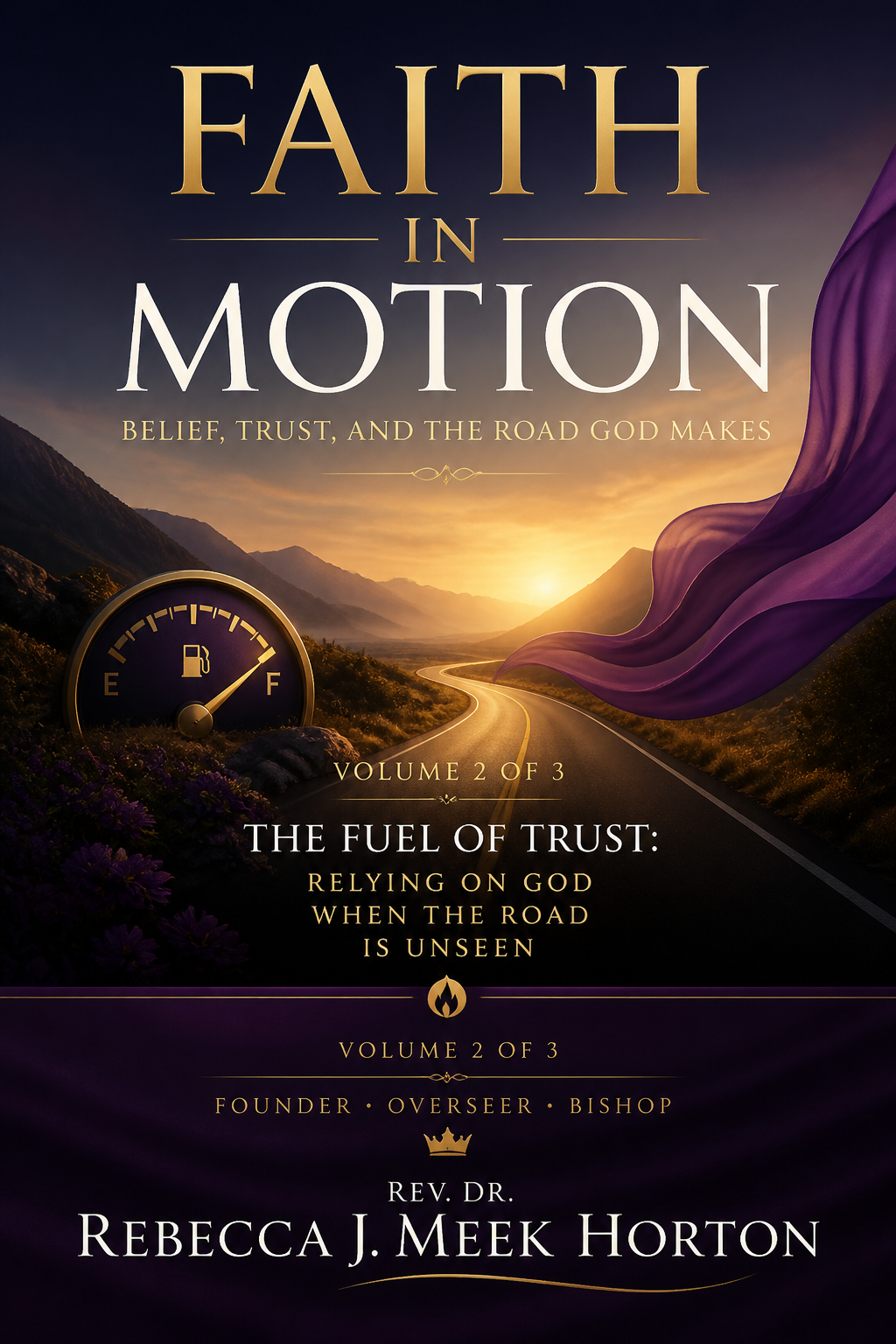
Faith in Motion: Belief, Trust, and the Road God Makes · Volume 2
The Fuel of Trust: Relying on God When the Road Is Unseen
Part 2 of 3 in the series "Faith in Motion: Belief, Trust, and the Road God Makes". Series theme: Series arc: True faith is a response to the God who speaks: belief gives faith its vehicle, trust gives faith its fuel, and obedience carries faith into faithful witness. The series begins with the foundation—faith begins with God, not human optimism or religious effort. It then moves into the cost a
Full publication
NBCNGMI MASTER KNOWLEDGE LIBRARY Featuring the works of The Sage, Apostle Prophet. Rev. Dr. Rebecca J. Meek Horton, Apostolic Prophetic Architect, NewBeing Creation Network Global Ministries, Inc. Integrated Framework Modalities™
Dedication
I dedicate this book to every leader still choosing to trust God when the road is unseen, the wait is long, and the cost is real. May your faith be fueled by His character, steadied by His Word, and strengthened for the next faithful step. May Proverbs 3:5-6 become more than a verse you know, but a path you walk.
Purpose
I prepared this book for leaders who believe God, yet still need strength to rely on Him when the road is unseen, costly, or slow.
My prayer is that these pages help you move from confessed belief into surrendered dependence, anchoring your trust in God’s character rather than in visible outcomes.
May you learn to say with a steady heart: God is faithful, whether the road gets easier or harder, and I will keep the next faithful step before Him. Proverbs 3:5-6.
Preface
This book was written for leaders who still believe God, but are learning what belief costs when the road is not clear.
I have found that faith is often strongest in confession, but tested in movement. It is one thing to say, God is faithful, when the path is bright. It is another to keep relying on Him when the answer is delayed, the burden is heavy, the door is not opening, and the next step requires surrender before certainty.
The Fuel of Trust is Part 2 in the Faith in Motion series. The first movement established that faith begins with God, not human optimism, religious effort, or emotional strength. Belief gives faith its vehicle. But when life becomes costly, belief must be fueled by trust.
That is the burden of these pages.
Trust is not pretending pain is easy. Trust is not denying grief, confusion, weakness, or waiting. Trust is active reliance on the character of God when outcomes are still unfolding. It is the settled surrender that says, God is faithful, whether the road gets easier or harder.
Leaders need this because leadership often requires us to walk while others are watching, serve while we are being stretched, and make decisions without having every detail in advance. The unseen road can expose what we have been leaning on. Sometimes we discover that we were trusting clarity more than Christ, control more than character, and outcomes more than obedience.
God is merciful enough to show us.
Proverbs 3:5-6 (KJV) Trust in the LORD with all thine heart; and lean not unto thine own understanding. In all thy ways acknowledge him, and he shall direct thy paths.
My prayer is that this book will help you slow down, tell the truth, release false control, and learn to rely on God with a steadier heart. Nothing is random. Nothing is wasted. Even the unseen road can become holy ground when God is leading.
As you read, do not rush past the places that search you. Bring your questions honestly. Let Scripture govern your conclusions. Let waiting form patience. Let uncertainty deepen dependence.
Begin with this simple prayer: Lord, teach me to trust You where I cannot yet see.
Introduction
Leaders often discover the cost of trust after they have already said yes to God.
At the beginning, belief may be clear. The call may be strong. The Word may burn with life. But then the road stretches longer than expected. The answer delays. The people change. The resources feel thin. The promise remains true, but the path becomes costly.
That is where trust is tested.
This book is Part 2 of Faith in Motion: Belief, Trust, and the Road God Makes. The first movement established that faith begins with God, not human optimism, religious effort, or emotional force. Belief gives faith its vehicle. It receives what God has spoken and says yes to His truth.
But belief must keep moving.
Trust is the fuel.
Trust is not pretending the road is easy. It is not controlling the outcome. It is not calling pain good, denying disappointment, or silencing honest questions. Trust is active reliance on the character of God when the road is unseen. It is the leader’s surrendered confession: God is faithful, whether the road gets easier or harder.
Proverbs 3:5-6 (KJV) Trust in the LORD with all thine heart; and lean not unto thine own understanding. In all thy ways acknowledge him, and he shall direct thy paths.
This passage does not promise that every step will feel obvious. It calls us away from self-reliance and into dependence. It teaches us that trust is not built on our ability to understand everything. Trust is built on the Lord who directs the path.
That matters deeply for leaders.
A leader’s trust is never private. The people we serve are shaped not only by what we teach, but by how we wait, how we suffer, how we make decisions, how we respond when God is quiet, and how we walk when the next step is all we have. When leaders trust God only when outcomes are favorable, the people learn fragile faith. When leaders trust God with honesty, humility, and obedience, the people learn endurance.
This book will walk through the places where trust is often strained: waiting, suffering, silence, uncertainty, hiddenness, loss of control, and costly obedience. Each chapter will carry one teachable idea and one clear practice. The aim is not to make you dependent on another voice to tell you what to do. The aim is to help you mature in discernment, surrender, and faithful movement before God.
Read slowly.
Keep your Bible near. Keep a journal if you can. Do not rush past the questions that search you. When a sentence names something you have been carrying, pause there. Let the Lord tell the truth without shame. Let Scripture correct the interpretation that fear, fatigue, or disappointment may have written in you.
Hebrews 11:8 (KJV) By faith Abraham, when he was called to go out into a place which he should after receive for an inheritance, obeyed; and he went out, not knowing whither he went.
Abraham did not begin with the whole map. He began with the God who called him.
That is still the pattern.
The unseen road does not mean an absent God. The unanswered question does not mean an unfaithful Father. The hard season does not mean grace has stopped flowing. Trust learns to move without demanding mastery. It waits in stillness, asks honestly, listens carefully, and keeps the next faithful step.
As you begin, bring one place before God where belief is present but trust feels tired. Name it plainly. Do not decorate it. Do not deny it. Write this sentence and complete it honestly:
Lord, I believe You, but I need grace to trust You with __________.
Then begin the road with Him.
Chapter 1 — 1. When Belief Meets the Unseen Road
The room gets quiet after the meeting ends.
The reports are still on the table. The budget is not settled. The team is tired. A door that seemed open last month now looks uncertain. People are looking to you for steadiness, but inside you are carrying questions you cannot say too loudly.
You believe God.
That is not the problem.
The problem is that you believe God and still cannot see the road.
This is where many leaders discover the difference between belief and trust. Belief says, “God is real. God is able. God has spoken.” Trust says, “I will rely on Him here, while the way is still hidden.”
The single idea of this chapter is simple: trust is active reliance on God’s character when visible outcomes are not enough to steady you.
Faith does not begin with our ability to see. Hebrews 11:1 says, “Now faith is the assurance of things hoped for, the conviction of things not seen.” Faith has never required full visibility. It requires a faithful God.
## The Unseen Road Is Not an Unfaithful Road
Leaders often feel pressure to interpret uncertainty as failure.
If the plan is unclear, we assume we missed something. If the provision has not arrived, we wonder if we moved too soon. If the people are unsettled, we question whether God is still leading.
But Scripture does not treat the unseen road as strange.
Abraham went out “not knowing where he was going” (Hebrews 11:8). Israel followed a cloud and fire through wilderness, not a printed map. The disciples stepped into storms with Jesus in the boat and still did not understand what He was doing.
The unseen road is not automatically an unfaithful road.
There are seasons when God gives enough light for obedience, but not enough detail for control.
A pastor may know it is time to strengthen the church’s foundation, but not know how the finances will respond. A ministry leader may know a hard conversation must happen, but not know whether the relationship will survive it. A founder may know the assignment is real, but not know how long the hidden work will take.
In those moments, trust is not pretending the road is clear.
Trust is saying, “God is faithful, and I will not make visibility my source of peace.”
Proverbs 3:5–6 gives the leader a grounded path: “Trust in the Lord with all your heart, and do not lean on your own understanding. In all your ways acknowledge Him, and He will make straight your paths.”
Notice the order.
Trust the Lord.
Do not lean on your own understanding.
Acknowledge Him in all your ways.
Then He makes the path straight.
The straight path is God’s work. Trusting, yielding, and acknowledging are ours.
## Belief Confesses; Trust Relies
Belief matters. Without belief, faith has no vehicle.
But belief can remain stated while the heart still leans on control. A leader can preach God’s faithfulness and still be ruled by panic. A leader can quote promises and still grasp for outcomes. A leader can believe correct doctrine while carrying the weight as if everything depends on human management.
This is why trust must become more than agreement.
Trust is reliance.
It is the difference between saying a chair can hold you and actually sitting down. It is the difference between knowing a bridge was built to carry weight and placing your feet on it when the river below is loud.
Many leaders live in the strain between confession and reliance.
We confess, “God will provide,” but we cannot sleep unless every number is already solved.
We confess, “God is leading,” but we rush decisions because silence feels unsafe.
We confess, “God owns the work,” but we carry criticism as if our identity depends on the approval of people.
This is not hypocrisy. Often, it is immaturity under pressure. It is the place where God kindly exposes what our words believe but our nervous system has not yet learned to entrust.
Trust grows when belief is tested.
A leader once described a season when every visible sign seemed mixed. Attendance was inconsistent. Giving was unpredictable. The staff needed clarity. She kept asking God for the full plan. What she received instead was one step: gather the team, tell the truth, pray, and strengthen what remained.
It felt too small.
But that was the next faithful step.
Months later, she could see that God had not abandoned the work. He had been removing hurry from the leader before rebuilding strength in the ministry.
Nothing is random. Nothing is wasted.
Trust often begins where our demand for full understanding ends.
## God’s Character Must Carry What Outcomes Cannot
Outcomes are not strong enough to carry a leader’s soul.
Good outcomes can encourage us, but they cannot become the foundation of our trust. If they do, peace will rise and fall with the report, the offering, the attendance, the response, the opportunity, or the approval.
That is not trust. That is emotional dependence on visible conditions.
Biblical trust anchors in God Himself.
Hebrews 11 does not celebrate people who controlled outcomes. It remembers people who acted because they trusted the God who called, promised, warned, and led. Some saw deliverance. Some endured suffering. Some received what was promised. Some died still waiting in faith.
The common thread was not ease.
The common thread was God.
This matters for leaders because leadership exposes what we have been using as fuel.
If praise fuels us, criticism will empty us.
If certainty fuels us, ambiguity will paralyze us.
If visible success fuels us, hidden obedience will feel like failure.
But if trust in God’s character fuels us, we can keep moving without demanding that every mile explain itself.
God is wise when the process feels confusing.
God is faithful when the timing feels slow.
God is present when the road feels lonely.
God is good when the outcome is not yet visible.
This does not make leadership painless. It makes leadership anchored.
A leader may still grieve. Still ask questions. Still seek counsel. Still revise plans. Still admit weakness. Trust does not remove honest stewardship. It purifies it.
Stewardship asks, “What responsibility has God placed in my hands?”
Control asks, “How can I force the outcome I fear losing?”
Trust helps us know the difference.
## The First Work of Trust Is Surrendered Attention
When the road is unseen, leaders often reach for motion.
Send another message. Schedule another meeting. Make another announcement. Rework the plan again. Search for a sign. Push for a door. Study everyone else’s success.
Some action is faithful. Some action is fear wearing leadership clothes.
The first work of trust is surrendered attention.
Before the leader moves, the leader must become present to God.
This does not mean passivity. It means we refuse to let anxiety become our strategist.
Proverbs 3:6 says, “In all your ways acknowledge Him.” That word “all” is mercy. God does not ask to be acknowledged only in spiritual language, prayer meetings, and worship services. He is to be acknowledged in budgets, hiring, timing, conflict, planning, correction, and rest.
Acknowledge Him in the email you want to send too quickly.
Acknowledge Him in the decision that feels urgent.
Acknowledge Him in the pressure to look stronger than you are.
Acknowledge Him before you explain yourself.
Acknowledge Him before you build what your soul cannot carry.
This is where trust becomes practical. It slows the leader down enough to ask, “Am I relying on God, or am I leaning on my own understanding?”
The answer may not condemn you. It may recalibrate you.
A leader can pause for five minutes before a hard meeting and pray, “Lord, I trust Your character more than my ability to manage this room. Give me wisdom. Keep me truthful. Keep me from fear.”
That small prayer is not small.
It is a transfer of weight.
## The Cost: Trust Will Challenge Your Need to See
Trust sounds beautiful until it asks for surrender.
The cost of this chapter is that you may have to release your demand for certainty before obedience. You may have to stop treating clarity as proof that God is with you. You may have to admit that some of your leadership exhaustion is not from responsibility alone, but from carrying what belongs to God.
This is tender work.
Leaders are often rewarded for knowing, deciding, fixing, and producing. People come to leaders for answers. But the leader who follows God must learn to say, “I do not see the whole road, but I know the One who leads.”
That sentence may feel costly.
It may humble your image.
It may slow your pace.
It may disappoint people who prefer confidence without dependence.
But it will also protect your soul.
Trust does not make you less responsible. It makes you rightly responsible. You carry obedience. God carries outcomes.
You steward the next step. God governs the road.
## Key Takeaways
- Trust is active reliance on God’s character when the road is unseen. - Uncertainty is not proof that God is absent or unfaithful. - Leaders carry obedience; God carries outcomes.
## Practice
Before your next major decision, take ten quiet minutes with Proverbs 3:5–6.
Write two columns:
**What I know God has asked me to steward.** **What I am trying to control because I cannot yet see.**
Pray honestly over both columns.
Then choose one next faithful step you can take without forcing the outcome.
Chapter 2 — 2. The Faithful One Is the Promise
The room was full, but the leader felt alone.
The worship had ended. The meeting had gone well. People shook hands, smiled, and said, “God is moving.” But in the quiet afterward, the leader sat in the office with the lights low and the questions loud.
What if the provision does not come?
What if the people leave?
What if I missed something?
What if obedience leads into more uncertainty, not less?
Many leaders know that room. The outside looks steady. The inside is searching for something solid.
This chapter’s single idea is simple: trust is not anchored in the road God shows us, but in the God who is faithful before the road is clear.
The comfort of faith is not control. It is not the ability to predict what happens next. It is the unchanging faithfulness of the Lord.
“Know therefore that the LORD your God is God, the faithful God who keeps covenant and steadfast love” (Deuteronomy 7:9).
Before leaders ask, “Where is this going?” we must learn again to ask, “Who is leading me?”
## Before the Road, There Is the Lord
God does not begin by giving His people a map. He begins by revealing Himself.
When Israel stood on the edge of promise, Moses did not first remind them of their military strategy, their numbers, or their ability to manage the unknown. He reminded them of God’s character.
“The LORD your God is God, the faithful God” (Deuteronomy 7:9).
That word *faithful* carries weight. God is not faithful because circumstances are favorable. He is faithful because He cannot deny Himself. His covenant love is not easily exhausted. His mercy is not thin. His promises are not fragile.
Leaders often want enough information to feel safe. God gives something deeper. He gives Himself.
A pastor may want to know if the church will grow.
A parent may want to know if the child will return.
A founder may want to know if the work will survive.
A leader may want to know if the decision will be understood.
Those questions are human. They are not wrong. But they cannot carry the full weight of trust.
If trust depends on knowing the outcome, then trust will rise and fall with every report, every conversation, every delay, every disappointment.
God invites us to a stronger place.
Trust begins when the soul says, “I do not know the road, but I know the One who leads.”
This is not denial. It is order.
Before the road, there is the Lord.
## Faithfulness Is God’s Nature, Not Our Mood
There are days when faith feels strong. There are days when faith feels tired. Leaders must learn the difference between God’s faithfulness and their own emotional weather.
Jeremiah wrote Lamentations from a place of deep sorrow. Jerusalem had fallen. The city was broken. The grief was not imagined. Yet in the middle of lament, he declared:
“The steadfast love of the LORD never ceases; his mercies never come to an end; they are new every morning; great is your faithfulness” (
Chapter 3 — 3. Trust Waits Without Wasting
The hallway outside the meeting room was quiet.
The leader had arrived early, notes in hand, ready to present the next step. The plan had been prayed over, revised, reviewed, and prepared. But by the end of the meeting, the answer was not yes. It was not no.
It was wait.
No timeline. No promise of quick movement. No visible progress to report to the team.
Only a closed folder, a tired smile, and the heavy walk back to the car.
Every leader knows that hallway.
Waiting can feel like wasted time when there is work to do, people to lead, and pressure to show movement. But in the kingdom of God, waiting is not empty space. Waiting is formation.
The controlling idea of this chapter is simple: trust waits without wasting because God uses hidden seasons to strengthen dependence, purify motives, and prepare leaders for what they cannot yet carry.
Psalm 27:14 says, “Wait for the Lord; be strong, and let your heart take courage; wait for the Lord!”
Isaiah 40:31 says, “But they who wait for the Lord shall renew their strength.”
Waiting is not passive delay. It is active reliance.
## Waiting Reveals What Has Been Carrying Us
Waiting exposes what movement can hide.
When things are moving quickly, leaders can mistake activity for strength. A full calendar can make us feel fruitful. A growing platform can make us feel secure. A visible assignment can make us feel approved.
Then God allows a pause.
The door does not open. The answer does not come. The funding slows. The team is not ready. The next instruction is not clear.
In that pause, we begin to see what has been carrying us.
Was it trust in God, or trust in momentum?
Was it obedience, or the comfort of being needed?
Was it calling, or the fear of becoming invisible?
This is not condemnation. It is mercy.
A leader once admitted, “I thought I was frustrated because the ministry was delayed. But I realized I was afraid people would forget me if I was not producing.”
That realization was not wasted. It was holy ground.
Waiting gave the leader a gift that success had not given: truth.
David wrote Psalm 27 while surrounded by threats, yet he ended with waiting. “Wait for the Lord.” Not wait for the threat to disappear. Not wait for the throne to feel secure. Wait for the Lord.
Waiting redirected his heart from visible relief to faithful reliance.
Leaders need this same mercy. We do not only need open doors. We need formed hearts.
Nothing is random. Nothing is wasted.
## Waiting Trains Us to Receive Strength, Not Manufacture It
Isaiah does not say, “They who wait for the Lord shall prove their strength.”
It says they “shall renew their strength.”
That matters.
Waiting teaches leaders that strength is received before it is expressed. We do not lead well by living permanently overextended and calling it sacrifice. We do not honor God by manufacturing energy He has not supplied.
There is a kind of leadership that runs on adrenaline, approval, and urgency. It can look powerful for a season. But it does not renew the soul. It drains it.
Waiting interrupts that false fuel.
Think of a phone plugged into the wall. From the outside, it looks inactive. No messages are being sent. No calls are being made. No maps are being used. But something necessary is happening. Power is being restored.
The waiting season may look inactive to others, but God may be renewing what constant output has depleted.
A pastor may wait before launching a new service because the current team is tired.
A marketplace leader may wait before expanding because the internal structure is strained.
A parent in ministry may wait before accepting another assignment because home needs attention.
To the impatient eye, waiting looks like lost opportunity.
To wisdom, waiting may be stewardship.
“Those who wait for the Lord shall renew their strength.” Renewal is not wasted time. It is preparation for faithful endurance.
A leader who refuses renewal may confuse exhaustion with devotion.
Trust learns to receive.
## Waiting Keeps Obedience Small and Faithful
Leaders often want the full map.
God often gives the next step.
That can feel frustrating, especially for those responsible for other people. Leaders are trained to plan, forecast, manage risk, and communicate direction. These are good responsibilities. But they can become burdensome when we demand certainty God has not given.
Waiting does not mean doing nothing. It means doing what is faithful while leaving the hidden parts with God.
There is usually something to steward in the waiting.
Pray honestly.
Clarify what is already known.
Strengthen what has been neglected.
Care for the people already entrusted to you.
Review the last instruction.
Repent where haste has entered.
Prepare quietly.
Encourage the weary.
Do the ordinary work.
A leader waiting on direction for a major transition may not know when the door will open. But that leader can still meet with the team, honor current commitments, teach faithfully, rest properly, and refuse manipulation.
That is not wasted waiting.
It is obedience without spectacle.
This is where the WALK™ rhythm becomes helpful: Wait in stillness, Ask honestly, Listen carefully, and Keep the next faithful step.
Not ten steps.
Not the impressive step.
The next faithful step.
Psalm 37:23 says, “The steps of a man are established by the Lord, when he delights in his way.” Steps are smaller than maps. But they are enough when God is the One establishing them.
Waiting matures leaders by teaching them to obey without needing the whole picture.
## Waiting Protects Us From Self-Made Outcomes
Hidden seasons test motive.
When waiting feels too long, leaders are tempted to create movement God has not given. We can force a door, pressure a person, announce prematurely, spiritualize impatience, or call our anxiety “vision.”
This is where trust must become practical.
Trust says, “I will not make an Ishmael because Isaac is taking time.”
Abraham and Sarah knew the strain of waiting. God had promised, but years passed. In Genesis 16, impatience entered the promise. They chose a self-made solution through Hagar, and that decision brought pain into the household.
Their story is not given so we can stand above them. It is given because we are capable of the same thing.
Leaders can birth self-made outcomes when waiting becomes unbearable.
We can hire too quickly because we are tired.
We can launch too early because people are asking.
We can speak before we are settled because silence feels weak.
We can accept assignments God has not confirmed because opportunity flatters us.
Waiting asks for restraint.
Restraint is not fear. Restraint is governed trust.
It says, “If God has not released this, I will not force it. If the structure cannot carry it, I will not pretend it can. If the people are not ready, I will not use them to satisfy pressure.”
Do not Force-The-FiT™.
God is not honored by movement that violates stewardship.
Waiting protects the leader from building what God did not ask them to carry.
## The Cost of Waiting
Waiting costs something.
It may cost visibility.
It may cost the applause that comes from announcing new things.
It may cost the comfort of appearing certain.
It may cost opportunities that look good but are not assigned.
It may cost the leader’s need to explain everything.
This is hard.
There are moments when waiting feels like weakness. People may misunderstand. Some may assume nothing is happening. Others may pressure you to move faster. Your own heart may accuse you of falling behind.
But trust does not measure faithfulness by speed.
Trust measures faithfulness by reliance.
The question is not, “Am I moving fast enough to feel secure?”
The question is, “Am I remaining faithful to God in what He has given me today?”
Waiting is not wasted when it forms courage.
Waiting is not wasted when it restores strength.
Waiting is not wasted when it keeps obedience clean.
Waiting is not wasted when it protects the leader from premature weight.
The unseen road is still held by the Faithful One.
## Key Takeaways
- Waiting is formation, not empty delay.
- God renews strength in hidden places.
- The next faithful step is enough for today.
## Practice
Set aside twenty quiet minutes this week.
Write down one area where you are waiting. Then answer these four questions:
1. What am I tempted to force? 2. What has God already made clear? 3. What responsibility can I steward faithfully today? 4. What next step can I take without grasping for control?
Close by praying Psalm 27:14 aloud:
“Wait for the Lord; be strong, and let your heart take courage; wait for the Lord!”
Chapter 4 — 4. Trust Tells the Truth About Pain
The leader closed the office door before the tears came.
The meeting had gone well enough. People had been encouraged. Decisions had been made. The right words had been spoken. But when the room emptied, the weight remained.
A family had left the church in anger. A trusted leader had disappointed her. A long-prayed-for breakthrough had not come. She believed God. She loved God. She still preached His faithfulness.
But she was in pain.
Many leaders know that room. They know how to carry sorrow quietly because others need them steady. They know how to say “God is good” while wondering why the ache has not lifted. They know how to keep serving while grief sits beside them.
This chapter’s single idea is simple: **trust does not require denial; trust tells the truth about pain in the presence of God.**
Biblical trust is not pretending the wound is small. It is refusing to carry the wound away from God. Lament is not the opposite of faith. Lament is one of faith’s honest languages.
## Trust Does Not Need a Mask
Some leaders learned, quietly or directly, that strong faith must sound untroubled.
So pain gets edited.
Grief becomes “I’m fine.”
Disappointment becomes “God has a plan.”
Exhaustion becomes “I’m just busy.”
Those statements may contain truth, but they can also become hiding places. A leader can use correct theology to avoid honest prayer.
Psalm 13 does not hide.
David begins with a question many leaders would be afraid to say aloud:
> “How long, O LORD? Will you forget me forever? How long will you hide your face from me?” > — Psalm 13:1
That is not polished language. It is not safe religious speech. It is the cry of a faithful man who feels forgotten.
David does not deny his pain in order to protect God’s reputation. He brings his pain to God because he trusts God’s character. That difference matters.
A leader once told me, “I feel guilty praying what I actually feel.” But the Psalms teach us that God is not honored by our pretending. He is honored when we bring the real heart before Him and stay there.
Lament is not unbelief.
Lament is pain refusing isolation.
It says, “Lord, this is where I am. I will not dress it up. I will not run from You. I will speak the truth here.”
Trust tells the truth because God already knows it.
## Lament Holds Pain and Confidence Together
Psalm 13 does not end where it begins.
David starts with anguish, but he does not abandon trust:
> “But I have trusted in your steadfast love; my heart shall rejoice in your salvation.” > — Psalm 13:5
The pain is real. The confidence is real too.
This is the holy tension of lament. It does not choose between sorrow and faith. It holds both before God.
Leaders often feel pressure to resolve the tension too quickly. We want a clean lesson, a clear answer, a testimony that makes sense by Sunday. But lament gives us room to be unfinished before God.
David asks, “How long?” and also says, “I have trusted.”
Both are in the same prayer.
That means a leader can say:
“I am hurting, and God is faithful.”
“I am confused, and God is still my help.”
“I am disappointed, and I will not turn away.”
“I do not understand this road, and I will keep my confidence in Him.”
This is not double-mindedness. This is mature trust.
The apostle Paul gives us another picture of this honesty. Writing about affliction in Asia, he says:
> “For we do not want you to be unaware, brothers, of the affliction we experienced in Asia. For we were so utterly burdened beyond our strength that we despaired of life itself.” > — 2 Corinthians 1:8
Paul does not sound untouchable. He does not present leadership as constant victory. He says they were burdened beyond strength. They despaired of life itself.
Then he names what the suffering produced:
> “But that was to make us rely not on ourselves but on God who raises the dead.” > — 2 Corinthians 1:9
Paul’s trust did not deny the burden. His trust was formed in the burden.
There are places in leadership where self-reliance quietly dies. Not dramatically. Not all at once. But through the painful mercy of realizing, “I cannot carry this by my strength.”
That moment is not failure.
It may be the beginning of deeper reliance.
## Pain Brought to God Becomes Stewarded Pain
Pain that is hidden does not disappear. It leaks.
It leaks into tone.
It leaks into decisions.
It leaks into sermons, meetings, parenting, correction, and silence.
A leader who never laments may still function, but the soul begins to harden. Unnamed grief becomes irritability. Unprocessed disappointment becomes suspicion. Unspoken fear becomes control.
Nothing is random. Nothing is wasted. Even pain must be stewarded.
To steward pain does not mean to explain it. It means to bring it under the care of God with honesty and surrender.
Consider a pastor who faces betrayal from someone close. If he refuses to name the wound, he may begin leading from guardedness. Every new leader becomes a potential threat. Every disagreement feels like danger. The pain is now governing the room.
But if he brings the wound to God in lament, something different can begin.
“Lord, I feel betrayed.”
“Lord, I am angry.”
“Lord, I do not know how to trust people right now.”
“Lord, keep my heart from becoming hard.”
That prayer does not erase the consequences. It does not remove the need for boundaries, counsel, or wise leadership decisions. But it places the pain in the presence of the One who can keep the leader from being ruled by it.
Paul says God “comforts us in all our affliction” so that we may comfort others with the comfort we have received from Him (2 Corinthians 1:3–4).
This is not romantic language. Comfort often comes slowly. Sometimes it comes through Scripture. Sometimes through prayer. Sometimes through tears, silence, godly counsel, rest, or the steady presence of the Spirit when nothing outward has changed.
But comfort received becomes comfort stewarded.
Leaders do not need to bleed on people in order to be honest. But they do need to let God tend the wound before the wound starts leading.
## Honest Trust Protects the Soul from False Strength
There is a kind of strength that looks impressive but is not holy.
It never admits need.
It never asks for prayer.
It never pauses.
It keeps producing while the inner life collapses.
This is not trust. It is performance wearing spiritual language.
True trust can say, “I am not enough, but God is faithful.”
Paul’s testimony in 2 Corinthians 1 moves from despair to reliance. He says God delivered, God will deliver, and “on him we have set our hope” (2 Corinthians 1:10). His hope is not in his capacity to endure. His hope is in the God who raises the dead.
Leaders need that sentence close.
God raises the dead.
Not just dead bodies at the last day, though yes, our hope rests there. But also dead courage. Dead joy. Dead expectation. Dead places in the soul that suffering has touched.
Trust does not say, “This does not hurt.”
Trust says, “This hurts, and my hope is still in the God who raises the dead.”
That kind of honesty protects leaders from two dangers.
First, it protects from despair. Pain spoken before God is not pain carried alone.
Second, it protects from pride. A leader who laments remembers that dependence is not weakness. It is the truth.
The cost is real. If you tell the truth about pain, you may have to stop pretending you are unaffected. You may need to ask for help. You may need to slow down long enough to feel what you have been outrunning. You may need to let trusted people know that you are human.
That can feel costly for a leader.
But the greater cost is carrying pain without God’s comfort, then calling the heaviness “faithfulness.”
The Lord does not ask you to be untouched.
He invites you to be held.
## Key Takeaways
- Trust tells the truth about pain in God’s presence. - Lament holds sorrow and confidence together. - Pain must be stewarded before it begins to lead.
## Practice
Set aside twenty quiet minutes this week to pray Psalm 13 slowly.
Write three honest sentences to God:
1. “Lord, this is what hurts…” 2. “Lord, this is what I do not understand…” 3. “Lord, I choose to trust You because…”
Do not rush to fix the prayer. Bring the truth, and remain with God there.
Chapter 5 — 5. Trust Listens in the Silence
The room was full, but the leader felt alone.
People were asking for direction. Staff needed answers. The calendar was moving. Decisions could not wait forever. Yet in prayer, there was no thunder. No clear sentence. No sudden peace that settled everything.
Only quiet.
Every leader eventually stands in that place. You still believe. You still pray. You still open Scripture. You still show up. But the clarity you want has not come.
This chapter’s single idea is simple: **trust learns to listen in the silence without forcing clarity or assuming abandonment.**
Silence is not always absence. Sometimes it is the place where God trains our attention, steadies our obedience, and deepens our surrender.
## Silence Is Not Proof That God Has Left
Elijah knew noise.
He had seen fire fall on Mount Carmel. He had confronted false prophets. He had watched God answer publicly and powerfully. But soon after, fear drove him into the wilderness. He was exhausted, discouraged, and ready to quit.
Then God brought him to Horeb.
There was a great wind. But the Lord was not in the wind. There was an earthquake. But the Lord was not in the earthquake. There was a fire. But the Lord was not in the fire.
Then came “a low whisper” (1 Kings 19:11–13).
God was present, but not in the form Elijah may have expected.
Leaders often expect God’s guidance to arrive with force. A dramatic confirmation. A visible open door. A quick answer that removes tension. But Scripture reminds us that God is not obligated to speak in the volume we prefer.
Sometimes He quiets the room so we can hear what noise has been covering.
A pastor may pray for immediate direction about a ministry decision and feel nothing certain. A founder may ask whether to expand and receive no clear release. A parent-leader may carry concern for both home and assignment and long for one unmistakable word.
Silence can feel like rejection.
But it may be invitation.
The faithful question is not, “Why is God not speaking the way I want?” The faithful question is, “How can I remain attentive to God as He chooses to lead?”
Trust does not demand that God become louder. Trust becomes quieter before Him.
## Attentiveness Is Different From Anxiety
Habakkuk gives leaders a holy picture of attentiveness.
After bringing his questions before the Lord, he says, “I will take my stand at my watchpost and station myself on the tower, and look out to see what he will say to me” (Habakkuk 2:1).
He does not pretend there is no tension. He does not abandon his post. He does not manufacture an answer. He watches.
Then the Lord answers, “Write the vision; make it plain on tablets, so he may run who reads it. For still the vision awaits its appointed time… If it seems slow, wait for it; it will surely come; it will not delay” (Habakkuk 2:2–3).
This is not passive waiting. It is attentive waiting.
Anxiety paces. Attentiveness watches.
Anxiety demands relief. Attentiveness stays available.
Anxiety fills the silence with guesses. Attentiveness leaves room for God to speak in His time.
For leaders, this matters deeply. When God seems quiet, the temptation is to interpret silence through fear. We begin asking, “Did I miss Him? Is He displeased? Should I move before the opportunity passes? What will people think if I do not have an answer?”
Those questions may feel urgent, but they can pull us out of listening.
Attentiveness requires a steadier posture.
It may look like setting aside time each morning to sit with Scripture before checking messages. It may mean telling a team, “We are not ready to decide today. We will keep praying, gathering counsel, and watching the fruit.” It may mean writing down what is clear and refusing to invent what is not.
Nothing is random. Nothing is wasted.
Even quiet seasons can become ordered when leaders refuse to let anxiety govern the room.
## Do Not Force Clarity
Silence exposes one of the leader’s strongest temptations: the desire to make something happen.
When clarity does not come, leaders may force decisions, overread circumstances, spiritualize preference, or call pressure “urgency.” We may confuse motion with obedience.
But trust does not Force-The-FiT™.
If God has not made the next mile clear, He may still be giving enough light for the next step. Psalm 119:105 says, “Your word is a lamp to my feet and a light to my path.” A lamp does not show the whole road. It gives enough light to walk faithfully where you are.
There is mercy in that.
Leaders do not need to know everything to obey something.
You may not know whether the whole initiative will succeed, but you can tell the truth in the next meeting. You may not know how the financial pressure will resolve, but you can steward today’s resources with integrity. You may not know when the door will open, but you can prepare without striving.
Forcing clarity often creates more confusion. It puts weight on a word God did not speak. It pressures people to follow certainty we do not actually possess. It can turn leadership into performance.
A wise leader can say, “I do not know yet.”
That is not weakness. It is truthfulness.
There is a holy simplicity in naming what is known, what is unknown, and what faithfulness requires now.
Known: God is faithful.
Unknown: the full timing and shape of the road.
Next step: remain obedient with what He has already entrusted.
This is governed movement. Not frantic movement. Not frozen movement. Governed Movement™.
## Silence Forms Deeper Surrender
God’s quietness can reveal what we have been leaning on.
If we only feel secure when answers are immediate, our trust may be resting in clarity more than in God. If we only feel confident when outcomes are visible, our peace may be tied to control. If we only feel called when people affirm us, our identity may need RE-Calibration™.
Silence searches us.
This is not punishment. It is formation.
In the quiet, God teaches leaders to stay grounded in what He has already said. He teaches us to return to Scripture, not as a tool to extract quick answers, but as the living Word that anchors our souls. He teaches us to pray without performing. He teaches us to receive counsel without surrendering discernment. He teaches us to obey without applause.
Jesus said, “My sheep hear my voice, and I know them, and they follow me” (John 10:27). Hearing and following belong together. Sometimes the next act of trust is not receiving new information. Sometimes it is obeying the last clear instruction.
A leader once described a quiet season this way: “I kept asking God for a map. He kept giving me manna.”
That is often how trust is fed.
Daily bread.
Daily mercy.
Daily strength.
Daily correction.
Daily presence.
Not the whole road. Enough for today.
Silence becomes dangerous when we stop listening. But it becomes holy ground when we remain present to God, honest about our need, and faithful in the next responsibility.
The cost is real.
Listening in silence asks leaders to lay down the appearance of certainty. It asks us to disappoint people who want immediate answers. It asks us to resist the ego that wants to sound more confident than we are. It asks us to trust God’s timing when delay makes us look unprepared.
That is not easy.
But it is mature.
Leaders who learn to listen in the silence become safer leaders. They do not rush people into untested words. They do not build strategies on panic. They do not mistake pressure for permission. They become steady because their confidence is not in constant clarity, but in the faithful God who leads.
## Key Takeaways
- God’s silence is not proof of His absence. - Attentiveness watches without anxiety. - Trust obeys the next clear step without forcing clarity.
## Practice
Set aside fifteen quiet minutes today.
Use the WALK™ rhythm:
**Wait** in stillness before God. **Ask** honestly: “Lord, what have You already made clear?” **Listen** with Scripture open, without rushing to fill the silence. **Keep** one next faithful step today.
Write that step in one sentence, then obey it.
Chapter 6 — 6. Trust Releases the Need to Control
The meeting had gone long.
A few leaders sat around the table with tired eyes and quiet phones. The numbers were uncertain. A key family had left. A needed answer had not come. Someone asked the question no one wanted to say out loud: “What if this does not work?”
The room shifted.
Not because the question was wrong, but because leaders often carry an invisible pressure to make everything work. We feel responsible for outcomes we cannot command. We feel judged by results we cannot guarantee. We want to be faithful, but somewhere along the way faithfulness can become mixed with grasping.
This chapter’s single idea is simple: **trust releases the need to control without releasing the call to steward well.**
Trust does not make leaders passive. It makes leaders honest. We are responsible before God, but we are not God. We plant. We water. We build. We decide. We repent. We repair. But we do not control the harvest, the timing, the response of people, or the hidden work of God.
Jesus said, “Do not be anxious about your life” (Matthew 6:25). James wrote, “You do not know what tomorrow will bring” (James 4:14). These are not rebukes against planning. They are corrections against pretending we possess what only God holds.
## Control Often Wears the Clothes of Responsibility
Most leaders do not call it control.
We call it urgency. Excellence. Burden. Vision. Protection. Wisdom.
Sometimes it is those things. But sometimes control hides underneath good language. It shows up when we cannot rest unless every variable is managed. It appears when we over-explain decisions to protect our image. It rises when we rush because uncertainty feels like failure.
A pastor sees giving decline for three months. Instead of prayerfully assessing the moment, he panics. He starts pushing every program harder. He pressures the team. He changes language to sound more successful than things are. He tells himself he is protecting the ministry.
But inside, he is trying to control fear.
A director receives criticism from a trusted volunteer. Instead of listening, she immediately defends herself. She sends long messages, gathers allies, and replays the conversation all night. She tells herself she is preserving clarity.
But inside, she is trying to control perception.
Control often begins where trust feels too vulnerable.
Jesus speaks directly to this in Matthew 6:27: “And which of you by being anxious can add a single hour to his span of life?” Anxiety can consume energy, but it cannot create sovereignty. It can make us busy, but it cannot make us God.
Faithful leadership requires responsibility. But anxious control turns responsibility into possession. It says, “This is mine to secure.” Trust says, “This is mine to steward before the Lord.”
That difference may look small from the outside. It is not small in the soul.
## Surrender Is Not Neglect
Some leaders resist surrender because they think it means carelessness.
They fear that if they release control, things will fall apart. If they stop carrying everything emotionally, no one will care enough. If they loosen their grip, standards will drop. If they do not manage every outcome, the work will suffer.
But biblical surrender is not neglect. It is ordered trust.
Jesus tells His disciples to “seek first the kingdom of God and his righteousness” (Matthew 6:33). That is not a passive command. Seeking requires attention, action, priority, and obedience. But Jesus places that action under trust: “and all these things will be added to you.”
The leader still seeks. The Father still provides.
James gives the same balance. He does not forbid planning. He corrects arrogant planning: “Come now, you who say, ‘Today or tomorrow we will go into such and such a town and spend a year there and trade and make a profit’” (James 4:13). The issue is not that they made a plan. The issue is that they spoke as if tomorrow belonged to them.
James then gives the surrendered posture: “If the Lord wills, we will live and do this or that” (James 4:15).
A surrendered leader can still make budgets, build teams, set goals, conduct evaluations, and make hard decisions. But all of it is held with open hands.
This is surrendered stewardship.
You do what is yours to do. You tell the truth. You prepare with diligence. You seek counsel. You make the next faithful decision. Then you release the outcome to God.
Nothing is random. Nothing is wasted. Even the parts you cannot manage are not outside the Lord’s sight.
## The Need to Control Grows When Identity Feels Threatened
Control becomes strongest when something deeper feels at risk.
For leaders, uncertainty often touches identity. If the plan fails, what will people think of me? If the church shrinks, am I still called? If the initiative does not grow, did I hear wrongly? If someone misunderstands me, must I correct every story?
This is where control becomes a form of self-protection.
A leader may say, “I just want to be understood.” That desire is human. But if understanding becomes the condition for peace, the leader becomes captive to public perception.
A leader may say, “I just want this to succeed.” That desire can be faithful. But if success becomes the proof of identity, the leader will be tempted to manipulate what should be entrusted.
Jesus frees us by returning us to the Father.
“Look at the birds of the air,” He says. “They neither sow nor reap nor gather into barns, and yet your heavenly Father feeds them” (Matthew 6:26). Birds are not careless. They still search. They still build nests. They still move. But they do not carry the illusion that they sustain the world.
Then Jesus says, “Are you not of more value than they?”
That question reaches beneath leadership performance. Before you are a strategist, preacher, founder, builder, administrator, or overseer, you are seen by the Father. Your value is not held together by visible outcomes.
This does not remove accountability. Leaders must still repent when wrong, repair what is broken, and strengthen what is weak. But accountability before God is different from identity panic before people.
When identity is settled in the Father’s care, leadership becomes less frantic.
You can make decisions without needing applause. You can admit limits without collapsing. You can receive correction without defending your entire existence. You can wait for fruit without forcing appearance.
Stewardship before increase.
## Open Hands Still Work
Releasing control is not a one-time prayer. It is a daily practice.
Control returns in small ways. It returns in the unfinished email. The uncertain conversation. The board report. The unanswered text. The delayed provision. The person who may leave. The plan that may not land the way you hoped.
This is why trust must become practical.
A leader with open hands still works. But the work is governed, not grasping.
Consider a ministry team preparing for a major community outreach. Registration is lower than expected. The controlling response says, “Push harder. Make it look bigger. Pressure the team. Hide the concern.” The passive response says, “Well, God is in control,” and does nothing.
Surrendered stewardship takes another path.
The leader gathers the team and tells the truth: “Registration is lower than we expected. Let’s review what is within our stewardship.” They pray. They examine communication. They ask whether the plan needs adjustment. They make appropriate changes. They do not exaggerate numbers. They do not shame the team. They do not measure obedience only by attendance.
They work with diligence and release the result.
That is trust with shoes on.
James reminds us that life is “a mist that appears for a little time and then vanishes” (James 4:14). That truth does not make our work meaningless. It makes it humble. We are not building monuments to our control. We are stewarding assignments before the Lord.
The leader’s confession becomes: “Lord, I will be faithful with what You have placed in my hands. I will not pretend to hold what belongs in Yours.”
## The Cost of Letting Go
This will cost you.
Releasing control may cost you the comfort of constant explanation. You may have to let some people misunderstand you while you keep walking in integrity.
It may cost you the illusion of guaranteed outcomes. You may have to plan wisely while admitting that the final result is not yours to command.
It may cost you the image of being unshaken. You may have to tell trusted people, “I do not know yet. I am seeking the Lord. I am taking the next faithful step.”
It may cost you speed. Control rushes because it wants relief. Trust may slow down long enough to seek wisdom, listen carefully, and refuse a forced fit.
This is not easy. Leaders often feel the weight of people, resources, history, and expectation. The burden can be real. The stakes can be high.
But control is a cruel fuel. It burns hot and leaves the soul exhausted.
Trust is quieter. It may not remove the pressure, but it returns the pressure to its proper place. You carry responsibility with God, not sovereignty in place of God.
Jesus closes His teaching with this mercy: “Therefore do not be anxious about tomorrow, for tomorrow will be anxious for itself” (Matthew 6:34). Today has enough. Grace is given for today. Wisdom is given for today. Obedience is walked today.
Do not borrow tomorrow’s burden and call it leadership.
## Key Takeaways
- Trust releases control without abandoning responsibility. - Surrendered stewardship works diligently and holds outcomes loosely. - Leaders are accountable to God, but they are not sovereign over tomorrow.
## Practice
Choose one situation you are trying to control.
Write two short lists:
1. **What is mine to steward faithfully?** 2. **What belongs to God alone?**
Pray over both lists. Then take one faithful action from the first list today, and intentionally release the second list to the Lord.
Chapter 7 — 7. Trust Keeps Walking When It Costs
The room had gone quiet.
A leader sat at the end of the table with a decision in front of him that would cost him either way. If he obeyed what he knew was right, he might lose support. If he softened the truth to keep peace, he might keep the room but lose integrity.
No one was shouting. No crisis alarm was sounding. It was the kind of moment leaders know well: quiet, heavy, and expensive.
Trust is often tested there.
Not only when we do not know what God will do next, but when we do know the next faithful step and it will cost us something to take it.
This chapter’s controlling idea is simple: trust matures through costly obedience, especially when faithfulness does not bring immediate relief.
It is one thing to trust God when obedience opens doors. It is another thing to trust Him when obedience narrows the road.
Jesus did not hide this from His disciples. He said, “If anyone would come after me, let him deny himself and take up his cross daily and follow me” (Luke 9:23). Daily. Not once. Not only in crisis. Not only when the outcome is visible.
Trust keeps walking when obedience costs comfort, approval, speed, and control.
## Costly Obedience Reveals What We Truly Trust
Every leader eventually meets a moment when obedience exposes the real object of trust.
We may say we trust God. But pressure reveals whether we trust God, outcomes, reputation, people’s responses, institutional momentum, or our own ability to manage the story.
Peter writes, “Therefore let those who suffer according to God’s will entrust their souls to a faithful Creator while doing good” (1 Peter 4:19).
That verse does not romanticize suffering. It names a kind of suffering that comes while doing good. Not suffering from foolishness. Not suffering from hidden sin. Not suffering from poor stewardship. But suffering that comes because obedience places us in costly alignment with God.
And Peter’s instruction is not, “Explain everything.” It is not, “Defend yourself until everyone understands.” It is not, “Wait until obedience feels safe.”
He says, “entrust their souls to a faithful Creator while doing good.”
Trust is not passive. Trust does good while surrendering the soul to God.
A leader may have to tell the truth in a meeting, even when silence would protect their image. A pastor may have to correct a pattern, even when people prefer comfort. A parent may have to hold a boundary, even when the child mistakes love for rejection. A ministry leader may have to slow expansion, even when others celebrate speed.
Costly obedience asks, “Who holds my soul?”
If the answer is people, we will bend. If the answer is outcomes, we will manipulate. If the answer is God, we can obey with trembling hands and a steady heart.
Nothing is random. Nothing is wasted. Even the costly place can become a place of formation.
## Relief Is Not Always the First Fruit
Many leaders quietly expect obedience to produce quick relief.
We obey, and we hope the tension lifts. We tell the truth, and we hope people understand. We make the faithful decision, and we hope God confirms it immediately with peace, provision, or visible fruit.
Sometimes He does.
But not always.
Jesus obeyed the Father perfectly, and the road led to a cross before it led to resurrection. “He humbled himself by becoming obedient to the point of death, even death on a cross” (Philippians 2:8). His obedience was not proof that the road would be painless. It was proof that love for the Father was stronger than the cost of the path.
This matters for leaders because we can misread hardship as evidence that we missed God.
Sometimes hardship is correction. We should be humble enough to examine that. Proverbs 12:1 says, “Whoever loves discipline loves knowledge.” Wise leaders receive correction.
But sometimes hardship is not correction. Sometimes hardship is the terrain of obedience.
A leader chooses integrity in finances, and the budget gets tighter before it gets healthier. A team refuses to build on personality and begins building shared responsibility, and things feel slower before they become stronger. A shepherd confronts hidden dysfunction, and the atmosphere gets uncomfortable before it becomes clean.
Relief may come later.
The first fruit may be clarity. Or courage. Or endurance. Or a deeper freedom from needing to be liked.
Hebrews 10:36 says, “For you have need of endurance, so that when you have done the will of God you may receive what is promised.”
There is a space between doing the will of God and receiving what is promised. Trust lives in that space.
## Integrity Is Obedience When No One Applauds
Costly obedience often happens without applause.
Some of the most faithful leadership decisions will never be fully known. You may carry the weight of information you cannot share. You may absorb misunderstanding because public explanation would harm others. You may choose restraint when defending yourself would feel satisfying.
This is not weakness. It may be holiness under pressure.
Jesus “continued entrusting himself to him who judges justly” (1 Peter 2:23). When reviled, He did not revile in return. When suffering, He did not threaten. He trusted the Father’s judgment more than His own public vindication.
Leaders must learn this kind of trust.
There is a difference between responsible clarity and anxious self-defense. There are times when truth must be spoken plainly. There are also times when the leader must let God be Judge and keep doing good.
Consider a leader who discovers that a staff member has mishandled responsibility. The easy road may be to protect the person out of loyalty. Another easy road may be to expose everything out of frustration. The faithful road may be slower and more costly: investigate carefully, confront privately where appropriate, protect those affected, involve proper governance, and refuse both cover-up and cruelty.
That kind of integrity costs time. It may cost relationships. It may cost the leader’s convenience. But it honors God.
Trust keeps walking there.
It does not use obedience as a performance. It does not demand applause as proof that the sacrifice mattered. It does not confuse hiddenness with waste.
The Father sees what is done in secret (Matthew 6:4). That includes secret generosity, secret prayer, and secret faithfulness under pressure.
Leaders who need applause for every act of obedience will become fragile. Leaders who entrust hidden obedience to God become steady.
## The Cross Comes Before the Witness
Jesus connects following Him with denying self and taking up the cross daily (Luke 9:23). This is not a call to dramatic suffering for its own sake. It is a call to surrendered allegiance.
The cross confronts the self that wants to lead without dying.
The self that wants influence without humility. The self that wants authority without accountability. The self that wants fruit without pruning. The self that wants the name of faith without the cost of obedience.
For leaders, the cross may look like repentance. Public if necessary. Private if appropriate. Real either way.
It may look like staying faithful in a small assignment when ambition wants a larger platform.
It may look like refusing to build a ministry, business, or household on hurry, flattery, fear, or control.
It may look like saying, “We are not ready,” when everyone wants to move.
It may look like forgiving without pretending the wound did not matter.
It may look like blessing someone who leaves, while refusing bitterness access to your leadership.
This is not easy. It is costly. But costly obedience gives weight to witness.
People do not only need leaders who can speak about trust. They need leaders who have walked with God when the road got harder and remained clean in spirit.
Paul told the Corinthians that suffering pressed him beyond his own strength, “so that we would not rely on ourselves but on God who raises the dead” (2 Corinthians 1:9). That is the deep work of costly obedience. It removes false reliance. It teaches the soul to lean where it should have leaned all along.
Trust becomes fuel when self-reliance runs out.
## The Cost Must Be Named
We should not pretend this is light.
Costly obedience may bring loneliness. Some people will not understand why you cannot take the easier road.
It may bring delay. Faithful processes often take longer than reactive decisions.
It may bring loss. Not every relationship survives truth. Not every opportunity is worth keeping. Not every open door is assigned.
It may bring grief. Obedience does not make leaders untouchable. It makes them surrendered.
This is why trust must be rooted in God’s character, not in immediate results.
If we only trust God when obedience produces visible reward, our trust will fail when obedience produces suffering. But if we trust the Faithful One, we can say with our lives, “God is faithful, whether the road gets easier or harder.”
That confession is not denial. It is surrender.
It says, “I will not call disobedience wisdom because obedience is expensive.” It says, “I will not abandon integrity to purchase relief.” It says, “I will keep doing good while entrusting my soul to a faithful Creator.”
This is where leaders are formed.
Not in the appearance of strength, but in the quiet surrender that keeps walking.
## Key Takeaways
- Trust matures when obedience costs something. - Relief is not always the first fruit of faithfulness. - Leaders entrust their souls to God while doing good.
## Practice
Name one costly act of obedience you already know is before you.
Write it plainly in one sentence.
Then pray through 1 Peter 4:19 and ask:
“Lord, what does it mean for me to entrust my soul to You while doing good today?”
Take the next faithful step within the next twenty-four hours.
Chapter 8 — 8. Fuel for the Road Ahead
The meeting is over. The chairs are stacked. The last light in the building hums above the hallway while you stand with your keys in your hand, too tired to leave and too responsible to pretend you are not carrying weight.
No one sees this part of leadership.
They see the sermon, the decision, the announcement, the counsel, the calm face in the room. They do not always see the private moment afterward when the leader whispers, “Lord, I still do not know what comes next.”
This is where trust must become daily fuel.
The controlling idea of this final chapter is simple: trust is sustained through a daily practice of dependence—wait, ask, listen, and keep the next faithful step.
Not the next impressive step.
Not the next perfect step.
The next faithful step.
Psalm 37:3–5 says, “Trust in the Lord, and do good; dwell in the land and befriend faithfulness. Delight yourself in the Lord, and he will give you the desires of your heart. Commit your way to the Lord; trust in him, and he will act.”
Hebrews 10:23 adds, “Let us hold fast the confession of our hope without wavering, for he who promised is faithful.”
This is the confession for the road ahead:
God is faithful, whether the road gets easier or harder.
## Trust Becomes Fuel When It Becomes Practice
A leader cannot live on yesterday’s surrender.
Yesterday’s obedience mattered. Yesterday’s prayer mattered. Yesterday’s courage mattered. But the unseen road keeps asking for fresh reliance.
Trust must move from a moment to a rhythm.
Many leaders wait until a crisis to practice dependence. They pray when the pressure peaks. They listen when decisions become dangerous. They surrender when control has already failed.
God is merciful in those moments. He meets us there.
But leaders are strengthened when dependence becomes daily before it becomes desperate.
Think of a lamp in a dark hallway. You do not wait until you have walked the whole hall to turn it on. You need light for the step in front of you. That is often how God leads. Not with the whole map. Not with full explanations. Often with enough light to obey.
Psalm 119:105 says, “Your word is a lamp to my feet and a light to my path.” A lamp does not show the whole journey. It shows where to place your foot next.
This is not weakness. This is discipleship.
A leader who practices daily dependence learns to stop treating uncertainty as failure. Uncertainty becomes the place where trust is exercised. The road may still be unseen, but the leader is not unfueled.
The practice is simple:
Wait.
Ask.
Listen.
Keep.
This is not a formula to control God. It is a rhythm that keeps the soul attentive to God.
## Wait: Begin Before You Move
Waiting is not inactivity. Waiting is refusing to let urgency become your master.
Leaders often feel pressure to move quickly because people are watching. A delayed answer can feel like weakness. A quiet season can feel like loss of momentum. A slow decision can feel like missed opportunity.
But Scripture does not treat waiting as wasted.
Psalm 37 begins with trust and then says, “dwell in the land and befriend faithfulness” (Psalm 37:3). That phrase carries weight. Dwell. Stay present. Do good where you are. Do not abandon obedience because the future is unclear.
Waiting trains the leader to remain faithful in the place God has assigned, even before the next door opens.
A pastor once described a season when every major plan stalled. Funding slowed. Leaders were tired. Invitations dried up. At first, he called it opposition. Later, with more honesty, he called it mercy. The pause exposed what speed had hidden. The team needed rest. The structure needed repair. The leader needed stillness.
What looked like delay became preservation.
Waiting gave them back their soul.
For the leader, waiting may look like ten quiet minutes before answering an email that stirs anxiety. It may look like sleeping before making a major decision. It may look like saying, “We are not ready to announce this yet.” It may look like resisting the need to explain what God has not yet clarified.
Waiting is costly because it humbles our need to appear certain.
But waiting also protects us.
It gives room for God to search motives, settle fears, and restore attention.
Before you move, wait.
## Ask and Listen: Bring the Real Questions to God
Trust does not require silent pretending.
Some leaders think dependence means they should not ask hard questions. But Scripture gives us a better way. The faithful bring their questions to God instead of building answers without Him.
Psalm 37:5 says, “Commit your way to the Lord; trust in him, and he will act.”
To commit your way is to place the real road before God. Not the polished road. Not the version you would say in public. The real one.
Lord, I do not know what to do.
Lord, I am tired.
Lord, I am afraid this will fail.
Lord, I want to obey, but I also want control.
Honest asking is not unbelief. It is relationship.
Then comes listening.
Listening is not forcing a voice. It is becoming attentive to God through His Word, His Spirit, wise counsel, prayerful reflection, and the quiet conviction that aligns with Scripture.
Leaders must be careful here. We do not call every impulse guidance. We do not baptize pressure and name it wisdom. We do not mistake anxiety for urgency.
Listening requires humility.
A leader may bring a decision to God and sense no immediate answer. That does not mean God is absent. Sometimes listening reveals not a new instruction, but a needed correction.
Slow down.
Tell the truth.
Seek counsel.
Repair the relationship.
Do not move yet.
Take responsibility for what is already in your hands.
Hebrews 10:23 was written to believers under pressure. They were called to hold fast, not because circumstances were easy, but because “he who promised is faithful.” Their confidence rested in God’s character, not in immediate relief.
That is still the anchor.
Ask honestly.
Listen carefully.
Hold fast.
## Keep the Next Faithful Step
Trust eventually has to walk.
Not run ahead.
Not freeze in fear.
Walk.
The last movement of daily dependence is to keep the next faithful step. This is where trust becomes visible. A leader may not know the full outcome, but obedience becomes possible when the next step is clear enough.
Sometimes the next faithful step is public courage.
Sometimes it is private repentance.
Sometimes it is making the hard phone call, delaying the launch, blessing someone else’s success, telling the board the truth, rebuilding a neglected discipline, or staying steady when applause disappears.
The next faithful step is often smaller than the leader wants and more costly than the leader expected.
But it is holy.
Jesus said, “If anyone would come after me, let him deny himself and take up his cross daily and follow me” (Luke 9:23). Daily. Not theoretically. Not dramatically for a moment. Daily.
A leader once faced a decision that could have protected his image but harmed the people. The easy road was to move forward and manage the appearance. The faithful road was to pause, admit the weakness in the plan, and absorb the disappointment of those who wanted speed.
It cost him approval.
It preserved trust.
That is leadership.
The road ahead will not always reward faithfulness quickly. Some obedience will be misunderstood. Some surrender will feel like loss. Some decisions made in integrity will slow the visible momentum.
This is the tension and cost: daily dependence asks leaders to release the illusion of control, the addiction to speed, and the comfort of being seen as certain.
It asks you to be faithful without being able to guarantee how everything turns out.
But this is also where peace grows.
You are not called to be the fuel.
You are called to receive it.
God is faithful, whether the road gets easier or harder.
## Key Takeaways
- Trust is sustained through daily dependence, not occasional crisis prayers. - Waiting, asking, listening, and keeping are practices of faithful leadership. - The next faithful step is enough when God is the One who holds the road.
## Practice
For the next seven days, begin each day with ten quiet minutes before God.
Use this simple rhythm:
1. **Wait:** Sit in stillness for two minutes. Do not plan. Do not rehearse. Become present to God. 2. **Ask:** Name one real question or burden you are carrying. 3. **Listen:** Read Psalm 37:3–5 slowly. Write one sentence of conviction, comfort, or correction. 4. **Keep:** Choose one faithful step you will take today.
End each day by praying this confession:
“Lord, You are faithful. Whether the road gets easier or harder, teach me to trust You and keep the next faithful step.”