 NBCNGMI™
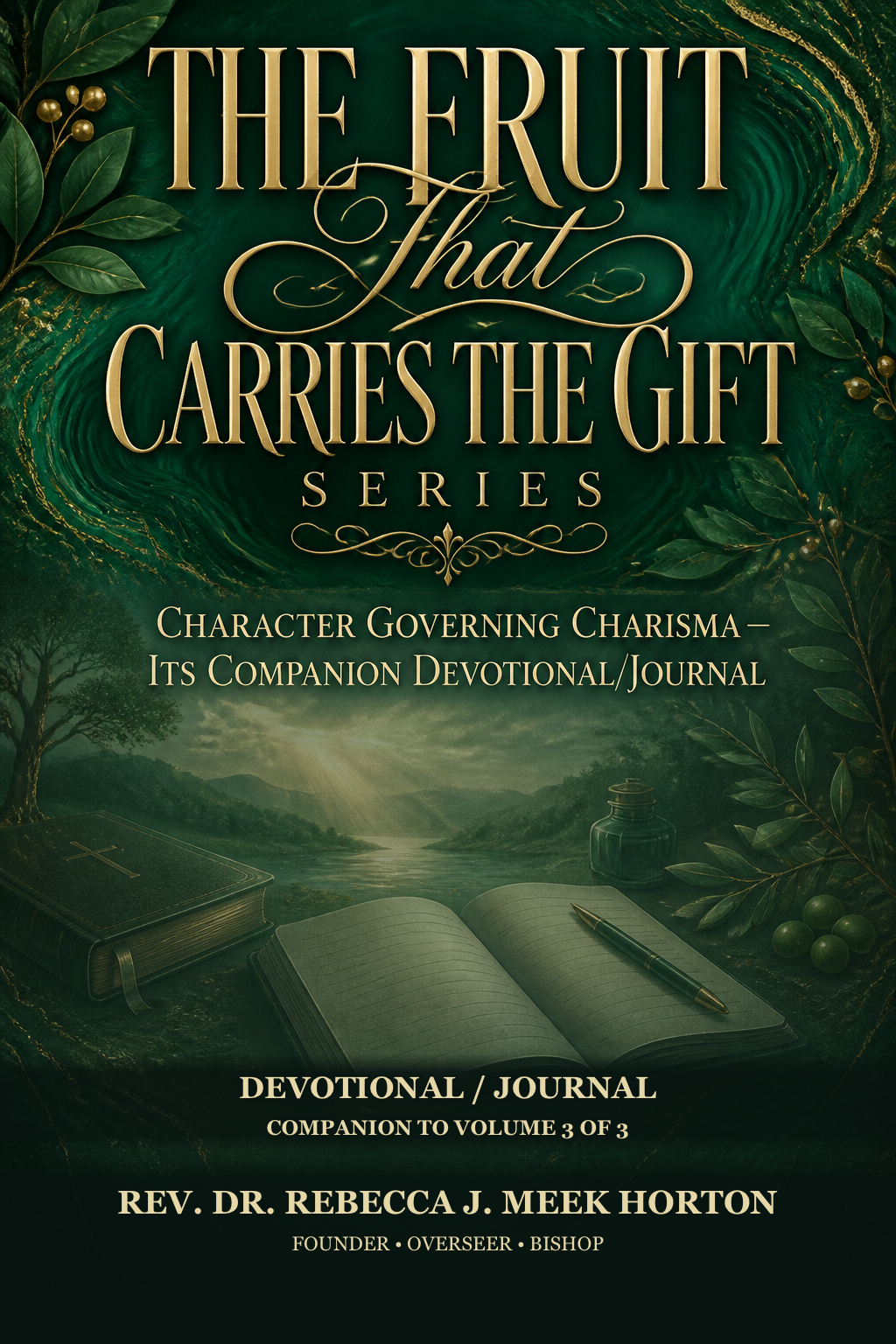
The Fruit That Carries the Gift · Volume 3
Character Governing Charisma — Its Companion Devotional/Journal
A companion devotional and journal for "Character Governing Charisma". Each chapter becomes five entries — a KJV Scripture reading, a devotional, a prayer, a journal prompt, and space to write — closing with An Apostolic Prophetic Architect Message and lined journal pages.
Full publication
NBCNGMI MASTER KNOWLEDGE LIBRARY Featuring the works of The Sage, Apostle Prophet. Rev. Dr. Rebecca J. Meek Horton, Apostolic Prophetic Architect, NewBeing Creation Network Global Ministries, Inc. Integrated Framework Modalities™
Chapter 1 — When the Gift Outruns the Life
Entry 1
Scripture Reading
Galatians 5:22-23 (KJV) 22 But the fruit of the Spirit is love, joy, peace, longsuffering, gentleness, goodness, faith, 23 Meekness, temperance: against such there is no law.
Devotional
The Fruit of the Spirit is not decoration. It is not the soft part added after the real ministry happens. It is the life of the Spirit being formed in us so that whatever God entrusts to us can be carried safely.
Many people desire to serve well. We want our prayers to matter. We want our words to strengthen. We want our presence to help, not harm. That desire is holy when it is surrendered. But desire alone is not enough. A gift may make room for us, but Fruit teaches us how to stand in that room without using people, rushing moments, or needing attention to feel valuable.
Galatians does not say fruits, as if we may choose one and neglect the others. It says fruit. The Spirit forms one whole life with many visible expressions. Love governs motive. Joy keeps service from becoming bitterness. Peace refuses to make chaos holy. Longsuffering stays steady when people grow slowly. Gentleness remembers that bruised souls need careful hands. Goodness keeps integrity in the hidden place. Faith remains loyal when the outcome is unclear. Meekness carries strength without domination. Temperance restrains appetite, urgency, and emotion.
This is the inner government of a servant.
Without this government, charisma can move too quickly. A strong voice can become sharp. A powerful prayer can become performance. A word of correction can become control. A room can be gathered, stirred, and impressed, while the people inside it are not truly strengthened. That is why the Spirit does not only give gifts. He forms character.
There is mercy in being slowed down. There is mercy in the hidden work. There is mercy when the Lord reveals impatience before a platform increases, pride before influence expands, or fear before leadership grows heavier. What He exposes, He intends to heal and govern.
Today, do not ask only, “What can I do for God?” Ask, “What is God forming in me so I can serve others safely?” That question does not shame the servant. It protects the servant and the people being served.
The Fruit is the life that carries ministry. Let the Spirit form the life beneath the gift.
Prayer
Father, I come to You with an honest heart. I do not want my gift to outrun my formation. I do not want to gather people with charisma and then handle them without love, peace, gentleness, or self-control. Search the life beneath what others can see. Form in me the Fruit of Your Spirit. Teach me to slow down where I need to slow down, listen where I need to listen, and obey where I have been excusing immaturity. I receive Your correction as mercy, not rejection. Make my service safe, faithful, and pleasing to You. Amen.
Journal Prompt
Where do I most need the Fruit of the Spirit to govern the way I serve, speak, lead, pray, or respond?
Space to Write [Answer Lines]
Entry 2
Scripture Reading
1 Corinthians 13:1-3 (KJV) 1 Though I speak with the tongues of men and of angels, and have not charity, I am become as sounding brass, or a tinkling cymbal. 2 And though I have the gift of prophecy, and understand all mysteries, and all knowledge; and though I have all faith, so that I could remove mountains, and have not charity, I am nothing. 3 And though I bestow all my goods to feed the poor, and though I give my body to be burned, and have not charity, it profiteth me nothing.
Devotional
Paul’s words are not gentle to the ego, but they are healing to the soul. He names some of the most impressive expressions of spiritual life: tongues, prophecy, knowledge, faith, generosity, sacrifice. Then he says that without charity, without love, they become noise, emptiness, and loss.
This does not mean the gifts are worthless. It means the gifts must be governed by the nature of Christ.
A gifted person may speak strongly and still fail to love carefully. A person may understand mysteries and still lack tenderness. A servant may give sacrificially and still be driven by the need to be seen. A leader may be accurate and still crush the one they were called to help. That is the danger when the gift outruns the life.
Charity asks a deeper question than charisma asks. Charisma may ask, “Did they respond?” Charity asks, “Were they strengthened?” Charisma may ask, “Did they notice?” Charity asks, “Did they see Christ?” Charisma may ask, “Was the moment powerful?” Charity asks, “Was the person handled with care?”
Love is not weakness. Love is holy strength under godly government. Love tells the truth, but it does not enjoy humiliating people. Love serves with courage, but it does not use service as a stage. Love can correct, but it corrects with tears in its heart and humility in its tone. Love does not need to prove itself by intensity.
There is a kind of ministry that sounds impressive but leaves people tired, confused, or dependent. There is another kind of ministry that may be quiet, but it helps people breathe, repent, grow, and walk with God. Paul is teaching us to discern the difference.
If the gift is present but charity is absent, the sound may still fill the room, but heaven is weighing the heart. This is not meant to frighten us away from serving. It is meant to call us into RE-Alignment™. God does not ask us to bury what He gave. He asks us to carry it in love.
Before the next conversation, prayer, teaching, correction, or act of service, pause and ask: Is love governing this? If not, wait long enough to be formed before you move.
Prayer
Father, I do not want to be impressive and empty. I do not want my words, insight, sacrifice, or service to become noise because love is missing. Teach me charity in the secret place. Let my motives be cleansed by Your presence. When I am tempted to perform, slow me down. When I am tempted to speak sharply, soften me. When I am tempted to serve for attention, bring me back to humility. I want my gift to point people to Christ, not to myself. Form love in me until it governs how I carry everything You have entrusted to me. Amen.
Journal Prompt
According to 1 Corinthians 13:1-3, where might I be serving with visible strength but needing deeper charity in motive, tone, or action?
Space to Write [Answer Lines]
Entry 3
Scripture Reading
Proverbs 4:23 (KJV) Keep thy heart with all diligence; for out of it are the issues of life.
Devotional
There is always a life beneath the gift.
Before the public word, there is the private heart. Before the prayer line, there is the secret response to God. Before the leadership role, there is the way we handle disappointment, fatigue, correction, silence, and delay. The heart is not a side issue in ministry. Scripture says the issues of life flow from it.
This is why Proverbs tells us to keep the heart with all diligence. Not casually. Not occasionally. Not only after something breaks. With all diligence.
An unguarded heart does not stay private for long. Bitterness can leak through correction. Pride can dress itself in authority. Fear can call itself wisdom while controlling others. Insecurity can turn ministry into performance. Weariness can make us sharp with people who needed gentleness. Unhealed motives can use spiritual language while still seeking human affirmation.
This is sobering, but it is also hopeful. If the heart can be guarded, then the life beneath the gift can be formed. We are not helpless before our patterns. We can bring the heart before God. We can name what is really happening. We can ask deeper questions. We can seek counsel. We can repent. We can rest. We can practice the next faithful step.
Keeping the heart is not self-protection in the selfish sense. It is stewardship. It protects what God is forming in us, and it protects those who receive from us. When a servant refuses heart work, the people around them eventually carry the cost. But when a servant lets God tend the heart, ministry becomes safer.
Sometimes the most spiritual thing you can do before serving is to pause. Ask the Lord, “What is moving in me right now?” Is it love, or is it pressure? Is it obedience, or is it the need to be needed? Is it courage, or is it frustration? Is it discernment, or is it suspicion?
The heart must be kept because the gift flows through it. God is not only concerned with what comes out of your mouth or hands. He is forming the inner life from which those words and actions come.
Guarding the heart is not fear. It is wisdom. It is character governing charisma before charisma governs the room.
Prayer
Father, I bring my heart before You. I do not want hidden bitterness, pride, fear, insecurity, or weariness to shape the way I serve others. Help me keep my heart with diligence. Show me what I have ignored, excused, or renamed. Give me humility to repent, courage to ask for help, and patience to be formed in hidden places. Let my words and actions flow from a heart being governed by Your Spirit. Protect the people I serve from anything in me that has not yet been surrendered. Teach me to steward my heart well. Amen.
Journal Prompt
As I sit with Proverbs 4:23, what is currently flowing from my heart into my service, relationships, or leadership?
Space to Write [Answer Lines]
Entry 4
Scripture Reading
1 Peter 4:10 (KJV) As every man hath received the gift, even so minister the same one to another , as good stewards of the manifold grace of God.
Devotional
A steward does not own what has been entrusted. A steward receives, carries, manages, serves, and answers to the one who entrusted it.
This truth changes the posture of ministry.
The gift is not mine to use however I want. The room is not mine. The people are not mine. The moment is not mine. The grace is God’s, and I am called to minister it as a good steward. That means I must care not only about whether I serve, but how I serve.
Stewardship slows down what ego tries to rush.
Ego says, “Take the opportunity.” Stewardship asks, “Am I ready to carry it faithfully?” Ego says, “They need me.” Stewardship says, “They belong to God.” Ego says, “Prove the gift.” Stewardship says, “Serve the body.” Ego says, “Do not let them see weakness.” Stewardship says, “Walk in truth, accountability, and humility.”
There is a cost to this kind of serving. It may cost speed. You may need to pause before accepting an invitation, giving correction, launching something new, or stepping into a role that exceeds your current formation. It may cost applause. Some may not understand preparation over performance. It may cost comfort. The Holy Spirit may address motives you would rather excuse. It may cost control. Real ministry does not create dependency so the servant feels important. It helps others mature in Christ.
But this cost is not punishment. It is protection.
Peter says to minister the gift one to another. Gifts are given for service, not self-display. They are entrusted so the body may be strengthened. When character governs charisma, the servant remembers that influence is responsibility. The sharper the gift, the deeper the need for humility. The wider the platform, the greater the need for hidden obedience. The stronger the moment, the more necessary the stewardship.
You may be called and still need development. You may be gifted and still need counsel. You may be effective and still need rest. You may be fruitful and still need correction. None of this cancels the gift. It protects it.
Today, receive the grace of being a steward. You do not have to own the outcome. You do not have to force the moment. You do not have to make people need you. You are free to serve faithfully, carefully, and under God’s authority.
Prayer
Father, I acknowledge that every gift I have received belongs to You. I am a steward, not an owner. Deliver me from using ministry to prove myself, secure attention, or control outcomes. Teach me to carry Your grace with humility and care. Help me know when to move and when to wait, when to speak and when to seek counsel, when to serve and when to rest. Let my stewardship protect the people You entrust to me. Make me faithful in hidden places and trustworthy in visible places. I want to serve as one who answers to You. Amen.
Journal Prompt
How does 1 Peter 4:10 challenge the way I view my gift, my influence, and the people I serve?
Space to Write [Answer Lines]
Entry 5
Scripture Reading
Luke 6:43-45 (KJV) 43 For a good tree bringeth not forth corrupt fruit; neither doth a corrupt tree bring forth good fruit. 44 For every tree is known by his own fruit. For of thorns men do not gather figs, nor of a bramble bush gather they grapes. 45 A good man out of the good treasure of his heart bringeth forth that which is good; and an evil man out of the evil treasure of his heart bringeth forth that which is evil: for of the abundance of the heart his mouth speaketh.
Devotional
Fruit tells the truth over time.
A moment can be moving. A message can be strong. A prayer can sound powerful. A room can respond. But Jesus teaches us to look deeper than the moment. The tree is known by its fruit. What is stored in the heart eventually comes out through the mouth, the hands, the decisions, the corrections, the patterns, and the atmosphere around a life.
This is not a call to suspicion. It is a call to discernment. We do not need to become harsh fruit inspectors, searching for flaws in others while ignoring our own formation. We begin with our own tree. We ask the Lord to show us what kind of fruit our life is producing in the people we touch.
Do people leave our presence strengthened or diminished? Do our words help them obey God, or do they make them dependent on us? Do we create peace, or do we create confusion and call it intensity? Do we correct with love, or do we wound and call it truth? Do we serve with steadiness, or do we require constant affirmation to keep serving?
These questions are not comfortable, but they are necessary. Character is not proven by one anointed moment. Character is seen in repeated patterns under pressure.
A tree does not strain to prove what it is. It bears what is growing within it. In the same way, what fills the heart will eventually speak. If the heart is full of envy, comparison may speak. If the heart is full of fear, control may speak. If the heart is full of pride, defensiveness may speak. But when the Spirit is forming the inner life, something different comes forth: love, patience, gentleness, faithfulness, humility, restraint, and goodness.
The promise is not that we become flawless overnight. The promise is that God can form good treasure in the heart. He can interrupt old patterns. He can heal what has been leaking. He can teach us to bring forth what is good.
Let this reading invite you into honest RE-Flection™, not condemnation. If the fruit has been mixed, bring the root to God. If your words have carried more pressure than peace, bring your heart to God. If your gift has moved faster than your life, let the Spirit slow you into formation.
A good tree is not manufactured by performance. It is cultivated by abiding, surrender, obedience, and time.
Prayer
Father, I ask You to show me the fruit of my life with truth and mercy. I do not want to measure myself only by strong moments, visible gifts, or the response of people. I want the life beneath my service to be good and governed by Your Spirit. Search the treasure of my heart. Where my words have revealed pressure, pride, fear, or impatience, lead me to repentance and healing. Cultivate in me what is good, steady, and Christlike. Let those I serve receive fruit that strengthens them and points them back to You. Amen.
Journal Prompt
According to Luke 6:43-45, what is my recent speech revealing about the treasure of my heart, and what needs to be cultivated there?
Space to Write [Answer Lines]
An Apostolic Prophetic Architect Message
Beloved servant, hear this with sobriety and hope: the Lord is not against the gift He gave you. He is committed to forming the life that carries it.
Do not despise the hidden place. Do not resent the pause. Do not call every delay rejection. Some delays are divine mercy. Some closed doors are protection. Some quiet seasons are not punishment, but preparation. The Spirit of God knows what the room cannot see. He knows the weight of influence before the invitation arrives. He knows what applause can awaken, what pressure can expose, and what responsibility can require.
Character governing charisma is not a small teaching. It is a ministry safeguard. It protects the servant from being crushed by premature increase. It protects the people from being handled carelessly. It protects the assignment from becoming personality-driven. It protects the witness of Christ from being buried beneath human ambition.
John 15:4-5 (KJV) 4 Abide in me, and I in you. As the branch cannot bear fruit of itself, except it abide in the vine; no more can ye, except ye abide in me. 5 I am the vine, ye are the branches: He that abideth in me, and I in him, the same bringeth forth much fruit: for without me ye can do nothing .
This is the confirmation: fruit comes from abiding, not striving. Much fruit comes from remaining in Christ, not performing for people. The branch does not produce life by force. It bears life by connection.
So let the Lord RE-Align™ your pace. Let Him RE-Order™ your motives. Let Him RE-Form your responses. Let Him teach your tongue gentleness, your hands stewardship, your heart humility, and your spirit obedience.
You are not called to be impressive. You are called to be faithful.
You are not called to gather people to yourself. You are called to serve them toward Christ.
You are not called to force a moment. You are called to steward the grace of God.
Walk slowly enough to be governed. Serve humbly enough to be trusted. Stay close enough to the Vine to bear what only the Spirit can produce.
Nothing is random. Nothing is wasted. Even the slowing is forming you.
[Journal Page]
[Journal Page]
Chapter 2 — The Spirit Gives, the Spirit Forms
Entry 1
Scripture Reading
1 Corinthians 12:4-11 (KJV)
Now there are diversities of gifts, but the same Spirit. And there are differences of administrations, but the same Lord. And there are diversities of operations, but it is the same God which worketh all in all. But the manifestation of the Spirit is given to every man to profit withal. For to one is given by the Spirit the word of wisdom; to another the word of knowledge by the same Spirit; To another faith by the same Spirit; to another the gifts of healing by the same Spirit; To another the working of miracles; to another prophecy; to another discerning of spirits; to another divers kinds of tongues; to another the interpretation of tongues: But all these worketh that one and the selfsame Spirit, dividing to every man severally as he will.
Devotional
The Spirit gives, but He does not give so we can compete. He does not place His gifts in us so we can build a private stage out of public grace. The gift is not a trophy. It is a trust.
Paul’s words bring order to the room. There are different gifts, different administrations, different operations, but the same Spirit, the same Lord, the same God. This means the servant with a visible gift is not more valuable than the servant whose obedience is quiet. The one who speaks is not greater than the one who serves. The one who discerns is not greater than the one who helps. Each gift has a place, and each place has a purpose.
The manifestation of the Spirit is given to profit withal. That phrase gives us a holy question: Who is being strengthened by the way I carry what God gave me?
This question is not meant to make us afraid of serving. It is meant to purify the posture of our service. If the gift draws attention to us but leaves people bruised, we need RE-Calibration™. If the gift opens a door for our voice but closes the door on gentleness, we need to slow down. If the gift works in the room but the people around us feel used afterward, the issue is not the Spirit. The issue is stewardship.
The Spirit is not confused. He gives with wisdom. He forms with wisdom. He knows what the body needs, and He knows what the servant needs. Sometimes we want the release of the gift without the weight of formation. But ministry is not only about whether something powerful happened. It is also about whether people were cared for in the process.
Today, receive the gift with gratitude, but hold it with humility. Ask the Lord to show you its true purpose. Ask Him to help you carry it in a way that profits the body, not just affirms the servant. You do not have to prove what God gave you. You have to steward it.
The same Spirit who gives the gift can teach you how to carry it safely.
Prayer
Father, I thank You for every gift You have entrusted to me. I confess that I do not own what You gave. I steward it before You. Search my motives where I have wanted to be seen more than I wanted others to be strengthened. Teach me to serve without competition, comparison, or self-promotion. Help me honor the gifts You placed in others. Help me recognize my place without shrinking and without swelling. Let what You manifest through me profit the body and glorify You. Form my heart while You use my hands, my voice, my discernment, and my service. I yield the gift back to You. Amen.
Journal Prompt
From 1 Corinthians 12:4-11, what gift, ability, or grace has God entrusted to me, and how can I carry it this week for the strengthening of others rather than the proving of myself?
Space to Write [Answer Lines]
Entry 2
Scripture Reading
Galatians 5:22-23 (KJV)
But the fruit of the Spirit is love, joy, peace, longsuffering, gentleness, goodness, faith, Meekness, temperance: against such there is no law.
Devotional
The Fruit of the Spirit is not decoration on a gifted life. It is evidence that the inner life is being formed by God.
A person can be gifted and still reactive. A person can be accurate and still unkind. A person can be bold and still careless. A person can be used in a moment and still need deep formation in the hidden places. This is not a statement of shame. It is a statement of truth. Truth helps us grow without pretending.
Paul says the fruit of the Spirit is love, joy, peace, longsuffering, gentleness, goodness, faith, meekness, and temperance. The Fruit of the Holy Spirit is a single fruit with multiple attributes, produced in the life of a believer as they yield to the Spirit’s work. The Spirit is not forming fragments. He is forming wholeness.
Love governs why we serve. Joy keeps service from becoming bitterness. Peace keeps urgency from becoming chaos. Longsuffering teaches us not to rush people through what God is patiently tending. Gentleness keeps our strength from becoming injury. Goodness keeps our motives clean. Faith keeps us dependent on God instead of forcing outcomes. Meekness reminds us that strength does not need to announce itself. Temperance teaches us that not every impulse deserves expression.
This is where character begins to govern charisma.
A powerful gift without temperance can become unsafe. Discernment without meekness can become harsh. Leadership without gentleness can become control. Correction without longsuffering can become bruising. Even a real gift can be mishandled when the servant refuses formation.
The mercy of God is that He does not only give. He forms. He does not only anoint public moments. He tends private motives. He does not only use our voice. He teaches our spirit how to carry sound, weight, timing, and restraint.
Today, do not ask only, What can I do for God? Ask also, What is God forming in me while I serve?
This question will keep you low, clear, and teachable. It will protect the people you serve. It will protect you from confusing movement with maturity. The Spirit gives power, but He also grows Fruit. The mature servant welcomes both.
Prayer
Father, I yield to Your forming work in me. I do not want to be gifted without being governed. I do not want to serve with power and leave people wounded by my immaturity. Grow Your Fruit in my inner life. Teach me love, joy, peace, longsuffering, gentleness, goodness, faith, meekness, and temperance. Show me where my reactions still need Your touch. Show me where my service needs restraint, patience, or humility. I receive correction without condemnation. I receive formation as mercy. Let my character reflect Christ as clearly as my gift reflects Your grace. Amen.
Journal Prompt
From Galatians 5:22-23, which attribute of the Fruit of the Spirit most needs to govern the way I serve right now, and what would that look like in one real situation this week?
Space to Write [Answer Lines]
Entry 3
Scripture Reading
1 Peter 4:10-11 (KJV)
As every man hath received the gift, even so minister the same one to another, as good stewards of the manifold grace of God. If any man speak, let him speak as the oracles of God; if any man minister, let him do it as of the ability which God giveth: that God in all things may be glorified through Jesus Christ, to whom be praise and dominion for ever and ever. Amen.
Devotional
Peter gives us a clean word for ministry: stewards.
A steward does not own what has been placed in his hands. A steward manages what belongs to another. That one word corrects pride, and it also corrects fear. Pride says, This gift is mine, and I can use it however I want. Fear says, This gift is too much, so I will hide it and avoid responsibility. Stewardship says, This gift belongs to God, and I will manage it faithfully for His purpose.
That is a different posture.
When we speak, we do not speak to fill space or impress people. We speak with reverence. When we serve, we do not serve from our own supply as though we are the source. We serve from the ability God gives. This protects the servant from exhaustion and protects the body from manipulation.
Every gift touches people. That is why stewardship matters. A gifted teacher must steward clarity. A gifted leader must steward influence. A gifted intercessor must steward burden. A gifted encourager must steward words. A gifted helper must steward capacity. A gifted prophet must steward speech. A gifted giver must steward resources with wisdom and quietness.
People are not projects. They are souls. They carry histories, wounds, hopes, fears, and callings. When our gift reaches their life, we are handling something precious. We may not know the full story of the person receiving our service. This is why we must be careful, prayerful, and submitted.
The goal is not that people leave saying how gifted we are. The goal is that God in all things may be glorified through Jesus Christ. That phrase moves the spotlight back where it belongs. Ministry is safest when glory returns to God, not the servant.
Today, consider the difference between using a gift and stewarding a gift. Using can become impulsive. Stewarding asks about timing, tone, readiness, and the good of the body. Using may rush to release. Stewarding knows when to speak, when to wait, when to ask counsel, and when to serve quietly.
The Spirit gives grace in many forms. The mature servant receives that grace with gratitude and carries it with responsibility.
Prayer
Father, I receive my assignment as stewardship, not ownership. Teach me to handle what You have entrusted to me with humility and care. Forgive me for times I have used a gift to feel important, or hidden a gift because I was afraid of responsibility. Give me wisdom in my speech, restraint in my timing, purity in my motives, and strength in my service. Let me serve from the ability You give, not from pressure, pride, or performance. May the people I touch be strengthened, and may You be glorified through Jesus Christ in all things. Amen.
Journal Prompt
From 1 Peter 4:10-11, where do I need to move from simply using my gift to stewarding it with wisdom, humility, and care?
Space to Write [Answer Lines]
Entry 4
Scripture Reading
John 1:14 (KJV)
And the Word was made flesh, and dwelt among us, and we beheld his glory, the glory as of the only begotten of the Father,) full of grace and truth.
Devotional
Jesus was full of grace and truth. He was not careless with either.
That matters for every servant. Some of us lean toward truth, but without grace our words can cut more deeply than they heal. Some of us lean toward grace, but without truth we may comfort people while leaving them unchanged. The Spirit forms servants who can carry both. Not half grace and half truth, but the fullness of both under the government of God.
Ministry often reveals which side needs formation in us.
If I love correction but lack tenderness, I need the Spirit to form gentleness. If I avoid hard conversations because I do not want anyone uncomfortable, I need the Spirit to form courage. If I move quickly because I sense something true, I need the Spirit to form patience. If I speak strongly because I believe the moment is urgent, I need the Spirit to form temperance.
Grace and truth are not rivals. In Christ, they dwell together.
This is where ministry becomes trustworthy. A person receiving prayer should not feel crushed by someone else’s intensity. A person receiving correction should not be publicly shamed when private care would have been enough. A person seeking help should not become a stage for someone’s gift. The Spirit may move with power, but He does not abandon the character of Christ while doing so.
Fruit protects the way we serve. Love keeps power from turning selfish. Peace keeps the room from becoming chaotic. Longsuffering makes room for process. Gentleness keeps the person in front of us from becoming a target. Goodness checks the motive beneath the method. Meekness keeps us low before God even when He uses us strongly. Temperance teaches us that not every true thing must be said in this moment, in this tone, or in this way.
This does not mean ministry will always feel easy or soft. Truth can be weighty. Correction can be needed. Spiritual warfare can be intense. But the servant must remain governed.
Jesus shows us the pattern. Glory was present, but so were grace and truth. Power was present, but so was holiness. Authority was present, but so was compassion.
Today, ask the Lord to bring your manner into agreement with His nature. Do not only ask Him to make your words true. Ask Him to make your way Christlike.
Prayer
Father, I want to carry both grace and truth. Search the way I speak, correct, pray, lead, and respond. Show me where truth in my mouth has lacked grace in my manner. Show me where my desire to be gentle has avoided needed truth. Bring my service into the character of Christ. Let my words be clean, my tone be governed, my timing be wise, and my motives be pure. I do not want to bruise people in the name of ministry. I want to serve them in a way that reflects You. Form me until my way agrees with Your heart. Amen.
Journal Prompt
From John 1:14, where do I need more grace and truth together in the way I serve, speak, lead, or correct?
Space to Write [Answer Lines]
Entry 5
Scripture Reading
John 15:4-5 (KJV)
Abide in me, and I in you. As the branch cannot bear fruit of itself, except it abide in the vine; no more can ye, except ye abide in me. I am the vine, ye are the branches: He that abideth in me, and I in him, the same bringeth forth much fruit: for without me ye can do nothing.
Devotional
The gift may operate in a moment, but Fruit grows through abiding.
This is one of the holy tensions of ministry. God may use us while He is still forming us. That is mercy. He may answer through our prayer, speak through our teaching, help someone through our service, or strengthen another person through our obedience. But being used does not mean every part of us is mature.
Jesus brings us back to the hidden place. Abide in me. Remain connected. Stay dependent. Do not confuse movement with life. A branch can only bear fruit while it abides in the vine. It does not produce from pressure. It does not produce from applause. It does not produce from giftedness alone. It bears because it remains.
This is where the servant is protected.
Without abiding, ministry becomes performance. We begin to draw from adrenaline, affirmation, urgency, and habit. We may still look active, but activity is not the same as fruitfulness. We may still sound spiritual, but sound is not the same as surrender. We may still be needed by people, but being needed is not the same as being nourished by Christ.
Formation costs something. It costs attention. We must notice what rises in us after ministry. Did I feel overlooked? Did I need praise? Did correction offend me? Did I rush because silence made me uncomfortable? Did I serve from love or from the hunger to matter?
Formation costs humility. We must let trusted people speak into not only what we do, but how we carry it. Formation costs patience. Hidden growth must matter as much as visible service. Formation costs surrender. We must let God govern timing, platform, access, and assignment.
But the cost is mercy. The pruning of God is not punishment for the servant who abides. It is preparation for more faithful fruitfulness.
Today, return to the Vine. Before you serve, abide. After you serve, abide. When you are affirmed, abide. When you are corrected, abide. When the gift is flowing, abide. When the hidden place feels quiet, abide.
Without Him, we can do nothing. With Him, much fruit can come from a life that remains.
Prayer
Father, I return to You as my Vine. I confess that I cannot bear lasting fruit from my own strength, gifting, or effort. Keep me from serving disconnected. Keep me from performing when You are inviting me to abide. Teach me to remain in You before, during, and after ministry. Search my reactions, my hunger for affirmation, my fear of correction, and my desire to control outcomes. I receive Your pruning as mercy. Form in me what can last. Let my life bring forth fruit that honors You and strengthens others. I depend on You again today. Amen.
Journal Prompt
From John 15:4-5, what would it look like for me to abide before I serve, and what reaction after ministry may be revealing an area where I need formation?
Space to Write [Answer Lines]
An Apostolic Prophetic Architect Message
Beloved servant, hear this with sobriety and hope: the Spirit has not only come upon you to use you. He has come within you to form you.
Do not despise the gift. Do not worship the gift. Steward the gift. The hand of God upon your life is not permission to move without government. It is an invitation to deeper surrender. The body of Christ needs what God placed in you, but the body also needs you formed enough to carry it with love, patience, meekness, and holy restraint.
This is a confirming word for this season: gifts are being RE-Aligned™ with Fruit. Charisma is being called back under character. Influence is being brought under stewardship. The Lord is not trying to silence faithful servants. He is maturing them so the room is strengthened, not bruised.
1 Corinthians 13:1-3 (KJV)
Though I speak with the tongues of men and of angels, and have not charity, I am become as sounding brass, or a tinkling cymbal. And though I have the gift of prophecy, and understand all mysteries, and all knowledge; and though I have all faith so that I could remove mountains, and have not charity, I am nothing. And though I bestow all my goods to feed the poor, and though I give my body to be burned and have not charity, it profiteth me nothing.
This is not a rebuke against spiritual gifts. It is a divine ordering of spiritual gifts. Love must govern sound. Love must govern revelation. Love must govern faith. Love must govern sacrifice. Without the governing work of the Spirit, even impressive ministry can become noise.
So take courage. If the Lord is showing you places where your gift has moved faster than your formation, that is mercy. If He is asking you to slow down, receive counsel, apologize, wait, listen, or submit your timing, that is not rejection. That is RE-Calibration™.
The Spirit gives. The Spirit forms. The Spirit sends. The Spirit corrects. The Spirit strengthens. Nothing is random. Nothing is wasted.
Go forward with clean hands, a yielded heart, and a teachable spirit. Ask not only, Lord, use me. Ask also, Lord, form me. Then serve the body well.
[Journal Page]
[Journal Page]
Chapter 3 — Love Sets the Limit
Entry 1
Scripture Reading
1 Corinthians 13:1-3 (KJV) 1 Though I speak with the tongues of men and of angels, and have not charity, I am become as sounding brass, or a tinkling cymbal. 2 And though I have the gift of prophecy, and understand all mysteries, and all knowledge; and though I have all faith, so that I could remove mountains, and have not charity, I am nothing. 3 And though I bestow all my goods to feed the poor, and though I give my body to be burned, and have not charity, it profiteth me nothing.
Devotional
There is a kind of ministry that can fill a room and still leave a soul unattended. It can sound strong, look powerful, and carry visible activity, but when love is not governing the movement, something becomes thin. Paul does not begin by questioning whether the gifts are real. He names tongues, prophecy, knowledge, faith, generosity, and sacrifice. These are not small things. Yet he says without charity, they lose their true weight.
Charity is not weakness. It is not emotional softness. It is love with responsibility. It is the self-giving love of God expressed through motive, restraint, timing, truth, and care. It asks not only, “Was something said?” but “Was the person honored?” It asks not only, “Was the gift released?” but “Was the soul protected?”
This is where character begins to govern charisma. The gift may be able to move quickly, but love knows when to slow down. The gift may be able to speak loudly, but love knows when quietness carries more healing. The gift may be able to reveal, correct, pray, teach, or serve, but love asks whether the action will build understanding and maturity.
Loveless power often feels urgent. It wants the word out now. It wants the moment used now. It wants the room to respond now. But love is patient enough to steward impact. Love cares about what happens after the meeting ends, after the prayer line is gone, after the public attention moves on.
This passage brings us back to holy simplicity. I can be gifted and still need formation. I can be accurate and still need tenderness. I can sacrifice and still need my motives washed before God. This is not condemnation. It is RE-Calibration™. The Father is not trying to shame His servants. He is teaching us to carry His work in His nature.
Before the next conversation, prayer, correction, or act of service, pause and ask: Is love governing this? If the answer is unclear, wait. Waiting may be the most mature ministry you offer that day. Nothing is random. Nothing is wasted when love is allowed to set the limit.
Prayer
Father, I bring my gifts, my words, my service, and my motives before You. I do not want to sound spiritual while becoming careless with people. Teach me charity that carries responsibility. Slow me down where I have confused urgency with obedience. Search the places where I want to be seen, needed, or proven right. Clean my service until it reflects Your heart. Help me remember that people are not platforms, pain is not material, and influence is stewardship. Let my speech, correction, generosity, and ministry be governed by love. Make me safe to serve through, not because I am perfect, but because I am surrendered to You.
Journal Prompt
In light of 1 Corinthians 13:1-3, where do I need love to govern my speech, service, or spiritual confidence more deeply? What is one place where I need to slow down before acting?
Space to Write [Answer Lines]
Entry 2
Scripture Reading
Galatians 5:22-23 (KJV) 22 But the fruit of the Spirit is love, joy, peace, longsuffering, gentleness, goodness, faith, 23 Meekness, temperance: against such there is no law.
Devotional
Love stands first in the Fruit of the Spirit. This is not accidental. Love gives holy shape to every other expression of Spirit-formed life. Joy without love can become self-focused. Peace without love can become avoidance. Longsuffering without love can become silent resentment. Gentleness without love can become performance. Goodness without love can become moral display. Faith without love can become force. Meekness and temperance without love can become controlled behavior without surrendered motive.
The Fruit of the Holy Spirit is a single fruit with multiple attributes, produced in the life of a believer as they yield to the Spirit’s work. We do not manufacture this fruit by pressure. We yield. We abide. We allow the Spirit to form what charisma alone cannot produce.
This matters for everyone who desires to serve others. Service will test our fruit. People will not always respond with gratitude. Needs may be heavy. Misunderstandings may come. Correction may be necessary. Boundaries may be required. In those moments, gifting alone is not enough. We need love, joy, peace, longsuffering, gentleness, goodness, faith, meekness, and temperance working together in us.
Love sets the limit, but temperance helps us honor the limit. Love says, “Do not expose this person.” Temperance helps us hold the word. Love says, “Speak truth without shaming.” Gentleness helps us choose the tone. Love says, “Do not serve from resentment.” Goodness calls us back to clean action. Love says, “Wait on God’s timing.” Longsuffering strengthens us to endure without becoming harsh.
The Spirit does not form us so we can appear impressive. He forms us so we can reflect Christ. A gifted person may be active, but a Spirit-formed person becomes safe to serve through. Safety here does not mean people will never be challenged. It means the challenge will not be handled carelessly. It means correction will aim for restoration. It means speech will be weighed. It means service will not become possession.
Today, do not only ask God to use you. Ask Him to form you. Ask Him to let the Fruit govern the gift. The work of God deserves servants who carry power under love, insight under humility, and action under self-control.
Prayer
Father, I yield myself to the work of Your Spirit. I do not want to carry gifts without fruit. Form love in me first, and let that love shape my joy, peace, patience, gentleness, goodness, faith, meekness, and self-control. Show me where my reactions reveal areas that still need RE-Calibration™. Help me serve without harshness, speak without pride, and wait without resentment. When pressure rises, let the Fruit of the Spirit rise in me stronger than my impulse. Make my life a place where Your character can be seen, not only Your activity. I receive Your formation with humility and trust.
Journal Prompt
According to Galatians 5:22-23, which attribute of the Fruit of the Spirit needs to govern your ministry, leadership, family life, or service more intentionally right now? How will you practice it today?
Space to Write [Answer Lines]
Entry 3
Scripture Reading
Ephesians 4:15 (KJV) But speaking the truth in love, may grow up into him in all things, which is the head, even Christ:
Devotional
Truth and love are not enemies. Scripture does not ask us to choose between honesty and care. It joins them together so that growth can happen in Christ. Truth without love can bruise. Love without truth can become vague. But truth spoken in love becomes a pathway for maturity.
This is important because words carry weight. A sentence spoken in a moment can remain in a person’s memory for years. A public correction can shape how someone sees God, leadership, and themselves. A careless label can attach shame to a pattern that should have been addressed with wisdom. Ministry speech must be stewarded, not simply released.
Speaking the truth in love means I must ask deeper questions before I speak. Is this true? Is it necessary? Is this the right time? Is this mine to say? Can this person carry this right now? Have I prayed through my motive, or am I using truth to relieve my own frustration?
Not every true thing needs to be spoken immediately. Not every insight belongs in public. Not every burden should become a declaration. Love does not weaken truth. Love governs the delivery of truth so the hearer has the best opportunity to receive, respond, and grow.
This is where RE-Language™ becomes a ministry practice. We shift from shame to responsibility, from dependency to stewardship, and from vague to actionable. Instead of saying, “You are rebellious,” love may say, “I see a pattern where receiving correction may be difficult. Would you be willing to pray and talk through what is happening?” The first statement labels. The second names a pattern and invites responsibility.
This does not mean every conversation will feel easy. Love can still confront. Love can still correct. Love can still draw boundaries. But love refuses careless words. Love does not use spiritual vocabulary to cover impatience, fear, pride, or control.
If our words are going to help others grow up into Christ, they must come from a heart submitted to Christ. Before you speak today, pause. Let love weigh the sentence. Let humility test the tone. Let wisdom choose the timing. A word governed by love may be shorter, quieter, and more fruitful than a long speech governed by urgency.
Prayer
Father, I surrender my speech to You. I ask You to teach me how to speak truth in love. Guard me from harshness, exaggeration, labeling, and careless correction. Help me recognize when I am speaking from frustration instead of faithfulness. Give me wisdom to know what to say, when to say it, how to say it, and when to remain silent. Let my words help others grow in Christ, not shrink under shame. Clean my motives before my mouth opens. Make my speech a vessel of truth, mercy, clarity, and maturity. I want my words to build, not bruise.
Journal Prompt
As you reflect on Ephesians 4:15, what conversation needs to be RE-Framed™ with love, humility, and clearer responsibility? What words should you avoid, and what words would build maturity?
Space to Write [Answer Lines]
Entry 4
Scripture Reading
1 Corinthians 14:3 (KJV) But he that prophesieth speaketh unto men to edification, and exhortation, and comfort.
Devotional
Prophetic ministry is not for display. It is not for domination, spiritual entertainment, or public astonishment. Paul gives a clear measure: edification, exhortation, and comfort. If what is spoken does not build, urge toward faithfulness, or strengthen the hearer, it must be weighed carefully before it is released.
Love does not deny discernment. Love stewards discernment. A person may sense something real and still be required to wait. A person may carry insight and still need Scripture, counsel, timing, humility, and peace. Spiritual accuracy alone is not the measure of spiritual maturity. Gifts reveal ability. Love reveals formation.
This is where many wounds begin. Someone sees something, feels something, or knows something, but moves faster than love. The word may contain truth, but the delivery exposes rather than protects. The correction may identify a pattern, but the method shames rather than restores. The room may call it bold, but love may call it unfinished.
Apostolic and prophetic service must be governed. The purpose is not to prove what we see. The purpose is to serve what God is doing. Love asks, “Will this build the person?” “Will this help them obey God?” “Will this bring comfort that strengthens, not comfort that flatters?” “Is this for now, for later, for private prayer, or for wise counsel?”
There is a holy restraint that belongs to mature ministry. Restraint is not fear. It is obedience under governance. It is temperance. It is the ability to carry a burden without making the burden a public moment before God has given release.
Edification builds. Exhortation urges toward faithfulness. Comfort strengthens. None of these require performance. Sometimes the most prophetic thing you can do is pray quietly, ask permission, speak privately, or hold the matter until God gives clarity.
Love sets the limit around prophecy and correction because people belong to God. Their lives are not stages for our insight. Their pain is not material for our credibility. Their process deserves prayerful stewardship.
Today, if you carry discernment, do not rush to release it. First, let love examine it. Let Scripture test it. Let humility lower your voice. Let the Spirit govern the timing. What comes from God should be handled in a way that honors God and protects people.
Prayer
Father, I submit every impression, burden, correction, and prophetic word to You. I do not want to use spiritual insight carelessly. Teach me to discern with humility and to speak only what love can carry. Help me honor edification, exhortation, and comfort. Where I have wanted to prove what I see, forgive me and RE-Calibrate™ my motive. Give me patience to wait, wisdom to test, and courage to speak when You truly lead. Let my ministry strengthen people toward obedience, not pressure them under performance. I trust You with the timing, the method, and the outcome.
Journal Prompt
How does 1 Corinthians 14:3 help you weigh prophetic words, correction, or spiritual impressions? What should love require before you speak?
Space to Write [Answer Lines]
Entry 5
Scripture Reading
John 13:34-35 (KJV) 34 A new commandment I give unto you, That ye love one another; as I have loved you, that ye also love one another. 35 By this shall all men know that ye are my disciples, if ye have love one to another .
Devotional
Jesus did not say the world would know His disciples by their giftedness. He did not say they would know them by spiritual vocabulary, public accuracy, institutional size, or visible sacrifice. He said love would mark them. Love is not optional decoration on the life of a servant. Love is the evidence that the servant remembers the Lord of the work.
This is a searching truth. We can become known for many things. We can be known for preaching, teaching, prayer, prophecy, leadership, generosity, discipline, boldness, or excellence. These may be valuable. But if love is absent, the witness becomes distorted. The mark of discipleship is not merely that something spiritual happened through us. The mark is that Christ can be recognized in how we treat one another.
Jesus says, “as I have loved you.” That raises the standard beyond preference, personality, convenience, and public image. His love served. His love told the truth. His love washed feet. His love corrected. His love laid down life. His love did not flatter, manipulate, or possess. His love carried both grace and truth.
This kind of love will cost us. It may cost the quick word. It may cost the public moment. It may cost the thrill of being needed. It may cost the satisfaction of being right. It may require apology. It may require us to say, “I moved too quickly,” or “I should have spoken privately,” or “My motive was not clean.”
That is not failure if we let it become RE-Calibration™. Love invites us back into alignment. Love teaches us how to serve without wounding, correct without crushing, give without controlling, and lead without using people to validate our importance.
A ministry governed by love may look less dramatic at times. It may be quieter. It may move slower. It may spend more time following up than showing out. But it carries the fragrance of Christ. It protects dignity. It notices the person after the room has moved on.
Today, return to the simple measure Jesus gave. Not charisma first. Not visibility first. Not intensity first. Love first. If love governs this, what must change? Let that answer become your next faithful step.
Prayer
Father, I receive the commandment of Jesus to love as He has loved me. I confess that I cannot carry this love in my own strength. Form it in me by Your Spirit. Teach me to serve with humility, speak with care, correct with restoration in mind, and give without control. Where I have valued visibility over tenderness, RE-Align™ my heart. Where I have rushed past people in the name of ministry, slow me down. Let my discipleship be recognizable by love, not only by activity. May those I serve encounter the character of Christ through my conduct.
Journal Prompt
Based on John 13:34-35, where does your service need to look more like the love of Jesus? Complete this sentence in writing: If love governs this, I will...
Space to Write [Answer Lines]
An Apostolic Prophetic Architect Message
Beloved servant, receive this with humility and strength: love is not limiting your ministry; love is governing it. The limit love sets is not a wall against obedience. It is a guardrail against harm. It keeps power from outrunning formation. It keeps speech from becoming a weapon. It keeps prophecy from becoming performance. It keeps generosity from becoming control. It keeps sacrifice from becoming silent pride.
This is a holy RE-Ordering™. Character must govern charisma because the people of God are not assignments to be handled carelessly. They are souls entrusted to the care of the Lord. Every gift must bow before the nature of Christ. Every word must pass through love. Every correction must seek restoration. Every act of service must preserve dignity.
1 Peter 4:10-11 (KJV) 10 As every man hath received the gift, even so minister the same one to another , as good stewards of the manifold grace of God. 11 If any man speak, let him speak as the oracles of God; if any man minister, let him do it as of the ability which God giveth: that God in all things may be glorified through Jesus Christ, to whom be praise and dominion for ever and ever. Amen.
You have received something from God, but what you have received must be stewarded. Stewardship is the sound of maturity. It asks, “Can God trust me with people when the room is full and when no one is watching?” It asks, “Will I protect the hidden place as faithfully as the public platform?” It asks, “Will I let love govern what my gift is able to do?”
Do not despise the slowing. Do not resist the testing of motive. Do not call restraint fear when God is using it to produce temperance. The Father is forming servants who can carry weight without crushing others under it.
Walk forward with courage, but walk governed. Speak truth, but speak it in love. Serve deeply, but do not possess. Correct when necessary, but aim for restoration. Give generously, but keep the motive clean.
The work is holy. The people are precious. The gift is real. And love must set the limit.
[Journal Page]
[Journal Page]
Chapter 4 — Order Protects the Room
Entry 1
Scripture Reading
1 Corinthians 14:26-33 (KJV) 26 How is it then, brethren? when ye come together, every one of you hath a psalm, hath a doctrine, hath a tongue, hath a revelation, hath an interpretation. Let all things be done unto edifying. 27 If any man speak in an unknown tongue, let it be by two, or at the most by three, and that by course; and let one interpret. 28 But if there be no interpreter, let him keep silence in the church; and let him speak to himself, and to God. 29 Let the prophets speak two or three, and let the other judge. 30 If any thing be revealed to another that sitteth by, let the first hold his peace. 31 For ye may all prophesy one by one , that all may learn, and all may be comforted. 32 And the spirits of the prophets are subject to the prophets. 33 For God is not the author of confusion, but of peace, as in all churches of the saints.
Devotional
A room can be full of spiritual activity and still need spiritual order.
Paul was not writing to a silent church. He was writing to a gifted church. People had psalms, doctrine, tongues, revelation, and interpretation. There was movement. There was expression. There was zeal. But gifts without order can become heavy for the people they were meant to serve.
This is why the question is not only, What do I have to release? The better question is, Will this edify the body?
Order protects the room because people are not props for our expression. They are souls entrusted to care. Someone may come into a gathering tender, grieving, ashamed, afraid, or overwhelmed. They may not have language for what they need. They may not be ready for public attention. They may need prayer, but not pressure. They may need truth, but not exposure. They may need support, but not a crowd.
God is not the author of confusion. That does not mean every holy moment will feel predictable. It means the Spirit of God does not need disorder in order to move. He is not strengthened by competition, noise, pressure, or performance. He is honored when the people serving Him are governable.
The spirits of the prophets are subject to the prophets. That verse calls gifted people into responsibility. It teaches us that spiritual sensitivity does not remove self-control. A word can be held. A prayer can be shortened. A moment can be weighed. A leader can pause the room without grieving the Spirit.
Character governing charisma is not the death of the gift. It is the protection of the gift.
Today, ask the Lord to make you both available and governable. Availability says, Father, use me. Governability says, Father, order me. Availability wants to serve. Governability learns when to speak, when to wait, when to yield, and when to let another member of the body carry the moment.
The goal is not to be seen moving. The goal is that all may learn, and all may be comforted.
When order is present, peace has room to settle. People can receive without being rushed. Leaders can serve without striving. Gifts can function without becoming the center.
Order does not quench the Spirit. Disorder burdens the room. Order makes space for God to be honored and people to be cared for well.
Prayer
Father, I come before You with a willing heart and a teachable spirit. I do not want my zeal to outrun Your wisdom. I do not want my gift to become pressure in the room. Teach me to serve in a way that edifies, comforts, and strengthens others. Help me know when to speak, when to wait, and when to yield. Make me sensitive to Your Spirit and responsible with people’s hearts. Deliver me from performance, competition, and the need to be seen. Let peace mark my presence. Let order guide my service. Let love govern every expression of ministry in me. In Jesus’ name, Amen.
Journal Prompt
Where does 1 Corinthians 14:26-33 invite me to become more governable in the way I serve, speak, pray, or lead?
Space to Write
[Answer Lines]
Entry 2
Scripture Reading
2 Timothy 3:16-17 (KJV) 16 All scripture is given by inspiration of God, and is profitable for doctrine, for reproof, for correction, for instruction in righteousness: 17 That the man of God may be perfect, throughly furnished unto all good works.
Devotional
Every ministry room needs a center.
If Scripture is not the center, something else will take its place. The loudest voice may become the center. The strongest personality may become the center. The most emotional moment may become the center. The most dramatic expression may become the center.
But ministry belongs to the Lord.
Scripture protects the room by giving everyone something higher than opinion, impulse, and preference. It teaches. It corrects. It instructs. It furnishes the servant of God for good works. Scripture does not make ministry cold. It makes ministry clean. It keeps us from using spiritual language carelessly. It brings weight where emotion rises quickly. It gives boundaries to what we say in the name of God.
This matters because compassion alone is not enough. Compassion needs truth. Zeal needs Scripture. Prayer needs wisdom. Leadership needs submission to the Word.
A person can mean well and still mishandle a tender soul. A leader can care deeply and still move too quickly. A gifted person can sense something real and still deliver it in a way that confuses or harms. Scripture slows us down and asks better questions.
Is this true? Is this necessary? Is this the right moment? Will this build up the person and honor God? Is this my assignment to carry?
When Scripture centers the room, no one has to compete for spiritual authority. The Word already has authority. Leaders are not called to create authority through intensity. They are called to steward the room under the authority of God’s Word.
There is comfort in that. You do not have to perform your way into usefulness. You do not have to force a moment to prove that God is present. You do not have to answer every question, solve every pain, or carry every need. Scripture equips you to serve faithfully within your measure.
The man of God is furnished unto all good works, not all possible works. There is a difference. You are not called to do everything. You are called to be faithful with the work assigned to you.
Let the Word give your service shape. Let the Word correct your tone. Let the Word govern your timing. Let the Word teach you how to care for people without becoming the center of their dependency.
Scripture protects the room because Scripture keeps the room centered on God.
Prayer
Father, I thank You for Your Word. I confess that I need Scripture to shape my service, my motives, my language, and my timing. I do not want to lead from opinion, emotion, or pressure. I want to be furnished by Your truth for the good works You have assigned to me. Correct what needs correction. Teach what needs teaching. Reprove what needs realignment. Instruct me in righteousness so I may care for others wisely. Help me keep ministry centered on You, not on my personality, gift, or preference. Let Your Word be the anchor in every room I enter. In Jesus’ name, Amen.
Journal Prompt
How does 2 Timothy 3:16-17 challenge me to let Scripture govern the way I serve others?
Space to Write
[Answer Lines]
Entry 3
Scripture Reading
Proverbs 11:14 (KJV) Where no counsel is, the people fall: but in the multitude of counsellors there is safety.
Devotional
Clarity is a form of care.
People should not have to guess what is happening in a ministry setting. They should not have to wonder who is leading, what is expected, whether they can say no, or whether their private pain will become public. Confusion creates pressure. Clarity creates safety.
Proverbs teaches that where no counsel is, the people fall. Counsel is not only private advice after something goes wrong. Counsel also includes the wisdom that prepares a room before people are placed inside it. It is the simple instruction that says, This is what we are doing. This is how we will serve. This is what we will not do. This is where you can receive additional support.
Clear order tells the room, We are not making this up as we go. We are serving with care.
This does not require long speeches or controlling scripts. Sometimes one gentle sentence can remove unnecessary fear. You are free to receive prayer or remain seated. You do not need to share personal details. We will pray briefly and respectfully. If you need deeper care, we will help connect you with the right support.
Those words do not quench the Spirit. They protect the people.
Some enter the room carrying wounds no one can see. A careless question may touch an old injury. A public demand may awaken shame. A loud prayer may feel overwhelming to someone already anxious. A leader may not know the whole story, and wisdom admits that. Clarity helps us serve without assuming.
Good counsel also protects the servant. It keeps us from overreaching. It reminds us that we are not called to be everything to everyone. We can listen. We can pray. We can encourage Scripture engagement. We can guide a next step. And when the need is beyond our assignment, we can make a wise handoff.
There is safety in the multitude of counsellors because the body is not one person. Shared wisdom protects what isolated zeal may miss.
Today, consider the spaces where you serve. Is there clarity there? Do people know what to expect? Do leaders know how to respond when deeper care is needed? Are boundaries spoken with gentleness before pressure rises?
Order is not harshness.
Order is care.
And care becomes trustworthy when clarity leads the way.
Prayer
Father, I ask You to make me a servant who brings clarity, not confusion. Teach me how to prepare rooms with wisdom and humility. Help me speak simple instructions that protect people and honor Your presence. I do not want anyone to feel pressured, exposed, or handled carelessly because I failed to provide order. Give me the courage to name boundaries kindly. Give me the humility to seek counsel and receive it. Help me know when to pray, when to listen, when to pause, and when to connect someone to further support. Let my service create safety and peace. In Jesus’ name, Amen.
Journal Prompt
In light of Proverbs 11:14, where do I need more counsel, clarity, or shared wisdom before I serve others?
Space to Write
[Answer Lines]
Entry 4
Scripture Reading
Ecclesiastes 3:1-8 (KJV) 1 To every thing there is a season, and a time to every purpose under the heaven: 2 A time to be born, and a time to die; a time to plant, and a time to pluck up that which is planted; 3 A time to kill, and a time to heal; a time to break down, and a time to build up; 4 A time to weep, and a time to laugh; a time to mourn, and a time to dance; 5 A time to cast away stones, and a time to gather stones together; a time to embrace, and a time to refrain from embracing; 6 A time to get, and a time to lose; a time to keep, and a time to cast away; 7 A time to rend, and a time to sew; a time to keep silence, and a time to speak; 8 A time to love, and a time to hate; a time of war, and a time of peace.
Devotional
Timing is a form of wisdom.
Not everything true must be said immediately. Not every burden must be shared publicly. Not every prayer needs to be long. Not every correction belongs in the room. Not every testimony is ready to be told.
There is a time to keep silence, and a time to speak.
This truth is tender, because many of us have confused urgency with obedience. We felt something strongly, so we assumed it had to be released immediately. We saw a need, so we moved without asking whether we were assigned to it. We wanted to help, so we spoke before discerning the purpose of the moment.
But the right thing at the wrong time can still place weight where God did not assign it.
A word may be true, but not ready for public delivery. A prayer may be sincere, but too long for the moment. A correction may be needed, but better suited for a private conversation. A testimony may be powerful, but not yet healed enough to be carried in front of others.
Order asks, What is this moment for?
If the moment is for teaching, teach clearly. If the moment is for prayer, pray faithfully. If the moment is for comfort, do not turn it into correction. If the moment is for repentance, do not turn it into performance. If the moment is finished, close it with peace.
Ending well is not weakness. It is stewardship.
Sometimes the most spiritual sentence in the room is, We are going to pause here. The Lord is faithful. Please continue to pray and reflect. If you need support, our team is available in the designated space.
That kind of closing teaches people that God is not trapped in one public moment. The Spirit works in the room, and the Spirit also works after the room. We do not have to drag a gathering beyond grace in order to prove that ministry happened.
Jesus was never hurried by people’s urgency. He moved with purpose. He withdrew to pray. He taught crowds. He answered questions. He corrected disciples. He comforted the broken. He knew the time and the purpose.
Today, ask for the grace to discern timing. Ask the Lord to govern your urgency. Let wisdom teach you when to speak, when to wait, when to continue, and when to close with peace.
Prayer
Father, I ask You to teach me the wisdom of timing. I confess that I have sometimes mistaken urgency for obedience and emotion for assignment. Help me slow down enough to discern what the moment is for. Give me humility when silence is wiser than speech. Give me courage when speech is necessary. Teach me to end well, serve well, and trust You beyond the visible moment. I do not want to drag what You have already completed or rush what You are still preparing. Govern my pace, my words, and my decisions. Let my timing protect the weight of Your work. In Jesus’ name, Amen.
Journal Prompt
What does Ecclesiastes 3:1-8 reveal about my relationship with timing, urgency, silence, and speech?
Space to Write
[Answer Lines]
Entry 5
Scripture Reading
Romans 12:4-8 (KJV) 4 For as we have many members in one body, and all members have not the same office: 5 So we, being many, are one body in Christ, and every one members one of another. 6 Having then gifts differing according to the grace that is given to us, whether prophecy, let us prophesy according to the proportion of faith; 7 Or ministry, let us wait on our ministering: or he that teacheth, on teaching; 8 Or he that exhorteth, on exhortation: he that giveth, let him do it with simplicity; he that ruleth, with diligence; he that sheweth mercy, with cheerfulness.
Devotional
No one person is the whole body.
That truth is both freeing and correcting. It frees us from carrying what was never assigned to us. It corrects the temptation to become the center of every need, every decision, every prayer, and every response.
Romans reminds us that the body has many members, and all members have not the same office. Gifts differ according to grace. That means ministry is shared stewardship. It also means order is necessary, because different gifts must learn how to move together without competing, crowding, or confusing the room.
Protocols help with this.
A protocol is not a prison. It is a pathway. It helps people know how care will be given. It helps teams move together. It helps leaders make fewer reactive decisions under pressure. A prayer protocol protects prayer from becoming interrogation. A teaching protocol keeps Scripture in the lead. An altar ministry protocol protects sacred response from crowding and display. A group care protocol honors confidentiality while refusing unsafe promises. A handoff protocol helps someone receive deeper support without leaving the servant isolated or overextended.
These are not cold systems. They are expressions of care.
Order protects the gift by placing it in proper relationship to the body. Prophecy does not replace pastoral care. Teaching does not replace prayer. Prayer does not replace counseling when counseling is needed. Encouragement does not replace wise referral. Mercy does not erase boundaries. Diligent leadership does not mean control.
Each gift serves best when it knows its measure.
This may cost something. Order costs the leader the thrill of being needed by everyone. It costs the gifted person the freedom to say everything they feel in the moment. It costs the team the convenience of improvising without preparation. It may disappoint those who confuse intensity with anointing.
But the cost is worth it.
Order protects the tender. It steadies the eager. It slows the impulsive. It restrains the controlling. It gives the quiet person room to breathe. It gives the wounded person room to receive without being handled carelessly.
Character welcomes order because character cares more about fruit than display.
Today, let Romans 12 release you from overreach and call you into faithful function. You are a member of the body, not the whole body. Serve your part with humility. Honor the parts carried by others. And when a need is beyond your measure, make a clear and kind handoff.
That is not failure.
That is stewardship.
Prayer
Father, I thank You that I am a member of the body, not the whole body. Help me serve faithfully within the grace You have given me. Deliver me from overreach, comparison, and the need to be needed by everyone. Teach me to honor the gifts, roles, and assignments of others. Give me wisdom to follow protocols that protect people and strengthen the room. Help me recognize when a need is beyond my measure and make a clear, kind handoff without shame. Let my service be humble, diligent, cheerful, and governed by love. May the body be strengthened through ordered stewardship. In Jesus’ name, Amen.
Journal Prompt
How does Romans 12:4-8 help me understand my measure, my limits, and my responsibility within the body of Christ?
Space to Write
[Answer Lines]
An Apostolic Prophetic Architect Message
Beloved servant, receive this confirmation with sobriety and peace: order is not the enemy of the anointing. Order is one of the ways love protects what the anointing touches.
The Lord does not need confusion to prove that He is present. He does not need pressure to produce response. He does not need personalities to compete in order for His Spirit to move. The room belongs to Him. The people belong to Him. The gifts belong to Him. Therefore, the stewardship must also belong to Him.
1 Corinthians 14:40 (KJV) Let all things be done decently and in order.
This is not a small instruction. It is a governing word for every servant who desires to minister with clean hands, a steady heart, and mature love. Decently and in order does not mean lifeless. It means cared for. It means the tender are not mishandled. It means the wounded are not exposed for display. It means the gifted are not allowed to move without accountability. It means the leader understands that the atmosphere is not theirs to manipulate, but theirs to steward.
Character Governing Charisma is not a correction against gifting. It is a call to mature the vessel so the gift can serve without harming the room.
You are being invited into a higher stewardship. Not louder. Not flashier. Not more impressive. Higher. That means slower when wisdom requires it. Clearer when people need safety. Quieter when silence is holy. Stronger when boundaries must be named. Humble enough to prepare. Mature enough to hand off. Faithful enough to close the moment and trust God to continue the work.
Do not despise the cost of order. The cost is real, but the fruit is holy. Order will cost you drama, but it will give you peace. It will cost you performance, but it will give you trust. It will cost you the need to be central, but it will return the room to God.
Go forward with governed movement. Prepare the room. Clarify the purpose. Honor the Word. Protect the people. Steward the gifts. Serve with peace.
Nothing is random. Nothing is wasted.
[Journal Page]
[Journal Page]
Chapter 5 — Discernment Is Not Control
Entry 1
Scripture Reading
1 John 4:1 (KJV) Beloved, believe not every spirit, but try the spirits whether they are of God: because many false prophets are gone out into the world.
Devotional
Discernment begins with humility. John does not tell the beloved to believe every spirit, every impression, every urgency, or every strong inward sense. He tells them to try the spirits. That one instruction slows us down in a holy way.
Many of us have been taught to value spiritual sensitivity, and we should. Ministry needs people who can notice what is happening beneath the surface. But sensitivity without testing can become unsafe. A feeling may be real, yet the interpretation may be wrong. A concern may be valid, yet the timing may be unwise. A word may carry weight, yet the way it is handled may wound the very person God loves.
Spirit-led discernment is not permission to rush. It is an invitation to serve carefully.
There is a difference between perceiving and proclaiming. Perception may come quickly. Proclamation must be governed. Some things are given for prayer before they are given for speech. Some things are given so we can ask better questions, not make stronger declarations. Some things are given so we can prepare our hearts, not expose another person’s pain.
Trying the spirits means we do not make ourselves the final authority over what we sense. We submit the impression to Scripture, to the Fruit of the Spirit, to counsel where needed, and to the character of Christ. If what we call discernment makes us harsh, suspicious, proud, or eager to control, then the first thing needing attention may be within us.
This is not weakness. This is stewardship.
Discernment that has been tested becomes safer to carry. It is less concerned with being impressive and more concerned with being faithful. It does not need an audience. It does not need drama. It does not need to prove that it saw something. It rests in the truth that God can reveal, confirm, correct, and guide without our pressure.
Today, the invitation is simple: slow down before you name what you sense. Let love govern your language. Let peace govern your pace. Let humility govern your confidence. If God has given you awareness, He can also give you wisdom for how to steward it.
The goal is not to prove what you see.
The goal is to serve what God loves.
Prayer
Father, I come to You with my perceptions, my concerns, and my desire to serve well. Teach me not to confuse urgency with authority or intensity with accuracy. Help me try what I sense before I speak from it. Give me patience when I want to move quickly, humility when I feel certain, and love when I am handling another person’s life. Purify my discernment so it does not become suspicion, control, or performance. Let the Fruit of the Spirit govern the gifts You entrust to me. I want to be faithful, careful, and clean in my service. In Jesus’ name, amen.
Journal Prompt
In light of 1 John 4:1 (KJV), what impression, concern, or assumption do I need to test before I speak or act on it?
Space to Write
[Answer Lines]
Entry 2
Scripture Reading
Proverbs 18:13 (KJV) He that answereth a matter before he heareth it, it is folly and shame unto him.
Devotional
One of the quiet dangers in ministry is answering before hearing. We can do it in conversation. We can do it in leadership. We can even do it in prayer.
A person comes near with tired eyes, quiet speech, or hesitation, and we begin to fill in the blanks. We may call it discernment, but sometimes it is assumption wearing spiritual language. We may see withdrawal and call it rebellion. We may see questions and call it dishonor. We may see silence and call it resistance. But Proverbs tells us plainly that answering a matter before we hear it is folly and shame.
This verse calls us back to holy listening.
Listening does not cancel discernment. It purifies it. Listening gives discernment a place to be tested. It allows the person before us to remain a soul, not a category. It reminds us that people are often carrying stories we have not heard, grief we cannot see, and pressure we may not understand.
Suspicion moves quickly because it wants control. Discernment can move slowly because it trusts God.
There is a faithful difference between naming what we observe and judging what we cannot know. We may observe that someone has missed assignments. We may observe that there has been repeated tension. We may observe that a conversation feels heavy. But we must be careful before we assign motives. There may be immaturity, yes. There may also be fear, burnout, confusion, pain, or lack of clarity.
RE-Language™ helps us shift from accusation to responsibility. Instead of saying, You are difficult, we can say, There seems to be repeated tension here, and I would like us to seek clarity. Instead of saying, You are not submitted, we can say, There appears to be a gap between what was agreed upon and what is happening. Can we talk through it honestly?
That kind of language does not weaken truth. It makes truth more faithful.
To hear before answering is an act of honor. It tells the person, I will not reduce you to my first impression. I will not make your pain public material. I will not use spiritual language to avoid patient care.
Today, listen before you label. Ask before you assume. Observe before you accuse. Let your first response create room for truth to come into the light without fear.
Discernment watches over people to serve them.
Prayer
Father, I ask You to make me slow enough to hear. Deliver me from answering matters before I understand them. Forgive me for the times I have filled in missing information with fear, frustration, or assumption. Teach me to listen with patience and speak with care. Let my words create room for truth, not pressure for performance. Help me honor the person in front of me as someone You love, not as a problem to solve. Give me wisdom to observe clearly, ask honestly, and respond faithfully. I want my discernment to serve healing, order, and maturity. In Jesus’ name, amen.
Journal Prompt
In light of Proverbs 18:13 (KJV), where am I tempted to answer, label, or conclude before I have truly listened?
Space to Write
[Answer Lines]
Entry 3
Scripture Reading
1 Thessalonians 5:21-22 (KJV) 21 Prove all things; hold fast that which is good. 22 Abstain from all appearance of evil.
Devotional
Testing is not unbelief. Testing is stewardship.
There are moments when something rises within us quickly. A concern. A caution. A burden. A sense that something is not right. The speed of the impression can make it feel urgent, and urgency can feel like command. But this Scripture gives us a steadier path: prove all things, hold fast what is good, and abstain from what does not belong.
This is discernment under governance.
To prove all things means we do not treat every impression as final. We bring it into the light. We ask whether it aligns with Scripture. We watch for the Fruit of the Spirit. We consider timing, setting, and responsibility. We seek counsel when the matter carries weight. We ask whether our motive is love, fear, pride, irritation, or control.
This kind of testing protects people. It also protects us.
A person can be spiritually sensitive and still misread what they sense. We perceive through our maturity, our wounds, our fatigue, our assumptions, our experiences, and our theology. That does not mean we should ignore discernment. It means we must submit it. The more serious the concern, the more carefully it should be handled.
Holding fast what is good also matters. Testing is not meant to make us cynical. It is meant to help us keep what is clean, true, useful, and aligned. There may be a real concern underneath an imperfect impression. There may be a needed conversation underneath a poor first interpretation. There may be a wise next step, but not the dramatic one.
Then Scripture says to abstain from all appearance of evil. In ministry, this includes avoiding manipulation, public exposure, careless words, pressure, gossip, and spiritual performance. Even if we sense something real, we must not handle it in a way that misrepresents the heart of Christ.
A simple rhythm can help today. See what is actually happening. Ask what is known, unknown, and assumed. Ponder the impression before God, Scripture, counsel, and peace. Practice one responsible next step.
That next step may be prayer. It may be silence. It may be a gentle question. It may be counsel with a trusted leader. It may be an apology. It may be immediate protective action if harm is present.
Discernment does not have to be loud to be faithful.
The Spirit does not need our drama to be powerful.
Prayer
Father, I bring my urgency under Your wisdom. Teach me to prove all things without becoming fearful or hard. Help me hold fast to what is good and release what is mixed with pride, pressure, or assumption. I do not want to move from impulse and call it obedience. I want my next step to be clean, responsible, and aligned with Your Word. Give me courage when action is needed and restraint when waiting is wiser. Guard me from careless handling of people You love. Let my discernment be tested, governed, and fruitful. In Jesus’ name, amen.
Journal Prompt
In light of 1 Thessalonians 5:21-22 (KJV), what is one concern I need to test before taking action, and what would a responsible next step look like?
Space to Write
[Answer Lines]
Entry 4
Scripture Reading
James 3:17 (KJV) But the wisdom that is from above is first pure , then peaceable, gentle, and easy to be intreated, full of mercy and good fruits, without partiality, and without hypocrisy.
Devotional
James gives us a beautiful test for what we call wisdom. It is pure. It is peaceable. It is gentle. It is easy to be intreated. It is full of mercy and good fruits. It is without partiality and without hypocrisy.
This matters deeply when we are handling discernment.
If what we call discernment is full of agitation, harshness, pride, favoritism, or a refusal to be questioned, we need to slow down. The issue may not be whether we sensed something. The issue may be whether we are carrying it with wisdom from above.
Wisdom from above is not weak. It can correct. It can warn. It can confront what harms. But even when it is firm, it is clean. It does not enjoy humiliating people. It does not need to overpower the room. It does not hide cruelty behind spiritual language. It does not demand trust while refusing accountability.
Gentleness is not the absence of authority. Gentleness is authority under holy restraint.
Mercy does not mean we ignore patterns. Mercy means we refuse to reduce a person to the pattern. A volunteer may need correction. A leader may need accountability. A relationship may need boundaries. But wisdom from above asks how truth can be handled in a way that serves restoration, safety, and maturity.
Easy to be intreated means teachable. This is one of the marks of mature discernment. A discerning servant must be willing to hear, I think you may have misread that. A discerning leader must be able to receive counsel. A prayer minister must be able to pause, submit, and adjust. If we cannot be entreated, our discernment is already in danger.
The Fruit matters. Good fruits matter. If the outcome of our ministry is fear, confusion, shame, and dependence on our personality, we should examine the root. But if our handling produces clarity, responsibility, peace, repentance, courage, and deeper trust in God, then wisdom is bearing witness.
Today, let James 3:17 become a mirror. Before you speak from discernment, ask: Is this pure? Is it peaceable? Is it gentle? Am I willing to be corrected? Is mercy present? Will this bear good fruit?
Discernment governed by wisdom does not lose power.
It gains trust.
Prayer
Father, I want the wisdom that comes from above. Search the way I carry what I perceive. Remove impurity, agitation, harshness, partiality, and hidden pride from me. Make me peaceable without becoming passive, gentle without becoming unclear, and merciful without avoiding truth. Teach me to be easy to be intreated, willing to receive correction, counsel, and timing from You and from those You place around me. Let good fruit follow my words, my leadership, my prayers, and my silence. I do not want to be impressive. I want to be faithful. In Jesus’ name, amen.
Journal Prompt
In light of James 3:17 (KJV), which quality of wisdom from above needs to govern my discernment more deeply right now?
Space to Write
[Answer Lines]
Entry 5
Scripture Reading
Galatians 5:22-23 (KJV) 22 But the fruit of the Spirit is love, joy, peace, longsuffering, gentleness, goodness, faith, 23 Meekness, temperance: against such there is no law.
Devotional
The gift may help us notice. Character must decide how we respond.
Galatians names the Fruit of the Spirit, and every part of this Fruit protects discernment from becoming control. Love asks whether our words will serve the person, not just express our perception. Peace asks whether we are moving from rest or agitation. Longsuffering asks whether we have waited long enough to understand. Gentleness asks whether truth can be handled without unnecessary harm. Goodness asks whether our action reflects the character of God. Faith keeps us from forcing what only God can reveal. Meekness keeps power submitted. Temperance keeps urgency from ruling us.
Temperance is especially needed in discernment. It is not weakness. It is strength under the Spirit’s governance. Without temperance, a spiritually sensitive person can become spiritually unsafe. They may speak too quickly, expose too publicly, correct too harshly, or pressure someone to respond before that person is ready.
But when discernment is governed by the Fruit of the Spirit, it becomes a gift to the body.
It protects without humiliating. It corrects without crushing. It warns without controlling. It serves without performing.
This is the way of Christ.
Jesus knew what was in people, yet He did not move with insecurity or display. He asked questions. He withdrew to pray. He spoke truth with authority and compassion. He confronted hypocrisy, received the broken, and never used spiritual sight to entertain a crowd. If we serve in His name, we must learn His way.
The cost is real. Humble discernment costs us the thrill of being seen as deeply spiritual. It costs us the speed of saying whatever we feel. It costs us the pride of being the first to name what is wrong. It costs us the false comfort of control.
But what we lose in ego, we gain in holiness.
Today, do not ask only, What do I discern? Ask, What fruit is governing me? If love, peace, gentleness, meekness, and temperance are not present, wait. Pray. Seek counsel. Let God work in you before you try to address what you see in someone else.
Character governing charisma is not the silencing of the gift.
It is the sanctifying of the vessel.
Prayer
Father, I yield my discernment to the Fruit of Your Spirit. Let love govern my motives, peace govern my pace, longsuffering govern my timing, gentleness govern my tone, and temperance govern my response. I do not want to wound people while claiming to help them. I do not want to use spiritual language to control, expose, or impress. Make me meek, faithful, and clean in the way I serve. Teach me the way of Christ, who carried truth with authority and compassion. Let my character be formed enough to steward what You entrust to me. In Jesus’ name, amen.
Journal Prompt
In light of Galatians 5:22-23 (KJV), which part of the Fruit of the Spirit needs to govern the way I handle discernment this week?
Space to Write
[Answer Lines]
An Apostolic Prophetic Architect Message
Beloved servant, discernment is a holy trust. It is not a throne. It is not a weapon for ego. It is not a shortcut around love, process, counsel, or care. It is a stewardship given under the Lordship of Jesus Christ, and it must remain submitted to His Word, His Spirit, and His way.
In this hour, the Body of Christ needs servants who can see without becoming suspicious, speak without becoming harsh, lead without becoming controlling, and wait without becoming passive. This is not a call to weaken spiritual sensitivity. It is a call to mature it.
Proverbs 11:14 (KJV) Where no counsel is, the people fall: but in the multitude of counsellors there is safety.
There is safety in counsel. There is safety in Scripture. There is safety in the Fruit of the Spirit. There is safety in humility that can say, I may be sensing something, but I must handle it carefully. There is safety in leaders who can be questioned, teams who can slow down, and servants who know the difference between burden and assignment.
Do not despise what God allows you to perceive. But do not exalt perception above character. The gift may open your eyes, but only maturity can govern your hands. You must not touch people’s wounds with unwashed motives. You must not call pressure power. You must not call exposure freedom. You must not call suspicion discernment.
Let the Lord RE-Calibrate the way you carry insight. Let Him RE-Align your language from accusation to clarity, from control to stewardship, from impulse to obedience. Some matters require courage. Some require silence. Some require counsel. Some require apology. All require love.
You are being formed into a safer servant.
You are being taught to see and still bow.
You are being trained to discern and still listen.
You are being called to carry truth without crushing what God intends to heal.
So take the next faithful step. Not the dramatic step. Not the controlling step. The faithful one. Slow down. Test what you sense. Seek counsel where needed. Speak with clean hands. Serve what God loves.
Nothing is random. Nothing is wasted.
[Journal Page]
[Journal Page]
Chapter 6 — Consent, Safety, and Sacred Trust
Entry 1
Scripture Reading
Mark 10:51-52 (KJV) 51 And Jesus answered and said unto him, What wilt thou that I should do unto thee? The blind man said unto him, Lord, that I might receive my sight. 52 And Jesus said unto him, Go thy way; thy faith hath made thee whole. And immediately he received his sight, and followed Jesus in the way.
Devotional
Jesus knew what Bartimaeus needed. He knew the condition of his body, the cry of his heart, and the mercy that was about to meet him. Yet Jesus still asked, What wilt thou that I should do unto thee?
That question is holy.
It shows us that love does not assume, even when the need seems obvious. Love makes room for the person to speak. Love honors participation. Love does not reduce someone to their pain, their condition, their crisis, or their visible need.
This matters deeply in ministry. Sometimes we are moved by compassion, but compassion without consent can become pressure. Sometimes we sense something tender, but discernment without humility can become exposure. Sometimes we are eager to help, but help that does not ask can make a person feel handled instead of honored.
Jesus did not treat Bartimaeus like a project. He addressed him as a person.
That is the beginning of sacred trust.
When someone comes near for prayer, counsel, encouragement, or support, the first act of care may not be a hand placed on their shoulder. It may be a question. May I pray with you? Would you like me to stand here, or would you prefer space? Is this something you want to share, or would you rather keep it private?
These questions do not weaken faith. They express honor.
Consent is not unbelief. Consent is stewardship.
A person’s no must be respected. A person’s silence must be honored. A person’s hesitation must be noticed. A small movement backward may be telling the truth before the mouth can form the words.
In a culture that often rewards visible ministry moments, Jesus teaches us to slow down and see the soul in front of us. The person is more precious than the moment. The trust is more important than the display. The Spirit of God is not threatened by tenderness, order, or patience.
Character governs charisma when we ask before we act.
Today, you may not be standing in a church altar line. You may be serving in your home, workplace, community, ministry, or friendship circle. The same truth applies. Do not rush past personhood in the name of help. Ask. Listen. Wait. Honor.
The question may become the doorway of care.
Prayer
Father, I come before You with a heart that wants to serve well. Teach me to honor people the way Jesus honored Bartimaeus. Help me not to assume that my compassion gives me permission to move without wisdom. Slow me down when I am eager. Make me attentive to words, silence, body language, and boundaries. Deliver me from the need to make ministry visible or impressive. Form in me a spirit that asks, listens, and waits. Let my service protect dignity, not pressure vulnerability. Let my words make room for truth without forcing exposure. I want my care to reflect Your heart. Father, I choose honor before action and love before urgency. Amen.
Journal Prompt
Mark 10:51-52 shows Jesus asking before He acted. Where do I need to practice asking, listening, and honoring consent more faithfully in the way I serve others?
[Answer Lines]
Entry 2
Scripture Reading
1 Peter 5:2-3 (KJV) 2 Feed the flock of God which is among you, taking the oversight thereof, not by constraint, but willingly; not for filthy lucre, but of a ready mind; 3 Neither as being lords over God's heritage, but being ensamples to the flock.
Devotional
Peter’s words search the heart of every servant: Neither as being lords over God’s heritage.
People do not belong to us.
Their pain does not belong to us. Their testimony does not belong to us. Their response does not belong to us. Their healing journey does not belong to us. Even when we are entrusted to lead, pray, teach, cover, guide, or encourage, we remain stewards, not owners.
This is why boundaries matter.
Boundaries are not cold. They are not rejection. They are not a lack of anointing. Healthy boundaries are guardrails that protect what love has been trusted to carry.
Without boundaries, compassion can become control. Availability can become unhealthy access. Spiritual authority can become pressure. Discernment can become intrusion. Care can become confusion.
Peter does not call shepherds to dominate the flock. He calls them to feed, oversee willingly, and become examples. That means leadership must be visible in character, not just audible in instruction.
A safe servant knows the difference between serving and possessing.
Time boundaries help us recognize when a moment needs to pause and continue with proper care. Touch boundaries remind us that bodies are not ministry tools. Language boundaries keep us from saying more than we know. Emotional boundaries keep us from demanding tears, confession, instant forgiveness, or visible proof that ministry “worked.” Role boundaries help us admit when another person, office, professional, or authority is needed.
This kind of restraint may feel costly. It may feel less dramatic. It may not produce the visible moment others expected. But sacred trust is often protected by quiet obedience.
A faithful servant can say, This matters, and we need more support.
A faithful servant can say, I care, but I am not the right person to carry this alone.
A faithful servant can say, Let us take the next step wisely.
That is not weakness. That is governed love.
The Lord’s people are His heritage. We do not use them to prove our calling. We do not pressure them to validate our gift. We do not cross wise limits because we feel deeply.
We serve willingly. We lead humbly. We model what we teach.
Character governs charisma when the servant remembers: I am entrusted with care, not ownership.
Prayer
Father, I thank You for every person You allow me to serve. Help me remember that they belong to You before they are connected to me. Guard me from control disguised as concern and pressure disguised as passion. Teach me to honor healthy boundaries in time, touch, speech, emotion, access, and role. Give me humility to say when I need help and wisdom to know when a matter requires another layer of care. Let me never use people’s pain to prove my gift. Make me an example of steadiness, tenderness, and truth. Father, I choose stewardship over possession and humility over control. Amen.
Journal Prompt
In light of 1 Peter 5:2-3, where do I need stronger boundaries so that my service remains faithful, humble, and safe?
[Answer Lines]
Entry 3
Scripture Reading
Proverbs 11:13 (KJV) A talebearer revealeth secrets: but he that is of a faithful spirit concealeth the matter.
Devotional
A faithful spirit knows how to conceal a matter.
That sentence carries weight for anyone who serves people. When someone trusts us with grief, weakness, sin, fear, family struggle, or a private prayer need, they are placing something tender in our hands. Their story is not material. Their pain is not an illustration. Their vulnerability is not a conversation starter.
Confidentiality is one way love protects dignity.
Many wounds are deepened when people discover that what they shared in trust became a prayer request, a warning, a sermon example, a leadership update without need, or a hallway conversation wrapped in concern. Careless speech can make a person wish they had stayed silent. It can teach the wounded that ministry is not safe.
Proverbs gives us a simple contrast. A talebearer reveals. A faithful spirit conceals.
But wisdom also teaches us that confidentiality is not the same as secrecy.
Confidentiality protects dignity. Secrecy can protect danger.
If someone shares ordinary struggle, temptation, grief, or a private burden, we hold it with care. We do not repeat it without permission. We do not share identifiable details to make ourselves appear involved or important. We do not turn someone’s sacred disclosure into a public example.
But if someone discloses abuse, threat of harm, harm to self, harm to others, exploitation, neglect, or danger to a vulnerable person, we cannot promise secrecy. Love must protect life. Sacred trust must include safeguarding. Faithfulness may require involving proper leadership, trained helpers, emergency support, or civil authorities according to policy and law.
This is not betrayal. This is responsibility.
A wise servant learns to say clearly, I will honor your privacy, but I cannot keep secrets that involve harm or danger. If safety is at risk, we will get the right help.
That sentence may feel uncomfortable, but it is merciful. It tells the truth before crisis comes. It protects the person sharing, the vulnerable, the ministry, and the servant from carrying alone what should be carried with proper support.
Today, ask the Lord to govern your mouth. Ask Him to make you trustworthy in both silence and action. Some matters must be concealed. Some matters must be escalated. Wisdom knows the difference.
Character governs charisma when our speech protects trust.
Prayer
Father, I ask You to make me faithful in how I carry what others share with me. Guard my mouth from careless speech, even when I think I am only expressing concern. Teach me to protect dignity and refuse gossip in every form. Give me wisdom to know the difference between confidentiality and secrecy. When safety is at risk, help me act with courage, calmness, and responsibility. Do not let fear of disappointing someone keep me from protecting life. Do not let curiosity or pride make me reveal what should be concealed. Father, form in me a faithful spirit that stewards truth with love. Amen.
Journal Prompt
Proverbs 11:13 speaks of a faithful spirit. How do I need to grow in protecting confidentiality while also refusing to keep secrets that involve harm or danger?
[Answer Lines]
Entry 4
Scripture Reading
Luke 10:34-35 (KJV) 34 And went to him, and bound up his wounds, pouring in oil and wine, and set him on his own beast, and brought him to an inn, and took care of him. 35 And on the morrow when he departed, he took out two pence, and gave them to the host, and said unto him, Take care of him; and whatsoever thou spendest more, when I come again , I will repay thee.
Devotional
The Good Samaritan did not walk past the wounded man. He came near.
He saw. He stopped. He touched the wound with care. He gave immediate help. He moved the man to a safer place. Then he involved another caregiver and made provision for continued care.
This is a beautiful picture of compassionate stewardship.
He did not do nothing. He also did not pretend he could do everything.
Many servants need this wisdom. Sometimes we think love means carrying every burden ourselves. We may feel that referring someone to pastoral care, counseling, medical help, crisis support, legal protection, recovery care, or trained advocacy means we have failed. But wise referral is not failure. It is humility.
The Body has many members because no one servant carries the whole assignment alone.
Prayer is powerful, but prayer is not always the only responsible action. Some needs require immediate safety planning. Some require professional training. Some require emergency response. Some require long-term discipleship. Some require accountability. Some require medical attention. Some require a safe place and a wider circle of care.
Mature ministry knows when to stay close and when to bring others in.
If someone says they do not want to live, love does not leave them alone with a quick prayer and a promise to check in later. Love stays, lowers the noise, involves trained help, and follows safety protocol.
If someone reveals violence at home, love does not pressure immediate reconciliation for the sake of appearance. Love prioritizes safety.
If someone collapses in a service, love prays and calls for medical help.
If someone confesses addiction, love prays and helps connect them with ongoing support, care, and accountability.
The Good Samaritan teaches us that mercy has movement. It does not remain sentimental. It acts. It transports. It provides. It coordinates. It follows through.
There is also a release in this passage. He entrusted the wounded man to another caregiver, but not into abandonment. He released responsibly, with provision and continued concern.
That is sacred trust.
Today, consider the places where you may be carrying what was never assigned to you alone. Love may be calling you to involve help. Love may be calling you to build a referral list, learn the protocol, ask for training, or stop improvising in crisis.
Character governs charisma when love knows how to refer and release.
Prayer
Father, I want to love people well, not carry people in ways that become unsafe or unwise. Teach me the mercy of the Good Samaritan. Help me see need, draw near with compassion, and take responsible action. Give me humility to know my limits and courage to involve the right help when the need is beyond my role. Deliver me from pride that wants to be the only answer. Deliver me from fear that delays wise referral. Show me how to release people into proper care without abandoning them. Father, make my service compassionate, ordered, and faithful. Amen.
Journal Prompt
Luke 10:34-35 shows both personal care and responsible handoff. Where do I need to prepare better so I can refer wisely instead of carrying alone?
[Answer Lines]
Entry 5
Scripture Reading
Galatians 5:22-23 (KJV) 22 But the fruit of the Spirit is love, joy, peace, longsuffering, gentleness, goodness, faith, 23 Meekness, temperance: against such there is no law.
Devotional
The Fruit of the Spirit governs the servant.
Love matters. Joy matters. Peace matters. Longsuffering matters. Gentleness, goodness, faith, meekness, and temperance matter. These are not decorative virtues for quiet moments. They are governing graces for powerful moments.
A ministry moment may feel strong, emotional, urgent, and deeply spiritual. But if it lacks gentleness and temperance, it is not fully yielded to the Spirit. If it pressures people, exposes what should be protected, ignores boundaries, or refuses correction, something needs RE-Calibration™.
Temperance is not small. It is holy restraint.
Meekness is not weakness. It is strength submitted to God.
Gentleness is not optional softness. It is one of the ways the Spirit makes power safe.
This is where character must govern charisma. The question is not only whether we believe the Spirit moves. The question is whether we will let the Spirit form how we move.
Can we pause when wisdom says pause?
Can we lower our voice when the room is tender?
Can we stop a prayer line to protect a person in crisis?
Can we ask before touching?
Can we receive correction without defensiveness?
Can we say no to a gifted person whose style is unsafe?
Can we prepare policies, training, referral contacts, and safeguarding procedures even when they feel less exciting than public ministry?
This kind of fruit may cost the dramatic moment. It may interrupt the flow. It may disappoint those who expected something visible. It may require hard conversations, written guidelines, and accountability. But protecting what is precious is part of ministry, not a distraction from it.
Every person who comes for prayer is someone God made. Every body matters. Every story matters. Every tear matters. Every no matters. Every silence matters. Every disclosure matters.
We do not own the moment. We steward it.
The servant who can stop is safer than the servant who can only start. The team that can pause is stronger than the team that must always push. The leader who welcomes accountability is more trustworthy than the leader who hides behind gifting.
Today, let the Fruit of the Spirit examine your way of serving. Not to shame you, but to mature you. Gifts may open a moment. Character must protect the person inside the moment.
Prayer
Father, I yield my gifts, my zeal, my emotions, and my desire to serve under the government of Your Spirit. Let love be pure in me. Let peace steady me. Let gentleness shape my approach. Let meekness keep me humble. Let temperance teach me when to pause, stop, ask, or wait. I do not want power without safety or ministry without character. Correct what needs RE-Calibration™ in me. Strengthen me to protect what is precious, even when it costs the visible moment. Father, make me trustworthy in hidden places and public places. Let the Fruit of the Spirit govern how I serve. Amen.
Journal Prompt
Galatians 5:22-23 names the Fruit of the Spirit. Which governing grace do I most need to practice in ministry or service right now, and what will that look like this week?
[Answer Lines]
An Apostolic Prophetic Architect Message
1 Corinthians 4:2 (KJV) Moreover it is required in stewards, that a man be found faithful.
Beloved servant, hear this clearly: faithfulness is not measured only by what flows through you. It is measured by what is protected around you.
Character Governing Charisma is not a call to reduce the move of God. It is a call to carry the move of God with clean hands, governed speech, wise boundaries, and reverence for the people He loves.
The Lord is not asking His servants to become fearful. He is calling His servants to become faithful. There is a difference. Fear shuts down. Faithfulness grows up. Fear avoids responsibility. Faithfulness accepts stewardship. Fear hides behind silence. Faithfulness tells the truth in love and prepares before crisis comes.
Consent, safety, confidentiality, boundaries, safeguarding, and wise referral are not enemies of ministry. They are part of ministry maturity. They create a trustworthy vessel. They protect the wounded from being wounded again. They teach the gifted to serve under order. They remind the Church that people are not platforms, stories are not materials, and pain is not a stage.
This is a RE-Ordering™ of ministry posture.
We will ask before we act.
We will honor the person before we pursue the moment.
We will protect confidentiality without hiding danger.
We will pray with faith and involve appropriate help when safety is at risk.
We will not confuse intensity with obedience.
We will not call pressure anointing.
We will not sacrifice sacred trust for visible demonstration.
The Spirit of God still moves. He heals, delivers, comforts, convicts, restores, and strengthens. But the Spirit also produces gentleness, meekness, and temperance. The same Spirit who empowers gifts forms character.
So take courage. This is not restriction. This is refinement. This is not the loss of ministry fire. This is the building of a safer altar.
Write the sentence. Train the team. Clarify the boundary. Prepare the referral list. Welcome accountability. Slow down enough to see the person in front of you.
Nothing is random. Nothing is wasted.
Sacred trust has been placed in your hands. Steward it well.
[Journal Page]
[Journal Page]
Chapter 7 — Teams That Carry Weight Together
Entry 1
Scripture Reading
Galatians 5:22-23 (KJV) 22 But the fruit of the Spirit is love, joy, peace, longsuffering, gentleness, goodness, faith, 23 Meekness, temperance: against such there is no law.
Devotional
A team can have gifts and still lack government. It can have willing people and still carry confusion. It can have sincere hearts and still become heavy on one person when the Fruit of the Spirit is not shaping how the servants stand together.
The Fruit is not only for private devotion. It is not only for quiet mornings, personal prayer, or individual character growth. The Fruit of the Spirit is also for the room, the meeting, the altar, the planning table, the group text, the follow-up call, and the moment when ministry becomes heavy.
Love keeps us from using people. Joy keeps service from becoming bitterness. Peace steadies the atmosphere when pressure rises. Longsuffering gives people space to mature without being discarded. Gentleness teaches us how to handle wounded souls and growing servants. Goodness keeps motives clean. Faith keeps us dependent on God instead of performance. Meekness keeps strength submitted. Temperance keeps gifted people from becoming ungoverned people.
A formed team is not built by talent alone. It is formed when servants allow the Spirit to govern how they carry weight. This is where charisma must bow to character. A person may pray powerfully, teach clearly, organize well, or discern deeply, but if that person cannot serve with others in love, patience, gentleness, and self-control, the team will eventually feel the strain.
Ministry weight exposes what is governing us. When the room is full, when needs are many, when emotions are high, when people are looking for direction, something will lead. Either the Fruit of the Spirit will lead, or fear, ego, fatigue, confusion, and control will try to lead.
This is why shared ministry requires more than availability. It requires formation. We do not only ask, “Can this person do the task?” We must also ask, “Can this person carry the task in the Spirit?”
Today, do not despise the hidden formation of team life. Every time you wait your turn, honor another’s role, speak with care, receive correction, or serve without needing attention, the Fruit is governing charisma. And when the Fruit governs the team, the burden becomes safer to carry.
Prayer
Father, I yield my gifts, my voice, my timing, and my desire to be useful to the government of Your Spirit. I do not want to serve from striving, comparison, fear, or the need to be seen. Teach me to carry ministry weight with love, joy, peace, longsuffering, gentleness, goodness, faith, meekness, and temperance. Form in me the kind of character that makes others safer, not heavier. Help me notice where I have tried to carry too much, speak too quickly, withdraw silently, or serve without peace. I receive Your correction as care. Make me a servant who strengthens the team and honors You in the room.
Journal Prompt
Where do I most need the Fruit of the Spirit to govern the way I serve with others, according to Galatians 5:22-23?
Space to Write [Answer Lines]
Entry 2
Scripture Reading
1 Corinthians 12:12-18 (KJV) 12 For as the body is one, and hath many members, and all the members of that one body, being many, are one body: so also is Christ. 13 For by one Spirit are we all baptized into one body, whether we be Jews or Gentiles, whether we be bond or free; and have been all made to drink into one Spirit. 14 For the body is not one member, but many. 15 If the foot shall say, Because I am not the hand, I am not of the body; is it therefore not of the body? 16 And if the ear shall say, Because I am not the eye, I am not of the body; is it therefore not of the body? 17 If the whole body were an eye, where were the hearing? If the whole were hearing, where were the smelling? 18 But now hath God set the members every one of them in the body, as it hath pleased him.
Devotional
The body of Christ was never designed to function as one visible person and many silent spectators. Scripture gives us a body, not a platform. This matters because ministry becomes fragile when one person becomes the whole system.
One person was never meant to pray, teach, discern, organize, comfort, correct, welcome, decide, and carry the emotional weight of every gathering alone. That may look strong for a season, but it is not sustainable. It also trains the room to depend on one voice instead of learning how the body supplies care.
The hand does not need to become the eye. The ear does not need to apologize for not being the foot. Each member has a place, and each place carries dignity. The visible role is not the only valuable role. The one teaching is not more spiritual than the one quietly praying. The one holding the microphone is not more necessary than the one watching the door, noticing the lonely person, preparing the room, or following up after the gathering.
God sets members in the body as it pleases Him. This means our functions are not accidents. Some carry public strength. Some carry hidden steadiness. Some carry administrative order. Some carry pastoral sensitivity. Some carry intercessory weight. Some carry wisdom for timing. Some carry the ability to notice what others miss.
When a team understands the body, comparison begins to lose power. We stop asking, “Why am I not doing what they are doing?” and begin asking, “What has God entrusted to me to carry faithfully?”
This is a holy shift. It releases overburdened leaders from becoming everything. It also calls passive servants out of waiting without responsibility. A body cannot be healthy if one member does everything. It also cannot be healthy if other members refuse to function.
Today, let God dignify your place. If you are carrying too much, ask for shared stewardship with humility. If you have been waiting silently, ask where you can serve with faithfulness. If you have been comparing, return to your assignment. The body is not one member, but many. And every faithful member strengthens the whole.
Prayer
Father, I thank You for placing members in the body as it pleases You. I repent for every place where I have compared my function, minimized my assignment, or tried to become what You did not ask me to be. I also repent for passivity where I have waited for others to carry what I could help carry. Teach me to honor visible and hidden service. Help me discern my place with humility and serve from that place with faithfulness. Strengthen the body through my obedience. Let my presence bring support, not confusion; care, not competition; and shared weight, not dependency on one person.
Journal Prompt
According to 1 Corinthians 12:12-18, what part of the body have I been entrusted to carry in this season, and where have I compared or withdrawn?
Space to Write [Answer Lines]
Entry 3
Scripture Reading
Ephesians 4:16 (KJV) From whom the whole body fitly joined together and compacted by that which every joint supplieth, according to the effectual working in the measure of every part , maketh increase of the body unto the edifying of itself in love.
Devotional
Every joint supplies something. That simple truth can change the way a team serves.
The body is edified in love when each part works in measure. Not outside measure. Not beyond capacity. Not without order. Not in competition. In measure. This means the health of the whole is connected to faithful stewardship in each part.
Love becomes practical when roles are clear. Without clarity, people guess. Some overfunction. Some disappear. Some assume responsibility they were not given. Some wait to be noticed. Some become frustrated because no one named what belongs to whom. In that kind of environment, even sincere servants can become weary, offended, or confused.
Clarity is not control. Clarity is care.
A lane does not quench the Spirit. A lane protects the people, the team, and the moment. When someone welcomes, someone prays, someone watches the room, someone follows up, someone supports the leader, and someone holds the atmosphere in quiet intercession, the work becomes shared. The room does not have to depend on one person doing everything at once.
This is how love takes shape. Love says, “I will not leave you guessing.” Love says, “I will not overload you because you are dependable.” Love says, “I will not put you forward before you are ready.” Love says, “I will not ignore your hidden contribution because it is not public.”
There are four questions every servant can ask with humility: What is my function? What assignment am I carrying today? Is the timing right for me to carry this responsibility? Can I steward it faithfully without harm to myself or others?
These questions are not small. They protect the servant from striving and protect the body from disorder. A gifted person still needs alignment. A willing person still needs preparation. A faithful person still needs boundaries. A tired person still needs care.
The body increases when each part works rightly. This requires self-control. It requires patience. It requires the humility to stay in your lane and the maturity to adjust when wisdom requires it.
Today, do not confuse vagueness with freedom. Ask for clarity. Offer clarity. Receive clarity. Let love become order, and let order make room for faithful service.
Prayer
Father, I want to supply what You have entrusted to me in the right measure. I do not want to carry from confusion, pride, pressure, or fear of disappointing people. Teach me the difference between faithful service and overfunctioning. Help me receive clear roles without feeling limited or unseen. Help me honor the roles of others without comparison. Where I need preparation, give me humility. Where I need boundaries, give me courage. Where I need to speak up, give me wisdom. Let my service edify the body in love, and let my place in the team reflect order, care, and stewardship.
Journal Prompt
In light of Ephesians 4:16, what is one role or responsibility I need to clarify before I serve again?
Space to Write [Answer Lines]
Entry 4
Scripture Reading
Luke 14:28-30 (KJV) 28 For which of you, intending to build a tower, sitteth not down first, and counteth the cost, whether he have sufficient to finish it? 29 Lest haply, after he hath laid the foundation, and is not able to finish it, all that behold it begin to mock him, 30 Saying, This man began to build, and was not able to finish.
Devotional
Counting the cost is not unbelief. It is stewardship.
Many teams pray deeply but prepare lightly. They love God, love people, and want to serve well. Yet they enter ministry moments without shared purpose, clear roles, honest capacity checks, Scripture anchoring, or a plan for what to do if the moment becomes too heavy. Then pressure arrives, and assumptions begin to speak.
One person thought they were leading prayer. Another thought they were observing. Someone is exhausted but never said so. Someone is willing but not ready. Someone assumes the leader will handle every difficult moment. Someone notices a practical concern, but there is no space to name it.
Preparation gives truth a place to speak before pressure arrives.
Sitting down first does not mean delaying obedience forever. It means honoring the weight of what is being built. A ministry gathering is not only an event. It is a place where real people bring real needs. If we will serve them well, we must not only ask for anointing; we must also ask for order.
A ten-minute preparation can protect a team from unnecessary strain. What is the purpose of this ministry moment? Who is carrying which role? What Scripture is anchoring us? What pressure point might arise? What do we do if something becomes too heavy? How will we follow up afterward?
These questions are not evidence of fear. They are evidence of care.
Debriefing after ministry is part of the same faithfulness. A wise team does not only ask, “Was it powerful?” It asks, “Was it healthy? Was it clear? Was anyone overloaded? Did we honor our roles? Where did we see Fruit? What needs RE-Alignment™ before next time?”
Nothing is wasted when a team is willing to learn. Even strain can become instruction when it is handled without blame. Even mistakes can become maturity when the team is humble enough to review and adjust.
Today, count the cost with peace. Preparation does not make ministry less spiritual. It makes love more responsible. The goal is not perfection. The goal is faithfulness that can finish what it starts.
Prayer
Father, I receive the wisdom of sitting down first and counting the cost. Deliver me from rushing in the name of zeal when preparation is needed. Deliver me also from fear that hides behind endless planning. Teach me to prepare with faith, humility, and honesty. Help me ask the right questions before I serve and review with grace after I serve. Show me where assumptions have created strain in my ministry life. Give me courage to name capacity, clarify roles, and seek Scripture-centered order. Let my preparation protect people, strengthen the team, and honor the work You have entrusted to us.
Journal Prompt
Based on Luke 14:28-30, what cost do I need to count before my next ministry assignment, and what preparation would help me serve faithfully?
Space to Write [Answer Lines]
Entry 5
Scripture Reading
Galatians 6:1-2 (KJV) 1 Brethren, if a man be overtaken in a fault, ye which are spiritual, restore such an one in the spirit of meekness; considering thyself, lest thou also be tempted. 2 Bear ye one another's burdens, and so fulfil the law of Christ.
Devotional
Every team will need correction. This is not failure. This is formation.
The question is not whether something will need to be addressed. The question is whether the team has enough Fruit to address it in the spirit of meekness. Truth without meekness can wound. Meekness without truth can avoid. But spiritual maturity restores.
Correction is not punishment when it is governed by love. It is care for the servant, care for the team, and care for the people being served. A team without correction becomes unsafe. Patterns go unnamed. Gifted people may be excused because they are useful. Tired people may be praised until they break. Confusion may be tolerated because no one wants an uncomfortable conversation.
But correction must never become harsh performance management dressed in spiritual language. Scripture says restore in the spirit of meekness, considering thyself. That means the one giving correction must remember their own need for grace. The tone matters. The timing matters. The place matters. The goal matters.
A wise leader does not publicly shame a servant to prove authority. A wise team member does not gossip about a pattern instead of helping restore order. Correction with dignity names behavior without attacking identity. It gives a next step. It protects the room. It honors the person.
Care also means noticing burden. Servants carry emotion. They hear stories. They stand near pain. They pray, plan, teach, welcome, listen, organize, and follow up. If a team only asks, “Did the ministry happen?” and never asks, “How are the servants doing?” the work may continue while the people weaken.
Bearing burdens does not mean enabling disorder. It means carrying one another with spiritual responsibility. Sometimes care says, “Rest tonight.” Sometimes it says, “Let someone else lead.” Sometimes it says, “Before you minister publicly again, let’s tend to what is happening privately.” Sometimes it says, “You are not in trouble, but we do need to grow here.”
This kind of team life costs something. It requires humility, trust, patience, and self-control. But it keeps the team whole.
Today, ask God to make you correctable and careful. Both are needed. A servant who can receive correction and give care with meekness becomes safe to carry more weight.
Prayer
Father, I want to be a servant who can be restored and who can help restore others with meekness. Remove defensiveness from my heart. Teach me not to hear correction as rejection when it is given in love. Also guard me from giving correction out of frustration, pride, fear, or impatience. Help me consider myself and remember my own need for grace. Show me where I have ignored strain, excused disorder, or failed to care for those serving beside me. Make me faithful enough to tell the truth and gentle enough to protect dignity. Let my team life fulfill the law of Christ.
Journal Prompt
According to Galatians 6:1-2, where do I need to receive correction, offer care, or help bear a burden with meekness?
Space to Write [Answer Lines]
An Apostolic Prophetic Architect Message
Beloved servant, this is the word to carry forward: the weight was never meant to sit on one person while the body watched from a distance. God is calling His servants out of isolated charisma and into governed, formed, faithful team stewardship.
There is a kind of ministry that looks powerful but is structurally fragile. One person becomes the voice, the hands, the eyes, the discernment, the answer, and the emotional container for the room. That is not strength. That is unsustainable weight. The Lord forms bodies, not idols. He joins members, supplies through joints, and matures servants until the work can be carried in love.
Philippians 2:3-4 (KJV) 3 Let nothing be done through strife or vainglory; but in lowliness of mind let each esteem other better than themselves. 4 Look not every man on his own things, but every man also on the things of others.
This is the holy ground of team ministry. We must lay down strife. We must lay down vainglory. We must lay down the hunger to be central and the fear of being unseen. We must also lay down passivity that lets one person carry what many have been called to share.
Character Governing Charisma is not a small correction. It is a kingdom necessity. Gifts can open a moment, but character sustains the ministry after the moment. Charisma may draw attention, but character protects the people. A team that carries weight together must be willing to clarify roles, prepare honestly, debrief without blame, correct with meekness, and care for the servants as well as the assignment.
Do not despise order. Order is not the enemy of the Spirit. Disorder is often the place where exhaustion hides, confusion multiplies, and dependency grows. When love becomes practical, roles become clear. When humility becomes real, correction becomes possible. When stewardship becomes shared, the room becomes safer.
Now take the next faithful step. Before you carry more, ask what you are carrying now. Ask what is not yours to carry. Ask where preparation is needed. Ask where governability must deepen. The Lord is not only building moments. He is forming people who can carry weight together without losing love.
[Journal Page]
[Journal Page]
Chapter 8 — Generosity Without Display
Entry 1
Scripture Reading
Matthew 6:1-4 (KJV) 1 Take heed that ye do not your alms before men, to be seen of them: otherwise ye have no reward of your Father which is in heaven. 2 Therefore when thou doest thine alms, do not sound a trumpet before thee, as the hypocrites do in the synagogues and in the streets, that they may have glory of men. Verily I say unto you, They have their reward. 3 But when thou doest alms, let not thy left hand know what thy right hand doeth: 4 That thine alms may be in secret: and thy Father which seeth in secret himself shall reward thee openly .
Devotional
There is a kind of giving that blesses twice. It blesses the one who receives, and it protects the one who gives.
Jesus does not rebuke generosity. He rebukes display. He does not say, Do not give. He says, Take heed. Watch the appetite under the action. Watch the desire to be seen. Watch the inner need that wants the gift to become an announcement.
This is where character governs charisma. A gifted person may know how to move a room, but private character asks a quieter question: Can I obey God without needing the room to know?
Generosity without display is not secrecy for the sake of appearing humble. Even secrecy can become another kind of performance if the heart is proud of being hidden. The issue is purity. The issue is whether the gift is released unto God or used to build an image.
Jesus tells us that the Father sees in secret. That truth is not small. It is an anchor. If the Father sees, I do not have to manufacture witnesses. If the Father sees, I do not have to turn obedience into a report. If the Father sees, I can give without attaching debt, pressure, or ownership to the person who receives.
Some gifts must be recorded for integrity. Ministry resources require order, accountability, receipts, and wise oversight. That is not display. That is stewardship. But the heart can still remain clean while the process remains accountable.
The hidden test is not whether anyone knows. The hidden test is whether I need them to know so I can feel important.
When generosity becomes a way to purchase influence, it loses its holiness. When help becomes a way to control, it stops being help. When I remind someone of what I did for them, I may reveal that I did not truly release the gift.
The Father calls His servants into freedom. Freedom to give and let go. Freedom to bless and not bind. Freedom to obey and not advertise. Freedom to trust that heaven has a better record than human applause.
Today, let your generosity be governed. Give with clean hands. Give without performing sacrifice. Give in a way that protects the dignity of the receiver and the purity of your own soul.
Private character strengthens public trust, and it often begins where only the Father can see.
Prayer
Father, I bring my motives before You. I do not want my generosity to become a stage, a weapon, or a quiet way to control others. Teach me to give with clean hands and a settled heart. Deliver me from the need to be seen, praised, admired, or remembered for what I release. Help me honor the dignity of those I serve. Make me faithful in accountability without becoming hungry for display. Let my giving bless without binding, support without possessing, and serve without drawing attention back to me. I trust that You see in secret, and I ask You to make that enough for my soul. Amen.
Journal Prompt
Matthew 6:1-4 searches the appetite behind giving. Where do I feel the pull to be noticed, thanked, or remembered for what I give, and what would it look like to release one gift cleanly this week?
Space to Write
[Answer Lines]
Entry 2
Scripture Reading
Acts 20:35 (KJV) I have shewed you all things, how that so labouring ye ought to support the weak, and to remember the words of the Lord Jesus, how he said, It is more blessed to give than to receive.
Devotional
To support the weak is holy work. It is also delicate work.
People are most vulnerable when they need help. A family in crisis, a person grieving, a child without protection, a young believer learning to stand, a servant exhausted from carrying too much — these are not opportunities for self-importance. They are invitations to stewardship.
Paul reminds the church to remember the words of the Lord Jesus: It is more blessed to give than to receive. This blessing is not only in the act of giving. It is in becoming the kind of person who can give without consuming the receiver.
True generosity strengthens. It does not create dependency. It does not make the weak feel owned. It does not turn need into a doorway for control. It does not say, I helped you, so now you owe me access, loyalty, silence, agreement, or admiration.
This matters in ministry because resources carry influence. Money, meals, transportation, time, housing, scholarships, counsel, recommendations, and opportunities can either serve people or bind them. A gift can lift a burden, or it can become a hidden leash if the giver’s heart is not governed.
The Spirit teaches us to support without possessing.
There is a difference between helping someone stand and making them dependent on our hand. There is a difference between being present and becoming central. There is a difference between compassion and control.
When the Fruit of the Spirit governs generosity, goodness asks, Is this right? Faithfulness asks, Can this be sustained cleanly? Meekness asks, Am I making myself larger than I should? Temperance asks, Am I attaching desire to this act?
Generosity without display is not cold. It is deeply loving. It protects the receiver from shame. It protects the giver from pride. It protects the ministry from confusion. It protects the witness of Christ from being mixed with hidden motives.
There will be times when helping costs you. You may give time you cannot recover. You may release resources that stretch you. You may serve someone who never fully understands the sacrifice. That cost is real. Jesus does not pretend otherwise.
But the blessing of giving is not always applause. Sometimes the blessing is freedom. You gave. You released. You obeyed. You did not demand ownership over the outcome.
That is governed generosity.
Today, ask the Lord to show you one way to support without controlling, to bless without announcing, and to strengthen without creating dependency.
Prayer
Father, I want my giving to reflect Your heart and not my need for importance. Teach me how to support the weak with wisdom, patience, and humility. Keep me from using help as a way to gain access, loyalty, or control. Show me how to give in ways that strengthen stewardship and protect dignity. If I have attached emotional debt to my generosity, correct me gently and deeply. Help me release what I give into Your hands. Make me a safe servant, one who can carry resources without making people feel owned by me. Let my help point them back to You. Amen.
Journal Prompt
Acts 20:35 calls me to support the weak. Where might my helping need RE-Alignment™ so that it strengthens someone instead of creating pressure, dependency, or hidden obligation?
Space to Write
[Answer Lines]
Entry 3
Scripture Reading
1 Timothy 2:9-10 (KJV) 9 In like manner also, that women adorn themselves in modest apparel, with shamefacedness and sobriety; not with broided hair, or gold, or pearls, or costly array; 10 But (which becometh women professing godliness) with good works.
Devotional
Modesty is ordered visibility.
It is not the erasing of beauty. It is not shame over dignity, care, personality, excellence, or strength. It is not a command to become invisible. Modesty is the Spirit-governed refusal to make self the center.
Paul speaks directly to women in this passage, but the wisdom searches every servant. Men and women alike can use appearance, platform, money, image, knowledge, suffering, humor, influence, or spiritual language to draw attention to themselves. Display is not limited to clothing. Display is any way we arrange ourselves so the room must orbit us.
This is why modesty belongs in a conversation about character. A person can stand in the back and still hunger to be noticed. A person can stand on a platform and remain submitted to God. The issue is not only location. The issue is posture.
Ordered visibility asks: What am I drawing attention to, and why?
There are moments when visibility is part of assignment. A teacher must teach. A singer must sing. A leader must lead. A giver may need to sign a document. A facilitator may need to speak clearly in front of others. Visibility itself is not sin.
But visibility must be governed.
If excellence becomes a tool for superiority, it needs RE-Calibration™. If beauty becomes a tool for manipulation, it needs submission. If knowledge becomes a way to dominate, it needs meekness. If vulnerability becomes a way to collect attention, it needs wisdom. If spiritual language becomes so elevated that people are impressed but not edified, it needs simplicity.
Modesty protects the room. It allows people to breathe. It lets the purpose remain larger than the personality. It lets the work be seen without the worker demanding worship.
Paul points us toward good works. This is not a rejection of outward care. It is a RE-Ordering™ of emphasis. The life that professes godliness should not be governed by display, but by fruit. Good works give weight to witness. Humility gives safety to influence. Sobriety gives order to visibility.
Today, you do not have to shrink. You do not have to hide what God has entrusted to you. But you are invited to submit what is visible to what is holy.
Let what is useful be seen. Let what is distracting be surrendered. Let what is beautiful serve what is godly. Let what is excellent remain humble.
Prayer
Father, I bring my visibility before You. Teach me the difference between showing up faithfully and displaying myself. I do not want my appearance, words, knowledge, role, beauty, skill, or story to pull attention away from You. Help me walk in dignity without vanity, excellence without pride, and confidence without domination. Search the places where I hunger to be noticed. Heal what is wounded, correct what is proud, and govern what is gifted. Let my life be adorned with good works, sobriety, humility, and love. Make my presence safe, ordered, and useful for Your purpose. Amen.
Journal Prompt
1 Timothy 2:9-10 invites me to examine ordered visibility. What am I currently drawing attention to, and does it serve godliness, good works, and love?
Space to Write
[Answer Lines]
Entry 4
Scripture Reading
1 Thessalonians 4:3-4 (KJV) 3 For this is the will of God, even your sanctification, that ye should abstain from fornication: 4 That every one of you should know how to possess his vessel in sanctification and honour;
Devotional
Chastity is whole-person stewardship.
It includes the body, but it is not limited to the body. It includes desire, imagination, affection, access, communication, emotional need, and relational power. It teaches the servant of God to possess the vessel in sanctification and honour.
This is not a harsh word. It is a protective word.
In ministry, people often meet us at tender places. They may be grieving, afraid, ashamed, lonely, confused, newly awakened, or hungry for affirmation. When we serve well, people may trust us. They may admire us. They may feel safe with us. That trust is sacred, and sacred things must be stewarded.
Character governing charisma means I do not use another person’s tenderness to feed my own need.
A gifted servant can become dangerous when admiration becomes food. A helper can become confused when someone’s dependence feels like purpose. A mentor can cross lines when spiritual care becomes emotional possession. A leader can misuse access when private communication is not governed.
These things do not always begin with obvious sin. Sometimes they begin with unexamined need.
I just want to be appreciated.
They understand me.
I am the only one who can help them.
I finally feel seen.
Those sentences should slow us down. Not with shame, but with wisdom. They may reveal places in us that need healing before they begin directing behavior.
Chastity says, I belong to God. My body belongs to God. My influence belongs to God. The people I serve belong to God.
That last confession changes everything. The people we serve are entrusted, not possessed. Their gratitude does not make them ours. Their vulnerability does not give us permission to consume their attention. Their admiration does not give us a right to emotional access. Their need does not make us their savior.
Jesus is the Savior. We are stewards.
This protects love from becoming possession. It protects care from becoming control. It protects ministry from becoming a place where desire hides under spiritual language.
Today, ask the Lord to govern your vessel with sanctification and honour. That may mean setting one communication boundary, ending one flirtation with attention, refusing one private attachment, or asking for wise counsel before a relationship becomes confused.
The cost of boundaries is real. But the fruit is safety.
Prayer
Father, I belong to You. My body, my desires, my affections, my imagination, my communication, and my influence belong to You. Teach me to possess my vessel in sanctification and honour. I ask You to reveal any place where I have confused care with possession, attention with assignment, or admiration with intimacy. Give me courage to set boundaries before harm grows. Help me honor the people I serve as Yours, not mine. Heal the needs in me that seek comfort from unhealthy access. Make me clean, sober, faithful, and safe in private and in public. Amen.
Journal Prompt
1 Thessalonians 4:3-4 calls me to possess my vessel in sanctification and honour. What boundary, desire, attachment, or communication pattern needs God’s government in my life right now?
Space to Write
[Answer Lines]
Entry 5
Scripture Reading
1 Peter 4:10-11 (KJV) 10 As every man hath received the gift, even so minister the same one to another , as good stewards of the manifold grace of God. 11 If any man speak, let him speak as the oracles of God; if any man minister, let him do it as of the ability which God giveth: that God in all things may be glorified through Jesus Christ, to whom be praise and dominion for ever and ever. Amen.
Devotional
A gift is received. A gift is ministered. A gift is stewarded.
It is not owned.
Peter gives us a clean order for influence. We receive from God. We serve one another. We steward grace. God is glorified through Jesus Christ. The gift does not end in self-display. It returns to God.
This order protects public trust.
Influence is one of the quietest tests in ministry because it often begins as responsibility. People ask for prayer. They listen when we teach. They invite us into tender moments. They trust our counsel. They believe our presence matters.
That trust should make us careful, not inflated.
If influence is not governed, it can become appetite. We may begin to expect access. We may feel offended when we are not consulted. We may assume our interpretation is final. We may use spiritual language to stop honest questions. We may become possessive of roles, teams, people, or platforms.
Good stewards do not resent accountability. They welcome it as protection.
Accountability is not accusation. It is not suspicion by default. It is order. It is one of the ways private character strengthens public trust. When money has more than one set of eyes, trust is protected. When communication with vulnerable people has wise boundaries, trust is protected. When leaders remain teachable, trust is protected. When praise is answered with humility, trust is protected.
Nothing is random. Nothing is wasted.
Every small habit is forming something. How we respond when we are not thanked forms us. How we speak when someone else is chosen forms us. How we handle admiration forms us. How we give when no one knows forms us. How we receive correction forms us. How we steward another person’s weakness forms us.
The Fruit of the Spirit governs what the gift can never govern by itself. Charisma may open a door, but character determines whether people are safe once we enter. Talent may gather attention, but temperance governs appetite. Wisdom may speak, but meekness keeps it from crushing. Compassion may help, but faithfulness keeps help clean.
Peter reminds us that ministry is not self-originated. We serve with the ability God gives. That should keep us grateful, sober, and accountable.
Today, do not despise structure. Do not resist wise questions. Do not hide behind the gift. Let your influence stay in the light, not for display, but for stewardship.
A gift under government becomes a place of safety.
Prayer
Father, I acknowledge that every gift I carry has been received from You. I do not own the grace You entrusted to me. Teach me to minister it as a good steward. Keep my influence accountable, humble, and clean. Correct any place where I have expected access, praise, control, or unquestioned authority. Help me welcome wise oversight without defensiveness. Let my speech be careful, my service sincere, and my motives submitted. I want You to be glorified through Jesus Christ, not my name enlarged through ministry. Make my private habits strong enough to carry public trust. Amen.
Journal Prompt
1 Peter 4:10-11 teaches that gifts are stewarded, not owned. Where do I need more accountability around my resources, attention, speech, access, or influence?
Space to Write
[Answer Lines]
An Apostolic Prophetic Architect Message
Beloved servant, hear this with peace and sobriety: God is not only forming what you do. He is forming how you carry what you do.
There is a generation that knows how to be seen, but the Lord is still building servants who know how to be governed. Visibility is not the enemy. Influence is not the enemy. Beauty, skill, resources, speech, leadership, and access are not the enemy. Ungoverned appetite is the danger.
Character Governing Charisma is not a small correction. It is a protective architecture for the servant of God. The Father is not trying to erase your gift. He is strengthening the vessel so the gift can serve without injuring what it was sent to bless.
Galatians 5:22-23 (KJV) 22 But the fruit of the Spirit is love, joy, peace, longsuffering, gentleness, goodness, faith, 23 Meekness, temperance: against such there is no law.
This is the government of the Spirit. Love purifies motive. Joy frees you from applause. Peace settles the need to control. Longsuffering keeps you from forcing outcomes. Gentleness protects the tender. Goodness chooses what is right. Faithfulness remains steady when unseen. Meekness lowers the need to dominate. Temperance restrains desire before desire becomes damage.
Do not call hidden obedience wasted. Nothing is random. Nothing is wasted. The gift given quietly, the sentence left unsaid, the boundary set early, the correction received humbly, the attention redirected back to God — these are not small things. These are altar things.
The Lord is making you safe for what He entrusts to you.
So examine one area honestly: resources, attention, body, speech, or influence. Do not examine it with shame. Examine it with RE-Sponsibility™. Then take one faithful step. Give without display. Speak to edify. Set the boundary. Ask for accountability. Release the need to be named.
Private character strengthens public trust.
And when the Father can trust your hidden life, your public life will not have to perform its weight. It will carry it.
[Journal Page]
[Journal Page]