 NBCNGMI™
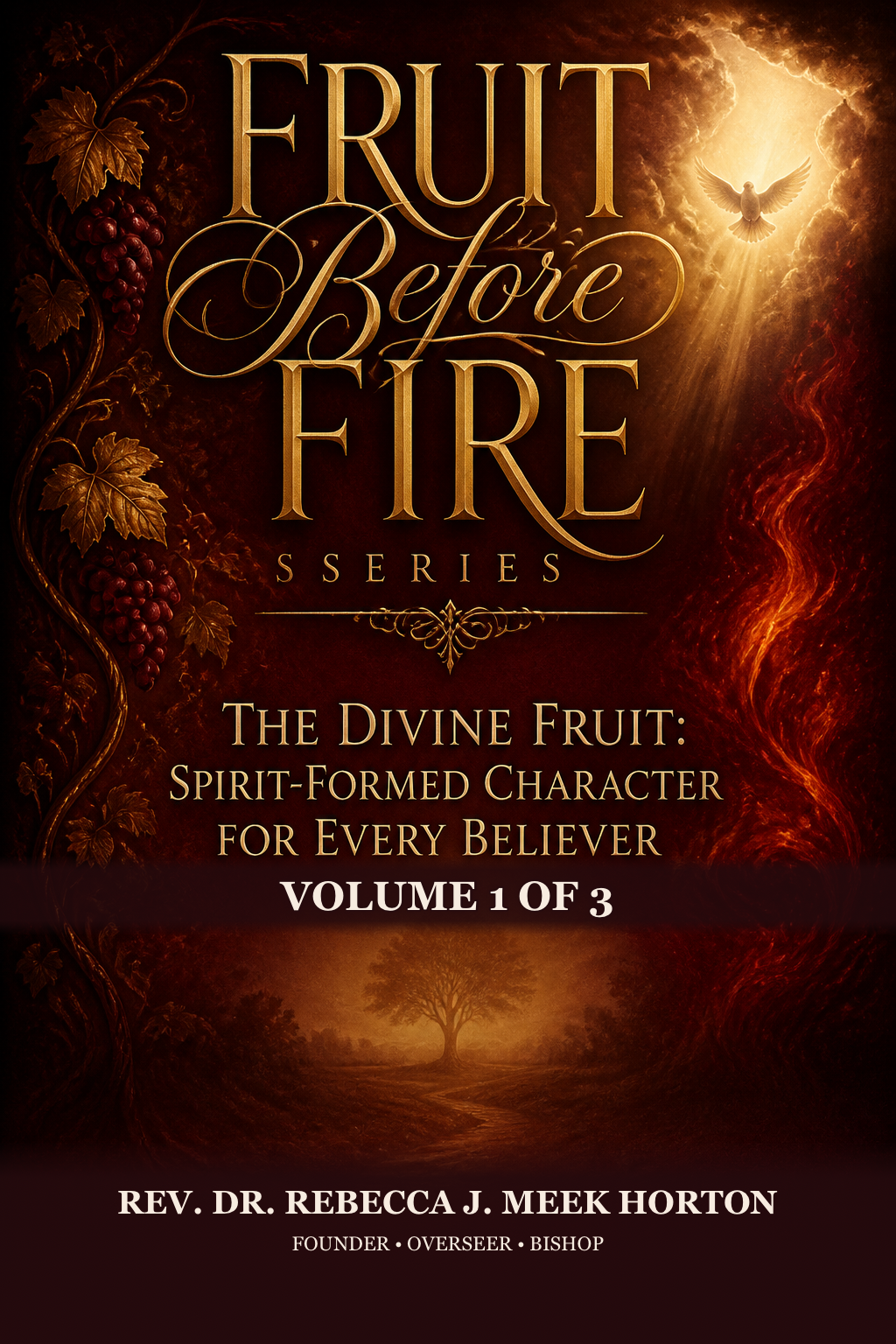
Fruit Before Fire · Volume 1
The Divine Fruit: Spirit-Formed Character for Every Believer
Part 1 of 3 in the series "Fruit Before Fire". Series theme: These are divine attributes not human chat Necessary for ministry Necessary to balance the gifts Necessary to engender works of faith Necessary to live by faith not by sigy Series arc: This three-book series moves from formation to ministry to Spirit-empowered service. Book 1 establishes the Fruit of the Holy Spirit as divine character formed in believers, not natural personality or religious language. Book 2 shows why that fruit is necessary for faithful ministry, daily obedience, and works of faith. Book 3 brings the Fruit and Gifts of the Holy Spirit together so fire remains holy, love governs power, and the Church is built up. How this book advances the series: This opening book grounds the whole series in spiritual formation before moving into ministry practice. This book teaches the Fruit of the Holy Spirit from Galatians 5:22-23 as one unified fruit with multiple holy attributes: love, joy, peace, longsuffering, gentleness, goodness, faith, meekness, and temperance. It makes clear that these are divine attributes produced by the Holy Spirit, not human charm, personality, or spiritual talk. The source material provides the 12-week course foundation; this book must expand it into a deeper teaching on abiding in Christ from John 15:1-8, walking in the Spirit, and living by faith rather than by sight according to 2 Corinthians 5:7.
Full publication
NBCNGMI MASTER KNOWLEDGE LIBRARY Featuring the works of The Sage, Apostle Prophet. Rev. Dr. Rebecca J. Meek Horton, Apostolic Prophetic Architect, NewBeing Creation Network Global Ministries, Inc. Integrated Framework Modalities™
Dedication
I dedicate this book to every believer who longs to bear what only the Holy Spirit can produce. May your life be rooted in Christ, formed in His character, and strengthened to walk by faith when sight cannot lead you.
Purpose
I wrote this book to help every believer understand that the Fruit of the Holy Spirit is divine character formed by the Spirit, not human charm, personality, or religious talk. My prayer is that Galatians 5:22-23, John 15:1-8, and 2 Corinthians 5:7 will call you deeper into abiding in Christ, walking in the Spirit, and living by faith rather than by sight. Before there is fire for ministry, there must be fruit in the life.
Preface
I wrote this book with a burden for formation.
Before fire is displayed, fruit must be formed. Before gifts are exercised, character must be surrendered. Before ministry becomes visible, the inner life must be yielded to the Holy Spirit.
The Divine Fruit was born from years of teaching, watching, praying, correcting, and being corrected by the Word of God. I have seen how easily we can mistake personality for fruit, charisma for maturity, and religious language for spiritual formation. But the Fruit of the Holy Spirit is not human charm. It is not temperament. It is not performance. It is divine character produced in a yielded believer.
Galatians 5:22-23 (KJV) But the fruit of the Spirit is love, joy, peace, longsuffering, gentleness, goodness, faith, Meekness, temperance: against such there is no law.
Notice that Scripture says “fruit,” not “fruits.” The Holy Spirit forms one unified fruit with holy attributes. Love is not separated from temperance. Joy is not separated from longsuffering. Faith is not separated from meekness. The Spirit does not develop us in fragments. He forms Christlike character in us as we abide in Christ.
This book is the first movement in the Fruit Before Fire series. It does not begin with ministry platforms, spiritual gifts, or public works. It begins with the life hidden in Christ. John 15:1-8 teaches us that fruit comes from abiding, not striving. We do not produce divine fruit by pressure, image, or self-effort. We bear fruit as we remain connected to the true Vine.
This matters for every believer. The Fruit of the Holy Spirit is necessary for ministry, necessary to balance the gifts, necessary to engender works of faith, and necessary to live by faith, not by sight.
2 Corinthians 5:7 (KJV) For we walk by faith, not by sight:
My prayer is that this book will slow you down in the best way. Not to delay your calling, but to deepen your roots. Not to quench fire, but to make sure the fire remains holy.
Read prayerfully. Let the Word search you. Let the Spirit form what only He can produce.
Nothing is random. Nothing is wasted.
Introduction
Before the Church needs louder gifts, it needs deeper fruit. Before ministry carries fire, character must be formed. Before works of faith can be trusted in public, the life of faith must be cultivated in private.
This is the burden of The Divine Fruit. The Fruit of the Holy Spirit is not human charm, a pleasant temperament, religious language, or a polished personality. It is divine character produced by the Holy Spirit in the life of a believer who yields, abides, obeys, and walks by faith.
Galatians 5:22-23 (KJV) But the fruit of the Spirit is love, joy, peace, longsuffering, gentleness, goodness, faith, Meekness, temperance: against such there is no law.
Notice the word fruit. Not fruits, as though the Spirit gives one believer love, another joy, and another self-control. The Fruit of the Holy Spirit is one unified fruit with multiple holy attributes. Love, joy, peace, longsuffering, gentleness, goodness, faith, meekness, and temperance belong together. They grow together because they come from the same Source.
That Source is not self-improvement. It is not emotional discipline alone. It is not moral ambition. The Source is the Holy Spirit working in a surrendered life.
This matters because spiritual language can sometimes move faster than spiritual formation. A person can talk about love and still refuse sacrifice. A person can speak of peace and still create confusion. A person can claim faith and still be governed by sight, fear, and pressure. The Fruit of the Spirit brings truth to our inner life. It does not only decorate our testimony; it governs our responses.
Jesus made the matter plain.
John 15:4-5 (KJV) Abide in me, and I in you. As the branch cannot bear fruit of itself, except it abide in the vine; no more can ye, except ye abide in me. I am the vine, ye are the branches: He that abideth in me, and I in him, the same bringeth forth much fruit: for without me ye can do nothing.
Fruit is not forced from the branch. Fruit comes from abiding in the Vine.
This book is the first movement in the Fruit Before Fire series. Book 1 grounds us in formation. Book 2 will show why this fruit is necessary for ministry, daily obedience, and works of faith. Book 3 will bring the Fruit and Gifts of the Holy Spirit together so that fire remains holy, love governs power, and the Church is built up.
But we must begin here. Formation comes before ministry. Character must carry calling. Fruit must govern fire.
As you read, do not rush through these attributes as familiar words. Let each one search you. Love is not sentiment. Joy is not denial. Peace is not passivity. Longsuffering is not weakness. Gentleness is not softness without strength. Goodness is not image management. Faith is not performance. Meekness is not insecurity. Temperance is not repression. Each attribute reveals something of the life of Christ being formed in the believer.
This book will ask something of you. It will ask you to stop excusing what the Spirit is trying to transform. It will ask you to distinguish personality from fruit, gifting from maturity, and religious talk from Spirit-formed character. That cost is real. But it is also mercy. God does not form fruit in us to shame us. He forms fruit in us so we can live, love, serve, and endure as people who belong to Him.
2 Corinthians 5:7 (KJV) For we walk by faith, not by sight:
Read this book slowly. Bring your real life to the page: your home, your words, your decisions, your private reactions, your ministry, your wounds, your habits, your hopes. Do not read only to learn terms. Read to be formed.
Begin with one prayer:
Holy Spirit, form in me what I cannot produce without You. Teach me to abide in Christ, walk in the Spirit, and bear fruit that honors God.
Chapter 1 — Not Human Charm
A man can stand in a pulpit with confidence, shake every hand with warmth, remember every name, and still be unformed in the places only God can see.
A woman can pray beautifully in public, serve faithfully in the church, speak the right words in the right tone, and still be carrying impatience, pride, envy, or hidden anger at home.
This is one of the quiet dangers of spiritual life: we can learn the language of fruit before we yield to the formation of fruit.
The controlling idea of this chapter is simple: the Fruit of the Holy Spirit is divine life produced by God in the believer, not polished behavior, religious vocabulary, public gifting, or natural personality.
Galatians gives us the starting place.
Galatians 5:22-23 (KJV) But the fruit of the Spirit is love, joy, peace, longsuffering, gentleness, goodness, faith, Meekness, temperance: against such there is no law.
Notice the words: the fruit of the Spirit.
Not the fruit of pressure. Not the fruit of image. Not the fruit of talent. Not the fruit of church culture. Not the fruit of being raised around spiritual language.
The fruit belongs to the Spirit because the source is the Spirit. This matters because what we misname, we mishandle.
The Mistake We Learn to Make
Many believers learn how to look spiritually mature before they learn how to be spiritually governed.
This is not always hypocrisy. Sometimes it is imitation. We hear spiritual language, so we repeat it. We see certain church behaviors, so we adopt them. We watch confident people lead, pray, sing, preach, or serve, and we assume visible confidence equals inward formation.
But confidence is not the same as character.
Some people are naturally warm. Some are naturally quiet. Some are disciplined by temperament. Some avoid conflict because they fear it, not because they are meek. Some are generous because they enjoy being needed, not because love is governing them.
Natural personality may be pleasant, useful, and even beautiful. But it is not the same as Spirit-formed character.
A naturally calm person may still lack the peace of God. A naturally cheerful person may still lack holy joy. A naturally assertive person may still lack faith. A naturally gentle person may still avoid truth.
Fruit is not personality with Scripture added to it. Fruit is the evidence of the Holy Spirit forming the life of Christ in us.
This is why we must be careful about judging spiritual maturity by the surface. Scripture warns us that God does not see as man sees.
1 Samuel 16:7 (KJV) But the LORD said unto Samuel, Look not on his countenance, or on the height of his stature; because I have refused him: for the LORD seeth not as man seeth; for man looketh on the outward appearance, but the LORD looketh on the heart.
The outward appearance can impress people. The heart is where fruit is proved.
That does not mean outward behavior does not matter. It does. Words matter. Actions matter. Tone matters. Service matters. But outward behavior must be connected to inward surrender. Otherwise, we become trained performers instead of transformed disciples.
Fruit Has a Source
The Fruit of the Holy Spirit is not self-improvement with religious language.
Self-improvement can help a person become more organized, more aware, more disciplined, and more productive. Those things can be useful. But the Fruit of the Spirit is deeper than improvement. It is formation.
Formation means the Holy Spirit is shaping what we love, how we respond, what we desire, how we endure, how we speak, and how we treat people when there is no applause.
A person can improve habits without yielding the heart. But Spirit-formed fruit comes through surrender.
This is why the phrase “of the Spirit” must stay central. Love, joy, peace, longsuffering, gentleness, goodness, faith, meekness, and temperance are divine attributes expressed through human vessels. They do not begin with us. They are produced in us as we yield to God.
Think of a tree. A healthy tree does not tape fruit to its branches. It bears fruit because life is moving through it. If someone ties apples to a dead branch, it may look fruitful for a moment, but nothing living is happening.
Religious performance works like taped fruit. It can look convincing from a distance. But when pressure comes, the branch tells the truth.
Someone can sound loving until they are corrected. Someone can seem joyful until they are overlooked. Someone can appear peaceful until plans change. Someone can speak of faith until obedience becomes costly. Someone can look self-controlled until desire is denied.
Pressure does not create what is in us. Pressure reveals what is governing us.
That revelation is not meant to shame us. It is meant to invite RE-Calibration™. When we see what is really happening, we can stop pretending and start yielding.
Gifts Can Be Visible Before Character Is Mature
One reason believers confuse gifting with fruit is that gifts are often visible.
A person may teach well, sing powerfully, pray boldly, lead skillfully, or discern sharply. These things can bless others. But public usefulness does not automatically prove private formation.
God can use a person while still forming that person.
This is a sober truth. It should make us humble, not suspicious. The goal is not to distrust every gifted believer. The goal is to stop calling giftedness the same thing as fruitfulness.
A gift may open a door. Fruit helps govern what happens after the door opens.
A gifted person without love may wound while trying to help. A gifted person without peace may spread anxiety while leading. A gifted person without longsuffering may quit when people grow slowly. A gifted person without meekness may confuse authority with control. A gifted person without temperance may be ruled by appetite, emotion, attention, or ambition.
This is why fruit is necessary before fire. Power without character can damage what it was meant to serve.
Jesus taught that fruit matters.
Matthew 7:20 (KJV) Wherefore by their fruits ye shall know them.
Fruit is evidence. Not noise. Not image. Not speed. Not platform. Evidence.
This kind of evidence is not measured only in public moments. It is seen in ordinary places: the kitchen, the car, the meeting, the text message, the delayed answer, the private disappointment, the hidden temptation, the unresolved conflict.
Spiritual formation is often proved where no one is clapping.
Let Fruit Tell the Truth
If the Fruit of the Spirit is divine life produced by God, then we must let fruit tell the truth about our formation.
This is where the cost appears.
It costs us the comfort of hiding behind personality. We can no longer say, “That is just how I am,” when “how I am” resists the Spirit’s work.
It costs us the habit of hiding behind religious language. We can no longer use spiritual words to cover unspiritual reactions.
It costs us the pride of hiding behind gifting. We can no longer assume that being used by God means every part of us is yielded to God.
This is not condemnation. It is invitation.
The Holy Spirit does not expose immaturity to destroy us. He reveals what needs to be surrendered so Christ can be formed in us more deeply.
A simple way to begin is to ask honest questions without shame:
Where do I sound spiritual but resist obedience?
Where do I appear patient but carry bitterness?
Where do I serve others but secretly need control?
Where do I speak of faith but live by what I can see?
Where do I manage my image instead of yielding my heart?
These questions are not meant to trap us. They help us see. And seeing truthfully is often the first mercy.
The Lord is not asking us to manufacture fruit. He is calling us to yield to the One who produces it. That means we stop confusing polish with formation. We stop confusing charisma with holiness. We stop confusing spiritual talk with spiritual maturity.
The Fruit of the Holy Spirit is not decoration for a religious life. It is evidence of divine life within the believer.
Key Takeaways
• The Fruit of the Spirit is produced by God, not manufactured by personality.
• Public gifting is not the same as Spirit-formed character.
• Honest examination is an invitation to growth, not shame.
Practice
Choose one attribute from Galatians 5:22-23 that feels least formed in your current life.
Write one sentence of honest RE-Flection™:
“Lord, I need Your Spirit to form greater __________ in me, especially when __________.”
Then take one clear step today that agrees with that prayer. If you chose peace, pause before responding. If you chose longsuffering, endure without bitterness. If you chose temperance, deny one ungodly impulse. If you chose love, serve without needing attention.
Do not perform fruit.
Yield, obey, and let the Spirit form what only He can produce.
Chapter 2 — The Vine Before the Visible
A branch does not announce itself before the fruit appears.
It stays connected. It receives what it cannot manufacture. It draws life from a source hidden beneath bark, soil, and root. Long before anyone sees grapes, there is attachment.
This is where many believers become tired. We try to look fruitful before we learn to abide. We polish behavior, refine language, manage impressions, and hope spiritual maturity can be seen quickly enough to be trusted. But the Fruit of the Holy Spirit is not formed by striving for an image. It is formed through abiding in Christ.
That is the promise of this chapter: lasting fruit comes from remaining connected to the true source.
John 15:1-8 (KJV)
I am the true vine, and my Father is the husbandman. Every branch in me that beareth not fruit he taketh away: and every branch that beareth fruit, he purgeth it, that it may bring forth more fruit. Now ye are clean through the word which I have spoken unto you. Abide in me, and I in you. As the branch cannot bear fruit of itself, except it abide in the vine; no more can ye, except ye abide in me. I am the vine, ye are the branches: He that abideth in me, and I in him, the same bringeth forth much fruit: for without me ye can do nothing. If a man abide not in me, he is cast forth as a branch, and is withered; and men gather them, and cast them into the fire, and they are burned. If ye abide in me, and my words abide in you, ye shall ask what ye will, and it shall be done unto you. Herein is my Father glorified, that ye bear much fruit; so shall ye be my disciples.
The Hidden Connection Comes First
Jesus does not begin with public ministry, visible results, or religious appearance. He begins with relationship.
“I am the true vine,” He says. “Ye are the branches.”
That order matters. The vine gives life. The branch receives life. The fruit comes because the branch remains. A branch may be visible, but its strength is not in visibility. Its strength is in connection.
A believer can be active and still be dry. A person can serve, speak, sing, teach, post, organize, and perform spiritual duties while slowly losing inward attachment. Activity can hide disconnection for a season. But eventually, what is not supplied by Christ cannot remain fresh.
Think of a cut flower in a vase. For a little while, it still looks alive. It has color. It may even carry fragrance. But it is no longer drawing from the root. Its appearance is temporary because its connection has been severed.
This is why formation must come before display. The visible life must be fed by hidden communion with Christ.
Abiding is not a decorative word. It means remaining. Staying. Continuing. Living from the place of connection. It is the daily practice of bringing the heart back to Christ before trying to produce what only Christ can supply.
This is not passive. It is surrendered dependence.
Abiding Is Not Performing
Many believers have been trained to ask, “How do I look?” before asking, “Where am I connected?”
Performance asks, “Do people think I am spiritual?”
Abiding asks, “Am I remaining in Christ?”
Performance becomes anxious because it depends on response. Abiding becomes steady because it depends on relationship. Performance needs applause, agreement, attention, or visible success. Abiding can continue in hidden places because the source is not the crowd.
Jesus said, “without me ye can do nothing.” He did not say, “without me ye can do less.” He said nothing.
That word humbles us. It strips away spiritual self-sufficiency. It reminds us that divine fruit cannot be produced by human pressure.
A person may imitate patience for a moment. A person may speak gently in public. A person may act joyful when watched. But Spirit-formed character is revealed when pressure comes, when no one is applauding, when obedience costs something, when delay stretches the heart.
Abiding makes the inner life honest before God.
Here is a simple example. A mother is exhausted after a long day. Her child spills something again. Performance says, “Do not lose your image.” Abiding says, “Lord, keep my heart governed.” One is trying to protect appearance. The other is drawing on grace.
The outward response may look similar at first. But the root is different.
The Fruit of the Holy Spirit is not image management. It is divine life working through yielded humanity.
Pruning Is Love, Not Rejection
Jesus says the Father is the husbandman. The Father tends the vine. He removes what is unfruitful and purges what is fruitful so it may bring forth more fruit.
This is tender, but it is not always comfortable.
Pruning can feel like loss. God may touch a habit, a motive, a relationship pattern, a hidden pride, a dependence on approval, or a way of serving that looks useful but is no longer healthy. He may slow what we wanted to accelerate. He may expose what we wanted to keep private. He may call us into RE-Calibration™ when we hoped for recognition.
This is not rejection. This is care.
A gardener does not prune a branch because he hates it. He prunes because he sees what the branch can carry if unnecessary growth is removed. The cut is not against the fruit. The cut is for the fruit.
Still, the cost is real.
We often want fruit without pruning. We want maturity without correction. We want deeper love without the death of selfishness. We want peace without surrendering control. We want joy without releasing our demand that life feel easy.
But the Father loves us too much to let us confuse growth with clutter.
Pruning teaches us to ask better questions.
Not only, “What am I losing?”
But also, “What is God making room for?”
Not only, “Why is this uncomfortable?”
But also, “What fruit is the Father forming through this?”
Nothing is random. Nothing is wasted.
Fruit Has a Source and a Sequence
John 15 gives us a holy sequence.
Christ is the vine. The Father is the husbandman. The believer is the branch. Abiding comes before fruit. Fruit glorifies the Father. Fruit marks discipleship.
This sequence protects us from striving.
We do not begin with fruit. We begin with Christ.
We do not begin with public proof. We begin with private dependence.
We do not begin with spiritual comparison. We begin with surrendered connection.
This is where faith is trained. Much of abiding happens before there is anything impressive to show. Prayer may feel quiet. Scripture may search more than soothe. Obedience may feel small. The heart may be learning to trust God without visible evidence of quick change.
That is part of learning to walk by faith, not by sight according to 2 Corinthians 5:7.
A seed does not become a tree in one afternoon. A branch does not bear mature fruit because someone demands it by Friday. Life has order. Formation has order. The Spirit works deeply, not merely quickly.
This matters because immature urgency can damage spiritual growth. When we demand visible fruit too soon, we may start decorating the branch instead of feeding the root. We may hang religious language where love has not yet matured. We may call ourselves peaceful while avoiding truth. We may call ourselves faithful while refusing obedience.
Abiding brings us back to the source and the sequence.
Stay with Christ.
Let His words abide in you.
Yield to the Father’s pruning.
Trust the Spirit’s formation.
Then fruit comes with weight.
The Cost of Remaining
Abiding sounds gentle, but it asks something of us.
It asks us to stop pretending that we can produce divine life by human effort. It asks us to release the pressure to appear mature before we have been formed. It asks us to let God deal with what is hidden, not just what is visible.
It also asks us to stay.
Stay when growth is slow.
Stay when pruning is uncomfortable.
Stay when no one sees the private obedience.
Stay when the old way would be easier.
Stay when the Spirit is forming character before opening doors.
This is not dependency on a feeling. This is stewardship of connection. Abiding is a daily return to Christ as source, Lord, teacher, and life.
The promise is not that abiding will make life effortless. The promise is that abiding will make fruit possible.
And not just any fruit.
Fruit that remains.
Key Takeaways
• Lasting fruit comes from abiding in Christ, not striving for an image.
• The Father’s pruning is care that makes room for greater fruitfulness.
• The visible life must be fed by hidden connection.
Practice
Choose one quiet moment today and sit with John 15:5 for five minutes.
Ask yourself:
Where am I trying to produce fruit without abiding?
Then take one faithful step of RE-Alignment™. Before you serve, speak, decide, or respond today, pause and pray:
Lord Jesus, keep me connected to You. Form in me what I cannot manufacture. Let my life bear fruit that glorifies the Father.
Chapter 3 — One Fruit, Many Holy Expressions
A bowl of fruit sits on the table after a family meal. Someone reaches for an apple. Another takes grapes. A child asks for the orange because it is bright and easy to peel.
No one is confused. Each piece is different, but all of it belongs to the same bowl. It has one purpose: nourishment.
The Fruit of the Holy Spirit is not a scattered list of religious qualities we try to collect. It is one fruit with many holy expressions. Love, joy, peace, longsuffering, gentleness, goodness, faith, meekness, and temperance belong together because they come from one Source: the Holy Spirit.
This matters because many believers treat the Fruit like separate self-improvement goals. One person says, “I need to work on patience.” Another says, “I need more self-control.” Another says, “I am just not a gentle person.” Those statements may sound humble, but they can quietly place the burden back on human effort.
The Fruit of the Holy Spirit is not produced by personality pressure. It is produced by Spirit-formed life.
Galatians 5:22-23 (KJV) But the fruit of the Spirit is love, joy, peace, longsuffering, gentleness, goodness, faith, Meekness, temperance: against such there is no law.
Notice the word fruit. Not fruits. One fruit. Many holy expressions.
One Source, One Fruit
A tree does not strain to tape fruit onto its branches. It bears what its life produces.
An apple tree does not hold a meeting and decide to become impressive. It does not compare itself to the vine, the fig tree, or the olive tree. It receives life through its roots, and in time, what is inside becomes visible.
So it is with the believer.
The Fruit of the Spirit begins with the life of the Spirit within us. It is not decoration for a Christian image. It is evidence of divine life.
This is why the language matters. If we call the Fruit “good habits,” we may reduce it to behavior management. If we call it “being nice,” we may confuse holiness with pleasantness. If we call it “my personality,” we may excuse what the Spirit wants to form.
The Fruit is divine character made visible in human life.
That does not mean the believer becomes perfect overnight. It means the source has changed. The Spirit begins forming what the flesh could not produce in truth.
A naturally calm person may still lack the peace of God. A cheerful person may still lack Spirit-formed joy. A generous person may still lack agapē love. A quiet person may still lack meekness. Human temperament can look similar from a distance, but it is not the same root.
The question is not, “Do I appear kind?”
The deeper question is, “Is the Spirit forming Christlike character in me when I am unseen, pressured, corrected, delayed, or denied?”
That question brings the Fruit out of the language of performance and into the place of formation.
Not Separate Projects
Many believers try to grow by picking one attribute and working on it like a personal improvement project.
“I will become more patient this month.”
“I will practice joy this week.”
“I will be more gentle with people.”
There is value in focusing attention. But the danger comes when we treat the attributes as isolated assignments disconnected from the Spirit’s work.
The Fruit is unified. Love affects patience. Peace affects self-control. Faith affects joy. Meekness affects gentleness. Goodness affects love. Temperance protects all of them.
Think of a woven cloth. If one thread is pulled hard enough, the whole fabric shifts. The threads are distinct, but they are not independent.
A person may claim love but refuse longsuffering. That love will soon become conditional.
A person may claim faith but lack temperance. That faith may become impulsive and unstable.
A person may claim goodness but lack meekness. That goodness may become harsh or proud.
A person may claim peace but lack faith. That peace may depend too much on circumstances.
The Holy Spirit does not form divided character. He forms whole character.
This is important for ministry, family, leadership, friendship, and private obedience. We do not get to choose the parts of the Fruit that suit our image and ignore the parts that confront our flesh.
A believer who wants joy must also let the Spirit address complaint.
A believer who wants peace must also let the Spirit address control.
A believer who wants gentleness must also let the Spirit address pride.
A believer who wants temperance must also let the Spirit address appetite, impulse, and excuse.
Nothing is random. Nothing is wasted. The Spirit forms the whole life, not just the public parts.
Holy Expressions in Ordinary Places
The Fruit of the Holy Spirit is often revealed in ordinary moments before it is seen in public ministry.
It is seen when someone interrupts you.
It is seen when plans change.
It is seen when your name is overlooked.
It is seen when you are tired and still must answer with care.
It is seen when you are right, but the Spirit restrains how you speak.
It is seen when you could defend yourself, but wisdom tells you to wait.
The holy expressions of the Fruit are not only for church services, platforms, pulpits, prayer lines, or leadership rooms. They are for kitchens, cars, workplaces, text messages, meetings, hospital rooms, grocery lines, and quiet bedrooms where no one applauds obedience.
A mother answers a child’s repeated question without contempt. Longsuffering is being formed.
A worker refuses to join a dishonest report. Goodness is being formed.
A leader receives correction without becoming defensive. Meekness is being formed.
A believer keeps praying when the situation has not changed. Faith is being formed.
A tired person chooses not to speak from irritation. Temperance is being formed.
These are not small things. They are places where divine life becomes visible.
We often want spiritual maturity to look dramatic. Sometimes it does. But much of Spirit-formed character is quiet, steady, and costly. It is formed in repeated surrender.
This is where we must be honest. The Fruit does not flatter the flesh. It confronts it.
The flesh wants credit. The Spirit forms humility.
The flesh wants control. The Spirit forms trust.
The flesh wants reaction. The Spirit forms restraint.
The flesh wants ease. The Spirit forms endurance.
The flesh wants appearance. The Spirit forms truth.
This is why the Fruit cannot be reduced to charm. Charm can behave well when it benefits the image. Spirit-formed character remains under holy rule when no image is being protected.
The Cost of Wholeness
The cost of receiving the Fruit as one unified work is that we can no longer hide behind our strongest attribute.
It is easy to say, “I am loving,” while excusing a lack of self-control.
It is easy to say, “I have faith,” while speaking harshly.
It is easy to say, “I am truthful,” while lacking gentleness.
It is easy to say, “I am peaceful,” while avoiding obedience.
The Spirit does not shame us, but He does search us.
Psalm 139:23-24 (KJV) Search me, O God, and know my heart: try me, and know my thoughts: And see if there be any wicked way in me, and lead me in the way everlasting.
This prayer is not comfortable, but it is safe when prayed before God. He reveals what He is ready to redeem, correct, heal, and form.
The Fruit of the Spirit calls us into wholeness. Not image. Not religious speech. Not one impressive strength covering several unsubmitted places.
Wholeness means letting the Spirit bring every part of life under the rule of Christ.
This will ask something of us.
It will ask us to stop calling reactions “just how I am.”
It will ask us to stop calling avoidance “peace.”
It will ask us to stop calling harshness “honesty.”
It will ask us to stop calling fear “wisdom.”
It will ask us to stop calling impulse “faith.”
This is where RE-Language™ becomes part of formation. We learn to speak with responsibility instead of shame.
Instead of saying, “I am just not patient,” we can say, “The Spirit is forming longsuffering in me, and I need to yield in this area.”
Instead of saying, “I cannot control myself,” we can say, “I am learning temperance through the Holy Spirit, one obedient step at a time.”
Instead of saying, “That is just my personality,” we can say, “My personality must come under the Lordship of Christ.”
This kind of language does not pretend growth is easy. It simply refuses to make bondage sound permanent.
The Fruit is one. The work is deep. The Spirit is faithful.
Key Takeaways
• The Fruit of the Holy Spirit is one unified fruit with many holy expressions.
• These attributes are produced by the Spirit, not by charm, personality, or self-effort.
• Spirit-formed character must be welcomed in ordinary, hidden, and costly places.
Practice
Choose one ordinary situation where your character is often tested.
It may be a conversation, a daily responsibility, a delay, a family pattern, a workplace pressure, or a private habit.
Write this sentence and complete it honestly:
“The Holy Spirit is forming Christlike character in me when I…”
Then name one expression of the Fruit you need to yield to in that place.
Do not make a dramatic vow. Take one faithful step today. Ask the Holy Spirit to form the whole fruit in the real place where your life is actually lived.
Chapter 4 — Love That Carries Weight
The room was full, the music was strong, and everyone knew when to stand, clap, and say amen. A gifted voice carried across the sanctuary. A powerful prayer followed. People nodded. Some cried. It looked like life.
But in the hallway afterward, the same mouth that had blessed God cut someone down. The same hands that had lifted in worship refused to serve. The same person who could speak with spiritual language could not speak with patience at home.
That is where we must slow down.
The controlling truth of this chapter is simple: love is the governing evidence of Spirit-formed life. Without love, gifts may still impress people, sacrifice may still be seen, speech may still sound spiritual, and faith may still appear strong, but they lose holy weight before God.
Love is not decoration on Christian character. Love is the weight that proves the life is being formed by the Spirit.
The Sound Without the Substance
Paul begins 1 Corinthians 13 by addressing speech. Not ordinary speech only, but elevated speech. Tongues of men. Tongues of angels. Language that sounds spiritual, beautiful, and powerful.
Then he gives the warning.
1 Corinthians 13:1-3 (KJV)
Though I speak with the tongues of men and of angels, and have not charity, I am become as sounding brass, or a tinkling cymbal. And though I have the gift of prophecy, and understand all mysteries, and all knowledge; and though I have all faith, so that I could remove mountains, and have not charity, I am nothing. And though I bestow all my goods to feed the poor, and though I give my body to be burned, and have not charity, it profiteth me nothing.
The King James Version uses the word charity. In this passage, charity speaks of godly love: not sentiment, not charm, not performance, but love that gives itself rightly before God.
Paul does not say speech is useless. He does not say tongues are false. He does not say spiritual language has no place. He says that without love, even the highest sound becomes noise.
A cymbal can be loud and still be empty.
This matters because believers can learn the sound of maturity before they carry the substance of it. We can learn phrases, tones, songs, prayers, and responses. We can know how to sound tender, bold, deep, or spiritual. But sound is not fruit by itself.
Love gives speech holy weight.
A person may say the right thing and still wound the hearer. A correction may be accurate and still lack mercy. A prayer may be intense and still be more about being heard by people than serving the will of God. A teaching may be true and still be handled harshly.
Spirit-formed love asks, “Is what I am saying faithful to God, and is the way I am saying it governed by Him?”
That question will slow the mouth. It will soften the tone. It will remove the need to perform. It will teach us that truth does not need cruelty in order to be strong.
Gifts Are Not a Substitute for Love
Paul then names prophecy, mysteries, knowledge, and mountain-moving faith. These are not small matters. These are the kinds of things people notice. They draw attention. They can build a reputation quickly.
Yet Paul says, “and have not charity, I am nothing.”
Not less impressive.
Nothing.
This is one of the most sobering statements in Scripture. It means visible gifting does not equal spiritual formation. A person may be able to minister in a way that helps others and still need deep formation in love. God can use a gift, but the gift does not prove the whole inner life is submitted.
This is why love must govern power.
A gifted person without love may use discernment to expose but not restore. They may use knowledge to dominate rather than teach. They may use faith language to pressure people instead of strengthening them. They may become more interested in being recognized than being conformed to Christ.
Love does not weaken the gifts. Love purifies their use.
Think of a sharp knife. In the hand of a surgeon, it can help heal. In the hand of a careless person, it can harm. The sharpness is not the problem. The governing heart matters.
So it is with spiritual gifts.
A prophetic word without love can become a weapon of pride. Knowledge without love can become cold superiority. Faith without love can become pressure that ignores pain, timing, and wisdom. But when love governs, gifts serve the body. They do not exalt the vessel.
Love asks different questions.
Not, “Did they notice me?”
But, “Was Christ honored?”
Not, “Did I sound powerful?”
But, “Was the person strengthened in truth?”
Not, “Did I prove my gift?”
But, “Did I steward what God entrusted?”
This is part of spiritual maturity. We do not despise gifts. We put them under holy rule.
Sacrifice Still Needs Love
Paul then moves from speech and gifting to sacrifice.
He speaks of giving goods to feed the poor. He even speaks of giving the body to be burned. These are costly acts. Most people would look at them and call them proof of devotion.
But Paul says that without charity, “it profiteth me nothing.”
This does not mean helping the poor is meaningless. Scripture consistently calls God’s people to mercy, generosity, and care. The warning is about motive. An outward act may be costly and still not be loving.
We can give and still be proud.
We can serve and still be resentful.
We can sacrifice and still be controlling.
We can do visible good while secretly needing people to see us, praise us, depend on us, or feel indebted to us.
Love does not only ask, “What did I give?”
Love asks, “What spirit did I give it in?”
A parent can provide everything and still withhold tenderness. A leader can work long hours and still treat people as burdens. A believer can volunteer faithfully and still carry bitterness because no one applauded enough. A person can give money and use that gift to control decisions.
The act may look generous, but love examines the heart.
This is where RE-Language™ helps us move from shame to RE-Sponsibility™. Instead of saying, “I am just an unloving person,” we can say, “The Holy Spirit is showing me where my service needs purer love.” That shift matters. Shame traps. RE-Sponsibility™ responds.
Love is not pretending our motives are always clean. Love is allowing God to search them.
Psalm 139:23-24 (KJV)
Search me, O God, and know my heart: try me, and know my thoughts: And see if there be any wicked way in me, and lead me in the way everlasting.
That prayer is not comfortable, but it is freeing. It brings hidden motives into the light where God can correct them.
The Fruit That Governs the Fire
Love is the first expression named in the Fruit of the Spirit in Galatians 5:22. That placement is not accidental. Love is not merely one attribute among many. Love gives holy shape to the rest.
Joy without love can become self-centered happiness.
Peace without love can become avoidance.
Longsuffering without love can become silent resentment.
Gentleness without love can become people-pleasing.
Goodness without love can become moral pride.
Faith without love can become harsh certainty.
Meekness without love can become false humility.
Temperance without love can become rigid control.
Love keeps the fruit whole.
It teaches joy to rejoice with others, not just in personal blessing. It teaches peace to pursue reconciliation, not just private calm. It teaches longsuffering to endure without becoming bitter. It teaches goodness to act with righteousness and mercy together. It teaches temperance to master desire for the sake of obedience, not image.
This is why love must be formed, not performed.
Human charm can imitate love for a moment. Personality can appear warm when things are easy. Religious language can sound loving in public. But Spirit-formed love remains when it costs something.
It remains when the person is difficult.
It remains when no one is watching.
It remains when correction is needed.
It remains when service is inconvenient.
It remains when forgiveness must be practiced, not just discussed.
This does not mean love has no boundaries. Biblical love is not passivity. It does not enable sin, tolerate abuse, or call confusion peace. Love tells the truth, but it tells the truth under God’s government. Love serves, but it does not worship being needed. Love forgives, but it also walks in wisdom.
The Cost of Spirit-Formed Love
The cost is that love will not let us hide behind our gifts.
It will not let us excuse harshness because we are “just bold.” It will not let us call impatience “discernment.” It will not let us use service as proof that our hearts are healthy. It will not let us measure maturity by how spiritual we sound in public while neglecting how we treat people in private.
Love asks for the whole person.
It reaches into speech, motives, service, decisions, relationships, and ministry. It asks us to slow down before speaking. It asks us to listen when we would rather defend ourselves. It asks us to repent without performing sorrow. It asks us to serve without needing control. It asks us to forgive without pretending harm did not happen.
That is not easy.
But this is the formation every believer needs before greater fire, greater visibility, or greater responsibility. The Church does not need more noise without charity. Families do not need more correct words without tenderness. Ministry does not need more gifts without holy love.
The Spirit forms love in us because Christ is not only powerful. He is holy, humble, merciful, and true.
John 13:35 (KJV)
By this shall all men know that ye are my disciples, if ye have love one to another.
Jesus did not say the world would know His disciples only by their vocabulary, platforms, knowledge, or activity. He named love.
That does not lower the standard.
It raises it.
Key Takeaways
• Love gives holy weight to speech, gifts, faith, and sacrifice.
• Visible gifting is not a substitute for Spirit-formed character.
• Love is not performance; it is divine life governing the whole person.
Practice
Before your next spiritual conversation, act of service, correction, post, prayer, or ministry moment, pause and ask one honest question:
“Is love governing how I am about to speak or act?”
Then take one faithful step. If the tone needs to soften, soften it. If the motive needs correction, pray first. If the act is right but the spirit is wrong, wait until you can move in love.
Chapter 5 — Joy That Does Not Depend on Ease
The room was full, but her face looked tired.
She had served all morning. She smiled at the door, hugged the latecomers, helped with the children, answered questions, and stayed after everyone else had gone. When someone asked, “Are you okay?” she gave the answer many believers know how to give.
“I’m blessed.”
And she was. But she was also weary.
That is where many of us learn the difference between performance and fruit. Joy is not the same as keeping a pleasant face. Joy is not pretending pain is not present. Joy is not a church word used to cover exhaustion, disappointment, or grief.
The controlling idea of this chapter is simple: Spirit-formed joy is deep delight in the Lord that remains when circumstances change, because its source is God’s presence, not ease.
Joy is not fragile when it is rooted in the Lord. It may become quiet. It may come with tears. It may sit beside sorrow. But it does not have to disappear every time life becomes hard.
The Source of Joy
Psalm 16:11 (KJV)
Thou wilt shew me the path of life: in thy presence is fulness of joy; at thy right hand there are pleasures for evermore.
David does not locate fullness of joy in perfect conditions. He locates it in God’s presence.
That matters.
If joy depends on comfort, then discomfort can take it. If joy depends on attention, then being overlooked can take it. If joy depends on visible success, then delay can take it. But if joy is rooted in the presence of the Lord, then circumstances may press the believer, but they do not own the believer’s inner life.
This does not mean hardship feels good. It means God remains good.
A person can be in a difficult season and still carry joy. Not because they enjoy the difficulty, but because they are not alone in it. The presence of God becomes the believer’s steady place.
Think of a child walking through a dark hallway while holding a parent’s hand. The hallway is still dark. The shadows are still there. But the child’s fear changes because presence changes the experience. The hand does not remove the hallway. It gives courage to walk through it.
Joy works like that.
The Spirit does not form joy by teaching us to deny reality. He forms joy by anchoring us in a greater reality: the Lord is present, faithful, and worthy of delight even here.
Not Cheerfulness, but Holy Delight
Some people are naturally cheerful. They laugh easily. They bring warmth into a room. That can be a gift, but it is not the same as the Fruit of the Holy Spirit.
Spirit-formed joy is not personality. It is not volume. It is not constant excitement. It is divine life expressed as delight in God.
This is important because quiet people can have joy. Grieving people can have joy. People in pressure can have joy. People who do not appear emotionally expressive can still be deeply rooted in the gladness of the Lord.
We must not confuse visible energy with spiritual fruit.
A person may speak loudly about joy and still be governed by resentment. Another may speak softly, endure faithfully, serve humbly, and carry a deep delight in God that steadies everyone around them.
Joy is not proven by noise. Joy is proven by source.
Nehemiah 8:10 (KJV)
Then he said unto them, Go your way, eat the fat, and drink the sweet, and send portions unto them for whom nothing is prepared: for this day is holy unto our LORD: neither be ye sorry; for the joy of the LORD is your strength.
The joy of the Lord strengthens. It does not merely decorate the believer’s life. It carries weight.
There are days when joy strengthens you to forgive. Days when joy strengthens you to get up again. Days when joy strengthens you to serve without applause. Days when joy strengthens you to stay tender when disappointment could have made you hard.
This is not shallow happiness. This is holy strength.
Joy When Circumstances Shift
Circumstances move. Health changes. Finances shift. Relationships stretch. Doors open and close. People celebrate you one season and forget you the next. If joy is tied to these things, the soul becomes unstable.
Spirit-formed joy teaches the believer to live from a deeper place.
Habakkuk 3:17-18 (KJV)
Although the fig tree shall not blossom, neither shall fruit be in the vines; the labour of the olive shall fail, and the fields shall yield no meat; the flock shall be cut off from the fold, and there shall be no herd in the stalls:
Yet I will rejoice in the LORD, I will joy in the God of my salvation.
Habakkuk names loss clearly. He does not pretend the fig tree is blossoming when it is not. He does not call empty fields full. He does not use religious language to escape reality.
He says, “Although.”
Then he says, “Yet.”
That is Spirit-formed joy.
Although this is hard, yet I will rejoice in the Lord.
Although I do not see the outcome, yet I will joy in the God of my salvation.
Although this season is not what I expected, yet I will not surrender my delight in God to the condition of the field.
This is not denial. This is governed faith.
A believer practicing RE-Language™ might shift from, “I have no joy because everything is hard,” to, “This is hard, and I need to return to the presence of the Lord where joy is strengthened.”
That small change matters.
The first statement gives circumstances full authority. The second tells the truth while taking RE-Sponsibility™ for turning back to God.
Joy does not require ease. It requires connection to the Lord.
Joy Without Applause
There is another thief of joy that is harder to name: the need to be seen.
Many believers begin serving with a sincere heart, but over time they become weary because their joy becomes tied to recognition. If someone thanks them, they feel alive. If no one notices, they feel empty. If the work grows, they feel important. If the work is hidden, they feel forgotten.
This is where joy must be RE-Calibrated™.
Visible success is not the source of holy joy. Public affirmation is not the source of holy joy. Fruitfulness before God is not always immediately visible to people.
Jesus warned His disciples not to build spiritual life around being seen by men. The Father sees what is done in secret. That truth protects joy from becoming dependent on applause.
A mother praying over her child at night may never be handed a microphone. A caregiver serving quietly may never be posted online. A believer choosing integrity at work may not be praised. A church member who keeps showing up faithfully may not be publicly named.
But heaven is not confused by hidden faithfulness.
Joy grows stronger when the believer learns to delight in pleasing God more than being noticed by people.
This does not mean encouragement is wrong. Encouragement is good. Gratitude is good. Honor is good. But they cannot become the root system of joy. If they do, the believer will become anxious, offended, or exhausted whenever recognition is delayed.
Spirit-formed joy says, “The Lord is my portion. I can serve from His presence, not from the hunger to be seen.”
The Cost of Joy
Joy sounds beautiful, but it asks something of us.
It asks us to release the demand that life must be easy before we rejoice. It asks us to stop using pain as permission to disconnect from God. It asks us to examine where our joy has been tied to comfort, attention, control, or results.
That can be uncomfortable.
Sometimes the loss of joy reveals a misplaced source. We thought we were delighting in the Lord, but we were delighting in being needed. We thought we were rejoicing in God, but we were rejoicing in momentum. We thought we had peace with hiddenness, but we were quietly waiting for someone to notice.
The Holy Spirit does not expose this to shame us. He exposes it to mature us.
Joy is part of the Fruit of the Spirit, which means it is produced as we yield to God. We do not manufacture joy by force. We return to the Lord. We sit in His presence. We tell the truth. We surrender the false sources. We receive again.
Philippians 4:4 (KJV)
Rejoice in the Lord alway: and again I say, Rejoice.
The command is not, “Rejoice in ease.” It is not, “Rejoice in approval.” It is not, “Rejoice when everything works.”
It is, “Rejoice in the Lord.”
That is where joy becomes durable.
Key Takeaways
• Spirit-formed joy is rooted in God’s presence, not perfect conditions.
• Joy is not personality, performance, or public excitement.
• The Holy Spirit matures joy by shifting our source from ease to the Lord.
Practice
Set aside ten quiet minutes today.
Read Psalm 16:11 slowly. Then write one honest sentence beginning with “Although…” and one faithful sentence beginning with “Yet…”
For example: “Although this season feels uncertain, yet I will rejoice in the Lord and return to His presence today.”
After you write it, take one simple step that reflects joy in God: pray, worship, serve quietly, give thanks, or encourage someone without needing recognition.
Chapter 6 — Peace That Guards the Inner Life
The room is quiet, but your mind is not.
You may be sitting at the kitchen table before anyone else wakes up. The coffee is still warm. The house is still. Yet inside, there is movement everywhere. A bill is due. A child is hurting. A diagnosis is unclear. A relationship feels strained. A responsibility is waiting for you, and you do not know if you have enough strength for it.
Nothing loud is happening around you, but pressure is speaking within you.
This is where peace matters.
Peace is not pretending nothing is wrong. Peace is not a calm personality. Peace is not the reward for having an easy life. Peace is Spirit-given steadiness rooted in trust in God’s sovereignty and provision. It guards the inner life when anxiety, pressure, and uncertainty rise.
Galatians names peace as part of the Fruit of the Spirit.
Galatians 5:22-23 (KJV) But the fruit of the Spirit is love, joy, peace, longsuffering, gentleness, goodness, faith, Meekness, temperance: against such there is no law.
Peace is not something we manufacture so others will think we are mature. It is something the Holy Spirit forms in us as we learn to bring the real weight of life before God.
Peace Is Not Denial
Some people call it peace when they avoid hard conversations. Some call it peace when they stop caring. Some call it peace when they keep everyone pleased while their own soul is weary.
That is not Spirit-formed peace.
Biblical peace does not require you to lie about pain. It does not ask you to rename fear as faith. It does not teach you to ignore danger, grief, or responsibility. Peace tells the truth in the presence of God.
Paul did not write about peace from a life free of pressure. He knew trouble, prison, opposition, weakness, and uncertainty. Yet he pointed believers to a peace that did not depend on perfect circumstances.
Philippians 4:6-7 (KJV) Be careful for nothing; but in every thing by prayer and supplication with thanksgiving let your requests be made known unto God. And the peace of God, which passeth all understanding, shall keep your hearts and minds through Christ Jesus.
The phrase “be careful for nothing” does not mean we become careless. It means we are not to be ruled by anxious care. The instruction is not, “Act like nothing matters.” The instruction is, “Bring everything to God.”
Think of a parent sitting beside a child during a storm. The thunder is real. The lightning is real. The child’s fear is real. But the parent’s presence changes how the child carries the storm.
Peace does not always stop the storm outside. Peace steadies the heart inside.
Peace Guards the Heart and Mind
Paul says the peace of God shall keep your hearts and minds through Christ Jesus.
That word “keep” carries the sense of guarding. Peace stands watch where anxiety tries to enter. It guards the heart, where motives, affections, and fears gather. It guards the mind, where thoughts repeat, argue, imagine, and accuse.
An unguarded heart can become driven by fear. An unguarded mind can turn one concern into ten imagined disasters. This is how pressure multiplies. One situation becomes a story. One delay becomes rejection. One unknown becomes doom.
Peace interrupts that spiral.
A woman waits for an important phone call. By noon, she has already imagined the worst. By three o’clock, her body is tense. By evening, she has rehearsed conversations that have not happened. Nothing has changed externally, but internally she has lived through several versions of trouble.
Peace does not shame her for feeling concern. Peace invites her to pause and ask, “What is actually happening? What am I imagining? What do I need to bring before God right now?”
That is RE-Language™ in practice. Instead of saying, “I cannot handle anything,” we learn to say, “This is heavy, and I need to bring it to God one honest step at a time.”
Peace guards by helping us return to what is true.
God is present.
God is sovereign.
God is not confused.
God can provide wisdom for the next step.
This does not remove all feeling. It restores order to feeling. It teaches the heart and mind that they are not the final authority. Christ is.
Peace Grows Where Trust Is Practiced
Peace is connected to trust. We cannot receive the peace of God while insisting on carrying life as if everything depends on us.
Isaiah gives a clear picture of this steadiness.
Isaiah 26:3 (KJV) Thou wilt keep him in perfect peace, whose mind is stayed on thee: because he trusteth in thee.
The mind that is stayed on God is not a mind that never notices trouble. It is a mind that keeps returning to the Lord as its resting place.
Trust has to be practiced.
It is practiced when you pray before you panic.
It is practiced when you tell the truth without surrendering to despair.
It is practiced when you take responsibility for what is yours and release what belongs to God.
It is practiced when you refuse to let sight become your master.
A man may look at his work schedule and feel overwhelmed. The visible facts are real: deadlines, people, needs, limits. If he lives only by sight, he may rush, snap, withdraw, or try to control everyone around him. But if he practices trust, he can pause and ask, “Lord, what is mine to do today? What must wait? Where do I need help? What am I carrying that You did not assign to me?”
That pause may not change the whole schedule. But it can change the spirit in which he walks through it.
Peace often begins with surrendering false ownership. We are stewards, not saviors. We are responsible, but we are not God.
This is where many believers struggle. We want God’s peace, but we also want control. We want relief, but we do not want to release the burden. We want calm, but we keep feeding the fear with constant checking, constant rehearsing, constant predicting.
Peace grows when trust becomes more than a sentence we say. It becomes a way we walk.
The Cost of Guarded Peace
Peace has a cost.
It costs the right to rehearse fear without interruption. It costs the habit of controlling outcomes to feel safe. It costs the comfort of complaining instead of praying. It costs the familiar identity of being the one who must hold everything together.
For some, peace also requires receiving help. There are burdens that should not be carried alone. Wise counsel, pastoral care, medical support, or professional guidance may be part of faithful stewardship. Seeking help is not a denial of faith. Sometimes it is one expression of humility.
Spirit-formed peace does not make us passive. It makes us governed.
Jesus spoke peace to His disciples, but He did not promise them a trouble-free life.
John 14:27 (KJV) Peace I leave with you, my peace I give unto you: not as the world giveth, give I unto you. Let not your heart be troubled, neither let it be afraid.
The peace Jesus gives is not like the world’s peace. The world often offers peace through escape, distraction, control, or favorable conditions. Christ gives peace through Himself.
That means peace can remain when the answer has not arrived.
Peace can remain when obedience is costly.
Peace can remain when the next step is small.
Peace can remain when you still have tears.
This is not emotional numbness. It is holy steadiness. It is the inner life learning to stay under the rule of Christ.
A peaceful believer is not someone who never feels pressure. A peaceful believer is someone whose pressure is no longer allowed to govern the heart.
Key Takeaways
• Peace is Spirit-given steadiness, not denial or personality.
• The peace of God guards the heart and mind through Christ Jesus.
• Peace grows as trust becomes a practiced way of walking.
Practice
Today, take ten quiet minutes and practice the WALK™ rhythm with one real concern.
Wait in stillness.
Ask God honestly about the burden.
Listen for the next faithful step.
Keep that step without trying to solve everything at once.
Write one sentence before you move on: “Today, the concern I am bringing to God is ________, and my next faithful step is ________.”
Chapter 7 — Longsuffering Without Bitterness
The waiting room was too bright, too quiet, and too full of people trying not to fall apart.
A mother sat with her hands folded over a worn Bible. Her son was in surgery. Every few minutes, someone walked through the double doors, and every head lifted. Then every head lowered again.
Across the room, a man paced. He was angry at the delay, angry at the nurses, angry at the vending machine, angry at the helplessness he could not control. His pain was real. So was hers.
But the woman with the Bible was not pretending. Tears still came. Her lips trembled. She was not untouched by trouble. She was being held through it.
That is the difference longsuffering makes.
Longsuffering is the Spirit-formed ability to endure difficulty without becoming hard, reactive, or hopeless. It is not natural tolerance. It is not pretending pain is small. It is not letting people abuse you without wisdom or boundaries. Longsuffering is holy endurance under pressure, shaped by surrender to God.
Galatians 5:22-23 (KJV) But the fruit of the Spirit is love, joy, peace, longsuffering, gentleness, goodness, faith, Meekness, temperance: against such there is no law.
The Pressure Reveals the Formation
Pressure does not create what is in us from nothing. It reveals what has been forming.
A cup can look steady on a table until someone bumps it. Then whatever is inside spills out. Life has a way of bumping the soul. Delay bumps us. Disappointment bumps us. Rejection bumps us. Sickness bumps us. Unanswered prayer bumps us.
Longsuffering is not proved when everything is calm. It is seen when something presses long enough to test the spirit.
Romans 5:3-4 (KJV) And not only so, but we glory in tribulations also: knowing that tribulation worketh patience; And patience, experience; and experience, hope:
Paul does not say tribulation is pleasant. He does not call pain good in itself. He shows us that surrendered pressure can become a place of formation. Tribulation worketh patience. Patience forms experience. Experience strengthens hope.
A believer may ask, “Why am I still here?” “Why has this not changed?” “Why does obedience feel so slow?”
Those are honest questions. But longsuffering teaches us not to let honest questions become bitter conclusions.
There is a difference between saying, “Lord, I do not understand,” and saying, “God is not faithful.” One is lament. The other is agreement with despair.
Longsuffering keeps the soul from making permanent accusations during temporary darkness.
Think of a farmer. He plants seed, covers it with soil, and waits. The waiting does not mean nothing is happening. Much of the first work happens beneath the surface. Roots form before fruit appears. If the farmer digs up the seed every day to check its progress, he interrupts what he is hoping to see.
Some seasons are root seasons. They feel hidden. They feel slow. But God is not wasting the ground.
Endurance Without Hardness
Some people endure, but they become sharp. They survive, but they lose tenderness. They keep going, but they stop hoping. They become functional, but not fruitful.
That is not longsuffering in the Spirit. That is pain without surrender.
Spirit-formed longsuffering does not make the heart stone. It keeps the heart governed while it is under weight.
This matters because hardship can train us in two different directions. It can train us to trust God more deeply, or it can train us to protect ourselves with bitterness. Bitterness feels like armor, but it is really a prison. It promises safety, but it keeps love, joy, peace, and gentleness from moving freely.
Hebrews gives a serious warning about this.
Hebrews 12:15 (KJV) Looking diligently lest any man fail of the grace of God; lest any root of bitterness springing up trouble you, and thereby many be defiled;
Bitterness rarely begins as a tree. It begins as a root. A small agreement. A quiet resentment. A rehearsed injury. A sentence we keep repeating: “They always…” “God never…” “I knew this would happen…” “Nobody cares…”
Longsuffering requires RE-Cognition™. We must notice what pressure is producing in our language, reactions, and expectations. Not with shame. With stewardship.
A woman caring for an aging parent may begin with love. Over time, exhaustion can make her words short and her heart resentful. She still serves, but now the service is mixed with anger. Longsuffering does not tell her to ignore her limits. Wisdom may call for help, rest, counsel, and better structure. But the Spirit also invites her to bring the resentment into the light before it becomes her identity.
The goal is not to look strong.
The goal is to remain surrendered.
The Waiting Has a Witness
How we wait teaches.
Children learn from how parents handle delay. Congregations learn from how leaders handle pressure. Friends learn from how we suffer without performing. Even those who never ask spiritual questions may notice when someone is afflicted but not consumed.
This does not mean we suffer publicly for display. It means our endurance has a witness whether we intend it or not.
Longsuffering becomes visible in small places.
A worker is overlooked for a promotion but refuses to become dishonest or spiteful. A spouse walks through a difficult season without using pain as permission to wound. A ministry leader faces criticism and chooses prayer before reaction. A young adult waits on God’s timing without surrendering to envy.
These are not small things in the Spirit.
The world often teaches us to react quickly, defend ourselves loudly, and leave when something becomes uncomfortable. Sometimes leaving is wise. Sometimes boundaries are necessary. Sometimes help must be sought immediately. Longsuffering is not passivity, and it is not permission for harm.
But there are also times when God is not calling us to escape discomfort. He is calling us to be formed in it.
SAPP™ Discernment helps here: See what is really happening. Ask the deeper questions. Ponder motives and costs. Practice the next faithful step.
Not every hard place is your assignment forever. But every hard place can become a place of formation if surrendered to God.
Longsuffering asks, “What is God forming in me while I wait?” not only, “When will this be over?”
This is where spiritual maturity grows. The believer learns not to be governed by immediate relief. The soul becomes steadier. Prayer becomes more honest. Obedience becomes less dependent on visible outcomes.
That is part of living by faith and not by sight.
The Cost of Holy Endurance
Longsuffering has a cost.
It costs the flesh its demand for immediate vindication. It costs pride its right to be understood by everyone. It costs bitterness its favorite stories. It costs fear its control over our decisions.
This is not easy work.
Sometimes the hardest part of longsuffering is not the outward difficulty. It is refusing to let the difficulty rename you. Pain will try to call you abandoned. Delay will try to call you forgotten. Rejection will try to call you unwanted. Weariness will try to call you finished.
But the Spirit forms another witness in the believer: still held, still called, still being formed, still able to obey.
This is where RE-Language™ matters. We learn to speak truth without denying pain.
Instead of “I cannot take this anymore,” we may need to say, “I need help, and I will take the next faithful step.”
Instead of “Nothing is changing,” we may need to say, “I cannot see everything God is doing yet.”
Instead of “This season is wasted,” we may need to say, “Lord, form what is holy in me here.”
This is not wordplay. It is stewardship. Language can either deepen despair or make room for obedience.
Longsuffering does not require us to be silent about suffering. Scripture gives us lament, prayer, counsel, and community. But it does call us to refuse bitterness as a home.
Psalm 27:14 (KJV) Wait on the LORD: be of good courage, and he shall strengthen thine heart: wait, I say, on the LORD.
Waiting on the Lord is not empty waiting. It is strengthened waiting. Courage is needed because waiting can make the heart tired. But God does not ask for endurance without offering strength.
He strengthens the heart.
Not always by changing the circumstance immediately.
Often by forming the person faithfully.
Key Takeaways
• Longsuffering is Spirit-formed endurance without bitterness.
• Pressure can become formation when surrendered to God.
• Waiting well requires truth, help, boundaries, and obedience.
Practice
Choose one pressure you are currently facing. Write three honest sentences:
• What is really hard about this?
• Where am I tempted toward bitterness, reaction, or hopelessness?
• What is one faithful step I can take today without hardening my heart?
Then pray simply: Lord, strengthen my heart while I wait, and form Your fruit in me here.
Chapter 8 — Gentleness and Goodness in Motion
A person can be right and still leave wounds behind.
You have seen it happen. Someone tells the truth, but the tone cuts. Someone corrects an error, but the correction humiliates. Someone does a generous thing, but the spirit behind it feels heavy, proud, or controlling.
Then there is another kind of person. They do not avoid truth, but they carry it carefully. They do not perform goodness, but they leave people strengthened. Their presence does not demand attention. Their choices make mercy visible.
That is where gentleness and goodness meet.
The controlling idea of this chapter is simple: Spirit-formed gentleness and goodness turn holy character into visible care. Gentleness governs how we handle people. Goodness governs what we do with what is right. Together, they show that the Fruit of the Holy Spirit is not passive niceness. It is righteousness expressed with humility and mercy.
Galatians 5:22-23 (KJV) But the fruit of the Spirit is love, joy, peace, longsuffering, gentleness, goodness, faith, Meekness, temperance: against such there is no law.
Gentleness Is Holy Handling
Gentleness is not weakness. It is strength under the rule of the Spirit.
A gentle person is not someone who has no conviction. Gentleness does not mean silence when truth is needed. It does not mean letting harm continue. It does not mean avoiding hard conversations.
Gentleness means the person in front of you is not treated as an object, a problem, or an interruption. They are treated as someone made by God.
Think of a nurse changing a bandage. The wound must be cleaned. The old covering may need to be removed. There may be pain involved. But the nurse does not rip carelessly. The goal is not to prove skill. The goal is healing.
That is holy handling.
Many believers know how to speak truth. Fewer have learned how to carry truth in a way that does not crush the bruised. Gentleness asks, How can I be faithful without being harsh? How can I correct without shaming? How can I be clear without becoming cruel?
Ephesians 4:32 (KJV) And be ye kind one to another, tenderhearted, forgiving one another, even as God for Christ's sake hath forgiven you.
Tenderhearted does not mean easily manipulated. It means the heart has not become hard while doing what is right.
This matters in homes, churches, workplaces, friendships, and ministry. A parent may need to discipline a child. A leader may need to address disorder. A friend may need to speak honestly. Gentleness does not remove responsibility. It refines the spirit in which responsibility is carried.
Goodness Is Righteousness in Action
Goodness is not the same as being agreeable.
Some people confuse goodness with keeping everyone comfortable. But Spirit-formed goodness is deeper than pleasant behavior. Goodness is moral excellence in motion. It is righteousness expressed through choices, actions, and treatment of others.
Goodness asks, What is right before God, and how can I participate in it faithfully?
This kind of goodness does not need an audience. It does not always feel convenient. It may require sacrifice, correction, generosity, honesty, or restraint. Goodness is not simply avoiding evil. It is actively choosing what reflects the character of God.
Micah 6:8 (KJV) He hath shewed thee, O man, what is good; and what doth the LORD require of thee, but to do justly, and to love mercy, and to walk humbly with thy God?
Notice the shape of goodness in this verse: justice, mercy, and humility.
To do justly is to care about what is right.
To love mercy is to care about people while doing what is right.
To walk humbly with God is to remember that goodness does not begin with us. We are stewards, not sources.
A person may give money and still lack goodness if the gift is used to control. A person may serve publicly and still lack goodness if private character is neglected. A person may defend truth and still lack goodness if mercy is absent.
Goodness is not image management. It is Spirit-formed integrity made visible.
When Gentleness and Goodness Work Together
Gentleness without goodness can become avoidance. Goodness without gentleness can become severity.
Together, they form holy care.
Gentleness protects people from being mishandled.
Goodness protects truth from being neglected.
One without the other becomes unbalanced. If I am gentle but unwilling to do what is right, I may comfort what God is calling to change. If I pursue goodness without gentleness, I may do the right thing in a damaging way.
This is why the Fruit of the Holy Spirit must be understood as one fruit with many holy expressions. Gentleness and goodness do not compete. They strengthen one another.
Imagine a leader who discovers that someone on the team has been acting irresponsibly. A harsh leader may expose, embarrass, and punish quickly. A fearful leader may ignore the issue to keep peace. But a Spirit-formed leader will seek the good with gentleness.
They may say, This cannot continue. We need to address it clearly. But you are not disposable, and this conversation is for correction, not destruction.
That is goodness with gentleness.
Or think of a family member who keeps making harmful choices. Gentleness does not pretend the harm is harmless. Goodness does not enable the cycle. Together, they may sound like this: I love you. I will not attack you. I also cannot support this decision or pretend it is wise.
That is holy care in motion.
Romans 12:21 (KJV) Be not overcome of evil, but overcome evil with good.
Goodness does not mirror evil. It does not let bitterness set the tone. It does not allow another person’s behavior to determine our obedience.
This is not easy. But it is possible when the Spirit forms the character, not when the flesh tries to polish behavior.
Not Niceness, But Holy Witness
Niceness often wants to be liked. Goodness wants to be faithful.
Niceness may avoid tension. Goodness may enter tension with humility.
Niceness can be a social habit. Gentleness is a spiritual fruit.
There is nothing wrong with being pleasant. But the Church cannot be built on pleasant behavior alone. Families cannot be healed by surface manners alone. Ministry cannot be entrusted to charm alone.
Spirit-formed gentleness and goodness become a witness because they reveal another source. They show that God is doing more than improving personality. He is forming Christlike character.
This is where we must be honest. Some of us learned harshness and called it strength. Some learned people-pleasing and called it kindness. Some learned religious performance and called it goodness. The Holy Spirit confronts all of that, not to shame us, but to form us.
RE-Language™ helps here. Instead of saying, This is just how I am, we can say, This is where I need RE-Calibration™. Instead of saying, I was only being honest, we can say, I need my honesty governed by gentleness. Instead of saying, I’m a good person, we can ask, Is my goodness visible in humility, mercy, and obedience?
That shift matters.
The Cost of Holy Care
Gentleness and goodness will cost you speed.
You may have to slow down before responding. You may have to examine your tone before speaking. You may have to choose the right action even when no one celebrates it. You may have to do good to someone who cannot repay you. You may have to correct someone without enjoying the correction.
Holy care also costs pride.
Gentleness refuses the pleasure of winning by force. Goodness refuses the comfort of looking righteous while avoiding obedience. Together, they require the heart to stay submitted to God.
This is not natural charm. This is not religious language. This is Spirit-formed character.
The question is not, Do people think I am nice?
The better question is, Are people handled with care, and is righteousness made visible through my choices?
Key Takeaways
• Gentleness is strength handled under the rule of the Spirit.
• Goodness is righteousness expressed through humble action.
• Holy care does what is right without mishandling people.
Practice
Choose one conversation or decision this week where gentleness and goodness must work together.
Before you respond, take five quiet minutes and write three sentences:
• What is the right thing before God?
• How can I handle this person with care?
• What one faithful action will I take without harshness, avoidance, or performance?
Then take that step prayerfully. Let goodness move, and let gentleness govern how it moves.
Chapter 9 — Faith, Meekness, and Temperance Under Holy Rule
The text came through at 11:47 p.m.
It was not long. It was not complicated. But it touched a place that was already tired.
For a moment, everything in you wanted to answer quickly. Explain yourself. Defend yourself. Prove what really happened. Your thumb hovered over the screen, and the words came fast.
Then another question rose quietly: Who is ruling me right now?
That question matters.
The Fruit of the Holy Spirit is not only seen when life is peaceful and people are kind. It is also seen when pressure presses, emotions rise, and sight argues against faith. Faith, meekness, and temperance train the believer to remain under the Spirit’s rule when the visible situation is loud.
Galatians 5:22-23 (KJV)
But the fruit of the Spirit is love, joy, peace, longsuffering, gentleness, goodness, faith, Meekness, temperance: against such there is no law.
These three attributes are not weakness, silence, or personality control. Faith is loyal trust in God. Meekness is strength submitted to God. Temperance is mastery over desires and emotions. Together, they teach us to live by faith, not by sight.
Faith Trusts Beyond What It Sees
Faith as the Fruit of the Spirit is more than believing God exists. It is loyal trust that holds steady when the evidence in front of you feels incomplete.
2 Corinthians 5:7 (KJV)
(For we walk by faith, not by sight:)
Sight says, “This is all there is.”
Faith says, “God is still present, still true, and still worthy of obedience.”
This does not mean faith ignores facts. Faith is not pretending the diagnosis is not real, the bill is not due, the relationship is not strained, or the door has not closed. Faith sees honestly, but it does not let what it sees become lord.
A believer living by sight is easily ruled by visible movement. If things look good, confidence rises. If things look delayed, confidence falls. If people approve, the heart feels steady. If people misunderstand, the heart begins to shake.
Spirit-formed faith brings another kind of steadiness. It does not depend on the scene changing before obedience begins.
Think of someone praying for a loved one who seems farther from God than ever. Sight may say, “Nothing is happening.” Faith keeps praying, keeps loving, keeps walking uprightly, and refuses to turn disappointment into unbelief.
Faith does not control the outcome.
Faith stays loyal to God in the process.
Meekness Submits Strength
Meekness is often misunderstood. Many hear the word and think of weakness, timidity, or letting people do whatever they want. But meekness is not the absence of strength. It is strength under God’s government.
Matthew 11:29 (KJV)
Take my yoke upon you, and learn of me; for I am meek and lowly in heart: and ye shall find rest unto your souls.
Jesus was meek, but He was never weak. He confronted hypocrisy. He spoke truth. He endured suffering. He carried authority without using it for self-protection, self-display, or revenge.
That is meekness.
Meekness does not mean you have no voice. It means your voice is submitted to God.
Meekness does not mean you avoid hard conversations. It means you enter them without pride, cruelty, or the need to dominate.
Meekness does not mean you deny your strength. It means your strength is no longer ruled by ego.
Picture a person who has every ability to win an argument. They have the facts. They can expose the other person. They know exactly what sentence would end the conversation and embarrass the one who hurt them.
But they pause.
They choose truth without humiliation. They choose firmness without harshness. They choose clarity without revenge.
That is not natural charm. That is not conflict avoidance. That is Spirit-formed meekness.
Meekness asks, “How can I obey God with the strength I have?”
Sometimes meekness speaks.
Sometimes meekness waits.
Sometimes meekness walks away.
Sometimes meekness stays present and refuses to return evil for evil.
The key is not whether the action looks soft or strong. The key is whether the heart is submitted to God.
Temperance Refuses Inner Disorder
Temperance is self-control, but not in a self-made, prideful way. It is Spirit-formed mastery over desires, impulses, appetites, emotions, and reactions.
1 Corinthians 9:25 (KJV)
And every man that striveth for the mastery is temperate in all things. Now they do it to obtain a corruptible crown; but we an incorruptible.
Temperance matters because desire is powerful. Emotion is powerful. Appetite is powerful. Anger is powerful. Fear is powerful. Attention is powerful.
Without temperance, a person may love God sincerely and still be ruled by whatever rises strongest in the moment.
“I had to say it.”
“I could not help myself.”
“That is just how I am.”
“I know it was wrong, but I felt it.”
These sentences may feel honest, but they can also become hiding places. RE-Language™ helps us move from excuse to stewardship. Instead of saying, “I cannot help it,” we can say, “This is an area where I need to yield to the Spirit and practice obedience.”
Temperance does not deny the feeling.
It refuses to let the feeling rule.
Consider the ordinary test of a stressful day. You are tired. The house is loud. Someone asks one more question. Your body wants irritation. Your mouth wants release. Your mind begins building a case for why you are allowed to be sharp.
Temperance steps in quietly and says, “Pause.”
Not because the pressure is imaginary.
Not because your need for rest is wrong.
But because your reaction still belongs under God.
Temperance may look like closing the laptop before the anger spills into your family. It may look like deleting the sentence that was true but cruel. It may look like eating with wisdom, spending with restraint, resting before collapse, or turning off the screen when your soul is becoming crowded.
Small decisions reveal deep formation.
Temperance is not glamorous, but it is necessary. Without it, gifts become dangerous, speech becomes careless, and desire becomes a driver instead of a servant.
The Three Work Together
Faith, meekness, and temperance do not operate as isolated traits. They strengthen one another.
Faith trusts God enough to obey before everything is visible.
Meekness submits strength so obedience is not polluted by pride.
Temperance governs desire so obedience is not interrupted by impulse.
Together, they train the believer to walk steadily.
A person may say, “I trust God,” but if every delay produces panic, faith needs formation.
A person may say, “I am strong,” but if strength is used to crush others, meekness needs formation.
A person may say, “I am free,” but if every desire becomes permission, temperance needs formation.
The Spirit does not form these attributes to make us impressive. He forms them to make us faithful.
This is especially necessary for those who desire to serve. Ministry will test what private life has not surrendered. Pressure will reveal whether we are walking by faith or by visible response. Correction will reveal whether strength is submitted. Opportunity will reveal whether appetite is governed.
Holy character is not optional for holy service.
Faith keeps us from quitting when we cannot see results.
Meekness keeps us from becoming harsh when we carry authority.
Temperance keeps us from being mastered by the very things we are called to steward.
This is how the inner life becomes trustworthy.
What This Will Cost
This kind of formation has a cost.
It will cost the right to be ruled by first reactions.
It will cost the comfort of always needing visible proof.
It will cost the pride of using strength however you want.
It will cost the habit of calling impulse “honesty” and calling lack of restraint “freedom.”
There will be moments when faith feels slower than panic. Meekness feels quieter than self-defense. Temperance feels harder than release.
But the cost is not punishment. It is pruning. It is training. It is the Spirit forming a believer who can be trusted under pressure.
The question is not, “Do I feel strong enough to do this?”
The better question is, “Will I yield to the Spirit in this next moment?”
You do not have to master your whole life in one day. But you do have to stop surrendering your next step to sight, pride, or impulse.
The Spirit forms fruit in surrendered places.
Key Takeaways
• Faith is loyal trust that obeys beyond what is visible.
• Meekness is strength submitted to God.
• Temperance is Spirit-formed mastery over desires and reactions.
Practice
Today, choose one moment where you are most tempted to be ruled by sight, pride, or impulse.
Pause before you respond. Ask yourself:
Who is ruling me right now?
Then take one faithful step:
Trust God without needing full proof.
Use strength without harshness.
Say no to the impulse that would lead you away from obedience.
Write one sentence to complete this practice:
Today, I will yield to the Spirit by ____________________.
Chapter 10 — Keep Walking in the Spirit
The plant in the window looked alive from across the room.
Its leaves were still green. The pot was clean. The soil looked dark enough. But when the owner touched one stem, it bent without strength. The roots had been sitting in dry soil for days. From a distance, the plant looked fine. Up close, it was thirsty.
Many believers know that feeling.
We can look alive in public and still be dry in private. We can know the right words, attend the right gatherings, and carry visible responsibility, yet feel thin in the places only God can see.
The single controlling idea of this final chapter is simple: Spirit-formed character is not maintained by appearance, pressure, or personality; it is cultivated by daily abiding, yielding, examining, and obeying the next faithful step.
The Fruit of the Holy Spirit is not a decoration for gifted people. It is the evidence of divine life being formed in every believer who keeps walking with God.
Galatians 5:22-23 (KJV)
But the fruit of the Spirit is love, joy, peace, longsuffering, gentleness, goodness, faith, Meekness, temperance: against such there is no law.
The question now is not, “Did I understand the fruit?”
The question is, “Will I keep walking in the Spirit when no one is watching?”
Stay Connected Before You Try Harder
A branch does not produce fruit by straining. It produces fruit by remaining connected.
This is where many sincere believers become weary. They try to become more loving by force. They try to become peaceful by denial. They try to become temperate by shame. But fruit is not manufactured by pressure. Fruit is formed by life.
John 15:5 (KJV)
I am the vine, ye are the branches: He that abideth in me, and I in him, the same bringeth forth much fruit: for without me ye can do nothing.
Abiding is not passive. It is active dependence.
It means you return to Christ as your source before you rush into reaction. It means prayer is not only for emergencies. Scripture is not only for sermons. Worship is not only for Sunday. Abiding becomes the hidden place where your inner life is nourished before your outer life is tested.
Think of a parent walking into a tense room. A child is crying. Dinner is late. A message from work is waiting. The flesh wants to snap. The Spirit invites a pause. That pause may be small, but it is holy. In that moment, abiding looks like breathing, praying inwardly, and choosing not to let pressure govern the response.
Fruit often begins in a pause no one applauds.
The branch stays connected. Then the fruit has a place to grow.
Yield Before You Perform
Walking in the Spirit is not performing spirituality. It is yielding to the Spirit’s rule.
Galatians 5:25 (KJV)
If we live in the Spirit, let us also walk in the Spirit.
To walk means there is movement. Step after step. Choice after choice. Moment after moment.
Yielding asks, “Who is leading me right now?”
Not, “How do I look?”
Not, “How do I prove myself?”
Not, “How do I stay in control?”
Yielding is where the believer stops treating the Holy Spirit as a topic and begins honoring Him as the One who governs the life of God within us.
This matters because the flesh can imitate religion for a while. It can speak kindly when it wants approval. It can serve when it wants recognition. It can sound humble while protecting pride. But the Spirit forms what the flesh cannot sustain.
A person may be naturally quiet, but that is not the same as meekness. A person may be naturally cheerful, but that is not the same as joy. A person may avoid conflict, but that is not the same as peace. A person may be disciplined, but that is not the same as temperance under holy rule.
Yielding brings the whole self under God: feelings, actions, thoughts, and spirit.
That is where daily RE-Calibration™ begins. Not with condemnation, but with surrender. Not with vague guilt, but with honest adjustment.
A simple prayer can become a doorway:
Lord, show me what is leading me. Teach me to yield before I move.
This is not dramatic, but it is durable.
Examine Fruit Without Shame
Fruit must be examined, but not with the voice of shame.
Shame says, “You are not really changing.”
Wisdom says, “Look honestly, then take responsibility.”
Shame says, “Hide the weak places.”
The Spirit says, “Bring them into the light.”
There is a difference between conviction and accusation. Conviction leads to repentance and life. Accusation leads to hiding and despair. The believer who is growing in fruit must learn to examine the heart without turning examination into self-attack.
Psalm 139:23-24 (KJV)
Search me, O God, and know my heart: try me, and know my thoughts: And see if there be any wicked way in me, and lead me in the way everlasting.
This is a courageous prayer. It does not ask God to admire the surface. It invites Him into the hidden places.
A weekly examination may ask:
Where did love carry weight in me this week?
Where did joy remain steady?
Where did peace guard me?
Where did longsuffering keep me from bitterness?
Where did gentleness shape my words?
Where did goodness move through my choices?
Where did faith hold me when sight was unclear?
Where did meekness submit my strength to God?
Where did temperance restrain what could have ruled me?
These questions are not meant to crush you. They are meant to train your attention.
A believer may notice, “I was patient with strangers but harsh with my family.” That is not a reason to quit. It is a place for obedience. The next step may be confession, apology, prayer, and a plan to pause before speaking at home.
That is RE-Sponsibility™. It is not shame. It is stewardship.
Live by Faith in the Ordinary
Many people want faith for the mountain but resist faith for Monday.
Yet most fruit grows in ordinary soil.
2 Corinthians 5:7 (KJV)
For we walk by faith, not by sight:
Walking by faith means we do not let visible conditions become our final authority. It means the unseen work of God matters even when the visible evidence seems slow.
This is necessary because fruit often develops quietly.
You may still feel the old reaction rise, but now you pause before obeying it. That is growth.
You may still face fear, but now you pray before deciding. That is growth.
You may still feel offended, but now you refuse to rehearse bitterness. That is growth.
You may still be tempted toward excess, but now you bring desire under holy rule. That is growth.
Sight says, “Nothing is happening.”
Faith says, “The Spirit is forming what obedience is making room for.”
A gardener does not dig up the seed every day to see if it is working. The gardener waters, watches, protects, and waits. In the same way, the believer keeps walking. Not carelessly. Not anxiously. Faithfully.
The WALK™ daily rhythm can help keep this simple:
Wait in stillness.
Ask honestly.
Listen carefully.
Keep the next faithful step.
This rhythm protects you from spiritual rush. It teaches you to begin in dependence, not noise. It keeps formation practical enough for real life.
The Cost of Daily Formation
The cost is consistency.
Not perfection. Consistency.
Daily formation asks you to stop excusing what God is ready to transform. It asks you to stop calling personality what may actually be immaturity. It asks you to stop using gifting as a covering for unformed character. It asks you to bring private reactions under the same Lord you praise in public.
That can feel costly.
It costs pride to apologize.
It costs comfort to forgive.
It costs impulse to practice temperance.
It costs control to walk by faith.
It costs image to admit you are still being formed.
But the cost of not being formed is greater.
Unformed character can damage relationships, weaken ministry, distort discernment, and make spiritual gifts unsafe in immature hands. This is why fruit must come before fire. Power without love becomes noise. Visibility without meekness becomes danger. Service without peace becomes strain. Faith without temperance becomes instability.
God is not merely preparing you to do something.
He is forming you to become someone who can carry what He entrusts.
That formation happens as you keep walking.
Not once.
Not only when inspired.
Not only when watched.
Daily.
Key Takeaways
• Fruit is sustained by abiding, not appearance.
• Yielding is daily obedience under the Spirit’s rule.
• Honest examination leads to growth, not shame.
Practice
For the next seven days, end each day with ten quiet minutes.
Use this simple LIFE STEP™ pattern:
Learn: Read Galatians 5:22-23 slowly.
Internalize: Ask, “Which attribute did I most need today?”
Focus: Choose one fruit expression to practice tomorrow.
Execute: Write one clear sentence that begins, “Tomorrow, I will…”
Keep it small and faithful.
One apology.
One pause.
One prayer before reacting.
One act of goodness.
One choice to walk by faith and not by sight.
Then rise the next day and keep walking.