 NBCNGMI™
When Anxiety Is Too Loud · Volume 2
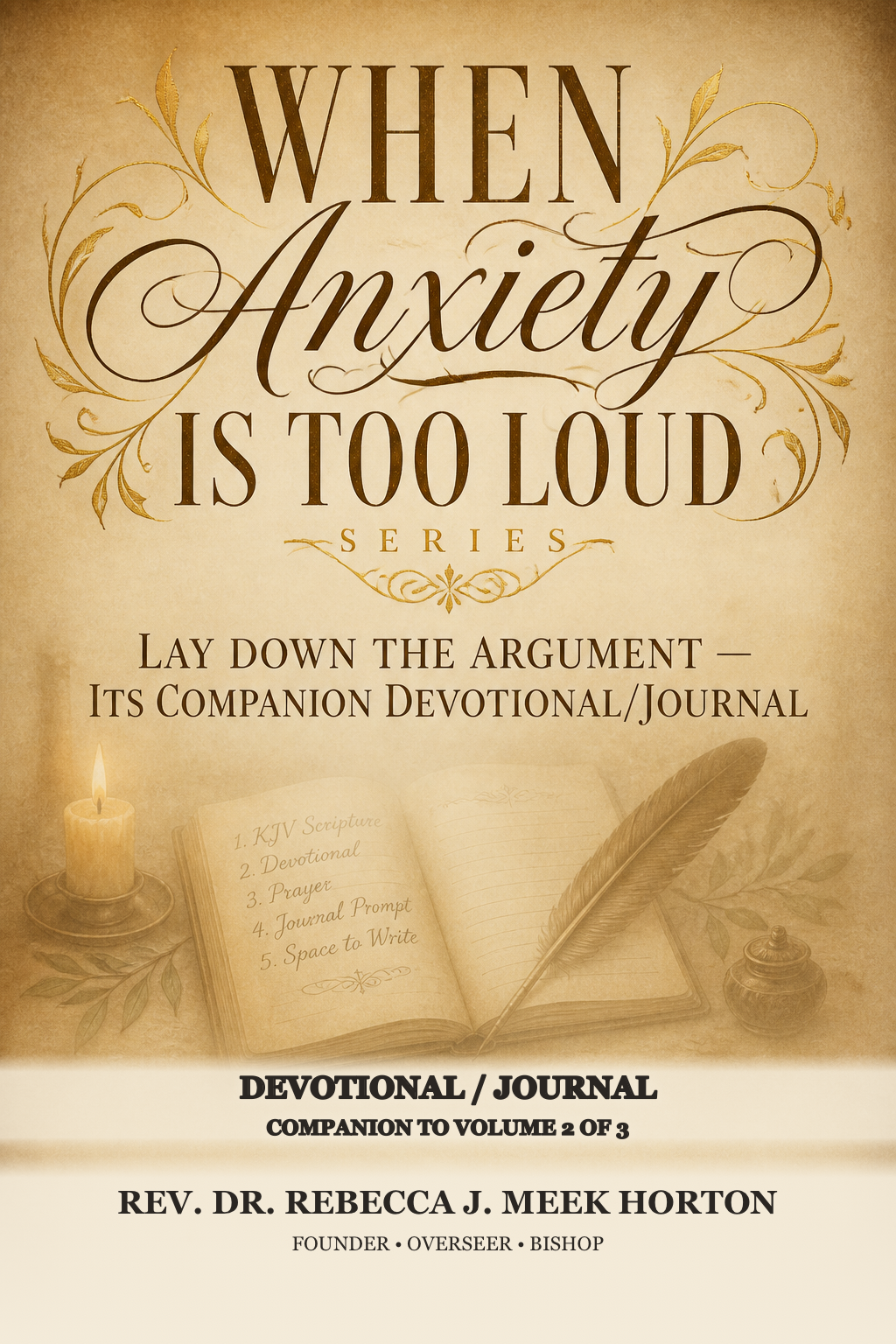
Lay Down the Argument — Its Companion Devotional/Journal
A companion devotional and journal for "Lay Down the Argument". Each chapter becomes five entries — a KJV Scripture reading, a devotional, a prayer, a journal prompt, and space to write — closing with An Apostolic Prophetic Architect Message and lined journal pages.
Full publication
NBCNGMI MASTER KNOWLEDGE LIBRARY Featuring the works of The Sage, Apostle Prophet. Rev. Dr. Rebecca J. Meek Horton, Apostolic Prophetic Architect, NewBeing Creation Network Global Ministries, Inc. Integrated Framework Modalities™
Dedication
I dedicate this companion devotional and journal to every heart learning to lay down the argument and make room for God’s peace. May these pages help you listen honestly, pray faithfully, and take the next obedient step with wisdom, humility, and grace.
Purpose
I wrote this companion devotional and journal to help you move from reading about laying down the argument to practicing it before God, one day at a time. My prayer is that Scripture, reflection, prayer, and honest writing will help you surrender the need to win, defend, explain, or rehearse what God is asking you to release. May this book guide you into peace, obedience, and the next faithful step, as James 1:22 calls us to be doers of the word, and not hearers only.
Preface
I wrote this companion devotional and journal for the moments after the teaching has been heard, when the real work begins in the heart.
Lay Down the Argument was not born from a desire to make people quiet. It was born from a burden to help us become whole. Many of us have learned how to defend ourselves, explain ourselves, correct others, and rehearse our side of the story. But fewer of us have been taught how to pause before God, listen without preparing a comeback, and let the Holy Spirit reveal what is really happening within us.
James 1:19-20 (KJV) Wherefore, my beloved brethren, let every man be swift to hear, slow to speak, slow to wrath: For the wrath of man worketh not the righteousness of God.
This companion was created as a slower walk through the message. Each chapter becomes five entries: a KJV Scripture reading, a devotional reflection, a prayer, a journal prompt, and space to write. The goal is not to rush through pages, but to let truth meet you where you are.
Argument is not always loud. Sometimes it is internal. Sometimes it is the speech we never say out loud but keep repeating inside. Sometimes it is the need to be right, the fear of being misunderstood, or the pain of feeling unseen. Laying down the argument does not mean denying truth. It means surrendering the need to carry truth in a wounded, defensive, or uncontrolled way.
This work asks something of us. It asks humility. It asks stillness. It asks the courage to stop blaming long enough to examine our own heart. That is not easy. But it is holy work.
My prayer is that this devotional and journal becomes a quiet place of RE-Flection™, RE-Alignment™, and RE-Sponsibility™. Not shame. Not performance. Not religious pressure. Just honest surrender before God.
Take your time with these pages. Read the Scripture slowly. Pray honestly. Write what is true. Let the Lord meet you beneath the argument.
Begin with one entry. Bring one real situation before God. Ask Him what needs to be laid down today.
Introduction
Most arguments do not begin in the mouth. They begin in the heart.
Before words rise, something inside us has already taken a position. We want to be understood. We want to be right. We want someone to see what they missed, repair what they broke, or admit what they denied. Sometimes the argument is with another person. Sometimes it is with God. Sometimes it is with ourselves.
Lay Down the Argument was written to call us out of the exhausting cycle of proving, defending, replaying, and resisting. This companion devotional and journal was created to help that message become practice.
The central invitation is simple: lay down the argument so you can pick up obedience, peace, humility, truth, and the next faithful step.
That does not mean pretending pain did not happen. It does not mean becoming silent when truth must be spoken. It does not mean accepting abuse, avoiding accountability, or calling confusion “peace.” Laying down the argument means surrendering the inner war that keeps you bound to reaction instead of governed by wisdom.
James 1:19-20 (KJV)
Wherefore, my beloved brethren, let every man be swift to hear, slow to speak, slow to wrath: For the wrath of man worketh not the righteousness of God.
This devotional/journal is not designed to rush you. Each chapter from Lay Down the Argument becomes five entries. Each entry gives you space to slow down, listen, respond honestly, and practice what you are learning.
The rhythm is intentional:
• A KJV Scripture reading to anchor you in the Word
• A devotional to help you understand the heart of the lesson
• A prayer to bring the matter before God
• A journal prompt to help you tell the truth without hiding
• Space to write, process, repent, release, and RE-Focus™
Do not treat this as a task to complete quickly. Let it become a place of honest RE-Flection™. Some entries may feel gentle. Others may press on places you have protected for a long time. That is part of the work. Growth often costs us the comfort of our favorite explanation.
You may discover that the argument you thought was about someone else is also revealing something in you: a wound, a fear, a need for control, a habit of rehearsing offense, or a refusal to trust God with timing and justice. Do not condemn yourself when you see it. Seeing clearly is not shame. It is stewardship.
Proverbs 3:5-6 (KJV)
Trust in the LORD with all thine heart; and lean not unto thine own understanding. In all thy ways acknowledge him, and he shall direct thy paths.
Read this book with your Bible open and your heart honest. If an entry exposes something difficult, pause. Pray. Write plainly. Ask the Lord what obedience looks like today. If you are working through a painful relationship, use wisdom and seek godly counsel where needed. This journal is a spiritual formation tool, not a replacement for pastoral care, wise accountability, or appropriate professional support.
You will get the most from this companion if you move slowly and consistently. One entry a day is enough. If a prompt requires more time, stay with it. The goal is not volume. The goal is transformation.
At the end of the devotional entries, you will find An Apostolic Prophetic Architect Message and additional lined journal pages. Use those pages to gather what God has been showing you. Write the patterns you are noticing. Name what you are laying down. Record the next faithful steps you are willing to keep.
Begin here: before reading the first entry, write one sentence in your journal answering this question:
What argument am I ready to lay down before God?
Chapter 1 — The Argument Is Wearing You Out
Entry 1
Scripture Reading
Matthew 6:25-27 (KJV) 25 Therefore I say unto you, Take no thought for your life, what ye shall eat, or what ye shall drink; nor yet for your body, what ye shall put on. Is not the life more than meat, and the body than raiment? 26 Behold the fowls of the air: for they sow not, neither do they reap, nor gather into barns; yet your heavenly Father feedeth them. Are ye not much better than they? 27 Which of you by taking thought can add one cubit unto his stature?
Devotional
Anxiety often feels like responsibility because it keeps us busy. It gives us something to check, something to replay, something to solve, something to fear before it happens. It can sound careful. It can sound mature. It can even sound spiritual. But Jesus asks a question that cuts through the noise without shaming the weary soul: Which of you by taking thought can add one cubit unto his stature?
There is a kind of thinking that helps us walk wisely. We plan. We prepare. We pay attention. We respond to what is ours to steward. That is not the problem. The problem begins when thought becomes a courtroom and every anxious possibility demands testimony. We keep answering. We keep proving. We keep returning to the same mental door to see if it is locked.
Jesus does not invite us into carelessness. He invites us out of captivity. He points to the birds, not because birds have no need, but because their need is held under the care of the Father. They do what is given to them. They live within the order assigned to them. They do not carry tomorrow as if tomorrow has already been placed in their hands.
This is where surrender begins. Not with pretending there is no concern. Not with denying that life has real responsibilities. Surrender begins when we recognize the difference between stewardship and control. Stewardship asks, What is mine to do today? Control asks, How can I guarantee nothing painful will happen?
That second question will wear you out.
The anxious argument says, Keep thinking until you feel safe. Jesus says that anxious thought cannot add what only God can give. It cannot add height. It cannot add life. It cannot add certainty. It can only spend strength.
Today, you are invited to stop treating every anxious demand as a command. You can notice the thought without entering the debate. You can say, This is anxiety asking me to prove safety again. Then you can return to the Father’s care and take one faithful step.
You do not have to win the argument. Some arguments are not assignments. Some must be laid down.
Prayer
Father, I come to You with the thoughts that keep pulling on me. I confess that I have often treated anxious questions like commands I must obey. I have confused constant mental labor with care, and I have tried to add by worrying what only You can hold by Your power. Teach me the difference between wisdom and fear. Help me prepare what is mine to prepare and release what is not mine to control. I receive Your care over my life today. I choose not to enter every argument anxiety presents. Give me grace to notice, pause, breathe, and return my trust to You. Amen.
Journal Prompt
In Matthew 6:25-27, Jesus shows the limit of anxious thought. What thought have you been treating as productive, even though it is only spending your strength?
Space to Write [Answer Lines]
Entry 2
Scripture Reading
Philippians 4:6-7 (KJV) 6 Be careful for nothing; but in every thing by prayer and supplication with thanksgiving let your requests be made known unto God. 7 And the peace of God, which passeth all understanding, shall keep your hearts and minds through Christ Jesus.
Devotional
There is a holy exchange in this passage. We bring the care. God gives peace. We bring the request. God keeps the heart and mind. We bring what is real without pretending, hiding, or performing. God meets us with a peace that does not require us to understand everything first.
Anxiety says, You cannot rest until you know. Scripture teaches us to bring the unknown to God. That is not the same thing. Anxiety demands certainty before surrender. Prayer makes room for surrender in the presence of uncertainty.
This matters because anxiety can turn even prayer into another form of striving. We may say the words, but inside we are still arguing. We are still trying to control the outcome, rehearse the conversation, predict the response, and secure the future. We pray, but we do not release. We speak to God, but we keep holding court in our own mind.
The instruction is gentle and direct: in every thing let your requests be made known unto God. Not polished things only. Not religious things only. Not concerns that seem important enough. Every thing. The small check. The repeated fear. The imagined outcome. The regret from yesterday. The child you cannot control. The result you cannot force. The conversation you keep replaying.
Bring it honestly.
But notice what follows. The promise is not that every answer will arrive immediately. The promise is that the peace of God shall keep your hearts and minds through Christ Jesus. Peace becomes a guard. The heart that was exposed to fear is kept. The mind that was running through anxious hallways is kept. The soul that felt responsible for securing every outcome is kept.
Peace that passeth all understanding does not mean life becomes simple. It means God can guard you before the situation is fully solved. That is a mercy. You do not have to wait for perfect circumstances to stop obeying panic.
RE-Language™ helps us here. Instead of saying, I cannot rest until I know, we can say, I can bring what I do not know to God. Instead of saying, I have to figure everything out tonight, we can say, I need one faithful step, not total control.
Prayer is not avoidance. Prayer is proper placement. It places the burden before the One who can actually carry it.
Prayer
Father, I bring You the concerns I have been carrying in my mind and body. I do not want to turn prayer into another place of striving. I want to make my requests known to You and receive the peace You give through Christ Jesus. Teach me to pray honestly without grabbing the burden back as soon as I say amen. Guard my heart where fear has pressed hard. Guard my mind where anxious thoughts have multiplied. I thank You that Your peace is not limited by my understanding. Help me walk today as one who is kept by You, not driven by panic. Amen.
Journal Prompt
Philippians 4:6-7 invites you to make your requests known to God. What is one request you need to bring honestly, and what would it look like to stop carrying it after you pray?
Space to Write [Answer Lines]
Entry 3
Scripture Reading
2 Corinthians 10:4-5 (KJV) 4 (For the weapons of our warfare are not carnal, but mighty through God to the pulling down of strong holds;) 5 Casting down imaginations, and every high thing that exalteth itself against the knowledge of God, and bringing into captivity every thought to the obedience of Christ;
Devotional
Not every thought deserves a conversation.
That truth may feel strange at first, especially when anxiety has trained you to answer every question it asks. What if this happens? What if I fail? What if they leave? What if I missed God? What if this never changes? The anxious mind can build a full courtroom from one question, then call it discernment because the matter feels urgent.
But Scripture gives us a different responsibility. We are not told to entertain every imagination. We are told to cast down imaginations and bring every thought into captivity to the obedience of Christ.
This is not harshness toward yourself. This is protection. Some thoughts are not harmless visitors. They exalt themselves. They rise up against the knowledge of God. They challenge His care, His faithfulness, His timing, His presence, and His authority. They may sound reasonable, but their fruit is bondage.
The work is not to become afraid of your thoughts. The work is to become more discerning with them. A thought can be present without becoming your master. Fear can speak without being enthroned. Anxiety can make a demand without receiving your obedience.
This is where the first movement toward surrender becomes practical. You recognize the argument without entering it. You name it clearly: Anxiety is asking me to argue about an imagined future. Anxiety is asking me to replay a past conversation until I feel safe. Anxiety is asking me to prove that nothing bad will happen.
Once it is named, it can be weighed. Is this a real responsibility for today, or an imagined trial? Is there a faithful step, or only a fearful loop? Is this thought leading me into obedience, or into exhaustion?
The weapons of our warfare are mighty through God. That means you are not left with willpower alone. You do not have to outthink anxiety by yourself. You can submit the thought to Christ. You can refuse the argument. You can take the next faithful step and leave the rest outside the courtroom.
Bringing a thought into captivity may look quiet. It may be as simple as closing the search window, putting down the phone, writing one sentence, praying one honest prayer, or choosing not to ask for reassurance one more time.
Small obedience interrupts strong patterns.
Prayer
Father, I ask You to help me discern the thoughts I have been entertaining. I do not want to give authority to imaginations that rise against Your truth. Teach me to recognize anxious arguments before I enter them. Strengthen me to bring my thoughts into captivity to the obedience of Christ. I receive Your help where my mind has felt crowded, pressured, and unsafe. I will not shame myself for having thoughts, but I will not surrender leadership to fear. Show me the next faithful step, and help me obey it without demanding total certainty first. Amen.
Journal Prompt
According to 2 Corinthians 10:4-5, what imagination or anxious storyline needs to be brought into captivity today? What is one obedient response you can practice?
Space to Write [Answer Lines]
Entry 4
Scripture Reading
Psalm 127:1-2 (KJV) 1 A Song of degrees for Solomon. Except the LORD build the house, they labour in vain that build it: except the LORD keep the city, the watchman waketh but in vain. 2 It is vain for you to rise up early, to sit up late, to eat the bread of sorrows: for so he giveth his beloved sleep.
Devotional
There is a labor that is faithful, and there is a labor that is vain. Psalm 127 helps us tell the difference.
The builder is not condemned for building. The watchman is not rebuked for watching. Work has its place. Attention has its place. Responsibility has its place. But the Scripture tells the truth: except the LORD build, the labor is vain. Except the LORD keep, the watching is vain.
Anxiety often convinces us that if we stop watching, everything will collapse. So we rise early in our minds. We sit up late in our thoughts. We eat the bread of sorrows, rehearsing outcomes, managing people internally, checking what we already checked, and trying to keep the city by mental strain.
But there is a limit to human watchfulness.
A parent can love a child, teach a child, pray for a child, correct a child, and provide for a child. But a parent cannot become God over the child’s future. A leader can prepare, plan, listen, and steward well. But a leader cannot secure every response. A person can apologize, clarify, and learn. But no one can rewrite yesterday through anxious regret.
This passage does not remove responsibility. It puts responsibility back in order. You build with the Lord. You watch under the Lord. You work, but you do not worship work. You care, but you do not bow to control. You prepare, but you do not pretend your preparation can replace God’s keeping power.
Then comes the mercy: for so he giveth his beloved sleep.
Sleep is not only physical rest. It is also a sign of trust. It is the body admitting, I am not the keeper of all things. It is the soul accepting, I can stop for a while because God has not stopped being God.
For the anxious heart, rest may feel like risk. Laying down the argument may feel like abandoning your post. But if the Lord is the keeper, then surrender is not abandonment. It is RE-Alignment™. It is returning to proper order.
You may have a faithful step today. Take it. Make the call. Pay the bill. lock the door once. Write the apology. Set the boundary. Pray for the child. Then stop eating the bread of sorrows as if sorrow can build what only God can establish.
The Lord gives His beloved sleep. Receive the gift.
Prayer
Father, I confess that I have tried to keep the city in my own strength. I have called it responsibility, but often it has become fear, control, and endless watching. Help me build only what You have assigned me to build. Help me watch with wisdom, not with panic. I receive the truth that You are the Keeper, and I am not. Teach my body, mind, and spirit how to rest under Your care. I lay down the bread of sorrows and ask for the grace to receive the sleep You give to Your beloved. Amen.
Journal Prompt
Psalm 127:1-2 shows the difference between faithful labor and vain striving. Where have you been trying to keep what only the Lord can keep?
Space to Write [Answer Lines]
Entry 5
Scripture Reading
Isaiah 26:3-4 (KJV) 3 Thou wilt keep him in perfect peace, whose mind is stayed on thee: because he trusteth in thee. 4 Trust ye in the LORD for ever: for in the LORD JEHOVAH is everlasting strength:
Devotional
A stayed mind is not an empty mind. It is a governed mind.
This matters because many people feel guilty when anxious thoughts come. They assume peace means no fearful thought ever appears, no concern ever rises, no question ever presses. But Isaiah does not describe a mind that never faces pressure. It describes a mind that is stayed on the Lord.
Stayed means anchored. Held. Directed. Returned. The anxious thought may come, but it does not have to become the throne. The demand may speak, but it does not have to lead the meeting. The imagined outcome may appear, but it does not have to become your dwelling place.
Perfect peace is connected to trust. Not trust in your ability to answer every question. Not trust in your ability to predict every outcome. Not trust in your ability to stay emotionally steady at all times. Trust in the LORD. Trust in the One whose strength is everlasting.
Anxiety wears us out because it keeps asking us to provide what we do not possess. It wants complete certainty, total control, and permanent reassurance. But we are not built to carry divine responsibilities in human strength. When the mind tries to hold what belongs to God, peace begins to leak out.
The invitation is not to force calm. The invitation is to return. Return the mind to the Lord. Return the concern to the Lord. Return the outcome to the Lord. Return the unanswered question to the Lord. Return again when you drift. This is not failure. This is practice.
WALK™ gives us a simple daily rhythm: Wait, Ask, Listen, Keep. Wait in stillness before you rush to solve. Ask honestly instead of hiding the fear. Listen carefully for truth, Scripture, wisdom, and the next faithful step. Keep that step without demanding the whole map.
A stayed mind is formed by many returns.
Today, you may still feel the pull of the argument. You may still feel the urge to check, replay, search, or seek reassurance. Do not turn that into shame. Turn it into a moment of RE-Cognition™. Notice what is happening. Name it. Then stay your mind again on the Lord.
The peace of God is not fragile. His strength is everlasting. You are allowed to be held.
Prayer
Father, I want my mind to be stayed on You. I admit that my thoughts often run toward fear, control, regret, and imagined outcomes. Help me return without shame. Teach me to trust You more than I trust the anxious argument. I receive Your perfect peace as a gift, not as something I must manufacture. When fear rises, help me pause and remember that You are everlasting strength. I will not make anxiety my master today. I will wait, ask, listen, and keep the next faithful step with You. Amen.
Journal Prompt
Isaiah 26:3-4 connects peace with a mind stayed on the Lord. When your mind starts to argue with anxiety, what truth about God can you return to today?
Space to Write [Answer Lines]
An Apostolic Prophetic Architect Message
Beloved, the argument has been exposed.
That is not a small thing. What remains hidden keeps working without permission. What is brought into the light can be discerned, weighed, and laid down. Over these five entries, the Spirit has been teaching one clear truth: every anxious demand is not an assignment. Every urgent thought is not wisdom. Every repeated question does not require your obedience.
You are not being called into carelessness. You are being called into governed stewardship. There is a difference. Carelessness ignores responsibility. Governed stewardship takes the next faithful step and refuses to worship control. This is where maturity begins to rise. Not in loud striving, but in quiet obedience.
The enemy of peace often comes disguised as endless responsibility. It says, Think longer. Check again. Replay it one more time. Secure the outcome. But the Lord is restoring order in your inner life. He is teaching you to recognize the courtroom without entering the trial. He is teaching you to stop feeding fear with your attention. He is teaching you to let prayer become placement, not performance.
Proverbs 3:5-6 (KJV) 5 Trust in the LORD with all thine heart; and lean not unto thine own understanding. 6 In all thy ways acknowledge him, and he shall direct thy paths.
This is the seal over the work: trust, do not lean, acknowledge, and follow. You do not need full control to take the next faithful step. You do not need every answer before you obey God. You do not need anxiety’s permission to rest.
As an Apostolic Prophetic Architect, I speak this as encouragement and confirmation: the Lord is not only quieting a moment; He is RE-Ordering™ a pattern. He is drawing you out of mental negotiation and into spiritual alignment. He is strengthening your discernment so you can tell the difference between a true responsibility and an imagined trial.
Carry this forward with simplicity. When anxiety asks you to argue, pause. Name the demand. Bring it to the Father. Choose one faithful step. Leave the rest in His hands.
Nothing is random. Nothing is wasted. Even this weariness is becoming a place of wisdom. The argument may speak again, but you do not have to answer the same way.
[Journal Page]
[Journal Page]
Chapter 2 — The Place Where Fear Can Be Put
Entry 1
Scripture Reading
Philippians 4:6-7 (KJV) 6 Be careful for nothing; but in every thing by prayer and supplication with thanksgiving let your requests be made known unto God. 7 And the peace of God, which passeth all understanding, shall keep your hearts and minds through Christ Jesus.
Devotional
There are some burdens that do not look heavy to anyone else. An envelope on the counter. A message waiting to be answered. A decision that has been delayed too long. A bill, an appointment, a conversation, a possibility. The object itself may be small, but the argument around it becomes loud.
Fear often does not begin by shouting. It begins by asking. What if this is worse than I think? What if I cannot handle it? What if this changes everything? Then the mind starts working overtime, trying to become savior, protector, prophet, planner, and judge all at once.
Philippians 4 does not shame us for having a burden. It gives the burden a place to go. The instruction is not to pretend nothing is happening. It is not to deny the pressure. It is not to produce instant calm before approaching God. It says in every thing. That means every thing can be brought into prayer.
This is important because anxiety often convinces us we must solve before we surrender. But God does not require you to win the argument in your head before you come near. He receives the request while your hands are still shaking. He receives the concern before your emotions have settled. He receives the honest sentence that may be all you can pray.
Prayer is not avoidance. Prayer is placement.
When you pray, you are not saying the circumstance does not matter. You are saying it matters too much for you to carry without God. You are relocating the burden from the center of your fear to the presence of your Father.
The peace of God is described as keeping your heart and mind through Christ Jesus. To be kept does not always mean you feel silent inside immediately. Sometimes it means you are guarded from being governed by fear. Sometimes it means you open the envelope. Sometimes it means you make the call. Sometimes it means you sleep instead of rehearsing every possible outcome.
Today, do not wait to feel calm before you pray. Bring the real thing. Bring the unfinished sentence. Bring the burden without decorating it. Fear needs a holy place to land, and God has made room for it in prayer.
Prayer
Father, I come to You with the thing I have been turning over in my mind. I confess that I have tried to answer fear with more thinking, more rehearsing, and more control. Teach me to bring the burden to You before I become exhausted by the argument. I do not have to sound perfect to be received by You. I do not have to feel calm before I pray. Help me make my request known with honesty and thanksgiving. Keep my heart and mind through Christ Jesus. Let Your peace guard me as I take the next faithful step. Amen.
Journal Prompt
Where have I been trying to solve fear through mental argument instead of bringing it to God in prayer from Philippians 4:6-7?
Space to Write [Answer Lines]
Entry 2
Scripture Reading
1 Peter 5:7 (KJV) Casting all your care upon him; for he careth for you.
Devotional
This verse is short, but it carries great mercy. It does not say to cast only the care that looks spiritual. It does not say to cast only the care that makes sense to other people. It does not say to cast only the care you have already organized, explained, and made respectable.
It says all your care.
That includes the care connected to your children. The care connected to your body. The care connected to money, work, calling, aging, grief, loneliness, decisions, family, and uncertainty. It includes the care you are tired of mentioning. It includes the care that returns after you thought you had already released it.
Many people carry fear privately because they believe they should be stronger by now. They assume that if they were truly faithful, the same concern would not keep coming back. But this verse does not begin with accusation. It begins with invitation. Cast it.
To cast something is to move it from one place to another. It is not pretending the burden does not exist. It is not denying responsibility. It is not refusing wise action. It is saying, This weight cannot remain enthroned in me.
Fear wants to stay close enough to keep speaking. It wants access to your decisions, your sleep, your tone, your body, and your imagination. But when you cast your care upon God, you are refusing to let fear become your main counselor.
The reason we cast is not because we are careless. We cast because He careth for us. God’s care is not distant, theoretical, or cold. His care is present enough to receive what we cannot resolve. He is not offended by trembling. He is not confused by the burden you cannot fully explain. He is not waiting for you to make your fear impressive before He receives it.
The chapter reminds us that fear needs a place. If fear has nowhere holy to land, it circles. It attaches itself to every possible future and calls that preparation. But the care was never meant to live unchallenged inside your mind.
Today, choose one care. Not ten. One. Name it plainly before God. Then practice a simple act of casting. Open your hands. Write it down and place it before Him. Kneel for one quiet minute. The action does not save you, but it teaches your body and mind that the burden has a better place to go.
Prayer
Father, I bring You the care I have been holding too tightly. I admit that part of me believes worrying means I am being responsible. Teach me the difference between stewardship and fear. I cast this care upon You because You care for me. I do not need to polish it or hide the parts that feel weak. Receive what I cannot carry well. Help me take responsibility without taking Your place. Help me obey without being ruled by anxiety. Let my heart learn the safety of placing the burden before You. Amen.
Journal Prompt
What specific care do I need to cast upon the Lord today according to 1 Peter 5:7, and what simple action will help me practice that release?
Space to Write [Answer Lines]
Entry 3
Scripture Reading
Psalm 55:22 (KJV) Cast thy burden upon the LORD, and he shall sustain thee: he shall never suffer the righteous to be moved.
Devotional
There is a tenderness in the word sustain. Sometimes we want God to remove the burden immediately. Sometimes He does. But often, before removal comes sustaining. He holds us together while obedience is still required. He strengthens us while the situation is still unfolding. He keeps us from being ruled by what has not yet changed.
This matters because many people become discouraged after prayer. They bring the burden to God, but when their emotions do not settle immediately, they assume nothing happened. They think they failed. They think God did not hear. They think peace must always feel like instant quiet.
But Psalm 55:22 gives another view. The burden is cast upon the Lord, and the promise is that He shall sustain. Sustaining may look like enough courage to open the envelope. Enough steadiness to attend the appointment. Enough wisdom to ask for help. Enough restraint not to send the fear-driven message. Enough humility to say, I cannot carry this alone.
Sustaining is not small. Sustaining is mercy in motion.
Fear often tells us that if we release the burden, we will become unprepared. It says, Keep rehearsing. Keep circling. Keep arguing. Keep imagining every possible outcome. But mental wrestling is not the same as wisdom. Anxiety can wear the clothing of preparation while quietly draining the strength needed for obedience.
To cast the burden upon the Lord is to stop treating worry as your only evidence of care. It is possible to care deeply without being controlled by fear. It is possible to act responsibly without letting dread lead the way. It is possible to feel trembling and still be sustained.
The verse also says the Lord shall never suffer the righteous to be moved. This does not mean life will never shake. It means God is able to keep His people from being uprooted by the shaking. There is a difference between feeling pressure and being governed by it. There is a difference between being concerned and being carried away.
Today, do not despise the grace that sustains. If the circumstance remains, God is still present. If your emotions rise again, God is still faithful. If the next step feels small, it may still be holy. Let the burden be placed before Him, and receive strength for the step that is actually yours to take.
Prayer
Father, I thank You that You do not only remove burdens; You also sustain me. I have measured Your help by how quickly my feelings change, and I ask You to renew my understanding. Keep me from believing that trembling means I am abandoned. Teach me to cast my burden upon You and receive the strength You provide for today. Hold me steady where I feel shaken. Help me stop using worry as proof that I care. Let me move in obedience, not panic, trusting that You are keeping me even now. Amen.
Journal Prompt
How might God be sustaining me in the middle of a burden that has not yet been removed, according to Psalm 55:22?
Space to Write [Answer Lines]
Entry 4
Scripture Reading
Isaiah 41:10 (KJV) Fear thou not; for I am with thee: be not dismayed; for I am thy God: I will strengthen thee; yea, I will help thee; yea, I will uphold thee with the right hand of my righteousness.
Devotional
Fear often speaks as if you are alone. It may not say those exact words, but it builds its argument on that assumption. You must figure this out by yourself. You must prevent every possible loss. You must become strong enough to hold the whole situation together.
But the Lord speaks differently. He does not begin by demanding that you manufacture courage from your own supply. He anchors the command in His presence. Fear thou not; for I am with thee.
God’s presence changes the place where fear lands. Without His presence in view, fear circles inside the mind and becomes its own atmosphere. With His presence acknowledged, fear is no longer the highest authority in the room.
This does not mean you will never feel fear. Isaiah 41:10 is not a scolding. It is a stabilizing word. The Lord knows the human heart can become dismayed. He knows what pressure does. He knows what uncertainty awakens. So He gives more than instruction. He gives Himself.
I am with thee. I am thy God. I will strengthen thee. I will help thee. I will uphold thee.
This is not a call to pretend. It is a call to RE-Alignment™. The mind must be brought back under truth when fear has been allowed to sit too high. Fear may be loud, but it is not Lord. Fear may describe a possibility, but it cannot define God’s faithfulness. Fear may point to what could happen, but it cannot cancel who is with you.
Sometimes the most faithful thing you can do is speak plainly to the burden: this belongs before God, not above Him. That sentence may not erase the feeling, but it can reset the posture. It reminds the soul that the burden is real, but it is not sovereign.
There is also a cost. Letting God uphold you means releasing the need to prove you can hold everything yourself. That can feel vulnerable. The argument in your mind may feel familiar, even when it is exhausting. But familiar is not the same as faithful.
Today, allow God’s promise to interrupt the inner debate. You are not being asked to carry the full weight of tomorrow. You are being invited to stand in the presence of the One who strengthens, helps, and upholds.
Prayer
Father, I receive Your word that You are with me. I confess that fear has made me feel alone, pressured, and responsible for more than I can carry. Bring me back into RE-Alignment™ with Your presence and Your truth. Strengthen me where I feel weak. Help me where I feel uncertain. Uphold me where I feel like I may fall apart. I will not pretend the burden is not real, but I will not place it above You. Teach my heart to trust Your nearness more than fear’s argument. Amen.
Journal Prompt
Where have I been acting as if I am alone, and how does Isaiah 41:10 invite me to place that fear under God’s presence?
Space to Write [Answer Lines]
Entry 5
Scripture Reading
Matthew 11:28-30 (KJV) 28 Come unto me, all ye that labour and are heavy laden, and I will give you rest. 29 Take my yoke upon you, and learn of me; for I am meek and lowly in heart: and ye shall find rest unto your souls. 30 For my yoke is easy, and my burden is light.
Devotional
Jesus does not call only the strong, settled, and composed. He calls the labouring and the heavy laden. He calls the person who has been carrying more than they were created to carry. He calls the one whose mind has been working all night, whose body feels the burden, whose soul needs rest deeper than sleep.
Come unto me.
That is the movement from argument to surrender. Fear says, Stay with the debate. Jesus says, Come. Fear says, Keep rehearsing the danger. Jesus says, Learn of me. Fear says, You must carry this alone. Jesus says, I will give you rest.
The rest Jesus gives is not careless escape. It is not the abandonment of responsibility. He speaks of a yoke, which means there is still a way to walk. There is still obedience. There may still be a conversation, a form to complete, a decision to make, a boundary to set, an apology to offer, or a practical step to take. But the difference is who is carrying the weight with you and who is teaching you how to walk.
Anxiety often creates a harsh yoke. It drives, accuses, hurries, and threatens. It says you are behind, unsafe, unprepared, and alone. It turns every burden into a test of whether you are enough. Jesus is meek and lowly in heart. His way does not crush the soul while calling it responsible.
This is why coming to Him must be practiced, not merely admired. When fear rises, we can return to the argument by habit. We can open the same mental files again and again. But the invitation of Jesus gives us another rhythm: come, take, learn, find rest.
Come with the real burden. Take His yoke instead of fear’s pressure. Learn His way instead of anxiety’s urgency. Find rest for the soul, even while the next step remains.
Nothing is random. Nothing is wasted. Even the place where fear becomes loud can become the place where you learn the gentleness of Christ. You do not have to be instantly quiet to begin. You only have to come honestly.
Today, let rest begin as obedience. Bring the burden to Jesus. Ask Him what is yours to carry today, and what must be laid down because it was never assigned to you.
Prayer
Father, I come to You through Jesus with the heaviness I have been carrying. I am tired of fear’s yoke and the pressure it places on my mind and body. Teach me the way of Christ. Help me receive rest without abandoning responsibility. Show me what is mine to do today and what I have been carrying without Your instruction. I want to learn of Jesus, who is meek and lowly in heart. Let my soul find rest in His presence, His pace, and His care. Amen.
Journal Prompt
What heavy burden do I need to bring to Jesus today, and what does Matthew 11:28-30 teach me about exchanging fear’s pressure for His rest?
Space to Write [Answer Lines]
An Apostolic Prophetic Architect Message
Beloved, fear does not become holy because it is loud. Fear does not become authority because it repeats itself. Fear does not become truth because it has occupied your thoughts for a long time.
This is the place where fear can be put.
Not buried. Not performed over. Not polished. Not enthroned.
Placed.
There is a difference between carrying a burden and being carried away by it. There is a difference between responsible attention and anxious argument. There is a difference between stewardship and fear-driven control. The Spirit of God is calling you into that discernment with gentleness and truth.
You are not being asked to deny the envelope on the counter. You are not being asked to pretend the appointment, bill, relationship, decision, or uncertainty is not real. You are being invited to stop letting fear become the highest voice over what is real.
Place the burden before God. Let prayer interrupt the argument. Let Scripture govern the interpretation. Let obedience become the next faithful step.
Psalm 34:4 (KJV) I sought the LORD, and he heard me, and delivered me from all my fears.
This is not a call to instant emotional perfection. It is a call to seek the Lord in the very place where fear has been speaking. He hears. He sustains. He keeps. He teaches. He strengthens. He upholds.
Nothing is random. Nothing is wasted. Even the anxious moment can become a place of RE-Calibration™ when you allow God to show you what you have been carrying, where fear has been leading, and what must now be placed before Him.
Do not confuse trembling with failure. Do not confuse process with defeat. Do not confuse peace with performance. Sometimes peace begins when you refuse to return to the argument as your source of safety.
Today, seal this work with one obedient movement. Name the burden. Place it before the Lord. Ask for wisdom. Take the next step. Fear may still speak, but it does not have to sit on the throne.
The burden belongs before God.
Your heart belongs under His care.
Your next step belongs in obedience.
[Journal Page]
[Journal Page]
Chapter 3 — Name the Burden Honestly
Entry 1
Scripture Reading
Psalm 62:8 (KJV) Trust in him at all times; ye people, pour out your heart before him: God is a refuge for us. Selah.
Devotional
There is a kind of prayer that tells God something true, but not yet complete. Lord, help me. Lord, strengthen me. Lord, make a way. These are good prayers. They are not wrong. But sometimes they stay at the doorway of the burden instead of entering the room where the real thing is sitting.
Psalm 62:8 invites us deeper. Pour out your heart before him. That is not polished language. That is not the prayer we say because we think it sounds more acceptable. Pouring out means the container opens. What is inside comes before God without pretending to be lighter, cleaner, or more organized than it is.
This matters because anxiety often survives in vague words. We say we are stressed when we are actually afraid. We say we are tired when we are actually resentful. We say we are overwhelmed when we are actually carrying shame, dread, grief, responsibility, and the belief that we should have known how to handle it all.
God is not asking you to perform calm. He is inviting you to bring truth. Not because He does not already know, but because naming the burden helps you stop wrestling with shadows. When the heart pours out before God, the burden moves from hidden pressure into holy presence.
This is not always comfortable. Honest prayer can make you feel exposed before it makes you feel relieved. You may discover that what you called pressure is fear of failure. What you called frustration is grief. What you called busyness is avoidance. But this is where surrender begins.
God is a refuge for us. A refuge is not only for people who arrive strong. A refuge is for those who need shelter. You do not have to wait until your thoughts are tidy to come near. You do not have to explain the burden perfectly. You can begin with one true sentence.
Father, what I am actually carrying is fear. Father, what I am actually carrying is shame. Father, what I am actually carrying is dread. Father, what I am actually carrying is loneliness.
Truthful naming is not weakness. It is the beginning of placement. You are not becoming the burden by naming it. You are bringing it into the presence of the One who can hold what you were never meant to carry alone.
Prayer
Father, I come to You with the real burden, not only the version I know how to say out loud. I confess that I sometimes hide behind vague words because honesty feels costly. I ask You to help me pour out my heart before You without performance, fear, or shame. Teach me to trust You at all times, including the times when I feel uncertain, exposed, or afraid. You are my refuge, and I do not have to carry this in secret. Help me name what is true, place it before You, and receive the shelter of Your presence today. Amen.
Journal Prompt
Psalm 62:8 calls me to pour out my heart before God. What have I been calling stress, pressure, or being fine that may need a more honest name today?
Space to Write
[Answer Lines]
Entry 2
Scripture Reading
Philippians 4:6-7 (KJV) 6 Be careful for nothing; but in every thing by prayer and supplication with thanksgiving let your requests be made known unto God. 7 And the peace of God, which passeth all understanding, shall keep your hearts and minds through Christ Jesus.
Devotional
Let your requests be made known unto God. That word known carries weight. It tells us that prayer is not a hiding place for polished language. Prayer is where the real request comes into the light.
Sometimes we pray around the burden instead of praying the burden. We say, Lord, bless my family, when what we mean is, Father, I am afraid my child is drifting and I do not know what to do. We say, Lord, help me at work, when what we mean is, Father, I am afraid I am not enough for what is being asked of me. We say, Lord, give me peace, when what we mean is, Father, I am rehearsing disaster and I need help bringing my mind back to You.
Philippians 4 does not shame us for having need. It gives us a pathway. Be careful for nothing. Bring everything by prayer and supplication with thanksgiving. Make the requests known. Then the peace of God shall keep your hearts and minds through Christ Jesus.
Peace is not produced by pretending the burden is small. Peace comes as the burden is brought into right placement before God. This is not a formula that guarantees instant emotional silence. It is a faithful order. Anxiety argues in noise. Surrender begins in truth.
The passage also holds together honesty and thanksgiving. Thanksgiving does not mean denial. It means that while I tell God the truth about what I carry, I also remember the truth about who He is. I can be afraid and still remember He is faithful. I can be uncertain and still remember He is present. I can need help and still remember He is not offended by my need.
There may be a request underneath your request today. Ask carefully. What am I actually asking God for? Am I asking for wisdom, provision, courage, correction, rest, help, forgiveness, protection, direction, or release? The more honest the request becomes, the less room anxiety has to keep changing its clothes.
Make it known. Not because God is uninformed, but because your heart needs to come out of hiding. The peace of God guards what anxiety tries to occupy. Your heart and mind can be kept through Christ Jesus, even before every circumstance is solved.
Prayer
Father, I bring my requests before You plainly today. I do not want to pray around the burden while keeping the real fear hidden. Help me make known what I am carrying, what I need, and where I have been trying to control the outcome. Teach me how to pray with honesty and thanksgiving at the same time. Guard my heart from panic and my mind from rehearsing what has not happened. Let Your peace keep me through Christ Jesus. Show me the request beneath the noise, and help me trust You with it. Amen.
Journal Prompt
Philippians 4:6-7 tells me to let my requests be made known unto God. What is the specific request I need to bring to Him today, without hiding behind general words?
Space to Write
[Answer Lines]
Entry 3
Scripture Reading
1 Peter 5:7 (KJV) Casting all your care upon him; for he careth for you.
Devotional
Casting begins with recognizing what is in your hands. We often want relief before we have admitted what we are holding. We want God to lift the weight, but we keep naming it everything except what it is.
This verse is short, but it is not shallow. Casting all your care upon him; for he careth for you. The care may be financial. It may be relational. It may be physical, emotional, spiritual, parental, vocational, or deeply private. It may be the thing you keep postponing because opening it feels like opening the envelope on the counter. You know it is there. You walk past it. Your chest tightens. You call it stress. But the Lord invites you to tell the truth.
Care is not only the circumstance. Care is the weight the circumstance places on your heart. The bill is one thing. The fear that there will not be enough is another. The conversation is one thing. The dread of rejection is another. The responsibility is one thing. The shame that says you should have done better is another.
God does not only care about the external matter. He cares for you. Not only the managed version of you. Not only the composed version. Not only the version that can explain the situation without crying. He cares for you where the burden is real.
This is where RE-Language™ becomes stewardship. Instead of saying, I am falling apart, you can say, I am carrying more than I can wisely hold alone. Instead of saying, I cannot handle anything, you can say, I need help with this specific responsibility. Instead of saying, I am a failure, you can say, I made a mistake, and I need wisdom for repair.
This is not pretending. It is truthful naming without false identity. You are not your fear. You are not your burden. You are not your worst response. You are a person invited to cast your care upon the Lord because He cares for you.
Today, do not try to cast a cloud. Name one care. Hold it before God honestly. Then release it as an act of obedience, even if your emotions need time to follow. Casting is not always a feeling. Sometimes it is the faithful decision to stop protecting what is hurting you and place it in the hands of God.
Prayer
Father, I acknowledge that I have been carrying care in my own hands. I have named some things vaguely because I did not want to face the fear beneath them. Help me recognize what I am holding and cast it upon You. I receive the truth that You care for me, not only for my responsibilities or outcomes. Teach me to speak about my burden without making it my identity. Help me release the care I was never meant to carry alone, and show me the next faithful step that belongs to me today. Amen.
Journal Prompt
1 Peter 5:7 tells me to cast all my care upon the Lord. What care am I still clutching, and what truthful words do I need to use as I place it before Him?
Space to Write
[Answer Lines]
Entry 4
Scripture Reading
Psalm 55:22 (KJV) Cast thy burden upon the LORD, and he shall sustain thee: he shall never suffer the righteous to be moved.
Devotional
Psalm 55:22 does not tell us to cast a polished explanation. It says, Cast thy burden upon the LORD. That is a mercy because some burdens do not arrive neatly. Some carry fear, anger, embarrassment, grief, fatigue, regret, confusion, and questions we do not know how to answer.
Many people delay honest prayer because they think they must sound more faithful than they feel. They clean up the burden first. They edit the sentence. They remove the trembling. They try to sound certain. But God is not strengthened by our performance. We are sustained by His mercy.
To cast the burden upon the Lord is to stop negotiating with it in secret. It is to bring the real weight into God’s presence. Lord, I am afraid of losing control. Lord, I am tired of being needed but not noticed. Lord, I regret what I said. Lord, I am angry that this has not changed. Lord, I do not know what to do next.
This kind of honesty is not disrespect. It is truthful placement before a holy and merciful God. The burden belongs in His hands, not hidden behind your composure.
The promise is not that every circumstance will shift immediately. The promise is that He shall sustain thee. Sustaining grace matters. Sometimes God strengthens you before He changes what surrounds you. Sometimes He gives wisdom before relief. Sometimes He exposes the deeper burden so that surrender can become specific.
We must also be honest about the cost. Naming the burden may reveal that action is needed. You may need to ask for help, open the envelope, make the call, confess the sin, set the boundary, rest the body, or stop rehearsing what you cannot control. Surrender is not avoidance. It is placement that leads to obedience.
He shall never suffer the righteous to be moved. This does not mean you will never feel shaken. It means the Lord is able to keep you from being uprooted. Your emotions may move. Your thoughts may need correction. Your circumstances may still require stewardship. But your life can be anchored in God while the burden is being placed where it belongs.
Today, cast the actual burden. Not the acceptable version. Not the summary. The real one. Let the Lord sustain you in truth.
Prayer
Father, I bring You the burden as it is. I confess that I have sometimes tried to make my prayers sound stronger than my heart felt. I do not want to perform before You. I want to place the real weight in Your hands. Sustain me where I am tired, afraid, ashamed, or uncertain. Help me see the next obedient step without trying to control the whole outcome. Keep me anchored when my emotions move. Teach me to trust Your sustaining grace and to stop carrying what belongs before You. Amen.
Journal Prompt
Psalm 55:22 invites me to cast my burden upon the Lord. What is the real burden I need to stop managing in secret, and what action might surrender require from me?
Space to Write
[Answer Lines]
Entry 5
Scripture Reading
Psalm 139:23-24 (KJV) 23 Search me, O God, and know my heart: try me, and know my thoughts: 24 And see if there be any wicked way in me, and lead me in the way everlasting.
Devotional
Search me is a courageous prayer. It is not the prayer of someone pretending to be fine. It is the prayer of someone willing to be known by God in the places that may feel complicated, tender, or unfinished.
Many of us pray for God to change the situation before we ask Him to search the heart carrying the situation. We want the pressure removed. We want the outcome settled. We want the anxious thoughts quieted. Those desires are understandable. But Psalm 139 leads us into deeper honesty. Search me, O God, and know my heart. Try me, and know my thoughts.
This does not mean God is looking for a reason to reject you. It means He is faithful enough to reveal what is hidden so it can be healed, corrected, surrendered, or RE-Aligned™. The Lord searches with truth and mercy. He exposes not to shame, but to lead.
There may be a way within us that keeps anxiety alive. A way of assuming the worst. A way of taking responsibility for what belongs to God. A way of turning mistakes into identity. A way of avoiding truth until the burden grows heavier. A way of calling fear wisdom. A way of calling control stewardship.
The psalm gives us language for honest surrender. Lord, know my heart. Know my thoughts. See what is in me that I cannot see clearly. Lead me in the way everlasting.
This matters because naming the burden honestly is not only about identifying the external problem. It is also about allowing God to reveal what the burden has awakened inside of us. Fear may be pointing to a real concern, but it may also be exposing an old belief. Shame may be attached to a real mistake, but it may also be speaking with a false identity. Dread may be connected to a future event, but it may also reveal where trust has grown weary.
Do not be afraid to ask God to search you. He already knows, and He is kind enough to lead. The goal is not self-condemnation. The goal is truthful placement and faithful movement.
Today, let this prayer become your doorway. Not Lord, confirm that I am fine. But Father, search me and lead me. That is where surrender deepens. That is where the burden begins to lose its hidden rule.
Prayer
Father, I invite You to search me and know my heart. Try me and know my thoughts. I do not want to hide behind vague words or spiritual phrases that keep me from surrendering the real burden. Reveal what I am carrying, what I am fearing, and what I may be believing that does not agree with Your truth. If there is any way in me that needs correction, lead me gently and clearly. Keep me from shame, and bring me into responsibility, wisdom, and peace. Lead me in the way everlasting today. Amen.
Journal Prompt
Psalm 139:23-24 asks God to search the heart and thoughts. What might God be revealing beneath the burden I named, and where do I need His leading now?
Space to Write
[Answer Lines]
An Apostolic Prophetic Architect Message
Beloved, the Lord is not asking you to win an argument with anxiety by becoming louder than the fear. He is calling you into truth. The burden loses hidden authority when it is named before God. This is not weakness. This is governed surrender. This is the beginning of RE-Alignment™.
You have walked through five movements of honesty. Pour out your heart. Make the request known. Cast the care. Cast the burden. Ask God to search the heart. Each movement brings you out of vague pressure and into truthful placement. Nothing is random. Nothing is wasted. Even the burden you did not want to name can become the place where God teaches you how to trust, how to steward, how to release, and how to obey.
Hear this clearly. You are not the burden you are carrying. You are not the fear that rose up. You are not the mistake, the unpaid bill, the difficult conversation, the weary season, or the unfinished process. You are a person invited to come boldly to the throne of grace.
Hebrews 4:15-16 (KJV) 15 For we have not an high priest which cannot be touched with the feeling of our infirmities; but was in all points tempted like as we are, yet without sin. 16 Let us therefore come boldly unto the throne of grace, that we may obtain mercy, and find grace to help in time of need.
Mercy is available. Grace is available. Help is available. But do not bring God only the polished version. Bring Him the real burden. Bring Him the fear beneath the noise. Bring Him the shame without letting shame rename you. Bring Him the request you have been afraid to say plainly.
Now seal this work with one faithful practice. Before you move into the next demand of the day, pause and write one sentence: Father, what I am actually carrying is. Finish it honestly. Then ask: What is mine to steward, what must I release, and what is my next faithful step?
Move with truth. Walk with wisdom. Let surrender begin where honesty starts.
[Journal Page]
[Journal Page]
Chapter 4 — Stop Managing Every Outcome
Entry 1
Scripture Reading
Matthew 6:34 (KJV) Take therefore no thought for the morrow: for the morrow shall take thought for the things of itself. Sufficient unto the day is the evil thereof.
Devotional
There is a kind of tiredness that does not come from work completed, but from outcomes rehearsed. The body sits still, but the mind travels four days ahead. It checks what has not changed. It reviews what has not been answered. It tries to solve what has not yet arrived.
Jesus speaks mercy into that exact place. He does not shame us for caring. He teaches us where care becomes overload. Tomorrow has its own weight, and today has its own assignment. When we drag tomorrow into today, we do not gain authority over it. We only carry extra heaviness.
This is where anxiety often disguises itself as responsibility. It tells us, “If you do not think through every possible problem, you are being careless.” But Jesus does not call us to careless living. He calls us to rightly ordered living. There is a difference between preparation and possession. Preparation asks, “What is the next wise step?” Possession says, “I cannot rest until I know how everything will turn out.”
Faithful stewardship is not passive. It does what belongs to today. It makes the call, prepares the document, checks the schedule, apologizes when needed, and speaks with care. Then it stops. Stopping may feel strange when the soul has been trained to survive by constant managing. But stopping is not neglect. It is RE-Alignment™.
Today has enough assigned to it. Enough does not mean easy. Enough means God has not asked you to live tomorrow before it comes. He gives grace for the day you are standing in, not for every imagined version of what might happen next.
So the invitation is simple and costly: come back to today. Come back to the breath in your body. Come back to the duty in front of you. Come back to the God who is already in tomorrow without requiring you to manage it from here.
You are not laying down obedience. You are laying down the false assignment of controlling every outcome. You are not refusing wisdom. You are refusing to let fear govern your movement.
Let today be today. Let tomorrow remain in the hands of God. Your next faithful step is enough for now.
Prayer
Father, I come to You with the weight of tomorrow trying to live inside today. I confess that I have often called my worry responsibility and my control preparation. Help me see the difference with honesty and grace. Teach me to steward what is actually mine without reaching for what only You can hold. I receive the mercy of today’s portion. I ask You to quiet the pressure to know every outcome before I obey. Bring me back to the next faithful step. Help me trust that You are already present in the day I cannot yet see. I choose to release tomorrow to You, one concern at a time.
Journal Prompt
Matthew 6:34 teaches me not to borrow tomorrow’s trouble. What concern have I been trying to live before its time, and what is one faithful responsibility that actually belongs to today?
Space to Write
[Answer Lines]
Entry 2
Scripture Reading
Proverbs 16:9 (KJV) A man's heart deviseth his way: but the LORD directeth his steps.
Devotional
Planning is not the enemy of faith. Wisdom plans. Stewardship prepares. Love thinks ahead. Integrity follows through. The problem begins when the plan becomes something we grip as if our peace depends on it.
Proverbs 16:9 gives us a balanced truth. A person may devise a way. That means there is room for thought, intention, preparation, and decision. Faith does not require us to float through life without structure. But the verse does not end with human planning. It says the LORD directs the steps.
That is where anxiety struggles. Anxiety wants the plan to become a guarantee. It wants the whole staircase before taking the next step. It wants every person’s response secured, every risk removed, every unknown answered, and every outcome brought under control. But that is not stewardship. That is possession.
There is freedom in learning what is actually yours. Your words may be yours. Your tone may be yours. Your preparation may be yours. Your repentance may be yours. Your obedience is yours. But another person’s heart is not yours. The timing of every door is not yours. The hidden outcome is not yours. The future is not fully yours.
This does not make you powerless. It makes you rightly placed.
A farmer can prepare the soil, plant the seed, water the ground, and guard the field. But the farmer cannot force life to rise from the seed. If he digs it up every morning to check whether it is growing, he may harm what he is trying to protect. Many anxious habits work that same way. We keep checking and call it care. We keep rehearsing and call it wisdom. We keep controlling and call it responsibility.
But faithful stewardship knows when the next step is enough.
The LORD directing your steps does not mean your plans never matter. It means your plans do not have to become your god. You can prepare without pretending. You can move without demanding mastery. You can decide without carrying divine weight.
Today, let your plan be honest, humble, and open before God. Devise your way with wisdom. Then release your steps to the One who sees what you cannot see.
Prayer
Father, I bring my plans before You. I do not want to live carelessly, but I also do not want to worship my own ability to manage. I confess that I sometimes feel safer when I think I am in control. Teach me to plan with humility. Show me what is mine to prepare, what is mine to say, and what is mine to do. Then help me release the direction of my steps to You. I trust that Your wisdom is greater than my grip. Lead me in the way that is right, and correct me when I confuse responsibility with control. I choose to walk with You today.
Journal Prompt
Proverbs 16:9 shows both human planning and God’s direction. Where am I holding a plan too tightly, and how can I practice humble planning today?
Space to Write
[Answer Lines]
Entry 3
Scripture Reading
James 4:13-15 (KJV) 13 Go to now, ye that say, To day or to morrow we will go into such a city, and continue there a year, and buy and sell , and get gain : 14 Whereas ye know not what shall be on the morrow. For what is your life? It is even a vapour, that appeareth for a little time, and then vanisheth away. 15 For that ye ought to say, If the Lord will, we shall live , and do this, or that.
Devotional
James does not correct planning because planning is wrong. He corrects planning without surrender. The people in this passage had a city, a timeline, a business plan, and an expected profit. What they did not have was humility before God.
That is the quiet danger of outcome management. It does not always look rebellious. Sometimes it looks organized, diligent, and capable. It may have a calendar, a spreadsheet, a confirmation number, and a backup plan. None of those things are wrong in themselves. The issue is the posture underneath them.
“If the Lord will” is not a religious decoration we place on our intentions. It is a surrendered way of living. It means, “I will prepare, but I will not pretend I control life. I will move, but I will remain yielded. I will plan, but I will not make my plan my peace.”
This is deeply practical. You can review the budget. You can prepare for the meeting. You can ask the question. You can schedule the appointment. You can gather the information. Then you stop. You do not have to keep circling the same concern until your body feels as if it has worked for hours while nothing has actually changed.
Stopping may feel like risk. Anxiety may say, “If you stop, something will go wrong.” But anxiety is not a faithful prophet. It often speaks from old pain, old chaos, old disappointment, or old fear. It may have learned to stay alert because something once surprised you. That history deserves compassion. But compassion does not mean anxiety gets to lead.
James reminds us that life is a vapour. That truth is not meant to make us afraid. It is meant to make us humble. We are not God. We do not know everything about tomorrow. We are not required to carry tomorrow as if we do.
There is peace in surrendered planning. It does not remove all uncertainty, but it places uncertainty under God instead of under fear. It lets the soul say, “I have done what wisdom requires today. The rest belongs to the Lord.”
Prayer
Father, I acknowledge that my life, time, plans, and outcomes are in Your hands. I confess the pride and fear that can hide inside my need to manage everything. I do not want to plan as if You are absent. Teach me to say, “If the Lord will,” not only with my mouth, but with my posture. Help me prepare faithfully and stop when my part is done. Deliver me from the pressure to secure what only You can hold. I trust You with the city, the timing, the provision, the response, and the result. Let my planning become stewardship, not bondage.
Journal Prompt
James 4:13-15 calls me to plan with humility. What plan am I making right now, and what would it look like to hold it before God with an “If the Lord will” posture?
Space to Write
[Answer Lines]
Entry 4
Scripture Reading
1 Peter 5:6-7 (KJV) 6 Humble yourselves therefore under the mighty hand of God, that he may exalt you in due time: 7 Casting all your care upon him; for he careth for you.
Devotional
We cast care because He cares.
That sounds simple, but it reaches deep. Many of us hold care because we believe holding is proof of love. We rehearse because we believe rehearsing is proof of responsibility. We remain tense because we believe relaxing would mean we stopped caring.
But 1 Peter 5:6-7 joins humility and casting. To cast care upon God is an act of humility. It admits, “I am not strong enough to be the keeper of every outcome. I am not wise enough to manage every hidden detail. I am not called to carry divine weight.”
That admission can feel uncomfortable at first. Control often gives a false sense of safety. It makes us feel active, alert, and necessary. But control also drains the soul. It keeps the body braced. It keeps the mind circling. It keeps the heart from resting in the care of God.
The Scripture does not say to cast care upon God because the situation is small. It does not say to cast care because the outcome is guaranteed to unfold the way we prefer. It does not even say to cast care because we feel calm. It says to cast care because He careth for you.
God’s care is the ground under your release.
This matters because letting go has a cost. You may feel exposed when you stop checking. You may feel irresponsible when you refuse to rehearse the conversation again. You may feel afraid when you do your part and leave the response with God. That does not mean you are failing. It may mean you are learning a new way to live.
You are not becoming passive. You are becoming rightly placed. You are not laying down obedience. You are laying down ownership of outcomes. You are not abandoning stewardship. You are rejecting the bondage of pretending you can hold what belongs to God.
Casting care may begin as a small act. Close the app. Put the phone down. Stop rereading the message. Write the concern in prayer. Take the one step that belongs to you. Then let God be God over what remains.
He is a better keeper than anxiety. He is a better guardian than fear. He careth for you.
Prayer
Father, I humble myself under Your mighty hand. I admit that I have carried cares that belong with You. I have tried to manage outcomes, responses, timing, and unknowns because I was afraid to release them. Thank You for caring for me with patience and mercy. Help me cast my care honestly, not pretending I am calm when I am not, but trusting You while I am still learning. Show me the difference between faithful stewardship and anxious control. I place my concern before You now. I receive Your care over my life, my mind, my body, my family, my work, and my future. Hold what I cannot hold.
Journal Prompt
1 Peter 5:6-7 invites me to cast care upon God. What care am I still carrying as if it depends entirely on me, and what would it mean to release it today?
Space to Write
[Answer Lines]
Entry 5
Scripture Reading
Philippians 4:6-7 (KJV) 6 Be careful for nothing; but in every thing by prayer and supplication with thanksgiving let your requests be made known unto God. 7 And the peace of God, which passeth all understanding, shall keep your hearts and minds through Christ Jesus.
Devotional
The command to be careful for nothing is not a command to feel nothing. It is not a denial of pressure, grief, responsibility, or real concern. Scripture is not asking us to pretend life is simple. It is calling us to bring the real thing to God in a different way.
Anxiety turns concern inward until the mind becomes a meeting room with no closing time. Prayer turns concern Godward. Supplication names the need. Thanksgiving remembers who God has already been. Together, they create a holy exchange: the burden is brought into the presence of God, and the peace of God begins to guard what anxiety has been attacking.
Notice that Philippians 4:7 says the peace of God shall keep your hearts and minds through Christ Jesus. Peace is not only a feeling. It is a guard. It stands watch over the heart and mind that have been exposed to fear, pressure, and imagined outcomes.
This is important because managing every outcome is not only mentally exhausting. It affects the heart. It tightens motives. It strains relationships. It can make us suspicious, controlling, restless, and unable to receive the present moment. Anxiety promises protection, but it often produces agitation.
Prayer does not mean every question is answered immediately. The peace of God passeth all understanding. That means peace may arrive before the explanation does. You may still not know how the conversation will go. You may still not know what the report will say. You may still not know how the provision will come. But your heart and mind can be guarded while you wait.
This is where RE-Language™ helps. Instead of saying, “I have to make sure this turns out right,” speak truth: “I am responsible to take the next faithful step, but I am not responsible to control the final outcome.”
That sentence may not silence every feeling at once. But it interrupts the lie. It brings the soul back into order. It makes room for prayer instead of mental circling.
Today, bring everything to God. Not the polished version. Not the spiritual-sounding version. Bring the fear, the question, the need, the pressure, and the desire to control. Then take the next faithful step, and let the peace of God guard what your managing never could.
Prayer
Father, I bring everything to You. I bring the concerns I understand and the fears I have not fully named. I bring the outcomes I have tried to control and the questions that keep circling in my mind. Teach me to pray instead of rehearse. Teach me to ask instead of grip. Teach me to give thanks while I wait. I receive Your peace as a guard over my heart and mind through Christ Jesus. Help me speak truth when anxiety speaks pressure. I am responsible for the next faithful step, not the final outcome. I trust You to hold what I release.
Journal Prompt
Philippians 4:6-7 teaches me to bring everything to God. What concern needs to become prayer today, and what truth-filled sentence can I speak when anxiety tries to make me manage the outcome?
Space to Write
[Answer Lines]
An Apostolic Prophetic Architect Message
Beloved, what has been built through these five readings is not a call to care less. It is a call to carry differently.
You have been invited out of the exhausting assignment of managing every outcome and into the holy stewardship of the next faithful step. This is RE-Calibration™. This is the soul coming back into order. This is the difference between responsibility and fear wearing responsible language.
There are things God has placed in your hands. Steward them well. Speak truth. Prepare with integrity. Make the appointment. Ask for help. Repair what needs repair. Keep your word. Do today’s duty with humility and courage.
But there are also things God has not placed in your hands. Do not seize them because fear told you to. The timing, the response, the hidden motive, the door, the healing, the provision, the final outcome, and tomorrow itself belong under the governance of God.
Psalm 37:5 (KJV) Commit thy way unto the LORD; trust also in him; and he shall bring it to pass.
Commitment is not control. Trust is not neglect. Surrender is not weakness. When you commit your way unto the LORD, you are not abandoning responsibility. You are placing responsibility in right order. You are saying, “I will do what is mine, and I will not pretend to be God over what is Yours.”
This may feel tender. Old control patterns do not always leave quietly. Anxiety may protest when you stop rehearsing. Fear may accuse you when you choose rest. But let truth answer: I am not laying down obedience. I am laying down ownership of outcomes.
Nothing is random. Nothing is wasted. Even the tension you feel can become instruction. It can show you where your trust has been tied to control and where God is inviting deeper freedom.
So go forward with steadiness. Plan with humility. Pray with honesty. Move with wisdom. Stop when your part is complete. Let your next faithful step be enough.
The Lord is not asking you to manage tomorrow. He is teaching you to walk with Him today.
[Journal Page]
[Journal Page]
Chapter 5 — Pray Without Striving
Entry 1
Scripture Reading
Matthew 6:7-8 (KJV) 7 But when ye pray, use not vain repetitions, as the heathen do: for they think that they shall be heard for their much speaking. 8 Be not ye therefore like unto them: for your Father knoweth what things ye have need of, before ye ask him.
Devotional
There is a kind of praying that comes from faith, and there is a kind of praying that comes from fear trying to manage the room.
Many of us know the difference, even if we have not always had language for it. We kneel down with a real burden, but before long the prayer becomes a case we are trying to present well enough. We explain, repeat, revise, measure, and check. We wonder if we said enough, believed enough, cried enough, stayed long enough, or used the right words.
Jesus gently interrupts that pressure. The Father is not convinced by many words. He is not awakened by our panic. He is not moved into care because we finally explained the situation with perfect accuracy. He already knows.
That truth does not silence prayer. It frees prayer.
You can still bring the details. You can still cry. You can still ask more than once. Repeated prayer is not the same as vain repetition. The issue is not whether the words come again. The issue is whether you believe the words must force God to become good.
Prayer without striving begins with this RE-Alignment™: I am not coming to make God care. I am coming because He already cares.
That shift will cost you something. It will cost the illusion that pressure produces peace. It will cost the habit of treating prayer like a performance. It will cost the need to examine every sentence to see if it worked. But what you receive is better. You receive the rest of being a child before the Father.
A child does not need a legal argument to be held. A child may speak clearly, weep honestly, sit quietly, or have no words at all. The faithful Father is not confused by weakness.
Today, let prayer become simple again. Not shallow. Simple. Begin by telling the truth without trying to control the outcome. Bring the fear. Name the need. Then stop trying to prove that the burden is worthy of God’s attention.
He knew before you asked.
He welcomed you before you spoke.
He is not waiting for you to strive harder. He is inviting you to come honestly.
Prayer
Father, I come to You without trying to perform. I confess that I have sometimes treated prayer like a place where I must prove my fear, explain every detail, and earn Your attention. I lay down the pressure to say everything perfectly. You know what I need before I ask, and You are not distant from me. Teach me to pray as Your child, not as someone trying to convince You to care. Help me bring my real burden without turning prayer into another argument. Let my words become honest, simple, and surrendered. I receive Your welcome, and I choose to rest in Your knowledge of me. Amen.
Journal Prompt
Matthew 6:7-8 shows that the Father knows before I ask. Where have I been using many words to manage fear instead of meeting God honestly?
Space to Write
[Answer Lines]
Entry 2
Scripture Reading
Philippians 4:6-7 (KJV) 6 Be careful for nothing; but in every thing by prayer and supplication with thanksgiving let your requests be made known unto God. 7 And the peace of God, which passeth all understanding, shall keep your hearts and minds through Christ Jesus.
Devotional
This passage does not shame the anxious heart. It gives the anxious heart somewhere to go.
There is a difference between pretending not to care and learning not to carry what belongs in God’s hands. The instruction is not to deny the weight. It is to move the weight. In everything, prayer becomes the holy place where the burden is no longer kept in inner custody.
Anxiety wants custody. It wants to hold the situation, review the possibilities, rehearse the outcome, and monitor the feeling. It says, If I keep thinking, maybe I can prevent pain. If I keep checking, maybe I can feel safe. If I keep praying until I feel different, maybe I will know God answered.
But Philippians gives us another order.
Prayer brings the matter before God. Supplication asks for help. Thanksgiving remembers that God has been faithful before this moment and will not stop being faithful inside this moment. This is not emotional denial. This is spiritual RE-Ordering™.
Sometimes we want peace to arrive as an immediate feeling. And sometimes, by mercy, it does. But this Scripture speaks of a peace that keeps. It guards the heart and mind through Christ Jesus. That means peace may come as calm, but peace may also come as divine keeping while the circumstance is still unresolved.
You may still be standing in the hallway of uncertainty. You may still be waiting on the call, the answer, the apology, the diagnosis, the provision, the decision, or the open door. Prayer without striving does not demand full emotional resolution before obedience. It asks God to keep you while you take the next faithful step.
That is maturity.
It is not weak to say, Father, I am afraid. It is not failure to need help. It is not unbelief to bring the same matter back to God when you notice your hands gripping it again. Faithful return is not vain repetition. It is stewardship of the soul.
Today, do not measure your prayer by how quickly the feeling changes. Measure it by whether you placed the burden before God honestly. Let Him keep what you cannot secure. Let Him guard what anxiety has been trying to patrol. Let your heart and mind be kept through Christ Jesus.
Prayer
Father, I bring everything to You today, not only the parts that sound spiritual or controlled. I bring my requests, my fears, my questions, and my tired thoughts. I ask for help without demanding that You answer according to my fear. Teach me to add thanksgiving to my asking, so I remember Your faithfulness while I wait. Guard my heart and mind through Christ Jesus. When I am tempted to measure whether prayer worked by checking my emotions, call me back to trust. Keep me steady where I am not yet calm. Help me receive Your peace as protection, not performance. Amen.
Journal Prompt
Philippians 4:6-7 invites me to bring everything to God. What request do I need to place before Him without measuring whether I feel immediate relief?
Space to Write
[Answer Lines]
Entry 3
Scripture Reading
1 Peter 5:7 (KJV) Casting all your care upon him; for he careth for you.
Devotional
The word all matters.
Not some of your care. Not only the care you can explain well. Not only the care that seems mature, reasonable, or easy to understand. All your care.
There are burdens we hesitate to bring because we think they are too small. There are burdens we keep because we think they are too tangled. There are burdens we carry privately because we feel embarrassed that we still care so much. But the Scripture does not make room for selective surrender. It invites full casting.
The reason is also clear. You cast your care upon Him because He careth for you.
Not because you have mastered calm. Not because you have achieved perfect faith. Not because your body has stopped reacting. Not because the fear has fully dissolved. You cast because God cares.
This is where anxious prayer often needs RE-Language™. Instead of saying, I failed because I prayed and still feel anxious, say, I am learning to place the burden with God even while my body is still settling. Instead of saying, Prayer did not work because I still feel afraid, say, Prayer is communion, surrender, and faithful return. Instead of saying, I must make myself peaceful, say, I can ask God to keep my heart and mind through Christ Jesus.
Language matters because language can either deepen striving or support stewardship.
Casting care is not the same as pretending you no longer feel anything. It is not spiritual numbness. It is not forced detachment. It is the faithful act of moving the burden from the throne of your attention to the hands of your Father.
You may need to cast it again when you notice you have picked it back up. That is not a reason for shame. It is an invitation to return. Nothing is random. Nothing is wasted. Even the moment you recognize your grip can become a holy moment of surrender.
The cost is real. Casting care means releasing the demand to control how, when, and where the answer comes. It means asking honestly without gripping the answer. It means letting God be faithful in ways that may not match your preferred timeline.
But you are not casting into emptiness. You are casting upon Him.
He careth for you.
Let that be enough for the next breath, the next minute, the next step.
Prayer
Father, I cast my care upon You because You care for me. I admit that I often ask for help while still gripping the outcome. I want relief, but I also want control. Today I lay down the hidden demand that You must answer according to my fear. Receive the burdens I have been holding too tightly. Teach me to surrender without pretending. Help me notice when I pick the care back up, and instead of condemning myself, help me return it to You. I trust Your care more than my control. Keep me close, steady, and honest as I learn this way of prayer. Amen.
Journal Prompt
1 Peter 5:7 tells me to cast all my care upon Him. What care have I been holding because I believed I had to manage the outcome myself?
Space to Write
[Answer Lines]
Entry 4
Scripture Reading
Psalm 46:10 (KJV) Be still, and know that I am God: I will be exalted among the heathen, I will be exalted in the earth.
Devotional
Stillness can feel unsafe when anxiety has trained the soul to keep moving.
One more search. One more call. One more plan. One more imagined conversation. One more review of what happened. One more attempt to make the future predictable. Anxiety calls this preparation, but often it becomes inner exhaustion.
God says, Be still.
This is not laziness. It is not denial. It is not ignoring responsibility. Stillness before God is governed attention. It is the decision to stop letting fear set the pace of the soul. It is choosing to remember that God is God, and we are not.
That sounds simple until we try to practice it.
When we sit still, we often meet the noise we were outrunning. The fear rises. The body reacts. The mind wants to leave. We may feel the urge to fill the silence with more words, more explanations, or more spiritual activity. But prayer without striving learns to wait long enough to receive.
This is the WALK™ rhythm in prayer: Wait, Ask, Listen, Keep.
Wait in stillness, not in panic. Ask honestly, not performatively. Listen carefully, not suspiciously. Keep the next faithful step, not the whole future.
You do not have to begin with an hour. Begin with two minutes if that is what you can steward. Sit before the Lord with an open Bible. Breathe slowly. Read one verse. Ask, Father, what is the faithful step in front of me? Then resist the urge to add ten more demands.
The answer may be simple. Rest. Apologize. Make the appointment. Stop rereading the message. Ask for counsel. Finish the responsibility in front of you. Go to sleep. Wait until you have more information.
God often meets striving people with simple obedience.
Stillness is costly because it exposes our addiction to control. It shows us how much movement we used to feel safe. But it also gives us room to know. Not merely to think about God, but to settle under the truth that He is God.
Today, let stillness be your act of trust. Do not rush to prove that you prayed well. Do not rush to measure the feeling. Wait. Ask. Listen. Keep.
WISDOM is not yours until YOU WALK IT.
Prayer
Father, I choose to be still before You. I confess that I often move quickly because I am afraid to trust what I cannot control. My mind wants to rehearse, plan, explain, and solve. Teach me to stop letting fear set the pace of my soul. Help me wait in stillness, ask honestly, listen carefully, and keep the next faithful step. I do not need to carry the whole future today. I need grace to obey You in what is before me. Quiet what is frantic in me, not by force, but by Your presence and truth. I receive this moment as holy ground. Amen.
Journal Prompt
Psalm 46:10 calls me to be still and know that God is God. What motion, habit, or mental rehearsal do I need to pause so I can listen?
Space to Write
[Answer Lines]
Entry 5
Scripture Reading
Psalm 55:22 (KJV) Cast thy burden upon the LORD, and he shall sustain thee: he shall never suffer the righteous to be moved.
Devotional
Sometimes the hardest part of prayer is what remains after prayer.
The situation may still be unfinished. The answer may still be hidden. The person may still be unchanged. The feeling may still be present. The outcome may still be unknown. This is where many hearts become discouraged. We prayed, but the weight did not disappear the way we hoped. We asked, but the process continued. We surrendered, but then we noticed the burden trying to return to our hands.
Psalm 55:22 gives us a steady promise. It does not only speak of removal. It speaks of sustaining.
That matters.
God is able to lift the burden. He is also able to sustain you while the process unfolds. Both are mercy. We often prefer removal because removal feels like control has been restored. Sustaining grace, however, forms trust in a deeper place. It teaches the soul that God is faithful even when relief is gradual.
Prayer without striving learns to entrust what remains unfinished.
This is not passive resignation. This is not pretending the situation does not matter. This is not spiritual language used to avoid wise action. Entrusting means, I have asked. I have told the truth. I have placed before God what I cannot secure. Now I will receive sustaining grace and take the next faithful step without taking the whole burden back.
That may need to happen more than once today.
You may pray in the morning and need to return the burden by noon. You may surrender before bed and wake up tempted to grip it again. Do not turn that into shame. Let it become practice. Let every recognition become a doorway back to trust.
Nothing is random. Nothing is wasted.
Even the unfinished place can become a training ground for steady faith. Even the unresolved issue can become a place where God teaches you to walk without being ruled by the demand for certainty. Peace becomes deeper than mood when you learn that He can sustain you in the middle of what has not yet changed.
Today, cast the burden, not because you know how everything will work out, but because you know where the burden belongs. It belongs upon the Lord.
And He shall sustain thee.
Prayer
Father, I cast my burden upon You. I admit that I want You to remove every weight quickly, and sometimes I struggle when the situation remains unfinished. Teach me to receive sustaining grace, not only visible relief. I place before You what I cannot fix, secure, control, or complete on my own. Help me take the next faithful step without taking the whole burden back. When I notice myself gripping again, call me gently into faithful return. Strengthen me where the process is still unfolding. Keep me from being moved by fear, pressure, or impatience. I trust You to sustain me today. Amen.
Journal Prompt
Psalm 55:22 promises that the Lord shall sustain me. What unfinished burden do I need to entrust to Him while I take only the next faithful step?
Space to Write
[Answer Lines]
An Apostolic Prophetic Architect Message
Beloved, hear this with clarity and peace: prayer was never given to become another battlefield of performance. Prayer is not where you prove your faithfulness to God. Prayer is where you bring your whole self before the Faithful One.
The argument has been loud. The fear has had words. The anxiety has built cases, rehearsed outcomes, and demanded certainty before obedience. But the Spirit of the Lord is calling you into a more governed way. You are being invited to lay down the argument and return to surrender.
This is not weakness. This is spiritual order.
You have learned through these entries that the Father knows, the peace of God keeps, the Lord receives all your care, stillness restores proper posture, and sustaining grace holds you when the matter remains unfinished. That is not random. That is formation. Nothing is random. Nothing is wasted.
Hebrews 4:16 (KJV) Let us therefore come boldly unto the throne of grace, that we may obtain mercy, and find grace to help in time of need.
Come boldly does not mean come loudly, frantically, or performatively. It means come with confidence in the One seated on the throne. You are not approaching a reluctant Father. You are not begging at a closed door. You are coming to the throne of grace.
There is mercy for what you carried too long. There is grace for the need in front of you. There is wisdom for the next step, not always the whole map. This is where maturity is formed: when you stop demanding full control and begin walking in faithful trust.
So today, RE-Align™ your prayer life. Do not use prayer to wrestle God into your preferred outcome. Use prayer to yield, ask, listen, and obey. Let your words become honest. Let your silence become holy. Let your next step become stewardship.
The burden is not your identity. The anxiety is not your master. The unfinished place is not proof that God has abandoned you.
Lay down the argument.
Pray without striving.
Receive mercy.
Find grace.
Walk the next faithful step.
[Journal Page]
[Journal Page]
Chapter 6 — Let Confession Break the Loop
Entry 1
Scripture Reading
Psalm 32:3-5 (KJV) 3 When I kept silence, my bones waxed old through my roaring all the day long. 4 For day and night thy hand was heavy upon me: my moisture is turned into the drought of summer. Selah. 5 I acknowledged my sin unto thee, and mine iniquity have I not hid. I said, I will confess my transgressions unto the LORD; and thou forgavest the iniquity of my sin. Selah.
Devotional
There is a kind of silence that is not peace. It is hiding.
David names it honestly. When he kept silence, his bones waxed old. His inner life carried the weight of what his mouth refused to bring before God. That is not just poetic language. Many of us know what it feels like when something hidden begins to speak through the body. The stomach tightens. The thoughts circle. The mind replays. The heart prepares for exposure even when no one has asked a question.
This does not mean every anxious place is a sinful place. We must be careful and compassionate with ourselves and others. Anxiety can come from many sources. But sometimes anxiety grows louder because truth has been avoided. Sometimes the loop is not only fear. Sometimes the loop is secrecy asking to be brought into the presence of God.
Confession breaks the loop because confession tells the truth. It says, I will not keep carrying this in the dark. It does not punish the soul. It releases the soul into truth. David did not find relief by pretending. He found mercy when he acknowledged his sin and stopped hiding his iniquity.
There is wisdom here for the quiet hours of the night. When the room is still and the mind is not, do not begin by attacking yourself. Begin by seeing what is really happening. Is there something you need to bring into the light? Is there a sentence you have avoided praying? Is there a truth you have renamed as stress, irritation, or busyness because confession felt too costly?
RE-Language™ helps us here. We move from, I am terrible, to, I have something I need to confess. We move from, I can never face this, to, I can take one truthful step. Shame tries to make confession feel like destruction. Grace shows us confession is an opening.
The hidden thing may not disappear all at once. There may still be repair. There may still be counsel. There may still be consequences. But there is a cleaner pain than hiding. There is a pain that heals because it moves toward truth.
Open your hand before God. Say what is true. Let confession become the beginning of mercy.
Prayer
Father, I come out of the false safety of silence. I admit that hiding has not healed me, and pretending has not given me peace. Search me with mercy and help me name what I have avoided. I do not want shame to speak louder than Your grace. I do not want anxiety to guard what confession is meant to release. Teach me to tell the truth without self-hatred and to receive Your forgiveness without delay. Give me courage for any responsible repair that needs to follow. I open my hand before You today. Meet me with mercy and lead me into the light. Amen.
Journal Prompt
Psalm 32:3-5 shows the weight of silence and the mercy of confession. What have I been carrying in silence, and what one truthful sentence do I need to pray today?
[Answer Lines]
Entry 2
Scripture Reading
1 John 1:9 (KJV) If we confess our sins, he is faithful and just to forgive us our sins, and to cleanse us from all unrighteousness.
Devotional
Confession begins with God because God is not surprised by what we finally say.
That truth matters. Many people delay confession because they imagine God discovering something new about them. They picture His face changing when they admit what happened, what they said, what they wanted, what they hid, or what they feared. But confession does not inform God. Confession aligns us with truth before Him.
The promise in 1 John 1:9 is not built on our emotional performance. It is built on God’s character. He is faithful. He is just. He forgives. He cleanses. That means confession is not a doorway into rejection. It is a doorway into mercy.
But confession must become honest enough to heal. There are times when we pray, Lord, forgive me for everything, because we are tired, overwhelmed, or unable to find words. God is kind in those moments. Yet there are other times when the next faithful step is to name the thing plainly.
Father, I lied.
Father, I have been resentful.
Father, I have been pretending I am fine.
Father, I sinned with my words.
Father, I have been afraid of being known.
Father, I have been carrying regret instead of bringing it to You.
This is not striving. This is surrender with words.
The loop often continues because the confession stays vague. Vague confession can leave the hidden thing untouched. The mind keeps circling because the soul still has not opened its hand. But when truth is named in the presence of God, the hiding loses authority.
Forgiveness and cleansing are both needed. Forgiveness addresses guilt. Cleansing addresses what has clung to us. Sometimes we need God not only to pardon the act, but to wash the residue from our thinking, our motives, our reactions, and our identity. Sin tries to attach a name to us. God’s cleansing restores truth.
You are not what you hid. You are not beyond mercy. You are not disqualified from coming near because you need cleansing. The verse does not say, If we are strong enough, He forgives. It says, If we confess.
So today, keep it simple. Tell God the truth. Do not decorate it. Do not defend it. Do not punish yourself with it. Confess it, receive the promise, and ask for the next faithful step.
Prayer
Father, I believe that You are faithful and just. I bring my sin before You without excuses and without hiding. I confess what I have done, what I have carried, and what I have allowed to remain in the dark. Forgive me and cleanse me from all unrighteousness. Wash my mind from shame, my heart from fear, and my mouth from denial. Help me receive Your mercy as truth, not as theory. Teach me to walk clean, not because I earned it, but because You have promised to forgive and cleanse when I confess. Lead me in honest obedience today. Amen.
Journal Prompt
According to 1 John 1:9, what does God promise when I confess? What specific confession do I need to bring to Him without defending, minimizing, or hiding?
[Answer Lines]
Entry 3
Scripture Reading
James 5:16 (KJV) Confess your faults one to another, and pray one for another, that ye may be healed. The effectual fervent prayer of a righteous man availeth much.
Devotional
Some confession belongs between you and God. Some confession also needs wise human care.
James does not present confession as public exposure without wisdom. He presents it inside faithful relationship, where prayer and healing can happen. This matters because anxiety can pressure us into extremes. One extreme says, Tell no one. Keep hiding. Handle it alone. The other extreme says, Tell everyone now so the pressure will stop. Neither extreme is always wisdom.
Confession is not carelessness. It is truth with stewardship.
There are burdens that need a mature witness. Not someone curious. Not someone reckless with your vulnerability. Not someone who will use your confession as control. Wise confession asks, Who can help me walk in truth without using my weakness against me?
That person may be a pastor, mature believer, counselor, mentor, accountability partner, or trusted spiritual leader. If the matter involves harm, abuse, danger, legal concerns, or serious risk, wise support may also include appropriate professional or legal help. Confession does not erase responsibility. It gives you courage to face responsibility with grace.
This is where many loops begin to break. Hidden things grow distorted in isolation. The mind rehearses the worst. Shame becomes louder than truth. Fear becomes the counselor. But when confession is brought into a safe, wise, prayerful space, the story is no longer guarded by darkness.
Still, there is a cost. You may tremble when you speak. You may feel exposed. You may fear being misunderstood. You may need to hear hard truth. Healing is not always comfortable. But the discomfort of truthful confession is different from the torment of secrecy. One keeps you bound. The other leads you toward wholeness.
James also says, pray one for another. This means the goal is not accusation. The goal is healing. The person who receives confession must carry it with humility, confidentiality, and reverence. The person confessing must carry it with honesty, not manipulation. Both must honor God.
Before you tell someone, pause. See the situation truthfully. Ask the deeper questions. Ponder motives, timing, and cost. Then practice the next faithful step. That is wisdom in motion.
You do not have to hand your whole story to unsafe hands. But you also do not have to heal alone. Ask God for the right help, then take one responsible step toward it.
Prayer
Father, I need wisdom for confession beyond private prayer. I do not want to hide in isolation, and I do not want to expose what should be handled with care. Lead me to safe, mature, prayerful counsel. Give me discernment to know who can help me walk in truth. Remove fear that keeps me silent and urgency that makes me careless. If I need accountability, help me receive it. If I need counsel, help me seek it. If I need to make repair, help me prepare with humility. Let healing begin in the light, with prayer, wisdom, and responsibility. Amen.
Journal Prompt
James 5:16 connects confession, prayer, and healing. Is there a burden I need to bring to a wise and trustworthy person, and what qualities should that person have?
[Answer Lines]
Entry 4
Scripture Reading
Proverbs 28:13 (KJV) He that covereth his sins shall not prosper: but whoso confesseth and forsaketh them shall have mercy.
Devotional
Confession and forsaking belong together.
To confess is to tell the truth. To forsake is to turn from what the truth has exposed. This is where confession becomes more than emotional relief. It becomes obedience.
Many people want the pressure to lift, but they do not yet want the pattern to change. That is understandable, but it will not bring freedom. If confession only becomes a moment where we feel better, but we return to the same secrecy, the same dishonesty, the same resentment, the same compromise, or the same avoidance, the loop keeps living.
Proverbs 28:13 is direct, but it is not cruel. It tells us covering sin does not prosper. Hiding may protect an image for a moment, but it cannot produce life. It cannot produce peace. It cannot produce spiritual strength. Secrecy charges interest. The longer we cover what God is calling us to confess, the more it begins to cost us in places we did not expect.
A simple question can feel like accusation. A normal delay can feel like judgment. A person’s silence can feel like exposure. We begin reacting to things that are not happening because the hidden place is already speaking inside us.
Mercy meets the person who confesses and forsakes.
Forsaking may look like an apology. It may look like restitution. It may look like deleting access to what keeps pulling you back. It may look like stepping away from a role for a season. It may look like telling the truth where lying created damage. It may look like setting boundaries. It may look like receiving help for a pattern you cannot keep managing alone.
This is not punishment. This is stewardship.
RE-Sponsibility™ says, I will participate in my own alignment. I will not expect forgiveness to become an excuse for continued hiding. I will let mercy teach me how to walk differently.
There is grace for the trembling person who is ready to turn. God is not asking for performance. He is inviting truth-led movement. One step may not fix everything today, but one faithful step matters.
WISDOM is not yours until YOU WALK IT. Confession becomes wisdom when it moves from words into surrendered action. Today, do not only ask, What do I need to confess? Ask, What do I need to forsake?
Prayer
Father, I do not want to cover what You are calling me to confess. I receive the truth of Proverbs 28:13 with humility. Show me where I have wanted relief without change. Teach me to confess honestly and forsake what is harming my walk with You. Give me courage to take responsible action, even when it costs pride, comfort, or convenience. I ask for mercy, not as permission to continue hiding, but as strength to turn. Help me walk in RE-Sponsibility™, repair what needs repair, and close doors that need to close. Lead me into clean obedience. Amen.
Journal Prompt
Proverbs 28:13 says mercy is connected to confession and forsaking. What do I need to stop covering, and what one action would show I am turning from it?
[Answer Lines]
Entry 5
Scripture Reading
John 3:20-21 (KJV) 20 For every one that doeth evil hateth the light, neither cometh to the light, lest his deeds should be reproved. 21 But he that doeth truth cometh to the light, that his deeds may be made manifest, that they are wrought in God.
Devotional
Coming into the light can feel frightening when you have been living under the fear of being found out.
That is why many people stay in the loop. The hidden place feels painful, but familiar. Confession feels uncertain. What will happen if I tell the truth? What will change? Who will know? What will it cost? Will I still be loved? Will I still be able to stand?
Jesus tells us that light exposes. That is true. But for the one who does truth, light also reveals what God is doing. The light is not only there to uncover what is wrong. It is there to show where grace is working, where truth is taking root, and where a person is choosing alignment over avoidance.
The enemy uses exposure as a threat. God uses light as a place of transformation.
This does not mean every confession must be rushed, public, or dramatic. Wisdom still matters. There are right places, right people, right timing, and right next steps. But the heart posture changes when we stop treating the light like an enemy. We begin to say, I want truth more than image. I want freedom more than secrecy. I want healing more than hiding.
The loop loses strength when you stop negotiating with darkness.
You may confess and still feel tender. You may tell the truth and still tremble. You may receive forgiveness and still need to rebuild trust. You may need counsel. You may need accountability. You may need time for new patterns to form. Do not confuse tenderness with failure. Sometimes the soul feels raw because it is finally breathing in clean air.
Nothing is random. Nothing is wasted. Even conviction can become mercy when it leads you into the light. Even the uncomfortable moment can become a doorway. Even the fear you feel can become a signal to walk carefully, prayerfully, and truthfully.
Today, do not ask God to help you manage darkness better. Ask Him to help you come into the light. Ask Him to make you a person who does truth, not merely a person who feels regret.
The next step may be small. Write the sentence. Pray the confession. Call the wise person. Begin the repair. Close the door. Tell the truth.
Light is not your punishment. Light is where healing can begin.
Prayer
Father, I come toward the light. I admit that I have sometimes feared truth because I feared what it might cost. Help me stop treating the light as punishment. Teach me to see Your light as mercy, correction, cleansing, and freedom. I do not want to keep negotiating with darkness. I want to do truth. Give me courage for the next faithful step and wisdom for the right timing, place, and counsel. Hold me steady if I tremble. Keep me humble if repair is needed. Let what is revealed become part of my healing and growth in You. Amen.
Journal Prompt
John 3:20-21 shows the difference between avoiding the light and doing truth. Where am I being invited to come into the light, and what is my next faithful step?
[Answer Lines]
An Apostolic Prophetic Architect Message
Beloved, confession is not the collapse of your life. Confession is the interruption of the loop that has been draining your strength in silence.
You have walked through the weight of hiding, the promise of forgiveness, the wisdom of safe counsel, the responsibility of forsaking, and the invitation to come into the light. Do not rush past what God has shown you. This is not a moment for performance. This is a moment for governed movement. See what is true. Ask what is required. Ponder the cost with wisdom. Practice the next faithful step.
There is a sorrow that accuses and leaves you trapped. There is also a sorrow that leads you home.
2 Corinthians 7:10 (KJV) For godly sorrow worketh repentance to salvation not to be repented of: but the sorrow of the world worketh death.
Godly sorrow does not destroy your identity. It awakens responsibility. It does not say, You are beyond help. It says, Come back into alignment. It does not leave you circling the same fear at 2:17 in the morning. It calls you to open your hand before God and let truth meet mercy.
Hear this clearly: shame is not your shepherd. Fear is not your counselor. Secrecy is not your covering. Christ is your refuge, and truth is the path into freedom.
If you have confessed to God, receive His forgiveness. If you need wise counsel, seek it with discernment. If you harmed someone, ask God for the wisdom and humility to repair responsibly. If a pattern must be forsaken, do not negotiate with what keeps pulling you back into darkness.
Nothing is random. Nothing is wasted. Even this conviction can become part of your RE-Calibration™. Even this tender place can become holy ground if you respond with obedience.
Do not try to fix everything tonight. But do not return to hiding. Take one clean step. Write the truth. Pray the truth. Speak to the right person. Close the wrong door. Make the responsible repair.
WISDOM is not yours until YOU WALK IT.
Now walk in the light you have been given.
[Journal Page]
[Journal Page]
Chapter 7 — Receive Help Without Handing Over Your Life
Entry 1
Scripture Reading
Galatians 6:2 (KJV) Bear ye one another's burdens, and so fulfil the law of Christ.
Devotional
There is a kind of burden that gets heavier in secrecy. You may still be standing. You may still be functioning. You may still be answering messages, showing up for work, caring for family, and doing what must be done. But inside, you know the weight has become too much to carry alone.
Galatians 6:2 does not say, Pretend you have no burden. It does not say, Hand your burden to someone else and disappear from responsibility. It says to bear one another’s burdens. That means love has hands. Community has purpose. Help is not a threat to surrender when it is received in wisdom.
Sometimes we confuse isolation with strength. We tell ourselves that if we were really trusting God, we would not need to speak to anyone. But surrender to God does not require silence before safe people. The Lord is still the source of your help, and He may send help through a mature friend, a pastor, a counselor, a mentor, or someone steady enough to sit with you while you tell the truth.
Healthy help does not take over your life. It helps you breathe long enough to stand before God honestly. It helps you separate fear from fact. It helps you remember what anxiety made loud and what truth made steady. It does not remove your responsibility; it strengthens your ability to carry it rightly.
You do not have to tell everyone. Wisdom still matters. Access should be stewarded. Not every person has the maturity, confidentiality, or spiritual grounding to walk with you in vulnerable places. But do not let the possibility of an unsafe voice convince you that all help is unsafe.
The law of Christ is fulfilled in love. And love sometimes looks like saying, I need someone to pray with me. I need someone to listen without fixing me. I need someone to help me identify one faithful next step.
That is not weakness. That is RE-Sponsibility. That is humility with order. That is receiving help without handing over your life.
Today, you are invited to come out of the closed room of your own thoughts. Not into noise. Not into pressure. Into wise, measured, prayerful support. Let someone help carry the weight for a few steps, while you keep your eyes on God and your hands on the responsibility He has given you.
Prayer
Father, I come to You honestly. I admit that some things have become heavy because I have tried to carry them in silence. I do not want pride, fear, or shame to keep me isolated from the care You may be providing. Teach me how to receive help wisely without surrendering my responsibility. Give me discernment to know who is safe, mature, and grounded enough to walk with me. Help me speak clearly, ask specifically, and remain anchored in You. I receive support as a gift, not as a replacement for obedience. Strengthen me to take the next faithful step with humility, courage, and trust. Amen.
Journal Prompt
Galatians 6:2 shows that burden-bearing is part of love. What burden have I been carrying alone, and what specific kind of support do I need to ask for this week?
Space to Write [Answer Lines]
Entry 2
Scripture Reading
Proverbs 11:14 (KJV) Where no counsel is, the people fall: but in the multitude of counsellors there is safety.
Devotional
Counsel is not control. This is important to remember when anxiety has made you tired. When you are overwhelmed, it can feel easier to let someone else decide. Just tell me what to do. Just take this from me. Just make the uncertainty stop.
But wise counsel does not erase your stewardship. It helps you see more clearly so you can respond more faithfully.
Proverbs 11:14 tells us that counsel brings safety. Not because every opinion is wisdom. Not because a crowd of voices automatically produces clarity. Counsel brings safety when it is grounded, prayerful, truthful, and submitted to God’s Word. Wise counsel interrupts the closed room of your own thoughts. It gives anxiety an outside witness. It helps you name what is real, what is imagined, what is urgent, what is important, and what is not yours to carry.
But counsel must be received with discernment. Not every loud voice is wise. Not every confident person is mature. Not every spiritual statement is spiritually sound. Not every person who loves you is equipped to guide you through the place you are in.
This is where you must slow down. Do not collect pressure and call it counsel. Do not ask five people in panic and then wonder why your mind feels more divided. Choose carefully. Ask clearly. Receive humbly. Weigh prayerfully.
You might say, I do not need you to decide for me. I need help seeing what I may be missing. That one sentence protects both humility and responsibility. It lets help come near without giving it the steering wheel.
This is also SAPP™ Discernment in practice. See what is really happening. Ask deeper questions about motive, timing, and cost. Ponder what aligns with Scripture, wisdom, and peace. Practice one faithful next step. Counsel should help you move through that process, not skip it.
If someone demands control over your decision, pause. If someone uses fear to keep you dependent, pause. If someone always rescues you from every hard feeling, pause. Healthy help makes you more mature. Unhealthy dependence makes you less able to stand.
God can use people to help you discern. But the decision still belongs before Him. You can receive counsel, honor wisdom, and remain responsible for your obedience.
That is safety with stewardship. That is help with order.
Prayer
Father, I need wisdom in how I receive counsel. I do not want to be isolated, but I also do not want to be led by pressure, panic, or people-pleasing. Teach me to choose voices that are mature, truthful, prayerful, and submitted to Your Word. Help me listen without surrendering my discernment. Help me weigh what I hear with humility and courage. If I have confused control with care, open my eyes. If I have rejected wise counsel out of fear, soften my heart. Lead me into safety that strengthens obedience, not dependence. I trust You to guide me as I take responsibility for my next step. Amen.
Journal Prompt
Proverbs 11:14 teaches that safety is connected to wise counsel. Who are one or two grounded people I can seek counsel from, and what question do I need to ask them clearly?
Space to Write [Answer Lines]
Entry 3
Scripture Reading
Galatians 6:4-5 (KJV) 4 But let every man prove his own work, and then shall he have rejoicing in himself alone, and not in another. 5 For every man shall bear his own burden.
Devotional
There is a holy balance in Galatians 6. We are called to bear one another’s burdens, and we are also told that every person shall bear his own burden. This is not contradiction. This is wisdom.
Some weights are meant to be shared. Some responsibilities cannot be transferred.
A friend can pray with you, but cannot obey for you. A counselor can help you identify patterns, but cannot practice new responses for you. A pastor can point you back to Scripture, but cannot surrender your heart for you. A loved one can encourage you, but cannot forgive, rest, repent, speak truth, set boundaries, or take the next faithful step in your place.
This is where healthy help becomes clear. It supports maturity. It does not become an escape.
Sometimes anxiety wants community, but not correction. It wants to rehearse the fear again and again. It wants to be soothed without being challenged. It wants reassurance, but reassurance does not last when obedience is being delayed. The fear returns, asks again, and demands another answer.
Wise community will comfort you, but it will also call you forward. It can say, That sounds heavy, and then ask, What truth are you practicing today? It can pray with you, and then ask, Have you made the call you keep avoiding? It can remind you that you are loved, and also remind you that love does not require you to keep feeding fear.
This is not harsh. This is love with order.
You are not being abandoned when someone refuses to carry what God assigned to you. You are being invited into maturity. There are areas where others can walk beside you, but they cannot walk instead of you. If you give away every hard decision, you may feel temporary relief, but you lose strength in the place where God is forming you.
The goal is not to become untouched by need. The goal is to become responsible with support. Humble enough to ask. Wise enough to receive. Courageous enough to act.
Today, ask yourself where you may be using help to delay obedience. Then do not shame yourself. RE-Calibrate™. Return to the truth. Identify the part that belongs to you. Take one concrete step.
Support can steady you. Obedience must still move through you.
Prayer
Father, I thank You for the people who can help me carry heavy things, but I also acknowledge that some responsibilities are mine to steward. I do not want to use community as a hiding place from obedience. Show me where I have been seeking reassurance instead of practicing truth. Help me receive comfort without avoiding correction. Strengthen me to do the part You have placed in my hands. Teach me to walk with others without expecting them to walk instead of me. I choose maturity over escape, stewardship over avoidance, and obedience over endless delay. Lead me in the next faithful step. Amen.
Journal Prompt
Galatians 6:4-5 reminds me that some burdens remain mine to steward. What responsibility have I been hoping someone else would carry for me, and what one act of obedience belongs to me now?
Space to Write [Answer Lines]
Entry 4
Scripture Reading
Psalm 121:1-2 (KJV) 1 A Song of degrees. I will lift up mine eyes unto the hills, from whence cometh my help. 2 My help cometh from the LORD, which made heaven and earth.
Devotional
People may be channels of help, but the Lord remains the source.
This truth protects your heart in two directions. It keeps you from rejecting people out of fear, and it keeps you from clinging to people as though they are God. Both extremes can grow in anxious places. When you have been disappointed, you may decide that no one is safe. When you are desperate for relief, you may make one voice too powerful. Psalm 121 brings your eyes back into order.
My help cometh from the LORD.
That does not mean help will never come through a person. It means the person is not the source. The source is the Lord who made heaven and earth. The One who formed you, sees you, knows you, and sustains you can send help in many forms. A calm conversation. A truthful question. A steady mentor. A qualified counselor. A pastor who points you back to Scripture. A friend who sits near without trying to become your savior.
When you know God is the source, you can receive people with gratitude instead of fear. You do not have to grip them. You do not have to demand that they always answer, always understand, always know what to say, or always remove your discomfort. You can let them be human. You can let them be helpful without requiring them to be ultimate.
This also keeps spiritual care clean. Mature spiritual care will always point you back to God. It will not use fear to keep you close. It will not make you dependent on a person’s private authority. It will not turn your anxiety into shame. It will help you return to Scripture, prayer, obedience, and wise responsibility.
That is the direction of healthy help: back to God, not away from Him.
This is where WALK™ Daily Practice becomes steady. Wait in stillness before you reach in panic. Ask honestly for the help you need. Listen carefully to Scripture, wise counsel, and the Spirit’s conviction. Keep the next faithful step.
Lift your eyes today. Not away from people in suspicion. Not toward people in desperation. Lift your eyes unto the Lord. Then receive the help He sends with discernment, gratitude, and freedom.
You are not alone. And no human helper has to be your source.
Prayer
Father, I lift my eyes to You. My help comes from You, the Maker of heaven and earth. Forgive me for the times I have rejected help because I was afraid, and for the times I have clung to people as though they were my source. Teach me to receive human support in a healthy way. Help me honor the people You send without giving them the place that belongs only to You. Point my heart back to Scripture, prayer, obedience, and trust. Let every form of help lead me closer to You, not deeper into dependence. I receive Your care with gratitude and discernment. Amen.
Journal Prompt
Psalm 121:1-2 declares that my help comes from the Lord. Where have I been tempted either to reject help completely or to depend on a person too heavily?
Space to Write [Answer Lines]
Entry 5
Scripture Reading
James 1:5-6 (KJV) 5 If any of you lack wisdom, let him ask of God, that giveth to all men liberally, and upbraideth not; and it shall be given him. 6 But let him ask in faith, nothing wavering. For he that wavereth is like a wave of the sea driven with the wind and tossed.
Devotional
Receiving help wisely requires wisdom. Not just need. Not just urgency. Wisdom.
When anxiety is loud, urgency often pretends to be discernment. It tells you to ask everyone. Search everything. Decide immediately. Avoid discomfort. Hand the matter to whoever sounds most certain. But James tells us where to begin when we lack wisdom: ask of God.
This is not a small instruction. It is an invitation back to order.
Before you send the message, ask God for wisdom. Before you choose who to tell, ask God for wisdom. Before you receive someone’s counsel as final, ask God for wisdom. Before you make a hard decision because you want relief, ask God for wisdom.
God gives liberally. He does not shame you for needing guidance. He does not mock you for not knowing. He is not offended by your honest request. But He does call you out of wavering. A wavering soul is driven and tossed, pulled by every fear, every opinion, every possible outcome, every emotional wave. Wisdom steadies what anxiety scatters.
This does not mean you will instantly feel no tension. Wisdom often requires courage. It may cost you the pride of appearing fine. It may cost you the false safety of secrecy. It may cost you the habit of venting without changing. It may cost you the comfort of letting someone else decide so you do not have to take responsibility.
It may also require boundaries. Wisdom may show you that someone is kind but not safe for this issue. Someone is available but not mature. Someone is spiritual in language but not steady in counsel. Discernment is not dishonor. It is stewardship.
Ask God to help you choose help that strengthens surrender. Ask Him to keep you from isolation and dependence. Ask Him to show you the difference between support and escape.
Then practice LIFE STEP™ movement. Learn the truth: God gives wisdom. Internalize it: I do not have to panic my way into clarity. Focus it: I will ask for specific support from a mature person. Execute it: I will take one faithful step after the conversation.
Wisdom is not passive. It asks, listens, weighs, and obeys.
Today, you do not need to hand over your life. You need to ask God for wisdom, receive the help He provides, and walk forward with responsibility.
Prayer
Father, I lack wisdom, and I ask You for it now. Thank You that You give generously and do not shame me for needing help. Settle the wavering places in me that are driven by fear, urgency, and too many voices. Teach me to ask before I react, listen before I decide, and obey before I seek more reassurance. Give me discernment to know who should have access to my vulnerable places. Help me receive counsel that strengthens maturity and refuse pressure that produces dependence. I trust You to guide me into the next faithful step with clarity, courage, and peace. Amen.
Journal Prompt
James 1:5-6 invites me to ask God for wisdom without wavering. What decision, conversation, or request for help do I need to bring before God first?
Space to Write [Answer Lines]
An Apostolic Prophetic Architect Message
Beloved, receive this with clarity: help is not your enemy. Isolation is not proof of surrender. Dependency is not proof of love. There is a governed way to receive care, counsel, and community without handing over the stewardship of your life.
The Lord has not called you to collapse under burdens He intended to be shared. He has also not called you to abandon the responsibility He placed in your hands. This is the architecture of mature help: God remains the source, people may serve as channels, and you remain accountable for obedience.
Ecclesiastes 4:9-10 (KJV) 9 Two are better than one; because they have a good reward for their labour. 10 For if they fall, the one will lift up his fellow: but woe to him that is alone when he falleth; for he hath not another to help him up.
There is no shame in needing someone to help you up. There is wisdom in knowing who should be near when you are vulnerable. There is maturity in saying, I need support, and there is maturity in saying, This is still mine to steward.
Do not let disappointment turn into a doctrine of isolation. Do not let anxiety turn into a pattern of handing people authority God did not give them. RE-Calibrate™ your expectations. A helper is not a savior. A counselor is not your conscience. A friend is not your foundation. A spiritual leader is not the Lord. Each role can be honored when each role stays in order.
This is confirmation for the one who has been typing the message and erasing it: you may ask for help. Ask clearly. Ask specifically. Ask without surrendering your discernment. Say what you need. Say what you are not asking them to carry. Invite prayer, truth, and one faithful next step.
Nothing is random. Nothing is wasted. Even this place of need can become formation when it is brought under wisdom. The fear that tried to isolate you can become the very place where God teaches you healthy connection, holy boundaries, and responsible movement.
Receive support. Keep responsibility. Walk with God. Take the next faithful step.
[Journal Page]
[Journal Page]
Chapter 8 — Carry Less, Walk Faithfully
Entry 1
Scripture Reading
1 Peter 5:6-7 (KJV) 6 Humble yourselves therefore under the mighty hand of God, that he may exalt you in due time: 7 Casting all your care upon him; for he careth for you.
Devotional
Some evenings do not feel like endings. The day closes, but the mind keeps opening files. One concern becomes three. One conversation becomes a courtroom. One unfinished task becomes proof that you are behind, exposed, or not enough. The house may be quiet, but anxiety knows how to keep talking.
This passage gives us a different posture. Before it tells us to cast our care, it tells us to humble ourselves under the mighty hand of God. That matters. Burdens become heavier when we believe everything depends on us. Humility is not thinking poorly of ourselves. It is telling the truth about God’s place and our place. He is mighty. We are held. He governs what we cannot control. We steward what He places in our hands.
Casting care is not pretending the care is not real. It is placing it where it belongs. The burden may be about your family, your body, your future, your finances, your calling, your regret, or your next decision. God is not embarrassed by the repetition of your need. He does not shame you because the same concern returned after you prayed. The Scripture gives the reason we can cast our care upon Him: for he careth for you.
That is the anchor. Not your ability to stop feeling. Not your strength to silence every thought. Not your performance in prayer. His care.
Daily release is a practiced way of walking with God. Some burdens will have to be placed before Him more than once. This is not failure. This is RE-Calibration™. Your heart is learning that worry is not the proof of love, control is not the proof of responsibility, and exhaustion is not the proof of faithfulness.
Today, you are invited to carry less without caring less. You can care deeply and still refuse to carry fear as your guide. You can be responsible without trying to secure every outcome. You can name the burden honestly, place it before the Lord, and take the next faithful step.
The argument may still be available, but you do not have to attend every meeting anxiety calls. Humble yourself under God’s mighty hand. Cast the care again. Let His care become the place where your hands open.
Prayer
Father, I come under Your mighty hand today. I confess that I have tried to carry what is too heavy for me and manage what belongs to You. I do not want to confuse worry with faithfulness. Teach me to cast my care upon You without shame, even when the same burden returns. Help me trust that Your care is stronger than my anxiety and wiser than my control. I place before You the concern that keeps pressing on my heart. Give me humility, steadiness, and courage to take only the next faithful step. I receive Your care for me today. Amen.
Journal Prompt
From 1 Peter 5:6-7, what care do I need to cast upon the Lord today, and what would humility look like in how I carry it?
Space to Write
[Answer Lines]
Entry 2
Scripture Reading
Philippians 4:6-7 (KJV) 6 Be careful for nothing; but in every thing by prayer and supplication with thanksgiving let your requests be made known unto God. 7 And the peace of God, which passeth all understanding, shall keep your hearts and minds through Christ Jesus.
Devotional
Peace is often misunderstood. We may think peace means the pressure disappears, the answer arrives, the relationship is repaired, the test result is clear, or the emotion becomes quiet. Sometimes God gives that kind of relief. But Philippians 4:6-7 shows us a deeper mercy. Peace does not only comfort us after everything is resolved. Peace keeps the heart and mind through Christ Jesus while we are still walking.
The command is not to deny need. It is to bring everything to God. Prayer is not performance. Supplication is not panic dressed in religious language. Thanksgiving is not pretending the burden is pleasant. It is remembering that God is still present, still good, still attentive, and still able to govern what we cannot see.
Anxiety often demands certainty before obedience. It says you cannot move until you feel calm, cannot rest until every possibility has been examined, cannot trust until the outcome is guaranteed. But God teaches us another way. He invites us to make our requests known and then receive a peace that passeth all understanding.
That phrase matters because the peace of God may not make sense to the anxious mind. You may still have unanswered questions and yet find grace not to obey panic. You may still feel concern and yet choose not to rehearse disaster. You may still have a hard conversation ahead and yet speak with honesty instead of fear. Peace guards. Peace stands watch. Peace does not always remove the pressure, but it can govern your movement under pressure.
This is where steady living becomes practical. You pray. You ask. You give thanks. You take the next faithful step. You do not rush because fear is loud. You do not freeze because uncertainty remains. You let God keep your heart and mind while you do what is yours to do.
Today, make the request known. Name it clearly. Do not polish it. Do not exaggerate it. Do not hide it beneath vague language. Then add thanksgiving, not as a formula, but as an act of truth. Thank God for His nearness. Thank Him for sustaining grace. Thank Him that you do not have to solve tomorrow before you obey today.
Peace may come like a flood. It may also come like one quieter breath. Receive both as mercy.
Prayer
Father, I bring everything to You today. I do not want anxiety to become my counselor or panic to become my pace. I make my request known to You with honesty and thanksgiving. Thank You for caring about what troubles my heart. Thank You for wisdom, provision, correction, and sustaining grace. Let Your peace keep my heart and mind through Christ Jesus. Teach me to recognize peace even when it comes quietly. Help me move faithfully without demanding perfect certainty. Guard me from rehearsing fear, and lead me in the next step that belongs to me today. Amen.
Journal Prompt
From Philippians 4:6-7, what request do I need to make known to God, and what can I thank Him for before the answer is complete?
Space to Write
[Answer Lines]
Entry 3
Scripture Reading
Psalm 55:22 (KJV) Cast thy burden upon the LORD, and he shall sustain thee: he shall never suffer the righteous to be moved.
Devotional
A burden is different from a task. A task may be yours to do. A burden may be what you keep carrying after you have done what is yours. The task may be making the call, keeping the appointment, telling the truth, asking for help, apologizing, preparing wisely, or showing up with integrity. The burden is the demand to control how everyone responds, how everything unfolds, and how quickly the outcome becomes comfortable.
Psalm 55:22 gives us both instruction and promise. Cast thy burden upon the LORD. That is the instruction. He shall sustain thee. That is the promise. God does not say the weight was imaginary. He does not say you should be strong enough to pretend it is not heavy. He tells you where to place it.
This is important for people who have learned to survive by over-carrying. When you have had to be alert for a long time, surrender can feel unsafe. When life has taught you to scan for danger, rest can feel irresponsible. When disappointment has visited often, trust can feel costly. The Lord does not mock that struggle. He invites you into practice.
To cast your burden is not to abandon responsibility. It is to return to stewardship. Stewardship asks, What has God given me to do today? Anxiety asks, How can I secure every possible outcome? Stewardship has limits. Anxiety resists limits. But the soul becomes steadier when it learns the difference.
This verse does not promise that you will never feel pressure. It promises that the Lord shall sustain thee. Sustaining grace may look like strength for one more honest conversation. It may look like the courage to stop scrolling for answers at midnight. It may look like receiving counsel without shame. It may look like eating, resting, praying, and refusing to punish yourself for being human.
Small obedience still counts. If all you can do today is name the burden and place it before God again, that is not nothing. That is a holy return. That is the beginning of governed stability.
You do not have to prove maturity by carrying every bag at once. Some things belong in your hands. Some things must be placed before God. Ask Him for discernment to know the difference, and then trust Him to sustain you as you walk.
Prayer
Father, I bring my burden to You. I admit that I have carried more than my assignment. I have tried to hold the task, the outcome, the timing, and the reactions of others. I need Your wisdom to know what belongs to me and what must be placed before You. Sustain me where I feel weak. Settle me where I feel restless. Help me take responsibility without carrying fear as my guide. I choose to cast this burden upon You today. Teach me to walk faithfully, one obedient step at a time, trusting that You will not let me be moved. Amen.
Journal Prompt
From Psalm 55:22, what is the difference between the task God has given me and the burden I have been carrying beyond that task?
Space to Write
[Answer Lines]
Entry 4
Scripture Reading
Matthew 11:28-30 (KJV) 28 Come unto me, all ye that labour and are heavy laden, and I will give you rest. 29 Take my yoke upon you, and learn of me; for I am meek and lowly in heart: and ye shall find rest unto your souls. 30 For my yoke is easy, and my burden is light.
Devotional
Jesus does not call only the strong, composed, and ready. He calls those who labour and are heavy laden. That means He is not offended by your tiredness. He is not surprised that your mind has been busy, your shoulders have been tight, or your heart has been carrying more than it can hold. His invitation begins right where weariness is telling the truth.
Come unto me.
This is not an invitation into passivity. Jesus says, Take my yoke upon you, and learn of me. A yoke speaks of direction, training, and shared movement. The Lord does not merely remove weight so we can wander. He teaches us how to walk with Him. Rest is not only what we receive when we stop. Rest is also what we learn as we move under His leadership.
That is why this passage is so tender and so practical. The anxious mind wants to run ahead or collapse behind. Jesus invites us to walk with Him. Not driven. Not abandoned. Not frantic. Not frozen. Yoked.
To be yoked with Christ means we do not set the pace by panic. We do not let fear write the schedule. We do not carry burdens He has not assigned. We learn His meekness and lowliness of heart. We let Him teach us a lighter way.
This will require RE-Language™ in daily life. Instead of saying, I have to figure everything out, we learn to say, I need to discern my next faithful step. Instead of saying, If I stop worrying, I am being careless, we learn to say, I can care deeply and still rest in Christ. Instead of saying, I cannot move until I feel calm, we learn to say, I can obey God with trembling hands.
The rest Jesus gives is not shallow escape. It is soul rest. It reaches beneath the noise and begins to reorder what fear has trained. It teaches the heart that the Lord is not asking us to carry life alone.
Today, hear His invitation personally. Come with the heavy thing. Come without pretending. Come before you have perfect words. Come while you are still learning how to release. Then take His yoke. Learn His way. The burden He gives will not crush what He came to restore.
Prayer
Father, I come to You weary and honest. I have laboured under thoughts, fears, and responsibilities that have made my soul tired. I hear the invitation of Jesus to come, to take His yoke, and to learn of Him. Teach me the way of rest that is not avoidance, but obedience under Your care. Help me release the burden that is crushing me and receive the burden that is light because it comes from You. Change my language, my pace, and my posture. I want to walk with Christ, not run ahead of Him. Give rest to my soul today. Amen.
Journal Prompt
From Matthew 11:28-30, where do I feel heavy laden, and what would it look like to learn a lighter way from Jesus today?
Space to Write
[Answer Lines]
Entry 5
Scripture Reading
Proverbs 3:5-6 (KJV) 5 Trust in the LORD with all thine heart; and lean not unto thine own understanding. 6 In all thy ways acknowledge him, and he shall direct thy paths.
Devotional
The anxious mind leans hard on its own understanding. It gathers details, imagines outcomes, studies reactions, replays conversations, and tries to build certainty out of limited information. Some thinking is wise. Planning matters. Preparation matters. Counsel matters. But there is a line where stewardship becomes mental captivity.
Proverbs 3:5-6 calls us back to trust. Trust in the LORD with all thine heart. This is not a call to ignore reality. It is a call to stop making our own understanding the final authority. Our understanding is limited by what we know, what we fear, what we have experienced, and what we cannot yet see. God’s wisdom is not limited that way.
To lean not unto thine own understanding does not mean you stop thinking. It means you stop bowing to thought patterns that have not been governed by truth. It means panic does not get to interpret the future for you. Regret does not get to rename your identity. Fear does not get to decide your obedience. You acknowledge the Lord in all your ways, including the way you think, speak, decide, wait, and respond.
This is where the next faithful step becomes holy ground. God does not always show the whole path at once. Often, He directs as we walk. The direction may be simple. Apologize. Rest. Ask for counsel. Tell the truth. Stop feeding the fear. Make the appointment. Finish the task. Pray again. Wait without forcing. Release the outcome.
The path becomes clearer when trust becomes practiced. Not perfect. Practiced.
You may still feel the pull to figure everything out. When that happens, do not shame yourself. See what is happening. Ask what fear is demanding. Ponder what wisdom is actually giving. Practice one faithful step. That is SAPP™ Discernment in ordinary life. It slows the inner argument so trust can lead.
God is not asking you to carry tomorrow’s full map in your hands. He is asking you to acknowledge Him in this way, this decision, this conversation, this hour. As you do, He shall direct thy paths.
Carry less. Walk faithfully. Trust the Lord with the path you cannot yet see.
Prayer
Father, I trust You with my whole heart today. I confess that I often lean on my own understanding when I feel afraid or uncertain. I have tried to solve what only You can govern. Teach me to acknowledge You in all my ways, not only in prayer, but in my thoughts, decisions, words, and timing. Direct my path. Show me the next faithful step, and give me grace to take it without demanding the whole outcome. I release the need to understand everything before I obey. Lead me in wisdom, peace, and steady trust. Amen.
Journal Prompt
From Proverbs 3:5-6, where have I been leaning on my own understanding, and what is one way I can acknowledge the Lord in that area today?
Space to Write
[Answer Lines]
An Apostolic Prophetic Architect Message
Beloved, what has been built in these five entries is not a moment of relief only. It is a pattern for governed living. The Lord is teaching you how to come out of the argument without abandoning responsibility. You are not being called to care less. You are being formed to carry less of what was never assigned to your hands.
There is a holy distinction between stewardship and striving. Stewardship obeys God with what is given. Striving tries to become God over what is unresolved. Stewardship listens for wisdom. Striving rehearses fear. Stewardship takes the next faithful step. Striving demands the whole outcome before it will rest.
This is a RE-Ordering™ of the inner life. The mind must no longer be ruled by every alarm. The heart must no longer be trained by every imagined emergency. The spirit must no longer confuse anxiety with discernment. The Lord is calling you into a steadier walk, where prayer is not performance, surrender is not passivity, and peace is not delayed until everything is easy.
Isaiah 26:3-4 (KJV) 3 Thou wilt keep him in perfect peace, whose mind is stayed on thee: because he trusteth in thee. 4 Trust ye in the LORD for ever: for in the LORD JEHOVAH is everlasting strength:
Receive this as confirmation: your repeated return to God is not weakness. It is formation. Every time you place the burden before Him again, you are training your life to trust. Every time you refuse the anxious argument and choose obedience, you are practicing Governed Movement™. Every time you name the truth and take one faithful step, you are walking wisdom into the day.
Do not despise small obedience. Heaven is not measuring drama. The Lord honors faithfulness. A quiet yes still matters. A surrendered burden still matters. A truthful prayer still matters. A step taken with trembling hands still matters.
So carry less, not because life is weightless, but because God is faithful. Walk faithfully, not because you see everything, but because the Lord directs the path of those who acknowledge Him. Let peace keep watch. Let wisdom lead. Let your next step be clear enough for today.
[Journal Page]
[Journal Page]