 NBCNGMI™
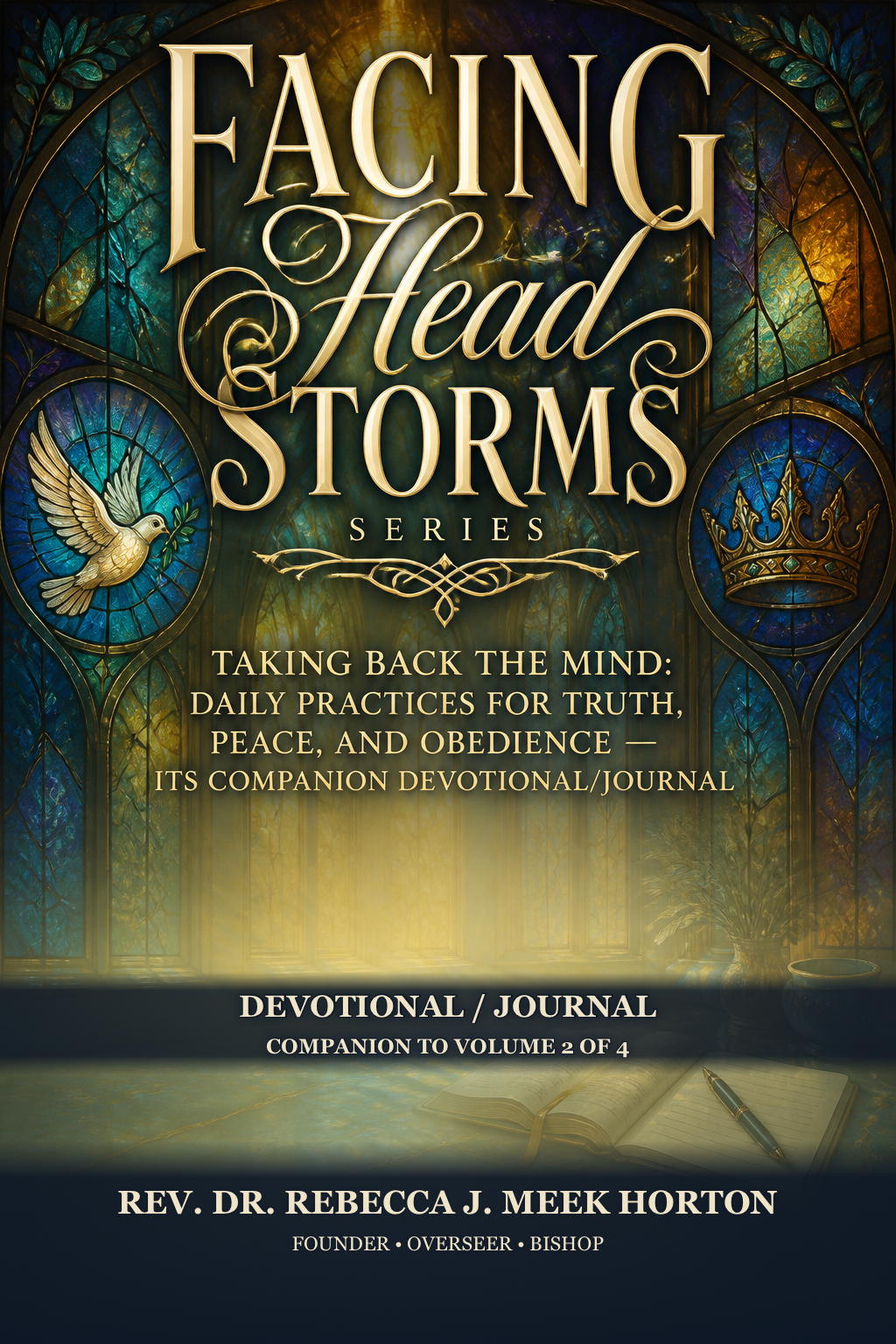
Facing Head Storms · Volume 2
Taking Back the Mind: Daily Practices for Truth, Peace, and Obedience — Its Companion Devotional/Journal
A companion devotional and journal for "Taking Back the Mind: Daily Practices for Truth, Peace, and Obedience". Each chapter becomes five entries — a KJV Scripture reading, a devotional, a prayer, a journal prompt, and space to write — closing with An Apostolic Prophetic Architect Message and lined
Full publication
NBCNGMI MASTER KNOWLEDGE LIBRARY Featuring the works of The Sage, Apostle Prophet. Rev. Dr. Rebecca J. Meek Horton, Apostolic Prophetic Architect, NewBeing Creation Network Global Ministries, Inc. Integrated Framework Modalities™
Chapter 1 — When the Storm Moves Inside
Entry 1
Scripture Reading
Philippians 4:6-8 (KJV) 6 Be careful for nothing; but in every thing by prayer and supplication with thanksgiving let your requests be made known unto God. 7 And the peace of God, which passeth all understanding, shall keep your hearts and minds through Christ Jesus. 8 Finally, brethren, whatsoever things are true, whatsoever things are honest, whatsoever things are just, whatsoever things are pure, whatsoever things are lovely, whatsoever things are of good report; if there be any virtue, and if there be any praise, think on these things.
Devotional
The storm inside the mind often begins before the day is fully awake. A thought rises while you are brushing your teeth. A fear sits beside you in the car. An accusation waits for you before the assignment, the classroom, the meeting, the pulpit, the exam, or the conversation.
Philippians 4 does not shame you for that pressure. It gives you a doorway. It teaches you what to do when anxiety tries to become your ruler. Bring it to God.
That sounds simple, but it is not always easy. Anxiety wants to keep the mind circling. It wants you to rehearse, predict, defend, explain, and imagine every possible outcome. Prayer interrupts that inward spiral. Prayer says, Father, this is what is in me. This is what I am carrying. This is what I cannot solve by worrying.
The passage says in every thing. Not only in the crisis that looks spiritual enough. Not only after you calm down. Not only after you know the right words. In the actual thing. The email. The diagnosis. The child. The lesson plan. The ministry weight. The private thought. The memory. The pressure you do not know how to name.
Bring it.
Then Scripture gives us a promise. The peace of God shall keep your hearts and minds through Christ Jesus. This peace is not shallow calm. It is not denial. It is not pretending there is no trouble. It is the guarding presence of God over the inner life when understanding is not enough.
But peace must be practiced with. After bringing the request, the mind is called to think on what is true, honest, just, pure, lovely, of good report, virtuous, and praiseworthy. This is not positive thinking. It is truth-governed thinking.
Today, the storm may not disappear all at once. But it does not have to govern you. You can bring the matter to God. You can receive His keeping peace. You can choose one true thought to return to when the old thought tries to take over.
Recognition is a beginning. Daily guarding is the practice.
Prayer
Father, I bring You what is in my mind today. I do not want anxiety to rule my thoughts, my words, my decisions, or my body. I make my request known unto You with honesty. Help me not to hide behind religious language or pretend I am fine when I need Your peace. Teach me to receive the peace that keeps my heart and mind through Christ Jesus. When fear repeats itself, help me return to what is true. When shame speaks loudly, help me answer with Your Word. Today, I choose to bring, receive, and think according to truth. Keep me steady in You. Amen.
Journal Prompt
From Philippians 4:6-8, what specific anxious thought or pressure do I need to bring to God today, and what true thought will I return to when it rises again?
Space to Write [Answer Lines]
Entry 2
Scripture Reading
Proverbs 4:23 (KJV) Keep thy heart with all diligence; for out of it are the issues of life.
Devotional
Naming the storm matters. There is relief when you finally say, this is fear, this is shame, this is accusation, this is not my whole identity. Language helps you stop blending with the attack. It helps you see what has been happening instead of simply drowning in it.
But naming is not the same as guarding.
A person can recognize a thief and still leave the door unlocked. That is often how the mind is treated. We recognize the pattern, but we keep feeding it. We scroll into agitation. We rehearse the conversation again. We repeat the accusation until it sounds like wisdom. We call it processing, but sometimes we are practicing the very thought that is hurting us.
Proverbs tells us to keep the heart with all diligence. That word keep carries responsibility. It means guard. Watch. Tend. Steward the inner place where thoughts, desires, motives, fears, memories, and responses begin to form.
This does not mean you can control every thought that enters your mind. Some thoughts come suddenly. Some are attached to pain. Some rise from old wounds. Some come when the body is tired. But guarding means every thought does not get a chair, a microphone, and authority.
Not every feeling should interpret God.
Not every memory should define your future.
Not every accusation should become a verdict.
Not every pressure should decide your next step.
A guarded heart is not a hard heart. It is a stewarded heart. It is a heart that learns to ask, what is this thought producing in me? Is this leading me toward truth, peace, obedience, humility, and love? Or is it leading me toward fear, shame, despair, secrecy, resentment, and confusion?
This is where responsibility replaces shame. Not, my mind is a mess, so I am hopeless. But, my mind is under pressure, so I need faithful guarding.
That shift matters. Shame pushes you into hiding. Responsibility brings you back into stewardship. God is not asking you to pretend the storm is not real. He is teaching you how to guard the inner place so the storm does not take ownership of the house.
Today, keep the gate. Slow down before agreement. Test the thought before obeying it. Let truth stand at the entrance.
Prayer
Father, I come to You as one who needs help guarding the inner life. I confess that I have sometimes allowed fear, shame, memory, and pressure to enter without testing them. Teach me to keep my heart with diligence, not with panic and not with hardness, but with wisdom. Help me recognize what is trying to take authority in me. Give me courage to close the door to what feeds confusion and open my heart to what strengthens truth, peace, and obedience. I receive responsibility without shame. I choose stewardship instead of surrendering my mind to every storm. Amen.
Journal Prompt
From Proverbs 4:23, what thought, habit, conversation, or influence has been entering my heart too freely, and what boundary do I need to practice today?
Space to Write [Answer Lines]
Entry 3
Scripture Reading
2 Corinthians 10:4-5 (KJV) 4 (For the weapons of our warfare are not carnal, but mighty through God to the pulling down of strong holds;) 5 Casting down imaginations, and every high thing that exalteth itself against the knowledge of God, and bringing into captivity every thought to the obedience of Christ;
Devotional
Some battles in the mind feel personal because they use your own voice. The thought may sound like you. It may use familiar pain. It may borrow an old memory. It may speak with the tone of someone who wounded you. It may arrive so quickly that you assume it must be true.
But a thought can be loud and still be false.
A thought can be familiar and still be destructive.
A thought can come from pain and still need correction.
Second Corinthians gives us language for the battle. We are not called to attack people. We are called to pull down strong holds, cast down imaginations, and bring thoughts into captivity to the obedience of Christ.
This is serious work, but it does not have to be frantic work. Spiritual warfare in the mind is not always loud. Sometimes it looks like pausing before you agree with despair. Sometimes it looks like writing down the accusation and asking, does this exalt itself against the knowledge of God? Sometimes it looks like saying, this thought is not my master. Sometimes it looks like calling a wise counselor, pastor, mentor, doctor, or trusted believer because stewardship includes receiving proper help.
The goal is not endless self-analysis. The goal is obedience to Christ.
If a minister keeps thinking, I have nothing worth saying, that thought may silence a needed word. If a student keeps thinking, I cannot learn, that thought may train surrender before effort begins. If a parent keeps thinking, I have ruined everything, that thought may steal wisdom, tenderness, and repair. If an educator keeps thinking, nothing I do matters, that thought may drain faithful service. If a young person keeps thinking, I am too broken to be helped, that thought may block the very help God is providing.
Thoughts train responses. Responses become patterns. Patterns shape stewardship.
That is why the mind must be brought under truth.
Today, do not argue with every storm all day. Choose one thought to bring into captivity. Name it. Test it. Answer it with Scripture. Then take one obedient step that agrees with truth instead of fear.
The mind may be under pressure, but Christ still has authority.
Prayer
Father, I bring my thoughts before You. I ask You to help me discern what is true and what is exalting itself against the knowledge of God. I do not want to attack people when the real battle is with lies, imaginations, fear, and disobedience. Teach me to use spiritual weapons with humility and steadiness. Help me cast down what does not agree with Your truth and bring my thoughts into obedience to Christ. When an old accusation speaks, give me courage to answer it with Your Word. Today, I choose not to be ruled by every inner sentence. Amen.
Journal Prompt
From 2 Corinthians 10:4-5, what thought do I need to bring into captivity today, and what obedient action will show that Christ has authority over that thought?
Space to Write [Answer Lines]
Entry 4
Scripture Reading
Isaiah 26:3-4 (KJV) 3 Thou wilt keep him in perfect peace, whose mind is stayed on thee: because he trusteth in thee. 4 Trust ye in the LORD for ever: for in the LORD JEHOVAH is everlasting strength:
Devotional
Peace is often misunderstood. Many people think peace means nothing is pressing, nothing is unresolved, nothing hurts, and nothing is uncertain. But Isaiah speaks of a deeper peace. Perfect peace is connected to a mind stayed on God.
Stayed means fixed, leaned, supported, held in place. The mind is not stayed on God by accident. It is returned to Him. Again and again. In the morning. In the car. Before the meeting. After the hard conversation. During the waiting. While the body is tired. When the old fear tries to explain everything.
This kind of peace is not fragile. It is rooted in trust.
The verse does not say the person has perfect peace because the circumstances are easy. It says because he trusteth in thee. Trust is the place where the mind leans when it cannot carry the full weight of understanding.
There will be days when your mind wants to lean on control. It wants a full map before obedience. It wants every person to respond correctly before you rest. It wants all outcomes secured before you breathe. But control is a poor resting place. It cannot hold the soul.
There will be days when your mind wants to lean on fear. Fear will promise protection, but it usually produces agitation. It tells you to prepare for every possible disaster, but it does not give you peace.
There will be days when your mind wants to lean on shame. Shame will tell you that if you punish yourself enough, maybe you will become safe. But shame does not heal. It hides.
The Lord is the only safe place for the mind to stay.
This does not mean you will never need help. It does not mean you ignore the body, dismiss trauma, refuse counsel, or avoid wise care. It means that even as you steward practical help, your deepest trust is not in your ability to manage every detail. Your trust is in the Lord JEHOVAH, who is everlasting strength.
Today, practice staying. When the mind runs ahead, bring it back. When fear becomes loud, bring it back. When shame reaches for authority, bring it back. Peace is not always felt first. Sometimes it is practiced by returning.
Prayer
Father, I want my mind to be stayed on You. I confess that I have leaned on control, fear, shame, and overthinking when I was tired. Those places cannot keep me. You alone are everlasting strength. Teach me to trust You in the middle of uncertainty. Help me return my attention to You when my thoughts scatter. Let Your peace guard me, steady me, and train me. I do not ask for a false peace that denies reality. I ask for Your peace that holds me while I walk in truth. Today, I choose to lean my mind on You again. Amen.
Journal Prompt
From Isaiah 26:3-4, where has my mind been leaning for safety, and what would it look like to stay my mind on the Lord today?
Space to Write [Answer Lines]
Entry 5
Scripture Reading
Psalm 139:23-24 (KJV) 23 Search me, O God, and know my heart: try me, and know my thoughts: 24 And see if there be any wicked way in me, and lead me in the way everlasting.
Devotional
Daily guarding requires honesty. Not panic. Not shame. Not harsh self-judgment. Honesty.
Psalm 139 gives us a prayer that is both brave and tender. Search me, O God. Know my heart. Try me. Know my thoughts. See what is in me. Lead me.
This is not the prayer of someone trying to hide. It is the prayer of someone who trusts God enough to be examined by Him. That matters because mental storms often grow in hidden places. A fear goes unnamed. A wound goes unhealed. A resentment becomes justified. A lie becomes familiar. A pressure becomes normal. Then, slowly, the inner life begins to move under a weight God never meant to rule it.
The psalmist does not say, I will search myself until I fix everything. Self-examination has a place, but without God it can become endless, anxious, and distorted. The prayer is not, leave me alone with my own analysis. The prayer is, search me, O God.
God searches with truth and mercy. He can reveal what is wrong without destroying what He is healing. He can expose a lie without calling you hopeless. He can show you a pattern without reducing your identity to that pattern. He can convict without condemning His child.
This is important for the mind. Some people avoid inner honesty because they are afraid of what they will find. Others over-examine themselves until every thought becomes a trial. Neither path brings peace. The way of wisdom is to bring the heart and thoughts before God and let Him lead.
Search me.
Try me.
See.
Lead me.
That is the movement.
God may show you that a thought needs correction. He may show you that you need rest. He may show you that you have been feeding anxiety through what you consume. He may show you that forgiveness, counsel, medical care, a boundary, repentance, or a difficult conversation is part of the next faithful step.
Do not be afraid of the light of God. His searching is not to shame you. His searching is to lead you in the way everlasting.
Today, invite God into the storm. Not as a distant observer, but as the One with authority to search, heal, correct, and guide.
Prayer
Father, I invite You to search me. Know my heart and know my thoughts. I do not want to hide from You, and I do not want to be ruled by fear of what You may reveal. Search me with mercy and truth. Show me what is false, what is harmful, what is unhealed, and what is disobedient. Also show me where Your grace is already helping me grow. Lead me in the way everlasting. When I need correction, help me receive it. When I need care, help me seek it wisely. When I need to obey, help me take the next faithful step. Amen.
Journal Prompt
From Psalm 139:23-24, what do I need to ask God to search in my thoughts today, and where do I need Him to lead me next?
Space to Write [Answer Lines]
An Apostolic Prophetic Architect Message
Beloved, hear this clearly. The storm that moves inside does not have the final authority over your mind. You are not powerless because a thought appeared. You are not disqualified because pressure rose. You are not abandoned because the battle returned in the morning.
The mind must be stewarded daily. This is not punishment. This is formation. God is teaching you how to recognize, guard, bring, receive, think, and obey. He is not building dependency in you. He is building maturity. He is training you to walk with Him in truth when fear is loud, in peace when pressure is present, and in obedience when the next step costs you something.
Romans 12:2 (KJV) And be not conformed to this world: but be ye transformed by the renewing of your mind, that ye may prove what is that good, and acceptable, and perfect, will of God.
Renewing is not a one-time glance at truth. It is a holy return. Return when anxiety rises. Return when shame accuses. Return when the old memory speaks. Return when your body feels tired and your mind wants to surrender to the loudest thought. Return to God. Return to Scripture. Return to wise counsel. Return to the next faithful step.
Nothing is random. Nothing is wasted. Even this battle can become a place of training. The enemy wanted the storm to make you lose trust. God will use your return to deepen trust. The lie wanted repetition to wear you down. God will use repeated obedience to strengthen you. The pressure wanted to scatter your attention. God will teach you how to stay your mind on Him.
Do not despise small obedience. One honest prayer matters. One tested thought matters. One guarded morning matters. One Scripture written down matters. One wise conversation matters. One boundary matters. One step of obedience before the day ends matters.
You are learning how to take back the mind, not by force of flesh, but by truth, peace, and obedience through Christ. Keep guarding. Keep bringing. Keep returning. Keep walking.
The storm may move inside, but Christ is Lord inside too.
[Journal Page]
[Journal Page]
Chapter 2 — Renewal Is a Daily Return
Entry 1
Scripture Reading
Romans 12:1-2 (KJV) 1 I beseech you therefore, brethren, by the mercies of God, that ye present your bodies a living sacrifice, holy, acceptable unto God, which is your reasonable service. 2 And be not conformed to this world: but be ye transformed by the renewing of your mind, that ye may prove what is that good, and acceptable, and perfect, will of God.
Devotional
Renewal begins with presenting.
Before Paul speaks of the renewing of the mind, he speaks of bringing the whole life before God. This matters because we often try to offer God only the part of ourselves that feels acceptable. We bring the worship voice, the composed face, the responsible role, the part that knows how to keep moving. But renewal reaches deeper than presentation before people. It begins when we present ourselves honestly before God.
That includes the tired mind.
That includes the anxious body.
That includes the thought you wish would stop returning.
That includes the fear you do not want anyone to see.
God does not renew what we keep pretending is not there. He meets us in truth. The mercy of God is not an excuse to stay conformed to fear, shame, pressure, or the patterns of this world. Mercy is the door that lets us return without hiding.
The world trains the mind by repetition. It repeats worry. It repeats comparison. It repeats panic. It repeats the lie that you must control everything or you will not be safe. But Scripture gives another way. Be not conformed. Be transformed. Let the mind be renewed.
This is not instant control. It is steady surrender.
A parent may need to present the child to God again, not because love is weak, but because worry cannot be allowed to rule. A student may need to present the school day to God before the fear begins writing the outcome. A minister may need to present the burden of service instead of carrying it as proof of faithfulness. An educator may need to present the classroom, the pressure, and the unseen fatigue before stepping into the building.
Presenting yourself is not passive. It is holy responsibility. It says, Father, I am here. Not just the strong part. Not just the polished part. All of me.
The mind is renewed where the life is surrendered.
Today, do not wait until your thoughts are calm to come to God. Come with the crowding. Come with the questions. Come with the place that feels unfinished. The mercy of God is strong enough to receive the whole offering of your life.
Prayer
Father, I present myself to You today. I bring my body, my mind, my emotions, my imagination, and my will. I confess that I often want control more than surrender. I want quick relief, but You are calling me into true renewal. Help me not to be conformed to fear, pressure, shame, or the patterns around me. Teach me to return to Your truth when my thoughts become loud. Renew my mind by Your Word and mercy. Show me the next faithful step, and give me grace to obey it without pretending, hiding, or rushing. I belong to You today.
Journal Prompt
Romans 12:1-2 teaches me to present my whole self to God. What part of my mind or life have I been withholding from surrender, and what would it look like to bring it honestly to Him today?
Space to Write [Answer Lines]
Entry 2
Scripture Reading
Lamentations 3:22-24 (KJV) 22 It is of the LORD'S mercies that we are not consumed, because his compassions fail not. 23 They are new every morning: great is thy faithfulness. 24 The LORD is my portion, saith my soul; therefore will I hope in him.
Devotional
There is mercy for the morning after.
The morning after a hard night can feel confusing. You may have prayed with tears, told the truth, resisted the lie, and still awakened to the same pressure knocking at the door of your mind. That does not mean nothing changed. It may mean today has its own mercy to receive.
Lamentations does not speak from an easy place. These words rise from sorrow, ruin, and grief. Yet right there, in the middle of pain, Scripture says the mercies of the LORD are the reason we are not consumed. His compassions fail not. They are new every morning.
New mercy does not mean yesterday was wasted. It means God is faithful today also.
Sometimes shame says, I should not still need help. Pride says, I should be past this by now. Despair says, I will never change. Wisdom answers, Return today.
Renewal is trained by return. The mind learns through repeated direction. Fear repeats its message, so truth must be returned to again and again. This is not empty repetition. It is faithful repetition. It is the daily practice of bringing the mind back under God’s truth until truth becomes more familiar than the lie.
A student may need mercy before the first class begins. A parent may need mercy before checking on the child again. A minister may need mercy before opening the message, answering the call, or serving while weary. An educator may need mercy before stepping into another demanding day. God’s compassion is not rationed to people who already feel strong. It is new every morning.
The verse says, The LORD is my portion. That means God Himself is not absent from the day. Before the schedule. Before the report. Before the meeting. Before the test. Before the conversation. Before the next responsibility. He is portion.
This kind of hope is not denial. It does not pretend the night was easy or the battle is over. It simply refuses to let the pain of yesterday become the lord of today.
You may not feel fully renewed this morning. Still, you can return. You can say, Father, Your mercy is here before my fear finishes speaking. Your compassion has not failed. Your faithfulness is greater than this familiar thought.
Receive today’s mercy. Then take today’s step.
Prayer
Father, I thank You that Your mercies are new this morning. I confess that I sometimes wake up discouraged when the same thought, fear, or pressure returns. Help me not to call the battle failure when You are teaching me daily return. I receive Your compassion today. I receive Your faithfulness today. Be my portion before I reach for control, worry, or shame. Teach my mind to hope in You again. Give me grace to walk through this day with honesty, steadiness, and obedience. I do not have to be consumed, because You are with me.
Journal Prompt
Lamentations 3:22-24 says God’s mercies are new every morning. What mercy do I need to receive today, and what fear or discouragement do I need to stop carrying from yesterday?
Space to Write [Answer Lines]
Entry 3
Scripture Reading
2 Corinthians 4:16-18 (KJV) 16 For which cause we faint not; but though our outward man perish, yet the inward man is renewed day by day. 17 For our light affliction, which is but for a moment, worketh for us a far more exceeding and eternal weight of glory; 18 While we look not at the things which are seen, but at the things which are not seen: for the things which are seen are temporal; but the things which are not seen are eternal.
Devotional
Do not measure renewal only by mood.
This is one of the places many sincere believers become discouraged. If peace feels strong, they think God is near. If anxiety remains, they think they failed. If the tears stop, they think renewal worked. If the heaviness lingers, they wonder if nothing changed.
But Scripture gives us a deeper measure.
Though the outward man perish, the inward man is renewed day by day. Paul does not deny strain. He does not pretend that hardship is easy. He does not call pressure pleasant. He simply teaches that God can renew the inner life even while the outward life remains under pressure.
That is important for real people living real days.
A parent may still be waiting on the child to turn, heal, mature, or come home. A minister may still carry the weight of people, leadership, and spiritual responsibility. A student may still feel nervous before the test, the hallway, or the conversation. An educator may still face a difficult atmosphere, limited support, and long demands. The outward condition may not change overnight. Yet the inward person can still be renewed.
Renewal may first appear as a small turn.
You paused before reacting.
You questioned the accusation instead of agreeing with it.
You told the truth instead of hiding.
You prayed before spiraling.
You opened Scripture instead of feeding panic.
You apologized without drowning in shame.
You kept the boundary.
You returned.
These may not feel dramatic, but they are not small to God. They are evidence of holy movement.
The enemy would like you to believe that if your emotions are not instantly calm, God is not working. That is not true. Peace may come first as obedience. Clarity may begin as one truthful sentence. Strength may appear as the decision not to quit. Renewal may start as direction before it becomes feeling.
Paul also teaches us where to look. Not only at what is seen, but at what is eternal. What is seen can be loud, urgent, and heavy. What is unseen is often quiet, deep, and formative. God is not only changing circumstances. He is forming the inward person.
So today, be honest about the outward pressure, but do not let it be the only evidence you read. Ask God to show you the small signs of inward renewal. Then honor them with continued obedience.
Prayer
Father, I admit that I often measure renewal by how I feel. When my mood is heavy or my circumstances do not change quickly, I am tempted to think nothing is happening. Help me see with truth. Renew my inward man day by day. Teach me to recognize small evidence of growth without despising it. Strengthen me to obey even when I still feel weak. Help me look beyond what is seen and remember what is eternal. I trust that You are working in me, not only around me. Keep forming me in truth, peace, and obedience.
Journal Prompt
2 Corinthians 4:16-18 teaches that the inward man can be renewed day by day. What small evidence of renewal can I recognize in my life, even if my feelings or circumstances are still difficult?
Space to Write [Answer Lines]
Entry 4
Scripture Reading
Ephesians 4:22-24 (KJV) 22 That ye put off concerning the former conversation the old man, which is corrupt according to the deceitful lusts; 23 And be renewed in the spirit of your mind; 24 And that ye put on the new man, which after God is created in righteousness and true holiness.
Devotional
Daily return has a cost.
Ephesians gives a simple pattern: put off, be renewed, put on. This is not spiritual drift. This is grace-shaped participation. God is the One who renews, but we are not called to be careless with what He is renewing.
There are things to put off.
Not only outward habits, but inward agreements. The old way of thinking. The old way of reacting. The old way of rehearsing fear. The old way of protecting shame. The old way of calling worry wisdom. The old way of letting pressure govern speech, choices, and obedience.
Then there is renewal in the spirit of the mind.
That means the inner life must be brought under truth again and again. Renewal is not only about removing wrong thoughts. It is about receiving a new way to stand, speak, decide, and obey.
Then there is a putting on.
The new man is not created in panic, performance, or image management. He is created after God in righteousness and true holiness. This is not pretending to be strong. It is learning to live from what Christ has made possible.
The cost is real. You may have to put off a thought that has become familiar. You may have to stop rehearsing an offense that gives your flesh a sense of control. You may have to put off the sentence, I am just this way, and put on, I am being formed in Christ. You may have to put off self-condemnation and put on repentance. You may have to put off avoidance and put on one honest conversation.
A minister may need to put off the need to appear untouched by burden. A parent may need to put off the belief that fear is proof of love. A student may need to put off the label one failure tried to write. An educator may need to put off the pressure to carry every problem alone.
This is where RE-Language™ matters in the soul.
Not, I am hopeless.
But, I am learning to return.
Not, I failed, so nothing changed.
But, I see where I stepped out of alignment, and I can return to truth.
Not, I must control every thought.
But, I will steward my mind under God.
Today, ask plainly: What must I put off, and what must I put on? Then take one faithful step. Not ten. One.
Prayer
Father, I ask You to help me put off what no longer belongs to the life You are forming in me. Show me the thoughts, reactions, fears, and patterns that I have kept too close. Renew me in the spirit of my mind. Teach me to put on the new man in righteousness and true holiness. I do not want to pretend change; I want to participate with Your grace. Give me courage to release what is familiar but harmful, and give me strength to practice what is true. Lead me in one faithful step today.
Journal Prompt
Ephesians 4:22-24 speaks of putting off, being renewed, and putting on. What old thought or pattern do I need to put off today, and what truth or practice do I need to put on?
Space to Write [Answer Lines]
Entry 5
Scripture Reading
Isaiah 26:3-4 (KJV) 3 Thou wilt keep him in perfect peace, whose mind is stayed on thee: because he trusteth in thee. 4 Trust ye in the LORD for ever: for in the LORD JEHOVAH is everlasting strength:
Devotional
A stayed mind is not an untouched mind.
It is a returned mind.
Sometimes we imagine peace as the absence of mental attack, emotional pressure, or difficult responsibility. But Isaiah speaks of a mind that is stayed on the Lord. Stayed means fixed, supported, held, brought back to its resting place. This does not mean the mind never feels wind. It means the mind is learning where to rest when the wind comes.
Perfect peace is not produced by denial. It is not produced by pretending nothing hurts. It is not produced by controlling every circumstance. It is connected to trust. Because he trusteth in thee.
Trust is not always loud. Sometimes trust is one quiet return in the middle of a crowded day.
Lord, I bring this thought back to You.
Lord, I will not let this fear lead me.
Lord, I will not treat this anxious feeling as prophecy.
Lord, I will not call condemnation conviction.
Lord, I will keep the next faithful step.
This is where the mind begins to become less ruled by mental weather. The thought may come, but it does not have to govern. The fear may rise, but it does not have to sit on the throne. The pressure may be real, but it does not have the right to define obedience.
A stayed mind is trained through practice. It may look like closing the phone and opening the Word. It may look like breathing slowly and praying before responding. It may look like asking for wise help. It may look like going to bed because exhaustion has been weakening discernment. It may look like writing one verse and carrying it into the day.
This is not small.
These small returns are places of stewardship. They are daily altars where the mind is brought back under the care and authority of God.
Isaiah also says, Trust ye in the LORD for ever: for in the LORD JEHOVAH is everlasting strength. Your strength is not everlasting. Your focus is not everlasting. Your emotional energy is not everlasting. His strength is. Renewal is not pretending you have endless capacity. It is returning to the One who does.
Today, do not panic about the thought that returned. Return your mind to the Lord. Let peace begin there. Let trust steady you. Let everlasting strength carry what your human strength cannot.
Prayer
Father, I want my mind to be stayed on You. I confess that my thoughts often run toward fear, pressure, shame, or control. Teach me to return without panic. Help me not to treat every thought as my identity or every anxious feeling as truth. I trust You as my strength. Keep me in Your peace as I bring my mind back to Your Word, Your presence, and Your authority. Show me the next faithful step, and help me take it with steadiness. I receive Your everlasting strength for this day.
Journal Prompt
Isaiah 26:3-4 connects peace with a mind stayed on the Lord. What pulls my mind away from Him most often, and what simple practice can help me return today?
Space to Write [Answer Lines]
An Apostolic Prophetic Architect Message
Philippians 4:6-7 (KJV) 6 Be careful for nothing; but in every thing by prayer and supplication with thanksgiving let your requests be made known unto God. 7 And the peace of God, which passeth all understanding, shall keep your hearts and minds through Christ Jesus.
Beloved, hear this with clarity and courage: the return is not wasted.
Every time you bring your mind back to God, something is being trained. Every time you refuse a lie, something is being strengthened. Every time you choose prayer over panic, Scripture over spiraling, obedience over fear, surrender over control, you are participating in renewal.
Do not despise the quiet work. Heaven does not only recognize dramatic breakthroughs. Heaven sees the mother whispering truth in the kitchen. Heaven sees the student carrying one verse into the school day. Heaven sees the minister pausing before answering with wisdom. Heaven sees the educator standing in pressure but refusing to be governed by it.
This is not small. This is formation.
Taking back the mind is not taking control away from God. It is bringing the mind back under His truth, His peace, and His authority. You are not called to panic about your thoughts. You are called to steward them. You are not called to pretend every battle is over. You are called to return daily with honesty and faith.
There is a difference between a thought that attacks you and a truth that anchors you. There is a difference between condemnation and conviction. Condemnation drives you into shame and hiding. Conviction leads you toward God with repentance, clarity, and life. Learn the difference. Guard your agreement.
The peace of God shall keep your hearts and minds through Christ Jesus. That word keep matters. God is not careless with the heart that returns to Him. He is not confused by your process. He is not intimidated by the storm in your head. He knows how to build peace where fear has been loud.
So I confirm this over you: renewal is working as you return. Truth is taking root as you practice. Peace is being formed as you surrender. Obedience is becoming stronger as you take the next faithful step.
Return today. Return tomorrow. Return until truth becomes familiar. Return until your mind learns where to stand.
The Lord is faithful. Your mind can be renewed. Your next step is simple: bring it back to God.
[Journal Page]
[Journal Page]
Chapter 3 — Start With Stillness
Entry 1
Scripture Reading
Psalm 46:10 (KJV) Be still, and know that I am God: I will be exalted among the heathen, I will be exalted in the earth.
Devotional
Stillness is not weakness. Stillness is not avoidance. Stillness is the holy pause where panic is denied the throne.
Many storms begin with very little information. A message comes. A tone changes. A door closes. A delay stretches. The mind moves quickly, trying to fill in every blank before God has been acknowledged. Fear writes a whole story from one sentence. Shame adds its own commentary. The body tightens as if the imagined thing has already happened.
Psalm 46:10 does not invite us into denial. It calls us into remembrance. Be still, and know that I am God. This is not decorative language. It is a command for troubled places. It teaches the soul to stop long enough to remember who is Lord.
Stillness gives you a small space between what happened and what you do next. That space matters. In that space, you can breathe. You can notice what is true. You can ask God for wisdom. You can refuse to obey the first surge of fear. You can decide not to send the text, make the accusation, rehearse the disaster, or surrender the whole day to an unproven alarm.
This is not doing nothing. This is stewardship.
A parent can pause before correcting a child. A minister can pause before answering criticism. A student can pause before turning one grade into an identity. A spouse can pause before interpreting silence as rejection. A believer can pause before letting a thought become a verdict.
Stillness does not always feel peaceful at first. Sometimes when you stop, you notice how loud the mind has become. Do not let that discourage you. The goal is not instant calm. The goal is to stop surrendering leadership to the storm.
God is not asking you to become naturally calm overnight. He is teaching you to return. Return your attention. Return your breath. Return your thoughts. Return your obedience.
The storm may still be present, but it does not have to become your master. Start with stillness. Let God be God before fear explains everything.
Prayer
Father, I come before You with the places in me that rush, react, and imagine the worst. I confess that I often let urgency speak louder than truth. Teach me to be still without hiding, and to pause without avoiding responsibility. Help me remember that You are God before I answer, decide, accuse, withdraw, or agree with fear. Settle my mind under Your presence. Give me courage to stop, breathe, notice what is true, and choose the next faithful step. I do not want panic to lead me. I want Your wisdom to govern me. Amen.
Journal Prompt
Where do I most need to practice Psalm 46:10 today, and what situation has been trying to rush my response?
Space to Write
[Answer Lines]
Entry 2
Scripture Reading
Isaiah 26:3 (KJV) Thou wilt keep him in perfect peace, whose mind is stayed on thee: because he trusteth in thee.
Devotional
Peace is not always the absence of pressure. Sometimes peace is the steadiness God gives while pressure is still present.
Isaiah 26:3 gives us a picture of a mind that is stayed on God. A stayed mind is not a mind that never feels fear. It is not a mind that never has intrusive thoughts, painful memories, sudden alarms, or difficult questions. A stayed mind is a mind that keeps returning to the right place.
Returning is the practice.
When a storm rises inside, the mind often reaches for control. It wants to know everything now. It wants reassurance now. It wants the outcome now. It wants the conversation settled now. But trust does not always receive the whole map. Trust receives God Himself and the next faithful step.
The mind stayed on God says, I may not know the whole story, but I will not let fear write the final word. I may feel alarmed, but I will not treat alarm as authority. I may need to act, but I will not be driven by panic when wisdom is available.
This matters because the body often joins the storm. The chest tightens. The jaw locks. The stomach turns. The breathing changes. You may feel as if danger is already in the room when what you actually have is a thought, a memory, a message, or a possibility.
You are not weak because your body reacts. You are human. Stillness helps you steward the body and return the mind to God.
Put your feet on the floor. Lower your shoulders. Take a slow breath. Look around and name where you are. Say quietly, God is here, and I can take the next faithful step.
This is not replacing faith with a technique. This is bringing your whole self, including your body, under the care and leadership of God.
Perfect peace does not mean every circumstance becomes easy. It means God is able to keep what is stayed on Him. The keeping belongs to Him. The returning is your faithful participation.
If you have to return ten times in one hour, return ten times. That is not failure. That is training. That is RE-Focusing your attention toward truth. That is taking back the mind one return at a time.
Prayer
Father, I bring You my unsettled mind and my alarmed body. I ask You to teach me how to return my attention to You when fear rises. Keep me in Your peace as I learn to trust You more deeply. Help me not to shame myself for being human, but also not to surrender to every anxious signal. Let my mind be stayed on You, not on every imagined outcome. Give me the grace to pause, breathe, remember, and obey. I receive Your keeping today. Amen.
Journal Prompt
According to Isaiah 26:3, where has my mind been resting most often, and what would it look like to return it to God today?
Space to Write
[Answer Lines]
Entry 3
Scripture Reading
James 1:19-20 (KJV) 19 Wherefore, my beloved brethren, let every man be swift to hear, slow to speak, slow to wrath: 20 For the wrath of man worketh not the righteousness of God.
Devotional
Stillness makes room for righteous response.
James does not tell us to become silent people who never speak truth. He tells us to become ordered people. Swift to hear. Slow to speak. Slow to wrath. That order matters because reaction can outrun righteousness when the heart is hot.
A quick answer can feel powerful. A sharp reply can feel protective. A long explanation can feel necessary. A defensive text can feel like control. But not every immediate response is obedience. Sometimes the first response is only fear wearing a strong voice.
Stillness helps us slow down enough to hear.
We need to hear God. We need to hear what is actually being said. We need to hear what our own heart is carrying. We need to hear whether the moment calls for correction, silence, apology, boundary, counsel, or rest.
Being slow to speak does not mean avoiding a necessary conversation. It means refusing to let the storm decide your words. Being slow to wrath does not mean pretending you were not hurt. It means bringing the hurt under God’s wisdom before you release it onto someone else.
This is especially important in homes, classrooms, ministries, and leadership spaces. A parent’s hasty words can land heavily on a child. A teacher’s reaction can shame a student who needs structure and guidance. A minister’s defensiveness can block needed correction. A student’s angry response can close a door that wisdom would have kept open.
The pause is not a loss of authority. The pause is where authority becomes mature.
Many people fear that if they do not answer immediately, they will lose control. But that thought needs to be RE-Languaged. Not, If I pause, I lose control. Instead, If I pause, I make room for self-control.
That one shift can change the atmosphere of a conversation.
Stillness does not remove the need to speak. It prepares the heart to speak with truth and restraint. The goal is not to win the moment. The goal is to honor God in the moment.
The wrath of man does not produce the righteousness of God. That is not a condemnation. It is a protection. God is teaching us that our unmanaged reactions cannot accomplish His holy work.
So pause before the reply. Wait before the correction. Pray before the meeting. Breathe before the call. Let righteousness, not reaction, lead.
Prayer
Father, I confess that I have often spoken too quickly when I felt hurt, afraid, pressured, or misunderstood. Teach me to be swift to hear and slow to speak. Help me recognize the difference between righteous action and emotional reaction. Guard my mouth, my tone, my timing, and my motives. When I need to speak, give me truth with grace. When I need to wait, give me strength without resentment. Let my words serve Your righteousness and not my need to defend myself. Form maturity in me through the faithful pause. Amen.
Journal Prompt
How does James 1:19-20 challenge the way I respond when I feel criticized, pressured, or misunderstood?
Space to Write
[Answer Lines]
Entry 4
Scripture Reading
Proverbs 14:29 (KJV) He that is slow to wrath is of great understanding: but he that is hasty of spirit exalteth folly.
Devotional
Urgency is not always wisdom.
Some moments do require quick action. If there is danger, harm, medical need, or real safety concern, you act. You call for help. You move toward protection. Stillness in those moments may be one breath before the responsible step.
But many mental storms are not emergencies. They feel urgent because the nervous system is alarmed, the imagination is active, or an old wound has been touched. The thought feels loud, so we assume it must be true. The fear feels powerful, so we treat it like a command. The pressure feels immediate, so we move before wisdom has spoken.
Proverbs 14:29 teaches us that slowness can carry understanding. Haste can exalt folly. That is a serious mercy. God is not trying to shame us. He is showing us the cost of being hasty in spirit.
Hasty words can wound. Hasty assumptions can accuse. Hasty vows can trap. Hasty decisions can carry consequences long after the feeling has passed. Hasty self-talk can turn one hard moment into a false identity.
A thought can feel urgent and still not be true.
A fear can feel strong and still not be your leader.
A memory can feel present and still belong to the past.
A pressure can feel immediate and still need wisdom before movement.
Stillness helps us separate urgency from obedience.
Ask simple questions. What is actually happening? What do I know, and what am I imagining? What part of me feels threatened? What response can wait until my mind is clearer? What would obedience look like in the next five minutes?
These questions are not overthinking. They are truth-telling. They help you see the situation without handing the pen to fear.
This is where SAPP™ discernment begins. See what is really happening. Not what fear predicts. Not what shame declares. Not what past pain assumes. See the situation truthfully, then ask the deeper questions.
You do not have to be ruled by the first surge. By the grace of God, you can pause. You can notice. You can refuse immediate agreement. You can choose a wiser pace.
The hasty spirit wants to move now just to feel relieved. The wise spirit is willing to wait long enough to respond faithfully.
Prayer
Father, I ask You to deliver me from the pressure of false urgency. Help me know when quick action is needed and when fear is only demanding control. Teach me to slow down without becoming passive. Give me understanding where I have been hasty in spirit. Help me stop building conclusions from incomplete information. I want my responses to be governed by wisdom, not panic; by truth, not assumption; by obedience, not pressure. Train me to pause, see clearly, and move when You give me the next faithful step. Amen.
Journal Prompt
Where does Proverbs 14:29 reveal haste in my thoughts, words, or decisions, and what slower response would wisdom choose?
Space to Write
[Answer Lines]
Entry 5
Scripture Reading
Psalm 131:1-3 (KJV) 1 A Song of degrees of David. LORD, my heart is not haughty, nor mine eyes lofty: neither do I exercise myself in great matters, or in things too high for me. 2 Surely I have behaved and quieted myself, as a child that is weaned of his mother: my soul is even as a weaned child. 3 Let Israel hope in the LORD from henceforth and for ever.
Devotional
There are thoughts too heavy for you to carry without God.
Psalm 131 is a small psalm with deep wisdom. It teaches humility of mind. The psalmist does not pretend to know everything. He does not reach for matters too high for him. He quiets his soul and hopes in the Lord.
This is not ignorance. This is maturity.
The anxious mind often tries to climb into places God has not assigned to it. It tries to know the whole future. It tries to interpret every silence. It tries to manage every person’s opinion. It tries to guarantee every outcome. It tries to prevent every possible pain by rehearsing it in advance.
But mental rehearsal is not the same as wisdom. Control is not the same as faithfulness. Carrying what belongs to God does not make you stronger. It makes you exhausted.
Stillness teaches the soul to come down from the high place of false control.
There is a holy humility in saying, I do not know enough to finish this story. I do not have grace for every imagined outcome. I do not have to solve tomorrow tonight. I can quiet my soul and take the next faithful step.
The psalm says, I have behaved and quieted myself. That means quieting the soul is not always automatic. Sometimes the soul must be guided. Sometimes we must speak truth to the restless places within us. Sometimes we must stop feeding the storm with more checking, scrolling, rehearsing, explaining, and imagining.
A quieted soul is not an empty soul. It is a surrendered soul.
This does not mean you stop caring. It means you stop pretending you are God. It means you carry your assigned responsibility and release what belongs to Him.
Parents need this. Ministers need this. Students need this. Educators need this. Leaders need this. Caregivers need this. Every person entrusted with people, decisions, pressure, and purpose needs to learn the difference between stewardship and control.
Stillness helps you return to your portion. What is mine to do today? What is not mine to carry? What is the next faithful step?
Hope in the Lord from this moment forward. Not in perfect information. Not in instant answers. Not in emotional certainty. Hope in the Lord.
Your mind does not have to master every unknown. Your soul can be quieted in the presence of the One who already knows.
Prayer
Father, I humble my mind before You. I confess that I have tried to carry matters too high for me. I have rehearsed outcomes, managed imaginations, and reached for control when You were calling me to trust. Teach me to quiet my soul without denying responsibility. Show me what is mine to do and what belongs to You. Help me release the need to know everything before I obey. Settle me like a weaned child in Your presence. My hope is not in certainty. My hope is in You. Amen.
Journal Prompt
What matter from Psalm 131:1-3 have I been trying to carry, control, or figure out before its time?
Space to Write
[Answer Lines]
An Apostolic Prophetic Architect Message
Beloved, stillness is not the end of movement. Stillness is the place where movement becomes governed.
The Lord is not calling you into passivity. He is calling you out of panic. He is teaching you to stop letting every message, memory, mood, pressure, accusation, and imagined outcome take leadership over your mind. This is part of taking back the mind. You are learning to pause long enough to remember God, tell the truth, and obey with wisdom.
There is an architecture to peace. It is not random. It is built through repeated returns. You stop. You settle. You see. You seek. Then you keep the next faithful step. This is not a complicated path, but it is a costly one. It will cost you the old rhythm of immediate reaction. It will cost you the false comfort of rehearsing fear. It will cost you the pride of always having an instant answer. But what you gain is worth more than what you lay down.
Psalm 119:105 (KJV) Thy word is a lamp unto my feet, and a light unto my path.
A lamp gives enough light for the next step. It does not always show the whole road. That is not punishment. That is training in trust.
I confirm this over you: the storm may be loud, but it does not have to be lord. Your body may feel alarmed, but alarm is not your master. Your mind may produce thoughts, but every thought does not deserve obedience. Fear may demand urgency, but wisdom can teach you timing.
Stand in this grace. Practice stillness before you need it. Do not wait until panic is in charge to practice peace. Set the rhythm now. Three quiet minutes. Feet on the floor. Breath slowed. Scripture read. One honest question before God: What is the next faithful step?
Then take that step.
Nothing is random. Nothing is wasted. Even this training ground is forming maturity in you. The Lord is teaching your mind to return, your mouth to slow down, your body to settle, and your obedience to rise. Keep coming back to Him. Keep choosing truth. Keep walking.
[Journal Page]
[Journal Page]
Chapter 4 — Hide the Word Before the Battle
Entry 1
Scripture Reading
Psalm 119:11 (KJV) Thy word have I hid in mine heart, that I might not sin against thee.
Devotional
The Word hidden in the heart is not hidden because it is forgotten. It is hidden because it is treasured, guarded, and kept close enough to reach when pressure comes.
A person does not prepare for battle after the battle has already begun. A teacher does not wait for smoke in the hallway to explain where the students should go. A parent does not wait for danger to teach a child how to respond. Preparation is love. Preparation is stewardship. Preparation is wisdom before pressure.
The same is true for the mind.
When fear rises, the mind often reaches for what has been repeated. If shame has been repeated, shame may answer first. If worry has been rehearsed, worry may feel familiar. If old wounds have become the loudest inner voice, pain may try to explain the whole situation. But when Scripture has been read, spoken, pondered, and carried, truth is already near.
This is not about collecting verses so we can appear spiritual. It is about letting the Word of God become a holy storehouse within us. The goal is not performance. The goal is formation. The Word hidden in the heart begins to shape what we recognize as true. It gives us language when the mind is under pressure. It reminds us that God has already spoken before fear started talking.
There is also honesty here. Hiding the Word takes attention. It takes time. It may require turning down noise, putting the phone aside, reading slowly, and returning to one verse again and again. That cost is real, but so is the mercy. A small truth carried faithfully can become strength in a hard hour.
Do not despise one verse. Do not shame yourself because you cannot memorize a whole chapter today. Begin with what you can carry. Write Psalm 119:11 where you can see it. Speak it in the morning. Return to it when your thoughts feel crowded.
The Word hidden in your heart is not wasted. Nothing is random. Nothing is wasted. What is planted in peace can become protection under pressure.
Prayer
Father, I come to You honestly. I confess that my mind often reaches for what is familiar, even when what is familiar is fear, shame, or worry. Teach me to hide Your Word in my heart before the storm rises. Help me not to treat Scripture as decoration or emergency language only, but as daily bread and holy truth. I receive responsibility without shame. I ask for a steady heart, a teachable spirit, and a willing mind. Let Your Word become near to me. Let it correct me, comfort me, and call me into obedience. Father, I want truth stored deeply enough that I can reach for it when pressure comes.
Journal Prompt
Psalm 119:11 speaks of hiding God’s Word in the heart. What truth do I need to store before my next head storm, and what usually competes for that space in me?
Space to Write
[Answer Lines]
Entry 2
Scripture Reading
Joshua 1:8 (KJV) This book of the law shall not depart out of thy mouth; but thou shalt meditate therein day and night, that thou mayest observe to do according to all that is written therein: for then thou shalt make thy way prosperous, and then thou shalt have good success.
Devotional
Joshua was not standing in an easy moment when God gave him this instruction. Moses had died. The people needed leadership. The land ahead was promised, but it was also contested. Joshua needed courage, but God did not call him into courage by pretending the assignment was light.
God gave Joshua a way to be governed.
The Word was to be in his mouth. The Word was to be in his meditation. The Word was to shape his obedience. This is important because many people want strength without governance. We want peace without discipline. We want clarity without meditation. We want victory in the hard place without allowing truth to form us in the hidden place.
But Joshua 1:8 gives us order. Speak the Word. Meditate on the Word. Obey the Word.
This is not empty repetition. It is not religious noise. It is the steady practice of bringing the mind under divine truth until the way we think, speak, and move is shaped by what God has said. Meditation is not rushing past the verse. It is staying with it long enough for it to search us. It asks, What is God revealing? What must I obey? What false thought is being corrected? What next faithful step is being made clear?
A minister needs this before entering difficult conversations. A student needs this before comparison begins speaking. A parent needs this before fear becomes control. An educator needs this before exhaustion turns tenderness into irritation. We all need the Word in the mouth and in the mind before the day tests what has been stored.
There is a cost. Meditation takes attention. It may feel slow in a world trained for speed. It may feel small compared to the size of the assignment. But daily formation is rarely dramatic while it is happening. It becomes visible when pressure comes.
Do not wait until fear is loud to decide Scripture matters. Begin in the calm. Read one verse slowly. Speak it out loud. Carry one sentence into the day. Ask God how to obey it in the next ordinary situation.
The Word is not only for information. It is for formation. It forms courage with humility. It forms obedience with wisdom. It forms leaders who do not move only by emotion, pressure, or impulse, but by truth.
Prayer
Father, I do not want to be governed by pressure, fear, or noise. I want Your Word to shape my mouth, my meditation, and my obedience. Teach me to slow down enough to receive what You have spoken. Forgive me for the times I have wanted direction without discipline or peace without daily formation. Help me carry Scripture into my real responsibilities today. Let Your Word steady me as I lead, learn, parent, teach, serve, and make decisions. I ask for courage that is rooted in truth, not pride. Father, make me faithful in the quiet so I can stand wisely under pressure.
Journal Prompt
Joshua 1:8 connects speaking, meditating, and obeying the Word. Which of these three needs more attention in my life right now, and what is one simple way I can practice it today?
Space to Write
[Answer Lines]
Entry 3
Scripture Reading
Psalm 119:105 (KJV) Thy word is a lamp unto my feet, and a light unto my path.
Devotional
A lamp does not show the whole road at once. It gives enough light for the next step.
That is not always what we want. When the mind is under pressure, we often want the full explanation, the full outcome, the full assurance, and the full map. We want to know how everything will resolve before we obey the next instruction. But God often leads with enough light for faithful movement, not enough light for total control.
Psalm 119:105 is mercy for the pressured mind. It reminds us that the Word of God gives light where we are standing and direction for the path ahead. It may not answer every question at once, but it keeps us from walking in darkness. It helps us refuse the lie, choose obedience, and take the next faithful step.
This matters when the head storm comes. Fear says, You need to solve everything right now. Shame says, You have already failed, so why try? Anxiety says, If you cannot see the whole way, you are not safe. But the Word says there is light for your feet. There is light for your path. You are not left to stumble alone.
Sometimes the most faithful thing you can do is not dramatic. It may be opening your Bible before opening your phone. It may be reading the same verse three mornings in a row. It may be writing one sentence in your journal. It may be calling a wise believer instead of sitting alone with a spiraling thought. It may be apologizing, setting a boundary, resting, or refusing to rehearse fear at bedtime.
The lamp is useful when it is already in your hand. This is why we read before we need rescue. Crisis reading is not wrong; God meets us there. But preparation reading gives the heart a place to return when the storm rises.
Do not make this complicated. Choose one passage. Read it slowly. Ask what it shows you about God, what it reveals about your heart, and what obedience looks like today. Then carry it. Not to impress anyone. Not to prove anything. Carry it because your mind needs light.
You may not see the whole road today. That does not mean God has failed to lead you. Take the step He has lit.
Prayer
Father, I admit that I often want the whole road before I trust You with the next step. I want control when You are offering light. Teach me to receive Your Word as a lamp to my feet and a light to my path. Help me stop demanding full explanations before I obey what is already clear. When my mind feels pressured, bring me back to the truth You have spoken. Give me enough light to reject the lie, enough courage to move responsibly, and enough humility to ask for help when I need it. Father, I will not despise the next faithful step.
Journal Prompt
Psalm 119:105 says God’s Word gives light for the path. What next faithful step is already clear to me, even if the whole road is not?
Space to Write
[Answer Lines]
Entry 4
Scripture Reading
Isaiah 26:3 (KJV) Thou wilt keep him in perfect peace, whose mind is stayed on thee: because he trusteth in thee.
Devotional
Isaiah 26:3 is not a weapon for shame. It is an invitation into return.
Some people read this verse and immediately accuse themselves. They think, If I feel anxious, I must not trust God. If my mind feels scattered, I must be failing spiritually. But that is not careful stewardship of the Word. Scripture corrects us, but it does not crush the weary who are learning to come back to God.
This verse shows us a place of peace: the mind stayed on God. Stayed means held, settled, supported, brought back again. It does not mean the believer never feels pressure. It does not mean the mind is never tempted to wander. It means there is a holy return available. When fear pulls, the mind can return. When comparison speaks, the mind can return. When shame rehearses old evidence, the mind can return.
Peace is not produced by pretending nothing is wrong. Peace is found as trust learns where to rest. The mind stayed on God is not ignoring reality; it is refusing to let reality become larger than God’s truth.
This is important for the daily life of the believer. A student may need to return to God before walking into a classroom. A parent may need to return before responding to a child. A minister may need to return before answering someone’s crisis. An educator may need to return between one hard moment and the next. The practice may be simple: pause, breathe, speak the verse, and ask, Father, what is true right now?
The mind is shaped by what it repeatedly receives. If we begin the day with noise, outrage, comparison, or hurry, we should not be surprised when peace feels far away. This does not mean every anxious thought is our fault. It means our inputs matter. We cannot control every storm, but we can tend the soil.
Let this verse become a place of RE-Alignment™. Not shame. Not striving. Return. Place one hand over your heart if you need to. Speak Isaiah 26:3 slowly. Name what is pulling your attention. Then bring your mind back to the Lord.
Perfect peace is not fragile. It is held by the faithful God who keeps those who trust Him.
Prayer
Father, I bring You my scattered mind. I do not want to turn Isaiah 26:3 into shame. I want to receive it as an invitation to return to You. Teach me how to keep my mind stayed on You when fear, pressure, comparison, or old pain tries to pull me away. Help me notice what I am feeding my mind and give me courage to make wise changes. I trust You, and I ask You to teach me to trust You more deeply. Father, keep me in Your peace, not because my circumstances are easy, but because You are faithful and near.
Journal Prompt
Isaiah 26:3 connects peace with a mind stayed on God. What most often pulls my mind away from Him, and what practice can help me return today?
Space to Write
[Answer Lines]
Entry 5
Scripture Reading
Matthew 4:3-4 (KJV) 3 And when the tempter came to him, he said, If thou be the Son of God, command that these stones be made bread. 4 But he answered and said, It is written, Man shall not live by bread alone, but by every word that proceedeth out of the mouth of God.
Devotional
Jesus knew the Word before the wilderness.
That is one of the great lessons of Matthew 4. The pressure was real. Jesus was hungry. He was alone. The tempter came with a question aimed at identity and appetite. The enemy did not begin with something random. He pressed where the body was weak and where obedience could be tested.
Jesus answered with written truth.
He did not panic. He did not negotiate with the lie. He did not let appetite become lord. He did not use His identity to prove Himself on the enemy’s terms. He stood in what God had already spoken.
This matters for our minds. A head storm often comes with pressure that feels urgent. Prove yourself. Fix this now. Escape this discomfort. Believe this accusation. Feed this fear. Follow this impulse. When the mind is tired, those suggestions can feel powerful. But the believer is not called to invent truth in the storm. The believer is called to return to truth already received.
It is written.
Those three words are not magic. They are submission. They mean God’s Word has authority over the moment. They mean pressure does not get to define obedience. They mean feelings may be real, but they are not sovereign. They mean the enemy does not get to rename what God has already named.
We must also be careful. The enemy can use Scripture words in twisted ways. Knowing Bible language is not the same as submitting to Bible truth. We must read in context, interpret faithfully, ponder honestly, and steward what we receive. Scripture should not be used to shame the suffering, avoid responsibility, deny wise care, or control people. The Word of God is holy, and it must be handled with humility.
The way Jesus used Scripture teaches us steadiness. He answered the lie without becoming like the liar. He stood firm without becoming frantic. He refused pressure without needing to perform.
Today, choose one place where your mind is often tempted. Is it fear? Anger? shame? comparison? control? appetite? despair? Do not wait until the storm rises. Find one Scripture that speaks truth to that place. Write it. Speak it. Carry it.
When pressure comes, you will not be empty. Truth will already be near.
Prayer
Father, I thank You for the example of Jesus in the wilderness. I confess that pressure often tempts me to react, prove myself, feed fear, or obey appetite instead of truth. Teach me to answer lies with what is written, not with panic or pride. Help me store Your Word before the battle comes. Give me discernment so I do not misuse Scripture or twist it to serve my emotions. Let Your truth govern my thoughts, my choices, and my obedience. Father, when the enemy presses my weakness, remind me that Your Word is already stronger than the temptation before me.
Journal Prompt
Matthew 4:3-4 shows Jesus answering temptation with what is written. What recurring lie or pressure do I need to answer with Scripture, and what verse will I carry for that battle?
Space to Write
[Answer Lines]
An Apostolic Prophetic Architect Message
Beloved, hear this with clarity and peace: the Word you store in the quiet is not wasted. The verse you read when no one sees, the Scripture you whisper through tears, the truth you write on paper when your mind feels crowded, the passage you teach your child at the table, the Word you carry into the classroom, pulpit, office, hospital room, or hard conversation; it is building a holy storehouse.
You are not preparing because you are afraid. You are preparing because you are responsible. Wisdom does not wait for the alarm to sound before learning the way of escape. Wisdom receives instruction while the room is calm, so obedience has a path when smoke fills the hallway.
This is not about religious performance. This is about truth, peace, and obedience. The mind must not be left unfed and then expected to stand strong under pressure. Feed it the Word. Govern it with truth. Return it to God again and again.
Colossians 3:16 (KJV) Let the word of Christ dwell in you richly in all wisdom; teaching and admonishing one another in psalms and hymns and spiritual songs, singing with grace in your hearts to the Lord.
Let the Word dwell richly, not thinly. Let it dwell in wisdom, not reaction. Let it dwell with grace in the heart, not arrogance in the mouth. The Word hidden in you is not only for your survival; it is for your stewardship. Ministers, teach from what has first searched you. Parents, place truth in the home without using it as a weapon. Educators, carry Scripture as inner governance when the work is heavy. Students, let God’s Word become louder than comparison and pressure.
There will be battles. There will be days when the mind feels crowded. There will be seasons when peace must be practiced, not merely desired. But you are not without help. God has spoken. His Word is near enough to read, strong enough to steady, and holy enough to correct.
So take the next faithful step. Choose one anchor Scripture for the next seven days. Write it by hand. Read it each morning. Speak it during the day. Before bed, ask, Where did I need this truth today?
Nothing is random. Nothing is wasted. Hide the Word before the battle, and let truth be ready when the storm comes.
[Journal Page]
[Journal Page]
Chapter 5 — Pray Before You Spiral
Entry 1
Scripture Reading
Philippians 4:6-7 (KJV) 6 Be careful for nothing; but in every thing by prayer and supplication with thanksgiving let your requests be made known unto God. 7 And the peace of God, which passeth all understanding, shall keep your hearts and minds through Christ Jesus.
Devotional
Anxiety often wants the first word. It does not wait until all the facts are present. It takes one message, one silence, one symptom, one bill, one meeting, and begins to build a story. Before you know it, your body is responding to something that has not happened yet. Your chest tightens. Your mind runs ahead. Your hands shake. The concern may be real, but the story fear is writing may not be true.
Paul gives us a holy interruption. He says, “in every thing.” That means nothing is too ordinary, too messy, too emotional, or too unfinished to bring before God. Prayer is not only for the moment after you have calmed yourself down. Prayer is the place you come while the alarm is still sounding.
This passage does not call you to pretend. It calls you to turn. Prayer turns toward God. Supplication brings the need with humility. Requests make the burden clear enough to name. Thanksgiving remembers that the present fear is not the whole story.
You do not have to say a long prayer to interrupt a spiral. You may simply say, “Father, I do not know what this means yet. Help me not build a false story. Show me what is true. Guard my heart and mind through Christ Jesus.”
That prayer may not remove the phone call, the appointment, the exam, the conversation, or the responsibility. But it changes who gets the first seat in the room. Fear does not have to narrate your future. God is present before the outcome is known.
The peace of God is not always the absence of feeling. Sometimes peace is the strength to breathe, pause, and not obey panic. Sometimes peace is the wisdom to make the call without imagining ten disasters. Sometimes peace is the courage to ask for help. Sometimes peace is the grace to wait without filling the unknown with terror.
Today, do not wait until the spiral has exhausted you. Bring the first flame to God before it becomes a wildfire. The concern may be real, but it does not have to become your ruler. Let your request be made known. Let thanksgiving steady you. Let the peace of God stand guard where anxiety has been pacing.
Prayer
Father, I come to You before my mind runs too far ahead. I confess that I often let fear speak before truth has been invited. I bring You the real concern I am carrying today. Help me name it honestly without making it larger than the facts. Teach me to pray before I spiral, to ask before I assume, and to thank You without pretending pain is not real. Let Your peace guard my heart and mind through Christ Jesus. I receive Your presence in this moment, and I ask for wisdom for the next faithful step. Amen.
Journal Prompt
Philippians 4:6-7 tells me to bring everything to God with prayer, supplication, and thanksgiving. What concern do I need to bring to Him before it becomes a false story, and what can I thank Him for right now?
[Answer Lines]
Entry 2
Scripture Reading
Psalm 55:22 (KJV) Cast thy burden upon the LORD, and he shall sustain thee: he shall never suffer the righteous to be moved.
Devotional
A burden is not imaginary just because you are praying about it. Some burdens are heavy. Some are complicated. Some involve people you love. Some involve consequences you cannot control. Prayer does not require you to call the burden light when it is not. Prayer teaches you where to put the weight.
The psalm says, “Cast thy burden upon the LORD.” That means the burden is acknowledged. It is named. It is not denied, hidden, decorated, or spiritualized. God does not ask you to carry the trouble until you collapse and then come to Him as a last resort. He invites you to bring it to Him while it is still pressing on your chest.
There is a holy difference between carrying responsibility and carrying what belongs to God. You may need to make a phone call. You may need to apologize. You may need to take your child to get help. You may need to study, budget, rest, report, forgive, set a boundary, or seek counsel. That is responsible stewardship. But you are not called to carry tomorrow’s unknowns as though worry can protect the future.
The promise is not that you will never feel weight. The promise is, “he shall sustain thee.” Sustaining grace may not always feel dramatic. It may come as enough strength for one more hour. It may come as clarity after a quiet pause. It may come as a mature person who listens without feeding your fear. It may come as the courage to tell the truth. It may come as restraint when your emotions want to send a sharp message.
When anxiety begins to spiral, it often says, “If you do not keep thinking about this, you are being careless.” But worry is not the same as wisdom. Worry circles. Wisdom casts, listens, and obeys. Worry rehearses disaster. Wisdom brings the matter under God’s care and asks, “What is mine to do now?”
Casting your burden is not throwing away responsibility. It is refusing to make your mind the throne where fear governs the day. It is saying, “Father, this is too heavy for me to carry as lord over my own life. I will do the faithful part, but I give You the ruling weight.”
Today, when the spiral begins, stop and cast. Name the burden plainly. Place it before the Lord. Then ask for the next faithful step. He is not offended by your need. He is able to sustain you.
Prayer
Father, I bring You the burden I have been trying to carry alone. I admit that I have confused worry with responsibility. I have rehearsed outcomes as if fear could keep me safe. Today, I cast this care upon You. Show me what belongs to me and what belongs to You. Sustain me with wisdom, patience, courage, and peace. Help me take the next faithful step without trying to control the whole road. Keep me steady when my thoughts want to run. I trust You to hold what I cannot hold. Amen.
Journal Prompt
Psalm 55:22 tells me to cast my burden upon the Lord. What burden am I carrying that needs to be placed back in God’s hands, and what responsible step is still mine to take?
[Answer Lines]
Entry 3
Scripture Reading
1 Peter 5:7 (KJV) Casting all your care upon him; for he careth for you.
Devotional
The word “all” is a mercy. God does not say to cast only the care that sounds mature. He does not say to bring only the care that makes sense to everyone else. He does not say to wait until your emotions are organized and your voice is calm. He says, “all your care.”
That includes the care you are embarrassed to admit. The concern that keeps returning. The fear that sounds unreasonable but still feels powerful. The ache over a child. The pressure of leadership. The exhaustion of teaching, serving, studying, parenting, or holding a family together. The private thought you would rather not say out loud. Bring it.
Casting all your care does not mean every fear is accurate. It means every fear can be brought honestly under God’s truth. There is a difference. You may say, “Father, this is what I feel, but I do not yet know what is true. Help me not make this feeling my master.”
Anxiety often thrives in vagueness. It says, “Everything is falling apart.” Prayer helps you name the real thing. “Father, I am afraid about this bill.” “Father, I feel alone tonight.” “Father, I am worried about my child.” “Father, I am tired and need strength.” Naming the care does not weaken faith. It opens the soul to receive help in truth.
The reason Peter gives is tender and strong: “for he careth for you.” You are not casting your care into emptiness. You are not speaking into a cold sky. You are bringing your care to the One whose concern for you is not fragile, distracted, or reluctant.
This matters when the mind begins to spiral. A spiral often whispers, “You are alone with this.” The Word answers, “He careth for you.” A spiral says, “You must figure out every possible outcome right now.” The Word says, “Cast.” A spiral says, “If you were stronger, you would not feel this.” The Word says, “Bring all your care.”
God’s care does not make us passive. It makes us honest enough to receive direction. Sometimes after casting the care, you will be led to rest. Sometimes to act. Sometimes to ask for counsel. Sometimes to stop searching online. Sometimes to make the appointment. Sometimes to wait before responding. The care goes to God first, and then the next step becomes clearer.
Today, let this truth settle: God is not asking you to perform peace. He is inviting you to practice trust. Cast the care, not because it is small, but because He cares for you.
Prayer
Father, I cast all my care upon You because Your Word says You care for me. I bring the concerns I understand and the ones I do not know how to explain. I bring the fear, the pressure, the fatigue, and the questions. Help me stop hiding from You behind spiritual language. Teach me to come honestly and quickly. Let Your care become louder than the story my anxiety is building. Show me what is true, what is mine to do, and what I must release. I receive Your compassion and Your wisdom today. Amen.
Journal Prompt
1 Peter 5:7 says God cares for me. What care have I been minimizing, hiding, or rehearsing instead of casting upon Him?
[Answer Lines]
Entry 4
Scripture Reading
James 1:5 (KJV) If any of you lack wisdom, let him ask of God, that giveth to all men liberally, and upbraideth not; and it shall be given him.
Devotional
Anxiety asks questions, but not always wise ones. It asks, “What if everything goes wrong?” “What if I fail?” “What if they leave?” “What if I never recover?” “What if my child never changes?” Some questions can help us plan responsibly, but many are fear wearing the clothes of preparation.
James gives us a better question to bring into the presence of God: “Father, I lack wisdom. Will You give it to me?”
That is a humble prayer, and it is a powerful interruption to the spiral. It admits that you do not know everything. It also refuses to let panic pretend to be prophecy. Fear often speaks as if it can see the future. Wisdom begins by telling the truth: “Here is what I know. Here is what I do not know. Lord, guide me.”
God does not shame the one who asks for wisdom. James says He gives liberally and “upbraideth not.” That means you do not have to be afraid to ask. God is not standing over you saying, “You should already know better.” He invites you to come.
This matters for ministers, parents, educators, students, and leaders because people often expect you to have answers quickly. The pressure to respond can be intense. A text arrives. A meeting turns difficult. A student cries. A child rebels. A parent complains. A report comes back. A decision is needed. The mind wants to rush toward control.
But wisdom-centered living slows the rush. It prays before it assumes. It asks before it builds a story. It listens before it speaks. It takes one faithful step instead of trying to solve the whole future in one anxious hour.
Prayer does not replace responsibility. It orders responsibility. If a matter needs action, wisdom can show you how to act without being ruled by panic. If a conversation needs to happen, wisdom can guard your tone. If help is needed, wisdom can give you humility to seek it. If waiting is required, wisdom can keep waiting from becoming fear’s playground.
The next time your mind begins filling the unknown with terror, pause and ask for wisdom. Not as a last resort. As your first turning. You may not receive the whole map, but God can give light for the step in front of you.
The spiral says, “Decide now, react now, assume now.” Wisdom says, “Ask God first.” That one turn can change the atmosphere of your mind.
Prayer
Father, I lack wisdom, and I come to You without shame. I do not want fear to answer questions You have not asked me to carry. Help me separate facts from assumptions. Help me slow down before I respond, speak, decide, or accuse. Give me wisdom for the real situation in front of me. Show me what is true, what is loving, what is responsible, and what is faithful. I receive Your promise that You give liberally. Lead me in the next obedient step, and keep my mind from building stories that do not come from You. Amen.
Journal Prompt
James 1:5 invites me to ask God for wisdom. What situation needs wisdom instead of panic, and what question do I need to bring honestly before God?
[Answer Lines]
Entry 5
Scripture Reading
Matthew 6:34 (KJV) Take therefore no thought for the morrow: for the morrow shall take thought for the things of itself. Sufficient unto the day is the evil thereof.
Devotional
Tomorrow can become a heavy place to live before you ever arrive there. Anxiety pulls tomorrow’s trouble into today and demands that you carry it with today’s strength. It asks you to solve next month, next year, the next diagnosis, the next conversation, the next crisis, and the next outcome all at once.
Jesus does not deny that trouble exists. He says, “Sufficient unto the day is the evil thereof.” That is honest. The day may have real pressure. There may be work to do, calls to make, children to guide, lessons to prepare, appointments to attend, emotions to steward, and decisions to face. Faith is not pretending the day is empty of difficulty.
But Jesus draws a boundary around today. He teaches us not to let tomorrow become the ruler of this moment. There is grace for today. There is wisdom for today. There is obedience for today. There is a next faithful step for today.
A spiral often begins when the mind refuses that boundary. One concern becomes a lifetime sentence. One mistake becomes a final identity. One symptom becomes a full tragedy. One hard conversation becomes the end of the relationship. One unknown becomes a stage where fear performs every possible disaster.
Prayer brings you back to today.
“Father, what is true right now?”
“Father, what is mine to do today?”
“Father, what must I release until You give more light?”
That kind of prayer costs something. It costs the illusion of control. It costs the habit of rehearsing fear until worry feels like preparation. It may cost putting the phone down, closing the search window, waiting before sending the message, or admitting, “I do not know yet.”
But there is freedom in living one day at a time with God. Not careless. Not passive. Not immature. Present. Obedient. Guarded.
If the matter is serious, take serious steps. Seek counsel. Make the appointment. Tell the truth. Ask for help. Use the resources God has placed around you. But do not let fear force you to live ten imagined tomorrows before you have obeyed God today.
The Lord is not asking you to carry the whole road. He is calling you to walk with Him now. Pray before the spiral. Return to the facts. Receive today’s grace. Take today’s step. Tomorrow is not God. Fear is not Lord. Christ is with you in this day.
Prayer
Father, I confess that I often try to live tomorrow before it comes. I carry imagined outcomes and call it responsibility. Bring me back to today. Help me see what is actually in front of me and release what You have not asked me to carry yet. Give me grace for this day, wisdom for this moment, and courage for the next faithful step. When fear tries to pull me into a future story, remind me that You are already there, but You are meeting me here. I choose to obey You today. Amen.
Journal Prompt
Matthew 6:34 teaches me not to be ruled by tomorrow. What future concern am I trying to carry today, and what is the next faithful step God is asking of me now?
[Answer Lines]
An Apostolic Prophetic Architect Message
Beloved, hear this with a steady heart: the mind must be stewarded before the storm becomes a throne. Anxiety may knock, but it does not have to govern. Fear may speak, but it does not have to narrate. The child of God is not called to live under the authority of every thought that arrives with urgency.
Prayer is not a weak response. Prayer is the first act of spiritual order. It brings the real trouble into the presence of the real God before imagination builds a false kingdom. This is where maturity is formed. Not in pretending. Not in panic. Not in shame. In truth, humility, and obedience.
You have learned through these readings to bring everything to God, cast the burden, trust that He cares, ask for wisdom, and return to today’s grace. Now seal it in practice. When the next trigger comes, do not wait until the spiral has spent your strength. Pause. Breathe. Pray. Name the real concern. Identify the fear-story. Make the request known. Add thanksgiving. Then take one responsible step.
This is not denial of pain. This is divine order in the inner life.
Isaiah 26:3 (KJV) Thou wilt keep him in perfect peace, whose mind is stayed on thee: because he trusteth in thee.
A stayed mind is not a mind without battles. It is a mind brought back, again and again, under the keeping power of God. Perfect peace is not manufactured by human control. It is received as the mind learns where to stay.
I confirm this over your journey: you are not powerless before the spiral. In Christ, you can interrupt it. You can bring the first fear to God. You can refuse to build a conclusion from half a fact. You can seek wisdom, receive care, and walk in obedience without needing the whole map.
If your anxiety is deep, persistent, or connected to trauma, do not confuse help with failure. Pastoral care, wise counsel, trusted community, medical support, and professional counseling can be part of faithful stewardship. God is not honored by hiding. He is honored by truth.
So rise in the next small obedience. Pray before you spiral. Let peace guard what fear cannot protect. Let God be first in the conversation.
[Journal Page]
[Journal Page]
Chapter 6 — Capture the Thought, Do Not Become It
Entry 1
Scripture Reading
2 Corinthians 10:4-5 (KJV) 4 (For the weapons of our warfare are not carnal, but mighty through God to the pulling down of strong holds;) 5 Casting down imaginations, and every high thing that exalteth itself against the knowledge of God, and bringing into captivity every thought to the obedience of Christ;
Devotional
A thought can arrive before you are ready for it. It may come while you are making breakfast, driving to work, helping a child, opening a textbook, preparing to teach, or trying to pray. It may sound like accusation, fear, memory, dread, or defeat. The thought may be sudden, loud, and familiar. But its arrival does not make it your identity.
Paul teaches us that there is warfare around imaginations, arguments, and high things that rise against the knowledge of God. This means the mind matters. It also means you are not helpless. God does not call you to panic over every thought. He calls you to bring thoughts into captivity to the obedience of Christ.
Captivity is not denial. You are not pretending the thought did not come. You are recognizing it, naming it, and refusing to let it rule without being tested. A thought may speak, but Christ is Lord. A thought may knock, but it does not get automatic authority in the house.
This is the first victory: separation. Instead of saying, I am a failure, you can say, I am having the thought that I will fail. That small shift opens space for truth. It allows you to stand as a steward instead of collapsing into shame. It helps you remember that a thought can be present without being final.
Some thoughts need correction. Some need prayer. Some need wise counsel. Some need practical care because you are tired, overwhelmed, grieving, or under too much pressure. Capturing a thought does not mean you never need help. It means you begin with responsibility and honesty.
Today, do not give every inner sentence the authority of truth. Pause. Notice what is speaking. Bring it before Christ. Ask whether it agrees with Scripture, whether it produces obedience, and whether it reflects God’s character.
You are not required to become every thought that enters your mind. In Christ, you can capture the thought before the thought captures the day.
Prayer
Father, I bring my mind before You today with humility and honesty. I confess that some thoughts feel so loud that I treat them like truth before I test them. Teach me to pause before I agree. Help me notice the thoughts that rise against Your Word, Your character, and my obedience. I do not want to be ruled by fear, shame, accusation, or confusion. I ask You to strengthen me through Your Spirit and help me bring every thought into captivity to the obedience of Christ. Give me wisdom to seek help when I need it and courage to take the next faithful step. Amen.
Journal Prompt
From 2 Corinthians 10:4-5, what thought do I need to bring into captivity today, and what truth of Christ must govern my response?
Space to Write [Answer Lines]
Entry 2
Scripture Reading
Proverbs 14:15 (KJV) The simple believeth every word: but the prudent man looketh well to his going.
Devotional
Not every word deserves belief. That includes the words spoken by others, the words replaying from old wounds, and the words that rise inside your own mind. Proverbs gives a simple contrast: the simple person believes every word, but the prudent person looks well to his going.
Prudence is not fear. It is careful wisdom. It slows down before surrendering agreement. It asks, Where will this thought take me if I follow it? What fruit will this belief produce? Will it lead me toward obedience, peace, repair, and truth, or toward panic, hiding, compromise, and despair?
Many head storms grow because we believe the first sentence too quickly. One thought says, You will fail again. Then the mind starts gathering evidence. It pulls old mistakes, disappointed faces, unfinished goals, and painful memories into the room. Before long, the thought has become a full report, and the report feels like a verdict.
But Proverbs teaches another way. Look well to your going. Do not only ask, Does this thought feel true? Feelings matter, but they are not always faithful judges. Ask where the thought is trying to lead you.
If the thought leads you to confess a real wrong and repair what you can, pay attention. That may be conviction. If the thought crushes you with vague shame and tells you to hide from God and people, test it. That is not the voice of holy clarity.
A student may think, One poor grade means I am stupid. A parent may think, My child’s struggle means I am a failure. A minister may think, One hard season means God is finished using me. An educator may think, I cannot make a difference. These thoughts may feel powerful, but prudence asks for evidence under truth.
Today, you do not have to believe every word that passes through your mind. You can slow down. You can look well to your going. You can ask God for wisdom before you agree, before you speak, before you quit, before you accuse yourself, and before you let one thought shape the whole day.
Prayer
Father, I do not want to believe every word without wisdom. I ask You to make me prudent in my inner life. Help me slow down when fear speaks quickly. Help me look carefully at where a thought is leading me. If a thought is true and calls me to repentance, help me obey without shame. If a thought is false and crushing, help me reject it without fear. Teach me to walk in truth, not impulse. Give me a sound mind, a teachable heart, and the courage to choose the way that honors You. Amen.
Journal Prompt
From Proverbs 14:15, what thought have I been believing too quickly, and where has it been leading my actions or emotions?
Space to Write [Answer Lines]
Entry 3
Scripture Reading
Psalm 139:23-24 (KJV) 23 Search me, O God, and know my heart: try me, and know my thoughts: 24 And see if there be any wicked way in me, and lead me in the way everlasting.
Devotional
David’s prayer is both brave and tender. He does not hide his inner life from God. He opens it. He asks God to search his heart, try his thoughts, reveal any wicked way, and lead him in the way everlasting.
That kind of prayer requires trust. It says, Father, I am not afraid to bring my thoughts into Your presence. I may not understand everything moving inside me. I may not always know what is fear, what is grief, what is temptation, what is fatigue, what is conviction, and what is accusation. But You know me truly. Search me and lead me.
Many people are afraid to name their thoughts before God. They think if they admit the thought, they are agreeing with it. But naming is not the same as surrendering. Naming the thought gives it edges. It brings what was vague into the light where God’s truth can address it.
A vague storm says, Something is wrong. You are not okay. This will never change. Nobody understands. God is far away. Those sentences feel large because they are cloudy. But when you name the thought in one sentence, you begin to steward it.
I am having the thought that God has left me. I am having the thought that I am a burden. I am having the thought that I need to quit. I am having the thought that this feeling will last forever.
That is not confession as identity. That is identification for examination. You are letting God search the thought instead of letting the thought secretly search and rule you.
There is also comfort here. God is not shocked by the thoughts you bring Him. He already knows. Prayer does not inform God of what He did not know. Prayer brings you into honest fellowship with the One who can lead you.
If the thought reveals sin, God can lead you to repentance. If the thought reveals fear, God can lead you to trust. If the thought reveals exhaustion, God can lead you to rest and wise care. If the thought reveals a lie, God can lead you into truth.
Today, let your prayer be honest, not polished. God is able to search you without destroying you. He corrects to lead. He reveals to heal. He brings hidden things into light so you can walk in the way everlasting.
Prayer
Father, I invite You to search me today. Know my heart, try my thoughts, and lead me in the way everlasting. I confess that I sometimes hide from what is moving inside me because I am afraid of what it might mean. Help me name my thoughts honestly without becoming them. Show me the difference between conviction and condemnation. Reveal what needs repentance, what needs healing, what needs rest, and what needs wise counsel. I trust that You do not expose me to shame me, but to lead me. Teach me to walk in the light with courage and humility. Amen.
Journal Prompt
From Psalm 139:23-24, what thought do I need to name honestly before God, and what kind of leading am I asking Him for?
Space to Write [Answer Lines]
Entry 4
Scripture Reading
Philippians 4:8 (KJV) Finally, brethren, whatsoever things are true, whatsoever things are honest, whatsoever things are just, whatsoever things are pure, whatsoever things are lovely, whatsoever things are of good report; if there be any virtue, and if there be any praise, think on these things.
Devotional
Philippians 4:8 gives the mind a holy filter. It does not invite us into denial. It does not tell us to pretend pain is not real, consequences do not matter, or hard situations are easy. It teaches governed attention. It teaches us that the mind must be trained to dwell where truth can lead.
Notice the first word in the list: true. Truth comes before pleasantness. That matters because some people try to think better thoughts by skipping over reality. But biblical peace does not grow from pretending. It grows from bringing reality under God’s truth.
A thought may contain a piece of truth and still lead you into a lie. I made a mistake may be true. I made a mistake, so God is done with me is not true. I feel afraid may be true. I feel afraid, so I must be outside God’s care is not true. This situation is hard may be true. This situation is hard, so obedience is impossible is not true.
The mind must learn to divide the truth from the distortion.
Philippians 4:8 helps us test what we are feeding. Is this thought true? Is it honest? Is it just? Is it pure? Is it lovely in the sense that it agrees with the beauty of God’s ways? Is it of good report? Is there virtue here? Is there praise here?
This does not mean every thought will feel soft. Sometimes truth confronts us. Sometimes honesty requires repentance. Sometimes justice requires a difficult conversation. Sometimes purity requires a boundary. But truth under God will lead toward obedience, not chaos. It will lead toward faithful action, not endless accusation.
If a thought produces secrecy, despair, revenge, compromise, or isolation, test it carefully. If a thought keeps you rehearsing shame without giving you one faithful step, do not let it govern you. Bring it under the filter of the Word.
Today, choose what receives your attention. You may not control every thought that enters, but you can practice refusing to host what opposes truth. You can redirect your mind toward what Scripture says. You can write the truth, speak the truth, pray the truth, and take one obedient step.
Peace is often guarded by what we allow to remain in the room of the mind.
Prayer
Father, I ask You to govern my attention today. Help me think on what is true, honest, just, pure, lovely, of good report, virtuous, and praiseworthy. Teach me not to confuse denial with faith. Help me face what is real while refusing the lies that attach themselves to pain. When I make a mistake, lead me to repentance without shame. When I feel afraid, lead me back to trust. When I am overwhelmed, show me the next obedient step. I yield my mind to Your truth and ask You to train my thoughts in the way of peace. Amen.
Journal Prompt
From Philippians 4:8, which part of this holy filter do I most need to apply to my recurring thought today?
Space to Write [Answer Lines]
Entry 5
Scripture Reading
Isaiah 26:3 (KJV) Thou wilt keep him in perfect peace, whose mind is stayed on thee: because he trusteth in thee.
Devotional
A stayed mind is not a mind that never gets attacked. It is a mind that keeps returning to God.
This is important because many believers feel discouraged when the same thought comes back. They think, If I really trusted God, I would not have to fight this again. But repetition does not always mean failure. Sometimes repetition is training. Sometimes you are learning to return, again and again, until the path of return becomes stronger than the path of panic.
Isaiah connects peace with a mind stayed on God. To stay the mind is to bring it back, settle it, anchor it, and hold it toward the Lord. The promise is not based on your ability to control every mental event. It is rooted in trust. Because he trusteth in thee.
Trust does not always feel dramatic. Sometimes trust is very small and very faithful. It looks like pausing before answering the accusation. It looks like saying, This is a fear thought, not my master. It looks like opening Scripture when shame tells you to hide. It looks like telling one safe person the truth instead of carrying a storm alone. It looks like making the appointment, taking the walk, drinking water, resting, apologizing, asking for prayer, or doing the next right thing.
The storm often demands that you fix your whole life at once. Wisdom usually gives you one step. The mind stayed on God does not need the whole map before obeying. It needs enough light for the next faithful response.
There is cost in this practice. You may have to release the false comfort of rehearsing accusation. You may have to stop letting emotion lead every decision. You may have to admit that some thoughts are too heavy to carry alone. That is not weakness. That is stewardship.
If your thoughts are pressing you toward harming yourself or someone else, seek immediate help. Tell someone now and contact emergency support in your area. Faithfulness includes safety. Your life matters.
For daily storms, return to the simple practice. Pause. Name the thought. Test it against truth. Choose the next faithful response. Then repeat as needed.
Perfect peace is not produced by pretending the battle is not real. It is given by God as the mind learns to stay, return, trust, and obey.
Prayer
Father, I want my mind to be stayed on You. I confess that I often drift toward fear, shame, and imagined outcomes. Bring me back. Teach me to return without condemning myself for needing to return. Help me trust You in the middle of the thought, not only after I feel calm. Give me perfect peace according to Your Word. Show me the next faithful response today, and give me courage to take it. If I need help, make me humble enough to ask. Keep me anchored in Your truth, Your presence, and Your care. Amen.
Journal Prompt
From Isaiah 26:3, what does it look like for me to return my mind to God today, and what one step will help me practice that return?
Space to Write [Answer Lines]
An Apostolic Prophetic Architect Message
Beloved, hear this with steadiness: the presence of a thought is not the same as the ownership of that thought. The enemy, the flesh, old wounds, fear, fatigue, grief, pressure, and pain may all try to speak into the inner room. But every voice does not have governing authority. Christ is Lord over the whole house.
This is a season to stop becoming every sentence that passes through the mind. You are being called into mature stewardship. Not panic. Not denial. Not shame. Stewardship. Notice what is speaking. Name it without fear. Test it by the Word of God. Then take the next faithful step.
Romans 12:2 (KJV) And be not conformed to this world: but be ye transformed by the renewing of your mind, that ye may prove what is that good, and acceptable, and perfect, will of God.
The renewing of the mind is not shallow positivity. It is holy transformation. It is the Spirit of God training your inner life to agree with truth. It is the discipline of refusing to let lies build strongholds. It is the humility to receive correction when needed and the courage to reject condemnation when it comes dressed like certainty.
Do not despise repeated obedience. If you had to capture the thought yesterday and you must capture it again today, do not call that failure. Call it training. Call it practice. Call it another opportunity to bring your mind under the obedience of Christ.
Some of you are breaking agreement with old verdicts. Some of you are learning that fear is not prophecy. Some of you are discovering that shame is not the Holy Ghost. Some of you are realizing that you can seek help and still be full of faith. This is wisdom. This is order. This is the mercy of God meeting you in the real place.
Now seal the practice. When the thought comes, do not bow to it. Capture it. Test it. Answer it with written truth. Then move in obedience.
Nothing is random. Nothing is wasted. Even this battle can become a training ground for peace, discernment, and holy maturity. Keep your mind stayed on the Lord, and keep the next faithful step.
[Journal Page]
[Journal Page]
Chapter 7 — Answer Lies With Written Truth
Entry 1
Scripture Reading
2 Corinthians 10:4-5 (KJV) 4 (For the weapons of our warfare are not carnal, but mighty through God to the pulling down of strong holds;) 5 Casting down imaginations, and every high thing that exalteth itself against the knowledge of God, and bringing into captivity every thought to the obedience of Christ;
Devotional
A lie does not always arrive loudly. Sometimes it comes as heaviness. Sometimes it comes as a sentence that feels familiar because it has repeated itself for years. Sometimes it sounds like caution, discernment, or realism, but underneath it is accusation against God, against your identity, or against your obedience.
This passage teaches us that the mind is not a place to leave unattended. Thoughts rise. Imaginations build. Strongholds form when falsehood is believed, rehearsed, protected, and obeyed. But the weapons God gives are not weak. They are mighty through God.
The first act of stewardship is not panic. It is clarity.
Write the lie down.
Not a vague sentence like, I feel bad. Write the thought that is trying to govern you. God has left me. I will never change. I am beyond mercy. I am not useful. I am alone. This is how a fog becomes a sentence, and a sentence can be tested.
You are not writing the lie down to agree with it. You are writing it down so it can be brought into captivity to the obedience of Christ. A vague lie can rule the room. A named lie can be answered.
This is not about becoming harsh with yourself. Some thoughts are connected to real pain, exhaustion, trauma, grief, pressure, or disappointment. The presence of a hard thought does not mean you are spiritually inferior. But every thought does not deserve authority. Some thoughts need care. Some need counsel. Some need rest. Some need repentance. Some need to be cast down because they rise against the knowledge of God.
Ask the FATS™ Integrity Check over the thought: Is it Faithful to Scripture? Is it Accurate to the whole situation? Is it Truthful, or is fear speaking as fact? Is it Simple enough to answer and act on?
When a lie says, You are a failure, truth may say, I am responsible for my next step, but I am not beyond grace. When a lie says, Nothing good is coming, truth may say, I do not know the whole outcome, but I can obey God today.
The work is not to argue all day with every thought. The work is to bring the thought under Christ, answer it with written truth, and take the next faithful step.
Prayer
Father, I come to You with the thoughts I have allowed to remain vague. I do not want shame, fear, accusation, or confusion to govern my obedience. Help me see what is really speaking in my mind. Give me courage to write the lie plainly without agreeing with it. Teach me to test every thought by Your Word, not by my pain, pressure, or past. I receive Your help for the pulling down of strong holds. I bring my thoughts into captivity to the obedience of Christ. Make me steady, honest, and willing to obey the next faithful step You place before me. Amen.
Journal Prompt
In light of 2 Corinthians 10:4-5, what is one repeated thought that needs to be brought into captivity to the obedience of Christ today?
Space to Write
[Answer Lines]
Entry 2
Scripture Reading
Matthew 4:3-4 (KJV) 3 And when the tempter came to him, he said, If thou be the Son of God, command that these stones be made bread. 4 But he answered and said, It is written, Man shall not live by bread alone, but by every word that proceedeth out of the mouth of God.
Devotional
Temptation often begins by pressing on a legitimate need. Jesus was hungry. The wilderness was real. The body was not pretending. The tempter did not begin with something random. He aimed at hunger, identity, and pressure.
If thou be the Son of God.
That is how many lies work. They attach themselves to a real condition and then draw a false conclusion. You are tired, so God must not be helping you. You are under pressure, so you must perform to prove yourself. You made a mistake, so your identity is gone. You are waiting, so God must be withholding good.
Jesus did not debate His identity with the tempter. He answered with written truth.
It is written.
That is not a religious slogan. It is a governing posture. Jesus placed the pressure of the moment under the authority of the Word. He did not let appetite decide. He did not let urgency decide. He did not let accusation decide. He remained obedient to the Father.
This teaches us how to answer lies with written truth. The answer must be specific. General encouragement may help for a moment, but a specific lie needs specific Scripture.
If the lie says, You must prove yourself right now, written truth reminds you that obedience matters more than performance. If the lie says, Your need gives you permission to disobey, written truth reminds you that life is sustained by every word that proceedeth out of the mouth of God. If the lie says, God’s timing cannot be trusted, written truth calls you back to surrender with responsibility.
There is tenderness here too. Jesus understands wilderness pressure. He knows what it is to be tested when the body is weak and the surroundings are bare. You are not strange because temptation feels louder when you are hungry, tired, lonely, or afraid. That is why preparation matters.
Build your written truth before the storm is at full strength. Keep a page, a card, or a note where you record the lie, the Scripture, the truth response, and the next faithful action. This is not dependency. This is stewardship.
When the lie returns, answer it. Then obey. Do not spend the day negotiating with darkness. The Word has already spoken. Stand under what is written and keep walking.
Prayer
Father, I come to You honestly about the places where pressure tries to define me. I confess that when I am tired, hungry, afraid, or waiting, I can become vulnerable to lies. Teach me to answer temptation the way Jesus did, with written truth and surrendered obedience. Help me stop trying to prove myself to voices You did not send. Let Your Word become my anchor when urgency rises. Strengthen me to refuse shortcuts that lead away from You. I receive grace for my real needs, and I choose to live by Your Word today. Amen.
Journal Prompt
In light of Matthew 4:3-4, where is pressure tempting you to prove yourself, rush, or meet a real need in an unfaithful way?
Space to Write
[Answer Lines]
Entry 3
Scripture Reading
Romans 8:1 (KJV) There is therefore now no condemnation to them which are in Christ Jesus, who walk not after the flesh, but after the Spirit.
Devotional
Condemnation has a way of sounding final. It does not simply say, You sinned. It says, You are finished. It does not simply say, This needs to be corrected. It says, God is tired of you. It does not invite repentance. It drives hiding.
That is one reason this Scripture must be written, kept, read, and answered with. Romans 8:1 does not excuse sin. It announces the standing of those who are in Christ Jesus. There is therefore now no condemnation.
Now.
Not after you have punished yourself long enough. Not after you have cried enough tears to prove sincerity. Not after you have repaired every consequence. In Christ, condemnation is not your governing sentence.
This matters because many believers confuse conviction with condemnation. Conviction is truthful and specific. It says, This is sin. Come into the light. Confess. Turn. Receive mercy. Walk in the Spirit. Condemnation is vague and crushing. It says, You are disgusting. Hide. Give up. There is no way forward.
One leads to God. The other pushes the soul into despair.
Written truth helps you discern the difference.
If the lie says, I am beyond mercy, write Romans 8:1. Then write a truthful response: In Christ, condemnation does not own me. I will confess what is true, receive mercy, and take the next obedient step. That response is not denial. It is alignment.
Sometimes the cost of written truth is humility. You may have to admit that a thought you called repentance was actually self-punishment. You may have to admit that shame has been making decisions for you. You may have to stop calling yourself names that God has not called you.
That does not remove responsibility. Grace never trains us to be careless. Grace teaches us to come into the light without being destroyed by shame. You can be honest about sin, weakness, and consequence without agreeing with condemnation.
For the parent, this may mean writing, I need to apologize to my child, but I am not a hopeless parent. For the student, I need to study differently, but I am not stupid. For the minister, I need rest and accountability, but I am not disqualified by being human. For the educator, I need wisdom for this classroom, but the burden does not define my worth.
Truth gives responsibility without shame. That is freedom beginning to govern the mind.
Prayer
Father, I thank You that in Christ Jesus there is therefore now no condemnation. I bring You the accusing thoughts that have sounded spiritual but have pushed me into hiding. Teach me to recognize the difference between Your conviction and the enemy’s condemnation. I will not excuse sin, but I will not agree with shame as my identity. Help me confess what is true, receive Your mercy, and walk after the Spirit. Give me clean courage to obey without self-punishment. Let Your written truth answer every sentence that says I am beyond grace. Amen.
Journal Prompt
In light of Romans 8:1, what condemning sentence have you been carrying, and what truthful response can you write in its place?
Space to Write
[Answer Lines]
Entry 4
Scripture Reading
James 1:22-25 (KJV) 22 But be ye doers of the word, and not hearers only, deceiving your own selves. 23 For if any be a hearer of the word, and not a doer, he is like unto a man beholding his natural face in a glass: 24 For he beholdeth himself, and goeth his way, and straightway forgetteth what manner of man he was. 25 But whoso looketh into the perfect law of liberty, and continueth therein, he being not a forgetful hearer, but a doer of the work, this man shall be blessed in his deed.
Devotional
Written truth is not only for comfort. It is for obedience.
There is a danger in reading truth, agreeing with truth, even underlining truth, and then doing nothing with truth. James speaks plainly to us. Be ye doers of the word, and not hearers only. The Word is not given so we can admire it from a distance. It is given so we can be formed, corrected, strengthened, and moved into faithful action.
This is important when answering lies. If we only write the lie and write the Scripture, but never take the next step, the practice can become another form of delay. Truth must become movement.
Write the lie.
Write the Scripture.
Write one truthful response.
Take one faithful action.
The action may be small, but small does not mean insignificant. If the lie says, Stay hidden, the next faithful action may be sending one honest message to a mature believer. If the lie says, You cannot face this conversation, the next faithful action may be writing your main point, praying for humility, and speaking calmly. If the lie says, You already failed, so keep sinning, the next faithful action may be confession, repentance, and removing access to the pattern.
The Word becomes liberty as we continue in it. Not by hearing once. Not by feeling inspired once. Continuing means we return, receive, remember, and respond. We stop treating truth as an emergency tool only and begin letting it govern daily practice.
This is where the LIFE STEP™ rhythm helps the soul mature. Learn the truth. Internalize it. Focus it into one aim. Execute a concrete next step. That keeps the mind from becoming a storage room of unused verses. It turns Scripture engagement into lived obedience.
This also protects you from endless arguing with your own mind. There is a time to answer the lie. There is also a time to stop debating and obey. Many storms get stronger because we keep negotiating with them. James calls us into a different rhythm: look into the perfect law of liberty, continue therein, and do the work.
You do not need to fix your whole life today. But you do need to obey the light you have today. Truth has been given. Grace is present. The next faithful step is enough for this moment.
Prayer
Father, I do not want to be a hearer only. I want Your Word to govern my choices, my speech, my habits, and my obedience. Forgive me for the times I have used truth for comfort but resisted the action truth required. Help me answer lies with Scripture and then move in one faithful step. Give me courage to obey without waiting for perfect feelings. Teach me to continue in Your Word when the storm is loud and when the day is ordinary. Make me a doer of the work, steady and faithful before You. Amen.
Journal Prompt
In light of James 1:22-25, what is one truth you already know, and what obedient action must now follow it?
Space to Write
[Answer Lines]
Entry 5
Scripture Reading
Psalm 119:9-11 (KJV) 9 Wherewithal shall a young man cleanse his way? by taking heed thereto according to thy word. 10 With my whole heart have I sought thee: O let me not wander from thy commandments. 11 Thy word have I hid in mine heart, that I might not sin against thee.
Devotional
A truth record is one way to hide the Word in your heart.
It may be a notebook. It may be index cards. It may be a document or a note in your phone. The form is not the point. The stewardship is. You are creating a place where truth is gathered, kept, and made available for the moments when your mind feels crowded.
The mind learns through repetition. Fear repeats. Shame repeats. Accusation repeats. Old wounds repeat. The enemy repeats. So truth must be carried repeatedly too. Not as decoration, but as formation.
Psalm 119 teaches us that the way is cleansed by taking heed according to the Word. The heart seeks God, and the heart also asks for help: O let me not wander from thy commandments. That prayer is honest. It admits that wandering is possible. It also trusts that God can keep us near as we treasure His Word.
This practice is simple, but it costs something.
It costs honesty to write the lie. It costs humility to admit that fear has been speaking as fact. It costs discipline to return to Scripture when scrolling feels easier. It costs obedience to take the next step when the written truth exposes what must change.
Still, the cost is worth it.
A truth record helps you prepare before the storm. You do not wait until accusation is shouting to search for every verse you have ever heard. You store truth in steadier moments so you can reach for it in weaker moments. This is not weakness. This is wisdom.
Begin with categories if that helps you: fear, shame, accusation, hopelessness, temptation, confusion. Under each one, write two or three Scriptures and one truthful response. Keep it faithful, accurate, truthful, and simple.
For fear: God has not given me the spirit of fear. I will do the next responsible thing.
For shame: Weakness is not worthlessness. I will ask for help without calling myself a failure.
For accusation: In Christ, condemnation does not own me. I will confess, receive mercy, and keep walking.
And if your mental storm includes thoughts of self-harm, harm to others, severe distress, loss of functioning, or symptoms that feel unmanageable, seek immediate help from a trusted person, pastor, medical professional, counselor, crisis service, or emergency support in your area. Asking for help is not a failure of faith. It is faithful stewardship.
Truth is not fragile. It can stand in prayer, counsel, care, and obedience.
Prayer
Father, I want Your Word hidden in my heart, not only written on a page. Teach me to treasure Scripture until it becomes part of how I respond. Help me build a truth record with honesty, humility, and discipline. Show me the lies that repeat, and give me Scriptures that answer them faithfully. Keep me from wandering from Your commandments when I am tired, pressured, or afraid. I receive wise care where I need it, and I reject shame for needing help. Let Your truth shape my mind, guard my way, and lead me into obedient peace. Amen.
Journal Prompt
In light of Psalm 119:9-11, what Scripture do you need to store in your truth record this week, and what lie will it answer?
Space to Write
[Answer Lines]
An Apostolic Prophetic Architect Message
Beloved, this is a building moment.
The Lord is not merely comforting your mind. He is teaching you how to steward it. A mind left unguarded becomes crowded with voices, pressures, accusations, rehearsals, and fears. But a mind brought under the Word of God becomes a place where truth can rule, peace can return, and obedience can become clear.
Do not despise the small practice. A notebook. A truth card. One written lie. One written Scripture. One truthful response. One next faithful step. These may look small to the natural eye, but in the Spirit, this is architecture. You are participating with God in the RE-Ordering™ of your inner life. You are no longer letting vague shame govern your movement. You are allowing written truth to stand at the gate of your mind.
John 8:31-32 (KJV) 31 Then said Jesus to those Jews which believed on him, If ye continue in my word, then are ye my disciples indeed; 32 And ye shall know the truth, and the truth shall make you free.
Continue.
That is the word to carry. Not visit truth once. Not reach for truth only after the storm has already taken the room. Continue in His Word. Continue when you feel strong. Continue when you feel weak. Continue when the lie returns. Continue when obedience costs you comfort, pride, control, or delay.
This is not a call to argue with your mind all day. It is a call to answer lies with written truth and then obey God in the next step. Do not attack people. Attack the lie. Do not rehearse disaster. Return to Scripture. Do not call shame conviction. Let the Holy Ghost lead you into truth, repentance, wisdom, and peace.
I confirm this over you: God has not abandoned your mind to confusion. He is training you in stewardship. He is teaching your thoughts to bow to Christ. He is giving you language for freedom and practices for obedience.
Nothing is random. Nothing is wasted. The written truth you prepare today may become the anchor you need tomorrow.
Now take the next faithful step. Write the lie. Write the Word. Answer with truth. Then walk.
[Journal Page]
[Journal Page]
Chapter 8 — Let Worship Reorder Attention
Entry 1
Scripture Reading
Isaiah 26:3-4 (KJV) 3 Thou wilt keep him in perfect peace, whose mind is stayed on thee: because he trusteth in thee. 4 Trust ye in the LORD for ever: for in the LORD JEHOVAH is everlasting strength:
Devotional
A stayed mind is not a mind that never gets interrupted. It is a mind that keeps being brought back to God.
That distinction matters for tired people. Many believers carry hidden shame because their thoughts wander, race, replay, or imagine. A minister may stand before people with a steady voice while inwardly battling pressure. A parent may tuck children into bed and then face the storm of unfinished concerns. A student may sit with an open book while fear keeps pulling attention away. An educator may leave the classroom with everyone else’s weight still sitting on the mind.
Isaiah does not say perfect peace belongs to the person who has no opposition, no questions, no responsibility, and no emotional strain. The promise is connected to the mind being stayed on the Lord. Stayed means held, leaned, supported, directed. It is the posture of attention.
Worship helps us practice that posture.
When fear speaks, worship does not deny that fear is present. Worship says, fear is present, but fear is not Lord. When pressure rises, worship does not pretend that the work is easy. Worship says, pressure is real, but God is still my strength. When the mind wants to run ahead into imagined outcomes, worship gently brings attention back to the One who is present now.
This is not performance. This is shepherding.
Your attention needs a shepherd. If it is not guided toward truth, it may drift toward anxiety, accusation, offense, comparison, or control. That drift does not always mean rebellion. Sometimes it means you are tired. Sometimes it means your nervous system has been carrying too much for too long. But even understandable drift still needs holy direction.
Begin simply. You do not have to create a dramatic worship moment. You can whisper, Father, You are my peace. You can hum a worship song while washing dishes. You can read one verse aloud before answering the next message. You can pause in the hallway, breathe, and say, Lord, my mind returns to You.
The storm may not stop immediately. The bill may still be there. The conversation may still need to happen. The child may still need prayer. The assignment may still need work. But worship can shift what is loudest in the room.
Perfect peace does not come from controlling every circumstance. It comes from trusting the Lord and returning attention to Him again and again.
Prayer
Father, I bring You my crowded mind. I confess that my attention has often been pulled by fear, pressure, imagined outcomes, and unfinished concerns. I do not want the loudest thought to become my leader. Teach me to stay my mind on You. Help me return without shame when I drift. Let worship become a faithful practice, not a performance. Remind me that You are everlasting strength when my strength feels low. I trust You with what I can handle today, and I trust You with what I cannot solve. Keep me in Your peace as I keep turning back to You.
Journal Prompt
In Isaiah 26:3-4, what does it mean for your mind to be stayed on the Lord today? What thought needs to lose the throne of your attention?
Space to Write [Answer Lines]
Entry 2
Scripture Reading
Psalm 34:1-3 (KJV) 1 A Psalm of David, when he changed his behaviour before Abimelech; who drove him away, and he departed. I will bless the LORD at all times: his praise shall continually be in my mouth. 2 My soul shall make her boast in the LORD: the humble shall hear thereof, and be glad. 3 O magnify the LORD with me, and let us exalt his name together.
Devotional
David said, I will bless the LORD at all times. He did not say all times would feel blessed. He did not say all times would be easy, predictable, fair, or comfortable. He made a decision about where his mouth and soul would point.
That is worship.
Worship is not the denial of hardship. Worship is the decision to turn attention toward God’s worth in the middle of hardship. It is a holy refusal to let fear, shame, anger, or pressure become the only voice speaking inside the mind.
To magnify the Lord does not make Him larger than He is. God cannot be enlarged. He is already holy, eternal, faithful, merciful, and strong. But worship makes Him clearer to us. It brings His character back into focus when our attention has been crowded by the storm.
Fear magnifies threat. Shame magnifies failure. Anxiety magnifies uncertainty. Offense magnifies injury. Worship magnifies the Lord.
This is why praise matters in daily life. Praise tells the mind who God is. When you say, Lord, You are faithful, you are not informing God of His own character. You are reminding your soul of the truth it needs to stand on. When you say, Lord, You are my refuge, you are placing your trouble under a greater reality. When you say, Lord, You are holy, you are remembering that the present moment is not sovereign. God is.
For the minister, praise may need to come before the pulpit. For the student, praise may need to come before the exam. For the parent, praise may need to come before the hard conversation. For the educator, praise may need to come before entering a room full of needs.
This does not remove responsibility. Worship does not pay the bill, write the paper, make the phone call, or set the boundary for you. But worship reorders attention so you can take the next faithful step without being ruled by panic.
There is a cost here. Praise costs the right to rehearse fear endlessly. It costs the habit of letting the mind circle the same accusation. It costs the pride of waiting until you feel spiritual before you obey.
But the cost is holy.
Bless the Lord with what you have today. If your voice is weak, whisper. If your heart is heavy, speak one praise. If your attention wanders, return again. Worship is not a quick fix. It is a faithful return.
Prayer
Father, I choose to bless You in this day, not because every part of this day is easy, but because You are worthy. I ask You to train my mouth and my mind to magnify You above fear, shame, offense, and pressure. When my thoughts make the problem seem larger than Your presence, help me return to praise. Let my worship be rooted in truth, not in changing feelings. I do not want to rehearse fear more than I remember Your faithfulness. Teach me to exalt Your name in ordinary moments, difficult moments, and quiet moments. Let praise reorder my attention today.
Journal Prompt
Psalm 34:1-3 speaks of blessing and magnifying the Lord. What have you been magnifying most with your thoughts or words, and what praise will you speak instead?
Space to Write [Answer Lines]
Entry 3
Scripture Reading
Philippians 4:6-8 (KJV) 6 Be careful for nothing; but in every thing by prayer and supplication with thanksgiving let your requests be made known unto God. 7 And the peace of God, which passeth all understanding, shall keep your hearts and minds through Christ Jesus. 8 Finally, brethren, whatsoever things are true, whatsoever things are honest, whatsoever things are just, whatsoever things are pure, whatsoever things are lovely, whatsoever things are of good report; if there be any virtue, and if there be any praise, think on these things.
Devotional
Paul does not tell the believer to pretend there is nothing to carry. He says to bring everything to God by prayer and supplication with thanksgiving. That is important. Scripture does not require denial. It teaches stewardship.
There are real concerns. A child may be struggling. A ministry may be under pressure. A student may be facing deadlines. A teacher may be exhausted. A body may be tired. A relationship may need repair. Faith does not erase reality. Faith brings reality before God and refuses to let anxiety govern the mind.
The command to be careful for nothing is not an invitation to become careless. It is an invitation to stop letting anxious care become lord. The needs are brought to the Father. The requests are made known. Thanksgiving is included, not because everything feels good, but because gratitude helps the heart remember God while asking Him for help.
Then Paul speaks of the peace of God keeping the heart and mind through Christ Jesus. The word keeping gives us a picture of protection. The mind needs guarding. The heart needs guarding. Not with denial. Not with distraction. Not with endless scrolling or emotional numbing. The heart and mind are kept through Christ.
Then comes the practice of attention.
Whatsoever things are true. Honest. Just. Pure. Lovely. Of good report. Virtuous. Worthy of praise. Think on these things.
This is not shallow positivity. It is holy focus. The mind must be taught what to feed on. If it feeds continually on fear, it will grow fearful. If it feeds continually on accusation, it will grow suspicious. If it feeds continually on comparison, it will grow restless. If it feeds on truth and praise, it becomes more able to walk in peace and obedience.
Worship helps this practice become daily. Praise gives the mind true words when emotions are unsettled. Thanksgiving helps the heart notice grace. Prayer brings the concern into the presence of God instead of letting it loop alone in the dark.
You may not feel peaceful the first time you pray. Keep returning. You may not feel thankful the moment you begin. Name one mercy anyway. You may not feel strong. Ask honestly.
Do not wait for your feelings to become ordered before you worship. Let worship help bring order to your attention. Bring the request. Name the mercy. Choose the thought that is true. Then take the next faithful step.
Prayer
Father, I bring every anxious care before You. I do not want to hide my concerns or be ruled by them. Teach me to pray with honesty, to ask with humility, and to give thanks even when the answer is still unfolding. Guard my heart and mind through Christ Jesus. Help me notice what I have been feeding my attention. Lead me away from thoughts that are false, corrupting, hopeless, or accusing. Train me to think on what is true, honest, just, pure, lovely, and worthy of praise. Let my worship become a daily practice of holy focus and obedient peace.
Journal Prompt
According to Philippians 4:6-8, what request do you need to bring to God, and what thankful remembrance can you place beside it?
Space to Write [Answer Lines]
Entry 4
Scripture Reading
Acts 16:25-26 (KJV) 25 And at midnight Paul and Silas prayed, and sang praises unto God: and the prisoners heard them. 26 And suddenly there was a great earthquake, so that the foundations of the prison were shaken: and immediately all the doors were opened, and every one's bands were loosed.
Devotional
Midnight worship has a different sound.
It is not the worship of convenience. It is not the worship of perfect conditions. Paul and Silas were not singing from ease. They were in prison. Their bodies had been hurt. Their future was uncertain. The night was real.
And at midnight, they prayed and sang praises unto God.
This passage is powerful, but it must be handled faithfully. God did move suddenly. The prison foundations were shaken. The doors opened. The bands were loosed. But worship is not a lever we pull to control outcomes. Worship is not a transaction where we sing in order to force a result.
Worship is surrender that keeps God central while outcomes remain in His hands.
That truth protects the tired soul from shame. If you worship and the circumstance does not change immediately, you have not failed. If you sing and still feel heavy, you have not failed. If you praise and still need counsel, rest, pastoral support, medical care, or community, you have not failed. Worship is not a denial of wise support. It is part of faithful stewardship.
Sometimes the outward prison shakes. Sometimes the inward prison begins to loosen first. Sometimes the song does not remove the night, but it keeps the night from owning your attention.
Song can carry truth when strength is low. There are days when long study feels difficult. Prayer may feel scattered. The mind may not have many organized words. A simple worship song, a hymn, a psalm read aloud, or one repeated line of praise can help the soul return to God.
This is not small. It is holy resistance.
A mother humming in the kitchen is resisting fear. A student playing worship before studying is resisting panic. A minister singing softly before walking into a hard meeting is resisting the lie that they must carry everything alone. An educator whispering praise before the classroom fills is resisting exhaustion becoming lord.
The prisoners heard Paul and Silas. That detail matters. Worship in the midnight does not only affect the worshiper. It bears witness. It tells the atmosphere, the body, the mind, and sometimes the people nearby that God is still worthy.
You may be in a midnight season. Do not despise a quiet song. Do not measure worship by volume. One true praise in a dark place carries weight.
Prayer
Father, I come to You in the midnight places of my life. I do not pretend the pain, pressure, or uncertainty is not real. But I declare that You are still worthy. Teach me to pray and sing when my strength is low. Let worship rise in me as surrender, not control. If You shake the prison suddenly, I will praise You. If You strengthen me to remain faithful while I wait, I will praise You. Help me use song as truth when my thoughts feel crowded. Let my worship bear witness that fear is not lord, pain is not final, and You are present with me.
Journal Prompt
In Acts 16:25-26, Paul and Silas worshiped at midnight. What would midnight worship look like in your current situation, and what song or praise can you choose?
Space to Write [Answer Lines]
Entry 5
Scripture Reading
Psalm 77:11-14 (KJV) 11 I will remember the works of the LORD: surely I will remember thy wonders of old. 12 I will meditate also of all thy work, and talk of thy doings. 13 Thy way, O God, is in the sanctuary: who is so great a God as our God? 14 Thou art the God that doest wonders: thou hast declared thy strength among the people.
Devotional
A crowded mind often forgets.
It forgets the prayers God has answered. It forgets the doors He opened. It forgets the strength He gave in the last hard season. It forgets mercy because pressure is loud. It forgets provision because the next need is already knocking.
The psalmist says, I will remember. That is not passive. It is a decision. Remembrance is worship that brings the heart back into holy perspective.
This does not mean we use memory to avoid grief. Some days are genuinely hard. Some losses still ache. Some prayers are still unanswered. Some circumstances still need wisdom, counsel, planning, boundaries, and obedience. Worship does not ask us to lie about pain. It teaches us to tell the whole truth.
Yes, this is hard.
And God has helped me before.
Yes, my mind is crowded.
And I can turn my attention back to the Lord.
Yes, my strength is low.
And God is the God that doest wonders.
This is RE-Language™ that leads the heart toward responsibility and hope. Not nothing ever changes, but this is hard, and God is still working. Not I am alone, but I feel overwhelmed, and I can return to the presence of God. Not worship did not work because I still struggle, but worship is a faithful return that helps me remember what is true.
Gratitude is one way remembrance becomes daily practice. It does not have to be large to be real. A cup of water. A safe drive. A moment of restraint. A child’s small kindness. A completed assignment. A text from a friend. A verse remembered at the right time. A breath taken before a harsh response. These are mercies worth noticing.
The mind often demands dramatic proof that God is near. But many days, God trains us to notice daily bread.
Remembrance keeps one painful chapter from rewriting the whole story. If today is hard, today is hard. But today is not all there is. God was faithful before this day. God is present in this day. God will remain God after this day.
So remember on purpose. Meditate on His works. Talk of His doings. Let gratitude help your attention return to the God who has carried you, kept you, corrected you, provided for you, and strengthened you again and again.
Prayer
Father, I choose to remember Your works. My mind often remembers pain quickly and mercy slowly. Help me become honest about both. I do not want one hard season to rewrite the whole testimony of Your faithfulness. Bring to my remembrance the ways You have carried me, provided for me, corrected me, protected me, and strengthened me. Teach me to notice daily bread and ordinary grace. Let gratitude become worship in my life. When fear says nothing will change, help me answer with remembrance. You are the God that doest wonders, and I trust You with today’s next faithful step.
Journal Prompt
Psalm 77:11-14 begins with I will remember. What work of the Lord do you need to remember today, and how does that memory change your perspective?
Space to Write [Answer Lines]
An Apostolic Prophetic Architect Message
Beloved, worship is not an escape from responsibility. Worship is the holy reordering of attention under the Lordship of God.
You have walked through five movements: staying the mind, magnifying the Lord, praying with thanksgiving, singing at midnight, and remembering the works of the Lord. These are not random practices. Nothing is random. Nothing is wasted. Together, they form a pathway of return.
When the mind is crowded, the question is not only, What am I thinking? The deeper question is, What is my attention serving? Fear wants service. Shame wants service. Anxiety wants service. Offense wants service. But worship calls the mind back to its rightful center.
God is worthy.
Psalm 103:1-5 (KJV) 1 A Psalm of David. Bless the LORD, O my soul: and all that is within me, bless his holy name. 2 Bless the LORD, O my soul, and forget not all his benefits: 3 Who forgiveth all thine iniquities; who healeth all thy diseases; 4 Who redeemeth thy life from destruction; who crowneth thee with lovingkindness and tender mercies; 5 Who satisfieth thy mouth with good things; so that thy youth is renewed like the eagle's.
Do not forget His benefits. Forgetfulness weakens obedience. Remembrance strengthens holy courage. Worship helps you remember who God is before you answer the text, enter the meeting, correct the child, take the test, preach the message, serve the classroom, or lie down at night with unfinished questions.
I confirm this truth over you: your mind can be trained to return. You are not powerless because thoughts are loud. You are not defeated because attention wandered. Return is part of formation. Worship is part of warfare. Praise is part of stewardship. Gratitude is part of peace.
Now take this into practice. Choose one worship anchor for the next seven days. One song. One psalm. One praise statement. Use it before the storm rises, and use it again when the storm begins. Keep it simple and faithful.
When your mind is crowded, do not bow to the loudest thought.
Turn your attention back to God.
Bless the Lord, O my soul.
[Journal Page]
[Journal Page]
Chapter 9 — Rest Is Not Laziness
Entry 1
Scripture Reading
1 Kings 19:5-8 (KJV) 5 And as he lay and slept under a juniper tree, behold, then an angel touched him, and said unto him, Arise and eat. 6 And he looked, and, behold, there was a cake baken on the coals, and a cruse of water at his head. And he did eat and drink, and laid him down again. 7 And the angel of the LORD came again the second time, and touched him, and said, Arise and eat; because the journey is too great for thee. 8 And he arose, and did eat and drink, and went in the strength of that meat forty days and forty nights unto Horeb the mount of God.
Devotional
Elijah had just come through a great spiritual confrontation, but afterward he was exhausted, afraid, and ready to give up. This matters because Scripture does not hide the humanity of God’s servants. Elijah was not faithless because he was tired. He was depleted.
Sometimes we misread depletion as defeat. We assume that if our thoughts are loud, our faith must be weak. We assume that if we are overwhelmed, something must be wrong with our love for God. But this passage gives us a merciful picture. God did not begin by scolding Elijah. God sent provision. Sleep. Food. Water. Then more rest. Then more food. The Lord knew the journey was too great for Elijah in that condition.
That sentence can become mercy for you today.
The journey may be too great for you in this condition. That does not mean the assignment is wrong. It may mean your capacity needs stewardship. The mind can become more vulnerable when the body is ignored. A thought that could be tested in the morning may feel like truth at midnight. A small delay may feel like abandonment. A simple mistake may feel like proof that you are failing. Exhaustion can make the battle feel larger than it is.
Rest is not laziness. Rest is obedient stewardship of the body, mind, and spirit God has entrusted to you.
This is where RE-Language™ helps you tell the truth without shame. Not, I am lazy because I need rest. But, I am stewarding my capacity so I can obey with a clearer mind and a steadier spirit.
Parents, students, ministers, educators, and caregivers can all fall into the same trap: calling depletion responsibility. But God does not ask you to live as if you are endless. You are not the Source. You are a steward. You are allowed to receive what God provides. You are allowed to pause, eat, sleep, ask for help, and return stronger.
Do not spiritualize what needs stewardship. Pray, yes. Read the Word, yes. Resist lies, yes. But also receive the mercy of rest. Sometimes the next faithful step is not pushing harder. Sometimes it is lying down, eating wisely, turning off the noise, and letting God remind your body that you are held.
Prayer
Father, I come to You honestly with the places where I am tired. I do not want to call depletion faithfulness when You are inviting me into wiser stewardship. Teach me to recognize when the journey is too great for me in my current condition. Help me receive rest without shame, nourishment without guilt, and correction without condemnation. I ask You to quiet the accusing thoughts that grow louder when I am worn down. Give me wisdom to care for the vessel You have entrusted to me. I want to obey You with a clearer mind, a steadier spirit, and a humble heart. Lead me into one faithful act of rest today. Amen.
Journal Prompt
From 1 Kings 19:5-8, where might God be inviting me to receive provision before I try to keep going? What basic need have I been ignoring?
Space to Write [Answer Lines]
Entry 2
Scripture Reading
Genesis 2:2-3 (KJV) 2 And on the seventh day God ended his work which he had made; and he rested on the seventh day from all his work which he had made. 3 And God blessed the seventh day, and sanctified it: because that in it he had rested from all his work which God created and made.
Devotional
Rest did not begin with failure. Rest appears in Scripture before sin enters the world. That means rest is not a repair plan for weak people only. Rest is part of God’s order.
God completed His work, and He rested. He did not rest because He was tired. He rested because creation had rhythm, completion, and holy order. This teaches us something simple and searching: endless motion is not more spiritual than ordered rest.
Many of us have been trained to measure worth by output. If the list is long, we feel important. If the calendar is full, we feel needed. If we are exhausted, we assume we must be responsible. But the Lord built rhythm into creation. Work has a place. Rest has a place. Neither should be worshiped. Both should come under God’s order.
This matters in daily life. A parent may feel guilty resting when the house is not perfect. A student may feel guilty sleeping while assignments remain. A minister may feel guilty stepping away when people still have needs. An educator may feel guilty stopping when there are still papers to grade and lessons to plan. But unfinished work does not always mean disobedience. Sometimes it means you have reached the end of today’s portion.
There is humility in accepting a portion.
Rest teaches us that we are creatures, not the Creator. We are stewards, not saviors. We can work faithfully, but we cannot make everything grow by worry. We can love people deeply, but we cannot become the Holy Ghost in their lives. We can prepare, plan, teach, lead, and serve, but we must still release the unfinished parts to God.
Rest is not quitting. Rest is order.
When you rest rightly, you are not saying the work does not matter. You are saying God matters more. You are saying your body belongs to Him. Your mind belongs to Him. Your spirit belongs to Him. Your assignment belongs to Him.
Today, ask where your rhythm has lost order. Not with shame. With honesty. Maybe the next step is a bedtime. Maybe it is one evening without unnecessary noise. Maybe it is taking a meal slowly. Maybe it is closing the laptop at a faithful stopping point.
Rest is not the enemy of obedience. Rest is one way obedience learns to breathe.
Prayer
Father, I receive the truth that rest is part of Your order. I confess that I often measure myself by what I finish, what I produce, and how available I am to others. Teach me to honor the rhythm You established. Help me work faithfully without worshiping work. Help me stop without fear when today’s portion is complete. I release the lie that everything depends on me. I belong to You, and the work belongs to You. Give me wisdom to RE-Order my day, my habits, and my expectations so that my life reflects trust, not striving. Let my rest become worship before You. Amen.
Journal Prompt
From Genesis 2:2-3, what does God’s pattern of rest teach me about order? Where do I need to stop treating endless work as faithfulness?
Space to Write [Answer Lines]
Entry 3
Scripture Reading
Mark 6:31 (KJV) And he said unto them, Come ye yourselves apart into a desert place, and rest a while: for there were many coming and going, and they had no leisure so much as to eat.
Devotional
Jesus saw the disciples after ministry, and He saw more than what they had accomplished. He saw their need.
They had been serving. People were coming and going. The needs were real. The movement was constant. There was so much demand around them that they had no leisure even to eat. Yet Jesus did not say, Keep proving your love by staying available. He said, Come apart and rest a while.
That phrase is gentle and wise.
Rest a while.
Not abandon the assignment. Not despise the people. Not disappear from responsibility. Rest a while.
For ministers, leaders, parents, students, educators, and caregivers, this word is a necessary correction. Need is not always assignment. Urgency is not always the voice of God. Pressure is not always holy. A person can have a real need and still not have the right to consume every part of your capacity.
Jesus remained Lord of the disciples even when people needed them. That means the crowd was not their master. The work was not their master. The emergency was not their master. Jesus was.
This is where rest requires humility. It takes humility to admit, I cannot be everywhere. I cannot answer everything tonight. I cannot carry every burden alone. I cannot serve well if I never receive care. Humility does not make you careless. It makes you honest.
A boundary is not hatred. A boundary is stewardship. It is one way to say, I am accountable to God for the life He entrusted to me. If I spend myself without wisdom, I may begin to resent the very people I am called to love. If I never come apart, I may lose tenderness, discernment, and peace.
Some of us need to RE-Language™ the word boundary. Not, I am selfish because I cannot do everything. But, I am stewarding my God-given limits so I can love with truth and endurance.
Resting a while may look simple today. Pause before responding. Eat without rushing. Take ten quiet minutes after work. Set a time when ministry messages, schoolwork, or household tasks stop for the night. Ask someone trustworthy to share a responsibility. Step away from constant input.
You do not have to wait until collapse to obey Jesus’ invitation. If He called His disciples to rest while needs still existed, then you can receive His permission to rest while your list is still unfinished.
Prayer
Father, I hear the invitation of Jesus to come apart and rest a while. I confess that I sometimes let need, pressure, and people’s expectations become my master. Forgive me for confusing constant availability with obedience. Teach me to serve with compassion and wisdom, not striving and resentment. Help me set boundaries that honor You and protect the assignment You have given me. Show me what is mine to carry and what I must release. Give me courage to pause even when needs remain. I want to return to my responsibilities with a clearer mind, a softer heart, and a spirit submitted to You. Amen.
Journal Prompt
From Mark 6:31, where is Jesus inviting me to come apart and rest a while? What boundary would help me obey that invitation?
Space to Write [Answer Lines]
Entry 4
Scripture Reading
Psalm 127:1-2 (KJV) 1 A Song of degrees for Solomon. Except the LORD build the house, they labour in vain that build it: except the LORD keep the city, the watchman waketh but in vain. 2 It is vain for you to rise up early, to sit up late, to eat the bread of sorrows: for so he giveth his beloved sleep.
Devotional
Psalm 127 does not condemn work. It corrects vain labor.
There is a kind of labor that is faithful, fruitful, and submitted to God. There is another kind of labor that is sorrow-fed. It rises early in fear. It stays up late in anxiety. It keeps watch as if God is absent. It builds as if everything depends on human strength. It may look responsible on the outside, but inside it is being driven by fear.
This passage asks us to tell the truth about our striving.
Are we working with God, or are we trying to replace Him? Are we watching because He assigned us to watch, or because we believe He will not keep what we release? Are we building in obedience, or trying to prove our worth by exhaustion?
The psalm says the Lord gives His beloved sleep. That is a tender sentence. Sleep is not presented as weakness here. It is a gift to beloved people. It is a reminder that God remains awake when you close your eyes. He does not ask you to keep the universe running through worry.
This can be hard to receive when responsibility is heavy. Parents know there is always something more to do. Students know deadlines are real. Ministers know people are hurting. Educators know preparation matters. Leaders know the city must be watched. But even watchmen are not God. Even builders are not God. Even faithful people must sleep.
Rest becomes an act of trust when the work remains unfinished.
To stop for the night may feel costly. You may have to face the fear that something will fall apart without you. You may have to release the pride of being indispensable. You may have to disappoint someone who expected access to your depleted self. You may have to let God expose the places where your identity has become tangled with productivity.
That exposure is mercy.
RE-Ordering™ your rest is not laziness. It is refusing to eat the bread of sorrows as a lifestyle. It is learning to labor faithfully and release faithfully. It is saying, I have done today’s obedient portion. I will not punish my body for being human. I will not make anxiety my evening meal. I will receive sleep as one of God’s gifts to His beloved.
Tonight, the Lord is still Builder. The Lord is still Keeper. You are still beloved. Rest under His care.
Prayer
Father, I confess that I have often eaten the bread of sorrows. I have risen early in fear and stayed up late in anxiety, believing that everything might fall apart if I stop. Teach me the difference between faithful labor and vain striving. Help me trust You as Builder and Keeper. I receive the truth that I am beloved, not because I finish everything, but because I belong to You. Give me wisdom to stop when it is time to stop. Quiet the fear that tries to keep me awake. I place my home, work, studies, ministry, and responsibilities in Your hands tonight. Amen.
Journal Prompt
From Psalm 127:1-2, where have I been eating the bread of sorrows? What would it look like to trust God as Builder and Keeper today?
Space to Write [Answer Lines]
Entry 5
Scripture Reading
Matthew 11:28-30 (KJV) 28 Come unto me, all ye that labour and are heavy laden, and I will give you rest. 29 Take my yoke upon you, and learn of me; for I am meek and lowly in heart: and ye shall find rest unto your souls. 30 For my yoke is easy, and my burden is light.
Devotional
The rest Jesus gives is deeper than sleep, but it does not despise the body. He speaks to the whole person. The one who labours. The one who is heavy laden. The one carrying too much for too long. The one whose mind has been loud, whose shoulders are tight, whose spirit is tired, whose obedience has begun to feel buried under pressure.
Jesus does not say, Perform your way into rest. He says, Come.
This is the first movement. Come to Him honestly. Not after you have hidden the exhaustion. Not after you have made your life look orderly. Not after you have explained away the heaviness. Come with the burden. Come with the mental noise. Come with the unfinished list. Come with the weariness you have been calling responsibility.
Then He says to take His yoke and learn of Him. Rest is not only removal. Rest is formation. Jesus teaches us a different way to carry life. Not frantic. Not self-saving. Not driven by accusation. Not ruled by other people’s urgency. Joined to Him. Learning from Him. Walking with Him.
There is a kind of tiredness a nap alone cannot heal. The soul needs Christ. There is also a kind of head storm that worsens when the body is denied basic care. The body needs stewardship. Wisdom does not separate what God has joined in human life. Body, mind, and spirit affect one another. To steward one wisely can support the others.
So receive this plainly today: you are allowed to be human.
You are allowed to need sleep. You are allowed to pause before answering. You are allowed to eat, breathe, walk, and recover. You are allowed to set a boundary without making a speech. You are allowed to stop working for the day even when work remains.
You are not lazy because you are limited. You are responsible when you steward your limits under God.
The invitation of Jesus is not permission to escape obedience. It is the way into obedience that is yoked to Him. His rest does not make you careless. It makes you free from striving. It teaches you to carry only what He gives, in the strength He supplies, with the humility to release what belongs to God.
Come to Him today. Not only for relief. Come to learn a new rhythm.
Prayer
Father, I come to Jesus with the labor and heaviness I have been carrying. I do not want to pretend I am fine when my soul needs rest. Teach me to take His yoke and learn His way. Deliver me from frantic striving, false guilt, and the pressure to prove my worth through exhaustion. Help me steward my body, renew my mind, and quiet my spirit before You. I receive the rest Christ gives, and I ask for wisdom to walk in it with obedience. Show me what burden is mine to carry and what burden I must lay down. I trust You with what remains unfinished. Amen.
Journal Prompt
From Matthew 11:28-30, what heaviness is Jesus inviting me to bring to Him? What do I need to learn from His way of carrying life?
Space to Write [Answer Lines]
An Apostolic Prophetic Architect Message
Beloved, hear this with clarity: rest is not the enemy of your assignment. Rest is part of the architecture of obedience. God does not build His people by destroying the vessels He has called. He forms sons and daughters who know how to work, pause, listen, recover, and move again with wisdom.
You are not called to live as if you are the source. You are called to remain connected to the Source. That means your limits are not shameful. They are reminders. They tell you where stewardship is needed. They tell you where rhythms must be RE-Calibrated™. They tell you where pride may be disguising itself as responsibility. They tell you where fear has been asking you to stay awake after God has invited you to trust.
Isaiah 40:28-31 (KJV) 28 Hast thou not known? hast thou not heard, that the everlasting God, the LORD, the Creator of the ends of the earth, fainteth not, neither is weary? there is no searching of his understanding. 29 He giveth power to the faint; and to them that have no might he increaseth strength. 30 Even the youths shall faint and be weary, and the young men shall utterly fall: 31 But they that wait upon the LORD shall renew their strength; they shall mount up with wings as eagles; they shall run, and not be weary; and they shall walk, and not faint.
The Lord does not faint. You do. That difference is not condemnation. It is design. It calls you back to dependence.
I confirm this over you: the next season cannot be carried well by old depletion patterns. You cannot keep calling overextension faithfulness and expect peace to govern your mind. Truth, peace, and obedience require capacity. Capacity requires stewardship. Stewardship requires humility.
So choose one faithful rest boundary. Keep it simply. Keep it prayerfully. Do not announce it to prove anything. Practice it as obedience. Turn off the device. Close the book. Ask for help. Eat the meal. Take the walk. End the work at the set time. Lay the burden before the Lord and let your body learn what your mouth has confessed: God is faithful while I rest.
You are not stepping back from purpose. You are being strengthened to walk in it with wisdom.
[Journal Page]
[Journal Page]
Chapter 10 — Confess What Keeps Returning
Entry 1
Scripture Reading
1 John 1:9 (KJV) If we confess our sins, he is faithful and just to forgive us our sins, and to cleanse us from all unrighteousness.
Devotional
Confession begins where hiding ends.
Many of us have learned to manage what keeps returning instead of bringing it into the light. We manage the tone, the fear, the resentment, the secret habit, the private despair, the repeated excuse. We tell ourselves we will do better next time, but we do not always tell the truth about what happened this time.
First John gives us a clear mercy. If we confess our sins, God is faithful and just. Confession does not meet a God who is surprised, cruel, or reluctant. It meets the God who already knows and still calls us near.
This matters because shame often speaks before truth can. Shame says, Hide. Shame says, You are what you did. Shame says, If you name it, you will be rejected. But Scripture teaches us another way. Confession is not self-punishment. It is agreement with truth before God. It says, Father, this is what is here. I will not defend it. I will not rename it. I will not let it keep ruling me in secret.
There is a holy difference between condemnation and conviction. Condemnation drives the soul into hiding. Conviction leads the soul into mercy and change. God’s faithfulness does not excuse sin. His faithfulness gives us a place to bring it, be forgiven, be cleansed, and begin again in obedience.
Today, do not try to confess your whole life in vague language. Name one returning thing. Be clear without being cruel to yourself. Do not say, I am terrible. Say, Lord, I spoke harshly. Lord, I have been feeding resentment. Lord, I have been hiding fear behind control. Lord, I have been avoiding the help I need.
Clear confession makes room for clear mercy.
This is responsibility without shame. You are not coming because you performed well. You are coming because God is faithful. You are not confessing so He can finally know the truth. You are confessing so you can stop defending the dark and begin walking in the light.
Prayer
Father, I come to You honestly. I do not want to hide what You already see. I confess the sin, pattern, attitude, or agreement that has kept returning in my life. Help me name it without excuse and without shame. I receive the truth that You are faithful and just to forgive and cleanse me. Teach me the difference between condemnation and conviction. Let Your mercy lead me into responsibility, not hiding. Give me courage to walk in the light today and to take the next faithful step in obedience. Amen.
Journal Prompt
From 1 John 1:9, what one thing do I need to confess clearly before God today, without minimizing it and without condemning myself?
Space to Write
[Answer Lines]
Entry 2
Scripture Reading
Psalm 32:3-5 (KJV) 3 When I kept silence, my bones waxed old through my roaring all the day long. 4 For day and night thy hand was heavy upon me: my moisture is turned into the drought of summer. Selah. 5 I acknowledged my sin unto thee, and mine iniquity have I not hid. I said, I will confess my transgressions unto the LORD; and thou forgavest the iniquity of my sin. Selah.
Devotional
Silence can feel safe, but it can become heavy.
David describes the weight of keeping silent. His bones waxed old. His strength dried up. What he refused to bring into the light did not disappear. It pressed on him. It affected him inwardly. Hidden things often do that. They do not stay neatly tucked away. They shape our tone, our energy, our relationships, our prayers, and our peace.
This does not mean every pain in the body or mind is caused by sin. We must be wise and compassionate. Trauma, illness, anxiety, grief, exhaustion, and spiritual attack require careful discernment and proper care. But Psalm 32 does show us this truth: when sin is present and hidden, silence does not heal it.
The turning point comes when David says, I acknowledged my sin unto thee. He stopped hiding. He stopped covering. He stopped pretending that silence was peace. He brought the real thing before the Lord, and forgiveness met him there.
Sometimes we avoid clear confession because vague language feels easier. We say, Lord, forgive me for everything, while carefully avoiding the one thing the Spirit is putting His finger on. But repeated patterns often need clear words.
Not, I have a bad attitude.
But, I keep rehearsing what they did, and I am letting resentment shape my words.
Not, I am just stressed.
But, I have been using stress as permission to speak harshly.
Not, I need to do better.
But, I have been hiding this habit, and I need help, boundaries, and accountability.
Clear confession is not cruelty. It is clean truth. It gives mercy a place to land and obedience a place to begin.
Today, listen for the thing you have been circling but not naming. Do not make it bigger than it is. Do not make it smaller than it is. Tell the truth. God is not asking you to collapse under the weight of it. He is inviting you to stop carrying it in silence.
What stays hidden often stays powerful. What is confessed before God can begin to be healed, forgiven, corrected, and brought under His light.
Prayer
Father, I admit that silence has sometimes felt easier than truth. I have hidden, minimized, delayed, or spoken in vague ways because I did not want to face what kept returning. Today I ask for courage to acknowledge what is real. Help me name the pattern clearly before You. Do not let shame rule my confession. Let truth lead me to mercy. If I need counsel, repair, accountability, or rest, give me wisdom to receive it. I do not want hidden things to govern me. I want to walk with You in light. Amen.
Journal Prompt
From Psalm 32:3-5, where has silence been costing me peace, clarity, or obedience?
Space to Write
[Answer Lines]
Entry 3
Scripture Reading
Psalm 139:23-24 (KJV) 23 Search me, O God, and know my heart: try me, and know my thoughts: 24 And see if there be any wicked way in me, and lead me in the way everlasting.
Devotional
There is a kind of confession that begins with humility instead of accusation.
Psalm 139 does not teach us to hate ourselves. It teaches us to invite God into the places we cannot fully see. Search me. Know my heart. Try me. Know my thoughts. See what is wicked. Lead me.
That is not despair. That is surrender.
We do not always understand what is happening inside us. Sometimes what keeps returning is sin that needs confession and forsaking. Sometimes it is fear that needs truth and support. Sometimes it is grief that has never been mourned. Sometimes it is exhaustion asking for stewardship. Sometimes it is trauma needing care. Sometimes it is resentment we have been feeding. Sometimes it is a mixture, and only God can help us sort it wisely.
This is why discernment matters. Confession is not a place to accuse yourself falsely. It is a place to tell the truth before God.
Some people confess too little. They deny harm, excuse sin, and resist responsibility. Others confess too much. They treat every intrusive thought, painful feeling, anxious surge, or bodily weakness as spiritual failure. Both can harm the soul.
The prayer in Psalm 139 helps us slow down. It does not assume we are always right about ourselves. It asks God to search and lead. The goal is not endless inspection. The goal is the way everlasting.
So today, do not rush to label everything. Ask honest questions.
Is this a sin I need to confess?
Is this a temptation I need to resist?
Is this a wound that needs care?
Is this fear shaping my decisions?
Is this exhaustion affecting my responses?
Is this a pattern that needs accountability?
Is this something I need to bring to a pastor, counselor, doctor, parent, mentor, or trusted leader?
God shepherds the whole person. He is not only after outward behavior. He cares about truth, healing, obedience, wisdom, and formation. He does not heal us by helping us lie, and He does not lead us by crushing us with false guilt.
Let this be your RE-Language today: not, I am broken beyond help, but, God is searching me truthfully and leading me responsibly.
Bring the returning thing before Him. Ask Him to show you what it is, what it is not, and what the next faithful step should be.
Prayer
Father, I invite You to search me with truth and mercy. I do not see myself perfectly. I may excuse what needs confession, and I may condemn myself for what needs healing. Help me discern wisely. Show me if there is any wicked way in me, and lead me in the way everlasting. Teach me to bring every returning storm into Your light without denial and without false guilt. Give me the humility to receive correction and the wisdom to seek care where care is needed. Lead me one faithful step at a time. Amen.
Journal Prompt
From Psalm 139:23-24, what do I need God to help me discern clearly about the thing that keeps returning?
Space to Write
[Answer Lines]
Entry 4
Scripture Reading
Proverbs 28:13 (KJV) He that covereth his sins shall not prosper: but whoso confesseth and forsaketh them shall have mercy.
Devotional
Confession is meant to move.
Proverbs gives us two strong words: confesseth and forsaketh. Confession says, This is true. Forsaking says, I cannot keep agreeing with it. Mercy meets the person who stops covering and starts turning.
This is where confession becomes more than religious language. We can say, Lord, forgive me, and still protect the same pattern. We can cry about what happened and still refuse the repair that obedience requires. We can feel bad and still keep access to the thing that keeps pulling us back. Feeling sorry is not the same as forsaking.
Forsaking does not always mean the pattern disappears instantly. Some things have roots. Some patterns require counsel, accountability, boundaries, time, and repeated obedience. But forsaking means we are no longer making peace with what God is calling us to leave.
If you spoke harshly, forsaking may begin with repair. Not, I am sorry you got offended. But, I spoke harshly. That was wrong. I am sorry. I am working on responding differently.
If you have been feeding resentment, forsaking may mean ending the private rehearsal, refusing gossip, and asking God to cleanse your heart.
If you have been hiding a habit, forsaking may mean removing access, telling one mature and trustworthy person, and submitting to accountability.
If you crossed a boundary, forsaking may mean accepting consequences and rebuilding trust slowly.
This is not punishment. This is stewardship.
There is also cost. Confession may cost the comfort of excuses. It may cost an image you wanted to protect. It may require a hard conversation. It may require help after pretending you were fine. It may require patience while others learn whether your repentance is bearing fruit.
But the cost of covering is greater.
Covered sin divides the life. Covered resentment poisons the heart. Covered fear governs decisions. Covered habits grow stronger in secrecy. Proverbs is not trying to shame us. It is warning us with mercy: covering will not prosper.
Today, ask the Lord what forsaking looks like in one concrete step. Do not try to fix your whole life in one day. Choose one agreement you will not renew. Choose one boundary you will honor. Choose one repair you will begin. Choose one source of help you will contact.
Mercy is not only forgiveness behind you. Mercy is strength for the turn in front of you.
Prayer
Father, I do not want to cover what You are calling me to confess and forsake. Give me courage to stop protecting the pattern. Show me the agreement I need to break, the repair I need to make, or the boundary I need to set. I receive Your mercy, and I ask for strength to walk in it responsibly. Help me not confuse sorrow with obedience. Teach me to bring forth fruit that shows a real turn. Where trust has been damaged, help me rebuild slowly, humbly, and truthfully. Amen.
Journal Prompt
From Proverbs 28:13, what does forsaking look like for me in one concrete action today?
Space to Write
[Answer Lines]
Entry 5
Scripture Reading
Hebrews 4:16 (KJV) Let us therefore come boldly unto the throne of grace, that we may obtain mercy, and find grace to help in time of need.
Devotional
Grace is not only for after the collapse.
Hebrews invites us to come boldly unto the throne of grace so we may obtain mercy and find grace to help in time of need. That means we do not have to wait until the pattern has erupted again. We can come when the resentment is rising. We can come when the fear is whispering. We can come when the temptation is near. We can come when the old sentence is forming in our mouth. We can come before we repeat what we promised we would not repeat.
This is confession as daily practice.
Lord, resentment is rising.
Lord, I want to hide.
Lord, I am tempted to return to what harms me.
Lord, I am afraid and trying to control everyone.
Lord, I need mercy and help now.
That kind of prayer is not weakness. It is wisdom. It brings the returning thing into the right light before it governs the next decision.
But choose the right light. Not every person is safe for every confession. Some people will minimize what God is correcting. Some will condemn what God is healing. Some will spread what should have been guarded. Some will use your confession to control you. Wisdom matters.
There is a difference between privacy and secrecy. Privacy can be wise and properly guarded. Secrecy protects darkness. Ask yourself: Am I keeping this private because it is wise, or am I keeping this secret because I do not want truth, counsel, or change?
For some matters, the right light is private confession before God. For some, it is an apology to the person harmed. For some, it is a pastor, counselor, mentor, parent, educator, or mature believer. For some, it is medical care, therapy, crisis support, recovery structure, or trained professional help. Seeking wise care is not a failure of faith. It can be faithful stewardship.
Today, come boldly. Not arrogantly. Not casually. Boldly because Christ has opened the way. Boldly because mercy is available. Boldly because grace is help, not just a word.
You are not being invited to drama. You are being invited to truth. Bring one returning thing to the throne of grace. Receive mercy. Find help. Then take the next faithful step.
Prayer
Father, I come boldly to Your throne of grace because You have invited me. I need mercy, and I need help in this time of need. Teach me to come before the pattern erupts again. Help me confess when the thought, fear, resentment, or temptation first begins to rise. Give me wisdom to know what should stay private and what must no longer remain secret. Lead me to safe, mature, and responsible help where help is needed. I receive grace for today, and I choose one faithful step in Your light. Amen.
Journal Prompt
From Hebrews 4:16, what would it look like for me to come to God before the returning pattern takes over again?
Space to Write
[Answer Lines]
An Apostolic Prophetic Architect Message
Beloved, what keeps returning is not to be worshiped, feared, excused, or hidden. It is to be brought under the light of God with truth, wisdom, and obedience.
You have not been called to live governed by secret agreements. You have not been called to let shame write your identity. You have not been called to call bondage by softer names so you can survive another day without change. The Lord is calling you into clean truth, not crushing accusation. He is calling you into mercy that forms movement.
Hear the Word of the Lord:
John 8:31-32 (KJV) 31 Then said Jesus to those Jews which believed on him, If ye continue in my word, then are ye my disciples indeed; 32 And ye shall know the truth, and the truth shall make you free.
Truth is not your enemy. Truth is the doorway where mercy meets responsibility. Truth does not destroy the one who comes to Christ. Truth exposes what has been governing in the dark so grace can teach you how to walk free.
As an apostolic and prophetic word of encouragement, I confirm this over your life: the returning thing does not get the final authority. The Word of God does. The mercy of God does. The leadership of the Holy Ghost does. But you must participate. You must stop protecting what is harming your peace, your family, your calling, your witness, and your obedience.
Do not confuse conviction with condemnation. Do not confuse privacy with secrecy. Do not confuse sorrow with repentance. Do not confuse spiritual warfare with a refusal to rest, confess, repair, or seek help. Wisdom is part of deliverance. Stewardship is part of freedom.
Bring one thing into the light. Name it clearly. Ask God what it is and what it is not. Confess what is sin. Seek care for what is wounded. Repair what has been harmed. Forsake the agreement that keeps opening the door. Receive mercy without shame, and take the next faithful step.
Nothing is random. Nothing is wasted. Even this returning struggle can become a place of truth, formation, humility, and holy recovery when it is surrendered to God.
Today, do not hide. Come into the light. Mercy is waiting, and grace is help for this moment.
[Journal Page]
[Journal Page]
Chapter 11 — Speak to Yourself With Wisdom
Entry 1
Scripture Reading
Proverbs 18:21 (KJV) Death and life are in the power of the tongue: and they that love it shall eat the fruit thereof.
Devotional
There are sentences that pass through the mind so quickly we almost miss them, but they still leave fruit behind. I cannot do anything right. I am failing. I will never change. God must be tired of me. Nobody understands. This will never lift.
No one may have spoken those words out loud, but the inner room heard them. The nervous system felt them. The heart received their weight. The next action was shaped by their tone.
Proverbs 18:21 does not invite us to pretend pain away. It does not teach us to deny grief, pressure, weariness, or responsibility. It teaches us that speech bears fruit. Words are not empty. Words can feed fear or faith. Words can deepen shame or open the door to wisdom. Words can make the storm feel like the whole story, or they can help the soul return to truth.
This is where wise self-talk begins. Not with performance. Not with religious pretending. Not with harsh self-correction that sounds spiritual but leaves the heart crushed. Wise self-talk begins with recognition. What am I saying to myself right now?
Recognition is not agreement. You can notice a sentence without obeying it. You can name an inner accusation without building a home for it. You can pause long enough to ask whether the words moving through your mind are faithful, accurate, truthful, and simple.
If the sentence attacks your identity, reduce it to truth. I am a failure becomes I failed in this moment, and I need to take the next faithful step. Nobody cares becomes I feel alone, and I need to reach out wisely. I cannot handle this becomes This is hard, and I need help, order, prayer, and one next step.
This is not softness. This is stewardship.
Death and life are in the power of the tongue, and the tongue also speaks inwardly. The words you use with yourself are shaping the room inside you. Let the room become governed by truth, not by panic. Let your inner language become clear enough to carry. Let wisdom locate what is happening without condemning who you are.
Do not try to rewrite your whole inner life today. Begin with one sentence. Recognize it. Test it. Reframe it. Speak what is true, responsible, and actionable.
One wise sentence can become a doorway back to peace.
Prayer
Father, I bring You the sentences I have been speaking inside myself. I confess that some of them have carried fear, shame, exaggeration, and despair. Teach me to recognize words that produce death before I agree with them. Give me wisdom to speak truth without cruelty and correction without condemnation. Help me slow down when my emotions are loud. Let my tongue, even inwardly, come under Your truth. I receive Your grace for this practice. I will not build my identity out of one tired moment. I will learn to speak words that lead me toward repentance, healing, peace, and obedience. Father, train my mouth and my mind in wisdom.
Journal Prompt
Proverbs 18:21 says words bear fruit. What is one sentence you often speak to yourself, and what fruit has it been producing in your thoughts, emotions, or actions?
Space to Write
[Answer Lines]
Entry 2
Scripture Reading
Ephesians 4:29 (KJV) Let no corrupt communication proceed out of your mouth, but that which is good to the use of edifying, that it may minister grace unto the hearers.
Devotional
Truth does not need cruelty to be strong.
Many people learned to speak harshly to themselves because harshness was once spoken over them. Maybe mistakes were mocked. Maybe struggle was labeled as weakness. Maybe correction came without tenderness. Maybe a tired parent, a wounded teacher, a careless friend, or a painful church environment taught the soul to believe that shame was the same as truth.
But shame and truth do not speak the same language.
Ephesians 4:29 teaches that communication should be good to the use of edifying. Edifying means building. Wise words do not ignore what is wrong, but they build toward what is right. They do not flatter sin. They do not excuse irresponsibility. They also do not crush hope until obedience feels impossible.
This matters in the way you speak to others, and it matters in the way you speak within yourself. If your inner speech is corrupting courage, breaking hope, or keeping you buried under condemnation, it needs to be brought under the wisdom of God.
A parent who loses patience can say, I am a terrible parent, or can say, I sinned with my words. I need to repent to God, apologize to my child, and seek help with my anger and exhaustion. One sentence condemns identity. The other tells the truth and opens a path of repair.
A student can say, I am stupid, or can say, This assignment is hard. I need to ask a question, review the instructions, and work for twenty minutes. One sentence labels. The other leads.
A minister can say, I am useless, or can say, I am weary. I need rest, counsel, prayer, and clearer boundaries. One sentence agrees with despair. The other practices stewardship.
This is RE-Language™ in daily life. Recognize the language that harms or confuses. Reframe it toward clarity and growth. The goal is not to sound positive. The goal is to become truthful, responsible, and actionable.
There will be moments when conviction is necessary. You may need to say, I was wrong. You may need to confess sin. You may need to repair damage. You may need to ask for help. But conviction brings you into the light so you can turn and grow. Condemnation tries to bury you where you fell.
Today, let your inner speech minister grace. Not cheap grace. Not excusing grace. Forming grace. The grace that tells the truth, keeps the door open, and calls you into obedience.
Prayer
Father, I ask You to cleanse the way I speak, both outwardly and inwardly. Show me where my words have become corrupt, harsh, condemning, or hopeless. Teach me the difference between conviction and condemnation. I do not want to excuse sin, but I also do not want to agree with shame. Give me language that builds what is right. Help me repent without hating myself, repair without despairing, and receive grace without becoming careless. Let my words minister grace to others, and let my inner speech come under Your Spirit and Your Word. Father, make my mouth a place of wisdom, truth, and healing.
Journal Prompt
Ephesians 4:29 calls for words that edify and minister grace. Where does your inner speech need to become more truthful and more building at the same time?
Space to Write
[Answer Lines]
Entry 3
Scripture Reading
Psalm 42:5 (KJV) Why art thou cast down, O my soul? and why art thou disquieted in me? hope thou in God: for I shall yet praise him for the help of his countenance.
Devotional
There are days when the soul is cast down before the day even begins. The body may be moving, but the inner life feels heavy. The mind may be crowded. The emotions may be loud. The future may feel too complicated to face.
Psalm 42:5 gives us a holy example of speaking to the soul with wisdom. The psalmist does not pretend. He does not say, I am fine, when he is not fine. He names the condition. Cast down. Disquieted. Troubled within.
But he does not stop there.
He speaks direction to his soul: hope thou in God.
This is wise self-talk. It is not denial. It is leadership of the inner life. There are moments when you must stop letting emotions speak without wisdom and begin speaking to your soul under the truth of God.
The sentence does not need to be long. In a head storm, you may not be able to preach a full sermon to yourself. You may need one faithful sentence that can be carried.
This feeling is real, but it is not my ruler.
I do not need to solve my whole life tonight.
God is with me in this moment.
I can take one faithful step.
I need counsel, not isolation.
I can repent without hating myself.
I can rest without calling myself lazy.
These are not magic words. They are handles. They help the mind hold truth when fear is trying to pull everything into confusion.
Notice the order in Psalm 42:5. The psalmist asks honestly, then directs faithfully. He does not shame the soul for being cast down. He does not accuse the soul of being weak. He brings the soul back toward God.
That is a needed practice. Shame says, Why are you like this? Wisdom says, What is happening, and where must I return? Shame says, You should be over this. Wisdom says, This is taking time, and I will keep walking with God responsibly.
Today, do not let a loud feeling become a final verdict. Let it be named, brought before God, and answered with truth. If your soul is cast down, speak to it with wisdom. If your soul is disquieted, do not scold it into silence. Lead it toward hope.
Hope thou in God is not a slogan. It is a decision to let God be the anchor when the inner waters are troubled.
Prayer
Father, I come to You with the places in me that feel cast down and disquieted. I will not pretend I am calm if I am troubled, and I will not let trouble become my ruler. Teach me to speak to my soul with honesty and faith. When my emotions are loud, help me pause before I agree with fear. Give me a simple sentence of truth I can carry today. Lead me back to hope in You. I believe that my soul can be directed by Your Word, not driven by every feeling. Father, help me take the next faithful step while I wait for Your help.
Journal Prompt
Psalm 42:5 shows honest naming and faithful direction. What is your soul feeling today, and what true sentence do you need to speak to it?
Space to Write
[Answer Lines]
Entry 4
Scripture Reading
Isaiah 50:4 (KJV) The Lord GOD hath given me the tongue of the learned, that I should know how to speak a word in season to him that is weary: he wakeneth morning by morning, he wakeneth mine ear to hear as the learned.
Devotional
Wise speech is learned speech.
Many people expect themselves to speak wisely under pressure without practicing wisdom in calmer moments. But the mouth usually reveals what the heart has been rehearsing. If the inner life has rehearsed fear, fear will speak quickly. If the inner life has rehearsed shame, shame will sound familiar. If the inner life has rehearsed panic, panic will try to lead.
Isaiah 50:4 gives a beautiful picture of formed speech. The Lord gives the tongue of the learned. The purpose is not to impress. The purpose is to know how to speak a word in season to the weary.
That weary one may be someone else. It may also be you.
There are moments when your own soul needs a word in season. Not every true sentence is the right sentence for the moment. A fearful soul needs truth that brings it back under God’s care. A corrected soul needs truth that leads to repentance. A weary soul needs truth that can be carried. A tempted soul needs truth that strengthens obedience.
This kind of speech begins with hearing. The verse says, he wakeneth mine ear to hear as the learned. Before the tongue is trained, the ear is awakened.
That means we let Scripture correct our inner vocabulary. We let wise counsel challenge the sentences we keep repeating. We let the Holy Spirit show us where we have confused fear with discernment, shame with truth, or control with responsibility.
Some sentences may sound responsible but are not wise.
I have to fix everyone sounds caring, but it puts you in God’s place.
RE-Language™ says, I am responsible to love, pray, speak truth, and obey God. I am not responsible to control outcomes.
If I rest, everything will fall apart sounds urgent, but it may be fear speaking.
RE-Language™ says, Rest is part of obedience. I will steward my limits and trust God with what is not mine to carry.
If I ask for help, I am weak sounds strong, but it may be pride wearing armor.
RE-Language™ says, Asking for wise help is stewardship, not failure.
This is the tongue of the taught. It does not speak from panic. It speaks from formation. It has learned to pause, listen, and answer with wisdom.
Today, ask God for a word in season. Ask Him to teach your ear before your mouth moves. Ask Him to give you language that can strengthen the weary place instead of shaming it.
Prayer
Father, I ask You to give me the tongue of the learned. Wake my ear to hear as one who is being taught by You. Correct the language I have learned from fear, shame, pressure, and pain. Give me words in season for others, and give me words in season for my own weary soul. Help me know when to be quiet, when to repent, when to ask for help, when to rest, and when to take the next step. I do not want panic to train my mouth. I want Your Word and Your wisdom to form my speech. Father, teach me to speak what builds life and obedience.
Journal Prompt
Isaiah 50:4 connects wise speech with a listening ear. What sentence do you need God to retrain in you, and what word in season do you need today?
Space to Write
[Answer Lines]
Entry 5
Scripture Reading
2 Corinthians 10:4-5 (KJV) 4 (For the weapons of our warfare are not carnal, but mighty through God to the pulling down of strong holds;) 5 Casting down imaginations, and every high thing that exalteth itself against the knowledge of God, and bringing into captivity every thought to the obedience of Christ;
Devotional
Not every thought deserves agreement.
Some thoughts arrive loudly. Some thoughts return repeatedly. Some thoughts sound like your own voice because they have been rehearsed for so long. But a repeated thought is not always a true thought. A familiar sentence is not always a faithful sentence. A strong emotion is not a command.
Second Corinthians 10:4-5 teaches us that there is a spiritual seriousness to the life of the mind. Imaginations can rise against the knowledge of God. Thoughts can exalt themselves. Inner narratives can become strongholds when they go untested and unchallenged.
This does not mean every difficult thought is your fault. It does not mean every intrusive thought defines you. It does not mean mental health struggles are proof of spiritual failure. Prayer, Scripture, pastoral care, wise community, and appropriate professional help can all be part of faithful stewardship.
But it does mean we must stop treating every inner sentence as truth.
A thought may say, God has left me. But the thought must be brought into captivity to the obedience of Christ.
A thought may say, I will never change. But the thought must be tested by truth.
A thought may say, I am beyond help. But the thought must not be allowed to rule the room inside.
This is where RE-Language™ becomes warfare with wisdom. Recognize the sentence. Test it. Reframe it. Respond.
Old sentence: I am too far gone.
Wise sentence: I am struggling, and I need truth, support, repentance where needed, and one faithful step.
Old sentence: I cannot trust myself.
Wise sentence: I need structure, accountability, and wisdom in this area.
Old sentence: If I struggle, I must be failing spiritually.
Wise sentence: Struggle is a place to bring prayer, truth, counsel, and obedience.
Old sentence: I have to fix everything now.
Wise sentence: I am not God. I will obey what is mine and release what is not.
Bringing a thought into captivity is not always instant. Sometimes it is repeated return. The old sentence rises, and you return. Shame speaks, and you return. Fear narrates, and you return. That is not failure. That is training.
Do not wait until you feel strong to speak wisely. Speaking wisely is part of becoming strong. The mind is renewed through repeated return to truth.
Today, take one thought captive. Not all of them at once. One. Write it down. Refuse to let it remain vague. Bring it before God. Answer it with truth. Then take the next faithful step.
Prayer
Father, I bring my thoughts under the obedience of Christ. I confess that I have agreed with some sentences without testing them. I have allowed fear, shame, and old patterns to speak too freely in my mind. Teach me to recognize thoughts that rise against Your truth. Give me grace to cast down imaginations without becoming afraid of my own mind. Help me take responsibility without condemnation. Strengthen me to return again and again when old words rise. I receive Your help for this training. I will not let every thought become my ruler. Father, lead my mind toward truth, peace, and obedience.
Journal Prompt
Second Corinthians 10:4-5 calls us to bring thoughts into captivity. What one thought do you need to test today, and what obedient truth will you answer it with?
Space to Write
[Answer Lines]
An Apostolic Prophetic Architect Message
Beloved, hear this with clarity: the battle for the mind is not only fought in dramatic moments. It is fought in the small sentences you repeat when you are tired, disappointed, corrected, delayed, overlooked, or afraid.
The Lord is not asking you to pretend. He is not asking you to deny pain, silence grief, or ignore responsibility. He is calling you into wise stewardship. The mind must be governed by truth, peace, and obedience. The tongue must come under holy order, even when the tongue is speaking inwardly.
This is a season to stop letting shame disciple your language. Shame labels. Wisdom locates. Shame says, This is who you are. Wisdom says, This is what is happening, and here is the next faithful step. You are not being called into self-flattery. You are being called into truth that can carry repentance, healing, courage, and maturity.
Romans 12:2 (KJV) And be not conformed to this world: but be ye transformed by the renewing of your mind, that ye may prove what is that good, and acceptable, and perfect, will of God.
The renewing of the mind is not only a thought change. It is a language change. It is RE-Cognition™, RE-Flection™, RE-Calibration™, and RE-Alignment™ under the authority of God’s Word. It is the holy practice of noticing what has been speaking inside you and bringing it into order.
Do not despise the small beginning. One sentence reframed in truth is not small in the spirit. One moment of refusing condemnation is not small. One decision to speak responsibly instead of shamefully is not small. That is formation. That is warfare with wisdom. That is stewardship.
I confirm this over you: you can learn a new tongue. The Lord can teach the inner room to sound different. What was trained by fear can be retrained by truth. What was shaped by wounds can be brought under healing. What was ruled by panic can learn stillness, counsel, and obedience.
Today, take back one sentence. Speak it with wisdom. Walk it with obedience. And keep returning until truth becomes louder than the storm.
[Journal Page]
[Journal Page]
Chapter 12 — Keep the Practice When the Sky Clears
Entry 1
Scripture Reading
Proverbs 4:23 (KJV) Keep thy heart with all diligence; for out of it are the issues of life.
Devotional
The clear sky can make us forget the work that still needs attention.
After the storm passes, the heart may feel relieved, but relief is not the same as repair. The wind may be gone, but there may still be branches to move, leaks to check, and weak places to strengthen. Proverbs tells us to keep the heart with all diligence because life flows from that hidden place.
Keeping the heart is not fear. It is stewardship.
Sometimes we only guard the mind when pressure is loud. We pray when anxiety rises. We open Scripture when the lie is already shouting. We ask for help when exhaustion has already taken over. God is merciful in crisis, but He also invites us into wisdom before crisis. Daily practice is how truth becomes familiar before the storm returns.
This matters because the mind often reaches for what it has practiced. If worry has been rehearsed, worry will speak quickly. If shame has been allowed to interpret every weakness, shame will explain the next hard moment. If avoidance has become normal, obedience will feel threatening. But if the Word has been received day by day, truth has a place to rise.
A guarded heart is not a closed heart. It is not suspicious, hard, or disconnected. It is a heart watched over with prayer, Scripture, confession, worship, wise counsel, rest, and truthful speech. It is a heart that refuses to let every emotion become a ruler.
The practice may be small. One quiet minute before the phone. One verse before the schedule begins. One honest prayer before the mind runs ahead. One captured thought before it grows roots. One next faithful step before avoidance settles in.
Do not despise the small practice. The roots that hold a tree are usually hidden. Nobody applauds them, but when the wind comes, they matter.
Today, do not wait until you feel overwhelmed to return to God. Keep your heart while the sky is clear. Let peace be practiced before pressure. Let truth be stored before testing. Let obedience be chosen before fear gives instructions.
This is not performance. This is faithful care.
Prayer
Father, I come to You with my heart as it really is. I do not want to only seek You when pressure becomes unbearable. Teach me to keep my heart with diligence on ordinary days, quiet days, busy days, and clear-sky days. Show me the thoughts I have allowed to lead me without testing them. Help me receive Your Word before fear speaks loudly. Help me practice truth, peace, and obedience in small ways that I can keep. I reject shame as my teacher. I receive stewardship as my responsibility. Let my hidden life become rooted in You. In Jesus’ name, amen.
Journal Prompt
From Proverbs 4:23, what part of your inner life needs more faithful care right now, and what small daily practice would help you keep it with diligence?
Space to Write
[Answer Lines]
Entry 2
Scripture Reading
Psalm 119:9-11 (KJV) 9 Wherewithal shall a young man cleanse his way? by taking heed thereto according to thy word. 10 With my whole heart have I sought thee: O let me not wander from thy commandments. 11 Thy word have I hid in mine heart, that I might not sin against thee.
Devotional
The Word is hidden before the testing moment.
Psalm 119 does not describe a person scrambling for truth after sin has already taken the lead. It shows a heart seeking God, taking heed according to His Word, and hiding that Word within. This is preparation. This is RE-Inforcement™. This is clear-sky stewardship.
Many people want Scripture to rise inside them during pressure, but they have not given Scripture a place to live in them during peace. That is not condemnation. It is instruction. God is not shaming us. He is showing us how the mind is renewed.
When the sky is clear, hide the Word.
Read it slowly. Speak it aloud. Write one verse where you can see it. Carry one phrase through the day. Let it correct your language. Let it interrupt your fear. Let it become the first voice, not the last resort.
A student does not prepare well by opening the book only when the exam begins. A parent does not build trust only in the middle of a crisis conversation. A minister does not develop spiritual weight only when standing before the people. An educator does not become patient only in the moment of classroom pressure. We practice in the ordinary places so wisdom can stand in the pressured places.
The psalmist says, With my whole heart have I sought thee. That does not mean every feeling is perfect. It means the direction is sincere. The heart may still be learning, but it is turned toward God.
This is important because daily practice is not about impressing God. It is about being formed by truth. We do not hide the Word in our heart so we can look spiritual. We hide the Word because we are human, forgetful, tempted, tired, and easily led by whatever voice becomes familiar.
Let the Word become familiar.
When fear says, You are alone, the Word can answer. When shame says, You are finished, the Word can answer. When pride says, You do not need correction, the Word can answer. When exhaustion says, Nothing matters, the Word can answer.
But the Word cannot be hidden in a heart that never receives it.
Today, receive one portion. Not ten chapters to prove yourself. Not a heavy rule you cannot keep. One faithful portion. Let it live in you. Let it steady you. Let it prepare you before the next storm.
Prayer
Father, I seek You with my whole heart, even where my attention feels divided. Help me take heed according to Your Word. I do not want Scripture to remain outside of me as something I only reach for in panic. I want Your Word hidden in my heart, shaping my thoughts, correcting my motives, and strengthening my obedience. Teach me to receive truth in a way I can carry. Keep me from wandering into old patterns simply because they are familiar. Let Your Word become familiar in me. Form my mind by truth, not by fear. In Jesus’ name, amen.
Journal Prompt
From Psalm 119:9-11, what verse or phrase do you need to hide in your heart this week, and what situation will it help you face faithfully?
Space to Write
[Answer Lines]
Entry 3
Scripture Reading
Isaiah 26:3-4 (KJV) 3 Thou wilt keep him in perfect peace, whose mind is stayed on thee: because he trusteth in thee. 4 Trust ye in the LORD for ever: for in the LORD JEHOVAH is everlasting strength:
Devotional
A stayed mind is not a mind that never feels pressure.
A stayed mind is a mind that has learned where to remain.
Isaiah 26 gives us a beautiful promise, but it is not a shallow one. Perfect peace is connected to a mind stayed on God and a heart that trusts Him. That means peace is not merely the absence of trouble. Peace is the result of being held in the right place, by the right truth, under the right Lord.
The clear-sky season is where we practice staying.
It is easier to notice our need for peace when fear is loud. But when the appointment goes well, when the child smiles again, when the sermon is over, when the grade improves, when the bill is paid, when the mind is quieter, we may drift. We may stop praying honestly. We may put Scripture down. We may let worship become occasional. We may return to the same exhaustion that weakened us before.
Then, when another storm comes, we wonder why peace feels far away.
God does not call us to panic-driven spirituality. He calls us to abiding trust. That trust must be practiced. Not because God is unstable, but because we are easily distracted. We need daily return.
A stayed mind says, I will not let this day be governed by noise. I will begin with God. I will ask honest questions. I will listen for truth. I will keep the next faithful step.
This is the WALK™ rhythm in daily form. Wait in stillness. Ask honestly. Listen carefully. Keep the next faithful step. It is simple, but it is not always easy. It costs convenience. It costs reaction. It costs the old habit of letting emotion have the first and final word.
But the promise is worth the practice.
The Lord is everlasting strength. Your strength may rise and fall. Your focus may feel strong one day and scattered the next. Your prayer may be full in one season and only one sentence in another. But the Lord does not run out. Peace is not rooted in your perfect performance. Peace is rooted in His faithful keeping.
So return today.
Let your mind be stayed before it is stirred. Let trust be practiced before the pressure builds. Let the clear sky become a classroom, not a distraction. God is present now, not only in emergency. Stay your mind on Him.
Prayer
Father, I want my mind to be stayed on You. I confess that I often let noise, fear, responsibility, and emotion pull my attention away. Teach me to trust You in clear skies, not only in storms. Keep me in Your peace as I practice returning to You. When my thoughts wander, help me come back without shame. When pressure rises, remind me that You are everlasting strength. I will wait, ask, listen, and keep the next faithful step. Let my peace be rooted in who You are, not in how calm my circumstances feel. In Jesus’ name, amen.
Journal Prompt
From Isaiah 26:3-4, what most often pulls your mind away from being stayed on God, and what clear-sky practice will help you return?
Space to Write
[Answer Lines]
Entry 4
Scripture Reading
Romans 12:1-2 (KJV) 1 I beseech you therefore, brethren, by the mercies of God, that ye present your bodies a living sacrifice, holy, acceptable unto God, which is your reasonable service. 2 And be not conformed to this world: but be ye transformed by the renewing of your mind, that ye may prove what is that good, and acceptable, and perfect, will of God.
Devotional
Renewal is not only something we think about. It becomes something we present.
Romans 12 begins with the body offered to God. Then it speaks of the mind being renewed. This matters because many people try to separate spiritual life from daily life. They want peace in the mind while ignoring the body’s exhaustion. They want obedience in public while neglecting private surrender. They want transformation without presenting the ordinary parts of life to God.
But renewal touches the whole person.
The way you sleep matters. The way you speak to yourself matters. The way you respond to correction matters. The way you use your phone matters. The way you carry stress into your home matters. The way you ask for help matters. The way you rest matters.
This is not legalism. This is stewardship.
The world has its own pattern. React quickly. Stay busy. Numb pain. Perform strength. Hide weakness. Compare constantly. Feed outrage. Avoid silence. Let exhaustion become normal. But Scripture says, Be not conformed. Do not let the world press your mind into its shape. Be transformed by the renewing of your mind.
Renewing takes practice.
It may begin with a ten-minute appointment with God. Wait quietly. Receive one Scripture. Pray honestly. Capture one thought. Answer it with truth. Keep one act of obedience.
That small rhythm may not look dramatic, but transformation is often quiet before it is visible. The roots grow before the fruit appears. The mind is renewed as truth is practiced again and again.
Some days, renewal will feel strong. Some days, it will feel like dragging your tired self back to the feet of Jesus. Do not measure faithfulness only by feeling. Measure it by return.
Did you return to God?
Did you return to truth?
Did you return to obedience?
Did you return to wise care?
Then grace is at work.
The mercy of God is the foundation of this offering. You do not present yourself to earn love. You present yourself because mercy has already reached for you. You do not practice renewal to prove you are worthy. You practice renewal because God is forming you into a person who can discern and walk in His will.
Today, let your whole life come under His mercy. Not just your thoughts. Your body. Your schedule. Your speech. Your habits. Your next step.
Prayer
Father, I present myself to You today by Your mercy. I bring my mind, my body, my schedule, my speech, my habits, and my hidden places. I do not want to be conformed to patterns that keep me anxious, reactive, ashamed, or exhausted. Renew my mind with Your truth. Show me where I have treated unhealthy patterns as normal. Help me make one faithful adjustment today. I receive Your mercy, and I accept my responsibility to walk in obedience. Transform me in ways that are honest, steady, and lasting. In Jesus’ name, amen.
Journal Prompt
From Romans 12:1-2, what part of your daily life needs to be presented to God more fully, and what is one practice of renewal you can keep this week?
Space to Write
[Answer Lines]
Entry 5
Scripture Reading
James 5:16 (KJV) Confess your faults one to another, and pray one for another, that ye may be healed. The effectual fervent prayer of a righteous man availeth much.
Devotional
A durable practice must make room for truth.
Some people try to use spiritual discipline to avoid honesty. They read Scripture but never name the fear. They pray but never confess resentment. They worship but refuse rest. They speak strong words but never admit they are wounded. They say they are fine because they think being honest would make them weak.
But truth is part of peace.
James 5:16 teaches confession, prayer, and healing together. Confession is not humiliation. It is agreement with truth before God and, when appropriate, with trusted people. It brings what has been hidden into the light where mercy, wisdom, prayer, accountability, and change can meet it.
This does not mean telling everything to everyone. Wisdom matters. Not every person is safe with tender places. Choose mature counsel. Choose someone who can pray without gossiping, correct without crushing, and support without controlling. The goal is not dependency. The goal is maturity.
There are two extremes to avoid. One says, I must handle everything alone. The other says, Someone else must fix me. Neither is wisdom. The faithful path says, I will bring this before God. I will tell the truth. I will receive Scripture. I will seek wise help when needed. I will take the next responsible step.
That is stewardship.
A repeated fear may need Scripture and prayer. It may also need counsel. A recurring resentment may need confession and forgiveness. A pattern of panic may need pastoral support, medical evaluation, trauma-informed care, or practical changes in schedule and environment. A cycle of exhaustion may require not only more faith, but better boundaries.
This is not weakness. This is wisdom.
Families, churches, schools, ministries, and mentoring spaces become healthier when truth can be named without shame and guided without chaos. We do not need environments that panic over pain. We need environments that help people bring pain into the light responsibly.
Your personal practice must tell the truth too. If you are tired, do not call it rebellion. If you are afraid, do not call it prophecy. If you are wounded, do not call it weakness. If you need help, do not call it failure.
RE-Language™ the moment.
Say, I am not hiding. I am stewarding. I am not collapsing. I am returning. I am not alone. I am bringing this into the light.
Then pray. Then take the next faithful step.
Prayer
Father, I do not want to hide behind religious language. I want truth that leads to healing. Give me courage to confess what needs to be confessed and wisdom to know who is safe to walk with me. Keep me from isolation, and keep me from unhealthy dependency. Teach me to receive prayer, counsel, correction, and support with humility. Where I have called fear wisdom or exhaustion faithfulness, correct me gently. Bring my hidden places into Your light. Help me take the next responsible step toward healing and obedience. In Jesus’ name, amen.
Journal Prompt
From James 5:16, what truth do you need to bring into the light, and who is one wise, mature person you could ask to pray with you?
Space to Write
[Answer Lines]
An Apostolic Prophetic Architect Message
Beloved, the clear sky is not the end of the assignment. It is the place where roots deepen.
The storm may have passed, but wisdom still checks the house. Wisdom looks at the heart, the habits, the language, the schedule, the hidden weariness, and the thoughts that have been allowed to lead without being tested. This is not fear. This is stewardship. The mind is not guarded by panic. It is guarded by practiced truth.
Hear this with clarity. You are not being called to perform strength. You are being called to return. Return to the Word. Return to prayer. Return to honest confession. Return to worship. Return to rest. Return to wise counsel. Return to the next faithful step.
Matthew 7:24-25 (KJV) 24 Therefore whosoever heareth these sayings of mine, and doeth them, I will liken him unto a wise man, which built his house upon a rock: 25 And the rain descended, and the floods came, and the winds blew, and beat upon that house; and it fell not: for it was founded upon a rock.
The house stood because the foundation had already been established. It did not begin building when the flood arrived. It had been built in advance, through hearing and doing.
That is the word for this season. Keep hearing. Keep doing. Keep practicing when nobody is watching. Keep the ten-minute appointment. Keep the Scripture near. Keep capturing the thought. Keep answering the lie with truth. Keep asking for help before the pressure becomes a crisis. Keep choosing obedience when familiar patterns invite you back.
Nothing is random. Nothing is wasted. Even the small returns are forming you.
You may not feel dramatic change every day. Do not despise hidden work. Roots are quiet. Foundations are unseen. Discipline can feel ordinary. But when the wind comes, what was practiced in secret will speak.
I confirm this over you with pastoral tenderness and apostolic clarity: peace, truth, and obedience are not only crisis tools. They are daily stewardship. Do not wait for the next storm to become serious about your mind.
Today, take one faithful step. Then take the next one tomorrow. Grace is still flowing. Keep the practice.
[Journal Page]
[Journal Page]