 NBCNGMI™
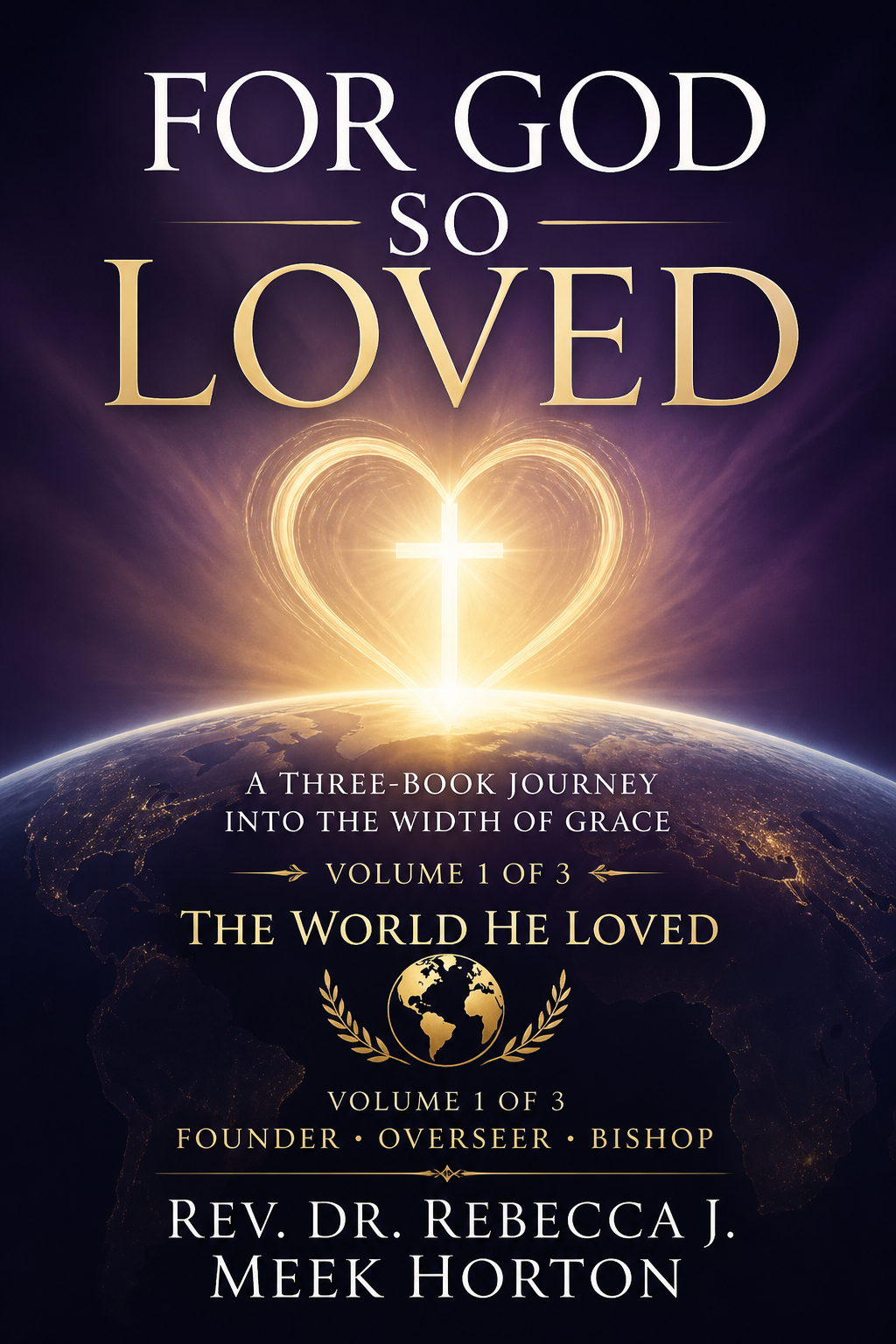
For God So Loved: A Three-Book Journey into the Width of Grace · Volume 1
The World He Loved
Part 1 of 3 in the series "For God So Loved: A Three-Book Journey into the Width of Grace". Series theme: John 3:16 Series arc: This series follows the movement of John 3:16 from revelation to reception to witness. Book One opens the heart of God, showing that His love begins with His own character and reaches the whole world. Book Two walks through the barriers that keep people from receiving tha
Full publication
NBCNGMI MASTER KNOWLEDGE LIBRARY Featuring the works of The Sage, Apostle Prophet. Rev. Dr. Rebecca J. Meek Horton, Apostolic Prophetic Architect, NewBeing Creation Network Global Ministries, Inc. Integrated Framework Modalities™
Dedication
To every soul who has wondered if God’s love could reach them.
I dedicate this book with the prayer that you will see, in Jesus Christ, the holy and pursuing heart of the Father who so loved the world.
Purpose
I wrote this book to help us begin where God begins: with His own heart revealed in Jesus Christ. John 3:16 shows us a love that is holy, costly, and wide enough to reach the world without becoming careless about truth. My prayer is that this book helps you see God’s love more clearly, receive its weight more honestly, and walk forward with greater humility, gratitude, and faith.
Preface
I have carried John 3:16 in my heart for many years, not as a slogan, but as a doorway. It is one of the most familiar verses in Scripture, yet familiarity can sometimes make holy things feel common. We can recite the words and still miss the wonder: God loved first. God gave freely. God reached toward a world that could not rescue itself.
John 3:16 (KJV) For God so loved the world, that he gave his only begotten Son, that whosoever believeth in him should not perish but have everlasting life.
This book was born from a burden to sit with that truth slowly. Not to rush past it. Not to soften it. Not to use it as a religious phrase without letting it search us.
The World He Loved is the first part of a three-book journey through the width of grace. Before we can talk faithfully about receiving God’s love, and before we can carry that love to others, we must first behold where it begins. It begins in God Himself. His love is not borrowed from human kindness. It is not shaped by cultural approval. It is not sentimental permission to remain unchanged. It is holy, costly, pursuing love revealed in Jesus Christ.
That is why this book begins with the heart of God. Inclusiveness, as Scripture reveals it, is not rooted in human sentiment. It is rooted in the God who loved the world and gave His Son. His love reaches widely, but it also calls deeply. Grace is generous, but it is never careless. The cross shows us both welcome and cost.
As you read, I invite you to come simply. Come with your questions, your weariness, your church history, your doubts, your longing, and your need for truth. This is not a book written to win arguments. It is written to help us see God more clearly and respond more faithfully.
My prayer is that these pages will lead you back to the wonder of God’s love with humility, gratitude, and holy attention.
Begin here: read John 3:16–17 slowly today. Ask God to show you not only that He loves the world, but what His love reveals about His heart.
Introduction
Most of us have heard John 3:16 so many times that its wonder can become quiet in our ears. It is printed on signs, quoted in sermons, taught to children, and remembered in hospital rooms. Yet the verse is not small. It carries the heart of God in a sentence.
John 3:16 (KJV) For God so loved the world, that he gave his only begotten Son, that whosoever believeth in him should not perish, but have everlasting life.
This book begins there.
The World He Loved is not an attempt to make God’s love softer than Scripture makes it. It is an invitation to see it more clearly. God’s love is not vague kindness. It is not human approval dressed in religious words. It is holy, costly, pursuing love revealed in Jesus Christ.
The controlling truth of this book is simple: inclusiveness begins not with human sentiment, but with the revealed heart of God.
Before we speak of who is welcome, we must look at the One who welcomes. Before we talk about the world, we must behold the God who loved it. Before we decide what love should mean, we must let Scripture show us what love has already done.
John 3:16 does not begin with the world. It begins with God. “For God so loved.” The source of love is not human goodness, cultural compassion, or moral progress. The source is God Himself. His love flows from His character. He does not love because the world is clean, worthy, safe, or easy to love. He loves because He is love.
1 John 4:9-10 (KJV) In this was manifested the love of God toward us, because that God sent his only begotten Son into the world, that we might live through him. Herein is love, not that we loved God, but that he loved us, and sent his Son to be the propitiation for our sins.
That is the foundation.
This first book in the series For God So Loved: A Three-Book Journey into the Width of Grace lays the groundwork for all that follows. Book One opens the heart of God. Book Two will walk through the barriers that keep people from receiving His love, including sin, shame, pride, fear, and the need for repentance. Book Three will turn received love outward, showing how the people of God can embody His welcome in relationships, church life, and mission.
But we cannot begin with our response. We must begin with His revelation.
This book will move through the source, scope, and seriousness of God’s love. The source is God’s own nature. The scope is the world He loved. The seriousness is the gift He gave: His only begotten Son. The cross teaches us that God’s love is wide enough to reach sinners and holy enough to deal with sin. Grace does not pretend we are well. Grace comes to save.
Romans 5:8 (KJV) But God commendeth his love toward us, in that, while we were yet sinners, Christ died for us.
Read these chapters slowly. Do not rush past familiar verses. Let the words search you. Let them comfort you. Let them correct any picture of God that is smaller than Jesus Christ.
You may find places of gratitude. You may also find tension. God’s love may confront prejudice, indifference, self-righteousness, despair, or the quiet belief that some people are beyond His reach. Let that work happen. The love of God is tender, but it is not weak. It heals by truth.
As you read, keep one question before you:
What does the love of God reveal about God before it says anything about me?
Begin there.
Then take one faithful step: ask the Lord to show you one person, group, or place you have struggled to see as part of “the world” He loved. Hold that before Him as you read. Not to excuse sin. Not to erase truth. But to let His heart teach yours.
Chapter 1 — The Verse We Think We Know
The child held the cardboard sign above his head with both hands.
He was sitting three rows behind the end zone, swallowed by a crowd larger than anything he could understand. The camera swept across the stadium, and for one second the sign filled the screen:
John 3:16
No explanation. No sermon. Just the reference.
Many of us have seen that verse in places like that. On signs. On bracelets. On church walls. On bookmarks tucked inside old Bibles. Some learned it in Sunday school before we learned long division. Some heard it at funerals, revivals, hospital beds, and altar calls.
It may be the most repeated verse in Scripture.
And that may be part of our problem.
Familiar words can become small in our hands. We repeat them, but we do not always receive them. We recognize them, but we do not always let them search us. We quote the verse, but sometimes we carry a narrowed version of the love it reveals.
The controlling idea of this chapter is simple: John 3:16 is not a slogan to prove that God is nice; it is a revelation of the holy, giving, saving love of God.
We are not beginning this book with a new idea. We are beginning by slowing down before an old one.
A Verse We Have Learned to Handle Quickly
John 3:16 (KJV)
For God so loved the world, that he gave his only begotten Son, that whosoever believeth in him should not perish, but have everlasting life.
There is a danger in knowing a verse by memory but not by surrender.
We can say the words and still rush past the wonder. For God. So loved. The world. He gave. His only begotten Son. Whosoever. Believeth. Should not perish. Everlasting life.
Every phrase has weight.
But when a verse becomes familiar, we may start using it more than we listen to it. We may use it to decorate a moment, settle an argument, comfort ourselves lightly, or identify our religious background. None of those uses are necessarily wrong. But none of them are enough.
Imagine receiving a letter from someone who saved your life. At first, you would read each line slowly. You would notice the handwriting, the tone, the cost behind the words. But after years of owning the letter, you might begin to treat it as an object instead of a message. You know where it is kept. You know what it says. But you no longer tremble when you read it.
John 3:16 is that kind of letter.
It is not merely a summary of Christian belief. It is the heart of God opened before us. It tells us that love did not stay hidden. Love moved. Love gave. Love came near in the Son.
This is where we must begin, not with what we assume about love, but with what God has revealed.
The Love We Narrow Without Noticing
Most of us do not mean to make God’s love small.
We narrow it quietly.
We narrow it when we imagine God loves people who are easier to understand, easier to approve, easier to sit beside, easier to explain.
We narrow it when we believe His love reaches our kind of people but hesitate when it comes to those whose lives, histories, sins, politics, wounds, or cultures make us uncomfortable.
We narrow it when we turn John 3:16 into a private comfort but forget that it says world.
We also narrow it in the other direction. We can make God’s love so soft and vague that it no longer saves. We speak of love as acceptance without truth, kindness without holiness, welcome without transformation. But John 3:16 does not let us do that either. The verse speaks of perishing and everlasting life. It is tender, but it is not casual.
A narrowed love is not always a loveless love. Sometimes it is a frightened love. Sometimes it is a tribal love. Sometimes it is a sentimental love. Sometimes it is a love that protects itself from the cost of seeing people the way God sees them.
This is why we need RE-Focusing™. Not a new gospel. Not a softer gospel. Not a harsher gospel. A clearer gaze.
We must let the verse correct both our coldness and our carelessness.
If God so loved the world, then His love is wider than my circle. If God gave His only begotten Son, then His love is deeper than my sentiment. If whoever believes in Him should not perish, then His love is not indifferent to our condition.
The verse is simple. It is not shallow.
The Night Conversation Behind the Verse
John 3:16 was not spoken into empty air.
It comes in the middle of a conversation between Jesus and Nicodemus, a ruler of the Jews. Nicodemus came to Jesus by night. He was religious, educated, and respected. He knew Scripture. He knew language. He knew order. Yet he still needed to be born again.
That should humble us.
A person can be near holy things and still need holy life. A person can understand religious systems and still miss the movement of God. A person can know enough to recognize that Jesus is sent from God and still need to be remade by grace.
John 3:3 (KJV)
Jesus answered and said unto him, Verily, verily, I say unto thee, Except a man be born again, he cannot see the kingdom of God.
Before John 3:16 comforts us, it confronts us.
Jesus is speaking to a man who would have been considered spiritually serious. Yet Jesus does not flatter him. He does not say, “Nicodemus, you are close enough.” He speaks of new birth. He speaks of the Spirit. He speaks of the Son of man being lifted up. Then comes the verse many of us know.
That context matters.
John 3:16 is not a general statement that everyone is already fine. It is the announcement that God has acted because we are not fine. We need life we cannot produce. We need rescue we cannot arrange. We need light we cannot manufacture.
Here is the mercy: God does not wait for Nicodemus to understand everything before Jesus reveals the love of God to him.
That is good news for the slow learner, the cautious seeker, the hidden questioner, and the religious person who knows how to appear settled while carrying deep unrest.
Nicodemus came at night. Jesus still spoke to him.
Receiving Revelation, Not Using a Slogan
A slogan is something we control. Revelation is something that addresses us.
A slogan can be repeated without obedience. Revelation asks for response.
This is one reason Scripture must be read slowly and stewarded carefully. We do not stand above the Word as editors of God’s heart. We come under the Word as people who need light.
When John 3:16 is treated as a slogan, we may use it to support what we already think. When it is received as revelation, it begins to reshape what we think, how we see, and how we love.
For example, when we hear “world,” we may ask, “Who have I quietly placed beyond concern?” When we hear “gave,” we may ask, “Have I reduced love to words without sacrifice?” When we hear “believeth,” we may ask, “Am I admiring Jesus from a distance or entrusting myself to Him?” When we hear “everlasting life,” we may ask, “Am I living as though the life of God has already begun its work in me?”
This is not about making the verse complicated. It is about letting it be complete.
A woman once said, “I know God loves the world. I am just not sure He loves people like me.”
That sentence carries the ache of many hearts. Some can believe in a large, general love but struggle to receive a personal one. Others believe God loves them and struggle to believe He loves the people they resent. John 3:16 presses on both places.
The love of God is not less holy because it reaches widely. It is not less personal because it reaches the world.
This verse is large enough to confront the proud and gentle enough to call the ashamed.
The Honest Cost
If we slow down before John 3:16, something will be asked of us.
We may have to release a version of God’s love that was shaped more by our comfort than by Scripture. We may have to repent of deciding too quickly who is reachable. We may have to stop using familiar Bible words as shields against actual surrender.
We may also have to let the verse come closer than we prefer.
It is easier to discuss the world than to admit our own need. It is easier to defend the doctrine of love than to be loved in the places where shame still hides. It is easier to talk about grace than to stand honestly before the God who gave His Son.
But this is the beginning of the journey.
Before we can receive the fullness of the promise, before we can face the barriers to receiving love, before we can witness to others with humility, we must hear the verse again.
Not quickly.
Not cheaply.
Not as a slogan.
As revelation.
God loved. God gave. The Son came. The world is not forgotten. Whoever believes is called from perishing into life.
John 3:17 (KJV)
For God sent not his Son into the world to condemn the world; but that the world through him might be saved.
Key Takeaways
• Familiar Scripture still needs fresh surrender.
• God’s love is wider than our circles and deeper than sentiment.
• John 3:16 is revelation before it is explanation.
Practice
Read John 3:16 aloud once each day for the next seven days.
Read it slowly. Pause after each phrase. Then write one honest sentence in response to this question:
Where have I made God’s love smaller than this verse reveals?
Chapter 2 — Love Begins in God
A child can tell when love is being measured.
They may not have the words for it, but they feel it. They know when affection rises after good behavior and disappears after failure. They learn the room. They study the face. They begin to ask silent questions. Am I safe? Am I wanted? Did I do enough? Did I lose it?
Many adults carry the same questions into the presence of God.
We may say, “God loves me,” but underneath the words we still wonder if His love began with something good He saw in us. We wonder if His love is a reward for spiritual progress, a response to our sincerity, or a temporary kindness that can be withdrawn when we are difficult.
This chapter’s single controlling idea is simple: God’s love does not begin with human worthiness, need, or response; it begins in His own holy character.
The world is loved because God is love.
Not because the world is easy to love. Not because humanity is harmless. Not because we first reached toward Him with clean hands and pure motives. God’s love begins in God. That is the promise beneath John 3:16, and without it, the verse becomes smaller than it is.
The Source of Love
The apostle John does not begin with human emotion. He begins with God’s nature.
1 John 4:7-10 (KJV) Beloved, let us love one another: for love is of God; and every one that loveth is born of God, and knoweth God. He that loveth not knoweth not God; for God is love. In this was manifested the love of God toward us, because that God sent his only begotten Son into the world, that we might live through him. Herein is love, not that we loved God, but that he loved us, and sent his Son to be the propitiation for our sins.
John says, “love is of God.” Then he says something even deeper: “God is love.”
That does not mean love is God. It means love is not an idea floating above Him, correcting Him, softening Him, or making Him more acceptable to us. Love belongs to Him. Love comes from Him. Love is true because He is true.
This matters because we often define love from our wounds. If love has been inconsistent, we may imagine God as unstable. If love has been controlling, we may hear His commands as threats. If love has been sentimental, we may resist His holiness. If love has been absent, we may struggle to believe His nearness.
But God does not borrow His definition of love from human experience.
Human love, at its best, reflects Him. Human love, at its worst, distorts Him. God Himself remains the source.
Think of the sun on a cold morning. A window may be dirty. A curtain may be closed. A person may refuse to step outside. But none of those things create or cancel the sun. They affect how much warmth is received, not whether the sun is shining.
So it is with the love of God. Our confusion may cloud our understanding. Our sin may harden our response. Our pain may make trust difficult. But God’s love begins in God, not in the condition of the window.
Love Is Not God’s Mood
Some people live as though God’s love changes with His mood.
They imagine Him warm one day and distant the next. Tender when they pray well, cold when they fail. Pleased when they are useful, disappointed when they are weak. This makes the soul tired. It turns faith into performance and prayer into pleading for acceptance.
But Scripture shows us a God whose character is steady.
Exodus 34:6 (KJV) And the LORD passed by before him, and proclaimed, The LORD, The LORD God, merciful and gracious, longsuffering, and abundant in goodness and truth,
God reveals Himself as merciful and gracious, longsuffering, and abundant in goodness and truth. His love is not careless emotion. It is not a passing softness. It is holy, faithful, and true.
That means God’s love does not ignore what is wrong. It is not weakened by His righteousness. It is not opposed to His truth. The love of God is not one part of Him fighting another part of Him. God is whole. His mercy is holy mercy. His patience is truthful patience. His goodness is righteous goodness.
This helps us reject two false pictures.
The first false picture says God is loving, so sin does not matter.
The second false picture says God is holy, so love must be uncertain.
Both are wrong.
God’s love is not vague kindness. His holiness is not loveless severity. In God, love and holiness are not enemies. They are united in His own character.
A parent who loves a child does not smile at poison in the child’s hand. Love moves toward the child, names the danger, and reaches for rescue. The child may experience that rescue as interruption. But the interruption is mercy.
God’s love is like that, only purer. He does not flatter us. He does not abandon us. He tells the truth because He loves, and He loves without ceasing to tell the truth.
Before We Loved Him
John gives us a sentence that unsettles pride and comforts shame:
“Herein is love, not that we loved God, but that he loved us.”
That order is everything.
Not that we loved God first. Not that we understood Him first. Not that we improved ourselves first. Not that we became worthy first.
He loved us.
This does not make our response unimportant. It makes our response possible. Love begins in God, then calls us awake. Grace comes before growth. Mercy comes before maturity. God’s initiative comes before our obedience.
A person drowning does not create the rescuer’s compassion by reaching correctly. The rescuer’s heart moves first. The hand reaches down before the drowning person can climb out. If the person is saved, they will need to receive the rescue, but they did not invent the love that came for them.
So it is with us.
We do not persuade God to be loving. We do not make Him merciful by becoming impressive. We do not earn His attention by presenting a cleaned-up version of ourselves. The love of God is not awakened by our beauty. It flows from His being.
This is why shame loses its authority.
Shame says, “If they really knew you, they would turn away.”
The gospel says, “God knew, and God loved.”
Not with denial. Not with shallow approval. Not with sentimental blindness. He loved with full knowledge and holy purpose.
This is also why pride loses its throne.
Pride says, “I must have been worth loving.”
The gospel says, “God is love.”
The ground of His love is not our superiority. It is His goodness. That humbles the strong and lifts the broken. No one can boast. No one has to despair.
Love Made Known
John does not leave God’s love in the realm of theory. He says it was “manifested.” It was made visible. It came into history. It entered the world in the Son.
We will look more fully at the giving of the Son in the next chapter, but here we need to see this: God’s love is not merely something He feels. It is something He reveals.
A hidden love may be claimed, but revealed love can be trusted.
God has not asked the world to guess His heart. He has shown it in Jesus Christ. If we want to know what God’s love is like, we do not begin with imagination. We look to the Son. We look to the One who came from the Father, full of grace and truth. We look to the life, compassion, obedience, suffering, and saving work of Christ.
John says God sent His Son “that we might live through him.” Love aims at life. Not mere comfort. Not religious appearance. Not temporary relief. Life.
This is important because many of us ask love to do less than God intends.
We want love to soothe us, but God’s love also raises us. We want love to affirm us, but God’s love also forms us. We want love to remove discomfort, but God’s love also restores truth.
The love that begins in God does not leave us dead in spirit, numb in conscience, or captive to falsehood. It moves toward life.
That is why the promise of this book is not simply, “You are loved,” though that is true. The fuller promise is this: you are loved by the God whose love is holy enough to tell the truth, strong enough to save, and faithful enough to begin what you could never start on your own.
The Honest Cost
If love begins in God, then we must surrender our right to redefine it.
That is the cost.
We cannot make God’s love into permission for everything we desire. We cannot reduce it to approval, comfort, or inclusion without transformation. We cannot use “God is love” to silence everything else God has said.
At the same time, we cannot make God’s love smaller than Scripture makes it. We cannot reserve it for people who look ready, sound respectable, or already understand what they need. We cannot act as though God only moves toward those who first move properly toward Him.
Both errors protect something in us.
Careless love protects our preferences. Narrow love protects our pride.
Holy love confronts both.
To receive the love that begins in God, we must let Him be the source, the measure, and the Lord of love. That asks humility. It asks trust. It asks RE-Alignment™ where our definitions have been shaped more by fear, culture, pain, or self-protection than by Scripture.
But it also gives rest.
If God’s love begins in God, then you do not have to manufacture it. You do not have to manipulate it. You do not have to perform your way into its existence. You are invited to receive what has already been revealed.
Key Takeaways
• God’s love begins in His holy character, not in human worthiness.
• “God is love” means He is the source and measure of all true love.
• Holy love tells the truth, moves toward life, and calls for humble response.
Practice
Set aside ten quiet minutes today and read 1 John 4:7-10 slowly.
Then write one sentence in response to this question:
Where have I been defining God’s love by my experience instead of by His character?
After you write it, pray simply: “Lord, teach me Your love as You have revealed it, not as I have feared it.”
Chapter 3 — The God Who Gave
A child can tell the difference between a promise and a present.
A promise may be true. It may be sincere. It may be spoken with tenderness. But when the box is placed in the child’s hands, something changes. The love that was spoken becomes love they can hold.
John 3:16 does not only tell us that God loved. It tells us how God loved.
God loved, so God gave.
That is the single truth of this chapter: the love of God is not merely something God feels toward the world; it is something God has done for the world in giving His Son. The gift of Jesus Christ is the clearest measure of divine love and the foundation for all Christian understanding of grace.
John 3:16-17 (KJV) For God so loved the world, that he gave his only begotten Son, that whosoever believeth in him should not perish; but have everlasting life. For God sent not his Son into the world to condemn the world; but that the world through him might be saved.
We often speak of love as emotion. God reveals love as action.
Love Took the Shape of Giving
The verse does not say, For God so loved the world, that He felt deeply.
He did feel. God is not cold. His love is not mechanical. But Scripture does not leave God’s love in the hidden place of feeling. It brings His love into history. It gives His love shape, flesh, name, and mission.
He gave.
Giving is costly because it moves love from intention into surrender. It releases something precious for the good of another.
A parent who sits beside a hospital bed gives more than words. A friend who stays when it would be easier to leave gives more than sympathy. A caregiver who rearranges life for someone weak gives love a body.
These human pictures are small, but they help us understand the direction of John 3:16. God’s love did not remain at a distance. God’s love moved toward us.
The giving of the Son was not an afterthought. It was not divine improvisation. It was not God trying to rescue a plan that had slipped out of His hands. The gift reveals the heart that was always in God.
This matters because many people imagine God as reluctant to love. They picture the Father as severe, waiting for the Son to persuade Him into mercy. But John 3:16 begins with the Father’s love.
For God so loved.
The Father gave the Son. The Son came willingly. The Spirit bears witness. Grace flows from the united heart of God.
Christian faith begins here. Not with human striving. Not with religious performance. Not with our ability to climb toward God. It begins with God giving Himself to us in His Son.
The Gift Was Not Small
We measure love by what it is willing to give.
Some gifts are easy. They cost little. They are kind, but they do not reach deep into the giver’s life.
John 3:16 does not speak of a small gift.
God gave His only begotten Son.
The language carries weight. God did not send a messenger only. He did not send an idea only. He did not send a system only. He gave His Son.
This is where grace becomes clear. Grace is not God tossing help from heaven. Grace is God coming near in Christ. Grace has a face. Grace has wounds. Grace has a cross.
Romans 8:32 (KJV) He that spared not his own Son, but delivered him up for us all, how shall he not with him also freely give us all things?
The gift of the Son tells us that God has not loved us cheaply.
We must be careful here. The cross was not accidental suffering. The giving of the Son includes His incarnation, His obedience, His suffering, His death, and His resurrection life. God’s love is revealed in the whole mission of Jesus Christ.
He came into the world He made.
He walked among the people He loved.
He touched the unclean.
He taught the confused.
He confronted the proud.
He received the broken.
He bore sin.
He laid down His life.
He rose with victory.
All of this is contained in the gift. When God gave His Son, He gave the only One who could reveal Him fully and redeem us truly.
This is why Christian grace cannot be reduced to positive thinking or general kindness. Grace is not vague approval. Grace is God’s costly action in Christ to save.
The gift was not small because the need was not small.
The Gift Reveals the Giver
Every true gift says something about the giver.
A rushed gift may say, I remembered at the last minute.
A thoughtful gift may say, I know you.
A sacrificial gift may say, I value you more than my comfort.
The gift of Jesus says more than we can finish saying.
It says God is merciful.
It says God is not indifferent.
It says God moves toward sinners.
It says God does not abandon the world to its ruin.
It says God’s love is holy enough to deal with sin and strong enough to rescue the sinner.
1 John 4:9-10 (KJV) In this was manifested the love of God toward us, because that God sent his only begotten Son into the world, that we might live through him. Herein is love, not that we loved God, but that he loved us, and sent his Son to be the propitiation for our sins.
Herein is love.
Not first our love for God.
Not first our decision.
Not first our improvement.
Not first our spiritual hunger.
Herein is love: God loved us and sent His Son.
This does not make our response unimportant. John 3:16 calls us to believe. But even our response is not the starting place of love. The starting place is God.
This protects us from two errors.
The first error is pride. Pride says, God loved me because I was worthy enough, wise enough, humble enough, or useful enough. But the gift of the Son tells the truth. We did not cause grace. We received it.
The second error is despair. Despair says, God cannot love me because I have failed too badly, wandered too far, or carried too much shame. But the gift of the Son tells the truth here also. God’s love does not begin with our record. It begins in His heart.
The cross speaks louder than both pride and despair.
It says, You are not your own savior.
It says, You are not beyond God’s mercy.
It says, Look at what God has given.
Grace Begins With God’s Initiative
Many people live as if God is waiting for them to become lovable.
They think they must clean up first, understand everything first, feel worthy first, or prove sincerity first. So they delay. They hide. They perform. They promise God they will come later, when they are better.
But John 3:16 does not say God waited until the world repaired itself.
God gave.
Grace begins with God’s initiative.
This is the foundation beneath every faithful teaching of salvation. We do not invent the bridge back to God. We do not build it with effort, regret, discipline, or religious activity. God has acted in Christ.
Ephesians 2:8-9 (KJV) For by grace are ye saved through faith; and that not of yourselves: it is the gift of God: Not of works, lest any man should boast.
Faith receives what grace gives.
That sentence is simple, but it may take a lifetime to live honestly.
Faith is not a way of earning the gift. Faith is open hands. Faith stops arguing with grace. Faith stops trying to pay God back before receiving mercy. Faith trusts the One God has given.
This is where love becomes personal without becoming private. John 3:16 announces God’s love for the world, and then it brings the hearer to the word whosoever. The gift is wide, but it must be received.
No one is saved by admiring grace from a distance.
No one is made whole by agreeing that God is loving in general.
The gift calls for trust.
The Honest Cost of a Gift
There is a tension here that we must not hide.
A gift sounds easy. But receiving grace can be hard for the human heart.
To receive the Son as God’s gift means we admit we could not save ourselves. That confronts pride.
To receive the Son as God’s gift means we stop pretending our sin is harmless. That confronts self-deception.
To receive the Son as God’s gift means we let God define love, not our preferences, wounds, or culture. That confronts control.
To receive the Son as God’s gift means we come with empty hands. That confronts the part of us that wants to negotiate.
This is why some people prefer religion without grace. Religion can give us tasks to manage. Grace requires surrender.
We may want God’s help while keeping our throne. We may want comfort without repentance, forgiveness without truth, belonging without yielding. But the gift of the Son is not an accessory added to an unchanged life. He is Savior. He is Lord.
Still, do not hear this as a threat. Hear it as mercy.
God is not asking you to bring what only Christ can provide. He is not asking you to become your own sacrifice. He is not asking you to climb into heaven. He is calling you to behold His Son and believe.
The God who loved is the God who gave.
The God who gave is the God who saves.
Key Takeaways
• God’s love is revealed in action: He gave His Son.
• The gift of Jesus is the clearest measure of grace.
• Faith receives what grace gives.
Practice
Take ten quiet minutes today and read John 3:16 slowly three times.
The first time, notice what God did.
The second time, notice what God gave.
The third time, answer honestly: Where am I still trying to earn what God has given in Christ?
Write one sentence of response:
Lord, I receive Your gift of grace by trusting Your Son today.
Chapter 4 — The World He Did Not Turn From
A hospital waiting room has a way of leveling people.
The well-dressed man sits beside the woman who came in with no coat. A tired mother rocks a feverish child. Someone is praying under his breath. Someone else is pretending not to be afraid. Nobody is asking who deserves help. Everybody is waiting because something is wrong and mercy is needed.
John 3:16 brings us into a deeper waiting room. Not one city. Not one class. Not one kind of person. The world.
That one word carries the weight of God’s reach toward broken, resistant, and undeserving humanity. God did not love a polished world, a willing world, or a world already moving toward Him. He loved the world He could have turned from.
John 3:16-17 (KJV) For God so loved the world, that he gave his only begotten Son, that whosoever believeth in him should not perish but have everlasting life. For God sent not his Son into the world to condemn the world; but that the world through him might be saved.
This chapter holds one truth plainly: the love of God reaches the whole world without making light of what is wrong in the world.
The Weight of One Word
It is easy to make the word world small.
We shrink it to people like us. People we understand. People whose failures seem familiar enough to forgive. People whose wounds make sense to us. People whose politics, language, habits, or histories do not trouble us too much.
But John does not let us make the word small.
The world includes the near and the far. The religious and the irreligious. The wounded and the wounding. The respectable sinner and the obvious sinner. The person who has never heard clearly and the person who has heard often and resisted.
This does not mean every path is true. It does not mean every choice is blessed. It does not mean sin has no consequence. It means the reach of God’s love is wider than our instinctive boundaries.
A church may say “the world” and quietly mean “our kind of people.” A family may say “God loves everybody” and still carry silent exclusions. A person may believe God loves the lost in theory, then struggle when mercy moves toward someone who has caused real harm.
John 3:16 will not let us keep love theoretical. It presses the question into the heart: do I believe God loved the world before the world was lovable?
The world God loved was not neutral. It was fallen. It was darkened. It was in need of rescue. That is why the verse does not only say God loved. It says God gave.
Love moved toward need.
Loved, Not Flattered
God’s love for the world is not flattery.
Flattery says, “You are fine as you are.” Holy love says, “You are worth reaching, and you still need saving.”
This matters because we often confuse love with approval. We think if God loves the world, then He must minimize sin. Or we think if God judges sin, then He must not truly love. Scripture refuses both errors.
The world is loved, and the world is in danger. That is why John 3:16 includes the words should not perish. The verse is tender, but it is not soft. It gives comfort, but it also tells the truth.
A doctor who refuses to name disease is not kind. A parent who sees danger and stays silent is not loving. A shepherd who watches wolves approach and says nothing is not gentle. Real love tells the truth because life is at stake.
Romans 3:23 (KJV) For all have sinned, and come short of the glory of God;
All means all.
This removes pride from the religious and despair from the ashamed. No one stands before God as self-made, self-cleaned, or self-sufficient. We are not divided into those who need mercy and those who only need improvement. We have all sinned. We have all come short.
But the same truth that humbles us also opens the door to compassion. If all have sinned, then no believer has the right to look at the world with disgust as though grace was not also needed at home.
The world is not loved because it is innocent. The world is loved because God is merciful.
The World That Resisted Him
The world God loved did not welcome Him easily.
John says this with painful clarity.
John 1:10-11 (KJV) He was in the world, and the world was made by him, and the world knew him not. He came unto his own, and his own received him not.
There is grief in those words.
The Maker entered what He made, and He was not recognized. The rightful King came near, and He was not received. This is not only a statement about people long ago. It shows the deep resistance of the human heart.
God’s love does not move toward a world eagerly waiting with open hands. It moves toward a world that often misunderstands Him, avoids Him, argues with Him, uses His gifts while ignoring His voice, and prefers darkness when truth becomes costly.
This is where the wideness of grace becomes humbling.
God did not wait for the world to become easy to love. He did not wait for human history to become clean. He did not wait for nations to become righteous, families to become whole, or individuals to become honest. He sent His Son into the real world.
Not the imagined world.
Not the improved world.
The real one.
This helps us see people more truthfully. The angry neighbor. The addicted son. The proud leader. The bitter friend. The stranger whose life seems far from God. None of them are beyond the kind of world John 3:16 names.
This does not erase responsibility. It does not remove the need for repentance. It does not ask us to call evil good. It simply forbids us from deciding that someone is outside the reach of God’s love.
If God did not turn from the world, we must be careful about the people we are tempted to turn from too quickly.
Wide Love, Serious Warning
The love of God is wide, but it is not vague.
John 3:16 says whosoever believeth in him. The invitation is wide. The response is personal. God’s love reaches the world, but it is not received by pretending there is no need to believe.
This is where many hearts feel the tension.
We want love without warning. Or we want warning without tears. But the gospel gives us both. God so loved the world, and the world must not perish. God sent His Son not to condemn the world, and the world still needs to be saved through Him.
This is not contradiction. This is mercy with truth in it.
2 Peter 3:9 (KJV) The Lord is not slack concerning his promise, as some men count slackness; but is longsuffering to us-ward, not willing that any should perish, but that all should come to repentance.
The patience of God is not indifference. It is mercy giving space for repentance.
Repentance is not a harsh word when we understand love rightly. It is the turning that love makes possible. It is the honest return from what destroys us. It is the surrender of false refuges. It is coming into agreement with God about sin, grace, and the need to be made new.
So we must not speak of the world in a way that hides judgment. But we must not speak of judgment in a way that hides God’s heart.
The Son was not sent because God was looking for a reason to reject. The Son was sent because God made a way to save.
The Cost of Seeing the World Truthfully
This chapter asks something of us.
It asks us to let God define the world, not our fear, pain, culture, politics, or preferences.
That is not easy.
Some of us have been hurt by people we now struggle to see through the lens of mercy. Some of us were taught to fear those outside our circle. Some of us have confused separation from sin with distance from sinners. Some of us have narrowed God’s love because a wider love feels like a threat to justice.
But God’s love is not unjust. It is not careless. It does not excuse wickedness or erase harm. The cross proves that sin is serious. It also proves that love is more serious still.
To see the world truthfully, we must carry both grief and hope.
Grief, because sin is real.
Hope, because God has not turned away.
This kind of seeing will change how we pray. We will pray less like judges protecting our superiority and more like witnesses who remember mercy. It will change how we speak. We will not use truth as a weapon to crush, nor love as a blanket to cover what needs healing. It will change how we treat people. We will be clear without being cruel, near without being naive, compassionate without being confused.
The world God loved is still the world God calls.
And every person we meet belongs, in some way, inside that word.
Key Takeaways
• God’s love reaches the whole world without denying the world’s sin.
• The word world includes people we may be tempted to exclude.
• Wide grace still calls for personal repentance and belief.
Practice
Choose one person or group you have quietly placed outside the reach of mercy.
In prayer, name them honestly before God. Ask Him to help you see them truthfully, without excusing sin and without withholding compassion. Then take one faithful step: pray for their salvation for seven days, speak of them without contempt, or show one act of humble kindness if it is wise and safe to do so.
Chapter 5 — Love With a Holy Center
A hospital waiting room has its own kind of honesty.
People come in dressed in work clothes, pajamas, uniforms, church clothes, or whatever they had on when the pain became too much to ignore. No one at the door asks whether they are worthy of care. No one says, “Come back when you are healthy.” The sick are welcomed because they are sick.
But the welcome is not the same as pretending nothing is wrong.
A good physician does not shame the wound, but neither does he bless the infection. He receives the patient in order to heal. He tells the truth because love is at work.
This is one of the places where we must hear John 3:16-17 carefully. God’s love reaches the world, but it does not become careless when it reaches us. His love welcomes sinners without calling sin good. His mercy moves toward us, and His truth exposes what is killing us.
God’s love is wide enough to welcome the world and holy enough to save the world from what destroys it.
John 3:16-17 (KJV) For God so loved the world, that he gave his only begotten Son, that whosoever believeth in him should not perish but have everlasting life. For God sent not his Son into the world to condemn the world; but that the world through him might be saved.
Mercy Has Shape
When Scripture says God loved the world, it does not mean God looked at the world and found it harmless. It means He looked at the world in its need, rebellion, confusion, pride, violence, grief, and darkness, and He moved toward it with saving love.
That love has shape. It is not a vague warmth in God’s heart. It is not a soft approval of whatever we choose. It is revealed in the giving of His Son.
The cross tells us two truths at the same time. Sin is serious enough that the Son of God had to die. Love is strong enough that the Son of God was given.
If we remove either truth, we distort the gospel.
If we speak only of sin without love, we may produce fear, hiding, or despair. If we speak only of love without sin, we may produce comfort without conversion. John 3:16-17 gives us neither cruelty nor vagueness. It gives us holy mercy.
Think of a parent who sees a child running toward traffic. Love does not say, “I affirm your direction.” Love runs, reaches, warns, and if necessary, pulls the child back. The urgency is not rejection. The correction is not hatred. The intervention is love with wisdom in it.
God’s love is not threatened by the truth. God’s love brings the truth because He desires life.
Welcome Is Not Approval
Many people have been wounded by religious spaces where truth was used like a weapon. Others have been formed by a culture that believes love must mean agreement. The gospel corrects both.
Jesus welcomed sinners. He ate with publicans. He touched lepers. He spoke to women others ignored. He received the ashamed, the curious, the morally tangled, and the publicly despised.
But His welcome was never empty. He did not draw near so people could remain unchanged. He drew near because the kingdom of God had come near.
John 1:14 (KJV) And the Word was made flesh, and dwelt among us, full of grace and truth.
Full of grace and truth.
Not half grace and half truth. Not grace when people were tender and truth when they were stubborn. In Christ, grace and truth are not enemies. They live together perfectly.
This matters for how we understand inclusion. The love of God truly reaches all kinds of people. No nation is outside His concern. No social class is beneath His notice. No failure is beyond His ability to redeem. No sinner is too dirty to be called. That is good news.
But inclusion into the love of God is not permission to remain lord over our own lives. The welcome of Christ is a doorway into surrender.
When Jesus spoke to the woman taken in adultery, He did not join the crowd’s appetite for condemnation. He also did not pretend sin was not sin.
John 8:10-11 (KJV) When Jesus had lifted up himself, and saw none but the woman, he said unto her, Woman, where are those thine accusers? hath no man condemned thee? She said, No man, Lord. And Jesus said unto her, Neither do I condemn thee: go, and sin no more.
There is mercy in His words. There is also a call to a different life.
This is the pattern of holy love. It protects the person without protecting the sin. It removes shame without removing responsibility. It offers grace without erasing obedience.
Truth Without Cruelty
Some of us need to repent of making truth harsh.
Truth does not need our anger to be strong. It does not need our sarcasm to be clear. It does not need our superiority to be holy.
When truth is separated from love, it may still contain correct words, but it carries the wrong spirit. People may hear doctrine, but not the heart of Christ. They may feel exposed, but not invited to be healed.
The Lord Jesus could speak with piercing clarity, yet His purpose was never to enjoy another person’s collapse. Even His warnings were filled with the seriousness of rescue.
John 3:17 helps us here. The Father did not send the Son into the world to condemn the world, but that the world through Him might be saved. This does not mean judgment is unreal. The verses that follow speak plainly about belief, unbelief, light, and darkness. But it does show us the heart of the mission. Christ came as Savior.
So when we speak truth, we must ask: Am I trying to win an argument, or am I bearing witness to the Savior? Am I naming sin because I love life, or because I need to feel right? Am I making space for repentance, or only announcing failure?
A church can have right convictions and still communicate them wrongly. A family can tell the truth and still crush the one who needs mercy. A believer can defend holiness while forgetting humility.
Truth must be stewarded.
Imagine someone walking into a church after years away from God. They carry choices, regrets, questions, and fear. If the first thing they meet is suspicion, they may assume God is like that. But if they meet warm welcome with honest teaching, patient discipleship, and clear Scripture, they may begin to believe that grace is safe enough to tell the truth.
That is not compromise. That is Christlike care.
Mercy Without Confusion
Others of us need to repent of making mercy vague.
Mercy is not the refusal to name what is wrong. Mercy is God’s kindness moving toward what is wrong in order to redeem, restore, and RE-Align™.
There is a kind of niceness that avoids hard conversations and calls itself love. But avoidance cannot heal. Silence cannot disciple. Approval cannot save.
If someone is trapped in bitterness, love does not bless bitterness. If someone is destroying their body, love does not call destruction freedom. If someone is living in deception, love does not rename deception as peace. Love stays near, but love tells the truth.
This is difficult because truth may cost us comfort. We may be misunderstood. We may be accused of being unloving by those who define love as agreement. We may also be tempted to pull back from people whose lives are complicated because we do not know how to walk with both conviction and compassion.
But Jesus shows us the way.
He does not stand far off in disgust. He comes near.
He does not flatter sin. He calls people into life.
He does not shame the broken. He restores those who receive Him.
He does not lower holiness to make love easier. He brings sinners into the life of God.
This is the narrow road of Christian love. Not exclusion. Not indulgence. Welcome with a cross at the center. Mercy with truth in its hands. Grace that receives us as we are and refuses to leave us as we were.
What This Asks of Us
This kind of love will require maturity.
It asks us to stop using people as symbols in our arguments. It asks us to see actual neighbors, actual family members, actual church members, actual strangers made in the image of God.
It asks us to lay down the pride that enjoys being right more than it desires restoration.
It also asks us to lay down the fear that avoids truth because we want to be liked.
Holy love will not let us hide behind harshness or softness. It calls us to be clear and tender, patient and honest, welcoming and faithful.
Parents will feel this when a child makes choices that grieve them.
Pastors will feel this when a church wants comfort without correction.
Friends will feel this when loyalty is confused with silence.
Believers will feel this when the world asks us to choose between compassion and conviction.
But in Christ, we are not forced to choose. We are called to hold both, because He holds both.
John 3:16-17 does not give us permission to narrow God’s love. It also does not give us permission to empty God’s love of holiness. The world He loved is the world He came to save.
And salvation is more than being included. It is being made alive to God.
Key Takeaways
• God’s love welcomes sinners without blessing sin.
• Grace and truth belong together in Jesus Christ.
• Holy love is clear, tender, and aimed at salvation.
Practice
Read John 3:16-17 slowly today. Then write down the name of one person you find difficult to love with both mercy and truth. Pray for them without correcting them in your mind. Ask God to show you one faithful way to reflect His welcome without surrendering His truth.
Chapter 6 — Loved While Yet Sinners
The man sat in his car outside the church for twenty minutes.
He had driven there three Sundays in a row and never gone inside. Each time he told himself the same thing: I will go in when I get myself together. When I stop drinking. When I stop being angry. When I can pray without feeling fake. When I am not ashamed to be seen.
So he sat there, close to the door but still outside it, believing that God was waiting for a better version of him.
Many people live there.
Not always in a car outside a church, but in the same inward place. Close enough to know they need mercy. Far enough to think they must improve before they can receive it.
Romans 5:8 tells us something better and harder to believe: God’s love did not wait for us to become repairable. His love moved toward us while we were still sinners.
Romans 5:8 (KJV) But God commendeth his love toward us, in that, while we were yet sinners, Christ died for us.
The controlling truth of this chapter is simple: grace comes first, not to excuse rebellion, but to make reconciliation possible.
Before We Were Ready
Paul does not describe humanity as almost healthy, mildly confused, or basically strong. He tells the truth plainly.
Romans 5:6 (KJV) For when we were yet without strength, in due time Christ died for the ungodly.
Without strength.
Ungodly.
Sinners.
These are not flattering words. They are honest words. And because they are honest, they make grace meaningful.
If we only needed encouragement, the cross would be excessive. If we only needed advice, Christ could have sent a teacher and no more. If we only needed a better example, we could try harder and call that salvation.
But Paul says we were without strength. Not simply untrained. Not merely uninformed. Without strength.
That means God did not love us because we were showing great promise. He did not wait until we had built a clean record. He did not stand at a distance saying, “Come back when you can prove you are worth saving.”
Christ died for the ungodly.
A child who falls into deep water does not need someone standing on shore giving swimming tips. The child needs rescue. The rescuer does not wait for the child to improve technique. The rescuer enters the water.
That is the movement of grace.
God saw us truthfully. He saw sin, rebellion, blindness, pride, and helplessness. And still He came near in Christ.
This does not make sin small. It makes love astonishing.
Grace Does Not Wait for Self-Repair
One of the quiet burdens many people carry is the belief that they must become less broken before they can come to God.
They say, “I need to fix my life first.”
But if we could fix ourselves first, grace would not be grace. We would be presenting God with a finished product and asking Him to admire our progress.
The gospel does not begin with our repair. It begins with God’s mercy.
Romans 5:8 does not say, “After we became sincere enough, Christ died for us.” It does not say, “After we stopped sinning, Christ died for us.” It says, while we were yet sinners.
While.
That little word carries mercy.
While we were still resisting. While we were still hiding. While we were still making excuses. While we were still trying to manage shame. While we were still choosing our own way.
Christ died for us.
Imagine a house damaged by years of storms. The roof leaks. The foundation has cracks. The walls are stained. The owner is embarrassed and keeps saying, “I cannot let anyone come in until I fix it.”
But the builder says, “You need me because it is damaged. Let me enter.”
Grace is not God pretending the house is fine. Grace is God entering what we cannot restore on our own.
This is where many people misunderstand love. They think being loved by God means God ignores what is wrong. But holy love does not ignore damage. Holy love comes close enough to redeem.
God’s love meets us before self-repair, but it does not leave us unrepaired.
The first move belongs to grace. The response belongs to faith.
Love That Makes Reconciliation Possible
Grace comes first because the relationship is broken in a way we cannot heal alone.
Sin is not only bad behavior. It is separation from God. It is a turning of the heart away from His rule, His truth, and His life. That is why we need more than comfort. We need reconciliation.
Romans 5:10 (KJV) For if, when we were enemies, we were reconciled to God by the death of his Son, much more, being reconciled, we shall be saved by his life.
Paul uses a strong word: enemies.
That may feel uncomfortable. Most people do not want to think of themselves that way. We may admit weakness before we admit hostility. We may confess mistakes before we confess rebellion.
But Scripture tells the truth so healing can begin.
To be an enemy of God does not mean every person is as wicked as possible. It means sin has placed us on the wrong side of fellowship with Him. Our wills have resisted His will. Our loves have been disordered. Our trust has gone elsewhere.
And still, God moved first.
Reconciliation means the broken relationship is addressed, not avoided. The offense is not denied. The distance is not romanticized. Peace is made through Christ.
A husband and wife can live in the same house and still be unreconciled. They may speak about schedules, bills, and children, but avoid the wound between them. Real reconciliation requires truth. Someone must stop pretending. Someone must move toward peace. Someone must be willing to face the cost.
At the cross, God did not avoid the wound. He dealt with sin through the death of His Son.
Grace is not sentimental permission to remain far from God. Grace is the open door to come home.
This is why Romans 5:8 is so tender and so serious. The love of God is not casual affection. It is reconciling love. It reaches us in sin so we may be brought back to God.
Not excused from truth.
Brought back through mercy.
The Lie of “After I Am Better”
The enemy of grace often sounds responsible.
“I will pray after I get consistent.” “I will come back to church after I stop feeling ashamed.” “I will seek God after I understand everything.” “I will repent after I feel stronger.” “I will receive love after I become lovable.”
These sentences may sound humble, but often they hide unbelief. They assume our improvement is the doorway to God’s love.
Romans 5:8 RE-Languages that shame into truth. The issue is not “I am too broken to come.” The truth is “I am too broken not to come.”
That shift matters.
Shame says, “Hide until you are healed.” Grace says, “Come to Christ and be made whole.”
Shame says, “God will love you when you are clean.” Grace says, “Christ died for you while you were yet a sinner.”
Shame says, “Repair yourself, then return.” Grace says, “Return, and let God begin the work you cannot finish.”
A person with a serious wound does not wait until the bleeding stops to go to the physician. The wound is the reason to go.
Jesus said it this way:
Mark 2:17 (KJV) When Jesus heard it, he saith unto them, They that are whole have no need of the physician, but they that are sick: I came not to call the righteous, but sinners to repentance.
He came for sinners.
Not so sinners could remain untouched by repentance, but so sinners could be called into life.
This is the mercy of God. He does not require you to become whole before you come to the Physician.
The Honest Cost
There is a cost to being loved while yet sinners.
It costs us the illusion that we were almost fine.
Grace is free to us, but it is not flattering. It tells us we were loved before we were admirable. It tells us Christ died because our condition was serious. It tells us we could not climb our way back by sincerity, morality, religious performance, or self-improvement.
That is hard for pride.
It is also hard for shame.
Pride does not want to need mercy. Shame does not believe mercy can be real.
The gospel confronts both.
To receive this love, we must stop negotiating with God about our image. We must stop presenting edited versions of ourselves. We must stop saying, “I am not that bad,” and we must also stop saying, “I am too bad.”
Both can keep us from grace.
Romans 5:8 gives us a truer confession: I was a sinner, and Christ died for me.
That confession is not despair. It is the doorway to worship.
God’s love met us before we could repair ourselves. Now we can stop hiding, stop performing, and begin responding.
Key Takeaways
• God’s love moved toward us while we were still sinners.
• Grace comes first, not to excuse sin, but to make reconciliation possible.
• We do not repair ourselves to receive Christ; we come to Christ to be restored.
Practice
Set aside ten quiet minutes today.
Write one honest sentence beginning with: “Lord, I have been waiting to come to You until…”
Then write Romans 5:8 beneath it.
Pray simply: “Lord, I receive the love You showed in Christ. Bring me out of hiding and into reconciliation with You.”
Chapter 7 — Mercy That Makes Alive
There is a kind of silence that settles over a room when everyone knows the problem is too deep for a quick answer.
Not the silence of peace.
The silence of helplessness.
A family stands beside a hospital bed. A friend stares at a phone that will not ring. A person sits alone at the kitchen table, knowing they have tried to change, tried to stop, tried to become new, and still feels trapped in the same inward place.
Some conditions cannot be encouraged away.
Some things do not need a little improvement.
They need life.
That is where Ephesians 2 speaks with holy clarity. God’s love does not merely comfort the living. His mercy moves toward the dead. The single controlling truth of this chapter is simple: the love of God does more than soothe our sorrow; by rich mercy, it makes us alive with Christ and begins true RE-Newal™.
Ephesians 2:4-5 (KJV)
But God, who is rich in mercy, for his great love wherewith he loved us, Even when we were dead in sins, hath quickened us together with Christ, (by grace ye are saved;)
The Weight of “But God”
The words “But God” are small, but they carry a world.
Before them, Paul describes a human condition that is not flattering. He does not call us confused but mostly fine. He does not say we were spiritually tired, mildly misguided, or simply in need of better habits. He says we were dead in sins.
That is not a casual diagnosis. Dead means unable to revive oneself. Dead means unable to climb upward into holiness by effort alone. Dead means the need is not advice first, but intervention.
Then Scripture says, “But God.”
Not “but we tried harder.”
Not “but we discovered our worth.”
Not “but we repaired the damage.”
“But God.”
This is the mercy of divine interruption. God steps into a condition we cannot reverse and does what only He can do.
Imagine a child caught in a current too strong to fight. From the shore, people may shout instructions. Kick harder. Turn left. Keep your head up. But if the child is being pulled under, instruction is not enough. Someone must enter the water.
In Christ, God did not love from a distance. He entered our helplessness. He came near in mercy.
That is why this chapter belongs after the truth that we are loved while yet sinners. Romans 5:8 shows us God loving us before we could make ourselves worthy. Ephesians 2:4-5 shows what that love does next. It does not stand beside spiritual death and offer sympathy. It brings resurrection life.
Rich Mercy, Not Thin Pity
Paul says God is “rich in mercy.”
That word matters. God is not reluctant in mercy. He is not poor in mercy. He does not ration mercy as though He might run out before the worst sinner comes home.
His mercy is rich.
Mercy is not God pretending sin does not matter. Mercy is God moving toward misery with holy compassion and saving power. Mercy sees the truth and still comes near. It does not excuse death. It brings life.
Thin pity feels bad for someone and walks away unchanged. Rich mercy bears cost. Thin pity says, “That is sad.” Rich mercy says, “I will come near.” Thin pity keeps a safe distance. Rich mercy reaches into the grave.
This is why grace must never be treated as vague kindness. God’s mercy is not softness without holiness. It is holy love acting toward those who could not rescue themselves.
Think of a person who has lived for years under shame. They do not merely need someone to say, “You are not that bad.” That may sound kind, but it is too small. Deep shame is not healed by denial. The gospel says something stronger: You were dead in sins, but God is rich in mercy. Your condition was real, and His grace is greater.
That is different from flattery.
That is salvation.
Grace does not make light of what bound us. Grace makes much of the God who raises us.
Made Alive With Christ
The KJV uses the word “quickened,” meaning made alive.
This is not self-improvement with religious language added. This is not polishing the outside while the inside remains unchanged. God makes us alive together with Christ.
The center of Christian RE-Newal™ is union with Christ. We are not handed a better attitude and sent back to manage spiritual death more politely. We are joined to the living Christ. His life becomes the source of ours.
That means RE-Newal™ begins deeper than behavior. It begins with life.
Behavior matters. Obedience matters. Growth matters. But the order matters too. Life comes before fruit. A tree does not produce fruit in order to become alive. It bears fruit because life is already working in it.
Galatians 5 speaks of the fruit of the Spirit. Love, joy, peace, longsuffering, gentleness, goodness, faith, meekness, and temperance are not decorations placed on a dead branch. They are evidence of the Spirit’s life at work within the believer.
Galatians 5:22-23 (KJV)
But the fruit of the Spirit is love, joy, peace, longsuffering, gentleness, goodness, faith, Meekness, temperance: against such there is no law.
This helps us understand growth without despair.
If you belong to Christ and still see areas that need change, do not confuse immaturity with death. A living child still must grow. A living branch still must be pruned. A living believer still must be taught, corrected, strengthened, and formed.
But life has begun.
This is the beginning of RE-Newal™: God brings life where sin brought death, then teaches us to walk in what He has made alive.
Comfort That Restores
God’s love comforts, but not by leaving us as we are.
There is a comfort that only calms the surface. It helps us feel better for a moment, but it does not restore what is broken. God’s comfort goes deeper. It raises, restores, and reorders.
A person may pray, “Lord, help me feel peace,” and God may answer by first revealing what has been ruling the heart. That may not feel comforting at first. It may feel like exposure. But mercy often begins by telling the truth.
RE-Newal™ is not God decorating our old bondage. It is God bringing us into newness of life.
Romans 12:2 (KJV)
And be not conformed to this world: but be ye transformed by the renewing of your mind, that ye may prove what is that good, and acceptable, and perfect, will of God.
This renewing is not a quick emotional lift. It is a Spirit-led reordering of thought, desire, response, and direction. It is learning to stop agreeing with death where God has spoken life. It is learning to stop calling bondage identity. It is learning to receive mercy not as permission to remain stuck, but as power to walk differently.
For example, someone who has lived under anger may say, “This is just who I am.” Mercy answers, “That may be what you learned, but it is not all you are in Christ.” Someone who has lived under fear may say, “I cannot change.” Mercy answers, “You cannot raise yourself, but God makes alive.” Someone who has lived under shame may say, “I am too far gone.” Mercy answers, “But God.”
This is not denial of struggle. It is refusal to let struggle have the final word.
The Honest Cost of Being Made Alive
There is a cost to receiving this kind of mercy.
If God’s love only comforted us, we might keep control. We could ask for relief without surrender. We could enjoy religious words while protecting old graves.
But mercy that makes alive requires us to stop calling death normal.
That is not easy.
It means we must let God tell the truth about our condition. We must release the pride that says, “I can fix myself.” We must release the shame that says, “I am beyond help.” Both pride and shame keep the self at the center. Grace moves Christ to the center.
This mercy also asks us to participate in the life we have received. We do not earn salvation. Paul is clear: “by grace ye are saved.” But grace that saves also begins to train us. It calls us into repentance, obedience, and daily dependence.
The tension is real. Many people want comfort without correction. Others want correction without comfort. The gospel gives us both in the right order. God is rich in mercy. God makes alive. Then God teaches the living how to walk.
There may be habits to lay down.
There may be apologies to make.
There may be thought patterns to take captive.
There may be relationships to steward differently.
There may be hidden places where we stop pretending and finally say, “Lord, I need Your mercy here too.”
But none of this begins with fear. It begins with “But God.”
The One who calls us into RE-Newal™ is the One who first made us alive.
Key Takeaways
• God’s mercy does not minimize spiritual death; it overcomes it.
• Grace makes us alive with Christ before it teaches us to walk in newness.
• RE-Newal™ begins when we stop agreeing with death and receive God’s life.
Practice
Set aside ten quiet minutes today. Read Ephesians 2:4-5 slowly three times.
Then write one honest sentence completing this prayer:
“Lord, I need Your mercy to make alive this place in me: __________.”
Do not rush to fix it. Bring it into the light. Ask God for one faithful step of obedience, and take that step within the next twenty-four hours.
Chapter 8 — The Cost of Being Loved
The child had chocolate on his hands and crumbs on his shirt, but he still said, I did not touch it.
The evidence was everywhere. On the counter. On the floor. Around his mouth. His mother was not asking because she lacked information. She was asking because love wanted truth.
That is often where God meets us.
Not where we are polished, but where we are hiding. Not where we have a clean answer, but where the crumbs are still on our hands. The love of God is gift, but it is not a game. It does not flatter what is false in us. It does not let us stay hidden and call that healing.
The single truth of this chapter is simple: to receive the love of God, we must stop hiding and let grace tell the truth.
God’s love costs us our hiding places.
Coming Into the Light
John 3:16 is often remembered for the word loved. But just a few verses later, Jesus speaks about light. Love is not separated from light. The God who loves the world also exposes what keeps the world in darkness.
John 3:19-21 (KJV) And this is the condemnation, that light is come into the world, and men loved darkness rather than light, because their deeds were evil. For every one that doeth evil hateth the light, neither cometh to the light, lest his deeds should be reproved. But he that doeth truth cometh to the light, that his deeds may be made manifest, that they are wrought in God.
This is not harshness. This is mercy with truth in it.
A wound kept in darkness does not heal well. It may be covered, but it is not clean. It may be ignored, but it is not gone. When a doctor turns on a light and examines the wound, the light may feel painful, but the purpose is healing.
So it is with God.
Grace is not God pretending we are well. Grace is God coming near enough to tell the truth without destroying us. The light of Christ does not expose us to shame us. It exposes us to save us.
This is one reason people resist holy love. We may say we want to be loved, but often we mean we want to be affirmed without being changed. We want comfort without confession. We want nearness without surrender.
But the love revealed in Jesus does not leave us divided. It gathers the hidden places and brings them before God.
That is the beginning of freedom.
The End of Self-Salvation
There is a kind of pride that sounds strong, and there is a kind of pride that sounds religious.
Strong pride says, I do not need help.
Religious pride says, I will make myself worthy first.
Both keep us from receiving love.
Self-salvation is the exhausting belief that we must repair ourselves before we can come to God. It sounds humble, but it is still control. It keeps the soul working, proving, promising, and comparing. It says, When I am better, then I will come.
But the gospel does not begin with our improvement. It begins with God’s mercy.
Jesus told a parable about two men praying. One had a spiritual résumé. The other had only need.
Luke 18:13-14 (KJV) And the publican, standing afar off, would not lift up so much as his eyes unto heaven, but smote upon his breast, saying, God be merciful to me a sinner. I tell you, this man went down to his house justified rather than the other: for every one that exalteth himself shall be abased; and he that humbleth himself shall be exalted.
The man who went home justified was not the man who presented the better case. He was the man who stopped pretending.
This is difficult for the capable person. It is difficult for the responsible person. It is difficult for the one who has survived by staying in control. To be loved by God means we must lay down the project of earning what can only be received.
That does not make obedience small. It puts obedience in the right order.
We do not obey to purchase love. We obey because holy love has reached us, claimed us, and begun to make us whole.
The Cost of Letting Shame Lose Its Voice
Shame hides differently than pride.
Pride hides behind strength. Shame hides behind fear.
Shame says, If God really knew me, He would turn away. Shame forgets that God already knows. It imagines that love is fragile, that one honest confession will make grace disappear.
But God’s love is not surprised by our condition.
In the garden, after sin entered, Adam and Eve hid themselves. They covered what they could and avoided the voice of the Lord. But God came calling.
Genesis 3:8-9 (KJV) And they heard the voice of the LORD God walking in the garden in the cool of the day: and Adam and his wife hid themselves from the presence of the LORD God amongst the trees of the garden. And the LORD God called unto Adam, and said unto him, Where art thou?
That question was not because God had lost Adam. It was because Adam had lost his place of honesty.
Where art thou?
It is still a mercy question.
Where are you hiding? Where have you covered yourself? Where have you mistaken shame for truth? Where have you believed that distance is safer than confession?
Shame wants secrecy. Grace invites confession.
1 John 1:8-9 (KJV) If we say that we have no sin, we deceive ourselves, and the truth is not in us. If we confess our sins, he is faithful and just to forgive us our sins, and to cleanse us from all unrighteousness.
Notice the promise. Not only forgiveness. Cleansing.
God does not merely forgive the record and leave the heart untouched. His love begins RE-Newal™ in the places shame tried to lock away. He cleanses what we confess. He meets what we uncover. He heals what we stop defending.
This does not always feel gentle at first. Sometimes truth stings because we have lived with a lie for so long. But the sting of truth is not the same as condemnation. Condemnation drives us from God. Conviction draws us toward Him.
Holy love knows the difference.
Resistance Is Not Always Loud
Not all resistance looks like rebellion.
Sometimes resistance looks like delay.
I will pray later. I will deal with that when life slows down. I will forgive when they apologize. I will surrender after I understand everything. I will come into the light when I feel stronger.
These may sound reasonable, but delay can become a hiding place.
Receiving the love of God asks for an honest response. Not a perfect response. Not a dramatic response. An honest one.
A person may sit in church for years and still resist being loved by God in the places that matter most. They may sing about grace while still living under accusation. They may teach about mercy while refusing to confess bitterness. They may believe God loves the world but quietly assume they are the exception.
This is why the cost must be named plainly.
To be loved by God costs us the right to keep managing our own darkness. It costs us the comfort of excuses. It costs us the old identity built around pain, performance, or distance. It costs us the false safety of being unknown.
Jesus does not force love upon us like a tyrant. But He does call us out of hiding.
Matthew 16:24 (KJV) Then said Jesus unto his disciples, If any man will come after me, let him deny himself, and take up his cross, and follow me.
Denying self is not self-hatred. It is refusing to let the old self remain in charge. It is saying no to the pride that performs, no to the shame that hides, no to the fear that delays, and yes to the Savior who tells the truth in love.
This is not the cost of becoming loved.
You are not paying God back.
This is the cost of receiving what love must do in you.
God’s love will comfort you, but it will also confront you. It will gather you, but it will also govern you. It will welcome you as you are, but it will not agree to leave you unchanged.
That is mercy.
That is serious love.
That is the love revealed in Christ.
Key Takeaways
• God’s love brings us into the light, not into shame.
• Grace ends the exhausting work of self-salvation.
• Receiving holy love means surrendering hiding, delay, and resistance.
Practice
Set aside ten quiet minutes today.
Ask the Lord one honest question: Where am I still hiding from Your love?
Write down the first truthful answer that comes. Do not defend it. Do not decorate it. Bring it to God in confession, using 1 John 1:9 as your prayer.
Then take one faithful step into the light. Tell the truth. Ask forgiveness. Receive prayer. Release the excuse. Begin there.
Chapter 9 — No One Outside His Reach
The airport gate was crowded with people who did not seem to belong together.
A tired mother rocked a crying baby. A businessman stared at his phone. Two college students laughed too loudly. An older man sat quietly with his hands folded over a worn Bible. Different languages moved through the air. Different stories. Different burdens. Different sins. Different hopes.
No one at that gate could see the full story of the person sitting beside them. But God could.
And this is part of the wonder of John 3:16. When Scripture says “the world,” it is not speaking in soft generalities. It is speaking of real people. People with names, histories, wounds, rebellions, cultures, questions, and failures.
The single controlling truth of this chapter is simple: no one is outside the reach of God’s love, but everyone must personally receive the Son whom God has given.
The wideness of grace does not erase the call to believe. It makes the call possible.
John 3:16-17 (KJV) For God so loved the world, that he gave his only begotten Son, that whosoever believeth in him should not perish, but have everlasting life. For God sent not his Son into the world to condemn the world; but that the world through him might be saved.
The Reach Is Wider Than Our Circles
Most of us have a circle.
We may not name it that way, but we carry one. People we understand. People we trust more quickly. People whose background feels familiar. People whose failures seem explainable to us.
Then there are those outside the circle. People we fear. People we avoid. People we have quietly judged. People whose story feels too messy, too foreign, too offensive, or too far gone.
John 3:16 will not let us keep a small circle and call it the heart of God.
God loved the world.
Not one class of people. Not one nation. Not one moral category. Not only the respectable. Not only the religiously prepared. Not only those who already knew how to speak the language of faith.
The love of God reaches farther than our comfort.
Peter had to learn this. He was a Jewish man shaped by covenant, law, and separation. Then God sent him to the house of Cornelius, a Gentile. This was not a small adjustment. It required Peter to let God correct what Peter assumed was settled.
Acts 10:34-35 (KJV) Then Peter opened his mouth, and said, Of a truth I perceive that God is no respecter of persons: But in every nation he that feareth him, and worketh righteousness, is accepted with him.
Peter did not discover that God had become more loving. Peter discovered that God’s love had always been larger than Peter’s categories.
That is often where our RE-Alignment™ begins. Not with God changing His heart, but with us letting Him correct ours.
A church can sing about grace and still practice suspicion. A family can speak of forgiveness and still decide some people are too stained to be welcomed. A believer can believe John 3:16 and still live as if God’s mercy works best among people like them.
The verse will not permit that.
The Story Is Older Than Our Boundaries
The love of God for the world did not begin when the church became global. It was present in the promise of God from the beginning.
God called Abraham, but not so Abraham’s family could become proud and closed. God blessed Abraham so blessing could move through him.
Genesis 12:3 (KJV) And I will bless them that bless thee, and curse him that curseth thee: and in thee shall all families of the earth be blessed.
All families.
That phrase matters. God’s covenant work was always moving toward a wider blessing. Israel was chosen, not because God hated the nations, but because God was preparing a way to bless the nations through His redemptive plan.
This helps us see John 3:16 with deeper roots. The giving of the Son is not a sudden act of kindness in the New Testament. It is the holy fulfillment of God’s long faithfulness.
The world God loved includes the nations we read about in Scripture. Egypt with its oppression. Nineveh with its violence. Babylon with its pride. Rome with its power. Samaria with its strained history. Gentiles who were once considered far off.
It also includes the world we live in now.
The immigrant. The prisoner. The addict. The skeptic. The church child who wandered. The wealthy person hiding emptiness behind success. The poor person carrying shame that was never theirs to carry. The person whose culture you do not understand. The person whose politics make you tense. The person whose past you would rather not hear about.
God sees the world without losing sight of the person.
That is one reason Christian witness must be humble. We do not carry good news because we are better than the people we speak to. We carry good news because we too have been loved while undeserving.
Grace Reaches Failures
Some people feel outside the reach of God because others have pushed them there.
Others feel outside because they know too much about themselves.
They know what they said. What they did. What they repeated. What they hid. What they ruined. They may sit in church, smile in public, and function at work, but inwardly they believe there is a line they crossed that grace cannot cross.
The gospel speaks directly to that fear.
Luke 19:10 (KJV) For the Son of man is come to seek and to save that which was lost.
Lost is not a mild word. It does not mean slightly confused. It means separated, unable to restore oneself, in need of rescue.
Jesus was not embarrassed to be seen near lost people.
He spoke with the Samaritan woman at the well. He called Zacchaeus down from the tree. He received the cry of a thief on a cross. He restored Peter after denial. He made an apostle out of Saul, who had persecuted the church.
These stories are not sentimental decorations. They are witnesses. They show us that failure does not place a person beyond the reach of Christ.
But notice this carefully: Jesus did not leave people unchanged and call that love. His mercy created a new direction. His welcome opened the door to truth. His forgiveness made room for obedience.
That is why grace is never weak.
Grace can enter a ruined story without pretending ruin is harmless. Grace can forgive without denying damage. Grace can restore without flattering pride. Grace can call a sinner beloved while also calling that sinner to repentance and faith.
This is good news for honest people.
If you are tired of pretending, grace is not asking you to polish your image first. If you are ashamed, grace is not waiting for you to feel worthy. If you are resistant, grace is still telling the truth. If you are far off, Christ is not confused about the distance.
He came to seek and to save.
The Invitation Still Asks for Faith
Here is the tension we must not avoid: the love of God reaches all, but it must be received.
John 3:16 says “whosoever believeth in him.” The door is wide, but it is still a door. The gift is given, but it is not received by denial, pride, or spiritual delay. The reach of love does not remove the response of faith.
Romans 10:12-13 (KJV) For there is no difference between the Jew and the Greek: for the same Lord over all is rich unto all that call upon him. For whosoever shall call upon the name of the Lord shall be saved.
Whosoever is one of the most merciful words in Scripture.
It means no nation owns salvation. No family line controls it. No human system can restrict it. No past can automatically disqualify the one who comes to Christ.
But “shall call” matters too.
The gospel does not merely announce that people are reachable. It invites them to respond. Believe. Call. Come. Receive. Turn. Trust.
This prepares us for the next movement of the journey. If this book has opened the heart of God, the next must help us face the barriers that keep people from receiving His love. Some barriers are obvious: unbelief, pride, fear, shame, bitterness. Others are quieter: delay, self-sufficiency, religious performance, resentment toward God.
The wideness of grace does not mean everyone has already received it. It means no one needs to be told, “There is no room for you.”
There is room in the mercy of God.
But there is no salvation apart from the Son.
That may cost us our favorite excuses. It may cost us the comfort of vague spirituality. It may cost us the pride of thinking we can admire Jesus without trusting Him. It may cost us the bitterness of keeping certain people outside the reach of mercy in our own minds.
Holy love is wide enough to reach the world and serious enough to call the world to believe.
That is not contradiction. That is gospel.
The Cost of a Wider Heart
If we receive this truth, it will change how we see people.
We will have to stop using labels as shortcuts. We will have to pray for people we once dismissed. We will have to speak the gospel without superiority. We will have to tell the truth without contempt. We will have to make room for stories that do not begin neatly.
This does not mean we lose discernment. It does not mean we approve of sin. It does not mean every relationship becomes safe or close. Wisdom still matters. Boundaries still matter. Repentance still matters.
But it does mean we stop treating any person as unreachable.
The person you struggle to love is not beyond God’s sight.
The person who wounded you is not beyond God’s judgment or mercy.
The person who seems hardened is not beyond conviction.
The person from another nation, class, history, or background is not outside the “world” God loved.
And neither are you.
Key Takeaways
• God’s love reaches farther than our familiar circles.
• No failure, nation, or history is outside Christ’s reach.
• The wideness of grace still calls each person to believe.
Practice
Choose one person or group you have quietly placed outside your circle of concern.
Write their name, or write a simple description if naming is not wise. Then pray this plainly:
Lord, help me see them truthfully. Keep me from pride, fear, and contempt. Show me how to bear witness to Your love with wisdom, humility, and courage.
After you pray, take one faithful step: speak kindly, stop rehearsing contempt, intercede for them for seven days, or prepare to share the hope of Christ when the door opens.
Chapter 10 — Standing in the Love Revealed
A person can hold a Bible open and still be hiding.
The page may be marked. The verse may be underlined. The words may be known by heart. Yet the heart can stand at a distance, as if the love of God is true for the world but uncertain for the one reading it.
That is why we must not rush past the verse we began with.
John 3:16-17 (KJV) For God so loved the world, that he gave his only begotten Son, that whosoever believeth in him should not perish but have everlasting life. For God sent not his Son into the world to condemn the world; but that the world through him might be saved.
The controlling truth of this final chapter is simple: the love revealed in John 3:16 is not only a message to explain; it is ground to stand on, a truth to worship from, and a life to carry with humility.
Before we speak of God’s love to others, we must learn to stand in it ourselves.
Return to the Love Revealed
Some truths are not meant to be visited once. They are meant to become home.
John 3:16 is not a small religious sentence. It is a doorway into the heart of God. It tells us where love begins, how love moves, whom love reaches, and what love gives. It does not flatter us. It does not ignore sin. It does not make salvation casual. It reveals a God who loved the world and gave His Son so that the perishing might live.
This is where durable faith begins.
Not in our mood. Not in our record. Not in our ability to explain every mystery. Not in our confidence on a good day.
Faith stands where God has spoken.
A believer may wake up heavy, ashamed, confused, or tired. The love of God does not become less true because the morning feels difficult. A church may walk through pressure, grief, or cultural change. The love of God does not shrink because the times are hard. A parent may pray for a child who seems far away. The love of God does not stop reaching because the story is still unfinished.
Standing in the love revealed means we let God’s Word carry more weight than our fear.
This is not denial. It is alignment.
A person standing on a bridge does not hold the bridge up. The bridge holds the person. In the same way, we do not hold up the love of God by feeling strong enough. We stand because God has revealed Himself in Christ, and His giving is the measure of His love.
Stand Before You Speak
There is a kind of witness that comes too quickly.
It speaks before it has listened. It corrects before it has wept. It explains love while sounding irritated with the people God loves. It may use true words, but the posture is strained.
The world does not need a church that merely argues for love. The world needs a people who have been humbled by it.
If God so loved the world, then no person we meet is beneath our dignity. If God gave His Son, then love is never cheap talk. If whosoever believeth may come, then we must not act as gatekeepers where God has made an invitation. And if everlasting life is needed, then we must not pretend that kindness without truth is enough.
This is the narrow road of Christian witness.
We do not widen grace by removing Christ. We do not protect holiness by withholding mercy. We do not honor truth by speaking without love. We do not honor love by refusing to speak truth.
The first practice of witness is standing.
Standing in the love revealed steadies the tongue. It helps us speak without panic. It teaches us to listen without surrendering conviction. It frees us from needing to win every exchange. It reminds us that we are not saviors. We are witnesses.
A witness tells what has been revealed and what has been received.
Think of the woman who has known mercy after years of shame. She does not need to turn her testimony into a weapon. She can speak plainly: I was hiding, and the Lord met me. I was guilty, and He did not lie to me. I was loved, and His love called me into life.
That kind of witness carries weight because it has been lived before it is explained.
Worship Keeps Love in Order
God’s love is not centered in us. It is given to us.
That difference matters.
When we forget worship, we slowly make God’s love serve our preferences. We begin to measure it by comfort, approval, ease, or immediate answers. But worship returns love to its proper order. God is the source. Christ is the gift. The Spirit bears witness. We are receivers before we are responders.
1 John 4:9-10 (KJV) In this was manifested the love of God toward us, because that God sent his only begotten Son into the world, that we might live through him. Herein is love, not that we loved God, but that he loved us, and sent his Son to be the propitiation for our sins.
Worship keeps us honest.
It reminds us that the love of God is holy. It came through the giving of the Son. It dealt with sin, not by pretending sin was harmless, but by making a way through Christ. Worship helps us receive comfort without becoming careless. It helps us repent without despair. It helps us rejoice without pride.
A durable practice of faith needs worship because the heart drifts.
We drift toward self-salvation. We drift toward shame. We drift toward suspicion. We drift toward making God prove again what He has already revealed in Christ.
Worship brings us back.
This can be simple. A quiet prayer before the day begins. A verse read slowly, not for information only, but for surrender. A song sung in the kitchen. A moment of confession before sleep. A whispered thank You when grace interrupts irritation.
Standing in revealed love is not dramatic every day. Often it is ordinary faithfulness.
Wait. Ask. Listen. Keep the next faithful step.
This is how love becomes practice. Not by noise. Not by performance. By daily return.
The Honest Cost
To stand in the love of God will cost us something.
It will cost the pride that wants to be worthy without mercy. It will cost the shame that refuses to be comforted. It will cost the false peace that wants welcome without repentance. It will cost the anger that enjoys deciding who is beyond reach. It will cost the fear that keeps faith private and witness silent.
Holy love does not leave us untouched.
There is a tenderness in God’s love, but there is also a searching light. When grace tells the truth, hiding becomes harder. When we receive mercy, contempt becomes harder. When we remember the Son was given, casual discipleship becomes harder.
This is not punishment. It is RE-Newal™.
God’s love does not merely soothe the old life. It brings us into new life. It reorders what we value. It teaches us to see people differently. It teaches us to speak more carefully. It teaches us to refuse both harshness and compromise.
Romans 5:8 (KJV) But God commendeth his love toward us, in that, while we were yet sinners, Christ died for us.
While we were yet sinners.
That phrase keeps the heart low and grateful. It does not excuse sin. It removes boasting. It reminds us that we were not rescued because we were easy to love. We were loved because God is love, and Christ is the proof.
So we go forward with humility.
Not as those who own grace. Not as those who manage the door. Not as those who have mastered the mystery. But as those who have been met by mercy and now bear witness to the One who gave Himself.
Carry the Love Without Carrying the Burden
There is freedom in knowing our place.
We are called to carry the witness, not the weight of being God. We can love people sincerely without controlling their response. We can tell the truth clearly without forcing outcomes. We can pray with perseverance without pretending we understand every delay. We can invite without manipulating. We can serve without needing to be seen.
The love revealed in John 3:16 sends us into the world with open hands and steady hearts.
This matters in homes. It matters at tables. It matters in churches. It matters with strangers. It matters with those who have been wounded by careless religion. It matters with those who resist the very grace they need.
Before we try to explain the wideness of God’s love, we must live as people who have been widened by it.
That may look like patience in a hard conversation. It may look like refusing to mock people for their confusion. It may look like telling the truth to someone you love, with tears instead of superiority. It may look like returning to prayer when you would rather give up. It may look like confessing, I have not represented the love of God well, and I want to walk differently.
Nothing is random. Nothing is wasted.
Even the places where we have failed can become places of deeper humility if we bring them into the light. Even the relationships we cannot repair quickly can become places where we practice faithful love without pretending. Even the questions we still carry can become invitations to stand more firmly in what God has revealed.
For God so loved the world.
This is where we began.
This is where we stand.
This is where we are sent.
Key Takeaways
• God’s revealed love is ground to stand on, not a slogan to repeat.
• We witness best when we have first been humbled by grace.
• Holy love comforts, confronts, renews, and sends.
Practice
Take ten quiet minutes today with John 3:16-17.
Read the verses aloud slowly. Then write one sentence for each prompt:
• Because God loved, I can stand in…
• Because God gave, I can release…
• Because God sent His Son to save, I can witness today by…
Choose one small act of humble witness from what you wrote. Do it within the next twenty-four hours.