 NBCNGMI™
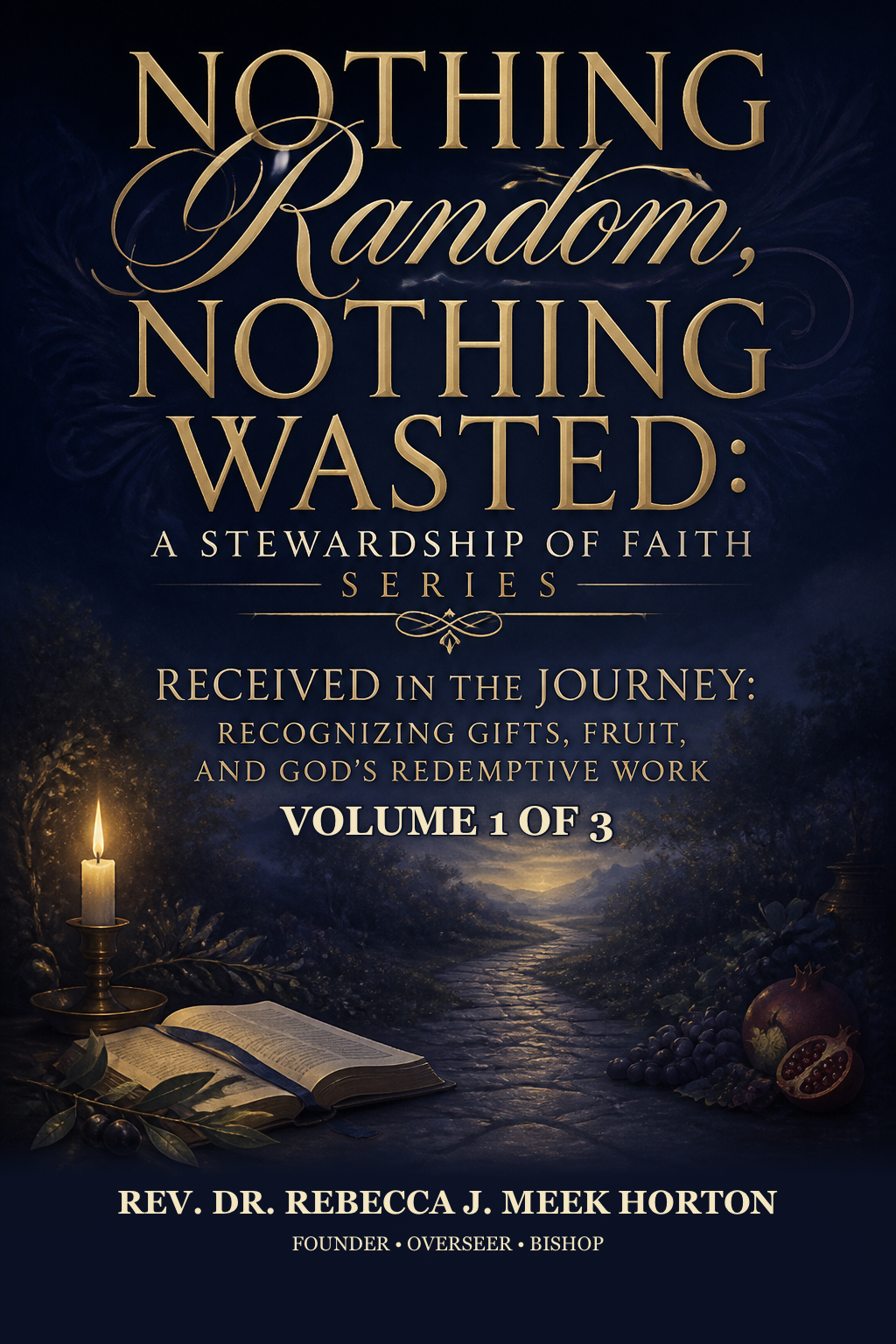
Nothing Random, Nothing Wasted: A Stewardship of Faith Series · Volume 1
Received in the Journey: Recognizing Gifts, Fruit, and God’s Redemptive Work
Part 1 of 3 in the series "Nothing Random, Nothing Wasted: A Stewardship of Faith Series". Series theme: Receiving, Developing, Balancing, and Stewarding Spiritual Gifts, Fruit, Faith, Grace, and Anointing Series arc: This three-book series moves the reader from recognition to responsibility. Book one helps believers receive and name what God has been developing through the journey: spiritual gift
Full publication
NBCNGMI MASTER KNOWLEDGE LIBRARY Featuring the works of The Sage, Apostle Prophet. Rev. Dr. Rebecca J. Meek Horton, Apostolic Prophetic Architect, NewBeing Creation Network Global Ministries, Inc. Integrated Framework Modalities™
Dedication
I dedicate this book to every believer and seeker learning to recognize God’s hand in the places they survived, questioned, and grew. May you receive with humility what the Holy Spirit has been forming in you, and may you come to know that nothing is random and nothing is wasted.
Purpose
I wrote this book to help you recognize what God has been forming in you through the journey: the gifts He entrusted, the fruit He is growing, and the wisdom He can redeem from what you have walked through. My hope is that you will receive these things with humility, not as personal possessions, but as works of the Holy Spirit given for God’s glory and the good of others. I also pray this book helps you see redemption truthfully, without calling harm good, and with faith that God can still work all things together for good according to His purpose.
Preface
I wrote this book because many believers are carrying more than they recognize.
Some are looking at their lives and only seeing delay, pain, mistakes, closed doors, survival, or unfinished places. Others can sense that God has been doing something in them, but they do not yet have language for it. They have gifts, but they are unsure how to name them. They have fruit, but they may not see it because it grew slowly through pressure, obedience, and time.
This book began from a simple teaching: gifts and fruit are developed through the journey. But as I sat with that truth, I knew it needed more room. We needed to slow down and ask, What has God entrusted? What has the Holy Spirit been forming? What has the journey revealed? What needs healing, naming, receiving, or surrender?
Scripture teaches, “But the manifestation of the Spirit is given to every man to profit withal” 1 Corinthians 12:7, KJV. Spiritual gifts are not trophies. They are not personal possessions. They are entrusted expressions of the Holy Spirit for the good of others and the glory of God.
The fruit of the Spirit is also His work in us. Galatians 5:22–23 shows us love, joy, peace, longsuffering, gentleness, goodness, faith, meekness, and temperance. These are not performances. They are evidence of formation.
I also want to be clear: redemption does not mean calling harm good. Evil is still evil. Loss is still loss. Wounds still need care. Some parts of the journey require wise counsel, help, repentance, boundaries, and healing. But God is able to work redemptively without pretending the pain was right. Joseph said, “But as for you, ye thought evil against me; but God meant it unto good” Genesis 50:20, KJV.
That is the heart of this book.
Before we rush to develop, balance, or steward what we carry, we must first receive and recognize it. We must let God show us what He has been forming in the hidden places.
My prayer is that as you read, you will begin to see your journey differently. Not as random. Not as wasted. But as a place where God has been present, forming fruit, revealing gifts, strengthening faith, and teaching you how to receive what He has entrusted.
Introduction
Some things in you were not born in a classroom. They were formed on the road.
You learned compassion because you suffered. You learned patience because you waited. You learned discernment because something once looked right and was not. You learned faith because you had to trust God when you could not trace Him. You learned mercy because you needed mercy yourself.
This book begins there: not with a platform, a title, or a public assignment, but with recognition.
Received in the Journey is the first movement in the Nothing Random, Nothing Wasted series. This book is about receiving and naming what God has been forming in you through your walk with Him. Before you develop what you carry, before you balance gifts and character, before you steward grace, anointing, power, presence, and purpose, you must first recognize what has been entrusted.
The central argument of this book is simple: spiritual gifts and spiritual fruit are works of the Holy Spirit, not personal possessions. They are given by God, developed through obedience, tested in the journey, and meant to serve others.
Paul writes, “Now there are diversities of gifts, but the same Spirit” (1 Corinthians 12:4, KJV). He also writes, “But the manifestation of the Spirit is given to every man to profit withal” (1 Corinthians 12:7, KJV). Gifts are not decorations for identity. They are manifestations of grace for service.
The fruit of the Spirit is different from the gifts, but it is not separate from the life of the Spirit. “But the fruit of the Spirit is love, joy, peace, longsuffering, gentleness, goodness, faith, meekness, temperance” (Galatians 5:22–23, KJV). Gifts may reveal what God can do through you. Fruit reveals what God is forming in you.
Both matter.
A gifted believer without fruit can harm people. A fruitful believer who refuses gifts may hide what God intended to use. This book does not ask you to choose between power and character. It invites you to recognize both with humility.
We will also talk honestly about the journey. Romans 8:28 teaches that “all things work together for good to them that love God” (KJV). Genesis 50:20 shows Joseph saying, “ye thought evil against me; but God meant it unto good” (KJV). These Scriptures do not call evil good. They do not excuse harm, abuse, betrayal, neglect, or injustice. They do not tell you to ignore pain, avoid wise counsel, or refuse needed help.
Redemption means God is able to work in what tried to waste you. It means He can bring wisdom, mercy, endurance, discernment, and purpose out of places you would never have chosen. Nothing is random. Nothing is wasted. But some things still must be grieved, named, healed, confronted, and brought into the light.
Read this book slowly. Do not rush to label yourself. Do not force a gift because you admire it in someone else. Do not dismiss fruit because it seems quiet. Do not confuse pain with calling, or charisma with maturity.
Each chapter will help you look again at your life with Scripture, prayer, honesty, and responsibility. You will be invited to map the journey: the places that shaped you, the patterns God exposed, the fruit that has grown, the gifts that have surfaced, and the wisdom you are now responsible to carry.
If you are a believer, read with surrender. If you are seeking, read with openness. You do not have to understand every term at once. Begin with the question beneath the question: What has God been showing me through the journey?
This is not a book about becoming impressive.
It is a book about becoming aware, humble, faithful, and ready for the next obedient step.
Chapter 1 — When the Journey Has Been Teaching You
The box was still in the closet.
She had moved twice since that season ended, but the box came with her every time. Old journals. Printed emails. A conference badge. A hospital bracelet. A church bulletin from a Sunday she almost did not attend. None of it looked important to anyone else.
But one evening, while looking for something completely different, she opened it.
At first, all she saw was pain. Then she noticed something else.
There were prayers in those pages that had changed over time. There were names she no longer feared. There were decisions she would not make again. There was a quiet strength she did not have before. The season had been hard. Some of it had been wrong. Some of it still carried grief.
But the journey had been teaching her.
That is the central truth of this chapter: many believers survive seasons without recognizing what God has been forming in them. We often remember what happened to us, but we do not always discern what was developed in us.
This book begins there.
Not with striving. Not with proving. Not with pretending. But with receiving.
Romans 8:28 says, “And we know that all things work together for good to them that love God, to them who are the called according to his purpose” (KJV).
This verse does not say all things are good. It says God is able to work in all things for good. That difference matters. Wisdom can read the journey without calling every part of the journey good.
What You Survived May Still Be Speaking
Some seasons are so demanding that survival becomes the only goal.
You get through the loss. You keep showing up for work. You raise the children. You keep serving. You keep praying, even if the prayers become shorter. You keep breathing. Then, when the season finally changes, you move on because you are tired.
But moving on is not always the same as receiving.
There may be wisdom in that season that you have not gathered yet. There may be strength you have not named. There may be compassion, discernment, patience, courage, or humility that was formed in hidden places.
Think of someone who cared for a sick parent for several years. During the season, they may have felt weak, stretched, and unseen. They may not have called anything about it “growth.” They were simply doing what love required.
But later, they notice something. They listen better. They pray differently. They are slower to judge people who are tired. They can sit with grief without rushing people through it. Something was formed.
That does not make the suffering pleasant. It does not erase the cost. But it does mean nothing has to be wasted.
This is part of receiving: learning to ask, “Lord, what have You been forming in me that I have not yet recognized?”
The Journey Needs Interpretation
Events do not automatically become wisdom.
A person can go through hardship and come out bitter. Another can go through hardship and come out tender. One may become guarded. Another may become discerning. One may repeat the same cycle. Another may pause for RE-Calibration™ and choose a different way.
The difference is not always the event. Often, it is interpretation.
To interpret the journey wisely means we slow down long enough to see what happened, what it revealed, what it produced, and what still needs healing. We do not rush to make everything meaningful. We do not force a spiritual explanation over real wounds. We also do not assume pain had the final word.
A farmer understands this. After a storm, he walks the field. He does not stand at the window and guess. He goes out and looks. Some branches are broken. Some roots held firm. Some soil washed away. Some seeds were pressed deeper.
The storm must be inspected honestly.
So must the journey.
Believers sometimes feel pressure to sound victorious before they have told the truth. But truth is not the enemy of faith. Truth gives faith a clean place to stand.
Romans 8:28 does not invite denial. It invites confidence in God’s redemptive ability. It teaches us to believe that God can work in what we would never have chosen.
This is why the journey needs interpretation. Without it, we may carry pain but miss wisdom. We may remember the wound but overlook the grace that sustained us. We may see the delay but miss the patience being formed. We may see the betrayal but miss the discernment that now guards our steps.
God Forms More Than We Notice
Much of God’s work in us happens quietly.
We often look for dramatic evidence. A public calling. A visible gift. A clear open door. A powerful moment. Those things may come, but formation often begins in ordinary obedience.
You forgive again.
You tell the truth when silence would protect your image.
You keep your word when no one thanks you.
You learn to wait without quitting.
You ask for help instead of pretending to be fine.
You stop confusing busyness with faithfulness.
These are not small things.
A young believer may think God is only working when they feel inspired. But sometimes God is working when they are learning to apologize. Sometimes God is working when they are learning to say no. Sometimes God is working when they are learning to pray without performing.
The Holy Spirit does not only give gifts for service. He also forms character for carrying what is given. Later chapters will help us name gifts and recognize fruit more clearly, but we begin by noticing this: God’s work is often present before we have language for it.
Consider Peter. Before Pentecost, we see boldness mixed with fear, devotion mixed with impulsiveness. His journey exposed him. But exposure was not the end. The Lord restored him and used him. Peter’s failure did not become his identity. It became part of a redeemed story under the mercy and leadership of Christ.
Many believers need that hope.
You are not only what happened. You are not only what you lost. You are not only what you regret. You are also someone God can teach, heal, correct, strengthen, and send forward with wisdom.
Receiving Begins With Honest Attention
The first movement of this book is receiving.
Receiving sounds simple, but it requires humility. We must admit that we may not have understood our own journey correctly. We may have overlooked grace because we were focused on pain. We may have mistaken delay for abandonment. We may have called ourselves weak when God was teaching us dependence.
Receiving also requires patience. We cannot map every season in one sitting. We cannot name every lesson at once. Some understanding comes slowly. Some memories need care. Some parts of the story should be processed with wise counsel, pastoral support, or professional help.
Faith does not require us to handle everything alone.
The cost of this chapter is honest attention.
It asks you to stop rushing past your life. It asks you to look again, not to relive pain, but to recognize formation. It asks you to let God show you what has been entrusted through the journey.
That may be uncomfortable.
You may have to grieve what you minimized. You may have to admit where you hardened. You may have to give thanks for grace you did not notice at the time. You may have to separate what God formed from what people did wrong.
This is careful work. But it is good work.
Nothing is random. Nothing is wasted.
That does not mean everything was right. It means God is wise enough, faithful enough, and redemptive enough to bring good out of places we could not repair on our own.
The journey has been teaching you. Now it is time to receive with wisdom.
Key Takeaways
• Survival is not the same as receiving what God formed.
• Romans 8:28 teaches redemption, not denial.
• The journey must be read with honesty, Scripture, and wisdom.
Practice
Set aside twenty quiet minutes this week.
Choose one past season that still feels significant. Do not choose the most painful season if you are not ready. Begin with one you can look at honestly.
Write three simple lines:
• What happened in that season?
• What did it reveal in me?
• What grace, wisdom, or growth can I now recognize?
Close with this prayer:
“Lord, help me receive what You have formed without pretending everything was good. Teach me to see with wisdom, give thanks with honesty, and take the next faithful step.”
Chapter 2 — Received, Not Owned
A young man once stood after a church service and said, “I think I know what I’m good at, but I don’t know if I’m allowed to call it a gift.”
He was not being dramatic. He was trying to be careful.
He had seen people use spiritual language to promote themselves. He had watched others hide what God placed in them because they feared sounding proud. He was caught between two errors: exalting the gift or denying it.
Many believers live there.
They sense that God has given them something, grown something in them, or used them in a meaningful way. But they do not know how to receive it without owning it, branding it, or making it their identity.
The controlling idea of this chapter is simple: spiritual gifts and spiritual fruit are works of the Holy Spirit. They are received, not owned. Gifts reveal what the Spirit distributes for service. Fruit reveals what the Spirit grows in character.
When we understand this, we can stop striving to possess what was given by grace. We can receive with humility and serve with clarity.
The Same Spirit Gives
Paul writes, “Now there are diversities of gifts, but the same Spirit” 1 Corinthians 12:4 (KJV).
That one sentence protects us from comparison.
There are diversities of gifts. This means God does not give every believer the same expression, the same assignment, or the same measure of usefulness in the same area. The body of Christ was never designed to be a room full of copies. Difference is not a threat when the same Spirit is the source.
Paul continues, “And there are differences of administrations, but the same Lord. And there are diversities of operations, but it is the same God which worketh all in all” 1 Corinthians 12:5–6 (KJV).
The gift, the way it is served, and the effect it produces all remain under God. This matters because a gift can be real and still need order. A gift can be powerful and still require humility. A gift can be visible and still belong to God.
A simple example may help.
Imagine someone hands you a set of keys to open a building for people who need shelter. The keys are in your hand, but the building is not yours. The keys give access for service, not ownership for pride. If you use them faithfully, people are helped. If you boast in having them, you miss the purpose.
Spiritual gifts work in a similar way. They are entrusted to us for the good of others.
Paul says, “But the manifestation of the Spirit is given to every man to profit withal” 1 Corinthians 12:7 (KJV).
The manifestation is given “to profit withal.” That means spiritual gifts are not decorations for our identity. They are expressions of God’s grace meant to build, strengthen, serve, and bless.
The question is not, “How do I use this gift to prove who I am?”
The better question is, “How does this gift serve what God loves?”
What God Gives and What God Grows
Spiritual gifts and spiritual fruit are both works of the Holy Spirit, but they are not the same thing.
Gifts are given for service.
Fruit is grown in character.
A person may be gifted in ways that are noticeable. They may teach clearly, encourage deeply, lead wisely, give generously, discern carefully, or serve faithfully. But the presence of a gift does not automatically mean the presence of mature character.
This is why fruit matters.
Paul writes, “But the fruit of the Spirit is love, joy, peace, longsuffering, gentleness, goodness, faith, Meekness, temperance: against such there is no law” Galatians 5:22–23 (KJV).
Notice the wording: “the fruit of the Spirit.” Fruit is not self-manufactured personality polish. It is the Spirit’s life becoming visible in us.
This is important for believers and seekers alike.
Christian growth is not merely becoming more talented, more impressive, or more useful in public. Christian growth is becoming more yielded to the Holy Spirit in private and in public. Gifts may make room for service, but fruit makes service safe.
Think of a tree.
A tree does not strain to tape fruit onto its branches. Fruit grows because life is moving through the tree. In the same way, the fruit of the Spirit is not a performance we attach to ourselves so we look mature. It grows as we abide, surrender, obey, repent, forgive, wait, and walk with God.
This does not mean growth is passive. It means growth is dependent.
We participate through obedience, but the Spirit produces the life.
Received, Not Used as Identity
One of the quiet dangers of spiritual gifts is that we can begin to use them as identity replacements.
A teacher may begin to think, “I am my teaching.”
A singer may begin to think, “I am my voice.”
A leader may begin to think, “I am my influence.”
An encourager may begin to think, “I am only valuable when people need me.”
This is where a gift can become a burden God never assigned. When we make a gift our identity, we become anxious when we are not being used. We become defensive when corrected. We become jealous when someone else is celebrated. We become afraid that if the gift is not visible, we are not valuable.
But our identity is not in the gift.
Our identity is in belonging to God.
The gift is something the Spirit gives. The fruit is something the Spirit grows. Neither one is meant to replace sonship, humility, worship, or obedience.
This distinction brings freedom.
If the gift is received, I do not have to force it.
If the fruit is grown, I do not have to fake it.
If both belong to the Holy Spirit, I can steward them without worshiping them.
This is part of Governed Movement™. The believer learns to move with order, weight, operation, and wisdom. Nothing is random. Nothing is wasted. But nothing is to be possessed as though grace began with us.
A mature believer can say, “God has entrusted something to me,” without pride.
A humble believer can say, “God is growing something in me,” without pretending the process is finished.
The Cost of Letting Go of Ownership
Receiving without owning sounds simple until it touches our motives.
It costs us comparison.
If the same Spirit gives diverse gifts, we cannot measure our value by someone else’s assignment. Comparison turns difference into insecurity. Humility turns difference into worship.
It costs us control.
We do not decide how God must use what He has given. We prepare, obey, and serve, but we do not control every door, platform, outcome, or response.
It costs us performance.
Some people have spent years trying to prove they are gifted. Others have spent years hiding because they fear being seen. Both can be forms of bondage. Receiving calls us into sober agreement with God: not inflated, not diminished, simply faithful.
It costs us pride.
If a gift is from the Spirit, we cannot boast as though we created it. If fruit is of the Spirit, we cannot brag as though maturity came from human strength alone.
It also costs us passivity.
Receiving does not mean neglecting. A gift should be submitted, practiced, tested, and used in love. Fruit should be cultivated through obedience and repentance. Stewardship before increase.
This is the tension: what is received by grace must still be carried responsibly.
A musician may receive ability, but still needs discipline.
A teacher may receive insight, but still needs study.
A leader may receive influence, but still needs accountability.
A believer may have visible gifting, but still need patience, meekness, and temperance.
The Spirit gives. The Spirit grows. We steward.
Holding Gifts and Fruit Together
The church needs gifts.
The church also needs fruit.
Gifts without fruit can wound people. Fruit without willingness to serve can become private virtue with little public obedience. The Holy Spirit works in both ways: empowering service and forming character.
This balance helps us avoid two mistakes.
The first mistake is chasing gifts while neglecting fruit. This produces activity without maturity. People may be impressed for a season, but eventually character speaks.
The second mistake is valuing only quiet character while refusing Spirit-empowered service. This can sound humble, but it may become disobedience if God has truly entrusted something to be used for others.
We are not asked to choose between gifts and fruit.
We are called to receive both rightly.
The gifts of the Spirit help us serve the body.
The fruit of the Spirit helps us serve like Christ.
A seeker may ask, “Does this mean every Christian has something to offer?”
Yes. In the body of Christ, no believer is meaningless. But what we offer is not rooted in self-importance. It is rooted in grace. God gives, God grows, and God receives the glory.
This keeps the heart clean.
When someone thanks you for the way God used you, you do not need to reject the encouragement. False humility often refuses to acknowledge grace. You can simply say, “Thank you. I am grateful God used it.”
That is receiving without owning.
Key Takeaways
• Spiritual gifts are given by the Holy Spirit for service.
• Spiritual fruit is grown by the Holy Spirit in character.
• What God gives and grows must be received with humility and stewarded with care.
Practice
Take ten quiet minutes this week and write two short lists.
First, write: “What may God have entrusted to me for service?”
Second, write: “What fruit may the Holy Spirit be growing in me?”
Do not judge the lists. Do not exaggerate them. Bring them to God in prayer, test them by Scripture, and consider sharing them with one wise believer who can help you walk in humility and clarity.
Chapter 3 — Naming the Gifts Without Exalting the Self
At the end of a small church gathering, someone stayed behind to stack chairs. Nobody asked her. Nobody noticed at first. She saw the room needed order, and her hands moved toward the need.
Across the room, another believer sat with a young man who had not said much all evening. He did not preach at him. He listened. He asked one honest question. The young man began to weep.
In the kitchen, someone noticed the food was running low and quietly made sure the children ate first. In the parking lot, someone prayed with a tired mother before she drove home.
No stage. No microphone. No announcement.
But gifts were present.
The controlling idea of this chapter is simple: spiritual gifts are often recognized through service, burden, grace, and repeated usefulness, but they must be named with humility because they are entrusted by God, not owned by the self.
Naming a gift is not self-exaltation. It is stewardship.
Refusing to name what God has entrusted can look like humility, but sometimes it is fear. Exalting what God has entrusted can look like confidence, but sometimes it is pride. Wisdom teaches us another way: receive clearly, name honestly, serve humbly.
Start Where Service Happens
Many people look for their gifts by asking, “What am I impressive at?”
A better question is, “Where do I consistently serve with grace?”
Spiritual gifts are not given so we can decorate our identity. They are given so the body can be strengthened. Paul wrote, “But the manifestation of the Spirit is given to every man to profit withal” 1 Corinthians 12:7 (KJV).
That phrase matters: “to profit withal.” The gift is not merely for the person carrying it. It is for the good of others.
This is why gifts are often easier to see in service than in self-analysis. You may not recognize teaching as a gift until people keep saying, “You helped me understand.” You may not recognize encouragement until people leave your presence strengthened. You may not recognize administration until confusion decreases when you help bring order. You may not recognize mercy until hurting people feel safe enough to breathe near you.
A woman may say, “I just like helping people make sense of things.” But over time, others notice that when she explains Scripture, confusion lifts. That repeated usefulness may be revealing a teaching gift.
A man may say, “I just cannot ignore people who are overlooked.” But again and again, he sees the unseen, sits with the lonely, and restores dignity through simple care. That may be mercy at work.
Service gives gifts a place to become visible.
If you are unsure where your gifts may be, do not begin with a platform. Begin with faithfulness. Serve in ordinary places. Help where help is needed. Pay attention to what happens when love takes action through you.
Notice the Burden That Returns
A burden is not the same as anxiety. Anxiety often drives us with fear. A godly burden draws us toward service, prayer, compassion, correction, or building.
Sometimes the gift is connected to what you cannot easily ignore.
You may keep noticing confusion and feel compelled to bring clarity. You may keep noticing disorder and feel compelled to create structure. You may keep noticing discouraged people and feel compelled to speak life. You may keep noticing injustice and feel compelled to stand with truth. You may keep noticing spiritual hunger and feel compelled to teach, pray, or disciple.
The burden does not make you superior. It makes you responsible.
There is a cost here. A burden can be uncomfortable. It may interrupt convenience. It may require patience. It may reveal that God has been shaping you to carry care in a specific direction.
But not every burden is an assignment, and not every strong feeling is a spiritual gift. This is where SAPP™ Discernment helps: see the situation truthfully, ask deeper questions, ponder motives and costs, and practice the next faithful step.
For example, someone may feel strongly about leadership problems in a ministry. That burden may be discernment, administration, wisdom, or intercession. It may also be frustration that needs maturity before action. The next faithful step may not be speaking publicly. It may be praying, asking questions, seeking counsel, and serving quietly until the burden becomes clear.
A burden becomes healthier when it is submitted to Scripture, wise counsel, and love.
If the burden makes you harsh, it needs RE-Calibration™.
If the burden makes you prayerful, humble, and faithful, pay attention.
Recognize the Grace That Comes With It
Grace does not mean the work is always easy. It means there is a supply from God that helps you carry what He has entrusted.
Paul wrote, “Having then gifts differing according to the grace that is given to us” Romans 12:6 (KJV).
Gifts differ. Grace differs. Assignments differ.
This protects us from comparison.
One person may carry a visible speaking gift. Another may carry a quiet gift of helps. One may lead many. Another may strengthen one person at a time. One may bring wisdom in decision-making. Another may create beauty that turns hearts toward God. One may intercede in hidden places. Another may give generously without needing attention.
The question is not, “Why is my gift not like theirs?”
The question is, “What grace has God given me to serve faithfully?”
Grace can often be seen in the way a task bears fruit beyond your natural effort. You may prepare a simple word of encouragement, and it reaches someone deeply. You may organize a small process, and a whole group becomes more peaceful. You may pray quietly, and someone is strengthened. You may give practical help, and someone feels the care of God through your obedience.
That does not mean you do not study, practice, prepare, or grow. Gifts still need maturity. A teaching gift needs study. A leadership gift needs character. A mercy gift needs boundaries. A giving gift needs wisdom. A discernment gift needs humility. A prophetic gift needs submission to Scripture and accountability.
Grace is not an excuse to stay undeveloped.
Grace is the supply that helps you serve while you keep growing.
Look for Repeated Usefulness
One moment may encourage you. Repeated usefulness helps confirm a pattern.
This does not mean everyone will always receive you. It does not mean your service will always be praised. It means that over time, there is evidence that God uses your obedience to strengthen others.
Repeated usefulness may sound like:
“You helped me understand.”
“You brought peace to that situation.”
“You noticed what others missed.”
“You helped us move forward.”
“You strengthened my faith.”
“You made room for me.”
“You served when nobody else saw the need.”
These responses are not trophies. They are clues.
Peter wrote, “As every man hath received the gift, even so minister the same one to another, as good stewards of the manifold grace of God” 1 Peter 4:10 (KJV).
The gift is received. The ministry is shared. The posture is stewardship.
A young believer may begin by helping in small ways. He checks on people who miss gatherings. He remembers names. He follows up when others forget. Over time, leaders notice that people feel cared for because of his consistency. He may not have called it a gift. He may have called it “just checking in.” But repeated usefulness may reveal pastoral care, mercy, exhortation, or helps.
Do not rush to label everything.
Do not refuse to notice anything.
Let fruit over time, counsel from mature believers, Scripture, and service help you name what is being entrusted.
The Cost of Naming Without Pride
The tension is real.
If you never name your gifts, you may hide from responsibility.
If you overname your gifts, you may build identity around them.
Both are dangerous.
A gift can become an idol when it becomes the place where you demand recognition, control, or importance. A person can begin by serving others and slowly start protecting a role, a title, or a reputation. That is why humility is not optional. It is protection.
Naming a gift will ask you to face comparison. Someone may seem more gifted. Someone may be noticed sooner. Someone may carry a similar gift with more maturity. You will have to choose stewardship over competition.
Naming a gift will also ask you to receive correction. If your gift is real, it still needs shaping. If your service matters, your character matters more. If God uses you, you still remain a servant.
Nothing is random. Nothing is wasted. Even correction can become part of formation when received with humility.
A simple way to speak about your gift is this:
“I am noticing that God may be using me to serve in this way. I want to grow in it faithfully.”
That sentence leaves room for gratitude, counsel, development, and accountability.
It names without boasting.
It receives without owning.
Key Takeaways
• Gifts are recognized through service, not self-display.
• Burden, grace, and repeated usefulness can help reveal what God has entrusted.
• Naming a gift requires humility, counsel, and continued growth.
Practice
This week, choose one place to serve without seeking attention.
Afterward, write three short observations:
• Where did I serve with peace, grace, or holy burden?
• Did my service strengthen, clarify, comfort, organize, or encourage someone?
• What counsel or confirmation should I seek before naming this as a gift?
Then pray simply:
“Lord, help me receive what You have entrusted without pride, fear, or comparison. Teach me to serve faithfully with what You give.”
Take one next faithful step from what you notice.
Chapter 4 — Recognizing Fruit in Ordinary Places
The kitchen was quiet except for the sink running and one tired person breathing hard.
The argument had ended, but the words were still in the room. A plate sat untouched on the counter. A phone lay face down. Nobody clapped. Nobody called it a spiritual victory.
Then something small happened.
Instead of sending the last sharp text, she put the phone down. Instead of rehearsing the offense all night, he prayed before speaking again. Instead of proving a point, one of them chose a softer answer.
That is where fruit is often seen.
Not always on a platform. Not always in a testimony. Not always in a dramatic moment everyone can recognize.
The single idea of this chapter is simple: the fruit of the Spirit is often revealed slowly in ordinary places through daily obedience.
Paul wrote, “But the fruit of the Spirit is love, joy, peace, longsuffering, gentleness, goodness, faith, Meekness, temperance: against such there is no law” Galatians 5:22–23 KJV.
Fruit is not spiritual decoration. It is evidence of life. It shows what the Holy Spirit is growing in a person who belongs to Christ and is learning to walk with Him.
Fruit Is Grown, Not Performed
Fruit does not appear because a person wants to look mature.
Fruit grows because life is connected to the right source.
Jesus said, “I am the vine, ye are the branches” John 15:5 KJV. A branch does not manufacture fruit by anxiety. It abides. It receives life. It remains connected.
This matters because many believers try to perform fruit. They try to look patient, sound gentle, appear joyful, or seem peaceful. But performed fruit usually breaks under pressure. It can last in public and disappear at home.
The fruit of the Spirit is different. It begins inside and becomes visible over time.
A quiet example may help.
A person used to respond to every correction with defense. Every question felt like attack. Every delay felt like rejection. But over time, through prayer, Scripture, repentance, and practice, something changes. The same correction comes, but the person pauses. They listen. They ask, “Is there something I need to see here?”
That pause may not look large to anyone else.
But in the journey, it is evidence.
Longsuffering is growing. Meekness is forming. Temperance is appearing.
Do not despise small evidence. Fruit is often first recognized in what you no longer do as quickly as before.
Pressure Reveals What Is Ripening
Pressure does not create all fruit instantly, but it reveals what has been growing.
A long line at the store. A child asking the same question again. A coworker taking credit. A delayed answer to prayer. A person speaking to you with less care than you hoped.
These ordinary pressures become mirrors.
They show whether patience is only a word we admire or a grace we are learning to walk in.
Patience under pressure does not mean pretending nothing bothers you. It means you do not let irritation become your ruler. It means you slow down enough to respond with wisdom instead of reacting from the first emotion.
This is not weakness.
It is governed strength.
A parent may feel exhausted at the end of the day. The child spills juice after being told to be careful. The old reaction would be harshness. The new response may still be firm, but it is not cruel.
That is fruit.
A worker may be overlooked again. The old reaction would be bitterness, gossip, or quitting in anger. The new response may be honest grief, wise conversation, and continued integrity while seeking the next faithful step.
That is fruit.
A believer may be misunderstood. The old reaction would be to explain everything to everyone. The new response may be to speak truth clearly, refuse revenge, and leave room for God to defend what needs defending.
That is fruit.
Fruit does not remove feeling. It teaches feeling to bow to the Spirit.
Gentleness Is Strength Under God’s Hand
Gentleness is often misunderstood.
Some hear the word and think of weakness, passivity, or silence. But biblical gentleness is not the absence of strength. It is strength submitted to God.
Gentleness matters most when you could be harsh and choose not to be.
In conflict, the question is not only, “Was I right?” The question is also, “Did I carry truth with the Spirit of Christ?”
A person can be correct and still be careless. A person can quote Scripture and still wound unnecessarily. A person can win an argument and lose tenderness.
Fruit asks more of us.
Gentleness does not mean avoiding hard conversations. It means having them without cruelty. It means truth is not used as a weapon to punish. It means correction is offered with humility, not superiority.
Consider a leader correcting someone who failed to follow through.
One approach humiliates: “You always do this. I cannot trust you.”
Another approach tells the truth with care: “This responsibility was not completed, and it affected others. Let’s talk about what happened and what needs to change.”
The second response is not soft on responsibility. It is careful with the person.
That is gentleness.
It is also goodness.
It reflects the heart of God, who corrects His children without delighting in shame.
For many believers, gentleness requires RE-Calibration™ of language. We may need to move from accusation to clarity, from sarcasm to honesty, from emotional punishment to responsible speech.
This is not easy.
But it is fruit.
Faithfulness When No One Sees
Some fruit grows in hidden places.
Faithfulness is one of them.
It is easy to celebrate visible obedience. It is harder to honor steady obedience that no one notices.
Faithfulness looks like keeping your word when there is no applause. It looks like praying when you do not feel dramatic emotion. It looks like serving without needing your name attached. It looks like showing up for the responsibility in front of you.
The world often measures fruit by visibility.
The Spirit often grows fruit through consistency.
A woman cares for an aging parent. Much of her service is unseen. Meals, appointments, patience, repeated conversations, quiet tears. No stage. No spotlight. Yet the Spirit is forming faithfulness, love, and longsuffering in her life.
A man chooses integrity with money when no one would know. He tells the truth. He refuses the shortcut. He accepts the cost of honesty. No one posts about it. Heaven sees.
A young believer keeps returning to Scripture after a week of failure. They repent. They rise. They keep walking. That is not hypocrisy. That is formation.
Faithfulness is not perfection.
It is continued obedience.
The fruit of the Spirit is often seen in the person who keeps coming back to God, keeps telling the truth, keeps choosing the next right step, and keeps refusing to let failure become identity.
Nothing is random. Nothing is wasted.
Even hidden obedience becomes part of formation.
The Cost of Slow Fruit
The cost of recognizing fruit in ordinary places is that you must slow down.
You may have to stop looking only for dramatic signs and begin paying attention to daily evidence. You may have to let God mature you without needing everyone to notice. You may have to confess that some reactions you called personality are actually places needing surrender.
This can be uncomfortable.
It is easier to say, “That is just how I am.”
It is harder to say, “Lord, grow Your fruit in me here.”
It is easier to excuse impatience because life is stressful.
It is harder to practice longsuffering when stress is real.
It is easier to call harshness honesty.
It is harder to let gentleness govern truth.
It is easier to be faithful when thanked.
It is harder to remain faithful when unseen.
It is easier to want self-control after temptation passes.
It is harder to practice temperance in the moment of testing.
But this is where maturity grows.
The fruit of the Spirit is not given so we can admire ourselves. It is grown so our lives increasingly bear witness to Christ.
A tree does not eat its own fruit. Fruit nourishes others.
Your patience may make room for someone else to feel safe. Your gentleness may help someone receive correction. Your faithfulness may strengthen people who depend on you. Your self-control may stop a cycle that has harmed your home for years.
This is why ordinary fruit matters.
It may look small, but it carries life.
Key Takeaways
• The fruit of the Spirit is revealed slowly through daily obedience.
• Pressure often shows what the Holy Spirit is growing in us.
• Hidden faithfulness matters, even when no one applauds.
Practice
Choose one ordinary place where your responses are often tested: home, work, traffic, conflict, waiting, money, or private habits.
For the next seven days, pay attention to one fruit of the Spirit in that place.
Ask daily: “Holy Spirit, what fruit are You growing here, and what is my next faithful step?”
Then practice one clear response: pause before speaking, answer gently, keep your word, refuse the shortcut, or walk away from the temptation.
Small obedience is still obedience.
Chapter 5 — Mapping the Journey With Honest Eyes
The old box sat on the closet floor for years.
Inside were birthday cards, church programs, medical bills, photographs, a funeral leaflet, a few letters, and one small notebook filled with prayers that had more questions than answers. Nothing in the box looked organized. It looked like life.
But when she spread the pieces across the bed, she began to see more than memories. She saw seasons. She saw who stayed. She saw what pressure revealed. She saw decisions she had made when she was afraid. She saw strength she did not know she had. She saw places where she had grown, and places where she was still reacting from what happened.
That is what honest journey mapping does.
The controlling idea of this chapter is simple: you cannot receive well what you refuse to recognize. Mapping the journey helps you trace seasons, pressures, lessons, losses, relationships, decisions, and growth so you can discern what God has been forming and where RE-Calibration™ is still needed.
This is not about reliving pain.
It is about reading your life with wisdom.
Psalm 90:12 says, “So teach us to number our days, that we may apply our hearts unto wisdom” (KJV). Numbering our days is not merely counting time. It is paying attention to what time has taught us.
The Map Is Not the Wound
A map is not the place itself. It is a tool that helps you see where you have been, where you are, and what may need attention next.
In the same way, mapping your journey is not the same as going back into every wound. You are not required to reopen what God is healing. You are not required to explain everything to everyone. You are not required to make your pain useful before you have allowed it to be named truthfully.
Honest mapping begins with safety and humility.
Some seasons can be reviewed alone with prayer and a journal. Other seasons need wise counsel, pastoral care, therapy, medical support, or trusted community. Wisdom does not call isolation strength. Wisdom knows when help is part of stewardship.
Proverbs 4:26 says, “Ponder the path of thy feet, and let all thy ways be established” (KJV). To ponder is to consider carefully. It is not rushing to conclusions. It is not blaming yourself for every hardship. It is not pretending every event was acceptable.
It is looking with honest eyes.
For example, a believer may look back over ten years and notice repeated burnout. At first, every season seemed different: a demanding job, a ministry assignment, family responsibility, financial pressure. But when mapped, one pattern becomes clear: they kept saying yes before asking whether they had capacity.
The map reveals more than activity.
It reveals a place needing RE-Calibration™.
Not shame. Not condemnation. Adjustment.
Seven Markers to Trace
A simple journey map can begin with seven markers.
Seasons. Pressures. Lessons. Losses. Relationships. Decisions. Growth.
Seasons are the broad chapters of your life. Childhood. School years. Early faith. Marriage. Singleness. Parenting. Caregiving. Ministry. Career transition. Illness. Grief. Starting over. A season does not need a perfect title. It only needs honest recognition.
Pressures are what pressed on you during that time. Pressure may come through responsibility, conflict, lack, delay, disappointment, change, or expectation. Pressure often reveals what was hidden. It may reveal fear. It may reveal endurance. It may reveal a gift. It may reveal a pattern that needs healing.
Lessons are what you learned. Some lessons came through instruction. Others came through consequence. Some came through obedience. Some came through correction.
Losses are what you had to release or grieve. This may include people, opportunities, dreams, health, certainty, innocence, trust, or time. Loss should not be minimized. Naming loss is part of truth.
Relationships are the people who shaped the season. Some strengthened you. Some taught you wisdom through their love. Some taught you discernment through their absence or harm. Some relationships revealed your need for boundaries, forgiveness, courage, or counsel.
Decisions are the choices you made. Not every decision was perfect. Some were wise. Some were reactive. Some were made with limited information. Honest mapping lets you learn without living under accusation.
Growth is what changed in you. Maybe you became more patient. Maybe you learned to pray honestly. Maybe you became more discerning. Maybe you learned to serve without needing applause. Maybe you discovered that God had placed compassion in you through what you walked through.
Imagine someone mapping a season of caring for an aging parent. The season marker may be “caregiving.” The pressure may be exhaustion and role reversal. The lesson may be dependence on God one day at a time. The loss may be freedom, sleep, and the slow grief of watching someone decline. The relationships may include siblings, nurses, church members, and friends who did or did not show up. The decisions may include medical choices, financial adjustments, and asking for help. The growth may be tenderness, patience, and courage.
The map does not make the season easy.
It helps the person see that nothing was random. Nothing was wasted.
Patterns Speak More Than Moments
One moment can be powerful, but patterns often tell the deeper truth.
A single conflict may reveal frustration. Repeated conflicts may reveal an unhealed fear, a communication pattern, or a boundary problem.
A single opportunity may reveal interest. Repeated opportunities may reveal a gift.
A single act of kindness may reveal compassion. Repeated mercy under pressure may reveal fruit being formed.
Journey mapping helps you stop treating every event as disconnected. It allows you to ask better questions.
Where do I keep responding the same way?
Where do others repeatedly seek my help?
Where have I grown stronger without noticing?
Where do I keep avoiding obedience?
Where do I confuse pressure with punishment?
Where do I confuse usefulness with identity?
This is where honest mapping becomes a tool of maturity. It helps you recognize formation without exalting yourself. It helps you recognize wounds without letting them define you. It helps you recognize responsibility without drowning in regret.
A man may look back and notice that in every church, workplace, or family setting, people come to him when confusion needs order. He never called it a gift. He simply thought, “Someone has to help.” But over time, repeated usefulness begins to speak. Perhaps God has entrusted him with wisdom for structure, administration, or counsel.
A woman may notice that she often withdraws when correction comes. Different leaders, different jobs, different friendships, same response. The pattern is not there to shame her. It is there to invite RE-Calibration™. Perhaps correction has been confused with rejection. Perhaps the next step is learning how to receive truth without collapsing.
Patterns are not prisons.
Patterns are information.
When brought before God with humility, Scripture, prayer, and wise counsel, they can become pathways into growth.
The Cost of Honest Seeing
Honest eyes are costly.
It is easier to say, “That season was just hard,” than to admit, “That season formed endurance in me, but it also exposed bitterness I have not surrendered.”
It is easier to say, “They hurt me,” than to also ask, “How did I learn to protect myself in ways that now keep healthy people out?”
It is easier to say, “God used me,” than to ask, “Did I begin to need people to need me?”
Honest mapping asks you to hold more than one truth at a time.
You may have been wronged, and still need healing.
You may have been useful, and still need humility.
You may have survived, and still need rest.
You may have grown, and still need correction.
This is not a small thing. Many people avoid mapping because they fear what they will find. They fear blame. They fear grief. They fear realizing they need help. They fear that if they name the pain, it will become larger.
But truth handled with God does not destroy you. It steadies you.
John 8:32 says, “And ye shall know the truth, and the truth shall make you free” (KJV). Freedom is not always instant relief. Sometimes freedom begins as clarity. You finally see what you are carrying. You finally see what belongs to you and what does not. You finally see where obedience is possible.
This is why mapping must be done with grace.
Not rushing.
Not forcing.
Not turning your story into a performance.
Not demanding that every wound produce a lesson by tomorrow.
Some things are still tender. Some questions remain unanswered. Some losses still ache. Honest mapping respects that.
The goal is not to finish the work in one sitting.
The goal is to begin seeing with wisdom.
Key Takeaways
• Honest mapping helps you recognize formation without reliving every wound.
• Seasons, pressures, lessons, losses, relationships, decisions, and growth reveal patterns.
• RE-Calibration™ begins where truth exposes what needs attention.
Practice
Set aside thirty quiet minutes this week.
Draw a simple timeline of your life with three to five major seasons. Under each season, write one phrase for each marker: pressure, lesson, loss, relationship, decision, and growth.
Then answer one question:
What is one place in my journey that may need RE-Calibration™ now?
Do not try to fix everything. Bring that one place to God in prayer, and if needed, share it with a trusted, wise person who can help you take the next faithful step.
Chapter 6 — Trials That Mature, Not Harm That Defines
A person can walk out of a difficult season carrying two things at the same time: real pain and real growth.
That is not contradiction. That is honesty.
Some believers look back over hardship and feel pressure to make the story sound clean. They say, “It made me stronger,” even when parts of it wounded them deeply. Others feel guilty because they cannot find joy in what happened. They wonder if their grief means their faith is weak.
James gives us a better way.
“My brethren, count it all joy when ye fall into divers temptations; Knowing this, that the trying of your faith worketh patience. But let patience have her perfect work, that ye may be perfect and entire, wanting nothing.” (James 1:2–4, KJV)
The controlling idea is simple: trials can mature faith, but harm must not be renamed as good. God can form patience in testing, but He does not require us to deny pain, excuse evil, or stay unsafe in order to prove we trust Him.
This matters because many people confuse endurance with silence. They confuse forgiveness with lack of boundaries. They confuse maturity with pretending nothing hurt.
That is not wisdom.
Testing Is Not the Same as Destruction
James speaks of “divers temptations,” meaning various trials, pressures, and tests. These are the kinds of seasons that press faith and reveal what is being formed inside us.
A trial may be a delay, a disappointment, a season of uncertainty, a responsibility that stretches capacity, or a pressure that exposes impatience. These moments are not easy, but they can become places of formation.
A young believer may pray for patience and then find herself caring for an aging parent, working a demanding job, and learning to love without applause. The season is heavy. Yet in that pressure, the Holy Spirit may grow endurance, gentleness, and faithfulness.
That is formation.
But abuse, exploitation, neglect, violence, manipulation, and injustice must not be lightly called “a trial” in a way that excuses wrongdoing. Scripture never asks us to call darkness light. Isaiah gives a warning: “Woe unto them that call evil good, and good evil” (Isaiah 5:20, KJV).
This distinction protects the soul.
Some hardship matures us because it tests faith. Some harm wounds us because someone sinned, violated trust, or acted unjustly. God can meet us in both, but we must not use spiritual language to cover what needs truth, safety, help, and accountability.
For example, a difficult workplace season may teach patience and diligence. But a workplace where a person is threatened, harassed, or degraded may require documentation, counsel, intervention, and possibly departure. Both situations may require prayer. They do not require the same response.
Wisdom sees the situation truthfully before deciding the next faithful step.
Patience Is Not Passive
James says, “the trying of your faith worketh patience” (James 1:3, KJV).
Patience in Scripture is not weakness. It is steadfastness. It is the ability to remain faithful under pressure without surrendering obedience, truth, or hope.
Patience does not mean doing nothing.
Patience may look like continuing to pray when the answer is not immediate. It may look like telling the truth calmly instead of reacting in anger. It may look like showing up faithfully in a hidden season. It may look like refusing revenge while still pursuing what is right.
Think of someone who is walking through a long healing process. They want everything repaired quickly. They want the grief gone, the trust restored, the energy back. But healing often requires time, counsel, rest, honesty, and repeated obedience.
Patience has work to do.
“But let patience have her perfect work,” James says, “that ye may be perfect and entire, wanting nothing” (James 1:4, KJV). The word “perfect” here carries the sense of maturity and completeness. James is not saying suffering makes a person flawless. He is saying tested faith can become settled, whole, and strengthened.
This kind of patience grows fruit.
Under pressure, love becomes more than a word. Joy becomes deeper than mood. Peace becomes more than a quiet room. Longsuffering becomes visible. Gentleness becomes costly. Faith becomes practiced.
Fruit is often revealed when obedience is inconvenient.
A person may discover, “I am more patient than I used to be.” Or, “I can tell the truth without cruelty now.” Or, “I no longer let fear make every decision.” These are not trophies. They are evidence of the Holy Spirit working through the journey.
When Help Is the Wise Step
There are seasons when the most faithful thing you can do is ask for help.
Some believers have been taught, directly or indirectly, that needing help means they lack faith. But Scripture honors wise counsel. “Where no counsel is, the people fall: but in the multitude of counsellors there is safety” (Proverbs 11:14, KJV).
Safety matters.
If you are in danger, being harmed, threatened, controlled, or abused, the next faithful step may be to seek immediate help from trusted people, appropriate authorities, trained professionals, pastoral care, or safe community support. Prayer is essential, but prayer is not a substitute for safety.
If the situation involves trauma, deep grief, depression, anxiety, addiction, or ongoing emotional distress, wise support may be part of God’s mercy in your life. A counselor, doctor, pastor, support group, or mature believer may help you tell the truth, stabilize, and move wisely.
This is not weakness. This is stewardship.
Do not Force-The-FiT™ by trying to make every painful experience fit one simple spiritual explanation. Some things need endurance. Some things need boundaries. Some things need repentance. Some things need protection. Some things need time. Some things need professional care.
Wisdom asks better questions.
What is really happening?
Is this pressure stretching my faith, or is harm being repeated?
What responsibility belongs to me, and what responsibility belongs to someone else?
What counsel do I need before taking my next step?
Where is safety needed?
A seeker may wonder, “Does following God mean accepting whatever happens?” No. Following God means learning to walk in truth. Jesus did not teach denial. He is “the way, the truth, and the life” (John 14:6, KJV). Truth is not the enemy of faith. Truth is part of freedom.
The Cost of Maturity
Maturity has a cost.
It costs us the comfort of blaming everything on others when God is correcting something in us. It also costs us the false peace of staying silent when something must be named.
Both are hard.
Sometimes the trial reveals impatience, pride, fear, or unbelief. In those moments, we do not need shame. We need RE-Calibration™. We bring the exposed place to God and say, “Teach me how to walk differently.”
Other times, the season reveals that we have normalized harm. We have called it loyalty. We have called it submission. We have called it keeping peace. But peace without truth is not wholeness.
Maturity may require a conversation you have avoided. It may require counsel you have resisted. It may require changing a pattern, leaving an unsafe environment, forgiving without pretending, or grieving what should have been different.
This is why James does not say the trial itself is joyful. He says to “count it all joy” because of what God can work in us as faith is tried. Joy is not pretending pain is pleasant. Joy is confidence that the trial does not get the final word over your formation.
Nothing is random. Nothing is wasted. But that does not mean everything that happened was right. It means God is able to meet you with wisdom, healing, correction, and grace in the truth of what happened.
You are not defined by the wound.
You are not defined by the test.
You are not defined by another person’s sin.
You are invited to become “perfect and entire, wanting nothing” through the faithful work of God in you.
Key Takeaways
• Trials can mature faith, but harm must not be renamed as good.
• Patience is steadfast obedience, not passive silence.
• Seeking safety, counsel, and support can be a faithful act of stewardship.
Practice
Take ten quiet minutes and name one hard season honestly. Write two columns: “What tested my faith?” and “What needs truth, help, or healing?” Then choose one next faithful step: pray with a trusted believer, seek counsel, create a safety plan, set a boundary, or ask God to show you where patience is still doing its work.
Chapter 7 — What Was Meant for Evil, God Can Redeem
Joseph stood in front of the brothers who had sold him.
They had thrown him away, covered their cruelty with a lie, and left their father grieving. Years had passed. Joseph had suffered in Egypt, served in places he did not choose, endured false accusation, and waited in prison longer than anyone would have wanted.
Now the power had shifted.
Joseph had food. Joseph had authority. Joseph had the ability to punish the very men who once decided his life was disposable.
But Joseph did not call their evil good. He did not pretend the wound was small. He did not erase the facts.
He said, “But as for you, ye thought evil against me; but God meant it unto good” (Genesis 50:20, KJV).
The single truth of this chapter is this: God can redeem what was meant for evil without excusing the evil itself.
That is not a soft truth. It is not a quick answer. It is not a phrase to place over someone’s pain before they have had room to grieve.
It is a holy tension.
Redemption does not deny what happened. Redemption reveals that evil does not get the final word.
Redemption Does Not Excuse Evil
Joseph was honest.
He said, “ye thought evil against me” (Genesis 50:20, KJV).
That sentence matters.
Joseph did not say, “It was all fine.” He did not say, “You did not mean it.” He did not spiritualize their betrayal until the betrayal disappeared. He named intent. He named evil. He told the truth.
Some believers have been taught to rush past this part. We think forgiveness means minimizing harm. We think maturity means refusing to feel grief. We think faith means calling painful things “good” because God later used them.
But that is not biblical redemption.
Biblical redemption tells the truth at every level.
If someone betrayed you, betrayal was wrong.
If someone abused power, abuse was wrong.
If someone neglected responsibility, neglect was wrong.
If someone harmed your body, your trust, your family, your faith, or your future, harm was wrong.
God’s ability to redeem a thing does not make the thing righteous.
A doctor may help a wound heal, but that does not mean the knife that caused it was good. A scar may become part of your testimony, but that does not mean the injury was God’s desire. A painful season may teach wisdom, but that does not make the pain itself holy.
This is where careful language protects the soul.
Instead of saying, “It was good that this happened,” we can say, “God has been faithful in what happened.”
Instead of saying, “I needed that harm,” we can say, “God met me there and formed wisdom in me.”
Instead of saying, “They were right to hurt me,” we can say, “They were wrong, and God still did not abandon me.”
That is RE-Language™. It moves us from denial to responsibility. It makes room for truth, grief, wisdom, and healing.
Nothing is random. Nothing is wasted. But that does not mean everything was righteous.
It means God is greater than what was meant to destroy.
God Can Work Without Being the Author of Evil
Joseph saw two realities at once.
His brothers meant evil.
God meant good.
This does not mean God and the brothers had the same motive. It means God was able to govern what they could not understand. Their intention was destruction. God’s redemptive work was preservation.
Joseph continued, “to bring to pass, as it is this day, to save much people alive” (Genesis 50:20, KJV).
The evil was real. The redemption was also real.
This helps us avoid two dangerous errors.
The first error is despair. Despair says, “Because evil touched my story, my story is ruined.”
The second error is denial. Denial says, “Because God used it, it must not have been evil.”
Faith refuses both.
Faith says, “This was wrong, and God is still working.”
Think of a family that walks through financial betrayal. Someone made dishonest choices. Trust was broken. There may be consequences, legal steps, hard conversations, and years of repair. Redemption does not mean everyone pretends the betrayal did not matter.
Redemption may look like truth coming into the light. It may look like better boundaries. It may look like wisdom about money. It may look like children learning integrity because a parent chose honesty after loss. It may look like God preserving the family’s faith when the finances were shaken.
The betrayal was not good.
But God’s work can still be good.
This is one reason believers must be careful when speaking to someone in pain. We should not use “God works all things” as a way to silence grief. Scripture comforts, but comfort is not the same as dismissal.
There is a time to sit quietly.
There is a time to help someone find safety.
There is a time to seek pastoral care, counseling, legal protection, medical attention, or wise support.
There is a time to say, “What happened to you was wrong.”
And there is also a time, when the heart is ready, to say, “This evil does not own the rest of your life.”
Redemption Is Often Seen Later
Joseph did not understand the whole story when he was in the pit.
He did not see the full pattern while he was being taken to Egypt.
He did not know the outcome when he was falsely accused.
He did not have the final chapter while he waited in prison.
Redemptive wisdom is often received after endurance, not during the first shock of pain.
This matters because some seasons cannot be interpreted quickly.
When we rush to explain our pain, we may force meaning before wisdom has matured. We may attach the wrong lesson to the wrong wound. We may blame ourselves for what someone else did. We may call a survival response a character flaw. We may try to build a testimony before we have allowed God to heal the tender place.
Wisdom instructs before expansion is released.
Joseph’s life teaches us to let God reveal the pattern in time.
This does not mean we become passive. Joseph served where he was. He used what God gave him. He interpreted dreams. He managed responsibility. He remained present to the next faithful step.
But he could not see the whole redemptive arc all at once.
Neither can we.
A woman who loses a relationship may not immediately know what God is forming. At first, she may only know grief. Later, she may recognize that God exposed unhealthy dependence, restored her voice, strengthened her discernment, and surrounded her with healthier community.
The loss was still painful.
But wisdom came through the journey.
A man who was overlooked in ministry may feel rejected. Later, he may see that the delay protected him from pride, deepened his prayer life, and gave him time to develop character before visibility.
The disappointment was still real.
But formation was happening.
This is not about pretending pain is pleasant. It is about learning to read the journey with honest eyes.
Ask slowly:
What did this reveal?
What did this require?
What did this teach?
What still needs healing?
What must not be repeated?
What has God preserved in me?
These questions help us receive redemptive wisdom without forcing false peace.
Accountability Can Belong Inside Redemption
Joseph forgave, but the story still carried truth.
His brothers had to face what they had done. Their fear showed that the past had not disappeared. Reconciliation did not begin with denial. It passed through truth.
Redemption does not remove the need for accountability.
This is important.
Sometimes people use spiritual language to avoid responsibility. They say, “God used it,” when they need to repent. They say, “Move on,” when they need to make repair. They say, “All things work together,” when they need to tell the truth.
That is not redemption. That is avoidance.
If you harmed someone, redemption begins with humility. Confess what is true. Stop the harmful behavior. Seek forgiveness without demanding it. Accept consequences. Make repair where possible. Walk in obedience.
If you were harmed, redemption does not require you to trust unsafe people. Forgiveness and access are not the same. Peace and proximity are not the same. Love and lack of boundaries are not the same.
God may heal your heart while also teaching you to guard what He has entrusted to you.
That guarding is not bitterness. It may be stewardship.
Joseph had power, wisdom, and restraint. He did not use his pain to destroy his brothers. But he also did not erase the moral truth of what they had done.
Mature redemption can hold mercy and truth together.
The cost is that we must stop choosing easy stories.
It is easier to call everything good than to grieve honestly.
It is easier to stay angry forever than to let God heal us.
It is easier to demand quick closure than to walk through truth, counsel, boundaries, and time.
It is easier to use pain as identity than to receive wisdom from it and keep growing.
But God invites us into a deeper way.
Not denial.
Not despair.
Redemption.
Receive the Wisdom, Not the Wound as Identity
What was meant for evil may have touched your story, but it does not have to name you.
You may carry wisdom from the pit, but you do not have to live as though the pit is your home.
You may remember the betrayal, but betrayal does not have to become your lens for every relationship.
You may have scars, but scars are not the same as chains.
God’s redemptive work does not always restore what was lost in the same form. Sometimes He restores strength. Sometimes He restores discernment. Sometimes He restores peace. Sometimes He restores purpose. Sometimes He restores the ability to love without surrendering wisdom.
Receiving redemption means asking God, “What can I carry from this that is holy, truthful, and useful?”
Not every memory should become a ministry.
Not every wound should become a public message.
Not every lesson is ready to be taught.
Some things are first meant to be healed, prayed through, counseled through, and stewarded quietly.
But in time, God can bring forth wisdom that serves life.
Joseph’s suffering became connected to preservation. Food was stored. A family was kept alive. A future was protected.
Only God can do that.
Only God can take what evil intended and bring life out of it without becoming guilty of the evil.
That is redemption.
Key Takeaways
• God can redeem evil without excusing it.
• Truth, grief, accountability, and healing can belong together.
• Redemptive wisdom is received slowly and stewarded carefully.
Practice
Take one painful season and write four honest sentences:
What happened was: __________.
What was wrong about it was: __________.
What God has preserved or formed in me is: __________.
The next faithful step for healing, counsel, boundary, or gratitude is: __________.
Chapter 8 — Carry What You Have Received
At the end of a long trip, most people do the same simple thing.
They unpack.
Receipts fall out of pockets. A program from a meeting is tucked inside a book. A small gift is wrapped in tissue. Clothes carry the scent of places visited. Some things are kept. Some are washed. Some are thrown away. Some are finally understood only after the trip is over.
The journey of faith is like that.
You do not always know what you are carrying while you are walking. In the middle of pressure, you may only feel tired. In the middle of loss, you may only feel grief. In the middle of service, you may only think you are doing what needed to be done. But later, with prayerful eyes, you begin to see what God entrusted, what the Holy Spirit grew, what wisdom was formed, and what still needs healing.
The controlling idea of this final chapter is simple: what God has allowed you to receive through the journey must now be carried with gratitude, tested by truth, and practiced in faithful steps.
You are not asked to perform. You are not asked to pretend every part of the journey was easy. You are not asked to turn your pain into a platform. You are invited to receive with humility and walk with stewardship.
Notice What Has Been Entrusted
Many believers miss what they have received because they are looking for something dramatic.
They expect a gift to arrive with a title. They expect fruit to appear in a public moment. They expect wisdom to feel impressive. But much of God’s work begins quietly.
You may notice that people often come to you for comfort. You may notice that you can explain truth in a way others understand. You may notice that your heart carries a burden for those who are overlooked. You may notice that you are slower to react than you used to be. You may notice that after loss, you have a deeper compassion for those who grieve.
These are not small things.
A woman who has walked through years of disappointment may not call herself patient. She may only say, “I am still here.” But someone near her may see endurance. A man who keeps showing up for his family after failure may not call it faithfulness. He may only say, “I am trying to do right.” But God may be growing fruit in ordinary obedience.
Scripture teaches, “As every man hath received the gift, even so minister the same one to another, as good stewards of the manifold grace of God” 1 Peter 4:10 (KJV).
Notice the order.
Received. Minister. Steward.
You do not steward what you refuse to notice. You do not minister well with what you deny. Naming what God has entrusted is not pride when it leads to service. It becomes pride when it becomes self-exaltation.
So begin here: pay attention.
What grace keeps showing up through your life for the good of others? What fruit has become more visible over time? What wisdom did the journey give you that could help someone else walk more carefully?
Give Thanks Without Grasping
Thanksgiving protects the heart from ownership.
When we forget to give thanks, we begin to grip what was given. A gift becomes “my gift.” Influence becomes “my influence.” Strength becomes “my strength.” Even testimony can become a possession if we are not careful.
But thanksgiving returns the gift to its Source.
Colossians 3:17 says, “And whatsoever ye do in word or deed, do all in the name of the Lord Jesus, giving thanks to God and the Father by him” (KJV).
Gratitude does not make you passive. It makes you properly positioned. It reminds you that the Spirit gives, the Spirit grows, and the Spirit leads.
Think of someone handed a lamp in a dark room. The lamp is useful, but the person did not create the light. Their responsibility is to carry it carefully, not boast as if they invented fire.
That is how gifts and fruit are to be carried.
If God has given you mercy, give thanks and use it to serve. If He has grown gentleness in you, give thanks and bring it into hard conversations. If He has brought wisdom out of a painful season, give thanks and share it carefully, without forcing your story onto someone else.
Thanksgiving also helps you carry redemptive wisdom without bitterness. You can say, “God sustained me.” You can say, “God taught me.” You can say, “God brought good out of what was painful.” But you do not have to call the pain good. Gratitude tells the truth without glorifying harm.
Nothing is random. Nothing is wasted. But everything must still be carried rightly.
Test What You Carry
Not everything that feels strong is ready to be released.
A burden may be from God, but the timing may need patience. A gift may be real, but the character around it may need maturity. A lesson may be true, but the wound connected to it may still need care. A desire to help others may be sincere, but sincerity is not the same as readiness.
This is why testing is mercy.
First Thessalonians 5:21 says, “Prove all things; hold fast that which is good” (KJV).
Testing does not mean suspicion toward God. It means humility about ourselves.
We test by Scripture. Does what I am carrying agree with the character and Word of God?
We test by fruit. Does this produce love, peace, patience, humility, and obedience, or does it feed control, fear, comparison, and pride?
We test by wise counsel. Proverbs 11:14 says, “Where no counsel is, the people fall: but in the multitude of counsellors there is safety” (KJV).
We test by timing. Is this the right season to speak, serve, lead, share, or wait?
Imagine someone who has walked through financial hardship and learned discipline. That wisdom is valuable. But if they begin speaking harshly to everyone who struggles, the wisdom has not yet been seasoned by compassion. The lesson may be real, but the delivery needs fruit.
Or think of someone who has a strong teaching gift. People are helped when they explain Scripture. But if they refuse correction, the gift can move faster than character. Testing protects the gift, the person, and the people they serve.
Do not Force-The-FiT™.
If a door is not open, you do not have to pry it open to prove you received something. If a role is not yours, you do not have to seize it to validate your calling. If a testimony is not ready to be shared publicly, you can let it mature privately.
Wisdom instructs before expansion is released.
Take the Next Faithful Step
God often leads through steps, not spotlights.
Psalm 37:23 says, “The steps of a good man are ordered by the LORD: and he delighteth in his way” (KJV).
A step is smaller than a life plan. A step is more concrete than a dream. A step can be obeyed today.
The next faithful step may be to serve quietly where you already are. It may be to apologize. It may be to rest. It may be to ask a mature believer for counsel. It may be to write down what you have learned. It may be to stop hiding a gift out of fear. It may be to stop using a gift without accountability.
The next step matters because received grace must become walked wisdom.
WISDOM is not yours until YOU WALK IT.
A young believer may sense a burden to encourage others. The next step may not be starting a ministry. It may be writing one sincere note to someone who is discouraged.
A seasoned believer may recognize a teaching gift. The next step may not be demanding a pulpit. It may be preparing faithfully, studying Scripture carefully, and serving under trusted leadership.
A wounded believer may see redemptive wisdom forming through suffering. The next step may not be telling the whole story. It may be seeking healing, receiving counsel, and letting God strengthen the inward places.
Faithfulness is not always visible, but it is never wasted.
Ephesians 2:10 says, “For we are his workmanship, created in Christ Jesus unto good works, which God hath before ordained that we should walk in them” (KJV).
Walk in them.
Not rush. Not perform. Not compare. Walk.
The Cost of Carrying Well
Carrying what you have received will cost you.
It will cost you the comfort of hiding. Some of you have called humility what was really fear. You have buried what God entrusted because you did not want to be seen, needed, corrected, or misunderstood.
It will also cost you the comfort of self-promotion. Some of you must slow down enough to let character catch up with gifting. You may need counsel, structure, rest, and accountability before wider influence.
It will cost you the right to use your pain carelessly. Not every lesson must become immediate advice. Not every testimony must be public. Not every open door is an assignment.
And it will cost you control.
The gifts are not yours to own. The fruit is not yours to display. The wisdom is not yours to weaponize. The story is not yours to edit into something painless.
You carry what you have received as a steward.
A steward does not despise the gift. A steward does not worship the gift. A steward receives, tends, tests, and uses what has been entrusted for the glory of God and the good of others.
Micah 6:8 gives a simple picture of this life: “He hath shewed thee, O man, what is good; and what doth the LORD require of thee, but to do justly, and to love mercy, and to walk humbly with thy God?” (KJV).
That is a durable practice.
Do justly.
Love mercy.
Walk humbly.
Carry what you have received.
Key Takeaways
• What God entrusts must be noticed, not owned.
• Gratitude keeps gifts, fruit, and wisdom rightly positioned.
• Tested grace becomes faithful obedience.
Practice
Set aside twenty minutes this week for a receiving review.
Write four headings on a page:
Gifts I have noticed
Fruit God has been growing
Wisdom formed through the journey
One next faithful step
Under each heading, write only what you can name honestly. Then pray over the page. Give thanks to God. Test what you wrote by Scripture and wise counsel. Choose one small step you will take within the next seven days.
Do not try to carry everything at once.
Carry the next thing faithfully.