 NBCNGMI™
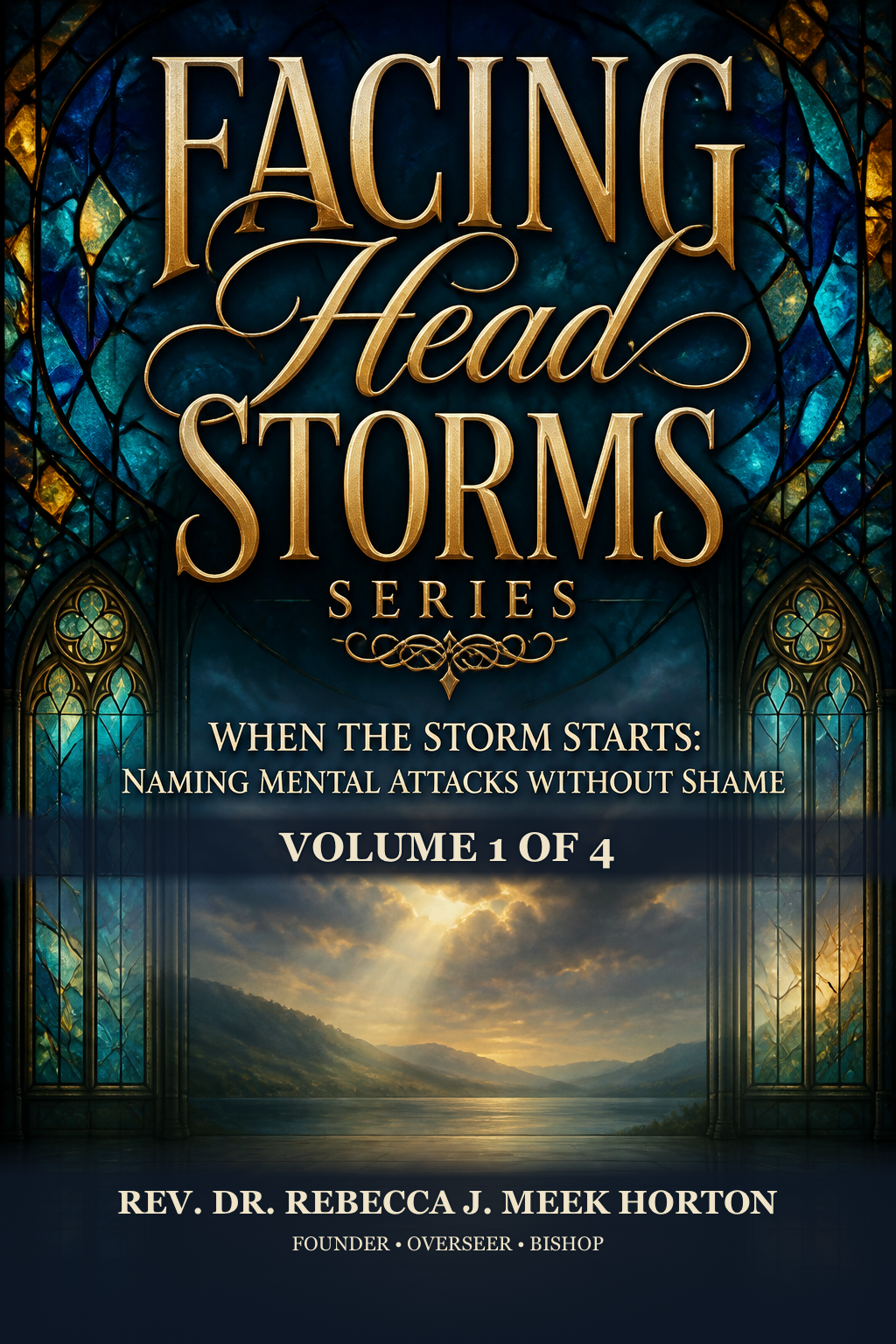
Facing Head Storms · Volume 1
When the Storm Starts: Naming Mental Attacks Without Shame
Part 1 of 4 in the series "Facing Head Storms". Series theme: Ways to facehead storms Series arc: This four-book series moves from recognition to renewal, from renewal to support, and from support to stewardship. The first book helps readers name mental attacks without shame or confusion. The second
Full publication
NBCNGMI MASTER KNOWLEDGE LIBRARY Featuring the works of The Sage, Apostle Prophet. Rev. Dr. Rebecca J. Meek Horton, Apostolic Prophetic Architect, NewBeing Creation Network Global Ministries, Inc. Integrated Framework Modalities™
Chapter 1 — The Storm Has a Name
She sat in the church parking lot with both hands on the steering wheel, trying to breathe before walking inside.
Nothing terrible had happened that morning. No argument. No emergency. No visible crisis.
But inside her mind, a storm was moving.
One thought kept circling: You are failing everyone.
Then another: God must be disappointed in you.
Then another: What if this never gets better?
By the time she opened the car door, she was not only tired from the thoughts. She was ashamed that the thoughts were there.
That shame made the storm heavier.
Many people suffer twice. First, they suffer the mental attack itself. Then they suffer the shame of not knowing how to name it.
The controlling idea of this chapter is simple: a storm loses some of its power when it is named truthfully before God without shame.
Naming is not the same as explaining everything. Naming is not diagnosing yourself. Naming is not pretending every struggle has one cause. Naming is the first faithful act of clarity. It says, “Something is happening in my mind, and I will bring it into the light.”
The Mind Can Become a Battleground
The Bible does not treat the inner life as small.
Thoughts matter. Imaginations matter. Desires matter. Fear matters. The unseen life shapes the lived life.
This is why Scripture speaks seriously about the mind.
2 Corinthians 10:4-5 (KJV)
For the weapons of our warfare are not carnal, but mighty through God to the pulling down of strong holds;) Casting down imaginations, and every high thing that exalteth itself against the knowledge of God, and bringing into captivity every thought to the obedience of Christ;
Paul does not say every thought should be ignored. He says thoughts can be brought into captivity to the obedience of Christ.
That means some thoughts are not neutral.
Some thoughts accuse. Some tempt. Some frighten. Some confuse. Some repeat until they feel stronger than truth. Some rise suddenly and disturb the heart. Some sound like your own voice but carry the weight of a lie.
This book uses the phrase mental attacks to describe those inward pressures that strike the mind and spirit with intrusive thoughts, accusation, fear loops, despair, confusion, temptation, or spiritual pressure.
That phrase is not meant to replace medical language. It is not meant to label every emotion as spiritual warfare. It is not meant to make people afraid of their own minds.
It is a faithful way to say, “There are times when thoughts come against truth, peace, wisdom, obedience, and hope.”
A student may sit in class and suddenly think, I will never be able to do this. A parent may lie awake and replay every possible danger that could touch a child. A minister may finish preaching and immediately hear, You are a fraud. An educator may carry the weight of a classroom and think, Nothing I do matters. A young adult may be tempted by a thought they hate and then feel dirty because it crossed their mind.
The storm does not always announce itself with noise. Sometimes it whispers. Sometimes it repeats. Sometimes it disguises itself as wisdom, caution, humility, or realism.
But fruit reveals much.
If a thought drives you toward God with honesty, repentance, courage, and wise action, it may be part of conviction or discernment.
If a thought drives you toward shame, hiding, panic, despair, secrecy, isolation, or self-destruction, it needs to be named and brought into the light quickly.
This chapter is not asking you to solve the whole storm today.
It is asking you to stop calling the storm “me.”
Naming Without Shame
Shame says, “If I were stronger, I would not think this.”
Wisdom says, “A thought is present. I need to name it honestly and respond faithfully.”
Those two sentences lead to very different places.
Shame pushes people into hiding. It makes a person afraid to pray honestly, afraid to ask for help, afraid to tell a trusted person what is happening. Shame often adds spiritual accusation to mental pressure: If you really loved God, your mind would not be like this.
That is not how Jesus treats the burdened.
Matthew 11:28 (KJV)
Come unto me, all ye that labour and are heavy laden, and I will give you rest.
Jesus does not invite only the calm. He invites the heavy laden.
Mental heaviness is real heaviness. A person can be tired in the body and also tired in the mind. A person can love God and still feel attacked by fear. A person can be saved and still need help learning how to steward thoughts. A person can pray and still need counsel, rest, support, or appropriate care.
Naming without shame sounds like this:
This is an intrusive thought.
This is an accusing thought.
This is a fear loop.
This is despair speaking in absolutes.
This is confusion pressing me to rush.
This is temptation trying to pull me toward compromise.
This is spiritual pressure, and I need to stand in truth.
These statements are not excuses. They are clarifying sentences.
RE-Language™ helps here. Instead of saying, “I am crazy,” say, “I am experiencing mental pressure, and I need wisdom and support.”
Instead of saying, “I am weak,” say, “I am under strain, and I need to respond with truth.”
Instead of saying, “God must be angry with me,” say, “I need to bring this thought before God and test it by Scripture.”
A teacher once noticed a student who kept putting his head down during math. At first, it looked like laziness. But when she asked gently, he said, “Every time I try, my mind says I’m stupid.”
That sentence changed the room.
The teacher could now respond to what was actually happening. The issue was not only math. It was an inner message attacking the student’s courage.
Naming did not solve everything that day. But it opened the right door.
That is what naming can do.
It opens the right door.
If you cannot name the storm, you may fight the wrong thing. You may fight your personality when you need to confront a lie. You may fight your family when you need rest. You may fight God when you need to pour out your heart. You may fight yourself when you need help.
Psalm 62:8 (KJV)
Trust in him at all times; ye people, pour out your heart before him: God is a refuge for us. Selah.
Pouring out your heart is not the same as being ruled by every feeling. It is bringing the real thing before the real God.
That is a mature act.
The Storm May Have More Than One Factor
One of the most important truths in this book is this: not every mental attack has one simple cause.
This must be said plainly.
Some storms are connected to spiritual pressure. Some are connected to exhaustion. Some are connected to trauma. Some are connected to grief. Some are connected to medical conditions. Some are connected to sin patterns. Some are connected to relational stress. Some are connected to lack of sleep, poor nourishment, isolation, or overload. Some are connected to demonic accusation or temptation. Many are a mixture.
Wisdom refuses shallow explanations.
James 1:5 (KJV)
If any of you lack wisdom, let him ask of God, that giveth to all men liberally, and upbraideth not; and it shall be given him.
Notice the mercy in this verse. God gives wisdom. He does not shame the one who asks.
That matters when the storm is confusing.
A parent may say, “My child is just being rebellious,” when the child is actually overwhelmed, anxious, and afraid to disappoint the family.
A minister may say, “I just need to pray harder,” when the body is exhausted from years of carrying crisis without rest.
A student may say, “Something is wrong with me,” when repeated stress, lack of sleep, and fear of failure are feeding a storm.
An educator may say, “I should be able to handle this,” when the weight of compassion fatigue is real.
A believer may say, “This is only spiritual warfare,” and ignore the need for counseling, medical evaluation, rest, or accountability.
Another believer may say, “This is only mental health,” and ignore prayer, Scripture, repentance, spiritual counsel, and obedience.
Both can become incomplete.
Faithful discernment asks better questions.
What is happening in my mind?
What is happening in my body?
What has been happening in my relationships?
What have I been carrying too long alone?
Is there sin I need to confess?
Is there a lie I keep agreeing with?
Is there fear I have allowed to interpret everything?
Is there trauma or grief that needs care?
Is there a medical or mental health concern that needs professional support?
Is there spiritual pressure that must be resisted with truth?
These questions are not meant to make you overthink. They are meant to slow down the rush to one easy answer.
A smoke alarm tells you something needs attention. But it does not tell you whether toast burned, a wire sparked, or a real fire has started in the wall. You still have to look carefully.
Mental storms are similar. The alarm matters. But wisdom looks carefully before deciding what kind of help is needed.
This is not weakness.
This is stewardship.
The First Work Is Recognition
The first work is not to win the whole battle in one moment.
The first work is recognition.
Before you can respond faithfully, you must see what is happening. Before you can bring a thought to truth, you must notice the thought. Before you can ask for help, you must admit that help may be needed. Before you can resist shame, you must hear the shame language clearly enough to reject it.
Recognition is not agreement.
If a thought says, You are worthless, recognizing the thought does not mean believing it. It means you can now separate the thought from truth long enough to respond.
If a thought says, Everyone would be better without you, that thought needs immediate support. Do not sit alone with it. Tell a trusted person, pastor, counselor, doctor, or crisis support service right away. Naming that kind of thought is not dramatic. It is responsible.
If a thought says, You should give up, recognition allows you to say, “Despair is speaking. I need truth and support.”
If a thought says, Hide this, recognition allows you to say, “Secrecy is part of the storm. I need to bring this into wise light.”
The goal is not to become suspicious of every thought. The goal is to become mature enough to notice when a thought is leading you away from truth, wisdom, life, and faithful action.
A man once described his mental storm like standing outside in heavy rain with no coat. He said, “I thought the rain was me. I did not know I could step back and say, ‘It is raining right now.’”
That sentence is simple, but it is powerful.
It is raining right now.
That means the weather is real, but it is not your identity.
A storm is happening, but it is not your name.
A thought is attacking, but it is not your lord.
A lie is loud, but it is not truth.
This is where the series begins. Not with pretending the storm is small. Not with panic. Not with shame. Not with one-size-fits-all answers.
We begin by telling the truth.
Something is happening in the mind.
God is not confused by it.
Wisdom is available.
Help is allowed.
Truth still stands.
The Cost of Naming
Naming the storm will cost you something.
It may cost you the comfort of denial. It may cost you the habit of pretending you are fine. It may cost you the pride of always being the strong one. It may cost you the secrecy that has protected shame. It may cost you the quick answer you wanted.
It may also require courage to say to someone safe, “I need help.”
For ministers, this can feel especially costly. People may expect you to always have language, strength, and answers. But shepherds are still sheep before the Chief Shepherd.
For parents, it may feel costly to admit that a child’s storm is not solved by correction alone. Love may require listening, boundaries, prayer, and support.
For students, it may feel costly to tell an adult, “My thoughts are scaring me.” But silence is not safety.
For educators, it may feel costly to recognize that what looks like behavior may be distress. Wisdom sees beyond the surface without excusing harm.
For believers, it may feel costly to hold together Scripture, prayer, counsel, medical wisdom, and daily responsibility. But truth is not threatened by wise care.
The cost is real.
But the cost of not naming the storm is often greater.
Unnamed storms grow in darkness. Named storms can be brought before God, examined with wisdom, and addressed with support.
That is why this first step matters.
Key Takeaways
• A mental attack can be named without shame.
• Not every storm has one simple cause.
• Recognition is the first faithful step toward wisdom and care.
Practice
Take five quiet minutes today.
Write one sentence that names what has been happening in your mind without attacking yourself.
Use this form:
I am noticing __________________________, and I am bringing it before God for wisdom, truth, and the next faithful step.
If what you are noticing includes thoughts of harming yourself or someone else, do not wait. Tell a trusted person immediately and seek urgent professional or crisis support. That is not failure. That is faithful stewardship of life.
Chapter 2 — You Are Not the Storm
The first time the thought came, it sounded like truth.
It did not announce itself as an attack. It did not say, I am here to weaken you. It sounded personal. It sounded final. It sounded like a verdict.
You are failing. You are too much. God is tired of you. You will never get free. Something is wrong with you.
The person hearing it may have been driving to work, sitting in class, washing dishes, trying to pray, or lying awake at 2:00 a.m. Nothing dramatic happened on the outside. But inside, a storm started pressing against identity.
That is why this chapter matters.
A thought can attack you without defining you.
You are not the storm. You are not every thought that crosses your mind. You are not the accusation that rises when you are tired. You are not the fear that repeats itself. You are not the despairing sentence that tries to write your future in one dark line.
In Christ, your identity is not decided by mental noise. It is received from God, guarded by truth, and strengthened as you learn to separate what is attacking you from who you are.
Romans 8:1 (KJV)
There is therefore now no condemnation to them which are in Christ Jesus, who walk not after the flesh, but after the Spirit.
Condemnation tries to name you by your struggle.
Christ names you by His grace.
The Thought Is Real, But It Is Not Lord
A thought can feel powerful and still not be true.
That is hard to believe when the thought is loud. Mental attacks often gain strength by sounding urgent. They demand attention. They press for agreement. They want you to stop and build your identity around them.
But a thought is not automatically truth because it appeared in your mind.
Some thoughts are observations. Some are temptations. Some are fears. Some are old wounds speaking in familiar language. Some are accusations. Some are reactions from stress, trauma, exhaustion, grief, or pressure. Some are spiritual attacks. Some are a mixture, and wisdom must slow down enough to discern.
This chapter is not asking you to pretend thoughts do not hurt. It is teaching you not to surrender your name to them.
Think of a bird flying over your house during a storm. You hear the wings. You see the shadow pass over the window. But the bird does not own the house because it flew over it.
In the same way, a thought may pass through the mind. It may even return again and again. But return does not equal ownership. Volume does not equal authority. Repetition does not equal identity.
This is where many people need RE-Language™.
Not, I am anxious, so anxiety is who I am.
But, I am experiencing anxious thoughts, and I need to bring them under truth and care.
Not, I am condemned because this thought came.
But, This thought is accusing me, and accusation is not the same as God’s voice.
Not, My mind is a mess, so I must be a mess.
But, My mind is under pressure, and I can seek wisdom, support, and the next faithful step.
This shift does not deny responsibility. It creates room for it. Shame says, Hide. Wisdom says, See clearly and respond faithfully.
When a thought attacks, the first act of wisdom may be simple: do not immediately agree with it.
You can pause and say, This thought is present, but it is not my master.
Known by God Before the Storm
Psalm 139 gives us a strong anchor because it begins with God’s knowledge of us.
Before we understand ourselves fully, God knows us. Before we can sort through every thought, God sees us. Before the storm has a name, God is already acquainted with the person standing inside it.
Psalm 139:1-4 (KJV)
O lord, thou hast searched me, and known me. Thou knowest my downsitting and mine uprising, thou understandest my thought afar off. Thou compassest my path and my lying down, and art acquainted with all my ways. For there is not a word in my tongue, but, lo, O LORD, thou knowest it altogether.
This is not shallow comfort. It is deep truth.
God knows your thoughts afar off. That means He is not shocked by what frightens you. He is not confused by the noise. He is not learning about your struggle at the same time you are learning about it.
He knows.
And His knowledge is not careless. It is not cold. Psalm 139 does not present God as distant surveillance. It presents Him as holy, present, searching, and acquainted with all our ways.
For the person under mental attack, this matters because shame often says, If God knew what passed through my mind, He would turn away.
But Scripture says God already knows.
The question is not whether God knows. The question is whether we will bring what He already sees into His presence with honesty.
A student may sit in a classroom afraid to ask for help because they think the teacher will be disappointed. But a good teacher already sees the struggle. The help begins when the student stops hiding the confusion.
A parent may watch a child wrestle with fear at night. The parent does not love the child less because the child is afraid. The parent draws near, helps name what is happening, and teaches the child how to breathe, pray, and rest.
God’s knowledge is not permission to stay passive. It is an invitation to come out of hiding.
You do not have to clean up every thought before you come to Him. You come to Him because you need truth, mercy, wisdom, and help.
Identity Is Received, Not Invented in a Storm
Storms are poor places to create identity.
When wind is loud, vision is limited. When fear rises, conclusions become narrow. When accusation presses, the soul starts looking for evidence against itself. That is why we must not let our darkest moments write our deepest definitions.
Identity in Christ is not invented during crisis. It is received from what God has already spoken and done.
Romans 8:1 begins with therefore. It stands on the finished work of Christ and the life of the Spirit. The believer is not standing before God trying to earn a non-condemned identity by having perfect thoughts. The believer stands in Christ.
This does not mean every thought is harmless. It does not mean sin is imaginary. It does not mean temptation should be entertained. It means condemnation is not the governing voice over the one who belongs to Christ.
Conviction may lead you to repent, repair, confess, seek help, or change direction.
Condemnation tries to make you collapse under a false name.
There is a difference between God showing you something that needs to be brought into the light and a mental attack telling you that you are beyond grace.
A father correcting a child may say, That behavior was wrong. Come here. Let us deal with it.
Accusation says, You are wrong all the way through. Run away. Hide. There is no use trying.
The Lord’s correction is truthful and purposeful. It brings us toward Him. Condemnation crushes and isolates. It makes the storm feel like the whole story.
Psalm 139 also reminds us that we are not accidents, not random, and not disposable.
Psalm 139:13-14 (KJV)
For thou hast possessed my reins: thou hast covered me in my mother's womb. I will praise thee; for I am fearfully and wonderfully made: marvellous are thy works; and that my soul knoweth right well.
The storm may say, You are nothing.
Scripture says you are known by God.
The storm may say, You are only your weakness.
Scripture says God’s works are marvellous.
The storm may say, You are too complicated to help.
Scripture says God formed you, knows you, searches you, and can lead you.
This does not remove all struggle in one moment. It gives your soul a place to stand while the struggle is being faced.
You are not required to build your identity out of the worst sentence your mind has spoken.
You are invited to receive your identity from the God who knows you fully and calls you toward life.
Separate the Voice From the Self
One of the most important skills in facing head storms is learning to separate the voice of the storm from the self.
This is not pretending. This is discernment.
When a thought says, I am worthless, slow down. That sentence may feel like it belongs to you, but it needs to be examined.
A clearer way to name it is: A thought is telling me I am worthless.
That small change matters.
The first sentence merges your identity with the attack. The second sentence creates enough space for wisdom.
A thought is telling me God has left me. A thought is telling me I will never change. A thought is telling me no one cares. A thought is telling me I should give up. A thought is telling me I am condemned.
Now the thought can be brought before Scripture, prayer, counsel, and care. It can be tested. It can be answered. It can be refused.
This is part of maturity. We do not attack ourselves for having a thought. We learn to steward our response to the thought.
Consider a person receiving a piece of mail addressed to the wrong name. The envelope arrives at the house, but that does not mean the contents belong to them. They can look at it and say, This came to my address, but it is not mine to keep.
Some thoughts arrive like wrongly addressed mail. They come near. They demand to be opened. They may even look official because they carry the stamp of fear, memory, or pain. But not everything delivered to your mind belongs in your identity.
This is also where wise support matters. Sometimes the storm is too loud to sort alone. A pastor, counselor, doctor, mentor, teacher, parent, or mature believer may help you separate the voice of the storm from the truth of who you are. Seeking help is not a denial of faith. It can be an act of stewardship.
This book will say that more fully later, but it belongs here too: you are not spiritually inferior because you need support.
You are a whole person. Spiritual, mental, emotional, physical, and relational pressures can overlap. Wisdom does not shame the overlap. Wisdom brings it into the light.
The Cost of Refusing False Names
There is a cost to separating identity from the storm.
It may feel easier at first to agree with the thought because agreement requires less resistance. If the thought says, You will never change, you may feel too tired to argue. If it says, God is done with you, shame may tell you not to pray. If it says, You are the problem, isolation may feel safer than reaching out.
Refusing false names takes courage.
It asks you to pause when you want to collapse.
It asks you to bring thoughts into the light when shame wants secrecy.
It asks you to receive Scripture as truth even when your emotions are not yet calm.
It asks you to say, This is attacking me, but it is not allowed to define me.
That can feel unnatural at first.
If you have lived for years under accusation, peace may feel unfamiliar. If fear has trained your nervous system to expect danger, truth may need to be repeated gently and consistently. If despair has spoken in absolutes for a long time, hope may feel small before it feels strong.
Do not despise small beginnings.
A clear sentence can be a faithful beginning.
I am in a storm, but I am not the storm.
That sentence does not solve everything. It helps you stop merging with the attack. It gives you enough space to pray, breathe, tell the truth, ask for help, and take the next faithful step.
Psalm 139 ends with a prayer that is honest and brave.
Psalm 139:23-24 (KJV)
Search me, O God, and know my heart: try me, and know my thoughts: And see if there be any wicked way in me, and lead me in the way everlasting.
This is not the prayer of someone hiding from God.
It is the prayer of someone willing to be searched and led.
That is the posture we need. Not shame. Not denial. Not self-attack. Not pretending every thought is harmless. Honest openness before God.
Lord, search me. Lord, know my heart. Lord, try my thoughts. Lord, show me what needs correction. Lord, lead me in the way everlasting.
This prayer keeps two truths together.
God can correct what is wrong.
And God does not condemn His children as worthless.
You can be searched without being destroyed. You can be corrected without being rejected. You can be under pressure without being defined by pressure.
Key Takeaways
• A thought can attack you without defining you.
• Your identity in Christ is stronger than the noise of the storm.
• Shame hides the struggle, but wisdom brings it into God’s light.
Practice
Today, write down one thought that has been trying to define you.
Do not write it as your identity. Write it this way:
A thought is telling me ____________________.
Then write this truth beneath it:
I am in a storm, but I am not the storm. In Christ, condemnation does not have the final word.
Read Romans 8:1 aloud slowly. Then pray Psalm 139:23-24 in your own words, asking God to search you, steady you, and lead you in the next faithful step.
Chapter 3 — What Mental Attacks Can Sound Like
A thought can enter the mind like a knock at the door.
Sometimes it is light and passing. You notice it, dismiss it, and keep moving.
Sometimes it knocks again.
And again.
Sometimes it does not feel like a knock at all. It feels like a storm beating against the windows, demanding to be believed, obeyed, or feared.
A mother is washing dishes and suddenly thinks, What if something terrible happens to my child? A student opens a book and hears inside, You are going to fail anyway. A minister prepares to preach and is struck by, Who do you think you are? A tired man lies down at night and the same regret plays over and over until sleep feels impossible.
The thought may not be chosen.
But it is present.
The single controlling idea of this chapter is simple: mental attacks often have recognizable patterns, and learning what they can sound like helps you respond with wisdom instead of shame.
We are not yet trying to solve every cause. We are not labeling every struggle as only spiritual, only emotional, only physical, or only circumstantial. We are learning to listen carefully enough to recognize patterns.
A passing thought is different from a repeated pattern.
A repeated pattern is different from a thought that needs immediate support.
Naming the difference is not fear. It is stewardship.
Proverbs 14:15 (KJV)
The simple believeth every word: but the prudent man looketh well to his going.
Not every thought deserves your agreement. Not every inner sentence is truth. The prudent person learns to look carefully.
Accusing Thoughts
Accusing thoughts often sound like a courtroom in the mind.
They do not simply point to something that needs correction. They prosecute the whole person.
They say:
You are a failure.
God is disappointed in you.
You always ruin everything.
No one should trust you.
You are not really saved.
You are too damaged to be used.
You should be ashamed to ask for help.
Accusation is heavy because it often uses pieces of truth in a cruel way. It may point to a real mistake, a real weakness, or a real regret. But then it makes a false conclusion about your identity, your future, or God’s mercy.
That is one reason accusation can feel convincing.
A student forgets an assignment. The fact is simple: the assignment was missed. A wise response would be responsibility: “I need to tell the teacher, ask what can be done, and make a better plan.” But accusation says, You are lazy. You will never succeed. Everyone else is better than you.
A parent loses patience and speaks harshly. Conviction may lead that parent to apologize, repair, and ask God for help. Accusation says, You are just like the people who hurt you. Your children would be better without you.
A minister mishandles a conversation. Wisdom may say, “Go back. Clarify. Repent where needed.” Accusation says, You are disqualified from everything.
Do you hear the difference?
Accusation does not lead to humble obedience. It drives the soul into hiding, despair, defensiveness, or performance. It crushes without restoring.
This chapter will not fully separate accusation from conviction; that comes later. For now, notice the sound. Accusing thoughts tend to be harsh, total, shaming, and isolating. They often use words like always, never, nothing, no one, and impossible.
They do not invite you to take one faithful step.
They try to name you.
When accusation rises, begin with this RE-Language™ shift:
Not, “This thought is me.”
But, “This is an accusing thought passing through my mind, and I need to test it before I agree with it.”
That one shift creates space.
Repeated Fear
Fear often speaks in forecasts.
It tells the future with confidence it does not have.
What if they leave?
What if you get sick?
What if you fail?
What if God does not help?
What if this never changes?
What if everyone finds out?
What if your child is not safe?
A fear thought may begin as a concern. Concern can be useful. It helps us pay attention, plan responsibly, and protect what matters. But repeated fear becomes a loop when the mind rehearses danger without moving toward wisdom.
Fear loops often sound like questions, but they are not always honest questions. Sometimes they are predictions wearing question marks.
A young person sends a message and does not get a quick reply. The first thought is, Maybe they are busy. Then fear speaks: What if they are mad? What if I said something wrong? What if everyone is talking about me? Within minutes, the mind has built a whole story without evidence.
A parent hears a cough from a child. Care says, “Check on the child.” Fear says, What if this is serious? What if I missed something? What if I am a bad parent? The body tightens. The mind searches. The internet opens. The storm grows.
An educator receives an email from administration: “Can we meet tomorrow?” Fear says, You are in trouble. Your job is at risk. You did something wrong. Sleep disappears over a message that did not say any of those things.
Fear loops feel powerful because they ask for immediate certainty. But life rarely gives immediate certainty. Wisdom asks for the next faithful step.
That may mean checking facts.
It may mean praying honestly.
It may mean asking one trusted person for perspective.
It may mean waiting until more information is available.
It may mean refusing to rehearse the same false forecast for the tenth time.
1 John 4:1 (KJV)
Beloved, believe not every spirit, but try the spirits whether they are of God: because many false prophets are gone out into the world.
That verse is about spiritual discernment, but the principle teaches us not to believe every message just because it is loud. A thought may feel urgent and still need to be tested.
Repeated fear often says, Decide now. Panic now. Protect yourself now. Assume the worst now.
Wisdom slows the storm enough to ask, What do I actually know? What am I assuming? What is one responsible step?
Despairing Conclusions
Despair does not always begin by saying, “Give up.”
Sometimes it begins by saying, “Nothing will change.”
That is a conclusion.
Despairing thoughts often sound final:
This is always going to be my life.
No one cares.
God is not listening.
I cannot keep doing this.
Nothing helps.
There is no point trying.
I am too far gone.
My family will never heal.
My mind will never be quiet.
Despair often speaks after exhaustion, disappointment, grief, rejection, chronic stress, sickness, trauma, or long waiting. It may grow louder when the body is depleted and the soul has carried too much without support.
This is why we must be tender and truthful.
Despairing thoughts should not be mocked. They often rise in real pain. But pain does not make every conclusion true.
A person in deep discouragement may say, “No one cares.” The pain may be real. Loneliness may be real. Neglect may be real. But the word no one may not be true. There may be one person who would come if they knew. There may be one pastor, counselor, teacher, mentor, doctor, family member, or friend who needs to be told plainly, “I am not okay.”
Despair thrives in silence.
It also thrives in absolutes.
Always.
Never.
No one.
Nothing.
Impossible.
Those words can turn a hard season into a life sentence.
This does not mean we deny suffering. Scripture does not teach us to pretend. The Psalms give language for anguish, complaint, sorrow, and waiting. God is not offended by honest lament. But lament brings pain into the presence of God. Despair tries to lock pain in a room alone.
A college student fails an important exam and thinks, My future is over. That thought feels true because disappointment is fresh. But a failed exam may require repair, counsel, tutoring, humility, and a new plan. It does not have authority to define an entire future.
A widow wakes up to another quiet morning and thinks, I will never feel joy again. The grief is real. The absence is real. But the word never may be too heavy for that moment to carry. Today may be a day to weep, eat, call someone, and take one small step.
A minister sees slow growth in the church and thinks, Nothing I do matters. But faithfulness is not always measured by visible speed. Some seeds grow underground before they show above ground.
When despair speaks, do not argue with it in pride. Answer it with care.
Not, “I should not feel this.”
But, “This is a despairing conclusion. It may be connected to real pain, but I need truth, support, and one next step.”
If despair includes thoughts of harming yourself, wishing you would not wake up, making a plan to die, or feeling unable to stay safe, that is not a moment for private spiritual toughness. Tell someone immediately. Contact emergency services in your area, call a crisis line, reach out to a trusted adult, pastor, counselor, doctor, family member, or safe friend. If you are with someone who says these things, stay with them and get help.
That is not shame.
That is stewardship.
Compulsive Mental Noise
Some mental attacks do not come as one clear sentence.
They come as noise.
Racing thoughts.
Repeated images.
Endless reviewing.
Mental arguments.
Checking and rechecking.
Rehearsing conversations that already happened.
Preparing for conversations that may never happen.
Trying to solve every possible outcome before morning.
This kind of storm can feel like the mind is full of open tabs, and every tab is making sound.
Compulsive mental noise often says, Think harder. Review again. Solve it now. Do not rest until you are certain.
But the more the person thinks, the less clear things become.
A teacher replays a difficult classroom moment all evening. Did I respond too strongly? Did I embarrass the student? Will the parent complain? Should I have said it differently? Some reflection is healthy. But when reflection becomes circular punishment, it stops producing wisdom.
A teenager re-reads a text thread twenty times, trying to decode tone. A short reply becomes evidence. A period at the end of a sentence becomes rejection. The mind keeps searching for certainty in a place where certainty may not be available.
A leader lies awake replaying a meeting. The mind argues with people who are not in the room. It drafts speeches. It defends motives. It imagines criticism. By morning, the body is tired, but nothing has been resolved.
Mental noise often grows when there is unprocessed stress, lack of sleep, too much stimulation, fear of conflict, trauma reminders, unresolved decisions, or spiritual pressure. Again, we do not reduce every storm to one cause. We observe the pattern.
One important distinction is this: not all thinking is wisdom.
Wisdom has fruit. It clarifies, humbles, guides, and prepares responsible action.
Noise multiplies pressure without producing obedience.
A helpful question is: After thinking about this for ten minutes, am I clearer and more faithful, or am I more tangled and afraid?
If you are more tangled, the next step may not be more thinking. It may be writing the thought down, praying simply, asking for counsel, resting the body, or choosing one action for tomorrow.
Compulsive noise often loses some power when it is moved from the mind to paper. A thought that feels huge inside may become clearer when written in one sentence.
“I am afraid that I damaged the relationship.”
“I am replaying the meeting because I want to control how people see me.”
“I need to apologize for one sentence, but I do not need to punish myself all night.”
“I do not have enough information yet.”
This is part of RE-Cognition™. You are intentionally identifying what is happening so you can respond with stewardship.
Tempting Suggestions
Temptation can sound reasonable.
It may not begin with something dramatic. It may begin with relief.
You deserve this.
Just this once.
No one will know.
You have been under so much pressure.
They hurt you first.
You can repent later.
This will make the pain stop.
You need to protect yourself.
Send the message.
Open the site.
Take the money.
Tell the story your way.
Stay angry.
Do not forgive.
Do not ask for help.
Tempting suggestions often offer a shortcut around pain, humility, patience, honesty, or obedience. They promise relief, control, pleasure, revenge, escape, or approval. But they do not show the cost clearly.
James gives sober language about temptation.
James 1:14-15 (KJV)
But every man is tempted, when he is drawn away of his own lust, and enticed.
Then when lust hath conceived, it bringeth forth sin: and sin, when it is finished, bringeth forth death.
Temptation is not the same as sin. Being tempted does not mean you have already failed. But temptation becomes dangerous when we begin to entertain it, excuse it, hide it, or rename it as wisdom.
A married person under emotional strain begins to enjoy attention from someone else. The thought says, They understand me better. It is not really wrong. I just need someone to talk to. Wisdom says, This path needs light, boundaries, counsel, and honesty before it becomes destruction.
A student feels overwhelmed and thinks, I could cheat just this once. The pressure is real. The temptation offers relief. But the cost is integrity.
A wounded person thinks, I should post the whole story so everyone knows what they did. There may be injustice that needs to be addressed. But temptation may twist justice into exposure, revenge, or public harm. Wisdom asks, What is righteous, timely, and accountable?
Temptation often needs interruption. Not panic. Interruption.
Stop.
Name it.
Move into the light.
Contact accountability.
Leave the environment.
Tell the truth quickly.
Do the next obedient thing.
The longer temptation is hidden, the more persuasive it becomes.
The goal is not to shame yourself for being tempted. The goal is to refuse agreement with what will destroy you or others.
Passing, Pattern, or Immediate Support
Now we need to make an important distinction.
A passing thought is a thought that comes and goes. It may be strange, fearful, tempting, or upsetting, but it does not keep taking over your attention. You can notice it, reject it, pray, redirect, and move on.
Example: You are driving and suddenly think, What if I crash? The thought startles you, but it passes. You keep driving safely.
A repeated pattern is a thought or type of thought that returns often enough to shape your mood, choices, sleep, relationships, or obedience. It may not be an emergency, but it needs attention.
Example: Every night you replay conversations and accuse yourself for hours. You are losing sleep and becoming anxious around people. That pattern needs care, truth, and possibly counsel.
A thought that needs immediate support is one connected to danger, loss of control, severe distress, or inability to stay safe. It should not be handled alone.
This includes thoughts about harming yourself or someone else, feeling commanded to do harm, feeling unable to resist destructive urges, being unable to function, severe confusion, losing touch with reality, or being in a situation of abuse or immediate danger.
If this is you, tell someone now. If you are a student, tell a safe adult, parent, school counselor, teacher, pastor, or emergency responder. If you are a parent, minister, educator, or mentor and someone tells you they may harm themselves or someone else, take it seriously. Stay calm. Stay present. Get appropriate help.
Do not make shame the gatekeeper of safety.
The tension is that naming these patterns asks for humility. It is easier to say, “I am fine,” than to admit, “My mind has been under attack.” It is easier to spiritualize everything than to seek practical care. It is easier to medicalize everything than to pray and test thoughts with Scripture. It is easier to hide than to invite wise support.
But maturity refuses easy extremes.
You can pray and call the counselor.
You can quote Scripture and get sleep.
You can resist the enemy and talk to your doctor.
You can repent where needed and reject false shame.
You can be spiritually serious and emotionally honest.
Naming the sound of the storm does not make you weak. It makes you more ready to respond.
Key Takeaways
• Mental attacks often have recognizable sounds: accusation, fear, despair, noise, and temptation.
• A thought can be present without being true, final, or part of your identity.
• Learn the difference between a passing thought, a repeated pattern, and a thought that needs immediate support.
Practice
Take ten quiet minutes today and write three columns on paper:
Passing Thought
Repeated Pattern
Needs Support
Under each column, write one example from your own life if it applies.
Then choose one repeated pattern and write this sentence:
“This is a repeated pattern of __________. I will not receive it as my identity. My next faithful step is __________.”
If the thought belongs in the “Needs Support” column, do not wait. Tell a safe person today and ask them to help you take the next step.
Chapter 4 — See Before You Fight
The phone lit up at 1:17 in the morning.
No emergency. No call. Just a short message with too few words and too much space around them.
We need to talk tomorrow.
That was all.
But the mind did not treat it as all. Within seconds, tomorrow became disaster. The body tightened. The stomach dropped. The mind began building scenes: rejection, accusation, loss, embarrassment, abandonment. Sleep left the room. Prayer felt far away. One sentence became a storm.
Many mental attacks begin like that.
A small trigger opens the door, and the mind starts running before wisdom has a chance to stand up.
The controlling idea of this chapter is simple: before you fight a mental attack, you must slow down enough to see what is actually happening. Seeing is not weakness. Seeing is wisdom. Observation is not agreement with the thought. It is the first faithful act that keeps you from reacting to noise as if it were truth.
SAPP™ Discernment gives us a simple way to slow down: See the situation truthfully, Ask the deeper questions, Ponder the motives and costs, and Practice the next faithful step.
A storm becomes more dangerous when we cannot tell the difference between the trigger, the thought, the feeling, the body response, and the next action. SAPP™ helps us separate them without shame.
The First Mercy Is a Pause
When a thought hits hard, the first impulse is often to answer it quickly.
Fix it now.
Text back now.
Quit now.
Defend yourself now.
Hide now.
Make a promise now.
Escape now.
But urgency is not always wisdom. Sometimes urgency is fear wearing a loud coat.
A pause does not mean you are ignoring the problem. It means you are refusing to let the storm become your leader. You are creating enough space to see.
Proverbs 14:15 (KJV)
The simple believeth every word: but the prudent man looketh well to his going.
The prudent person does not believe every word. That includes every word that rises inside the mind. Every thought is not a command. Every fear is not a prophecy. Every accusation is not the voice of God. Every desire is not direction.
A pause gives you room to say, “Something is happening in me, but I do not have to obey it immediately.”
Consider a student who receives a low grade. The first thought says, “I am a failure.” The feeling is shame. The body response is heaviness. The urge is to stop trying. If the student reacts immediately, one grade becomes an identity. But if the student pauses, the picture becomes clearer: “I did poorly on this assignment. I feel ashamed. I need help understanding what I missed. One grade is not my whole future.”
That is not denial. That is seeing.
Consider a parent whose child does not answer the phone. The first thought says, “Something terrible has happened.” The feeling is panic. The body response is racing. The urge is to call ten times, send angry messages, or imagine the worst. A pause does not mean the parent stops caring. It means the parent checks the facts, breathes, prays, and takes a responsible step.
Consider a minister who hears criticism after teaching. The first thought says, “I should never speak again.” The feeling is embarrassment. The urge is withdrawal. But a pause allows a better question: “Was there truth in what was said? Was it delivered wisely? Do I need correction, rest, counsel, or simply thicker skin?”
The pause is not passive. It is spiritual and practical stewardship.
You are not surrendering to the storm. You are refusing to swing blindly inside it.
See What Is Happening
SAPP™ begins with See.
See the situation truthfully.
Not dramatically. Not shamefully. Not vaguely. Truthfully.
Many people say, “I am losing my mind,” when what they may need to say is, “I am having repeated fear thoughts after a stressful conversation.”
They say, “I am a terrible Christian,” when what they may need to say is, “I am being pressed by accusation, and I need to bring this into the light.”
They say, “Everything is falling apart,” when what they may need to say is, “Three things are unresolved, and I feel overwhelmed.”
RE-Language™ matters here. Words can either increase confusion or create stewardship.
Try separating the storm into five parts:
Trigger: What happened?
Thought: What did my mind say?
Feeling: What emotion rose up?
Body: What did I notice physically?
Urge: What do I want to do next?
This is not overthinking. This is ordering.
For example:
Trigger: I saw a bill I cannot pay today.
Thought: I will never get out of this.
Feeling: Fear and shame.
Body: Tight chest, tired eyes, restless hands.
Urge: Avoid the bill and stop answering calls.
Once the parts are separated, the storm becomes nameable. The person can now say, “I am facing financial pressure, and a despairing thought is trying to take over.” That is different from, “My life is over.”
Seeing does not solve everything at once. It brings the matter out of the fog.
Psalm 139:23-24 (KJV)
Search me, O God, and know my heart: try me, and know my thoughts: And see if there be any wicked way in me, and lead me in the way everlasting.
This prayer is not a performance. It is an invitation for God to search what feels tangled. Notice that the psalmist does not pretend the heart is simple. He brings the heart and thoughts before God.
Seeing with God is different from inspecting yourself with shame.
Shame says, “Find what is wrong with you so you can condemn yourself.”
Wisdom says, “Let God show what is true so you can walk rightly.”
A mental attack often gains power by staying unnamed. It hides behind vague heaviness. It hides behind “I do not know what is wrong with me.” It hides behind embarrassment. But when you name what is happening with humility, you begin to take responsibility without taking false blame.
You might say:
• A repeated thought is telling me I am alone.
• A fear thought is forecasting disaster.
• An accusing thought is trying to define me by one mistake.
• My body is exhausted, and my mind is more vulnerable tonight.
• I am tempted to make a permanent decision from a temporary storm.
Simple language can become a shield.
Not because words are magic, but because truth brings order.
Ask the Deeper Questions
After See comes Ask.
Ask the deeper questions.
The first question is usually loud: “How do I make this stop?”
That question is understandable. When the mind hurts, relief matters. But relief is not the only question. Wisdom asks deeper.
What is true here?
What do I actually know?
What am I assuming?
What am I afraid will happen?
What desire is being threatened?
What pressure am I under?
What have I not slept, eaten, grieved, confessed, or discussed?
What does Scripture clearly say?
Who can help me see this wisely?
James 1:5 (KJV)
If any of you lack wisdom, let him ask of God, that giveth to all men liberally, and upbraideth not; and it shall be given him.
God does not shame His children for needing wisdom. He invites them to ask.
That matters because mental attacks often make people feel foolish for needing help. But asking is not immaturity. Asking can be obedience.
A young adult may feel a sudden wave of dread before making a career decision. The loud question is, “What if I ruin my whole life?” SAPP™ invites better questions: “What decision is actually before me? What deadline is real? What counsel have I received? What skill or resource do I lack? Am I afraid of failure, or am I sensing a true warning? What is the next faithful step, not the next ten years?”
A spouse may feel rage after a tense conversation. The loud question is, “How do I prove I am right?” Wisdom asks, “What hurt was touched? What did I hear that may not have been said? Am I seeking peace or control? What words will I regret if I speak from this heat?”
A pastor, educator, mentor, or parent may carry the weight of many people’s needs. The loud question is, “Why can’t I fix everyone?” Wisdom asks, “What is mine to steward? What belongs to God? What belongs to another person? What support or boundary is needed?”
Asking deeper questions slows the storm because it interrupts the automatic story.
The mind may say, “This always happens.”
Ask, “Always?”
The mind may say, “No one cares.”
Ask, “No one?”
The mind may say, “Nothing will change.”
Ask, “What is one thing that can be addressed today?”
You are not arguing with yourself in circles. You are refusing to let exaggerated language govern your next step.
Ask with humility. Ask with Scripture open. Ask with counsel when needed. Ask without pretending that one question will explain every layer.
Sometimes the answer is spiritual. Sometimes the answer is practical. Sometimes the answer includes rest, food, medical care, confession, forgiveness, grief, protection, or a hard conversation. Often, several things are happening at once.
Wisdom does not panic when the picture is layered. Wisdom keeps asking until the next responsible step becomes clear.
Ponder the Pressure and the Cost
After Ask comes Ponder.
Ponder the motives and costs.
This is where many people want to skip ahead. We want relief, not reflection. We want the storm quiet, not exposed. But some storms keep returning because we keep reacting to them without learning what feeds them.
Pondering is not rumination. Rumination circles the same fear again and again. Pondering weighs the matter before God with honesty.
Proverbs 18:13 (KJV)
He that answereth a matter before he heareth it, it is folly and shame unto him.
That verse applies to conversations with other people, but it also gives wisdom for the inner life. If you answer the storm before you hear what is really happening, you may respond foolishly.
Ponder the pressure.
Am I tired?
Am I grieving?
Am I under spiritual pressure after obeying God?
Am I reacting to old pain in a present situation?
Am I carrying responsibility that is not mine?
Am I isolated?
Am I hiding something?
Am I afraid to disappoint someone?
Am I tempted to choose comfort over obedience?
Ponder the cost.
What will happen if I obey this thought?
What will happen if I speak from this feeling?
What will happen if I hide?
What will happen if I delay getting help?
What will happen if I tell the truth?
What will happen if I take one faithful step instead of chasing total control?
A teacher receives a harsh message from a parent. The teacher feels accused and wants to reply immediately. Pondering asks, “What is the cost of answering while angry? What is the cost of ignoring it? What is the wise process? Do I need an administrator present? What tone represents Christ and protects truth?”
A teenager feels rejected after being left out. The urge is to post something sharp online. Pondering asks, “What will this produce tomorrow? Am I trying to be understood, or am I trying to wound? Who can I talk to before I make my pain public?”
A ministry leader feels pressure to say yes to another request. The mind says, “If you do not do it, people will think you do not care.” Pondering asks, “Is this love, fear, or people-pleasing? What has God actually assigned to me? What will this cost my family, body, prayer life, and integrity?”
Pondering tells the truth about consequences.
This is not meant to make you afraid of every choice. It is meant to restore stewardship. You do not have to be ruled by the loudest thought in the room. You can weigh the path.
Practice One Responsible Step
After See, Ask, and Ponder comes Practice.
Practice the next faithful step.
Not the perfect step.
Not the step that guarantees no pain.
Not the step that gives full control.
The next faithful step.
This is important because mental attacks often demand an all-or-nothing response. They pressure you to solve your whole life immediately. But God often leads by enough light for the next step.
Psalm 119:105 (KJV)
Thy word is a lamp unto my feet, and a light unto my path.
A lamp gives real light, but it does not always show the whole road. That is mercy. If God showed us everything at once, many of us would collapse under the weight. So He teaches us to walk.
One responsible step may be writing the thought down instead of obeying it.
One responsible step may be opening Scripture before opening another message.
One responsible step may be drinking water, eating something, and sleeping before making a major decision.
One responsible step may be calling a trusted believer and saying, “I need help seeing this clearly.”
One responsible step may be apologizing.
One responsible step may be setting a boundary.
One responsible step may be scheduling counseling or medical care.
One responsible step may be telling someone immediately, “I am not safe alone right now,” if thoughts of self-harm or harm to others are present.
That last one matters. A faithful step is not always private prayer. Sometimes faithful stewardship is bringing the storm into immediate support. That is not shameful. That is wise.
The goal of SAPP™ is not to make you dependent on someone else to think for you. The goal is to help you become responsible, truthful, and supported as you walk with God.
A simple SAPP™ statement might sound like this:
“I see that after that conversation, I am having repeated thoughts of rejection. I am asking what is true and what I may be assuming. I am pondering the cost of withdrawing from everyone. My next faithful step is to pray, write the facts, and call one mature friend before I respond.”
That is clear.
That is humble.
That is movement.
What This Will Cost
Seeing before you fight will cost you speed.
You may not get to send the quick reply, make the dramatic exit, or feed the familiar story. You may have to sit quietly when everything in you wants to react. You may have to admit, “I do not know yet.” You may have to ask for counsel. You may have to face the difference between what happened and what fear added to it.
This practice may also cost you pride.
It is humbling to say, “My first interpretation may not be accurate.” It is humbling to acknowledge exhaustion, bitterness, fear, temptation, or unresolved grief. It is humbling to need help.
But the cost is not punishment. It is formation.
The person who learns to see before reacting becomes less easy to move by every thought, every mood, every accusation, every fear, and every pressure. That person becomes more teachable. More steady. More truthful. More able to receive wisdom.
This does not mean the storms disappear overnight. It means the storm no longer gets the first and final word.
Key Takeaways
• Seeing is not surrender; it is wisdom before action.
• SAPP™ helps separate the trigger, thought, feeling, body response, and urge.
• The next faithful step is better than a rushed reaction.
Practice
Choose one mental storm from this week. Do not choose the most overwhelming one if you are already exhausted. Choose one you can safely examine.
Write four short lines:
See: What happened, and what did my mind say?
Ask: What is true, and what am I assuming?
Ponder: What pressure is influencing me, and what would reaction cost?
Practice: What is one responsible step I will take today?
End with this prayer:
Lord, help me see what is true before I react to what is loud. Give me wisdom, humility, and courage to take the next faithful step.
Chapter 5 — Accusation Is Not Conviction
The text message was short, but it landed like a verdict.
You forgot again.
That was all it said.
A student read it and felt stupid. A parent read something like it and felt like a failure. A minister heard a similar sentence inside after missing a call: You are careless. You should not be leading anyone. An educator heard it after a hard day in the classroom: You are not making a difference. You are not enough.
One sentence can become a storm when the mind turns it into identity.
A mistake becomes, I am a mistake.
A sin becomes, I am beyond help.
A weakness becomes, God must be tired of me.
A hard day becomes, nothing will ever change.
The controlling idea of this chapter is simple: the condemning voice that shames and isolates is not the same as the faithful work of God that corrects, restores, and calls us near. Scripture corrects without crushing. The Spirit of God convicts without destroying identity. Accusation drives the soul away from God; conviction brings the soul back to truth, repentance, and grace.
This distinction matters because many people reject correction because they think all correction is shame. Others accept shame because they think shame is holiness. Both paths wound the soul.
God does correct His children. He does expose sin. He does call us to repent, repair, obey, apologize, confess, and grow.
But He does not have to destroy you to correct you.
The Voice That Pushes You Away
Accusation often sounds spiritual at first.
It may use religious words. It may remind you of a real failure. It may point to something you actually need to address. But its fruit is not repentance, wisdom, humility, or repair. Its fruit is hiding.
Accusation says:
You are filthy.
You always fail.
God is done with you.
No one should know.
Do not pray.
Do not tell anyone.
Do not try again.
You are disqualified forever.
Notice the movement. Accusation does not simply name what happened. It pushes you away from God, away from people, away from help, and away from the next faithful step.
That is one of its clearest signs.
Revelation gives us direct language for this enemy work.
Revelation 12:10 (KJV) And I heard a loud voice saying in heaven, Now is come salvation, and strength, and the kingdom of our God and the power of his Christ: for the accuser of our brethren is cast down, which accused them before our God day and night.
The enemy is called the accuser. That does not mean every painful thought is directly demonic. We must be careful and humble. Thoughts can come through fatigue, trauma, habit, fear, sin, memory, medical conditions, spiritual pressure, or relational wounds. But accusation has a recognizable pattern: it condemns identity, multiplies shame, and blocks return.
Think of a child who breaks a dish in the kitchen. Conviction says, Tell the truth. Clean it up. Learn to carry it with both hands next time. Accusation says, You are bad. Hide the pieces. Your parent will not love you now.
One path teaches responsibility.
The other teaches fear.
Many adults are still hiding broken pieces because accusation taught them that exposure means rejection. They learned to cover, pretend, overperform, or punish themselves. But self-punishment is not repentance. Shame is not holiness. Hiding is not healing.
Romans gives the believer a firm foundation.
Romans 8:1 (KJV) There is therefore now no condemnation to them which are in Christ Jesus who walk not after the flesh, but after the Spirit.
Condemnation attacks the person as hopeless. Conviction addresses the matter so the person can return, obey, and be restored.
If the inner voice leaves you feeling trapped in darkness with no path back to God, do not call it the voice of God too quickly.
God tells the truth, but His truth makes a way toward Him.
The Work That Calls You Back
Conviction is not comfortable, but it is merciful.
It is the faithful work of God that brings truth to the surface so we can respond rightly. Conviction may grieve us. It may interrupt us. It may expose what we wanted to ignore. It may require confession, apology, restitution, accountability, or change.
But conviction carries a doorway.
It says, This is wrong. Come into the light.
It says, This attitude is not Christlike. Bring it to Me.
It says, You wounded someone. Go make it right.
It says, You are drifting. Return.
It says, This secret is growing power over you. Tell the truth.
Jesus said the Spirit would reprove the world.
John 16:8 (KJV) And when he is come, he will reprove the world of sin, and of righteousness, and of judgment:
To reprove is to bring correction and exposure. That can feel painful, but it is not cruelty. A doctor who shows the infection is not attacking the patient. A teacher who marks the error is not saying the student has no future. A wise parent who corrects a child is not rejecting the child. They are addressing what must be addressed so health, learning, and maturity can continue.
Conviction is specific.
Accusation is often vague and global.
Conviction says, You lied in that conversation.
Accusation says, You are a liar and always will be.
Conviction says, You need to apologize to your child for speaking harshly.
Accusation says, You are a terrible parent.
Conviction says, You have been feeding that temptation. Cut off the access.
Accusation says, You are disgusting. There is no use fighting.
Conviction says, You are avoiding the assignment God gave you.
Accusation says, You are useless.
This difference helps us RE-Language™ what is happening. We move from shame to responsibility. We move from identity attack to obedient response.
Not, I am hopeless.
But, I am being shown something I must bring into the light.
Not, God hates me.
But, God is correcting me because He is not finished forming me.
Not, I can never recover.
But, I need to confess, receive mercy, and take the next faithful step.
Godly sorrow leads somewhere.
2 Corinthians 7:10 (KJV) For godly sorrow worketh repentance to salvation not to be repented of: but the sorrow of the world worketh death.
Godly sorrow moves toward repentance. The sorrow of the world collapses into death, despair, and hopelessness.
A minister who realizes they spoke from pride can repent, apologize, and seek accountability. A student who cheated can confess, accept consequences, and rebuild integrity. A parent who lost patience can return to the child, name the wrong, and model humility. An educator who responded harshly can repair with the student and learn a better way.
Conviction does not excuse wrong.
It gives wrong a truthful path to be addressed.
How Accusation Borrows Truth
One reason accusation is confusing is that it often borrows a piece of truth.
You did sin.
You did procrastinate.
You did speak harshly.
You did ignore the warning.
You did make a poor choice.
You did feed the fear loop.
Because part of the thought is true, the whole attack may feel true. This is why discernment is necessary. A thought can contain a fact and still carry a false conclusion.
Fact: I sinned.
False conclusion: God will never receive me again.
Fact: I failed in that responsibility.
False conclusion: I am a failure in every part of life.
Fact: I am struggling mentally.
False conclusion: I am spiritually worthless.
Fact: I need help.
False conclusion: I am a burden and should stay silent.
Accusation takes a real issue and adds a destructive verdict.
Scripture teaches us to confess sin, not to become sin. There is a difference between owning responsibility and accepting a false identity.
1 John 1:9 (KJV) If we confess our sins, he is faithful and just to forgive us our sins, and to cleanse us from all unrighteousness.
The verse does not say, If we confess our sins, He will shame us for coming. It says He is faithful and just to forgive and cleanse.
That does not make sin small. It makes mercy trustworthy.
Imagine muddy shoes at the door. Conviction says, Your shoes are muddy. Take them off. Clean the floor. Learn to look before you walk in next time. Accusation says, You are mud. You do not belong in the house.
God may address the mud.
He does not rename His child as mud.
This matters for people facing mental attacks because accusation often tries to fuse the thought with the self. A blasphemous intrusive thought comes, and the person panics: Does this mean I do not love God? A fearful thought comes, and the person says, I have no faith. A tempting thought comes, and the person says, I must be evil. A despairing thought comes, and the person says, I am beyond help.
A thought can pass through the mind without becoming your identity. A temptation can present itself without becoming your chosen obedience. An intrusive thought can distress you precisely because it does not agree with what you love.
Conviction will show you whether there is something to confess, resist, repair, or surrender. Accusation will try to make you afraid to even look.
So slow down.
Ask: What is the fact here?
Ask: What conclusion is being added?
Ask: Does this thought move me toward God, truth, repentance, counsel, and wise action?
Ask: Or does it move me toward shame, secrecy, isolation, despair, and paralysis?
The answer will help you separate correction from attack.
Correction Without Crushing
God is holy. God is also merciful.
We must hold both truths together. If we only speak of mercy and never correction, we become careless. If we only speak of correction and never mercy, we become crushed. Scripture gives us a better way.
Psalm 51 shows David after deep sin. He does not minimize what he did. He does not blame someone else. He does not call evil good. He comes broken before God.
Psalm 51:17 (KJV) The sacrifices of God are a broken spirit: a broken and a contrite heart O God thou wilt not despise.
A contrite heart is not a condemned identity. It is a truthful, humbled heart that comes to God. The verse says God will not despise that heart.
This is important for anyone who has confused God’s correction with rejection.
God can put His finger on the very thing you do not want to face and still be drawing you with mercy. He can say, That relationship is compromising you. He can say, That bitterness is poisoning you. He can say, That habit is forming you in the wrong direction. He can say, That lie must stop. He can say, You need help.
But His purpose is not to crush the bruised soul into despair.
Isaiah gives us a tender picture of the Servant of the Lord.
Isaiah 42:3 (KJV) A bruised reed shall he not break and the smoking flax shall he not quench: he shall bring forth judgment unto truth.
A bruised reed is already bent. Smoking flax is already faint. God knows how to deal truthfully with fragile things.
This does not mean He avoids correction. The verse says He brings forth judgment unto truth. But He does not handle weakness the way accusation does. Accusation sees a bruise and presses it. God sees a bruise and tells the truth with holy care.
A teacher can fail here. A parent can fail here. A pastor can fail here. A friend can fail here. We may think that if our words are true, our tone does not matter. But truth used without love can become a weapon in human hands. God’s truth is never careless.
For ministers and leaders, this is a serious stewardship. People who are already battling mental storms may hear correction as rejection because of past wounds. That does not mean we never correct. It means we correct with clarity, patience, and care. We do not use shame to produce obedience. Shame may produce compliance for a moment, but it does not form mature love.
For parents, this matters in the home. A child who hears, You lied, can learn truth. A child who hears, You are a liar, may begin to live under a label. A student who hears, This answer needs more work, can grow. A student who hears, You never think, may carry that sentence for years.
Correction should name the issue clearly and preserve the person’s dignity.
God does this with us.
He tells us the truth so we can live.
The Cost of Staying Near
There is a cost to separating accusation from conviction.
It requires honesty.
Some people want to call everything accusation because they do not want to repent. If a trusted person names a pattern, if Scripture exposes a sin, if the Spirit presses on an area of disobedience, it is not wise to dismiss it as an attack just because it hurts.
Other people want to call everything conviction because they are used to living under shame. They think the harshest voice must be the holiest voice. They punish themselves internally and call it humility.
Both responses avoid maturity.
Wisdom asks us to stay near enough to God to hear correction without surrendering to condemnation.
That is not easy.
It may cost you the comfort of denial. You may have to admit, I was wrong. I need to apologize. I need to stop making excuses. I need to ask for help. I need to bring this into the light.
It may also cost you the familiarity of shame. Some people know how to function under self-hatred better than they know how to receive mercy. Mercy can feel unsafe when shame has been the language of the house, the classroom, the church, or the mind.
But God is not asking you to choose between truth and grace.
He gives both.
Hebrews 4:15-16 (KJV) For we have not an high priest which cannot be touched with the feeling of our infirmities; but was in all points tempted like as we are yet without sin. Let us therefore come boldly unto the throne of grace that we may obtain mercy and find grace to help in time of need.
The invitation is not to run from God until you are clean enough. The invitation is to come for mercy and grace in the time of need.
When accusation says, Hide, conviction says, Come.
When accusation says, You are finished, conviction says, Repent and walk.
When accusation says, You are alone, conviction says, Bring this into truth with God and wise support.
When accusation says, Stay ashamed, conviction says, Receive mercy and take responsibility.
This is not a soft message. It is a strong one. It asks more of us than shame does. Shame can sit in the dark and rehearse pain. Conviction requires movement. It requires confession, repair, counsel, boundaries, and obedience.
But it also gives hope.
You are not helped by a voice that crushes you and leaves you there. You are helped by the God who tells the truth and makes a way back.
Key Takeaways
• Accusation shames, isolates, and attacks identity.
• Conviction tells the truth and calls you back to God.
• God corrects without crushing the soul He is restoring.
Practice
Take one accusing thought you have heard recently and write it down exactly as it sounds.
Then answer four questions:
• What fact, if any, is inside this thought?
• What false conclusion is being added?
• What responsible step is God calling me to take?
• What Scripture truth answers the shame?
End by writing one RE-Languaged sentence.
Example:
Not, I am a failure.
But, I failed in this area, and God is calling me to tell the truth, receive mercy, and take the next faithful step.
Chapter 6 — Fear Loops and False Forecasts
The text message came at 11:47 p.m.
Nothing terrible had happened. No doctor had called. No bill had arrived. No door had slammed. It was just a short message: “Can we talk tomorrow?”
But the mind began writing the whole story.
Maybe I did something wrong.
Maybe they are leaving.
Maybe the job is changing.
Maybe this is the beginning of something I cannot handle.
By midnight, tomorrow had already become a courtroom, a hospital room, a rejection, a disaster, and a long road of suffering. None of it had happened. But fear had already shown the movie.
That is what fear often does. It repeats a worst-case story until the story starts to feel like truth.
The controlling idea of this chapter is simple: fear may warn you, but fear must not become your interpreter. A fearful thought may need attention, prayer, counsel, planning, or care. But it does not have the authority to define reality, predict the future, or explain God’s character.
Fear loops are repeated thoughts that circle around danger, loss, rejection, failure, or pain. False forecasts are the conclusions fear announces before wisdom has examined the facts. Together, they can make the mind feel trapped inside a future that has not arrived.
The goal is not to shame fear. The goal is to put fear in its proper place.
Fear may be present.
Fear may be loud.
Fear may be understandable.
But fear is not Lord.
When Fear Keeps Repeating
A fear loop often begins with one real concern.
A parent notices a child is quiet after school. A student receives a low grade. A minister hears that someone is upset. An educator reads a troubling report. A person feels pain in the body. A bill is higher than expected.
The first thought may be reasonable: I need to pay attention.
But then the loop begins.
What if this gets worse?
What if I cannot fix it?
What if people judge me?
What if God does not help me?
What if I lose everything?
The mind circles the same question again and again, but the circling does not bring wisdom. It brings exhaustion. The person is not discerning anymore. They are rehearsing fear.
A smoke alarm is useful when there is smoke. But if the alarm keeps screaming after the toast has already been removed, it stops helping and starts harming. Fear can work the same way. It may alert us to something that needs attention. But when fear keeps ringing without examination, it can dominate the whole house.
This is why Scripture does not pretend fear never comes. It teaches us what to do when fear is present.
Psalm 56:3-4 (KJV)
What time I am afraid, I will trust in thee. In God I will praise his word, in God I have put my trust; I will not fear what flesh can do unto me.
The psalm does not say, “I was never afraid.” It says, “What time I am afraid.” That is honest. Faith is not pretending there is no fear. Faith is bringing fear under trust.
This helps us RE-Language™ the experience.
Not, “I am faithless because I feel afraid.”
But, “Fear is present, and I can bring this fear under God’s truth.”
That shift matters. Shame makes fear heavier. Truth gives us a handle. Once we can name the loop, we can stop treating it as prophecy.
A fear loop often sounds urgent, but urgency is not the same as wisdom. It may demand an immediate answer, an immediate text, an immediate decision, an immediate escape, or an immediate conclusion. Wisdom slows the pace long enough to ask, “What is actually true right now?”
For example, “My child is quiet” is a fact.
“My child is in danger and everything is falling apart” may be a false forecast.
“My supervisor asked to meet” is a fact.
“I am going to lose my job” may be a false forecast.
“My body feels tired” is a fact.
“Something terrible is certainly happening” may be a false forecast.
Fear becomes more manageable when we separate the fact from the forecast.
When Fear Becomes the Interpreter
Fear does not only predict events. It interprets meaning.
If someone does not answer a message, fear says, “They are angry with you.”
If a plan changes, fear says, “You are not safe.”
If money is tight, fear says, “You will never have enough.”
If prayer feels quiet, fear says, “God has stepped away.”
This is where fear becomes spiritually dangerous. Not because the feeling itself is sinful every time, but because fear can begin explaining God, people, and the future without truth.
Fear is a poor pastor.
Fear is a poor teacher.
Fear is a poor prophet.
Fear may know how to raise questions, but it does not know how to shepherd your soul.
Proverbs 29:25 (KJV)
The fear of man bringeth a snare: but whoso putteth his trust in the LORD shall be safe.
A snare traps movement. It catches the foot. It limits the path. Fear does this in the mind. It can trap a person inside people-pleasing, avoidance, overexplaining, hiding, controlling, or constant self-protection.
A minister may avoid a needed conversation because fear says, “They will leave.”
A student may not ask for help because fear says, “They will think I am foolish.”
A parent may try to control every detail because fear says, “If I loosen my grip, my child will be lost.”
An educator may stop correcting with courage because fear says, “Someone will be upset.”
Fear often promises safety but produces bondage. It says, “Let me lead, and I will protect you.” But fear-led living usually makes the world smaller, the heart more anxious, and obedience harder.
There is a difference between caution and fear-driven control.
Caution looks both ways before crossing the street.
Fear-driven control refuses to cross any street because something might happen.
Caution plans wisely.
Fear-driven control demands certainty before moving.
Caution listens to counsel.
Fear-driven control gathers opinions until it finds one that feeds the fear.
Caution honors limits.
Fear-driven control assumes every limit is a threat.
This is why we must ask, “Who is interpreting this moment for me?”
Is Scripture interpreting it?
Is wise counsel helping me see clearly?
Is love guiding my response?
Is fear writing the meaning before truth has spoken?
Fear becomes especially convincing when it uses past pain as evidence. If you have been rejected before, fear may treat every pause as rejection. If you have lived through loss, fear may treat every uncertainty as the beginning of another loss. If you have been betrayed, fear may treat every unanswered question as proof that betrayal is happening again.
That pain matters. It should not be mocked or dismissed. But pain does not become Lord because it is real. The past may explain why fear is loud. It does not give fear the right to govern the future.
Test the Forecast
A false forecast needs to be tested, not obeyed.
Fear says, “This will happen.”
Wisdom asks, “How do I know?”
Fear says, “This always happens.”
Wisdom asks, “Is that true, or is that pain speaking in absolutes?”
Fear says, “No one will help.”
Wisdom asks, “Who is one faithful person I can ask?”
Fear says, “God will not provide.”
Wisdom asks, “What has God said, and what is the next responsible step?”
Testing a forecast does not mean pretending nothing is wrong. Sometimes a concern is valid. Sometimes action is needed. Sometimes counsel, boundaries, repentance, rest, support, or professional care may be necessary. Testing simply means fear does not get to skip examination.
Jesus taught us not to let tomorrow consume today.
Matthew 6:34 (KJV)
Take therefore no thought for the morrow: for the morrow shall take thought for the things of itself. Sufficient unto the day is the evil thereof.
This verse does not teach laziness. It does not forbid planning. In the same sermon, Jesus teaches trust in the Father’s care. The warning is against anxious preoccupation that drags tomorrow’s trouble into today’s strength.
Fear loops often make us live several days, months, or years ahead. The body is sitting in today, but the mind is suffering in an imagined tomorrow.
A mother is making dinner, but her mind is already at a future funeral.
A student is sitting in class, but the mind is already living a failed life.
A leader is preparing a message, but the mind is already hearing criticism that has not been spoken.
A worker is driving home, but the mind is already unemployed, ashamed, and abandoned.
This is not wisdom. This is mental time travel under fear’s command.
A simple way to test the forecast is to write three lines:
What happened?
What is fear forecasting?
What is true right now?
For example:
What happened?
My friend did not answer my message.
What is fear forecasting?
They are upset, and our relationship is ending.
What is true right now?
I do not know why they have not answered. I can wait, pray, and follow up kindly if needed.
Another example:
What happened?
I made a mistake at work.
What is fear forecasting?
I will be fired, and I will never recover.
What is true right now?
I made one mistake. I need to take responsibility, correct what I can, and ask for guidance if needed.
This practice is small, but it interrupts the loop. It moves the thought from the storm inside the head to the page where it can be examined. Fear thrives in fog. Truth brings light.
Wise counsel also helps test forecasts.
Proverbs 15:22 (KJV)
Without counsel purposes are disappointed: but in the multitude of counsellors they are established.
The key is wise counsel, not crowded counsel. Fear may want ten opinions because it is trying to feel certain. Wisdom seeks mature, truthful, grounded counsel that honors God and does not feed panic.
A wise counselor, pastor, mentor, parent, educator, or trusted believer can help you ask:
What are the facts?
What are you assuming?
What does Scripture say?
What responsibility is yours?
What is outside your control?
What step is faithful now?
Good counsel does not take over your life. It helps you steward your life. It does not create dependency. It strengthens maturity.
Answer Fear With Truth and Action
Fear loops weaken when truth is spoken and a faithful step is taken.
Some fear grows stronger because we keep debating it in our head without ever bringing it into prayer, Scripture, counsel, or action. We replay the same thought and hope it will resolve itself. But fear rarely becomes wise by repetition.
It must be answered.
2 Timothy 1:7 (KJV)
For God hath not given us the spirit of fear; but of power, and of love, and of a sound mind.
This verse is not a weapon to shame a person who feels afraid. It is a truth to help us discern what is governing us. God does not lead His children by panic, torment, and confusion. His way forms power, love, and a sound mind.
Power means we are not helpless before every thought.
Love means fear does not get to make us harsh, suspicious, or self-protective in ways that wound others.
A sound mind means we can return to truth, order, and sober judgment.
Answering fear may sound like this:
“Fear is telling me I am alone, but God has not forsaken me.”
“Fear is telling me I must decide right now, but wisdom allows me to pause.”
“Fear is telling me everyone is against me, but I need to test that with truth.”
“Fear is telling me tomorrow will destroy me, but God gives grace for the next faithful step.”
This is not a magic phrase. It is a practice of RE-Focusing™ the mind toward truth.
Then we act responsibly.
If the fear is about a relationship, the next step may be one honest conversation.
If the fear is about money, the next step may be opening the bill, making a list, and asking for wise guidance.
If the fear is about school, the next step may be emailing the teacher, studying for twenty minutes, or asking for tutoring.
If the fear is about ministry, the next step may be praying, reviewing the facts, and speaking with a mature leader before making a decision.
If the fear is about health, the next step may be making the appointment instead of searching symptoms all night.
Fear wants either panic or paralysis. Wisdom chooses faithful movement.
This is where the cost appears.
To resist fear as interpreter, you may have to stop rehearsing the story that gives you a strange sense of control. You may have to give up the belief that worry protects people. You may have to wait before responding. You may have to ask for counsel instead of hiding. You may have to admit that a fear feels strong but is not fully true.
That can feel vulnerable.
For some, fear has been a long-time survival strategy. It feels familiar. It feels responsible. It feels like, “If I imagine every possible danger, I can keep myself safe.”
But constant fear does not create true safety. It drains attention, weakens trust, and trains the mind to bow before possibilities instead of truth.
God is not cruel about this. He knows our frame. He knows what we have lived through. He is patient with the trembling heart. But His patience does not mean He wants fear to remain in charge.
A fear loop is interrupted one truthful moment at a time.
Name the fact.
Name the forecast.
Bring it to Scripture.
Seek wise counsel when needed.
Take the next faithful step.
That is how fear loses authority.
Not because every circumstance becomes easy.
Not because every outcome becomes certain.
But because fear is no longer allowed to sit on the throne of interpretation.
Key Takeaways
• Fear may warn you, but it must not interpret God, people, or the future.
• A false forecast becomes weaker when you separate facts from assumptions.
• Truth, wise counsel, and one faithful step help interrupt the loop.
Practice
Choose one fear loop you have been rehearsing.
Write three sentences:
What happened?
What is fear forecasting?
What is true right now?
Then read Psalm 56:3-4 aloud. Ask God for wisdom, and take one faithful step within the next twenty-four hours.
Chapter 7 — When Despair Speaks in Absolutes
The sentence came in the middle of an ordinary afternoon.
Nothing will ever change.
There was no thunder outside. No visible crisis. Just a person sitting on the edge of the bed with laundry piled beside them, phone in hand, heart heavy, mind tired. One disappointment had joined another. One delay had piled on top of another. One unanswered question had started speaking for the whole future.
That is how despair often works.
It does not always arrive screaming. Sometimes it arrives as a conclusion. Always. Never. No one. Nothing. It takes a painful moment and tries to make it permanent.
The controlling idea of this chapter is simple: despair speaks in absolutes, but God teaches us to answer despair with honest lament, self-addressed truth, and hope that does not deny pain.
Psalm 42 helps us learn that way.
It does not shame the sorrowful soul. It does not pretend the pain is small. It does not tell the hurting person to hurry up and be happy. It gives language for thirst, tears, memory, heaviness, and hope.
That matters because a despairing thought can feel true because it feels strong. But strength is not the same as truth. A thought may be loud and still be lying. A conclusion may feel final and still need to be brought before God.
When the Mind Starts Using Final Words
Despair often uses words that close doors.
Always.
Never.
No one.
Nothing.
This always happens to me.
I will never get better.
No one cares.
Nothing will change.
These words may come after real pain. That is important. We are not dismissing the wound. A person may truly have been rejected. A student may truly be overwhelmed. A parent may truly be exhausted. A minister may truly be carrying grief that the congregation never sees. An educator may truly feel worn down by constant pressure.
The problem is not admitting pain. The problem is letting pain become a prophet over the future.
Despair takes one season and calls it the whole story. It takes one relationship and calls it everyone. It takes one failure and calls it identity. It takes one delay and calls it never.
A child who fails one test may think, I am stupid. A parent whose child is struggling may think, I have ruined everything. A minister who sees little fruit may think, My labor is pointless. A person facing depression may think, This is who I will always be.
Those are not small thoughts. They carry weight. If they are not named, they can begin to govern decisions.
This is why naming matters.
Not, I am hopeless.
But, A despairing thought is telling me nothing will change.
Not, I am a failure.
But, My mind is using an absolute word because I am tired and discouraged.
Not, God has abandoned me.
But, I feel forsaken, and I need to bring that feeling into God’s presence.
That is RE-Language™ in practice. We are not denying the struggle. We are shifting the language from identity to observation, from shame to responsibility, from confusion to a next faithful step.
Psalm 42 gives us this kind of language.
Psalm 42:3 (KJV)
My tears have been my meat day and night, while they continually say unto me, Where is thy God?
The psalmist does not pretend. Tears have become daily bread. The question is not mild. Where is thy God? That is the voice of accusation pressing against sorrow.
But notice this: the painful question is brought into prayer. It is not hidden. It is not polished. It is not turned into religious performance.
The psalmist names the storm.
Psalm 42 Gives Permission to Lament
Some people were never taught how to grieve before God.
They were taught to praise, serve, give, pray, and keep moving. Those are good and holy practices when they are rooted in truth. But if we do not learn lament, we may start believing sorrow is a sign of failure.
Psalm 42 teaches otherwise.
Psalm 42:1-2 (KJV)
As the hart panteth after the water brooks, so panteth my soul after thee, O God. My soul thirsteth for God, for the living God: when shall I come and appear before God?
This is not cold theology. This is thirst.
The psalmist does not only want relief. He wants God. His soul is dry, and he knows that entertainment will not heal it, busyness will not quiet it, and denial will not satisfy it.
He is honest about longing.
There is a lesson here for every person facing a head storm. Lament is not unbelief. Lament is sorrow turned Godward.
Despair says, There is no point in speaking.
Lament says, I will speak to God from the place that hurts.
Despair says, This pain proves God is absent.
Lament says, I do not understand this pain, but I will bring it into God’s presence.
Despair isolates.
Lament reaches.
Think of a parent sitting in the parking lot before going inside the house. They do not want to bring their heaviness to the family, but they also do not know where to put it. Lament may begin with one honest sentence: Lord, I am tired, and I do not know how to carry this well.
Think of a student overwhelmed by repeated pressure. Lament may sound like: Lord, I feel surrounded by expectations, and I need wisdom for the next step.
Think of a minister who has poured out and feels empty. Lament may be: Lord, I have served, but my soul is thirsty. Bring me back to You.
Lament does not have to be dramatic. It has to be true.
Psalm 42 also shows that memory can be painful. The psalmist remembers worship, community, and former joy.
Psalm 42:4 (KJV)
When I remember these things, I pour out my soul in me: for I had gone with the multitude, I went with them to the house of God, with the voice of joy and praise, with a multitude that kept holyday.
Memory can ache when the present feels different. A person may remember when prayer felt easy, when the family felt whole, when the mind felt clear, when church felt safe, when the body had strength, when hope came more naturally.
Psalm 42 does not shame that ache. It gives it a place before God.
This is important: hope that denies grief is not mature hope. Mature hope can tell the truth about grief and still refuse despair’s final verdict.
Speak to Your Soul Without Shaming It
One of the most powerful movements in Psalm 42 is that the psalmist begins to address his own soul.
Psalm 42:5 (KJV)
Why art thou cast down, O my soul? and why art thou disquieted in me? hope thou in God: for I shall yet praise him for the help of his countenance.
He does not say, What is wrong with you?
He says, Why art thou cast down?
That is a different tone.
He asks. He observes. He speaks truth. He gives direction.
This is not self-hatred. This is spiritual leadership of the inner life.
There are moments when you must learn to speak to your own soul. Not harshly. Not with shame. Not with empty slogans. But with truth.
Despair speaks to you.
You must learn to answer.
Despair says, You will always feel this way.
You answer, I feel cast down, but this feeling is not the whole future.
Despair says, Nothing good is coming.
You answer, I cannot see the whole road, but I can hope in God and take the next faithful step.
Despair says, No one understands.
You answer, I feel alone, and I need wise support, but I am not abandoned by God.
Despair says, You are finished.
You answer, I am weary, but God is not finished being faithful.
This is not pretending. This is stewardship.
The psalmist does not command his soul because everything feels better. He commands his soul while still cast down. That means truth can be spoken before the emotions change.
This matters in daily life.
A student may not feel calm before taking the exam, but can still say, I will do the next right thing.
A parent may not feel hopeful before a hard conversation, but can still say, I will speak truth with love.
A minister may not feel refreshed before serving, but can still say, I will not let weariness define God’s worth.
A person under mental attack may not feel free yet, but can still say, This thought is not my master.
Psalm 42 repeats the same movement later in the psalm.
Psalm 42:11 (KJV)
Why art thou cast down, O my soul? and why art thou disquieted within me? hope thou in God: for I shall yet praise him, who is the health of my countenance, and my God.
Repetition is not failure.
The psalmist has to say it again.
That should comfort us. Sometimes the same truth must be spoken more than once. Sometimes the soul needs repeated guidance. Sometimes hope is not a single declaration; it is a faithful return.
Do not despise the need to repeat truth. Repetition can be part of renewal.
Hope That Does Not Deny Pain
Biblical hope is not denial.
It does not say the wound is imaginary. It does not call evil good. It does not demand a smile from a breaking heart.
Biblical hope looks at pain and still looks to God.
Psalm 42 contains both heaviness and worship. Both thirst and remembrance. Both questions and confidence.
Psalm 42:7-8 (KJV)
Deep calleth unto deep at the noise of thy waterspouts: all thy waves and thy billows are gone over me. Yet the LORD will command his lovingkindness in the daytime, and in the night his song shall be with me, and my prayer unto the God of my life.
The psalmist feels overwhelmed. Waves and billows have gone over him. That is not light language. It is the language of being covered, surrounded, and pressed.
Then comes one small, strong word: Yet.
Yet the LORD will command his lovingkindness.
Yet is a holy resistance.
It does not erase the waves. It refuses to let the waves have the last word.
This is the kind of hope we need when despair speaks in absolutes.
I am hurting, yet God is still faithful.
I am tired, yet I can ask for wisdom.
I feel alone, yet I can reach for wise counsel.
I do not see change yet, yet I can take one faithful step.
I am under pressure, yet this storm is not my identity.
Hope does not have to be loud to be real. Sometimes hope is a whisper that says, I will not agree with the absolute word.
A person in despair may not be ready to say, Everything is fine. That may not be true. But they may be able to say, Everything is not finished.
That is a faithful sentence.
They may not be able to say, I feel strong. But they may be able to say, God can meet me in weakness.
They may not be able to say, I know what comes next. But they may be able to say, I will ask God for wisdom.
James gives the invitation plainly.
James 1:5 (KJV)
If any of you lack wisdom, let him ask of God, that giveth to all men liberally, and upbraideth not; and it shall be given him.
Despair says, There is no wisdom for this.
God says, Ask.
Despair says, You should be ashamed that you do not know what to do.
Scripture says God gives and upbraideth not.
That means you can ask without being crushed by shame.
The Cost of Refusing Absolutes
There is a real cost to this practice.
It is easier to agree with despair than to challenge it carefully. Despair can feel strangely certain. It gives the mind a dark kind of explanation. It says, Stop hoping. Stop trying. Stop reaching. Stop asking.
To refuse despair’s absolutes, you may have to slow down when your emotions want to collapse into final words.
You may have to write the thought instead of letting it spin.
You may have to admit, I am not okay today, without adding, I will never be okay.
You may have to ask for help before the storm grows louder.
You may have to tell a trusted person, I am having despairing thoughts, and I need support.
That takes humility.
It also takes courage.
If despair includes thoughts of harming yourself, harming someone else, or believing people would be better off without you, do not carry that alone. Tell a trusted person immediately, contact emergency support in your area, or reach out to a qualified crisis or mental health professional. Seeking help is not spiritual failure. It is responsible stewardship of life.
The cost is also spiritual. You may have to give up the false comfort of being the final judge of your future. You may have to admit that your pain is real, but it is not omniscient. It does not know everything. It cannot see every door. It cannot measure all grace. It cannot predict every mercy.
Despair is not qualified to define the rest of your life.
God is.
This does not mean every hard thing changes quickly. Psalm 42 does not offer instant relief. The psalmist repeats the struggle. He still asks questions. He still feels cast down.
But he keeps turning.
That is the durable practice.
Turn the pain into lament.
Turn the absolute into an observed thought.
Turn the observed thought toward truth.
Turn truth into one faithful step.
This is how we begin to face despair without shame and without surrendering to its final words.
Key Takeaways
• Despair often uses absolute words like always, never, no one, and nothing.
• Psalm 42 teaches honest lament, not denial or shame.
• Hope can tell the truth about pain and still refuse despair’s final verdict.
Practice
Take ten quiet minutes and write one despairing absolute you have heard in your mind.
Use this simple form:
The despairing thought says: __________.
What is true about my pain is: __________.
What this thought cannot truthfully know is: __________.
My Psalm 42 answer is: Hope thou in God; I will take this next faithful step: __________.
Then take that step within twenty-four hours. It may be prayer, rest, a conversation, asking for counsel, making an appointment, opening Scripture, or completing one small responsibility.
Do not aim to solve the whole storm today.
Name the absolute. Answer it with truth. Keep the next faithful step.
Chapter 8 — Confusion, Temptation, and Spiritual Pressure
A person can sit in the same chair and feel five storms at once.
The mind is racing. The body is tired. A hard conversation from yesterday keeps replaying. A temptation is whispering a shortcut. A heaviness presses in during prayer. Then confusion rises and asks, “What is wrong with me?”
That question can become its own burden.
Some people blame everything on themselves. Some blame everything on the devil. Some blame everything on stress, hormones, trauma, personality, family, or circumstances. But real life is often layered. A head storm may involve mental, emotional, physical, relational, and spiritual pressure at the same time.
The controlling idea of this chapter is simple: wisdom does not force every struggle into one explanation; wisdom slows down, asks God for help, names the layers honestly, and takes the next faithful step.
James gives us a clean beginning place.
James 1:5 (KJV) If any of you lack wisdom, let him ask of God, that giveth to all men liberally, and upbraideth not; and it shall be given him.
God does not shame His children for needing wisdom. He invites them to ask.
The Storm May Have More Than One Layer
Confusion grows when we demand one simple answer for a layered struggle.
A student may say, “I cannot focus. Maybe I am lazy.” But the full picture may include poor sleep, fear of failure, too much phone use, pressure at home, and a pattern of self-accusing thoughts.
A parent may say, “I am angry all the time. Maybe I am just a bad person.” But the full picture may include exhaustion, financial pressure, unprocessed grief, lack of support, and spiritual discouragement.
A minister may say, “I do not feel like praying. Maybe I am backslidden.” But the full picture may include compassion fatigue, hidden resentment, body weariness, constant availability, and temptation to perform instead of receive from God.
A young person may say, “My mind feels dark. Maybe God is disappointed in me.” But the full picture may include isolation, bullying, trauma memories, anxiety, depression, or thoughts that need immediate support and wise care.
The point is not to excuse sin. The point is to tell the truth carefully.
Sin is real. Temptation is real. Spiritual warfare is real. Mental illness is real. Trauma is real. Fatigue is real. Relationship pressure is real. The body matters. The soul matters. The mind matters. The spirit matters.
When we pretend only one part matters, we often mistreat the whole person.
Scripture treats people as whole beings. God does not only address thoughts. He addresses the heart, body, relationships, desires, habits, worship, obedience, rest, and community. This helps us resist shallow answers.
A shallow answer says, “Just stop thinking that.”
Wisdom asks, “What is feeding this thought?”
A shallow answer says, “This is only spiritual.”
Wisdom asks, “What else is happening in the body, emotions, relationships, and habits?”
A shallow answer says, “This is only medical.”
Wisdom asks, “What spiritual truth, prayer, counsel, and obedience also need attention?”
A shallow answer says, “This is just who I am.”
Wisdom says, “This is something I am experiencing, and with God’s help I can learn how to respond.”
That is RE-Language™ in practice. We move from shame to responsibility. Not, “I am the storm.” But, “I am facing a layered storm, and I need wisdom.”
Confusion Needs Slowing, Not Panic
Confusion often demands speed.
It says, “Figure this out now.” It says, “Make a decision now.” It says, “React now.” It says, “Send the message now.” It says, “Quit now.” It says, “Hide now.”
But confusion is rarely helped by panic.
When the mind is crowded, the first faithful step is often to slow down enough to see. You may not be able to solve the whole storm in one moment, but you can begin to separate the pieces.
Ask simple questions.
What am I feeling in my body? What thought keeps repeating? What happened before this started? What am I afraid will happen? What am I tempted to do? What have I not slept, eaten, said, grieved, or faced? What truth from Scripture do I need near me right now? Who is a wise, safe person I can contact?
This is not overthinking. This is careful noticing.
Confusion gets stronger when everything is tangled together. It gets weaker when truth begins to separate what is happening.
Imagine a drawer full of cords. If you yank one cord hard enough, the knot tightens. But if you lay the cords on the table and gently separate one from another, you begin to see what belongs where.
That is what wisdom does in a head storm.
It may help to write five lines in a notebook:
Mental: What thoughts are repeating? Emotional: What feelings are strong? Physical: What is happening in my body? Relational: What person or situation is affecting me? Spiritual: What truth, prayer, temptation, or pressure is present?
This simple practice can reduce shame because it shows you that the storm is not your identity. It is a situation that needs discernment.
David prayed with this kind of honesty.
Psalm 139:23-24 (KJV) Search me, O God, and know my heart: try me, and know my thoughts: And see if there be any wicked way in me, and lead me in the way everlasting.
Notice the order. David does not pretend nothing is wrong. He invites God to search him. But he does not search himself alone in panic. He asks God to lead him.
That matters.
Self-examination without God can turn into self-attack. But honest examination with God can become wisdom.
The question is not, “How can I accuse myself until I feel punished enough?”
The question is, “Lord, what is true here, and what step leads me in the way everlasting?”
Temptation Offers a Door, Not an Identity
Temptation can feel frightening because it often speaks in the first person.
It may sound like, “I want this.” It may sound like, “I should do this.” It may sound like, “This will help.” It may sound like, “No one will know.” It may sound like, “I deserve this.” It may sound like, “It is too late now.”
But temptation is not the same as agreement.
A tempting thought can pass through the mind without defining the person. The danger comes when the thought is welcomed, rehearsed, justified, planned, and obeyed.
A person may be tempted to lash out, but that does not mean anger must rule them.
A person may be tempted toward lust, but that does not mean lust is their identity.
A person may be tempted to escape through substances, secrecy, spending, overeating, self-harm, or destructive behavior, but temptation is not a command from God and not a final verdict on the soul.
Scripture gives both comfort and responsibility.
1 Corinthians 10:13 (KJV) There hath no temptation taken you but such as is common to man: but God is faithful, who will not suffer you to be tempted above that ye are able; but will with the temptation also make a way to escape, that ye may be able to bear it.
This verse does not say temptation is imaginary. It says temptation is common to man, and God is faithful.
There is a way to escape.
Sometimes the way to escape is leaving the room.
Sometimes it is calling someone.
Sometimes it is putting the phone down.
Sometimes it is confessing before secrecy grows.
Sometimes it is eating, resting, or stepping away before fatigue becomes a doorway.
Sometimes it is refusing to have a private conversation with a thought that has already proven itself destructive.
Sometimes it is saying out loud, “This is temptation. I do not have to obey it.”
Temptation often grows in vagueness. It loses some power when named clearly.
Not, “I am terrible.”
But, “I am being tempted to return to a harmful pattern.”
Not, “I cannot help myself.”
But, “This is a dangerous moment, and I need to take the way of escape now.”
Not, “God must be done with me because I was tempted.”
But, “God is faithful, and temptation is calling for immediate obedience.”
This kind of language does not minimize sin. It puts responsibility back into the moment where obedience can happen.
If a tempting thought involves harming yourself or someone else, do not handle it alone. Tell a trusted person immediately and seek urgent help. That is not shameful. That is stewardship.
Spiritual Pressure Is Real, But Not Everything Is Simple
There are storms that feel heavier than ordinary stress.
A person tries to pray and suddenly feels accused. A family starts moving toward healing and old conflict erupts. A believer prepares to obey God and a wave of fear rises. A minister teaches truth and then gets attacked in the mind with doubt, despair, or temptation. A young person begins to seek God, and pressure increases around identity, belonging, or worth.
Spiritual pressure is real.
Ephesians 6:12 (KJV) For we wrestle not against flesh and blood, but against principalities, against powers, against the rulers of the darkness of this world, against spiritual wickedness in high places.
Scripture does not teach us to be naive. There is a real enemy. There is real darkness. There are lies, temptations, accusations, and pressures that oppose the knowledge of God and the obedience of His people.
But spiritual warfare must be handled with humility, not drama.
If we call everything demonic, we may ignore wisdom, repentance, rest, medical care, trauma care, or practical responsibility.
If we call nothing spiritual, we may ignore prayer, Scripture, discernment, resistance, repentance, and the authority of Christ.
Both errors can harm people.
A wise believer learns to ask better questions.
Is this thought accusing God or accusing my identity in Christ? Is this pressure pushing me toward secrecy, fear, despair, pride, rebellion, or isolation? Is there a pattern that intensifies when I move toward obedience? Is my body exhausted and making the pressure feel worse? Is there sin I need to confess? Is there pain I need to grieve? Is there counsel I need to seek? Is there a practical boundary I need to set? Is there a Scripture I need to hold steady?
Spiritual pressure does not remove personal responsibility. It calls for sober response.
A storm may include the enemy’s lies, your own fear, another person’s behavior, lack of sleep, unresolved grief, and a tempting opportunity all at once. Wisdom does not panic because there are many layers. Wisdom brings every layer before God.
This is where James 1:5 becomes more than a memory verse. It becomes a posture.
“Lord, I lack wisdom here. I do not want to exaggerate. I do not want to deny. I do not want to blame the wrong thing. I do not want to excuse what needs repentance. I do not want to shame what needs care. Give me wisdom.”
That prayer is strong because it is honest.
The Cost of Humble Discernment
Humble discernment costs us our need to have a quick label.
It costs the pride of saying, “I already know what this is.”
It costs the fear that says, “If I name this honestly, I will be rejected.”
It costs the habit of blaming everything on one source so we do not have to change anything else.
It costs the comfort of either-or thinking.
Sometimes you may need to pray and sleep.
Sometimes you may need Scripture and a doctor.
Sometimes you may need deliverance and discipline.
Sometimes you may need repentance and counseling.
Sometimes you may need forgiveness and boundaries.
Sometimes you may need worship and a meal.
Sometimes you may need a pastor, a therapist, a parent, a mentor, a physician, or a trusted friend to help you see clearly.
This is not weakness. This is maturity.
Wisdom-centered discernment does not make you dependent on everyone else to decide for you. It teaches you to seek God, tell the truth, receive counsel, and take responsibility for the next faithful step.
The cost is humility.
The fruit is clarity.
Key Takeaways
• Not every head storm has one simple cause.
• Temptation, confusion, and spiritual pressure must be named without shame and handled with wisdom.
• God gives wisdom generously when we ask Him honestly.
Practice
Take ten quiet minutes and write five headings on a page: Mental, Emotional, Physical, Relational, Spiritual.
Under each heading, write one sentence about what may be contributing to your current storm.
Then pray James 1:5 in your own words.
End by choosing one next faithful step: rest, pray, confess, seek counsel, set a boundary, contact support, read Scripture, or remove yourself from a tempting situation.
Do not try to solve the whole storm today.
Name the layers.
Ask for wisdom.
Take one faithful step.
Chapter 9 — Bring Every Thought to Truth
The paper was folded in half and pushed under a Bible.
On the outside, one sentence was written in a shaking hand: I cannot keep fighting this in my head.
Inside the paper was not a long prayer. It was not polished. It was a list.
The thought that keeps coming. The fear behind it. The Scripture that answers it. The one step I will take today.
That small page did not fix everything in one moment. But it did something important. It moved the battle out of the fog. It gave the person a way to stop wrestling with noise and start bringing thoughts to truth.
That is the controlling idea of this chapter: every thought that rises in the storm must be brought to truth before it is believed, obeyed, repeated, or allowed to define you.
The mind can feel like a courtroom, a battlefield, a weather system, or a crowded room. Thoughts come quickly. Some are ordinary. Some are painful. Some are tempting. Some accuse. Some threaten. Some sound spiritual but carry shame. Some sound reasonable but lead toward despair.
You do not have to accept every thought as truth.
You also do not have to attack yourself because a thought appeared.
Scripture gives us a wiser way. We bring the thought into the light. We examine it. We answer it with truth. We do not attack people. We attack the lie.
2 Corinthians 10:4-5 (KJV)
For the weapons of our warfare are not carnal, but mighty through God to the pulling down of strong holds;) Casting down imaginations, and every high thing that exalteth itself against the knowledge of God, and bringing into captivity every thought to the obedience of Christ;
The Thought Is Not the Judge
A thought may speak with confidence and still be wrong.
That is one of the hardest lessons to learn during a head storm. The thought feels loud, urgent, and convincing. It may use your history against you. It may borrow the voice of someone who hurt you. It may sound like your own inner wisdom. It may even quote fragments of truth in a twisted way.
But volume is not authority.
A thought does not become true because it repeats. A thought does not become holy because it sounds severe. A thought does not become wise because it frightens you into action.
During a storm, a person may think, I have ruined everything. That thought feels final. It may come with a heavy body, tight chest, and racing mind. But when brought to truth, it may need to be corrected.
A more truthful statement may be: I made a real mistake, and I need to take responsibility, but my life is not beyond God’s mercy.
That is not denial. That is truth with responsibility.
This is where shame often tries to confuse the work. Shame says, If the thought came to me, it must reveal who I am. But that is not faithful discernment. A thought can attack you without defining you. A temptation can visit without becoming your identity. An accusation can shout without becoming God’s verdict.
Jesus teaches us that truth brings freedom, but He connects that freedom to continuing in His word.
John 8:31-32 (KJV)
Then said Jesus to those Jews which believed on him, If ye continue in my word, then are ye my disciples indeed; And ye shall know the truth, and the truth shall make you free.
Truth is not whatever the storm says loudly.
Truth is what agrees with God.
A student may sit in class after one failed exam and think, I am stupid. A parent may lose patience and think, I am destroying my children. A minister may preach while tired and think, God is finished with me. An educator may face a hard year and think, Nothing I do matters.
Those thoughts must be brought to truth.
Maybe the student needs study support and a better plan. Maybe the parent needs repentance, rest, and repair. Maybe the minister needs counsel and renewal. Maybe the educator needs encouragement and practical help.
But none of them need to enthrone the storm as judge.
Capture Before You Carry
Paul says to bring every thought into captivity. That means the thought is not left free to run the house.
Capturing a thought begins with a pause.
Not a dramatic pause. Not a perfect spiritual moment. Just enough space to say, Wait. What is this thought saying? Where is it trying to take me?
Many people suffer because they carry thoughts they never capture. The thought enters, and they follow it. One sentence becomes a story. The story becomes a mood. The mood becomes a decision. The decision becomes damage.
Capturing interrupts that chain.
For example, the thought comes: They did not answer my message. They must be angry. I am being rejected again.
If you do not capture it, the mind may begin building a whole case. You replay old wounds. You imagine conversations. You withdraw. You send a harsh message. You punish someone who may simply be busy.
Capturing sounds like this: The thought says I am being rejected. I do not know that yet. I need truth before I react.
That small pause can protect a relationship.
Capturing a thought is not the same as suppressing it. Suppression says, I must not think this. Capturing says, I see this thought, and I am bringing it under Christ’s authority.
That is mature stewardship.
This is also where writing becomes useful. The mind can argue in circles. Paper slows the storm. A written sentence can be examined more clearly than a thought spinning in the dark.
Write the thought plainly.
Not beautifully. Not dramatically. Not with shame.
Plainly.
The thought I am having is: God has forgotten me.
Now the thought is no longer a fog. It is a sentence. A sentence can be tested.
A young adult once described anxious thoughts as birds flying through the room. Every time one flew by, she chased it. She was exhausted. A wise mentor told her, Do not chase every bird. Let the bird land long enough to see what it is. Then decide whether it belongs in the house.
That is capturing.
You are not pretending the thought did not come. You are refusing to let it govern you without examination.
Examine the Thought Honestly
After a thought is captured, it must be examined.
This is where many people rush. They either believe the thought immediately or try to rebuke it without understanding what it is. But wisdom slows down. It asks truthful questions.
Is this thought true? Is it fully true? Is it accusing me or correcting me? Is it leading me toward God or away from Him? Is it calling me to responsible action or crushing me with hopelessness? Is it based on evidence, fear, fatigue, pain, or old wounds? Does it agree with Scripture? Do I need wise counsel before I act?
Examination is not overthinking. It is responsible discernment.
A thought may contain a small piece of truth wrapped in a lie. That is why we must be careful.
The thought says, You are a terrible friend.
Examination may reveal: I did neglect a friend. I need to apologize. But the statement I am a terrible friend is an identity attack, not godly correction.
The thought says, You should leave this commitment today.
Examination may reveal: I am exhausted, angry, and reacting. I should not make a major decision while flooded. I need prayer, counsel, rest, and a clear conversation.
The thought says, No one cares.
Examination may reveal: I feel lonely right now. I have not reached out honestly. There are people who care, but I need to ask for support instead of silently testing them.
Truth does not remove responsibility. It places responsibility in the right size.
Psalm 119:11 (KJV)
Thy word have I hid in mine heart, that I might not sin against thee.
The Word hidden in the heart becomes a measuring line. It helps us know what belongs and what does not. It guards us from sin, but it also guards us from lies that push us toward sin.
There is a difference between conviction and accusation. Conviction is specific enough to obey. Accusation is vague enough to crush. Conviction says, Confess this. Repair this. Turn from this. Accusation says, You are hopeless. You are fake. You are beyond help.
When examining thoughts, do not only ask, Is this painful? Ask, Is this producing the fruit of truth?
God’s truth may grieve us when it reveals sin, but it does not lead us into despair. God’s truth may humble us, but it does not strip us of identity in Christ. God’s truth may require obedience, but it does not drive us into hiding.
A simple way to examine a thought is to place it in three lines:
The thought says: The truth is: The faithful step is:
The thought says: I will never change. The truth is: Growth may be slow, but God is able to work in me. The faithful step is: I will confess honestly and take one obedient step today.
That is how a thought begins to lose unlawful authority.
Answer With Written Truth
A captured and examined thought needs an answer.
Not every thought deserves a long debate. Some thoughts need a short, written truth repeated faithfully.
Jesus answered temptation with Scripture. He did not negotiate with the enemy. He did not perform to prove Himself. He answered with what was written.
Matthew 4:4 (KJV)
But he answered and said, It is written, Man shall not live by bread alone, but by every word that proceedeth out of the mouth of God.
There is wisdom here for the stormed mind.
Written truth gives you something to return to when emotion rises again. It keeps you from depending only on memory when you are tired. It gives your eyes a place to land when your thoughts are loud.
This does not mean you use Scripture as a slogan while avoiding real issues. Written truth is not denial. It is not pretending pain is small. It is not quoting verses to silence necessary grief, repentance, medical care, counseling, rest, or hard conversations.
Written truth is agreement with God in the presence of mental noise.
Here is an example.
The thought says: God is punishing me because I am struggling.
Written truth: Romans 8:1 says there is no condemnation to them which are in Christ Jesus. Struggle is not proof that God has abandoned me. I will bring this honestly to Him and seek wise help.
Romans 8:1 (KJV)
There is therefore now no condemnation to them which are in Christ Jesus, who walk not after the flesh, but after the Spirit.
Another example.
The thought says: I have to fix everything tonight.
Written truth: God has not commanded me to solve my whole life tonight. I can take the next faithful step. I will write down what is urgent, what can wait, and who I need to ask for counsel.
Another example.
The thought says: If I tell someone, they will think I am weak.
Written truth: Asking for wise support is not weakness. It is stewardship. I will not isolate with a storm that needs light.
For some readers, written truth may become a small notebook. For others, a card in a wallet. For a student, it may be a note inside a planner. For a parent, it may be taped near the sink. For a minister, it may rest inside the Bible. For an educator, it may sit in a desk drawer where no one else has to see it.
The form is not the point.
The practice is the point.
Capture. Examine. Answer. Return.
You may have to answer the same lie more than once. That does not mean the truth failed. It means the pattern is being retrained. Strongholds are not always pulled down in one swing. Some walls come down through repeated obedience, repeated truth, repeated prayer, repeated counsel, and repeated refusal to agree with the lie.
This practice has a cost.
It costs the comfort of passivity. It is easier to let thoughts run wild and call it normal. It is easier to blame people than to examine the lie. It is easier to shame yourself than to take responsibility. It is easier to stay vague than to write the sentence down.
Truth requires honesty.
Sometimes the thought you capture will reveal fear you did not want to admit. Sometimes it will reveal resentment. Sometimes it will reveal exhaustion. Sometimes it will show that you need to apologize, rest, ask for help, set a boundary, or stop feeding your mind with what strengthens the storm.
This is not comfortable.
But it is freeing.
If a thought is urging you to harm yourself or someone else, do not sit alone trying to manage it privately. Tell a safe person immediately, contact emergency support in your area, or reach out to a qualified professional or crisis line. Bringing thoughts to truth also means bringing dangerous thoughts into immediate care and protection.
That is not spiritual failure.
That is wise stewardship of life.
Most thoughts, however, will not require emergency action. They will require faithful practice. They will require you to stop treating every mental sentence as a command.
Philippians 4:8 (KJV)
Finally, brethren, whatsoever things are true, whatsoever things are honest, whatsoever things are just, whatsoever things are pure, whatsoever things lovely, whatsoever things are of good report; if there be any virtue, and if there be any praise, think on these things.
Paul does not tell us to think on whatever is loudest. He gives a filter. True. Honest. Just. Pure. Lovely. Good report. Virtue. Praise.
That filter helps us refuse the storm without refusing reality.
The goal is not an empty mind. The goal is a governed mind.
A governed mind still has to face grief, responsibility, temptation, conflict, and pressure. But it learns to ask, Does this thought agree with truth? Does this thought lead me toward obedience? Does this thought honor God, protect life, and produce wise action?
If not, it must be brought captive.
Key Takeaways
• A thought can be loud and still be false.
• Capture the thought before you carry it.
• Written truth helps you answer lies without attacking yourself or others.
Practice
Choose one repeated thought that has been troubling you this week.
Write four lines:
• The thought says:
• The truth of Scripture says:
• The wise counsel I may need is:
• The next faithful step I will take is:
Keep that written truth where you can see it for the next seven days. Read it slowly each morning and each evening. Do not argue with the storm all day. Bring the thought to truth, answer it, and take the next faithful step.
Chapter 10 — When the Mind and Body Need Care
The hallway after service was full of laughter, hugs, and children running around the adults.
One woman stood near the door with her Bible in her hand and a smile on her face. She had worshiped. She had taken notes. She had said, “I’m fine,” three times.
But she had not slept more than two hours a night all week.
Her chest kept tightening without warning. Her thoughts were racing so fast she could not finish a prayer. She was afraid to tell anyone because she thought they might say, “You just need more faith.”
So she drove home alone, still carrying the storm.
This chapter holds a faithful boundary: prayer and Scripture are essential, but medical needs, trauma, exhaustion, and mental health conditions are not proof of spiritual failure. Sometimes the next faithful step is prayer. Sometimes it is rest. Sometimes it is confession. Sometimes it is calling a pastor, counselor, doctor, crisis line, or trusted person who can help you stay safe.
Needing care does not mean you have failed God.
It may mean you are finally stewarding the whole life God gave you.
The Whole Person Needs Stewardship
God did not create you as a floating thought.
You have a spirit. You have a mind. You have a body. You live in relationships. You carry history. You have limits. You need food, sleep, safety, truth, prayer, community, and care.
A mental attack may have spiritual pressure in it, but that does not mean every part of the storm is only spiritual. Exhaustion can make thoughts louder. Trauma can make the nervous system stay on guard long after the danger has passed. Grief can sit heavily on the body. Hormones, medications, illness, pain, and poor sleep can affect mood and thinking. Isolation can deepen despair.
Faith does not require us to ignore these realities.
Faith teaches us to bring them under God’s care with humility and responsibility.
The apostle Paul prayed for the whole person, not just one part of the person.
1 Thessalonians 5:23 (KJV)
And the very God of peace sanctify you wholly; and I pray God your whole spirit and soul and body be preserved blameless unto the coming of our Lord Jesus Christ.
Wholly matters.
God’s work in us is not shallow. He cares for the whole life. That means we should not treat the body as unimportant, the mind as shameful, or the spirit as disconnected from daily stewardship.
Think of a young student who keeps getting in trouble for not paying attention. Everyone says, “Try harder.” But no one asks whether the child is sleeping, eating, safe, grieving, anxious, overstimulated, or needing evaluation. Once someone slows down and sees the whole child, the response becomes wiser. The problem may still need discipline, but discipline without understanding can wound.
Adults are not different.
A minister may keep preaching while quietly collapsing. A parent may keep providing while panic rises every morning. An educator may keep serving students while compassion fatigue settles in. A teenager may keep laughing with friends while secretly fighting intrusive thoughts at night.
The whole person needs care.
This is not an excuse for sin. It is not a denial of spiritual warfare. It is not a rejection of prayer.
It is stewardship.
Prayer Is Essential, Not a Substitute for Stewardship
Prayer is not small.
Prayer is not symbolic.
Prayer is not the “least we can do.”
Prayer brings the real person before the living God. Scripture renews the mind, corrects lies, exposes sin, comforts the afflicted, and anchors the soul in truth. No faithful care should push prayer and Scripture aside.
But we must also say this clearly: prayer is not a substitute for every form of stewardship God may require.
If someone has chest pain, we pray and seek medical care. If someone has a broken bone, we pray and go to the doctor. If someone is bleeding, we pray and apply pressure. We do not call wisdom a lack of faith.
The same humility should apply when the mind and emotions are in distress.
Some people have been harmed by careless words:
“You must not be praying enough.”
“You must have opened a door.”
“Real Christians don’t struggle like that.”
“Medication means you do not trust God.”
“Counseling is for weak people.”
These statements may sound spiritual, but they can become heavy burdens God did not place on the person. They can make people hide until the crisis becomes worse.
Scripture shows us a gentler way.
Elijah was a prophet of God. He had seen the power of God. Yet after a great confrontation on Mount Carmel, he became afraid, exhausted, and ready to die. God did not begin by shaming him. God gave him rest and food.
1 Kings 19:5-8 (KJV)
And as he lay and slept under a juniper tree, behold, then an angel touched him, and said unto him, Arise and eat. And he looked, and, behold, there was a cake baken on the coals, and a cruse of water at his head. And he did eat and drink, and laid him down again. And the angel of the LORD came again the second time, and touched him, and said, Arise and eat; because the journey is too great for thee. And he arose, and did eat and drink, and went in the strength of that meat forty days and forty nights unto Horeb the mount of God.
God knew Elijah needed more than a sermon in that moment.
He needed sleep.
He needed food.
He needed strength for the journey.
There is wisdom here for families, churches, schools, and ministries. Sometimes the most spiritual thing we can do for someone is help them become safe, rested, fed, and connected to wise care.
A teenager who says, “I can’t make the thoughts stop,” may need prayer, but also an adult who stays calm, asks direct safety questions, and gets help.
A grieving mother may need Scripture, but also meals, sleep support, counseling, and someone who does not rush her lament.
A pastor who cannot sleep, cannot think clearly, and feels numb may need time away, medical evaluation, counsel, and accountability, not only another invitation to preach.
Prayer remains essential.
Stewardship asks what obedience looks like in the whole situation.
When to Reach for More Help
Not every troubling thought is an emergency.
Some thoughts pass. Some need to be answered with truth. Some need prayer and counsel. Some reveal stress, fatigue, temptation, grief, or spiritual pressure. But some thoughts and symptoms need immediate support.
Wisdom learns the difference.
Reach for more help when the storm begins to affect safety, daily function, relationships, or your ability to tell truth from noise.
This may include:
• Thoughts of harming yourself or someone else
• Feeling unable to stay safe
• Hearing or seeing things others do not hear or see
• Feeling detached from reality or dangerously confused
• Panic that feels unmanageable or repeated
• Not sleeping for long periods
• Severe depression, hopelessness, or inability to function
• Using alcohol, drugs, food, self-harm, or risky behavior to cope
• Trauma memories that overwhelm daily life
• Sudden major changes in mood, behavior, personality, or thinking
• A child or teen withdrawing, threatening self-harm, giving away possessions, or speaking as if life is not worth living
If there is immediate danger, do not wait for the feeling to pass. Call emergency services, a local crisis line, a trusted person, or go to the nearest emergency department. If you are supporting someone else, do not leave a person alone when you believe they may not be safe.
This is not fear.
This is responsible care.
Proverbs speaks plainly about the safety found in wise counsel.
Proverbs 11:14 (KJV)
Where no counsel is, the people fall: but in the multitude of counsellors there is safety.
The “multitude of counsellors” does not mean asking everyone’s opinion. It means receiving wise, appropriate help from people who can speak truthfully into the situation.
A pastor may help with prayer, Scripture, confession, spiritual counsel, community care, and discernment.
A doctor may evaluate sleep, medication, hormones, pain, nutrition, neurological concerns, or other medical factors.
A licensed mental health professional may help with trauma, anxiety, depression, compulsive thoughts, grief, emotional regulation, or patterns that require trained care.
A mature mentor may help with accountability and daily encouragement.
A parent, teacher, or caregiver may help notice changes and advocate for support.
Each role matters.
No one role should pretend to be every role.
A minister should not be pressured to function as a psychiatrist if that is not their training. A therapist should not be expected to replace the church. A parent should not be left alone to carry a child’s crisis without support. A friend should not become the only lifeline for someone in danger.
Good care works with truth, humility, and proper boundaries.
That is not weakness.
That is wisdom.
Care Without Shame
Shame says, “Hide this.”
Wisdom says, “Name this with the right people.”
Shame says, “If they knew, they would reject you.”
Wisdom says, “Choose safe, mature support.”
Shame says, “You are the storm.”
Wisdom says, “You are a person God loves, and you need care.”
This is where RE-Language™ matters.
Not, “I am crazy.”
But, “I am experiencing distress and need support.”
Not, “I am failing spiritually.”
But, “I am seeking God and stewarding my mind and body.”
Not, “I should be able to handle this alone.”
But, “I can take responsibility by reaching for wise help.”
Not, “If I need medicine or counseling, my faith is weak.”
But, “I can pray, receive Scripture, and consider appropriate care with wisdom.”
This shift does not deny the seriousness of the storm. It removes the shame that keeps people from help.
The church should be a place where truth and tenderness meet.
We do not help people by calling everything a demon. We do not help people by calling everything a diagnosis. We do not help people by ignoring sin, trauma, biology, oppression, exhaustion, or spiritual attack. We help by slowing down, telling the truth, seeking wisdom, and refusing careless conclusions.
James gives a simple invitation for the person who lacks wisdom.
James 1:5 (KJV)
If any of you lack wisdom, let him ask of God, that giveth to all men liberally, and upbraideth not; and it shall be given him.
Notice the mercy in that verse.
God gives wisdom liberally.
God does not upbraid the one who asks.
If God does not shame us for needing wisdom, we should not shame one another for needing help.
A school counselor notices a student who has stopped turning in work. Instead of saying, “You are lazy,” she asks, “What has changed?” The student begins to cry. There has been violence at home. The work mattered, but the hidden burden mattered too.
A father notices his son is angry every evening. Instead of only punishing the tone, he asks about sleep, pressure, bullying, and fear. The son finally says, “I don’t know why I feel like this.” That honest sentence becomes the doorway to help.
A church leader notices a faithful volunteer becoming withdrawn and tearful. Instead of demanding more service, the leader says, “You matter more than the role you fill. Let’s talk about what support you need.”
That is care without shame.
It honors the person.
It protects maturity.
It refuses dependency by helping the person take the next responsible step.
The Tension and Cost
This chapter asks something costly.
It asks us to let go of oversimplified answers.
That can be uncomfortable.
It is easier to say, “Just pray more,” than to sit with someone whose pain is layered. It is easier to say, “It is only medical,” than to discern spiritual and moral realities. It is easier to avoid the conversation than to ask, “Are you safe?” It is easier to carry everything privately than to admit, “I need help.”
Wisdom often costs pride.
For the person suffering, the cost may be honesty. You may have to tell someone what is really happening. You may have to make an appointment. You may have to accept rest. You may have to follow a care plan. You may have to stop pretending you are fine.
For the minister, the cost may be humility. You may need to refer someone to trained help while continuing to provide spiritual care. Referral is not abandonment. It can be love.
For the parent, the cost may be attention. You may need to slow your assumptions and listen beneath behavior.
For the educator, the cost may be patience. A student may need structure and compassion.
For the church, the cost may be maturity. We must become people who can pray with power and refer with wisdom.
This does not weaken faith.
It strengthens faithful stewardship.
Jesus invited the weary to come.
Matthew 11:28-30 (KJV)
Come unto me, all ye that labour and are heavy laden, and I will give you rest. Take my yoke upon you, and learn of me; for I am meek and lowly in heart: and ye shall find rest unto your souls. For my yoke is easy, and my burden is light.
Coming to Jesus does not mean refusing every other form of help.
It means bringing the whole burden under His lordship.
If He leads you to rest, receive rest.
If He leads you to confess, confess.
If He leads you to call someone, call.
If He leads you to seek counsel, seek counsel.
If He leads you to medical care, do not call that failure.
Keep walking with Him in truth.
Key Takeaways
• Needing care for the mind or body is not proof of spiritual failure.
• Prayer and Scripture are essential, and wise stewardship may also include pastoral, medical, or professional support.
• The next faithful step may be asking for help before the storm becomes unsafe.
Practice
Choose one area of care you may be neglecting: sleep, food, medical attention, counseling, pastoral care, wise counsel, safety, or honest conversation.
Write one sentence:
“The next faithful step I need to take for my mind and body is __________.”
Then take that step within the next forty-eight hours.
If you are in immediate danger or afraid you may harm yourself or someone else, do not wait. Contact emergency services, a crisis line, or a trusted person now. Stay with someone safe until help is present.
Chapter 11 — Name It With Scripture and Counsel
The message came late at night.
“I do not know what is happening to me. I prayed. I read a verse. I rebuked the thought. But it keeps coming back. I am scared to tell anybody because they may think I am weak, sinful, or unstable.”
That is where many people suffer alone.
Not because there is no help.
Not because God is absent.
But because they do not yet have language that is faithful, careful, and safe enough to tell the truth.
This chapter’s controlling idea is simple: mental storms must be named with Scripture and wise counsel, not with shame, exaggeration, denial, or isolation.
Scripture gives us truth. Wise counsel helps us steward truth responsibly. We need both.
If we only use private interpretation, we may become trapped in our own fear. If we only use other people’s opinions, we may become dependent on voices that were never meant to govern us. But when we read the Word carefully and bring our struggle into wise, grounded counsel, we learn to name the storm without becoming the storm.
Read Before You React
When the mind is under pressure, it often wants speed.
It wants an answer now.
It wants relief now.
It wants to know whether the thought is sin, sickness, trauma, temptation, exhaustion, spiritual warfare, or something else entirely.
Sometimes the first faithful step is not to solve everything. It is to read slowly.
RIPS™ Scripture Engagement begins here: Read.
Read the text well. Read it in context. Read it before using it as a weapon against yourself. Read it before using it to diagnose somebody else. Read it before building a whole conclusion out of one verse, one feeling, or one frightening moment.
Psalm 119:130 (KJV)
The entrance of thy words giveth light; it giveth understanding unto the simple.
The Word gives light. But light must be received, not rushed.
A flashlight is useful because it helps you see what is actually in front of you. It does not remove the road. It does not carry your feet. It does not tell you every mile ahead. But it keeps you from stumbling over what is near.
That is how Scripture often helps in a storm. It gives light for the next faithful act of truth.
For example, a person may be attacked by the thought, “God is done with me.” If they react only from fear, they may spiral. If they grab a verse carelessly, they may use it like a bandage without letting truth reach the wound. But if they read carefully, they can begin with what Scripture clearly says about God’s mercy, Christ’s intercession, and the believer’s identity.
Romans 8:1 has already anchored us earlier in this book. The reader does not need to force a feeling before truth is true. They need to let the Word speak with authority over the condemning noise.
Reading well slows the storm.
It says, “I will not let panic be my teacher.”
It says, “I will not let one intrusive thought become my theology.”
It says, “I will sit with the Word until I can see more clearly.”
This is especially important for ministers, parents, educators, and mentors. When someone comes to us in a mental storm, we must resist the urge to throw quick verses at deep pain. Scripture is not shallow. We must not use it in shallow ways.
A wise response may sound like this:
“Let’s slow down. Let’s read what God says. Let’s not decide your whole identity from this one thought.”
That kind of leadership gathers the person into safety, grounds them in truth, and helps them grow in responsible language.
Interpret With Humility
The second movement of RIPS™ is Interpret.
Interpretation asks, “What does this text mean, and how does it speak faithfully into this situation?”
This matters because mental storms can distort interpretation. Fear may read judgment into every verse. Shame may read rejection into every correction. Despair may read silence as abandonment. Confusion may pull verses out of context and use them to strengthen anxiety rather than faith.
Scripture must interpret us more than we interpret Scripture through our panic.
2 Timothy 2:15 (KJV)
Study to shew thyself approved unto God, a workman that needeth not to be ashamed, rightly dividing the word of truth.
Rightly dividing the word of truth requires care.
It asks us not to force Scripture to say what fear wants it to say. It asks us not to use Scripture to avoid responsibility. It asks us not to use Scripture to condemn what God is trying to heal. It also asks us not to excuse sin when the Lord is calling us to repentance.
This is where wise counsel becomes important.
A storm often feels convincing from the inside. A repeated thought can sound like truth simply because it is loud. A person may say, “I know God hates me,” when what they really mean is, “I feel unbearable shame.” They may say, “Nothing will ever change,” when what they really mean is, “I cannot see the way forward today.” They may say, “I am under attack,” when they may also be exhausted, isolated, grieving, tempted, or in need of care.
Interpretation helps us separate what is true from what is loud.
A faithful counselor, pastor, mature believer, teacher, or parent does not need to pretend to know everything. Humility may say, “I hear the pressure you are under. Let’s not oversimplify this. Let’s bring Scripture, prayer, wisdom, and appropriate care together.”
That is not weak faith. That is faithful stewardship.
Consider Psalm 42. The psalmist does not deny distress. He names tears, heaviness, and inner disquiet. But he also speaks to his own soul and returns to hope in God. That pattern teaches us something. Honest lament and faithful truth can live in the same prayer.
Psalm 42:11 (KJV)
Why art thou cast down, O my soul? and why art thou disquieted within me? hope thou in God: for I shall yet praise him, who is the health of my countenance, and my God.
The psalmist does not say, “I am fine.” That would be denial.
He does not say, “I am hopeless.” That would be surrender to despair.
He says, “Why art thou cast down, O my soul?” That is honest naming.
Then he says, “hope thou in God.” That is truth returning.
Wise interpretation helps us do both.
Ponder Before You Pronounce
The third movement of RIPS™ is Ponder.
Pondering lets truth search us before we speak too quickly. It asks us to sit with God, examine what is happening, and notice what the storm is producing.
This is not overthinking. Overthinking circles the same fear without wisdom. Pondering brings the matter into the presence of God with humility.
A person in a mental storm may need to ask:
• What thought keeps repeating? • What emotion rises with it? • What does this thought accuse God of? • What does this thought accuse me of? • Does this thought push me toward truth, help, repentance, and life? • Or does it push me toward shame, secrecy, isolation, despair, or harm? • What does Scripture clearly say? • Who is wise enough to help me name this carefully?
These questions do not make us dependent. They make us responsible.
There is a difference between saying, “Tell me what to do so I do not have to think,” and saying, “Help me see clearly so I can obey faithfully.”
The first creates dependency. The second builds maturity.
Pondering also helps us avoid exaggerated language.
Exaggeration often sounds honest because it is intense. But intensity is not the same as accuracy.
A person may say, “I am always attacked.” A more truthful name may be, “I have had repeated fear thoughts every night this week.”
A student may say, “Nobody cares about me.” A more truthful name may be, “I feel alone, and I have not told anyone how bad it has been.”
A parent may say, “My child is rebellious and unreachable.” A more truthful name may be, “My child is withdrawn, anxious, and resistant to conversation right now.”
A minister may say, “This person is just under demonic attack.” A more careful name may be, “This person is experiencing spiritual pressure, fear, exhaustion, and possible mental health concerns. We need prayer, Scripture, support, and appropriate referral wisdom.”
Truthful naming does not make the storm smaller than it is. It makes the language accurate enough for wise care.
James 1:5 (KJV)
If any of you lack wisdom, let him ask of God, that giveth to all men liberally, and upbraideth not; and it shall be given him.
Wisdom is not only knowing what to say. Wisdom is also knowing what not to say yet.
Sometimes the most faithful phrase is, “I need more wisdom before I name this.”
That protects people.
It protects the struggler from shame.
It protects the helper from pride.
It protects the community from careless conclusions.
Steward the Name Responsibly
The fourth movement of RIPS™ is Steward.
To steward truth means we carry it responsibly. We do not use it to perform spirituality. We do not use it to control people. We do not use it to create fear. We do not use it to avoid care.
When a storm is named, the name should serve healing, clarity, and faithful next steps.
A responsible name is specific, humble, and actionable.
Not, “I am broken.”
But, “I am experiencing repeated accusing thoughts, and I need Scripture, counsel, and support.”
Not, “My mind is ruined.”
But, “My thoughts feel loud and intrusive today, and I need to slow down, tell the truth, and not isolate.”
Not, “God is punishing me.”
But, “I feel afraid that God is angry with me, and I need to bring that fear under Scripture and wise counsel.”
Not, “I cannot tell anyone.”
But, “I need to choose one safe, mature person and speak honestly.”
This is RE-Language™ in practice. We recognize language that harms or confuses, and we reframe it toward clarity and growth.
The goal is not to make everything sound positive. The goal is to make everything truthful enough to steward.
Proverbs 11:14 (KJV)
Where no counsel is, the people fall: but in the multitude of counsellors there is safety.
Counsel brings safety when it is wise, mature, and submitted to truth.
Not every opinion is counsel.
Not every loud person is wise.
Not every spiritual phrase is accurate.
Not every helper is equipped for every storm.
Wise counsel is marked by humility, Scripture, patience, integrity, and appropriate boundaries. It does not shame the sufferer. It does not feed panic. It does not flatter sin. It does not pretend to replace God. It does not discourage appropriate professional help when the situation calls for it.
For a church leader, wise counsel may mean listening without rushing to label. For a parent, it may mean asking calm questions instead of reacting with fear. For an educator, it may mean noticing concerning patterns and following proper support procedures. For a student, it may mean telling a trusted adult, “I am not okay, and I need help.” For a believer, it may mean asking a mature Christian to pray and help sort truth from noise.
Stewardship also includes knowing when the name of the storm requires urgent action.
If thoughts include self-harm, harm to others, inability to function, severe confusion, abuse, or danger, do not keep that private in the name of being strong. Tell a trusted person immediately and seek appropriate emergency, pastoral, medical, or professional support. That is not a lack of faith. That is responsible care.
Naming the storm with Scripture and counsel means we refuse both extremes.
We refuse denial: “This is nothing.”
We refuse exaggeration: “This is everything.”
We refuse isolation: “I must carry this alone.”
We choose stewardship: “This is what I am noticing. This is what Scripture says. This is who can help me wisely. This is the next responsible step.”
The Tension and Cost
This chapter asks something costly.
It asks you to give up private panic as your only interpreter.
It asks you to let Scripture correct the story your fear has been telling.
It asks you to bring the storm into wise counsel instead of hiding behind shame.
That may feel uncomfortable.
You may have been judged before. You may have trusted the wrong person. You may be afraid someone will minimize your pain or over-spiritualize your struggle. Those fears may have history behind them. We do not dismiss that.
But isolation has a cost too.
What remains unnamed often grows in the dark. What is named carelessly can wound. What is named wisely can become the beginning of stewardship.
The aim is not to tell everyone everything.
The aim is to tell the truth to God, submit the matter to Scripture, and bring it to the right person with the right level of clarity.
That is maturity.
That is courage.
That is a faithful way to face the storm.
Key Takeaways
• Scripture gives light, but it must be read carefully.
• Wise counsel helps us name the storm without shame or exaggeration.
• A responsible name is specific, humble, and actionable.
Practice
Choose one repeated thought or mental pattern you have been carrying.
Write one sentence for each step:
• Read: What Scripture will I read slowly and in context?
• Interpret: What does this passage truly say, not what fear says it means?
• Ponder: What is this thought producing in me?
• Steward: Who is one wise, safe person I can tell, and what exact words will I use?
Use this sentence to begin:
“I need to name something honestly. I have been experiencing __________, and I would like help bringing it under Scripture, wisdom, and the next responsible step.”
Chapter 12 — Keep the Next Faithful Step
The storm may not announce itself loudly.
Sometimes it begins while you are brushing your teeth, driving to work, sitting in class, preparing a sermon, helping a child with homework, or trying to fall asleep. One thought slips in. Then another. Then the mind starts running ahead, replaying what happened, predicting what may happen, accusing what you should have done, and rehearsing what you fear.
Nothing outside has changed, but inside, the weather has shifted.
This is why you need a rhythm before the storm rises high.
The controlling idea of this final chapter is simple: when a head storm begins, do not rush to panic, shame, or self-attack. Wait, Ask, Listen, and Keep the next faithful step.
This rhythm will not make every storm disappear immediately. It will not answer every question at once. It will not replace Scripture, prayer, wise counsel, pastoral care, medical care, or professional help when needed.
But it will help you stop becoming lost inside the noise.
It gives you a way to recognize the storm early, name it without shame, bring it under truth, and move forward with God one step at a time.
Begin by Waiting
The first movement is Wait.
Waiting does not mean doing nothing forever. It means refusing to let panic lead.
When a mental attack begins, urgency often tries to take over. The mind says, “Fix this now.” “Decide now.” “Text them now.” “Quit now.” “Hide now.” “Explain yourself now.” “Believe the worst now.”
But not every urgent thought is a truthful thought.
Waiting creates space between the attack and your response. That space matters. It is where wisdom can enter.
Psalm 46:10 (KJV)
Be still, and know that I am God: I will be exalted among the heathen, I will be exalted in the earth.
Stillness is not weakness. Stillness is a spiritual act of resistance when the storm is trying to govern you.
Think of a parent hearing a loud crash in the house. If the parent runs in screaming before seeing what happened, fear fills the room. But if the parent pauses long enough to breathe, look, and assess, the response can be firm and wise.
The same is true with the mind.
A thought may crash through your inner room. You may feel alarmed. But before you agree with the thought, obey the thought, repeat the thought, or condemn yourself for having the thought, pause.
Name what is happening simply.
“This is a storm.”
“This is an intrusive thought.”
“This is accusation.”
“This is fear trying to forecast.”
“This is despair speaking in absolutes.”
“This is confusion, and I need wisdom.”
You are not making the storm bigger by naming it. You are bringing it into the light.
Waiting may look like putting your phone down for five minutes. It may mean stepping away from an argument. It may mean breathing slowly and praying one honest sentence. It may mean saying, “I am not ready to decide while my mind is flooded.”
For a student, waiting may mean not sending the message typed in fear.
For a parent, waiting may mean not correcting a child from panic.
For a minister, waiting may mean not preaching from injury.
For an educator, waiting may mean not labeling a student’s behavior before asking what pressure may be underneath it.
The cost of waiting is that it will feel uncomfortable. The storm wants speed. Wisdom often asks for stillness.
But stillness can keep you from giving the storm authority it does not deserve.
Ask the Honest Question
The second movement is Ask.
After you pause, bring the real question before God. Not the polished question. Not the religious question you think you are supposed to ask. The real one.
“Lord, what is happening in me?”
“Is this thought true?”
“What am I afraid of?”
“What am I being tempted to believe?”
“What do I need to do next?”
“What support do I need?”
“What does Your Word say?”
James 1:5 (KJV)
If any of you lack wisdom, let him ask of God, that giveth to all men liberally, and upbraideth not; and it shall be given him.
This verse is a mercy. God does not shame His children for needing wisdom. He invites them to ask.
Many people suffer longer because they ask only surface questions.
They ask, “How do I make this feeling stop?”
That is understandable. Pain wants relief.
But wisdom asks deeper questions too.
“What is feeding this storm?”
“Am I exhausted?”
“Have I been isolated?”
“Have I been rehearsing accusation?”
“Have I neglected care for my body?”
“Is there sin I need to confess?”
“Is there trauma being triggered?”
“Is there a conflict I need to address?”
“Is there a pattern that requires support beyond what I can carry alone?”
Asking honest questions does not mean blaming yourself for the storm. It means stewarding your response with maturity.
A person caught in heavy rain is not guilty because rain is falling. But it is wise to ask, “Where is shelter? Do I need to pull over? Do I need to call someone? Can I safely keep driving?”
The storm is not your identity. But your response still matters.
This is where shame must be refused.
Shame says, “I should not be having this struggle.”
Wisdom says, “Since this struggle is present, I will bring it into truth and care.”
Shame says, “Hide it.”
Wisdom says, “Name it responsibly.”
Shame says, “You are the only one.”
Wisdom says, “Ask God, and seek the right help.”
There is a holy difference between condemnation and responsibility. Condemnation crushes. Responsibility gives you something faithful to do.
A simple asking practice can help:
“Lord, I am noticing ________. I am feeling ________. I am tempted to believe ________. Please show me what is true and what step is faithful.”
That sentence is not magic. It is a doorway. It helps move the mind from storm reaction to prayerful attention.
Listen for Truth and Support
The third movement is Listen.
Listening is not waiting for a dramatic sign while ignoring what God has already given. Listening means paying attention to Scripture, conviction, wisdom, counsel, fruit, and proper care.
God does not lead us into truth by confusion, secrecy, pride, or destruction. His Word gives light. His Spirit convicts without lying. Wise counsel helps us see what we could not see alone.
Psalm 119:105 (KJV)
Thy word is a lamp unto my feet, and a light unto my path.
A lamp does not show every mile of the road. It gives enough light for the next step.
That is important in a head storm. The mind may demand the whole future. God may give the next act of obedience.
The storm asks, “What if this never changes?”
The lamp asks, “What is true right now?”
The storm asks, “What if everything falls apart?”
The lamp asks, “What faithful step is in front of me?”
The storm asks, “What if I cannot handle tomorrow?”
The lamp asks, “What grace is available for this moment?”
Listening also includes counsel.
Proverbs 15:22 (KJV)
Without counsel purposes are disappointed: but in the multitude of counsellors they are established.
Counsel is not the same as collecting opinions from everyone. Wise counsel is grounded, truthful, humble, and responsible. It does not feed panic. It does not flatter sin. It does not shame weakness. It helps you move toward truth and obedience.
There are times when listening means calling a mature believer and saying, “I am having a hard mental storm. I do not need you to fix me. I need help staying anchored.”
There are times when listening means telling a pastor, counselor, doctor, parent, mentor, or trusted leader, “This pattern is not passing, and I need support.”
There are times when listening means admitting, “I have not slept. I have not eaten well. I am overwhelmed. My body is part of this storm too.”
That is not spiritual failure. That is stewardship.
If a smoke alarm keeps sounding, you do not shame the alarm. You investigate. You check the kitchen. You look for danger. You call for help if needed.
In the same way, repeated mental distress should not be ignored or spiritualized away. Pray, yes. Read Scripture, yes. Resist lies, yes. And also seek appropriate care when the pattern calls for it.
This is especially important when thoughts become dangerous, persistent, or overwhelming. If a person is thinking about harming themselves or someone else, or feels unable to stay safe, that is not a private battle to carry alone. Immediate help is needed. Call emergency services, contact a crisis line, reach out to a trusted person nearby, or go to a safe place where support is present.
Faith does not require isolation.
Faith tells the truth and reaches for help.
Keep One Faithful Step
The fourth movement is Keep.
After waiting, asking, and listening, take one faithful step.
Not ten steps.
Not the whole life plan.
One step.
2 Corinthians 10:4-5 (KJV)
For the weapons of our warfare are not carnal, but mighty through God to the pulling down of strong holds;) Casting down imaginations, and every high thing that exalteth itself against the knowledge of God, and bringing into captivity every thought to the obedience of Christ;
Bringing a thought into captivity is not attacking yourself. It is refusing to let a lie rule freely in your mind.
You may not be able to stop every thought from appearing. But you can learn, with grace and practice, not to enthrone every thought as truth.
A faithful step may be writing the thought down and answering it with Scripture.
Thought: “God has left me.”
Truth: “God’s Word says He is near to those who call upon Him in truth.”
A faithful step may be confessing sin instead of hiding it.
A faithful step may be eating a meal, taking medication as prescribed, resting, walking outside, or calling your counselor.
A faithful step may be apologizing.
A faithful step may be setting a boundary.
A faithful step may be not making a major decision until the storm passes.
A faithful step may be telling a trusted person, “I need you to sit with me for a while.”
The step should be clear enough to obey.
Not, “I will fix my whole mind.”
But, “I will read Psalm 42 aloud and write one truth.”
Not, “I will never be afraid again.”
But, “I will not let fear make this decision tonight.”
Not, “I will handle this alone.”
But, “I will contact one wise person today.”
Not, “I will understand everything.”
But, “I will take the next faithful step with the light I have.”
This is how maturity forms.
Small obedient steps, repeated over time, become a path.
The Tension of Continuing
This rhythm is simple, but it is not always easy.
The cost is honesty.
You will have to admit when the storm is present instead of pretending you are fine.
The cost is humility.
You will have to ask God for wisdom and sometimes receive help from people.
The cost is patience.
You may have to practice this rhythm many times before it feels natural.
The cost is responsibility.
You cannot control every thought that enters, every pressure that rises, or every wound that gets touched. But you can learn to steward your response.
The cost is courage.
Some storms need more than private prayer. They need conversation, care, counsel, treatment, accountability, rest, or protection. Asking for that help may feel frightening, especially if shame has trained you to hide. But hiding is not healing.
Do not despise small steps.
A storm may begin in the mind, but so can a holy refusal.
“I will not call this thought my identity.”
“I will not let accusation isolate me.”
“I will not let fear interpret God.”
“I will not let despair have the final word.”
“I will not fight people when the lie is the enemy.”
“I will bring this thought to truth.”
“I will ask for help.”
“I will keep walking.”
Proverbs 3:5-6 (KJV)
Trust in the LORD with all thine heart; and lean not unto thine own understanding. In all thy ways acknowledge him, and he shall direct thy paths.
God does not ask you to pretend the storm is not real.
He calls you to trust Him inside it.
He gives truth for the lie, wisdom for confusion, conviction without condemnation, counsel for isolation, care for weakness, and light for the next step.
This book began by helping you recognize that the storm has a name. It ends by reminding you that the storm does not get the final name over you.
You belong to God.
You can name what is happening without shame.
You can bring thoughts under truth.
You can seek help without calling yourself weak.
You can keep the next faithful step.
And when the next storm begins, you do not have to start from confusion. You have a rhythm.
Wait.
Ask.
Listen.
Keep.
Key Takeaways
• A head storm should be named early, not obeyed quickly.
• Waiting, asking, listening, and keeping help you respond with wisdom.
• The next faithful step is enough light for the moment.
Practice
Choose one current or recent head storm and walk through this rhythm today.
Write four short lines:
Wait: What am I noticing in my mind, body, emotions, or spirit?
Ask: What honest question do I need to bring before God?
Listen: What Scripture, counsel, care, or truth do I need to pay attention to?
Keep: What is one faithful step I will take within the next 24 hours?
Finish with this sentence:
Today, with God’s help, I will keep the next faithful step by ____________________.